
Lipo-C / MIC B12 A Nobel-grade discovery history, a rodent deficiency model, and a clinic injection the evidence never caught up with
Almost everything in this syringe is a real discovery. One of its ingredients was found by the man who helped discover insulin. Another took a Nobel Prize to explain, a second Nobel Prize to draw, and roughly a hundred chemists twelve years to build from scratch. The idea that holds them together — that certain nutrients move fat out of a liver — was established in the 1930s, is correct, and has never been overturned. What has never been established is the step the product depends on: that giving more of these substances to somebody who already has enough will take fat off their body. In all of PubMed, the phrase “lipotropic injection” returns nothing at all.
Findings are labelled by the kind of study that produced them, in the sentence that reports them. A result in a mouse is called a result in a mouse. A result in a laying hen is called that. Where a number appears, the species, the route and the duration travel with it.
The subject is not a molecule. It is a mixture, and the five substances in it have five separate literatures that must not be pooled. Methionine is an essential amino acid and a methyl donor. Inositol is a cyclitol that the human body manufactures for itself. Choline is an essential nutrient. Vitamin B12 is a cofactor whose deficiency was once a death sentence. L-carnitine carries fatty acids into mitochondria. Evidence about one of them is not evidence about another, and evidence about any of them individually is not evidence about the mixture. Every finding below names the substance that was actually studied.
Doses appear only as reported experimental parameters. Nothing in this document recommends human use of any compound, and it specifies no dose, route or schedule for any person.
01A dog that could not stop making fat
In 1921, in a hot Toronto laboratory, a medical student named Charles Herbert Best helped Frederick Banting extract insulin from dog pancreas. The prize that followed went to Banting and to J. J. R. Macleod; Best was not among the laureates, and Banting split his share of the money with him. Best stayed in Toronto, and within a decade he was working on a problem that insulin had created rather than solved.
Dogs whose pancreases had been removed could now be kept alive on insulin. Kept alive, they developed enormous fatty livers. In 1932 Best and his colleague J. M. Hershey reported that feeding those animals crude lecithin held the fat back (Best & Hershey, 1932). A companion paper the same day showed the same thing in normal rats (Best et al., 1932). Ten weeks later Best and M. E. Huntsman published the paper that mattered most, because it asked which part of lecithin was doing the work (Best & Huntsman, 1932). It was not the fatty acids, or the glycerol, or the phosphate. It was choline.
Over the following decade the Toronto group turned this into a body of work. Choline prevented fatty liver in diabetic dogs. Dietary protein did the same thing, which pointed at something inside protein. In 1940 Best and J. H. Ridout named it: methionine, an amino acid, had a lipotropic action of its own (Best & Ridout, 1940). Two of the letters in MIC were now in place, and they were in place for a reason that would turn out to be exactly right.
The word itself entered the literature in 1935, in a paper from Best’s group with H. J. Channon on preventing and curing fatty livers (Best & Channon, 1935). A year later Best was still writing it in scare quotes. No individual is documented as having coined it. The Oxford English Dictionary dates the nutritional sense to 1935 and to Best’s group; Merriam-Webster reports a first use in 1903, which is almost certainly a different, histological meaning. What can be said without qualification is that the concept is Toronto’s, that it dates from the early 1930s, and that it is true.
02The methyl group changes hands
Why should an amino acid and a nutrient do the same job? The answer is the one genuinely deep connection inside this formula, and it is worth understanding because it explains what the mixture can do as well as what it cannot.
Methionine was pulled out of casein in 1922 by John Howard Mueller, who was trying to work out why a bacterium would not grow on the amino acids then known. He got the empirical formula right, could not determine the structure, and gave the substance no name. The name arrived six years later from George Barger and Frederick Coyne in Edinburgh, who worked out the structure, confirmed it by synthesis, and — in consultation with Mueller — proposed calling it methionine, after the methyl-sulphur group that characterises it (Barger & Coyne, 1928).
That group is the point. In the early 1940s Vincent du Vigneaud’s laboratory fed rats methionine whose methyl group carried deuterium, and then went looking for the label. They found it in choline. The methyl group had been transferred, intact, from one molecule to another — a process du Vigneaud’s Harvey Lecture established in the literature as transmethylation, and which he and his colleagues continued to trace with isotopes for the rest of the decade (Keller et al., 1949).
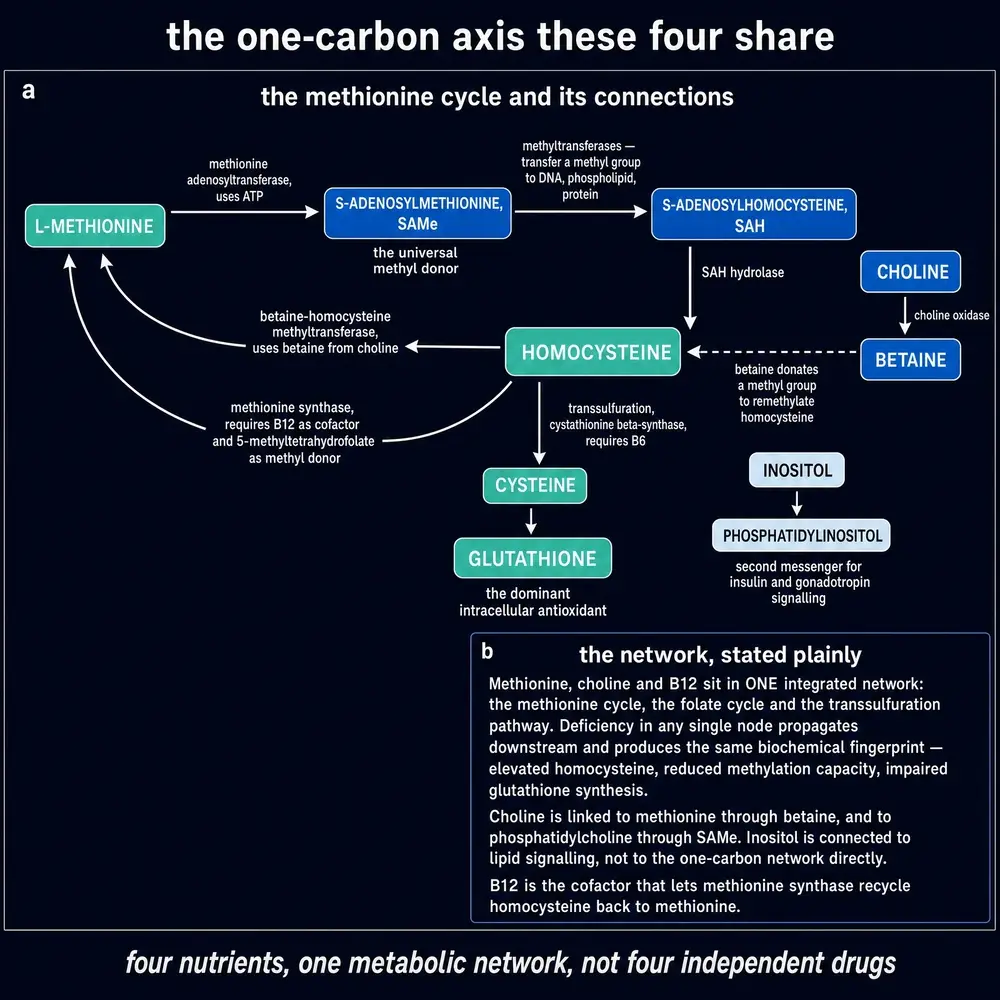
So methionine and choline are not two independent treatments that happen to share an effect. They are two entry points to the same economy. Choline can be built from methionine’s methyl groups; methionine can be regenerated using methyl groups derived from choline. Vitamin B12 sits in the same circuit as the cofactor for one of the two enzymes that do the regenerating. Three of the five substances in the injection meet at this junction, and that is a real biochemical fact rather than a marketing one.
It is worth being precise about what the fact licenses. The cycle in Figure 1 conserves methyl groups and keeps membrane synthesis supplied. It does not dispose of triglyceride, and nothing in it is a route by which adipose tissue is reduced.
03The most decorated molecule in medicine
The B12 in a lipotropic injection has a history out of all proportion to what a milligram of it does in a well-nourished person, and the mismatch is worth sitting with, because it is part of why the product is persuasive.
Pernicious anaemia was fatal. In the 1920s George Whipple in Rochester was bleeding dogs to make them anaemic — not giving them pernicious anaemia, which has no animal model — and found that liver in the diet drove haemoglobin regeneration harder than anything else. George Minot and William Murphy took the idea to patients who were actually dying of the disease, fed forty-five of them large daily quantities of lightly cooked liver, and watched them recover. In 1934 the three shared the Nobel Prize in Physiology or Medicine “for their discoveries concerning liver therapy in cases of anaemia.”
Nobody knew what was in the liver. It took fourteen more years, and it took an assay: Mary Shorb worked out that a strain of Lactobacillus lactis would grow in proportion to the unknown factor, which turned a chemical hunt into a measurable one (Shorb, 1948). In 1948 two groups reported crystals within months of each other — Karl Folkers’ team at Merck in the United States (Rickes et al., 1948) and Ernest Lester Smith at Glaxo in Britain (Smith, 1948). Shorb’s paper is printed immediately after the Merck one, in the same issue of the same journal.
Having the crystals did not mean knowing the molecule. It is large, it contains cobalt, and in 1948 there was no method that could be expected to solve it. Dorothy Hodgkin solved it anyway, by X-ray crystallography, in stages across the mid-1950s and with computing help from Kenneth Trueblood in Los Angeles (Hodgkin et al., 1955; Hodgkin et al., 1956). Her 1964 Nobel citation reads “for her determinations by X-ray techniques of the structures of important biochemical substances” — generic wording that names neither B12 nor penicillin, though both are what it means.
Then chemistry built it. R. B. Woodward at Harvard and Albert Eschenmoser at ETH Zürich ran parallel campaigns that converged on a common intermediate in 1971 and were announced complete in 1972 (Eschenmoser & Wintner, 1977). By Eschenmoser’s own later account it took roughly a hundred chemists about twelve years. There was never a joint Harvard–ETH paper.
Three Nobel Prizes, a fourteen-year hunt, a structure that redefined what crystallography could do, and one of the largest synthetic efforts ever mounted — all of it for a molecule that, in a person who is not deficient in it, has never been shown to do anything for energy, metabolism or body weight. The grandeur belongs to the discovery. It does not transfer to the injection.
04Muscle sugar and flesh acid
The remaining two components were found earlier and celebrated less.
Inositol came out of muscle. In 1850 Johann Joseph Scherer isolated a sweet substance from muscle flesh and called it Inosit, from the Greek for sinew. It was treated for a time as a vitamin — the designation “B8” still circulates — but that was settled in 1942, when D. W. Woolley showed that mice make their own (Woolley, 1942). Humans do too. Inositol is the one substance in this formula that is not, in any normal circumstance, something a person can be short of by not eating it.
There is a sharper detail here, and it belongs to Best. In 1951 Best’s own laboratory ran a statistical evaluation of inositol’s lipotropic action — and the reason a paper needed to be written with “statistical evaluation” in its title is that the effect was not obvious (Best et al., 1951). The group that established the lipotropic concept, and that had good reason to want it to be general, examined the I in MIC and found the case for it weaker than for the other two. That scepticism is seventy-five years old and has never been resolved in inositol’s favour.
Carnitine came out of meat. Vladimir Gulewitsch and Rudolf Krimberg isolated it from muscle extract in 1905 and named it from the Latin carnis, flesh; Friedrich Kutscher isolated the same thing independently the same year and called it novain, with a structure that turned out to be wrong. For a while it was a vitamin too — “vitamin B-T,” named for a mealworm that genuinely cannot live without it, and identified as carnitine in 1952 (Bhattacharyya et al., 1952). Mammals make their own from lysine, using methyl groups donated by methionine, so for people it is conditionally essential rather than a vitamin (Bremer, 1983).
What carnitine does was worked out slowly and is frequently misreported. Irving Fritz’s 1955 paper showed that an unidentified factor in muscle extract stimulated the oxidation of palmitic acid by liver preparations; carnitine is not named in it (Fritz, 1955). The identification came four years later, in two papers (Fritz & McEwen, 1959; Fritz, 1959), and the shuttle was stated as a mechanism in 1965 (Fritz & Marquis, 1965). The regulatory gate on it — malonyl-CoA inhibiting carnitine palmitoyltransferase 1 — was described in 1977 (McGarry et al., 1977). The widely repeated claim that Fritz showed in 1955 that carnitine stimulates fat oxidation compresses four years and one identification out of the story, and it originates in a 2006 review whose own reference list contradicts it.
05Injecting them is not new. Injecting them for weight is.
One more piece of history matters, and it is the piece that is usually asserted without a source.
Lipotropic factors really were given by injection in the mid-twentieth century, and the papers exist. In 1946 Eilert and Dragstedt compared oral and parenteral lipotropic administration against dietary fatty liver in rats (Eilert & Dragstedt, 1946). In 1955 Read and Obetz reported clinical experience with parenteral lipotropic therapy in cardiovascular disease (Read & Obetz, 1955). There are others, through the late 1940s and 1950s, on cirrhosis and hepatitis and atherosclerosis.
None of them is about obesity. A systematic search of the indexed literature from 1940 to 1975 for lipotropic administration by injection returns work on liver disease and vascular disease and nothing on weight reduction. A search of the same literature for lipotropic agents and obesity returns fatty liver, atherosclerosis, carcinogenesis and animal nutrition. The peer-reviewed history of obesity pharmacotherapy — which covers amphetamines, the “rainbow pills,” aminorex and fenfluramine in detail — does not mention lipotropic injections at all.
The claim that lipotropic injections have been used for weight loss for decades is repeated on essentially every page that sells them. No primary source for it could be located: no first use, no originating clinician, no trade name, no regulatory filing that establishes a date. The practice has a market and a price list. It does not have a documented beginning.
06Five substances, no fixed recipe
A compound monograph normally opens its second part with a structure, a molecular formula and a CAS number. This one cannot, because there is no molecule to draw. MIC B12 and Lipo-C are trade descriptions for a mixture, and the mixture is not standardised.
The letters are the three classical lipotropes: M methionine, I inositol, C choline. The B12 is cobalamin, usually as cyanocobalamin but sometimes as methylcobalamin or hydroxocobalamin. Lipo-C normally denotes the same base plus L-carnitine, though not always; one retailer sells a product called Lipo-C whose active ingredient is glutathione and which contains no lipotrope at all. Many preparations add thiamine, riboflavin, pyridoxine or dexpanthenol.
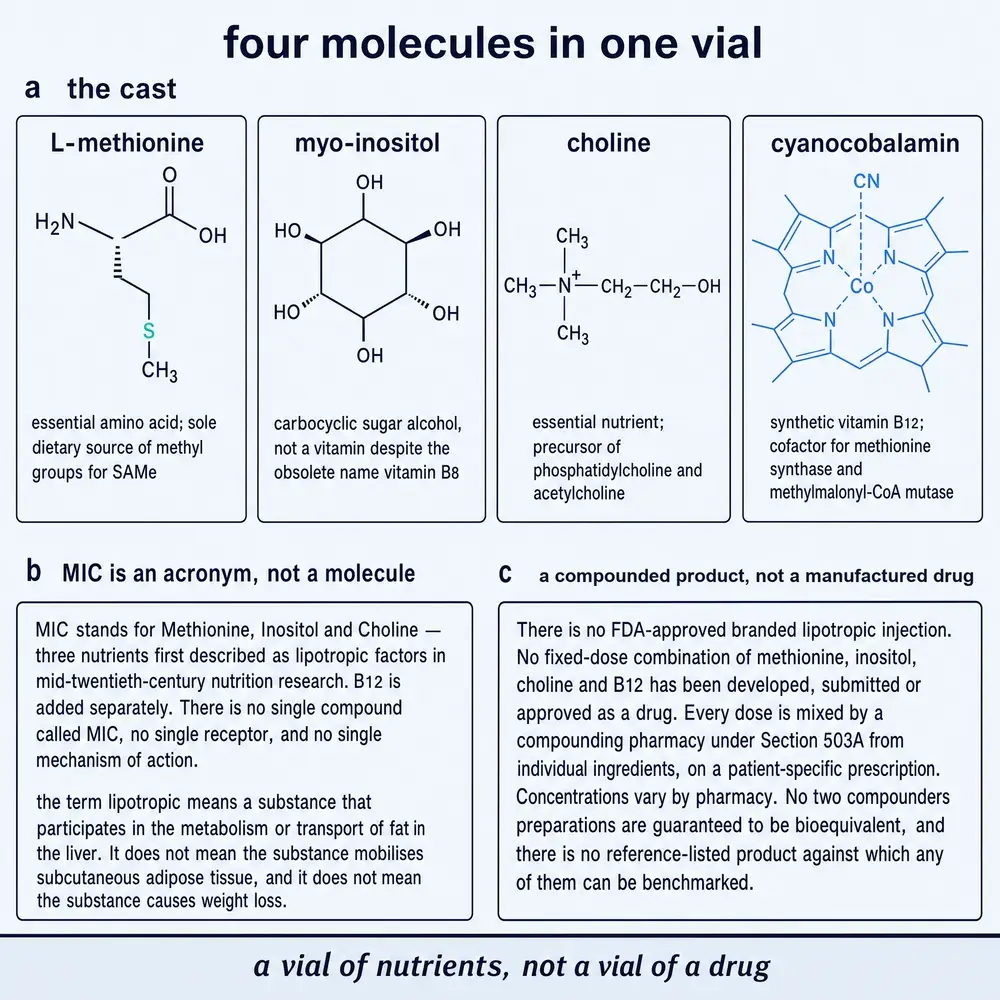
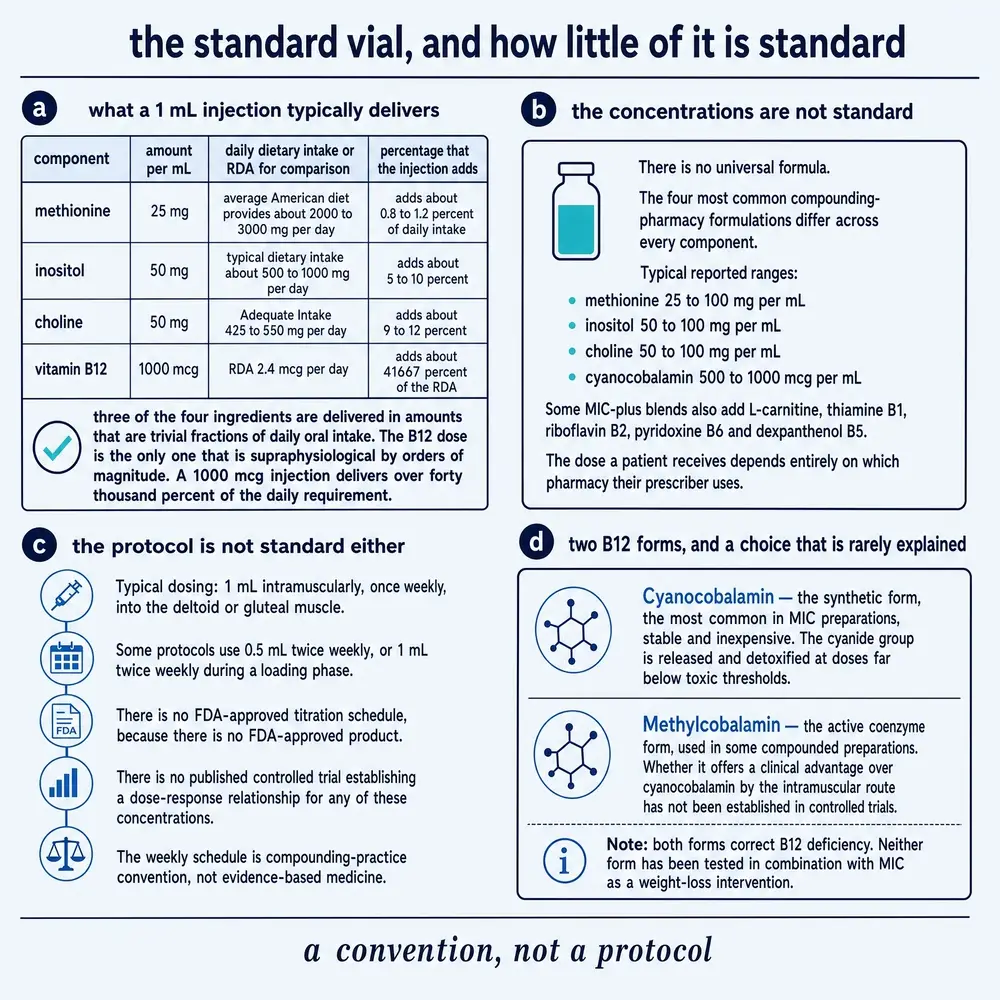
The variability is not a detail. Compounded preparations sold under the same name differ severalfold in every component, and one widely sold formula contains no inositol and no B12 despite being marketed inside the same category. A comparison between two sellers’ products, or between a seller’s product and a published trial, is a comparison between different things wearing one label.
This project’s own reference library carries two curated records for these mixtures: P241, a Lipo-B injection mixture of methionine, inositol, choline and B vitamins, and P242, a Lipo-C injection mixture. Both carry the scope note “formula varies by supplier.” The evidence-coverage record attached to P242 is discussed in section 20; it was compiled independently of this monograph and reaches the same conclusion.
07Compounded, which is not the same as approved
No lipotropic injection is approved by the United States Food and Drug Administration. That sentence is easy to write and easy to under-read, so it is worth establishing precisely how strong the negative is.
Querying the agency’s own approvals database for products containing each constituent as an active ingredient returns approved applications for cyanocobalamin — many of them injectable, for vitamin B12 deficiency — and for levocarnitine, for carnitine deficiency. For methionine, inositol and choline chloride it returns nothing at all. Not no combination product: no product. Those three substances have never been approved as an active ingredient in any drug, by any route, for any indication. There is therefore no reference listed drug for a lipotropic injection, and there could not be one.
What these products are instead is compounded. Two statutory routes exist, and the difference between them is the part that is usually blurred. Section 503A of the Federal Food, Drug, and Cosmetic Act covers a traditional pharmacy compounding for an identified patient against a prescription. Section 503B covers a registered outsourcing facility. Both sections exempt the resulting drug from § 505, which is premarket approval of safety and efficacy, and from § 502(f)(1), which is adequate directions for use. So in neither route has the agency reviewed whether the product works, whether it is safe, or whether its labelling is accurate.
The routes diverge on manufacturing. Section 503B does not exempt § 351(a)(2)(B), so current good manufacturing practice binds an outsourcing facility; section 503A does exempt it, so it does not bind a traditional compounding pharmacy, which is overseen day to day by its state board rather than federally. They diverge again on adverse events, and that divergence matters for section 21: § 503B(b)(5) requires an outsourcing facility to submit adverse event reports, and there is no counterpart obligation under § 503A.
A further point is often stated wrongly, so it is worth stating correctly. The FDA maintains “bulk drug substances” lists and category evaluations, and methionine, inositol and choline chloride appear in category 1 of the 503B evaluation list. Category 1 is an interim enforcement-discretion posture — the agency does not currently intend to act against a compounder using them, pending a listing decision. It is not an approval, not a safety finding, and not an efficacy finding. The codified lists themselves, at 21 CFR § 216.23 and its 503B counterpart, contain eleven substances between them, none of which is a component of a lipotropic injection. That regulation also provides that representing such a compounded drug as FDA-approved misbrands it.
08The dose arithmetic
The most concrete objection to the lipotropic injection is not conceptual. It is quantitative, and it can be settled with arithmetic.
Every component of this mixture has a body of oral human research behind it, and in each case the doses that produced measurable effects are large and were sustained for months. Myo-inositol’s clinical literature in polycystic ovary syndrome converged on two grams twice daily — four grams a day, taken continuously (Facchinetti et al., 2015). The only regimen ever shown to raise human muscle carnitine content used four grams of carnitine a day, with eighty grams of carbohydrate alongside each dose, for twenty-four weeks (Wall et al., 2011). The recent randomised trial of choline in diagnosed fatty liver disease used 2,400 mg a day of oral phosphatidylcholine for twelve weeks (Sedhom et al., 2025).
A typical millilitre delivers 25 mg of methionine, 50 mg of inositol and 50 mg of choline together with 1,000 µg of vitamin B12, once or twice a week, plus about 125 mg of L-carnitine where the “Lipo-C” variant includes it. Those are the quantities printed in Figure 4, and they are the basis for every ratio below. Across compounders the reported ranges are wider — 25 to 100 mg for each of the three lipotropes — and the same figure gives them.
Compared over a single week, the injection supplies about one part in five hundred and sixty of the inositol used in the trials that give inositol its reputation, and about one part in two hundred and twenty of the carnitine intake in the only study that moved muscle carnitine at all. Those two ratios are computed in Figure 5 from the quantities printed beside them, so the arithmetic on the plate and the arithmetic in this sentence cannot drift apart. The comparison in Figure 5 is drawn on a logarithmic scale because on a linear one the injected quantities would not be visible.
Two things make that comparison more generous to the injection than it looks. The oral regimens were continuous and the injection is a weekly bolus, so the time-averaged difference is larger than the per-week difference. And the carnitine regimen achieved its effect only in combination with a very large daily carbohydrate load, for reasons section 17 explains.
Vitamin B12 is the exception, and it should be granted plainly: a 1,000 µg weekly injection is a dose comparable to the doses used in the trials that establish what B12 does. Those trials enrolled patients who were deficient in it.
Dietary reference intakes — the adequate intake for choline, its tolerable upper intake level of 3,500 mg a day for adults — are derived for the oral route. They are built on assumptions about intestinal absorption, first-pass hepatic handling and the fraction of a dose that ever reaches the circulation. An injection is designed to bypass exactly those assumptions. No adequate intake, upper limit or estimated requirement has been established for any of these substances by the parenteral route, and the oral figures cannot be read across in either direction — neither to reassure nor to alarm.
09How to give an animal a fatty liver
If you want a mouse with steatohepatitis — fat in the liver, plus inflammation, plus the beginnings of fibrosis — there is a standard way to produce one. You feed it a diet deficient in methionine and choline. It works in weeks, it works reliably, and it has been the field’s workhorse model for decades. Nearly two thousand documents in this monograph’s reading corpus use it.
The mechanism is understood in detail, and it is an export failure rather than a production excess. Triglyceride leaves the liver packaged inside very-low-density lipoprotein particles, and assembling those particles requires phosphatidylcholine — the only phospholipid currently known to be required for lipoprotein assembly and secretion (Cole et al., 2012). A liver short of choline cannot make enough of it. The nascent particles are built defective, recognised as defective, and degraded inside the secretory pathway before they ever leave. The fat they would have carried stays behind.
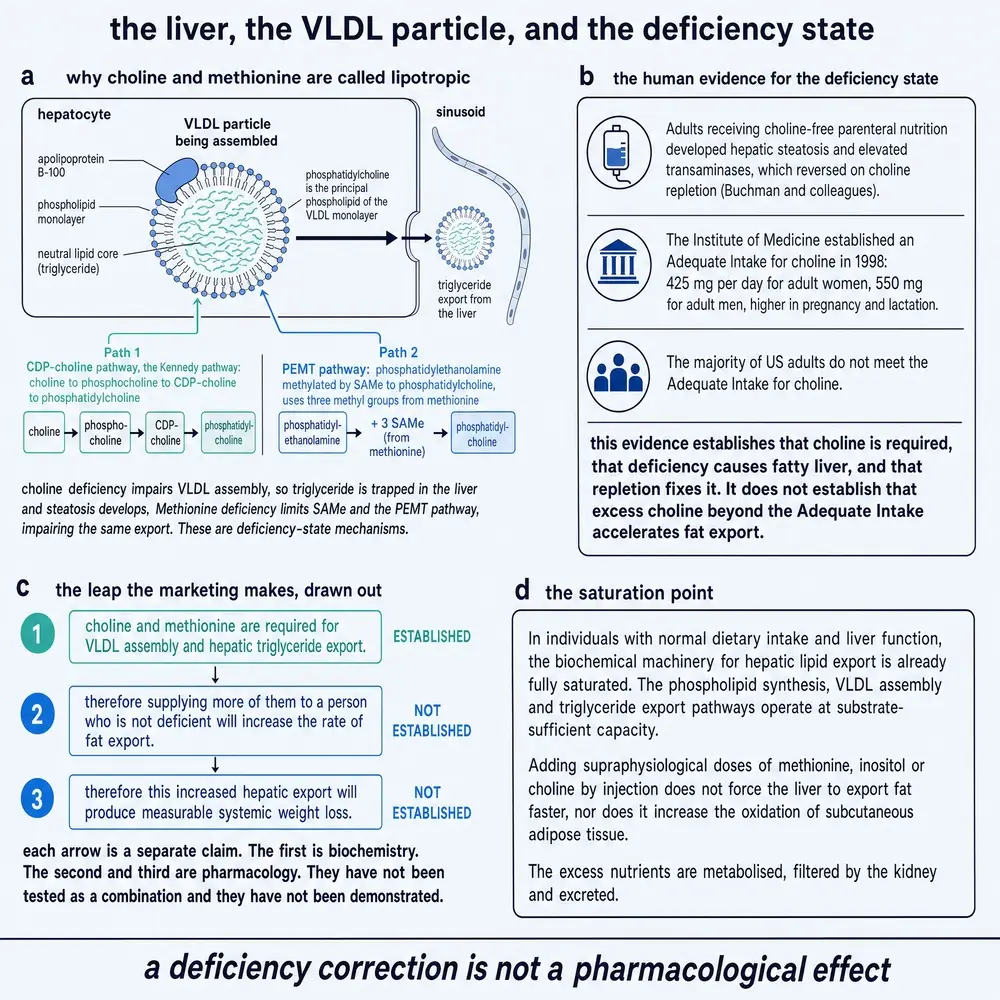
Methionine enters at the same point by a second route. There are two ways to make phosphatidylcholine: directly from choline, or by methylating phosphatidylethanolamine using the enzyme PEMT, which spends three molecules of S-adenosylmethionine for every molecule of phosphatidylcholine it produces. That is why removing methionine deepens what removing choline starts.
The genetics confirm it. Mice engineered to lack PEMT develop severe fatty liver disease on a high-fat diet, and both groups that have characterised them attribute it to inadequate secretion of VLDL particles rather than to overproduction of fat (van der Veen et al., 2017; Presa et al., 2019). Giving those mice a drug that increases fatty-acid oxidation prevents the disease entirely — a defect of disposal can be compensated by a route of disposal.
All of this is real, and none of it is in dispute. Best was right in 1932, he was right for the reason he thought, and ninety-four years of mechanistic work have filled in the detail without overturning the claim.
10The weight paradox
Here is the difficulty, and it is the centre of this document.
Animals on the methionine- and choline-deficient diet lose weight. Not slightly. In a 2008 study that characterised the mechanism directly, insulin-sensitive mice fed the diet for four weeks lost 35 per cent of body weight and 90 per cent of gonadal fat; insulin-resistant mice on the same diet lost 13 per cent and 23 per cent respectively (Rinella et al., 2008). A separate group, developing an improved model precisely because of this problem, records that the diet “can cause severe weight loss and liver atrophy, which are not characteristics of NASH seen in human patients,” with declines of up to 20 per cent of initial weight (Matsumoto et al., 2013).
Nor are the animals metabolically ill in the way people with fatty liver disease are. Mice on the diet are not insulin resistant. Their fasting glucose runs at about 81 mg/dL against roughly 199 in chow-fed controls, and glucose tolerance testing, insulin tolerance testing and QUICKI all confirm the absence of insulin resistance — QUICKI is in fact significantly higher than in chow-fed animals (Rinella & Green, 2004).
The weight loss is so consistent that it functions as an instrument. One group used the diet specifically because a GLP-1 agonist “did not impact body weight, fat accretion or glycemic control” in animals fed it, which they noted confirmed the model’s suitability for avoiding confounding (Somm et al., 2021). Another used weight loss as one of four phenotypic markers of the disease (Rangnekar et al., 2006). Papers testing candidate treatments report, as a favourable outcome, that their compound “inhibited body weight loss induced by MCD diet” (Duan et al., 2017; Nie et al., 2024).
Set the two columns side by side. Human fatty liver disease is a disease of surplus: the patient is overweight, insulin resistant, and hyperglycaemic. The animal in the model is lean, insulin sensitive and hypoglycaemic, with its fat depots collapsed. The liver matches. The organism is inverted.
The MCD model is the strongest experimental evidence that methionine and choline govern liver fat. It is also, read honestly, evidence that withholding these nutrients is associated with becoming leaner, not fatter. Whatever the case for a lipotropic injection is, it cannot be built on this model, because the model runs the wrong way for it.
11Human choline deficiency is real, and it is severe
None of the above means choline does not matter to people. It matters, and the evidence that it does is unusually good, because it comes from controlled feeding experiments rather than from epidemiology.
Fifty-seven adults were fed a diet supplying less than 50 mg of choline per 70 kg per day for up to forty-two days. Seventy-seven per cent of the men and 80 per cent of the postmenopausal women developed fatty liver or muscle damage; among premenopausal women, 44 per cent did (Fischer et al., 2007). Organ dysfunction was defined in advance — a more than fivefold rise in serum creatine kinase, or a more than 28 per cent rise in liver fat — and it resolved when choline was put back (Kohlmeier et al., 2005). In some men creatine kinase rose as much as sixty-six-fold (da Costa et al., 2004). Every subject on the deficient diet showed roughly twice the lymphocyte DNA damage seen on the control diet (da Costa et al., 2006).
An independent placebo-controlled trial in long-term parenteral-nutrition patients — a population that really is choline deficient — found that adding choline improved hepatic imaging and lowered ALT, and that the steatosis returned ten weeks after choline was withdrawn (Buchman et al., 2001).
The most interesting result in this literature is how variable the requirement is. Susceptibility tracks sex, menopausal status and genotype: carriers of one promoter variant in PEMT had roughly twenty-five-fold odds of developing organ dysfunction on the deficient diet (da Costa et al., 2006), and a variant in MTHFD1 carried a sevenfold odds ratio, rising to fifteen-fold in premenopausal women (Kohlmeier et al., 2005). Six men in the original study became ill while consuming 550 mg per 70 kg per day, which is the current adequate intake.
12The intake statistic, and what it does not show
A figure appears on nearly every page that sells these injections: only about ten per cent of Americans meet the adequate intake for choline. The figure is real. In a national survey analysis of 16,809 people, 10.8 per cent achieved the adequate intake — 15.6 per cent of males, 6.1 per cent of females, and just 1.8 per cent of adolescents (Wallace & Fulgoni, 2016). Counting multivitamins as well as food moves it only to about 8 per cent of the population exceeding it (Wallace et al., 2014).
What the figure does not show is that ninety per cent of people are choline deficient, and the reason is technical rather than rhetorical. An adequate intake is not an estimated average requirement, and it is a formal property of how adequate intakes are constructed that the proportion of a population below one cannot be used to estimate the prevalence of inadequacy. The authors of that analysis say so themselves, and call for the adequate intake to be replaced with an estimated average requirement and a recommended dietary allowance so that population inadequacy could actually be calculated.
The depletion study points the same way from the other direction. Forty-four per cent of premenopausal women did not develop organ dysfunction on fewer than 50 mg a day for six weeks, while six men did develop it at 550. The distance between those two observations is the width of the individual variation, and it is wide enough that a population percentile cannot tell any particular person anything.
13The step that was never taken
Everything in this part is evidence about deficiency. It is good evidence, it is human evidence in the case of choline, and it establishes a real disease with a real remedy: if a person is depleted of choline, repleting them reverses hepatic and muscular injury.
The product is not sold to people who are depleted of choline. It is sold to people who want to weigh less, and the inference it depends on has three separate joints in it:
- that giving extra of a nutrient to somebody who is not deficient produces the same benefit that repleting a deficient person does;
- that a benefit measured in the liver transfers to fat stored elsewhere in the body;
- that milligram quantities delivered by weekly injection do what gram quantities delivered orally and daily for months do.
None of the three is supported. The first is the one that matters most, and it is the one that the entire deficiency literature is silent on by construction — a depletion–repletion experiment can only tell you about the range it explored, and it did not explore surplus. Part Four takes each component in turn and asks what is known about giving it to a body that already has enough.
14Choline
There is no randomised controlled trial of choline supplementation for liver fat or body weight in healthy, choline-replete adults. That is the finding for this section, and everything else in it is context around an absence.
What exists nearby: a 2025 randomised study gave 2,400 mg a day of oral phosphatidylcholine for twelve weeks to patients with diagnosed non-alcoholic fatty liver disease, and reported reduced hepatic steatosis on transient elastography, reduced fibrosis measures, lower oxidative-stress markers and lower triglycerides (Sedhom et al., 2025). The trial was single-blinded with an unblinded control arm receiving no placebo, at a single centre, in seventy-nine patients — and it did not report body weight or fat mass as an outcome. It is a liver trial, in a diseased population, using an oral dose roughly thirty times what an injection supplies.
The literature on choline and body weight in humans consists, essentially, of one study: twenty-two female taekwondo and judo athletes given choline tablets for one week before competition, who lost body mass (Elsawy et al., 2014). The setting is combat-sport weight cutting, where losing mass in a week is accomplished principally by dehydration. It was unblinded, uncontrolled and tiny. It cannot support a fat-loss claim.
The one animal study in which supplemental choline reduced body weight is a toxicology study. Rats given ten to fifteen times basal dietary choline for four weeks showed body-weight decreases of 8.5 to 10.2 per cent, and those decreases were the basis on which the investigators set the maximum tolerated dose (Bagley et al., 2017). Weight loss there is the adverse effect that bounds the dose, not the benefit.
The complication that runs the other way
Choline is metabolised by gut bacteria to trimethylamine, which the liver oxidises to trimethylamine N-oxide. In healthy volunteers — vegans, vegetarians and omnivores alike — oral choline at about 450 mg a day for two months raised plasma TMAO more than tenfold and enhanced platelet responsiveness to submaximal ADP, an effect that low-dose aspirin attenuated but did not abolish (Zhu et al., 2017). That is a human interventional result at a dose close to the adequate intake.
Whether TMAO causes cardiovascular disease is a different question, and the honest answer is that it is contested. The observational association is large and repeatedly replicated — a hazard ratio of 2.54 for major events across 4,007 patients (Tang et al., 2013), a dose-response of about 7.6 per cent additional mortality risk per 10 µmol/L across 26,167 subjects (Schiattarella et al., 2017). But a large prospective cohort found no association once identically adjusted, with TMAO becoming positive only at lower kidney function (Shea et al., 2024); another found urinary TMAO associated with coronary disease while its precursors, choline among them, were not (Yu et al., 2019); and a 2025 umbrella review of twenty-seven syntheses concluded that causal roles are controversial, that no intervention has lowered TMAO and measured outcomes, that prospective studies in healthy populations are entirely absent, and that most of the published meta-analyses have flaws serious enough to warrant critically low confidence (Obeid et al., 2025).
And one point cuts in the injection’s favour, which should be said plainly: the pathway requires the intestinal lumen. An injected dose bypasses it. Whether injected choline generates TMAO at all is untested, in either direction.
15Methionine, and the direction of its literature
Methionine is the component whose research runs opposite to the product’s premise, and it does so consistently enough that it is worth stating flatly: the metabolic literature on methionine is a literature about restricting it.
Rats fed 0.17 per cent methionine instead of 0.86 per cent lived about 30 per cent longer, with pair-fed controls establishing that this was not simply eating less (Orentreich et al., 1993). The finding replicated in mice, alongside lower insulin, glucose, IGF-1 and thyroid hormone (Miller et al., 2005). Restricted rats carried significantly less visceral fat than both control-fed and pair-fed animals, with higher adiponectin and — against intuition — higher daily energy expenditure than either comparison group (Malloy et al., 2006). The reduction of adipose mass is described in the field’s own reviews as a salient feature of the restriction phenotype (Perrone et al., 2013; Ables & Johnson, 2017).
The one human trial is careful and its result is mixed. Twenty-six obese adults with metabolic syndrome ate a diet restricted to 2 mg methionine per kilogram per day for sixteen weeks, randomised double-blind to capsules supplying either placebo or 33 mg/kg/day of methionine back. Fat oxidation rose 12.1 per cent in the restricted group and fell 8.1 per cent in the controls, and intrahepatic lipid improved more in the restricted group. But energy expenditure was unaffected by either diet, insulin sensitivity and metabolic-syndrome markers improved comparably in both, and weight and adiposity fell comparably in both — the fuel-partitioning shift was explicitly independent of the weight loss, which happened in both arms because both arms were on a restrictive diet (Plaisance et al., 2011).
No trial of methionine supplementation for weight or fat loss in humans could be located. Searched directly, the query returns nothing relevant. And the one experiment that manipulated methionine in the supplementing direction and measured body weight found that in mice on a ketogenic diet, choline was more effective at reducing steatosis while methionine was more effective at restoring weight gain — the authors concluding that methionine and choline restriction, rather than carbohydrate restriction, underlies much of the ketogenic diet’s metabolic effect in that species (Pissios et al., 2013).
Homocysteine, correctly weighted
A methionine load raises plasma homocysteine acutely, and intakes above about five times normal raise it chronically; a tenfold error in a loading dose has proved fatal (Garlick, 2006). In healthy subjects a standard load raises homocysteine by roughly 15 µmol/L (Suliman et al., 2001). There is a genuinely elegant interaction here: choline-deficient mice show twice the post-load homocysteine of choline-fed mice, and choline-depleted men about 35 per cent more than the same men when replete (da Costa et al., 2005). Adequate choline buffers a methionine load. That is the most defensible mechanistic argument available for combining these two substances — and note what it is an argument for: mitigating a hazard the mixture itself introduces.
How much the homocysteine should worry anyone is a separate matter, and the trial evidence is deflationary. A Cochrane review of fifteen randomised trials in 71,422 participants found homocysteine-lowering interventions produced no difference in myocardial infarction, death from any cause, or serious adverse events, with a small reduction in stroke — all on high-quality evidence (Martí-Carvajal et al., 2017). Homocysteine is a well-established marker whose lowering has repeatedly failed to deliver the outcomes the association predicted, and it should not be presented as a causal chain in either direction.
16Inositol
Inositol is the component with the weakest claim to being in the syringe at all. Humans synthesise it from glucose-6-phosphate; it has no recommended dietary allowance because it is not classified as an essential nutrient; and ordinary diets supply it in the hundreds of milligrams to about a gram and a half a day (Clements & Darnell, 1980; Holub, 1986). Best’s own group found its lipotropic action equivocal in 1951 (Best et al., 1951).
Its modern reputation comes from polycystic ovary syndrome, and that reputation is partly earned. A 2026 umbrella review of thirteen meta-analyses reports reductions in luteinising hormone, free testosterone and HOMA-IR, increases in sex hormone-binding globulin, and roughly a 2.75-fold relative rate of ovulation against placebo (Duan et al., 2026). It also reports that across eighty-five graded evidence items, not one reached high quality, and that against metformin most differences were not significant.
On weight specifically — the endpoint that matters here — the signal is the weakest in the whole dossier. A meta-analysis of twenty-six randomised trials found a BMI difference against placebo of −0.45 kg/m², with a confidence interval whose upper bound is −0.02, drawn from eight trials; against metformin the difference was null (Greff et al., 2023). In network meta-analyses that rank supplements against each other in this condition, it is carnitine, not inositol, that comes out first on anthropometric outcomes (Hu et al., 2023; Zhao et al., 2025).
Outside polycystic ovary syndrome the best-designed test is explicitly null where it counts. Eighty postmenopausal women with metabolic syndrome took four grams of myo-inositol a day for twelve months. Glucose, insulin, HOMA-IR, triglycerides, cholesterol and blood pressure all improved significantly against placebo — and BMI and waist circumference did not (Santamaria et al., 2012). The six-month predecessor found the same pattern (Giordano et al., 2011).
The trial dose throughout is four grams a day, orally, sustained for months (Facchinetti et al., 2015). A weekly injection of 25 mg is a different intervention by three orders of magnitude.
17L-carnitine, and whether the shuttle is limited
The carnitine claim is the most mechanistically specific one the product makes, which makes it the most testable. Carnitine carries long-chain fatty acids into mitochondria through carnitine palmitoyltransferase 1, and that step is genuinely rate-limiting for fat oxidation (Fritz & Marquis, 1965; McGarry et al., 1977). More carnitine, more fat burned — the inference feels almost forced.
It requires a further premise, and that premise is false in the form the product needs. The question is not whether the step is rate-limiting; it is whether carnitine availability limits it in a healthy person, and whether administering carnitine raises the availability.
The decisive experiment infused L-carnitine intravenously into healthy men for five hours, raising plasma concentration to about 500 µmol/L. At fasting insulin concentrations, muscle total carnitine did not change at all. It rose only when insulin was clamped at about 150 mIU/L, roughly twenty times fasting, at which point uptake proceeded with a corresponding rise in the transporter’s messenger RNA (Stephens et al., 2006). Muscle carnitine uptake is sodium-dependent and insulin-gated. The paper’s own opening premise is that studies to that date had failed to raise muscle carnitine in healthy humans by dietary or intravenous administration.
What it took to succeed is instructive. Fourteen healthy men ingested two grams of L-carnitine with eighty grams of carbohydrate, twice daily, for twenty-four weeks. Muscle total carnitine rose 21 per cent, glycogen use during moderate exercise fell by 55 per cent, and work output rose 11 per cent — and every significant effect appeared only at twenty-four weeks (Wall et al., 2011). A replication in men around seventy used 4.5 g a day in an insulinogenic beverage for twenty-five weeks, and raised whole-body fat oxidation during exercise by 20 per cent, with placebo showing no change in either carnitine or oxidation (Chee et al., 2021). The intervention is fragile as well as slow: adding forty grams of whey protein to the carbohydrate abolished forearm carnitine uptake entirely (Shannon et al., 2016). And raising muscle carnitine added nothing to the adaptations produced by twenty-four weeks of interval training (Shannon et al., 2018).
The pharmacokinetics explain why the body is so hard to load. Supplemental L-carnitine is only 14–18 per cent bioavailable, because absorption of a supplement dose is largely passive; renal reabsorption is 90–99 per cent efficient at normal concentrations but saturates, so raising plasma carnitine mostly raises renal clearance (Rebouche, 2004). The system is built to defend a set point.
What the outcome trials show
Against that, oral carnitine does have a small, real effect on body weight. Three independent syntheses agree on its size and on its limits. Thirty-seven randomised trials in 2,292 participants: weight −1.21 kg, BMI −0.24 kg/m², fat mass −2.08 kg — with waist circumference and body-fat percentage both non-significant, and only the body-weight effect surviving restriction to high-quality trials (Talenezhad et al., 2020). Forty-three trials: weight −1.13 kg, fat mass −1.16 kg, body-fat percentage again null, effects confined to overweight and obese subjects who were also making lifestyle changes (Askarpour et al., 2020). An umbrella meta-analysis of eight syntheses in 16,352 participants: weight −1.11 kg — with heterogeneity of about 90 per cent on the headline outcomes, which means the pooled estimate is not describing one underlying effect (Hamedi-Kalajahi et al., 2025).
Every trial in every one of those syntheses used oral dosing at 150–4,000 mg a day for eight to thirty weeks.
Carnitine is also a genuine, lifesaving therapy — for the roughly one person in thirty thousand born with a defect in the OCTN2 transporter, in whom early treatment prevents cardiomyopathy (Lamhonwah et al., 2002; Lin et al., 2020), and for inborn errors causing secondary deficiency. Those are the approved indications. They have almost nothing in common with the cosmetic claim.
Finally, carnitine is the second TMAO precursor in the mixture, and in controlled feeding it is the one that drives the rise: isotope challenge showed chronic red or white meat increased TMAO production from carnitine but not from choline (Wang et al., 2019; Koeth et al., 2013).
One qualification travels with that finding and is routinely dropped when it is cited. In the 2,595 patients undergoing cardiac evaluation, plasma carnitine predicted cardiovascular events only among subjects whose TMAO was concurrently high (Koeth et al., 2013). The molecule on its own was not the risk; the molecule together with a microbiome that converts it was. Reporting the association without the condition overstates it, and this document does not.
18Vitamin B12
B12 is the component where the evidence is clearest, and it is clear in a way that does not help the product.
In deficiency, B12 is transformative, and deficiency is not rare in specific groups: long-term metformin users carry roughly twice the risk, with serum B12 about 64 pmol/L lower and the effect dose- and duration-dependent across thirty-one studies (Yang et al., 2019); unsupplemented vegans and their infants are at substantial risk (Pawlak et al., 2014); and malabsorption from pernicious anaemia, gastric or ileal surgery, or atrophic gastritis is the classical cause (Green et al., 2017). None of these describes a typical weight-loss-clinic patient.
Even in deficiency, the case for the injection specifically is weaker than assumed. A Cochrane review comparing oral with intramuscular B12 found three randomised trials in 153 participants, could not meta-analyse them, and rated the evidence low certainty — but what evidence there is shows oral dosing at 1,000–2,000 µg a day performing comparably, and in one trial better (Wang et al., 2018). No trial in that review reported clinical signs, symptoms or quality of life.
In people who are not deficient, the direct tests are null. Twenty professional singers with mild vocal fatigue — with known or suspected B12 deficiency excluded — received 1,000 µg intramuscular cyanocobalamin or saline in a double-blind placebo-controlled crossover. Both arms failed to reach the minimal clinically important difference, and the 20 per cent of subjects who reached it after B12 were matched by the same proportion after placebo (Shoffel-Havakuk et al., 2021). Ninety-five adults with disabling fatigue and normal B12 took 1,000 µg a day orally for eight weeks against placebo; the primary fatigue endpoint was null (Scholten et al., 2018). A 2026 Cochrane review of sixteen trials in 4,083 children found supplementation reliably reduced biochemical deficiency on high-certainty evidence and made little to no difference to growth, cognition or anaemia (Larvie et al., 2026).
Vitamin B12 supplementation reliably corrects the vitamin B12 number. It does not reliably change the outcomes people want it for. No randomised trial of B12 by any route with body weight or fat mass as a primary endpoint in non-deficient adults could be located.
The safety point that is usually stated backwards
High serum B12 is a strong, replicated marker of undiagnosed cancer. In 333,667 Danish adults it carried a one-year standardised incidence ratio of 6.27 above 800 pmol/L (Arendt et al., 2013); in 757,185 UK primary-care patients, an incidence rate ratio of 4.72 above 1,000 pmol/L (Arendt et al., 2019). Both cohorts excluded people receiving B12 treatment, and the mechanism appears to be tumour-driven elevation of the binding proteins haptocorrin and transcobalamin (Arendt & Nexo, 2013). A cohort that explicitly corrected for reverse causation found the B12–mortality link did not survive it (Chen et al., 2021).
So this is not evidence that supplemental B12 causes cancer, and it should not be presented as such. The defensible concern is different and narrower: routine supraphysiological dosing removes the diagnostic value of a measurement that would otherwise flag occult disease.
19What the combination does
Nothing is known.
There is no interaction study, no factorial design, no combination pharmacokinetics, and no trial of the mixture as administered. The components have five separate literatures and the mixture has none. The matrix in Figure 12 resolves the evidence to the component that actually carries it, and its bottom row — the product itself — is empty across its full width.
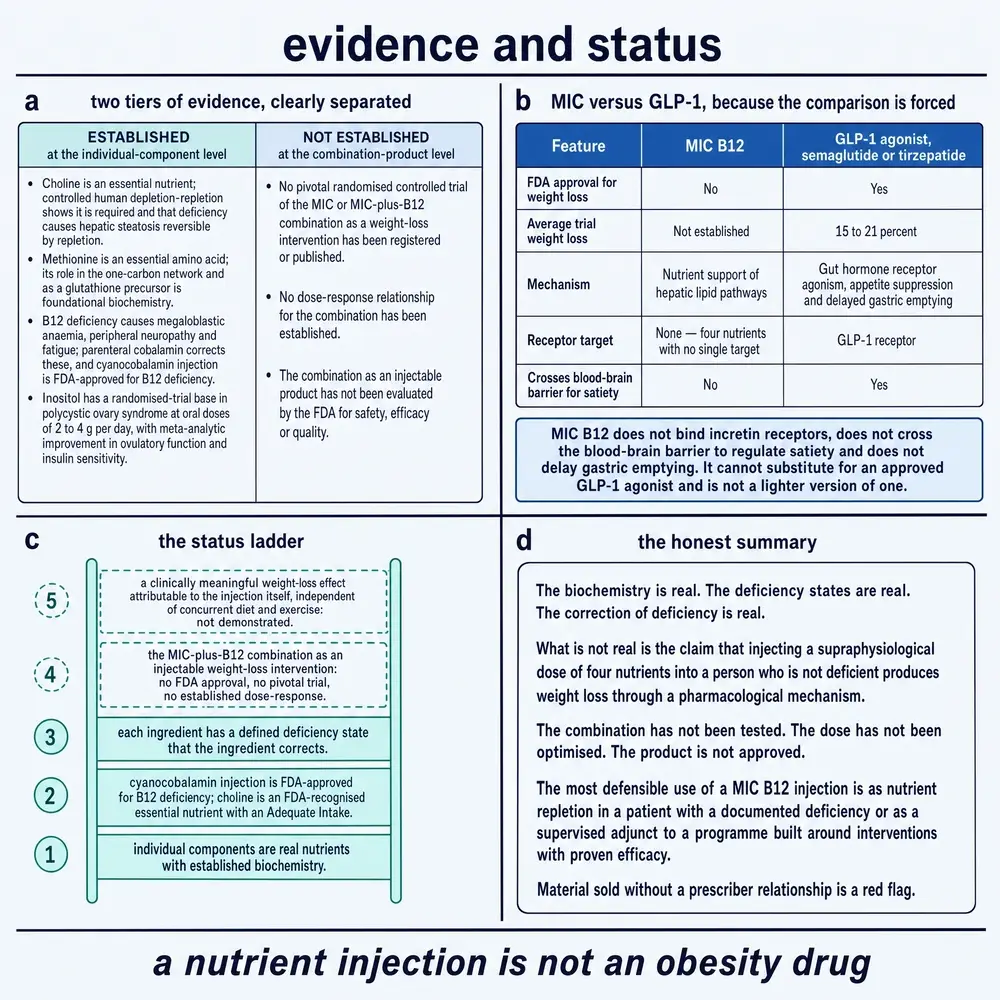
It is worth noticing which way the two known interactions point. Choline buffers the homocysteine rise that methionine causes, which is a reason to give them together if you are giving methionine. Choline and carnitine are both TMAO precursors, which is a reason for caution about giving them together orally, and an open question by injection. Neither is a mechanism by which the combination removes fat.
20The empty registry
A monograph normally reports what the trials found. This section reports that there are none, because on this subject the search result is the finding.
Searched on 3 August 2026: the phrase "lipotropic injection" returns zero records in PubMed. So does "MIC injection". A search of the entire lipotropic intervention space on ClinicalTrials.gov returns one record — a phase 2 placebo-controlled trial of choline chloride for parenteral-nutrition-associated hepatic steatosis, begun in September 2001, which was terminated. Not one registered study of a lipotropic injection for weight loss exists.
The local evidence base tells the same story from a different angle. The source library for this monograph holds 10,198 biomedical full texts. The word “lipotropic” occurs in exactly one of them, and section 21 describes what that document is.
There is one more piece of internal corroboration worth reporting, because it was arrived at independently and before this monograph was written. The project’s curated compound catalogue holds a record for P242, Lipo-C injection mixture. Its coverage assessment records zero tier-A, tier-B and tier-C studies, zero retained full texts, zero verified chemical identifiers and zero clinical-trial registry records, against seven loosely linked studies of the lowest and unclassified tiers. The catalogue’s automated diagnosis of the primary gap reads no-directness-signal. A generated draft dossier for the same compound reports seventeen claims, of which seventeen are uncited.
Assembling a reading corpus for a subject like this is itself an exercise in subtraction, and the shape of what had to be removed is informative. Every one of the five component names occurs inside a longer word that means something else — choline inside acetylcholine, inositol inside phosphatidylinositol, methionine as a protein residue — and the mixture’s own abbreviation is one of the most overloaded strings in biomedicine. Figure 15 shows how much of the apparent surface was collision rather than subject.
None of this shows that a lipotropic injection is ineffective. It shows that the question has not been asked in any form that could produce an answer. A product sold for decades, across five distinct commercial channels, has generated no retrievable clinical literature under its own name — not a randomised trial, not a cohort, not a case series, not a registered protocol. The claim and the evidence have simply never been in contact.
21Where the word still lives
“Lipotropic” has not vanished from science. It has migrated, and where it went is the most honest available explanation of why the idea did not simply die.
The single document in this project’s 10,198-text library that uses the word is a 2026 poultry-nutrition study of 576 laying hens, testing whether a novel organic choline source improves egg production and egg quality against conventional choline chloride (Lim et al., 2026). It describes choline as “a recognized lipotropic agent that facilitates the movement of fat stored in the liver… to tissues outside the liver.” Its own reference list is drawn from broiler chickens, baby pigs and heat-stressed poultry.
This is not a curiosity. In production animals the 1930s conditions are reproduced deliberately: the birds eat a formulated diet held near the margin of choline sufficiency, because choline costs money and the margin is where the economics sit; the animals are genetically selected for production rates that stress hepatic lipid export; and the endpoint of interest really is fat in the liver. Under those conditions Best’s finding applies directly, because those are Best’s conditions.
A person walking into a clinic is not in those conditions. They are not on a formulated diet held at the margin, their endpoint is not hepatic lipid export, and the fat they want removed is not in their liver. The word survived by staying where it was true.
22The clinic is part of the intervention
Lipotropic injections are sold through at least five channels — medical spas, physician weight-loss clinics, intravenous-hydration bars, telehealth mail-order, and wellness memberships — at roughly $39–125 per in-clinic injection or $73–199 a month by subscription, the lower figures usually gated behind a membership that raises the true cost.
Two features of that setting are worth naming, not as mechanism but as confounding, because they bear directly on why a product with no trial evidence produces satisfied customers.
The first is that the injection is generally not the only thing happening. Every telehealth seller identified also sells compounded semaglutide or tirzepatide, and the cross-selling is explicit: clinics publish protocols positioning the lipotropic shot as an adjunct to GLP-1 therapy, as a remedy for GLP-1 side effects, as a taper product when GLP-1 treatment stops, and as a free inducement for enrolling in a weight-loss programme. A weekly injection given alongside a drug that produces substantial weight loss will be present for the weight loss.
The second is that the delivery format is itself an intervention. A weekly appointment, a scale, a practitioner who asks how the week went, and a financial commitment are the components of most successful behavioural weight programmes. They would be expected to produce results whatever was in the syringe, and no study of this product has ever separated them from it, because no study of this product exists.
23Safety: what is known, and what is merely unreported
Searched directly, the pharmacovigilance record is nearly empty. The FDA adverse event system returns eighteen reports naming a “lipotropic” product and two naming Lipo-C. In nineteen of the twenty the product is coded as concomitant rather than suspect, most reporters are consumers, and the reactions that recur are hypersensitivity-type — swollen tongue, urticaria, pruritus — and injection-site pain and bruising. Two reports involve serious infection, one of them a pharmacist-filed report of septic shock and multiple organ dysfunction.
It would be a serious error to read that as reassurance, for four reasons that compound.
There is no denominator: the reporting system has no exposure base, so twenty reports against an unknown number of injections is uninterpretable. Reporting is voluntary and unverified, and product names are free text. The literature offers no independent channel — no trial safety database, no registry, no case series — that could corroborate or refute a signal. And most decisively, the reporting duty structurally does not reach much of this supply chain: as section 7 established, § 503B(b)(5) obliges an outsourcing facility to report adverse events, and there is no counterpart obligation on a § 503A pharmacy, a medical spa or a telehealth intermediary. At least one major seller describes its lipotropic product as a 503A preparation.
An unstudied product distributed through a channel with no mandatory reporting duty would produce exactly this data pattern whether it were harmless or harmful. The correct statement is that the safety of this mixture has not been characterised — not that it is safe.
One documented harm belongs in this section with its scope stated precisely. The best-characterised injection-site injuries in this commercial space concern a different drug: phosphatidylcholine-deoxycholate “lipodissolve” preparations, where atypical mycobacterial infections have been traced to a single physician’s office. That is not a lipotropic adverse event and must not be reported as one. Its relevance is narrower and real: non-sterile technique in the medical-spa channel has produced documented outbreaks, and that channel risk attaches to any injectable given in that setting, independent of what is in it.
24Where the evidence stops
The chain of reasoning this product rests on has six links, and it is possible to say exactly which one fails.
Withholding methionine and choline gives an animal a fatty liver: established since the 1930s, mechanistically explained, not in dispute. Withholding choline from a person raises liver fat and damages muscle: established in controlled human feeding studies. Restoring choline to a depleted person reverses it: established in the same experiments and independently in parenteral-nutrition patients.
Then the chain breaks. That giving extra to a person who is not depleted removes liver fat has not been demonstrated. That it removes body fat is a different claim about a different tissue, and has not been demonstrated either. And that a milligram-scale mixture injected weekly does what gram-scale oral regimens do over months has never been examined in any study design at all.
The first three links are real science, and two of them are good enough to have changed medicine. The last three are the product.
This document describes published research. It does not recommend human use of any substance discussed in it, and it specifies no dose, route or schedule for any person. Quantities appear only as reported experimental parameters, with the species, route and duration attached. Where a compounded preparation’s composition is described, it is described from commercial product listings, which are neither regulatory filings nor peer-reviewed sources; no composition stated here should be taken as a specification of what any particular product contains.
25References
Generated from verified NCBI records rather than from recall. Author lists, journal names, volumes, pages and identifiers are taken from the PubMed record for each citation, and the build refuses to run if any identifier fails to resolve. This series has now had recalled author attributions turn out wrong in seven consecutive monographs; on this one the check caught a poultry-nutrition paper attributed to the wrong first author.
- Ables GP, Johnson JE. Pleiotropic responses to methionine restriction. Exp Gerontol. 2017;94:83-88.
PMID 28108330 · doi:10.1016/j.exger.2017.01.012 - Alshaikh B, Schall JI, Maqbool A, Mascarenhas M, Bennett MJ, Stallings VA. Choline supplementation alters some amino acid concentrations with no change in homocysteine in children with cystic fibrosis and pancreatic insufficiency. Nutr Res. 2016;36(5):418-29.
PMID 27101760 · doi:10.1016/j.nutres.2015.12.014 · PMC4841899 - Arendt JF, Pedersen L, Nexo E, Sørensen HT. Elevated plasma vitamin B12 levels as a marker for cancer: a population-based cohort study. J Natl Cancer Inst. 2013;105(23):1799-805.
PMID 24249744 · doi:10.1093/jnci/djt315 · PMC3848986 - Arendt JF, Nexo E. Unexpected high plasma cobalamin : proposal for a diagnostic strategy. Clin Chem Lab Med. 2013;51(3):489-96.
PMID 23241600 · doi:10.1515/cclm-2012-0545 - Arendt JFH, Sørensen HT, Horsfall LJ, Petersen I. Elevated Vitamin B12 Levels and Cancer Risk in UK Primary Care: A THIN Database Cohort Study. Cancer Epidemiol Biomarkers Prev. 2019;28(4):814-821.
PMID 30642843 · doi:10.1158/1055-9965.EPI-17-1136 - Askarpour M, Hadi A, Miraghajani M, Symonds ME, Sheikhi A, Ghaedi E. Beneficial effects of l-carnitine supplementation for weight management in overweight and obese adults: An updated systematic review and dose-response meta-analysis of randomized controlled trials. Pharmacol Res. 2020;151:104554.
PMID 31743774 · doi:10.1016/j.phrs.2019.104554 - Bagley BD, Chang SC, Ehresman DJ, Eveland A, Parker GA, Peters JM, et al.. Four-week dietary supplementation with 10- and/or 15-fold basal choline caused decreased body weight in Sprague Dawley rats. Toxicol Ind Health. 2017;33(10):792-801.
PMID 28901218 · doi:10.1177/0748233717711361 - Barger G, Coyne FP. The amino-acid methionine; constitution and synthesis. Biochem J. 1928;22(6):1417-25.
PMID 16744158 · doi:10.1042/bj0221417 · PMC1252276 - BEST CH, RIDOUT JH, PATTERSON JM, LUCAS CC. A statistical evaluation of the lipotropic action of inositol. Biochem J. 1951;48(4):448-52.
PMID 14838865 · doi:10.1042/bj0480448 · PMC1275349 - Best CH, Hershey JM. Further observations on the effects of some component of crude lecithine on depancreatized animals. J Physiol. 1932;75(1):49-55.
PMID 16994300 · doi:10.1113/jphysiol.1932.sp002874 · PMC1394504 - Best CH, Hershey JM, Huntsman ME. The effect of lecithine on fat deposition in the liver of the normal rat. J Physiol. 1932;75(1):56-66.
PMID 16994301 · doi:10.1113/jphysiol.1932.sp002875 · PMC1394511 - Best CH, Huntsman ME. The effects of the components of lecithine upon deposition of fat in the liver. J Physiol. 1932;75(4):405-12.
PMID 16994325 · doi:10.1113/jphysiol.1932.sp002899 · PMC1394586 - Best CH, Channon HJ. The action of choline and other substances in the prevention and cure of fatty livers. Biochem J. 1935;29(12):2651-8.
PMID 16745949 · doi:10.1042/bj0292651 · PMC1266810 - Best CH, Ridout JH. The lipotropic action of methionine. J Physiol. 1940;97(4):489-94.
PMID 16995179 · doi:10.1113/jphysiol.1940.sp003824 · PMC1393926 - BHATTACHARYYA PK, CARTER HE, FRAENKEL G, WEIDMAN KR. The identity of vitamin BT with carnitine. Arch Biochem Biophys. 1952;35(1):241-2.
PMID 14915559 · doi:10.1016/s0003-9861(52)80069-4 - Bremer J. Carnitine--metabolism and functions. Physiol Rev. 1983;63(4):1420-80.
PMID 6361812 · doi:10.1152/physrev.1983.63.4.1420 - Buchman AL, Ament ME, Sohel M, Dubin M, Jenden DJ, Roch M, et al.. Choline deficiency causes reversible hepatic abnormalities in patients receiving parenteral nutrition: proof of a human choline requirement: a placebo-controlled trial. JPEN J Parenter Enteral Nutr. 2001;25(5):260-8.
PMID 11531217 · doi:10.1177/0148607101025005260 - Chee C, Shannon CE, Burns A, Selby AL, Wilkinson D, Smith K, et al.. Increasing skeletal muscle carnitine content in older individuals increases whole-body fat oxidation during moderate-intensity exercise. Aging Cell. 2021;20(2):e13303.
PMID 33464721 · doi:10.1111/acel.13303 · PMC7884033 - Chen S, Honda T, Hata J, Sakata S, Furuta Y, Yoshida D, et al.. High Serum Folate Concentrations Are Associated with Decreased Risk of Mortality among Japanese Adults. J Nutr. 2021;151(3):657-665.
PMID 33484141 · doi:10.1093/jn/nxaa382 - Clements RS, Darnell B. Myo-inositol content of common foods: development of a high-myo-inositol diet. Am J Clin Nutr. 1980;33(9):1954-67.
PMID 7416064 · doi:10.1093/ajcn/33.9.1954 - Cole LK, Vance JE, Vance DE. Phosphatidylcholine biosynthesis and lipoprotein metabolism. Biochim Biophys Acta. 2012;1821(5):754-61.
PMID 21979151 · doi:10.1016/j.bbalip.2011.09.009 - da Costa KA, Kozyreva OG, Song J, Galanko JA, Fischer LM, Zeisel SH. Common genetic polymorphisms affect the human requirement for the nutrient choline. FASEB J. 2006;20(9):1336-44.
PMID 16816108 · doi:10.1096/fj.06-5734com · PMC1574369 - da Costa KA, Badea M, Fischer LM, Zeisel SH. Elevated serum creatine phosphokinase in choline-deficient humans: mechanistic studies in C2C12 mouse myoblasts. Am J Clin Nutr. 2004;80(1):163-70.
PMID 15213044 · doi:10.1093/ajcn/80.1.163 - da Costa KA, Niculescu MD, Craciunescu CN, Fischer LM, Zeisel SH. Choline deficiency increases lymphocyte apoptosis and DNA damage in humans. Am J Clin Nutr. 2006;84(1):88-94.
PMID 16825685 · doi:10.1093/ajcn/84.1.88 · PMC2430662 - da Costa KA, Gaffney CE, Fischer LM, Zeisel SH. Choline deficiency in mice and humans is associated with increased plasma homocysteine concentration after a methionine load. Am J Clin Nutr. 2005;81(2):440-4.
PMID 15699233 · doi:10.1093/ajcn.81.2.440 · PMC2424020 - Duan M, Yang M, Li C, Wu X, Yin X, Zhu H. Effects of inositol in women with polycystic ovary syndrome: an umbrella review of meta-analyses from randomized controlled trials. Front Endocrinol (Lausanne). 2026;17:1741509.
PMID 41757236 · doi:10.3389/fendo.2026.1741509 · PMC12932251 - Duan X, Meng Q, Wang C, Liu Z, Liu Q, Sun H, et al.. Calycosin attenuates triglyceride accumulation and hepatic fibrosis in murine model of non-alcoholic steatohepatitis via activating farnesoid X receptor. Phytomedicine. 2017;25:83-92.
PMID 28190475 · doi:10.1016/j.phymed.2016.12.006 - EILERT ML, DRAGSTEDT LR. Lipotropic action of lipocaic; a study of the effect of oral and parenteral lipocaic and oral inositol on the dietary fatty liver of the white rat. Am J Physiol. 1946;147:346-51.
PMID 21000758 · doi:10.1152/ajplegacy.1946.147.2.346 - Elsawy G, Abdelrahman O, Hamza A. Effect of choline supplementation on rapid weight loss and biochemical variables among female taekwondo and judo athletes. J Hum Kinet. 2014;40:77-82.
PMID 25031675 · doi:10.2478/hukin-2014-0009 · PMC4096089 - Eschenmoser A, Wintner CE. Natural product synthesis and vitamin B12. Science. 1977;196(4297):1410-20.
PMID 867037 · doi:10.1126/science.867037 - Facchinetti F, Bizzarri M, Benvenga S, D'Anna R, Lanzone A, Soulage C, et al.. Results from the International Consensus Conference on Myo-inositol and d-chiro-inositol in Obstetrics and Gynecology: the link between metabolic syndrome and PCOS. Eur J Obstet Gynecol Reprod Biol. 2015;195:72-76.
PMID 26479434 · doi:10.1016/j.ejogrb.2015.09.024 - Fischer LM, daCosta KA, Kwock L, Stewart PW, Lu TS, Stabler SP, et al.. Sex and menopausal status influence human dietary requirements for the nutrient choline. Am J Clin Nutr. 2007;85(5):1275-85.
PMID 17490963 · doi:10.1093/ajcn/85.5.1275 · PMC2435503 - FRITZ I. The effect of muscle extracts on the oxidation of palmitic acid by liver slices and homogenates. Acta Physiol Scand. 1955;34(4):367-85.
PMID 13282744 · doi:10.1111/j.1748-1716.1955.tb01256.x - FRITZ IB, McEWEN B. Effects of carnitine on fatty-acid oxidation by muscle. Science. 1959;129(3345):334-5.
PMID 13624727 · doi:10.1126/science.129.3345.334 - FRITZ IB. Action of carnitine on long chain fatty acid oxidation by liver. Am J Physiol. 1959;197:297-304.
PMID 13825279 · doi:10.1152/ajplegacy.1959.197.2.297 - Fritz IB, Marquis NR. The role of acylcarnitine esters and carnitine palmityltransferase in the transport of fatty acyl groups across mitochondrial membranes. Proc Natl Acad Sci U S A. 1965;54(4):1226-33.
PMID 5219827 · doi:10.1073/pnas.54.4.1226 · PMC219846 - Garlick PJ. Toxicity of methionine in humans. J Nutr. 2006;136(6 Suppl):1722S-1725S.
PMID 16702346 · doi:10.1093/jn/136.6.1722S - Giordano D, Corrado F, Santamaria A, Quattrone S, Pintaudi B, Di Benedetto A, et al.. Effects of myo-inositol supplementation in postmenopausal women with metabolic syndrome: a perspective, randomized, placebo-controlled study. Menopause. 2011;18(1):102-4.
PMID 20811299 · doi:10.1097/gme.0b013e3181e8e1b1 - Green R, Allen LH, Bjørke-Monsen AL, Brito A, Guéant JL, Miller JW, et al.. Vitamin B12 deficiency. Nat Rev Dis Primers. 2017;3:17040.
PMID 28660890 · doi:10.1038/nrdp.2017.40 - Greff D, Juhász AE, Váncsa S, Váradi A, Sipos Z, Szinte J, et al.. Inositol is an effective and safe treatment in polycystic ovary syndrome: a systematic review and meta-analysis of randomized controlled trials. Reprod Biol Endocrinol. 2023;21(1):10.
PMID 36703143 · doi:10.1186/s12958-023-01055-z · PMC9878965 - Hamedi-Kalajahi F, Zarezadeh M, Malekahmadi M, Jamilian P, Jamilian P, Molani-Gol R, et al.. The Effect of the L-Carnitine Supplementation on Obesity Indices: An Umbrella Meta-Analysis. Int J Vitam Nutr Res. 2025;95(2):40033.
PMID 40298161 · doi:10.31083/IJVNR40033 - Hilberath J, Shunova A, Heister L, Poets CF, Bernhard W. Choline and Choline-Related Metabolites in Pediatric Short Bowel Syndrome. Nutrients. 2026;18(10).
PMID 42197014 · doi:10.3390/nu18101553 · PMC13209643 - HODGKIN DC, KAMPER J, MACKAY M, PICKWORTH J, TRUEBLOOD KN, WHITE JG. Structure of vitamin B12. Nature. 1956;178(4524):64-6.
PMID 13348621 · doi:10.1038/178064a0 - HODGKIN DG, PICKWORTH J, ROBERTSON JH, TRUEBLOOD KN, PROSEN RJ, WHITE JG. The crystal structure of the hexacarboxylic acid derived from B12 and the molecular structure of the vitamin. Nature. 1955;176(4477):325-8.
PMID 13253565 · doi:10.1038/176325a0 - Holub BJ. Metabolism and function of myo-inositol and inositol phospholipids. Annu Rev Nutr. 1986;6:563-97.
PMID 2425833 · doi:10.1146/annurev.nu.06.070186.003023 - Hu X, Wang W, Su X, Peng H, Tan Z, Li Y, et al.. Comparison of nutritional supplements in improving glycolipid metabolism and endocrine function in polycystic ovary syndrome: a systematic review and network meta-analysis. PeerJ. 2023;11:e16410.
PMID 38025704 · doi:10.7717/peerj.16410 · PMC10652859 - KELLER EB, RACHELE JR, DU VIGNEAUD V. A study of transmethylation with methionine containing deuterium and C14 in the methyl group. J Biol Chem. 1949;177(2):733-8.
PMID 18110450 - Koeth RA, Wang Z, Levison BS, Buffa JA, Org E, Sheehy BT, et al.. Intestinal microbiota metabolism of L-carnitine, a nutrient in red meat, promotes atherosclerosis. Nat Med. 2013;19(5):576-85.
PMID 23563705 · doi:10.1038/nm.3145 · PMC3650111 - Kohlmeier M, da Costa KA, Fischer LM, Zeisel SH. Genetic variation of folate-mediated one-carbon transfer pathway predicts susceptibility to choline deficiency in humans. Proc Natl Acad Sci U S A. 2005;102(44):16025-30.
PMID 16236726 · doi:10.1073/pnas.0504285102 · PMC1276051 - Lamhonwah AM, Olpin SE, Pollitt RJ, Vianey-Saban C, Divry P, Guffon N, et al.. Novel OCTN2 mutations: no genotype-phenotype correlations: early carnitine therapy prevents cardiomyopathy. Am J Med Genet. 2002;111(3):271-84.
PMID 12210323 · doi:10.1002/ajmg.10585 - Larvie DY, Güitrón Leal CE, Venkatramanan S, Palma Molina XE, Steel LB, Kuriyan R, et al.. Vitamin B12 supplementation for growth, development, and cognition in children. Cochrane Database Syst Rev. 2026;6(6):CD015264.
PMID 42227307 · doi:10.1002/14651858.CD015264.pub2 · PMC13227581 - Leclercq IA, Farrell GC, Field J, Bell DR, Gonzalez FJ, Robertson GR. CYP2E1 and CYP4A as microsomal catalysts of lipid peroxides in murine nonalcoholic steatohepatitis. J Clin Invest. 2000;105(8):1067-75.
PMID 10772651 · doi:10.1172/JCI8814 · PMC300833 - Lim CJ, Wong JY, Leow WSK, Chompunut L, Wong YT. Dietary supplementation with organic choline improves layer performance, egg production, and egg quality. J Anim Sci. 2026;104.
PMID 41389338 · doi:10.1093/jas/skaf426 · PMC12863947 - Lin Y, Xu H, Zhou D, Hu Z, Zhang C, Hu L, et al.. Screening 3.4 million newborns for primary carnitine deficiency in Zhejiang Province, China. Clin Chim Acta. 2020;507:199-204.
PMID 32371215 · doi:10.1016/j.cca.2020.04.039 - Malloy VL, Krajcik RA, Bailey SJ, Hristopoulos G, Plummer JD, Orentreich N. Methionine restriction decreases visceral fat mass and preserves insulin action in aging male Fischer 344 rats independent of energy restriction. Aging Cell. 2006;5(4):305-14.
PMID 16800846 · doi:10.1111/j.1474-9726.2006.00220.x - Martí-Carvajal AJ, Solà I, Lathyris D, Dayer M. Homocysteine-lowering interventions for preventing cardiovascular events. Cochrane Database Syst Rev. 2017;8(8):CD006612.
PMID 28816346 · doi:10.1002/14651858.CD006612.pub5 · PMC6483699 - Matsumoto M, Hada N, Sakamaki Y, Uno A, Shiga T, Tanaka C, et al.. An improved mouse model that rapidly develops fibrosis in non-alcoholic steatohepatitis. Int J Exp Pathol. 2013;94(2):93-103.
PMID 23305254 · doi:10.1111/iep.12008 · PMC3607137 - McGarry JD, Mannaerts GP, Foster DW. A possible role for malonyl-CoA in the regulation of hepatic fatty acid oxidation and ketogenesis. J Clin Invest. 1977;60(1):265-70.
PMID 874089 · doi:10.1172/JCI108764 · PMC372365 - McGarry JD, Brown NF. The mitochondrial carnitine palmitoyltransferase system. From concept to molecular analysis. Eur J Biochem. 1997;244(1):1-14.
PMID 9063439 · doi:10.1111/j.1432-1033.1997.00001.x - Miller RA, Buehner G, Chang Y, Harper JM, Sigler R, Smith-Wheelock M. Methionine-deficient diet extends mouse lifespan, slows immune and lens aging, alters glucose, T4, IGF-I and insulin levels, and increases hepatocyte MIF levels and stress resistance. Aging Cell. 2005;4(3):119-25.
PMID 15924568 · doi:10.1111/j.1474-9726.2005.00152.x · PMC7159399 - Najt CP, Senthivinayagam S, Aljazi MB, Fader KA, Olenic SD, Brock JR, et al.. Liver-specific loss of Perilipin 2 alleviates diet-induced hepatic steatosis, inflammation, and fibrosis. Am J Physiol Gastrointest Liver Physiol. 2016;310(9):G726-38.
PMID 26968211 · doi:10.1152/ajpgi.00436.2015 · PMC4867327 - Nie YF, Shang JM, Liu DQ, Meng WQ, Ren HP, Li CH, et al.. Apical papilla stem cell-derived exosomes regulate lipid metabolism and alleviate inflammation in the MCD-induced mouse NASH model. Biochem Pharmacol. 2024;222:116073.
PMID 38395263 · doi:10.1016/j.bcp.2024.116073 - Obeid R, Mohr L, White BA, Heine GH, Emrich I, Geisel J, et al.. Circulating trimethylamine N-oxide and cardiovascular, cerebral, and renal diseases including mortality: Umbrella review of published systematic reviews and meta-analyses. Nutr Metab Cardiovasc Dis. 2025;35(8):103908.
PMID 40118729 · doi:10.1016/j.numecd.2025.103908 - Olsen T, Øvrebø B, Haj-Yasein N, Lee S, Svendsen K, Hjorth M, et al.. Effects of dietary methionine and cysteine restriction on plasma biomarkers, serum fibroblast growth factor 21, and adipose tissue gene expression in women with overweight or obesity: a double-blind randomized controlled pilot study. J Transl Med. 2020;18(1):122.
PMID 32160926 · doi:10.1186/s12967-020-02288-x · PMC7065370 - Orentreich N, Matias JR, DeFelice A, Zimmerman JA. Low methionine ingestion by rats extends life span. J Nutr. 1993;123(2):269-74.
PMID 8429371 · doi:10.1093/jn/123.2.269 - Pawlak R, Lester SE, Babatunde T. The prevalence of cobalamin deficiency among vegetarians assessed by serum vitamin B12: a review of literature. Eur J Clin Nutr. 2014;68(5):541-8.
PMID 24667752 · doi:10.1038/ejcn.2014.46 - Perrone CE, Malloy VL, Orentreich DS, Orentreich N. Metabolic adaptations to methionine restriction that benefit health and lifespan in rodents. Exp Gerontol. 2013;48(7):654-60.
PMID 22819757 · doi:10.1016/j.exger.2012.07.005 - Pissios P, Hong S, Kennedy AR, Prasad D, Liu FF, Maratos-Flier E. Methionine and choline regulate the metabolic phenotype of a ketogenic diet. Mol Metab. 2013;2(3):306-13.
PMID 24049742 · doi:10.1016/j.molmet.2013.07.003 · PMC3773836 - Plaisance EP, Greenway FL, Boudreau A, Hill KL, Johnson WD, Krajcik RA, et al.. Dietary methionine restriction increases fat oxidation in obese adults with metabolic syndrome. J Clin Endocrinol Metab. 2011;96(5):E836-40.
PMID 21346062 · doi:10.1210/jc.2010-2493 · PMC3085194 - Presa N, Clugston RD, Lingrell S, Kelly SE, Merrill AH, Jana S, et al.. Vitamin E alleviates non-alcoholic fatty liver disease in phosphatidylethanolamine N-methyltransferase deficient mice. Biochim Biophys Acta Mol Basis Dis. 2019;1865(1):14-25.
PMID 30300671 · doi:10.1016/j.bbadis.2018.10.010 - Rangnekar AS, Lammert F, Igolnikov A, Green RM. Quantitative trait loci analysis of mice administered the methionine-choline deficient dietary model of experimental steatohepatitis. Liver Int. 2006;26(8):1000-5.
PMID 16953841 · doi:10.1111/j.1478-3231.2006.01314.x - READ JT, OBETZ RC. Clinical experience with parenteral heparin-lipotropic therapy in cardiovascular disease; a preliminary report. Ohio State Med J. 1955;51(3):221-5.
PMID 14356684 - Rebouche CJ. Kinetics, pharmacokinetics, and regulation of L-carnitine and acetyl-L-carnitine metabolism. Ann N Y Acad Sci. 2004;1033:30-41.
PMID 15591001 · doi:10.1196/annals.1320.003 - Rickes EL, Brink NG, Koniuszy FR, Wood TR, Folkers K. Crystalline Vitamin B12. Science. 1948;107(2781):396-7.
PMID 17783930 · doi:10.1126/science.107.2781.396 - Rinella ME, Elias MS, Smolak RR, Fu T, Borensztajn J, Green RM. Mechanisms of hepatic steatosis in mice fed a lipogenic methionine choline-deficient diet. J Lipid Res. 2008;49(5):1068-76.
PMID 18227531 · doi:10.1194/jlr.M800042-JLR200 · PMC2311450 - Rinella ME, Green RM. The methionine-choline deficient dietary model of steatohepatitis does not exhibit insulin resistance. J Hepatol. 2004;40(1):47-51.
PMID 14672613 · doi:10.1016/j.jhep.2003.09.020 - Robscheit-Robbins FS, Whipple GH. BLOOD REGENERATION IN SEVERE ANEMIA : XIV. A LIVER FRACTION POTENT IN PERNICIOUS ANEMIA FED ALONE AND COMBINED WITH WHOLE LIVER, LIVER ASH AND FRESH BILE. J Exp Med. 1929;49(2):215-27.
PMID 19869543 · doi:10.1084/jem.49.2.215 · PMC2131523 - Santamaria A, Giordano D, Corrado F, Pintaudi B, Interdonato ML, Vieste GD, et al.. One-year effects of myo-inositol supplementation in postmenopausal women with metabolic syndrome. Climacteric. 2012;15(5):490-5.
PMID 22192068 · doi:10.3109/13697137.2011.631063 - Schiattarella GG, Sannino A, Toscano E, Giugliano G, Gargiulo G, Franzone A, et al.. Gut microbe-generated metabolite trimethylamine-N-oxide as cardiovascular risk biomarker: a systematic review and dose-response meta-analysis. Eur Heart J. 2017;38(39):2948-2956.
PMID 29020409 · doi:10.1093/eurheartj/ehx342 - Scholten AM, Vermeulen E, Dhonukshe-Rutten RAM, Verhagen T, Visscher A, Olivier A, et al.. Surplus vitamin B12 use does not reduce fatigue in patients with Irritable Bowel Syndrome or inflammatory bowel disease: A randomized double-blind placebo-controlled trial. Clin Nutr ESPEN. 2018;23:48-53.
PMID 29460813 · doi:10.1016/j.clnesp.2017.10.004 - Sedhom SS, El Wakeel LM, Barakat EMF, Shousha HI, Shamkh MA, Salama SH, et al.. The impact of choline supplementation on oxidative stress and clinical outcomes among patients with non-alcoholic fatty liver disease: a randomized controlled study. Ther Adv Chronic Dis. 2025;16:20406223251358659.
PMID 40838115 · doi:10.1177/20406223251358659 · PMC12361734 - Sha W, da Costa KA, Fischer LM, Milburn MV, Lawton KA, Berger A, et al.. Metabolomic profiling can predict which humans will develop liver dysfunction when deprived of dietary choline. FASEB J. 2010;24(8):2962-75.
PMID 20371621 · doi:10.1096/fj.09-154054 · PMC2909293 - Shannon CE, Nixon AV, Greenhaff PL, Stephens FB. Protein ingestion acutely inhibits insulin-stimulated muscle carnitine uptake in healthy young men. Am J Clin Nutr. 2016;103(1):276-82.
PMID 26675771 · doi:10.3945/ajcn.115.119826 · PMC4756606 - Shannon CE, Ghasemi R, Greenhaff PL, Stephens FB. Increasing skeletal muscle carnitine availability does not alter the adaptations to high-intensity interval training. Scand J Med Sci Sports. 2018;28(1):107-115.
PMID 28345160 · doi:10.1111/sms.12885 - Shea JW, Jacobs DR, Howard AG, Lulla A, Lloyd-Jones DM, Murthy VL, et al.. Choline metabolites and incident cardiovascular disease in a prospective cohort of adults: Coronary Artery Risk Development in Young Adults (CARDIA) Study. Am J Clin Nutr. 2024;119(1):29-38.
PMID 37865185 · doi:10.1016/j.ajcnut.2023.10.012 · PMC10808833 - Shoffel-Havakuk H, Lava CX, Reuven Y, Moog D, Odell K, Reder LS, et al.. Effect of Vitamin B12 Injection on the Vocal Performance of Professional Singers: A Randomized, Double-blind, Placebo-Controlled, Crossover Trial. JAMA Otolaryngol Head Neck Surg. 2021;147(1):9-15.
PMID 33180098 · doi:10.1001/jamaoto.2020.4026 · PMC7662483 - Shorb MS. Activity of Vitamin B12 for the Growth of Lactobacillus lactis. Science. 1948;107(2781):397-8.
PMID 17783931 · doi:10.1126/science.107.2781.397 - SMITH EL. Purification of anti-pernicious anaemia factors from liver. Nature. 1948;161(4095):638.
PMID 18856623 · doi:10.1038/161638a0 - Somm E, Montandon SA, Loizides-Mangold U, Gaïa N, Lazarevic V, De Vito C, et al.. The GLP-1R agonist liraglutide limits hepatic lipotoxicity and inflammatory response in mice fed a methionine-choline deficient diet. Transl Res. 2021;227:75-88.
PMID 32711187 · doi:10.1016/j.trsl.2020.07.008 - Stephens FB. Does skeletal muscle carnitine availability influence fuel selection during exercise?. Proc Nutr Soc. 2018;77(1):11-19.
PMID 29037265 · doi:10.1017/S0029665117003937 - Stephens FB, Constantin-Teodosiu D, Laithwaite D, Simpson EJ, Greenhaff PL. Insulin stimulates L-carnitine accumulation in human skeletal muscle. FASEB J. 2006;20(2):377-9.
PMID 16368715 · doi:10.1096/fj.05-4985fje - Suliman ME, Filho JC, Bárány P, Anderstam B, Lindholm B, Bergström J. Effects of methionine loading on plasma and erythrocyte sulphur amino acids and sulph-hydryls before and after co-factor supplementation in haemodialysis patients. Nephrol Dial Transplant. 2001;16(1):102-10.
PMID 11209001 · doi:10.1093/ndt/16.1.102 - Talenezhad N, Mohammadi M, Ramezani-Jolfaie N, Mozaffari-Khosravi H, Salehi-Abargouei A. Effects of l-carnitine supplementation on weight loss and body composition: A systematic review and meta-analysis of 37 randomized controlled clinical trials with dose-response analysis. Clin Nutr ESPEN. 2020;37:9-23.
PMID 32359762 · doi:10.1016/j.clnesp.2020.03.008 - Tang WH, Wang Z, Levison BS, Koeth RA, Britt EB, Fu X, et al.. Intestinal microbial metabolism of phosphatidylcholine and cardiovascular risk. N Engl J Med. 2013;368(17):1575-84.
PMID 23614584 · doi:10.1056/NEJMoa1109400 · PMC3701945 - van der Veen JN, Lingrell S, Gao X, Takawale A, Kassiri Z, Vance DE, et al.. Fenofibrate, but not ezetimibe, prevents fatty liver disease in mice lacking phosphatidylethanolamine N-methyltransferase. J Lipid Res. 2017;58(4):656-667.
PMID 28159867 · doi:10.1194/jlr.M070631 · PMC5392742 - Wall BT, Stephens FB, Constantin-Teodosiu D, Marimuthu K, Macdonald IA, Greenhaff PL. Chronic oral ingestion of L-carnitine and carbohydrate increases muscle carnitine content and alters muscle fuel metabolism during exercise in humans. J Physiol. 2011;589(Pt 4):963-73.
PMID 21224234 · doi:10.1113/jphysiol.2010.201343 · PMC3060373 - Wallace TC, Fulgoni VL. Assessment of Total Choline Intakes in the United States. J Am Coll Nutr. 2016;35(2):108-12.
PMID 26886842 · doi:10.1080/07315724.2015.1080127 - Wallace TC, McBurney M, Fulgoni VL. Multivitamin/mineral supplement contribution to micronutrient intakes in the United States, 2007-2010. J Am Coll Nutr. 2014;33(2):94-102.
PMID 24724766 · doi:10.1080/07315724.2013.846806 - Wang H, Li L, Qin LL, Song Y, Vidal-Alaball J, Liu TH. Oral vitamin B12 versus intramuscular vitamin B12 for vitamin B12 deficiency. Cochrane Database Syst Rev. 2018;3(3):CD004655.
PMID 29543316 · doi:10.1002/14651858.CD004655.pub3 · PMC6494183 - Wang Z, Klipfell E, Bennett BJ, Koeth R, Levison BS, Dugar B, et al.. Gut flora metabolism of phosphatidylcholine promotes cardiovascular disease. Nature. 2011;472(7341):57-63.
PMID 21475195 · doi:10.1038/nature09922 · PMC3086762 - Wang Z, Bergeron N, Levison BS, Li XS, Chiu S, Jia X, et al.. Impact of chronic dietary red meat, white meat, or non-meat protein on trimethylamine N-oxide metabolism and renal excretion in healthy men and women. Eur Heart J. 2019;40(7):583-594.
PMID 30535398 · doi:10.1093/eurheartj/ehy799 · PMC6374688 - Woolley DW. SYNTHESIS OF INOSITOL IN MICE. J Exp Med. 1942;75(3):277-84.
PMID 19871182 · doi:10.1084/jem.75.3.277 · PMC2135247 - Yang W, Cai X, Wu H, Ji L. Associations between metformin use and vitamin B12 levels, anemia, and neuropathy in patients with diabetes: a meta-analysis. J Diabetes. 2019;11(9):729-743.
PMID 30615306 · doi:10.1111/1753-0407.12900 - Yu D, Shu XO, Rivera ES, Zhang X, Cai Q, Calcutt MW, et al.. Urinary Levels of Trimethylamine-N-Oxide and Incident Coronary Heart Disease: A Prospective Investigation Among Urban Chinese Adults. J Am Heart Assoc. 2019;8(1):e010606.
PMID 30606084 · doi:10.1161/JAHA.118.010606 · PMC6405718 - Zeisel SH, da Costa KA. Choline: an essential nutrient for public health. Nutr Rev. 2009;67(11):615-23.
PMID 19906248 · doi:10.1111/j.1753-4887.2009.00246.x · PMC2782876 - Zhang C, He J, Huo Y, Liu L, Xie Y, Meng Y, et al.. Gut microbial metabolite trimethylamine N-oxide as a novel predictor for adverse cardiovascular events after PCI: a systematic review and dose-response meta-analysis. Nutr J. 2025;24(1):91.
PMID 40524200 · doi:10.1186/s12937-025-01159-9 · PMC12168366 - Zhao G, Fan Y, Li R, Huang Y, Li W, Zhao Y, et al.. The effectiveness of nutritional supplements in improving polycystic ovary syndrome in women: a systematic review and network meta-analysis. Reprod Biol Endocrinol. 2025;23(1):94.
PMID 40611279 · doi:10.1186/s12958-025-01409-9 · PMC12224500 - Zhu W, Wang Z, Tang WHW, Hazen SL. Gut Microbe-Generated Trimethylamine N-Oxide From Dietary Choline Is Prothrombotic in Subjects. Circulation. 2017;135(17):1671-1673.
PMID 28438808 · doi:10.1161/CIRCULATIONAHA.116.025338 · PMC5460631
Sources without a PubMed record
Statutes, regulations, agency databases and registry searches have no PubMed record and are listed separately, so the generated list above remains wholly machine-verified. Every regulatory claim in this document was checked against the instrument itself rather than against a description of it.
- United States Congress. Federal Food, Drug, and Cosmetic Act § 503A, 21 U.S.C. § 353a — Pharmacy compounding. Read as enacted. Exempts a compounded drug from § 505 (premarket approval of safety and efficacy), § 502(f)(1) (adequate directions for use) and § 351(a)(2)(B) (current good manufacturing practice). The cGMP exemption is the one that does NOT carry over to § 503B.
https://www.law.cornell.edu/uscode/text/21/353a - United States Congress. Federal Food, Drug, and Cosmetic Act § 503B, 21 U.S.C. § 353b — Outsourcing facilities. Read as enacted. Exempts § 505 and § 502(f)(1) but NOT § 351(a)(2)(B), so cGMP binds an outsourcing facility. § 503B(b)(5) imposes an adverse-event reporting duty that has no counterpart under § 503A.
https://www.law.cornell.edu/uscode/text/21/353b - United States Food and Drug Administration. 21 CFR § 216.23 — Bulk drug substances that can be used in compounding under section 503A. Read as codified. The list contains six substances, none of them a component of a lipotropic injection. § 216.23(d) provides that representing such a compounded drug as FDA-approved misbrands it.
https://www.ecfr.gov/current/title-21/chapter-I/subchapter-C/part-216/subpart- - United States Food and Drug Administration. Drugs@FDA, queried through the openFDA application programming interface for approved products containing methionine, inositol, choline chloride, cyanocobalamin and levocarnitine as active ingredients. Queried 3 August 2026. Methionine, inositol and choline chloride return no approved application of any kind. Cyanocobalamin and levocarnitine return approved products, for vitamin B12 deficiency and for carnitine deficiency respectively. This is a stronger negative than an absent combination product: two of the constituents have never been approved as an active ingredient by any route.
https://api.fda.gov/drug/drugsfda.json - United States Food and Drug Administration. FDA warns health care professionals not to use injectable vitamin products distributed by Medical Supply Liquidators LLC. The only FDA action located that names MIC injections directly; the recall list includes “MIC Injection USP” and several B12-with-MIC preparations. The agency states it has not approved the products and cannot be assured of their safety, effectiveness or quality, and that it is not aware of any associated adverse event reports. FDA’s page carries no visible publication date and its metadata is internally inconsistent; contemporaneous republication places the alert at approximately 30 June 2014, and the date is reported here as approximate for that reason.
https://www.fda.gov/drugs/drug-safety-and-availability/fda-warns-health-care-p - United States Food and Drug Administration. Bulk drug substances nominated for use in compounding under sections 503A and 503B of the FD&C Act — category lists. 503A list updated 14 May 2026; 503B list updated 21 March 2025. Methionine, inositol and choline chloride appear in category 1 of the 503B list and are NOT marked as components of an approved drug; cyanocobalamin and levocarnitine are so marked. Category 1 is an interim enforcement-discretion posture, not an approval and not an efficacy finding.
https://www.fda.gov/drugs/human-drug-compounding/bulk-drug-substances-nominate - United States Food and Drug Administration. openFDA adverse event reports, queried for lipotropic and Lipo-C preparations. Queried 3 August 2026. Eighteen reports name a “lipotropic” product and two name Lipo-C. In nineteen of the twenty the product is coded as concomitant rather than suspect, and most reporters are consumers. FAERS has no exposure denominator and a § 503A pharmacy has no federal adverse-event reporting duty, so this near-absence is uninformative in both directions.
https://api.fda.gov/drug/event.json - National Institutes of Health, Office of Dietary Supplements. Choline — Fact Sheet for Health Professionals. Adequate intake 550 mg/day for adult men and 425 mg/day for adult women; tolerable upper intake level 3,500 mg/day for adults, set on hypotension and fishy body odour. Every one of these values is derived for the ORAL route.
https://ods.od.nih.gov/factsheets/Choline-HealthProfessional/ - National Institutes of Health, Office of Dietary Supplements. Vitamin B12 — Fact Sheet for Health Professionals. States that deficiency is typically treated by injection because that route bypasses barriers to absorption, that high oral doses may be equally effective, and that supplementation appears to have no beneficial effect on performance in the absence of a nutritional deficit.
https://ods.od.nih.gov/factsheets/VitaminB12-HealthProfessional/ - United States National Library of Medicine. ClinicalTrials.gov — searched for lipotropic, MIC injection and methionine-inositol-choline as interventions. Searched 3 August 2026. The entire intervention space returns ONE record: a phase 2 placebo-controlled trial of choline chloride for parenteral-nutrition-associated hepatic steatosis, begun in September 2001 and TERMINATED. No trial of a lipotropic injection is registered.
https://clinicaltrials.gov/ - South Beach Longevity Research Library (project 05). Curated compound records P241 Lipo-B injection mixture and P242 Lipo-C injection mixture. The library’s own curated coverage record for P242 reports zero tier-A, tier-B and tier-C studies, zero retained full texts, zero verified identifiers and zero clinical-trial registry records against seven linked studies, with the primary gap recorded as “no-directness-signal.” The catalogue reached this monograph’s conclusion independently and before it.
26How this document was assembled
The corpus was built against project 05, the Therapeutic Peptide Research Library, and on this subject the interesting part of the arithmetic is how much had to be thrown away, and why.
The identity problem is unlike any previous subject in this series. There is no molecule. The subject is a mixture of five substances, so the gate runs on a component axis with five separate matchers and the evidence is never pooled across them. Worse, every one of the five names is a substring of something that means something else: choline inside acetylcholine and cholinesterase; inositol inside phosphatidylinositol and inositol trisphosphate; methionine as a residue in every protein sequence, as selenomethionine, and as methionine sulfoxide; carnitine inside acetyl-L-carnitine and propionyl-L-carnitine, which are different compounds with their own literatures. And the mixture's own abbreviation, MIC, means minimum inhibitory concentration almost everywhere it appears in a biomedical corpus — it also denotes MIC-1, which is GDF-15, a weight-regulating protein, so the collision lands inside this document's own subject matter.
The remedy is order of operations. Collision superstrings are stripped from the text before any matcher runs, because the prefixes vary in length and no lookaround can remove them; the bare string MIC is then handled by an inverted gate that refuses it unless injection or lipotropic vocabulary sits beside it. One superstring was deliberately kept: phosphatidylcholine, because hepatic phosphatidylcholine synthesis is the reason choline is lipotropic at all. Stripping it would have deleted the mechanism.
One trap was found by reading, not by any gate. The word lipotropic matches lipotropin — beta- and gamma-lipotropin, pituitary peptide hormones cleaved from pro-opiomelanocortin, which have nothing to do with lipotropic agents. That would be an ordinary homograph except for one thing: lipotropin is a controlled alias of AOD-9604, which is monograph No. 25 in this series. Before the fix, the gate had admitted AOD-9604 and thymosin working files from this project's own library on the strength of that string alone; eight documents were demoted when it was corrected. A matcher that imports a sibling monograph's subject is a failure this series has amendments about, and here it arrived from inside the library rather than from the literature.
The threshold problem, and why the statistic had to change. An absolute mention count is length-dependent, so it means different things in different documents: five mentions of methionine in a four-page paper is a paper about methionine, and five in a four-hundred-page book is an index entry. Applied to the local sweep it admitted 5,404 documents averaging some twenty thousand words each — a surface, not a corpus. The screen was rebuilt on density, mentions of the dominant component per thousand words, which is length-invariant, and a document must clear both floors. That took the local layer to 1,474 documents.
The external harvest. A six-armed PubMed query returned 7,638 records, of which 6,959 survived a relevance screen — far too many to retrieve, so the substantive-use screen was moved in front of the fetch and 1,731 were selected by route: the blend and the deficiency model first, then trials, then systematic reviews, then component-plus-endpoint titles, then discovery histories. 1,459 records were counted and deliberately not read. A second route searched PubMed Central's full text for the lipotropic and methionine-choline-deficient terms and returned 3,263 matches, of which 2,063 were capped out of the fetch as papers that merely use the deficiency diet as a model for testing some other drug. 2,741 full texts were retrieved and 2,676 passed the far-side screen.
Merging the three layers by PubMed Central identifier and removing the 329 documents present in more than one gives the reading corpus this monograph is written from: 4,140 unique full texts, roughly 71,730 printed-page equivalents. That is the largest corpus assembled for any monograph in this series, and the reason is not that the subject is well studied. It is that five nutrients have five large literatures and the mixture has none.
| Stage | What it does | Result |
|---|---|---|
| 01b | Scan of every document store in the project | 5,404 assets carry a component string |
| 01c | Component-axis gate over the curated library database | 319 of 1,652 documents |
| 01g | Density screen — the length-invariant statistic | 1,474 retained |
| 02 | PubMed E-utilities harvest, six arms, date-partitioned | 7,638 records |
| 02b | PubMed Central body-text search | 3,263 matches |
| 02c | Pre-fetch screen by route | 1,731 selected |
| 03a | Batched open-access retrieval | 2,741 full texts |
| 03c | Far-side substantive-use screen, per component | 2,676 retained |
| 04 | Keyed union across layers, de-duplication | 4,140 unique full texts |
| 05 | Reference list from verified NCBI records | 108 citations |
| 06 | Assembly of this document | 1 deliverable |
The corpus, by the component that carries it
Evidence is never pooled across components in this document, so the corpus is reported the same way. Each document is attributed to the single component it is most substantively about.
| Component | Documents | Page equivalents |
|---|---|---|
| Methionine | 2,431 | 52,277 |
| Choline | 751 | 10,081 |
| Vitamin B12 | 504 | 4,023 |
| L-carnitine | 381 | 4,528 |
| Inositol | 73 | 822 |
| The mixture itself | 0 | 0 |
The last row is the finding. 227 documents in the corpus use the word lipotropic at all, overwhelmingly in animal-nutrition contexts, and 1,990 use the methionine-choline-deficient diet as a laboratory model. Not one is a study of a lipotropic injection administered to a person.
Figures
Seventeen figures. Twelve are authored vector charts, generated from values traceable to the evidence dossier, with every colour resolving through the document's own design tokens so the artwork re-themes with the page. Five are commissioned plates, prepared for this document and admitted after the value-by-value audit described below. No third-party published figure is reproduced anywhere. Where a figure is schematic rather than plotted — the corrin ring, the export pathway, the carnitine shuttle — its caption says so and names what is not being asserted.
The commissioned plates were checked before they were used, and two defects were corrected rather than captioned. The arithmetic on the composition plate was recomputed from the quantities printed beside it and is correct in all four rows; the adequate-intake values, and the 15 to 21 per cent weight-loss range quoted for the GLP-1 comparison, agree with the corpus. Two errors were found on the first plate. Its methionine was drawn with the side chain on a solid wedge, which makes the stereocentre (R) — D-methionine — beneath a label reading L-methionine; the bond was redrawn hashed, which makes it (S), and no atom was moved. A misspelling in one panel heading was repainted. Both are recorded in the plate mapping file and named in that figure's caption, because a corrected plate is still supplied material and a reader is entitled to know what changed. Three further points are captioned rather than corrected, because they are matters of emphasis rather than error: an enzyme named for its plant and bacterial form, a contested meta-analytic result presented as settled, and a blood-brain-barrier row that concerns satiety signalling rather than permeability.
Two figures print numbers that are computed rather than typed. The dose comparison derives each ratio in code from the two quantities drawn beside it, so the arithmetic on the plate cannot disagree with itself; and the corpus figure takes its counts from the same manifest the table above is generated from, so the figure and the Apparatus cannot state different numbers. The composition plate is drawn from commercial compounding-pharmacy listings, which are neither regulatory filings nor peer-reviewed sources; its caption says so, because for this subject no other source of composition exists, and the quantities it prints are the basis used for the dose arithmetic everywhere else in the document.
27Evidence handling
Findings are labelled by the kind of study that produced them, in the sentence that reports them, and for this subject the species is named every time as well. That is not a formality. The lipotropic evidence base is overwhelmingly rodent and, in its living remnant, poultry and swine; the human evidence is a small number of controlled feeding studies about deficiency. A result in a mouse fed a deficient diet is called that, every time.
Five substances, kept apart. Methionine, inositol, choline, vitamin B12 and L-carnitine are studied separately, in different populations, at different doses, for different endpoints. One of them, L-carnitine, is the subject of its own monograph in this series, No. 34, compiled alongside this one; nothing from that document's record is imported here, and this document treats carnitine only as one of five actives in a mixture. Nothing in one component's literature is evidence about another, and nothing in any of them is evidence about the mixture. The consequences of pooling would be material in both directions: the carnitine weight-loss meta-analyses are carnitine's, the polycystic-ovary trials are inositol's, the depletion–repletion studies are choline's, and the transformative deficiency results belong to B12. None of it is the injection's record.
Deficiency is not supplementation. This is the single discipline the whole document turns on. Every strong finding reported here concerns withholding a nutrient and then restoring it. A depletion–repletion experiment can only speak about the range it explored, and none of them explored surplus. Wherever a repletion result appears in these pages, the population it was measured in is named.
Absence is reported as a finding, not apologised for. Where a literature does not exist — no trial of methionine supplementation for fat loss, no randomised trial of choline in the replete, no study of the mixture in any design, no adequate intake for any of these substances by the parenteral route — this document says so and states what was searched. The search results in section 20 are presented as results.
Recency is weighted, but not blindly. A newer finding takes precedence unless a preponderance of evidence contradicts it. Applied here it cuts in both directions: the 2025–2026 syntheses of carnitine and inositol are given precedence over the individual trials beneath them, and they are less favourable than the older primary reports, because heterogeneity and quality restriction shrink the effects. The 1932 lipotropic finding is not superseded, because nothing has contradicted it — it is simply about a different question than the one the product asks.
Conflicts are presented as conflicts. Four are live in this literature and none is resolved here: whether trimethylamine N-oxide is causal or merely a marker, on which the observational literature and the most recent umbrella review disagree sharply; whether inositol improves insulin resistance in polycystic ovary syndrome, on which two overlapping meta-analyses of the same trial pool reach opposite conclusions; whether elevated vitamin B12 carries risk of its own, which this document treats as reverse causation because the cohorts that found it excluded people receiving B12; and when, if ever, lipotropic injections began to be given for weight reduction, for which no primary source could be found at all. Where a widely repeated claim is not supported by the primary record — that Best coined the word “lipotropic,” that Best was a Nobel laureate, that Fritz showed in 1955 that carnitine stimulates fat oxidation, that roughly ninety per cent of the population is choline deficient — it is named as unsupported rather than quietly omitted.
Continue exploring