
Thymalin A calf-thymus polypeptide complex from a Leningrad military academy, three short peptides later read out of it, and four decades of evidence that almost never left one programme
Thymalin is not a sequence. It is a preparation: a low-molecular-weight peptide fraction cut from the thymus of young calves in Leningrad in the mid-1970s, registered in the Soviet Union as an immunocorrector, and still carried under Russian medicinal registration LS-000267. Later work read three short peptides out of that complex—Glu-Trp (EW / Thymogen), Lys-Glu (KE / Vilon), and Glu-Asp-Pro (EDP / Crystagen)—and built a molecular story of T-cell differentiation, cytokine tone, and peptide–DNA binding around them. The human record is long, Russian, and thin on independent Western replication. The COVID years produced the freshest cluster the compound has ever had, from the same network. This monograph reports both the historical weight of a registered Soviet medicine and the evidentiary limits of a single-source literature, without recommending any human use.
Section 01What Thymalin is—and three things it is not
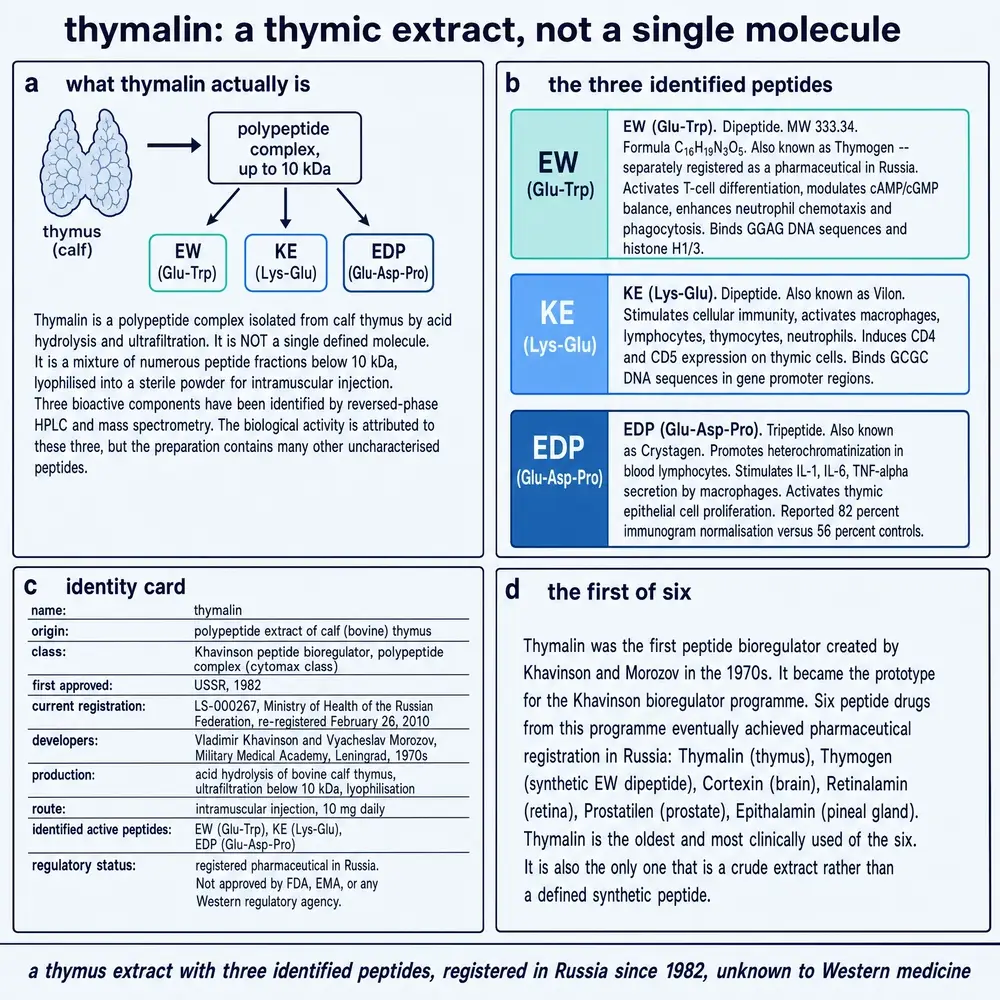
In the language of the laboratory that made it, Thymalin is a cytomedine: an organ-specific polypeptide complex prepared from young animal tissue by mild acid extraction and fractionation, with a molecular-weight window below about 10 kDa. The source organ is the thymus of calves. The finished preparation is a mixture, not a single covalent structure. There is no one amino-acid sequence that is Thymalin the way there is a sequence that is thymosin α1 or the serum thymic factor nonapeptide. Catalogue pages sometimes attach a PubChem CID anyway. That pointer must not be mistaken for a crystal structure of “the” molecule, and in one important case it points at the wrong substance entirely.
Three neighbours share enough of the name to wreck a literature search if they are not named at the door. Thymulin (also called serum thymic factor, or nonathymulin) is a zinc-dependent nonapeptide; PubChem CID 3085284 belongs to it, not to the calf-thymus complex. Thymosin α1 (thymalfasin) is a synthetic twenty-eight-residue peptide from the Goldstein lineage, with its own chemistry, its own trials, and its own commercial life as Zadaxin. Thymogen is the synthetic dipeptide Glu-Trp (EW) later isolated from Thymalin by reversed-phase HPLC and registered as a separate medicinal product. Shared “thymo-” prefixes do not admit any of those three into the evidence base for the extract. A hit that names only Thymulin, only thymalfasin, or only Thymogen is not a hit about Thymalin. Section 14 returns to what that has cost secondary writers who did not keep the names apart.
What the mixture is claimed to contain has become clearer with time. Programme reviews identify, among its characterised short-peptide components, KE (Lys-Glu, later marketed as Vilon), EW (Glu-Trp / Thymogen), and EDP (Glu-Asp-Pro / Crystagen). Those fragments are not Thymalin. They are pieces later read out of it and synthesised. When a paper reports a result for Thymogen, it is reporting on EW; when it reports on Vilon, it is reporting on KE. Concordance between fragment and extract is an experimental claim, not a structural inevitability, and it is reported in this document only where a study actually tested both.
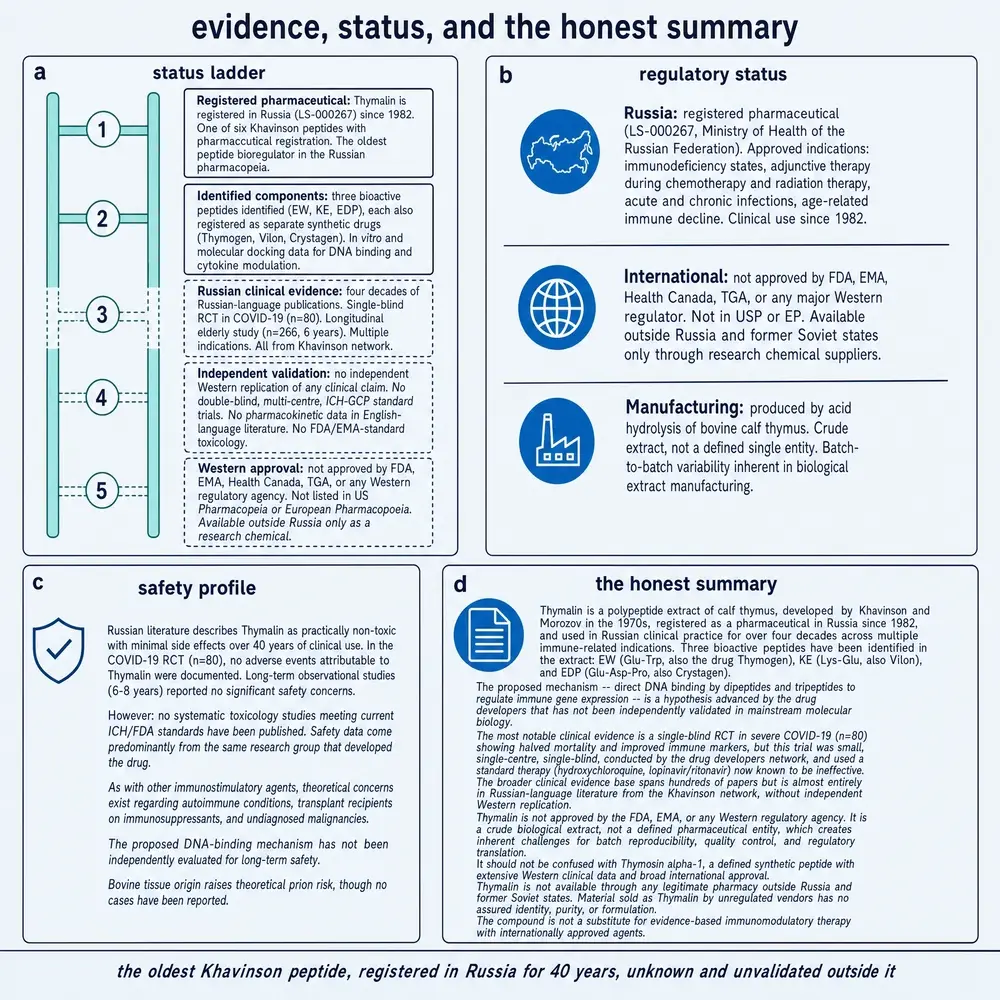
The regulatory fact underneath the chemistry is real and geographically bounded. Thymalin entered Soviet clinical practice in the early 1980s and remains a Russian medicinal product under registration LS-000267 (Ministry of Health of the Russian Federation; the February 2010 date commonly cited is a re-registration). That is not an FDA approval, not an EMA authorisation, and not a ClinicalTrials.gov registration—of which this monograph found none under the compound name. A domestic registration history is evidence of prolonged clinical exposure inside one regulatory system. It is not evidence that the preparation has been characterised to the standards of a modern Western new molecular entity.
Every experimental result below is labelled by study type in the sentence that reports it: human cells in culture, rat or mouse in vivo, human cohort, abstract-only report, or in silico model. That labelling is not decoration. In this literature the distance between a marker shift in a dish and a claim about a person is routinely covered in a single sentence of an abstract, and the labelling is what makes the jump visible when it happens. Nothing here recommends that any person use this compound. Concentrations, routes and schedules appear only as parameters of named studies.
Section 02Discovery history: Morozov, Khavinson, and the Kirov Academy
The story begins in a place that commercial blurbs love to call secret and that the indexed literature describes more prosaically. In the early 1970s, at the S. M. Kirov Military Medical Academy in Leningrad, Vladimir Grigorievich Morozov and Vladimir Khatskelevich Khavinson began a programme of isolating low-molecular-weight polypeptide fractions from animal organs. The working idea was simple enough to state and ambitious enough to organise a career around: each organ carries regulatory peptides that help maintain its own function; extract those peptides under mild conditions; return them; measure whether the corresponding physiological systems move back toward a younger or healthier set point. They called the products cytomedines. The thymus extract that became Thymalin was among the first.
The institutional path matters because it explains both the scale of the subsequent literature and its shape. Work that began inside a Soviet military medical academy did not circulate the way a contemporary NIH-funded programme circulates. Early reports appeared in Russian journals, in academy proceedings, and in clinical practice notes that Western indexes caught late or not at all. Pharmacological clearance inside the USSR is reported around 1977; medicinal registration of Thymalin followed around 1982. After the Soviet collapse, the programme reconstituted itself in St Petersburg. Khavinson founded and led the St Petersburg Institute of Bioregulation and Gerontology (North-Western Branch of the Russian Academy of Medical Sciences), which became the institutional home of the cytomedine-to-short-peptide arc for the next three decades. Morozov remained a central co-author on the founding immunopharmacology and geroprotection papers that still anchor the English-indexed record.
The English-language founding statement of the immunopharmacology is the 1997 review in the International Journal of Immunopharmacology (Morozov & Khavinson, 1997; PMID 9637345). It states, in language that has been repeated ever since, that natural thymic peptides were isolated from calf thymus by mild acid extraction; that a pharmaceutical containing those natural peptides (Thymalin) was put into practice as an immunocorrector; that one immunomodulatory molecule, L-Glu-L-Trp, was isolated from Thymalin by reversed-phase HPLC and became the basis of the synthetic drug Thymogen; and that a further synthetic dipeptide, later termed Vilon (Lys-Glu), was designed in the same programme. Both natural and synthetic preparations are described in that review as activating T-cell differentiation, altering cyclic-nucleotide composition, and changing interleukin-2 and interferon output from blood lymphocytes. The synthetic dipeptides are additionally said to activate neutrophil chemotaxis and phagocytosis. The review is comparative: it argues that natural and synthetic products are not interchangeable at every endpoint, and that thymic peptides participate in inflammatory regulation partly as cytokine antagonists. Those claims are programme self-description at the level of a review, not a single controlled trial. They are the doorway through which almost every later English abstract walks.
A 2020 Russian programme review by Khavinson places Thymalin among the first-generation peptide complexes created at the Kirov Academy in the 1980s–90s alongside Epithalamin, Cortexin, Prostatilen and Retinalamin, and then describes the second-generation move: isolation of short di-, tri- and tetrapeptides, determination of primary structure, and chemical synthesis (Thymogen, Vilon, Pinealon, Vesugen, Epitalon and others). That arc—extract first, defined peptide later—is the spine of the whole class. For Thymalin it has a special consequence: the molecule people now argue about in docking papers and gene-expression reviews is often not the extract at all, but a dipeptide that was mined from it. Holding the extract and the fragments in separate mental drawers is the first competence this literature demands.
Commercial material about these compounds tends to describe the origin as closed military research. Precision helps. The programme did originate in a military medical academy, and Soviet biomedical publication of the period was not Western open science. But the documented record is a gerontology and immunocorrection programme with hundreds of indexed publications, most of them in Russian-language journals and a substantial minority in international ones. The interesting fact is not that the work was concealed. It is that it was published continuously for four decades and was read, outside its own network, by almost nobody with the tools—and the incentive—to replicate it.
Section 03From extract to dipeptides: EW, KE, EDP
The practical history of Thymalin is a history of progressive reduction. The complex came first. Chromatography and synthesis later pulled discrete di- and tripeptides out of its compositional story. Programme reviews treat EW, KE and EDP as the principal characterised active fragments, while acknowledging that the parent preparation contains additional peptides whose contribution is not fully mapped. That incompleteness is not a footnote. It means every claim about “how Thymalin works” that is really a claim about how KE or EW docks to DNA is an inference across a compositional gap.
The isolation narrative for EW is the clearest of the three. Morozov and Khavinson (1997) describe Glu-Trp as having been isolated from Thymalin by reversed-phase HPLC and then recreated by directed synthesis as Thymogen. KE (Vilon) is described in the same literature as a novel immunomodulatory dipeptide synthesised in the programme rather than simply sequenced out of the extract. EDP (Crystagen) appears in later composition lists as a tripeptide constituent. The distinction between isolated from and designed on the basis of matters for the same reason it matters in the liver-peptide branch of this class: evidence about a synthetic fragment transfers to the extract only where both have been tested, and evidence about the extract transfers to a fragment only where the fragment has been shown to be present and active in the mixture.
A 2023 open-access study (Linkova et al., 2023; PMID 37686182 / PMC10488166) makes the compositional claim explicit in its title and then works almost entirely at the fragment level: KE and EW as active substances of the Thymalin drug, assessed by molecular docking against dsDNA, bioinformatic mapping onto COVID-pathogenesis genes, and an in vitro lipopolysaccharide inflammation model in human peripheral blood mononuclear cells. The paper is useful precisely because it is candid about the reduction. It does not pretend that docking Glu-Trp to a GGAG motif is the same experiment as giving the calf-thymus complex to a hospitalised patient. Section 07 returns to what the docking and the PBMC cytokine data can and cannot establish.
One empirical caution against treating any fragment as a drop-in substitute comes from organotypic work summarised in the programme literature: the whole complex has been reported to out-perform any single characterised fragment on certain spleen-explant growth indices. If that pattern holds under inspection, it argues that unmapped constituents, or synergistic combinations, still do work that KE or EW alone do not. The monograph records the pattern as a programme claim requiring primary-study inspection; it does not treat it as settled pharmacology.
Section 04The people, the institute, and the single-source character of the record
Authorship is not a gossip column in a literature like this. It is a structural property of the evidence. Reading down the PubMed trail that names Thymalin—237 records spanning 1981 to 2024—the centre of gravity does not move. Morozov and Khavinson; then Khavinson with Kuznik, Linkova, Trofimova, and the St Petersburg–Chita clinical collaborators; then the same network’s COVID-era papers. Collaborating institutes appear (the Institute of Gerontology in Kiev on the elderly cohort; City Hospital No. 2 in St Petersburg on the 2021 COVID series; Ukrainian morphological groups on the 2024 mandible work), but the conceptual ownership, the framing language, and the continuity of endpoints remain inside one research lineage.
That is not, by itself, an accusation. Small fields are often the work of a few hands. What it does mean is that the ordinary error-correcting mechanism of biomedical science—a second group with different reagents, different patients, different incentives, and no stake in the cytomedine hypothesis attempting the same measurement—has operated sparsely or not at all on the findings that define this compound’s modern reputation. Where this document describes a result as consistent across studies, the reader should hear that as consistent across studies by people who share a school, which is a weaker statement than the bare word “consistent” suggests.
The corpus assembled for this monograph makes the same point in numbers. A local sweep found 305 unique files naming Thymalin; 277 of them were vendor pages, certificates of analysis, catalogue stubs, or empty dossiers. PubMed returned 237 named records; only four carried a PMCID at harvest. Seven scientific full texts, amounting to roughly sixty-seven page-equivalents, were available for close reading. The rest of the indexed trail is abstract-tiered. A literature that is rich in filenames and thin in open full text is not secretly deep. It is exactly as deep as the pages one can read—and for Thymalin, those pages are fewer than the citation count implies.
ClinicalTrials.gov, searched for the compound name at build time, returned zero registrations. That absence does not erase decades of Russian clinical use. It does mark the boundary between a domestically established immunocorrector and a globally inspectable development programme. Parts Two through Four climb the evidence ladder inside that boundary. Part Five weighs what the climb is worth.
Before that climb begins, the identity work in Part One has to stay in view. Every later section that reports a fold-change, a mortality triad, or a docking pose is reporting on a preparation that is still a mixture, still tied to one institutional lineage, and still easily confused with three neighbours that share a prefix. The reader who keeps those constraints attached to every number will not need this document to soften the findings; the findings will arrive already labelled. The reader who drops the constraints will invent a cleaner drug than the corpus contains.
Section 05T-cell differentiation and the HSC marker study
The sharpest modern molecular claim for the extract itself—not for a fragment mined from it—is a short open-access note on human hematopoietic stem cells in culture (Khavinson et al., 2020; PMID 33237528 / PMC7686446). The experimental system is in vitro: human HSCs exposed to Thymalin, with surface-marker expression read as a proxy for differentiation state. The reported result is directional and large. Expression of CD44, a stem-cell marker, and CD117, a marker of an intermediate differentiation stage, fell by two- to three-fold. Expression of CD28, a marker of mature T lymphocytes required for full T-cell activation, rose 6.8-fold. The authors read that pattern as indirect evidence that Thymalin pushes CD117-positive cells toward mature CD28-positive T lymphocytes.
That is a cell-culture finding, and it should stay labelled as one. No human was treated in the experiment. No viral challenge was applied. The bridge the paper itself builds to COVID-19 is interpretive: severe COVID-19 is known to depress circulating CD28+, CD4+ and CD8+ T-cell counts, so a preparation that expands CD28 expression on differentiating HSCs in a dish is framed as a candidate immunoprotective intervention. The bridge is biologically intelligible. It is not, on its own, clinical evidence. Section 13 examines the human COVID series that tried to cash the cheque.
The same note situates Thymalin historically as a polypeptide complex isolated from the thymus and already described as raising T-lymphocyte functional activity in respiratory and other immunopathology—claims that point back into the older Russian clinical literature rather than into new Western pharmacokinetics. The targeted molecular mechanism, the authors concede, still required further study. The HSC marker panel is their contribution to that further study. It is one of the few Thymalin-named experiments in the open corpus that reports clean fold-changes on named surface proteins. It is also, like almost everything else in Parts Two through Four, the product of the St Petersburg network.
A related in vitro neighbourhood paper places Thymalin among five Khavinson peptides tested on the THP-1 monocyte/macrophage line for proliferative and inflammatory readouts (Avolio et al., 2022; PMID 35408963 / PMC8999041). That study is useful as class context and as a reminder that the extract can be run in the same dish as its synthetic relatives. It does not replace a receptor-binding constant, a dose–response curve for the HSC effect, or an independent replication of the CD28 finding. None of those three exists in the material assembled for this monograph.
Section 06Cytokines, hemostasis, phagocytosis: the immunocorrector claim
Long before anyone docked KE to a nucleosomal DNA sequence, Thymalin was described as an immunocorrector. The word is programme vocabulary. It means, in practice, a preparation given when immune indices are judged depressed or disordered—after infection, after cytostatic treatment, in chronic inflammatory disease, in ageing—with the expectation that T-cell counts, phagocyte function, and cytokine balance will move toward reference ranges. The 1997 founding review states the claim at the level of lymphocyte cyclic nucleotides, IL-2 and interferon output, and neutrophil chemotaxis and phagocytosis for the synthetic dipeptides (Morozov & Khavinson, 1997). Decades of Russian clinical abstracts echo the same endpoints in human cohorts with infections, surgical stress, and oncology adjunct settings. Most of those abstracts are Tier B for this monograph: readable as claims, not inspectable as methods.
What can be inspected more closely sits in the COVID-era full texts, and those texts braid three physiological stories into one. The first is cellular immunity: lymphopenia, depressed CD3/CD4/CD8 counts, and the CD4/CD8 ratio. The second is inflammatory tone: IL-6, C-reactive protein, ferritin. The third is hemostasis: fibrinogen, D-dimer, platelet counts, and the platelet-to-lymphocyte and neutrophil-to-lymphocyte ratios that COVID clinicians learned to watch as severity markers. In the 2021 St Petersburg complex-therapy series (Khavinson et al., 2021; PMID 33575961 / PMC7877506), a human cohort of hospitalised moderate-to-severe COVID-19 patients receiving standard care plus Thymalin was compared with a control arm on standard care alone. The authors report that standard care already lowered IL-6, CRP and D-dimer, and that adding Thymalin accelerated the decline in those markers and in T-cell system indices. No deaths were reported in either arm of that particular series. Study-reported administration in that paper was intramuscular Thymalin as an add-on to a Ministry of Health temporary COVID protocol; the regimen parameters are properties of that trial, not recommendations of this monograph.
A 2022 Russian-language abstract on severe COVID-19 in middle-aged and elderly patients (Kuznik et al., 2022; PMID 36169363) pushes the hemostasis story into a three-arm contrast: basic therapy, basic therapy plus tocilizumab, and basic therapy plus Thymalin. Hospital mortality is reported as 40.9%, 28.4% and 20.6% respectively. Under Thymalin, the abstract reports roughly two-fold increases in lymphocytes and monocytes, a 1.3-fold rise in leukocytes, a 1.5-fold rise in platelets, falls in platelet/lymphocyte and neutrophil/lymphocyte ratios, and reductions in fibrinogen, lactate dehydrogenase and D-dimer. Tocilizumab, in the same abstract, raised platelets and lowered fibrinogen but worsened platelet/leukocyte and platelet/lymphocyte ratios in a direction the authors flag as potentially unfavourable. These are abstract-tiered human-cohort findings from inside the programme network. They are among the most consequential numbers attached to Thymalin in the past decade. They are also exactly the kind of finding that needs a second hospital, a pre-registered protocol, and an analysis plan written before the envelope was opened. Section 13 weighs them without laundering them into regulatory efficacy.
Older comparative immunology sits one rung down the ladder. A 2013 Russian abstract compared tinrostim, a peptide preparation from squid optic ganglia, with pharmacopoeial Thymalin in experimental animals and in human peripheral-blood cell culture (Kuznetsova et al., 2013; PMID 24734422). Both preparations are reported to stimulate humoral and cellular responses and neutrophil phagocytosis in animals, and to raise pro- and anti-inflammatory cytokines (TNF-α, IL-1, IL-10) in intact peripheral-blood cultures in vitro. The comparison is useful mainly as a reminder that Thymalin has long been the domestic reference immunocorrector against which other marine or tissue peptides are scored. It is not a modern GLP immunotoxicology package.
Section 07The bioregulator / DNA-binding frame: what is and is not established
Most peptides in clinical pharmacology earn their keep at a receptor. The Khavinson short-peptide programme claims something else for its di- and tetrapeptides: that molecules small enough to write in one-letter code cross membranes, enter nuclei, and bind DNA or histones at preferred sequences, altering gene availability without a classical receptor intermediate. That is the bioregulator hypothesis. It is a coherent research programme. It is not a pharmacological classification recognised in FDA or EMA nomenclature, and it should not be read as one.
For Thymalin specifically, the DNA-binding story is almost entirely a story about its fragments. The 2023 Linkova paper reports in silico docking in which EW prefers a GGAG motif on classical B-form dsDNA and KE prefers GCGC on curved nucleosomal DNA (Linkova et al., 2023). Bioinformatic mapping then nominates AKT1/AKT2-linked cytokine-storm genes as shared potential targets, with ACE2 and CYSLTR1 highlighted for EW and CHUK for KE. An accompanying in vitro experiment on human PBMCs stimulated with lipopolysaccharide reports that Thymalin, EW and KE each reduced supernatant IL-1β, IL-6 and TNF-α by roughly 1.4- to 6.0-fold across the conditions tested. Blood came from four donors; ELISA replicates were limited. That is a real cytokine-suppression signal in a small human-cell system under inflammatory challenge. It is not proof that the docked DNA poses are occupied inside a living nucleus, and it is not proof that the extract’s clinical effects—if any—run through those poses.
Class-level reviews assemble a broader picture: short peptides of two to seven residues enter nuclei and nucleoli, interact with nucleosomes and histones, and regulate gene expression and differentiation (Khavinson et al., 2021, Molecules systematic review). KE appears in that literature as a Thymalin constituent; many of the mechanistic experiments are performed on the synthetic dipeptide, not on the calf-thymus mixture. Evidence for the class is not automatically evidence for the extract. Wherever this monograph leans on a fragment study to illuminate Thymalin, the peptide actually tested is named in the sentence.
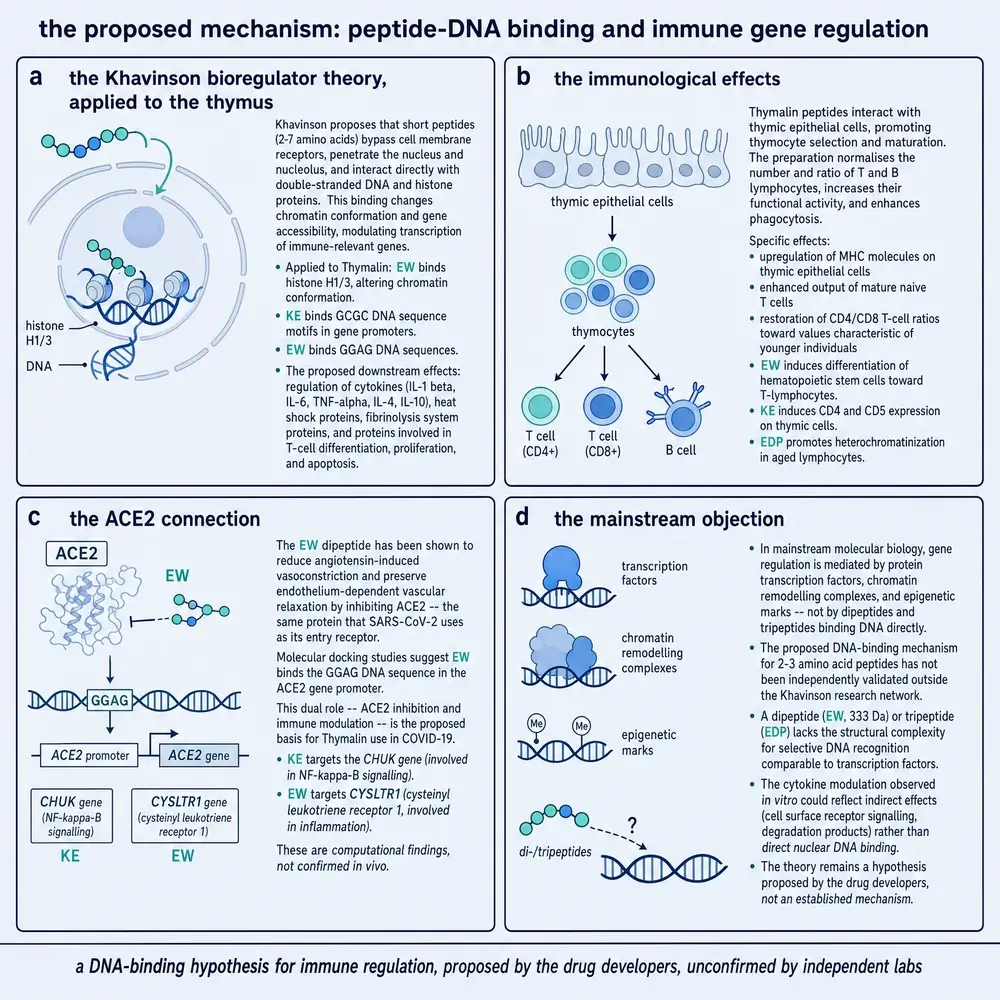
Two absences define the mechanistic ceiling. There is no published high-resolution structure of a Thymalin constituent bound to a genomic locus in a living cell. And there is no pharmacokinetic study of the extract in any species in the material reviewed here: no half-life, no bioavailability by any route, no distribution, no metabolism, no elimination. A multi-component peptide fraction below 10 kDa would be expected to face rapid proteolysis in plasma; that expectation is chemistry, not a measurement. The immunocorrector claim in Section 06 and the HSC claim in Section 05 therefore sit on functional readouts without a demonstrated exposure–response curve. That is a description of the record, not a verdict that the readouts are false.
Part Two’s contribution is therefore bounded on purpose. It shows what the extract is said to do in culture and in the immunocorrector narrative, and it shows how far the DNA-binding frame can be pressed before it becomes a story about KE and EW rather than about the calf-thymus mixture. It does not yet ask what happens when the same preparation is given to a tumour-bearing rat, injected beside a mandibular graft, or used as a reference arm against a marine peptide. Those questions belong to living animals, and they are the business of Part Three. A reader who carries only the HSC fold-changes into the next Part will over-read a dish; a reader who carries the mechanistic ceiling will keep the animal work in scale.
Section 08Tumour and thymus models: sarcoma 45
The animal literature naming Thymalin is older and wider than the open full-text shelf can display. What this monograph can inspect closely is a smaller set of modern experimental papers, of which the 2018 sarcoma study is the clearest tumour-facing example (Zhukova et al., 2018; PMID 29797130). The system is in vivo: albino outbred male rats bearing transplanted sarcoma 45, treated with Thymalin under an “activation therapy” schedule that deliberately uses doses the authors describe as lower than ordinary therapeutic doses and modulates them across the course. The reported antitumour effect is large on its face. Tumour growth arrest and regression were observed in more than half the animals; in the remainder, growth was suppressed by about 78%. Microstructural reading of the thymus showed increased lymphoproliferative activity and higher counts of tissue basophils and plasmocytes in thymic lobules. Tumour regression was accompanied, the authors write, by stable antistress adaptation reactions of “calm and elevated activation”—language that belongs to a Russian school of activation therapy and does not map cleanly onto Western RECIST-style oncology endpoints.
Several cautions attach before that paragraph can be weighed. The study is small-animal transplantable tumour work, not a spontaneous tumour model and not a human oncology trial. The activation-therapy framing means the dosing schedule is part of the experimental claim; this monograph records that a schedule was used and does not reproduce it as guidance. The paper is indexed and abstractable, but it sits inside a methodological tradition that Western oncology readers will find unfamiliar, and unfamiliarity is not the same as refutation. What can be said cleanly is that a named rat sarcoma model produced a large reported response under a named experimental protocol from a group working with Thymalin, and that independent replication of that protocol outside the originating tradition was not found in the corpus assembled here.
Older programme summaries assert broader effects on tumour incidence and lifespan when thymic and pineal peptide preparations are given to animals over long periods. Those summaries are secondary. Where this document cannot read the primary animal survival curves, it does not pretend to have read them. The sarcoma 45 paper earns its place in Part Three because it is a concrete, citable, Thymalin-named in vivo experiment with morphological thymus readouts attached to the tumour outcome—not because it settles the oncology question.
Section 09Osteogenesis adjunct: the 2024 rat mandible studies
Recency has a gravitational pull in any monograph, and the 2024 mandible papers are the freshest animal work in the Thymalin trail (Boiko et al., 2024; PMID 38431810 and PMID 38642352). Both report experiments on mature WAG rats (n = 48 across four groups of twelve) with a standardised hole defect in the lower jaw. The design crosses two interventions: filling the defect with a hydroxyapatite-containing osteotropic material (Biomin GT), and injecting Thymalin into the soft tissues surrounding the defect. Group 4 receives both. Histology, morphometry and immunohistochemistry (CD3, CD20, CD68, CD86, CD163 and related macrophage phenotype markers) are the readouts.
The morphological paper reports activation of reparative osteogenesis when graft and local Thymalin are combined: faster clearance of necrotic tissue and hematoma, fewer neutrophils, more monocytes, macrophages, lymphocytes and fibroblastic-differon cells, stage-appropriate shifts in osteoblasts and osteoclasts, activation of hematopoiesis in lamellar bone of the regenerate, and more active mineralisation. The companion immunohistochemistry paper reports that the same combination stimulates local immune reactions in the regenerate—T-lymphocytes rising from day 3 through day 28, B-lymphocytes rising from day 14, macrophages rising across the same window, with a phenotypic shift away from M1-like and toward M2-like macrophage markers. The authors propose that local immune stimulation is one mechanism by which reparative osteogenesis is accelerated.
These are carefully designed small-animal morphology studies, and they are recent. They are also, in the authors’ own closing sentences, framed as recommending a clinical dental technique. That framing is the authors’ clinical inference from rat histology. This monograph does not adopt it. A local soft-tissue injection around a grafted mandibular defect in a rat is not a systemic immunocorrection protocol, not a COVID regimen, and not evidence about oral bioavailability of a research peptide sold online. Recency is weighed here for what the papers actually measured—local immune-cell dynamics and bone-repair morphology under a named experimental combination—not for the leap into dental practice advice. No independent laboratory replication of the Biomin GT plus Thymalin design was located at build time.
Section 10Comparative peptide immunology: tinrostim versus Thymalin
Comparative work is valuable when it can fail. The 2013 tinrostim study (Kuznetsova et al., 2013; PMID 24734422) puts Thymalin in the role of pharmacopoeial reference and asks whether a peptide preparation from squid optic ganglia can match it. In experimental animals, both agents are reported to stimulate humoral and cellular immune responses and neutrophil phagocytosis to a comparable degree. In vitro, both raised TNF-α, IL-1 and IL-10 in cultures of intact human peripheral-blood cells. A detail the abstract emphasises for tinrostim—that a ten-fold lower experimental dose produced effects comparable to a higher one in mice—is a claim about tinrostim, not a titration curve for Thymalin.
The comparison earns a short section for two reasons. First, it shows Thymalin functioning inside Russian experimental immunology as a standard against which newer tissue peptides are judged—an institutional role that matches its pharmacopoeial status and helps explain why the name keeps appearing even when the scientific question is about something else. Second, it illustrates how thin even “comparative” evidence can be when the primary report is an abstract: group sizes, blinding, assay validation and statistical plans are not available for inspection here. The monograph records a reported head-to-head resemblance on phagocytosis and cytokine output, and it declines to promote either arm into a general theory of marine-versus-thymic peptide superiority.
Taken together, Part Three is a thin sandwich with two distinct flavours of bread. In the middle is a suggestive rat sarcoma result under activation therapy. On one side, a pharmacopoeial comparison that treats Thymalin as the known quantity. On the other, a modern mandibular-repair pair that is methodologically earnest, locally focused, and clinically over-interpreted by its own closing lines. None of these animal findings, separately or together, establish a human indication. They establish that the extract continues to be used as an experimental immunomodulatory tool in living rodents, which is a weaker and more honest statement.
Part Four therefore starts from a narrower question than the animal literature invites. The issue is no longer whether Thymalin can move immune or repair indices in a rat under a named protocol. It is whether the human observations that follow—elderly follow-up, COVID complex therapy, and the severe-disease mortality contrast—are strong enough, transparent enough, and independent enough to carry the weight secondary writers already place on them. The animal work supplies continuity of use. It does not supply that human weight. Keeping that distinction sharp matters because the same research lineage writes both the rodent papers and the hospital series; shared authorship is not shared species, and a mandible defect in a WAG rat does not underwrite a lymphopenia endpoint in a COVID ward. The pages that follow therefore treat the human record as a separate climb, with its own design limits, and they do not borrow confidence from the animal sandwich just reviewed. If the human series later look internally coherent, that coherence will have to be earned on human endpoints and human reporting standards—not inherited from sarcoma 45 morphology or from CD3 counts at a bone-defect margin. Part Four opens with the elderly cohort precisely because that is where secondary writers most often begin; the COVID cluster comes second because it is newer and denser in English full text, not because it erases what came before. Keep the animal sandwich in the background as continuity of laboratory use, not as a warrant for the human numbers.
Section 11The elderly geroprotection cohort
If one human study defines Thymalin’s reputation outside the COVID years, it is the long geroprotection observation reported by Khavinson and Morozov in Russian and English (Khavinson & Morozov, 2002; PMID 12577695; and Khavinson & Morozov, 2003; PMID 14523363). Researchers at the St Petersburg Institute of Bioregulation and Gerontology and the Institute of Gerontology of the Ukrainian Academy of Medical Sciences in Kiev clinically assessed thymic (Thymalin) and pineal (Epithalamin) peptide bioregulators in 266 elderly and older persons over six to eight years. The bioregulators were applied during the first two to three years of observation. The English 2003 report describes the design as a clinical trial and randomised controlled trial in its PubMed publication types; the underlying methods, allocation concealment, and analysis plan are not open as a modern CONSORT package in the material available here. This monograph therefore treats the numbers as a large programme-linked human cohort with long follow-up, not as a contemporary multi-centre RCT.
The reported outcomes are sweeping. Homeostasis indices across cardiovascular, endocrine, immune and nervous systems are described as improved. Acute respiratory disease incidence fell 2.0- to 2.4-fold relative to control. Clinical manifestations of ischemic heart disease, hypertension, deforming osteoarthrosis and osteoporosis are described as reduced. Mortality during observation fell 2.0- to 2.1-fold in the Thymalin-treated group, 1.6- to 1.8-fold in the Epithalamin group, and 2.5-fold in patients who received both, versus control. A separate subgroup treated annually with the combination for six years is reported to have shown a 4.1-fold mortality decrease. Those fold-changes are among the most striking survival claims attached to any peptide in this monograph series.
They are also among the hardest to audit. The reports available for reading are abstract-tiered and review-shaped; individual-patient data, cause-of-death adjudication, concurrent care, and sensitivity analyses are not on the open shelf. The same two investigators who developed the preparations are among the assessors of their long-term benefit. Collaboration with a Kiev gerontology institute widens the geography without dissolving the programme linkage. None of that proves the mortality folds are wrong. All of it determines how far a careful reader can take them. This document reports the figures as published, labels them as programme-linked human-cohort findings, and refuses to convert them into a recommendation that any person use Thymalin to live longer.
One structural feature of the study is easy to miss and important to keep. Thymalin and Epithalamin are co-packaged in the narrative as parallel geroprotectors from thymus and pineal gland. Combination effects are reported as larger than either alone. That is interesting as a programme hypothesis about multi-gland peptide hygiene in ageing. It is also a design feature that makes Thymalin-specific attribution harder wherever the combination arm drives the headline mortality number. Readers who meet only the 4.1-fold figure in secondary writing are often meeting the combination, not the thymus extract alone.
Section 12Decades of Russian clinical observations
Between the 1982 registration and the COVID cluster sits a long shelf of Russian clinical reports that PubMed indexes and that this monograph mostly cannot open. The pattern across abstracts is repetitive enough to summarise without pretending to have re-analysed each ward study. Thymalin appears as an adjunct in acute and chronic viral and bacterial infections, in pneumonia and tuberculosis contexts, in post-surgical and post-cytostatic immune suppression, in some oncology-adjacent supportive settings, and in scattered specialty uses (for example, chrono-immunocorrection language in reproductive inflammatory disorders, or dental and ENT adjunct observations). Programme reviews list hepatitis A and B, erysipelas, meningococcal infection, typhoid fever, and cavernous pulmonary tuberculosis among historical infectious indications (secondary accounts citing the Russian clinical tradition).
What those abstracts typically offer is a direction: lymphocyte counts up, infection episodes down, recovery shorter, complications fewer. What they typically omit, from the vantage point of a reader working only with indexed English abstracts, is the scaffolding that would let a stranger trust the direction—randomisation details, blinding, pre-specified primary endpoints, multiplicity control, and registration. ClinicalTrials.gov holds no Thymalin trial record to lean on. For this monograph’s evidence rules, the older clinical layer is therefore background weather: it explains why Russian clinicians had a bottle to reach for in 2020, and it does not, by volume of titles alone, upgrade the extract to a globally demonstrated therapy.
A few specialised human observations illustrate the range without changing the grade. Abstract-only reports describe Thymalin immunocorrection language in women with inflammatory disorders of internal reproductive organs (Litvinenko et al., 2015; PMID 26033592), in age-related dental disease bioregulatory therapy (Pinelis et al., 2020; PMID 32362097), and in pediatric secretory otitis settings among other background pathologies (Kulikova et al., 2019; PMID 31889704). Each is a human-cohort or clinical-observation fragment. None is developed here into an indication. The honest summary of Section 12 is that Thymalin has been extensively used and written about in Russian clinical medicine for forty years, and that extensive use is not the same resource as extensive open evidence.
Section 13The COVID-19 cluster, weighed carefully
The years 2020–2023 gave Thymalin the densest burst of English-open attention in its history. The burst has a shape: an in vitro HSC rationale (Section 05), a hospital complex-therapy series with inflammatory and hemostatic markers, a severe-disease mortality contrast against tocilizumab, and a mechanistic fragment paper that returns to KE and EW. Almost every author string traces to the same research lineage. That is the single-source problem in its acute form, and it is stated here before any COVID number, because the numbers are easy to want and hard to place.
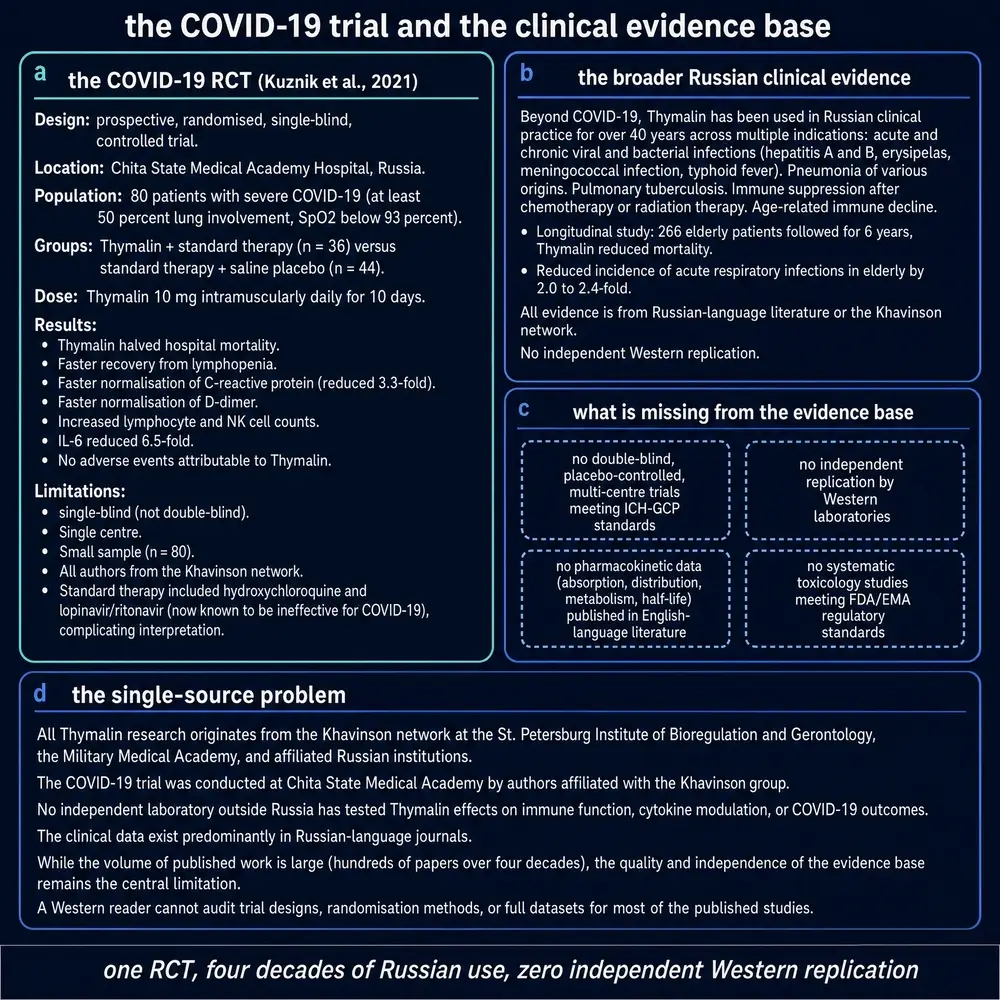
The 2021 Stem Cell Reviews and Reports paper is the most inspectable clinical full text (Khavinson et al., 2021; PMID 33575961 / PMC7877506). It reports a single-centre, open-label, prospective, randomised, controlled trial at St Petersburg City General Hospital No. 2 during April–July 2020. Adults with moderate or severe COVID-19, lymphopenia, and CT-confirmed bilateral pneumonia were assigned by envelope randomisation to standard care (n = 50) or standard care plus Thymalin (n = 42). Standard care followed the Russian Ministry of Health temporary COVID guidelines then in force and included antibacterials, variable off-label antivirals, glucocorticoids in a minority, and low-molecular-weight heparin. Study-reported Thymalin use in the experimental arm was 10 mg intramuscularly once daily for five days—a regimen parameter of that protocol, not a recommendation of this monograph.
On laboratory endpoints, the authors report that both arms improved, and that the Thymalin arm improved faster and further on several markers. Lymphocytes, CD3 and CD4 counts rose significantly in the Thymalin arm versus post-treatment controls; the CD4/CD8 ratio widened; IL-6 fell from a mean around 20 pg/ml to about 3.7 pg/ml in the Thymalin arm versus a more modest decline under standard care alone. CRP and D-dimer fell further with Thymalin; ferritin and prothrombin time also moved toward reference more strongly in the experimental arm. Neutrophil-to-lymphocyte ratio declined. No deaths occurred in either arm during the observation window; CT progression was noted in five control patients and two Thymalin-arm patients. Those are human-cohort findings from an open-label randomised hospital study inside the programme network. They are among the best-documented clinical observations Thymalin has. They are not a blinded, multi-centre, regulatory-grade demonstration, and the simultaneous use of heparin, steroids and off-label antivirals means attribution is bundled with complex care.
The 2022 Advances in Gerontology abstract (Kuznik et al., 2022; PMID 36169363) is the mortality paper secondary writers reach for. In severe COVID-19 among middle-aged and elderly patients, hospital mortality is reported as 40.9% after standard therapy, 28.4% after standard therapy plus tocilizumab, and 20.6% after standard therapy plus Thymalin. The same abstract reports the leukocyte, lymphocyte, monocyte, platelet and coagulation shifts summarised in Section 06, and concludes that Thymalin matched the principles of pathogenic therapy more closely than tocilizumab in that cohort. This monograph repeats the mortality triad because it is in the record and because readers will meet it elsewhere. It also names the limits without euphemism: Russian-language abstract-tiered reporting; programme-linked authorship; no open individual-level dataset in the corpus; no independent Western replication; pandemic-era care that changed under everyone’s feet. A single-source mortality contrast can be true, false, or entangled with residual confounding. The available text does not let a stranger decide which.
The 2023 KE/EW paper (Linkova et al., 2023; PMID 37686182) then reinterprets the clinical story at the fragment level: docking, pathway mapping, and PBMC cytokine suppression under LPS. It cites the COVID clinical experience as background and offers a molecular vernacular for why an old thymus extract might matter in a cytokine-storm disease. As mechanism hypothesis generation, it is inventive. As a substitute for independent clinical replication, it is not. In silico poses do not rescue an unreplicated mortality contrast.
How should a common reader hold this cluster? As the most detailed human laboratory story Thymalin has ever had, generated under pandemic pressure by the people who know the drug best, showing marker movements that line up with the older immunocorrector narrative—and as a cluster that has not yet been stress-tested by investigators who did not invent the drug. The COVID years made Thymalin newly visible. They did not make it newly independent.
What Part Four leaves on the table, then, is not a blank. It is a human record with a clear centre of gravity—elderly follow-up, open-label COVID complex therapy, and an abstract-tiered mortality contrast—and a clear missing circumference: second-hospital replication, pre-registered analysis plans, and any Western marketing-authorisation dossier. Part Five turns from that record to the naming traps and evidence ranks that decide how much weight a careful reader should place on it.
Section 14Identity traps, Thymogen leakage, and the CID that is not this drug
Before the evidence can be ranked, the names have to be policed one last time, because secondary writing about thymic peptides fails this test constantly. Thymulin the nonapeptide is not Thymalin the extract. PubChem CID 3085284 is a Thymulin identifier; admitting a CID-3085284-only hit as Thymalin evidence is a category error that will import zinc-dependent serum thymic factor pharmacology into a calf-thymus complex dossier. Thymosin α1 / thymalfasin is not Thymalin; it is a synthetic 28-mer with a separate discovery line, separate trials, and separate commercial identity. Shared prefix is not shared substance.
Thymogen leakage is subtler and more damaging. Because EW was isolated from Thymalin and marketed under its own registration (LS-002304 in the Russian system, as cited in programme reviews), writers routinely slide from properties of the dipeptide to properties of the parent complex without saying they have changed objects. Docking scores for Glu-Trp, neutrophil effects reported for synthetic Thymogen, and gene-expression results for KE can all be real and still not be results about the multi-component extract. This monograph’s rule is mechanical: a sentence that reports a finding names the preparation actually tested. Where commercial or secondary text treats Thymogen as “the active ingredient of Thymalin” in a sense that erases the rest of the mixture, it is making a compositional claim the open primary literature has not fully cashed.
Vendor literature adds a different noise. Of 305 local files naming Thymalin in the project sweep, 277 were catalogue pages, certificates of analysis, cart captures, or empty dossier stubs. Those files are excellent at repeating trade names and vial sizes. They are worthless as evidence of efficacy. The research-chemical marketplace that sells “Thymalin” to English-speaking buyers is not the Samson-Med medicinal product described in Russian hospital papers, and this document never conflates the two supply chains.
Section 15What is stronger, what is thin; recency versus preponderance
Relative to this corpus, the stronger strata are identity and history: a documented origin at the Kirov Military Medical Academy; a continuous institutional home in St Petersburg; Soviet-era introduction into clinical practice around 1982; ongoing Russian registration LS-000267; and a compositional research programme that named EW, KE and EDP as characterised constituents. Those are facts about what the preparation is and where it came from. They do not require believing any particular CD28 fold-change.
Also relatively stronger, inside a still-limited frame, is the 2020 human HSC differentiation note: a named in vitro system, named surface markers, and large reported effect sizes on CD44, CD117 and CD28 (Khavinson et al., 2020). The 2021 open-label randomised COVID complex-therapy series is the strongest modern human laboratory package the extract has in English full text, with concurrent controls and a panel of immune, inflammatory and hemostatic markers (Khavinson et al., 2021). Both remain single-network results.
The elderly geroprotection cohort is large in n and long in follow-up, and its mortality folds are unforgettable on the page. Design transparency and independence are not in the same league as the headline numbers. It sits in a middle band: too big to ignore, too opaque to lean on as decisive. The 2022 tocilizumab-versus-Thymalin mortality triad is more recent and more dramatic, and thinner still as an inspectable object—an abstract-tiered severe-COVID contrast from the same lineage. Recency is weighed here for consistency with the immunocorrector story (markers move in the expected directions) and not as a licence for the newest paper to overwrite the structural problem. The structural problem is not contradiction between studies. It is dependence on one programme for nearly every rung of the ladder.
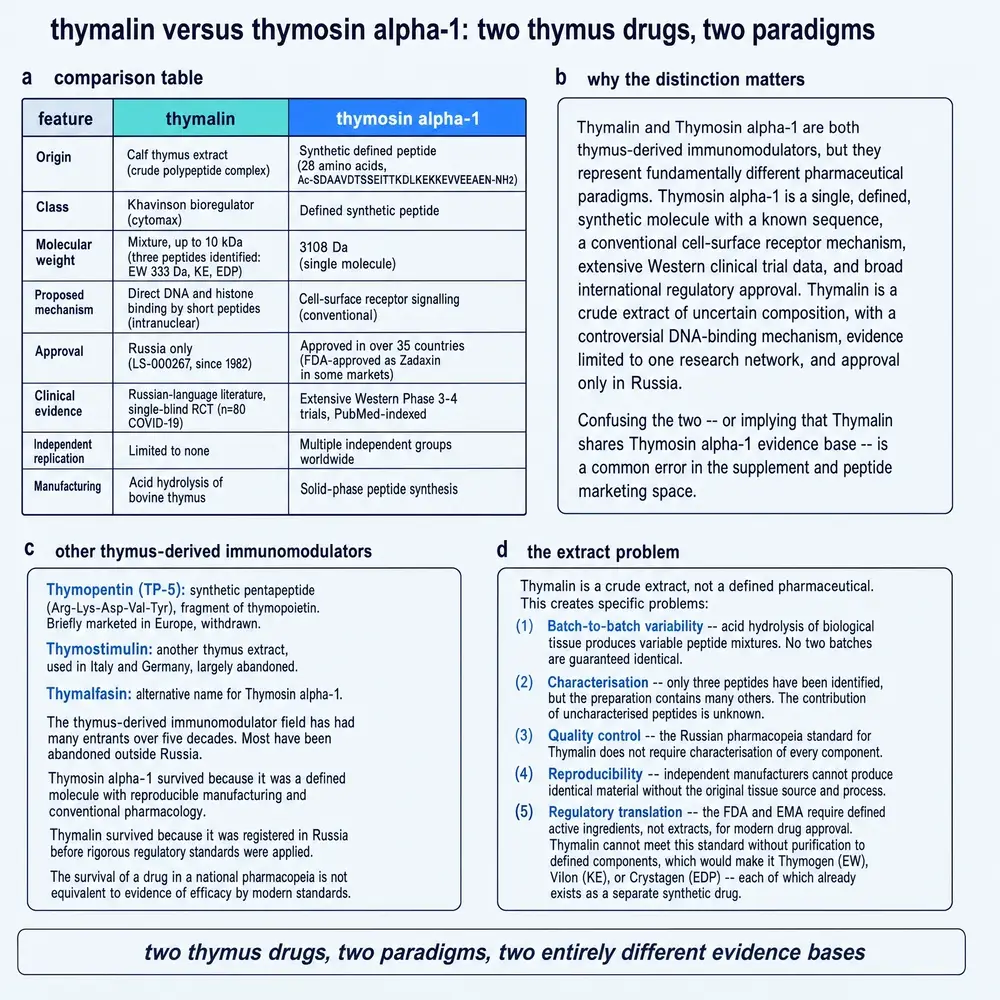
Thin or absent, by ordinary biomedical standards: independent Western replication of the HSC or COVID findings; prospectively registered multi-centre trials; pharmacokinetics of the complex in any species; a complete map of every peptide in the mixture; receptor-level mechanism for the extract as opposed to docking hypotheses for its fragments; and any FDA or EMA marketing authorisation. ClinicalTrials.gov registrations naming Thymalin: zero at build time. Open scientific full text: about sixty-seven page-equivalents after deduplication, against 237 PubMed records and 305 local filename hits. The library is rich in mentions and poor in pages.
A useful comparison inside the class keeps expectations honest. Some Khavinson short peptides—Epitalon is the usual example—have attracted more varied experimental attention, including primate and telomerase-adjacent work discussed elsewhere in this series. Thymalin’s distinction is almost the opposite: it is the older, registered extract with the longer clinical shadow and the less defined molecular edge. That makes it historically heavier and pharmacologically blurrier than a single synthetic dipeptide. Blurring is not mystique. It is a reason to demand, not relax, study-type labels.
Section 16Standing constraint
This monograph is a research document. It describes published experiments and clinical observations. It does not recommend that any person use Thymalin, Thymogen, Vilon, Crystagen, or any related preparation. No dose, route, schedule, formulation or duration is specified for any person anywhere in this document. Where a named study reported a concentration, an intramuscular milligram amount, or a five-day course, those figures are parameters of that study and are labelled as such. Nothing here is medical advice. Research use only.
The temptation with a literature like this is to resolve it cheaply, in one direction or the other. It can be dismissed—Soviet origin, single school, translated abstracts, pandemic papers from interested parties—and dismissal costs nothing, because nothing here has to be acted on by a reader of this series. Or it can be accepted wholesale, because the internal story really does run from a 1970s military academy through a registered medicine to marker-rich COVID wards, and internal consistency feels like confirmation. Both moves are cheaper than the accurate one.
The accurate one is to hold Thymalin at the weight it has earned: a real calf-thymus polypeptide complex with a documented Soviet and Russian clinical life; a parent to short peptides that now carry much of the molecular storytelling; a body of in vitro and human-cohort observations that cohere inside one research network; and a near-absence of the independent checks science uses when a claim begins to matter outside its home. The gap between what Russian hospital practice has long done with this preparation and what a global evidence reviewer can verify from open full text is not a gap this monograph can close with prose. Naming the gap is the work.
The apparatus that follows is deliberately dry: verified references, a record of how the corpus was built, and the four evidence rules that governed the reading. Dryness is the point. After a literature that invites either dismissal or wholesale acceptance, the useful last move is to show the joints—what was read, what was excluded, and which inferences were refused—so a stranger can re-weigh the same material without inheriting this document’s tone. The series convention is to put that machinery after the weighing is finished, not before; a reader who stops at Section 16 has the argument, and a reader who continues into the apparatus has the audit trail. Either stopping point is legitimate. Neither is a substitute for opening the primary papers the reference list will name.
What remains is housekeeping: the verified bibliography, the inventory numbers that shaped the method, and the four evidence rules restated without the surrounding narrative. A monograph that ends on a weighing section without that trail asks the reader to trust the author’s memory. This one prefers to show the shelves. The apparatus is short on purpose; its job is to make the preceding Parts falsifiable, not to reopen the argument under a different heading. Read it as a packing list for the evidence, then go back to the papers.
Section 17References
The reference list below is generated at build time from verified NCBI records rather than from recall. Author lists, journal names, volumes, pages and identifiers are taken from the PubMed record for each citation. The build refuses to proceed if a cited identifier is unresolved. Non-PubMed sources—programme reviews, registration notes, and registry searches—are listed separately when the pipeline supplies them.
Section 17References
Generated from verified NCBI records rather than from recall. Every PubMed identifier below was resolved against the harvest before this build was allowed to write the deliverable.
- Avolio F, Martinotti S, Khavinson VK, Esposito JE, Giambuzzi G, Marino A, et al.. Peptides Regulating Proliferative Activity and Inflammatory Pathways in the Monocyte/Macrophage THP-1 Cell Line. International journal of molecular sciences. 2022. 23(7).
PMID 35408963 · doi:10.3390/ijms23073607 · PMC8999041 - Boiko AA, Malanchuk VA, Myroshnychenko MS. Reparative osteogenesis in mandible in cases of filling a bone defect with hydroxyapatite-containing osteotropic material and injecting the surrounding soft tissues with thymalin: experimental and morphological study. Wiadomosci lekarskie (Warsaw, Poland : 1960). 2024. 77(1):68-76.
PMID 38431810 · doi:10.36740/WLek202401110 - Boiko AA, Malanchuk VA, Myroshnychenko MS, Markovska OV, Shapkin AS, Marakushyn DI. Expression features of T-lymphocytes, B-lymphocytes and macrophages in the post-traumatic regenerate of the mandible rats under conditions of filling a bone defect with hydroxyapatite-containing osteotropic material and thymalin injecting the surrounding soft tissues. Polski merkuriusz lekarski : organ Polskiego Towarzystwa Lekarskiego. 2024. 52(2):171-177.
PMID 38642352 · doi:10.36740/Merkur202402105 - Khavinson VK, Linkova NS, Kvetnoy IM, Polyakova VO, Drobintseva AO, Kvetnaia TV, et al.. Thymalin: Activation of Differentiation of Human Hematopoietic Stem Cells. Bulletin of experimental biology and medicine. 2020. 170(1):118-122.
PMID 33237528 · doi:10.1007/s10517-020-05016-z · PMC7686446 - Khavinson VK, Kuznik BI, Trofimova SV, Volchkov VA, Rukavishnikova SA, Titova ON, et al.. Results and Prospects of Using Activator of Hematopoietic Stem Cell Differentiation in Complex Therapy for Patients with COVID-19. Stem cell reviews and reports. 2021. 17(1):285-290.
PMID 33575961 · doi:10.1007/s12015-020-10087-6 · PMC7877506 - Khavinson VKh, Morozov VG. [Geroprotective effect of thymalin and epithalamin]. Advances in gerontology = Uspekhi gerontologii. 2002. 10:74-84.
PMID 12577695 - Khavinson VKh, Morozov VG. Peptides of pineal gland and thymus prolong human life. Neuro endocrinology letters. 2003. 24(3-4):233-40.
PMID 14523363 - Khlystova ZS, Kalinina II, Shmeleva SP, Ryabchikov OP, Khavinson VKh. Age-related changes of thymalin content in human epidermis. Bulletin of experimental biology and medicine. 2002. 133(6):620-2.
PMID 12447484 · doi:10.1023/a:1020214816056 - Khlystova ZS, Kalinina II, Shmeleva SP. Thymalin in developing respiratory organs of human fetus. Bulletin of experimental biology and medicine. 2003. 135(6):600-2.
PMID 12937685 · doi:10.1023/a:1025449923475 - Kuznetsova TA, Besednova NN, Zaporozhets TS, Smolina TP, Kazha AK, Ivanushko LA. [Comparative study of immunomodulatory activity of peptides, tinrostim and thymalin]. Antibiotiki i khimioterapiia = Antibiotics and chemoterapy [sic]. 2013. 58(11-12):8-12.
PMID 24734422 - Kuznik BI, Shapovalov KG, Smolyakov YN, Lukyanov SA, Tereshkov PP, Kazantseva LS, et al.. [Morphological compound and indicators of the blood clotting system in severe COVID-19 patients of middle aged and elderly during treatment of Tocilizumab and Thymalin.]. Advances in gerontology = Uspekhi gerontologii. 2022. 35(3):368-374.
PMID 36169363 - Linkova N, Khavinson V, Diatlova A, Petukhov M, Vladimirova E, Sukhareva M, et al.. The Influence of KE and EW Dipeptides in the Composition of the Thymalin Drug on Gene Expression and Protein Synthesis Involved in the Pathogenesis of COVID-19. International journal of molecular sciences. 2023. 24(17).
PMID 37686182 · doi:10.3390/ijms241713377 · PMC10488166 - Morozov VG, Khavinson VK. Natural and synthetic thymic peptides as therapeutics for immune dysfunction. International journal of immunopharmacology. 1997. 19(9-10):501-5.
PMID 9637345 · doi:10.1016/s0192-0561(97)00058-1 - Zhukova GV, Schikhlyarova AI, Barteneva TA, Shevchenko AN, Zakharyuta FM. Effect of Thymalin on the Tumor and Thymus under Conditions of Activation Therapy In Vivo. Bulletin of experimental biology and medicine. 2018. 165(1):80-83.
PMID 29797130 · doi:10.1007/s10517-018-4104-z
Sources without a PubMed record
- Khavinson VKh. Лекарственные пептидные препараты: прошлое, настоящее, будущее (Peptide medicines: past, present, future). Klinicheskaya Meditsina. 2020;98(3):165-177. Local full text in project 05 fulltext/russian_open/.
http://dx.doi.org/10.30629/0023-2149-2020-98-3-165-177 - Khavinson VKh. Perspectives of application of peptide bioregulators for vital function increase. Local full text, 2013; programme review naming Thymalin among cytomedines.
- Ministry of Health of the Russian Federation. Thymalin medicinal product registration LS-000267. Russian State Register of Medicines; clinical use lineage from early 1980s Soviet registration.
- ClinicalTrials.gov. Registry search for Thymalin / Thymalinum. Queried at build time; zero interventional registrations under the compound name.
https://clinicaltrials.gov/
Section 18How this document was assembled
The finding that shaped the method came before any of the prose. A workspace sweep for files naming Thymalin returned hundreds of hits; nearly all of them were vendor pages, certificates of analysis, catalogue stubs, or empty standard-dossier shells. The scientific reading corpus had to be built deliberately: one strong local Russian programme review, a handful of light neighbourhood papers, four PMC open-access full texts, and the abstracts of the remaining indexed record. Inventory at compile time: 305 unique local hits (277 vendor-class), 237 PubMed records naming Thymalin in title or abstract (1981–2024), seven scientific full texts retained for close reading (~67 page-equivalents / ~38,500 words of body text after deduplication), and zero ClinicalTrials.gov registrations under the compound name.
Identity was enforced before counting. Hits that named only Thymulin / nonathymulin (including CID 3085284-only records), only thymosin α1 / thymalfasin, or only Thymogen without the parent extract were excluded from the Thymalin evidence pool. Vendor PDFs—including high-hit-count product sheets—were catalogued and never counted as scientific full text. Empty dossier stubs and bibliography-only intake maps contributed filenames, not findings.
Tier A full texts were read in full where lawfully available (notably PMC7686446, PMC7877506, PMC10488166, PMC8999041, and local Russian programme reviews). Tier B PubMed records were read as abstracts; claims drawn from them are labelled abstract-only in the prose and are restricted to what the abstract states. Key anchor records for the narrative include PMID 9637345 (1997 founding immunopharmacology), PMID 14523363 / 12577695 (elderly cohort), PMID 33237528 (HSC markers), PMID 33575961 (COVID complex therapy), PMID 36169363 (tocilizumab contrast), PMID 37686182 (KE/EW mechanism), PMID 29797130 (rat sarcoma 45), and PMID 38431810 / 38642352 (2024 rat mandible).
All figures in this monograph are original works generated by the project figure toolkit from numerical results and structural facts stated in the captions. No published figure has been reproduced or adapted. Figure tokens in the body (FIG 01 through FIG 12) are replaced at build time. Light and dark PDF editions, when rendered, share one body fragment and one figure set.
“Project 05 — Therapeutic Peptide Research Library” names the series research corpus against which the sweep ran; it is not a claim that Project 05’s therapeutic-peptide database has been merged into any other project identity. Source paths searched included full-text stores, literature folders, knowledge-base captures, dossiers, and archived vendor material, with the exclusions listed in the inventory report.
Section 19Evidence handling rules
Four rules governed the reading. They are stated here so that a reader who disagrees with one can discount the parts of the document that depend on it.
Study type in the reporting sentence. Every experimental or clinical finding is labelled in the sentence that reports it: in vitro, animal species, human cohort, abstract-only, or in silico. In this literature the distance between a marker shift and a claim about a person is routinely crossed inside one abstract; naming the system makes the crossing visible.
Fragment evidence is not extract evidence. Results for Thymogen (EW), Vilon (KE), Crystagen (EDP), thymosin α1, or Thymulin do not transfer to Thymalin unless a study tested the calf-thymus complex itself. Where an argument rests on compositional inference, the text says so.
Single-source dependence is named, not laundered. Consistency across papers from the St Petersburg Institute of Bioregulation and Gerontology and its collaborators is consistency inside a network. It is reported as such. Independent Western replication was sought and, for the defining modern claims, not found in the assembled corpus.
Recency is weighed for what it adds, not for its date. The 2020–2024 COVID, HSC and osteogenesis papers receive full attention because they are the most inspectable recent windows on the compound. They are not allowed to erase the older structural limits: thin open full text, absent pharmacokinetics, absent multi-centre registration, and absent independent replication. Where a newer abstract and an older full text conflict in transparency, transparency wins.
Two things were deliberately not done. No attempt was made to invent a complete peptide map of the extract beyond what programme papers name. And no attempt was made to translate any result into advice about what a person should take, inject, or buy. The absence of that translation is not an omission at the end of the document. It is the constraint stated on the first page, still in force on the last.
A reader who has reached this apparatus with the earlier Parts still in mind will notice the same shape twice: a preparation with a long domestic clinical shadow, and an open scientific shelf that is shorter than the citation count suggests. The references and assembly notes below are the mechanical record of that shape. They are not a substitute for reading the full texts they point to, and they are not a licence to treat abstract-tiered claims as if those full texts had been inspected.
Continue exploring