
Pinealon A three-residue peptide read out of a cattle-brain extract, a mechanism that runs through the nucleus, and an evidence base that has never left one laboratory
Pinealon is three amino acids long. Its sequence was not found floating free in a gland; it was read out of a cattle cerebral-cortex extract by mass spectrometry and then synthesised to see whether that short stretch could carry the extract's activity. Twenty years of work later, the molecule has a coherent molecular story — it enters the cell nucleus, binds specific DNA sequences and histone proteins, and retunes a short list of genes that matter in neurodegeneration — and a ladder of supportive findings that runs from HeLa cells through bees, flies and rats to small human cohorts. Almost all of that ladder was built by one institute and its collaborators. There is no pharmacokinetic file, no independent replication of the neuroprotection, and not a single registered clinical trial. Both of those facts belong in the same sentence as the mechanism.
01Three residues
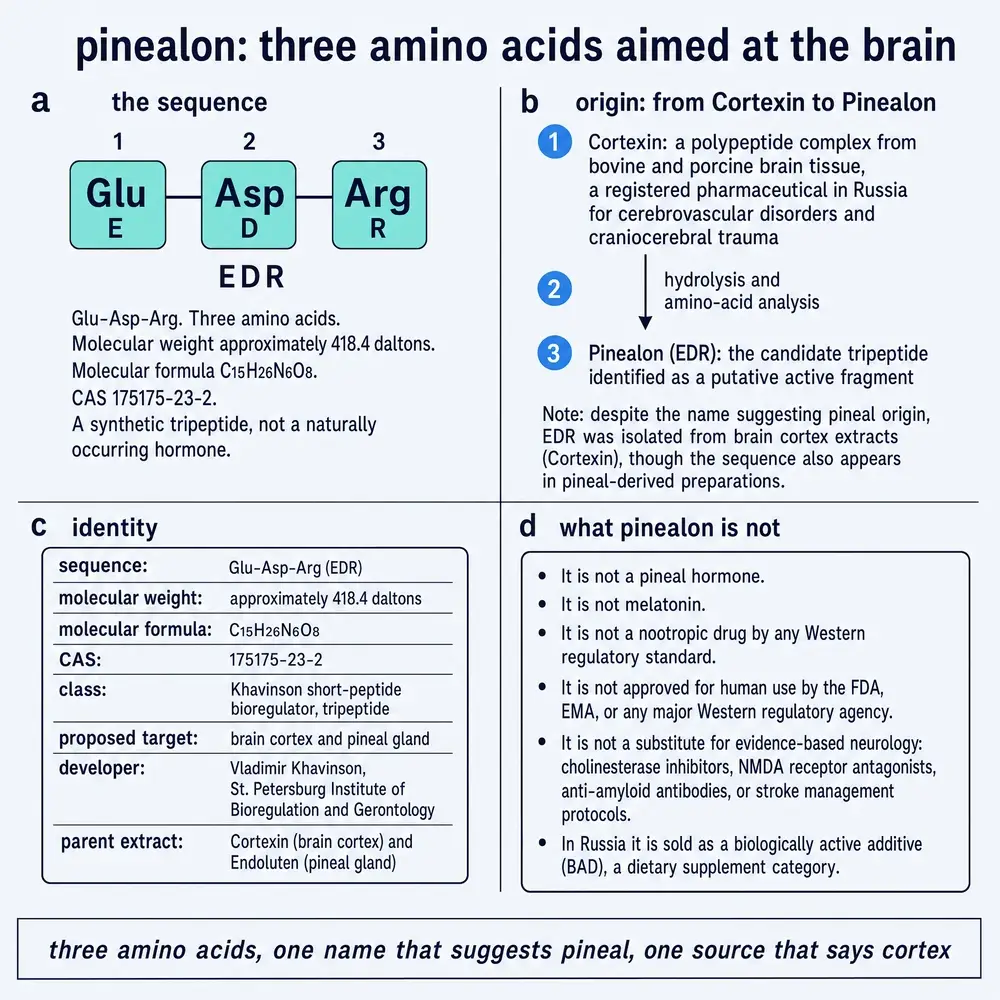
Pinealon is glutamate, aspartate, arginine — in that order, joined by two ordinary peptide bonds, and nothing else. Written in the one-letter code that biochemists use it is EDR, which is how a good deal of the literature refers to it. It weighs about 418 daltons. A molecule of table sugar weighs 342. At physiological pH it carries a net charge of roughly minus one, because the two acidic residues outweigh the single basic one (Khavinson et al., 2020).
Three residues is short even by the standards of this series. Insulin has fifty-one. The shortest peptide hormones the body makes on purpose run to three or four. At this length a peptide has almost no structure to speak of: it is a floppy string that samples a great many shapes per nanosecond. What makes EDR interesting is not a fold. It is the claim that a molecule this small can enter a cell nucleus, bind named stretches of DNA and named histone proteins, and change the expression of a short, coherent list of genes.
The compound answers to at least four names. Its originators called it Pinealon (and, in Cyrillic, пинеалон); the literature also calls it the EDR peptide, Glu-Asp-Arg, and occasionally pinealon peptide. The three-letter token EDR is a heavy homograph — endpoint detection and response, electrodermal response, estimated date of restitution, and several other expansions share it — and bare EDR is not treated as a hit anywhere in this monograph. The natural counterpart of the synthetic peptide is Cortexin, a cattle cerebral-cortex polypeptide extract registered in Russia in 1999. Cortexin is a different substance. Conflating the two is the central error this monograph exists to prevent.
02A stress programme and a meat-packing plant
In 1973, at the S. M. Kirov Military Medical Academy in Leningrad, two military physicians began looking for a way to make soldiers more durable. The problem, as they framed it, was not any particular disease. It was that personnel exposed to ionising radiation, toxic chemicals, injury, oxygen shortage and sustained stress became less able to cope with all of those at once. Vladimir Khavinson's own retrospective account of the programme, published in 2020, states its object plainly: to raise "the resource of the organism" of service members working under unfavourable conditions (Khavinson, 2020).
The theoretical basis was borrowed from the Hungarian-Canadian endocrinologist Hans Selye, whose general adaptation syndrome divided the body's response to stress into an alarm stage and then a resistance stage. During alarm, Selye had argued, two glands are suppressed: the thymus, which trains the immune system, and the pineal, a pea-sized structure at the centre of the brain that secretes melatonin at night. Resistance normally sets in around the fourth or fifth day. Vladimir Morozov and Vladimir Khavinson reasoned that if you could shorten the gap — if you could push the body into the resistance stage faster — you would have something useful. And the obvious way to do that, in 1973, was to give back what the alarm stage had suppressed: extracts of thymus and pineal gland.
This is where the story acquires its most concrete and least glamorous detail. The work was done jointly with the medical preparations factory of the Leningrad Meat-Packing Combine, an enterprise later reorganised as Samson-Med and still the manufacturer of several of the resulting products. The reason is straightforward: the raw material was cattle organs, and the meat combine was where cattle organs were. The extraction line Khavinson describes is an industrial one — acetic-acid extraction, centrifugation, precipitation of the low-molecular-weight fraction with acetone, redissolution, removal of ballast, and finally ultrafiltration through hollow fibres whose pores pass nothing above ten kilodaltons. What came off the end was a mixture of small peptides of unknown composition, standardised by molecular weight rather than by chemistry (Khavinson, 2020; Morozov and Khavinson, US patent 5,538,951, 1996).
In 1988 the programme was formalised: by decision of the USSR State Committee for Science and Technology, a dedicated bioregulator laboratory was established at the Military Medical Academy under Khavinson's direction. The first product, Thymalin, from thymus, was registered in 1982. The pineal preparation, Epithalamin, followed in 1990. The cerebral-cortex preparation, Cortexin, was registered in 1999 and is now manufactured by Geropharm of St Petersburg (Khavinson, 2020). None of these was a defined molecule. All three were extracts.
03From extract to sequence
By the late 1990s the programme had a second, sharper problem. The extracts worked in the sense that they had been registered and used, but a mixture of peptides of unknown composition is a poor object of molecular biology. Studying a mechanism requires a molecule. So the institute turned to chromatography–mass spectrometry and began fishing individual short sequences out of the extracts, establishing their amino-acid order, and synthesising them from free amino acids. The first success had been Thymogen (Glu-Trp), pulled out of Thymalin and registered in 1990. Epitalon (Ala-Glu-Asp-Gly) came out of Epithalamin. Vesugen (Lys-Glu-Asp) came out of a vascular extract. And from Cortexin, the cerebral-cortex preparation, the tripeptide Glu-Asp-Arg was identified and named Pinealon (Khavinson, 2020).
The Russian Federation patent that covers the peptide — RF 2301678, granted in 2007 to Khavinson, Grigoryev, Malinin and Ryzhak — describes it as a peptide that stimulates the regeneration of neurons of the central nervous system, and sets out a pharmaceutical composition and a method of use. The identification itself is reported in the 2020 programme review as the product of high-sensitivity chromatography–mass spectrometry applied to the Cortexin complex. The sequence was not inferred from an amino-acid tally, as Epitalon's was; it was read. That distinction matters for the reliability of the claim that the synthetic peptide is what the extract contained (Khavinson, 2020).
The programme's own account of what Pinealon does, summarised in that 2020 review, is already a list of the claims this monograph will weigh. In culture, the peptide is said to reduce neuronal apoptosis and raise serotonin synthesis in rat cerebral-cortex cells. In cultures of striatal neurons from YAC128 mice (a Huntington's model) and hippocampal neurons from PS1-M146V-KI mice (an Alzheimer's model), it is said to increase the number of dendritic spines. In animals it is said to raise cortical DOPA and dopamine and brainstem adrenaline, to protect against hyperhomocysteinemia, and to protect the fetal brain of a pregnant rat under hypoxia. In bees it is said to normalise memory formation; in a fruit-fly Parkinson's model it is said to raise locomotor activity; in rhesus monkeys it is said to cut learning time by about one and a half times. Molecular modelling is said to find two DNA binding sites, d(CCTGCC)2 and d(CCAGC)2, and contacts with several histones. That is a great deal of claim for three residues. The rest of this monograph takes each rung of that ladder in turn (Khavinson, 2020; Khavinson et al., 2020).
04The people and the programme
Vladimir Khatskelevich Khavinson (1946–2024) was the director of the St Petersburg Institute of Bioregulation and Gerontology, a corresponding member of the Russian Academy of Sciences, and the central figure of the programme that produced Pinealon. His collaborator from the beginning was Vladimir Grigorievich Morozov. The gerontologist Vladimir Anisimov, at the Petrov Research Institute of Oncology, supplied much of the ageing and carcinogenesis work on the pineal peptides. Later papers on Pinealon specifically carry the names of Natalia Linkova, Svetlana Trofimova, Anahit Arutjunyan, Alexander Mendzheritsky and others in the institute's orbit (Khavinson, 2020; Khavinson et al., 2021).
The single-source character of the record is not a secret and should not be treated as one. Of the seventeen scientific full texts that form the reading corpus of this monograph, the large majority have at least one author from the St Petersburg institute or a close collaborator. The freshest papers — the 2024 and 2025 induced-neuron studies — still carry institute affiliations. An outside laboratory has not, as of the compilation of this document, published an independent replication of the neuroprotective claim. That fact does not erase the mechanism work. It does set the weight that mechanism work can carry, and section 21 returns to it.
05Not a key in a lock
Most of the peptides in clinical use work the way a hormone works: they bind a receptor on the surface of a cell and start a signalling cascade. Insulin, GLP-1 agonists, growth-hormone-releasing peptides — all of them are keys in locks. The short-peptide bioregulators of the St Petersburg programme make a different claim. They are said to enter the cell, reach the nucleus, and bind DNA and histone proteins directly, thereby changing which genes are available for transcription. The claim is unusual enough that it needs to be stated plainly before any of the supporting measurements are introduced (Khavinson et al., 2021; Ilina et al., 2022).
Two things follow from that claim, and both shape how the evidence has to be read. First, if the peptide really does work by binding DNA, then its selectivity is a property of sequence complementarity rather than of receptor distribution. The programme's own language for this is "gene- and tissue-specific, not species-specific": the same short peptide is expected to find the same DNA sites in a plant, an insect, a rodent and a human, because the sites are written in the same alphabet. Second, if the peptide really does reach the nucleus, then a pharmacokinetic file that never measured nuclear concentration is missing the only compartment that matters. Neither of those consequences has been tested by an outside laboratory. Both are load-bearing for the interpretation that follows.
06Into the nucleus
Short peptides of this size are small enough, on paper, to pass a nuclear pore. Nucleopores have an internal diameter of about 42 nanometres and admit diffusing molecules up to roughly five kilodaltons; Pinealon weighs 0.42 kilodaltons and is on the order of a nanometre across. That is a steric argument, not a demonstration. The demonstration came in 2011, when Fedoreyeva, Khavinson and Vanyushin showed that FITC-labelled short peptides — including FITC-Glu-Asp-Arg — accumulate in the cytoplasm, the nucleus and the nucleolus of HeLa cells (Fedoreyeva et al., 2011). The same laboratory later showed that short peptides bind FITC-labelled wheat histones (Fedoreyeva et al., 2013).
A 2023 survey of twenty-six ultrashort peptides from the same programme examined their feasibility of transport via the LAT and PEPT amino-acid and peptide transporters. EDR was among the peptides modelled. The survey is an in-silico and transporter-feasibility study, not a measured brain concentration, and it is cited here for what it is: evidence that the programme has begun to ask the pharmacokinetic question that the earlier papers left open (Khavinson et al., 2023).
07Binding DNA and histones
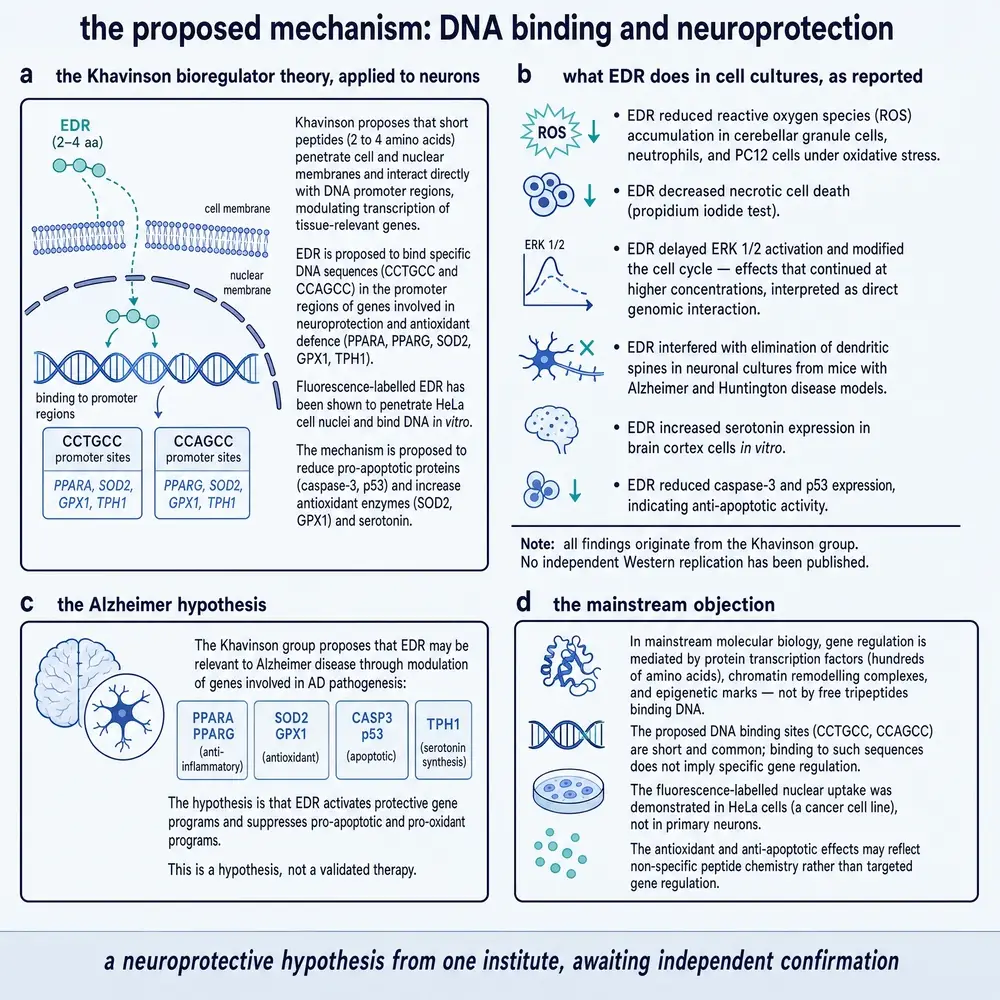
If the peptide reaches the nucleus, the next question is what it does there. Molecular modelling by the institute proposed two preferred binding sites in double-stranded DNA in the classical B-form: d(CCTGCC)2 and d(CCAGC)2. The contacts are drawn as a network of hydrogen bonds into the minor groove. Binding-site motifs with those sequences appear in the promoter regions of several genes the programme treats as Pinealon targets — among them PPARA, PPARG, SOD2, GPX1 and TPH1 (Khavinson et al., 2020; Khavinson et al., 2021).
The same peptide was shown, in a binding assay with FITC-labelled wheat histones, to interact with histones H1.1, H1.3, H1.6, H2b, H3 and H4 (Fedoreyeva et al., 2013; Khavinson, 2020). A 2019 physical-chemistry study of the Glu-Asp-Arg–DNA interaction examined the role of mono- and divalent ions in the complex and found that ionic conditions modulate the binding (Silanteva et al., 2019). The 2021 5xFAD paper added a further modelling observation: in the lowest-energy complexes of EDR and of the related tripeptide KED with hexanucleotide DNA, the two peptides sit in the same region of the minor groove but with their N- and C-termini reversed, and the DNA base-pair masks of those best complexes are identical. The authors take that as a hint that short peptides may recognise sequences of base pairs rather than of one strand alone (Khavinson et al., 2021).
08A short, coherent gene list
The genes the programme nominates as Pinealon targets are not a random sample of the genome. They form a short list that maps cleanly onto the pathogenesis of Alzheimer's disease as the 2020 English-language review draws it. SOD2 and GPX1 are antioxidant enzymes; CASP3 and TP53 are pro-apoptotic factors; PPARA and PPARG are transcription factors that restrain inflammatory gene expression and favour non-amyloidogenic processing of the amyloid precursor; TPH1 sits on the serotonin-synthesis pathway; NES, GAP43 and APOE are involved in neuronal differentiation, synaptic remodelling and lipid transport at synapses (Khavinson et al., 2020; Khavinson et al., 2021).
The list is coherent. Coherence is not the same thing as proof. The modelling work shows that the preferred DNA motifs appear in those promoters; the expression and activity work shows that some of the corresponding proteins move in the predicted direction under stress. An outside laboratory has not confirmed either half of that chain for Pinealon specifically. The 2024 review by Ilina on short peptides in Alzheimer's disease restates the same chain from inside the programme (Ilina, 2024).
09The timing result
One measurement in the mechanism literature is sharper than the rest. In cultures of rat cerebellar granule cells, the addition of homocysteine activates the ERK1/2 kinases within about two and a half minutes. When the same cells are exposed to homocysteine in the presence of the EDR peptide, the rise in the active forms of ERK1/2 is delayed to about twenty minutes. The peptide also lowers reactive-oxygen-species production under receptor-dependent (ouabain, homocysteine) and non-receptor (hydrogen peroxide) oxidative stress, and in zymosan-activated neutrophils (Khavinson et al., 2020, summarising earlier culture work including Khavinson et al., 2011).
Two further details from that culture work are worth keeping beside the timing result. The limitation of ROS accumulation and cell death occurred at lower concentrations of the peptide; higher concentrations modulated the cell cycle. And the peptide's effect on caspase-3 in whole animals is not unidirectional: in some aged-rat hypoxia models it lowered caspase-3 activity, while in others it activated the protease while holding the level of the active form at control. Context-dependence of that kind is a finding, not a contradiction, and it is reported as such in section 14.
10Gene- and tissue-specific, not species-specific
The programme's slogan for these peptides — gene- and tissue-specific, not species-specific — is doing real work in the argument. If the peptide binds DNA motifs that are conserved across kingdoms, then a result in a wheat histone assay, a HeLa cell, a bee, a fruit fly, a rat and a rhesus monkey can all be read as samples of the same mechanism. That is a strong claim. It licenses the wide ladder of evidence that Part Three lays out. It also makes the absence of an independent replication more costly, because the same laboratory is the source of every rung. The slogan is a hypothesis about how the molecule works. It is not a finding that the molecule works (Khavinson et al., 2021; Ilina et al., 2022).
11In the dish
The earliest functional claims for Pinealon are cell-culture claims. In rat cerebral-cortex neuron cultures the peptide raised serotonin expression (Khavinson et al., 2014). In a Rejuvenation Research paper of 2011 it increased cell viability and suppressed free-radical processes (Khavinson et al., 2011). In cerebellar granule-cell cultures it lowered reactive oxygen species under several oxidative stressors and delayed ERK1/2 activation under homocysteine, as already described. In the brains of hypoxia-sensitive rats, administration of the peptide raised SOD2 and GPx1 activity toward the levels seen in hypoxia-resistant animals (Khavinson et al., 2020). A separate culture study of bioregulatory tripeptides on rat skin cells places EDR in a broader tissue-repair neighbourhood without making a brain-specific claim (Voicekhovskaya et al., 2012).
These are consistent direction-of-effect findings from one laboratory. They establish that, under the conditions tested, the peptide moves antioxidant and serotonergic markers in the direction the gene-target list predicts. They do not establish a free concentration in brain, a half-life, or a dose that would produce the same movement in a living animal without the culture medium holding the concentration constant.
12Dendritic spines
The morphological claim that matters most for a neuroprotective reading is about dendritic spines. Spines are the small protrusions on neuronal dendrites where most excitatory synapses sit. Mushroom-shaped spines are the most stable and the most synaptic; they are sometimes called "memory spines." Thin spines are more plastic. In Alzheimer's disease and related synaptopathies, mushroom spines are preferentially lost.
In an in-vitro amyloid-synaptotoxicity model, the EDR peptide increased the number of mushroom spines by up to 71 percent in primary hippocampal cultures treated with Aβ42. In a Huntington's-disease culture model using medium spiny neurons from YAC128 mice, the peptide restored spine numbers. The same direction of effect was reported for the related tripeptide KED (Khavinson et al., 2017; Khavinson et al., 2021, citing the earlier culture work).
13The 5xFAD mouse
The strongest in-vivo morphological claim is the 2021 Pharmaceuticals paper on 5xFAD mice. Five-month-old animals carrying five familial Alzheimer's mutations were treated with EDR or KED peptide at 400 micrograms per kilogram intraperitoneally once daily for two months. The EDR peptide increased total dendritic-spine density in CA1 secondary dendrites by 11 percent (12.64 versus 11.31 spines per 10 micrometres) and restored density to the level of non-transgenic M-line controls. It did not, in the pooled analysis, significantly restore the mushroom-spine fraction; that restoration was the stronger finding for KED. Sex-stratified analysis changed the picture: in males, EDR raised spine density by 13 percent and mushroom spines by 25 percent, restoring both to control levels; in females, EDR raised density by 12 percent without restoring mushroom spines (Khavinson et al., 2021).
Two further points from that paper belong beside the spine numbers. First, long-term potentiation in hippocampal slices of untreated 5xFAD mice was itself only a trend toward impairment (p = 0.057 versus wild type), and the peptide effects on LTP were likewise trends. Second, the authors argue that EDR and KED can cross the blood–brain barrier by analogy with other neuroprotective tripeptides (GPE, RER, 5-oxo-PRP) that have been shown to do so, and by the fact that a systemic dose produced a hippocampal morphological effect. That is a reasonable inference. It is not a measured brain concentration (Khavinson et al., 2021).
14Hypoxia, homocysteine, the pregnant rat
A separate strand of animal work treats Pinealon as an antihypoxic and antistress peptide. Arutjunyan and colleagues reported that the peptide protected rat offspring from prenatal hyperhomocysteinemia, with improved resistance of cerebellar cells to oxidative stress (Arutjunyan et al., 2012). Kozina reported antihypoxic properties of short peptides including this one (Kozina, 2008). Mendzheritsky and colleagues published a series of papers on aged rats under hypoxia and hypothermia: the peptide altered cytokine content and caspase-3 activity in serum and brain, influenced maze learning, and — in combination with Cortexin — shifted behaviour and neurochemistry in 18-month-old animals (Mendzheritsky et al., 2011, 2013, 2014, 2015). A short-peptide pretreatment before carotid artery occlusion is also in that series.
15Bees, flies, monkeys
The programme's widest biological claim for Pinealon is that the same peptide acts across a remarkable phylogenetic range. In honeybees (Apis mellifera) it is reported to normalise the formation of memory. In a Drosophila melanogaster Parkinson's model it is reported to raise locomotor activity and to restore short-term memory in the Agnts3 mutant, possibly via reduced limk1 expression. In rhesus monkeys (Macaca mulatta), Kuznetsova and colleagues reported that the tripeptide shortened learning time by about 1.5 times and improved the stability of attention during a visual search for an informative feature (Khavinson, 2020; Kuznetsova et al., 2019). The monkey study is published in a Russian-language journal not indexed in PubMed; it was retrieved and read for this monograph and is listed among the sources without a PMID.
16The freshest work, 2024 to 2025
Recency is weighted in this monograph, but not blindly. The two most recent primary studies that touch Pinealon directly are a 2024 International Journal of Molecular Sciences paper on fibroblast-derived induced neurons from elderly donors, and a 2025 Current Issues in Molecular Biology paper on transdifferentiation of fetal mesenchymal stem cells. Both come from groups linked to the St Petersburg programme. Both are valuable precisely because they report what the peptide did not do as well as what it did (Kraskovskaya et al., 2024; Sakhenberg et al., 2025).
In the 2024 study, induced cortical neurons were generated by direct reprogramming of dermal fibroblasts from donors aged 61, 66 and 68, preserving age-related cellular features that induced pluripotent stem cells erase. After ten days of EDR at 10 micrograms per millilitre, oxidative DNA damage measured by 8-OHdG fell by 23 percent (to a value the authors describe as very close to significant, p = 0.0566). Primary dendrite number rose by 28 percent and total dendrite length by 46 percent. Mitochondrial membrane potential, lysosomal activity, p16 and lamin B1 did not move. The related peptides KED and AEDG produced similar morphological gains; AEDG's 8-OHdG effect was smaller (Kraskovskaya et al., 2024).
In the 2025 study, the same three peptides were applied to induced neurons derived from fetal MSCs. Here the geroprotective reading split. AEDG and KED lowered β-galactosidase activity (by roughly 2.4-fold and 1.5-fold) and KED lowered p21; EDR did not significantly change either senescence marker, and none of the three peptides raised the neuronal marker TUJ-1 or changed lamin B1. The honest reading of the two papers together is that EDR's most reproducible recent effect in human-cell systems is morphological — dendritogenesis — and that its geroprotective signature is weaker than that of KED or AEDG in the fetal-MSC model (Sakhenberg et al., 2025).
17The human observations
The human record for Pinealon is small, uncontrolled, and almost entirely Russian-language. It is reported here because it exists, and because the programme's own reviews treat it as part of the compound's story. It is not reported as evidence that the compound works in people under modern trial standards.
The 2020 English-language review states that oral administration of Pinealon in older patients improved memory, attention and cognitive function, accelerated perceptual-motor responses, raised mental performance and slowed central-nervous system ageing, citing earlier clinical series (Khavinson et al., 2020). A series of 72 patients with traumatic-brain injury consequences and cerebrasthenia is said to have shown improved memory, reduced headache duration and intensity, emotional balance and enhanced performance when oral EDR was added to standard therapy. In patients with long-term traumatic-brain-injury consequences, oral EDR reduced errors on a correction test and raised the α-index of brain bioelectric activity. Oral EDR plus standard therapy improved memory in 59.4 percent of patients with craniocerebral trauma in another series cited by the 2021 5xFAD paper (Khavinson et al., 2020, 2021).
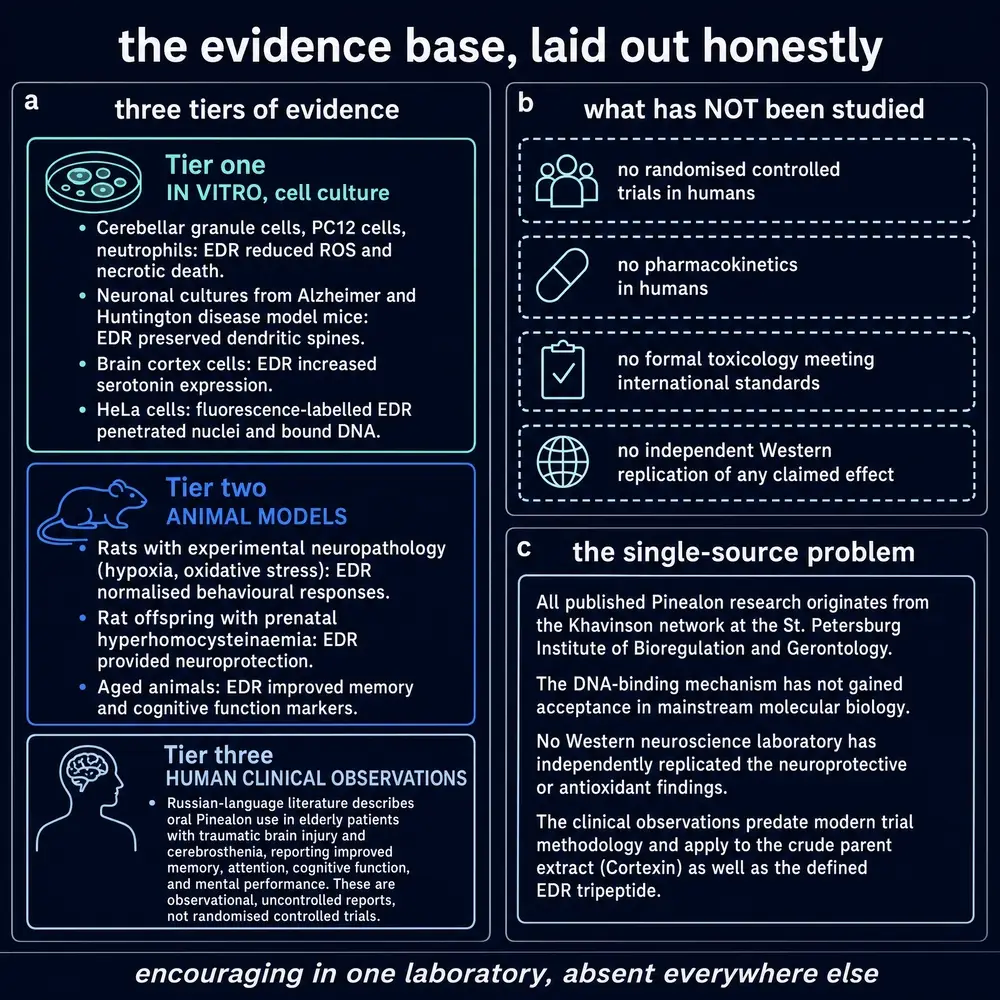
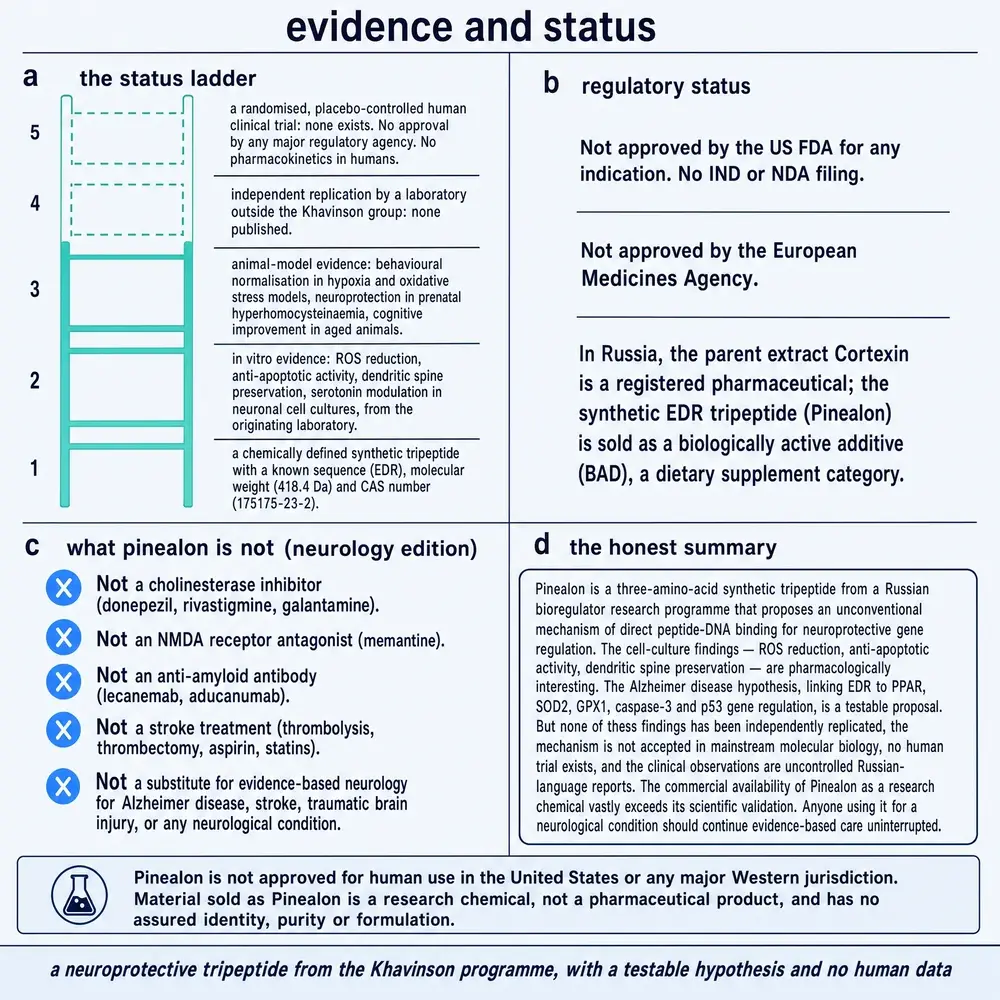
Bashkireva and colleagues published two papers on peptide correction of neurotic disorders and work-ability index among professional truck drivers; Meshchaninov and colleagues reported on synthetic peptides in patients with chronic organic brain syndrome. Umnov and colleagues reviewed neuroprotective peptide bioregulators across age groups. These papers sit in the Advances in Gerontology / Uspekhi Gerontologii literature and are uncontrolled or open-label observational series (Bashkireva et al., 2012, 2015; Meshchaninov et al., 2015; Umnov et al., 2013). A ClinicalTrials.gov query on 3 August 2026 for the interventions pinealon, Glu-Asp-Arg and EDR peptide returned zero registered interventional studies.
18Cortexin, the parent extract
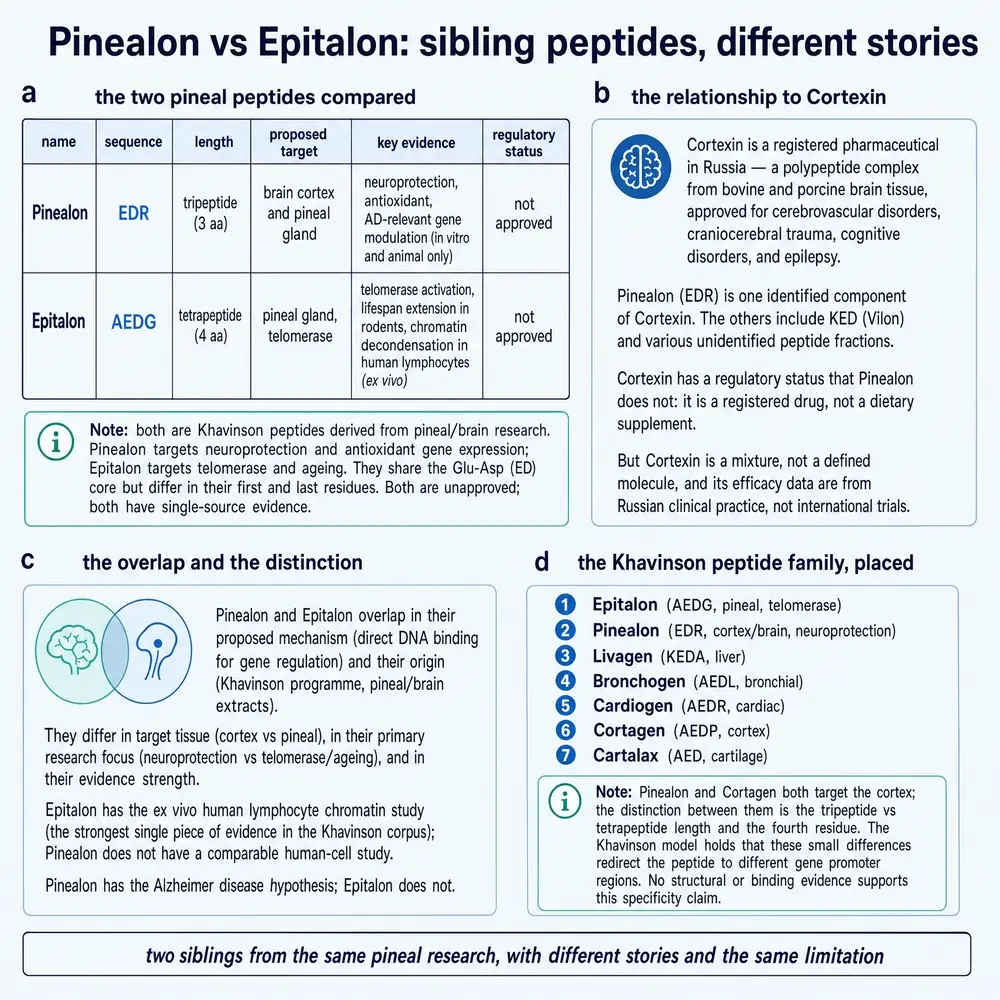
Cortexin is the substance Pinealon was read out of, and it is a different substance. It is a complex of peptides with molecular mass up to 10 kilodaltons, isolated from the cerebral cortex of cattle, registered in Russia in 1999 and now manufactured by Geropharm. A multicentre randomised double-blind placebo-controlled study in 272 patients with hemispheric ischaemic stroke reported safety and a statistically significant improvement in psychosomatic state versus control. That result belongs to Cortexin. It does not belong to Pinealon (Khavinson, 2020).
A 2018 ototoxicity study found that Cortexin protected against cisplatin-induced hearing damage in an animal model (Eroğlu et al., 2018). Combination studies of Pinealon plus Cortexin in aged rats under hypoxia exist and are cited above; where the two were given together, the result is attributed to the combination (Mendzheritsky et al., 2015). The house rule applied throughout this monograph is the same rule applied to Epithalon and Epithalamin in the sister monograph of this series: every result is attributed to the substance that was actually administered.
19The family around it
Pinealon sits in a small constellation of short peptides from the same programme. Epitalon (Ala-Glu-Asp-Gly) is the pineal tetrapeptide with the telomerase claim. Vesugen (Lys-Glu-Asp) is the vascular tripeptide that shared the 5xFAD spine study with EDR and, in that study, was the stronger restorer of mushroom spines. Cortagen (Ala-Glu-Asp-Pro) is a tetrapeptide designed from Cortexin's amino-acid composition rather than isolated from it. Thymogen (Glu-Trp) and Vilon (Lys-Glu) are the thymic pair. The consumer lines marketed by the programme and its licensees — Cytogens (including a PINEALON capsule aimed at the central nervous system) and Cytomaxes (including a CERLUTEN brain preparation) — are food-supplement and cosmeceutical products, not medicines, and are not evidence of pharmacology (Khavinson, 2020; GARMONIA leaflet, 2015).
A 2025 Acta Naturae paper on a Semax derivative that carries the Glu-Asp-Arg motif is worth a separate mention. Semax is a different peptide from a different Russian programme (a synthetic ACTH4–10 analogue). The derivative paper is not a Pinealon study; it is an outside touchpoint in which the EDR sequence appears as a designed motif in an Alzheimer's context (Radchenko et al., 2025). It is the closest thing the recent literature offers to an external use of the sequence, and it is still not an independent replication of the Pinealon claim.
20The market
Pinealon is not an approved medicine in any jurisdiction examined for this monograph. Cortexin is a registered medicine in Russia; Pinealon is not. The synthetic tripeptide is sold by research-chemical retailers, typically as a lyophilised vial, and by the programme's own consumer channels as a food-supplement capsule under the Cytogen brand. A 2026 orthopaedics-peptide review places short therapeutic peptides in a broader market context without treating Pinealon as a clinical product (Rahman et al., 2026). Research-use-only vendor pricing and catalogue captures from the Therapeutic Peptide Research Library (project 05) are held as an internal observation and are listed among the sources without a PMID. None of that market activity is evidence of pharmacology, safety or efficacy.
21The single-source problem
Almost every primary finding in this monograph comes from the St Petersburg Institute of Bioregulation and Gerontology or from laboratories working closely with it. That is not a hidden fact. It is the shape of the literature. The mechanism papers, the culture papers, the 5xFAD paper, the hypoxia series, the bee and fly and monkey reports, the human observational series, and the 2024 and 2025 induced-neuron papers all carry that orbit. The one recent outside touchpoint — a Semax derivative that happens to carry the Glu-Asp-Arg motif — is not a replication of the Pinealon claim (Radchenko et al., 2025).
Single-source literatures are not automatically wrong. They are automatically thinner than they look. A finding reproduced inside one programme is not the same kind of finding as a finding reproduced by a laboratory with no shared funding, no shared authorship and no shared incentive to confirm. The mechanism work in Part Two is detailed and internally consistent. The morphological work in Part Three is quantitative and, in the 5xFAD paper, sex-stratified. Neither has been confirmed from outside. That sentence is the weight-bearing sentence of this weighing.
22What is strong, what is thin
What is strong is the internal coherence of the mechanism and the repeated direction of morphological effect. A three-residue peptide that enters the nucleus, binds named DNA motifs and histones, delays a stress kinase, and raises dendritic-spine density in an Alzheimer's mouse is an interesting molecule whether or not it ever becomes a medicine. What is thin is everything that would turn that interest into a claim about a person: a free concentration in brain after a real route of administration, an outside laboratory confirming the spine or the gene-expression result, a randomised trial with a clinical endpoint. The human observations in section 17 do not fill that gap.
23Recency versus weight of evidence
The instruction under which this monograph was written is to give weight to recency and freshness of data so long as that is not contradicted by a preponderance of evidence. Applied here, that rule cuts both ways.
The 2024 and 2025 induced-neuron papers are the freshest primary work. They are given full weight, including the parts that are unwelcome: EDR's failure to move p21 and β-galactosidase in the 2025 fetal-MSC model, while KED and AEDG moved both. The 2021 5xFAD paper is the strongest in-vivo morphological study and is treated as current on spine density, including the sex difference and the non-significant LTP trend. The 2020 English-language mechanism review and the 2020 Russian-language programme review are treated as the best available maps of the claim, not as independent confirmations of it.
What recency does not license is treating a 2024 review that restates 2008–2015 primary studies as if it were new evidence. Publication recency is not evidence recency. The Ilina 2024 review on short peptides in Alzheimer's disease is a useful recent synthesis; the primary measurements it rests on are older, and they remain single-source (Ilina, 2024; Ilina et al., 2022). The same is true of the 2021 systematic review of peptide regulation of gene expression (Khavinson et al., 2021).
The missing denominator under all of this is pharmacokinetics. Every culture concentration and every intraperitoneal mouse dose in this monograph is a numerator without a measured free concentration in the compartment that the mechanism says matters — the neuronal nucleus. Until that denominator exists, concentration-dependent claims cannot be translated across systems.
24What would move the assessment
Three experiments would change the weight of this monograph, and none of them is exotic.
A pharmacokinetic study in one mammalian species, by the routes people actually discuss — oral and parenteral — would establish whether the molecule reaches plasma and brain in measurable amounts and for how long. It would give every concentration in Parts Two and Three a denominator.
An independent replication of the 5xFAD spine-density result, or of the ERK1/2 timing result, by a laboratory with no shared authorship or funding with the St Petersburg institute, would convert the strongest morphological and signalling claims from single-source findings into reproduced findings. That is a different tier of evidence.
A single properly randomised, blinded, placebo-controlled trial with a clinical endpoint in a defined human population would establish whether the compound does anything a person can feel or measure. No such trial has been registered. The observational series in section 17 are not a substitute.
Until those three exist, the honest verdict is the one this monograph opened with. Pinealon is a genuinely interesting molecule with a plausible, well-drawn mechanism and a consistent direction of morphological effect, resting on a thin, single-source foundation. Both halves of that sentence are true.
25Standing constraint
26References
Generated from verified NCBI records rather than from recall. Author lists, journal names, volumes, pages and identifiers are taken from the PubMed record for each citation, and every entry was checked against its title before the build was allowed to run. This series has twice shipped reference lists drafted from memory in which identifiers pointed at real but unrelated papers; the build refuses to run if any identifier is unresolved.
- Arutjunyan A, Kozina L, Stvolinskiy S, Bulygina Y, Mashkina A, Khavinson V. Pinealon protects the rat offspring from prenatal hyperhomocysteinemia. International journal of clinical and experimental medicine. 2012;5(2):179-85.
PMID 22567179 · PMC3342713 - Bashkireva AS, Artamonova VG. [The peptide correction of neurotic disorders among professional truck-drivers]. Advances in gerontology = Uspekhi gerontologii. 2012;25(4):718-28.
PMID 23734521 - Bashkireva AS, Kachan EY. [Assessment of work ability index in evaluation of small peptides geroprotective effect]. Advances in gerontology = Uspekhi gerontologii. 2015;28(3):510-512.
PMID 28509489 - Eroğlu O, Karlıdağ T, Kuloğlu T, Keleş E, Kaygusuz İ, Yalçın Ş. The Protective Effect of Cortexin on Cisplatin-Induced Ototoxicity. J Int Adv Otol. 2018;14(1):27-33.
PMID 29092803 · doi:10.5152/iao.2017.3825 · PMC6354512 - Fedoreyeva LI, Kireev II, Khavinson VKh, Vanyushin BF. Penetration of short fluorescence-labeled peptides into the nucleus in HeLa cells and in vitro specific interaction of the peptides with deoxyribooligonucleotides and DNA. Biochemistry. Biokhimiia. 2011;76(11):1210-9.
PMID 22117547 · doi:10.1134/S0006297911110022 - Fedoreyeva LI, Smirnova TA, Kolomijtseva GY, Khavinson VKh, Vanyushin BF. Interaction of short peptides with FITC-labeled wheat histones and their complexes with deoxyribooligonucleotides. Biochemistry. Biokhimiia. 2013;78(2):166-75.
PMID 23581987 · doi:10.1134/S0006297913020053 - Ilina A, Khavinson V, Linkova N, Petukhov M. Neuroepigenetic Mechanisms of Action of Ultrashort Peptides in Alzheimer's Disease. Int J Mol Sci. 2022;23(8).
PMID 35457077 · doi:10.3390/ijms23084259 · PMC9032300 - Ilina AR, Popovich IG, Ryzhak GA, Khavinson VK. [Prospects for use of short peptides in pharmacotherapeutic correction of Alzheimer's disease.]. Advances in gerontology = Uspekhi gerontologii. 2024;37(1-2):10-20.
PMID 38944767 - Khavinson V, Ribakova Y, Kulebiakin K, Vladychenskaya E, Kozina L, Arutjunyan A, et al.. Pinealon increases cell viability by suppression of free radical levels and activating proliferative processes. Rejuvenation research. 2011;14(5):535-41.
PMID 21978084 · doi:10.1089/rej.2011.1172 - Khavinson V, Linkova N, Kozhevnikova E, Trofimova S. EDR Peptide: Possible Mechanism of Gene Expression and Protein Synthesis Regulation Involved in the Pathogenesis of Alzheimer's Disease. Molecules (Basel, Switzerland). 2020;26(1).
PMID 33396470 · doi:10.3390/molecules26010159 · PMC7795577 - Khavinson V, Ilina A, Kraskovskaya N, Linkova N, Kolchina N, Mironova E, et al.. Neuroprotective Effects of Tripeptides-Epigenetic Regulators in Mouse Model of Alzheimer's Disease. Pharmaceuticals (Basel, Switzerland). 2021;14(6).
PMID 34071923 · doi:10.3390/ph14060515 · PMC8227791 - Khavinson VK, Popovich IG, Linkova NS, Mironova ES, Ilina AR. Peptide Regulation of Gene Expression: A Systematic Review. Molecules. 2021;26(22).
PMID 34834147 · doi:10.3390/molecules26227053 · PMC8619776 - Khavinson VK, Linkova NS, Rudskoy AI, Petukhov MG. Feasibility of Transport of 26 Biologically Active Ultrashort Peptides via LAT and PEPT Family Transporters. Biomolecules. 2023;13(3).
PMID 36979488 · doi:10.3390/biom13030552 · PMC10046148 - Khavinson VKh, Linkova NS, Chalisova NI, Dudkov AV, Koncevaya EA. Effect of short peptides on expression of signaling molecules in organotypic pineal cell culture. Bulletin of experimental biology and medicine. 2011;152(1):138-41.
PMID 22803060 · doi:10.1007/s10517-011-1473-y - Khavinson VKh, Lin'kova NS, Tarnovskaya SI, Umnov RS, Elashkina EV, Durnova AO. Short peptides stimulate serotonin expression in cells of brain cortex. Bulletin of experimental biology and medicine. 2014;157(1):77-80.
PMID 24909721 · doi:10.1007/s10517-014-2496-y - Khavinson VKh, Kuznik BI, Tarnovskaya SI, Lin'kova NS. Short Peptides and Telomere Length Regulator Hormone Irisin. Bulletin of experimental biology and medicine. 2016;160(3):347-9.
PMID 26742748 · doi:10.1007/s10517-016-3167-y - Kozina LS. [Investigation of antihypoxic properties of short peptides]. Advances in gerontology = Uspekhi gerontologii. 2008;21(1):61-7.
PMID 18546825 - Kozina LS, Arutiunian AV, Stvolinskiĭ SL, Khavinson VKh. [Biological activity of regulatory peptides in model experiments in vitro]. Advances in gerontology = Uspekhi gerontologii. 2008;21(1):68-73.
PMID 18546826 - Kraskovskaya N, Linkova N, Sakhenberg E, Krieger D, Polyakova V, Medvedev D, et al.. Short Peptides Protect Fibroblast-Derived Induced Neurons from Age-Related Changes. International journal of molecular sciences. 2024;25(21).
PMID 39518916 · doi:10.3390/ijms252111363 · PMC11546785 - Mendzheritski AM, Karantysh GV, Abramchuk VA, Ryzhak GA. [Effect of peptide geroprotectors on the navigation system learning and caspase-3 in brain structures in rats of different age]. Advances in gerontology = Uspekhi gerontologii. 2013;26(2):252-257.
PMID 28976148 - Mendzheritskiĭ AM, Karantysh GV, Ivonina KO. [Effects of introduction of short peptides before carotid artery occlusion on behaviour and caspase-3 activity in the brain of old rats]. Advances in gerontology = Uspekhi gerontologii. 2011;24(1):74-9.
PMID 21809624 - Mendzheritskiĭ AM, Karantysh GV, Ryzhak GA, Dem'ianenko SV. [Regulation of content of cytokines in blood serum and of caspase-3 activity in brains of old rats in model of sharp hypoxic hypoxia with Cortexin and Pinealon]. Advances in gerontology = Uspekhi gerontologii. 2014;27(1):94-7.
PMID 25051764 - Mendzheritsky AM, Karantysh GV, Ryzhak GA, Prokofiev VN. [Pinealon and Cortexin influence on behavior and neurochemical processes in 18-month aged rats within hypoxia and hypothermia]. Advances in gerontology = Uspekhi gerontologii. 2015;28(3):532-539.
PMID 28509493 - Meshchaninov VN, Tkachenko EL, Zharkov SV, Gavrilov IV, Katyreva IuE. [EFFECT OF SYNTHETIC PEPTIDES ON AGING OF PATIENTS WITH CHRONIC POLYMORBIDITY AND ORGANIC BRAIN SYNDROME OF THE CENTRAL NERVOUS SYSTEM IN REMISSION]. Advances in gerontology = Uspekhi gerontologii. 2015;28(1):62-7.
PMID 26390612 - Radchenko AI, Kuzubova EV, Apostol AA, Mitkevich VA, Andreeva LA, Limborska SA, et al.. The Potential of the Peptide Drug Semax and Its Derivative for Correcting Pathological Impairments in the Animal Model of Alzheimer's Disease. Acta Naturae. 2025;17(4):110-120.
PMID 41479572 · doi:10.32607/actanaturae.27808 · PMC12755871 - Rahman OF, Lee SJ, Seeds WA. Therapeutic Peptides in Orthopaedics: Applications, Challenges, and Future Directions. Journal of the American Academy of Orthopaedic Surgeons. Global research & reviews. 2026;10(1).
PMID 41490200 · doi:10.5435/JAAOSGlobal-D-25-00236 · PMC12753158 - Sakhenberg E, Linkova N, Kraskovskaya N, Krieger D, Polyakova V, Medvedev D, et al.. The Influence of Short Peptides on Cell Senescence and Neuronal Differentiation. Curr Issues Mol Biol. 2025;47(9).
PMID 41020860 · doi:10.3390/cimb47090739 · PMC12468822 - Silanteva IA, Komolkin AV, Morozova EA, Vorontsov-Velyaminov PN, Kasyanenko NA. Role of Mono- and Divalent Ions in Peptide Glu-Asp-Arg-DNA Interaction. The journal of physical chemistry. B. 2019;123(9):1896-1902.
PMID 30762356 · doi:10.1021/acs.jpcb.8b10359 - Umnov RS, Lin'kova NS, Khavinson VKh. [Neuroprotective effects of peptides bioregulators in people of various age]. Advances in gerontology = Uspekhi gerontologii. 2013;26(4):671-8.
PMID 24738258 - Voicekhovskaya MA, Chalisova NI, Kontsevaya EA, Ryzhak GA. Effect of bioregulatory tripeptides on the culture of skin cells from young and old rats. Bulletin of experimental biology and medicine. 2012;152(3):357-9.
PMID 22803085 · doi:10.1007/s10517-012-1527-9
Sources without a PubMed record
A Russian-language programme review that is not indexed in PubMed, a Huntington's-model paper in a non-indexed journal, a rhesus-monkey cognition study, the programme patent, a ClinicalTrials.gov registry query, and producer and market observations. Each was retrieved and read in full.
- Khavinson VKh. Peptide medicines: past, present, future [Lekarstvennye peptidnye preparaty: proshloe, nastoyashchee, budushchee]. Klinicheskaya Meditsina. 2020;98(3):165-177. In Russian; not indexed in PubMed. Names the tripeptide Glu-Asp-Arg identified in the cortex peptide complex and designated Pinealon.
https://doi.org/10.30629/0023-2149-2020-98-3-165-177 - Khavinson V, Linkova N, Kukanova E, Bolshakova A, Gainullina A, Tendler S, et al. Neuroprotective effect of EDR peptide in mouse model of Huntington's disease. Journal of Neurology and Neuroscience. 2017;8(1):166. Not indexed in PubMed.
- Kuznetsova TG, Golubeva IYu, Trofimova SV, Khavinson VKh, Shuvaev VT. The influence of the Pinealon tripeptide on the rehabilitation of cognitive functions in the aging process using the example of rhesus monkeys (Macaca mulatta). Vestnik Moskovskogo Universiteta. In Russian; not indexed in PubMed.
- Morozov VG, Khavinson VKh (inventors). Pharmaceutical preparation for the therapy of immune deficiency conditions. United States patent US 5,538,951. Granted 23 July 1996. The cytomedine (tissue peptide-complex) platform from which the short peptides were later derived.
https://patents.google.com/patent/US5538951A/en - United States National Library of Medicine. ClinicalTrials.gov. Registry queried 3 August 2026 for the interventions pinealon, Glu-Asp-Arg and EDR peptide: zero registered interventional studies.
https://clinicaltrials.gov/ - GARMONIA / Peptide Bioregulator programme (St Petersburg Institute of Bioregulation and Gerontology). Research-grade short-peptide preparations, including the Glu-Asp-Arg tripeptide, as supplied for the cited experimental studies. Producer information.
- South Beach Longevity. Research-use-only peptide market survey, vendor pricing and catalogue capture, project 05 (Therapeutic Peptide Research Library), observations of 2025-2026: Pinealon offered by multiple research-chemical retailers, typically as a 20 mg lyophilised vial. Internal dataset.
27How this document was assembled
The corpus was built by an eight-stage pipeline against project 05, the Therapeutic Peptide Research Library. Every file with a document extension in the project's document stores was opened and its extracted text searched for explicit mentions of the compound. Two identity traps were handled before any reading began. Bare EDR was rejected on its own, because it is one of the most overloaded three-letter tokens in the literature — endpoint detection and response, electrodermal response, estimated date of restitution, and many more — and the full-text sweep returns thousands of them; the token had to sit beside the word peptide, or be written as the explicit sequence Glu-Asp-Arg. Bare Glu-Asp-Arg was itself gated on Khavinson-programme neighbourhood terms, because the tripeptide motif occurs by chance in innumerable proteins. And Cortexin was admitted but counted separately, because it is a different substance and conflating the extract with the synthetic peptide is the central error this monograph exists to correct.
That sweep opened 45,962 files and returned 194 raw matches, which collapsed to 182 after de-duplication. Classifying those by kind of source is the step that matters: only 7 were peer-reviewed scientific full texts. The remainder were vendor catalogue material, consumer web content captured for style training, bulk acquisition files and internal working documents. That ratio, roughly 25 to one, is itself a finding about how this compound is documented.
Because the local snapshot held so little primary science, the pipeline queried NCBI directly by two routes. A PubMed harvest returned 49 indexed records. PubMed indexes titles, abstracts and MeSH terms only, so a second stage searched PubMed Central's full text: 427 matches, of which 417 were invisible to the first route. Every fetched document was then scored by explicit mention count under the homograph-aware rules above, and those naming the compound only once or twice — typically a single row in a table of geroprotective agents — were excluded: 12 substantive against 405 passing mentions. Merging the local and fetched sets by identifier rather than by adding their totals gives the reading corpus this monograph is written from: 17 unique scientific full texts, roughly 179 printed-page equivalents, together with the complete 49-record metadata layer.
| Stage | What it does | Result |
|---|---|---|
| 01b | Targeted scan of the project's document stores | 45,962 files opened |
| 02 | PubMed E-utilities harvest, complete publication record | 49 records |
| 02b | PubMed Central full-text search | 427 matches |
| 03 | Open-access full-text retrieval of the union | 417 fetched |
| 03b | Substantive-use screen on the body-text sweep | 12 kept, 405 dropped |
| 04 | De-duplication, classification, keyed merge | 17 unique |
| 05 | Reference list generation from verified records | 30 citations |
| 06 | Assembly of this document | 20 figures |
Three traps are worth recording, because each has produced a published error in this series. A PubMed article record contains reference and comment lists that are themselves full of identifier nodes belonging to other papers; parsing them without scoping each lookup to the article's own subtree silently assigns a bibliography entry's identifiers to the article being read. Raw match counts flatter a corpus badly — here they overstated the scientific evidence base by roughly an order of magnitude once commercial snapshots were removed. And a merged corpus total must be keyed rather than summed, or every document held locally and fetched again is counted twice. All three are guarded against in the pipeline rather than in review.
28Evidence handling
Findings in this document are labelled by the kind of study that produced them. Uncontrolled human series, animal experiments, cell and tissue measurements and computer simulations are different kinds of claim, and the difference is stated in the sentence that reports the result rather than left to the reader to infer. Animal and in-vitro findings are never phrased so as to imply a human outcome, and the species is named every time.
One rule is particular to this compound and is applied without exception: Cortexin and Pinealon are treated as separate substances. Cortexin is a cattle cerebral-cortex peptide extract; Pinealon is a synthetic tripeptide identified inside it. Every result is attributed to the substance that was actually administered. Where a claim about the tripeptide rests on evidence from the extract, that is stated in place rather than corrected quietly. Bare EDR is never treated as a hit on its own.
Recency is weighted, but not blindly. A newer finding takes precedence over an older one unless a preponderance of evidence contradicts it. That rule cuts both ways here. The 2024 and 2025 induced-neuron papers are the most important recent findings and are given full weight, including the part of the 2025 paper in which EDR failed to move senescence markers that KED and AEDG moved. The 2020–2024 review layer is treated as current on the shape of the claim, while its pharmacological assertions are traced back to the primary studies they rest on. Recency of publication is not recency of evidence.
Where evidence conflicts, both sides are given, and the reason one does or does not supersede the other is stated. Where an effect appears only at some concentrations, that boundary is reported with the effect. Where a widely repeated claim is not supported by the primary record — an independent replication of the neuroprotection, a pharmacokinetic file, a registered clinical trial — it is named as absent rather than quietly omitted.
Continue exploring