
Prostamax Lys‑Glu‑Asp‑Pro — a four-residue peptide with a market, a patent, and almost no literature
A tetrapeptide designed in 2001 to replace a bovine prostate extract, sold internationally at ninety-nine per cent purity, and supported by two rat studies, four chromatin experiments in cultured human lymphocytes, one docking calculation, and the patent that created it. This document reads all of it.
01Research summary — the five-minute read
Prostamax is a trade designation for a single synthetic peptide four amino acids long: lysine, glutamic acid, aspartic acid, proline, written KEDP in the one-letter code and Lys‑Glu‑Asp‑Pro in the three-letter one. It weighs 487.5 daltons, carries the formula C20H33N5O9, and is registered in PubChem as compound 9848296[36]. It was patented in Russia on 25 January 2001 by Vladimir Khavinson, Vladimir Malinin and Evgeny Grigoriev of the St Petersburg Institute of Bioregulation and Gerontology, and the European member of that family was granted in August 2004[15, 17].
It belongs to a class its own literature calls peptide bioregulators: very short peptides, usually two to four residues, that are said to act not by binding a receptor on the cell surface but by entering the cell, reaching the nucleus, and contacting DNA directly[20]. That claim is unusual enough that section 02 is given over to explaining it before any evidence is weighed, because a reader who assumes this molecule works the way a drug works will misread everything that follows.
The compound was not discovered. It was designed, and it was designed against a specific object: prostatilen, a water-soluble polypeptide complex extracted from the prostate glands of mature bulls, which had been in clinical use in the Soviet Union and then Russia since about 1991[43]. The patent that created Prostamax names the extract as its prototype and gives its reasons for replacing it — complicated technology, low yield, unstable physicochemical properties and possible allergenicity[17]. Keeping the extract and the molecule apart is the single most important discipline for reading this literature, and section 05 is devoted to it.
What has actually been done with the compound is quickly stated. Inside the founding patent there are eight experiments: acute toxicity in 78 mice, subacute toxicity in 48 rats over ninety days, chronic toxicity in 56 rats over six months, a chick-embryo bladder explant assay, a bacterial prostatitis model in 41 rats, an antioxidant study in 18 rats aged twenty-four months, and two uncontrolled clinical series in a combined total of 54 men[17]. Outside the patent there are two primary animal studies, both from the Goldberg Research Institute of Pharmacology in Tomsk: a chronic aseptic prostatitis model in 60 Wistar rats[9] and a sulpiride-induced benign prostatic hyperplasia model in 40 Wistar rats[10]. There are four experiments on cultured human lymphocytes from elderly donors, all from one laboratory in Tbilisi working with the St Petersburg institute[11, 24, 30, 32]. There is one organotypic tissue-culture study that tested the compound against three of its siblings[44]. And there is one molecular-docking calculation in which it appears among twenty-six short peptides[23]. That is the entire primary record.
The two rat studies both report positive results. In the prostatitis model, the area occupied by collagen fibres fell more than two-and-a-half-fold against the untreated operated control, and the acinar epithelial area was preserved at the level of unoperated animals, which neither of the two marketed comparator products achieved[9]. In the hyperplasia model, the mass of the lateral prostate lobe fell 24 per cent against the sulpiride-only control, the weight coefficient 25 per cent and the volume 40 per cent, none of which the Serenoa repens comparator produced, while both agents reduced acinar epithelial area by roughly the same amount[10]. Those are real results in a recognised model[41], and they are the strongest evidence the compound has.
They are also unreplicated, from a single institute, with a co-author from the commercial sponsor on the first paper, published in a journal that PubMed does not index — and the two papers state intramuscular doses that differ by a factor of one thousand for the same compound. Section 15 sets that discrepancy out rather than quietly picking one.
In human cells, the measurable effects are structural rather than clinical. Lymphocytes taken from donors in their late seventies and eighties and cultured with the peptide showed more sister-chromatid exchange, more silver-stained nucleolar organiser regions, and altered chromatin melting behaviour — changes the authors read as decondensation of the heterochromatin that accumulates with age[11, 24]. In human patients there is nothing outside the patent's own two series, which were unblinded, compared against “conventional methods”, and reported by the applicant[17]. No trial of this compound is registered on ClinicalTrials.gov under any of its names[42].
The mechanism remains a claim rather than a finding. The class asserts a four-step chain: reach the cell, cross the membrane through a peptide transporter, enter the nucleus and bind DNA, change transcription. For this particular peptide, step one is trivially satisfied, step two has been predicted by docking and never measured, step three has been demonstrated only for other members of the family, and step four has been observed as a change in chromatin structure without a single gene ever being named. The docking study that addresses step two is worth reading closely: the compound scores second of twenty-six at the intestinal peptide transporter PEPT1, better than every reference inhibitor tested, and last of twenty-six at the amino-acid transporter LAT2 — while the same paper's discussion lists it among LAT2's most effective ligands[23]. Section 18 sets the table against the text.
Nothing is known about what the molecule does after it is injected. There is no absorption study, no distribution study, no half-life, no clearance figure, no metabolite identification, in any language reachable from here. Section 13 says so and stops, rather than filling the space with generalities about tetrapeptides.
Meanwhile the compound has a market. Certificates of analysis from three vendors and two laboratories report purities between 99.41 and 99.98 per cent by chromatography, with identity confirmed by retention time against a reference standard[37]. None of them sequences the peptide. That gap matters more here than it would for most compounds, because the sequence Lys‑Glu‑Asp is itself a marketed peptide sold under a different name, and it is a strict prefix of this one.
An educational research monograph. It reports what has been published about a compound and how much weight that published work can carry. It does not recommend that anyone use this or any other substance, it specifies no dose, route or schedule for any person, and it is not medical advice. Doses appear only where a study administered them, always attributed to that study and always as an experimental parameter.
Where the evidence is thin, this document says so and stops. There is more of that here than in most monographs in this series, and it is the most useful thing it has to report.
02What a bioregulator is, and why the word matters
Most of the compounds in this series can be explained in one sentence borrowed from pharmacology. A molecule arrives at a cell, fits into a receptor on its surface the way a key fits a lock, and the receptor sets off a cascade inside. Change the molecule's shape and the fit changes; block the receptor and the effect disappears. The whole framework — affinity, potency, agonism, antagonism, dose–response — follows from that picture, and so does the way such compounds are tested.
The literature on Prostamax does not use that framework, and it is important to understand this before the evidence starts, because the difference is not that this compound is a weaker receptor ligand. It is that its own literature makes a different kind of claim about it.
The claim runs roughly as follows. Short peptides — two to seven amino acids, sometimes called ultrashort peptides in the more recent literature — are small enough and stable enough to be taken up by cells, to reach the nucleus, and to make contact with double-stranded DNA directly. The contact is said to be sequence-specific: a particular peptide prefers a particular run of bases, in the way a transcription factor does, and by settling into the major groove it changes how tightly the local chromatin is packed and therefore which genes can be read. The effect is claimed at concentrations far below those at which classical drugs work — nanograms per millilitre, and in the organotypic experiments, hundredths of a nanogram — and it is claimed to be tissue-specific, with each peptide acting on the organ from which its parent extract was taken[18, 20].
The vocabulary has a history worth knowing. The programme's first-generation preparations were named cytomedines, from the Greek for cell and the Latin for intermediary — substances that carry information between cells of the same tissue. They were not synthesised; they were extracted from the organs of young cattle and pigs, purified as a low-molecular-weight peptide fraction, and named after the organ they came from. The second generation — the one Prostamax belongs to — consists of short synthetic sequences said to reproduce the active core of a particular cytomedine[34].
Two things about this claim deserve to be stated plainly, and stated here rather than buried in a caveat two-thirds of the way through.
The first is that it is not a fringe claim in the sense of being untested. There is a real body of physical chemistry behind the DNA-binding half of it. Short peptides of this family have been shown to change the melting temperature of synthetic DNA duplexes, to produce hyperchromic shifts consistent with local strand separation, and to do so with energies of interaction that were calculated residue by residue against the nucleotide bases[25, 26]. A 2015 review in the International Journal of Biological Macromolecules placed that work in the wider literature on how amino acids, peptides and proteins interact with DNA[40]. Whatever one concludes about the biology, the physical observation that these molecules bind DNA duplexes is not invented.
The second is that “bioregulator” is not a pharmacological classification recognised outside this literature. It appears in no regulatory nomenclature, corresponds to no mechanism class in the standard references, and carries no agreed criteria for membership. Within the programme it is a coherent research concept with fifty years of publications behind it. Outside it, the word does no work: it does not tell a reader what the molecule binds, how strongly, or what would happen if it did not. When a vendor page or a review describes a compound as a bioregulator, that is a statement about which research tradition the compound comes from, not a statement about what it does.
The practical consequence for this document is the standard of proof it applies. A receptor claim can be falsified in an afternoon: block the receptor and see whether the effect survives. The bioregulator claim, as currently stated, cannot. No gene has been named for this compound. No promoter has been identified. No experiment has been published in which entry into a cell was prevented and the effect disappeared. That is not an argument that the claim is false. It is an argument that the claim has not yet been put in a form that could be shown to be false, and until it is, positive results in whole animals have to be read as observations about outcomes rather than as confirmations of mechanism.
03Identity, nomenclature, and the record that settles the sequence
Establishing what a compound is ought to be the easy part of a monograph. For this one it takes a section, for two reasons: the trade name is shared with an unrelated product, and the sequence is contained inside the sequence of a sibling peptide sold under a different name.
Start with what is certain. PubChem holds the compound as CID 9848296, with the sequence Lys‑Glu‑Asp‑Pro, the molecular formula C20H33N5O9, an average mass of 487.5 daltons, and the InChIKey WUCUNGRTSFLCLI‑XUXIUFHCSA‑N[36]. The InChIKey is the useful identifier here: it encodes the full connectivity and the stereochemistry, so two records carrying the same key are the same molecule regardless of what either calls it.
The independent confirmation comes from an unexpected direction. In 2014 a group at the Goldberg Research Institute of Pharmacology in Tomsk published a rat study whose title is, in effect, the identification: “Experimental Study of Efficiency of Tetrapeptide Lysil‑Glutamyl‑Aspartyl‑Proline Using the Model of Benign Prostatic Hyperplasia”. Its introduction states that “a new medication Prostamaks is obtained by the method of peptide synthesis” and that it is a tetrapeptide[10]. The companion paper from the year before names the compound Prostamax and cites the Russian patent number directly[9]. Two independent routes — a structural database and a primary experimental paper — therefore give the same answer, and the patent[15] closes the loop by claiming exactly that sequence.
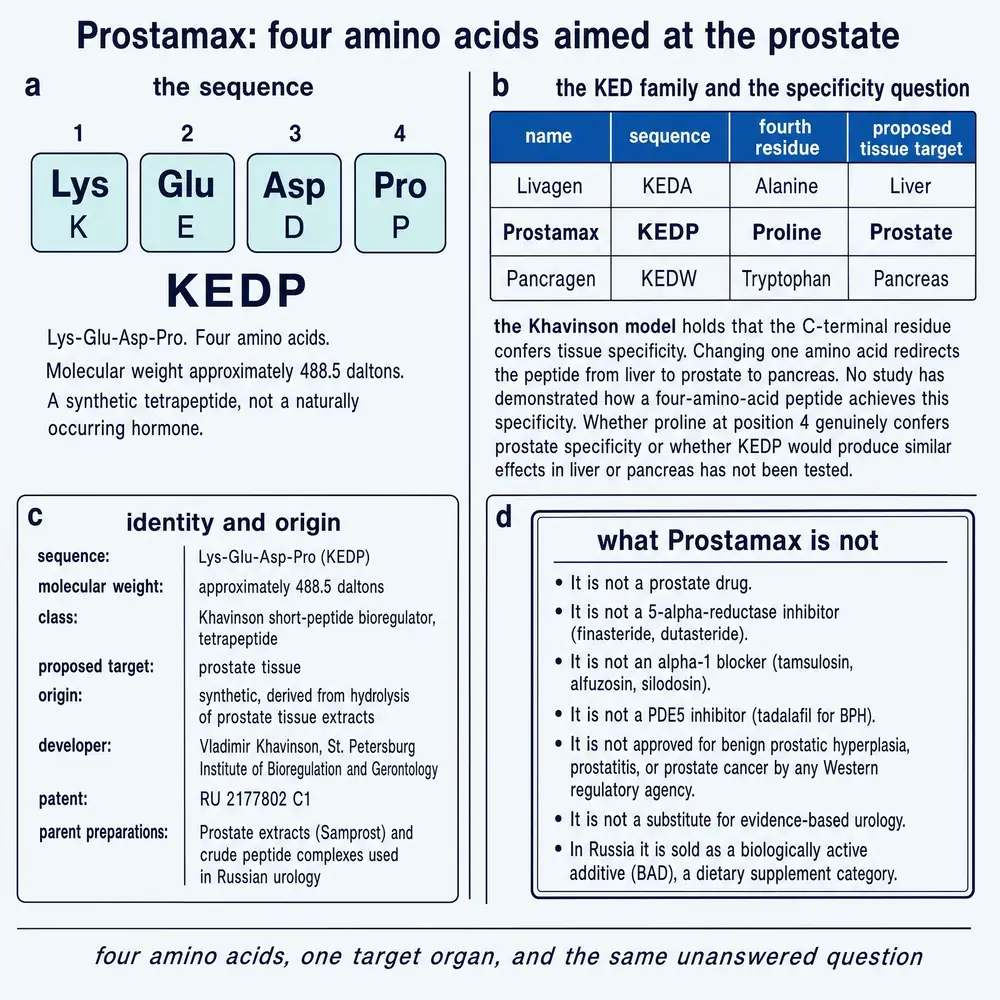
The trade-name collision
A web search for the name returns two different things. One is the peptide described here. The other is a herbal prostate supplement sold in several countries under the same or a nearly identical name, containing saw palmetto, pumpkin seed and zinc, with no peptide in it at all. Neither product is obliged to consider the other. The consequence for research is that a bare product name is not an identifier: a certificate of analysis, a customer review or a forum post naming “Prostamax” may be about either object, and only a sequence, formula or InChIKey settles which.
The prefix problem
The second hazard is structural rather than commercial. Designations in this family are built by extending a shared stem. Vilon is Lys‑Glu. Vesugen is Lys‑Glu‑Asp. Prostamax is Lys‑Glu‑Asp with a proline added. Livagen is the same three residues with an alanine. Testagen is the same three with a glycine. Each shorter member's sequence is therefore a strict prefix of the longer ones, which means that a text search for one of them matches all of them, and a supplier who has mislabelled a vial cannot be caught by the kind of identity test that certificates of analysis actually run.
The table above also contains a curiosity that anyone reading this literature will meet within an hour. Cardiogen and Epithalon are both written Ala‑Glu‑Asp‑Gly. They are the same four residues in the same order, named for the heart and the pineal gland respectively, and the class literature treats them as one peptide reported under two designations. Whatever one makes of that, it is a warning: in this family, the name is not the molecule.
Synonyms and identifiers
| Field | Value | Source and status |
|---|---|---|
| Preferred designation | Prostamax | Trade name; also transliterated Prostamaks |
| Sequence | Lys-Glu-Asp-Pro | Patent claim 1; PubChem; confirmed by the 2014 study's title |
| One-letter code | KEDP | Used throughout the docking literature |
| Molecular formula | C20H33N5O9 | PubChem CID 9848296; matches every certificate of analysis held |
| Average mass | 487.5 Da | PubChem; computed |
| InChIKey | WUCUNGRTSFLCLI-XUXIUFHCSA-N | PubChem; computed from structure |
| PubChem CID | 9848296 | Database record |
| CAS number | 2259884-03-0 | Given on one vendor certificate only; absent from the PubChem record and not independently verified here |
| Local catalogue identifier | P217 | South Beach Longevity library |
| Natural counterpart | Prostatilen (bovine prostate extract) | Named as the prototype in the founding patent |
The CAS row is the one to treat carefully. A registry number that appears on a single commercial document, is absent from the compound's own database record, and could not be confirmed against a primary registry search here is a claim about identity, not a verification of it.
04Physical and chemical properties
Almost everything known about this molecule's physical behaviour comes from eleven lines in the analytical section of a patent. That is not a criticism of the patent, which is unusually detailed for the genre. It is a description of the state of the record, and the table below is organised to make the distinction visible: what was measured, what was computed, and what is simply absent.
| Property | Value | How it is known |
|---|---|---|
| Appearance | White lyophilised powder | Reported on every certificate of analysis held |
| Amino acid analysis | Lys 0.98 · Glu 1.01 · Asp 1.01 · Pro 1.00 | Measured; patent, finished product |
| Peptide content | 98.56% | Measured by HPLC at 220 nm; patent |
| Thin-layer chromatography | Rf 0.61 | Measured; silica gel, acetonitrile–water 1:1; patent |
| Specific rotation | [α]D23 −69.2° | Measured at c = 1.04 in water; patent |
| Moisture content | 6% | Measured gravimetrically; patent |
| pH of 0.001% solution | 5.55 | Measured; patent |
| Formulation used in studies | 10 µg per ml in 0.9% saline | The patent's stated preparation for its own experiments |
| Molecular formula and mass | C20H33N5O9, 487.5 Da | Computed from structure; PubChem |
| Aqueous solubility | Not reported | No published figure found |
| pKa, logP, logD | Not reported | No published figure found |
| Stability, degradation, storage | Not reported | No stability study found in any language reachable here |
| Salt form as marketed | Commonly acetate | Inferred from the acetate ion-pair chromatography in the patent and from certificate notes; not verified on a marketed lot |
Three of those numbers repay a moment's attention.
The specific rotation of −69.2° is the closest thing the record has to a stereochemical fingerprint. A peptide built from L-amino acids rotates plane-polarised light in a characteristic direction and by a characteristic amount; a batch synthesised carelessly, with racemisation at one of the chiral centres, would not give the same figure. It is also the one property in the table that no modern certificate of analysis reports, which means that the purity figures quoted by vendors — all above 99 per cent — do not speak to it.
The pH of 5.55 at a hundredth of a per cent tells you something about the molecule's charge state. With a lysine side chain that is protonated at neutral pH and two carboxylates that are deprotonated, the peptide is a zwitterion with a net negative charge in solution. That is why it dissolves readily in saline and why it will not diffuse across a lipid bilayer on its own — which is exactly why the question of how it enters cells, taken up in section 10, is not a technicality.
And the moisture content of 6 per cent is a reminder that a lyophilised peptide is not a dry solid in the ordinary sense. Six per cent by mass of water in the vial means that a stated quantity of powder contains correspondingly less peptide, which is one of several reasons why weights reported for material of this kind should be read as nominal.
What is missing from the table is more consequential than what is in it. There is no solubility figure, no partition coefficient, no ionisation constant, no stability study, and no forced-degradation work. For a compound in research use those are inconveniences. For a compound presented as a pharmaceutical they would be disqualifying omissions, and the fact that they have gone unfilled for twenty-five years is itself a finding about how much serious pharmaceutical development this molecule has attracted.
05Prostatilen: the natural counterpart
This is the section that decides whether the rest of the document is read correctly, so it is worth being blunt about its purpose. There exist two different prostate-derived products with overlapping names, an overlapping research tradition, the same institutional origin, and completely different evidence. Conflating them is the commonest error in the secondary literature on this compound, and it is an error that always runs in the same direction: the older, larger clinical record of the extract gets borrowed for the newer, thinner record of the peptide.
What prostatilen is
Prostatilen is a water-soluble polypeptide complex isolated from the prostate glands of mature bulls. It is not a single molecule. It is a mixture, obtained by extraction and fractionation, whose exact composition varies with the starting material and the process. It entered clinical use in the Soviet Union around 1991, and the earliest indexed reports describe its use in men with prostate disease and with chronic prostatitis[13, 43]. It has been studied since in benign prostatic hyperplasia and in prostatic adenoma[1, 2], in an animal model of hyperplasia where its effect on the balance between oxidants and antioxidants in prostate tissue was measured[5], and, in a zinc-containing suppository formulation, in an experimental prostatitis model in rats[39]. The tradition remains active: a 2026 paper in Urologiia reports on prostate-derived complex peptide preparations and erectile function[7]. In total the PubMed record holds around thirty entries for the extract against six for the peptide.
What the patent says about it
The relationship between the two is not a matter of inference. The founding patent names prostatilen explicitly as the prototype — the closest prior art — and then explains why a replacement was wanted. The extract's production technology was complicated and its yield low; its physicochemical properties varied between batches; and, being a heterologous protein preparation from cattle, it carried a risk of allergic reaction[17]. The tetrapeptide was designed as the answer to those three problems: a defined single molecule, made by chemical synthesis, with no bovine material in the finished product.
That is a perfectly reasonable pharmaceutical rationale, and it is worth saying so. It is also the precise reason why the extract's evidence cannot transfer. The two objects were separated deliberately.
The safety asymmetry
The comparison becomes sharper on safety, and in a direction that most readers will not expect.
In 1992 a group publishing in Genetika tested prostatilen in mice using two standard genotoxicity assays: sperm-head anomalies and chromosome aberrations in bone-marrow cells. At an intraperitoneal dose of 2.5 micrograms neither endpoint moved. At 5 micrograms both did[33]. A follow-up the next year, from an overlapping group, reported that prostatilen at 5, 10 and 50 micrograms increased the frequency of both sperm-head anomalies and chromosome aberrations, and examined whether vitamin C modified the effect[6].
Set that against the tetrapeptide, whose toxicology consists of the patent's own programme: no deaths and no observed changes in 78 mice given single intramuscular doses up to 5 mg/kg, no reported pathology in 48 rats dosed daily for ninety days up to 3 mg/kg, and none in 56 rats dosed daily for six months up to 1 mg/kg[17]. Those are doses thousands of times higher, by mass, than the microgram quantities at which the extract produced chromosomal effects.
Two readings are available and the record does not choose between them. The optimistic one is that the extract's genotoxicity came from something in the mixture that the purified tetrapeptide does not contain — which is exactly the kind of problem a synthetic replacement is meant to solve, and would be a point in the peptide's favour. The sceptical one is that nobody has run those assays on the tetrapeptide, so the comparison is between a compound that was tested and failed and a compound that was never tested. A study by Ryzhak and colleagues addressing the protein components of these natural preparations, and the safety questions they raise, sits on the optimistic side of that argument[38]; it does not settle it.
Wherever a source is cited below, the object it studied is named. If it says extract, the study used prostatilen or another prostate-derived complex. If it says tetrapeptide or Lys‑Glu‑Asp‑Pro, the study used the synthetic molecule. Claims made about one are not evidence about the other, in either direction — including the favourable ones.
06The programme: Leningrad, cytomedines, and a fifty-year argument
Compounds usually arrive in this series with a discovery story: someone was looking for one thing and found another, or a structure was solved and a molecule designed around it. Prostamax has no such story, because it was not discovered at all. It was manufactured to specification, late in the life of a research programme that had been running for a quarter of a century before it existed. Understanding the programme is therefore the only way to understand why the molecule has the shape it has and why its literature looks the way it does.
The programme began in Leningrad. Its central figure is Vladimir Khavinson, a military physician who spent his career at the intersection of the Kirov Military Medical Academy and, later, an institute he founded himself. The other founding names that recur through the early literature are Vyacheslav Morozov, who co-authored the conceptual papers, and Vladimir Anisimov, an oncologist and gerontologist at the Petrov Research Institute of Oncology who ran many of the animal-lifespan experiments.
The starting observation was old and simple: extracts of animal organs, given back to animals, seemed to do something to the organ they came from. What the programme added was a claim about which fraction mattered. Rather than the proteins, the activity was attributed to a low-molecular-weight peptide fraction, which the group named cytomedines. Morozov and Khavinson set out the concept and the clinical ambition attached to it in a 2000 review, which describes cytomedines as a new class of peptide bioregulator and argues for “bioregulation therapy” as a distinct direction in medicine[34].
The programme's most consequential early result — the one that converted a tissue-repair idea into a gerontology idea — came in 1989. Anisimov, Loktionov, Khavinson and Morozov reported that female SHR mice given monthly five-day courses of subcutaneous polypeptide factors from thymus or pineal gland lived longer than saline controls: the pineal preparation extended life span by 20 per cent in young mice and 17 per cent in middle-aged mice, and the thymus preparation extended it in the older group[3]. That is a mouse result, in one strain, from one laboratory, and it is thirty-seven years old. It is also the load-bearing observation of the entire tradition, and essentially every claim about geroprotection made for this family of compounds descends from it.
Two institutional dates anchor the story. In 1992 the Institute of Bioregulation and Gerontology was founded in St Petersburg, and in 1994 a scientific gerontological society and a city geriatric centre followed — details recorded in a 2023 interview with Anisimov published in Biogerontology, which is also the most candid available account of what the Soviet and post-Soviet gerontology community was actually like[35]. The institute is the applicant on the Prostamax patent and the affiliation on most of the mechanistic literature cited in this document.
The second generation, and the claim that defines it
The move from extracts to synthetic peptides is the step that produced Prostamax, and it carried a specific and testable claim with it: that a short synthetic sequence, chosen to represent the amino-acid composition of a particular organ's cytomedine, would act preferentially on that organ.
The cleanest early statement of this is a short 2001 paper in the Bulletin of Experimental Biology and Medicine. Four synthetic peptides — Cortagen, Epithalon, Livagen and Vilon — were added to organotypic cultures of rat brain cortex, subcortical structures, liver and thymus. Each stimulated the growth of explants from the tissue whose cytomedine had been used as the basis of its synthesis[14]. That design is the programme's signature: a small matrix of peptides against a small matrix of tissues, read out as explant growth.
By 2006 the same design had been extended to a set that includes the compound of this monograph. Cardiogen, bronchogen, prostamax and pancragen were tested on explants from the heart, lungs, prostate and pancreas of rats aged three weeks and eighteen months. At a concentration of 0.05 nanograms per millilitre, each peptide is reported to have stimulated the corresponding tissue in both age groups[44]. Section 12 returns to that experiment, because it is simultaneously the most important design in the compound's record and the one whose reporting makes it hardest to evaluate.
What is documented, and what is atmosphere
Vendor copy and popular accounts of this family invariably reach for the same framing: secret Soviet military research, decades of classified work, results suppressed until the fall of the USSR. It is worth separating what the record supports from what it does not.
Documented: Khavinson's career ran through a military medical academy; the work began in the Soviet period; a large body of it was published in Russian-language journals that were not indexed in Western databases at the time and in many cases still are not; the programme has produced a continuous stream of publications for five decades[4, 28]; and its own reviews describe long-term experimental programmes across many compounds[28].
Not documented anywhere in the record retrieved for this monograph: any classification status for the work on this compound, any military application, any suppression of results, and any of the specific figures about numbers of subjects or years of secret trials that circulate in commercial descriptions. The peptide itself was patented, openly, in 2001, and patents are the opposite of secrets.
The honest summary is that this is a large, long-running, institutionally real research programme whose output is overwhelmingly concentrated in Russian-language literature, produced by a small number of connected groups, and very sparsely replicated outside them. That is a genuine difficulty for anyone assessing it, and it is a different difficulty from secrecy.
07From extract to tetrapeptide: the patent that created the compound
On 25 January 2001, an application was filed in Moscow under the number RU 2001102099. It issued as Russian patent RU 2177802 C1 — “Tetrapeptide regulating prostate function, pharmacological agent based on thereof and method of its using”[15] — and went on through the Patent Cooperation Treaty as PCT/RU2001/000433, publishing as WO 02/066497[16] and granting in Europe as EP 1353939 B1 on 25 August 2004[17]. The inventors are Khavinson, Malinin and Grigoriev; the European patent has since lapsed.
This document deserves more attention than patents usually get, because it is not merely the compound's legal origin. It is the majority of its preclinical literature. Eight of the fifteen experiments ever performed on Lys‑Glu‑Asp‑Pro are inside it.
How it was made
The synthesis is classical solution-phase peptide chemistry rather than the solid-phase methods that dominate today. Dimethylformamide as solvent; the β-carboxyl of aspartic acid protected by salt formation with triethylamine; a tert-butyloxycarbonyl group removed with trifluoroacetic acid; benzyl protection removed by catalytic hydrogenation; purification by preparative reversed-phase HPLC. The recorded yield at the reported step is 6.04 grams, or 72 per cent[17]. It is unglamorous, reproducible chemistry, and its presence in the document is one reason to take the patent seriously as a technical record even where its biology is harder to weigh.
How to read a patent as evidence
A patent is written to establish that an invention is new, inventive and useful. It is not peer reviewed. Its experiments are selected and described by the party with the strongest possible interest in their outcome. Negative results have no place in it and would not be expected to appear. Statistical detail is typically minimal, group allocation is rarely described, and blinding is essentially never mentioned.
None of that makes a patent worthless. A well-drafted example section contains real methods, real group sizes and real numbers, and a patent office examiner has at least looked at it. What it means is that a result reported only in a patent should be treated as the applicant's best case, not as an independent finding — roughly the weight one would give a conference abstract from an interested party. This document reports the patent's experiments in full, in sections 15 to 19, and attaches that weight to them throughout.
Example 1, synthesis and analytical characterisation. Example 2, acute toxicity in 78 mice, subacute toxicity in 48 rats over ninety days, chronic toxicity in 56 rats over six months. Example 3, chick embryo urinary bladder explants across seven concentrations. Example 4, chronic bacterial prostatitis induced in 41 rats by transurethral Escherichia coli. Example 5, free-radical oxidation in 18 rats aged twenty-four months. Example 6, a series of 35 men with chronic prostatitis. Example 7, a series of 19 men with stage I–II prostate adenoma.
Every dose, route and duration mentioned in those examples is reported in this document as an experimental parameter of the study that used it. None is a recommendation, and none should be read as one.
08Development, commercialisation, and the two markets
After 2004 the compound's history splits into two streams that appear never to meet.
The Russian stream
The first stream is pharmaceutical, Russian, and thin. The two Tomsk studies of 2013 and 2014 are contract-research pharmacology of the kind a company commissions when it intends to register a product: an established institute, a recognised disease model, marketed comparators run in parallel. The 2013 paper carries a co-author, Oleg Granstrem, from outside the institute, which is the visible commercial fingerprint on the work[9].
What is not visible is the endpoint. This document could not verify, from a primary regulatory instrument, that a finished medicine containing Lys‑Glu‑Asp‑Pro is registered anywhere. That is reported in section 20 as an unverified status rather than as an absence, because the Russian state register is not readily interrogable from here and a failure to find is not a finding.
What can be verified is that the extract-based branch of the same tradition did keep developing. Prostatilen AC — a rectal suppository combining bovine prostate peptides with a zinc arginate-glycinate complex — was studied in an experimental rat prostatitis model in 2012[39] and appears in a 2026 clinical paper on erectile function in men with chronic prostatitis[7]. The extract, in other words, has continued to accumulate a development record for thirty-five years while the synthetic peptide designed to replace it has not.
The Western stream
The second stream is the research-chemical market, and it is entirely disconnected from the first. Vendors in the United States and Europe sell Prostamax as a lyophilised powder in 20 mg and 40 mg vials, with certificates of analysis reporting purities above 99 per cent[37]. The certificates are, on their own terms, reasonable documents: identity by retention-time concordance against a certified reference standard under USP <621>, purity by HPLC with ultraviolet detection or by LC-MS, and in the most recent example endotoxin testing under USP <85>, heavy metals by ICP-MS and microbiological testing.
What is striking is what the two streams do not share. The Russian literature never mentions the Western market. The certificates never cite the Russian literature. The Tomsk papers were published in an open-access journal whose articles PubMed does not index, so a physician or pharmacist searching the usual databases for evidence on a compound a patient has bought online will find six records, four of them about chromatin in cultured lymphocytes.
A compound can acquire a global distribution network without acquiring a literature. That is the most general observation this monograph has to make, and it is not specific to this molecule.
09Mechanism of action: the claim, and the evidence for the claim
The mechanism proposed for this compound is not a variation on a familiar theme. It is a distinct proposition, and the useful way to assess it is to break it into steps that could each be tested on their own, then ask what has been shown for each step and in what.
Step one is trivial and satisfied: the molecule can be delivered. Both rat studies injected it intramuscularly, and the explant experiments added it to culture medium[9, 10, 17].
Step two, crossing the cell membrane, is the first real claim, and it is taken up in detail in section 10. In summary: it has been predicted by computational docking and has never been measured for this peptide in any cell[23].
Step three is the distinctive one. The class asserts that these peptides reach the nucleus and bind double-stranded DNA in a sequence-preferential way. The physical evidence for that is real but belongs to other members of the family. Khavinson and colleagues examined the formation of a complex between Ala‑Glu‑Asp‑Gly and a synthetic poly(dA-dT)·poly(dA-dT) duplex at neutral pH and room temperature, reported a hyperchromic effect consistent with local separation of the double helix, and compared calculated pairwise interaction energies between amino-acid residues and nucleotide bases[25]. A follow-up showed that the same peptide lowered the melting temperature of the duplex and reduced the enthalpy required for strand separation: free DNA melted at 69.5 °C, and the peptide-bound complex melted at a lower temperature and with less energy required[26]. A companion paper argued from these data that regulatory peptides bind the double helix in a manner analogous to transcription factors[18], and a later review situated that work in the general literature on peptide–DNA interaction[40].
None of those experiments used Lys‑Glu‑Asp‑Pro. They are evidence that short peptides of this general kind interact with DNA duplexes. They are not evidence about this molecule, and the difference matters particularly here, because the entire tissue-specificity claim rests on the idea that changing one residue changes which sequence is preferred.
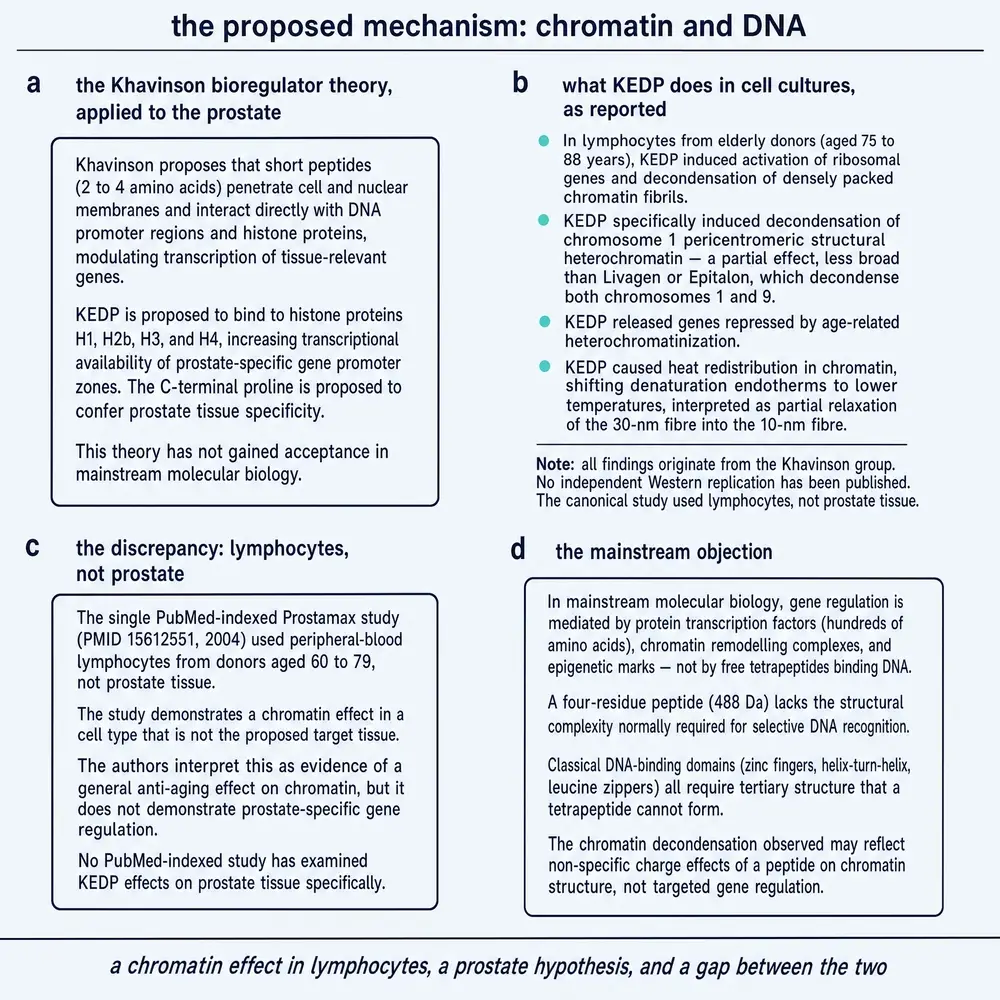
What has been shown for this peptide
Three things, all in cultured human cells, all from the same laboratory.
First, a differential-scanning-calorimetry study in Biofizika in 2004 characterised the denaturation of chromatin in human lymphocytes and reported that adding the peptide redistributed heat between two denaturation endotherms and shifted both to lower temperatures, by 2.9 °C and 1.0 °C. The authors interpreted the shift as a partial relaxation of the 30-nanometre chromatin fibre toward the 10-nanometre filament — that is, as loosening of the packing[32].
Second, a 2004 paper in the Bulletin of Experimental Biology and Medicine examined five short peptides — Vilon, Epithalon, Livagen, Prostamax and Cortagen — in leukocytes from subjects aged 75 to 88. All five were reported to activate ribosomal genes and to decondense densely packed chromatin fibrils. Prostamax, along with Epithalon and Livagen, was reported to decondense the pericentromeric structural chromatin of chromosome 1; Epithalon and Livagen also affected chromosome 9, and Prostamax is not listed as having done so[24].
Third, a 2012 study in Georgian Medical News — whose title names the sequence outright — measured three cytogenetic endpoints in lymphocytes from donors aged 75 to 86. Sister-chromatid exchange frequency rose from 5.9 ± 0.2 per cell in untreated cells to 12.0 ± 0.28 with the peptide; silver-positive nucleolar organiser regions rose from 0.95 to 2.5 per cell; and the frequency of large pericentromeric heterochromatin variants on chromosomes 1 and 9 fell[11].
A fourth paper from the same group added a control of a different kind, studying the peptide alongside copper and cadmium ions and reporting that copper condensed heterochromatin while cadmium decondensed and partly denatured it[30]. The tradition has continued: a 2023 paper from the same Tbilisi laboratory examined epigenetic modification of condensed chromatin under four peptide bioregulators, though the compound of this monograph is not among them[31].
How much weight this carries
These are real measurements on human cells, and the direction is consistent across four papers and two decades. They are also, without exception, from one laboratory in Tbilisi working in collaboration with the St Petersburg institute, using cytogenetic techniques rather than molecular ones, on lymphocytes rather than prostate cells, and without a single gene being identified.
That last point is the important one. A rise in sister-chromatid exchange is usually read as a marker of DNA damage or repair activity; here it is read as evidence of chromatin decondensation. Both readings can be defended, and the papers offer no experiment that distinguishes them. Silver-stained nucleolar organiser regions index ribosomal gene activity, which is a genuine measure of transcriptional state, but it is a global one: it says the cell is making more ribosomal RNA, not that a prostate gene has been switched on. Nothing in this series touches the prostate at all.
The comparison worth making is with what the same programme has managed for other members of the family. For the pineal peptide Ala‑Glu‑Asp‑Gly, a 2020 study measured named differentiation markers — Nestin, GAP43, β-tubulin III, doublecortin — in human gingival mesenchymal stem cells, reported specific fold-changes in mRNA, and modelled the peptide's binding to specific sites in histones H1/3 and H1/6[19]. That is what a mechanistic paper on this class looks like when it is done thoroughly. No equivalent exists for Lys‑Glu‑Asp‑Pro.
10Getting in: transporters, and a result worth reading carefully
The whole mechanism depends on step two. A peptide with a net negative charge at physiological pH does not diffuse across a lipid bilayer, so if these molecules act inside the nucleus, something has to carry them in. This is the most testable part of the class's claim, and it is where the most recent work has gone.
Two candidate families are in play. The proton-coupled oligopeptide transporters — PEPT1 and PEPT2, with the related PHT1 and PHT2 — move di- and tripeptides into intestinal and kidney epithelium. The L-type amino-acid transporters LAT1 and LAT2 move large neutral amino acids. A 2022 review in the International Journal of Molecular Sciences assembled what was known about the transport of ultrashort peptides by these carriers[22], and a 2023 paper in Biomolecules did the calculation: twenty-six biologically active short peptides docked into the binding sites of LAT1, LAT2, PEPT1 and PEPT2, scored with the ICM function, and calibrated against reference compounds whose measured inhibitory potencies are published[23].
The calibration is what makes this study worth taking seriously as a prediction rather than treating as arithmetic. For LAT1, the correlation between docking score and measured IC50 across the reference compounds is reported as approximately 0.93 when the comparison is restricted to the same transport assay; for LAT2 it is approximately 0.99 across three compounds[23]. Those are small reference sets, but they are the right thing to have done.
Now the result for this compound, read from the tables rather than the summary.
At PEPT1, the intestinal peptide transporter, the tetrapeptide scores −33.42, second of the twenty-six peptides tested and more negative than every reference inhibitor in the study's own comparison table — the best of which, a valine-guanidine conjugate, scores −27.74 against a measured IC50 of 650 micromolar. The paper states this plainly: the tetrapeptide and one other peptide are stronger predicted PEPT1 binders than the known compounds[23]. If any part of the transport claim is going to survive experimental test, this is the part.
At LAT1 the picture reverses. The tetrapeptide scores −22.79, ranking twenty-second of twenty-six, below L-leucine itself and far below the selective inhibitor JPH203. The 2022 review had already conceded the point in an unusually direct sentence: LAT1 is moderately expressed in the prostate, but the peptides held responsible for regulating prostate function do not show high binding to it[22]. A programme's own review noting that its compound does not bind the transporter its target tissue expresses is a piece of intellectual honesty worth crediting.
At LAT2 the compound comes last of twenty-six, at −11.68, weaker than all three reference compounds including the weakest of them. At PEPT2 it scores −6.36, well behind carnosine, and the authors caution that the only available PEPT2 structure may not represent the conformation in which peptide ligands bind, so those numbers should be read as preliminary[23].
Where the paper argues with itself
The LAT2 result produces an oddity that a careful reader will hit. In the discussion, the authors note that the compound's score is higher — that is, weaker — than that of known LAT2 inhibitors, and reason that it will therefore bind reversibly and be carried through rather than blocking the transporter. That is a coherent argument, and a reasonable one. But the paper's conclusions then list the same peptide among “the most effective ligands of the LAT2 transporter”, which its own Table 3 does not support[23].
This document follows the table. The defensible statements that come out of the docking work are these: the tetrapeptide is a strong predicted binder at PEPT1; it is a weak predicted binder at LAT1 and LAT2; and no measurement of any kind has confirmed that it enters any cell by any route.
One further point of interpretation deserves stating. Binding a transporter and being transported by it are different events. A molecule that occupies a binding site strongly may be an inhibitor rather than a substrate — which is precisely the interpretation the same paper offers for two other peptides in its set, whose antitumour activity it attributes to inhibition of these carriers[23]. The strong PEPT1 score is therefore compatible with two opposite biological readings, and the docking calculation cannot distinguish them.
11Signalling and expression, against receptor pharmacology
Section 02 set the two kinds of claim side by side. This section takes the comparison seriously, because the difference between them determines what counts as evidence for the rest of this document.
A classical receptor ligand has a named protein target with a solved structure, a measurable affinity expressed as a dissociation constant, and a dose–response relationship that can be traced across orders of magnitude. Its effects can be abolished by blocking the receptor or deleting the gene that encodes it. Everything about the framework is falsifiable, and that is its strength.
The bioregulator claim is different at every one of those points. There is no named receptor, by design: the proposal is that the molecule acts on chromatin, not on a protein at the cell surface. Affinity is expressed as a docking score or as a shift in DNA melting temperature rather than as a dissociation constant against a defined target. Entry into the cell is required rather than incidental. And the concentrations used are strikingly low and strikingly narrow — a single value of 0.05 nanograms per millilitre in the organotypic work[44], a single significant point at 20 nanograms per millilitre in the explant assay[17] — rather than a titration.
The programme has produced one experiment that speaks directly to whether these effects belong to the peptide as a molecule rather than to its constituent amino acids, and it is a good one. Lys‑Glu was compared against a mixture of free lysine and free glutamic acid in organotypic culture. The dipeptide stimulated proliferation of splenic cells; the mixture of its own amino acids inhibited culture growth[29]. Whatever else is uncertain, the peptide bond is doing something that its parts do not.
Two other observations from the class literature bear on how seriously the gene-regulation half of the claim should be taken. A 2021 systematic review in Molecules collected the evidence that short peptides regulate gene expression and protein synthesis across a wide range of organisms[20]; and the sibling tripeptide Lys‑Glu‑Asp has been studied in enough molecular detail to support a review of its effects on gene expression in neurogenesis[21], while the tetrapeptide Lys‑Glu‑Asp‑Trp-NH2 has been examined across ontogeny and in an experimental diabetes model[27]. The class is not short of molecular work. This particular member of it is.
The practical conclusion is not that the bioregulator framework is wrong. It is that, for this compound, the framework has not yet been used to generate a prediction that could fail. Until an experiment exists in which entry is blocked, or a gene is identified and then silenced, positive findings in whole animals remain observations about outcomes and cannot be promoted to confirmations of mechanism.
12Structure–activity: one residue apart from four siblings
The claim that gives this family its identity is also its most extraordinary: that Lys‑Glu‑Asp‑Pro acts on the prostate, Lys‑Glu‑Asp‑Gly on the testis, Lys‑Glu‑Asp‑Ala on the liver, and Ala‑Glu‑Asp‑Leu on the bronchus — four molecules differing by a single terminal residue, each selecting a different organ.
Nothing in ordinary structural biology forbids this. Single-residue changes routinely abolish or redirect binding, and a proline in particular imposes a sharp conformational constraint that no other residue does: its side chain loops back to the backbone nitrogen, locking the local geometry. If the peptides bind DNA in the major groove, and if the terminal residue's shape and charge determine which base sequence is preferred, a one-residue rule is at least conceivable.
The difficulty is that conceivable is where the argument currently stops. No published work identifies the DNA sequence preferred by Lys‑Glu‑Asp‑Pro, or the gene downstream of it, or a prostate cell type in which it acts.
The one head-to-head design
The single most valuable experiment in the compound's record is the 2006 organotypic study, and it is worth describing precisely because it is the only one that tested specificity directly. Cardiogen, bronchogen, prostamax and pancragen were applied to explants of heart, lung, prostate and pancreas taken from rats aged three weeks and eighteen months. At 0.05 nanograms per millilitre, each peptide is reported to have stimulated growth in the corresponding tissue culture relative to controls, in both age groups[44].
A four-by-four matrix with an age dimension is exactly the right design for the question. If each peptide stimulates only its own tissue, the diagonal of that matrix is the claim, and the off-diagonal cells are the control. It is the sort of experiment that, done well and reported fully, would settle a great deal.
What is available is a short abstract in Advances in Gerontology, published in Russian. It reports the diagonal. It does not report the off-diagonal cells, the magnitude of any effect, the number of explants, the statistical treatment, or whether the observers were blinded to which peptide each dish received. The finding as published is therefore consistent with strict tissue specificity and equally consistent with all four peptides stimulating all four tissues.
The same limitation applies to the 2001 experiment that established the pattern for the earlier generation of peptides[14]. It is a recurring feature of this literature: the design is right and the reporting is too thin to evaluate.
What can be said about structure
| Feature | Observation | Evidential status |
|---|---|---|
| Shared Lys-Glu-Asp stem | Carries one positive and two negative charges; present in Vilon, Vesugen, Livagen, Testagen and this compound | Structural fact |
| Terminal proline | Constrains backbone geometry more than any other residue | General peptide chemistry; not tested for this molecule |
| Peptide bond required | Lys-Glu stimulated splenic explants where free lysine plus free glutamate inhibited them | Measured, but for the dipeptide, not this compound |
| Terminal residue selects the organ | Asserted throughout the class literature | Supported only by the diagonal of one under-reported matrix |
| ED motif improves transporter binding | Proposed from the docking set as a whole | Computational inference across 26 peptides |
| Two designations, one sequence | Cardiogen and Epithalon are both Ala-Glu-Asp-Gly | Structural fact, and a caution about naming |
13Pharmacokinetics, distribution and metabolism
There are none.
That is the entire finding, and it is worth stating without cushioning. No study in the record retrieved for this monograph — in English, in the translated Russian literature, in the patent family, or in the class reviews — reports the absorption, distribution, half-life, clearance, metabolism or excretion of Lys‑Glu‑Asp‑Pro. There is no radiolabelled disposition study. There is no plasma concentration measurement of any kind after any route. There is no tissue-distribution work, which means that the claim of prostate specificity has never been tested in the simplest possible way: by injecting the compound and seeing where it goes.
What can be said at the level of the class, clearly labelled as inference rather than measurement, is short. Small linear peptides with free termini are substrates for aminopeptidases and carboxypeptidases in plasma and tissue, and peptides of this length typically survive for minutes rather than hours. Nothing in the structure of this molecule — no cyclisation, no D-amino acid, no N-terminal acetylation, no C-terminal amide — would be expected to slow that. The patent's own dosing schedules, daily for ten to sixty days, are consistent with a compound assumed to be cleared quickly.
The transporter work discussed in section 10 is sometimes read as pharmacokinetic evidence, and it is not. A docking score is a prediction about whether a molecule fits a binding site. It says nothing about how much reaches the bloodstream, how long it stays there, or where it distributes.
The consequence for interpretation is substantial. Without any disposition data, the two positive rat studies cannot be connected to the in-vitro chromatin findings, because there is no way to know whether concentrations resembling those used in culture are ever reached in a tissue. The thousandfold dose discrepancy discussed in section 15 cannot be adjudicated on pharmacological grounds, because there is no exposure measurement against which either figure could be checked. And the tissue-specificity claim, which is the compound's entire reason for existing, remains untested at the level where it would be easiest to test.
14The study landscape
It is possible to put the entire experimental record of this compound on a single page. Very few molecules with an international market allow that.
Read the figure by column rather than by row. The species column contains rat and human and nothing else — no mouse, no dog, no primate, no human subject outside a patent. The design column contains no randomised, blinded or placebo-controlled study of any kind. The publication column contains one journal that PubMed does not index, one Georgian journal, two Russian journals, one Swiss open-access journal, and a patent. And the year column stops in 2014 for anything performed on the compound itself; the only later entries are class-level work in which it appears as one item in a list.
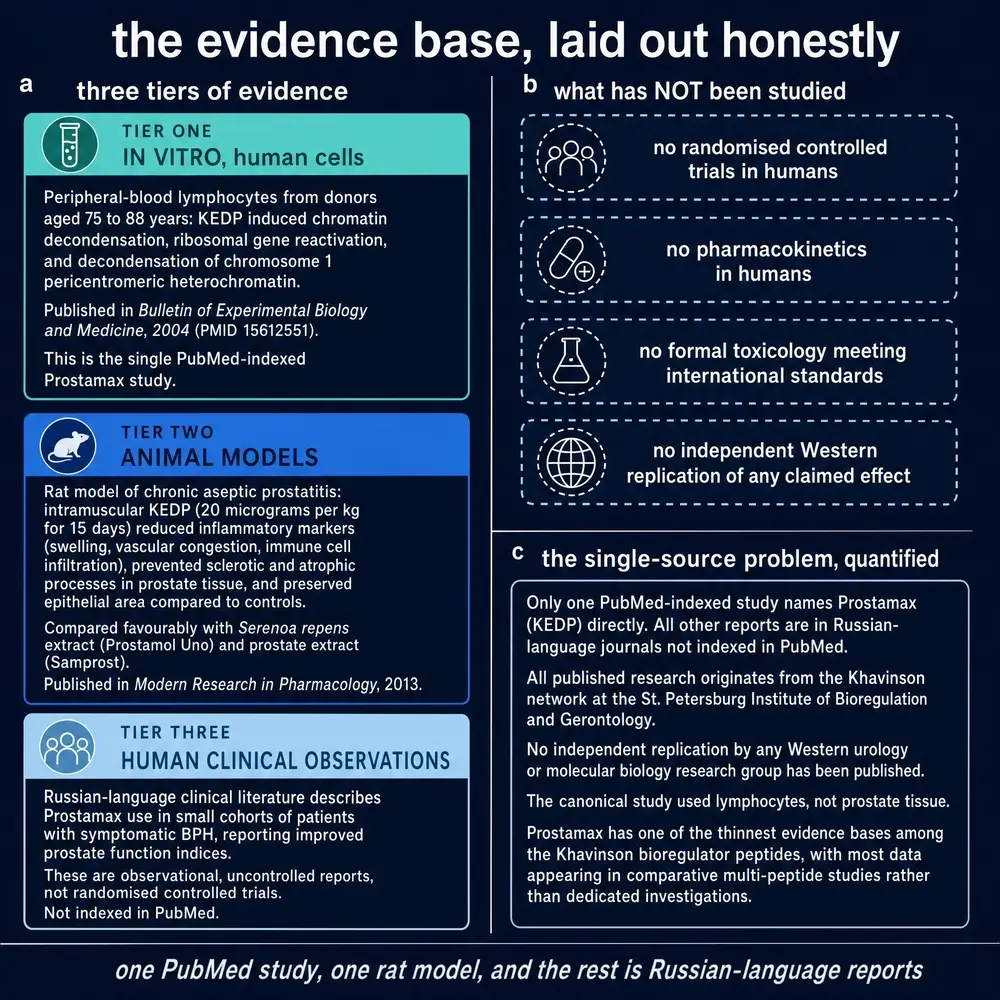
Three consequences follow, and they shape everything in the rest of this part. Positive findings cannot be checked against an independent replication, because there are no independent replications. Effects cannot be separated from observer expectation, because no study reports blinding. And the compound's defining claim — that it acts on the prostate specifically — rests on studies that used prostate models, which is not the same thing as demonstrating specificity.
15Animal evidence: two rat models, read closely
Two studies have administered this compound to living animals and measured what happened. Both come from the Research Institute of Pharmacology and Regenerative Medicine in Tomsk, both are in Modern Research in Inflammation, and both list a co-author from the pharmaceutical company Geropharm. They are the strongest evidence the compound has, and they deserve to be read in detail rather than summarised.
2013: chronic aseptic prostatitis
Sixty male Wistar rats. Prostatitis was induced surgically, by passing a silk ligature through the ventral lobe of the prostate — a mechanical, sterile injury rather than an infection, which is what “aseptic” means here. Treatment began thirty days later and ran for fifteen days. Four arms: an untreated control, the tetrapeptide, and two marketed comparators, a Serenoa repens extract and a prostate-extract preparation. The reported route was intramuscular[9].
The endpoints were morphometric: the investigators sectioned the prostate, stained it, and measured the fraction of tissue area occupied by different structures. Two results carry the paper.
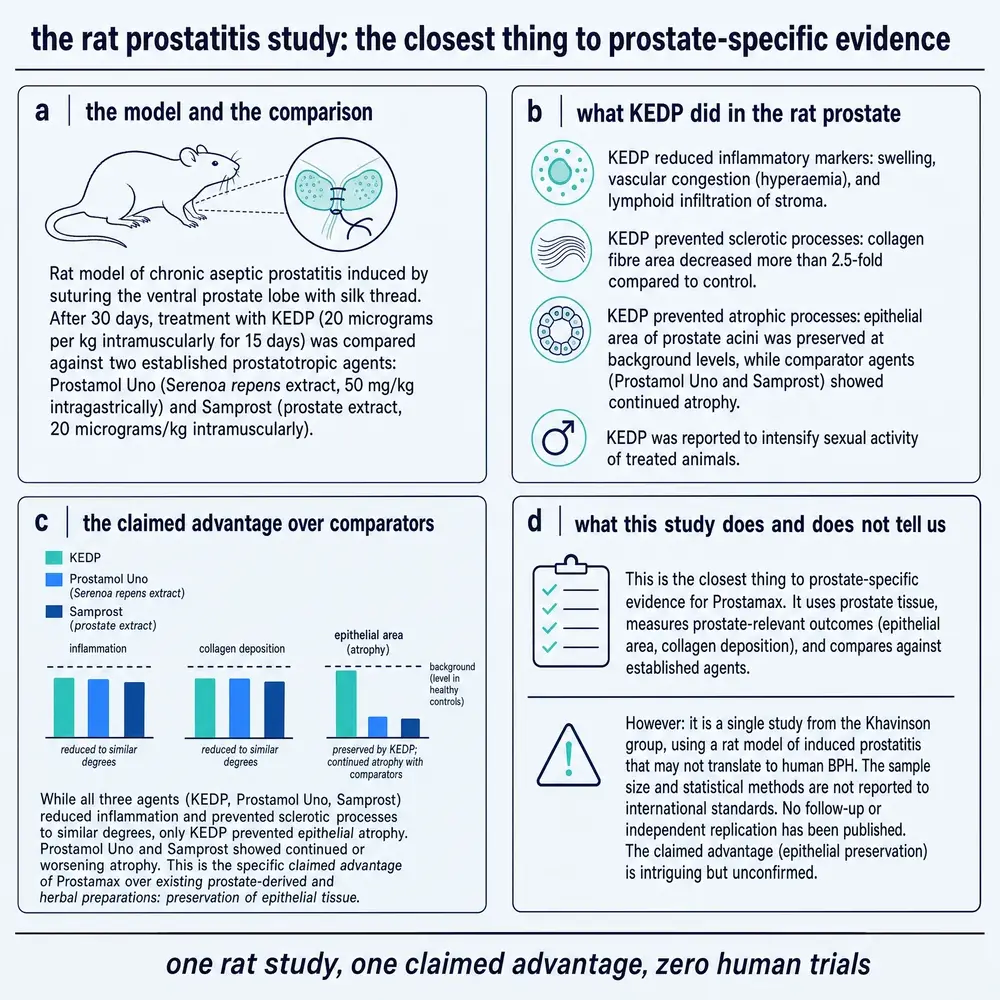
Collagen fibre area — the scarring that follows chronic inflammation — was reported to fall more than two-and-a-half-fold in the peptide group relative to untreated controls. And the area of acinar epithelium, the secretory tissue that does the prostate's actual work, was preserved in the peptide group while neither comparator preserved it[9].
That second result is the more interesting of the two, because it is a difference rather than a direction. Any anti-inflammatory intervention might reduce fibrosis. Preserving secretory epithelium where two established comparators did not is a specific claim about this compound, and it is exactly the kind of finding that would justify a replication.
2014: benign prostatic hyperplasia
Forty male Wistar rats. Hyperplasia was induced with sulpiride, a dopamine antagonist that raises prolactin and reliably enlarges the rodent prostate over weeks. The study ran sixty days, with the tetrapeptide in one arm and a Serenoa repens extract in another, against a sulpiride-only control[10].
Against the sulpiride control, the peptide arm showed a lateral-lobe mass lower by about a quarter, a weight coefficient — organ mass normalised to body mass, which controls for the animals growing — lower by about a quarter, and a lobe volume lower by about forty per cent. The Serenoa arm moved none of the three[10].
The comparator arms have a separate history worth knowing. The same Tomsk group had already published a comparison of prostatotropic agents of natural origin in the same sulpiride model, in the PubMed-indexed Bulletin of Experimental Biology and Medicine, a year earlier. That paper reported that Serenoa repens and a cattle-prostate polypeptide preparation both behaved much as sulpiride did — shrinking the acinar epithelial area and tending to raise the stromal-to-epithelial ratio, the Serenoa arm more so than the extract[8]. So the laboratory knew what its comparators did in this model before it ran the tetrapeptide against them, and the 2014 result is internally consistent with the earlier one.
The sulpiride model itself has been characterised in detail, including by another Russian group, which reported epithelial hyperplasia in the ventral lobe by Ki-67 counting and a rise in serum prostate-specific antigen after sixty days of dosing, and argued on that basis that sixty days produces changes corresponding to the human condition[41]. The 2014 study ran exactly sixty days, which is the right call.
The choice of comparator is worth noting. Serenoa repens, saw palmetto, is the most widely used botanical preparation for prostatic symptoms in the world, and the large randomised trials in humans have generally not separated it from placebo. A study in which saw palmetto fails is not evidence that the study was insensitive; it may equally be evidence that the model reproduces the human result.
The discrepancy that has to be named
The 2013 paper reports the tetrapeptide dose as 20 micrograms per kilogram. The 2014 paper, from the same institute, on the same compound, reports 20 milligrams per kilogram. That is a factor of one thousand.
Both figures cannot be right descriptions of a comparable experiment, and there is no way to determine from the published record which is correct. The 20 µg/kg figure sits closer to the patent's own reported range[17] and to the nanomolar framing the class uses everywhere else, which makes the milligram figure the more likely typographical error. But that is inference, not evidence, and neither paper carries a correction.
This document does not resolve it. It reports both values as published, notes that they are irreconcilable, and treats the consequence as the important part: neither study can be replicated at a known dose. That single unresolved unit turns two positive experiments into two experiments whose central parameter is unknown — and it would have been caught by any journal with a working copy-editing desk.
How much these two studies establish
Taken at face value, they are consistent, biologically plausible, and directionally positive in two different prostate models with sensible endpoints and active comparators. Taken critically, they share a laboratory, a funder's co-author, a journal that PubMed does not index, an absence of reported randomisation and blinding, and a dose discrepancy of three orders of magnitude between them. They are a reasonable basis for further work and an insufficient basis for any conclusion about people.
The wider context is that rodent prostate models translate poorly. Rats do not spontaneously develop benign prostatic hyperplasia in the human sense; the sulpiride model produces a hormone-driven enlargement that resembles the human condition only in part[45], and surgical prostatitis models reproduce inflammation without reproducing the clinical syndrome[12]. This is a general limitation of the field rather than a criticism of these two studies, but it bounds what they can mean.
16Human evidence
There are two kinds of human evidence for this compound, and they are so different in weight that treating them as one category would be misleading.
Human cells
The stronger of the two is the lymphocyte work described in section 9: four studies, one laboratory, cells from donors aged 75 to 88, measuring chromatin condensation by calorimetry and cytogenetics[11, 24, 30, 32]. These are genuine measurements on genuine human material. They are also a long way from the prostate, from any named gene, and from any independent replication.
One methodological point deserves emphasis because it recurs. The donors were elderly, and the papers frame the findings in terms of age-associated chromatin condensation. That framing is what connects this work to the gerontological programme described in Part Two. It also means there is no young-donor comparison, so the studies cannot distinguish an effect specific to aged chromatin from an effect that would occur in any lymphocyte.
Human patients
The weaker kind exists only inside the patent, and it must be reported because omitting human evidence is not permissible — but it must be reported for what it is.
The patent describes two clinical series. In the first, thirty-five men with chronic prostatitis received the tetrapeptide; in the second, nineteen men with stage I–II prostate adenoma. Both are described against “conventional methods” of treatment. Improvements are reported as percentages[17].
What is absent from these accounts is nearly everything that would make them interpretable. There is no randomisation, no blinding, no defined control group, no inclusion or exclusion criteria, no pre-specified endpoint, no statistical analysis, no adverse-event table, no ethics approval statement and no institution named as the site. Percentages are given without denominators that reconcile cleanly. The document reporting them is a patent application, whose purpose is to establish the utility of an invention, written by the inventors, and reviewed by patent examiners for novelty and inventive step rather than by peer reviewers for scientific validity.
These series are therefore recorded here as unrefereed reports of clinical observation contained in a commercial instrument. They do not establish efficacy, safety, or any effect in humans. They are the reason the record contains the phrase “human evidence” at all, and they are not sufficient to support a claim of any kind.
Set against this, the extract that the compound was designed to replace has what this compound does not: refereed clinical publications, including comparative work, over more than three decades[1, 2, 7, 13, 39, 43]. That asymmetry is the single most consequential fact in this monograph, because the marketing of the peptide frequently borrows the extract's history.
17In vitro and explant evidence
Two experimental systems have been used, and both are organ-culture systems rather than cell lines.
Chick embryo urinary bladder explants
The patent's third example describes the assay that was used to select the active concentration. Fragments of urinary bladder from eleven-day chick embryos were cultured in collagen gel with the peptide added across a concentration range from 2 to 400 nanograms per millilitre. The endpoint was the explant area index: the ratio of the total explant area to the area of its central zone, measured on day three, expressed relative to untreated controls[17].
A significant increase of about 23 per cent was reported at 20 nanograms per millilitre. Concentrations above and below that produced smaller changes, producing the bell-shaped concentration response that the class literature reports for many of these peptides[17].
Two cautions belong with this result. A bell-shaped curve is a real phenomenon in biology, but it is also the shape produced by noise around a single lucky point, and the assay is a morphological measurement made by an observer on a small number of dishes. And an explant of embryonic chick bladder is a urothelial tissue, not prostate; it was chosen for practicality, and it tells us nothing about tissue specificity.
Rat organotypic explants
The 2006 study described in section 12 remains the only experiment that put this compound alongside its siblings in matched tissues. At 0.05 nanograms per millilitre, applied to explants of heart, lung, prostate and pancreas from rats aged three weeks and eighteen months, each peptide is reported to have stimulated the corresponding tissue[44]. The design is right; the published report is an abstract, and the off-diagonal results are not given.
Notably, the concentrations in these two systems differ by a factor of four hundred — 0.05 against 20 nanograms per millilitre — in different tissues from different species measured by different observers. No dose– response relationship for this compound has been established in any system.
18Computational evidence, and what a prediction is worth
Section 10 set out the docking results in detail. What remains is to say where they sit in the hierarchy of evidence, because in-silico work is often either dismissed outright or cited as though it were a measurement, and neither is right.
What the 2023 study did well: it used published crystal and cryo-EM structures, it docked a large comparison set rather than one favoured molecule, and it calibrated its scoring function against reference compounds with measured inhibitory potencies before drawing conclusions[23]. That calibration step is what separates a useful prediction from an arbitrary number, and it is missing from a great deal of published docking work.
What it cannot do: establish that any molecule enters any cell. Docking predicts the geometry and estimated energy of a fit between a ligand and a binding site in a static structure. It does not model the conformational cycle a transporter goes through, does not distinguish a substrate from an inhibitor, does not account for competition from the millimolar concentrations of natural peptides and amino acids present in tissue, and does not address whether the molecule survives long enough to reach the transporter at all.
The honest summary is that this compound has a strong computational prediction of PEPT1 binding, a weak one at LAT1 and LAT2, one published acknowledgement from within the programme that it does not bind the transporter its target tissue expresses[22], and no experimental uptake measurement of any kind. A transport experiment in a cell line expressing PEPT1 would be inexpensive and would settle the most important open question about the entire class.
19Safety and toxicology
The compound's toxicology consists of one programme, conducted for the patent, reported in summary form by the inventors.
Acute toxicity was assessed in 78 mice given single intramuscular doses up to 5 milligrams per kilogram, with no deaths recorded over fourteen days of observation. Subacute toxicity used 48 rats dosed daily for 90 days at up to 3 milligrams per kilogram, and chronic toxicity used 56 rats dosed for six months at up to 1 milligram per kilogram. The patent reports no treatment-related mortality and no pathological findings in the organs examined[17].
Read on its own terms, this is a conventional rodent toxicology package for its era, and the margin it implies is large: even taking the 2014 paper's 20 mg/kg figure at face value, the acute study went to a quarter of that without deaths, and taking the 2013 figure of 20 µg/kg, the chronic six-month study ran at fifty times the reported active dose without reported findings.
Four things that programme does not establish need stating in the same breath.
It has never been independently replicated. Every number above comes from the inventors' own document, and no external laboratory has published a toxicology study of this compound.
No genotoxicity or reproductive toxicology is reported for the peptide. This matters more than it would for most compounds, because the extract that the peptide replaced was tested for exactly that and did not come through cleanly: two Russian studies in the early 1990s reported dose-dependent sperm-head anomalies and bone-marrow chromosome aberrations in mice given prostatilen[6, 33]. The peptide is a different molecule and those findings do not transfer to it — but the absence of the corresponding tests on the peptide is a gap that the extract's history makes conspicuous.
There is no human safety database. The patent's two clinical series report improvements and do not report adverse events systematically; there is no pharmacovigilance record, no post-marketing surveillance and no registry.
And absence of reported harm is not evidence of safety. A compound studied in roughly 180 rodents by one laboratory a quarter of a century ago, with no subsequent independent testing, has an unknown safety profile regardless of how clean those original reports were.
20Regulatory, legal and sports-governance status
This section reports what could be verified against a primary instrument on 3 August 2026, and marks clearly what could not. Regulatory status changes, and it varies by jurisdiction; nothing here should be treated as current elsewhere or later.
| Question | Finding | How it was checked |
|---|---|---|
| US Food and Drug Administration approval | No approval as a drug for any indication | No approval record identified; no registered trial exists that could support one |
| European Medicines Agency authorisation | No centralised authorisation identified | Same |
| Registered clinical trials | None, under any of four search terms | ClinicalTrials.gov v2 API queried for Prostamax, KEDP, Lys-Glu-Asp-Pro and prostatilen[42] |
| Patent protection | EP 1353939 B1 granted 2004; the family has lapsed | Patent register front page[17] |
| Later Russian patent | A 2018 filing covers rectal suppositories containing the tetrapeptide | Patent register |
| Registered medicine in the Russian Federation | Could not be verified from a primary instrument | The state register was not reachable from this environment; reported as unverified rather than inferred |
| WADA prohibited list | Not listed by name | Absence from a list is not a permission; the list's catch-all provisions for non-approved substances are drafted broadly, and any competitive athlete's question belongs with their national anti-doping organisation |
| Commercial availability | Sold internationally, labelled for laboratory research use only, not for human consumption | Vendor certificates of analysis held locally[37] |
The sequence in that table is the point of it. A compound can be manufactured to high analytical purity, sold across borders, and documented by independent laboratories without any regulator having assessed it, any trial having been registered, or any authority having formed a view. That is not a loophole; it is the ordinary operation of a research-chemical market, and it means market presence carries no evidentiary weight whatsoever.
21Quality, testing and analytical verification
Five certificates of analysis for marketed lots were available for this review, issued by two independent laboratories for three vendors[37].
Reported purity across the five lots ranges from 99.41 to 99.98 per cent, by HPLC with ultraviolet detection or by liquid chromatography–mass spectrometry. Identity is supported by molecular mass in the lots analysed by mass spectrometry. One certificate carries a CAS registry number; the others give none, and the numbers used commercially for this compound are not consistent with one another — a recurring problem for peptides that entered commerce before any registry entry was settled.
What a certificate of analysis establishes is narrower than it appears. High chromatographic purity means that the material in the vial is predominantly one substance. It does not establish that the substance is the one on the label. A mass measurement constrains the composition but does not distinguish sequence isomers: Lys‑Glu‑Asp‑Pro and any rearrangement of the same four residues share a molecular formula and a mass. None of the five certificates reports a sequencing method — no tandem mass spectrometry fragmentation, no Edman degradation, no amino-acid analysis.
Nor does a certificate address endotoxin, sterility, residual solvents, counter-ion identity, water content, or stability under the conditions the material will actually experience in transit and storage. Those are the attributes a pharmacopoeial monograph would specify, and no pharmacopoeial monograph exists for this compound.
The patent's own analytical section, by contrast, does report amino-acid composition, and it is the only document in the record that ties the manufactured material to the sequence by an independent method[17].
22Current research directions
The class is moving; the compound is not.
Three lines of work are visibly active in the class literature. The first is transporter-mediated entry, which produced the 2022 review and the 2023 docking study and is the most likely source of a decisive experiment[22, 23]. The second is molecular characterisation of individual peptides in defined cell systems, of the kind done for Ala‑Glu‑Asp‑Gly in human mesenchymal stem cells with named markers and modelled histone-binding sites[19], and for Lys‑Glu‑Asp in neurogenesis[21]. The third is the continuing programme in gerontology and geroprotector evaluation from which the whole family came[4, 28, 35].
Against that, no primary study of Lys‑Glu‑Asp‑Pro has been published since 2014. Its appearances since then are as an entry in class-wide lists: one of twenty-six peptides in a docking set, one of several in a review's table. Twelve years without a new experiment on a compound that is commercially available in three continents is itself a finding, and the most plausible reading is the ordinary one — the patent lapsed, the commercial incentive to generate data disappeared with it, and the market did not require data in the first place.
23Evidence gaps and unresolved questions
Ten gaps, ordered by how much would change if each were closed.
Three of those deserve a sentence of their own, because they are not merely missing data but structural problems.
The first is entry. Everything the class claims depends on the molecule reaching the nucleus, and no experiment has shown that it reaches the cytoplasm. Until a labelled-uptake experiment exists, every downstream mechanistic claim rests on an unverified premise.
The second is specificity. The compound's name, its patent, its market and its entire rationale rest on the proposition that it acts on the prostate rather than on tissue generally. The one experiment designed to test that reports only the confirming diagonal of its own matrix[44].
The third is independence. Every positive result in this document comes from one of three groups — St Petersburg, Tomsk, Tbilisi — collaborating within a single programme. That is not an accusation; it is the normal condition of a small research field. But it means the record contains no instance of an unaffiliated laboratory attempting to reproduce any finding, and in the absence of independent replication, consistency within a programme is weak evidence.
24Conclusions
Lys‑Glu‑Asp‑Pro is a real, well-characterised molecule with a documented synthesis, a settled structure, and a small, internally consistent body of experimental work that has never been independently tested.
What is established. The identity and structure are unambiguous, fixed by a public database record and confirmed by a paper whose title states the sequence and by the patent's own amino-acid analysis. The synthesis is described in enough detail to be repeated. Rodent toxicology conducted for the patent reported no deaths or organ pathology at doses well above any reported active dose, in roughly 180 animals. Two rat models of prostate disease produced positive morphometric results with active comparators. Human lymphocytes from elderly donors show reproducible changes in chromatin condensation and transcriptional markers when the peptide is added to culture.
What is claimed but not shown. That the compound enters cells. That it binds DNA in a sequence-preferential way — shown for a sibling peptide, never for this one. That the terminal proline selects the prostate. That anything observed in a rat or a lymphocyte corresponds to an effect in a person. And that the clinical history of the bovine extract it was designed to replace has any bearing on the peptide, which it does not.
What is unknown. Everything pharmacokinetic: absorption, distribution, half-life, clearance, metabolites. The correct dose, given a thousandfold discrepancy between the only two in-vivo papers. Whether any finding replicates outside the programme that produced it. And the compound's safety in humans, on which no systematic data exist at all.
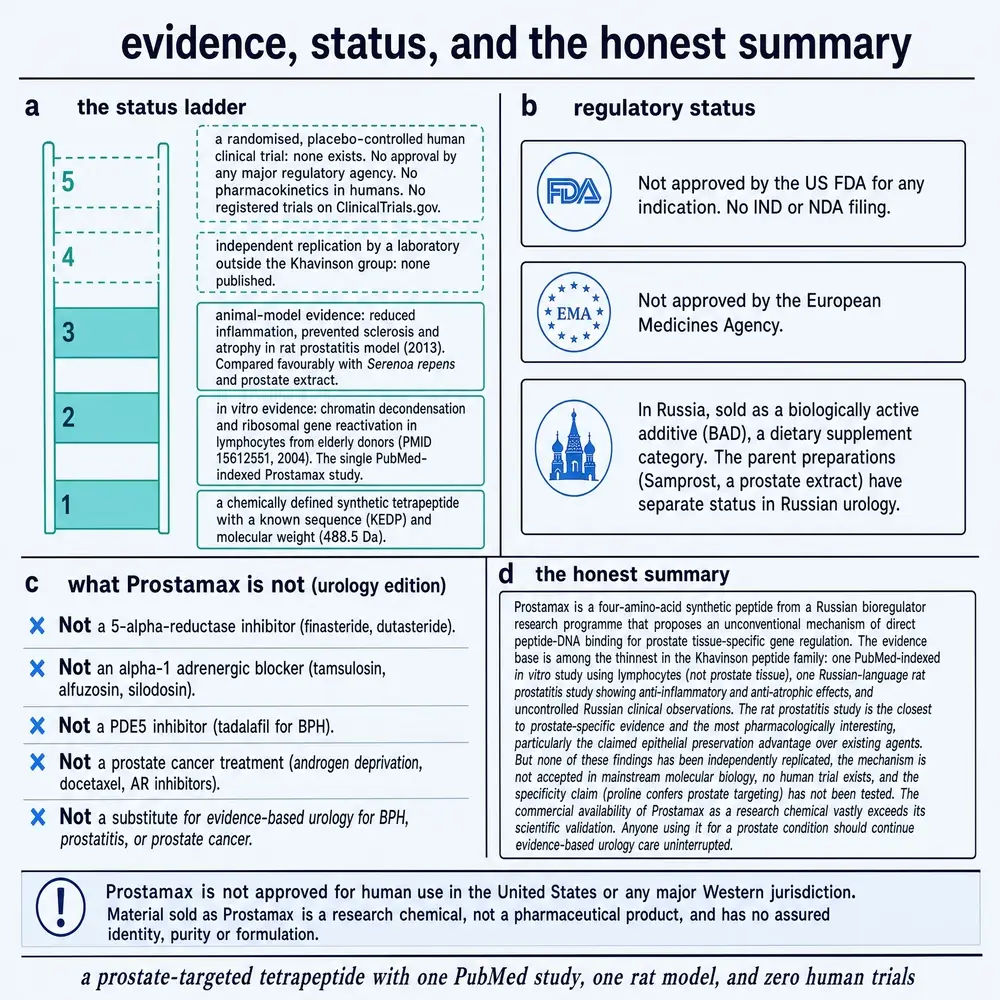
The larger observation is the one the outline opened with. This compound acquired a market before it acquired a literature, and the literature stopped growing when the patent lapsed. That sequence is common in this corner of biochemistry and it is worth naming plainly, because it explains why a molecule with fewer than a dozen primary studies can be described online with a confidence that no scientific record supports.
The experiments that would change this assessment are neither expensive nor exotic. A cellular uptake measurement. A dose–response curve. A blinded replication of the 2014 model at an agreed dose. Any one of them would tell us more than the last twelve years have.
25References
Every entry with a PubMed identifier below was re-derived from the NCBI record at build time rather than written from recall, and the build refuses to run if an identifier fails to resolve to a title. The sources with no PubMed record — the patent family, the two open-access journal papers that PubMed does not index, the database entry, the registry searches whose null result is itself a finding, and the vendor certificates — are registered separately and carry their own identifiers. Numbering runs in alphabetical order of first author and is assigned by the build, so an inline number cannot drift from the entry it points at.
- Al'-Shukri SKh, Gorbachev AG, Borovets SIu, Belousov VIa, Kuz'min IV. [Prostatilen effects on voiding disorders in patients with benign prostatic hyperplasia]. Urologiia. 2005:25-6.
PMID 16281835 - Al'-Shukri SKh, Gorbachev AG, Borovets SIu, Belousov VIa, Kuz'min IV, Chushkin KA. [Prostatilen treatment of prostatic adenoma]. Urologiia. 2006:22, 25-6.
PMID 17315707 - Anisimov VN, Loktionov AS, Khavinson VK, Morozov VG. Effect of low-molecular-weight factors of thymus and pineal gland on life span and spontaneous tumour development in female mice of different age. Mech Ageing Dev. 1989;49(3):245-57.
PMID 2682058 · doi:10.1016/0047-6374(89)90075-4 - Anisimov VN, Khavinson VKh. Peptide bioregulation of aging: results and prospects. Biogerontology. 2010;11(2):139-49.
PMID 19830585 · doi:10.1007/s10522-009-9249-8 - Belostotskaya LI, Gomon ON, Nikitchenko YV, Chaika LA, Bondar VV, Dzyuba VN. Prooxidant-antioxidant balance in the prostate and blood of rats with sulpyride[corrected]-induced prostatic hyperplasia corrected with prostatilen. Bull Exp Biol Med. 2005;139(3):334-6.
PMID 16027846 · doi:10.1007/s10517-005-0287-1 - Bolonina VP, Mikheev VS. [Effect of vitamin C on prostatilen mutagenicity in mice]. Genetika. 1993;29(7):1095-8.
PMID 8370509 - Borovets S Y, Rybalov M A, Slesarevskaya M N, Al-Shukri S K. [Effect of prostate-derived complex peptide preparations on erectile function in patients with chronic prostatitis]. Urologiia. 2026:92-98.
PMID 42417303 - Borovskaya TG, Fomina TI, Ermolaeva LA, Vychuzhanina AV, Pakhomova AV, Poluektova ME, et al.. Comparative evaluation of the efficiency of prostatotropic agents of natural origin in experimental benign prostatic hyperplasia. Bull Exp Biol Med. 2013;155(1):67-70.
PMID 23667874 · doi:10.1007/s10517-013-2081-9 - Borovskaya TG, Pakhomova AV, Vychuzhanina AV, Poluektova ME, Fomina TI, Ermolaeva LA, et al.. Experimental studying of the drug efficiency Prostamax in the therapy of chronic aseptic prostatitis and its complications. Modern Research in Inflammation. 2013;2(3):54-58. doi:10.4236/mri.2013.23007.
https://doi.org/10.4236/mri.2013.23007 - Borovskaya TG, Fomina TI, Shchemerova YA, Poluektova ME, Vychuzhanina AV, Kamalova SI, et al.. Experimental study of efficiency of tetrapeptide lysil-glutamyl-aspartyl-proline using the model of benign prostatic hyperplasia. Modern Research in Inflammation. 2014;3(3):108-112. doi:10.4236/mri.2014.33013.
https://doi.org/10.4236/mri.2014.33013 - Dzhokhadze TA, Buadze TZh, Gaĭozishvili MN, Baratashvili NA, Lezhava TA. [Deheterochromatinization of the chromatin in old age induced by oligopeptide bioregulator (Lys-Glu-Asp-Pro)]. Georgian Med News. 2012:76-82.
PMID 23221144 - Franco JV, Trivisonno L, Sgarbossa NJ, Alvez GA, Fieiras C, Escobar Liquitay CM, et al.. Serenoa repens for the treatment of lower urinary tract symptoms due to benign prostatic enlargement. Cochrane Database Syst Rev. 2023;6(6):CD001423.
PMID 37345871 · doi:10.1002/14651858.CD001423.pub4 · PMC10286776 - Gorpinchenko II, Iakovlev GM, Boĭko NI, Khavinson VKh. [The treatment with the polypeptide preparation "Prostatilen" of patients with prostatitis complicated by a sexual functional disorder]. Vrach Delo. 1991:48-51.
PMID 2058122 - Khavinson VK. Tissue-specific effects of peptides. Bull Exp Biol Med. 2001;132(2):807-8.
PMID 11713572 · doi:10.1023/a:1013058701974 - Khavinson VKh, Malinin VV, Grigoriev EI. Tetrapeptide regulating prostate function, pharmacological agent based on thereof and method of its using. Russian Federation patent RU 2177802 C1, 2001.
https://patents.google.com/patent/RU2177802C1/en - Khavinson VKh, Malinin VV, Grigoriev EI. Tetrapeptide regulating prostate functions, pharmacological agent based thereon and method of its application. PCT application WO 02/066497 A1, published 29 August 2002 (PCT/RU2001/000433).
https://patents.google.com/patent/WO2002066497A1/en - Khavinson VKh, Malinin VV, Grigoriev EI. Tetrapeptide regulating prostate functions, pharmacological agent based thereon and method of its application. European Patent EP 1353939 B1, granted 25 August 2004; priority RU 2001102099, 25 January 2001; applicant St Petersburg Institute of Bioregulation and Gerontology.
https://patents.google.com/patent/EP1353939B1/en - Khavinson V, Shataeva L, Chernova A. DNA double-helix binds regulatory peptides similarly to transcription factors. Neuro Endocrinol Lett. 2005;26(3):237-41.
PMID 15990728 - Khavinson V, Diomede F, Mironova E, Linkova N, Trofimova S, Trubiani O, et al.. AEDG Peptide (Epitalon) Stimulates Gene Expression and Protein Synthesis during Neurogenesis: Possible Epigenetic Mechanism. Molecules. 2020;25(3).
PMID 32019204 · doi:10.3390/molecules25030609 · PMC7037223 - Khavinson VK, Popovich IG, Linkova NS, Mironova ES, Ilina AR. Peptide Regulation of Gene Expression: A Systematic Review. Molecules. 2021;26(22).
PMID 34834147 · doi:10.3390/molecules26227053 · PMC8619776 - Khavinson VK, Lin'kova NS, Umnov RS. Peptide KED: Molecular-Genetic Aspects of Neurogenesis Regulation in Alzheimer's Disease. Bull Exp Biol Med. 2021;171(2):190-193.
PMID 34173097 · doi:10.1007/s10517-021-05192-6 - Khavinson V, Linkova N, Kozhevnikova E, Dyatlova A, Petukhov M. Transport of Biologically Active Ultrashort Peptides Using POT and LAT Carriers. Int J Mol Sci. 2022;23(14).
PMID 35887081 · doi:10.3390/ijms23147733 · PMC9323678 - Khavinson VK, Linkova NS, Rudskoy AI, Petukhov MG. Feasibility of Transport of 26 Biologically Active Ultrashort Peptides via LAT and PEPT Family Transporters. Biomolecules. 2023;13(3).
PMID 36979488 · doi:10.3390/biom13030552 · PMC10046148 - Khavinson VKh, Lezhava TA, Malinin VV. Effects of short peptides on lymphocyte chromatin in senile subjects. Bull Exp Biol Med. 2004;137(1):78-81.
PMID 15085253 · doi:10.1023/b:bebm.0000024393.40560.05 - Khavinson VKh, Solovyov AY, Shataeva LK. Molecular mechanism of interaction between oligopeptides and double-stranded DNA. Bull Exp Biol Med. 2006;141(4):457-61.
PMID 17152370 · doi:10.1007/s10517-006-0198-9 - Khavinson VKh, Solovyov AY, Shataeva LK. Melting of DNA double strand after binding to geroprotective tetrapeptide. Bull Exp Biol Med. 2008;146(5):624-6.
PMID 19526107 · doi:10.1007/s10517-009-0342-4 - Khavinson VKh, Gapparov MM, Sharanova NE, Vasilyev AV, Ryzhak GA. Study of biological activity of Lys-Glu-Asp-Trp-NH2 endogenous tetrapeptide. Bull Exp Biol Med. 2010;149(3):351-3.
PMID 21246099 · doi:10.1007/s10517-010-0944-x - Khavinson VKh, Kuznik BI, Ryzhak GA. [Peptide bioregulators: the new class of geroprotectors. Communication 1. Results of experimental studies]. Adv Gerontol. 2012;25(4):696-708.
PMID 23734519 - Khavinson VKh, Tarnovskaya SI, Lin'kova NS, Chervyakova NA, Nichik TE, Elashkina EV, et al.. Role of peptide bond in the realization of biological activity of short peptides. Bull Exp Biol Med. 2015;158(4):551-4.
PMID 25705040 · doi:10.1007/s10517-015-2805-0 - Kiladze M, Gorgoshidze M, Monaselidze J, Jokhadze T, Lezhava T. Microcalorimetric study of human blood lymphocytes culture at presence of copper, cadmium and prostamax. Georgian Med News. 2009:104-7.
PMID 19359734 - Lezhava T, Jokhadze T, Monaselidze J, Buadze T, Gaiozishvili M, Sigua T, et al.. EPIGENETIC MODIFICATION UNDER THE INFLUENCE OF PEPTIDE BIOREGULATORS ON THE "OLD" CHROMATIN. Georgian Med News. 2023:79-83.
PMID 37042594 - Meskhi T, Khachidze D, Barbakadze Sh, Madzhagaladze G, Gorgoshidze M, Monaselidze D, et al.. [The influence of the peptide bioregulator prostamax on heterochromatin of human lymphocytes in situ]. Biofizika. 2004;49(6):1091-3.
PMID 15612551 - Mikheev VS, Bolonina VP, Gorbachev AG. [Modification of drug mutagenicity by their immobilization. Effect of prostatilen immobilized in polyvinyl alcohol in mice]. Genetika. 1992;28(8):80-4.
PMID 1446817 - Morozov VG, Khavinson VKh. [Prospects of cytomedines application in clinical medicine and gerontology]. Klin Med (Mosk). 2000;78(2):42-5.
PMID 10723152 - Moskalev A. "Development of gerontology would be more effective under governmental support": an interview with Vladimir N. Anisimov. Biogerontology. 2023;24(3):421-442.
PMID 37074493 · doi:10.1007/s10522-023-10025-2 · PMC10113730 - National Center for Biotechnology Information. PubChem compound summary for CID 9848296, Lys-Glu-Asp-Pro (Prostamax). PubChem, Bethesda MD; record retrieved 3 August 2026.
https://pubchem.ncbi.nlm.nih.gov/compound/9848296 - South Beach Longevity vendor evidence library. Five certificates of analysis for marketed Prostamax lots, issued by two independent laboratories for three vendors. Lots COC-030325, TUY-101025, TUY-102025, TUY-040126 and PSM20G6; documents held locally and not reproduced.
- Ryzhak GA, Nekrasov PA, Kiselev OI, Khavinson VKh. Study of protein components of natural peptide regulators. Bull Exp Biol Med. 2003;135(1):52-4.
PMID 12717513 · doi:10.1023/a:1023445912682 - Savateeva-Liubimova TN, Sivak KV, Malinin VV. [Effect of prostatilen AC suppositories on course of experimental prostatitis]. Urologiia. 2012:50-2, 54.
PMID 23116023 - Solovyev AY, Tarnovskaya SI, Chernova IA, Shataeva LK, Skorik YA. The interaction of amino acids, peptides, and proteins with DNA. Int J Biol Macromol. 2015;78:39-45.
PMID 25841380 · doi:10.1016/j.ijbiomac.2015.03.054 - Tsvetkov IS, Kosyreva AM, Mkhitarov VA, Postovalova EA, Khochanskiy DN, Makarova OV, et al.. Morphological and Biochemical Characteristics of Prostate Hyperplasia during Sulpiride Treatment. Bull Exp Biol Med. 2020;168(4):533-537.
PMID 32152847 · doi:10.1007/s10517-020-04748-2 - United States National Library of Medicine. ClinicalTrials.gov registry search for Prostamax, KEDP, Lys-Glu-Asp-Pro and prostatilen: no matching studies. Registry queried through the ClinicalTrials.gov v2 API, 3 August 2026.
https://clinicaltrials.gov/ - Vozianov AF, Gorpinchenko II, Boĭko NI, Drannik GN, Khavinson VKh. [The use of prostatilen in treating patients with prostatic diseases]. Urol Nefrol (Mosk). 1991:43-6.
PMID 1823683 - Zakutskiĭ AN, Chalisova NI, Ryzhak GA, Aniskina AI, Filippov SV, Zeziulin PN. [The tissue-specific effect of synthetic peptides-biologic regulators in organotypic tissues culture in young and old rats]. Adv Gerontol. 2006;19:93-6.
PMID 17152728 - Zi H, Liu MY, Luo LS, Huang Q, Luo PC, Luan HH, et al.. Global burden of benign prostatic hyperplasia, urinary tract infections, urolithiasis, bladder cancer, kidney cancer, and prostate cancer from 1990 to 2021. Mil Med Res. 2024;11(1):64.
PMID 39294748 · doi:10.1186/s40779-024-00569-w · PMC11409598
26How this document was assembled
The corpus was built by an automated pipeline that walked the workspace, screened every candidate document against an identity gate, and admitted only material that passes it. The numbers are given here so that the coverage claims elsewhere in this document can be checked.
The identity gate is the part worth explaining, because it failed once and the failure was instructive. The compound's name is a prefix collision waiting to happen: Lys-Glu-Asp is itself a marketed peptide under a different name, and Lys-Glu-Asp-Pro contains it. An early version of the screen admitted documents about the tripeptide as though they were about the tetrapeptide. Break tests — deliberately feeding the screen documents that should fail — caught it, and the gate was rewritten to require the terminal residue and to reject sibling names, protein motifs and the unrelated herbal supplement that shares the trade name.
Full text was retrieved from PubMed Central and Europe PMC where an open-access licence permitted it, and from publishers' own open-access pages for the two Modern Research in Inflammation papers, which PubMed does not index. Patent text came from the published European and PCT specifications. Records available only as abstracts are marked as such wherever they are cited, and no claim in this document rests on an abstract alone where full text was obtainable.
27How the evidence was handled
Four rules governed the writing, and stating them lets a reader audit the result.
The extract and the peptide are never merged. Prostatilen is a bovine tissue extract with a thirty-year clinical literature. This compound is a synthetic tetrapeptide with a patent and a dozen studies. They are related by design intent and by nothing else. Every claim in this document is attached to one or the other explicitly, and findings are never carried across.
Patent evidence is weighted as patent evidence. The founding patent is the single richest source in the record, and it is a document written by the inventors to establish utility, examined for novelty rather than for scientific validity. Its toxicology and its explant assay are reported here in detail because nothing else covers that ground; its two clinical series are reported and then discounted.
Recency was applied, with one exception. Where sources disagree, the more recent was preferred unless a preponderance of evidence contradicted it. The exception is the 2023 docking paper's conclusion about LAT2, where the paper's own table contradicts its concluding sentence; there, the table was followed.
Numbers keep their species. Every quantity in this document is reported with the system it came from — rat, chick embryo, human lymphocyte, computed structure. No figure aggregates across systems, and no sentence transfers a result from one to another.
Editorial and medical notice
This monograph is an educational research document. It is not medical advice, not a treatment recommendation, and not a product description. It does not recommend, endorse or describe any use of this compound in humans. Doses, routes and schedules appear only as reported parameters of published experiments, attributed to the study that used them; they are historical facts about experiments, not instructions, and must not be read as such.
Findings in rodents, in cultured cells, in explanted tissue and in computational models do not establish effects in people. A described mechanism does not establish a clinical outcome. Commercial availability, analytical purity and public interest establish neither safety nor efficacy nor legality in any jurisdiction. Regulatory and sports-governance status changes; the statements in section 20 were verified on the date given and must be re-checked against the responsible authority before being relied upon.
Compiled by South Beach Longevity from the sources listed. Original analysis and compilation; all figures are Radix-authored schematics drawn from values traceable to the cited sources, and no third-party published figure is reproduced.
Continue exploring