
Testagen Lys-Glu-Asp-Gly — four residues assigned to the testis, a market spelling that collides with testosterone, and a literature thin enough to read end to end
If you search for this molecule under the name many shops use—Testogen—you will find testosterone esters, topical testosterone trials, and vial labels that sound like hormone replacement. The peptide underneath those collisions is something else: lysine–glutamate–aspartate–glycine, a four-residue bioregulator from a St Petersburg research programme that built short peptides from organ extracts. Its clearest PubMed paper prints the trade name while studying copper corrosion. This monograph keeps the naming trap in view, then reports what the bird, cell and human papers actually measured—and what they did not.
Section 01A name that sounds like a hormone
Start with the confusion, because the confusion is not a footnote. The molecule this document is about is sold and discussed as Testagen. Vendors and product URLs often write Testogen. Separately, “Testogen 250 Myogen” is an injectable testosterone-enanthate brand. Separately again, ClinicalTrials.gov lists NCT02733133 under the name Testagen™ TDS®-Testosterone—a topical testosterone product that has nothing to do with a tetrapeptide (ClinicalTrials.gov, 2026). The local compound index for Science-DB key P275 even points at that trial. A search that trusts the spelling will hand you the wrong object.
The right object is four amino acids long. Its sequence is Lys-Glu-Asp-Gly, coded KEDG, systematically written H-Lys-Glu-Asp-Gly-OH. PubChem carries it as CID 123863700 with formula C17H29N5O9 and a relative molecular mass of 447.4 (PubChem, 2026). A 2025 open-access chemistry paper in Molecules names it explicitly as “Testagen peptide” while measuring how it adsorbs on copper in saline—not a biology paper, but the cleanest indexed confirmation that the trade name and the sequence belong together (Dobriţescu et al., 2025).
What the programme that made it claims is more interesting than corrosion. In the framing of Vladimir Khavinson’s group at the St Petersburg Institute of Bioregulation and Gerontology, short peptides of two to four residues are tissue-specific “bioregulators”: they are said to enter cells and nuclei and to modulate gene expression in the organs from whose extracts they were derived (Khavinson, 2002; Khavinson et al., 2021). Testagen is the testicular entry. The older extract counterpart in the Cytomax line is called Testoluten. The synthetic tetrapeptide is sold internationally as a research chemical and, in Russian channels, as an oral peptide complex. It is not a registered Western medicine, and it is not testosterone.
That last sentence has to do real work. Marketing language around this compound slides easily into the grammar of testosterone replacement: raise T, support andropause, restore male vitality. The published record that can be checked in major indexes is thinner than that grammar implies. PubMed returns two hits for the word “testagen.” One is the copper paper. The other is a 2011 cell study that lists testagen among short peptides that reach the HeLa nucleus (Fedoreyeva et al., 2011). A small cluster of Russian-language bird studies administer Lys-Glu-Asp-Gly alongside its near-twin Ala-Glu-Asp-Gly (Epitalon) after hypophysectomy and report thyroid and thymus effects. One Ukrainian clinical paper from 2011 names Testagen in men with chronic abacterial prostatitis (Rossikhin et al., 2011). There is no registered trial of the peptide. There is no pharmacokinetic study. There is no independent Western replication of a testicular endpoint.
None of that proves the claims false. Absence of replication is not a negative result. It does determine what kind of document this has to be. The subject of a Testagen monograph includes the thinness of the Testagen literature. Put that in the first section, not the last.
Every experimental result below is labelled by study type in the sentence that reports it: human cells in culture, bird in vivo, clinical observation, computational model, chemistry. Doses and schedules appear only as parameters of published studies. This document does not recommend human use of Testagen or any dose pattern for any person.
Section 02What “bioregulator” is claiming
Most compounds in this monograph series are understood in one way. A peptide arrives at the outside of a cell, fits a receptor, and the receptor does the rest. Binding constants, displacement curves and receptor knockouts make the model fragile in a useful sense: it can fail in public. The Khavinson short peptides claim something else. Peptides of two to four residues are said to cross plasma and nuclear membranes and to act on DNA and chromatin directly—binding particular sequences, binding histones, altering which genes are available to be read (Fedoreyeva et al., 2011; Fedoreyeva et al., 2013; Khavinson et al., 2021). There is no named receptor for Testagen. In the class’s own framing, that is the point.
“Bioregulator” is not a pharmacological classification recognised outside this literature. It is a term of art belonging to one programme. It does not map onto a regulatory mechanism class, and in commercial material it often functions as a shelf label rather than as a tested claim. Within the literature the term names a coherent hypothesis: that tissue extracts contain short informational peptides, that those peptides can be synthesised, and that the synthetics reproduce organ-specific effects at nanomolar and lower concentrations (Khavinson, 2002). The hypothesis is extraordinary. Extraordinary hypotheses are allowed. They are not excused from ordinary evidence.
Two generations matter. First came the tissue extracts—cytomedines, later marketed in Cytomax / Cytogen lines—prepared from animal organs. Then came chemically defined short peptides derived from those extracts by isolation or by design from amino-acid composition (Khavinson et al., 2021). Thymogen was isolated by HPLC from Thymalin; Epitalon was designed from Epithalamin’s bulk composition rather than sequenced out of it. Those are different epistemic objects. For Testagen and Testoluten, the sourced literature does not settle which path was taken. Section 04 returns to that gap and refuses to close it with a supplier’s phrase.
Falsifiability is the uncomfortable twin of the mechanism claim. Docking scores every ligand. Fluorescence quenching reports a constant for every interacting pair. Chromatin cytochemistry can always be described as a change. In the indexed Testagen-specific record, no experiment is framed whose negative outcome would have counted against the hypothesis. That is a description of how the literature has been written, not a verdict on whether the hypothesis is true—but it means a pile of positive abstracts is worth less than a pile count suggests.
Section 03Identity: Lys-Glu-Asp-Gly
Write the molecule out. Lysine, glutamic acid, aspartic acid, glycine. One-letter code KEDG. Systematic name H-Lys-Glu-Asp-Gly-OH. PubChem CID 123863700 returns molecular formula C17H29N5O9, relative molecular mass 447.4, exact mass 447.1965, and InChIKey HKEYFJLTNCUNAD-DCAQKATOSA-N (PubChem, 2026). Queried under the names “Testagen” and “Lys-Glu-Asp-Gly,” PubChem’s name resolver does not find a compound; the record appears under the systematic peptide name. The CID also does not list “Testagen” among its synonyms. The trade name is therefore a literature and catalogue identity, not a PubChem synonym lock.
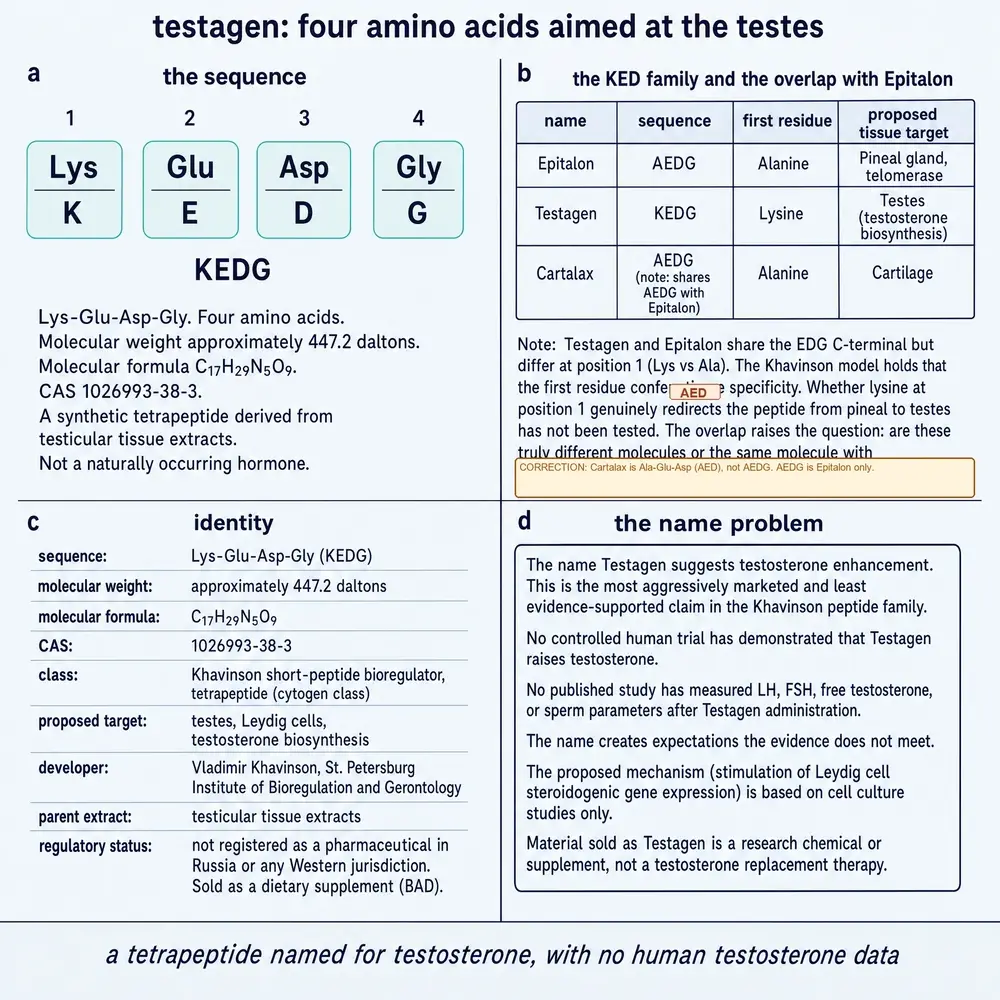
A CAS number, 1026993-38-3, circulates on secondary peptide encyclopedias and vendor pages. A PubChem name lookup for that string returned not-found on 4 August 2026. This monograph reports the number as catalogue-circulating and does not treat it as independently verified from the PubChem record above.
The sequence sits in a family that shares stems the way surnames share syllables. Lys-Glu is Vilon. Add aspartate and it is Vesugen, KED. Add glycine and it is Testagen, KEDG. Add alanine instead and it is Livagen, KEDA; proline, Prostamax, KEDP; tryptophan, Pancragen, KEDW. Change the first residue of KEDG from lysine to alanine and you have Epitalon, AEDG—the pineal tetrapeptide, one letter away, with a much larger literature. Any search that matches on a three-residue prefix will pull the siblings. Any argument that one terminal residue retargets the peptide from pineal to testis is making an extraordinary specificity claim with a one-residue lever.
Older literature also contains Lys-Glu-Asp-Gly as a protein motif and in unrelated neuropeptide work. Those hits are excluded here by an identity gate that requires short-peptide or bioregulator corroboration and that disqualifies testosterone-ester and Aplysia vocabulary. The gate is not pedantry. Without it, the corpus fills with the wrong hormone.
Section 04Testoluten—the parent extract
Every synthetic short peptide in this class has a natural peptide-complex counterpart, and the monograph is required to name it, pair it, and compare the two (house style §8a.2). For Testagen the claimed counterpart is Testoluten, a bovine testicular tissue preparation in the Cytomax peptide-complex line. Programme catalogues and secondary research profiles present Testagen as the chemically defined cytogen counterpart to that extract. PubMed returns zero hits for “Testoluten” (queried 4 August 2026). The pairing is therefore a programme claim with a thin trail in the international index, not a richly documented isolation story.
Two comparisons are mandatory and both are awkward.
First: isolated versus designed. For some members of the class the path is documented. Thymogen (Glu-Trp) was isolated by HPLC from Thymalin. Epitalon was designed from the amino-acid composition of Epithalamin rather than sequenced out as a fragment. For KEDG, no sourced paper in this build’s corpus demonstrates HPLC isolation from Testoluten or states a composition-based design with experimental detail. The honest status is unsettled. This document will not call Testagen “the active fragment” of Testoluten. That phrase is a marketing default; it is not an established result here.
Second: regulatory asymmetry. Several Khavinson extracts became registered medicines in Russia (Thymalin, Epithalamin, Prostatilen, Cortexin, Retinalamin, Thymogen). Testagen has not joined that pharmaceutical list. It is marketed as a dietary peptide complex in Russian channels and as a research chemical elsewhere. Long-horizon human impressions that circulate around “testicular bioregulators” often belong to the extract—or to undifferentiated clinic narrative—rather than to controlled studies of the tetrapeptide. When a claim does not name which of the two was studied, it cannot be attributed to KEDG.
Section 05Programme, people, and the open literature
The story begins before the trade name. In the early 1970s, work that would become the St Petersburg Institute of Bioregulation and Gerontology began isolating biologically active peptide complexes from animal organs. The group’s own retrospectives date the programme to 1973–74: a 1994 paper titled around twenty years of study and a 2009 paper titled around thirty-five years of experience both place the origin there (Anisimov et al., 1994; Khavinson & Anisimov, 2009). Vladimir Khavinson is the central figure. The early theoretical language spoke of cytomedines—intermediaries of cellular information—and of a bioregulation system in which peptides returning from tissues could influence genome activity (Khavinson et al., 2021).
Context matters. Late-Soviet and post-Soviet gerontology was looking for small endogenous signals that might restore organ function without the bluntness of hormone replacement. Tissue extracts were an available technology. Short synthetic peptides were a later refinement that promised chemical definition, lower effective concentrations, and cleaner manufacturing. The programme produced a catalogue in which each organ had an extract and, eventually, a short-peptide name: pineal, thymus, prostate, vessels, liver, pancreas, heart, testis. Testagen is the testicular slot in that catalogue.
Vendor copy sometimes wraps this history in “secret military research.” Parts of the Soviet biomedical enterprise were indeed closed. What can be cited for Testagen specifically is more ordinary: open (if often Russian-language) journals, a systematic review in Molecules, cell-biology papers that list the peptide among siblings, a bird endocrinology series, one Ukrainian clinical article, and a 2025 chemistry paper that happens to print the trade name. Those are the documents. Lore that cannot be sourced is not used below as evidence.
When does “Testagen” enter the English-indexed record as a word? The Fedoreyeva nuclear-penetration paper of 2011 lists “testagen, Lys-Glu-Asp-Gly” among fluorescein-labelled peptides that light up HeLa nuclei and nucleoli (Fedoreyeva et al., 2011). The same group’s 2013 histone-binding study includes KEDG among six short peptides that quench labelled wheat histones (Fedoreyeva et al., 2013). The bird series of 2008–2013 studies Lys-Glu-Asp-Gly and Ala-Glu-Asp-Gly side by side after hypophysectomy. Rossikhin’s 2011 clinical paper uses the trade name in a urology–endocrinology context. The 2021 systematic review folds KEDG into class tables for differentiation and histone interaction (Khavinson et al., 2021). The 2025 Molecules paper is the first PubMed-indexed article whose title is about Testagen itself—and it is about copper (Dobriţescu et al., 2025).
That last fact is almost too neat as a metaphor. The molecule is real enough to synthesise and adsorb onto metal. The biology that the name promises is still mostly a promissory note written in the handwriting of one research school.
Section 06Nuclear entry and histone binding
If a tetrapeptide is going to regulate genes in a Leydig cell, it has to get into the cell and, on the class’s own theory, into the nucleus. The direct imaging that bears on Testagen was not done in Leydig cells. It was done in HeLa cells. Fedoreyeva and colleagues incubated fluorescein-labelled short peptides—including testagen (Lys-Glu-Asp-Gly), epithalon (Ala-Glu-Asp-Gly) and pinealon (Glu-Asp-Arg)—with HeLa cultures and observed marked fluorescence in cytoplasm, nucleus and nucleolus (Fedoreyeva et al., 2011). The same paper reports in-vitro interaction with deoxyribooligonucleotides and DNA. That is a real result about a real peptide in a real cell line. It is also a result in a cervical-cancer cell line, not in testicular tissue, and it is shared with sibling peptides. It shows that peptides of this size can reach a nucleus. It does not show tissue-specific targeting of the testis.
Two years later, fluorescence-quenching work showed that KEDG, together with AEDG, EDR, AEDL, AEDR and KEDW, binds FITC-labelled wheat histones H1, H2B, H3 and H4, with binding that depended on peptide structure and on associated oligonucleotides (Fedoreyeva et al., 2013). The 2021 systematic review repeats KEDG in that histone set and lists KEDG among peptides described as activators of immunogenic differentiation (Khavinson et al., 2021). Again: class mechanism, not a testicular transcriptome.
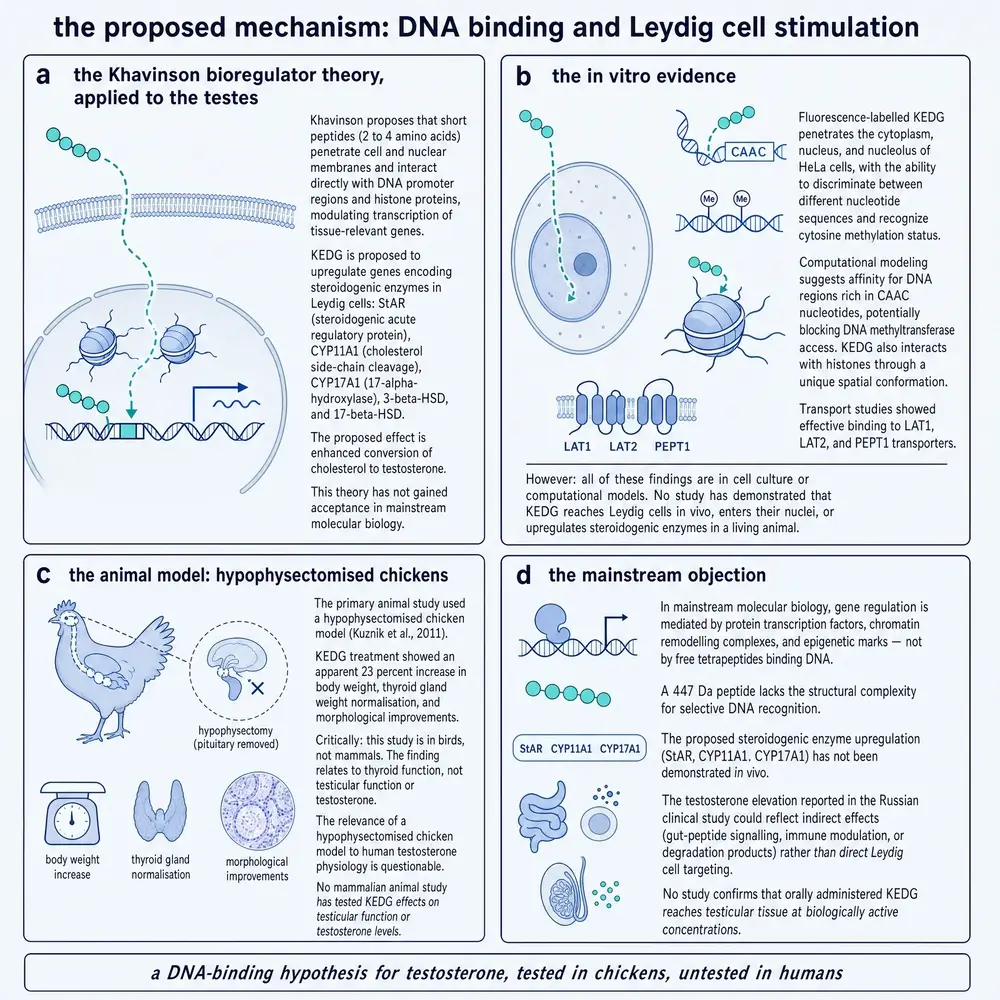
What is missing is the bridge the marketing implies. There is no PubMed-indexed study that measures KEDG binding to Leydig-cell chromatin, no ChIP-style map, no reported upregulation of StAR, CYP11A1 or 3β-HSD under KEDG with methods a second laboratory could rerun from the abstract. Secondary encyclopedias sometimes name those enzymes as proposed targets. Proposed is not shown. This monograph keeps them in the proposed column.
Section 07Birds without a pituitary
The largest cluster of PubMed records that name the sequence Lys-Glu-Asp-Gly is not about testes. It is about birds that have had their pituitary glands removed. Across papers from 2008 to 2013, investigators administered Lys-Glu-Asp-Gly and Ala-Glu-Asp-Gly to neonatally hypophysectomized chickens and to older birds, and reported effects on thyroid structure and hormones (TSH, T3, T4) and on thymus morphology (PMID 19024016; PMID 20731122; PMID 21809626; PMID 22268052; PMID 23658898). Abstracts describe prevention of atrophic thyroid changes and alleviation of secondary hypothyrosis, with recovery often characterised as more pronounced in younger animals.
Read carefully. These are in-vivo animal experiments after a drastic endocrine ablation. They place KEDG in an endocrine-repair narrative. They also place AEDG—Epitalon, the pineal peptide—in the same assays. A design that gives both peptides and reports thyroid rescue for the pair is not a demonstration that KEDG is testis-specific. If anything, the joint design is a quiet problem for the organ-assignment story: the one-residue neighbour assigned to the pineal appears in the same thyroid and thymus readouts. Full texts for this series were not open-access in this build; claims here stay inside what the abstracts state.
For a compound sold as a testicular bioregulator, the absence of a parallel PubMed-indexed Leydig-cell or spermatogenesis assay is the loud fact. The bird work is not nothing. It is also not the organ on the label.
Section 08Against its siblings
House style §8a.4 asks every bioregulator monograph to compare the subject with ordinary receptor pharmacology and with its own siblings. The receptor contrast is Section 02. The sibling contrast is this one.
Testagen differs from Epitalon by a single N-terminal substitution (Lys vs Ala) and from Livagen by a single C-terminal substitution (Gly vs Ala). Vesugen is its first three residues. The programme assigns these molecules to testis, pineal, liver and vessels respectively. That is a strong claim about sequence-dependent tissue addressing. The evidence that would make it persuasive—head-to-head assays in the assigned tissues, with off-target tissues as negative controls—is not what the Testagen record contains. What it contains is shared nuclear-entry behaviour, shared histone-binding behaviour, shared appearance in differentiation lists, and shared billing in bird thyroid studies with Epitalon.
Livagen, by contrast, has a chromatin literature in aged human lymphocytes that is thin but internally repeated. Prostamax has patents and rodent prostatitis models. Epitalon has a broader gerontology footprint. Testagen’s specific testicular file is smaller than each of those. The honest comparative sentence is uncomfortable and necessary: among the KE-family entries, Testagen is one of the least independently documented for its assigned organ.
Section 09The only human paper
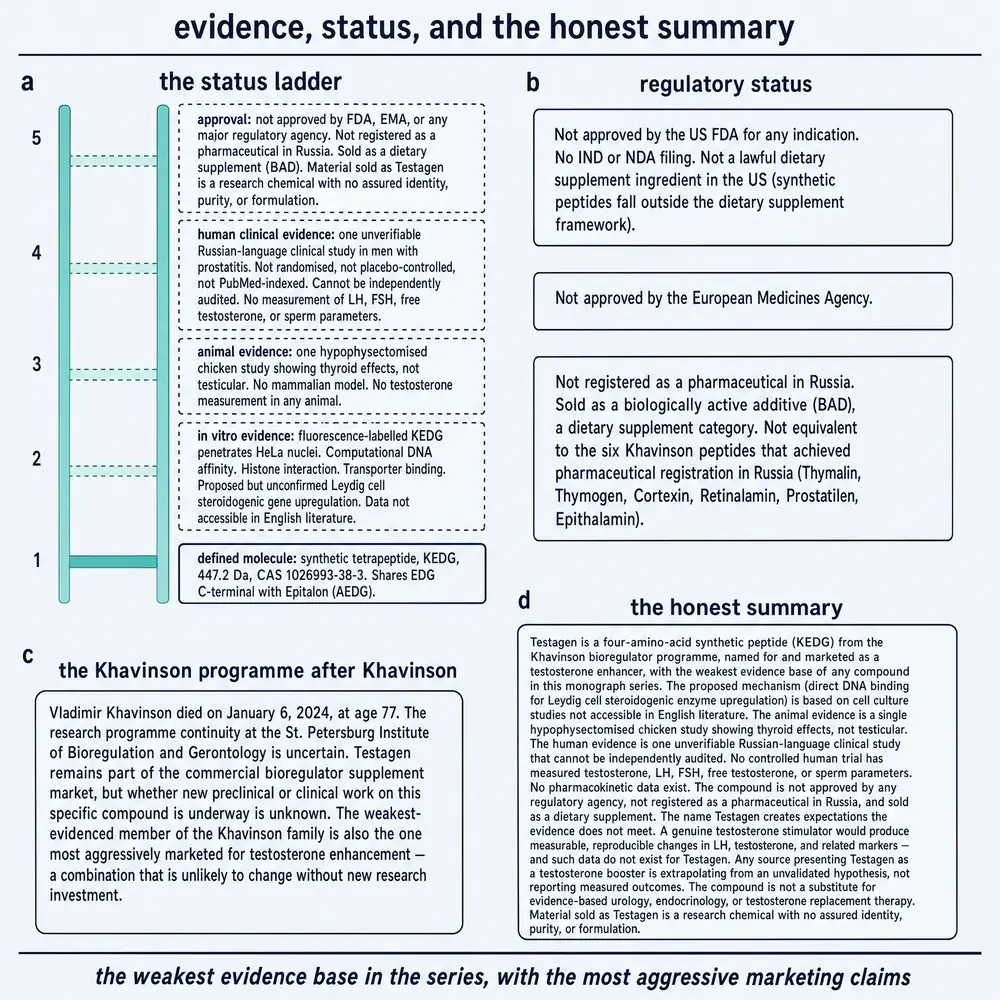
Rossikhin, Hoshchenko and Osipov published in 2011 in Problems of Endocrine Pathology on “testosterone synthesis inductor” Testagen in men with chronic abacterial prostatitis (type IIIA) and androgenic deficiency (Rossikhin et al., 2011). The article is not indexed in PubMed. The English abstract reports thirty-six patients who received conservative therapy described as an α1-adrenolytic plus rectal NSAID suppositories; after one month, uroflowmetric parameters improved, prostatic inflammation decreased, and total serum testosterone rose.
That abstract is easy to over-read. The title names Testagen. The abstract sentence that describes the protocol emphasises standard urologic therapy. Without the full methods in hand—this build’s PDF fetch from the journal host failed on DNS—a careful reader cannot tell from the English abstract alone how Testagen was scheduled, whether there was a control arm, or how much of the testosterone change should be attributed to resolution of inflammation under conventional therapy. Concurrent α1-blockade and NSAID use are not inert. Inflammation itself suppresses androgen signalling; treating prostatitis can raise measured testosterone without any peptide on stage.
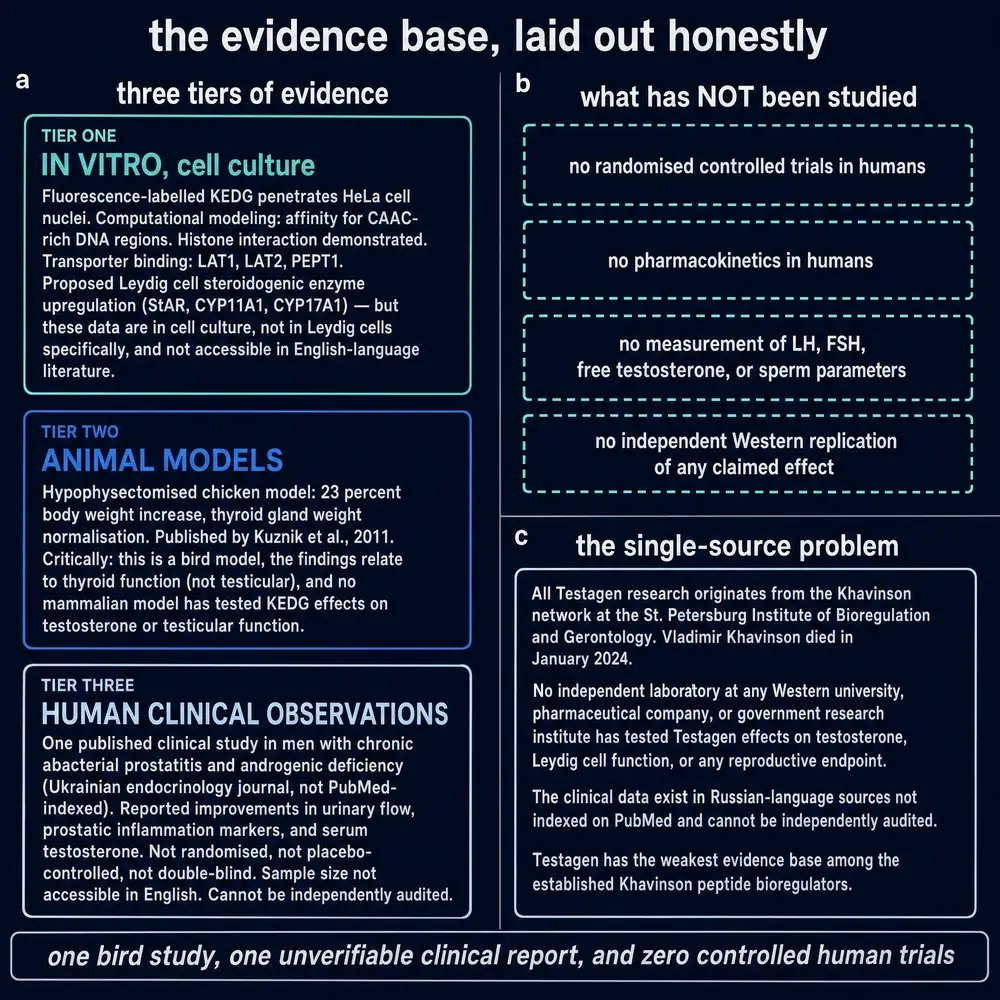
What can be said without stretching: there is one published clinical article that names Testagen in this indication; it is small; it is not randomised or placebo-controlled on the evidence of the abstract; it has not been replicated in a registered trial; and it sits outside PubMed. Secondary profiles that present it as proof that KEDG raises testosterone in men are ahead of the design.
The stack above is the authored tally. The commissioned plate that follows redraws the same emptiness in three tiers and four dashed boxes, so the reader can see the shape twice without mistaking either graphic for a meta-analysis.
Section 10Transport, pharmacokinetics, and the empty cells
How would an oral or injected tetrapeptide reach Leydig cells intact? The class has begun to ask that question with transporter docking. A 2023 Biomolecules paper modelled twenty-six ultrashort peptides against LAT and PEPT family transporters (PMID 36979488). That is progress on a falsifiable mechanism—carrier-mediated entry rather than mystical diffusion—but docking is still a model, and testicular pharmacokinetics are not measured in it. For KEDG specifically, no plasma half-life, oral bioavailability, tissue distribution or metabolite profile appears in the indexed record.
Empty cells accumulate. No ClinicalTrials.gov registration for the peptide (ClinicalTrials.gov, 2026). No dose–response curve for a testicular endpoint. No reproductive toxicology package. No independent laboratory repeating a Leydig-cell or hypogonadism endpoint. No structural characterisation of a KEDG–DNA complex in testicular chromatin. The 2025 copper paper confirms that chemists can make and study the molecule (Dobriţescu et al., 2025). It does not fill those cells.
Section 11How to weigh this
Recency is a legitimate weight when fresh data are not contradicted by a thicker older record. The 2025 Molecules paper is the right place to lock the chemical identity of Testagen as H-Lys-Glu-Asp-Gly-OH (Dobriţescu et al., 2025). The 2023 transporter docking work is the right place to look for a testable entry route for the class (PMID 36979488). Neither paper is a testicular efficacy study, and neither should be asked to do that job.
Preponderance still governs the biological claim. Across in-vitro, animal and human tiers, the pattern is consistent: mechanism evidence is class-level and mostly not testicular; animal evidence that names the sequence is largely thyroid and thymus after hypophysectomy, often with Epitalon as a co-subject; human evidence is a single uncontrolled paper whose abstract does not cleanly isolate the peptide; independent replication is absent. Preferring the newest catalogue claim over that pattern would be cargo-cult recency.
In-vivo animal work exists and should be counted—as bird endocrine repair data, not as a substitute for Leydig-cell pharmacology. In-vitro human-cell work exists—as HeLa nuclear entry and wheat-histone binding, not as a steroidogenic gene panel. The human observational paper exists—as a signal that someone studied the trade name in a clinic, not as a trial that establishes effect size.
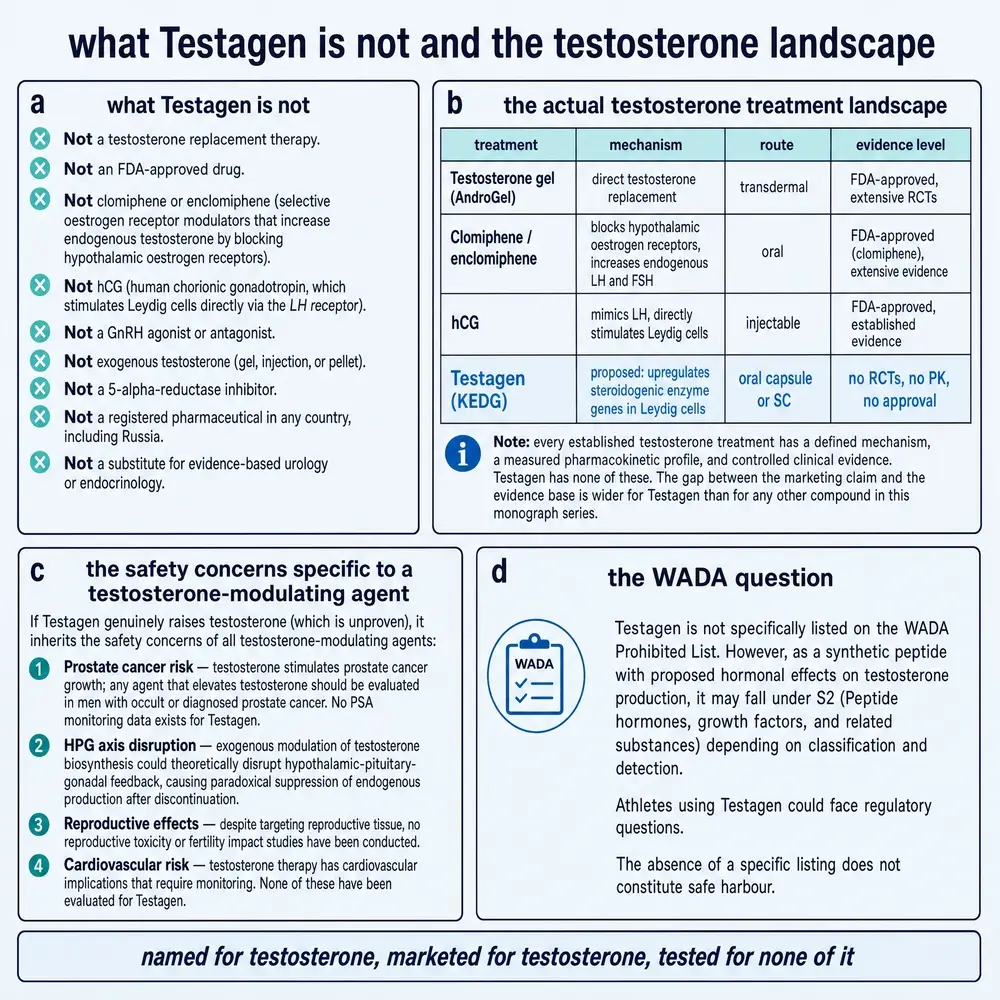
Compare Testagen with what a reader might confuse it for. Exogenous testosterone raises serum levels by supplying the hormone; the evidence base is large and the risks are characterised. Clomiphene and hCG act on the HPG axis through named receptors with dose–response data. Testagen, on the published record assembled here, is a short peptide with a programme assignment to the testis and a thin, mostly non-testicular experimental file. Conflating those categories is the central commercial error this monograph exists to block.
Section 12Open questions
The gaps are specific enough to list.
- Was KEDG isolated from Testoluten or designed from its composition? Unsettled.
- Does intact KEDG reach Leydig cells after oral or parenteral administration in any species? Unmeasured.
- Does KEDG alter steroidogenic gene expression in primary Leydig cells or testicular explants under controlled conditions? Not in PubMed.
- In a randomised, controlled human study with testosterone as a pre-specified endpoint, does Testagen outperform placebo when concurrent prostatitis therapy is balanced? Not done.
- Why do KEDG and AEDG appear together in bird thyroid assays if organ assignment is residue-specific? Unanswered.
- What is the safety profile in men at risk for hormone-sensitive malignancy? Unknown.
Those are not rhetorical questions. They are the experimental programme a second laboratory would write if the first laboratory’s hypothesis is to be tested rather than repeated.
Section 13Closing
Testagen is a real tetrapeptide. Its name is easy to confuse with testosterone products, and that confusion is already in the databases. Its programme biography is coherent: extract to short peptide, testis as the assigned organ, nuclear gene regulation as the claimed style of action. Its indexed experimental biography is small, internally clustered, and largely pointed at other organs or at class-general assays. The copper paper that confirms the sequence is a useful reminder of what settled chemistry looks like. The biology that the market attaches to the name has not yet earned the same tense.
This monograph does not recommend that any person take Testagen, Testoluten, or any dose of either. It reports what the published record contains, and it stops where that record stops.
Section 14Methods note
Project 05 — Therapeutic Peptide Research Library denotes the workspace research corpus, not a single folder. Local stores scanned for filename and text hits on Testagen / Testogen / KEDG included fulltext/, dossiers/, output/, literature/, South Beach Longevity Library/, Radix_Peptides_Global_Project/library/, and vendor PDF replicas. Twelve filename matches resolved to four unique document types after deduplication: an empty Radix dossier (20 pp), an intake evidence map (7 pp), a compound index page, and a vendor product PDF (5 pp). None of those is peer-reviewed science.
PubMed was queried for testagen, KEDG AND peptide, Lys-Glu-Asp-Gly, and Testoluten on 4 August 2026. Identity gating excluded testosterone-ester brands, NCT02733133, and protein-motif collisions. Open-access full texts were retrieved via EuropePMC for PMID 40807317 and PMID 36979488. The local Khavinson 2021 systematic review PDF was screened and retained. Rossikhin et al., 2011 was resolved by DOI; full-text PDF download failed from this workstation and claims from that paper are restricted to the publisher’s English abstract plus bibliographic metadata.
Chemical constants were taken from PubChem CID 123863700 queried the same day. Catalogue CAS 1026993-38-3 is reported as unverified against PubChem. Series number assignment follows house style A38 (lowest unused integer in the filed-PDF library) and was re-checked immediately before filing.
Figures are authored SVG using house colour tokens only. No third-party published figure has been reproduced. No human use, dose, route or schedule is recommended in this document; study parameters appear only as published.
Section 15References
- Anisimov VN, Khavinson VKh, Morozov VG. Twenty years of study on effects of pineal peptide preparation: epithalamin in experimental gerontology and oncology Ann N Y Acad Sci 1994;719:483-93. PMID 8010617 · doi
- Dobriţescu A, Samide A, Cioateră N, Mic OC, Ionescu C, Dăbuleanu I et al.. The Inhibitory Effect and Adsorption Properties of Testagen Peptide on Copper Surfaces in Saline Environments: An Experimental and Computational Study Molecules 2025;30(15). PMID 40807317 · doi · PMC12348504
- Fedoreyeva LI, Kireev II, Khavinson VKh, Vanyushin BF. Penetration of short fluorescence-labeled peptides into the nucleus in HeLa cells and in vitro specific interaction of the peptides with deoxyribooligonucleotides and DNA Biochemistry (Mosc) 2011;76(11):1210-9. PMID 22117547 · doi
- Fedoreyeva LI, Smirnova TA, Kolomijtseva GY, Khavinson VKh, Vanyushin BF. Interaction of short peptides with FITC-labeled wheat histones and their complexes with deoxyribooligonucleotides Biochemistry (Mosc) 2013;78(2):166-75. PMID 23581987 · doi
- Khavinson V, Linkova N, Diatlova A, Trofimova S. Peptide Regulation of Cell Differentiation Stem Cell Rev Rep 2020;16(1):118-125. PMID 31808038 · doi
- Khavinson VK, Linkova NS, Rudskoy AI, Petukhov MG. Feasibility of Transport of 26 Biologically Active Ultrashort Peptides via LAT and PEPT Family Transporters Biomolecules 2023;13(3). PMID 36979488 · doi · PMC10046148
- Khavinson VK, Popovich IG, Linkova NS, Mironova ES, Ilina AR. Peptide Regulation of Gene Expression: A Systematic Review Molecules 2021;26(22). PMID 34834147 · doi · PMC8619776
- Khavinson VKh. Peptides and Ageing Neuro Endocrinol Lett 2002;23 Suppl 3:11-144. PMID 12374906
- Khavinson VKh, Anisimov VN. [35-year experience in research of peptide regulation of aging] Adv Gerontol 2009;22(1):11-23. PMID 19827673
- Kuznik BI, Pateyuk AV, Rusaeva NS. Effect of tetrapeptides Lys-Glu-Asp-Gly and Ala-Glu-Asp-Gly on the structure and function of the thyroid gland in neonatally hypophysectomized chickens Bull Exp Biol Med 2008;145(1):104-7. PMID 19024016 · doi
- Kuznik BI, Pateiuk AV, Rusaeva NS, Baranchugova LM, Obydenko VI. [Effects of hypophyseal Lys-Glu-Asp-Gly and Ala-Glu-Asp-Gly synthetic peptides on immunity, hemostasis, morphology and functions of the thyroid gland in neonatally hypophysectomized chicken and one-year-old birds] Patol Fiziol Eksp Ter 2010;(1):14-8. PMID 20731122
- Kuznik BI, Pateiuk AV, Rusaeva NS, Baranchugova LM, Obydenko VI. [Effects of Lys-Glu-Asp-Gly and Ala-Glu-Asp-Gly peptides on hormonal activity and thyroid morphology in hypophysectomized mature and old birds] Adv Gerontol 2011;24(1):93-8. PMID 21809626
- Kuznik BI, Pateyuk AV, Rusaeva NS, Baranchugova LM, Obydenko VI. Effects of peptides Lys-Glu-Asp-Gly and Ala-Glu-Asp-Gly on hormonal activity and structure of the thyroid gland in hypophysectomized young chickens and old hens Bull Exp Biol Med 2011;150(4):495-9. PMID 22268052 · doi
- Pateyk AV, Baranchugova LM, Rusaeva NS, Obydenko VI, Kuznik BI. Effect of peptides Lys-Glu-Asp-Gly and Ala-Glu-Asp-Gly on the morphology of the thymus in hypophysectomized young and old birds Bull Exp Biol Med 2013;154(5):681-5. PMID 23658898 · doi
- Rossikhin VV, Hoshchenko YO, Osipov PG. Efficacy of testosterone synthesis inductor application “Testagen” in androgenic deficiency in patients with chronic abacterial prostatitis. Probl Endocrine Pathol. 2011;36(2):17-22. doi:10.21856/j-PEP.2011.2.03. Not indexed in PubMed. Resolved 4 August 2026. link
- National Center for Biotechnology Information. PubChem Compound Summary CID 123863700, H-Lys-Glu-Asp-Gly-OH. PubChem, Bethesda MD. Molecular formula C17H29N5O9, relative molecular mass 447.4, exact mass 447.1965, InChIKey HKEYFJLTNCUNAD‑DCAQKATOSA‑N. No synonym “Testagen” on this CID. Queried 4 August 2026. link
- United States National Library of Medicine. ClinicalTrials.gov search for Testagen peptide / KEDG, and exclusion of NCT02733133. Zero studies returned for the tetrapeptide. NCT02733133 (“Testagen™ TDS®-Testosterone”) is a topical testosterone product and is excluded. Queried 4 August 2026. link
Continue exploring