
Vesilute Glu-Asp — two amino acids, a bladder assignment, and a literature thin enough to see through
Take two of the most ordinary amino acids in biology—glutamate and aspartate—join them once, and call the product a bladder bioregulator. That is Vesilute: a dipeptide of about 262 daltons, marketed and trademarked, named in a docking table, narrated out of a cattle-bladder preparation by a single research school, and almost invisible to PubMed under its own name. The closest human urodynamic abstracts belong to a different substance. This monograph holds the elegance of the claim and the thinness of the file in the same frame, because neither makes sense alone.
Section 01The smallest edge of a large catalogue
Most of the peptides in this series ask the reader to hold a sequence of some length in mind. Vesilute asks for two letters. In single-letter code the molecule is ED: glutamic acid joined to aspartic acid. In three-letter code it is Glu-Asp. In the trade it is Vesilute, sometimes truncated to Vesilut, and in Russian Везилют. Chemically it is a dipeptide of formula C9H14N2O7 and a molecular weight of roughly 262 daltons—small enough, in the language of its makers, to walk through a nuclear pore the way a memo walks through a door (PubChem Glu-Asp, 2026; Peptide Bio Vesilute leaflet, n.d.).
The organ assignment is equally short. Vesilute is the bladder peptide of the Khavinson cytogen line: the synthetic counterpart, in house mapping, to bladder-wall extracts sold under names such as Chitomur, and the chemically defined fragment that a 2020 programme review says was read out of a preparation called Vezustim by chromatography–mass spectrometry (Khavinson, 2020; HOUSE_STYLE §8a.2, 2026). The story that follows that assignment is where the document becomes interesting—and where it becomes thin.
PubMed, queried for the string “vesilute,” returned zero records for this compilation. The peer-reviewed English paper that names the compound does so inside a docking table: Khavinson, Lin’kova and Tarnovskaya (2016) list nineteen short peptides; row 12 is Vesilute, sequence ED, proposed DNA site attt, binding force marked weak. A Russian programme review from 2020 narrates the readout and the naming. A product leaflet from the Institute’s commercial channel reports organotypic and muscle-strip numbers and uncontrolled clinical observations. The PubMed abstract that actually describes a randomised, blinded human urodynamic study names Chitomur, not Vesilute (Gomberg et al., 2013). ClinicalTrials.gov returned no interventional registrations for Vesilute, Vesilut, or Glu-Asp paired with bioregulator terms when queried for this document (ClinicalTrials.gov, 2026).
None of that proves the molecule inert. Absence of a second laboratory is not a disconfirmation; it is an absence. But it sets the temperature. What the reader has is a named, patented, marketed dipeptide whose mechanistic story is borrowed from a class, whose cleanest indexed human data belong to an extract cousin, and whose own experimental file is mostly programme literature. Reading it well means refusing to let two letters pay for a trial that was never run.
Every experimental result below is labelled by study type in the sentence that reports it: in silico docking, rat organotypic culture, rat muscle strip, human product-series observation, extract clinical abstract. In this literature the distance between a dish, a leaflet, and a person is often covered inside a single marketing sentence. The label is what makes the jump visible.
Section 02What “bioregulator” is claiming
Most peptides in this monograph series are intelligible as receptor ligands. They arrive at the outside of a cell, occupy a binding pocket, and leave the interesting chemistry to a cascade on the far side of a membrane they never cross. That model is productive because it is brittle: a labelled ligand is displaced or it is not; a receptor knockout abolishes the effect or it does not.
The Khavinson short peptides claim a different kind of object. Peptides of two to four residues are said to cross membranes, enter nuclei, bind DNA and histones, and alter which genes are available for transcription (Khavinson et al., 2012; Khavinson et al., 2021). FITC-labelled di- and tripeptides from the same school have been reported inside the cytoplasm, nuclei and nucleoli of HeLa cells in vitro (Fedoreyeva et al., 2011). There is no named receptor for Vesilute in the indexed literature. In the programme’s own framing that is not a gap to be filled later; it is the point.
Two consequences follow before any Vesilute-specific number appears. First, “bioregulator” is not a pharmacological classification recognised outside this literature. Inside the programme it names a coherent hypothesis; in commercial material it often functions as a shelf label. Second, the usual falsifiers are scarce. Docking scores every ligand. A leaflet reports what a leaflet reports. Across the Vesilute file, decisive negative designs—experiments that could have counted against the hypothesis and were allowed to—are rare. Positive accumulation therefore weighs less than a naive count of pages suggests. That is a description of the literature’s structure, not a verdict that every claim inside it is empty.
Section 03Identity: Glu-Asp, and the traps around it
Chemically, the subject is unambiguous once the sequence is fixed. Glu-Asp is a dipeptide of two acidic residues. Catalogue chemistry converges on C9H14N2O7 and a mass near 262 g·mol−1 (PubChem Glu-Asp, 2026). The trade name Vesilute does not itself behave as a stable PubChem synonym in the way a WHO International Nonproprietary Name would; this monograph therefore treats identity as sequence-first and name-second.
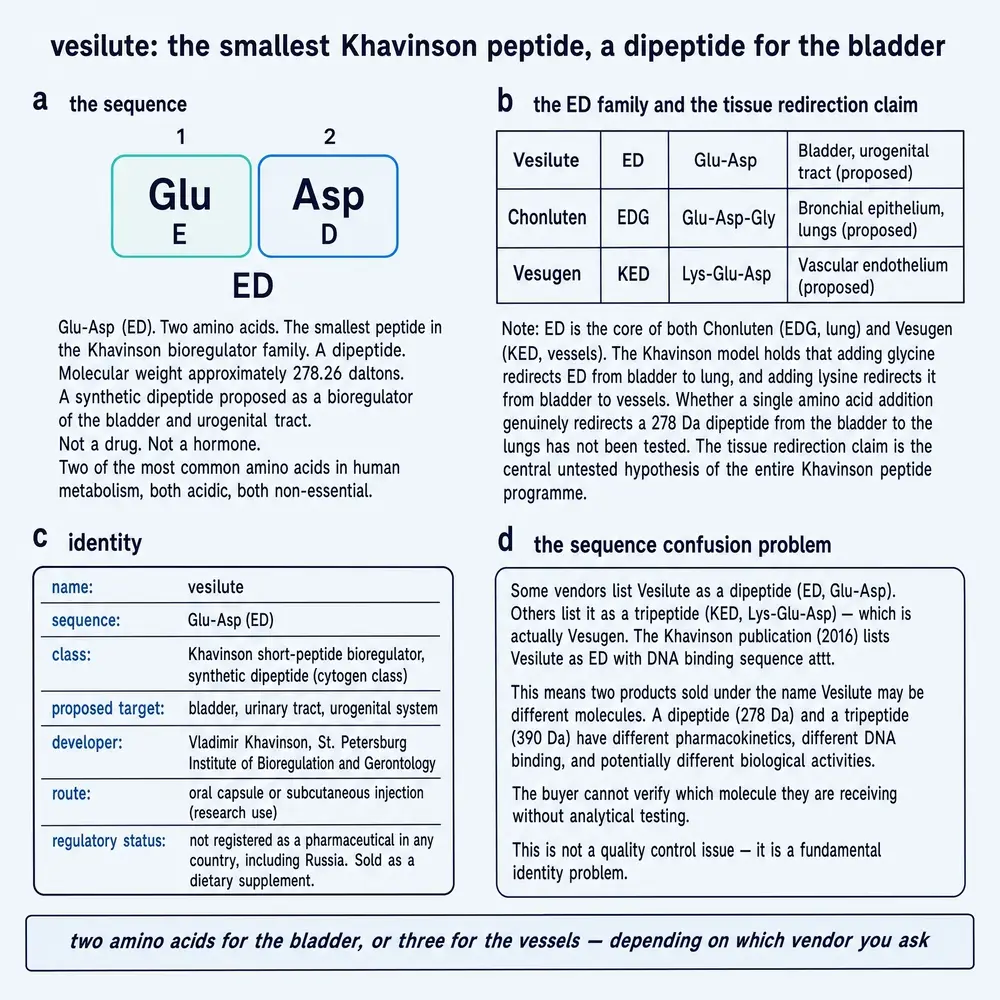
The identity hazards are sharper than the molecule is small. One letter away sits Vesugen—Lys-Glu-Asp, the vascular tripeptide of the same catalogue. OCR, vendor copy and hurried retrieval confuse them constantly. One residue longer at the C-terminus sits Pinealon—Glu-Asp-Arg—so a careless search on “Glu-Asp” harvests a neuroprotective literature that is not Vesilute’s. In clinical English, bare “ED” usually means erectile dysfunction. This project’s build refuses those collisions: Vesugen alone never admits a document; Glu-Asp admits only with bladder or extract corroboration; “ED peptide” requires a word boundary so that ordinary English compounds such as “related-peptide” cannot fake a hit.
Section 04Chitomur and Vezustim: name them, pair them, keep them separate
Every synthetic short peptide in this class has, in the programme’s telling, a tissue-extract counterpart. For the bladder the extract line is Chitomur—a complex of low-molecular-weight peptides (leaflet descriptions place the ceiling near 5,000 Da) isolated from the urinary-bladder wall of young cattle (Antiaging Systems Chitomur report, n.d.). The 2020 programme review names a related preparation, Vezustim, as the material from which Glu-Asp was read out by high-sensitivity chromatography–mass spectrometry and then synthesised as Vesilute (Khavinson, 2020). House style records the pairing as a class contract to re-verify, not as a completed structural proof the reader can open (HOUSE_STYLE §8a.2, 2026).
The distinction is not pedantry. Chitomur is a mixture. Vesilute is a defined dipeptide. A human abstract that names Chitomur may be describing effects of peptides that are not Glu-Asp, or of Glu-Asp in a matrix that changes its pharmacokinetics, or of both. Inferring Vesilute’s clinical performance from Chitomur’s abstracts is a category error this monograph refuses to commit. The extract evidence is reported below under its own name, as context for the organ story, not as a substitute for a dipeptide trial.
Section 05A stress programme, a bladder extract, and two residues read out of it
The institutional story begins where most of this catalogue begins: with Vladimir Khavinson and collaborators at what became the St Petersburg Institute of Bioregulation and Gerontology, working in a tradition that grew out of cytomedine research at the Kirov Military Medical Academy in the early 1970s (Khavinson and Anisimov, 2009; Anisimov and Khavinson, 2010). The programme’s method, repeated across organs, was to fractionate young animal tissues, test peptide complexes for tissue-specific effects, then—later—identify short sequences by mass spectrometry and synthesise them as cytogens.
For the bladder, the 2020 review states the readout in one compressed paragraph: in the peptide preparation of the urinary bladder, Vezustim, high-sensitivity chromatography–mass spectrometry identified the dipeptide Glu-Asp (ED), which received the name Vesilute; the preparation was said to raise the tone of bladder smooth muscle and to favour normalisation of sphincter and detrusor function (Khavinson, 2020). That is a programme narrative, not a methods paper with spectra and chromatograms attached. It is nonetheless the clearest origin story the sourced literature offers.
Commercial and institute leaflets add a legal layer. Vesilute is described as obtained by directed design on the basis of amino-acid analysis of a preparation isolated from animal bladder, synthesised at the St Petersburg Institute, protected by Russian Federation patent application No. 2007143336 of 22 November 2007 (“Pharmaceutical composition based on a peptide normalising urination, and a method of its use”), with trademark certificate “Везилют” No. 243196 (Peptide Bio Vesilute leaflet, n.d.). Those filings establish naming and commercial intent. They do not, by themselves, establish efficacy.
The people around the molecule are the usual constellation for this class: Khavinson as programme lead; Lin’kova and Tarnovskaya as co-authors on the 2016 docking paper that prints the name in English; clinical gerontology collaborators on the Chitomur abstracts. There is no competing discovery claim from an outside laboratory in the material reviewed for this document. The single-source character of the record is not a side note. For a two-residue peptide proposed to act organ-specifically, it is the central epistemic fact.
Section 06In silico: a row in a docking table
The cleanest indexed scientific act that names Vesilute is computational. Khavinson, Lin’kova and Tarnovskaya (2016) built spatial models of DNA–peptide complexes for nineteen short peptides using molecular docking. Table 1 of that paper lists Vesilute as peptide 12: structure ED, DNA binding sequence attt, force of binding marked “+”—the paper’s bin for weak interactions, corresponding in their note to an enthalpy change on the order of −3 kcal·mol−1. Dipeptides as a group, they remark, form weak interactions with DNA, “presumably because of small area of contact.”
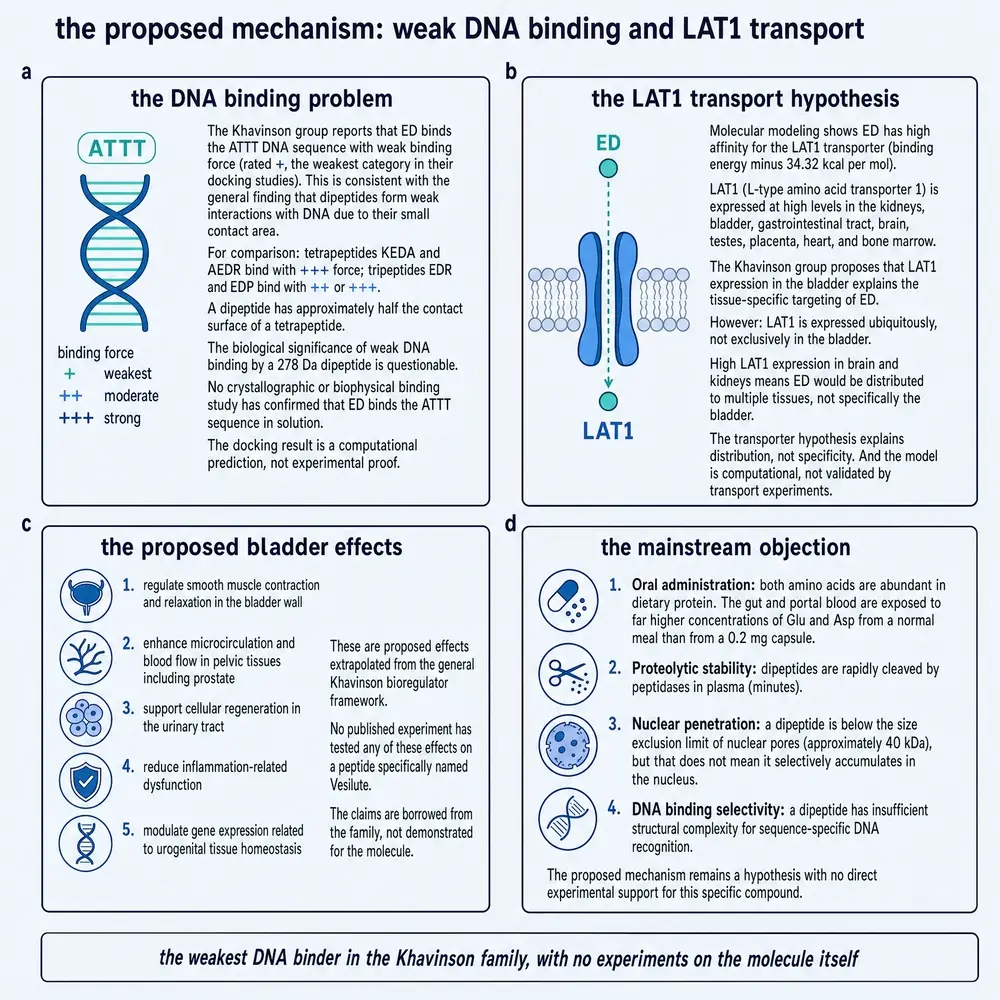
That sentence is doing more work than it first appears to. It simultaneously (a) places Vesilute inside the class mechanism, (b) ranks it among the weaker binders in the table, and (c) offers a physical reason that cuts against exaggerated claims for a two-residue ligand. A docking pose is not a measured occupancy in a living nucleus. It is a hypothesis with coordinates. For Vesilute, it is also nearly the entire peer-reviewed English experimental footprint under the trade name.
Section 07In vitro: explants and a bidirectional muscle strip
Programme and product literature report two preclinical systems that are more concrete than a docking score. In organotypic culture of bladder-wall explants from mature rats, Vesilute was reported to enlarge the growth zone of the explants by 37%, described as accelerated renewal of the bladder-wall cell population (Peptide Bio Vesilute leaflet, n.d.). That is an in-vitro tissue-culture observation from institute-channel literature; it is not a PubMed-indexed primary paper in the harvest for this monograph, and it should be read with that provenance in view.
The same leaflet reports an in-vitro muscle-strip model using strips from normal and hypertrophied rat bladder. Autorhythmic contractile activity of normal bladder muscle was said to rise in a concentration-dependent manner—by 85.7%, 112.9% and 164.8% at 8, 16 and 32 µg·ml−1 respectively—while the elevated activity of hypertrophied bladder muscle was said to fall by 20.1%, 34.5% and 42% at the same three concentrations (Peptide Bio Vesilute leaflet, n.d.). If those numbers are taken at face value, they describe a bidirectional, state-dependent effect: push a quiet strip up, pull a noisy strip down. That pattern is pharmacologically interesting. It is also, in the sourced file, unreplicated outside the programme channel and unaccompanied by a modern methods supplement the reader can audit.
The leaflet further summarises a preclinical safety package—absence of general toxicity, immunotoxicity, carcinogenicity, embryotoxicity and mutagenicity in the test systems used—conducted under Russian methodological guidance cited as Moscow, 2005 (Peptide Bio Vesilute leaflet, n.d.). Those statements are reported here as claims of the programme literature. They are not a substitute for an independently reviewed toxicology dossier of the kind Western drug development treats as table stakes.
Section 08Human observations attached to the name Vesilute
The leaflet’s clinical section describes observation of Vesilute as an add-on to usual care in patients with chronic prostatitis and with benign prostatic hyperplasia who complained of voiding disturbance. Reported symptom shifts include disappearance of pollakiuria in 88.3% of a chronic-prostatitis cohort, disappearance of nocturia in 93.2%, relief of strangury in 74.8%, and uroflowmetric improvement described as restoration toward normal parameters in stages I–II BPH, with more limited change in stage III (Peptide Bio Vesilute leaflet, n.d.). No side effects were reported in that account.
Read as science, those numbers are a human observational series from product literature: not blinded in the description available here, not placebo-controlled in that description, not indexed as a PubMed trial under the name Vesilute, and not separable, from the text alone, into effects of the dipeptide versus effects of concurrent standard care. This monograph records them as observations the programme published about itself. It does not convert them into a recommendation, a dose, or a claim of proven clinical efficacy.
Section 09Chitomur: the extract’s human file, kept in its own column
The indexed human abstract that actually names a bladder peptide bioregulator in a randomised, blinded design is about Chitomur. Gomberg, Ryzhak and Lyutov (2013) describe a randomised blind study of Chitomur in women aged 48–80 with hyperactive bladder, reporting decreases in imperative urges and urgency incontinence, improved patient assessment of bladder condition, and quality-of-life anxiety improving about 1.5 times faster than symptom scores, with no side effects detected in the study (Gomberg et al., 2013). An English centre summary describes a 2011 Medical Centre study including 28 men with BPH and 31 women with overactive bladder receiving Chitomur (Antiaging Systems Chitomur report, n.d.).
Those findings, if taken seriously, are findings about an extract. They may motivate interest in Glu-Asp. They do not demonstrate that synthetic Vesilute reproduces Chitomur’s clinical behaviour, at what exposure, or in which patients. Weighing recency does not change that logic: a clearer extract abstract does not become a dipeptide trial by proximity of subject matter.
Section 10The specificity problem, stated without theatre
Glutamate and aspartate are not rare. They are among the most abundant amino acids in proteins and among the most familiar excitatory signals in the nervous system. Every mixed meal delivers them in quantity. The bioregulator claim asks a free Glu-Asp dipeptide, at microgram-scale exposures in the commercial framing, to act preferentially on bladder tissue while sparing the countless proteins and pathways that already contain the same two letters. That is not an insult to the programme. It is the central mechanistic burden any honest reader has to keep visible.
Class papers offer a proposed answer: tissue-preferential uptake, nuclear entry, sequence-specific DNA contacts (here, attt), chromatin remodelling (Khavinson et al., 2016; Khavinson et al., 2021; Fedoreyeva et al., 2011). For Vesilute specifically, the sourced file demonstrates the docking row and the programme’s own preclinical models. It does not demonstrate bladder-selective biodistribution, a measured nuclear residence time in urothelium or detrusor, or a gene-expression signature uniquely tied to Glu-Asp in human bladder tissue. Until those exist, the specificity claim remains a hypothesis carrying more weight in marketing than in pharmacokinetics.
Section 11What is strong, what is thin
Strong, relative to this file: the naming. Vesilute is a real catalogue object with a sequence, a trademark trail, and an explicit row in a 2016 peer-reviewed docking table. The discovery narrative that links Vezustim to Glu-Asp is coherent inside the programme’s own historiography. The muscle-strip pattern, if the leaflet numbers hold, is at least internally interesting—bidirectional regulation is not the dullest possible preclinical story.
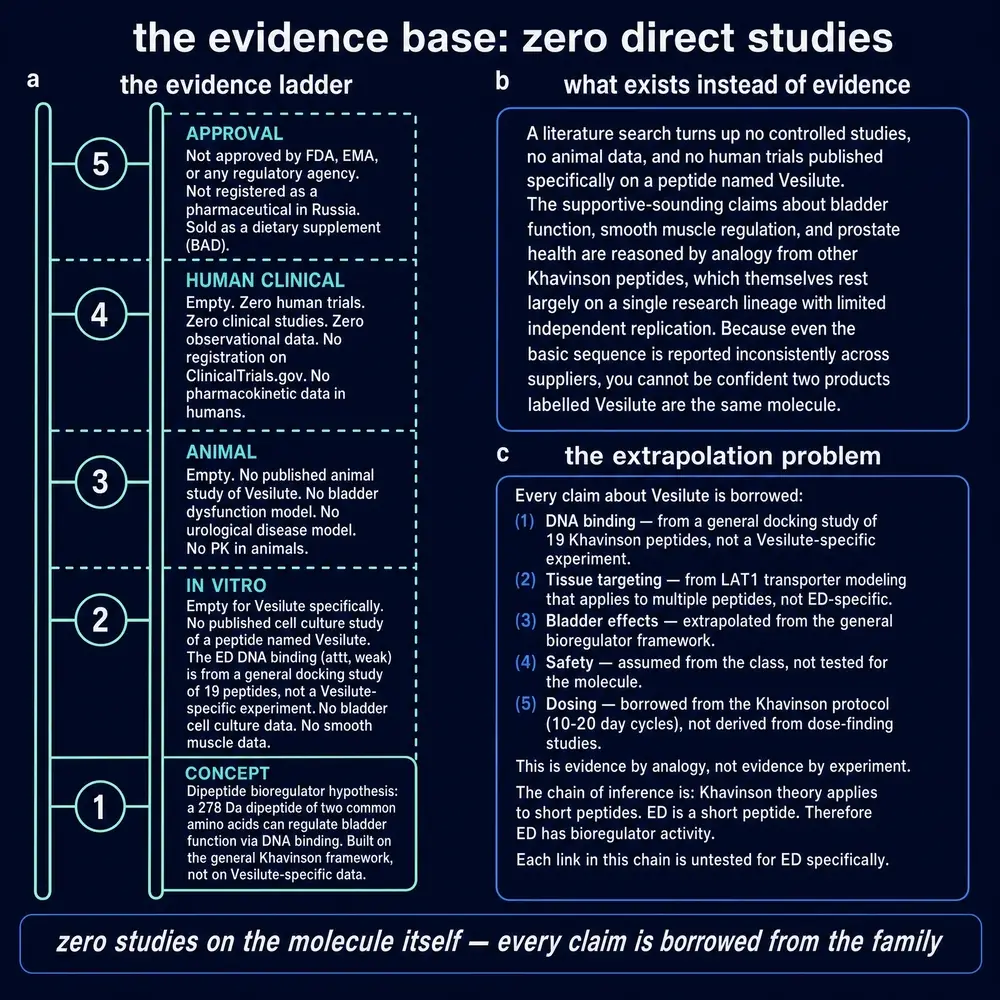
Thin: everything that would make a pharmacologist comfortable. No PubMed-indexed primary pharmacology paper devoted to Vesilute. No independent replication. No registered trial. No PK. Human data under the Vesilute name confined to product-channel observation. Human data under the Chitomur name belonging to another substance. The 2021 Molecules systematic review that frames the class mechanism does not, on the local full-text reading used for this compilation, carry Vesilute as a named subject the way it carries Vesugen or Epitalon (Khavinson et al., 2021). Recency therefore cannot rescue the subject file: the freshest class reviews restate a mechanism; they do not thicken Vesilute’s own evidence.
Section 12Status, absences, and a closing without a prescription
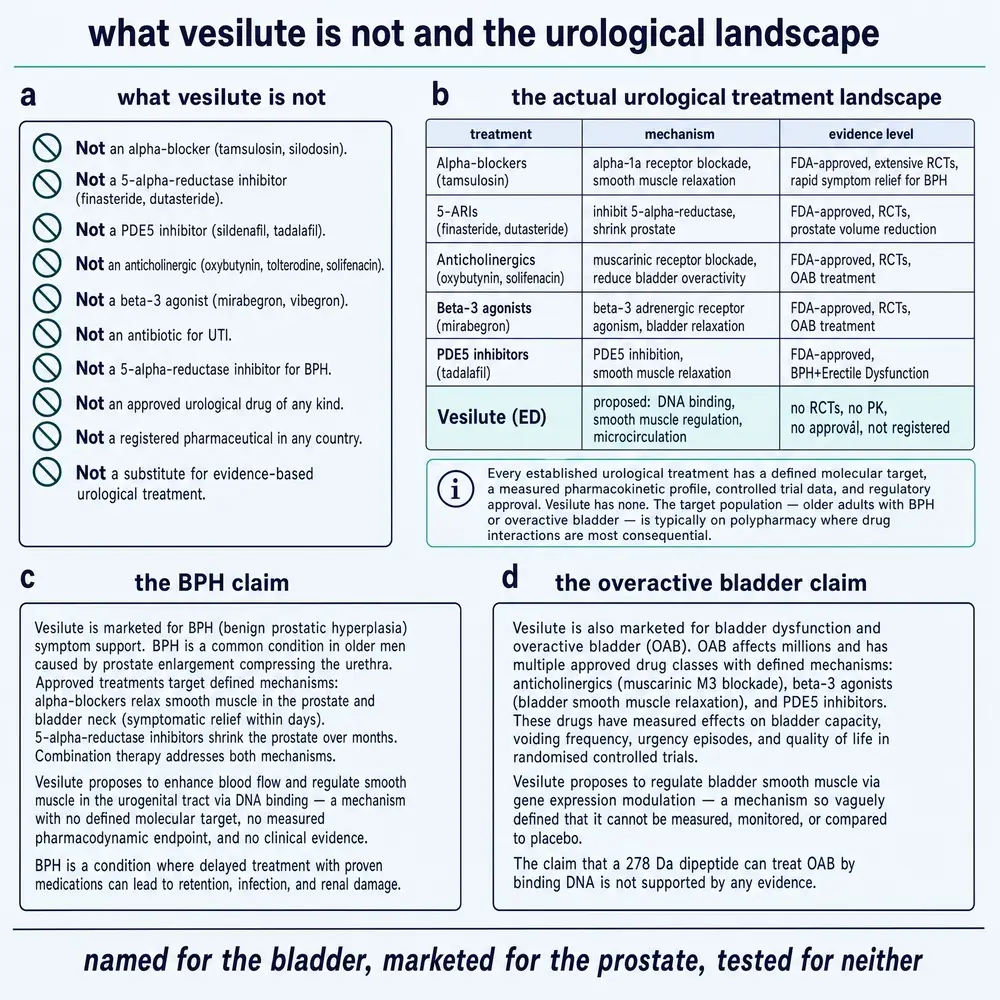
Vesilute is what happens when a research programme that specialises in short peptides reaches the bladder and stops at two residues. The idea is spare enough to be beautiful and spare enough to be fragile. Two amino acids can be synthesised by any competent laboratory. Organ specificity at that size is a claim that demands evidence proportional to its ambition. The evidence assembled here is not proportional. It is suggestive inside one school, thin outside it, and repeatedly at risk of being inflated by borrowing Chitomur’s human abstracts or the class’s nuclear story without saying so.
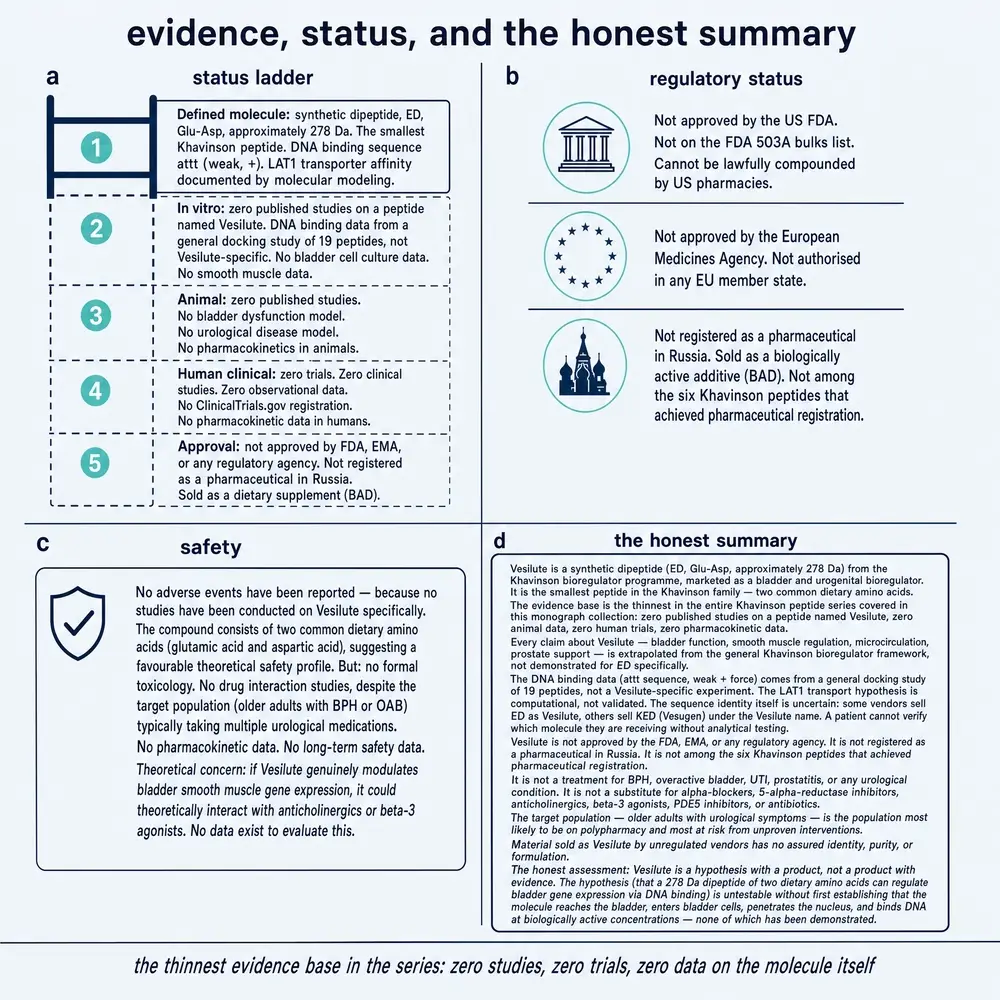
What would move the assessment is not another vendor page. It is a pharmacokinetic study that asks whether Glu-Asp reaches bladder tissue as intact dipeptide; an independent laboratory willing to repeat the muscle-strip or explant work; and a registered, controlled human study that names the synthetic compound rather than the extract. Until then, Vesilute remains a named edge-case of the bioregulator catalogue: real as a chemical and a trademark, provisional as a medicine-shaped story, and out of scope for any recommendation of human use.
This document does not recommend that any person use Vesilute, Chitomur, Vezustim, or any related preparation. It specifies no dose, route, schedule, or clinical indication. Where product literature mentions regimens, those mentions are reported as historical observations about that literature, not as advice.
Section 13References
- Anisimov VN, Khavinson VKh. Peptide bioregulation of aging: results and prospects Biogerontology 2010;11(2):139-49. PMID 19830585 · doi
- Fedoreyeva LI, Kireev II, Khavinson VKh, Vanyushin BF. Penetration of short fluorescence-labeled peptides into the nucleus in HeLa cells and in vitro specific interaction of the peptides with deoxyribooligonucleotides and DNA Biochemistry (Mosc) 2011;76(11):1210-9. PMID 22117547 · doi
- Fedoreyeva LI, Smirnova TA, Kolomijtseva GY, Khavinson VKh, Vanyushin BF. Interaction of short peptides with FITC-labeled wheat histones and their complexes with deoxyribooligonucleotides Biochemistry (Mosc) 2013;78(2):166-75. PMID 23581987 · doi
- Gomberg VG, Ryzhak AP, Lyutov RV. [Correction of age related bladder function decrease with peptide geroprotector in women] Adv Gerontol 2013;26(2):309-314. PMID 28976156
- Khavinson V, Linkova N, Diatlova A, Trofimova S. Peptide Regulation of Cell Differentiation Stem Cell Rev Rep 2020;16(1):118-125. PMID 31808038 · doi
- Khavinson VK, Lin'kova NS, Tarnovskaya SI. Short Peptides Regulate Gene Expression Bull Exp Biol Med 2016;162(2):288-292. PMID 27909961 · doi
- Khavinson VK, Popovich IG, Linkova NS, Mironova ES, Ilina AR. Peptide Regulation of Gene Expression: A Systematic Review Molecules 2021;26(22). PMID 34834147 · doi · PMC8619776
- Khavinson VKh, Solov'ev AIu, Zhilinskiĭ DV, Shataeva LK, Vaniushin BF. [Epigenetic aspects of peptide regulation of aging] Adv Gerontol 2012;25(1):11-22. PMID 22708439
- Khavinson VKh, Anisimov VN. [35-year experience in research of peptide regulation of aging] Adv Gerontol 2009;22(1):11-23. PMID 19827673
- Khavinson VKh. Peptide medicines: past, present, future (programme review). Russian-language review of the St Petersburg Institute programme. Narrates LC–MS identification of Glu-Asp (ED) in the bladder peptide preparation Vezustim and the naming of Vesilute (Везилют). Local full text: fulltext/russian_open/2020-khavinson-peptide-medicines-past-present-future.pdf (13 pp).
- St Petersburg Institute of Bioregulation and Gerontology / ZAO Excess Biosciences. Vesilute — product description and experimental conclusions. Institute/licensee leaflet: patent application RF 2007143336 (22.11.2007); trademark № 243196; organotypic rat bladder explant +37% growth zone; in-vitro muscle-strip dose series at 8/16/32 µg/ml; clinical observations in chronic prostatitis and BPH cohorts. Programme/product literature, not a PubMed-indexed RCT. link
- Antiaging Systems / Medical Centre of the St Petersburg Institute of Bioregulation and Gerontology. Clinical study of the biologically active peptide bioregulator Chitomur. English summary of a 2011 centre study: 28 men with BPH (45–62 y) and 31 women with overactive bladder (48–56 y) receiving the bladder-wall peptide complex Chitomur. Extract counterpart evidence — not Vesilute. link
- ClinicalTrials.gov. Search for Vesilute, Vesilut, Chitomur, and Glu-Asp bioregulator. U.S. National Library of Medicine trial registry. Queried 4 August 2026; zero interventional registrations returned for the synthetic dipeptide name. link
- National Center for Biotechnology Information. PubChem compound records for L-glutamyl-L-aspartic acid (Glu-Asp). Structure chemistry for the dipeptide C9H14N2O7, ~262.22 g·mol−1. The trade name Vesilute is not treated here as a stable PubChem synonym; identity in this monograph is sequence-first. link
- South Beach Longevity. Bioregulator class contract — extract→peptide mapping. House style pairs bladder-tissue cytomedins (Chitomur / related preparations) with the synthetic cytogen Vesilute (Glu-Asp). Treated as a claim to re-verify, not as independent experimental evidence.
Section 14How this document was assembled
Full-text stores of Project 05 (Therapeutic Peptide Research Library) were swept with identity gates that admit Vesilute / Везилют / Vesilut, Chitomur / Vezustim, and bladder-corroborated Glu-Asp, while refusing Vesugen, Pinealon prefixes, bare clinical “ED,” and false hits inside English compounds such as “related-peptide.” PubMed was queried for the trade name (zero hits) and for Chitomur / Glu-Asp×Khavinson neighbourhood records. ClinicalTrials.gov was queried for interventional registrations. Figures are authored SVG from cited numbers; no third-party published figure has been reproduced.
Section 15How evidence was weighed
Study type is labelled in the reporting sentence. Extract findings are never silently attributed to the synthetic dipeptide. Recency is favoured when it extends design or system; a newer restatement of an older claim does not outrank a clearer primary source. Single-school origin is named rather than softened. Programme and product literature are used where they are the only source of a number, and are labelled as such.
Continue exploring