
SS-31 The peptide that found its target after it reached the clinic
In the late 1990s two pharmacologists were building better painkillers. They wanted a peptide that would grip the mu-opioid receptor tightly and do nothing else, and they made one: four amino acids, highly water-soluble, carrying three positive charges. Molecules like that are not supposed to cross membranes. Theirs crossed everything — the gut wall in a dish, the tight junctions of an epithelial sheet, and, in rodents, the blood‑brain barrier. The finding was so contrary to the textbook that the authors went looking for their own error. What they found instead was that the peptide had been concentrating, all along, in the one place in the cell they had not thought to look: the inner membrane of the mitochondrion. Two decades later, after a cardiovascular programme that failed, a phase 3 myopathy trial that failed, and an eye trial that missed both of its primary endpoints, the same molecule became the first drug ever approved for Barth syndrome. This document is an account of how a compound can be wrong about itself for ten years and still end up on a label — and of how much of its record remains unsettled.
Every finding is labelled by the kind of study that produced it, in the sentence that reports it. A result in isolated mitochondria is called a result in isolated mitochondria; a result in a mouse is called a result in a mouse. This matters more than usual for SS-31, because its preclinical record is unusually broad and unusually favourable, and its human record is neither. Where a number comes from people, the trial, its size, its duration and whether the endpoint was prespecified are given alongside it.
A note on doses. Doses appear here only as facts about the research: what was administered, to whom, for how long, in a registered trial or on an approved label. Nothing in this document is offered to any person as guidance for use.
A note on the negative results. Three large trials missed their primary endpoints. They are not quarantined in a late section; they appear chronologically, at the same length as the positive results, because that pattern is the most informative thing in the record.
01An accident in an opioid laboratory
Hazel Szeto and Peter Schiller were not looking for a mitochondrial drug. They were making analogues of a synthetic opioid peptide with high mu-receptor affinity. The compound that interested them was SS-02, also written [Dmt1]DALDA: molecular weight 640, fully polar, net charge +3. Compounds with that profile are the standard example of what does not get into cells.
Then it produced central analgesia in rodents after subcutaneous administration (Szeto & Birk, 2014). To act centrally it had to have crossed the blood‑brain barrier, and a peptide of that description should not have been able to. Szeto describes the reaction in the first person, and the phrasing is worth keeping: the result was so disturbing that they sought confirmation in cell culture. The confirmation made things worse. The peptide was taken up by many cell types without any transporter or receptor, and it went through a layer of polarised epithelial cells with intact tight junctions.
The explanation, when it came, was structural. The residues alternate: cationic, aromatic, cationic, aromatic. Szeto and Birk (2014) propose that the aromatic rings form an electronic cage around the charges, which is what allows a molecule with three positive charges to pass through a lipid bilayer. Almost all peptide design of that era had gone the other way, toward greater lipophilicity, without much success. This one worked for the opposite reason.
The compound that entered clinical development is a close relative of that first peptide, with the residues reordered. It is SS-31.
02What the molecule is
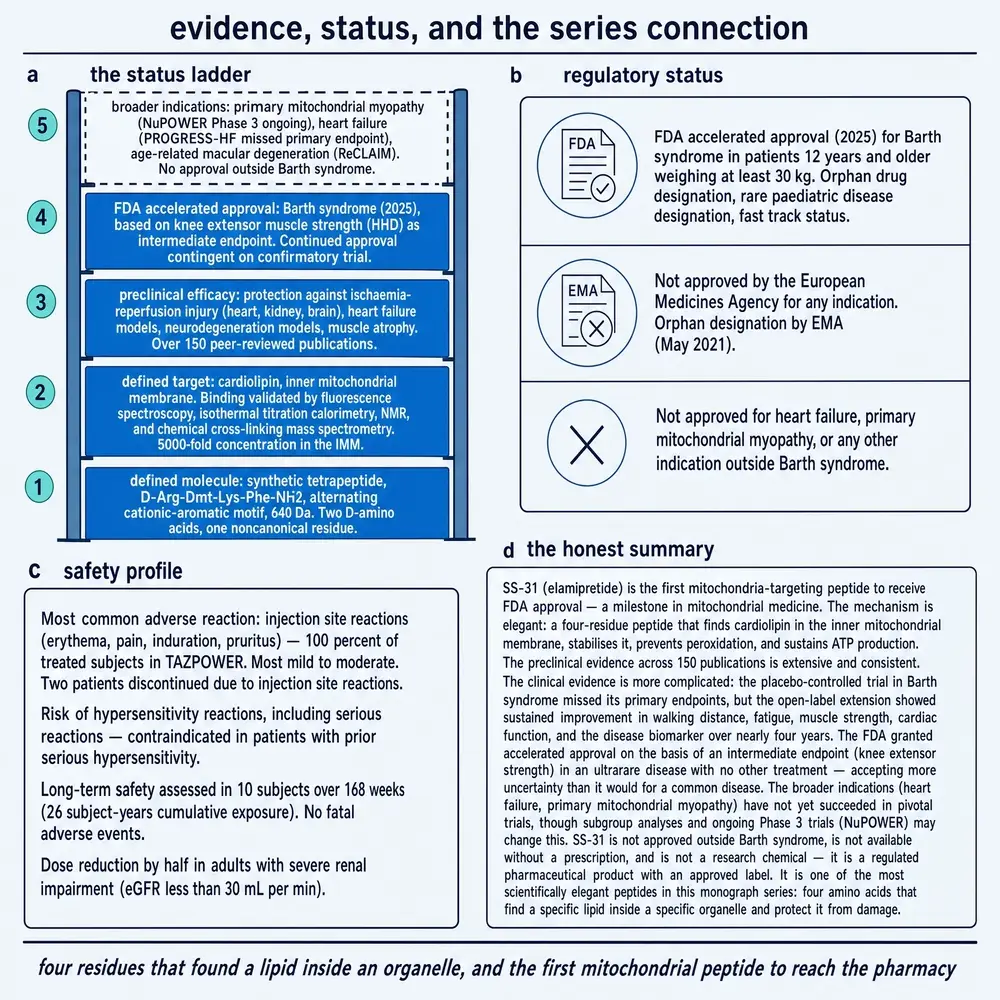
SS-31 is a tetrapeptide with the sequence D‑Arg–2′,6′‑dimethyltyrosine–Lys–Phe–NH2 (Reid Thompson et al., 2021). Its formula is C32H49N9O5 and its PubChem compound identifier is 11764719. Two features of the sequence are design rather than accident. The arginine at position one is in the D configuration, which makes the N-terminus resistant to aminopeptidase attack, and the C-terminus is amidated rather than free, which reduces hydrolysis. Both are ordinary stabilising moves in peptide chemistry, and both matter for a molecule that has to survive in plasma long enough to reach tissue.
It has an unusual number of names, and the names carry history. In the academic literature it is SS-31, the thirty-first compound in the Szeto–Schiller series. As a clinical candidate under a commercial sponsor it became MTP-131, the acetate salt, and for several years it was also called Bendavia. Its international non-proprietary name is elamipretide, and its trade name, since 2025, is Forzinity. Papers from different eras of the programme use different names for the same molecule, and a reader following the literature backwards will meet all five.
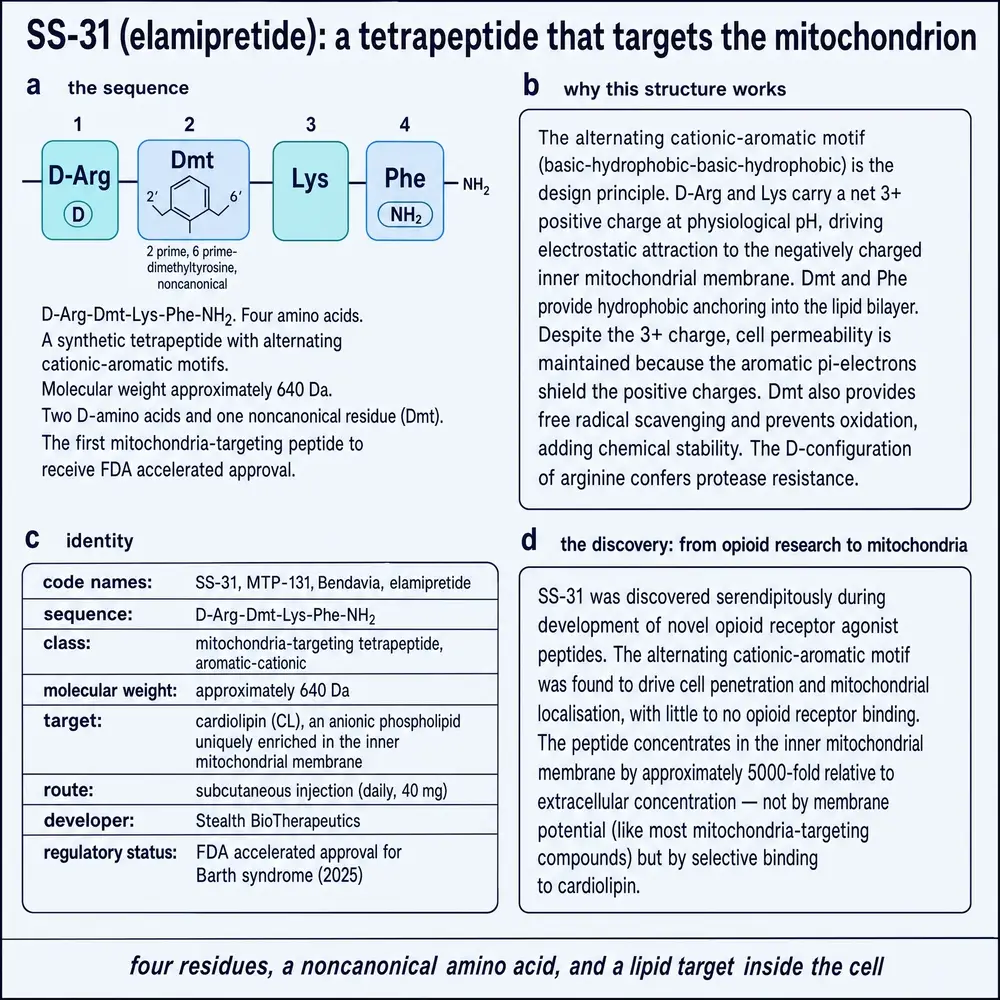
The other member of the series that recurs in this document is SS-20, which lacks the dimethyltyrosine residue. It appears in mechanistic work as a comparator, and it matters because it separates two candidate explanations of what the compound does — a point that took the field the better part of a decade to work through.
03Cardiolipin, and why the inner membrane is a hard target
To understand what SS-31 binds, it helps to know why the inner mitochondrial membrane is a difficult place to put a drug. It is engineered to hold a steep electrochemical gradient and to keep redox chemistry away from the cytosol (Di et al., 2026). Anything that reaches it must do so without collapsing the membrane potential or disorganising the respiratory chain, and the tissues that depend on it — heart, muscle, retina, kidney, brain — have very different energetic demands. For most of the history of mitochondrial pharmacology there was no specific molecular target there at all; programmes converged instead on downstream readouts like oxidative stress, which are easy to measure and only loosely connected to the structural determinants of mitochondrial performance.
Cardiolipin is the exception. It is the signature phospholipid of the inner membrane and is found essentially nowhere else in the cell. Its structure is unusual: two phosphatidyl groups bridged by a glycerol backbone, so that it carries four acyl chains and a compact head group rather than the two chains of an ordinary phospholipid. That geometry favours negative curvature, which is what the tightly folded cristae require, and it makes cardiolipin a structural participant in the assembly of respiratory-chain complexes into the higher-order groupings called supercomplexes (Di et al., 2026). When cardiolipin is depleted, oxidised or abnormally remodelled, the penalty is not confined to one enzyme. Electron transfer becomes less efficient across the chain, leakage rises, and the reactive oxygen species produced by that leakage damage the lipid environment further.
The identification of cardiolipin as the target came late and by a specific experiment. Szeto and Birk (2014) describe incorporating a polarity-sensitive fluorescent amino acid, aladan, into the peptide sequences and watching what happened in the presence of different phospholipids. Only anionic phospholipids shifted the emission maximum and intensity, and cardiolipin did so most strongly; the zwitterionic phospholipids phosphatidylcholine and phosphatidylethanolamine did nothing. Since phosphatidylserine is negligible in the inner membrane, cardiolipin is the plausible target by elimination as well as by direct measurement. Nuclear magnetic resonance work then supported a model in which electrostatic contact between the two basic residues, lysine and arginine, and the cardiolipin phosphate head groups positions the two aromatic residues among the acyl chains.
The number most often quoted for the consequence is a roughly 5,000-fold enrichment of the peptide in the inner membrane relative to the surrounding medium. It is a measurement in isolated systems, not in a person, and it should be read as an account of partitioning behaviour rather than as a pharmacokinetic parameter.
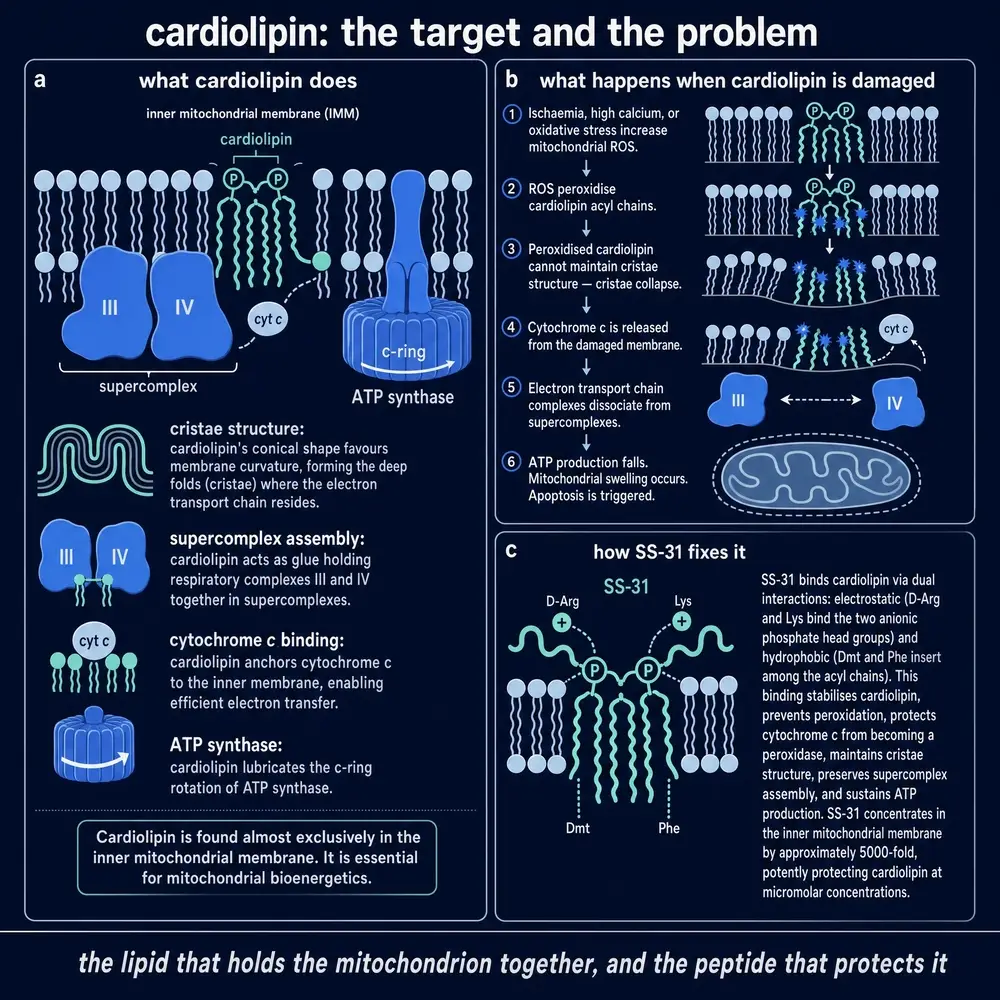
That binding story is the hinge into the next section: the clinic was not designed under a single settled account of what the peptide does, and the account has been rewritten twice since the first human studies began.
04Three accounts of the same molecule
The mechanistic story attached to SS-31 has been rewritten twice, and the rewrites matter because a good deal of the clinical programme was designed under the first version.
The first account was scavenging. Zhao et al. (2004) introduced the compound as a cell-permeable peptide antioxidant targeted to the inner mitochondrial membrane, and for most of a decade the dimethyltyrosine residue was credited with quenching reactive oxygen species directly. The framing was plausible and it was wrong in an instructive way: it could not explain why the compound was active at concentrations far below those needed to intercept radicals in stoichiometric quantity, and it made no prediction about which mitochondria would respond.
The second account was cardiolipin binding, which supplied a location and a structural rationale. Birk et al. (2013) reported that the compound re-energised ischaemic mitochondria, and the subsequent work connected binding to cristae architecture, supercomplex stability and the behaviour of cytochrome c, which switches between electron carrier and peroxidase depending on how it sits against cardiolipin. This is the account that appears in the introductions of most of the clinical papers.
The third account is biophysical and is the current one. Mitchell et al. (2020) measured the interaction directly in model and mitochondrial membranes and found something more specific than binding. The peptide partitions into the interfacial region of the bilayer, with both its affinity and its binding density set by surface charge. It does not destabilise lamellar bilayers even at the highest binding densities tested, but it does produce saturable changes in lipid packing, and — the finding the authors put at the centre — it modulates the surface electrostatics of the membrane. As a proof of concept they showed that it alters the distribution of calcium at the interface and reduces the energetic burden of calcium stress in mitochondria. On this account the compound is not an antioxidant and not simply a lipid ligand; it is something closer to a modifier of the electrostatic environment in which membrane proteins operate.
Two later results fit that reading. Chavez et al. (2020) mapped the mitochondrial protein interaction landscape of SS-31 by cross-linking, giving the compound a defined set of neighbours rather than a diffuse membrane effect. And Pharaoh et al. (2023) reported that the peptide binds the adenine nucleotide translocator, the protein that carries ADP into the matrix, and that treatment increases ADP sensitivity in mitochondria from old mouse muscle by increasing uptake through that transporter. Notably, the abundance of the proteins in the ADP/ATP pathway did not change; what changed was their redox modification, with protein S-glutathionylation falling, including on the translocator itself.
Sabbah et al. (2025) summarise the trajectory without softening it: the antioxidant framing has been superseded rather than confirmed. It is worth sitting with the chronology. The compound entered clinical development in 2010. The cardiolipin target was published in 2013. The biophysical account arrived in 2020, after the cardiovascular programme had already read out. For most of the period in which decisions were being made about which diseases to test, the field did not know what the molecule was doing.
05What the structure–activity work adds
If the mechanism is interfacial, the structure–activity relationships should track membrane behaviour rather than any conventional binding pocket. Mitchell et al. (2022) tested that directly, comparing three analogues against SS-31 that differ in aromatic side-chain composition and in the order of the residues along the chain. They produced the first structural models for the class, and the models contain a surprise: all the analogues adopt compact reverse-turn conformations in the membrane-bound state, and SS-31 is the one that does not.
All four peptides bound cardiolipin-containing membranes, and all four crossed into cells and reached mitochondria, with no strict requirement for a particular side-chain composition or sequence register. But they differed substantially in how they bound, in how they altered membrane surface charge, and in what they did in cell-stress assays — restoring mitochondrial membrane potential, preserving ATP content and promoting survival to different degrees. The analogue carrying tryptophan side chains, SPN10, had the largest effect on membrane properties and the greatest efficacy in culture.
Two things follow. The first is that membrane-electrostatic modulation is supported as a mechanism by an independent line of evidence: the analogue that moves surface charge most is the one that works best in cells. The second is that SS-31 is not obviously the optimum of its own series. It is the compound that happened to be in hand when the programme needed a candidate, which is a different property from being the best one.
06The heart, before reperfusion
The first serious therapeutic idea for SS-31 was reperfusion injury, and the logic behind it was sound. When a coronary artery is blocked and then reopened, a substantial part of the eventual damage is done in the minutes after blood flow returns, as mitochondria that have been starved of oxygen are suddenly flooded with it. Cardiolipin is oxidised and degraded during that window, supercomplexes come apart, and the permeability transition pore opens. A compound that stabilises cardiolipin ought to blunt exactly that sequence.
The animal data were strong and consistent. Kloner et al. (2012) reported reduction of ischaemia–reperfusion injury in an animal model, and Brown et al. (2014) reported reduction of early reperfusion injury. Summarising the body of work later, Swain et al. (2024) give the figures: intravenous MTP-131 administered before reperfusion — not after — reduced myocardial infarct size by 10 per cent in rabbits, 15 per cent in sheep, and 55 per cent in rats. The spread across species is itself worth noticing, and so is the timing requirement, which will become the central issue when the compound reaches patients.
Beyond acute infarction, the compound was tested in chronic heart failure in dogs, and the results there were among the most substantial in its whole preclinical record. Reviewing that work, Tung et al. (2025) report that acute intravenous infusion decreased left ventricular end-systolic volume and increased ejection fraction and stroke volume, and that three months of subcutaneous therapy increased stroke volume, ejection fraction, cardiac output and cardiac index while decreasing left ventricular end-diastolic pressure, systemic vascular resistance and end-diastolic wall stress. Natriuretic peptides and proinflammatory cytokines normalised. Sabbah et al. (2019) added a skeletal-muscle finding from the same disease model: treatment restored a near-normal ratio of slow-twitch to fast-twitch fibres and produced a dose-dependent improvement in skeletal-muscle mitochondrial function.
These are animal results and they say nothing directly about people. But they are not weak animal results. A drug that changes ventricular volumes and normalises heart-failure biomarkers in a large-animal model over three months is the kind of preclinical package that justifies a clinical programme, and it explains why the cardiovascular bet was placed first.
07Kidney, eye, brain, and the breadth problem
The preclinical literature on SS-31 is unusually wide. In this project's reading corpus it spans acute kidney injury, diabetic kidney disease, renovascular disease, diabetic retinopathy, age-related visual decline, Alzheimer-type amyloid toxicity, Parkinson-type dopaminergic damage, doxorubicin cardiotoxicity, neonatal lung injury, spinal-cord injury, sepsis, oocyte ageing, bone-marrow stromal-cell differentiation and postoperative cognitive dysfunction. A few examples give the flavour. Liu et al. (2020) built a ROS-responsive chitosan–SS31 prodrug that distributes rapidly to the kidney in a mouse model of acute kidney injury. Kim et al. (2019) reported that mitochondrial protection partly mitigated kidney cellular senescence in swine with atherosclerotic renovascular disease. Alam et al. (2015) reported reversal of visual decline in mouse models of diabetes, and the same group (Alam et al., 2022) reported treatment of age-related visual impairment. Zhao W et al. (2019) reported improvement in mitochondrial dysfunction and in synaptic and memory impairment in a mouse model, and Zhu M et al. (2025) reported that the peptide eased acute lung injury in neonatal mice with respiratory distress syndrome.
One study deserves separating out because it is not an animal study. Zhao H et al. (2017) worked in lymphoblasts and fibroblasts derived from patients with Friedreich ataxia — human cells, outside the body. SS-31 reduced the oxidative stress caused by frataxin deficiency, and, more interestingly, increased frataxin protein itself in a dose-dependent manner through a translational mechanism, with corresponding increases in the activity of the iron–sulphur enzymes aconitase and respiratory complexes II and III. Mitochondrial membrane potential, ATP content, NAD+/NADH ratio and mitochondrial morphology all improved. A phase 1/2 investigator-initiated trial in Friedreich ataxia was subsequently registered and completed (NCT05168774).
Breadth of this kind cuts two ways, and the tension is worth naming rather than resolving too quickly. Read favourably, it is what a genuinely upstream mechanism should look like: if the compound stabilises a lipid environment common to every mitochondrion, it should help wherever mitochondrial failure is part of the pathology, and the diversity of successful models is evidence for the mechanism rather than noise around it. Read sceptically, a compound that improves outcomes in twenty unrelated disease models is exhibiting the signature of a general cytoprotective effect in stressed cells, which is a well-populated category with a poor translational record. The mitochondrial-medicine field has produced many such compounds and very few therapies (Di et al., 2026). Both readings were available in 2015. Only the clinical record could separate them.
08Ageing, and the selectivity claim
A distinct strand of the preclinical work concerns normal ageing rather than disease, and it produced the most specific mechanistic claim in the whole programme.
Campbell et al. (2019) reported that improving mitochondrial function with SS-31 reversed age-related redox stress and improved exercise tolerance in aged mice, and the same group later showed that intermittent rather than continuous treatment preserved exercise tolerance (Campbell et al., 2023). Chiao et al. (2020) reported that late-life restoration of mitochondrial function reversed cardiac dysfunction in old mice — late-life, meaning that the intervention began after the decline had occurred.
Pharaoh et al. (2023) then supplied the mechanism, and it is the adenine nucleotide translocator result described earlier. Ageing muscle mitochondria become insensitive to ADP: a given concentration of ADP produces a smaller metabolic response than it does in young tissue, which impairs ATP production and raises reactive oxygen species output at physiological ADP levels. Treatment increased ADP sensitivity in old mouse muscle mitochondria by increasing uptake through the translocator, and rescued muscle force and systolic heart function in the same animals. The abundance of the transport proteins did not change; their S-glutathionylation did.
This body of work is also the source of the selectivity claim that recurs throughout the literature: that SS-31 acts on dysfunctional mitochondria and has little effect on normally functioning ones. Karaa et al. (2020) invoke it explicitly when interpreting a subgroup result. It is a claim with real mechanistic support — if the target is an abnormal lipid environment, a normal one offers nothing to correct — and it has a testable consequence that shows up repeatedly in the clinical data: participants who are more impaired at baseline should respond more than those who are less impaired. Whether that consequence actually held is one of the questions Part Four addresses.
09How mitochondrial function gets measured, and why it matters here
A recurring difficulty in reading this literature is that the word “works” means something different at each level of the evidence, and the levels are not commensurable. It is worth setting them out, because the distance between them explains a good deal of what happens in Parts Three and Four.
At the lowest level are measurements on isolated mitochondria or permeabilised fibres: oxygen consumption at defined substrate and ADP concentrations, membrane potential, and the rate at which reactive oxygen species escape. These are the measurements behind almost every mechanistic claim in this document. They are precise, they are made under controlled substrate conditions that do not exist in a living tissue, and they are made on organelles that have been removed from the cell that was regulating them.
Above that are structural measurements: cristae morphology by electron microscopy, supercomplex assembly by native gel electrophoresis, cardiolipin species by mass spectrometry. Allen et al. (2020) work at this level when they report mitigation of cristae-network fragmentation, and it is where the compound's effects are most visually persuasive.
Above that are cell-level and animal-level functional outcomes: ATP content, survival under stress, grip strength, running time, ejection fraction. This is where the preclinical case was made, and where the effects are large.
At the top are human clinical outcomes: how far someone walks in six minutes, how tired they report being, how many letters they read on a low-contrast chart. Only two studies in this record bridge the gap directly. Chatfield et al. (2019) measured mitochondrial function in tissue from failing human hearts, and Roshanravan et al. (2021) measured in vivo ATP production in the skeletal muscle of older adults using magnetic resonance spectroscopy in a randomised trial — a physiological measurement made in living people, showing improvement after a single dose.
That second study is the most direct evidence in existence that the mechanism operates in a human being. It is also, precisely, a measurement of ATP production and not of anything a patient would notice. The gap between “mitochondria in this person are making more ATP” and “this person can do more” is where the entire clinical programme of this compound lives, and no trial in this record has closed it.
10Stealth, and the arc of the company
SS-31 entered clinical development in 2010 with a commercial sponsor, Stealth Peptides of Newton, Massachusetts, using the acetate salt form designated MTP-131 (Szeto & Birk, 2014). The early clinical work was pharmacokinetic and unremarkable in the best sense. Intravenous infusion was well tolerated across a wide range, from 0.01 to 0.25 mg/kg/h, with predictable linear pharmacokinetics, an elimination half-life of about four hours and a very small apparent volume of distribution. The human values were compatible with those from several animal models, which is not always the case for peptides. An oral formulation reached plasma concentrations that had been cardioprotective in preclinical studies and was also well tolerated, though the oral route did not become the development path.
Later, subcutaneous bioavailability was calculated at approximately 90 per cent, which is what allowed the programme to move from intravenous infusion in a hospital to daily self-administered subcutaneous dosing at home (Karaa et al., 2020). Every subsequent efficacy trial in this document used that route. In MMPOWER-3, population pharmacokinetic modelling covered elamipretide and two metabolites, M1 and M2, in 106 treated participants (Karaa et al., 2023).
The company's strategic arc is legible in the registry. The first bet was acute cardiovascular: reperfusion injury in myocardial infarction, then renal artery angioplasty, then heart failure. When those read out, the programme moved to rare inherited mitochondrial disease, where the biology is unambiguous and the regulatory path for a mechanistically coherent drug is shorter. When the pivotal myopathy trial failed, the programme narrowed again — to a genotype-defined subset of that same population, and to an ultra-rare disease of cardiolipin metabolism where the mechanistic rationale is as direct as it can be. A fourth line, in the eye, ran in parallel throughout.
That is a story of successive narrowing, and it is not a criticism. It is what a mechanism-led programme looks like when the mechanism turns out to be real but the effect size in unselected patients turns out to be small.
11EMBRACE STEMI
EMBRACE STEMI was the first real test of SS-31 in people, and it was designed carefully. Chakrabarti et al. (2013) published the rationale and design in advance, which is worth noting because it means the trial's logic can be read as its designers stated it rather than as it was reconstructed afterwards. The trial began in 2012.
The design followed the animal work closely. It enrolled 118 patients presenting with a first anterior ST-elevation myocardial infarction from a proximal or mid lesion in the left anterior descending artery, all of whom underwent successful percutaneous coronary intervention. MTP-131 was infused intravenously at 0.05 mg/kg/h, timed to be on board before reperfusion, in a randomised, double-blind, placebo-controlled comparison. The primary endpoint was infarct size, measured as the area under the curve of creatine kinase-MB release over the first 72 hours.
The primary endpoint was not met. Gibson et al. (2016) reported no decrease in infarct size by that measure. Nor was there an effect on any of the secondary measures of the same thing: troponin I release, infarct volume by cardiac magnetic resonance imaging, myocardial structure and function, TIMI flow grade, resolution of ST-segment elevation, or clinical outcome. The infusion was safe and well tolerated. Summarising the trial in a review of mitoprotective agents, Bøtker et al. (2020) list it among the translational failures of the field.
There is one secondary observation that survives, and it should be reported with its qualifications attached. Tung et al. (2025), summarising the trial, note a reduced incidence of heart failure within 24 hours after percutaneous intervention in treated patients — a window that accounted for roughly three-quarters of all new-onset heart-failure events in the trial. The reduction did not extend beyond 24 hours. This was not the primary endpoint, it was not the mechanism the trial was built to test, and in a trial of 118 patients whose primary endpoint was null, a single favourable secondary in a short window is a hypothesis and nothing more.
12Heart failure: PROGRESS-HF, and the trials around it
The heart-failure programme had the stronger preclinical foundation of the two cardiovascular bets. The dog work described in Part Two was chronic, was dose-ranging, and produced changes in exactly the parameters a heart-failure trial measures.
An early small randomised, placebo-controlled trial was encouraging in a qualified way: Tung et al. (2025) report that it reduced left ventricular end-diastolic and end-systolic volumes, but that the changes did not correspond with biomarker changes and carried wide confidence intervals. That is the profile of a result that needs a larger trial to mean anything.
PROGRESS-HF was that trial. Butler et al. (2020) report a phase 2, randomised, double-blind, placebo-controlled study in patients with stable heart failure with reduced ejection fraction, run across twenty European centres, with 71 participants in the registry record (NCT02788747). The primary endpoint was left ventricular end-systolic volume.
The primary endpoint was not met. There was no reduction in end-systolic volume, and the secondary analyses of ejection fraction and end-diastolic volume showed no significant improvement either (Tung et al., 2025; Di et al., 2026). A second phase 2 heart-failure study, RESTORE-HF (NCT02814097, 46 participants), is listed in the registry as completed on 2 June 2017; peer-reviewed reporting of a definitive efficacy result from it remains limited, which is itself a fact about the record.
Running alongside these was a piece of work that deserves separate mention because of what it measured. Chatfield et al. (2019) studied elamipretide in tissue from failing human hearts, providing the first direct data on the effect of the class on mitochondrial function in the human heart. This is human tissue studied outside the body, not a clinical outcome. But it matters, because it shows the mechanism operating in the intended species and the intended organ at a time when the clinical trials in that organ were returning nothing.
13The trials that never reached a paper
A programme is not only what it publishes, and the registry record for this compound contains several studies whose results do not appear in the peer-reviewed corpus assembled for this document. They are worth listing, because a reader who works only from the published literature will form a systematically more favourable picture than the full record supports.
The first-in-human study (NCT01115920) enrolled 40 participants for intravenous dosing between May and September 2010. A small mechanistic study of endothelial reactivity in smokers (NCT01518985, six participants) ran in early 2012. A single-oral-dose study (NCT01754818, 30 participants) ran over the winter of 2012 and 2013; the oral route did not become the development path, and no efficacy programme followed it.
Two further cardiovascular studies are more consequential. A phase 1/2 trial in renal artery angioplasty (NCT01755858) enrolled 16 participants and is listed as terminated, having run from December 2012 to May 2016. And a phase 2 study of short-term cardiac and renal effects (NCT02914665) is listed as completed with 308 participants — the largest single enrolment anywhere in this compound's registry record, larger than MMPOWER-3. No peer-reviewed report of it appears in this project's corpus. A study of 308 people whose results are not in the literature is a real gap, and it sits in the middle of the cardiovascular arm.
An open-label extension (NCT02976038, 28 participants) is likewise listed as terminated, in April 2020. One registered study is listed as withdrawn.
None of this is evidence of concealment; unpublished registry entries are ordinary in drug development, particularly for studies terminated when a programme changes direction. But publication bias runs in a known direction, and the effect of these gaps on the visible record is not neutral. Where this document reports that a trial's outcome is “not reported”, that is what the phrase means: no peer-reviewed efficacy report was found, not that none exists.
14What the cardiovascular failures do and do not prove
Two large, well-conducted, placebo-controlled trials in the compound's best-supported indication returned nothing on their primary endpoints. It is worth being precise about what follows from that, because the field's subsequent behaviour depended on the answer.
What follows straightforwardly: intravenous SS-31 given around the time of reperfusion does not measurably reduce infarct size in patients undergoing successful primary percutaneous coronary intervention, and subcutaneous SS-31 does not measurably reverse ventricular remodelling in stable heart failure with reduced ejection fraction over the durations tested. Those are the questions the trials asked, and the answers are negative.
What does not follow: that the mechanism is absent in people. There are three specific reasons for the gap, and each has a consequence.
The first is timing. Every animal reperfusion result required the compound to be present before reperfusion; administration afterwards did not work (Swain et al., 2024). In a rabbit, that is a matter of scheduling an infusion. In a patient arriving at a catheterisation laboratory with an occluded artery, the interval available before the artery is opened is short, variable, and constrained by the fact that opening the artery quickly is the treatment. A trial can time the infusion; it cannot reliably guarantee tissue concentrations at the critical moment. Swain et al. (2024) went on to test intracoronary delivery before reperfusion in 27 swine, with veno-arterial extracorporeal membrane oxygenation arms, and reported a trend toward reduced infarct size — an attempt to solve exactly this delivery problem, and one that has not yet been translated into a human trial.
The second is the patient population. Modern primary percutaneous intervention is fast and effective, and the residual reperfusion injury it leaves is smaller than the injury present in the animal models where the compound was validated. If a drug corrects a component of damage that contemporary care has already largely eliminated, a null result is what a trial will find even if the drug does exactly what it is supposed to do.
The third is the selectivity claim itself. If SS-31 acts only where mitochondria are already dysfunctional, then the average patient in a stable heart-failure trial — medically optimised, ambulatory, enrolled precisely because they are stable — may not have enough of the pathology the drug addresses for an effect to be visible against measurement noise.
Each of these is a legitimate explanation. Each is also unfalsifiable in the absence of a new trial, and this is the point at which a reader should become careful. A mechanism that predicts benefit before the trial, and then explains the absence of benefit afterwards, has stopped being a prediction. The honest summary of the cardiovascular decade is that the compound was tested twice in large randomised trials in its best-supported indications and did not work, and that plausible reasons exist for why it might still work under conditions that have not yet been tested. Both halves of that sentence are load-bearing.
15The shape of the registered programme
The ClinicalTrials.gov record for this compound, retrieved on 10 July 2026, contains thirty registered studies. Twenty-two are listed as completed, three as terminated, one as withdrawn, one as recruiting, one as active but not recruiting, one as not yet recruiting, and one as an available expanded-access programme. Across those thirty records, phase 1 designations appear thirteen times, phase 2 sixteen times, phase 3 four times and phase 4 once; two records carry no phase designation.
Read as a whole, the programme has four arms and one thread running through all of them. The arms are cardiovascular, primary mitochondrial myopathy, Barth syndrome and ophthalmology. The thread is the six-minute walk test, or an analogue of it: an outcome measure that asks a patient to do something physical for a fixed period and records how much they achieved. Almost every efficacy question in this programme was ultimately put to that instrument, and a good deal of what follows turns on how well it works.
16Primary mitochondrial myopathy: three trials, one outcome
Primary mitochondrial myopathy is the population where the biological case was cleanest. These are patients with genetically confirmed defects in mitochondrial function, presenting with exercise intolerance and fatigue that track directly to impaired oxidative phosphorylation. If a drug that improves mitochondrial respiration helps anyone, it should help them.
MMPOWER (NCT02367014) was a randomised dose-escalation study. Karaa et al. (2018) administered three daily intravenous dose levels over five days to adults with genetically confirmed disease and reported improvement in six-minute walk distance at the highest dose. On the strength of that signal the programme moved to subcutaneous dosing.
MMPOWER-2 (NCT02805790) was a randomised, double-blind, placebo-controlled crossover trial. Karaa et al. (2020) screened 36 eligible participants and randomised 30, who received 40 mg per day subcutaneously for four weeks in each arm, separated by a four-week washout. The population had a mean age of 45.3 years, was 83 per cent female and 97 per cent White, and walked 389.4 ± 23.6 m at baseline.
The primary endpoint was not met. Participants walked 398.3 ± 134.16 m on treatment against 378.5 ± 125.10 m on placebo, a difference of 19.8 m with a 95 per cent confidence interval from −2.8 to 42.5 and a P value of 0.0833. Several patient-reported secondary endpoints did reach nominal significance: total fatigue on the Primary Mitochondrial Myopathy Symptom Assessment (P = 0.0006), fatigue during activities (P = 0.0018), Neuro-QoL fatigue (P = 0.0115) and the patient global assessment (P = 0.0421). Others did not: the physician global assessment (P = 0.0636), the triple timed up-and-go test (P = 0.8423), and accelerometry at both wrist (P = 0.9345) and hip (P = 0.7326). Injection-site reactions were the most common adverse events.
The gap between what patients reported and what accelerometers recorded is the first appearance of a pattern that runs through the rest of this programme. Patients on treatment said they were less tired. Devices strapped to those same patients recorded no change in how much they moved.
MMPOWER-3 (NCT03323749) was the pivotal trial, and it was properly powered. Karaa et al. (2023) report a randomised, double-blind, placebo-controlled study of 40 mg per day subcutaneously for 24 weeks across 27 centres in seven countries. Candidates were identified partly through RePOWER, a global prospective observational registry of 413 ambulatory people aged 16 to 80 with signs and symptoms of the disease. Of 296 screened, 218 were randomised, 109 to each arm, between October 2017 and December 2019. Mean age was 44.9 years, 64.2 per cent were women, and baseline walk distance was 330.28 ± 76.5 m. Participants who walked less than 100 m or more than 450 m were excluded, a design decision intended to concentrate the sample where change was measurable. The trial was sized at 202 participants for 90 per cent power to detect a 30 m difference.
Both co-primary endpoints were not met. Least-squares mean change in six-minute walk distance was 14.1 ± 5.7 m on elamipretide against 17.3 ± 5.7 m on placebo — a difference of −3.2 m, with a 95 per cent confidence interval from −18.7 to 12.3 and a p value of 0.69. The per-protocol analysis gave −2.2 m. Total fatigue on the symptom assessment gave −0.07 (95 per cent CI −0.10 to 0.26; p = 0.37). The authors classify the result as Class I evidence that elamipretide does not improve the six-minute walk test or fatigue at 24 weeks in this population.
Two details of MMPOWER-3 deserve attention beyond the headline. The first is that 205 of 218 participants completed the trial, a 94 per cent completion rate, which means the null result is not an artefact of attrition. The second is the placebo arm: participants receiving placebo improved their walk distance by 17.3 m over 24 weeks. In a chronic degenerative condition, that is a substantial effect from participation alone, and it is a direct measurement of how much a trial of this design must overcome before a drug effect becomes visible.
A note on the registry entry: MMPOWER-3 appears in ClinicalTrials.gov with a status of TERMINATED, while the publication reports a completed 24-week randomised period with 94 per cent completion. The registry status reflects the discontinuation of the open-label extension after the randomised phase read out, not a failure of the trial itself. The two records are consistent once that is understood, and are noted here rather than reconciled silently.
17The genotype argument, and NuPOWER
What happened next is the most interesting methodological episode in this compound's record, and it can be read two ways.
Karaa et al. (2024) went back into MMPOWER-3 and analysed it by genotype. The trial population was heterogeneous in a way that matters: 73 per cent (n = 159) carried mitochondrial DNA variants and 27 per cent (n = 59) carried nuclear DNA variants, after post hoc correction of three misclassifications — two POLG and one TWNK. Within the mitochondrial DNA group, 70 per cent had either single large-scale deletions or the MT-TL1 variant. Most of the nuclear DNA participants had defects in the mitochondrial DNA replisome, the machinery that maintains and replicates the mitochondrial genome, predominantly POLG and TWNK.
In the replisome cohort, six-minute walk distance improved by 25.2 ± 8.7 m on treatment against 2.0 ± 8.6 m on placebo (p = 0.06). Among replisome participants who also had chronic progressive external ophthalmoplegia, the difference was 37.3 ± 9.5 m against −8.0 ± 10.7 m (p = 0.0024).
The favourable reading is that this is exactly what the selectivity claim predicts. Replisome defects produce progressive depletion of mitochondrial DNA and a distinctive pattern of respiratory-chain impairment; a compound that stabilises the residual functional pool should do more in that setting than in a population where the defect is a heteroplasmic point mutation of variable tissue distribution. The subgroup is mechanistically defined rather than data-dredged, and the nuclear DNA analysis was prespecified.
The sceptical reading is equally available. This is a subgroup analysis of a trial that missed both co-primary endpoints. The p values are nominal, the CPEO cohort is a subgroup of a subgroup, and the three genotype reclassifications were made after the fact. The base rate for subgroup findings of this kind surviving a dedicated trial is not high, and the literature on mitochondrial therapeutics contains many such findings that did not.
The programme took the favourable reading and did the correct thing with it: it ran the trial. NuPOWER (NCT05162768) is a genotype-enriched phase 3 study of 102 participants, listed as completed on 4 December 2024. At the time of compilation, results had not appeared in the peer-reviewed literature in this project's corpus. That trial, not the post hoc analysis, is what will settle the question.
18Barth syndrome, and an approval built on an extension
Barth syndrome is where the mechanistic argument for this compound is strongest and where the evidence supporting its use is weakest in design.
The disease is caused by defects in the TAZ gene, which encodes the transacylase that remodels immature cardiolipin into its mature acyl-chain composition. When tafazzin fails, monolysocardiolipin accumulates and mature cardiolipin falls. The result is cardiomyopathy, skeletal myopathy, neutropenia and growth delay in affected males, with an estimated prevalence of about one in a million (Reid Thompson et al., 2021). A drug that binds and stabilises cardiolipin is, on paper, aimed at the precise molecular lesion.
TAZPOWER (NCT03098797) tested it. Reid Thompson et al. (2021) screened 16 patients at a single centre and randomised 12 — all male, mean age 19.5 years, range 12 to 35 — to 40 mg per day subcutaneously for 12 weeks in each arm of a double-blind crossover, with a four-week washout. Baseline walk distance was 395.5 ± 59.9 m and baseline total fatigue on the Barth Syndrome Symptom Assessment was 8.0 ± 1.3. Two of the twelve were neutropenic at baseline.
Neither primary endpoint was met in the randomised part.
The trial then continued as an open-label extension, and it is the extension that produced the numbers now attached to this drug. Ten participants continued and eight reached 36 weeks. At that point six-minute walk distance had increased by 95.9 m (p = 0.024) and the symptom score had fallen by 2.1 points (p = 0.031), with significant improvements in knee extensor strength, in the patient global impression of change, and in some cardiac parameters. Thompson et al. (2024) subsequently reported efficacy and safety out to 168 weeks.
A 95.9 m improvement in walk distance is large. In MMPOWER-3, the threshold the trial was powered to detect was 30 m, and the observed difference was −3.2 m. So the Barth result is not a marginal signal; if it reflects a drug effect, it is a substantial one.
The design cannot show that it does. An open-label extension has no control group, no blinding, and no protection against three specific confounds: patients know they are receiving drug and are being watched closely, the six-minute walk test improves with repetition independently of physiology, and the participants who continue into an extension are disproportionately those who felt they were benefiting. The trial's own randomised phase — the part designed to control for all three — found nothing.
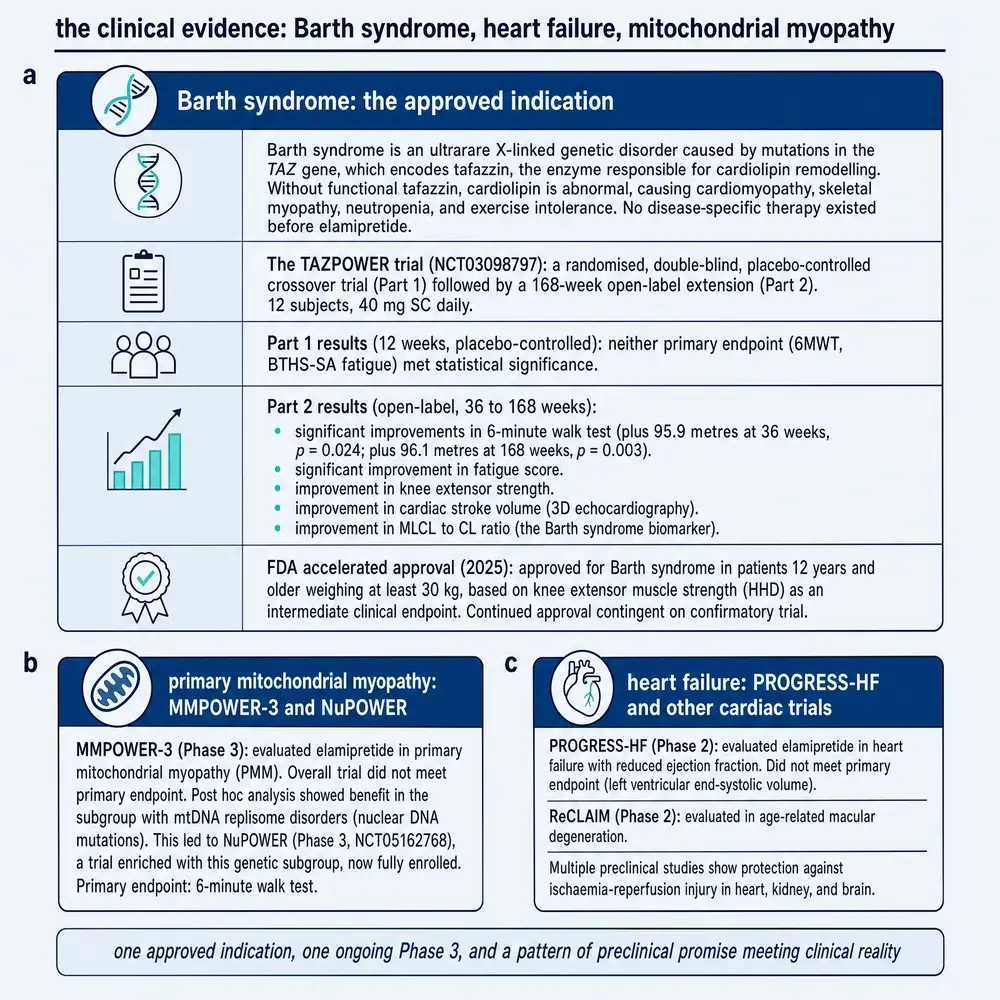
The programme addressed this directly rather than ignoring it. Hornby et al. (2022) constructed an external natural-history comparison under FDA draft guidance, so that the open-label trajectory could be set against the expected course of untreated disease. Van den Eynde et al. (2023) applied hierarchical clustering to identify which participants responded. Sabbah et al. (2021, 2022) described the cardiac effect mechanistically as gradual reverse remodelling of a failing left ventricle at global, cellular and molecular levels. Case reports from the expanded-access programme describe improved quality of life (Ansari et al., 2024) and use in a newborn (Ortmann et al., 2025).
These are reasonable responses to a hard problem. In a disease affecting one in a million, a conventional confirmatory randomised trial is close to impossible to recruit, and the alternative to imperfect evidence is often no evidence at all. But an external control is not a randomised control, and the distinction is exactly what the regulatory outcome preserves.
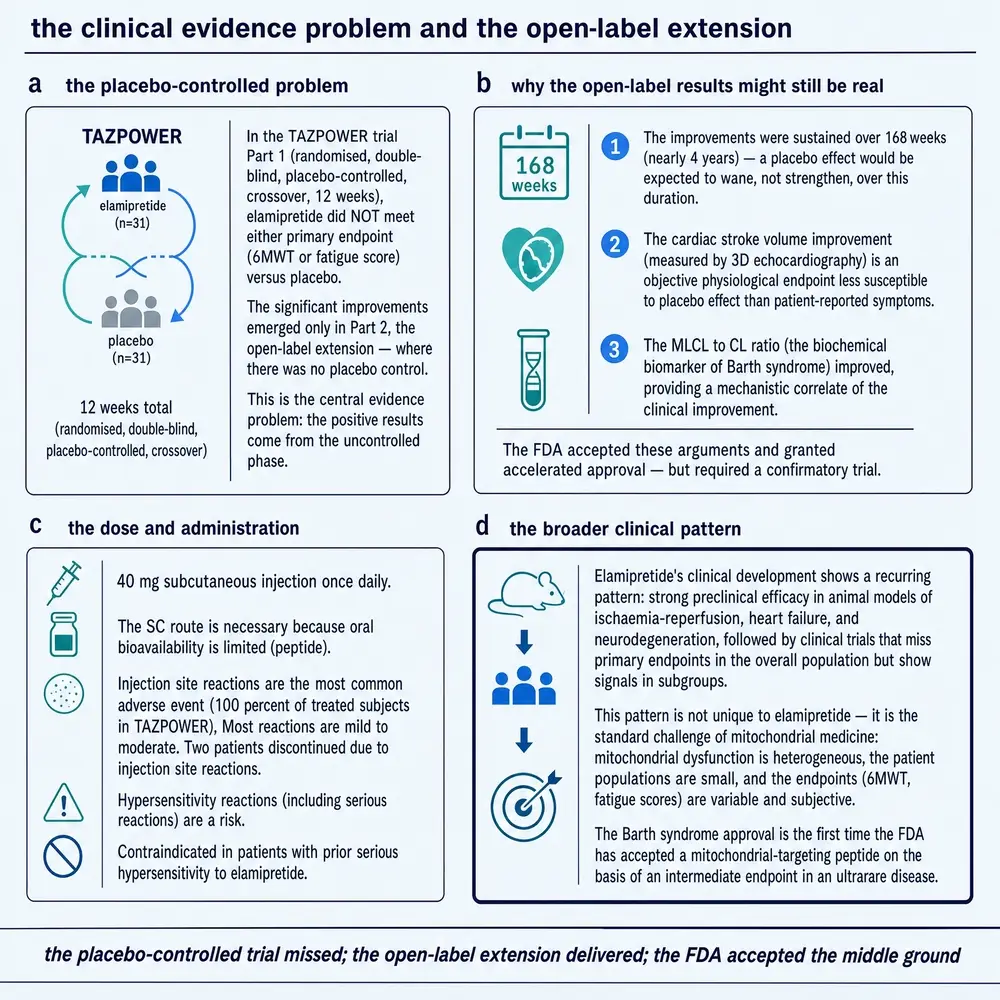
The next plate isolates the design problem that plate cannot dissolve: the randomised half of TAZPOWER and the open‑label half disagree about whether a drug effect is present, and the approval rests on an intermediate endpoint chosen after that disagreement was already on the record.
19The eye: ReCLAIM and ReCLAIM-2
The ophthalmic programme rested on a specific piece of anatomy. The photoreceptors and the retinal pigment epithelium are among the most metabolically demanding tissues in the body, and mitochondrial decline in the retinal pigment epithelium is one of the better-supported mechanisms in dry age-related macular degeneration.
ReCLAIM was a phase 1, open-label, uncontrolled study of 24 weeks of daily 40 mg subcutaneous dosing, reported in two cohorts. Mettu et al. (2022) report the non-central geographic atrophy cohort: 15 completers analysed, 4 withdrawals. Treatment was generally well tolerated; adverse events were predominantly injection-site reactions, mild or moderate, with one discontinuation for injection-site pruritus and two serious adverse events in a single patient (urinary tract infection and sepsis), neither considered drug-related. Exploratory measures showed increases in low-luminance best-corrected visual acuity and low-luminance reading acuity from day 7 and week 4, sustained thereafter. Mean increase in geographic-atrophy area, on the square-root transformation used in this field, was 0.14 mm by fundus autofluorescence and 0.13 mm by optical coherence tomography, against published six-month natural-history increases of 0.17 to 0.19 mm. The authors state plainly that the absence of a placebo control is the study's most significant limitation. Allingham et al. (2022) report the companion cohort with intermediate disease and high-risk drusen.
ReCLAIM-2 (NCT03891875) was the controlled test. Ehlers et al. (2025) randomised 176 participants aged 55 and over with geographic atrophy — 117 to elamipretide and 59 to placebo — to 48 weeks of daily subcutaneous dosing in a double-masked, multicentre trial.
Both primary endpoints were not met: mean change in low-luminance best-corrected visual acuity, and change in square-root-converted geographic-atrophy area on optical coherence tomography.
Several additional predefined endpoints did separate. Progression of total ellipsoid-zone attenuation or loss — a measure of damage to the photoreceptor layer itself — was reduced by 43 per cent (nominal P = 0.0034), and partial attenuation by 47 per cent (nominal P = 0.0040). A gain of ten letters or more in low-luminance acuity occurred in 14.6 per cent of treated participants against 2.1 per cent on placebo (nominal P = 0.0404). Adverse events occurred in 86 per cent of the treated group and 71 per cent of placebo, most commonly injection-site reactions.
Every one of those p values is nominal, and the word carries weight. Once the primary endpoints fail, the statistical hierarchy that controls the false positive rate across multiple comparisons is broken, and everything below it becomes hypothesis-generating regardless of how large the percentages look. The trial's conclusion is that ellipsoid-zone attenuation will serve as the primary endpoint in the phase 3 programme — a statement about how the next trial should be designed, not a claim about what this one showed. ReNEW (NCT06373731), a phase 3 study of 313 participants, began in May 2024 and is listed as active and not recruiting with estimated completion in September 2027.
20Safety and tolerability
The safety record is the most consistent part of this compound's clinical file, and it is consistent in a specific way: the dominant finding is local, not systemic.
Injection-site reactions are the most commonly reported adverse events across the entire subcutaneous programme — MMPOWER-2, MMPOWER-3, TAZPOWER, ReCLAIM and ReCLAIM-2 alike. They include pruritus, pain, bruising, erythema, and in longer exposures injection-site nodules and masses. In ReCLAIM-2 the overall adverse-event rate was 86 per cent on treatment against 71 per cent on placebo (Ehlers et al., 2025); the excess is largely accounted for by this category. In ReCLAIM, one participant discontinued for injection-site pruritus (Mettu et al., 2022).
Systemic safety in the largest randomised dataset was unremarkable. In MMPOWER-3, serious adverse events occurred in 5 of 109 participants receiving elamipretide; 13 of 218 participants across both arms discontinued treatment, and adverse-event withdrawals numbered two on elamipretide and one on placebo. The authors conclude that the phase 3 trial demonstrated subcutaneous elamipretide to be well tolerated, with most adverse events mild to moderate (Karaa et al., 2023).
Long-term animal exposure is often cited as reassuring — no safety issues over eight weeks in pigs, no adverse effects after eight months of daily treatment in mice — but the source reports these as a personal communication (Szeto & Birk, 2014), and they are recorded here with that provenance attached rather than as published toxicology.
Two limits on the safety picture should be stated. First, the populations studied are narrow: the myopathy and Barth trials enrolled predominantly White participants, TAZPOWER enrolled twelve males at one centre, and the ophthalmic trials enrolled adults over 55. Second, the longest controlled exposure in this record is 48 weeks. The 168-week TAZPOWER data (Thompson et al., 2024) extend the exposure but not the control.
21The approval, and what it commits to
On 19 September 2025 the US Food and Drug Administration granted accelerated approval to elamipretide, as Forzinity, to improve muscle strength in adult and paediatric patients with Barth syndrome weighing at least 30 kg (Zhao C et al., 2026; Shirley, 2026). It is the first disease-specific treatment approved for the condition, and the first cardiolipin-directed therapeutic of any kind to reach a label. The labelled regimen is once-daily subcutaneous administration at 40 mg for eligible patients, and the compound is classified as a mitochondrial cardiolipin binder (Di et al., 2026). It appears in the record of 2025 peptide and oligonucleotide approvals compiled by AlShaer et al. (2026).
The regulatory architecture is worth reading carefully, because it encodes the same uncertainty this document has been describing. Accelerated approval is not full approval. It permits marketing on the basis of an endpoint judged reasonably likely to predict clinical benefit, rather than on a demonstration of clinical benefit itself. Here that endpoint is knee extensor muscle strength (Di et al., 2026) — not the six-minute walk test that both primary endpoints of the randomised phase had failed to move. Continued approval is conditional on a post-marketing confirmatory trial, and that trial is registered: 4TAZPower (NCT07531251), a phase 4 study of 48 participants, listed as not yet recruiting, with a start date of 30 June 2026 and estimated completion on 30 November 2029.
In other words, the regulator reached the same conclusion a careful reader of TAZPOWER would reach: the evidence is suggestive, the disease is rare enough that waiting for certainty carries its own cost, and the question remains open until a confirmatory trial closes it. Phase 3 development continues in dry age-related macular degeneration and in mitochondrial myopathies (Shirley, 2026).
22Why the results diverge
Set the record out end to end and a pattern appears that is more informative than any single trial. In cell and animal models — hundreds of them, across a dozen organ systems — SS-31 works, reliably and often substantially. In randomised human trials with prespecified functional endpoints, it has not: EMBRACE STEMI, PROGRESS-HF, MMPOWER-2, MMPOWER-3, the randomised phase of TAZPOWER, and ReCLAIM-2 all missed. In uncontrolled human studies, subgroups and secondary endpoints, favourable results recur.
Four explanations account for most of that gap, and they are not mutually exclusive.
The measurement. The six-minute walk test carries almost the entire efficacy programme, and it is a poor instrument for this purpose. It measures a composite of cardiopulmonary capacity, muscle strength, joint function, motivation and familiarity with the test, of which mitochondrial ATP supply is one contributor. It improves with repetition. And it improved in the placebo arm of MMPOWER-3 by 17.3 m over 24 weeks in a degenerative disease, which sets the bar a real drug effect has to clear. The pattern in MMPOWER-2 is the signature of this problem: patient-reported fatigue improved significantly, while accelerometry at wrist and hip recorded nothing at all. Something changed in how patients experienced their days. Whether it changed how much they moved is not supported by the devices that measured it.
The population. If the compound acts only where mitochondria are already dysfunctional — the selectivity claim of Section 08 — then every trial that enrols a broad, stable, medically optimised population dilutes its own effect. MMPOWER-3 excluded participants walking under 100 m or over 450 m for exactly this reason, and still returned nothing. The genotype analysis of Section 17 is the same argument applied one level deeper: not all mitochondrial disease is the same disease, and a drug that stabilises a residual functional pool should do most where a residual functional pool is what remains.
The timing. This applies specifically to the cardiovascular arm and it is the strongest of the four. Every animal reperfusion result required the drug to be present before the artery reopened. In a clinical setting, guaranteeing tissue concentrations in that window is close to impossible, and the intracoronary work in swine (Swain et al., 2024) is an explicit attempt to engineer around it.
The mechanism may simply be smaller in people than in models. This is the explanation the field is most reluctant to state and the one the data most directly support. Animal models of mitochondrial disease are acute, severe and homogeneous. Human mitochondrial disease is chronic, variable, heteroplasmic and accompanied by decades of secondary adaptation. A compound that restores respiration in a mouse mitochondrion within hours may produce a real but small effect in a 45-year-old with a lifetime of compensations built around the deficit — too small to move a walking test in 24 weeks, and still real.
Note that the first three explanations are all recoverable: better endpoint, better population, better delivery. The fourth is not. Distinguishing them is the entire content of the compound's remaining research programme.
23How to read a preclinical record this broad
The single most striking feature of this compound's file is the breadth of its preclinical success, and it is worth developing the reasoning that makes that breadth ambiguous rather than simply impressive.
Consider what a positive result in an animal model of, say, cisplatin nephrotoxicity actually establishes. The model produces acute mitochondrial injury in a tissue with very high mitochondrial density, measured over days, with a compound administered before or alongside the insult. A treatment that stabilises mitochondrial membranes under those conditions will improve the readout. So will a great many other things: antioxidants, calcium-channel modulators, permeability-transition inhibitors, heat-shock protein inducers. The model has low specificity for mechanism, which is a different thing from being a bad model. It answers the question “does this compound protect mitochondria under acute stress?” well, and the question “will this compound help a patient?” hardly at all.
Now consider the alternative reading, which the mechanism genuinely supports. Cardiolipin is present in every mitochondrion in every tissue. If a compound stabilises it, the compound has a target in every organ, and a wide range of positive models is the predicted consequence rather than a warning sign. On this view, the diversity of the preclinical record is confirmatory: it is what universality of target looks like from the outside.
Both readings predict the same preclinical literature. They diverge only on what happens in the clinic, and they diverge in a specific way. The low-specificity reading predicts that human trials will produce small, inconsistent effects concentrated in secondary and patient-reported endpoints. The universal-target reading predicts that human trials will produce effects proportionate to how much mitochondrial dysfunction the enrolled patients actually have. The observed record — consistent failure on prespecified functional primaries, recurrent signal on patient-reported and subgroup measures — is closer to the first than to the second, though the genotype analysis of Section 17 is a serious attempt to test the second directly.
The general lesson is not about this compound. Bøtker et al. (2020) and El-Hattab et al. (2017) both write about the field's structural problem: mitochondrial therapeutics have produced a large preclinical literature and very few approved therapies, and the reason is not that the biology is wrong. It is that preclinical models select for acute, severe, homogeneous mitochondrial injury, and patients present with chronic, moderate, heterogeneous mitochondrial injury layered under decades of physiological compensation. A compound can be genuinely active on the mechanism and still fail to move a clinical endpoint, and that possibility deserves to be held open rather than argued away.
24What is established, what is suggested, what is not
The following separation is by evidence tier rather than by plausibility, and it is deliberately unkind to the middle column.
What is established is mostly mechanistic and mostly not clinical. Selective binding to cardiolipin and enrichment in the inner mitochondrial membrane are well supported by direct measurement (Szeto & Birk, 2014; Birk et al., 2013). Interfacial binding that modifies membrane surface charge and lipid packing without destabilising the bilayer is supported by biophysical measurement in both model and mitochondrial membranes (Mitchell et al., 2020, 2022). Linear pharmacokinetics, a roughly four-hour half-life and approximately 90 per cent subcutaneous bioavailability are established in people (Szeto & Birk, 2014; Karaa et al., 2020). Tolerability of daily subcutaneous dosing is established across several hundred randomised participants, with injection-site reactions as the dominant finding (Karaa et al., 2023; Ehlers et al., 2025). And improvement of respiration and ultrastructure in damaged mitochondria is established across a very wide range of preclinical models.
What is suggested but unresolved shares a single structural feature: every item rests on an analysis that was not the trial's prespecified primary test. Benefit in the replisome subgroup of mitochondrial myopathy is a prespecified subgroup of a failed trial with nominal p values (Karaa et al., 2024). Slowing of photoreceptor-layer loss in dry macular degeneration is a set of additional predefined endpoints in a trial whose primaries failed (Ehlers et al., 2025). Durable functional gain in Barth syndrome comes from an open-label extension whose randomised phase was negative (Reid Thompson et al., 2021). Improved in vivo mitochondrial ATP production in ageing human skeletal muscle (Roshanravan et al., 2021) is a physiological measurement rather than a clinical outcome. Each of these is a legitimate reason to run the next trial. None is a result.
What is not established is stated in the negative form the trials support. There is no demonstrated effect on infarct size in acute myocardial infarction, no demonstrated effect on ventricular volumes in heart failure with reduced ejection fraction, and no demonstrated effect on walking distance or fatigue in unselected primary mitochondrial myopathy — the last of these graded as Class I evidence of absence of effect at 24 weeks, which is a stronger statement than a failure to detect. Clinical benefit in Barth syndrome is not established either, a point the accelerated-approval mechanism makes explicitly by requiring a confirmatory trial. And nothing in this document establishes any use, dose, route or schedule for any person outside a registered trial or an approved label.
25What would settle it
Three specific results would change the picture, and all three are either running or registered.
The first is NuPOWER, the genotype-enriched phase 3 myopathy trial completed in December 2024 and not yet published in this project's corpus. It is a direct prospective test of the Section 17 hypothesis in the population that hypothesis specifies. If it is positive, the MMPOWER-3 failure becomes a story about population selection. If it is negative, the subgroup finding takes its place among the many that did not replicate.
The second is ReNEW, the phase 3 ophthalmic trial due to complete in September 2027, which promotes ellipsoid-zone attenuation from a secondary observation to the prespecified primary endpoint. This is the correct design response to ReCLAIM-2, and it converts a nominal finding into a testable one.
The third is 4TAZPower, the confirmatory phase 4 trial in Barth syndrome due to complete in November 2029, on which continued approval depends.
Beyond these, two gaps in the record are worth naming because nothing currently registered addresses them. There is no published head-to-head comparison of SS-31 against the analogues that outperformed it in cell-based assays (Mitchell et al., 2022), which means the series may not have been optimised before its lead compound was committed to a decade of clinical work. And there is no human trial of the intracoronary delivery route that resolved the timing problem in swine (Swain et al., 2024), leaving the most specific explanation of the EMBRACE STEMI failure untested in people.
SS-31 was discovered by accident in a laboratory studying opioid peptides, spent a decade in clinical development under a mechanistic account that was subsequently replaced, failed its two large cardiovascular trials, failed its pivotal trial in mitochondrial myopathy with Class I evidence of no effect, failed both primary endpoints of its controlled trial in macular degeneration, failed the randomised phase of its trial in Barth syndrome — and was approved, on accelerated terms and with a confirmatory trial required, on the strength of that trial's open-label extension. Its target is real and well characterised. Its biophysics are better understood now than at any point during the programme that tested it. What remains unresolved, after twenty years and thirty registered studies, is whether the effect it has on mitochondria is large enough to change how a person functions. Three trials now running are designed to answer precisely that, and until they report, the honest position is that the question is open.
Section 26References
Every entry below was resolved against the National Library of Medicine's records during this build and read back against its author, journal, year and title line. None was written from recall. The build refuses to run if any identifier fails to resolve.
- Alam NM, Mills WC, Wong AA, Douglas RM, Szeto HH, Prusky GT. A mitochondrial therapeutic reverses visual decline in mouse models of diabetes. Dis Model Mech. 2015;8(7):701-10.
PMID 26035391 · doi:10.1242/dmm.020248 · PMC4486862 - Alam NM, Douglas RM, Prusky GT. Treatment of age-related visual impairment with a peptide acting on mitochondria. Dis Model Mech. 2022;15(3).
PMID 34766182 · doi:10.1242/dmm.048256 · PMC8891924 - Allen ME, Pennington ER, Perry JB, Dadoo S, Makrecka-Kuka M, Dambrova M, et al.. The cardiolipin-binding peptide elamipretide mitigates fragmentation of cristae networks following cardiac ischemia reperfusion in rats. Commun Biol. 2020;3(1):389.
PMID 32680996 · doi:10.1038/s42003-020-1101-3 · PMC7368046 - Allingham MJ, Mettu PS, Cousins SW. Phase 1 Clinical Trial of Elamipretide in Intermediate Age-Related Macular Degeneration and High-Risk Drusen: ReCLAIM High-Risk Drusen Study. Ophthalmol Sci. 2022;2(1):100095.
PMID 36246187 · doi:10.1016/j.xops.2021.100095 · PMC9560633 - AlShaer D, Al Musaimi O, Albericio F, de la Torre BG. 2025 FDA TIDES (Peptides and Oligonucleotides) Harvest. Pharmaceuticals (Basel). 2026;19(2).
PMID 41754785 · doi:10.3390/ph19020244 · PMC12943124 - Ansari S, Koenig MK. Expanded-Access Use of Elamipretide Improves Quality of Life in Patients With Rare Mitochondrial Disorders Characterized by Ophthalmic Symptoms: A Case Series. Clin Case Rep. 2024;12(12):e9591.
PMID 39619320 · doi:10.1002/ccr3.9591 · PMC11606928 - Birk AV, Liu S, Soong Y, Mills W, Singh P, Warren JD, et al.. The mitochondrial-targeted compound SS-31 re-energizes ischemic mitochondria by interacting with cardiolipin. J Am Soc Nephrol. 2013;24(8):1250-61.
PMID 23813215 · doi:10.1681/ASN.2012121216 · PMC3736700 - Birk AV, Chao WM, Bracken C, Warren JD, Szeto HH. Targeting mitochondrial cardiolipin and the cytochrome c/cardiolipin complex to promote electron transport and optimize mitochondrial ATP synthesis. Br J Pharmacol. 2014;171(8):2017-28.
PMID 24134698 · doi:10.1111/bph.12468 · PMC3976619 - Brown DA, Hale SL, Baines CP, del Rio CL, Hamlin RL, Yueyama Y, et al.. Reduction of early reperfusion injury with the mitochondria-targeting peptide bendavia. J Cardiovasc Pharmacol Ther. 2014;19(1):121-32.
PMID 24288396 · doi:10.1177/1074248413508003 · PMC4103197 - Butler J, Khan MS, Anker SD, Fonarow GC, Kim RJ, Nodari S, et al.. Effects of Elamipretide on Left Ventricular Function in Patients With Heart Failure With Reduced Ejection Fraction: The PROGRESS-HF Phase 2 Trial. J Card Fail. 2020;26(5):429-437.
PMID 32068002 · doi:10.1016/j.cardfail.2020.02.001 - Bøtker HE, Cabrera-Fuentes HA, Ruiz-Meana M, Heusch G, Ovize M. Translational issues for mitoprotective agents as adjunct to reperfusion therapy in patients with ST-segment elevation myocardial infarction. J Cell Mol Med. 2020;24(5):2717-2729.
PMID 31967733 · doi:10.1111/jcmm.14953 · PMC7077531 - Campbell MD, Duan J, Samuelson AT, Gaffrey MJ, Merrihew GE, Egertson JD, et al.. Improving mitochondrial function with SS-31 reverses age-related redox stress and improves exercise tolerance in aged mice. Free Radic Biol Med. 2019;134:268-281.
PMID 30597195 · doi:10.1016/j.freeradbiomed.2018.12.031 · PMC6588449 - Campbell MD, Samuelson AT, Chiao YA, Sweetwyne MT, Ladiges WC, Rabinovitch PS, et al.. Intermittent treatment with elamipretide preserves exercise tolerance in aged female mice. Geroscience. 2023;45(4):2245-2255.
PMID 36840897 · doi:10.1007/s11357-023-00754-0 · PMC10651577 - Chakrabarti AK, Feeney K, Abueg C, Brown DA, Czyz E, Tendera M, et al.. Rationale and design of the EMBRACE STEMI study: a phase 2a, randomized, double-blind, placebo-controlled trial to evaluate the safety, tolerability and efficacy of intravenous Bendavia on reperfusion injury in patients treated with standard therapy including primary percutaneous coronary intervention and stenting for ST-segment elevation myocardial infarction. Am Heart J. 2013;165(4):509-514.e7.
PMID 23537966 · doi:10.1016/j.ahj.2012.12.008 - Chatfield KC, Sparagna GC, Chau S, Phillips EK, Ambardekar AV, Aftab M, et al.. Elamipretide Improves Mitochondrial Function in the Failing Human Heart. JACC Basic Transl Sci. 2019;4(2):147-157.
PMID 31061916 · doi:10.1016/j.jacbts.2018.12.005 · PMC6488757 - Chavez JD, Tang X, Campbell MD, Reyes G, Kramer PA, Stuppard R, et al.. Mitochondrial protein interaction landscape of SS-31. Proc Natl Acad Sci U S A. 2020;117(26):15363-15373.
PMID 32554501 · doi:10.1073/pnas.2002250117 · PMC7334473 - Chiao YA, Zhang H, Sweetwyne M, Whitson J, Ting YS, Basisty N, et al.. Late-life restoration of mitochondrial function reverses cardiac dysfunction in old mice. Elife. 2020;9.
PMID 32648542 · doi:10.7554/eLife.55513 · PMC7377906 - Di K, Hu Y, Sun H, Meng T, Han T, Qie R. Cardiolipin remodelling in mitochondrial therapeutics: translational evidence chains from elamipretide to emerging strategies. Front Physiol. 2026;17:1813119.
PMID 42291734 · doi:10.3389/fphys.2026.1813119 · PMC13259677 - Ehlers JP, Hu A, Boyer D, Cousins SW, Waheed NK, Rosenfeld PJ, et al.. ReCLAIM-2: A Randomized Phase II Clinical Trial Evaluating Elamipretide in Age-related Macular Degeneration, Geographic Atrophy Growth, Visual Function, and Ellipsoid Zone Preservation. Ophthalmol Sci. 2025;5(1):100628.
PMID 39605874 · doi:10.1016/j.xops.2024.100628 · PMC11599447 - El-Hattab AW, Zarante AM, Almannai M, Scaglia F. Therapies for mitochondrial diseases and current clinical trials. Mol Genet Metab. 2017;122(3):1-9.
PMID 28943110 · doi:10.1016/j.ymgme.2017.09.009 · PMC5773113 - Gibson CM, Giugliano RP, Kloner RA, Bode C, Tendera M, Jánosi A, et al.. EMBRACE STEMI study: a Phase 2a trial to evaluate the safety, tolerability, and efficacy of intravenous MTP-131 on reperfusion injury in patients undergoing primary percutaneous coronary intervention. Eur Heart J. 2016;37(16):1296-303.
PMID 26586786 · doi:10.1093/eurheartj/ehv597 - Gwaltney C, Stokes J, Aiudi A, Mazar I, Ollis S, Love E, et al.. Psychometric performance of the Primary Mitochondrial Myopathy Symptom Assessment (PMMSA) in a randomized, double-blind, placebo-controlled crossover study in subjects with mitochondrial disease. J Patient Rep Outcomes. 2022;6(1):129.
PMID 36562873 · doi:10.1186/s41687-022-00534-y · PMC9789285 - Hornby B, Thompson WR, Almuqbil M, Manuel R, Abbruscato A, Carr J, et al.. Natural history comparison study to assess the efficacy of elamipretide in patients with Barth syndrome. Orphanet J Rare Dis. 2022;17(1):336.
PMID 36056411 · doi:10.1186/s13023-022-02469-5 · PMC9438322 - Karaa A, Haas R, Goldstein A, Vockley J, Weaver WD, Cohen BH. Randomized dose-escalation trial of elamipretide in adults with primary mitochondrial myopathy. Neurology. 2018;90(14):e1212-e1221.
PMID 29500292 · doi:10.1212/WNL.0000000000005255 · PMC5890606 - Karaa A, Haas R, Goldstein A, Vockley J, Cohen BH. A randomized crossover trial of elamipretide in adults with primary mitochondrial myopathy. J Cachexia Sarcopenia Muscle. 2020;11(4):909-918.
PMID 32096613 · doi:10.1002/jcsm.12559 · PMC7432581 - Karaa A, Bertini E, Carelli V, Cohen BH, Enns GM, Falk MJ, et al.. Efficacy and Safety of Elamipretide in Individuals With Primary Mitochondrial Myopathy: The MMPOWER-3 Randomized Clinical Trial. Neurology. 2023;101(3):e238-e252.
PMID 37268435 · doi:10.1212/WNL.0000000000207402 · PMC10382259 - Karaa A, Bertini E, Carelli V, Cohen B, Ennes GM, Falk MJ, et al.. Genotype-specific effects of elamipretide in patients with primary mitochondrial myopathy: a post hoc analysis of the MMPOWER-3 trial. Orphanet J Rare Dis. 2024;19(1):431.
PMID 39574155 · doi:10.1186/s13023-024-03421-5 · PMC11583740 - Kim SR, Eirin A, Zhang X, Lerman A, Lerman LO. Mitochondrial Protection Partly Mitigates Kidney Cellular Senescence in Swine Atherosclerotic Renal Artery Stenosis. Cell Physiol Biochem. 2019;52(3):617-632.
PMID 30907989 · doi:10.33594/000000044 · PMC6519989 - Kloner RA, Hale SL, Dai W, Gorman RC, Shuto T, Koomalsingh KJ, et al.. Reduction of ischemia/reperfusion injury with bendavia, a mitochondria-targeting cytoprotective Peptide. J Am Heart Assoc. 2012;1(3):e001644.
PMID 23130143 · doi:10.1161/JAHA.112.001644 · PMC3487333 - Liu D, Shu G, Jin F, Qi J, Xu X, Du Y, et al.. ROS-responsive chitosan-SS31 prodrug for AKI therapy via rapid distribution in the kidney and long-term retention in the renal tubule. Sci Adv. 2020;6(41).
PMID 33036968 · doi:10.1126/sciadv.abb7422 · PMC7546709 - Mettu PS, Allingham MJ, Cousins SW. Phase 1 Clinical Trial of Elamipretide in Dry Age-Related Macular Degeneration and Noncentral Geographic Atrophy: ReCLAIM NCGA Study. Ophthalmol Sci. 2022;2(1):100086.
PMID 36246181 · doi:10.1016/j.xops.2021.100086 · PMC9560640 - Mitchell W, Ng EA, Tamucci JD, Boyd KJ, Sathappa M, Coscia A, et al.. The mitochondria-targeted peptide SS-31 binds lipid bilayers and modulates surface electrostatics as a key component of its mechanism of action. J Biol Chem. 2020;295(21):7452-7469.
PMID 32273339 · doi:10.1074/jbc.RA119.012094 · PMC7247319 - Mitchell W, Tamucci JD, Ng EL, Liu S, Birk AV, Szeto HH, et al.. Structure-activity relationships of mitochondria-targeted tetrapeptide pharmacological compounds. Elife. 2022;11.
PMID 35913044 · doi:10.7554/eLife.75531 · PMC9342957 - Nhu NT, Xiao SY, Liu Y, Kumar VB, Cui ZY, Lee SD. Neuroprotective Effects of a Small Mitochondrially-Targeted Tetrapeptide Elamipretide in Neurodegeneration. Front Integr Neurosci. 2021;15:747901.
PMID 35111001 · doi:10.3389/fnint.2021.747901 · PMC8801496 - Ortmann L, Velasco D, Cole J. Expanded-access use of elamipretide in a newborn with Barth syndrome: a case report. Eur Heart J Case Rep. 2025;9(2):ytaf030.
PMID 39917770 · doi:10.1093/ehjcr/ytaf030 · PMC11799937 - Petcherski A, Trudeau KM, Wolf DM, Segawa M, Lee J, Taddeo EP, et al.. Elamipretide Promotes Mitophagosome Formation and Prevents Its Reduction Induced by Nutrient Excess in INS1 β-cells. J Mol Biol. 2018;430(24):4823-4833.
PMID 30389435 · doi:10.1016/j.jmb.2018.10.020 · PMC6290358 - Pharaoh G, Kamat V, Kannan S, Stuppard RS, Whitson J, Martín-Pérez M, et al.. The mitochondrially targeted peptide elamipretide (SS-31) improves ADP sensitivity in aged mitochondria by increasing uptake through the adenine nucleotide translocator (ANT). Geroscience. 2023;45(6):3529-3548.
PMID 37462785 · doi:10.1007/s11357-023-00861-y · PMC10643647 - Reid Thompson W, Hornby B, Manuel R, Bradley E, Laux J, Carr J, et al.. A phase 2/3 randomized clinical trial followed by an open-label extension to evaluate the effectiveness of elamipretide in Barth syndrome, a genetic disorder of mitochondrial cardiolipin metabolism. Genet Med. 2021;23(3):471-478.
PMID 33077895 · doi:10.1038/s41436-020-01006-8 · PMC7935714 - Roshanravan B, Liu SZ, Ali AS, Shankland EG, Goss C, Amory JK, et al.. In vivo mitochondrial ATP production is improved in older adult skeletal muscle after a single dose of elamipretide in a randomized trial. PLoS One. 2021;16(7):e0253849.
PMID 34264994 · doi:10.1371/journal.pone.0253849 · PMC8282018 - Sabbah HN, Alder NN, Sparagna GC, Bruce JE, Stauffer BL, Chao LH, et al.. Contemporary insights into elamipretide's mitochondrial mechanism of action and therapeutic effects. Biomed Pharmacother. 2025;187:118056.
PMID 40294492 · doi:10.1016/j.biopha.2025.118056 · PMC12164653 - Sabbah HN, Gupta RC, Singh-Gupta V, Zhang K. Effects of elamipretide on skeletal muscle in dogs with experimentally induced heart failure. ESC Heart Fail. 2019;6(2):328-335.
PMID 30688415 · doi:10.1002/ehf2.12408 · PMC6437430 - Sabbah HN. Barth syndrome cardiomyopathy: targeting the mitochondria with elamipretide. Heart Fail Rev. 2021;26(2):237-253.
PMID 33001359 · doi:10.1007/s10741-020-10031-3 · PMC7895793 - Sabbah HN. Elamipretide for Barth syndrome cardiomyopathy: gradual rebuilding of a failed power grid. Heart Fail Rev. 2022;27(5):1911-1923.
PMID 34623544 · doi:10.1007/s10741-021-10177-8 · PMC9388406 - Schauer A, Jahn D, Vahle B, Barthel P, Männel A, Fabig G, et al.. Mitochondrial Targeting by Elamipretide Improves Myocardial Bioenergetics Without Translating into Functional Benefits in HFpEF. Int J Mol Sci. 2026;27(2).
PMID 41596703 · doi:10.3390/ijms27021060 · PMC12841679 - Shirley M. Elamipretide: First Approval. Drugs. 2026;86(3):377-383.
PMID 41335372 · doi:10.1007/s40265-025-02269-8 - Swain L, Bhave S, Qiao X, Reyelt L, Everett KD, Awata J, et al.. Novel Role for Cardiolipin as a Target of Therapy to Mitigate Myocardial Injury Caused by Venoarterial Extracorporeal Membrane Oxygenation. Circulation. 2024;149(17):1341-1353.
PMID 38235580 · doi:10.1161/CIRCULATIONAHA.123.065298 · PMC11039383 - Szeto HH, Birk AV. Serendipity and the discovery of novel compounds that restore mitochondrial plasticity. Clin Pharmacol Ther. 2014;96(6):672-83.
PMID 25188726 · doi:10.1038/clpt.2014.174 · PMC4267688 - Szeto HH. First-in-class cardiolipin-protective compound as a therapeutic agent to restore mitochondrial bioenergetics. Br J Pharmacol. 2014;171(8):2029-50.
PMID 24117165 · doi:10.1111/bph.12461 · PMC3976620 - Thompson WR, Manuel R, Abbruscato A, Carr J, Campbell J, Hornby B, et al.. Long-term efficacy and safety of elamipretide in patients with Barth syndrome: 168-week open-label extension results of TAZPOWER. Genet Med. 2024;26(7):101138.
PMID 38602181 · doi:10.1016/j.gim.2024.101138 - Tung C, Varzideh F, Farroni E, Mone P, Kansakar U, Jankauskas SS, et al.. Elamipretide: A Review of Its Structure, Mechanism of Action, and Therapeutic Potential. Int J Mol Sci. 2025;26(3).
PMID 39940712 · doi:10.3390/ijms26030944 · PMC11816484 - Van den Eynde J, Chinni B, Vernon H, Thompson WR, Hornby B, Kutty S, et al.. Identifying responders to elamipretide in Barth syndrome: Hierarchical clustering for time series data. Orphanet J Rare Dis. 2023;18(1):76.
PMID 37041653 · doi:10.1186/s13023-023-02676-8 · PMC10088720 - Zhao C, Zhuang X, Gao J. Elamipretide: The first cardiolipin-directed mitochondrial therapeutic for Barth syndrome approved under accelerated approval. Drug Discov Ther. 2026;19(6):435-436.
PMID 41260682 · doi:10.5582/ddt.2025.01111 - Zhao H, Li H, Hao S, Chen J, Wu J, Song C, et al.. Peptide SS-31 upregulates frataxin expression and improves the quality of mitochondria: implications in the treatment of Friedreich ataxia. Sci Rep. 2017;7(1):9840.
PMID 28852135 · doi:10.1038/s41598-017-10320-2 · PMC5575096 - Zhao K, Zhao GM, Wu D, Soong Y, Birk AV, Schiller PW, et al.. Cell-permeable peptide antioxidants targeted to inner mitochondrial membrane inhibit mitochondrial swelling, oxidative cell death, and reperfusion injury. J Biol Chem. 2004;279(33):34682-90.
PMID 15178689 · doi:10.1074/jbc.M402999200 - Zhao W, Xu Z, Cao J, Fu Q, Wu Y, Zhang X, et al.. Elamipretide (SS-31) improves mitochondrial dysfunction, synaptic and memory impairment induced by lipopolysaccharide in mice. J Neuroinflammation. 2019;16(1):230.
PMID 31747905 · doi:10.1186/s12974-019-1627-9 · PMC6865061 - Zhu M, Song L, Wei Y, Hong F, Lu Y, Ji J, et al.. Szeto-Schiller 31 eases acute lung injury in neonatal mice with acute respiratory distress syndrome by mediating TXNIP expression and NLRP3 inflammasome activation. Transl Pediatr. 2025;14(7):1563-1577.
PMID 40800174 · doi:10.21037/tp-2025-165 · PMC12336897 - Zhu Y, Luo M, Bai X, Li J, Nie P, Li B, et al.. SS-31, a Mitochondria-Targeting Peptide, Ameliorates Kidney Disease. Oxid Med Cell Longev. 2022;2022:1295509.
PMID 35707274 · doi:10.1155/2022/1295509 · PMC9192202
Sources with no PubMed record. Registry and chemical database material is listed separately so that the numbered list above stays wholly machine-verified.
- ClinicalTrials.gov, US National Library of Medicine. Registry records for elamipretide, MTP-131 and SS-31 (30 studies, including NCT01115920, NCT01572909, NCT02367014, NCT02788747, NCT02805790, NCT02814097, NCT03098797, NCT03323749, NCT03891875, NCT05162768, NCT06373731 and NCT07531251). Trial phase, enrolment, status, start and completion dates quoted in Sections 13 and 15 to 21 and drawn in Figures 5 and 6 come from a local snapshot of these records retrieved 10 July 2026. Registry status can differ from a published report, and where it does - MMPOWER-3 - the difference is stated in the text rather than resolved silently..
https://clinicaltrials.gov/search?term=elamipretide - PubChem, National Library of Medicine. Elamipretide, compound summary, CID 11764719. Molecular formula, InChIKey and synonym set quoted in Section 02 and drawn in Figure 1 were retrieved from this record during the preparation of this document..
https://pubchem.ncbi.nlm.nih.gov/compound/11764719
Section 27How this document was assembled
The corpus was built against project 05, the Therapeutic Peptide Research Library, and against PubMed and PubMed Central. As with every compound in this series, the interesting arithmetic is not what was collected but what had to be refused — and this molecule refuses in four distinct ways, which is more than any previous compound in the series.
Five names and one dangerous abbreviation
SS-31 is the hardest identity problem this pipeline has been given. The compound carries five designations across three eras of its own literature — SS-31 in the academic work, MTP-131 and Bendavia under its first commercial sponsor, elamipretide as its international nonproprietary name, and Forzinity as its trade name since 2025. A matcher that knows only one of them misses most of the corpus.
The four unambiguous designations are safe: elamipretide, bendavia, Forzinity and the full development code MTP-131 belong to nothing else in the biomedical literature. The notation SS-31 is not safe, and the reason is the two-letter stem. “SS” is one of the most overloaded abbreviations in science: it is Sjogren's syndrome, stainless steel, sample size, steady state, single-strand, Shwachman–Diamond, and a dozen other things, and several of those appear in documents that also carry a numeral 31. The matcher therefore treats a bare SS-31 as a proposal rather than an admission, and requires corroboration from the compound's own semantic field before accepting it.
Two further traps are specific to this compound. The first is the sibling series: SS-20, SS-02, SS-01 and SS-19 are Szeto–Schiller peptides that appear throughout the mechanistic literature, and SS-20 in particular is used as a control in exactly the papers most likely to name the subject. The matcher counts them and refuses a document only where a sibling dominates by a margin, never on a tie, so a paper genuinely about both survives while an SS-20 paper that name-checks the subject once does not. The second is the field itself: cardiolipin, cristae, supercomplex and mitochondria-targeted antioxidant are the vocabulary of a large literature in which this compound is one of many entrants. Matching on that vocabulary admits the entire field.
The matcher was verified before the first sweep rather than after, on constructed traps covering each designation in isolation, the bare notation with and without corroboration, each disqualifying sense of “SS”, each sibling alone and jointly with the subject, and the programme stem with no subject named. The verification checks the stated reason for each decision, not only the decision, because a document admitted for the wrong reason is a defect that no later stage can see.
The local store
Every file with a document extension in the project's stores was opened — 55,526 of them, across twenty-four stores — and its extracted text searched. 1,261 contained something that looked like a designation, and 931 were refused. The causes are reported separately because they mean different things:
| Cause of refusal | Documents | What it tells you |
|---|---|---|
| Named the mitochondrial field, never the compound | 720 | the prefilter is wide, as intended |
| Bare SS-31 with no corroborating context | 126 | the corroboration rule is load-bearing |
| A different sense of “SS” | 72 | a genuine homograph collision reached the sweep |
| Sibling peptide dominant, or programme stem only | 13 | the sibling margin is doing real work |
That leaves 330 documents admitted. Note the middle two rows: 198 documents carried a string that a naive matcher would have counted as a hit. A corpus figure built on raw string matching would have been roughly 282 per cent too large.
The admitted documents were then classified by what kind of document they are, because a corpus figure that silently includes vendor pages is a claim about coverage this document does not have. The result: 116 peer-reviewed full texts against 164 commercial and derived documents. The commercial material here is almost entirely stored web and catalogue captures rather than product pages, and none of it contributes a number to this monograph.
The external harvest
The PubMed query ran in four arms — the compound by all five names; the cardiolipin and mitochondrial-membrane pharmacology that makes the mechanism intelligible; the Szeto–Schiller programme and its siblings, harvested deliberately so that this document can say what belongs to SS-20 rather than silently inheriting it; and the comparator class of mitochondria-targeted antioxidants. Those arms returned 2,408 records, of which 2,011 passed record-level relevance and 337 passed the identity gate on title and abstract alone.
A separate full-text sweep of PubMed Central returned 2,378 body-text matches. A17 moves the substantive-use screen in front of the fetch where a surface is too large to retrieve, and 2,378 is well over this pipeline's threshold, so the front screen was applied: 244 documents were selected for retrieval and 2,147 were counted and not read. Counting a document is not reading it, and this document does not present the surface figure as corpus.
244 full texts were fetched and 242 yielded usable body text. Each was then screened on the far side, where nothing is counted without being read:
| Far-side screen | Documents | Enters the corpus |
|---|---|---|
| Substantive use — the compound appears in the methods | 144 | yes |
| Discussed but not used experimentally | 64 | yes |
| Passing mention only | 28 | yes |
| Refused by the identity gate on full text | 6 | no |
The reading corpus is 297 unique scientific full texts, about 8,768 printed-page equivalents. That figure is a keyed union of the local store and the external harvest, not a sum of the two: 54 documents were reachable by both routes and are counted once.
The corpus profiles by evidence kind as follows: 148 documents dominated by animal work, 50 by human studies, 28 by cell or cell-free work, 5 reviews, and 5 that could not be classified from their own text. That distribution is itself a finding about this compound, and Part Five is largely an argument about what follows from it.
What this document could not verify
Three limits are worth stating plainly rather than leaving to be inferred from the corpus figure.
Registry entries without publications. Several registered studies, including one of 308 participants, have no peer-reviewed efficacy report in this corpus. Section 13 lists them. Where this document says an outcome was “not reported”, it means no such report was found here.
Results announced but not yet published. NuPOWER completed in December 2024 and its results had not appeared in the peer-reviewed literature in this corpus at the time of compilation. The genotype hypothesis it tests is described in Section 17 as open, because from this corpus it is.
Values quoted at one remove. Several preclinical figures — the species-by-species infarct-size reductions, and the chronic heart-failure results in dogs — are quoted from reviews that report them (Swain et al., 2024; Tung et al., 2025) rather than from the primary reports, which are not in this corpus. The text says so at the point of use, and the evidence dossier records the provenance for every one.
| Stage | What it did | Result |
|---|---|---|
| 00b | verify the identity matcher, decisions and stated reasons, before the first sweep | all traps passed |
| 01b | open and gate every document in twenty-four local stores | 330 admitted of 55,526 opened |
| 02 – 02b | PubMed and PubMed Central surfaces, partitioned under the retrieval ceiling | 2,408 and 2,378 |
| 02c | screen before fetch, and record what was counted and not read | 244 targeted, 2,147 unread |
| 03 – 03b | fetch full text; backfill bibliographic metadata NCBI could resolve | 242 with usable text |
| 04 | keyed union, source-kind classification, inventory | 297 unique full texts |
| 05 – 05c | resolve every reference against NCBI; assert every prose citation; inject figures | 57 references, 14 figures |
| 06 – 07c | assemble, number figures, render both editions, stamp running furniture | 14 figures |
| 11 – 15 | density, margins, artwork, contrast and format gates | run against both editions |
Section 28Evidence handling
Study type is named in the sentence that reports the finding. A result in isolated mitochondria is called a result in isolated mitochondria. For this compound the label carries unusual weight, because the preclinical record is broad and overwhelmingly favourable while the randomised human record is neither, and a reader who loses track of which is which will form a picture the evidence does not support.
Negative trials are reported at the same length as positive ones. EMBRACE STEMI, PROGRESS-HF, MMPOWER-2, MMPOWER-3, the randomised phase of TAZPOWER and ReCLAIM-2 all missed their primary endpoints, and all six appear in their chronological place with their designs, populations and numbers intact. None is relegated to a limitations paragraph.
Prespecified and post hoc are distinguished everywhere. Where a result comes from a subgroup, a secondary endpoint, an open-label extension or an analysis performed after the trial read out, the sentence reporting it says so, and the p value is described as nominal where the statistical hierarchy had already been broken. This applies to the genotype cohorts of Section 17, the ellipsoid-zone endpoints of Section 19, and the entire open-label component of Section 18.
Conflicting evidence is presented as conflict. Two cases are load-bearing. The first is the mechanism itself, which has been described three different ways over twenty years; Section 04 sets out all three rather than retrofitting the current account onto the earlier literature. The second is MMPOWER-3's registry status, which reads TERMINATED against a publication reporting 94 per cent completion; Section 16 states the discrepancy and explains it rather than silently preferring one source.
Weakly sourced claims are labelled at the point of use. The long-term animal safety figures widely quoted for this compound are reported in their source as a personal communication, and Section 20 says so.
Registry claims are read from the register. Trial phases, populations, enrolment, status and dates come from a local snapshot of the ClinicalTrials.gov records for this compound retrieved on 10 July 2026, not from a summary of them.
Absence is reported as a finding. Where a registered study of consequence has no published result, this document says so instead of omitting the study; where a mechanistic explanation for a failed trial exists but has never been tested in people, Section 25 names it as an untested explanation rather than as a reason to discount the trial.
No recommendation is made anywhere. Doses, routes and schedules appear only as parameters of registered studies or as text on an approved label. They are facts about the research. Nothing in this document is offered to any person as guidance for use.

Continue exploring