
A History of Peptide Science and Medicine From organ extracts to molecular engineering
For most of its history, this science could not see what it was studying. A hormone was known by what it did to an animal; the substance itself — its identity, its size, its concentration in blood, its shape — was out of reach. Every major advance in the field was at bottom an advance in making a molecule visible, and each time visibility improved the discipline's central question changed shape. This monograph follows six things that became visible in turn, and argues that the field's last and most stubborn problem was never solved by a discovery at all.
This is a history, and its evidence is of a different kind from the rest of the series. Every substantive claim carries an evidence class that is stated in the sentence or the note that makes it. Primary read means the original document was obtained and read. Primary via scholarship means a peer-reviewed historian read it and this document is relying on that reading. Scholarship means the claim rests on secondary historical work. Unverifiable means the claim is widely repeated and could not be traced to any source; there are several, and they are named rather than quietly dropped.
Two rules govern the harder passages. Where a decision now looks wrong, the document states what was known and knowable at the time before it states what is known now, and it never merges the two into a single verdict. Where a practice was contested by identifiable contemporaries, that objection is reported — because it settles the question of anachronism with evidence rather than with the author's judgement. Where a number is quoted everywhere and sourced nowhere, that absence is reported as a finding about the literature.
This document recommends no human use of any compound and specifies no dose, route or schedule for any person. It reports, in several places, what was in fact administered to people in 1891, in 1922 and in 1985, with the population, the duration and the outcome attached, including where the outcome was harm. A historical report of an administration is not a recommendation.
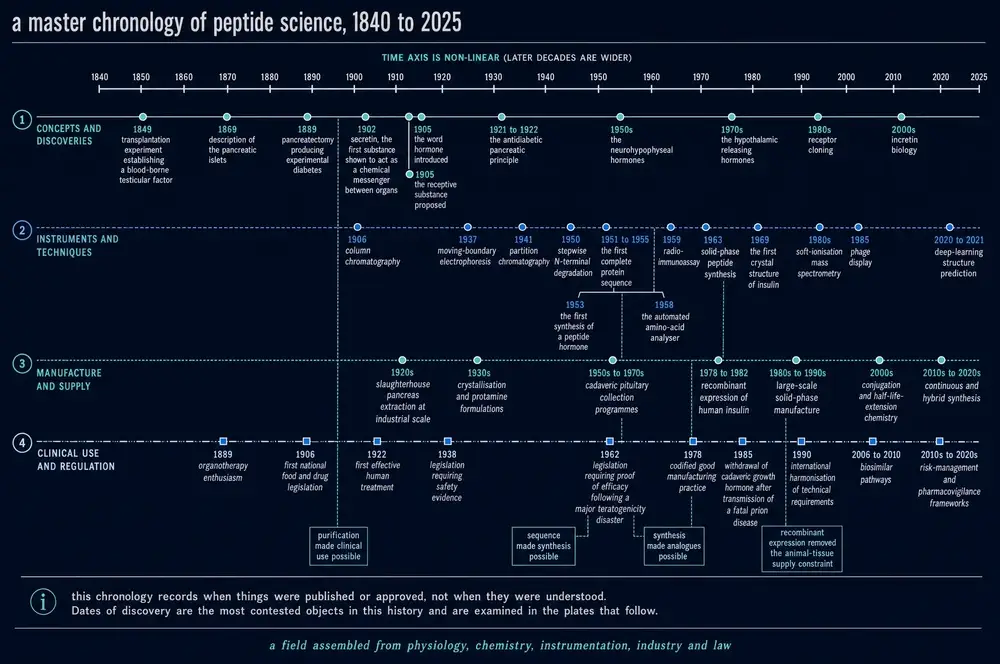
01The body governed by organs
Before there was a hormone there was a question, and it was a good one: how does one part of a body influence another part at a distance? The obvious answer for most of the history of medicine was the nervous system, and it was obvious because it was visible. Nerves can be dissected, traced, cut, and shown to abolish the effect they were carrying. Nothing else in the body has that property.
Against that, the glands were a puzzle. Anatomy of the seventeenth century onward recognised organs that produced something — Thomas Wharton coined the English word thyroid in 1656 — and by the nineteenth century anatomists had a category of "blood-glands" or "ductless glands", organs with a rich blood supply and no tube leading anywhere. Something was presumably going somewhere. There was no functional theory of what.
The practices came long before the theory, which is the first thing this
history has to say about itself. Castration was practised for millennia for
agricultural, military and musical reasons, and its effects on a body were
common knowledge; Aristotle described them. John Hunter transplanted testes into
capons in the 1760s or 1770s and the specimens survive in his museum, though he
never published the work and the sources give three different years for it.
Fulton Albright's summary of the field's real prehistory is worth quoting
because it is exactly right about motive: the earliest beginnings of
endocrinology had as their reasons the procurement of a form of man-power
safe for the harem, the salvaging of a male soprano voice for the choir, and the
increased palatability that a rooster attains when he turns into a capon
.
Endocrinology as a discipline is about a century old. The observations it organises are as old as animal husbandry.
02Berthold's cockerels, and a result that went nowhere
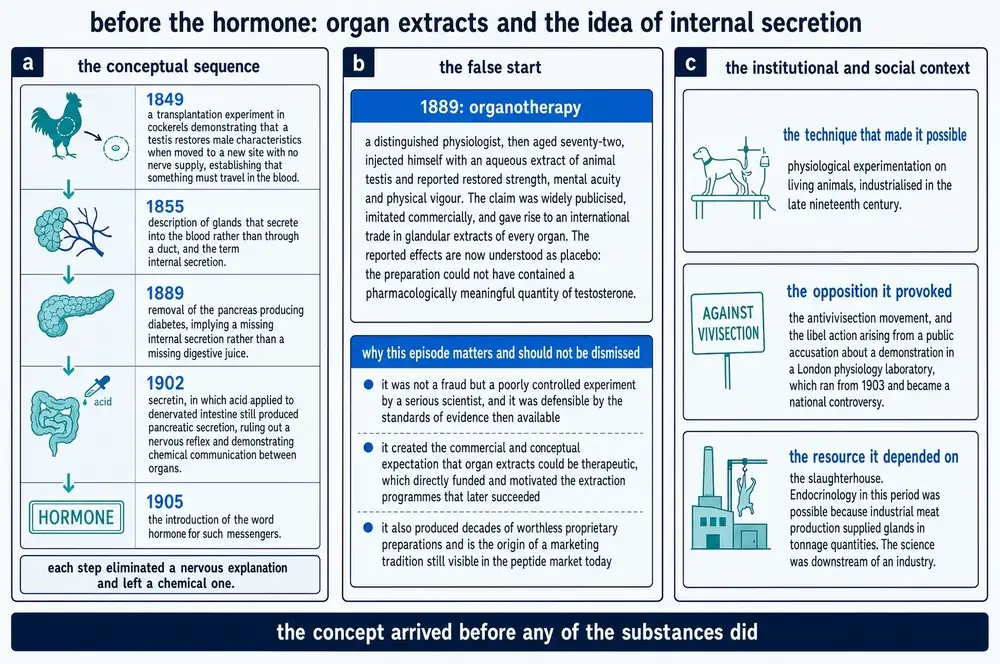
In August 1848 Arnold Adolph Berthold, at Göttingen, castrated six young cockerels. Two he left castrated; two he left intact; and in two he re-implanted a testis into the abdominal cavity, where it could have no nervous connection to anything. The two with transplanted testes developed and behaved as normal cockerels. He announced the result in February 1849.
The experiment is now routinely called the first experiment in endocrinology, and the design does license a strong conclusion: the testis acts on the body through the blood, because in these birds it had no other route. Three things about the standard telling do not survive checking, and they are worth setting out at the start because they establish how this document handles its own material.
Berthold probably did not have an endocrine concept in mind. The reading of his experiment as a demonstration of internal secretion is largely retrospective. The result had essentially no contemporary influence, including one failed replication, and it sat unused for decades. And there are two 1849 papers rather than one, of which only the more obscure credits Hunter's earlier grafting.
None of this makes the experiment less good. It makes the standard account of its reception wrong, and the difference matters, because a history that reports only the experiments that turned out to be foundational will conclude that science proceeds by foundational experiments. Berthold's result was correct, well designed, and ignored.
03Bernard, and a phrase that has been laundered
Claude Bernard's milieu intérieur — the idea that the constancy of the internal environment is the condition of a free life — is the conceptual ancestor of every feedback loop in this document, and it is correctly attributed to him. The phrase internal secretion is a different matter and is very commonly mis-transmitted.
Bernard introduced it in 1855 for the liver's release of glucose into the blood: an organ pouring a substance directly into the circulation rather than down a duct. That is the literal meaning, and glucose is not a hormone. He is credited with the phrase because his demonstration was decisive, not because he coined it — the term probably existed in the French and German literature earlier — and he did not apply it to chemical messengers in anything like the modern sense. Within a few decades the phrase was being used so broadly that it had become nearly useless, covering any substance any organ released into blood.
The point is not pedantry about attribution. It is that a concept can be present in a period's vocabulary and absent from its practice. "Internal secretion" was available from 1855 and did not by itself produce a single identified messenger for the next forty-seven years.
Thomas Addison's account of the consequences of adrenal destruction appeared the same year, 1855, and Brown-Séquard shortly afterwards established experimentally that the adrenals are essential to life. Something the adrenals made was necessary; nobody could say what.
04Brown-Séquard, 1889: the experiment that was wrong and mattered anyway
In 1889, at the age of seventy-two, Charles-Édouard Brown-Séquard told the Société de Biologie in Paris that he had injected himself subcutaneously with liquid extracts of dog and guinea-pig testicles and had recovered his physical strength, his intellectual stamina and his capacity for work. He was one of the most distinguished physiologists in Europe. He published the claim twice in the same year, and generalised it almost at once: nearly any illness might respond to testicular extract, and every organ in the body probably produced an agent of therapeutic use.
The effects were placebo. This is not a modern presumption but an experimental finding: in 2002 a group prepared extracts from five dog testes using Brown-Séquard's own published method and assayed them, and found testosterone at concentrations four orders of magnitude below what a biological effect requires (Cussons et al., 2002). The preparations can at best have had placebo effects. The authors draw the live conclusion rather than the antiquarian one: the episode is a demonstration of how large a placebo response androgen treatment can evoke, which is a caution about the present.
The obvious objection to criticising an 1889 experiment is that Brown-Séquard could not have known. The record answers it directly. In the same year, the British Medical Journal published an anonymous annotation on his claims headed "The Pentacle of Rejuvenescence" — a pentacle being a symbol used in magic.
The claim was contested at the time, in print, by an organ of the profession, in the year of publication. Whatever was wrong with it was therefore visible to contemporaries with contemporary evidence, and this document is entitled to say so without anachronism. That test — did anyone say so at the time? — is applied throughout, and where the answer is no, the judgement is softened accordingly.
And yet the episode is not a footnote, because of what followed it. In 1893 Brown-Séquard claimed the whole movement in organ-extract therapeutics as his own, and the enterprise acquired a respectable name: organotherapy. It became a commercial industry, selling extracts of essentially every organ, and it ran alongside the genuinely effective biologicals of the same period in the same catalogues, indistinguishable to a purchaser. Its later reaches include Steinach's vasoligation from 1918, Voronoff's grafting of monkey testicular tissue into men from 1920, and a programme at San Quentin in which a prison physician performed testicular implantation on 643 inmates.
The industry did not end when the evidence turned against it. It ended when the chemistry arrived and made it possible to ask what was actually in the bottle.
05The extract that worked, and a priority nobody looked for
Two years before Brown-Séquard's announcement, and by the same general method, something worked.
From 13 April 1891, George Redmayne Murray injected a forty-six-year-old woman with advanced myxoedema with an extract of sheep thyroid, and reported it in the British Medical Journal that October (Murray, 1891). Within three months she was transformed. She continued on discontinuous treatment, later switched to an oral preparation, and lived a further twenty-eight years, dying at seventy-four, having consumed in that time roughly five litres of thyroid extract derived from some 870 sheep. Murray explained the experimental nature of the treatment to her beforehand and recorded that he had obtained her consent.
This is the first successful hormone replacement therapy, and set against section 04 it makes the period's problem exactly visible. Two organ extracts, two years apart, prepared by comparable methods, promoted with comparable confidence. One was inert and one was curative, and there was no way for anyone alive at the time to tell which was which except by watching the patient. No assay existed. No chemistry existed. The only instrument was a human being.
Murray was ridiculed for the proposal, and the ridicule was rational, because Brown-Séquard had poisoned the well two years earlier. He also reported, in his second paper, that thyroid therapy had killed patients — and at the same 1892 meeting Victor Horsley made an early argument against publication bias, urging that unfavourable results be reported. Some of Murray's non-responders turned out to be an assay failure of the crudest possible kind: the butcher had supplied thymus.
The priority belongs to Lisbon, by nearly a year. On 15 November 1890, Antonio-Maria Bettencourt-Rodrigues reported beneficial effects from hypodermic injections of thyroid juice to the Lisbon Society of Medical Sciences — three months before Murray had even presented his plan.
The background is better still. In June 1890 Bettencourt and Serrano had implanted half a sheep's thyroid subcutaneously in a myxoedematous patient, and the graft worked before it could have vascularised. They drew the correct and important inference: the effect was not the graft functioning as an organ but simple absorption of juice from the gland — which is why they proposed injection next.
Murray cited their graft work in detail in his own first paper and it very probably prompted him; neither he nor Horsley appears to have known of the full Portuguese report or of the November 1890 injection result. The historian who corrected this record notes that Bettencourt's finding appeared only as a note in a Lisbon society's proceedings and was overshadowed by Murray's more accessible papers in the BMJ. That is a publication-venue effect, not a scientific one, and versions of it recur throughout this document — in section 19, where a sequence published in July is overshadowed by a synthesis published in October, and in section 24, where a method is rejected by two journals before it is accepted by one.
06Adrenaline, and a dispute that is still in the pharmacopoeia
In 1894 George Oliver and Edward Schäfer showed that an extract of the adrenal gland raised blood pressure sharply. The observation was reliable, dramatic, and easy to reproduce, and it made the adrenal the most attractive target in the field: here was an organ whose extract did something unmistakable and immediate to a measurable variable.
What happened next is the field's first modern priority dispute, and it has a commercial edge. John Jacob Abel at Johns Hopkins prepared material from adrenal extract and named the active principle epinephrin in 1897–98. Jokichi Takamine, working with the American firm Parke-Davis, obtained the active principle in crystalline form in 1901 and marketed it under the trade name Adrenalin.
The substance of the dispute is chemical, and it is usually softened. Abel's epinephrin was not adrenaline: it was an inactive benzoylated derivative. He named the substance and prepared crude extracts; Takamine obtained the active compound. A minority reading in the literature describes the isolation as joint work, and this document records that reading as a minority one rather than adopting it.
The consequence outlived both men. Because Adrenalin was a Parke-Davis trade mark, American usage moved to epinephrine as the generic term while British usage kept adrenaline — a split enforced in Britain partly by Henry Dale, who pressed the British usage against the commercial interest of his own employer. The two names are still in the pharmacopoeias, still cause confusion in clinical practice, and are still argued about on safety grounds. A naming dispute from 1901 is a live patient-safety question in 2026.
One qualification matters for this document's scope: adrenaline is the first hormone isolated in pure form, and it is not a peptide. It is a small catecholamine. The techniques that isolated it — crystallisation, a pressor bioassay — were the best available, and they worked because the molecule is small, stable and abundant in the gland. Applied to a peptide they would fail, and for the next fifty years they did.
07Secretin, 1902, and the word
The experiment that founded the field was performed on 16 January 1902 by William Bayliss and Ernest Starling at University College London, and its design is the argument.
It was known that acid entering the small intestine caused the pancreas to secrete. Pavlov's school held that this was a nervous reflex, and Pavlov had enormous authority on exactly this question. Bayliss and Starling took a loop of jejunum in an anaesthetised dog and stripped it of its nerve supply, so that no reflex arc could reach the pancreas. They introduced acid into the denervated loop. The pancreas secreted anyway.
Then they did the step that makes it decisive. They scraped the mucosa from the intestinal wall, ground it with sand and acid, filtered it, and injected the filtrate into a vein. The pancreas secreted. Whatever caused the effect was a chemical substance, present in the gut lining, capable of travelling in blood and acting on a distant organ — and the intravenous injection makes the denervation argument almost unnecessary, because a substance injected into a vein has no nerves to travel along.
They named it secretin, published through the Royal Society within a week and in the Journal of Physiology eight months later.
The famous account of Pavlov's reaction — that he received the news in silence, repeated the experiment himself, and conceded — is real as a report but reaches this document second-hand, and what is documented of his public conduct does not straightforwardly match the graceful-concession story. There is also a genuine anticipation question: Wertheimer and Lepage had observed in 1901 that acid in an isolated loop provoked pancreatic secretion. The distinctive Bayliss–Starling step is the intravenous injection of the extract, and that is how the priority is stated here.
In June 1905 Starling gave four Croonian Lectures to the Royal College of Physicians and used them to generalise. Substances of this kind, he proposed, are the body's general mechanism of chemical coordination, and they needed a name. He took the Greek verb meaning to arouse or excite and called them hormones.
Who actually suggested the word is contested, and the contest is instructive. Bayliss attributed it to W. B. Hardy. A footnote written thirty-one years later attributes it to Hardy together with the classicist W. T. Vesey at a Caius College dinner; its author was not present and gives no date. Hardy is attested by two independent lines; Vesey rests on one undated second-hand footnote. Both are reported here, weighted accordingly.
Two features of the coinage deserve emphasis. First, secretin came from the gut wall, not from any recognised gland — the messenger idea therefore arrived attached to an organ nobody had classified as endocrine, which is part of why it generalised so quickly. Second, at the moment the word was coined there were exactly two respectable internal secretions to apply it to. The vocabulary preceded the inventory by a wide margin. Gastrin, proposed in 1905 as the second gut hormone, waited thirty-three years for vindication.
08What a unit of hormone meant
Everything in Part One was measured the same way: give a preparation to an animal, or a person, and observe what happens. Nothing in this era could be measured chemically, because there was no chemistry that reached it.
The consequence is easy to state and hard to overstate. A hormone had no mass. It had no concentration. It had no formula, no molecular weight, and no identity beyond the tissue it came from and the effect it produced. What it had instead was potency, and potency was defined by the response of a biological preparation — a fall in a rabbit's blood sugar, a rise in a dog's blood pressure, a contraction of an isolated uterus.
This is workable but it has a specific failure mode: the answer depends on the animal. A unit measured in one laboratory's rabbits is not the same quantity as a unit measured in another's, and for a substance being manufactured and injected into patients, that is not an academic problem. Starling had already put the precondition clearly in 1904: a substance whose amount cannot be stated cannot be studied quantitatively.
The solution was to fix the biology by decree. A physical reference preparation is sealed in ampoules, a defined mass of its contents is declared to be one international unit, and every other laboratory calibrates its own bioassay against that ampoule. The unit is not a quantity of substance; it is a quantity of a particular batch of powder in a particular vault. Insulin acquired such a standard in the 1920s, and the League of Nations Health Organisation took the international standard over.
That thread runs unbroken to the present. Several peptide medicines are still dosed in units traceable, by an unbroken chain of comparisons, to a reference ampoule rather than to a molecular weight — a fossil of the age of effects surviving inside modern pharmacy, and one of the more surprising continuities this history contains.
Part Two is about how the substance stopped being invisible.
09Insulin, 1921–1923: the story and its corrections
The discovery of insulin is the best-known story in this history and the one most in need of correction. The popular version has two young men in a hot Toronto laboratory, a dog, and a miracle. Almost every element of that is either wrong or is someone else's.
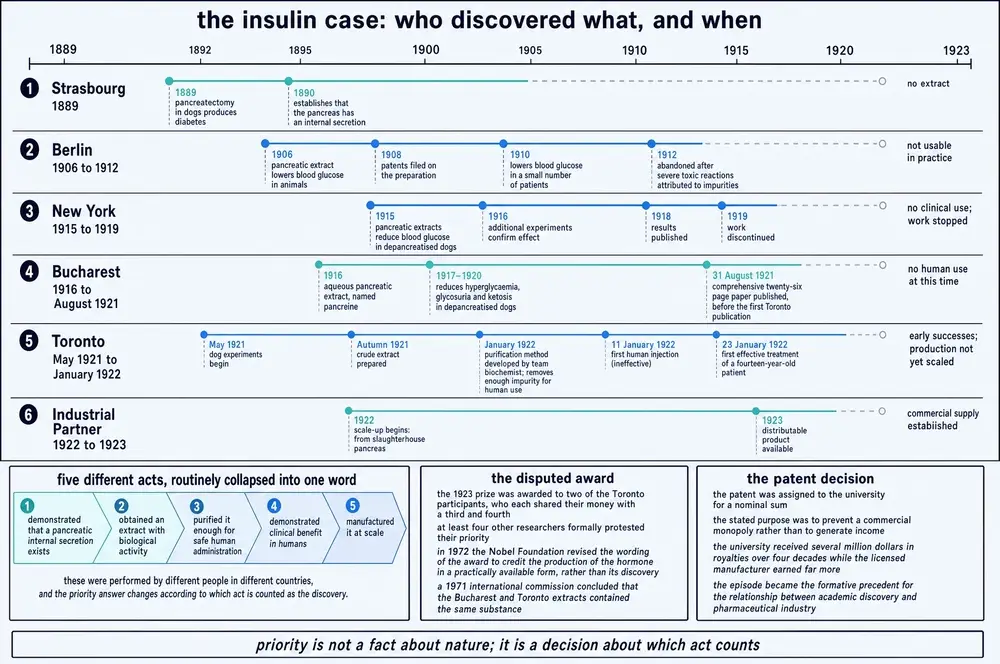
Start with what was already established. In 1889 Oskar Minkowski and Joseph von Mering removed a dog's pancreas and it became diabetic, which localised the disease to that organ; the full report followed in 1890. Over the next thirty years at least five investigators pursued a pancreatic extract, and several got it. Georg Zuelzer in Berlin produced a preparation he called Acomatol between 1906 and 1914, patented it, and treated eight patients — including a boy who improved and then deteriorated when the supply failed. Ernest Scott in 1911–12 obtained an extract that lowered blood sugar and had his conclusion reversed by his own supervisor. Israel Kleiner published clear work in 1919. Nicolae Paulescu in Bucharest published in 1921, before the Toronto work, a pancreatic extract he called pancreine that demonstrably lowered blood glucose in diabetic dogs, with control experiments.
Every one of these preparations was too toxic to use. That is the whole problem, and it is what the Toronto group solved.
Frederick Banting's idea was that the pancreas's digestive enzymes were destroying the internal secretion during extraction, and that ligating the pancreatic duct to make the enzyme-producing tissue atrophy would allow it to be recovered. The hypothesis was wrong. It was abandoned in stages over the following year, as the group found that ordinary whole-pancreas extraction with acidified alcohol worked at least as well — and the historical assessment of the work is that they did not entirely notice they had abandoned it. Banting and Best also did not read the prior literature; their first paper's review of it contains a mistranslation of Paulescu that reverses his result.
What gave Toronto the edge was not the hypothesis. It was James Bertram Collip. Brought in at the end of 1921, Collip developed the alcohol-fractionation purification that removed the toxic material, and that is the step which converted a substance into a medicine.
On 11 January 1922, fourteen-year-old Leonard Thompson received an injection of Banting and Best's extract. It produced only a slight fall in blood glucose and a sterile abscess at the injection site. It was not a success and was not continued.
On 23 January 1922 he was injected again, with material prepared by Collip. Blood glucose fell sharply, ketones cleared, and he improved clinically. That is the injection the anniversaries commemorate, and the twelve days between the two are the difference between a pancreatic extract and insulin.
The 1923 Nobel Prize in Physiology or Medicine went to Banting and John Macleod. Banting was furious that Macleod was included and Best was not, and announced he would share his half with Best; Macleod then shared his with Collip. Paulescu protested to the Nobel Institute and received a reply. The prize was awarded a year after the first successful treatment, which is extraordinarily fast, and the speed is part of why the attribution was contested.
US Patent 1,469,994 was executed on 19 December 1922, filed on 12 January 1923 and granted on 9 October 1923, assigned to the Governors of the University of Toronto. Two things in it are not in the popular account.
First, it is a substitution in part of an earlier application filed on 22 May 1922 in the names of Collip and Best only. Banting is not on the original insulin patent application. That is consistent with the patentable step having been the purification, and with Banting's recorded objection to patenting at all.
Second, the specification concedes the predecessors explicitly. It states
that previous investigators had suggested the islets contained a hormone
capable of alleviating diabetic symptoms and had given extracts to patients and
animals, that the results did not justify continued use because of the
presence in the extracts of toxic substances
, and that no definite progress
was made toward a preparation pure enough to be safely administered until
these experiments were continued by us
.
This is the Toronto group, in 1922, in a legal instrument that must distinguish itself from prior art, signed by all three men, asserting exactly the position modern historiography defends: the predecessors had the substance; Toronto had the purification. It is stronger evidence than any historian's summary because of the adversarial context in which it was written.
The "sold for a dollar" story concerns a separate assignment instrument that was not retrieved; the patent itself is silent on consideration, and sources differ between one dollar in total and one dollar to each of three men. The date 23 January 1923, widely printed for the assignment, appears to be a confusion with Leonard Thompson's successful injection exactly one year earlier. Even the word is borrowed: insuline was proposed by de Meyer in 1909 and insulin by Sharpey-Schafer in 1916, both for a hypothetical substance neither possessed. Toronto adopted an existing name for a thing it had made real.
The defensible modern position is not a compromise but a distinction, and it is the same distinction this document draws throughout: Paulescu and others demonstrated the hormone; Toronto produced the medicine. Discovery, isolation, purification and clinical application are four events, and the last one is what changed the world in 1922. It is also the one for which the popular account credits the wrong person.
10The unit, and manufacture as a scientific problem
Insulin created a problem that had never existed before: a peptide had to be manufactured, at scale, to a consistent strength, for patients who would die without it. Nothing about the substance could be measured chemically. Its potency was defined by what it did to a rabbit.
The solution was the one described in section 08 — fix the biology by decree, against a physical reference preparation — and insulin is where it became urgent rather than academic. The League of Nations Health Organisation's standards commission approved a definition of the insulin unit at Edinburgh in July 1923, with the definitive volume published in 1926.
Most accounts give 1925 for the insulin standard. That date could not be sourced at first hand, and the Edinburgh 1923 approval could; the discrepancy is recorded rather than resolved.
The thread does not stop. The modern international unit of insulin is still defined by mass of a reference material — one unit is 0.03846 milligrams of the international standard — and several peptide medicines are still dosed in units traceable by an unbroken chain of comparisons to a sealed ampoule rather than to a molecular formula. A convention invented because nobody could measure a hormone survives in a pharmacy that can measure it to four decimal places.
11The colloid century, and a theory that had to be beaten
In 1902, at the meeting of German naturalists and physicians at Karlsbad, two men independently proposed that proteins are chains of amino acids joined by amide bonds. Emil Fischer is universally credited; Franz Hofmeister presented the same model at the same meeting, and the simultaneity is real. A prior claim also exists: Grimaux had proposed amide linkages in proteins in 1882, twenty years earlier.
It is essential to see that this was not obviously right, because the standard telling makes the alternative look foolish. It was not. The competing view held that proteins were colloids — aggregates of smaller units held together by forces other than covalent bonds, without definite composition or molecular weight. This was a serious position held by serious people for defensible reasons: protein solutions behave unlike solutions of small molecules, proteins denature under conditions that break no covalent bond, and no method then existing could measure the molecular weight of anything that large.
The most striking evidence that the polypeptide theory was not self-evident is that Fischer himself did not believe proteins were very large molecules. He worked at the scale he could reach, and thought natural proteins were chains of a few dozen residues at most.
The colloid view lost to instruments rather than to argument. Theodor Svedberg's ultracentrifuge, developed as a programme running to about 1930 rather than in one 1926 paper, sedimented proteins as species of definite and reproducible molecular weight. A colloid does not do that. Svedberg himself drew a wrong conclusion from his own data — he believed protein molecular weights were multiples of a common unit — and his 1926 Nobel Prize was not for the protein work at all.
12The alphabet, completed in 1935
Meanwhile the inventory of parts was still incomplete, and it took much longer than the story usually implies.
Asparagine was isolated from asparagus juice in 1806. Glycine came from gelatin in 1820, tyrosine from casein in 1846, tryptophan from a tryptic digest in 1901, methionine from casein in 1922. The last of the twenty was threonine, isolated from fibrin by McCoy, Meyer and Rose and published in 1935.
The comparison in that figure is the argument of the whole Part. The last letter of the alphabet was identified ten years before Sanger began and twenty years before the first protein was read. The 129 years produced the inventory; the 20 years produced the order; and the reason the second was so much faster is that the instruments arrived in between.
13Tswett, and a method neglected for thirty years
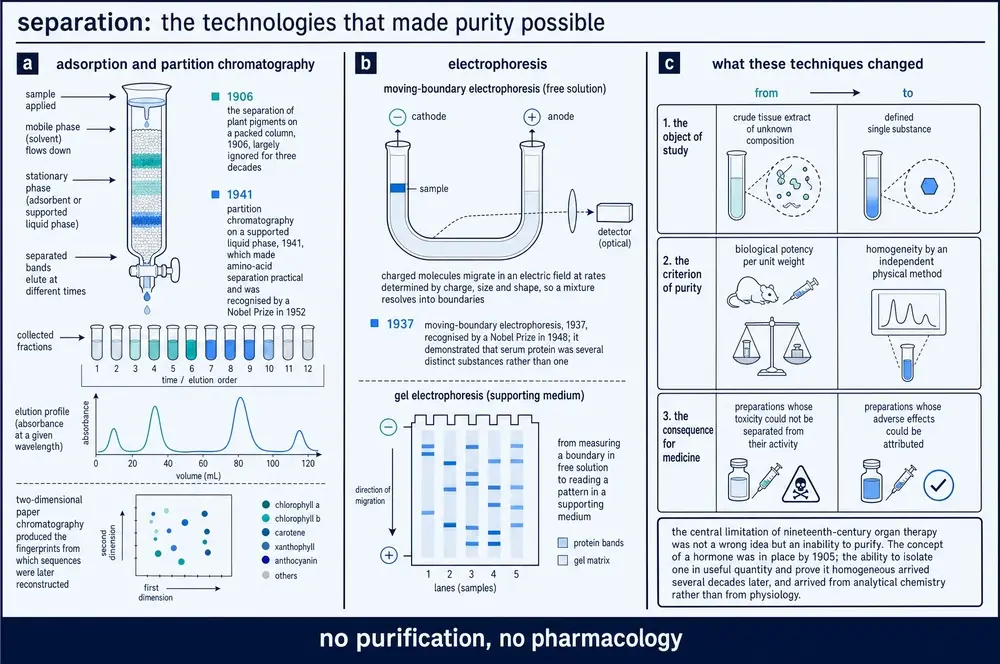
Chromatography was invented by Mikhail Tswett in 1906, who separated plant pigments on a column of powdered chalk. It was substantially neglected for decades. The usual explanation — that the work was ignored because it was published in Russian, or because a prominent chemist attacked it — is rejected by the principal peer-reviewed treatment of the question, and this document therefore reports the neglect as real and its cause as unsettled.
Archer Martin and Richard Synge reintroduced the idea with a theory in 1941, in the Biochemical Journal, describing what they called partition chromatography: separation by the differing tendency of solutes to distribute between two liquid phases, one held stationary on a support. In 1944, with Consden and Gordon, the method moved onto a sheet of filter paper, which made it cheap, two-dimensional and available to any laboratory. They shared the 1952 Nobel Prize in Chemistry equally.
This is the pivotal enabling technology of the entire field, and the reason is worth stating precisely. Before partition chromatography, a protein hydrolysate was a mixture of unknown composition; the constituents could be identified only by laborious isolation of each in turn, in quantities large enough to crystallise. After it, the same hydrolysate became a set of separated spots whose positions identified them and whose intensities quantified them, from a few milligrams of material. Every technique in the rest of this Part depends on it.
14The moving boundary, and the machine that counted amino acids
Arne Tiselius's moving-boundary electrophoresis apparatus, published in 1937, did for charge what chromatography did for partition. It resolved blood serum into albumin and three globulin fractions — and in 1939, with Elvin Kabat, identified antibody activity with the gamma fraction, which is the origin of the term gamma globulin. Tiselius took the 1948 Nobel Prize in Chemistry unshared; the citation covers adsorption analysis as well as electrophoresis.
Stanford Moore and William Stein — both trained in Bergmann's laboratory, as section 18 records — then attacked the quantitative problem. Their route ran through starch columns to ion-exchange chromatography on sulfonated polystyrene resins, with ninhydrin as a quantitative colour reaction, and in 1958 Darrel Spackman, Stein and Moore described an instrument that automated the whole sequence.
15Sanger's twelve years, and what a sequence proved
Frederick Sanger's problem in 1943 was that nobody knew whether a protein had a sequence. The live alternatives included that a protein was a statistical population of similar molecules rather than a single defined species. There was no way to tell.
His approach was to attack the ends. In 1945 he introduced 1-fluoro-2,4-dinitrobenzene, since called Sanger's reagent, which attaches a yellow dinitrophenyl group to a free amino group. Hydrolyse the labelled protein and the residue that had been at the N-terminus emerges still carrying its yellow label, identifiable by chromatography. Do this with insulin and you learn which residues are at the ends. Then hydrolyse the chain only partially, so it breaks into overlapping fragments; determine the end residue of each fragment; and reassemble the order from the overlaps, like reconstructing a sentence from torn strips of paper.
It took twelve years by his own reckoning, and part of that time was spent being wrong for a reason nobody could have avoided. The molecular weight of insulin was believed to be 12,000 for most of the work; the true value is about 6,000. At 12,000, finding two N-terminal phenylalanines and two N-terminal glycines implied four chains and a molecule built of two identical halves. At 6,000 it implies two chains. The interpretation of the data depended on a number supplied by a different technique, and that number was wrong by a factor of two.
The sequence was complete in 1955, disulfide bridges included, and Sanger took the 1958 Nobel Prize in Chemistry unshared. In his lecture he stated three distinct things that are usually collapsed into one, and they are worth separating.
The first is adjudication: the results, he said, supported only the
classical peptide hypothesis of Hofmeister and Fischer. The colloid question was
settled by a sequence. The second is definiteness: proteins are
definite chemical substances possessing a unique structure in which each
position in the chain is occupied by one and only one amino acid residue
— not a statistical population. The third is aperiodicity, and it is
the most interesting. There is no periodicity in the insulin sequence and no
principle determining the arrangement; the residues seem put together in a
random order, but nevertheless a unique and most significant order, since on it
must depend the important physiological action of the hormone
.
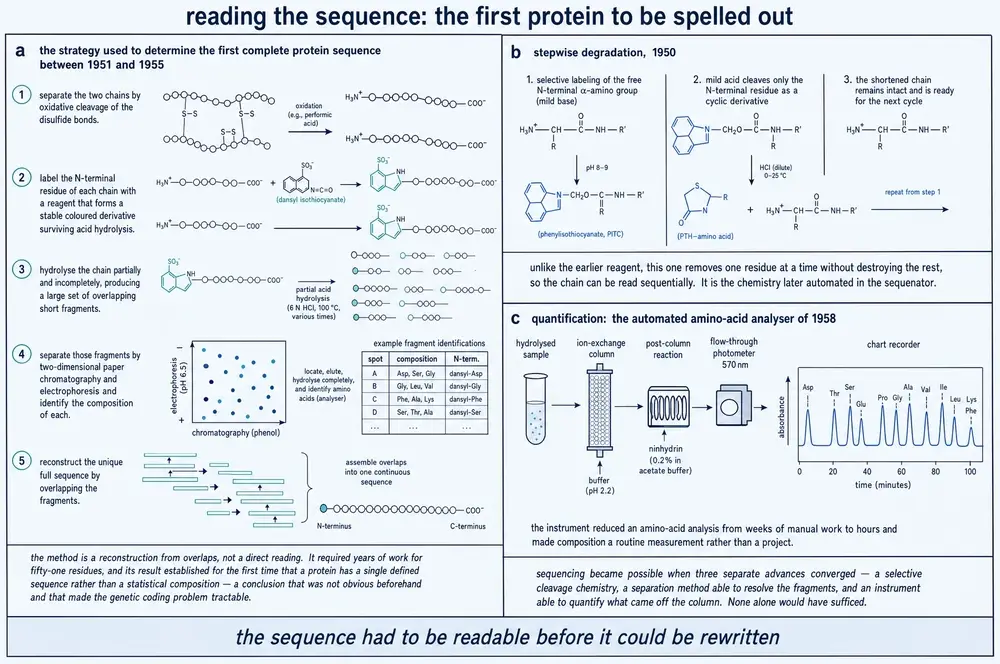
A sequence that is both arbitrary and exact is precisely what a coded message looks like. That is the conceptual payload, and it was established on a peptide hormone.
Sanger did not say the sequence was genetically determined, and this document does not attribute that claim to the insulin papers. The bridge was built by Vernon Ingram in 1956 and 1957, showing that sickle-cell haemoglobin differs from normal haemoglobin at a single residue. Sanger's insulin work also produced the first molecular-evolution result almost incidentally: comparing insulins across five species, the B chain was identical throughout and the only differences lay in three residues inside the A-chain ring.
16Edman, and sequencing as an industry
Sanger's method is brilliant and does not scale. Each round of partial hydrolysis destroys the protein, and the reassembly is a puzzle that grows combinatorially.
Pehr Edman's alternative, first published in 1949 in a paper of about three hundred words, is chemically less ingenious and operationally far superior. A reagent reacts with the N-terminal residue and, under acid, removes only that residue as a stable derivative, leaving the rest of the chain intact with a new N-terminus exposed. Identify the derivative, then repeat. The chain is read from one end, one residue at a time, without ever being destroyed.
Because it is a repeated cycle on an intact substrate, it can be mechanised — and in 1967 Edman and Begg described the sequenator, which did exactly that. This is the same structural insight as Merrifield's in section 20, arrived at independently and for the opposite operation: a repetitive cycle performed on a molecule that stays put is a cycle a machine can run.
Sequence, then shape, fourteen years later
One comparison closes this Part. Dorothy Hodgkin took the first X-ray photographs of insulin crystals in 1935. The sequence was known in 1955. The three-dimensional structure was not solved until 1969 — fourteen years after the sequence and thirty-four years after the first photograph. Her 1964 Nobel Prize — usually described as being for penicillin and vitamin B12, though its citation names neither — came five years before she solved insulin.
Knowing what a molecule is made of, knowing the order of its parts, and knowing its shape are three different achievements requiring three different instruments, and they arrived decades apart. That gap is the subject of section 28, and the fact that a peptide's shape was the last thing to become visible is why Part Five's engineering problem took so long to become tractable.
17Fischer's glycylglycine, and four problems
In 1901 Emil Fischer and Ernest Fourneau joined two glycine molecules together and reported the result to the Berichte der deutschen chemischen Gesellschaft (Fischer & Fourneau, 1901). Glycylglycine is the smallest thing that can be called a peptide, and making it took the best organic chemist of the age. The following year, at the meeting of German naturalists and physicians at Karlsbad, Fischer proposed that proteins are chains of amino acids joined by exactly this linkage, and gave the class of compounds its name. By 1907 he had run the chain out to eighteen residues.
That eighteen-residue molecule is worth looking at closely, because it shows what the method could and could not do. It is L‑leucyl‑triglycyl‑L‑leucyl‑triglycyl‑L‑leucyl‑octaglycyl‑glycine: three leucines and fifteen glycines, molecular weight 1213. It contains two distinct amino acids. A protein contains twenty, in an order that matters, and Fischer had no way to control that order at any useful length. He had demonstrated that the bond was formable and that chains could be built. He had not demonstrated that a specific chain could be built.
Four obstacles stood between those two statements, and they defined peptide chemistry for the following sixty years.
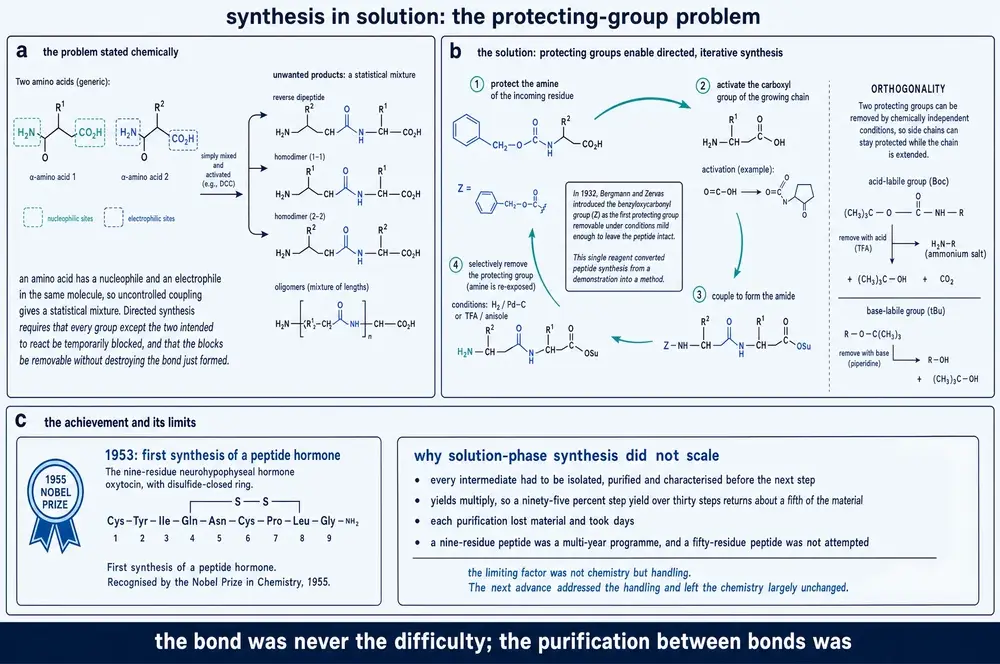
The first is protection. An amino acid has an amine at one end and a carboxyl at the other, and both are reactive. Put two amino acids in a flask with a coupling agent and they will join in both orientations, join to themselves, and polymerise. To make a specific bond you must first render every other reactive group inert, and then be able to restore it afterwards without destroying what you have built.
The second is activation. The amide bond does not form spontaneously under mild conditions; the carboxyl has to be converted into something more reactive. Every method of doing that carries side reactions, and the side reactions accumulate.
The third is racemisation. Nineteen of the twenty amino acids are chiral, and activation chemistry has a persistent tendency to scramble the stereocentre adjacent to the activated carbon. A racemised residue is not an impurity that can be washed out; it is a diastereomer of the target, nearly identical in every physical property, and it is biologically inert or worse.
The fourth is the one that is rarely named as an obstacle at all, because it is not a chemical problem but an arithmetic one, and it is the subject of section 21.
18Bergmann and Zervas, 1932, and a laboratory dispersed
The protection problem was solved — not completely, but usefully — in a single paper. In 1932 Max Bergmann and Leonidas Zervas, working at the Kaiser Wilhelm Institute for Leather Research in Dresden, described the carbobenzoxy group (Bergmann & Zervas, 1932). A benzyl carbamate is stable to the conditions of peptide coupling and is removed cleanly by catalytic hydrogenation or by sodium in liquid ammonia, neither of which touches the amide bonds already made. For the first time an amine could be masked and then reliably unmasked.
The group is benzyloxycarbonyl, abbreviated Z after Zervas. It is frequently rendered "benzoyloxycarbonyl" — including, during the preparation of this document, in a chemistry magazine published by a national chemical society, in the same sentence that correctly gives the year, both names and the deprotection conditions.
The error is worth recording because it is characteristic. The secondary literature of this period propagates small errors freely, and they are almost always in the details a reader is least likely to check. Section 21 contains a more consequential example.
The institutional context is part of the history and is not decoration. In April 1933 the German government enacted the Law for the Restoration of the Professional Civil Service, and Bergmann, who was Jewish, was removed from the directorship he had held since 1922. He went to the Rockefeller Institute for Medical Research in New York, where he remained until his death in 1944, and where his laboratory trained Stanford Moore, William Stein, Joseph Fruton and Klaus Hofmann. Moore and Stein appear again in section 14; the automated amino-acid analyser is a direct descendant of a laboratory that existed in New York because a government in Dresden had made its director's position untenable.
Zervas's position is different and is worth stating precisely, because the two men are often described together as though displaced by the same events. He was Greek and was not subject to the racial laws. He had been vice-director since 1929, briefly succeeded Bergmann as director, followed him to the Rockefeller Institute as a lecturer from 1934 to 1937, and then returned to Greece, holding chairs at Thessaloniki and then Athens from 1939. That is an ordinary academic progression, not an expulsion.
Sources disagree on whether Bergmann left in 1933 or 1934. The peer-reviewed historical assessment of this period gives 1934; the biographical reference works give 1933; one gives 1933 for the arrival and "until 1934" for the directorship. The defensible statement is that he was removed under the April 1933 law and took up the Rockefeller position in 1933 or 1934, and this document does not resolve it further.
19du Vigneaud: oxytocin, and synthesis as proof
Twenty-one years after Bergmann and Zervas, Vincent du Vigneaud's laboratory at Cornell published the structure of oxytocin and then made it. The two events are separable and the order matters.
In October 1953 the group published a communication in the Journal of the American Chemical Society reporting the synthesis of an octapeptide amide with the hormonal activity of oxytocin (du Vigneaud et al., 1953b); on the facing pages of the same issue, a second communication proposed a structure for vasopressin (du Vigneaud, Lawler & Popenoe, 1953). The oxytocin sequence paper followed in December in the Journal of Biological Chemistry (du Vigneaud, Ressler & Trippett, 1953a), and the full synthesis paper in June 1954 (du Vigneaud et al., 1954) — the last of a run of four papers from the group in one issue, which is what a completed campaign looks like when it is published deliberately.
The methodological idea in these papers is more important than the molecule.
Du Vigneaud stated it plainly in his Nobel lecture: the structure they had
arrived at was the only one consistent with their data, but we felt that
synthetic proof of this structure was mandatory because of certain assumptions
involved in postulating it.
Because a proposed structure rests on
assumptions, the way to test it is to build the molecule the structure describes
and see whether it behaves like the natural material. The synthetic flavianate
crystallised in the same silky needles with the same melting point as the
natural one; ultracentrifuge studies could not tell them apart; and the
synthetic product was, in his words, fully effective in stimulating
labor
.
He was candid about the difficulty: the target was an octapeptide of eight
different amino acids, one of them being cystine
, carrying three amide
groups, and cyclic — a cyclic pentapeptide with a tripeptide side
chain
— for which no known synthetic methods were available
.
The 1955 Nobel Prize in Chemistry went to du Vigneaud alone, prize share 1/1,
for his work on biochemically important sulphur compounds, especially for the
first synthesis of a polypeptide hormone
.
Hans Tuppy, working in Vienna, published a proposed amino-acid sequence for oxytocin in Biochimica et Biophysica Acta in July 1953 (Tuppy, 1953), followed by a fuller structural paper with Herbert Michl in Monatshefte für Chemie. On the printed record that is roughly five months before du Vigneaud's sequence paper appeared.
This is not a suppressed claim, and du Vigneaud did not suppress it. He
named Tuppy in the Nobel lecture, said Tuppy had reached the same structure
independently using the Cornell group's compositional data together with his
own partial-hydrolysis and enzymatic work, and described the reasoning in the
two laboratories as quite parallel
. What the record supports is that
Cornell did most of the compositional groundwork, that Tuppy published a
structure first, and that Cornell then did the thing Tuppy did not do. The
Nobel citation rewards the synthesis, not the sequence, and read that way there
is no contradiction at all — only a more interesting story than the one
usually told.
One caveat is load-bearing and is stated rather than glossed: the received dates of both papers could not be obtained from any accessible record. Since the two are only months apart, the ordering given here is an ordering in print, not in submission.
A second common framing is simply wrong. Boissonnas and colleagues at Sandoz
published an oxytocin synthesis in Helvetica Chimica Acta in 1955, and it
is sometimes presented as a competing claim. Its own title settles the question:
Une nouvelle synthèse de l'ocytocine
— a new synthesis,
two years after du Vigneaud's. It is an independent improved route, which is a
real contribution and a different one.
20Merrifield's inversion, 1963
Solution-phase peptide synthesis works like this. Couple two protected amino acids. Purify the product away from unreacted starting material, coupling reagent, and by-products — typically by crystallisation or column chromatography, losing material at each step. Deprotect. Purify again. Couple the third residue. Purify. Repeat.
The purification is the expensive part, and it gets harder as the chain grows, because the impurity most difficult to remove is the chain that failed to react at the last step — a molecule differing from the target by one residue in perhaps thirty, with nearly identical solubility and chromatographic behaviour. Merrifield's own account of what prompted him is the most direct statement of the problem available: he had spent eleven months preparing a pentapeptide, in seven per cent yield.
The idea he recorded in his notebook on 26 May 1959, and described as
a new approach to the continuous, stepwise synthesis of proteins
, inverts
the arrangement. Anchor the first residue to an insoluble polymer bead by its
carboxyl end. Everything subsequently added to the growing chain is attached to
that bead. Everything not attached to the bead — excess reagent,
by-product, solvent — can be removed by pouring it away and washing.
Purification, the step that dominated the cost, becomes filtration.
The consequence is not a better yield per step. It is that the operator can now afford to drive each step to completion with a large excess of reagent, because removing the excess is free. Solid-phase synthesis buys coupling efficiency with reagent, and reagent is cheap where chromatography is not.
Merrifield presented the work at the Federation meeting in the spring of 1962 and published it in 1963 as the synthesis of a tetrapeptide, L‑leucyl‑L‑alanylglycyl‑L‑valine (Merrifield, 1963). Because the operations are repetitive and the vessel never changes, the method is mechanisable, and within two years he and John Stewart had built a machine to do it (Merrifield & Stewart, 1965), described in full the following year (Merrifield, Stewart & Jernberg, 1966).
The reception was hostile, and the hostility is documented rather than
folkloric. Joseph Fruton, then the dominant figure in the field, is reported to
have told the 1962 meeting that this is not the way to synthesize
peptides
. A referee of the 1963 paper called it a travestry, …not
chemistry at all, a concept which should be suppressed by the community
.
Merrifield's first graduate student later described the early reception as
"vehement and vitriolic".
Both quotations reach this document through a peer-reviewed historical assessment rather than from a contemporary printed source, and the Fruton remark in particular is an oral recollection recorded in 1991 about an event in 1962. They are reported here as what the historical literature records, which is a weaker claim than what was said.
The objection was not stupid. Synthetic chemists had spent a century learning that you characterise an intermediate before you build on it, and Merrifield was proposing to run a hundred reactions without isolating anything. The answer to that objection is arithmetic, and it is the subject of the next section.
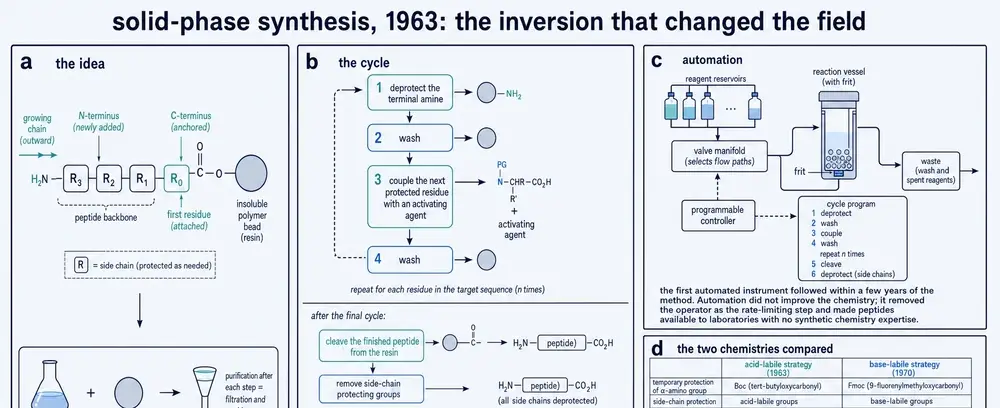
This plate has been cropped. Its fourth panel, a chart of overall yield against cycle number, is withheld: it labels two different curves “99.0 per cent per step”, plots its 99.5 per cent curve below its 99.0 per cent curve, which is impossible, and labels 95 per cent against a value of 0.77 per cent while its own adjacent text panel correctly states that 95 per cent returns about eight. It contradicts itself, and Figure 12 carries that relationship computed exactly. See the mapping register.
21Boc, Fmoc, and the arithmetic that decides everything
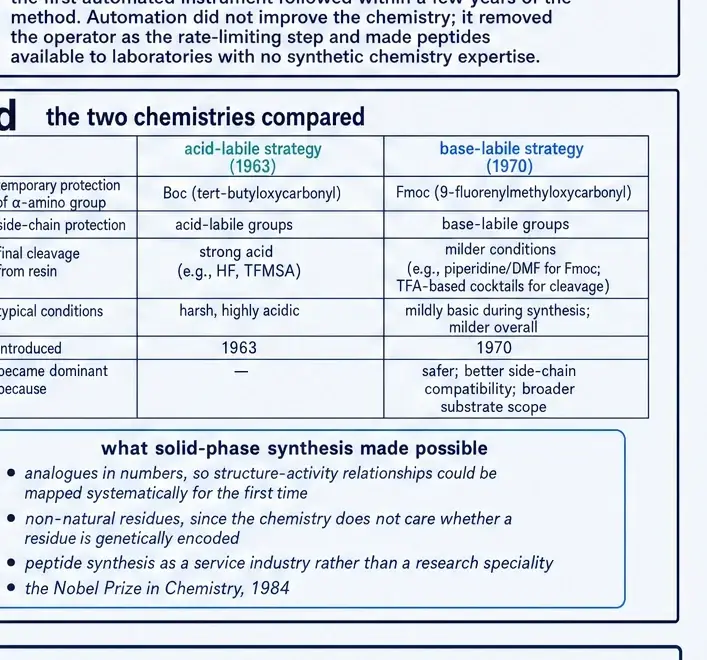
Solid-phase synthesis needs a protecting-group scheme with a specific property. The group protecting the growing chain's amine must come off at every cycle; the groups protecting the amino-acid side chains, and the linkage to the resin, must survive every cycle and come off only at the end. Two chemistries that can be selected between independently are called orthogonal, and orthogonality is what makes a repeated cycle safe.
The first practical scheme used tert-butyloxycarbonyl, Boc, removed with trifluoroacetic acid at every cycle, with benzyl-based side-chain protection removed at the end with anhydrous hydrogen fluoride. It works, and almost all of the early achievements of the method were made with it. But the two chemistries are both acid-labile and differ only in degree, so each cycle's acid treatment removes a little side-chain protection and detaches a little peptide from the resin. The scheme is not orthogonal; it is merely graded.
The Boc group is routinely credited to a 1957 paper by Carpino at JACS 79:98–101. That paper is about isophthalimides. Its title is "Oxidative Reactions of Hydrazines. II. Isophthalimides. New Protective Groups on Nitrogen", and it describes a different protecting group entirely.
Boc emerged from three independent 1957 reports in the same journal and the same volume, none of which is that one. Carpino's relevant paper is at 79:4427; McKay and Albertson's "New Amine-masking Groups for Peptide Synthesis" is at 79:4686 and is the first to propose tert-butyl carbamates for this purpose explicitly; and Anderson and McGregor's "t-Butyloxycarbonylamino Acids and Their Use in Peptide Synthesis" is at 79:6180 and is the one that delivered usable building blocks. The third is the one most often dropped.
The group had no single inventor, and the standard citation for it points at the wrong molecule.
Genuine orthogonality arrived with the fluorenylmethoxycarbonyl group, Fmoc, described by Louis Carpino and Grace Han in 1970 and in full in 1972 (Carpino & Han, 1972). Fmoc is removed by base — piperidine — while side-chain protection and the resin linkage are acid-labile. Base and acid are genuinely independent, so the cycle no longer erodes the thing it is building. Robert Sheppard's group at Cambridge applied it to solid-phase synthesis in 1978, in two back-to-back communications in one issue of Chemical Communications (Atherton et al., 1978).
Fmoc took most of a decade to displace Boc, and the reasons usually given for the delay are plausible and, as far as this document could establish, unsourced. What is documented is why it eventually won: it removed the need for anhydrous hydrogen fluoride, which requires specialised apparatus and is extremely hazardous; the cleavage releases a fluorene group with a strong ultraviolet absorbance, which gives a free per-cycle readout of whether the step worked; and both properties together made the method usable by biologists on inexpensive machines rather than only by specialist chemists. The chronology is reported here; the causal story is not asserted.
All of which matters because of one identity. The overall yield of a stepwise synthesis is the per-step efficiency raised to the power of the number of couplings. Nothing else enters into it.
This is why the length of a target peptide is not a detail, and why the objection that solid-phase synthesis could not work was reasonable in 1963. What the critics could not see, because it had not yet been demonstrated, was that anchoring the chain would let the per-step figure be driven up rather than merely measured. The curve does not change; the position on it does, and at thirty-eight couplings the distance between its bottom line and its top is 1.8 per cent against 96.3.
22Ribonuclease, and what the method could not yet do
In January 1969 Bernd Gutte and Merrifield reported the total synthesis of a 124-residue polypeptide with ribonuclease A activity (Gutte & Merrifield, 1969), described in full two years later (Gutte & Merrifield, 1971). The 1971 paper reports a purified synthetic material with a specific activity of 78 per cent of the natural enzyme, indistinguishable from it by gel filtration, ion-exchange chromatography and electrophoresis. An enzyme had been made from amino acids.
In the same issue of the same journal, on the immediately following pages, a group at Merck led by Ralph Hirschmann and Robert Denkewalter published a five-part series reporting a synthesis of their own, by classical solution-phase fragment condensation. The two teams did not make the same molecule, and accounts that say both synthesised ribonuclease are imprecise: Merck's parts II and III build residues 21–64 and 65–124 — the S-protein — and part IV converts it to ribonuclease S′. Merrifield's group made the full 124-residue A chain. Two laboratories using opposite methods arrived at the same problem in the same month, and the journal printed them back to back.
The obvious reading is that 1969 vindicated solid-phase synthesis. The
documented reading is close to the opposite: it exposed it. The
peer-reviewed historical assessment of the method's development states that by
the early 1970s it had become apparent that the ribonuclease synthesis
could not be generalized
, and that consequently virtually every aspect
of the technique was re-examined and improved through that decade —
amino-acid insertion, Nα-trifluoroacetylation, N-alkylation, cleavage
conditions, and the dependence of coupling efficiency on chain length.
Erich Wünsch, who had synthesised the 29-residue glucagon in solution, published a review in 1971 concluding that solid-phase synthesis exhibited "inborn defects" and was unsuitable for peptides of more than fifteen residues. He wrote that two years after Gutte and Merrifield had run the method to 124. He was wrong about the ceiling and right about the defects, and both halves of that judgement were reasonable on the evidence then available.
Several numbers commonly attached to this synthesis could not be verified and are therefore not printed here: the frequently quoted figures of 369 reactions and 11,931 machine steps appear only in a secondary source; the elapsed time and overall yield could not be obtained from any source; and a widely repeated activity figure of 13–24 per cent sits in unexplained tension with the 78 per cent the 1971 paper's own abstract reports. A statistical objection to the method, usually rendered as 0.99100 ≈ 37 per cent, is attributed in modern teaching to contemporary critics; no source attributing it to any named contemporary was located, and it may be a later reconstruction.
The 1984 Nobel Prize in Chemistry went to Merrifield alone, prize share 1/1,
for his development of methodology for chemical synthesis on a solid
matrix
. The citation is worth reading carefully: it says solid matrix,
not solid phase, and it does not say peptide.
That omission was deliberate and correct, because the idea had already escaped its origin. Robert Letsinger published the first application of a polymer support to oligonucleotide synthesis in 1965, two years after Merrifield's paper — and his first general solid-support paper appeared in October 1963, five issues after Merrifield's in the same volume of the same journal. He followed rather than paralleled, and the tightness of the spacing is itself the evidence of how fast the idea propagated. Marvin Caruthers' phosphoramidite chemistry in 1981 made the nucleotide version efficient enough to automate, and the historical assessment of the peptide method records the consequence: a 21-base-pair DNA duplex that had taken the equivalent of four years of skilled effort became a day's work.
Automated DNA synthesis is a precondition for site-directed mutagenesis, for the polymerase chain reaction, for sequencing, and for the recombinant manufacturing described in section 29. A technique invented to make peptides is upstream of a great deal of molecular biology that has nothing to do with peptides at all.
23A useful fiction: Langley, Ehrlich, Clark
Everything so far has been about the messenger. The other half of the problem — what receives it — ran on a separate track for most of a century, and for nearly all of that time its central object had no demonstrated physical existence at all.
John Newport Langley started from an experiment rather than a theory. In 1878 he studied the mutual antagonism of atropine and pilocarpine on salivary secretion and observed that the two drugs appeared to compete for the same something. In 1905 he named it: a receptive substance, distinct from the contractile machinery of the cell, on which a drug acts. The distinction is sharper than it looks. Langley was separating the thing that recognises a chemical from the thing that responds, which is the founding move of receptor pharmacology and is why the better claim to the concept is usually his rather than Paul Ehrlich's.
Ehrlich arrived at something similar from immunology, with the side-chain theory from 1897, and left the field its motto: corpora non agunt nisi fixata — substances do not act unless bound. The two men's ideas are often merged; they were not the same idea, and Langley's was closer to what the word came to mean.
A.J. Clark then made it quantitative in the 1920s and 1930s by doing something that had not been done before: applying the mass-action law of ordinary solution chemistry to a drug and a tissue. If a drug binds reversibly to a fixed number of sites, the fraction occupied at equilibrium follows a specific curve; if response is proportional to occupancy, the dose-response relation should have that shape. It does. Quantitative pharmacology begins there.
From Langley's 1905 paper to the binding experiments of 1973, the receptor was a construct inferred entirely from responses. Nobody had isolated one, purified one, weighed one or counted them. The entire quantitative apparatus — occupancy, affinity, antagonism, the shapes of dose-response curves — was built on a thing whose existence was an inference from the behaviour of tissues.
This was not lost on the people doing it. Raymond Ahlquist, whose 1948 paper
divided adrenergic responses into alpha and beta types and is one of the
founding documents of modern receptor classification, described adrenotropic
receptors in that paper as those hypothetical structures
affected by epinephrine. The scare-word is his own, in the work that made the
classification stick.
His classification was also not accepted quickly. Eleven years later a major review was still weighing his alpha/beta scheme against a competing excitatory/inhibitory one. A framework that now looks self-evident took over a decade to displace its rival, and its author called its central object hypothetical.
It is worth being clear about what kind of situation this is, because it is not a failure. A theoretical entity that organises a large body of quantitative data, predicts new results, and cannot be observed is a perfectly respectable scientific object; physics is full of them. But it is a different epistemic condition from having the thing in a tube, and the transition between the two conditions is what section 26 describes.
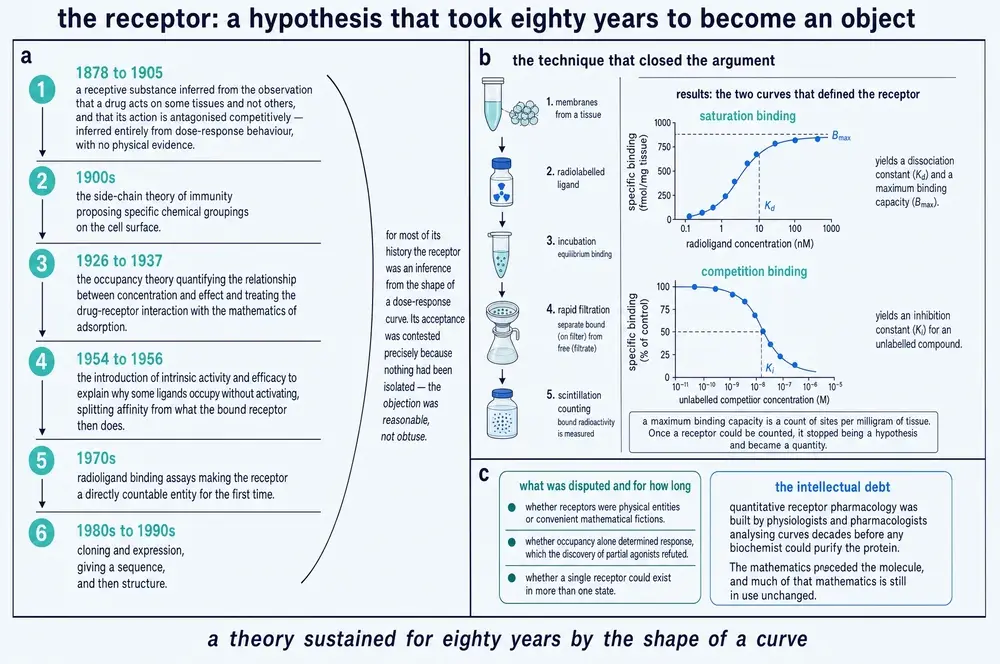
What made the transition possible was not a new idea about receptors. It was that somebody worked out how to measure very small quantities of a labelled molecule, which is section 24, and that is why this Part puts the assay before the object.
24Yalow and Berson: measurement in picograms
In 1956 Solomon Berson and Rosalyn Yalow published an observation about diabetic patients that nobody had asked for. Patients treated with animal insulin developed something in their blood that bound insulin, and the binding material behaved like an antibody (Berson et al., 1956). This was not supposed to be possible. Insulin was regarded as too small to provoke an immune response, and the immunologists of the period said so.
The paper was rejected by Science and then by the Journal of
Clinical Investigation, and Yalow described what happened next in her Nobel
lecture: A compromise with the editors eventually resulted in acceptance of
the paper, but only after we omitted "insulin antibody" from the title and
documented our conclusion that the binding globulin was indeed an antibody by
showing how it met the definition of antibody given in a standard textbook of
bacteriology and immunity.
The story is usually told as the editors making them delete the word "antibody". Yalow's own account says the phrase removed was insulin antibody, and the published title reads "insulin binding globulin". A later account by two JCI editors states that the substitution was for "insulin transporting antibody"; that wording for the original could not be checked against the submitted manuscript. The rejection letter itself is reproduced in both Yalow's lecture and that account as a photograph, and its full text could not be read from either; the passages quoted about it in the historical literature are transcriptions at one remove.
Then Berson and Yalow did the thing that turned an awkward finding into an instrument. If an antibody binds insulin, and if you have insulin labelled with radioactive iodine, then unlabelled insulin in a sample will compete with the labelled insulin for a fixed, limited quantity of antibody. Measure how much radioactivity ends up bound, and you have measured how much unlabelled insulin was present — because the two are related by nothing more complicated than competition for a scarce resource. The immune system's specificity supplies the selectivity; the radioisotope supplies the sensitivity; and the assay reads out a concentration rather than a physiological effect.
They reported the method for plasma insulin in 1959 (Yalow & Berson, 1959) and in full in 1960 (Yalow & Berson, 1960).
What this did to endocrinology is difficult to overstate, and it is the reason radioimmunoassay belongs in a history of peptides rather than a history of immunology. Before it, a hormone was known by what it did. After it, a hormone was a number, measurable in a millilitre of a patient's blood, repeatedly, in hundreds of samples a week. Every question of the form how much, in whom, when, and in response to what became askable at once.
The contrast is often compressed into a slogan — that assays went from micrograms to picograms. That version does not survive checking, and it is not used here. Some contemporary bioassays were sensitive: Schally's own account reports one detecting ten picograms in 1966. What radioimmunoassay changed, and what the sources actually support, is the combination of sensitivity with throughput, small sample volume, and chemical specificity — a hundred samples in a day, from a few microlitres each, distinguishing one peptide from its near neighbours. A bioassay that can detect ten picograms is still an animal, and you cannot run five hundred of them a week.
The 1977 Nobel Prize in Physiology or Medicine was divided: one half jointly
to Roger Guillemin and Andrew Schally, one half to Yalow, for the development
of radioimmunoassays of peptide hormones
. Berson had died in April 1972,
while attending a meeting in Atlantic City. Yalow used the third paragraph of
her lecture on him: together we gave birth to and nurtured through its
infancy radioimmunoassay… Would that he were here to share this
moment.
The committee named him from the podium as well, calling the method
the Yalow–Berson method.
Berson's exclusion is usually explained by a Nobel rule against posthumous awards. That explanation is anachronistic as stated: the statutory bar dates from 1974, two years after his death, and before then posthumous awards had been made twice. He was ineligible in 1977 under the statute then in force, and would not in practice have been considered regardless; but the rule did not exist when he died.
A priority question here is real, and it has never been settled because it is not really a question about dates.
Roger Ekins, at the Middlesex Hospital in London, published a method for measuring thyroxine in 1960 (Ekins, 1960). It works on the same principle — a labelled analyte competing with the unlabelled one for a limited quantity of a specific binder — but his binder was not an antibody. It was thyroxine-binding globulin, a natural plasma protein, with albumin as the comparator. He called the general method saturation analysis, and his own schematic of it explicitly lists antibodies among the binding agents it can use.
The chronology is not seriously in dispute and does not favour him. Yalow and Berson's Nature note appeared on 21 November 1959, roughly eight months before Ekins's paper; their full Journal of Clinical Investigation paper and his are effectively simultaneous, both in July 1960. Ekins dated his own conception to 1954 and reported presenting the idea in 1959 — but that presentation was to his own medical school's research society, no abstract of it was published, and the account of it comes from a memoir he wrote thirty-nine years later. He never claimed publication priority, writing only that the two publications "essentially coincided".
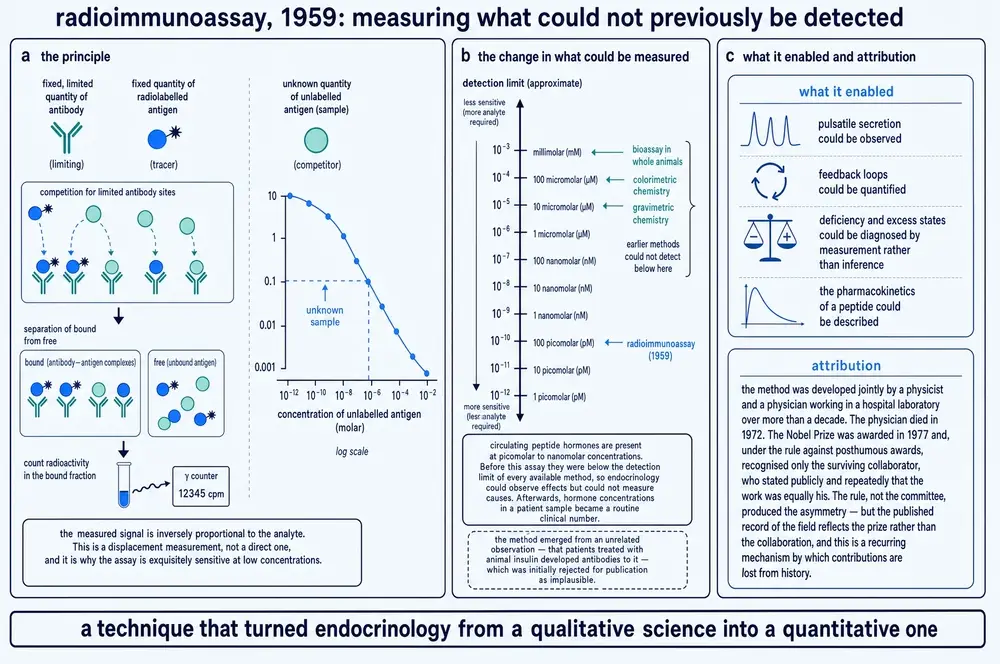
What the dispute is actually about is what the invention is. Yalow
addressed Ekins in her Nobel lecture, twice, and the framing is precise: the
radioimmunoassay principle, she said, is not limited to immune systems but can
be extended to others in which a specific binding substance stands in
place of the antibody — and Ekins is named as having done that with
thyroxine-binding globulin. Ekins's reply, published in 1998, is the mirror
image: saturation analysis was conceived from the outset as general, antibodies
were one obvious case of it, and the insulin assay had been, in his words, a
fortuitous by-product of studies on the immunogenicity of insulin
where
his own work was an explicit quest for a general microanalytical
method
.
Each framing makes the other party's contribution a special case of one's own. There is no fact that decides between them, because the disagreement is about how to individuate an invention, and this document does not pretend to resolve it. Three things are worth recording. Ekins's assay contained no antibody, so it is not a radioimmunoassay in the ordinary sense of the word. His own later hormone assays adopted the antibody method. And his published grievance was mostly not about the prize at all — the bulk of that 1998 paper argues that Berson and Yalow's definition of assay sensitivity was wrong, a technical complaint he pressed for decades and which his Royal Society memoirist judges was his real and lasting irritation.
The distribution of opinion is itself a finding. British sources describe Ekins as an independent co-originator; American and international sources either place him as an extender of the principle or do not mention him at all — a much-cited account of the Berson and Yalow rejection story in the journal that rejected them does not name him once. There is no source that argues against Ekins. The disagreement is between assertion and silence, which is a characteristic shape for a priority dispute that is really a dispute about definitions.
25Five million brains
By 1960 there was a hypothesis with no visible object. Geoffrey Harris had argued that the anterior pituitary was controlled by substances secreted from the hypothalamus and carried down a short portal circulation — not by nerves. If true, there were unknown chemical messengers in the brain, controlling the gland that controlled the other glands, present in vanishingly small quantities and known only by what happened when crude hypothalamic extract was applied to pituitary tissue.
Two laboratories set out to isolate them, and spent the next fifteen years in a rivalry that is the field's most-documented case of competition shaping science. Roger Guillemin worked with sheep; Andrew Schally, with pigs. The quantities are the part of the story everybody remembers, and they are also the part that is most often reported wrongly, so this document takes them from the two men's own Nobel lectures rather than from any account of them.
The first structure came in 1969, and it came from both laboratories at once. Thyrotropin-releasing factor is pyroglutamyl-histidyl-proline amide — three residues, the smallest thing that could reasonably be called a hormone. Guillemin's group presented their mass-spectrometric determination to the Académie des Sciences at its session of 29 October 1969, with the note appearing in print on 12 November (Burgus et al., 1969); Schally's collaborators in Karl Folkers' laboratory at Austin published in Biochemical and Biophysical Research Communications dated 6 November (Bøler et al., 1969).
Those two dates are not comparable, and the difference matters. One is a
presentation date and the other is an issue date; the received date of
the BBRC paper is not recorded in any accessible index. A clean priority claim
cannot be constructed from them, and this document does not construct one.
Schally's own account is candid about the sequence: he writes that when Burgus
and Guillemin announced in 1969 that ovine TRH contained the same three amino
acids he had found in porcine TRH three years earlier, his enthusiasm for the
program was rekindled
.
Luteinising-hormone-releasing hormone followed in 1971, and here the two groups' contributions are genuinely unequal in a way that is often flattened. Matsuo, Baba and colleagues in Schally's laboratory published a proposed complete amino-acid sequence (Matsuo et al., 1971). The paper from Guillemin's group two weeks later reports purification, amino-acid composition and the N-terminus — a weaker claim, and its title says so. Somatostatin came from the Salk Institute in 1973 (Brazeau et al., 1973), found not by looking for it but by noticing that a hypothalamic fraction inhibited growth-hormone release when the group was looking for something that stimulated it.
It is frequently said that radioimmunoassay is what made the releasing factors findable. The record does not support that.
Schally's TRH work was tracked by bioassay — TSH release from rat
pituitary in vitro, radioiodine release from mouse thyroid in vivo — and
the 1966 isolation was guided that way. For LH-RH he states plainly that
release was determined by bioassays and later by radioimmunoassays
. The
somatostatin assay is the interesting hybrid: the assay system is living
dispersed rat pituitary cells in monolayer culture, which is a bioassay, and
what is measured in their medium is immunoreactive growth hormone,
which is radioimmunoassay. The Science paper's own title says
"immunoreactive".
The defensible claim is narrower and still large. Bioassay found these molecules, over fifteen years. What radioimmunoassay changed was the quantitation — it turned a slow, noisy, animal-consuming endpoint into one Guillemin could call consistent and easily quantitated, and a purification campaign that must be run thousands of times is only tractable when the assay at the end of it is fast.
The competition's cost is worth naming. Two laboratories spent fifteen years
and millions of dollars of public money duplicating each other's work on
different species, with a personal animosity documented at length in Nicholas
Wade's The Nobel Duel (Wade, 1981). It also worked: the field was
pushed through a brute-force problem that neither group would plausibly have
finished alone, and the presentation speech at the ceremony that rewarded them
put the ratio memorably — Rarely have so many gained so little from so
much.
26The receptor becomes an object, 1973
Section 23 left the receptor as a construct: a way of writing down dose – response data that had no demonstrated physical referent. The step from that to a thing you can count in a test tube was taken in 1973, and it was taken three times.
The enabling method was Avram Goldstein's. In 1971 he, Lowney and Pal
reported that a radiolabelled opiate bound to a subcellular fraction of mouse
brain in a way that distinguished the active from the inactive enantiomer
(Goldstein, Lowney & Pal, 1971). Stereospecificity is
the crucial design element: a receptor should discriminate between mirror images
of a drug, whereas nonspecific adsorption to membranes should not. The abstract
is honest about the limitation — the stereospecific component was
only 2% of the total association of drug with tissue
, and the material
responsible might be the opiate receptor
. That signal-to-noise ratio is
why the experiment did not settle the question.
Three groups independently improved it by the same insight: use a radioligand of much higher specific activity at much lower concentration, so that specific binding rises above the nonspecific background. Candace Pert and Solomon Snyder at Johns Hopkins published in Science on 9 March 1973 using tritiated naloxone (Pert & Snyder, 1973a); Lars Terenius at Uppsala published in the same month (Terenius, 1973); Eric Simon, Jacob Hiller and Irit Edelman at New York University published in PNAS in July, using tritiated etorphine (Simon, Hiller & Edelman, 1973).
These are commonly described as simultaneous. In the loose sense that is fair — three independent groups, four months, one idea. In the strict sense it is not: Simon's paper was communicated on 19 April, six weeks after the Pert and Snyder paper was in print, and it cites that paper explicitly as prior while describing its own work as independent. The relative order of the two March papers cannot be established at all, because neither journal's received date is recoverable from any accessible record. "Independent and near-contemporaneous" is what the evidence supports.
The 1978 Lasker Award for opiate receptors and enkephalins went to Kosterlitz, Hughes and Snyder, and not to Pert, who had done the binding experiments as Snyder's graduate student. She wrote to Mary Lasker objecting, declined to attend the luncheon, and the dispute was reported in Science (Marx, 1979). Snyder is quoted there saying he thought it would have been appropriate for her to share it, and that he telephoned jury members asking them to add her and was refused. Snyder had also named her from the podium in his acceptance remarks. The two gave conflicting accounts of who originated the project. Contemporaries raised the question of whether her sex was a factor, and letters followed in the same journal.
This episode is frequently attributed to the science journalist Nicholas Wade. It is not his: the reporter is Jean L. Marx. Wade's book on a scientific credit dispute concerns Guillemin and Schally and the 1977 Nobel, which is section 25's story, not this one. The confusion of the two is itself a small instance of what this Part is about.
27Enkephalin, 1975, and the inversion
The 1973 experiments created a problem that had no precedent in the field. There was now a demonstrated binding site in mammalian brain, specific for molecules extracted from a poppy. Evolution does not build receptors for plant alkaloids. Something endogenous must bind there, and nobody knew what it was.
This is an inversion of the field's entire prior method. For eighty years, discovery had run effect → substance: observe a physiological phenomenon, infer a messenger, chase the molecule. Now it ran substance → effect, or more exactly receptor → ligand. The target was in hand and the messenger was the unknown.
John Hughes and Hans Kosterlitz at Aberdeen answered it in 1975, with Fothergill, Morgan and Morris: two pentapeptides from brain, Tyr-Gly-Gly-Phe-Met and Tyr-Gly-Gly-Phe-Leu, identified by dansyl–Edman degradation and mass spectrometry, and then — the same logic as du Vigneaud's, twenty-two years later — confirmed by synthesising them and comparing (Hughes et al., 1975). The following year C. H. Li and David Chung isolated a 31-residue opioid peptide from camel pituitary and showed it was the carboxy-terminal fragment of β-lipotropin, a molecule that had been sitting in the literature for a decade without anyone knowing what it was for (Li & Chung, 1976).
The names Met-enkephalin and Leu-enkephalin do not appear in the 1975 paper; it presents them as two related pentapeptides, and the nomenclature is a later convention.
Three things about this episode set the pattern for everything in Part Five. The receptor was characterised before its ligand was known. The ligand was found because the receptor implied it must exist. And the endogenous molecule turned out to be a peptide — which by 1975 could be sequenced in microgram quantities, synthesised to check the answer, and radiolabelled to look for more. The techniques of Parts Two and Three had made the inversion survivable.
It would happen twice more, and faster each time. Section 35 records the two cases where the starting point was not even a receptor protein but a gene sequence with no known function at all.
28Shape, and what structure did not change
The last of this document's six visibilities is the slowest, and it never fully arrives for the molecules the series is about.
William Astbury's X-ray fibre work on keratin in the 1930s showed that proteins have regular internal geometry. In 1951 Linus Pauling and Robert Corey described the alpha-helix and the pleated sheet, arrived at partly by insisting that the peptide bond is planar — a chemical constraint imported into a structural problem, and the correct move. Pauling proposed a structure for DNA the same year and got it wrong.
The first protein structure was John Kendrew's myoglobin in 1958; Max Perutz's haemoglobin followed, and with it a solution to the phase problem by isomorphous replacement. They shared the 1962 Nobel Prize in Chemistry. Dorothy Hodgkin solved insulin in 1969, thirty-four years after her first photographs of its crystals, and five years after her 1964 Nobel Prize in Chemistry — awarded for determining the structures of important biochemical substances by X-ray techniques, a citation that names neither penicillin nor vitamin B12, the two structures it is usually said to be for.
Kurt Wüthrich's nuclear magnetic resonance methods then made it possible to determine a structure in solution rather than in a crystal, by assigning each resonance to a residue and converting nuclear Overhauser measurements into distance constraints. This matters disproportionately for peptides, and the reason is a limitation rather than a strength. The first full protein solution structure by these methods computed several conformers rather than one, and its authors were explicit that what the comparison established was the global features of the fold — the overall dimensions and the threading of the chain — not a single set of coordinates.
That is precisely the right instrument for a molecule that does not have one shape.
A short peptide in water is usually not folded. It samples a large ensemble of conformations and adopts a defined one only on binding its receptor. So the question "what is the structure of this peptide" has, strictly, no answer — and a crystal structure of a peptide, where one can be obtained at all, shows the conformation that crystallised, which need not be the one that binds.
The field's understanding of this moved in three stages. First the assumption that a peptide has a structure. Then the conformational-analysis era, which asked which shape was the active one and set out to lock it. Then the modern ensemble view, in which the sequence specifies a population of shapes and binding selects from it.
The middle stage produced the field's cleanest rational-design success, and it is worth following because it shows exactly what structural thinking could deliver before any receptor structure existed.
Somatostatin is a fourteen-residue cyclic peptide with a half-life of a couple of minutes. At Merck, David Veber's group reasoned that only a short stretch of it was the biologically essential message, and that if the rest of the molecule existed to hold that stretch in the right shape, the rest could be replaced by something smaller and more rigid that held the same shape better. They built conformationally restricted bicyclic analogues to test it, and published the programme in 1978.
The descendant is octreotide, reported from Sandoz in 1982 as an eight-residue analogue with prolonged action, arrived at by the same method — stepwise modification of a conformationally stabilised analogue of the essential fragment. Its sequence retains the Phe-D-Trp-Lys-Thr core that the Merck work had identified as the message, closed in a disulfide loop, with a D-amino acid at the N-terminus to resist proteolysis.
Nothing in that programme required a receptor structure, and none existed. What it required was the conformational hypothesis, the synthetic chemistry of Part Three, and a binding assay to test each analogue. Octreotide is a conformational argument made in molecules.
Receptor structures did eventually arrive, and for the peptide-hormone receptors they arrived very late. The secretin family of receptors — class B1, which is the class most of the metabolic peptide hormones act through — yielded to cryo-electron microscopy substantially from 2017 onward, four decades after octreotide. They confirmed a two-domain binding mode that had been inferred from mutagenesis long before: an extracellular domain that captures the peptide's C-terminal end, and the peptide's N-terminus reaching down into the transmembrane core to trigger activation.
A number that does not exist. A natural claim here would be that some stated fraction of peptide hormones act through class A versus class B1 receptors. No such published breakdown exists, and it was searched for directly. Constructing one by subtraction from adjacent figures would produce a number that looks authoritative and is not, so none is given. What can be said is verified and is arguably more interesting: of 341 endogenous human peptide and protein ligands, 230 act at G-protein-coupled receptors; and the class B1 family has exactly fifteen members, all of them peptide-activated, with no orphans remaining. An entire receptor family evolved for peptide signalling.
An over-claim now being corrected. From the 1990s the idea of biased agonism — that a ligand can preferentially engage one downstream pathway over another at the same receptor — promised a way to separate a drug's wanted effects from its unwanted ones. It generated a large literature and at least one approved analgesic developed on that rationale. It is now substantially under revision: several of the founding interpretations have been reassessed, with observations originally attributed to bias reattributed to low intrinsic efficacy, and the knockout experiments underpinning the original reasoning re-examined by multiple laboratories. The dispute is not settled in either direction, and this document reports it as live rather than resolving it. It appears here because a history that recorded only the ideas that survived would be teaching the wrong lesson about how the field works.
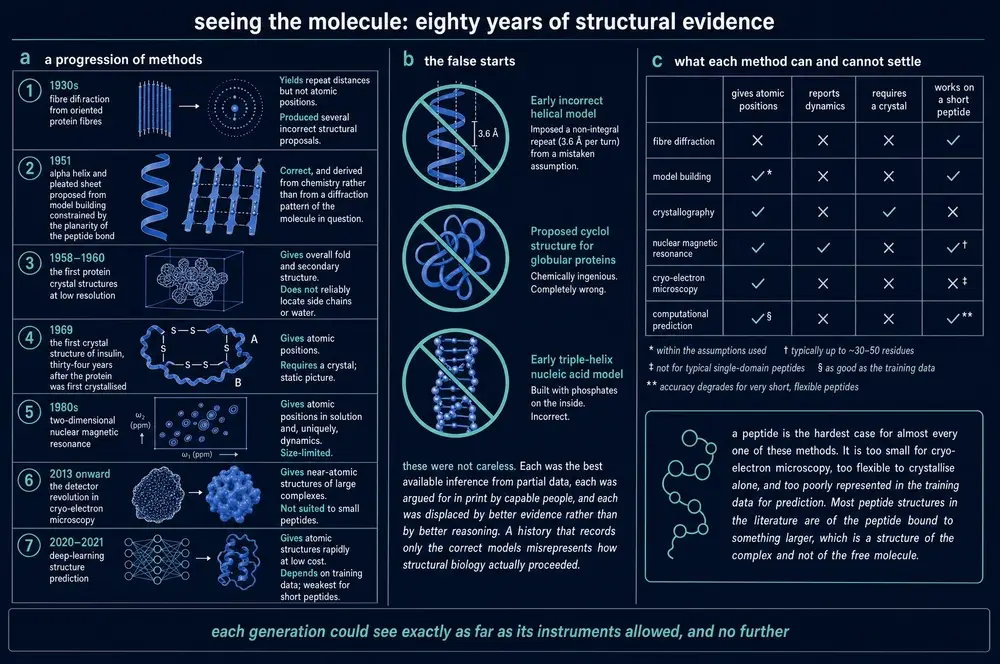
Which leaves the sober assessment that closes this Part. Structural biology transformed what could be understood about peptide action. It has transformed rather less about how peptide medicines are actually made. Most approved peptide drugs were not designed from a receptor structure. They are natural ligands, or fragments of natural ligands, modified empirically — by substitution, cyclisation, acylation and truncation — and tested in assays. Exenatide came from venom. Octreotide came from a conformational argument made before any relevant structure was known. Semaglutide is a natural hormone with two substitutions and a fatty acid.
The visibilities of Part Four made it possible to understand why these molecules work. What made them into medicines was the engineering of Part Five.
29Somatostatin in a bacterium, 1977
In 1973 Stanley Cohen, Annie Chang, Herbert Boyer and Robert Helling demonstrated that functional recombinant plasmids could be built and propagated in Escherichia coli. In 1975 the Asilomar conference produced a published statement on how such work should be constrained. In 1976 Boyer and Robert Swanson founded Genentech.
The company's first demonstration, in 1977, was the expression in bacteria of a human hormone from a chemically synthesised gene. The hormone was somatostatin, and the choice is the part of the story that matters for this document: somatostatin is a fourteen-residue peptide, and it was chosen precisely because it was small enough that a gene for it could be chemically synthesised with the oligonucleotide methods then available.
Those methods, as section 22 records, descend from Merrifield's. The first human hormone made by genetic engineering was made possible by a peptide-chemistry technique applied to nucleotides, and the hormone chosen was one that Guillemin's laboratory had extracted four years earlier from half a million sheep hypothalami. Both halves of Part Four are standing behind that result.
Recombinant human insulin followed in 1979, expressed as separate A and B chains and combined chemically, and Humulin was approved in 1982 as the first recombinant therapeutic protein. Recombinant human growth hormone arrived in 1985, and Humatrope was approved on 16 October 1986.
Recombinant expression is very good at making long polypeptides of natural amino acids, and cannot easily make anything else. Chemical synthesis is very good at making short polypeptides containing whatever the chemist likes — D-amino acids, N-methylated backbones, fatty-acid conjugates, non-natural residues, macrocycles — and gets exponentially worse with length, for the reason in section 21.
So the field split along a boundary defined by that trade-off, and the boundary is where modification outweighs length rather than at a fixed residue count. A defensible upper bound for commercial stepwise synthesis is demonstrated rather than estimated: enfuvirtide, at 36 residues, has been manufactured by stepwise chemical synthesis at multi-tonne scale. Tirzepatide and exenatide are 39 residues and are synthetic because they are modified. Insulin at 51 is recombinant.
The commonly quoted crossover of thirty to fifty residues is a range on which sources disagree, and it is written here as a range for that reason.
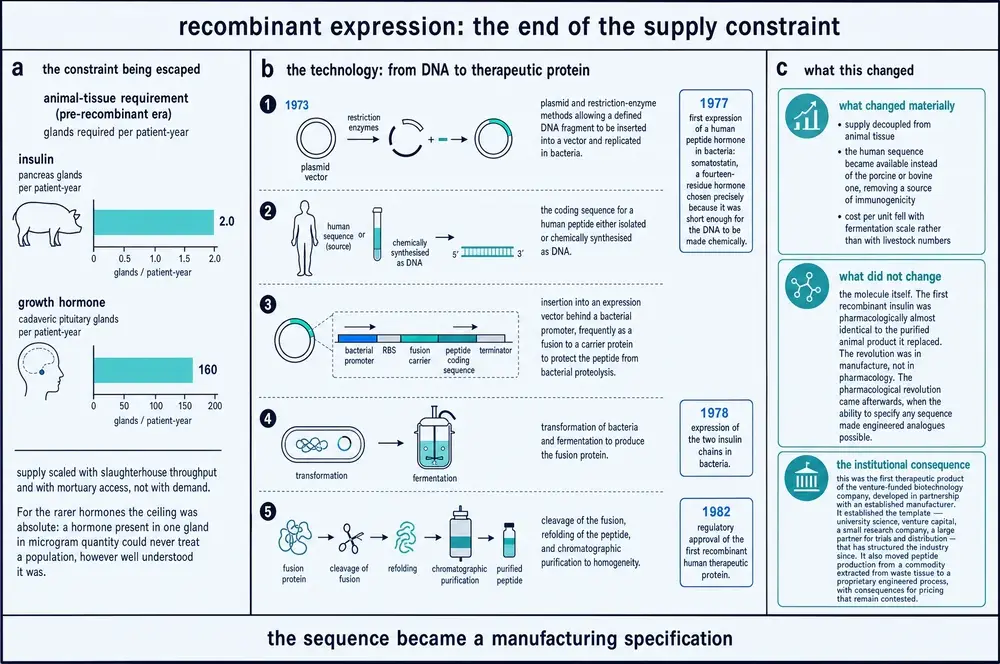
30The harm: cadaveric growth hormone
Between 1958 and 1985, children with growth hormone deficiency were treated with human growth hormone extracted from the pituitary glands of cadavers, because no other source existed. In the United States this ran as the National Hormone and Pituitary Program. The treatment worked.
In 1985 two reports appeared back to back in one issue of the New England Journal of Medicine describing Creutzfeldt–Jakob disease in young adults who had received the hormone. The agent is a prion; it is not destroyed by the purification then in use; and the incubation period is measured in decades. Distribution was halted, and recombinant growth hormone — which had become available that year — replaced it.
The two-clause rule set out at the start of this document applies here, and it is worth applying explicitly rather than by implication.
What was known and knowable at the time. When the programme began in 1958, the transmissible spongiform encephalopathies were not understood to be caused by a self-propagating protein; the prion hypothesis was not published until 1982. The children being treated had a condition for which cadaveric extract was the only available treatment, and untreated growth hormone deficiency has its own serious consequences. No test for the agent existed, and no test exists that would have detected it in a donor pituitary in 1958. The decision to run the programme was reasonable on the evidence then available.
What is known now, and what happened. At least 226 people worldwide contracted a fatal, untreatable neurodegenerative disease from a medicine given to them as children. The rates differed enormously by country — 6.3 per cent of French recipients against 0.4 per cent of American ones — and the documented explanation is a difference in the extraction and purification process, with a change in the United States process around 1977 associated with the disappearance of cases in patients starting treatment after that date. The authors of that analysis write that the change "may have" greatly reduced or eliminated the risk, and this document preserves the hedge.
The transferable lesson is about source rather than about prions. Every therapeutic peptide before 1982 came out of an animal or a human body, and a body carries whatever it carried. Recombinant expression and chemical synthesis did not merely make peptides cheaper; they made them traceable to a defined starting material. That is the clearest safety argument for the technologies of section 29, and it is not the argument usually made for them.
31The undruggable decade
By the mid-1980s the field had everything it had spent a century acquiring. It could isolate a peptide, sequence it, synthesise it, measure it in blood, identify its receptor, and manufacture it recombinantly at scale. And the pharmaceutical industry substantially walked away from peptides for the better part of two decades.
The reasons were not foolish and were not refuted; they were engineered around, which is a different thing.
A native peptide hormone circulates for minutes. It is cleaved by peptidases in plasma and on endothelial surfaces, and what survives that is cleared by the kidney, because most peptides are small enough to be freely filtered. It cannot be given by mouth, because the gastrointestinal tract is an apparatus for digesting exactly this class of molecule and because even an intact peptide crosses the intestinal epithelium poorly. It may provoke an antibody response. It costs far more to manufacture than a small molecule. And the dominant medicinal-chemistry orthodoxy of the period — oral bioavailability, low molecular weight, few hydrogen-bond donors — described almost precisely the properties a peptide does not have.
A history that skips this interval makes the recovery look inevitable. It was not. The field was widely considered a dead end by people who had good reasons, and the reasons were all true. What changed was that the constraints became targets.
32Half-life as a design problem
The clearest case is glucagon-like peptide-1, and it is clear because the failure mode was identified specifically rather than generally.
GLP-1's physiological case as a target was established between 1987 and 1993. Its problem was then localised: it is cleaved by dipeptidyl peptidase-4 at the N-terminus, and the cleavage was subsequently confirmed in vivo with the metabolite identified and quantified. This is a different kind of knowledge from "peptides are unstable". It names an enzyme, a bond, and a product — and a named bond is something a chemist can protect.
Three strategies follow directly, and all three are in the approved medicines. Substitute the residue the enzyme recognises, which is what the aminoisobutyric acid at position 8 of semaglutide does. Attach a fatty acid so the molecule binds circulating albumin, creating a reservoir that is too large to be filtered by the kidney and that releases free peptide slowly — the liraglutide design, published in 2000, and extended in the semaglutide design of 2015 to give once-weekly dosing. Co-formulate with a permeation enhancer so that some fraction survives and crosses the gut, which is what sodium N-(8-[2-hydroxybenzoyl]amino) caprylate does for oral semaglutide.
None of these is a discovery about biology. Every one is an engineering response to a measured constraint, and that is the character of the whole era.
33A lizard, and the incretin era
The most-used peptide medicines in the world descend from the venom of a lizard, and the route is worth following because it exercises every technique in this document.
In 1992 John Eng isolated a 39-residue peptide from the venom of the Gila monster, Heloderma suspectum, and named it exendin-4. It resembles human GLP-1 closely enough to act at the same receptor and differs from it in exactly the way that matters: the residue DPP-4 attacks is not there. A molecule that had evolved in a venom gland for reasons having nothing to do with human metabolism happened to be a GLP-1 receptor agonist that resists the enzyme which destroys GLP-1.
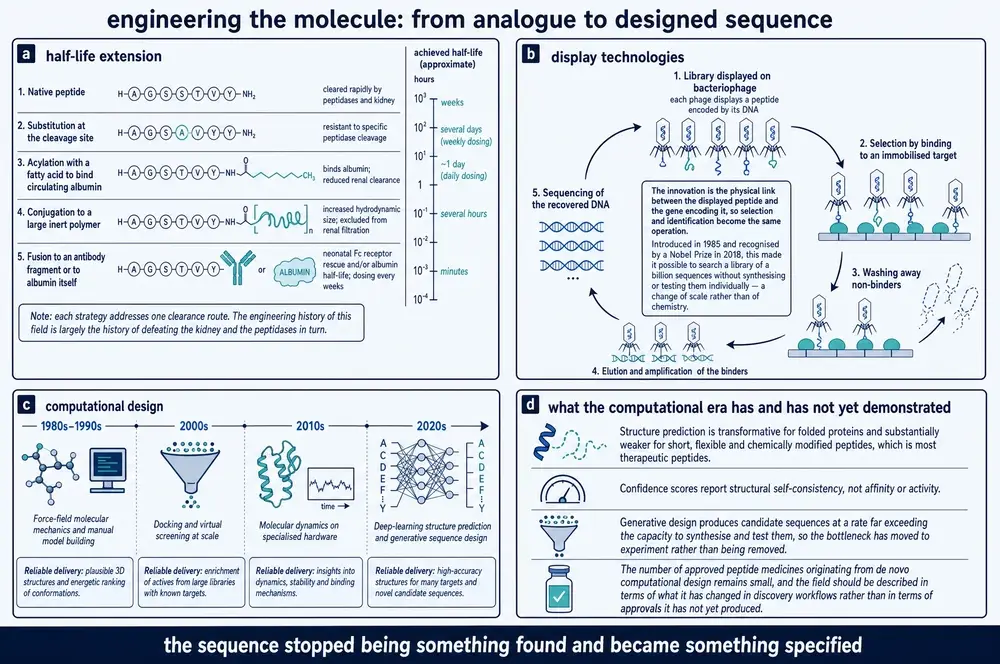
Synthetic exendin-4 became exenatide, the first GLP-1 receptor agonist to reach patients. Then the design became deliberate: liraglutide's fatty-acid acylation, semaglutide's combination of a protease-resistant substitution with albumin binding, an oral formulation with a permeation enhancer, and dual receptor agonists engaging GIP and GLP-1 receptors together.
A peptide found by bioassay-guided isolation from a natural source (Part One's method); sequenced (Part Two); synthesised chemically at scale (Part Three); acting at a receptor characterised by binding and later by structure, its concentrations measured by immunoassay (Part Four); and then engineered against a named clearance mechanism (Part Five). Nothing in the sequence could have been skipped, and the whole of it took a hundred and twenty years to become possible.
34Selection instead of design
In 1985 George Smith showed that a foreign peptide could be displayed on the surface of a bacteriophage while the DNA encoding it sat inside the same particle. That physical link between a molecule and its own gene is what makes selection possible: expose billions of variants to a target, keep what binds, amplify it, sequence it, repeat. Greg Winter's group turned the technique into an antibody-engineering platform around 1990–91. Smith and Winter shared half of the 2018 Nobel Prize in Chemistry, the other half going to Frances Arnold for directed evolution.
Cell-free formats followed in 1997 — mRNA display from Roberts and Szostak, ribosome display from Hanes and Plückthun — reaching library sizes phage cannot, with measured consequences for the affinities obtainable. Hiroaki Suga's flexizymes then extended selection beyond the natural amino acids entirely, allowing libraries of macrocyclic peptides containing residues no ribosome would normally accept.
This is the second inversion. Section 27's was receptor → ligand. This one is a change in what a chemist is for: instead of reasoning about which molecule ought to bind and then making it, you make a library of a trillion and let the target choose. The intellectual content moves out of the molecule's design and into the design of the selection.
35The peptidome, and reverse pharmacology
The third inversion goes further still, and it removes the starting molecule entirely.
By the late 1990s, genome sequencing was producing large numbers of predicted G-protein-coupled receptors with no known ligand — orphan receptors. The strategy that emerged, called reverse pharmacology, is to express an orphan receptor, expose it to fractionated tissue extracts, and purify whatever activates it. The starting point is not a physiological effect and not even a protein; it is a gene sequence with no known function.
Two results from this period are the best demonstrations in the document of the method working.
Orexin, or hypocretin. In 1998 two laboratories, using two different methods, published the same molecules about six weeks apart, and named them differently — which is why the field still carries two names for one pair of peptides. It is a genuine simultaneous discovery, and unlike the disputed cases in Parts Two and Four it was recognised as such almost immediately.
Ghrelin. In 1999 Kojima and colleagues went in the opposite direction: a receptor had been identified from a synthetic compound that stimulated growth-hormone release, and the endogenous ligand for that receptor was then purified from stomach. It turned out to be an acylated peptide — carrying a fatty acid on a serine, essential for activity — which is the same modification the engineers of section 32 were bolting onto GLP-1 analogues at the same time, for the same physical reason.
Mass spectrometry is what made systematic searching of this kind practical, because it can identify a peptide from a complex mixture without any bioassay and without knowing in advance what it is looking for. Electrospray ionisation and matrix-assisted laser desorption made peptides and proteins accessible to the technique in 1988–89; the 2002 Nobel Prize recognised Fenn and Tanaka, and the omission of Karas and Hillenkamp, whose 1988 work is the direct ancestor of what everyone now calls MALDI, remains a live credit question.
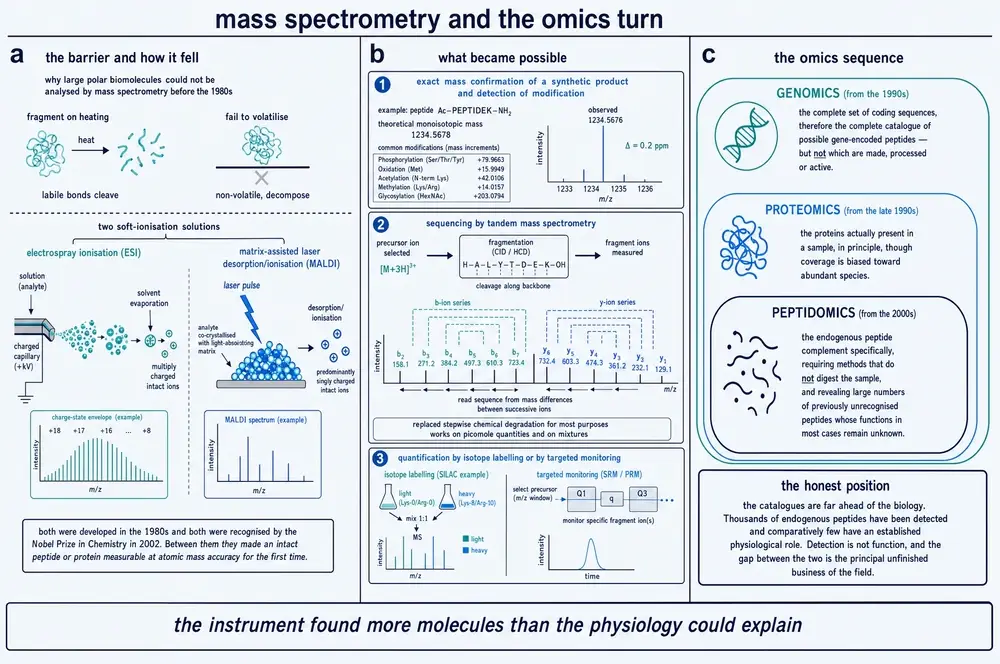
36Prediction, and what has actually been shown
In 2020 AlphaFold2 performed at CASP14 well enough that the organisers described the structure-prediction problem as substantially solved for single-chain proteins with evolutionary relatives; the method was published in 2021, AlphaFold3 followed in 2024, and the 2024 Nobel Prize in Chemistry went to David Baker, Demis Hassabis and John Jumper. The Baker laboratory's ProteinMPNN and RFdiffusion made the inverse problem — design a sequence that will fold to a specified shape — tractable enough to produce binders that work.
This document is the most cautious here that it is anywhere, for a reason that is methodological rather than temperamental: this is its most recent evidence, and recent evidence in a fast-moving field is the least settled evidence it has.
Predicting a structure is not designing a drug. AlphaFold predicts the folded structure of a protein. Most therapeutic peptides are short, flexible, and substantially disordered until they bind — the case section 28 describes — which is the regime where structure prediction is least applicable, not most.
Designing a binder is not producing a medicine. A designed molecule that binds its target with high affinity in vitro has cleared the first of perhaps twenty obstacles, and every obstacle in Part Five's list — half-life, route, immunogenicity, manufacture, trials — is still in front of it.
Ask what has reached patients. As of this document's compilation the honest answer for peptide therapeutics designed de novo by these methods is a short list, and it is shorter than the volume of commentary implies. The computational tools have unambiguously changed what is askable. Whether they have yet changed what is approvable is a separate question with a much thinner evidence base, and conflating the two is the characteristic error of writing about this period.
The pattern this document has followed for a century suggests where to look. Every previous technique in this history took between fifteen and forty years to travel from demonstration to approved medicine: radioimmunoassay from 1959 to a routine clinical instrument, solid-phase synthesis from 1963 to the manufacture of approved drugs, phage display from 1985 to approved antibodies. On that record, judgement on the computational methods is not yet available, and anyone offering it is not reasoning from this history.
37Manufacture, regulation, and a market that outran both
The regulatory architecture that governs all of this was built by disaster. Thalidomide produced the Kefauver–Harris amendments of 1962, which required proof of efficacy as well as safety. The Declaration of Helsinki followed in 1964, and has been revised repeatedly since — most recently in 2024.
Peptides then created a regulatory problem of their own, and it comes straight out of section 21's arithmetic. A synthetic peptide is not one molecule. At ninety-nine per cent coupling efficiency, roughly a third of what leaves the vessel for a thirty-nine-residue target is something else: chains missing one residue, chains truncated early, diastereomers formed by racemisation. These impurities are structurally almost identical to the drug, which makes them hard to detect, hard to remove, and impossible to dismiss, because a peptide one residue short of the target may be immunogenic.
A peptide also sits on a legal fault line. Above a threshold of length a molecule is regulated as a biologic; below it, as a drug — and the two regimes have entirely different pathways for a second manufacturer's version, biosimilarity against generic equivalence. Where a given peptide falls decides what evidence a competitor must produce.
The United States regulator issued draft guidance on generic synthetic peptides in 2017 and finalised it in 2021. On 28 July 2026 it published seventeen revised draft product-specific guidances for peptides and withdrew the 2021 guidance, stating that it no longer reflects the agency's current scientific thinking. That is five days before this document's compilation date.
Relatedly: the frequently reported "first generic semaglutide" is, on the regulator's own database, a tentative approval dated 7 April 2026, not an approval. A tentative approval means the application meets the standards but cannot be marketed. Any sentence describing a marketed generic is wrong as written.
And the market has outrun both the manufacture and the regulation. Demand for GLP-1 receptor agonists from 2023 produced shortages, compounding at scale, and a large grey market. The regulator's stated objection to research-use labelling on such products is precise and worth reproducing accurately: the problem is not the phrase "for research purposes only" in itself, but that phrase combined with sale to consumers and instructions for dosing.
Even the size of the field is contested. Two 2026 papers by overlapping author teams, published four days apart, give 46 and 44 FDA approvals for 2025. Counts of total approved peptide drugs vary widely with the definition of "peptide" and the cut-off date. This document therefore quotes no single total, and treats the variation as the finding: a field whose boundary is unsettled cannot be counted, and the disagreement is a fact about the classification rather than about the drugs.
38What the history suggests about the next constraint
This document has argued that the practice of this science was bounded, at each stage, by what could be measured, and that its one great non-measurement problem — that the body destroys peptides — was solved by engineering rather than by discovery. Two things follow, and neither is a prediction.
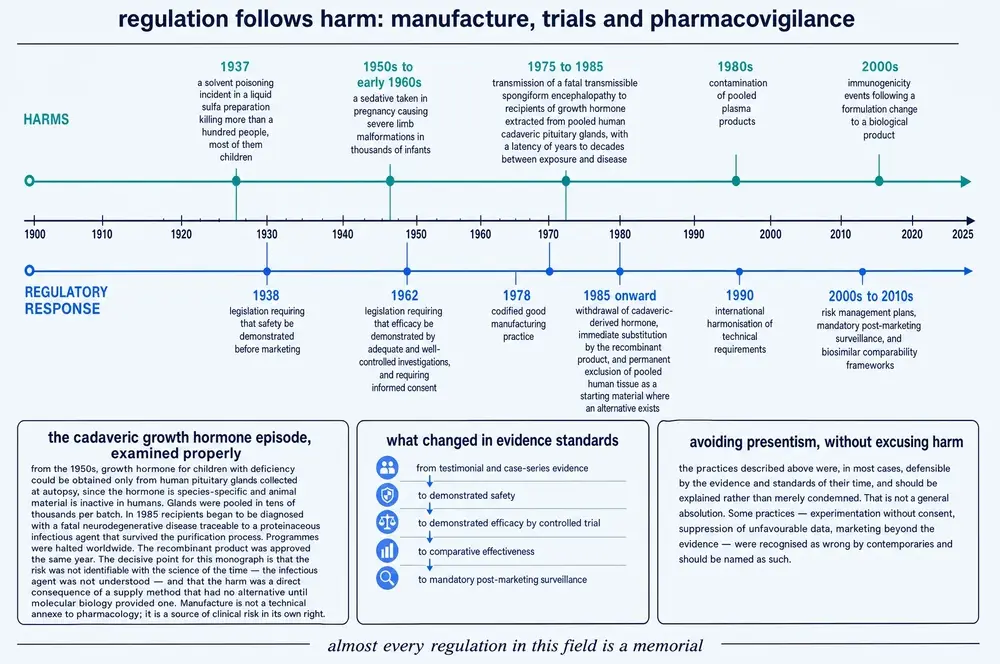
The visibility that is still poorest is the one inside a person. Every technique in Parts Two through Four measures a peptide in a tube, a tissue homogenate, a cultured cell, or a sample of plasma. What remains genuinely hard is knowing the concentration of a specific peptide at a specific receptor in a specific tissue in a living human being over time. The instruments of Part Four brought the measurement from the whole animal to the millilitre of blood; they did not bring it to the synapse or the islet. That is where the resolution argument has stopped.
The constraint that engineering has least defeated is the route. Half-life has been solved to the point where once-weekly and longer dosing is routine. Oral delivery has not: the best-developed oral peptide formulations still deliver a small percentage of what is swallowed, and the technology that achieves it is a permeation enhancer rather than a solution to the underlying permeability problem. Tissue selectivity is in a similar state — a peptide goes where its receptor is, which is not always only where the prescriber wants.
If the pattern of this history holds, those are the two places where the next generation of work will be, and the form it will take is the form every previous generation took: not a new idea about physiology, but an instrument that makes something visible which currently is not.
This document describes published research and its history. It does not recommend human use of any compound and specifies no dose, route or schedule for any person. Where doses, routes and schedules appear — in sections 05, 09, 30 and elsewhere — they are what a published study or a historical record reports having administered, given with the population, the period and the outcome attached, including where the outcome was harm. Several of the practices described in this document were unsafe, and are reported because a history that omitted them would be a worse history and a less useful one. It is not medical advice.
39Glossary
Terms used in a specific sense in this document, placed here rather than at first use because a reader consulting a section out of order needs them more than a reader following the argument.
| Term | As used here |
|---|---|
| Bioassay | Measurement of a substance by the magnitude of a biological response it produces, calibrated against a reference preparation. The only quantitative instrument available before 1959. |
| Deletion sequence | A synthetic by-product missing one internal residue, formed when a coupling step fails. Structurally almost identical to the target; the characteristic impurity of solid-phase synthesis. |
| Discovery / isolation / synthesis / characterisation / clinical application | Five distinct events, frequently decades and continents apart. Conflating them is the commonest defect in short accounts of this field, and the document separates them throughout. |
| Internal secretion | A substance released by an organ directly into the blood rather than down a duct. Coined for hepatic glucose output, not for hormones (section 03). |
| International unit | A quantity defined by mass of a sealed reference preparation, not by molecular weight. A survival of the bioassay era inside modern pharmacy. |
| Orthogonal protection | Two protecting-group chemistries removable by independent conditions, so that repeated cycles do not erode what has been built. The property that makes Fmoc superior to Boc in principle. |
| Peptide | Used here as the field uses it: a short chain of amino acids joined by amide bonds. The boundary with "protein" is conventional, contested, and — as section 37 records — legally consequential. |
| Presentism | Judging a historical decision by evidence unavailable when it was taken. Handled here by a fixed two-clause form: what was knowable then, then what happened. |
| Radioimmunoassay | Measurement by competition between a radiolabelled and an unlabelled analyte for a limited quantity of specific antibody. |
| Reverse pharmacology | Starting from an orphan receptor and searching for its endogenous ligand, rather than from a physiological effect. |
| Saturation analysis | The same competition principle using any specific binding agent, not necessarily an antibody. Whether this is the parent of radioimmunoassay or its child is the dispute in section 24. |
| Solid-phase synthesis | Chain assembly on an insoluble support, so that purification at each step becomes filtration. |
| Stepwise efficiency | The fraction of chains successfully extended at one coupling. Overall yield is this raised to the number of couplings (Figure 12). |
40Disputed-priority register
Every contested attribution this document takes a position on, with the position and its basis. Where the document declines to resolve a dispute, that is stated as the position.
| Dispute | Position taken here |
|---|---|
| Thyroid replacement therapy Murray 1891 vs Bettencourt-Rodrigues 1890 | Murray was not first. Lisbon has priority by nearly a year. Murray has priority in the accessible literature and in clinical follow-through, and the difference is a publication-venue effect (section 05). |
| Isolation of adrenaline Abel vs Takamine | Abel named the substance and prepared crude extracts; Abel's epinephrin was an inactive benzoylated derivative. Takamine obtained the active principle in crystalline form. A minority reading describes the isolation as joint and is recorded as a minority reading. |
| Anticipation of secretin | The isolated-loop observation existed in the prior literature (Wertheimer and Lepage). The distinctive Bayliss–Starling step is the intravenous injection of the extract. |
| Who suggested the word "hormone" | Hardy is attested by two independent lines; Vesey rests on one undated second-hand footnote written thirty-one years later. Both reported, weighted accordingly. |
| Discovery of insulin Toronto vs Paulescu and others | Both, distinguished. Paulescu and others demonstrated the hormone; Toronto produced the medicine. The patent's own specification, written adversarially in 1922, asserts exactly this. |
| Within Toronto | The purification was Collip's and it is what made the extract usable. Banting is not on the original patent application. |
| The polypeptide theory Fischer vs Hofmeister | Simultaneous and independent, at the same 1902 meeting. A prior claim by Grimaux (1882) exists. Fischer is credited alone by convention rather than by the record. |
| The oxytocin sequence du Vigneaud vs Tuppy | Tuppy published a structure first, in print, by about five months. Du Vigneaud acknowledged his independence in the Nobel lecture. The prize rewarded the synthesis, not the sequence, so there is no contradiction. Received dates are unobtainable; the ordering is in print, not in submission. |
| Boissonnas 1955 | Not a competing first synthesis. Its own title calls it "a new synthesis", two years later. |
| The Boc group | No single inventor. Three independent 1957 reports. The citation universally given for it points at a paper about isophthalimides. |
| Ribonuclease, 1969 Merrifield vs Merck | They did not make the same molecule. Merrifield's group made the full 124-residue A chain; Merck made the S-protein, reconstituted to ribonuclease S′. Published back to back in one issue. |
| Solid-phase priority Merrifield vs Letsinger | Letsinger followed, by five issues of the same 1963 volume of the same journal for the general idea and by two years for the nucleotide application. |
| Radioimmunoassay Yalow & Berson vs Ekins | Publication priority is Yalow and Berson's by about eight months. Independence is not contested by anyone. The dispute is about how to individuate the invention, and this document does not resolve it (section 24). |
| TRH structure, 1969 | Not resolvable from the documents. One date is a presentation to an academy, the other an issue date, and the second paper's received date is not recorded anywhere accessible. Reported as simultaneous. |
| LH-RH, 1971 | Unequal, and usually flattened. Schally's group published a proposed complete sequence; Guillemin's published purification, composition and N-terminus, which is a weaker claim, and its title says so. |
| The opiate receptor, 1973 | Independent and near-contemporaneous, not simultaneous. Simon's paper was communicated six weeks after Pert and Snyder's was in print and cites it. The relative order of the two March papers cannot be established. |
| The 1978 Lasker award | Pert's exclusion is documented, as is Snyder's stated view that she should have shared it and his unsuccessful approach to the jury. Reported, not adjudicated. The reporter was Jean Marx, not Nicholas Wade, a misattribution in wide circulation. |
| MALDI and the 2002 Nobel | The omission of Karas and Hillenkamp, whose 1988 work is the direct ancestor of the method now called MALDI, is recorded as a live credit question. |
| Orexin / hypocretin, 1998 | Genuine simultaneous discovery, two laboratories, two methods, about six weeks apart, recognised as such almost immediately — which is why the field still carries two names. |
41References
Generated from verified NCBI records and, where a source is not indexed in PubMed, from bibliographic records verified against Crossref or against the document itself. 87 entries. Sources without a PubMed identifier are marked, and their absence is a fact about the literature rather than an omission: PubMed coverage effectively begins in 1946 and this document's evidence begins in 1806.
- Abrams JY, Schonberger LB, Belay ED, Maddox RA, Leschek EW, Mills JL, et al.. Lower risk of Creutzfeldt-Jakob disease in pituitary growth hormone recipients initiating treatment after 1977. J Clin Endocrinol Metab. 2011;96(10):E1666-9.
PMID 21816775 · doi:10.1210/jc.2011-1357 - AHLQUIST RP. A study of the adrenotropic receptors. Am J Physiol. 1948;153(3):586-600.
PMID 18882199 · doi:10.1152/ajplegacy.1948.153.3.586 - Amoss M, Burgus R, Blackwell R, Vale W, Fellows R, Guillemin R. Purification, amino acid composition and N-terminus of the hypothalamic luteinizing hormone releasing factor (LRF) of ovine origin. Biochem Biophys Res Commun. 1971;44(1):205-10.
PMID 4940370 · doi:10.1016/s0006-291x(71)80179-1 - Anderson GW, McGregor AC. t-Butyloxycarbonylamino acids and their use in peptide synthesis. J Am Chem Soc. 1957;79(23):6180-6183.
doi:10.1021/ja01580a020 - Anonymous. The pentacle of rejuvenescence. Br Med J. 1889;1:1416.
no PubMed identifier — see the unresolved-evidence log - Atherton E, Fox H, Harkiss D, Logan CJ, Sheppard RC, Williams BJ. A mild procedure for solid phase peptide synthesis: use of fluorenylmethoxycarbonylamino-acids. J Chem Soc Chem Commun. 1978:537-538.
doi:10.1039/c39780000537 - Banting FG, Best CH, Collip JB. Extract obtainable from the mammalian pancreas or from the related glands in fishes, useful in the treatment of diabetes mellitus, and a method of preparing it. US Patent 1,469,994. 1923:filed 12 January 1923; granted 9 October 1923.
no PubMed identifier — see the unresolved-evidence log - BARAKAT RM, EKINS RP. Assay of vitamin B12 in blood. A simple method. Lancet. 1961;2(7192):25-6.
PMID 13686681 · doi:10.1016/s0140-6736(61)92711-8 - Bauer W, Briner U, Doepfner W, Haller R, Huguenin R, Marbach P, et al.. SMS 201-995: a very potent and selective octapeptide analogue of somatostatin with prolonged action. Life Sci. 1982;31(11):1133-40.
PMID 6128648 · doi:10.1016/0024-3205(82)90087-x - Bergmann M, Zervas L. Ueber ein allgemeines Verfahren der Peptid-Synthese. Ber Dtsch Chem Ges. 1932;65(7):1192-1201.
doi:10.1002/cber.19320650722 - BERSON SA, YALOW RS, BAUMAN A, ROTHSCHILD MA, NEWERLY K. Insulin-I131 metabolism in human subjects: demonstration of insulin binding globulin in the circulation of insulin treated subjects. J Clin Invest. 1956;35(2):170-90.
PMID 13286336 · doi:10.1172/JCI103262 · PMC438794 - Bettencourt R, Serrano JA. Un cas de myxoedeme traite par la greffe hypodermique du corps thyroide d'un mouton. Sem Med. 1890;10:294.
no PubMed identifier — see the unresolved-evidence log - Bliss M. The Discovery of Insulin. University of Chicago Press. 1982.
no PubMed identifier — see the unresolved-evidence log - Boissonnas RA, Guttmann S, Jaquenoud PA, Waller JP, Cherbuliez E, Stoll A. Une nouvelle synthese de l'ocytocine. Helv Chim Acta. 1955;38(6):1491-1501.
doi:10.1002/hlca.19550380622 - Boler J, Enzmann F, Folkers K, Bowers CY, Schally AV. The identity of chemical and hormonal properties of the thyrotropin releasing hormone and pyroglutamyl-histidyl-proline amide. Biochem Biophys Res Commun. 1969;37(4):705-10.
PMID 4982117 · doi:10.1016/0006-291x(69)90868-7 - Bradbury AF, Smyth DG, Snell CR. Lipotropin: precursor to two biologically active peptides. Biochem Biophys Res Commun. 1976;69(4):950-6.
PMID 1275928 · doi:10.1016/0006-291x(76)90465-4 - Bradbury AF, Smyth DG, Snell CR. Biosynthetic origin and receptor conformation of methionine enkephalin. Nature. 1976;260(5547):165-6.
PMID 1256559 · doi:10.1038/260165a0 - Bray BL. Large-scale manufacture of peptide therapeutics by chemical synthesis. Nat Rev Drug Discov. 2003;2(7):587-93.
PMID 12815383 · doi:10.1038/nrd1133 - Brazeau P, Vale W, Burgus R, Ling N, Butcher M, Rivier J, et al.. Hypothalamic polypeptide that inhibits the secretion of immunoreactive pituitary growth hormone. Science. 1973;179(4068):77-9.
PMID 4682131 · doi:10.1126/science.179.4068.77 - Brown P, Brandel JP, Sato T, Nakamura Y, MacKenzie J, Will RG, et al.. Iatrogenic Creutzfeldt-Jakob disease, final assessment. Emerg Infect Dis. 2012;18(6):901-7.
PMID 22607808 · doi:10.3201/eid1806.120116 · PMC3358170 - Brown-Sequard CE. Du role physiologique et therapeutique d'un suc extrait de testicules d'animaux d'apres nombre de faits observes chez l'homme. Arch Physiol Norm Pathol. 1889;1:739-746.
no PubMed identifier — see the unresolved-evidence log - Burgus R, Dunn TF, Desiderio D, Guillemin R. [Molecular structure of the hypothalamic hypophysiotropic TRF factor of ovine origin: mass spectrometry demonstration of the PCA-His-Pro-NH2 sequence]. C R Acad Hebd Seances Acad Sci D. 1969;269(19):1870-3.
PMID 4983502 - Burgus R, Dunn TF, Desiderio D, Ward DN, Vale W, Guillemin R. Characterization of ovine hypothalamic hypophysiotropic TSH-releasing factor. Nature. 1970;226(5243):321-5.
PMID 4985794 · doi:10.1038/226321a0 - Bylund DB. Alpha- and beta-adrenergic receptors: Ahlquist's landmark hypothesis of a single mediator with two receptors. Am J Physiol Endocrinol Metab. 2007;293(6):E1479-81.
PMID 17957033 · doi:10.1152/ajpendo.00664.2007 - Carpino LA, Han GY. The 9-fluorenylmethoxycarbonyl amino-protecting group. J Org Chem. 1972;37(22):3404-3409.
doi:10.1021/jo00795a005 - Cary BP, Zhang X, Cao J, Johnson RM, Piper SJ, Gerrard EJ, et al.. New Insights into the Structure and Function of Class B1 GPCRs. Endocr Rev. 2023;44(3):492-517.
PMID 36546772 · doi:10.1210/endrev/bnac033 · PMC10166269 - Cheng Y, Prusoff WH. Relationship between the inhibition constant (K1) and the concentration of inhibitor which causes 50 per cent inhibition (I50) of an enzymatic reaction. Biochem Pharmacol. 1973;22(23):3099-108.
PMID 4202581 · doi:10.1016/0006-2952(73)90196-2 - Cussons AJ, Bhagat CI, Fletcher SJ, Walsh JP. Brown-Séquard revisited: a lesson from history on the placebo effect of androgen treatment. Med J Aust. 2002;177(11-12):678-9.
PMID 12463999 · doi:10.5694/j.1326-5377.2002.tb05014.x - DU VIGNEAUD V, RESSLER C, TRIPPETT S. The sequence of amino acids in oxytocin, with a proposal for the structure of oxytocin. J Biol Chem. 1953;205(2):949-57.
PMID 13129273 - du Vigneaud V, Ressler C, Swan JM, Roberts CW, Katsoyannis PG, Gordon S. The synthesis of an octapeptide amide with the hormonal activity of oxytocin. J Am Chem Soc. 1953;75(19):4879-4880.
doi:10.1021/ja01115a553 - du Vigneaud V, Lawler HC, Popenoe EA. Enzymatic cleavage of glycinamide from vasopressin and a proposed structure for this pressor-antidiuretic hormone of the posterior pituitary. J Am Chem Soc. 1953;75(19):4880-4881.
doi:10.1021/ja01115a554 - du Vigneaud V, Ressler C, Swan JM, Roberts CW, Katsoyannis PG. The synthesis of oxytocin. J Am Chem Soc. 1954;76(12):3115-3121.
doi:10.1021/ja01641a004 - du Vigneaud V. A trail of sulfa research: from insulin to oxytocin. Nobel Lecture, 12 December 1955. 1955.
no PubMed identifier — see the unresolved-evidence log - EKINS RP. The estimation of thyroxine in human plasma by an electrophoretic technique. Clin Chim Acta. 1960;5:453-9.
PMID 13819821 · doi:10.1016/0009-8981(60)90051-6 - EKINS RP. Estimation of protein bound 131 I in plasma. Phys Med Biol. 1959;4:182-4.
PMID 13819820 · doi:10.1088/0031-9155/4/2/308 - Ekins RP. Ligand assays: from electrophoresis to miniaturized microarrays. Clin Chem. 1998;44(9):2015-30.
PMID 9733000 - Fischer E, Fourneau E. Ueber einige Derivate des Glykocolls. Ber Dtsch Chem Ges. 1901;34(2):2868-2877.
doi:10.1002/cber.190103402249 - Fischer E. Synthese von Polypeptiden. XVII. Ber Dtsch Chem Ges. 1907;40(2):1754-1767.
doi:10.1002/cber.19070400273 - Foster SR, Hauser AS, Vedel L, Strachan RT, Huang XP, Gavin AC, et al.. Discovery of Human Signaling Systems: Pairing Peptides to G Protein-Coupled Receptors. Cell. 2019;179(4):895-908.e21.
PMID 31675498 · doi:10.1016/j.cell.2019.10.010 · PMC6838683 - FURCHGOTT RF. The receptors for epinephrine and norepinephrine (adrenergic receptors). Pharmacol Rev. 1959;11(2, Part 2):429-41; discussion 441-2.
PMID 13667424 - Goldstein A, Lowney LI, Pal BK. Stereospecific and nonspecific interactions of the morphine congener levorphanol in subcellular fractions of mouse brain. Proc Natl Acad Sci U S A. 1971;68(8):1742-7.
PMID 5288759 · doi:10.1073/pnas.68.8.1742 · PMC389284 - Guillemin R. Peptides in the brain: the new endocrinology of the neuron. Nobel Lecture, 8 December 1977. 1977.
no PubMed identifier — see the unresolved-evidence log - Gutte B, Merrifield RB. The total synthesis of an enzyme with ribonuclease A activity. J Am Chem Soc. 1969;91(2):501-2.
PMID 5782505 · doi:10.1021/ja01030a050 - Gutte B, Merrifield RB. The synthesis of ribonuclease A. J Biol Chem. 1971;246(6):1922-41.
PMID 5102153 - Henderson J. Ernest Starling and 'Hormones': an historical commentary. J Endocrinol. 2005;184(1):5-10.
PMID 15642778 · doi:10.1677/joe.1.06000 - Hughes J, Smith TW, Kosterlitz HW, Fothergill LA, Morgan BA, Morris HR. Identification of two related pentapeptides from the brain with potent opiate agonist activity. Nature. 1975;258(5536):577-80.
PMID 1207728 · doi:10.1038/258577a0 - INGRAM VM. A specific chemical difference between the globins of normal human and sickle-cell anaemia haemoglobin. Nature. 1956;178(4537):792-4.
PMID 13369537 · doi:10.1038/178792a0 - INGRAM VM. Gene mutations in human haemoglobin: the chemical difference between normal and sickle cell haemoglobin. Nature. 1957;180(4581):326-8.
PMID 13464827 · doi:10.1038/180326a0 - Kahn CR, Roth J. Berson, Yalow, and the JCI: the agony and the ecstasy. J Clin Invest. 2004;114(8):1051-4.
PMID 15489951 · doi:10.1172/JCI23316 · PMC522271 - LANDS AM. Sympathetic receptor action. Am J Physiol. 1952;169(1):11-21.
PMID 14923856 · doi:10.1152/ajplegacy.1952.169.1.11 - Li CH, Chung D. Isolation and structure of an untriakontapeptide with opiate activity from camel pituitary glands. Proc Natl Acad Sci U S A. 1976;73(4):1145-8.
PMID 1063395 · doi:10.1073/pnas.73.4.1145 · PMC430217 - Maren TH. Lasker Award and opiate receptors. Science. 1979;203(4383):834.
PMID 217086 · doi:10.1126/science.217086 - Martin AJP, Synge RLM. A new form of chromatogram employing two liquid phases. 1. A theory of chromatography. 2. Application to the micro-determination of the higher monoamino-acids in proteins. Biochem J. 1941;35(12):1358-1368.
no PubMed identifier — see the unresolved-evidence log - Marx JL. Lasker award stirs controversy. Science. 1979;203(4378):341.
PMID 216074 · doi:10.1126/science.216074 - Matsuo H, Baba Y, Nair RM, Arimura A, Schally AV. Structure of the porcine LH- and FSH-releasing hormone. I. The proposed amino acid sequence. Biochem Biophys Res Commun. 1971;43(6):1334-9.
PMID 4936338 · doi:10.1016/s0006-291x(71)80019-0 - McKay FC, Albertson NF. New amine-masking groups for peptide synthesis. J Am Chem Soc. 1957;79(17):4686-4690.
doi:10.1021/ja01574a029 - Merrifield RB, Stewart JM. Automated peptide synthesis. Nature. 1965;207(996):522-3.
PMID 5886140 · doi:10.1038/207522a0 - Merrifield RB, Stewart JM, Jernberg N. Instrument for automated synthesis of peptides. Anal Chem. 1966;38(13):1905-14.
PMID 5977852 · doi:10.1021/ac50155a057 - Merrifield RB. Solid phase peptide synthesis. I. The synthesis of a tetrapeptide. J Am Chem Soc. 1963;85(14):2149-2154.
doi:10.1021/ja00897a025 - Mills JL, Schonberger LB, Wysowski DK, Brown P, Durako SJ, Cox C, et al.. Long-term mortality in the United States cohort of pituitary-derived growth hormone recipients. J Pediatr. 2004;144(4):430-6.
PMID 15069388 · doi:10.1016/j.jpeds.2003.12.036 - Mitchell AR. R. Bruce Merrifield and solid-phase peptide synthesis: a historical assessment. Biopolymers (Pept Sci). 2008:UCRL-JRNL-237037.
no PubMed identifier — see the unresolved-evidence log - Moore S, Stein WH. The chemical structures of pancreatic ribonuclease and deoxyribonuclease. Nobel Lecture, 11 December 1972. 1972.
no PubMed identifier — see the unresolved-evidence log - Murray GR. Note on the Treatment of Myxoedema by Hypodermic Injections of an Extract of the Thyroid Gland of a Sheep. Br Med J. 1891;2(1606):796-7.
PMID 20753415 · doi:10.1136/bmj.2.1606.796 · PMC2273741 - Murray GR. THE LIFE-HISTORY OF THE FIRST CASE OF MYXOEDEMA TREATED BY THYROID EXTRACT. Br Med J. 1920;1(3089):359-60.
PMID 20769820 · doi:10.1136/bmj.1.3089.359 · PMC2337775 - Nieschlag E, Nieschlag S. Testosterone deficiency: a historical perspective. Asian J Androl. 2014;16(2):161-8.
PMID 24435052 · doi:10.4103/1008-682X.122358 · PMC3955324 - Pert CB, Snyder SH. Opiate receptor: demonstration in nervous tissue. Science. 1973;179(4077):1011-4.
PMID 4687585 · doi:10.1126/science.179.4077.1011 - Pert CB, Snyder SH. Properties of opiate-receptor binding in rat brain. Proc Natl Acad Sci U S A. 1973;70(8):2243-7.
PMID 4525427 · doi:10.1073/pnas.70.8.2243 · PMC433710 - Pollin W. Pert and the lasker award. Science. 1979;204(4388):8.
PMID 17816714 · doi:10.1126/science.204.4388.8-a - Sanger F. The chemistry of insulin. Nobel Lecture, 11 December 1958. 1958.
no PubMed identifier — see the unresolved-evidence log - Schally AV. Aspects of hypothalamic regulation of the pituitary gland. Nobel Lecture, 8 December 1977. 1977.
no PubMed identifier — see the unresolved-evidence log - Simon EJ, Hiller JM, Edelman I. Stereospecific binding of the potent narcotic analgesic (3H) Etorphine to rat-brain homogenate. Proc Natl Acad Sci U S A. 1973;70(7):1947-9.
PMID 4516196 · doi:10.1073/pnas.70.7.1947 · PMC433639 - Simoni RD, Hill RL, Vaughan M. The discovery of the amino acid threonine: the work of William C. Rose [classical article]. J Biol Chem. 2002;277(37):E25.
PMID 12218068 - Slater S. The discovery of thyroid replacement therapy. Part 3: A complete transformation. J R Soc Med. 2011;104(3):100-6.
PMID 21357978 · doi:10.1258/jrsm.2010.10k052 · PMC3046199 - Starling EH. The Croonian Lectures on the chemical correlation of the functions of the body. Lancet. 1905;166(4275):339-341.
no PubMed identifier — see the unresolved-evidence log - Tan SY, Bracha A. Rosalyn Yalow (1921-2011): Madame Curie from the Bronx. Singapore Med J. 2019;60(7):337-338.
PMID 31378819 · doi:10.11622/smedj.2019073 · PMC6658655 - Terenius L. Stereospecific interaction between narcotic analgesics and a synaptic plasm a membrane fraction of rat cerebral cortex. Acta Pharmacol Toxicol (Copenh). 1973;32(3):317-20.
PMID 4801733 · doi:10.1111/j.1600-0773.1973.tb01477.x - Terenius L. Stereospecific uptake of narcotic analgesics by a subcellular fraction of the guinea-pig ileum. A preliminary communication. Ups J Med Sci. 1973;78(3):150-2.
PMID 4128958 · doi:10.3109/03009737309178620 - TUPPY H. The amino-acid sequence in oxytocin. Biochim Biophys Acta. 1953;11(3):449-50.
PMID 13093758 · doi:10.1016/0006-3002(53)90071-7 - Veber DF, Holly FW, Paleveda WJ, Nutt RF, Bergstrand SJ, Torchiana M, et al.. Conformationally restricted bicyclic analogs of somatostatin. Proc Natl Acad Sci U S A. 1978;75(6):2636-40.
PMID 208068 · doi:10.1073/pnas.75.6.2636 · PMC392617 - Vincent A. Roger Philip Ekins. 22 September 1926-26 July 2016. Biogr Mems Fell R Soc. 2023;75:93-107.
doi:10.1098/rsbm.2023.0020 - Wade N. The Nobel Duel: two scientists' 21-year race to win the world's most coveted research prize. Anchor Press/Doubleday, Garden City NY. 1981:ISBN 0385149816.
no PubMed identifier — see the unresolved-evidence log - Wagner G, Wüthrich K. Sequential resonance assignments in protein 1H nuclear magnetic resonance spectra. Basic pancreatic trypsin inhibitor. J Mol Biol. 1982;155(3):347-66.
PMID 6176717 · doi:10.1016/0022-2836(82)90009-2 - Williamson MP, Havel TF, Wüthrich K. Solution conformation of proteinase inhibitor IIA from bull seminal plasma by 1H nuclear magnetic resonance and distance geometry. J Mol Biol. 1985;182(2):295-315.
PMID 3839023 · doi:10.1016/0022-2836(85)90347-x - YALOW RS, BERSON SA. Assay of plasma insulin in human subjects by immunological methods. Nature. 1959;184 (Suppl 21):1648-9.
PMID 13846363 · doi:10.1038/1841648b0 - YALOW RS, BERSON SA. Immunoassay of endogenous plasma insulin in man. J Clin Invest. 1960;39(7):1157-75.
PMID 13846364 · doi:10.1172/JCI104130 · PMC441860 - YALOW RS, BERSON SA. Plasma insulin concentrations in nondiabetic and early diabetic subjects. Determinations by a new sensitive immuno-assay technic. Diabetes. 1960;9:254-60.
PMID 13846365 · doi:10.2337/diab.9.4.254 - Yalow RS. Radioimmunoassay: a probe for fine structure of biologic systems. Nobel Lecture, 8 December 1977. 1977.
no PubMed identifier — see the unresolved-evidence log
42How this document was assembled
The corpus was built in two layers and merged keyed by identifier rather than summed.
The local layer is the project-05 Therapeutic Peptide Research Library, scanned XML-first. Every asset was scored on two independent axes: subject-matter coverage across twenty-two concept families, and historical discourse — narration markers, the count of distinct pre-2000 years named in the body, and named historical actors. A document had to score on both. A modern kinetics paper citing Sanger in its introduction has subject coverage and no discourse; a history of cardiac surgery has discourse and no subject. Neither is about the history of peptide science, and they were rejected into different named classes.
The external layer was harvested from PubMed along thirty-one chronological axes, partitioned by publication window rather than sorted by date. That decision was taken because the sibling monograph in this series recorded a harvest in which a flat retrieval limit with date sorting returned a corpus of which 763 of 884 documents were published in one year, silently discarding sixteen years of literature while every count in the log looked healthy. Windowing recovered a distribution running from the 1940s to the present. The indexed records were then screened before fetching, and the retained full texts screened again afterwards.
| Stage | Output |
|---|---|
| Project-05 assets scanned (XML-driven) | 10,204 documents · 110,631 printed-page equivalents |
| Retained by the two-axis screen | 1,398 documents · 25,200 pp |
| External indexed surface across 31 axes | 252,330 records |
| Indexed records retrieved and screened | 6,811 |
| Admitted by the indexed-record screen | 554 — of which only 142 had retrievable open-access full text |
| PMC full-text sweep, 18 phrase queries | 3,569 further documents |
| Full texts fetched | 3,700 requested, 3,700 returned, zero shortfall |
| Retained by the far-side screen | 771 documents · 28,036 pp |
| Corpus read, keyed merge | 2,165 documents · 53,156 pp · 26.6 million words |
| References | 87, all verified |
Three things the table is careful about. The merge is keyed by PMCID and not summed; four documents appear in both layers and are counted once, and the naive sum would have overstated the corpus by four documents and seventy-nine pages. The surface and the corpus are reported as different numbers throughout, because a figure of 252,330 would be a claim about coverage this document does not have. And the two-axis screen's largest rejection class, at 5,860 documents, is not_historical — papers with real subject-matter coverage and no historical content at all. That is the correct outcome for a peptide-pharmacology library and it is reported rather than absorbed.
Of 554 indexed records admitted by the screen, only 142 had retrievable open-access full text. The PMC full-text sweep then returned 3,569 further documents, of which 743 survived the substantive-use screen against 22 from the indexed route.
Two things follow. The history-of-science literature of this field sits disproportionately in journals that deposit no open-access full text, and much of it predates the deposit era entirely — so an abstract-driven search would have missed most of what this document rests on. And the local peptide library, though large, contains almost no history-of-science writing: its retained documents are modern reviews carrying historical material in their background sections, useful for corroborating a specific fact and not substitutes for historiography. The document says so rather than letting a corpus figure of 2,165 imply otherwise.
43Evidence handling
Four evidence classes are used, and the class is stated in the sentence or note that carries the claim rather than collected here. Primary read: the original document was obtained and read — this includes the insulin patent, six Nobel lectures, and a scanned 1969 Comptes rendus page. Primary via scholarship: a peer-reviewed historian read it and this document relies on that reading. Scholarship: the claim rests on secondary historical work. Unverifiable: widely repeated and not traceable to any source.
The fourth class is not empty, and its members are named where they arise rather than dropped. Among them: the received dates of Tuppy's and du Vigneaud's 1953 papers, which is the only thing that could settle that priority rigorously; the received dates of the two March 1973 opiate-receptor papers, for the same reason; the full text of the rejection letter sent to Berson and Yalow, which survives only as a photograph in two publications; a figure of 500 tons of hypothalamic tissue, which appears in no source and looks like a decimal corruption of 50; the elapsed time and overall yield of the 1969 ribonuclease synthesis; and a statistical objection to solid-phase synthesis, universally attributed in modern teaching to contemporary critics and traceable to none of them.
On presentism. Where a decision now looks wrong, the document states what was knowable at the time before it states the outcome, and does not merge the two. Where a practice was contested by identifiable contemporaries, that objection is reported, because it settles the question of anachronism with evidence rather than with the author's judgement — which is why section 04 can say plainly that Brown-Séquard's claim was unsupportable in 1889, and why section 30 is careful that the decision to run the pituitary programme was reasonable on the evidence of 1958.
On numbers that disagree. Where sources conflict, both are given with their scope. The three United States figures for iatrogenic Creutzfeldt–Jakob disease are all correct and count different cohorts; two 2026 papers published four days apart give different totals for one year's drug approvals; a national health agency's own page reports one country's case count differently in its table and its prose. This document quotes no aggregate it cannot scope, and treats the disagreement as a finding about the literature.
On what a historical report of an administration is. Sections 05, 09 and 30 report what was given to identified patients in 1891, 1922 and between 1958 and 1985, with population, duration and outcome. Several of those practices were unsafe and one was fatal to at least 226 people. They are reported because a history that omitted them would be both worse history and less useful, and because the reason each was undertaken is part of the evidence. None of it is a recommendation.
On figures. Every figure in this document is authored in-house as inline vector graphics from values traceable to the evidence dossiers. No third-party figure is reproduced, and no photograph, portrait, notebook page or patent drawing appears — not for want of relevance but because reproducing them would be a third-party use this series does not make. Where the commissioned brief asked for an archival image, what is produced instead is a reconstruction, a transcription of recorded values, or a chart, and the caption states which. Where the evidence base does not carry a value a figure would need, the figure is not drawn: two planned figures were withheld on that basis, one because no published breakdown of peptide-hormone receptor classes exists and constructing one by subtraction would have produced an authoritative-looking invention.
Continue exploring