
Discovering and Engineering Therapeutic Peptides From biological lead to drug candidate
A peptide is easy to find and hard to keep. Finding a molecule that binds is close to a solved problem: a modern laboratory can interrogate more sequences in an afternoon than the whole pharmaceutical industry synthesised in its first century. Keeping one alive long enough, selective enough, cheap enough and quiet enough to be a medicine is not solved at all — and the reason is that the properties which make peptides superb biological messengers are, three times out of five, the properties a drug must not have. This monograph is about the argument that follows.
Findings are labelled by study type in the sentence that reports them. Computational means a prediction, a docking result, a simulation or a generative proposal; in vitro means a cell or a tube; animal names the species; human means people. A number without a species attached is a number that has lost its meaning, and this document prints the species even where it makes a sentence heavier.
Where a value could not be traced to a primary source, the document says so rather than repeating it. That happens more often than a reader might expect, and Section 32 is about why. No human use, dose, route or schedule is recommended anywhere; study parameters appear only as reported, with the population and duration attached.
Section 01The argument with evolution
Consider what a hormone is for. It carries a message from one tissue to another, and the message has to be able to stop. A signal that persists after the circumstance that prompted it has passed is not a signal; it is a disease. So the body builds its messengers to be destroyed — quickly, reliably, and by enzymes that are everywhere. Native glucagon-like peptide-1 disappears from human circulation with a half-life of about ninety seconds after intravenous administration. That is not a defect. It is the design specification.
Now consider what a medicine is for. It has to be present when the patient needs it, which is usually hours or days after they took it, and it has to arrive at a tissue far from where it was administered, at a concentration the prescriber controls rather than the patient's own physiology. Every one of those requirements is the opposite of a good signal.
This is the structural fact from which the rest of the document follows. Two of the five properties that make a peptide an excellent messenger survive the transition to medicine intact: potency and selectivity, which are precisely the two that synthetic chemistry finds hardest to achieve from scratch. Three must be actively destroyed. Every operation catalogued in Part Four — a D-amino acid, a lactam bridge, a fatty-acid chain, an N-methylated backbone — is an attempt to undo one of evolution's deliberate design decisions without damaging either of the two that were worth keeping.
The field keeps returning to biological molecules anyway, and the reason is in that same sentence. Nature has already run an optimisation that no laboratory can match, over timescales no funding body will support, against the two objectives that matter most. A venom peptide that blocks a calcium channel at picomolar concentrations without touching its neighbours represents a search that has already been paid for. What has not been paid for is everything after binding.
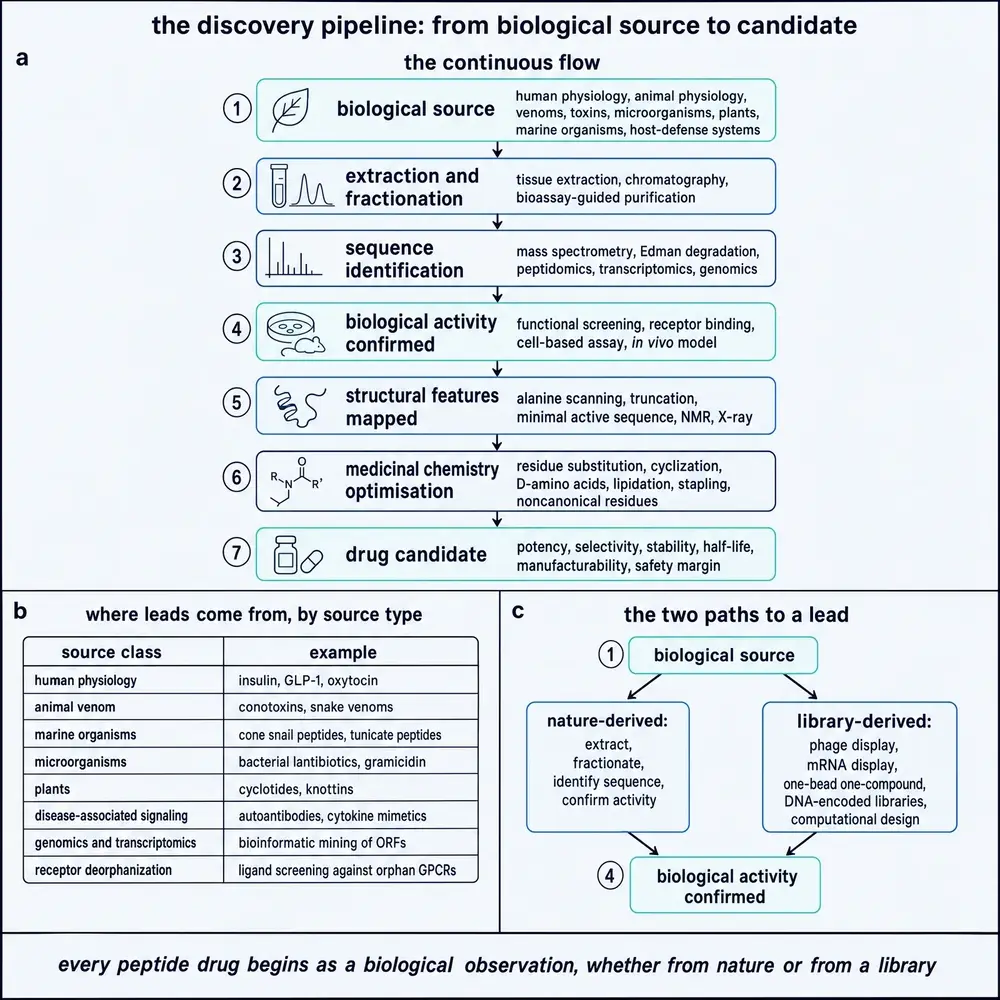
Two threads run through the whole of what follows, and both are stated wherever they appear rather than saved for a conclusion.
The bottleneck has inverted. For most of the twentieth century the hard part of this discipline was getting the molecule. A hormone was purified from tonnes of tissue over years, and determining its sequence could consume a career. Three technologies dissolved that problem almost completely: solid-phase synthesis, which made peptides available in quantity; genotype-linked display, which made selection from enormous populations possible; and sensitive mass spectrometry, which made identification routine. Since roughly 1990 the hard part has been everything after binding. A document that treats discovery as the difficulty is describing the field as it was, not as it is.
Every fix costs something. There is no free modification. This is not a rhetorical caution — it is measurable, it has been measured repeatedly, and the exchange rate spans three orders of magnitude. Section 28 gathers the ledger; Part Four posts to it in every section.
Section 02The body's own vocabulary
The highest-prior lead available to anyone is a molecule the organism already makes. If a peptide circulates in humans and binds a human receptor to produce a physiological effect, the target is validated by the strongest evidence that exists: the species survived with it. No animal model, no knockout, no genetic association study carries that weight.
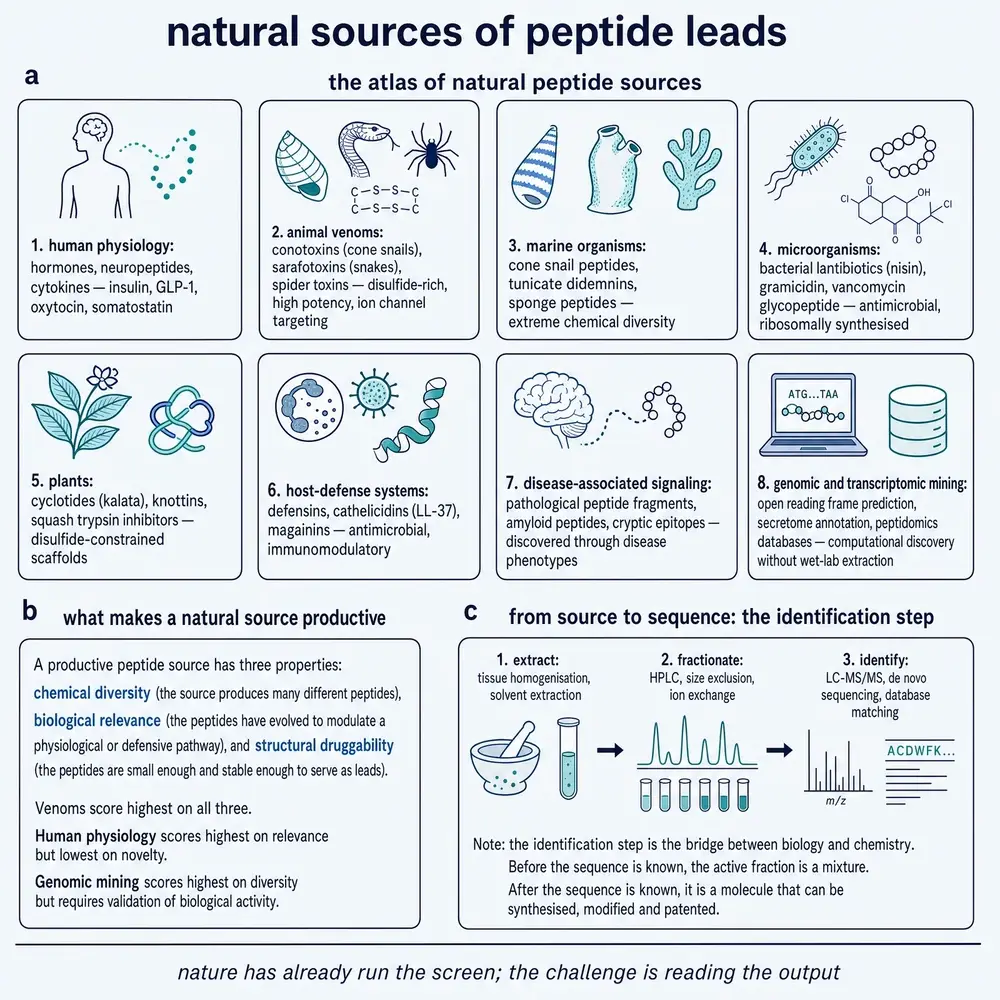
And yet the endogenous molecule is almost never the drug. Insulin is the great exception, and it is instructive precisely because of how much engineering it has required since. The general pattern is that the natural ligand supplies the address — the receptor, the pharmacophore, the proof that engaging it does something worth doing — and then is discarded in favour of something more durable. Native GLP-1 is not a medicine; liraglutide and semaglutide are. Native GLP-2 is not a medicine; teduglutide is, and differs from its parent by a single residue.
The precursor is often the more informative object, and it is routinely overlooked. Peptide hormones are cut out of larger proteins by prohormone convertases, and the same precursor frequently yields several products with different, sometimes opposing, activities. A laboratory that identifies a peptide fragment in a tissue extract has found something real; whether that fragment is released in life, at what concentration, and whether the concentration is ever sufficient to engage a receptor are three further questions, and Section 09 is about how often they go unasked.
Section 03Chemical warfare as a pre-optimised library
A venom is a library that evolution has already screened. The cone snail does not have the luxury of a compound that works slowly or hits the wrong target; it is a slow animal hunting fast fish, and its venom has been optimised under lethal selection pressure for potency, selectivity and stability in a biological medium. There are perhaps seven hundred Conus species, each with a distinct venom of a hundred or more peptides, and the resulting library is both enormous and pre-validated in a way no synthetic collection can be.
Ziconotide is the clean case. It is ω-conotoxin MVIIA, from the venom of Conus magus, and it is unmodified: a twenty-five-residue, polybasic peptide held in shape by three disulfide bridges, synthesised rather than extracted, and otherwise exactly the molecule the snail makes. It blocks the N-type calcium channel and, through it, transmitter release from the central terminals of pain fibres. Every bit of the human contribution went into delivery rather than chemistry, and Section 25 returns to what that cost.
Exenatide is the second case and a more complicated one. Exendin-4 was isolated from the venom of the Gila monster, Heloderma suspectum, by an assay designed to find peptides beginning with histidine. It is 53 per cent identical to human GLP-1, and — the point of the story — its second residue is glycine where GLP-1's is alanine, so dipeptidyl peptidase-4 cannot excise its N-terminal dipeptide. A lizard solved, incidentally and for its own reasons, the specific proteolytic problem that would occupy the pharmaceutical industry for the next two decades.
A toxin is optimised to disable. That is not the same objective as to treat, and the difference shows up in the therapeutic window rather than in the binding constant. It also shows up in immunogenicity: exenatide is a lizard peptide, and in a trial programme that measured both drugs with the same assay, 61 per cent of patients developed antibodies to it against 8.3 per cent for liraglutide, a human analogue — with high anti-exenatide titres significantly attenuating the glycaemic response (P = 0.0022, human). Evolution optimised that molecule for a lizard's purposes in a fish's body, and neither of those is a human patient.
Section 04Host defence, and the source class that will not translate
Antimicrobial and host-defence peptides are the most heavily published lead source in this field and among the least translated. The numbers are worth stating plainly, with their provenance, because they are the sharpest available illustration of a literature enriching for the wrong thing.
A 2020 database analysis reports that more than three thousand antimicrobial peptides have been described and seven approved by the United States Food and Drug Administration — a ratio of roughly four hundred and thirty to one. A 2025 review puts the described count at 11,612 with eleven marketed, a ratio of about a thousand to one, and notes that some fifty have entered clinical trials with fourteen reaching Phase III. The two counts are not commensurable — different jurisdictions, different inclusion rules — and this document presents them as two independent estimates of the same order of magnitude rather than as a time series. What is not in doubt is the order of magnitude.
Inside the 2020 analysis sits the finding that explains the ratio. About seventy per cent of the database — 1,869 of 2,700 analysed entries — are small cationic amphipathic peptides, the structural class that dominates every review of the field. Exactly one approved antimicrobial peptide, colistin, belongs to that class. Every approved one was discovered in Gram-positive soil bacteria, and 98 per cent of all described antimicrobial peptides come from natural sources such as frog skin secretions and animal toxins. The field has spent three decades collecting more members of the structural class that has produced one drug.
The stated causes of failure are consistent across both reviews: cytotoxicity, susceptibility to proteolysis, and poor pharmacokinetics. There is a fourth that neither states directly and that the approval pattern reveals: most approved antimicrobial peptides are used topically. The class has largely succeeded by avoiding the systemic pharmacokinetic problem rather than by solving it — which is the same manoeuvre Section 25 finds in the gut-restricted peptides, arrived at by a different route.
Pexiganan is the cautionary programme, and Section 31 tells it in full. It is worth noting here only that it failed Phase 3 twice, twenty years apart, and that in one of the 2016 trials the placebo arm outperformed the drug arm — 60.6 per cent resolution against 50.6 per cent, in humans.
Section 05Scaffolds rather than drugs: plants and the sea
Cyclotides are plant peptides of about thirty residues whose backbone is a closed circle and whose three disulfide bonds are threaded through one another in a knot. The architecture is extraordinarily robust: cyclotides survive boiling, and they survive proteases that dismantle ordinary peptides in minutes. Knottins, from a range of organisms including spiders and cone snails, share the topology.
This source class has contributed more frameworks than molecules, and this document says so rather than implying a clinical record it does not have. The interest in cyclotides is largely that a foreign binding loop can be grafted into a scaffold whose stability is already established — a way of buying protease resistance without designing it. That is a real contribution and it is a contribution to Part Four rather than to Part One: the cyclotide is not the lead, it is the chassis.
Section 06Choosing a target instead of finding a molecule
Everything so far starts from a molecule. The alternative is to start from a target and manufacture a molecule for it, and this is where peptides have an argument no other modality can make.
A great many disease-relevant proteins do their work through protein–protein interactions, and those interfaces are flat, wide and largely featureless — nothing like the deep pockets that small molecules occupy. The interface between two proteins may bury a thousand square ångströms with binding energy concentrated in a handful of hot-spot residues. A small molecule cannot span it. An antibody cannot reach inside a cell to find it. A peptide is the right size and the right shape, because a peptide is made of the same thing the interface is made of. This is the substantive content of the claim that peptides address the "undruggable" class.
The inverted route — find the receptor first, then its ligand — has been running since the 1970s and produced several of the field's most important molecules. It fails differently from the classical route, and both failure modes are worth holding in mind. Classical discovery starts from something that demonstrably matters and may never find the molecule responsible. Reverse pharmacology starts from a molecule that certainly exists and may discover that it does nothing anyone needs. The second failure is cheaper to reach and considerably harder to publish.
Target validation is the first decision in a programme and the most consequential, and there is quantitative evidence about what happens when it is weak. Of drug-candidate failures between Phase II and submission in 2013–2015, 218 were reported and 174 stated a reason; the majority were attributed to efficacy (52 per cent) or safety (24 per cent). This is an analysis of stated reasons across all modalities, and two cautions travel with it: sponsors have obvious incentives to attribute a termination to portfolio strategy rather than to a target that never existed, so 52 per cent is plausibly a floor; and the residual quarter is unallocated in the evidence this document obtained, so no three-way split is printed.
The two famous industry audits of preclinical reproducibility — a pharmaceutical company reporting that it could fully reproduce the published findings behind only a fraction of its internal projects, and another reporting that it reproduced six of fifty-three landmark cancer studies — are discussed in Section 32 rather than here, and they are discussed rather than quoted. Both are one-page items with no abstract in the public index, behind paywalls, whose headline figures this build could not verify against the instrument. That is not a small point about citation hygiene. It is the principal evidence for a claim the entire field repeats.
Part Two is about the problem that used to be the whole problem.
Section 07The classical route, and what it cost
The original method for finding a peptide was to grind up a great deal of tissue and follow the activity down. You take an extract, you split it into fractions, you test every fraction in an assay, you keep the one that works, and you split that. Repeat until one thing is left.
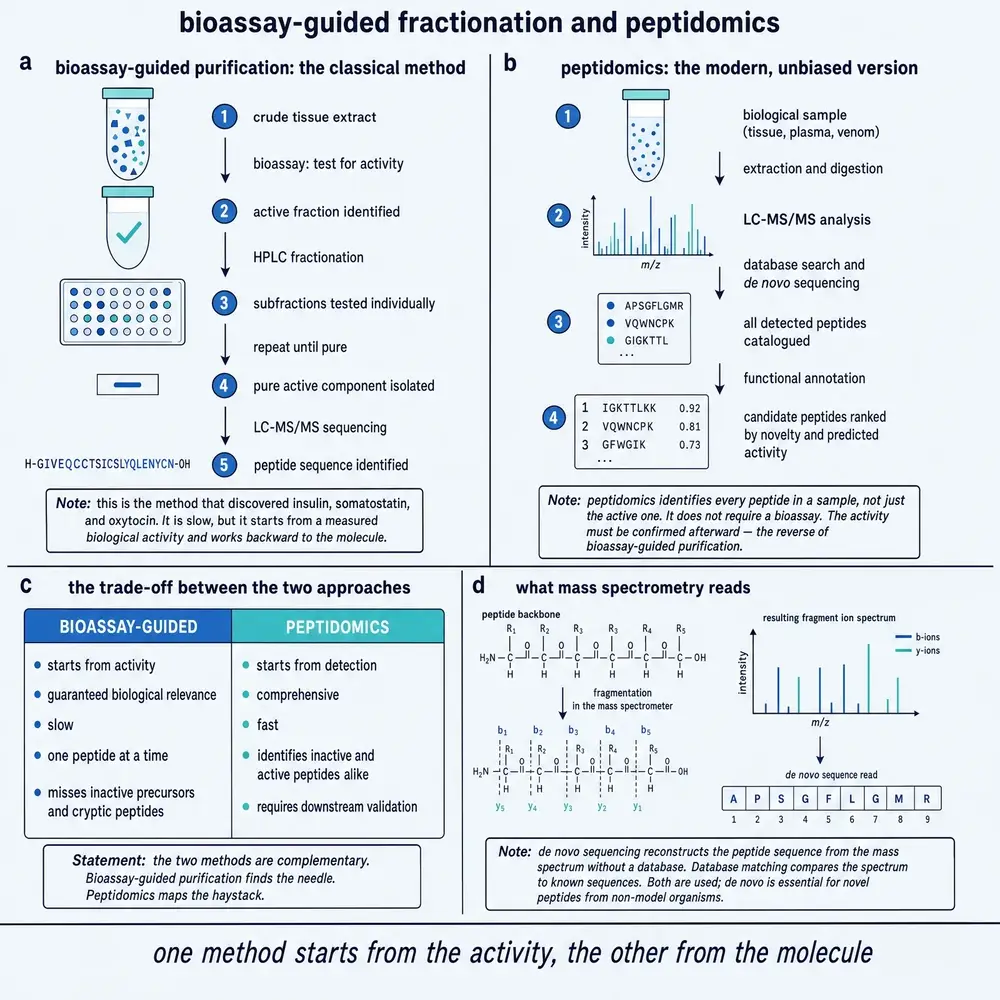
Everything in that description is easy except the assay. Fractionation is mechanical; the difficulty is that the readout has to survive the dilution. Each round removes most of the mass, so the activity you are chasing gets fainter as the material gets purer, and an assay that works on a crude extract may report nothing at all on the fraction that actually contains the molecule. The history of this discipline is substantially a history of assays sensitive enough to see what was left.
What it cost was time and material on a scale that is now hard to picture. The point is not nostalgia; it is that the modern era's characteristic problem — too many candidates, not enough ways to choose between them — is the exact inverse, and both are worth holding in mind when reading a claim that some new platform has "accelerated discovery".
Section 08Reading the molecule
A purified peptide is not yet a known peptide. Edman degradation, which removes and identifies one residue at a time from the N-terminus, made sequencing possible and imposed its own limits: it needs a free N-terminus, which many biological peptides do not have, and its yield per cycle compounds, so long peptides degrade into noise.
Mass spectrometry replaced it for most purposes and changed what a sequencing experiment is. Tandem mass spectrometry fragments a peptide along its backbone and reads the sequence from the mass differences between fragments, which requires no free terminus, works on mixtures, and needs vanishingly little material. De novo sequencing — reading a sequence with no database to match against — is what makes venom and tissue peptidomes tractable.
PubMed Central's full-text extraction strips superscripts. A library size written as 1013 comes back as a bare "10". Several library-size figures visible in the prose of papers read for this monograph were therefore recorded as unverified rather than guessed, and the comparison table in Section 11 has empty cells because of it. A reader working from extracted text and a reader working from the PDF are not looking at the same numbers.
Section 09The whole population at once
Peptidomics inverts the classical question. Instead of chasing one activity to its molecule, it asks what peptides are present in a tissue at all, and returns a list.
Three things go wrong, and all three produce confident answers to the wrong question. The first is quench chemistry: proteases keep working after the animal stops, so what is not quenched within seconds is a degradation product of what you wanted, and it will be sequenced with exactly the same confidence as the real thing. The second is the database match, which tells you a sequence exists inside a precursor protein — not that the fragment is released in life, nor that its concentration ever reaches a receptor. The third is the candidate list itself, which is where a peptidome stops being a measurement and becomes a hypothesis.
The modern version of this approach is computational rather than analytical: mine a genome or a transcriptome for sequences that look like precursors of known peptide families. One study in this corpus screened three hundred thousand sequences with profile hidden Markov models and reported a discrimination coefficient of 0.93 against 0.76 for a straightforward sequence search, recovering eighty-seven conoinsulin precursors from twenty-three cone snail transcriptomes, fifty-seven of them previously undescribed (computational). The same paper supplies the caution: a single substitution at position B10 abolished receptor binding entirely. A mined sequence is a hypothesis about a molecule, and the distance between the two is one residue.
Section 10Making the library instead of finding it
Solid-phase peptide synthesis is the enabling engineering of this entire field, and its logic is worth stating because everything downstream inherits it. Anchor the C-terminal residue to an insoluble bead; add the next residue; wash away everything that did not react; repeat. Because the growing chain is attached to something you can filter, purification between steps becomes a rinse rather than a chromatography. What had been a career became an afternoon.
Two consequences follow immediately. The first is that once peptides can be made quickly, they can be made in large numbers, and the 1991 issue of Nature that carried the two dominant approaches to synthetic peptide libraries carried them on facing pages: one-bead-one-compound at 354:82, and mixture-based positional scanning at 354:84.
The second consequence is arithmetical and unforgiving, and Section 29 returns to it: yield compounds. Every coupling is a probability, and a fifty-residue peptide requires forty-nine of them.
The mixture-library paper reports "more than 34 million hexapeptides", and that figure is quoted constantly as an illustration of combinatorial scale. Computed rather than recalled: 186 = 34,012,224, while 206 = 64,000,000. The published number is the theoretical diversity of an eighteen-letter alphabet — consistent with the customary omission of cysteine and tryptophan from mixture libraries. Quoting it as what twenty amino acids give you is a near-twofold error, and it is the kind of error that survives indefinitely because nobody recalculates it.
The two synthetic approaches trade against each other cleanly. One-bead-one-compound puts a single sequence on each bead, so the library size is a physical count of beads — millions — and screening can be done on-bead, including enzymatic screens. Its limitation is fundamental: there is no genotype to amplify. A bead consumed is gone, and no round of enrichment is possible. Mixture-based libraries put the peptides free in solution in usable quantities, so they work in whole-cell assays that bead-bound libraries cannot touch; their cost is that a mixture returns an averaged signal and identification requires iterative resynthesis.
Section 11Coupling the molecule to its own instructions
Display technologies solve the amplification problem with one idea: keep a physical link between each peptide and the nucleic acid encoding it. Then selection can be followed by amplification, amplification by another round of selection, and a population can be evolved rather than merely searched.
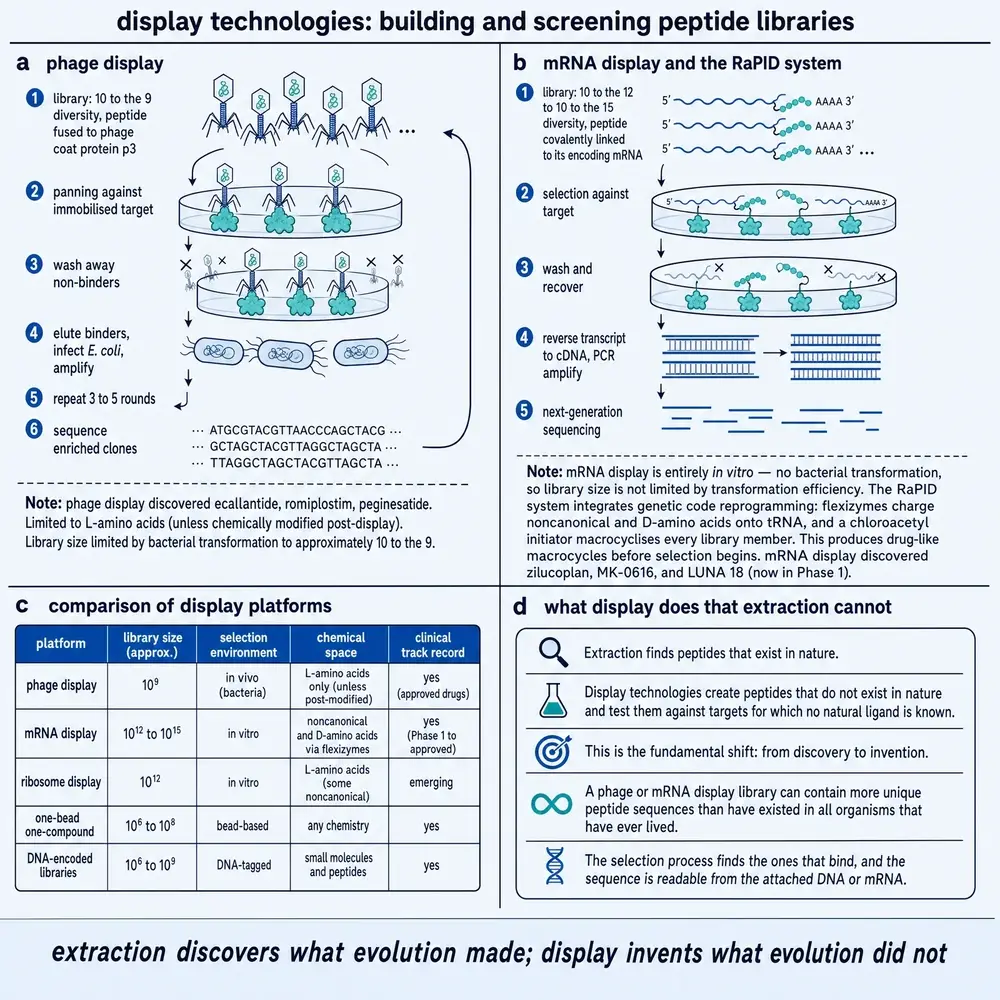
The axis that explains most of the differences between platforms is whether the library has to pass through a living cell. Phage and yeast display require transformation, and transformation efficiency caps diversity. Ribosome and mRNA display are cell-free, and the founding ribosome-display paper says so explicitly: libraries "can now be screened and made to evolve in a cell-free system without any transformation or constraints imposed by the host cell". That single architectural difference propagates into diversity, into the tolerance of sequences toxic to the host, and into whether non-canonical residues can be encoded at all.
On the last point the evidence is uneven, and this document reports the unevenness rather than smoothing it. The flexizyme system — ribozymes that charge transfer RNAs with almost any acid — permits genetic-code reprogramming, and N-methyl amino acids, D-amino acids, α-hydroxy acids, β-amino acids and macrocyclic scaffolds have all been encoded through it (experimental). For phage and yeast display, no clean capability statement was obtained in this build, and the corresponding cells in the comparison table are empty.
Which brings the section to its real limit. The largest verified in vitro selection libraries hold more than 1013 species — the RaPID system's are described as trillion-member. Sequence space at ten residues is 1.024 × 10¹³. The best library technology anyone has built exhausts the possibilities at about ten residues and is lost above twelve. The co-inventor of mRNA display states it of his own platform: the largest selections "can only search a vanishingly small fraction of sequence space for proteins longer than ≈10 amino acids".
And a library is smaller than its nominal size. A probabilistic analysis of an NNK-encoded heptapeptide library of one billion clones finds it contains about 5.6 × 10⁷ distinct peptides — roughly eighteenfold redundant, covering about six per cent of what it nominally targets (computational). Any comparison of "library size" that does not say whether the number is theoretical, constructed or sampled is comparing three different quantities.
There is a further observation from this document's own corpus that a methods chapter would not predict. Across the 156 local full texts read in detail, display campaigns appear about twice. Almost all the actual peptide discovery in that corpus is mining endogenous sequences or building small rational series — libraries of tens to hundreds, not billions. The platforms in this section are the field's most celebrated technology and, at least in a therapeutic-peptide library assembled for other purposes, not its most used one.
Section 12Screening
A screening cascade does not narrow because compounds fail. It narrows because each stage asks a harder question than the one before it, and the two descriptions have different consequences for how you read a hit rate.
Peptides bring two specific false positives that ordinary counter-screening was not designed for. The first is aggregation: a peptide that forms colloidal particles can inhibit almost any enzyme non-specifically, and it does so reproducibly, which means a re-test confirms it. The second is membrane disruption, which produces a beautiful dose-response in a cell assay and represents no target engagement whatever. Both survive a primary screen and a confirmation; only an orthogonal assay on a different physical principle removes them.
The corpus supplies an unusually clean illustration of the gap between binding and function. One study reports a small molecule binding a viral protease in the catalytic cleft at nanomolar affinity, verified, with zero antiviral activity in cells. Binding was real. Function was absent.
One document in this corpus reports a hundred- to thousandfold discrepancy in half-maximal effective concentration for a single compound between assay formats. Another finds isothermal titration calorimetry and fluorescence disagreeing two- to threefold on identical peptide–membrane systems. A third records that acylated analogues lose an order of magnitude of apparent potency when the assay moves from 0.5 per cent plasma to 100 per cent human plasma — the albumin that extends the half-life is competing for the drug. A potency comparison across papers is usually a comparison of assays.
Section 13Computation as a discovery method
This section is given its own recency weighting and its own honesty constraint. Every claim in it is labelled computational or experimental in the sentence that reports it, because the distinction is doing real work here in a way it does not elsewhere in the document.
Begin with a framing error that is easy to make and hard to detect. Most of what is publicised as "AI peptide binder design" is the design of a sixty-to-hundred-residue protein whose target happens to be a peptide. In the most celebrated of these papers the peptides — parathyroid hormone, glucagon, neuropeptide Y — are the targets; the designed molecules are proteins. Reporting its sub-picomolar affinities as peptides designed by artificial intelligence inverts the experiment.
With that separated out, what has actually been done is still substantial. A diffusion-based method applied to macrocyclic peptides generated between ten and twenty thousand backbones per target computationally, synthesised fewer than twenty molecules per target, and obtained binders at 6 nM and 9.4 nM for two of four targets, with X-ray structures within 1.5 Å of the design models (experimental). Against a trillion-member library that is eleven orders of magnitude fewer physical molecules. The other two targets stalled at about 2 µM — roughly where classical parametric design landed — so the hit rate across targets is fifty per cent and target-dependence is severe.
The single best-validated generative peptide result located for this document trained a diffusion model on sequencing kinetics from a prior display selection. Of ten thousand generated sequences, twelve were synthesised: eleven were functional and nine had higher affinity than the picomolar parent (experimental). More than ninety-nine per cent of generated sequences were absent from the training data. And a detail worth more than the headline: two of the best sequences carry a proline at position three — helix-breaking, and predicted to adopt a polyproline conformation rather than the expected helix. A rational designer would have excluded them.
The counterweight is equally well documented. In the antimicrobial peptide field, a Bayesian analysis across matched datasets gives a 94.9 per cent probability that shallow-learning models outperform deep-learning models on current data (computational), with the authors naming the cause: there are no labelled negative sets, assay conditions are not standardised, and no applicability-domain analysis of the kind routine in small-molecule work is performed. Two published AI-antimicrobial campaigns illustrate the range: one that generated sequences de novo synthesised twenty and found two active (10 per cent); one that mined a metagenome synthesised 216 and found 181 active (over 83 per cent). Those are different activities, and conflating them inflates apparent generative success roughly eightfold.
This document's own corpus adds a consistent finding from a different angle: wherever a computational score was followed by a measurement, the calibration was poor. A binding energy of −109 kcal/mol corresponded to twenty-seven per cent maximum inhibition on a bell-shaped curve; a machine-learned antimicrobial score rose while measured concentrations worsened and cytotoxicity increased ninefold; an eight-residue peptide scored best against six of seven unrelated targets. Prediction is not yet ranking.
Part Three is about the step that turns a molecule into a design.
Section 14Confirming that the activity is real
A hit is a claim about a molecule, and the claim has five distinct strengths that are routinely conflated: it binds; it does something in a cell; it does something in an animal; it does something in a person; it is approved. The distance between the first and the last is the subject of Part Five. The distance between the first and the second is the subject of this section, and it is where the cheapest failures live.
Binding selects easily and function does not, and every discovery campaign in this document's corpus that reported both found the gap. A phage-display campaign over four rounds with a twelve-residue library produced four binders and one inhibitor, at a modest 7.4 µM (experimental). Another found that fusion peptides assembled from two receptor-binding sites had sub-nanomolar affinity comparable to the native hormone and could not stabilise the receptor's activated conformation at all — and, revealingly, slowed hormone dissociation where the native hormone accelerates it. They bound the right protein in the right place and did the opposite of the right thing.
One study in this corpus measured circular dichroism on its alanine-scan mutants and found that five of them had reduced helicity. Part of what had been recorded as lost binding interface was in fact lost structure: the substitution had not removed a contact, it had unfolded the peptide. Without that control, a scan attributes to a side chain what belongs to the backbone — and the resulting map of "important residues" sends the next round of chemistry to the wrong positions.
Section 15The minimal active sequence
Truncation asks the simplest possible question: how much of this can be removed before it stops working? Remove residues from one terminus, assay, repeat; then do the other end. The answer is frequently startling.
The lineage drawn above runs from a two-hundred-residue neurotrophic factor to an eleven-residue peptide, then to a four-residue core, and finally to an adamantylated pentamer that is orally active. Note the last rung: the pentamer's half-life is lower than the eleven-mer's, and it was still the candidate, because oral viability was worth more than duration. The tradeoff ledger of Section 28 is already operating inside a single programme.
Truncation buys more than convenience. In one case in this corpus, cutting an orexin peptide back produced fragments with more than thousandfold selectivity between two receptors that are about eighty per cent identical across their transmembrane region (in vitro). The removed residues were not inert; they were what the peptide used to engage the receptor it was not supposed to engage. Shortening a molecule can be a selectivity strategy rather than a simplification.
Section 16Alanine scanning and the hot spot
Replace each residue in turn with alanine — a side chain reduced to a single methyl group — and measure what happens. It is the cheapest informative experiment in the discipline and the one that turns a molecule into a design.
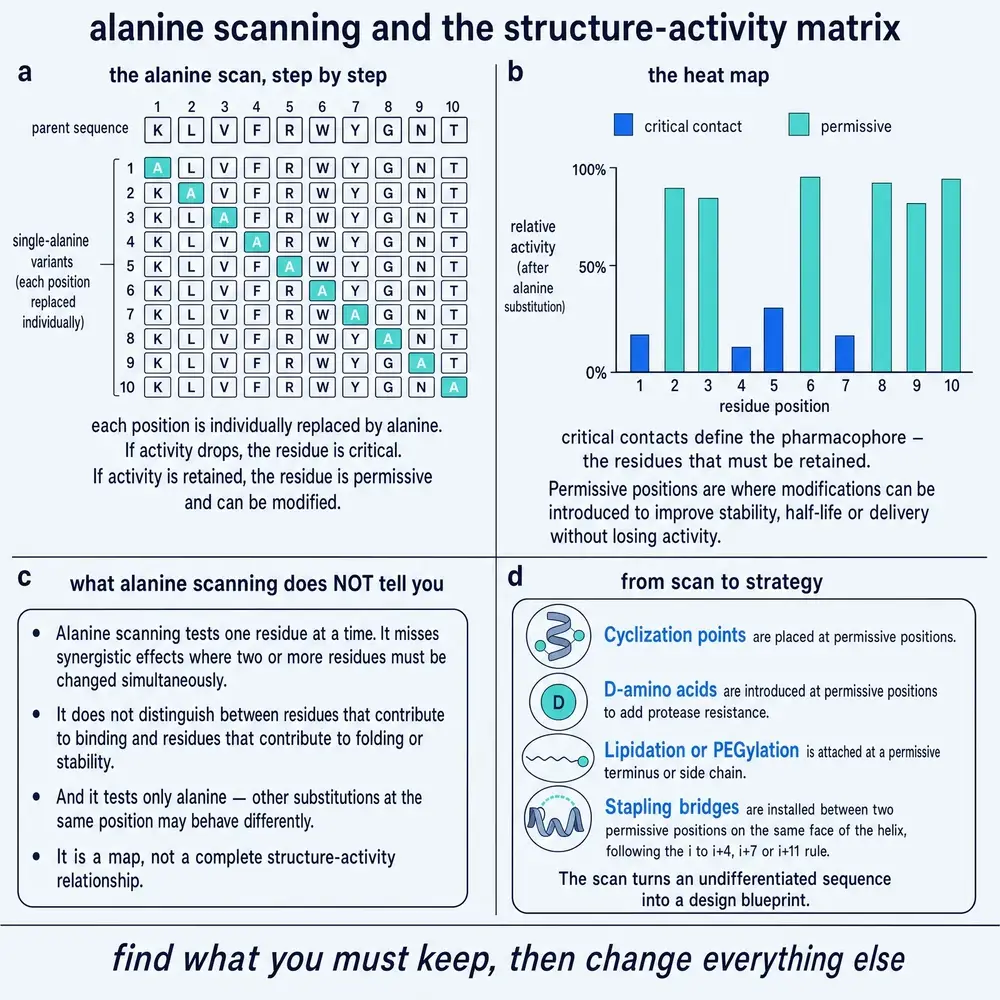
The characteristic result is that most positions tolerate substitution and a few do not, and it is that ratio which makes peptide engineering possible at all. If every residue mattered, a forty-residue hormone could not be replaced by a ten-residue design and there would be no room to install any of Part Four's chemistry.
Three cautions, each from this corpus, and each of which limits what a scan can be asked to support.
A scan tests alanine, not substitution in general. In one humanin study, replacing serine 14 with glycine raised potency more than thousandfold and replacing it with D-serine did something similar — while replacing it with alanine abolished activity (in vitro). A position-level summary reading "position 14 is essential" would be true of the alanine scan and profoundly misleading about the position.
A scan can find gains, not only losses. A routine alanine scan of a receptor rather than a ligand produced a single substitution that improved potency seventy-twofold. Scans are usually read as maps of what must not be touched; they are equally maps of where there is room.
And a scan measures the peptide's structure as well as its contacts — the circular-dichroism control of Section 14.
Section 17Substitution, matrices and the structure–activity relationship
Beyond alanine, the question becomes which residue to put where, and here the tools imported from protein science fit badly. Substitution matrices such as BLOSUM encode how often residues replace one another across evolutionary time in folded proteins, where the dominant constraint is maintaining a hydrophobic core. A ten-residue peptide binding a receptor surface has no core to maintain, and its constraints are almost entirely local. A matrix that says leucine and isoleucine are interchangeable is describing a statistical regularity in a context that does not apply.
The matrix above is the structure–activity summary this document can support, and its most important feature is how much of it is empty. Fifty-nine of ninety-six cells carry a direction; thirty-seven do not. Those cells are blank because this document's evidence base does not establish a direction for them — not because the effect is zero. A matrix filled by inference would read as knowledge the field does not have, and would be the exact defect this document's figure rules exist to prevent.
Two structural findings from the corpus deserve to be read alongside it, because both say that where matters more than what.
In one insulin-engineering study, moving a boronic-acid modification from the B chain to the A chain — the same chemistry, a different position — gained sixfold solubility at no cost in potency, while N-terminal acetylation gained solubility and cost eightfold potency. In a second, reversing the order of two motifs in a conjugate, with identical residues and identical composition, changed the half-maximal inhibitory concentration 2.8-fold. In a third, two fusion constructs of identical molecular weight and identical net charge, differing only in which terminus carried the functional module, differed 4.2-fold against 1.5-fold in cellular uptake.
None of those results is visible in a composition-based analysis, and none would be predicted by a substitution matrix. The lesson generalises and Part Four depends on it: a peptide is not a bag of residues, and the position of a modification is frequently worth more than its identity.
Part Four is about what is done with that knowledge.
Section 18What actually kills a peptide
Three things remove a peptide from circulation, and they are not interchangeable. Proteases cut it. The kidney filters it. The liver takes it up. A modification that defeats one leaves the others entirely intact, and the history of this field is largely the history of discovering that in the expensive order.
The procedural lesson is the one worth carrying, and it comes from the programme in this document that documents it most fully. That team did not predict where its peptide would be cut. They identified the metabolite, found the cleavage site from it, and installed an N-methylation precisely there. The result took the molecule from 5 nM to 0.9 nM while making it stable in human, monkey and rat plasma (in vitro). You cannot block a cut you have not located, and locating it is an analytical problem rather than a computational one.
Ex vivo blood half-lives for the incretin peptides run to hours — two hours for GLP-1(7–36)amide in human whole blood at room temperature, more than ninety-six hours in plasma with protease inhibitors added. The in vivo intravenous half-life of the same peptide in a person is about ninety seconds. The assay measures proteolysis only; in the body the kidney is working at the same time. Four independent studies in this corpus found in vitro plasma stability failing to predict in vivo duration, and the cleanest of them raised mouse plasma half-life from 5.4 to 9.3 hours and improved potency fivefold, only for a dedicated pharmacokinetic study to find no difference in exposure at all — the gain came from biased signalling and reduced receptor internalisation, not from stability.
On renal clearance this document prints no threshold, and the reason is worth stating. The best available meta-analysis explicitly rejects one: "it appears unlikely that a single cut-off point exists… the data indicate a continuous relationship between the molecular weight and the glomerular sieving coefficient." The determinant is hydrodynamic radius and charge rather than mass, which is why quoted mass thresholds range from 30 to 70 kDa depending on who is quoting. A measured ladder is available and is used instead: inulin at 3.0 nm is filtered completely, albumin at 7.3 nm is 0.3 per cent filterable, immunoglobulin G at 11.0 nm essentially not at all.
Section 19Stopping the cut
Proteases recognise both the side chains around a bond and the backbone geometry, so a peptide can be protected by changing either. D-amino acids invert the stereochemistry the enzyme expects. N-methylation removes the amide hydrogen the enzyme's binding site reads. α-Aminoisobutyric acid replaces the α-hydrogen with a methyl group, which is enough to obstruct a protease and enough to bias the backbone toward a helix. Terminal amidation removes the C-terminal charge that carboxypeptidases recognise.
The decisive experiment for this whole class is the position-8 series in GLP-1, and it is decisive because it records the failures alongside the success. Substituting glycine at the DPP-4 site conferred resistance and significantly reduced receptor affinity. The stated result: "the only Ala substitution that resulted in both DPP-IV stability and high GLP-1R affinity was the introduction of aminoisobutyric acid at position 8." One non-proteinogenic residue solved a problem that the twenty canonical ones could not.
That the same glycine substitution was tolerated by the GLP-2 receptor, and became teduglutide, is the qualification that keeps this from being a rule. Whether a substitution is affordable is a property of the receptor, not of the chemistry.
Icatibant shows what a full commitment to non-canonical chemistry buys. It carries five non-proteinogenic residues — a D-arginine extension, a hydroxyproline, a thienylalanine, a D-configured tetrahydroisoquinoline carboxylic acid, and a bicyclic proline surrogate — and against its first-generation comparator it is roughly two thousand seven hundred times more potent in guinea-pig ileum, eight hundred times in rat uterus. Four hours after a subcutaneous dose ten times lower than the comparator's, inhibition still amounted to sixty per cent where the comparator's effect was not significant (rat).
What it cost: no recombinant route, five specialty building blocks, no biologic scale economics — and a human half-life of 1.4 hours, because duration was never the design objective and was never solved. Icatibant is an acute rescue drug and cannot be prophylaxis.
One programme in this corpus made a D-amino-acid substitution in a peptide–drug conjugate and made the drug sixfold weaker: the half-maximal inhibitory concentration went from 1.5 to 8.9 µM, because the modification made the linker too stable to release its payload. A second study's negative control blocked protease cleavage successfully and showed little activity. Protease resistance is a means. A molecule that survives and does nothing has satisfied the assay and failed the purpose.
Section 20Freezing the shape
A linear peptide in solution samples an enormous number of conformations, and only one of them binds. Every binding event therefore pays an entropic price for the ones that were discarded. Pre-organise the molecule into something closer to its bound shape and the price falls. That is the argument for constraint, it is sound, and it is not sufficient.
The best-documented near-failure in this corpus is a disulfide-to-lactam substitution intended to remove a redox liability. Replacing the bridge with a same-size four-atom lactam took the molecule from 0.45 nM to worse than 10 µM — a loss of more than four orders of magnitude from a change that preserved ring size exactly. Only a six-to-eight-atom linker with the amide near residue 2 recovered potency. In that series the amide's position was worth more than two hundredfold and its orientation was worth nothing. The ring has to hold the right shape, not merely a shape.
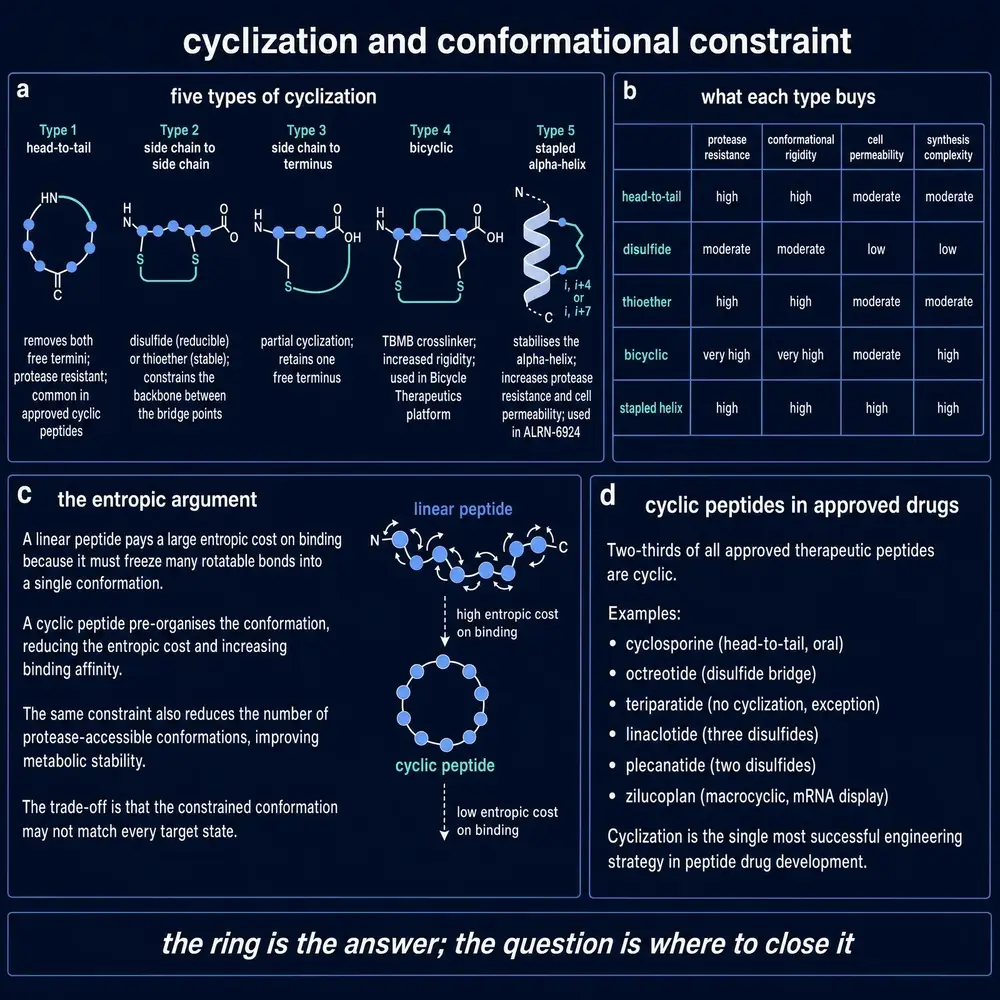
The same programme records why the disulfide had to go at all, and it is not the reason usually given. All thirty-one disulfide-containing analogues dimerised on storage — twenty-seven per cent at 1 mg/mL and forty-two per cent at 20 mg/mL after two weeks at 40 °C. Replacing the bridge took dimer formation to zero and made neutral-pH co-formulation possible. The disulfide is routinely treated as the free option among constraints; it is redox-labile, and in this series it was the formulation problem.
Hydrocarbon stapling makes the strongest structural claim in the class. In one well-characterised molecule, a single ring-closing metathesis across an i, i+7 spacing took helicity from eleven per cent to seventy per cent, and the crystal structure shows the staple itself contributing to target engagement rather than merely holding the helix. What it cost is visible in the clinical protocol rather than in the chemistry: the molecule is a strong inhibitor of a hepatic transporter, and the trial that used it had to exclude patients on medications cleared by that transporter. A chemistry decision became an enrolment restriction.
And a corpus finding that cuts against the technique's reputation: stapling a host-defence peptide raised potency sixteenfold and serum half-life from under an hour to 18.3 hours — while making a non-cytotoxic peptide cytotoxic, and improving the therapeutic index in only three of five analogues. Staples placed on cationic residues lost the charge those residues carried, and with it the activity.
Section 21Staying in the blood
Everything in Sections 19 and 20 defeats proteases, and defeating proteases gets a peptide to about two hours in a human. Exenatide, protected by nature, reaches 2.4 hours. Teduglutide, protected by a single substitution, reaches about two. Both are then cleared by the kidney — the exenatide label says so in one line: "predominantly eliminated by glomerular filtration with subsequent proteolytic degradation."
Breaking the two-hour ceiling requires making the molecule effectively larger, and the elegant way to do that is to borrow something large that is already in the blood.
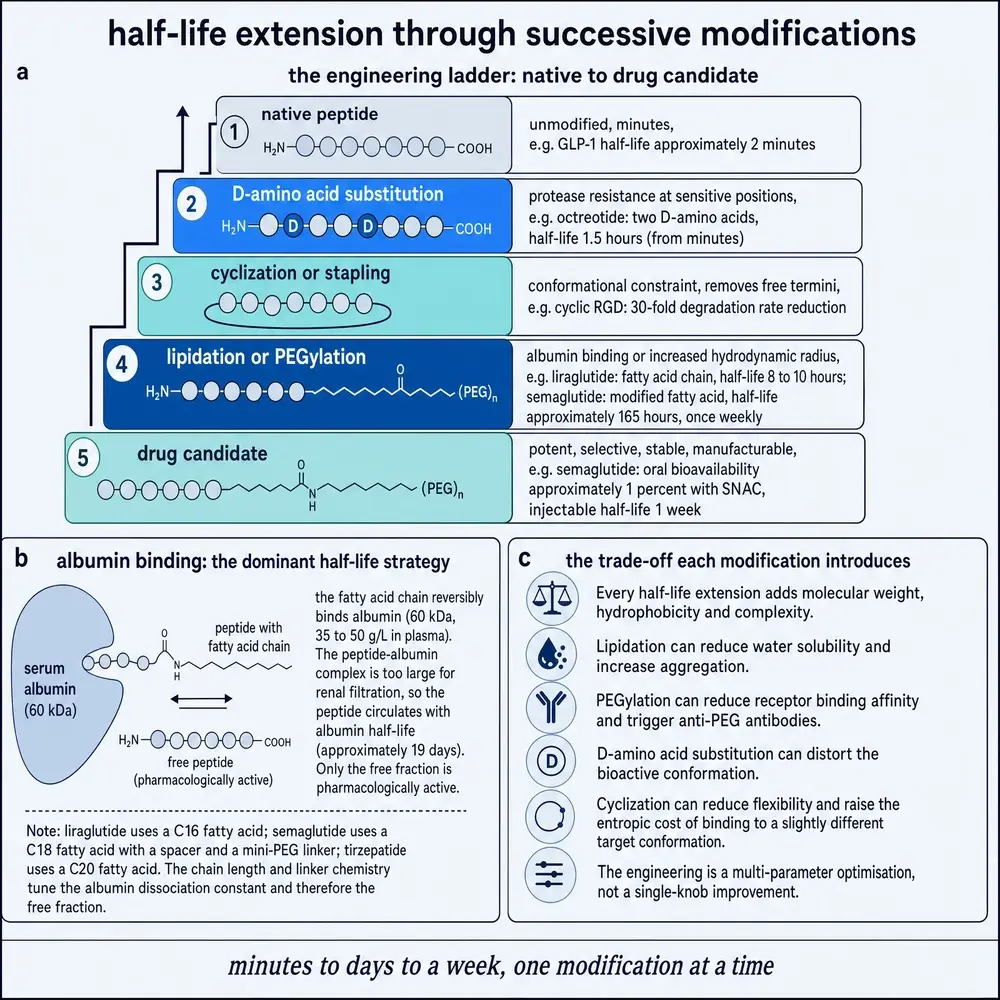
Liraglutide carries a C16 palmitic acid on lysine 26 through a glutamic acid spacer, with the other lysine changed to arginine. Semaglutide carries a C18 diacid through a longer spacer, with α-aminoisobutyric acid at position 8. Human half-lives: about thirteen hours and about one week respectively. Zilucoplan, a macrocycle rather than a linear analogue, carries a C16 through a polyethylene glycol and glutamate spacer and reaches about 172 hours in humans.
The structure–activity relationship underneath those three molecules is not monotonic and not transferable, and this is the section's central claim. Fatty diacids longer than C14 through a glutamate linker lost activity, while mono-acids up to C16 retained it. With a longer spacer, potency rose with diacid chain length from C12 to C18 and then reversed above C18. Three independent non-monotonic optima appear elsewhere in this corpus: acylation of a GLP-2 analogue peaked at C12 and fell at C16 for epithelial translocation; a fluorous oligoarginine peaked at six residues and fell at eight; a dual linker did not beat a single one. In each case the property being maximised kept improving while the property that mattered turned over.
The zilucoplan team tried semaglutide's exact protraction chemistry — the longer spacer with a C18 diacid — and lost about fortyfold potency. Removing the spacer entirely, leaving the fatty acid attached directly, lost about tenfold, "possibly due to interference with target engagement from the steric hindrance effect imposed by albumin binding". The combination that worked was a shorter spacer with a C16, and it worked for that target and that scaffold. There is no universal albumin tag.
What albumin binding costs is potency, reliably, and the exchange rate spans three orders of magnitude. Semaglutide's receptor affinity is about threefold worse than liraglutide's, because the albumin that protects it competes with the receptor for it. Zilucoplan surrendered about threefold for roughly ninefold half-life. Albiglutide, an albumin fusion rather than a binder, reached a six-to-eight-day half-life at a receptor affinity of 20 nM against 0.02 nM for exenatide — about a thousandfold. And one programme measured the cost directly by changing only the assay: a dual agonist's half-maximal effective concentration went from 0.29 nM in 0.5 per cent plasma to 8.3 nM in 100 per cent human plasma.
Lipidation also fails outright more often than its reputation suggests. In this corpus, N-terminal palmitoyl, myristoyl and stearoyl additions took a channel-blocking peptide from fifty-five per cent inhibition to twenty-seven, eighteen and five per cent respectively; palmitoylation of a ghrelin analogue at one lysine cost fivefold potency and ninefold epithelial permeability; two labelled analogues of the same series simply precipitated.
Section 22Native to engineered: one molecule, every change
Zilucoplan is the clearest complete example available, because its discovery paper publishes the failures alongside the successes and because it is, in its authors' words, "the first approved peptide therapeutic derived from an mRNA display screen."
It has no natural parent. A display selection against complement component 5 produced two hits: a thirteen-residue linear peptide at 12 nM containing four non-canonical residues, and a weaker one carrying two cysteines that permitted direct cyclisation. The molecule that became the drug is a hybrid — the cyclic head of one, the linear tail of the other, fifteen residues.
Then the engineering, in order, each step with its measurement. A cysteine replaced by serine to remove an oxidation liability, at essentially no cost. A phenylglycine replaced by cyclohexylglycine because phenylglycine "is notorious for epimerization", producing close-eluting diastereomers — a manufacturing problem solved by chemistry. Hybridisation itself was the stability fix: the linear hit alone left four per cent intact after twenty-four hours in mouse plasma and nine per cent in human, while the hybrid left ninety-five per cent in human. The cross-linker changed from a thioether to a lactam to remove a redox liability, gaining 2.2-fold potency. Metabolite identification located an internal cleavage site, an N-methylation blocked it, and the molecule reached 0.9 nM. Finally lipidation, at the cost and by the route described above.
The result is approved in three jurisdictions for generalised myasthenia gravis. And it carries a differentiator that came from the chemistry rather than from the pharmacology: unlike the antibody against the same target, it binds a distant domain and retains full capacity to bind the receptor variants that respond poorly to the antibody. The macrocycle reaches an epitope the antibody cannot.
Section 23Aiming it
A peptide–drug conjugate is three parts, and the middle one decides whether it works. A linker that cleaves in circulation delivers free cytotoxin systemically and the targeting is worthless; a linker that never cleaves delivers an inert conjugate. Most of the medicinal chemistry in this area is linker chemistry, and most published diagrams draw the linker as a line.
Targeting can also make things worse, which is not the expected failure mode. In one study here, adding a cell-penetrating peptide tripled tumour uptake of one construct — from 2.7 to 8.6 per cent of injected dose per gram (mouse) — and reduced uptake of a closely related construct, while adding hepatic sequestration to both. In another, the same dual linker worked on an unstructured peptide and failed on a helical one, contradicting a published claim that the chemistry does not impair receptor affinity: the measured inhibitory concentration went from 19 to between 38 and 251 nM. And in a third, a fluorescent label intended to be inert improved the half-maximal effective concentration from 69 to 52 nM while destroying about ninety per cent of the efficacy.
There is a case where the delivery tag stops being separable from the molecule at all: in one construct the cell-penetrating segment's residues are perturbed on target binding and respond to the target's phosphorylation state. The tag is part of the pharmacophore.
Section 24One molecule, several receptors
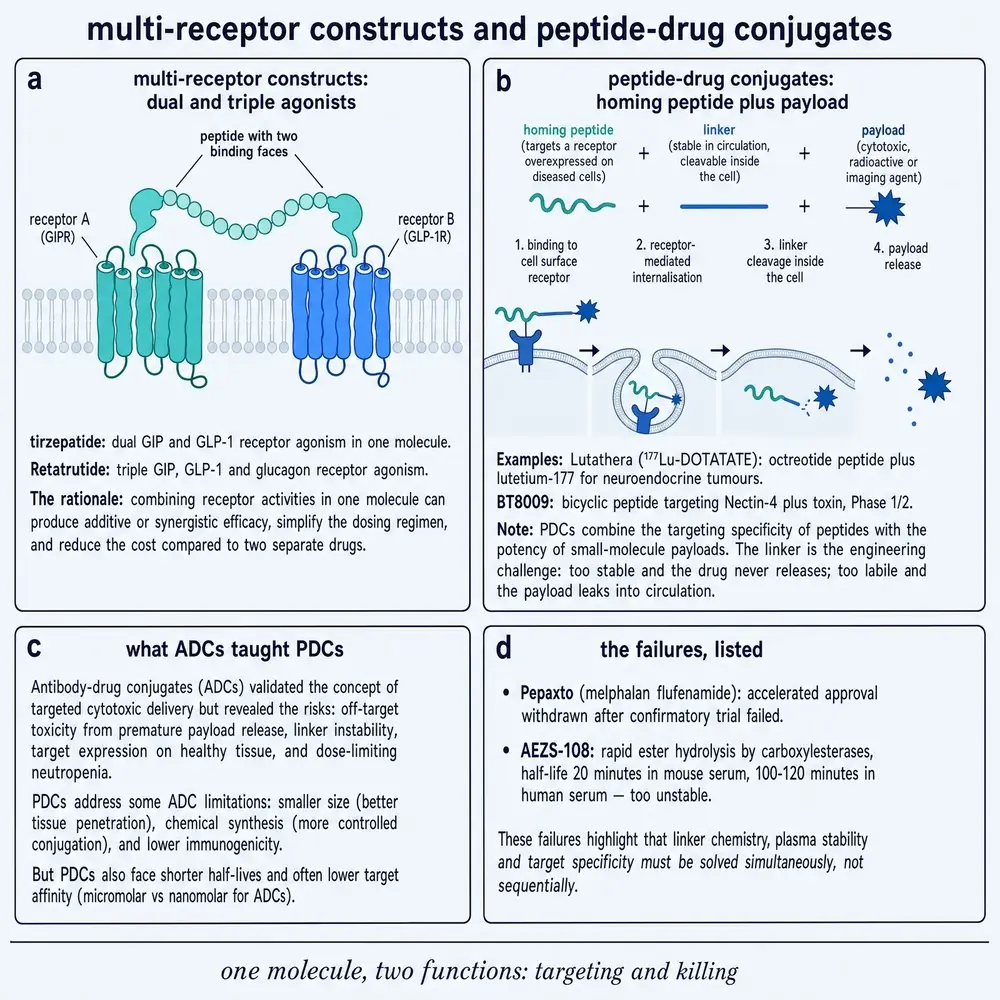
The arguments for putting two activities in one molecule rather than combining two molecules are pharmacokinetic and regulatory. Two molecules have two half-lives, two clearance routes and two dose-response curves, and the ratio of their activities varies with the patient. One molecule fixes that ratio in chemistry.
Which makes the corpus's central finding here counterintuitive. The most successful dual agonist in this evidence base was deliberately made fivefold weaker in affinity and twentyfold weaker in potency at one of its two receptors, for tolerability — and outperformed the balanced comparator. A related programme names the receptor ratio, not the absolute potency, as the discontinuation-relevant design parameter, contrasting a 1:3 programme that was discontinued with 1:5 and 1:8 programmes that were not. Balanced potency is not the objective it is usually assumed to be; the ratio is the design.
The most striking single result in this document's corpus belongs here. One molecule reported as 245-fold weaker at one receptor and 11-fold weaker at another than its comparator, non-lipidated, with an in vitro half-life of about two and a half minutes, produced 14.0 per cent body-weight loss over forty-five days in diet-induced obese rats against 14.7 per cent for semaglutide — with better glycaemic control. Every optimisation criterion in Part Four says that molecule should not work. It is one animal study and it should be read as one animal study. It is also a standing reminder that the criteria are proxies.
Section 25Getting it in
Subcutaneous injection is the default because it works: 89 per cent absolute bioavailability for semaglutide, 88 per cent for teduglutide, 97 per cent for icatibant, all human. Everything else is a negotiation.
Oral delivery with a permeation enhancer is the most-pursued alternative and the measured results are sobering. Oral semaglutide, the field's landmark success, achieves 0.4 to 1 per cent absolute bioavailability in humans by its own label, in a reformulation reaching 1 to 2 per cent. Insulin with a different enhancer reached 7 ± 4 per cent in fourteen people — a standard deviation fifty-seven per cent of the mean. An antisense oligonucleotide reached 9.5 per cent relative in a Phase I with intra-subject variability from 2 to 28 per cent. The reviewers of that literature conclude that enhancers give "single-digit highly variable increases… although this may be adequate for potent macromolecules", and that across sixteen Phase I studies in more than three hundred subjects "the most notable feature was the massive intra-subject variability".
One document in this corpus states the field's goal, in 2008, as raising oral bioavailability "from <1 per cent to at least 30–50 per cent". Another, in 2026, describes the one success as achieving 0.4 to 1.0 per cent — which works only because a 168-hour half-life tolerates not being absorbed. The goal was missed by a factor of about fifty and the drug succeeded anyway, for a reason unrelated to the goal.
Linaclotide is an orally administered drug with about 0.10 per cent oral bioavailability (mouse), and that is not a failure — it is the design. Its receptor faces the gut lumen, so the molecule never has to cross a membrane at all. Three disulfides in fourteen residues, roughly one cross-link per 4.7 residues, buy survival in the lumen rather than permeability. And it is not indefinitely stable: after thirty minutes in jejunal fluid it is completely degraded. It is stable just long enough. Instability is part of the safety design.
Ziconotide makes the same move in the other direction. In cerebrospinal fluid it has nearly 100 per cent bioavailability and is not metabolised; in serum it is completely degraded by peptidases and cannot cross into the brain at all. Its half-life is 4.6 hours in one compartment and 1.3 hours in the other. Peptide pharmacokinetics are a property of the compartment, not only of the molecule — so it is delivered directly into the compartment, by an implanted pump.
Inhaled delivery has one completed experiment and it is a market withdrawal. An inhaled insulin reached approval in the United States and Europe with efficacy comparable to short-acting subcutaneous insulin, and was withdrawn; its recorded adverse profile was dry cough, a slight non-progressive and largely reversible fall in pulmonary function, and increased insulin antibody formation without clinical sequelae. Transdermal delivery of peptides has no marketed product at all, and this document reports that absence rather than reaching for a weak example.
Section 26Design by machine
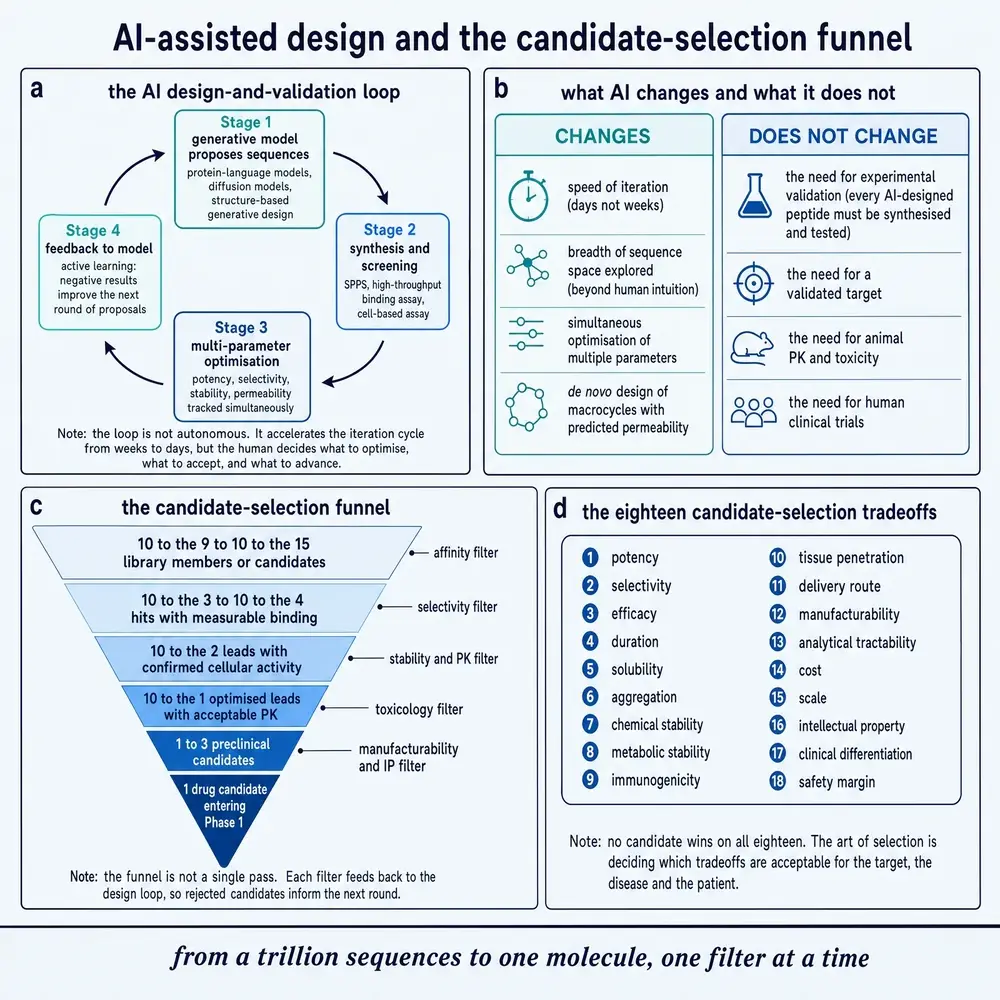
The loop is not new; what is new is which arcs are cheap. Generation and filtering are now nearly free, and a structure predictor used as a gate — with published numerical cutoffs on interface confidence and model quality — can reject most of a design set before anything is made. The two expensive arcs are synthesis and assay, and they are the two the publicity usually omits.
Section 13 gave the state of the evidence. What Part Four adds is the economic point: the macrocycle design programme generated ten to twenty thousand backbones and synthesised fewer than twenty molecules per target. That is not a better search of sequence space; a trillion-member library searches it eleven orders of magnitude more thoroughly. It is a different transaction — replacing searching with predicting, and thereby changing the unit cost of a hit from a library to a synthesis run. Whether that transaction is favourable depends entirely on whether the prediction is calibrated, and Section 13's evidence is that calibration is the open problem.
One peptide plausibly designed this way has entered a clinical trial: a Phase 1, open-label, first-in-human study of a sortilin-targeting peptide conjugated to a cytotoxic payload, recruiting, with a planned enrolment of eighty. The registry facts are verified. The claim that the peptide was designed substantially de novo by computation is a sponsor claim with no peer-reviewed primary paper located, and is printed here as one.
Part Five is about choosing between what survives.
Section 27The eighteen things a candidate must be at once
These are not stages and they are not independent. They are simultaneous constraints, and the reason candidate selection is hard is not that any one of them is difficult — it is that improving any one of them usually costs at least one other. A molecule that satisfies seventeen and fails the eighteenth is not a near miss; it is a failure, and which one it fails is often decided late.
This document draws them as a list rather than a funnel deliberately. A funnel asserts an order and a survival fraction at each gate. Neither could be sourced for peptides specifically, and drawing them would be an invention.
Section 28Every fix costs something
The ledger holds only operations for which both sides were measured in the same programme. The direction never reverses — potency is what you spend, and exposure, stability, selectivity or manufacturability is what you buy — but the exchange rate spans three orders of magnitude, from no measurable cost for an α-aminoisobutyric acid to about a thousandfold affinity loss for an albumin fusion.
Two rows deserve attention because they break the pattern in opposite directions. Tirzepatide's programme spent potency deliberately, making the molecule fivefold weaker in affinity and twentyfold weaker in signalling at one receptor for tolerability, and won on the endpoint that mattered. And one amylin analogue's removal of two deamidation-prone residues raised seven-day stability at neutral pH from 64 to 92 per cent while improving receptor potency from 0.25 to 0.19 nM — a modification that cost nothing at all. Free lunches exist. They are rare enough that the programme reporting one says so.
Section 29Making it
Manufacturability is treated as a downstream concern and is a design constraint, and the arithmetic is the reason. Overall yield of full-length product is the per-step coupling efficiency raised to the number of couplings, and an N-residue peptide needs N − 1 of them. Computed rather than quoted:
| Per-step efficiency | 10-mer, 9 steps | 30-mer, 29 steps | 50-mer, 49 steps |
|---|---|---|---|
| 99.5 % | 95.6 % | 86.5 % | 78.2 % |
| 99.0 % | 91.4 % | 74.7 % | 61.1 % |
| 98.0 % | 83.4 % | 55.7 % | 37.2 % |
| 95.0 % | 63.0 % | 22.6 % | 8.1 % |
At ninety-nine per cent per coupling — a good coupling — nearly forty per cent of the material in a fifty-residue crude is not the target. And the impurities are the hardest possible ones to remove: deletion sequences differ from the product by a single residue, which is precisely the separation reverse-phase chromatography does worst. At ninety-five per cent per step a fifty-mer is not manufacturable.
The corpus supplies the practical version. A sequential synthesis of liraglutide gave about twenty-five per cent crude purity at thirty-seven per cent recovery; an improved route reached about fifty per cent and seventy-six per cent, took three times as long, and failed at tenfold scale. The laboratory result and the manufacturing result are different results.
The environmental cost is an outlier even within pharmaceutical chemistry. Process mass intensity — total material in against product out — is about 13,000 for solid-phase peptide synthesis, against roughly 168 to 308 for small-molecule production and about 8,300 for biopharmaceuticals, from an analysis of forty industrial peptide processes. An industry consortium identified greener peptide manufacture as a critical unmet need in 2016 and characterised the field as using "primarily legacy technologies with use of large amounts of highly hazardous reagents and solvents".
No cost-of-goods figure appears in this document. Everything located was commercial web material of poor quality and mutually inconsistent, and none of it was verifiable. Nor does a residue count at which recombinant production overtakes synthesis: no source stated one, and the circulating figure is anchored to product examples rather than to any economic analysis. The drivers — quantity, timeline, and whether non-canonical residues or lipidation are required — are nameable; the crossover is not.
Impurities are also a regulatory and immunological matter rather than a purely chemical one, because a new impurity in a generic peptide can introduce a sequence that binds major histocompatibility complex molecules. That connects manufacturing directly to Section 30.
Section 30The immune system's opinion
Immunogenicity is two unrelated risks wearing one name, and conflating them is how a programme misses one.
The first is adaptive. The patient's immune system recognises the molecule as foreign and makes antibodies to it. The cleanest available demonstration of what drives it comes from two drugs at the same receptor measured in the same trial programme with the same assay: liraglutide, a human analogue, produced antibodies in 8.3 to 8.7 per cent of patients with no effect on efficacy; exenatide, a lizard peptide 53 per cent identical to the human hormone, produced them in 61 per cent, and high titres significantly attenuated the glycaemic response (P = 0.0022, human). Because both were measured by the same radioimmunoassay in the same trials, the comparison survives the usual objection that immunogenicity assays are not comparable. Sequence divergence from the human protein is the variable.
The second is not adaptive at all. Basic, cationic peptides can trigger mast-cell degranulation directly, through a single receptor: the response was abolished in knockout mice, and "most classes of FDA-approved peptidergic drugs associated with allergic-type injection-site reactions" activate both the mouse and the human receptor, with injection-site inflammation absent in the mutant animals. This is immunoglobulin-E-independent. A cationic peptide can produce injection-site and anaphylactoid reactions with no anti-drug antibody at all, and an antibody assay will not see it.
The corpus adds a size floor with a documented failure case: a peptide below about 2.5 kDa cannot bridge two immunoglobulin-E receptors and therefore cannot cross-link them. The case that established the practical boundary was an outbreak of allergy to hydrolysed wheat protein in a facial soap between 2004 and 2010, resolved by hydrolysing below about 3.3 kDa. Making a peptide smaller is an immunogenicity strategy, and it has a threshold.
Section 31Why candidates die
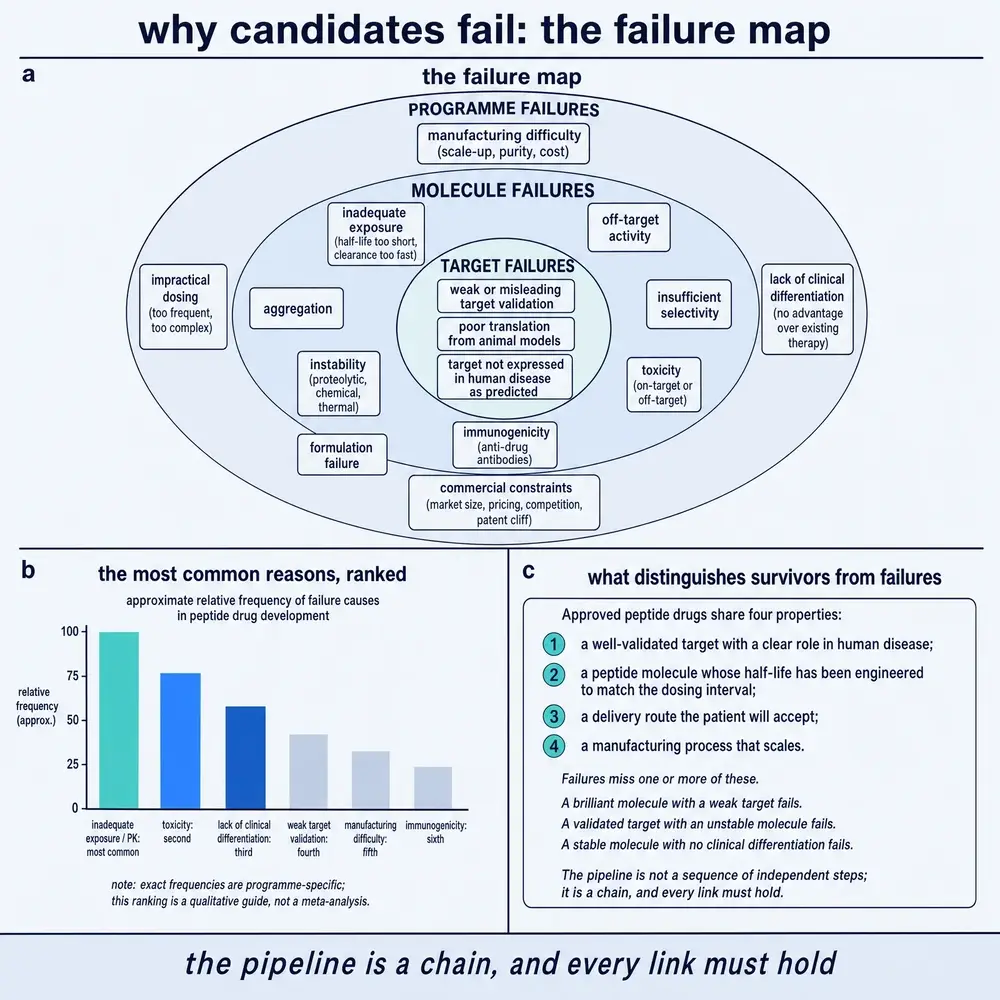
The map groups failure modes by where the cause lies rather than by when the candidate died, because only the first is actionable. A target that was never real cannot be rescued by chemistry; a molecule with inadequate exposure sometimes can.
Three programmes are worth telling in full, because each fails in a different place and none fails for the reason a summary would give.
Pexiganan failed twice, twenty years apart, and the second failure is the instructive one. Four Phase 3 trials are on the registry: two in the 1990s against oral ofloxacin, enrolling 584 and 342; two in 2014–2016 against placebo, enrolling 189 and 200. The posted results of the later pair, in humans: pexiganan resolved infection in 50.6 per cent against placebo's 60.6 per cent in one trial, and 57.7 against 52.4 per cent in the other. The placebo arm outperformed the drug arm in the first. Note also what the regulatory record adds, per the sponsor's own securities filing: the 1999 non-approvable letter cited not only efficacy but "cGMP manufacturing deficiencies, namely stability and quality control issues, and questions regarding the comparability of the product used in the Phase 3 program versus that which was produced at commercial scale." A host-defence peptide programme was set back by Section 29's problem as well as by its own.
ALRN-6924 is routinely described as a late-stage stapled-peptide failure and was not one. All six of its registry records are Phase 1 or 1/2a. Two were terminated; one after six patients in six weeks. The molecule worked — there is a documented complete remission in a patient with p53-wild-type angioimmunoblastic T-cell lymphoma in a peer-reviewed paper. What failed was the second hypothesis, chemoprotection, and it failed because the protective effect did not appear. The staple did its job.
Ularitide and serelaxin failed with physiology intact. Ularitide's Phase 3 enrolled 2,157 and produced greater reductions in systolic pressure and natriuretic peptide than placebo, with cardiovascular death in 21.7 against 21.0 per cent, hazard ratio 1.03 (96 per cent CI 0.85–1.25, P = 0.75). Serelaxin's enrolled 6,545 in its intention-to-treat analysis, with cardiovascular death at 8.7 against 8.9 per cent, hazard ratio 0.98 (0.83–1.15, P = 0.77). Neither is a peptide-engineering failure. Both are the mechanism-versus-outcome disconnect, which no amount of chemistry addresses.
On attrition rates this document is deliberately thin, and the thinness is the finding. The best public estimate of clinical attrition is all-modality: of industry development paths entering Phase 1 between 2000 and 2015, 66.4 per cent advanced to Phase 2, 58.3 per cent of those to Phase 3, 59.0 per cent of those to approval, giving 13.8 per cent overall from Phase 1. That analysis does not disaggregate by modality at all. The one recent analysis that does merges proteins with peptides into a single category and reports its rates in a supplement that could not be retrieved. No peptide-versus-small-molecule phase-transition comparison could be sourced from any source, and any such comparison encountered elsewhere should be treated as unsupported.
The authors impute missing Phase 2 transitions, which raises their estimate from the 32.4 and 30.7 per cent of prior phase-by-phase studies to 58.3. That twenty-six-point gap is a methodological artefact, not an improvement in drug development, and the number should not be quoted without it.
Section 32What the literature cannot show you
A failure taxonomy assembled from a success literature is an argument about publication unless it admits as much. This section admits it, with the specific gaps this build encountered.
Trials with a peptide intervention post results at about twice the registry-wide rate — 27.2 per cent against 13.3 per cent. Two caveats travel with that or it misleads: the registry expands intervention searches to related terms, so the denominator is soft and the set is not curated; and the likeliest explanation is sponsor composition, since peptide interventions skew toward industry-sponsored registrational programmes subject to mandatory reporting. Neither caveat was testable here.
Then there is what the registry does not say. A 900-patient Phase 2/3 trial of an antimicrobial peptide for ventilator-associated pneumonia is recorded as terminated with the reason field empty; a Phase 3 of the same molecule has a status of unknown and a null enrolment field, never updated. Any narrative about why those stopped is not registry-supported.
Three specific numbers were sought for this document and are not printed in it.
The two famous reproducibility audits. One pharmaceutical company's report on reproducing published target-validation findings, and another's on reproducing landmark preclinical cancer studies, are the principal evidence for a claim the entire field repeats. Both are one-page items — a Letter and a comment piece — with no abstract in the public index, behind paywalls. Their headline figures could not be verified against the instrument in this build. The limitation is more serious than citation hygiene: confidentiality prevented both teams from sharing their data, and one team states it cannot say which studies failed. The samples were company-selected, the replication protocols unpublished, the failed studies unnamed, and there was no pre-registration. They are industry testimony about an internal experience, and they are routinely cited as reproducibility experiments.
A widely circulated success rate for computational binder design, attributed to a preprint whose abstract does not contain it and whose full text returned an access error twice.
The origin breakdown of approved peptide drugs, which Section 33 is about.
Add to those what this document's own reading found. Of the 156 local full texts read in detail, between thirteen and forty-one per cent per batch contributed nothing usable — overwhelmingly small-molecule docking studies that a keyword gate had scored on shared method vocabulary. That is a finding about the gate, reported rather than concealed, and it carries a concrete remedy recorded in the Apparatus: require a residue-position token in the body text, not peptide-adjacent language.
Section 33Where the class actually comes from
The commissioning brief asked for a chart of approved peptide drugs by decade and by origin. That chart is not in this document, because no published quantitative breakdown of approved peptide drugs by origin could be located — not from six search formulations, not from three open-access reviews, and not from the field's canonical review, which offers a three-way typology of native, analogue and heterologous peptides with no counts attached to any category. Drawing that chart would have meant inventing it.
What can be shown honestly is stranger and more useful: the field does not agree on how many of its own drugs exist. Published counts range from thirty-three to about a hundred and thirty. Only one of six states its inclusion criteria — molecular weight 500 to 5,000 Da, insulins excluded — and it is the source of the lowest figure. One 2025 review states "nearly 100", "surpassed 60" and "nearly a hundred" for the same two-decade window in the same article. One 2025 analysis gives the year's FDA approval total as 44 in its abstract and 46 in its body, computing percentages against both.
Against that background, one concrete fact: the FDA approved exactly one peptide in 2025 — a tetrapeptide for a rare mitochondrial disease. Peptides and oligonucleotides together were four of forty-six novel approvals, about ten per cent; the other three were oligonucleotides. Against a record approval year, the peptide share was about two per cent.
So what does the evidence support about origin? Only exemplars, and this document gives an atlas of them in Figure 3. Read together they suggest a pattern that is worth stating as a hypothesis rather than a finding: the molecules that reached the clinic are overwhelmingly those whose target was validated by an organism before a company touched it. Human hormones and their analogues; a lizard's venom peptide acting on a human hormone receptor; a snail's toxin acting on a human ion channel; a bacterial enterotoxin acting on a human gut receptor. The two entries with no natural parent are recent, and one of them — a macrocycle found by display against complement C5 — is the first approved peptide from a display screen, approved in 2023.
If that pattern is real, the prediction it makes is uncomfortable for the technologies in Part Two. Display and computational design are extraordinary at producing binders, and binding was never the constraint. What they cannot supply is the thing the venom and the hormone supply for free: the assurance that engaging this target does something a patient would want. On the evidence available, the rate-limiting step in peptide drug discovery has moved from chemistry to target biology, and none of the platforms in this document addresses target biology at all.
This document describes published research. It does not recommend human use of any compound and specifies no dose, route or schedule for any person. Study parameters appear only as reported by their sources, with the population, species and duration attached. Nothing here is medical advice, and nothing here should be read as a recommendation to administer any substance to any person.
Section 34References
Generated from verified records, never from recall (House style Sec 5, and the two failures that made it standing: an earlier monograph in this series shipped five wrong author attributions, another eleven identifiers pointing at unrelated papers). Every PubMed identifier below was resolved against the National Center for Biotechnology Information at build time, and the build refuses to proceed if any fails. Sources genuinely not indexed in PubMed as journal articles — regulatory labels, trial-registry records, preprints, and one industry web resource — are marked with an asterisk and their instrument is named rather than given a fabricated identifier.
PMID 38718835 · doi:10.1038/s41586-024-07487-w · PMC11168924
PMID 21532551 · doi:10.1038/nrd3439
PMID 23903212 · doi:10.1038/nrd4090
PMID 22460880 · doi:10.1038/483531a
PMID 39663567 · doi:10.1080/14712598.2024.2436094
PMID 9181578 · doi:10.1038/nbt0697-553
PMID 39754551 · doi:10.1111/1751-7915.70072 · PMC11702388
PMID 20307554 · doi:10.1016/j.lfs.2010.03.015
PMID 21450987 · doi:10.1210/jc.2010-2822
PMID 29643228 · doi:10.1126/scitranslmed.aao3003 · PMC6130841
PMID 23946421 · doi:10.1073/pnas.1303002110 · PMC3767549
PMID 18636716 · doi:10.1021/ar8000603
PMID 31941022 · doi:10.3390/antibiotics9010024 · PMC7168295
PMID 17891134 · doi:10.1038/nbt1340 · PMC2702539
PMID 22242561 · doi:10.1111/j.1365-2125.2012.04172.x · PMC3394130
PMID 33707779 · doi:10.1038/s41551-021-00689-x
PMID 36108050 · doi:10.1126/science.add2187 · PMC9997061
PMID 20528354 · doi:10.1586/14737167.8.1.33
PMID 37467878 · doi:10.1016/j.drudis.2023.103714
PMID 7883856 · doi:10.1210/jcem.80.3.7883856
PMID 26501323 · doi:10.3390/toxins7104175 · PMC4626728
PMID 12654924 · doi:10.1074/jbc.M300581200
PMID 38917959 · doi:10.1016/j.ijpharm.2024.124382 · PMC11389361
PMID 21637198 · doi:10.1038/nprot.2011.331
PMID 37439511 · doi:10.1021/acs.jmedchem.3c00623
PMID 25593849 · doi:10.4103/2230-8210.146879 · PMC4287767
PMID 9144168 · doi:10.1073/pnas.94.10.4937 · PMC24609
PMID 27811931 · doi:10.1038/nrd.2016.184
PMID 1364851 · doi:10.1111/j.1476-5381.1991.tb12248.x · PMC1917958
PMID 1719428 · doi:10.1038/354084a0
PMID 32065623 · doi:10.1001/jamaneurol.2019.5125 · PMC7042797
PMID 26222385 · doi:10.1111/obr.12299
PMID 30900880 · doi:10.1021/acs.joc.8b03001
PMID 34265844 · doi:10.1038/s41586-021-03819-2 · PMC8371605
PMID 31031702 · doi:10.3389/fendo.2019.00155 · PMC6474072
PMID 22924529 · doi:10.1111/j.1365-2230.2012.04373.x
PMID 29784932 · doi:10.1038/s41598-018-24897-9 · PMC5962569
PMID 1944576 · doi:10.1038/354082a0
PMID 9346854
PMID 26308095 · doi:10.1021/acs.jmedchem.5b00726
PMID 24433216 · doi:10.1111/apt.12604 · PMC4305214
PMID 28425639 · doi:10.1002/prot.25310
PMID 38779019 · doi:10.1016/j.heliyon.2024.e31105 · PMC11110537
PMID 35241840 · doi:10.1038/s41587-022-01226-0
PMID 18491995 · doi:10.1517/13543784.17.6.945
PMID 20154676 · doi:10.1038/nmeth.1432
PMID 25517090 · doi:10.1038/nature14022 · PMC4359082
PMID 31433919 · doi:10.1056/NEJMoa1801291
PMID 21376095 · doi:10.1016/j.peptides.2011.02.017
PMID 16628205 · doi:10.1038/nmeth877
PMID 33536635 · doi:10.1038/s41573-020-00135-8
PMID 9315729 · doi:10.1016/s0014-5793(97)01026-0
PMID 29789628 · doi:10.1038/s41467-018-04356-9 · PMC5964252
PMID 28402745 · doi:10.1056/NEJMoa1601895
PMID 27862700 · doi:10.1002/ejhf.698
PMID 24580641 · doi:10.1146/annurev-biochem-060713-035456
PMID 18164496 · doi:10.1016/j.regpep.2007.11.003
PMID 26344696 · doi:10.1038/nchembio.1907 · PMC4575266
PMID 34181000 · doi:10.1093/bib/bbab240
PMID 21892149 · doi:10.1038/nrd3439-c1
PMID 41147133 · doi:10.1002/cbic.202500302 · PMC12582155
PMID 40542165 · doi:10.1038/s41589-025-01929-w · PMC12643943
PMID 9356443 · doi:10.1073/pnas.94.23.12297 · PMC24913
PMID 38093160 · doi:10.1007/s40265-023-01977-3 · PMC10925559
PMID 26042419 · doi:10.1371/journal.pone.0129200 · PMC4456392
PMID 4001944 · doi:10.1126/science.4001944
PMID 38230324 · doi:10.2337/cd22-0118 · PMC10788673
PMID 30727869 · doi:10.2174/1381612825666190206105232
PMID 12012270 · doi:10.1055/s-2002-29087
PMID 38070657 · doi:10.1016/j.ijpharm.2023.123680
PMID 31134577 · doi:10.1007/978-1-4939-9504-2_14
PMID 30781867 · doi:10.3390/pharmaceutics11020078 · PMC6410172
PMID 38109936 · doi:10.1038/s41586-023-06953-1 · PMC10849960
PMID 41504033 · doi:10.1021/acs.biochem.5c00646
PMID 35165272 · doi:10.1038/s41392-022-00904-4 · PMC8844085
PMID 34206124 · doi:10.3390/molecules26113338 · PMC8199541
PMID 1364852 · doi:10.1111/j.1476-5381.1991.tb12249.x · PMC1917928
PMID 29394327 · doi:10.1093/biostatistics/kxx069 · PMC6409418
PMID 30445524 · doi:10.1093/biostatistics/kxy072 · PMC6409416
PMID 7993909 · doi:10.1021/bi00253a022
PMID 40038239 · doi:10.1038/s41392-024-02107-5 · PMC11880366
PMID 41379101 · doi:10.1021/acs.jmedchem.5c02537 · PMC12751008
PMID 26222180 · doi:10.1371/journal.pone.0134427 · PMC4519045
PMID 30849445 · doi:10.1016/j.jconrel.2019.02.016
PMID 40055730 · doi:10.1186/s12967-025-06321-9 · PMC11887333
PMID 41162353 · doi:10.1038/s41467-025-64552-2 · PMC12572394
no PubMed identifier — see the unresolved-evidence log
no PubMed identifier — see the unresolved-evidence log
no PubMed identifier — see the unresolved-evidence log
no PubMed identifier — see the unresolved-evidence log
no PubMed identifier — see the unresolved-evidence log
no PubMed identifier — see the unresolved-evidence log
no PubMed identifier — see the unresolved-evidence log
no PubMed identifier — see the unresolved-evidence log
PMID 1313797
no PubMed identifier — see the unresolved-evidence log
no PubMed identifier — see the unresolved-evidence log
no PubMed identifier — see the unresolved-evidence log
no PubMed identifier — see the unresolved-evidence log
no PubMed identifier — see the unresolved-evidence log
no PubMed identifier — see the unresolved-evidence log
no PubMed identifier — see the unresolved-evidence log
no PubMed identifier — see the unresolved-evidence log
Section 35How this document was assembled
The subject of this monograph is a process rather than a molecule, so its identity gate is unusual and worth describing, because the shape of the corpus is a consequence of it.
The identity gate
A document about peptide drug discovery must satisfy three independent tests at once, and the tests reject into different named classes so that a rejection for one reason is never mistaken for another. The first is peptide class: is the molecule under discussion a peptide at all, or is it an antibody, an aptamer or a small molecule running the same discovery machinery? The second is campaign: does the document describe a search, a selection, a series or an optimisation, rather than reporting a single measurement? The third is subject coverage across twenty-five concept families spanning the sources, methods, engineering operations, tradeoffs and failure modes the commission names. A document that runs a textbook campaign on an antibody rejects as not-peptide; a pharmacology paper on a peptide rejects as not-discovery; and the two are counted separately because they mean opposite things — one says the sweep was wide, the other is the class the gate exists to remove. The matcher was break-tested against nine constructed traps before any sweep ran, and two real defects were found and fixed by that test.
The local store
| Class | Documents | What it means |
|---|---|---|
| Reading corpus (core / substantive / supporting) | 156 | read in full |
not_discovery | 2,023 | peptide subject, no campaign — the class the gate exists to remove |
not_peptide | 283 | a campaign on a non-peptide molecule |
neither_arm | 6,979 | neither peptide class nor campaign |
ubiquitous | 161 | only method-vocabulary families engaged |
unrelated / no_body | 407 | no subject family, or no readable body |
| Scanned | 10,204 | every project-05 JATS asset, reconciled |
The core tier of the local store was empty, and that is a finding rather than a defect. Not one of the 10,204 project-05 assets engaged the whole coverage list and described a strong campaign and carried a core-subject phrase in its title or abstract. The reason is visible in the strongest documents: they are papers about particular compounds that happen to perform engineering operations, not papers whose subject is how peptides are found and improved. Project 05 was assembled to support compound monographs, and it shows. The thresholds were not lowered to manufacture a core tier; manufacturing one by relaxing a constant would have converted a finding into a decoration. The consequence is that for this document the external indexed literature is the primary corpus and the local store is corroboration — the reverse of the usual arrangement in this series.
The external harvest
Fourteen named query arms were harvested from PubMed, each requiring a peptide term and a discovery-or-engineering term, because either alone returns a literature this document is not about. The surface is six figures, and A17's rule applies: where the surface is too large to retrieve, the screen moves in front of the fetch. Publication years from 2023 onward and four arms the local store is structurally thin on — computational design, oral delivery, manufacture, and developability — were harvested in full; earlier years of the other arms were harvested under a review-and-perspective filter, and everything not harvested was counted.
| Stage | Count |
|---|---|
| External surface, across arms (with overlap) | 260,256 |
| — of which counted and not read (A17) | 147,477 |
| Indexed records harvested and de-duplicated | 91,580 |
| Passed the abstract-scale screen | 7,061 |
| Targeted for full-text fetch (budgeted) | 2,600 |
| Retrieved (zero shortfall) | 2,600 |
| Retained after the far-side three-arm screen | 1,333 |
The merged reading corpus
The two reading corpora are merged keyed by PMCID, never summed (A11, and the reason it exists: an earlier monograph overstated its corpus by 853 pages by adding two stores without subtracting their overlap). Sixteen documents were present in both stores and are counted once.
1,473 full texts read · 23,528 printed-page equivalents · 11.8 million words, of which 86 per cent were published in 2023 or later. Composed of 156 documents from the project-05 library and 1,333 from the external harvest, less 16 present in both. Printed-page equivalents use the house convention of 500 words to a page over extracted body text only, so the figure understates the physical page count of the sources and is comparable across the series. This corpus is layered over a metadata surface of 10,204 local assets scanned and 260,256 external records screened, of which 147,477 were counted and deliberately not read.
A finding about the gate, reported rather than concealed
Of the 156 local full texts read in detail, the reading agents judged between 13 and 41 per cent per batch to have contributed nothing usable — overwhelmingly small-molecule docking studies that the keyword gate had admitted on shared method vocabulary. That is a real limitation of a vocabulary-based gate on a compound-oriented library, and the recorded remedy is concrete: require a residue-position token — a string such as “Ala8” or “Lys26” — in the body text, not merely peptide-adjacent language. It is reported here because a corpus figure that silently included documents contributing nothing would claim coverage the document did not have.
Section 36Evidence handling
Study type is named in the sentence that reports a finding. Computational means a prediction, a docking result, a simulation or a generative proposal; in vitro means a cell or a tube; animal names the species; human means people. This is not decoration: the distinction between designing a peptide and designing a protein that binds a peptide, or between an ex-vivo plasma half-life and an in-vivo one, changes what a number means, and both distinctions carried real weight in Sections 13 and 18.
Species travels with every pharmacokinetic number. A minipig bioavailability and a human bioavailability are different claims, and a mouse half-life and a monkey half-life for the same molecule differed by twelvefold in one case in this document. Where a source states a number without a species, the document says the species is unstated rather than assuming one.
Recency is a tie-breaker on equal evidence, not a trump. Where a recent result contradicts an established one, both are printed with their designs and the reason the newer does or does not supersede; where the recent result merely extends the older, recency wins. This bites hardest in the machine-learning design literature, whose newest claims are numerous, computational and largely unreplicated, and which is therefore reported as computational proposal and not allowed to displace experimental findings on recency alone.
Every registry and regulatory claim was checked against the registry or the label itself, never against a summary of it (House style Sec 10 item 8). This is why Section 31 can state that a 900-patient trial was terminated with an empty reason field, and why the ALRN-6924 programme is described as never having been a late-stage failure: the registry says so, and the trade-press narrative does not match it.
Where a value could not be traced, the document says so rather than repeating it. The two most-cited reproducibility audits in the field are one-page items with no abstract in the public index, and their headline figures could not be verified against the instrument; they are described rather than quoted. No cost-of-goods figure and no renal-filtration mass threshold is printed, because neither could be sourced to a verifiable primary. That absence is itself reported, in Section 32 and in Appendix C.
Section 37Appendix A — Glossary
Terms used in a specific sense in this document, placed here rather than at first use because a reader consulting a section out of order needs them more than a reader following the argument.
| Term | As used here |
|---|---|
| Amino acid, non-canonical | A residue outside the twenty the ribosome normally installs — a D-amino acid, an N-methylated one, α-aminoisobutyric acid, a backbone isostere. The commonest lever for defeating a protease. |
| Bioavailability | The fraction of an administered dose that reaches systemic circulation, relative to intravenous dosing (absolute) or another route (relative). Always reported here with the route and the species. |
| Deletion sequence | A synthetic by-product missing one internal residue, formed when a coupling step fails. Differs from the target by a single residue, which is the hardest impurity for chromatography to remove. |
| Display technology | A method that keeps a physical link between each peptide and the nucleic acid encoding it, so a population can be selected, amplified and re-selected — evolved rather than merely searched. |
| Diversity, theoretical / constructed / sampled | Three different quantities routinely conflated. Theoretical is 20n; constructed is how many distinct molecules a library actually contains; sampled is how many a selection actually interrogates. They can differ by orders of magnitude. |
| DPP-4 (dipeptidyl peptidase-4) | The protease that removes the N-terminal dipeptide of many incretin peptides. The single most common proteolytic liability in the class. |
| Half-life extension | Any modification — lipidation, PEGylation, albumin binding, fusion — that prolongs circulating time, generally by making the molecule effectively larger than the kidney will filter. |
| Hot spot | A residue that carries a large share of a binding interaction, identified when its substitution causes a large loss of activity. A pharmacophore is the set of hot spots. |
| Lipidation | Attachment of a fatty acid, usually to enable reversible binding to serum albumin. Buys half-life; spends potency and solubility. |
| Peptide | Used as the field uses it: a short chain of amino acids joined by amide bonds. The boundary with “protein” is conventional and contested, and it is consequential — several counts of “approved peptide drugs” disagree precisely because they draw it differently. |
| Permeation enhancer | An excipient that transiently increases epithelial permeability to allow oral or nasal absorption of a peptide. Delivers single-digit, highly variable bioavailability. |
| Pharmacophore | The minimal arrangement of features required for activity — what survives truncation and alanine scanning. |
| Process mass intensity | Total mass of material used per unit mass of product. About 13,000 for solid-phase peptide synthesis, an order of magnitude worse than biopharmaceutical production. |
| Reverse pharmacology | Starting from an orphan receptor and searching for its endogenous ligand, rather than from a physiological effect. Discovery run backwards. |
| Solid-phase peptide synthesis | Chain assembly on an insoluble bead, so purification at each step becomes a rinse. The enabling engineering of the whole field. |
| Stepwise efficiency | The fraction of chains successfully extended at one coupling. Overall yield is this raised to the number of couplings (Section 29). |
Section 38Appendix B — Patent-source appendix
The commission asks for a patent-source appendix, and honesty about its scope is part of delivering it. Full-text patent databases were not reachable in the session that produced this document, so what follows is not a freedom-to-operate analysis and does not claim to be. It records intellectual-property facts named in the peer-reviewed corpus and in regulatory documents, which is a narrower and verifiable thing.
| Subject | What the read sources establish |
|---|---|
| Composition of matter, generally | The read literature repeatedly frames a novel sequence or a novel modification as the patentable unit, and half-life-extension chemistry (a specific fatty-acid–spacer–attachment combination) as separately claimable. This is the mechanism by which an engineered analogue of an unpatentable natural peptide becomes proprietary. |
| Generic and biosimilar entry | A read review notes that at least five of the ~80 approved peptide drugs are off-patent and being developed as generics, and that the abbreviated pathway turns on impurity equivalence — a new impurity can introduce a T-cell epitope — which ties patent expiry to Section 30's immunogenicity question. |
| Platform intellectual property | The display and computational-design literatures are substantially method-patent literatures; the corpus names the mRNA-display and flexizyme lineages as proprietary platforms whose output (a specific macrocycle) is separately claimed. |
| What is not claimed here | No specific patent number, family, priority date, claim scope or freedom-to-operate position. Those require a patent database this session could not reach, and inventing them would be the defect this document's evidence rules forbid. |
Section 39Appendix C — Unresolved-questions register
What this document went looking for and could not settle, with what would settle it. This register is not a list of the document's weaknesses; it is a list of the field's, encountered honestly.
| Question | Status, and what would resolve it |
|---|---|
| Where do approved peptide drugs come from, by origin? | No published quantitative breakdown exists. Six search formulations, three open-access reviews and the field's canonical review returned a typology with no counts. A curated, criteria-explicit census of approved peptides by origin would resolve it, and would be a genuine contribution. |
| How many approved peptide drugs are there? | Unsettled by definition. Published counts range from 33 to ~130; only one states its inclusion criteria. Resolution requires an agreed definition of “peptide,” which is the contested boundary of Section 37's glossary entry. |
| What is the peptide-specific clinical success rate? | Not sourced. The best analysis is all-modality (13.8 per cent from Phase 1); the one modality-resolved analysis merges proteins with peptides and reports rates in an unretrievable supplement. A modality-disaggregated re-analysis would resolve it. |
| What renal-filtration size threshold does half-life extension defeat? | No threshold printed, because the best source rejects one. The relationship is continuous and governed by hydrodynamic radius and charge, not mass. A fractional-clearance-versus-radius dataset resolves the mechanism; a single mass cut-off does not exist. |
| What is the in-vivo half-life of an unmodified linear peptide, and the fold-gain from each stabilising modification? | Partially open. Excellent ex-vivo data and the native-GLP-1 in-vivo figure (~1.5 min, human) were obtained; a clean numerical fold-change in serum half-life for D-amino-acid substitution, cyclisation, N-methylation or C-terminal amidation was not. A controlled modification series with matched in-vivo pharmacokinetics would resolve it. |
| Do the field's famous reproducibility audits hold up? | Unverifiable from the public record. Both are paywalled one-page items with no abstract; one team states it cannot reveal which studies failed. Only access to the underlying, confidential data would resolve it — which is precisely what is withheld. |
| Has any peptide designed substantially de novo by computation reached the clinic? | One candidate, provenance unverified. A Phase 1 peptide–drug conjugate exists; its de-novo-design claim is a sponsor statement with no peer-reviewed primary paper. A published design-and-validation account would resolve it. |
| What is the cost of goods for a peptide API, and where does recombinant production overtake synthesis? | Neither printed. Only inconsistent commercial web material was found for cost; no source stated a crossover in residues. A peer-reviewed process-economics analysis would resolve both. |
This document describes published research. It does not recommend human use of any compound and specifies no dose, route or schedule for any person. All reported study parameters carry their population, species and duration. Nothing here is medical advice.
Continue exploring