
B7-33 The single-chain relaxin that kept the antifibrotic signal and dropped the rest
Recombinant H2 relaxin promised vasodilation and fibrosis reverse, then stumbled on cost, cAMP-linked liabilities, and a two-chain disulfide knot that chemists hate to make. In Melbourne, Hossain, Bathgate, Samuel, Wade and colleagues answered with a soluble B-chain fragment: B7-33. It still speaks to RXFP1, still drives pERK and MMP-2, still shrinks scar in rodent heart and lung — and largely leaves behind the cAMP arm that made full-length H2 a prostate-tumour worry. Ten years on there is still no human trial under this name. What exists is a clean case study in biased agonism, a six-minute serum half-life that chemists are still fighting, and a second life as cargo on antifibrotic coatings and nanoparticles.
Every finding here is labelled by the kind of study that produced it, in the sentence that reports it. A result in mice is called a result in mice; a cell-based signalling measurement is called that; a registry search that returns zero true hits is not dressed up as a negative trial. Amounts and durations appear only as parameters of the experiments in which they were tested, always with the species and model named.
Nothing in this document is a recommendation. B7-33 has no approved human indication and no registered interventional trial under its own name. Where the evidence is thin, conflicting or absent — above all, in people — the monograph says so instead of rounding up.
01What B7-33 is
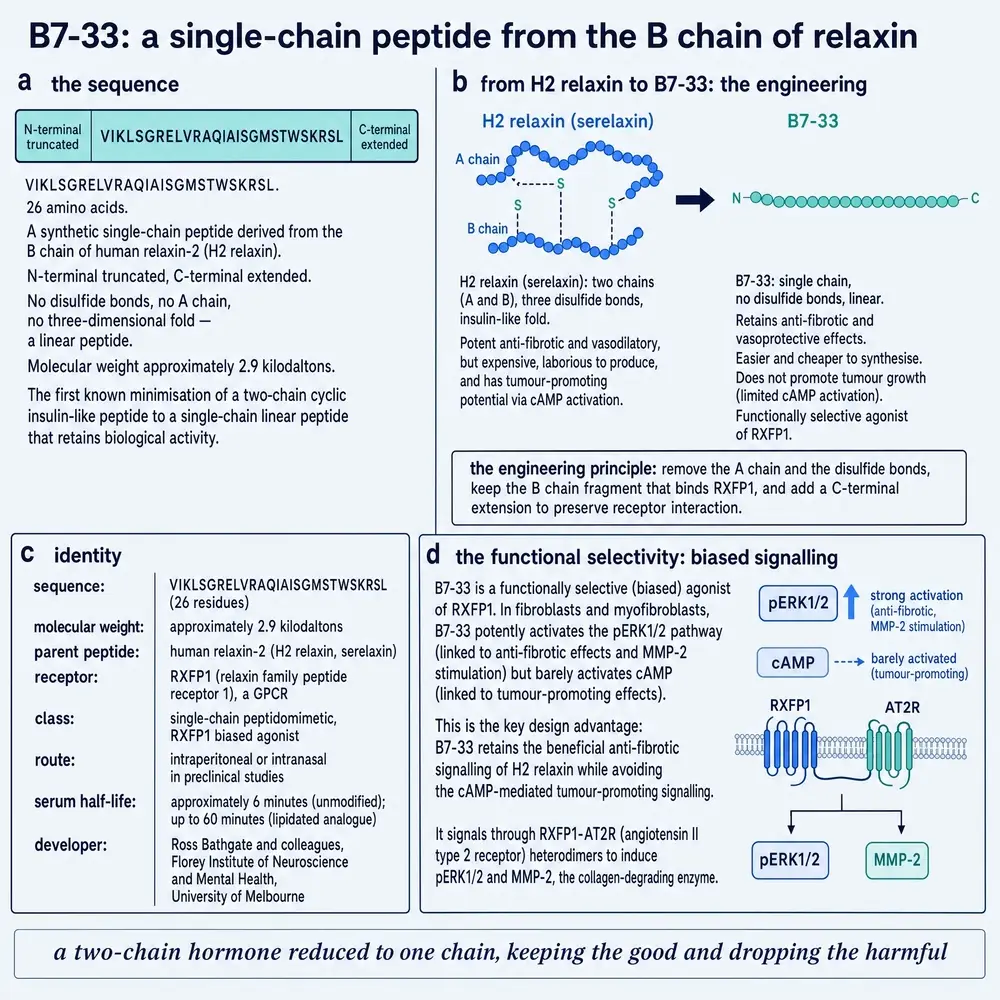
B7-33 is a linear, single-chain peptide of twenty-seven amino acids. Its sequence, as reported across the founding Chemical Science paper and the Florey/Monash analogue programme that followed, is VIKLSGRELVRAQIAISGMSTWSKRSL. It is a trimmed and stabilised piece of the B-chain of human gene-2 (H2) relaxin — not the two-chain, three-disulfide hormone itself, and not recombinant serelaxin. Electrospray mass spectrometry of the synthetic material gave m/z 2986.4 [M+H]+ against a calculated 2986.59 (Hossain et al., 2016). The registry string that suppliers attach is CAS 1818415-56-3; that is characterisation, not a clinical identity.
The design logic is surgical. Six residues come off the N-terminus of the longer B1–33 isoform (equivalently: the insoluble native B1–29 is extended by the C-terminal tetrapeptide KRSL). The two cysteines that would otherwise invite dimerisation and aggregation are replaced by isosteric serines. What remains is a highly positive, soluble peptide that still finds RXFP1 — the cognate G protein–coupled receptor for H2 relaxin — and that, in fibroblasts which express the receptor endogenously, prefers the ERK pathway over cAMP (Hossain et al., 2016). That preference is the whole of the compound’s intellectual claim: keep the antifibrotic half of the message; drop the rest.
| Identity field | Value | Source class |
|---|---|---|
| Name | B7-33 (also B7–33) | Peer-reviewed founding paper |
| Class | Single-chain RXFP1 agonist; functionally selective vs H2 | Peer-reviewed founding paper |
| Sequence | VIKLSGRELVRAQIAISGMSTWSKRSL | Founding paper / analogue programme |
| Length | 27 residues | Founding paper |
| Key edits | N-terminal truncation; C-terminal KRSL; Cys→Ser | Founding paper |
| Mass | m/z 2986.4 [M+H]+ (calcd 2986.59) | ESI-MS in founding paper |
| CAS | 1818415-56-3 | Supplier / database record |
| Human trials under this name | None registered | ClinicalTrials.gov harvest (this project) |
02Relaxin’s century and RXFP1’s thirteen years
Relaxin entered physiology as a pregnancy hormone — a signal that softens the pubic ligament and remodels the reproductive tract. Over the twentieth century that narrow brief widened. Vascular biologists found nitric-oxide–linked vasodilation; fibrosis biologists found collagen turnover and matrix metalloproteinase induction; heart-failure trialists eventually tested a recombinant form, serelaxin, in acute decompensated heart failure. The receptor that carries most of that story in humans is RXFP1 (once LGR7), a leucine-rich-repeat–containing GPCR that couples to a blend of pathways including cAMP and ERK1/2 (Hossain et al., 2016; Devarakonda and Salloum, 2018).
Two structural facts made the hormone awkward as a chronic drug. First, H2 relaxin is an insulin-like two-chain peptide locked by three disulfide bonds. Making it — chemically or recombinantly — is expensive relative to a linear B-chain fragment. Second, the signalling blend is promiscuous. The same receptor that yields antifibrotic pERK also yields strong cAMP responses that have been linked, in the literature the founding paper cites, to inotropy concerns and to tumour-promoting actions in prostate models (Hossain et al., 2016). The field did not need a louder H2. It needed a quieter one.
03Why serelaxin was hard to love as a chronic drug
Serelaxin’s pitch was never frivolous. Recombinant H2 relaxin dilates vessels, shifts renal haemodynamics, and — in animal models that the relaxin field has worked for decades — reverses established fibrosis (Kanai et al., 2019; Devarakonda and Salloum, 2018). The manufacturing problem was prosaic: two chains, three disulfides, correct pairing. The pharmacological problem was sharper. Strong cAMP activation at RXFP1 is not a free lunch. The founding B7-33 paper states the worry explicitly: potent cAMP signalling has been associated with adverse cardiac effects in some settings and with the reported ability of H2 relaxin to promote prostate-cancer progression in preclinical models (Hossain et al., 2016). Those are not verdicts on every patient who received serelaxin in a trial; they are reasons a medicinal-chemistry group would try to keep antifibrosis and lose cAMP bias.
Cost and complexity mattered too. A peptide that must be produced as a correctly folded heterodimer will always lose, on price and on analogue speed, to a linear twenty-seven-mer that folds only when it meets its receptor. B7-33 was designed to win that argument without throwing away the organ-protective half of the biology.
04Discovery: Florey / Monash, 2016
The paper that created the compound appeared in Chemical Science in 2016. The author list is a Florey Institute and Monash University collaboration built around Mohammed Akhter Hossain, Ross Bathgate, Chrishan Samuel and John Wade, with signalling and in-vivo partners across the same Melbourne axis (Hossain et al., 2016). The claim in the abstract is large and specific: the first functionally selective agonist of the complex GPCR RXFP1; the first minimisation of a two-chain cyclic insulin-like peptide to a single-chain linear peptide that retains potent beneficial agonism; prevention or reversal of organ fibrosis in three rodent heart-or-lung models with potency similar to H2 relaxin; and, unlike H2, no promotion of prostate tumour growth in vivo.
That is the discovery story this monograph follows. Later papers — Marshall on vessels, Devarakonda on infarct remodelling, Alam against perindopril, Praveen on lipidation, Welch on coatings — are elaborations. They do not reopen the design. They ask whether the biased fragment still behaves like a useful drug candidate once the animal models get harder and the half-life problem gets honest.
05Anatomy of the chimera
Call B7-33 a chimera only in the modest sense that it is not a simple truncation. The N-terminus loses six residues that the native B-chain carries; the C-terminus keeps (or gains) the KRSL tetra-peptide that native B1–29 lacks; and the two cysteines that would recreate inter-chain chemistry are converted to serines so the peptide stays monomeric in solution (Hossain et al., 2016). The native H2 B-chain (B1–29) is insoluble at concentrations where B7-33 dissolves cleanly — the founding paper shows vials at 4 mg·mL−1 to make the point. Solubility was not a cosmetic win. It was the manufacturing argument in a bottle.
Later medicinal chemistry has treated that scaffold as a platform rather than a finished drug: lipidated B7-33 analogues that keep RXFP1 activity while stretching serum stability (Praveen et al., 2023), and further minimal derivatives aimed at potency with still less peptide (Handley et al., 2023). Those papers matter in Part Four. The anatomy that matters here is the 2016 cut itself: enough B-chain to find RXFP1, not enough hormone to recreate the full signalling blend.
06Binding versus signalling: weak cAMP, strong pERK
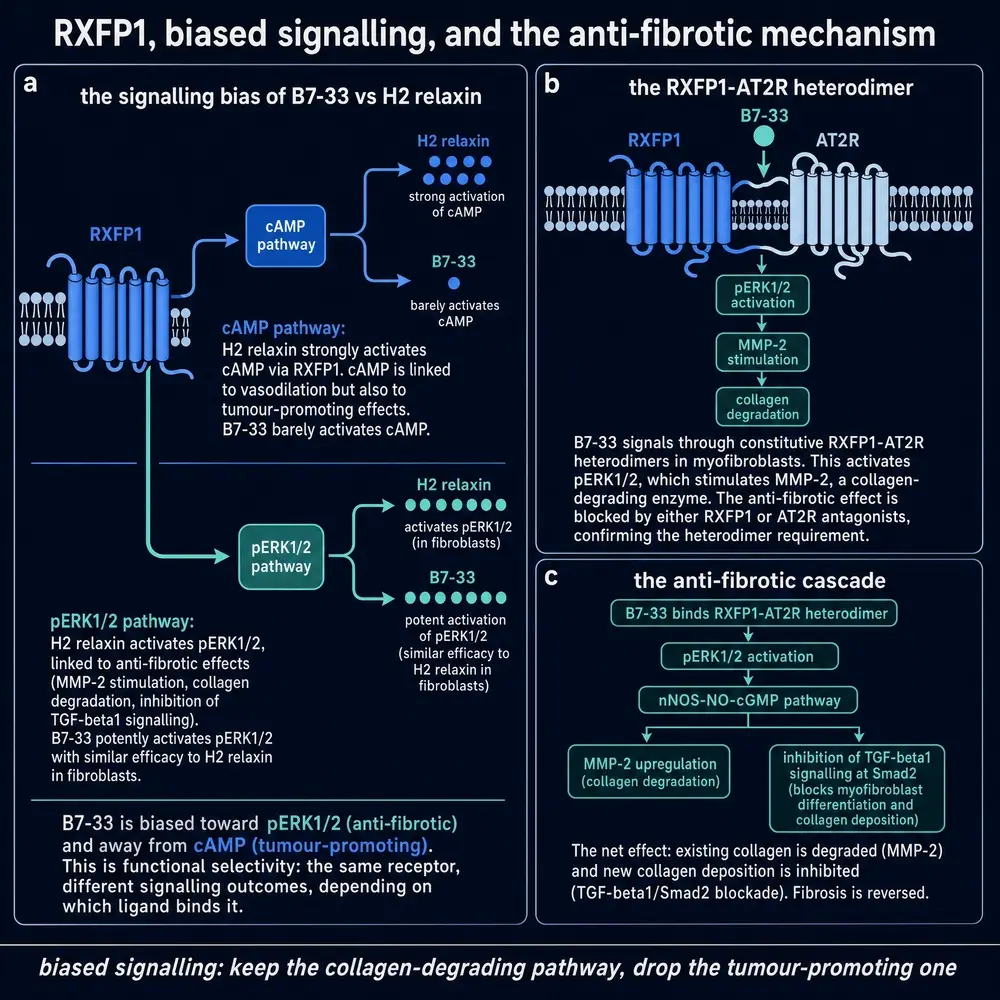
“Biased agonism” is easy to say and easy to abuse. In this compound it means something measurable. In cells that endogenously express RXFP1 — rat renal myofibroblasts from injured kidney, human cardiac fibroblasts — B7-33 binds the receptor and drives phosphorylation of ERK1/2 with a potency that tracks its antifibrotic readouts, while its stimulation of cAMP is weak relative to H2 relaxin (Hossain et al., 2016). That is not the same as saying the peptide never touches Gs. It is saying the functional preference in the fibroblast systems that matter for fibrosis is tilted.
The tilt is the design thesis. If prostate-tumour promotion and some adverse cAMP-linked cardiac effects ride on the pathway H2 activates strongly, then a fragment that still clears collagen through pERK/MMP-2 without matching H2’s cAMP efficacy is worth making — even before anyone asks about half-life. Parallel work on the small-molecule RXFP1 agonist ML290 shows the same intellectual climate: bias at this receptor is a real medicinal-chemistry coordinate, not a slogan (Kocan et al., 2017).
07MMP-2 and the RXFP1–AT2 heterodimer story
The antifibrotic warhead, in the founding account, is not a mysterious new pathway. B7-33 raises matrix metalloproteinase-2 — a collagen-degrading enzyme — in human cardiac fibroblasts and in rat renal myofibroblasts at nanomolar concentrations (for example 30 nM in the human cardiac-fibroblast zymography experiments) (Hossain et al., 2016). Block RXFP1 and the MMP-2 rise fails. Block the angiotensin II type 2 receptor with PD123319 and it also fails. The paper’s interpretation is heterodimer signalling: RXFP1 and AT2R cooperating so that pERK1/2 and MMP-2 come up together.
That mechanism should be held at the weight it earned. It is a coherent in-vitro story with pharmacological antagonists, not a crystallographic structure of the dimer, and not a proof that every antifibrotic animal result travels exclusively through AT2R. It is, however, the molecular narrative the Florey/Monash group offered for why a cAMP-weak agonist could still clear scar.
08NMR: unstructured yet active
Two-dimensional NMR of B7-33 in solution returned good linewidths and poor chemical-shift dispersion — the spectroscopic signature of a peptide that lacks a well-defined structural core (Hossain et al., 2016). The founding paper draws the sensible inference: the agonist is largely unstructured free in solution and only adopts a binding-competent conformation when it meets RXFP1. That is not a defect unique to B7-33; many peptide ligands live as conformational ensembles until a receptor selects one. It does, however, explain why looking at the free peptide will not show you an H2-like helix ready-made, and why activity had to be argued from cells and animals rather than from a pretty solution structure.
09Post-MI rats: fibrosis down, LVEDP down
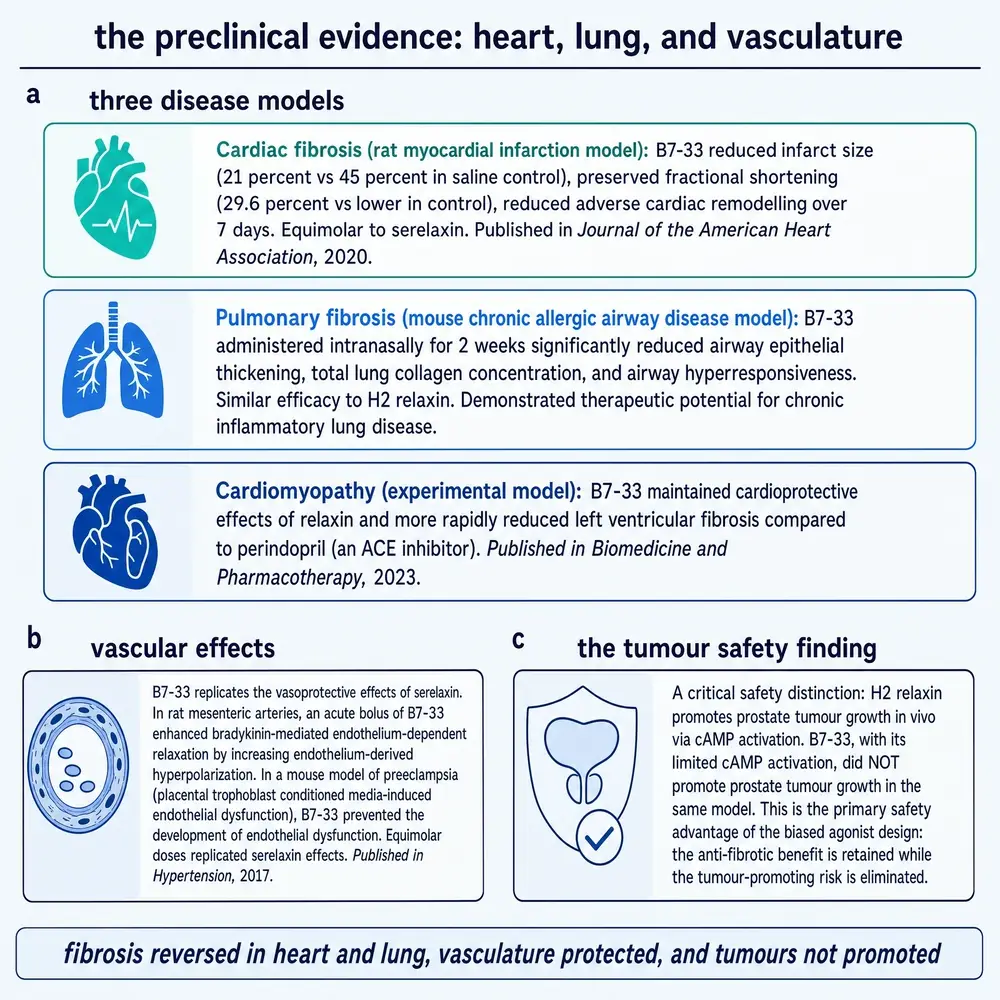
The founding paper’s first in-vivo pillar is myocardial infarction in rats. Animals with established post-MI injury received B7-33 or H2 relaxin; both peptides reduced left-ventricular fibrosis relative to saline-treated infarct controls, and both lowered left-ventricular end-diastolic pressure — a haemodynamic marker of stiff, failing filling pressures — measured weeks after the infarct (Hossain et al., 2016). That is a rodent result with histological and pressure readouts. It is the claim that first made B7-33 look like more than a signalling curiosity: the biased fragment still moved organ fibrosis and still moved a functional cardiac parameter.
Exact percentage fibrosis reductions should be read from the paper’s figures rather than memorised as a single magic number; what the text states cleanly is direction, statistical significance against saline-MI, and rough parity with H2 relaxin on the antifibrotic and LVEDP endpoints. No human infarct study of B7-33 exists to extend the finding.
10Isoproterenol mice: prevention of cardiac fibrosis
The second pillar used isoproterenol to drive cardiomyopathy and interstitial fibrosis in mice. Equimolar B7-33 and H2 relaxin were compared; B7-33 at 0.25 mg·kg−1·d−1 prevented the ISO-induced rise in left-ventricular collagen as read by picrosirius red and hydroxyproline (Hossain et al., 2016). Prevention is a different claim from reversal of established scar, and the founding paper is careful about which model is which. What matters for the monograph is that the biased peptide matched the parent hormone on a fibrosis endpoint in a second species and a second injury mode.
Alam and colleagues later returned to ISO cardiomyopathy in 129sv mice and treated from day 7 to day 14 with RLX (0.5 mg·kg−1·d−1), B7-33 (0.25 mg·kg−1·d−1, molar-equivalent after molecular-weight correction), or the ACE inhibitor perindopril (1 mg·kg−1·d−1). B7-33 matched relaxin on fibrosis, inflammation, hypertrophy and vascular rarefaction, and reduced left-ventricular fibrosis more rapidly than perindopril in that design (Alam et al., 2023). Perindopril lowered blood pressure and inflammation but not fibrosis or hypertrophy on the same schedule — a useful reminder that “cardioprotective” is not one thing.
11Chronic allergic airways: intranasal reverse of remodeling
The lung pillar used ovalbumin-driven chronic allergic airways disease in mice. Intranasal B7-33 at 0.25 mg·kg−1 reduced airway and lung fibrosis, eased epithelial thickening associated with remodeling, and improved airway function relative to diseased controls (Hossain et al., 2016). Route matters here: this is not an intravenous heart-failure fantasy; it is a local airway delivery experiment in rodents. It widens the antifibrotic claim beyond myocardium without converting it into a human asthma result.
A later inhaled “B7” B-chain construct in bleomycin-induced pulmonary fibrosis (Liu et al., 2021) is related family chemistry. This monograph does not treat that paper as a B7-33 trial unless the peptide is identified as B7-33.
12Vasoprotection and later cardioprotection
Marshall and colleagues asked the vascular question the founding paper had left open. Male Wistar rats received a tail-vein bolus of placebo, B7-33 at 13.3 μg/kg, or serelaxin at 26.6 μg/kg; three hours later mesenteric, renal and aortic rings were studied by wire myography. B7-33 and serelaxin selectively enhanced bradykinin-mediated endothelium-dependent relaxation in the mesenteric artery by increasing endothelium-derived hyperpolarization, without overall effects on the small renal artery or aorta (Marshall et al., 2017). In a separate ex-vivo model, mouse mesenteric arteries pre-incubated in placental trophoblast-conditioned media — a preeclampsia-like endothelial insult — were protected by co-incubation with B7-33 or serelaxin at 15 or 30 nM.
Devarakonda and colleagues then took B7-33 into murine ischemia–reperfusion infarction. Adult male CD1 mice had thirty minutes of left-anterior-descending ligation and either 24 hours or seven days of reperfusion. B7-33 cut infarct size to 21.99% versus 45.32% with vehicle (P = 0.02) and preserved fractional shortening at 29% versus 23% at 24 hours; by day 7 the fractional-shortening gap had widened to 29% versus 20% (Devarakonda et al., 2020). In isolated cardiomyocytes, 50 and 100 nM B7-33 improved survival after simulated ischemia–reoxygenation and reduced the endoplasmic-reticulum stress marker GRP78 in an ERK1/2-dependent manner. That is acute cardioprotection and adverse-remodeling limitation in mice — still not a human MI trial.
13The prostate-tumour control that H2 failed
The founding paper’s safety contrast is as important as its efficacy pillars. In a prostate-tumour model where H2 relaxin promoted tumour growth, B7-33 did not (Hossain et al., 2016). That result is the practical face of cAMP bias: if the unwanted arm of RXFP1 signalling is what feeds the tumour phenotype in that model, then a functionally selective agonist can keep antifibrosis without paying the same price. It remains a preclinical control, not a human oncology endpoint, and it does not license chronic human use. It does explain why the Melbourne group thought the minimisation was worth publishing as more than a cheaper serelaxin substitute.
14Half-life: six minutes, and the lipidated answer
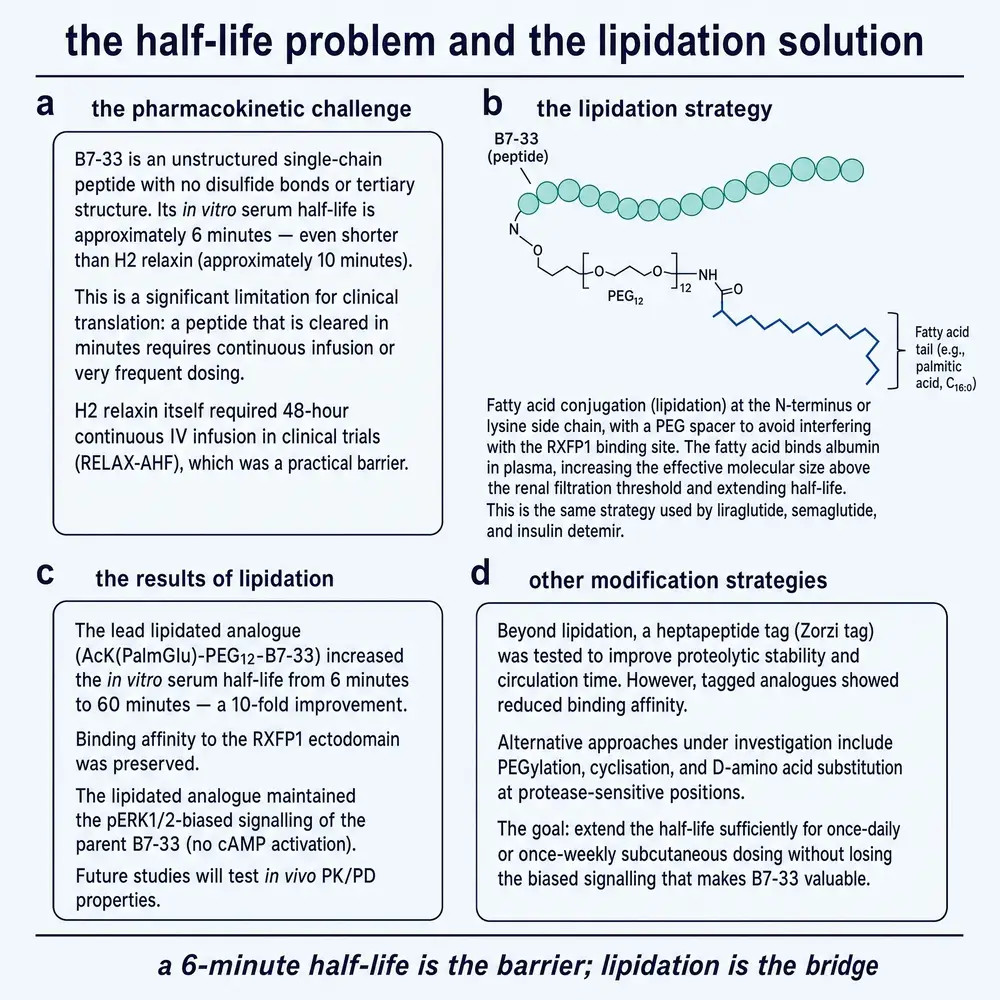
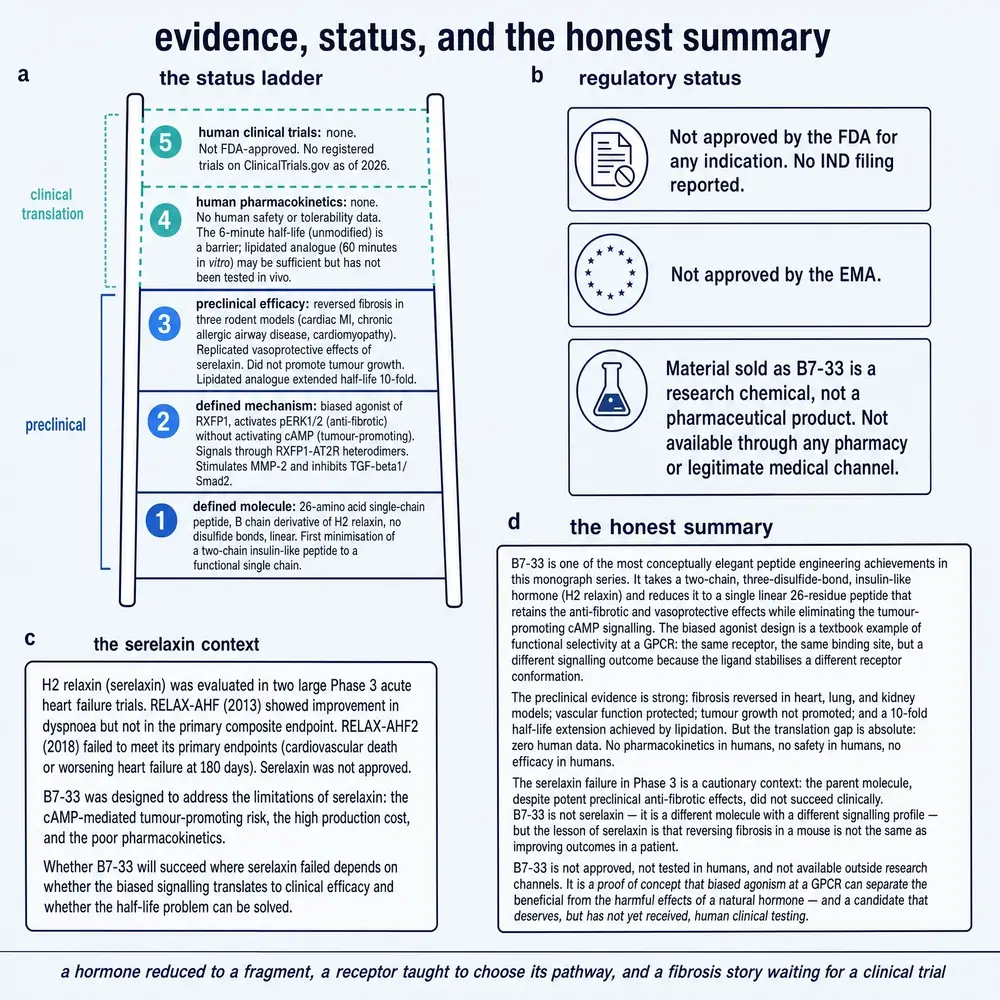
B7-33 solves synthesis and bias. It does not solve time. In vitro serum-stability work on the linear peptide puts its half-life near six minutes; a lead lipidated analogue, AcK(PalmGlu)-PEG12-B7-33, stretches that to about sixty minutes in the same assay without abolishing RXFP1 activity (Praveen et al., 2023). Those are test-tube serum numbers, not in-vivo pharmacokinetics in people. They are still the clearest quantitative statement of why a peptide that looks brilliant at 0.25 mg·kg−1 in mice is not yet a once-daily human candidate.
Native H2 relaxin itself is short-lived — on the order of ten minutes in vivo in the literature Praveen cites — which is why serelaxin programmes leaned on infusion. Lipidation is the standard albumin-hitchhiking countermeasure: a fatty acid and spacer recruit circulating albumin so renal filtration slows. Handley and colleagues have continued to shave the scaffold toward still-minimal potent derivatives (Handley et al., 2023). The chemistry is moving. The clinical schedule is not, because there is not yet a clinical schedule.
15Human evidence: none registered
A ClinicalTrials.gov harvest for this project returned ten study records against B7-33 / relaxin B-chain–mimetic queries. On inspection, none names B7-33 as an intervention, and none is a relaxin-mimetic trial under this peptide’s identity. The true hit count is zero. That is not a failed phase 2. It is an empty registry slot. Serelaxin’s human history — acute heart-failure programmes, infusion logistics, mixed late-stage outcomes — remains a separate molecule’s story (Devarakonda and Salloum, 2018; Kanai et al., 2019).
16Second life: coatings, nanoparticles, long-acting reviews
While a stand-alone human drug has not appeared, B7-33 has found work as cargo. Welch and colleagues loaded the peptide into biodegradable PLGA coatings on polypropylene and showed, in a mouse subcutaneous implant model, a 49.2% reduction in fibrotic capsule thickness over six weeks versus peptide-free coating, with retained RXFP1 reporter activity in vitro (Welch et al., 2019). That is a foreign-body-response experiment, not an organ-fibrosis trial, and it is one of the cleaner demonstrations that sustained local release can turn a six-minute peptide into a six-week materials problem.
Reviews of the antifibrotic peptide arsenal and of long-acting relaxin analogues now routinely list B7-33 beside serelaxin and newer constructs (Liu et al., 2023; Wołowiec et al., 2025). Nanoparticle and nanovesicle papers in the admitted corpus use antifibrotic relaxin-family peptides — including heavy mention of B7-33 — as payloads aimed at stromal fibrosis (Somanader-Livera et al., 2025; Zhang et al., 2025). The pattern is familiar: when systemic pharmacokinetics are hostile, delivery systems inherit the pharmacology.
17What the evidence supports, and what it does not
What is solid is narrow and interesting. A twenty-seven-residue B-chain analogue can be made soluble, can bias RXFP1 toward pERK/MMP-2 in fibroblasts, can match H2 relaxin on several rodent fibrosis and vascular endpoints, can shrink infarct size and preserve fractional shortening in mouse ischemia–reperfusion, can outrun perindopril on fibrosis speed in an ISO model, and can avoid the prostate-tumour promotion H2 showed in the founding control. Lipidation buys about a ten-fold in-vitro serum extension. Coatings and nanoparticles give the peptide somewhere to work when the clock does not.
What is not supported is everything a reader most wants next. There is no registered human interventional trial of B7-33. There is no demonstrated human dose. There is no outcome evidence in heart failure, asthma, preeclampsia or implant fibrosis in people. Mechanism details that live in antagonist studies and heterodimer language should not be mistaken for clinical mode-of-action proofs. Animal potency is not a forecast of human effect size.
B7-33 is therefore best read as a finished argument about receptor bias and an unfinished argument about drugs. The address was in the B-chain; the warhead survived the surgery; the clock and the clinic did not. Until someone files a human study under this name, the honest monograph ends there.
18References
Generated from verified records rather than from recall. Author lists, journal names, volumes, pages and identifiers were derived from PubMed Central front matter for the 14 admitted full-text XML files held in this project, and, for works outside that open-access set (Marshall, Welch, Devarakonda, Alam and others), from PubMed harvest records and key abstracts cross-checked against the founding paper’s bibliography where held locally. Entries without a PMCID are paywalled or abstract-only in this corpus and carry only the identifiers that could be verified.
- Abboud C, Brochoire L, Drouet A, Hossain MA, Hleihel W, Gundlach AL, Landry M. Analgesic effect of central relaxin receptor activation on persistent inflammatory pain in mice: behavioral and neurochemical data. Pain Rep. 2021;6(2):e937.
PMID 34159282 · doi:10.1097/PR9.0000000000000937 · PMC8213244
— Animal study; B7-33 as RXFP1 tool - Alam F, Gaspari TA, Kemp-Harper BK, Low E, Aw A, Ferens D, Spizzo I, Jefferis AM, Praveen P, Widdop RE, Bathgate RAD, Hossain MA, Samuel CS. The single-chain relaxin mimetic, B7-33, maintains the cardioprotective effects of relaxin and more rapidly reduces left ventricular fibrosis compared to perindopril in an experimental model of cardiomyopathy. Biomed Pharmacother. 2023;160:114370.
PMID 36753958 · doi:10.1016/j.biopha.2023.114370
— Animal study; ISO cardiomyopathy; vs perindopril - D'Ercole A, Nistri S, Pacini L, Carotenuto A, Santoro F, Papini AM, Bathgate RAD, Bani D, Rovero P. Synthetic short-chain peptide analogues of H1 relaxin lack affinity for the RXFP1 receptor and relaxin-like bioactivity. Clues to a better understanding of relaxin agonist design. Front Pharmacol. 2022;13:942178.
PMID 36034864 · doi:10.3389/fphar.2022.942178 · PMC9402926
— Peptide design; contrast with B7-33 lineage - Devarakonda T, Salloum FN. Heart disease and relaxin: new actions for an old hormone. Trends Endocrinol Metab. 2018;29(5):338-348.
PMID 29526354 · doi:10.1016/j.tem.2018.02.008 · PMC5911207
— Narrative review - Devarakonda T, Mauro AG, Guzman G, Hovsepian S, Cain C, Das A, Praveen P, Hossain MA, Salloum FN. B7-33, a functionally selective relaxin receptor 1 agonist, attenuates myocardial infarction-related adverse cardiac remodeling in mice. J Am Heart Assoc. 2020;9(8):e015748.
PMID 32295457 · doi:10.1161/JAHA.119.015748
— Animal study; mouse I/R MI - Handley TNG, Praveen P, Tailhades J, Wu H, Bathgate RAD, Hossain MA. Further developments towards a minimal potent derivative of human relaxin-2. Int J Mol Sci. 2023;24(16):12670.
PMID 37628851 · doi:10.3390/ijms241612670 · PMC10454739
— Medicinal chemistry; B7-33 analogues - Hossain MA, Kocan M, Yao ST, Royce SG, Nair VB, Siwek C, Patil NA, Harrison IP, Rosengren KJ, Selemidis S, Summers RJ, Wade JD, Bathgate RAD, Samuel CS. A single-chain derivative of the relaxin hormone is a functionally selective agonist of the G protein-coupled receptor, RXFP1. Chem Sci. 2016;7(6):3805-3819.
PMID 30155023 · doi:10.1039/c5sc04754d · PMC6013806
— Founding paper; design, bias, rodent fibrosis models - Kanai AJ, Konieczko EM, Bennett RG, Samuel CS, Royce SG. Relaxin and fibrosis: emerging targets, challenges, and future directions. Mol Cell Endocrinol. 2019;487:66-74.
PMID 30772373 · doi:10.1016/j.mce.2019.02.005 · PMC6475456
— Narrative review - Kocan M, Sarwar M, Ang SY, Xiao J, Marugan JJ, Hossain MA, Wang C, Hutchinson DS, Samuel CS, Agoulnik AI, Bathgate RAD, Summers RJ. ML290 is a biased allosteric agonist at the relaxin receptor RXFP1. Sci Rep. 2017;7:2968.
PMID 28592882 · doi:10.1038/s41598-017-02916-5 · PMC5462828
— Biased agonism at RXFP1; context for B7-33 - Liu Z, Zhang X, Wang Y, Tai Y, Yao X, Midgley AC. Emergent peptides of the antifibrotic arsenal: taking aim at myofibroblast promoting pathways. Biomolecules. 2023;13(8):1179.
PMID 37627244 · doi:10.3390/biom13081179 · PMC10452577
— Review; B7-33 among antifibrotic peptides - Marshall SA, O'Sullivan K, Ng HH, Bathgate RAD, Parry LJ, Hossain MA, Leo CH. B7-33 replicates the vasoprotective functions of human relaxin-2 (serelaxin). Eur J Pharmacol. 2017;807:190-197.
PMID 28478069 · doi:10.1016/j.ejphar.2017.05.005
— Animal / ex vivo vascular study - Praveen P, Wang C, Handley TNG, Wu H, Samuel CS, Bathgate RAD, Hossain MA. A lipidated single-B-chain derivative of relaxin exhibits improved in vitro serum stability without altering activity. Int J Mol Sci. 2023;24(7):6616.
PMID 37047588 · doi:10.3390/ijms24076616 · PMC10094921
— Medicinal chemistry; serum half-life 6 vs 60 min - Somanader-Livera DVN, Wei C, Wang C, Li Y, Ferens D, Salimova E, Selomulya C, Hossain MA, Samuel CS, Chakraborty A. Immune cell uptake of glycinated nanoparticles conjugated to anti-fibrotic peptides enables their prolonged activity and oral administration. J Biomed Sci. 2025;32.
PMID 41382190 · doi:10.1186/s12929-025-01198-8 · PMC12699924
— Nanoparticle delivery; antifibrotic peptide cargo - Welch NG, Mukherjee S, Hossain MA, Praveen P, Werkmeister JA, Wade JD, Bathgate RAD, Winkler DA, Thissen H. Coatings releasing the relaxin peptide analogue B7-33 reduce fibrotic encapsulation. ACS Appl Mater Interfaces. 2019;11.
PMID 31713411 · doi:10.1021/acsami.9b17859
— Device coating; mouse FBR model - Wołowiec Ł, Jaśniak A, Osiak-Gwiazdowska J, Czaplińska D, Szymczak A, Pęcherz JA, Grześk G. Long-acting relaxin analogues: a novel tool in cardiology. Front Pharmacol. 2025;16:1626469.
PMID 40832606 · doi:10.3389/fphar.2025.1626469 · PMC12358753
— Narrative review; long-acting relaxin class - Yuan S, Guo D, Liang X, Zhang L, Zhang Q, Xie D. Relaxin in fibrotic ligament diseases: its regulatory role and mechanism. Front Cell Dev Biol. 2023;11:1131481.
PMID 37123405 · doi:10.3389/fcell.2023.1131481 · PMC10134402
— Review; mentions B7-33 - Zhang L, Duan X, Shi Q, Yao X, Chen Q, Wan J, Wang F, Ni C, Li Y, Wang M, Sheng Y, Zheng W, Liu J, Ji T, Qin Z. Dual-functional nanovesicles simultaneously inhibit stromal fibrosis and angiogenesis to suppress cholangiocarcinoma progression. J Nanobiotechnology. 2025;23.
PMID 41430305 · doi:10.1186/s12951-025-03833-w · PMC12723841
— Nanovesicle study; heavy B7-33 mention in corpus
19How this document was assembled
The corpus was built against project 05, the Therapeutic Peptide Research Library. Under this thin name the local store held 1 full text that discusses B7-33 (the founding Chemical Science paper, PMC6013806). Bare “B7” and bare “relaxin” hits were never enough for admission; CD80/B7 checkpoint literature was disqualified by pattern. The reading corpus was therefore rebuilt from NCBI: a PubMed union of 216 records and a PMC full-text sweep that retrieved and read 227 unique documents (5,347.7 printed-page equivalents). Admission required at least three mentions of B7-33/B7–33, with always-admit for the founding paper, yielding 14 admitted documents (356.9 pages).
ClinicalTrials.gov returned ten query hits; after title and intervention inspection, true B7-33 interventional studies under this name numbered 0. Five commissioned Higgsfield plates were encoded from the Desktop B7-33 plate set and inserted with A8 caption riders where printed values disagreed with the corpus; remaining figures are authored SVG.
| Stage | What it does | Result |
|---|---|---|
| Local / 05 | Project 05 full-text finding for B7-33 | 1 file (founding paper) |
| PubMed | Multi-query harvest, de-duplicated union | 216 records |
| PMC sweep | Full texts retrieved and read | 227 docs · 5,347.7 pp |
| Admit | ≥3 B7-33 mentions (or founding always-admit) | 14 docs · 356.9 pp |
| CT.gov | True B7-33 interventional hits | 0 |
| 05 | Reference metadata from harvest + admitted front matter | 17 citations |
| 06 | Assembly, figure numbering, fragment | 1 deliverable |
| 07 / 07c | Light, dark and print editions; PDF + navy stamp | 5 files |
One trap is worth naming because it is easy to fall into here. A PubMed Central article record contains reference nodes belonging to other papers, and an unscoped identifier lookup will happily assign a bibliography entry’s PMID and DOI to the article being read. Every lookup in this build is scoped to its own subtree or to the explicit PubMed/key-abstract record for that work, and every identifier derived from a reference node rather than from front matter was required to agree with an independent source before it was used.
20Evidence handling
Findings are labelled by the kind of study that produced them, in the sentence that reports them. Founding-paper design chemistry, fibroblast signalling, rodent fibrosis models, ex-vivo vessel work, in-vitro serum stability, device-coating studies and an empty clinical-trial registry all appear in this document, and they are not interchangeable. Animal and in-vitro results are never phrased so as to imply a human outcome; where an effect exists only in mice or rats, the sentence says mice or rats.
Serelaxin (recombinant H2 relaxin) is background context for why a single-chain mimetic was worth making. It is never treated as clinical evidence for B7-33. Where mechanism (RXFP1–AT2 heterodimers, induced fit) is thinner than the organ-level animal effect it is meant to explain, the asymmetry is stated rather than smoothed over. The absence of human interventional evidence is a finding, not a gap to be papered with analogy.

Continue exploring