
Adipotide A postcode, a warhead, and the drug that starved fat of its blood supply
In 2004 a laboratory in Texas found the street address of body fat — a nine-letter peptide that, injected into the bloodstream, goes to the blood vessels feeding white fat and almost nowhere else. They bolted a lethal peptide onto it. In obese mice, then rats, then three species of monkey, the resulting molecule stripped fat off animals faster than anything in the literature. Fifteen years later it has been given to four human beings, no result from those four has ever been published, and the two laboratories that studied it most closely disagree about whether it works by destroying fat or simply by stopping the animal eating. This is the record of what is actually known.
Every finding below is labelled by the kind of study that produced it, in the sentence that reports it. “In obese rhesus macaques” and “in mice” are not decoration; they are the boundary of the claim. Adipotide has been given to four people and no result from that study exists, so nothing in this document is a human finding unless it says so.
Where evidence conflicts — and on the central question about this compound it conflicts sharply — both sides are given, with the reason one does or does not supersede the other. No dose, route or schedule is recommended for any person anywhere in this document. Doses appear only as reported study parameters, always with the species attached.
01Two peptides bolted together
Most drugs are a compromise. A molecule binds a receptor a little more tightly than it binds three others, tips a signalling pathway a few per cent in the desired direction, and the clinical effect is the sum of many small displacements. Adipotide is not that kind of object. It is a chimera made of two peptides that were never found together in nature, joined by a hinge, and its logic is closer to a guided munition than to pharmacology.
The first half is CKGGRAKDC: nine amino acids, closed into a loop by a chemical bridge between the cysteine at each end. It binds a protein called prohibitin on the surface of the endothelial cells that line blood vessels inside white fat. On its own it does nothing whatever. It is an address.
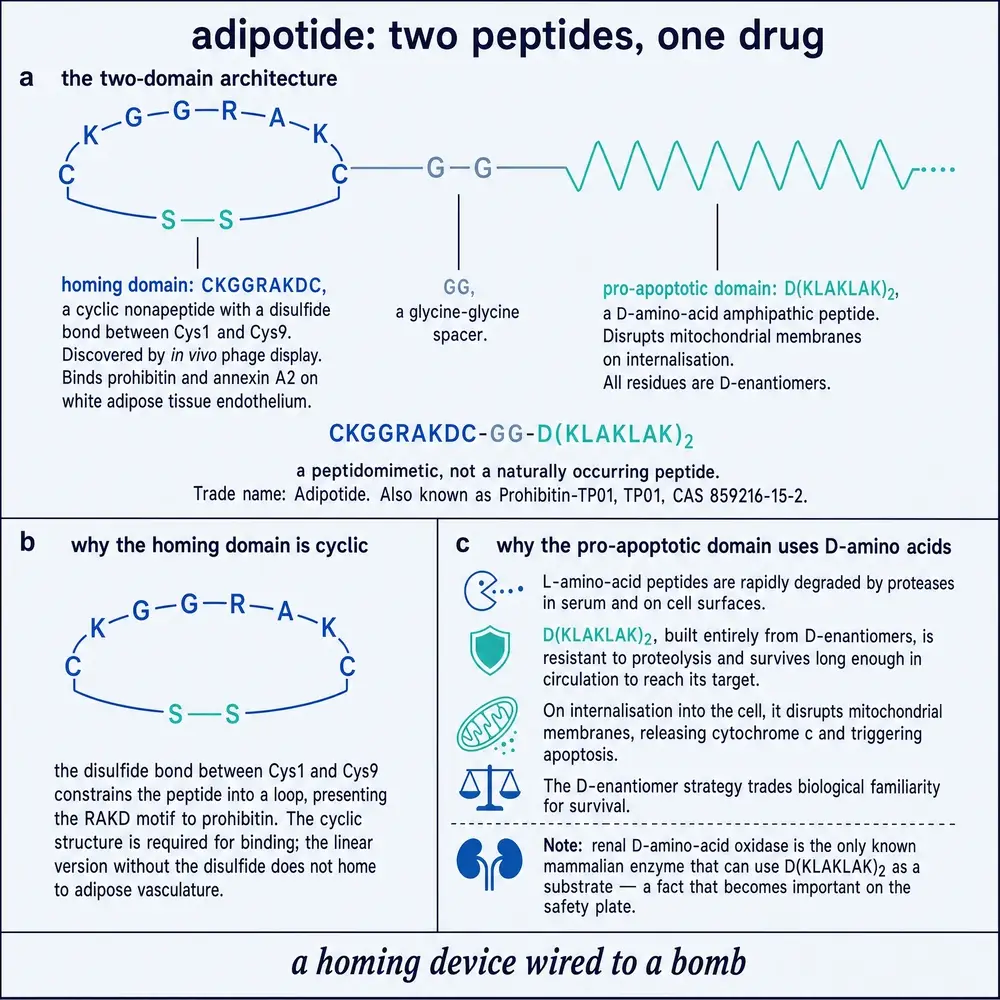
The second half is D(KLAKLAK)₂: fourteen amino acids that fold, once inside a cell, into a helix with all its greasy residues on one face and all its charged residues on the other. That shape punches holes in mitochondrial membranes, and a cell whose mitochondria have been opened dies. Outside a cell the peptide is harmless, because it cannot cross a membrane by itself. It is a warhead with the safety catch built into its chemistry.
Two glycines join them. The whole molecule is twenty-five residues long. Its formula and mass can be computed from the sequence rather than taken on trust, and doing so is worth the five minutes: summing the residue formulae and adding one water gives C₁₁₁H₂₀₆N₃₆O₂₈S₂ at 2557.20, which matches the public chemical record exactly. That record, however, describes the molecule with its two cysteines unlinked. The compound that was given to animals is the closed loop, two hydrogens lighter.
02The problem it was built for
To understand why anyone would build such a thing, it helps to remember what obesity pharmacology looked like when adipotide was designed, because it looked nothing like it does now.
Every serious anti-obesity drug of that era worked on the brain. They suppressed appetite by acting on the circuits that govern hunger, and the trouble with acting on those circuits is that they sit next to the ones governing mood, blood pressure and heart rhythm. The record is a graveyard. When the primate study was published in 2011 its authors noted that the entire United States market held exactly two approved weight-loss drugs — an appetite suppressant and a fat-absorption blocker — that sibutramine had just been withdrawn, and that the regulator had refused three further anti-obesity agents on safety grounds (Barnhart et al., 2011). They were writing in a field that had spent a decade producing nothing that could be approved.
A reader in 2026 will find this hard to picture, because the GLP‑1 drugs have since done what that generation could not. That is worth holding in mind: adipotide was conceived as an answer to a problem that has since been answered another way. It is not competing with semaglutide. It comes from the world before it.
The proposition was to leave the brain out of it entirely. Fat is a tissue like any other, and like any other tissue it needs a blood supply. Work in the early 2000s had shown that fat mass in obese mice could be pushed around by interfering with its vasculature. If a drug could be aimed at the blood vessels that feed fat, and only those, it would never touch the nervous system at all. The question was how to aim it.
03Reading the body’s postcodes
The answer came from a technique that sounds implausible and is not. In 1985 George Smith showed that a foreign peptide could be spliced into the coat protein of a bacteriophage — a virus that infects bacteria — without stopping the phage working. Because a phage carries the gene for whatever is on its own surface, a population of billions of phage, each displaying a different random peptide, is a physical library in which every molecule is labelled with its own recipe. Find the one that sticks to something, grow it, and read its gene.
In 1996 Renata Pasqualini and Erkki Ruoslahti took the library out of the test tube and put it into an animal. The procedure is brutally simple. Inject the library into a mouse’s tail vein. Wait five to fifteen minutes — long enough for the phage to circulate, too short for them to leave the bloodstream. Flush the circulation clean. Then cut out the organ you care about, recover whatever phage is still stuck to it, grow that population up in bacteria, and inject it again. After three to five rounds one sequence dominates, and that sequence is a peptide that finds the organ by itself, from the blood, in a living animal.
Over the following years the same laboratory used it to read addresses for prostate, kidney, skin, pancreas, retina, intestine, uterus and adrenal gland (Hajitou et al., 2006). The vascular lining, it turned out, is not generic plumbing. It is differentiated tissue by tissue, and it can be written to.
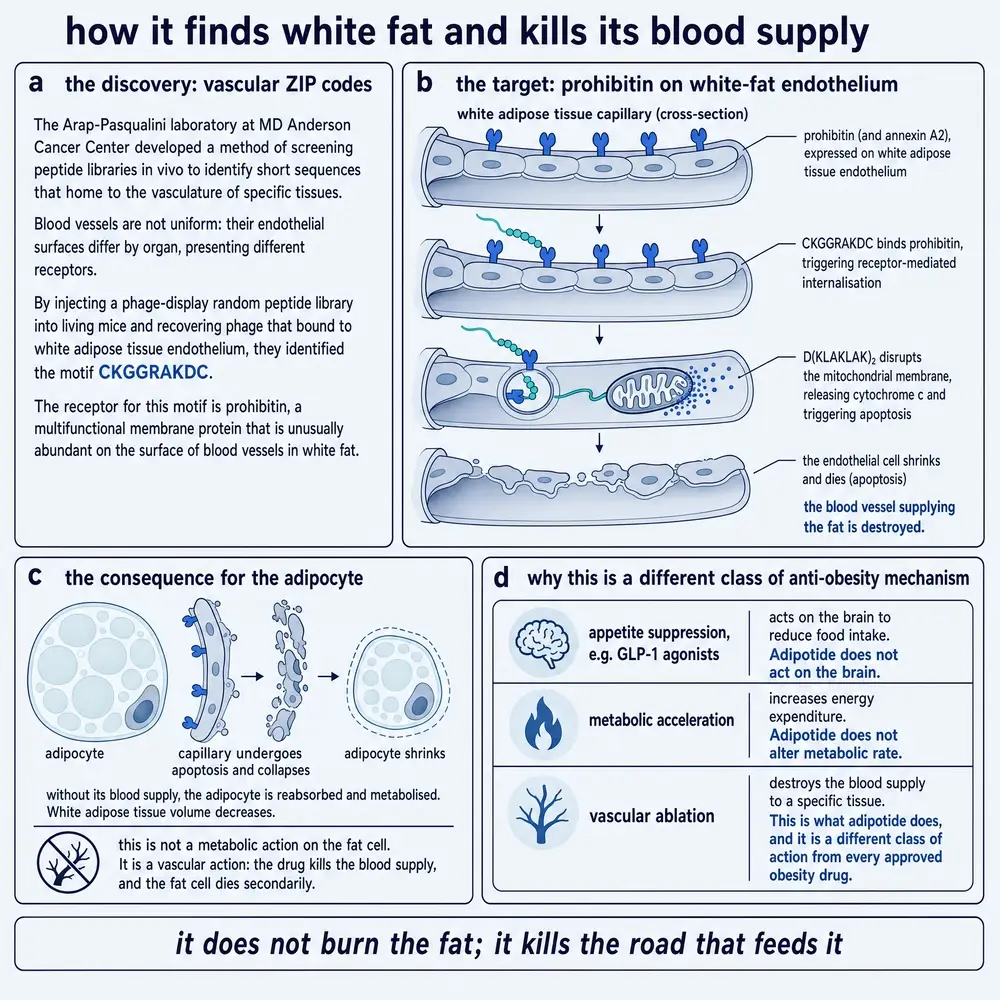
One limitation of the method matters enormously for what follows, and it is not a flaw so much as a consequence of the physics. In five minutes a phage particle cannot cross a vessel wall. So what the screen returns is overwhelmingly an address for the vasculature of an organ rather than for the organ itself (Gray and Brown, 2014). Adipotide was therefore never going to be a drug that attacks fat cells. From the moment the method was chosen, it was going to be a drug that attacks their plumbing.
04The address of fat
In 2004 Mikhail Kolonin, working with Pradip Saha, Lawrence Chan, Renata Pasqualini and Wadih Arap, published the result in Nature Medicine under a title that gave away the ambition: Reversal of obesity by targeted ablation of adipose tissue (Kolonin et al., 2004).
The screen had been run in leptin-deficient mice — animals that are massively obese because they lack the hormone that signals satiety — and the winning sequence was CKGGRAKDC. Crucially it also homed to white fat vasculature in ordinary mice, which are a better model of ordinary human obesity than a single-gene mutant is (Gray and Brown, 2014).
Then they did the thing the laboratory had done twice before with other addresses: they welded the pro-apoptotic peptide onto it and injected the result into obese mice, daily, for a month. The treated animals ended an average of fifteen grams lighter than controls — and the controls were not saline but the two halves of the molecule given unlinked, which is the right comparison and rules out either piece working on its own. Staining showed apoptosis in the white-fat vasculature of treated mice and not in controls. Metabolism improved. Insulin resistance reversed.
The paper’s abstract reported all of this as occurring “without detectable adverse effects.” Hold on to that phrase. It becomes important twice.
It is worth being precise about what kind of achievement this was. Adipotide was the third compound off an established production line, not a bolt from the blue. The same group had already fused the same warhead to an address for tumour blood vessels in 1998, and to a different tumour address in 2004 (Hajitou et al., 2006). What was new was the target. This was the first time the platform had been pointed at something that was not cancer.
05The receptor that is in the wrong place
Every targeted drug rests on the claim that its target is where the drug needs it and not where the drug would do harm. For adipotide that claim rests on prohibitin, and prohibitin is a strange thing to hang it on.
Prohibitin was found in 1989 during a search for proteins that stop cells dividing, which is where the name comes from. It exists as two subunits, PHB1 at 32 kilodaltons and PHB2 at 34, which assemble into a ring roughly twenty to twenty-five nanometres across. That ring lives in the inner membrane of the mitochondrion. Its known jobs are all internal housekeeping: chaperoning newly made components of the respiratory chain, protecting imported proteins from being degraded, maintaining the number of copies of mitochondrial DNA, handling the machinery that divides mitochondria in two (Thuaud et al., 2013; Belser and Walker, 2021). Deleting it kills a mouse embryo.
Adipotide requires this protein to be somewhere else entirely: on the outside of a cell, facing the bloodstream, reachable by an injected peptide, and able to carry that peptide inside. The second requirement is as important as the first, because a warhead that cannot get in is inert.
Prohibitin does appear on cell surfaces — this is not in dispute. It has been reported on platelets, on microglia, on the endothelium of fat, on intestinal epithelium, on activated T cells, and on cancer cells that have become resistant to taxane chemotherapy (Thuaud et al., 2013). What is in dispute, or rather what has never been established, is how it gets there. Three separate mechanisms have been proposed — shuttling through lipid rafts, partitioning driven by which lipids it happens to bind, and physical transport of mitochondria to the cell edge followed by release — and none is settled. A laboratory that traced the third route in colorectal cancer cells wrote plainly that the details of the release “remain to be elucidated.”
This leaves the specificity argument in an uncomfortable position, and it is worth stating exactly, because it is the fault line running under everything that follows. Prohibitin is ubiquitously expressed (Belser and Walker, 2021). It is in every tissue, doing essential work, in every cell’s mitochondria. The adipotide rationale does not require it to be adipose-specific in expression — it requires the much narrower claim that surface-displayed, internalisation-competent prohibitin is preferentially present on white-fat vasculature at doses where other tissues’ surface pools are not engaged.
No study in this corpus measures that. There is no comparison of surface prohibitin density between fat vasculature and any other vascular bed. There is also — and this is the more striking absence — no binding constant of any kind for the interaction between CKGGRAKDC and prohibitin. No dissociation constant, no half-maximal concentration, nothing, in any paper reviewed for this monograph. For a compound whose entire safety case is selective binding, the affinity of that binding has never been published.
Prohibitin is pushed to the cell surface by ordinary growth-factor signalling, and it is upregulated on the surface of cancer cells that have become resistant to chemotherapy (Thuaud et al., 2013). An independent laboratory later used the adipotide homing peptide itself, tagged with a dye, as a general-purpose stain for surface prohibitin on human colorectal tumours — treating the “fat address” as a generic reagent, with no expectation of adipose selectivity at all.
Adipotide’s only human trial enrolled men with metastatic prostate cancer: a population selected, in effect, for the very cell type known to put this receptor on its surface.
06A weapon made of mirror images
The killing half of adipotide has a history of its own, and understanding its design explains both why the drug worked and why it damaged kidneys.
The sequence KLAKLAK, repeated twice, folds into an amphipathic helix — a spiral with every water-hating residue on one side and every charged residue on the other. Molecules of that shape insert themselves into membranes and disrupt them. What makes this one usable as a drug rather than a poison is that it cannot get into a cell on its own. Free in the bloodstream it does essentially nothing. Deliver it inside, and it ruptures the mitochondrial membranes and the cell dies by apoptosis (Gray and Brown, 2014). The toxicity is conditional, and the condition is set entirely by whatever address is attached to it.
This is why the choice of prohibitin mattered in a second way that is easy to miss. It is not enough for a receptor to be present on the surface; it has to internalise, dragging its cargo in with it. Many of the receptors this laboratory found by phage display turn out to double as viral entry points, which is a strong hint that they take things inside (Hajitou et al., 2006). Prohibitin is one of them: it is exploited by chikungunya, dengue, hepatitis C, HIV and both SARS coronaviruses to get into cells (Thuaud et al., 2013; Belser and Walker, 2021). The address adipotide uses is a door that is already known to open.
The other design decision is the one that returns to bite. The warhead is built from D‑amino acids — the mirror images of the L‑forms that life is made of. Proteases, the enzymes that dismantle peptides, are shaped to handle L‑forms and cannot grip the mirror image. A D‑peptide therefore survives in blood long enough to reach its target intact. That is the whole reason for the choice; it changes nothing about how the peptide kills.
But it does change how the body gets rid of it. There is exactly one mammalian enzyme known to accept the D(KLAKLAK)₂ moiety as a substrate, and it is renal D‑amino-acid oxidase — an enzyme of the kidney (Barnhart et al., 2011). The molecule was made durable so it could reach fat, and the price of that durability is that only one organ can take it apart. Section 14 is the bill.
07Mice, and a result nobody expected
The 2004 mouse data were dramatic and, in one respect, quietly anomalous.
Obese mice given the conjugate daily for a month ended fifteen grams lighter than mice given the unlinked components. Immunohistochemistry showed apoptosis confined to the vasculature of white fat. Fat mass fell, metabolism rose, and insulin resistance reversed (Kolonin et al., 2004; Gray and Brown, 2014). A rat replication followed. On its face this was a clean demonstration of exactly the intended mechanism: kill the vessels, lose the tissue.
The anomaly is in what the paper reported about eating. It reported no change in food intake. That was presented as a strength — evidence that the weight loss was a direct structural effect rather than appetite suppression by another route. It is also the single claim in the founding paper that later work contradicts most flatly, and Part Three is about that collision.
08Monkeys
Rodent obesity is a poor model of the human kind, and the investigators said so themselves. Mice and primates differ in how their fat cells respond to signals to release fat, in their adipokines and peptide hormones, in their circadian and feeding behaviour. A great many anti-obesity compounds have worked in mice and then failed to matter (Barnhart et al., 2011). So in 2011, in Science Translational Medicine, Kirstin Barnhart and colleagues at MD Anderson published the study that made adipotide famous: the drug in Old World monkeys, whose fat biology closely resembles ours.
They began with four spontaneously obese female rhesus macaques, aged nine to thirteen, with body-mass indices from 34 to 45 — one of them morbidly obese by any standard. Two received escalating daily subcutaneous doses over nine weeks; two received saline. The treated animals lost 15.4 and 20.4 per cent of their body weight. The morbidly obese one went from a BMI of 45.0 to 37.3. Waistlines fell by six and a half and nine centimetres. The area under the insulin curve — a measure of how hard the pancreas has to work to handle a glucose load — fell by 61.4 and 63.5 per cent. The saline animals did not change.
That study fixed the dose. The second was larger and properly controlled: fifteen obese rhesus macaques, ten treated with 0.43 mg/kg daily for twenty-eight days and five given saline, followed by four weeks of recovery. Weight fell between 7.4 and 14.7 per cent in the treated group while the controls ranged from a 1 per cent gain to a 3.5 per cent loss. Body-mass index and abdominal circumference moved with it. All three measures separated the groups at P < 0.0001. Nine of ten treated monkeys lost waistline; one gained two per cent.
One detail deserves more attention than it usually gets: weight, BMI and waist all kept falling for three weeks after dosing stopped. A drug that suppressed appetite would stop working when it was withdrawn. Something structural was still unwinding.
Imaging confirmed that what was lost was fat rather than muscle. Weekly whole-body scans put the average fall in total body fat at 38.7 per cent in treated animals. Magnetic resonance imaging of the abdomen showed white fat volume down 17.5 per cent by the end of treatment and 27.0 per cent by the end of recovery, significant against controls at P = 0.02 and P = 0.04.
The 38.7 per cent is the number that travelled around the world in 2011. The number that travelled with it much less often is the control group’s: those animals, which received nothing but saline, lost 14.8 per cent of their body fat over the same weeks. The paper does not explain it. Whatever caused it — housing, handling, season, the measurement itself — roughly two-fifths of the headline figure is present in untreated animals. The drug-attributable difference is real, it is statistically robust, and it is smaller than the number people remember.
The metabolic results were, if anything, the more interesting half. The area under the insulin curve fell 36.2 per cent relative to controls (P = 0.019). The insulinogenic index — a ratio that rises as a body needs more insulin to do the same job — fell 48.5 per cent in treated animals while rising 33.8 per cent in controls over the same four weeks (P = 0.006). These monkeys were insulin-resistant but not diabetic; their fasting glucose was normal throughout and stayed normal. What improved was the amount of insulin needed to keep it there.
09The lean monkeys
Buried in the safety work is the most important control in the entire corpus, and it is routinely left out of summaries.
A formal toxicology study gave adipotide to lean rhesus macaques at 0.25, 0.43 and 0.75 mg/kg daily for twenty-eight days. At the two lower doses — including 0.43 mg/kg, the dose that took up to 14.7 per cent off obese animals — the lean monkeys did not lose weight at all. Only at the highest dose did they either hold their starting weight or lose a little (Barnhart et al., 2011).
This matters because it rules out the dullest explanation. A drug that simply made animals feel unwell would take weight off a lean monkey as readily as an obese one. This one did not. Whatever adipotide does, it does it to something that obese animals have and lean animals do not have enough of — which is what a drug aimed at expanded fat vasculature ought to do. The same pattern appears in mice, where the peptide did not significantly reduce food intake in lean animals (Kim et al., 2010).
Two more species were tested. Fifty-two cynomolgus macaques were used in single- and multiple-dose safety work; single doses of up to 100 mg/kg — roughly 133 times the therapeutic dose — were not lethal. Two obese baboons given the drug for twelve weeks lost weight of a similar magnitude. Across three primate species and something over a hundred animals, the effect reproduced.
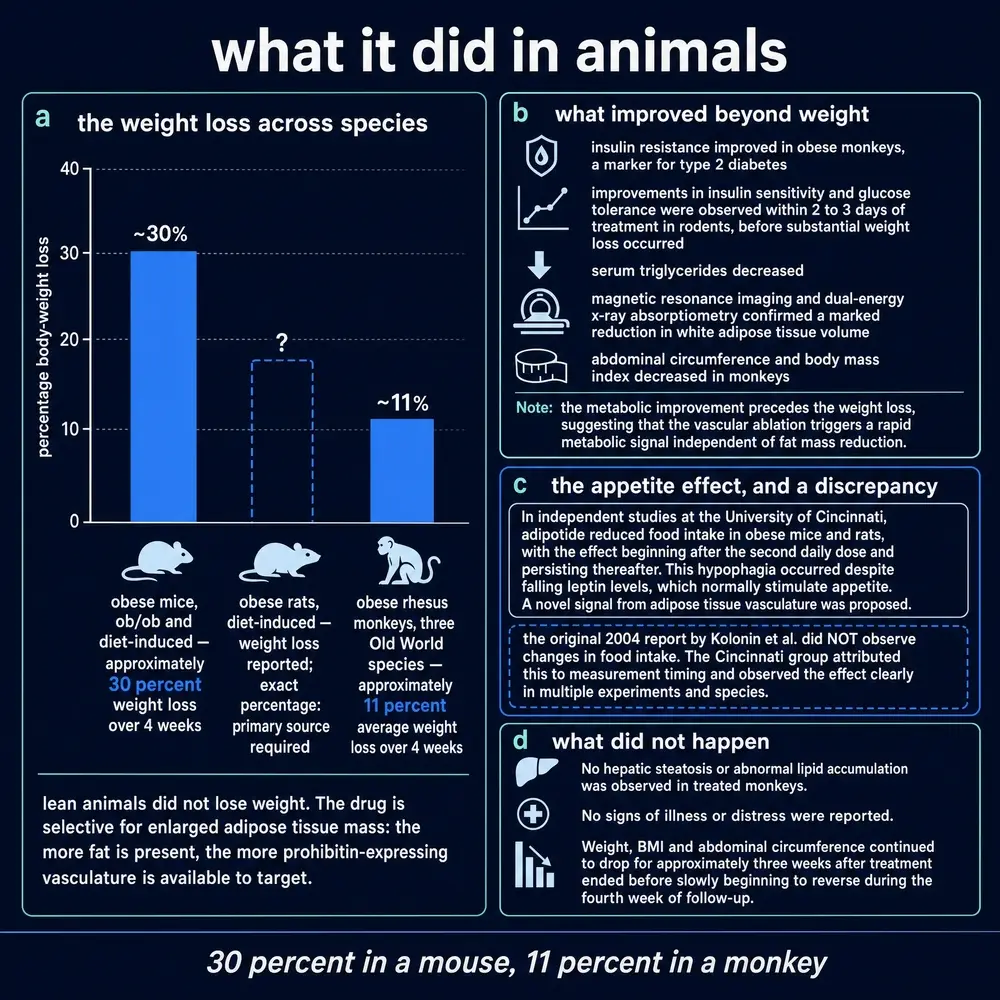
The primate data are the strongest thing adipotide has. They are well-controlled, imaged by two independent methods, reproduced across three species, and accompanied by a formal toxicology study. Very few compounds discussed in this monograph series have preclinical evidence this good.
They are also entirely animal data, and the largest efficacy cohort is ten treated monkeys. Nothing in Part Two is a human finding.
10The monkeys ate less
The 2011 primate paper contains, in its own results, the finding that would be used against it. The monkeys were fed a measured ration of biscuits plus enrichment foods, and consumption was recorded daily. The treated animals ate fewer biscuits, and the amount by which they cut back tracked the dose they were given and the weight they lost (Barnhart et al., 2011).
The authors addressed it directly rather than burying it. The animals stayed bright and alert, interacted normally, and showed no sign of nausea, vomiting or food aversion. They went on eating their treats while eating less of their staple — a selective pattern, the authors argued, that looks like satiety rather than sickness.
Lorenz Criscione was not persuaded. In a comment published in the same journal in April 2012 he made the objection formal: a study reporting that adipotide reduces weight in obese monkeys by killing the blood vessels around white fat “may instead reflect a direct effect of adipotide on food consumption” (Criscione, 2012). The authors replied in the same issue.
Put plainly, the challenge is this. If a drug makes an animal eat less, and the animal loses weight, the elaborate mechanism is not needed to explain the result. It might still be true — but the weight loss stops being evidence for it.
11Seventy-six per cent
By the time Criscione’s comment appeared, an independent laboratory had already measured the thing properly, and got an answer that was worse for the vascular story than the monkey data were.
Dong-Hoon Kim, Stephen Woods and Randy Seeley at Cincinnati gave the same peptide to obese mice for twenty-seven days and, unlike the founding study, weighed the food carefully and often. Their title states the conclusion: Peptide designed to elicit apoptosis in adipose tissue endothelium reduces food intake and body weight (Kim et al., 2010). Their central number is that 76 per cent of the reduction in body mass was accounted for by reduced energy intake.
They were explicit about the discrepancy with the original report, and about its cause: the earlier null, they wrote, was likely a failure to measure food intake accurately at the times when it mattered. Divergence in intake began about eight hours after the second dose — not the first — which is exactly the kind of thing a study not looking for it would miss.
The rest of that paper is a careful process of elimination, and the null results are as informative as the positive one:
- Energy expenditure did not rise. If the drug were destroying fat and forcing the body to burn it, one might expect metabolic rate to move. It did not, over four days or over four weeks.
- It is not acting on the brain directly. Peptide injected into the brain’s ventricle had no effect on food intake or body weight at all, and no dying cells were detectable in the appetite-regulating regions.
- It is not nausea. A conditioned taste aversion test — the standard way to ask a rodent whether something made it feel ill — was negative, while a positive control produced a robust aversion.
- It requires obesity. The peptide did not significantly reduce intake in lean mice, which agrees with the lean-monkey result in Section 09.
What is left is genuinely strange, and the authors said so: something originating in fat tissue, or its vasculature, is telling the brain to stop eating, and it is doing so while circulating leptin is falling — the opposite of the normal signal. They proposed an unidentified messenger from the adipose vasculature. Sixteen years later it has not been identified.
Two papers using the same molecule in obese mice report opposite findings on the same variable. The 2004 study reports no change in food intake; the 2010 study reports that reduced intake explains three-quarters of the weight loss. They cannot both be right.
On the evidence, the 2010 result should be preferred: it measured the variable directly and frequently, it is the more recent, and it identifies a specific reason the earlier measurement would have missed the effect. Nothing published since has reversed it. But note what this does and does not settle — it removes weight loss as evidence for the vascular mechanism. It does not show the vascular mechanism is absent.
12The strongest defence, and what it defends
Two years later the same Cincinnati group published the best counter-argument adipotide has, and it is worth being precise about its scope because it is routinely overstated.
The design is the right one: compare treated mice not against untreated mice but against pair-fed mice — animals given exactly as much food as the treated ones chose to eat, delivered every twelve hours so the pattern matched too. Anything that separates the two groups cannot be explained by eating less, because both groups ate the same (Kim et al., 2012).
Several things did separate. On day two, when body weight was explicitly no different between the groups, glucose tolerance was significantly better in the treated animals than in the pair-fed ones, with blood glucose lower at forty-five, sixty and one hundred and twenty minutes. Ketone production, which rises when an animal is short of food, was lower in treated mice than in pair-fed mice — the treated animals were not simply starving. Specific fatty acids moved in the treated group only. Gene expression in white fat shifted towards the pattern seen in lean animals, reversing the suppression of mitochondrial and oxidative-phosphorylation pathways that a high-fat diet causes.
That is a real, weight-independent drug effect on glucose handling, and it is the title of the paper. But read the right-hand column of the figure. Body weight is there because it was matched by design at these early time points, not because pair-feeding failed to reduce it. Adipocyte size at day three was not significantly different between groups (P = 0.16). And the paper’s own summary sentence describes the weight and fat loss as “largely secondary to reduced food intake.”
So the defence establishes that adipotide does something to metabolism that eating less does not explain. It does not establish that the weight loss was independent of eating less. Those two claims are constantly conflated, including in material that sells the compound.
And there is a gap in the experimental record that no one has filled: no study has ever pair-fed animals for the full twenty-seven or twenty-eight day course. The pair-fed comparisons run to two, three and ten days. The question of whether a month of matched feeding reproduces a month of adipotide has never been asked.
13What nobody measured
Step back from the individual studies and a pattern in the corpus becomes visible that is more troubling than any single result.
The mechanism everyone repeats — that adipotide kills the endothelial cells lining fat’s blood vessels — was demonstrated once, by immunohistochemistry, in the 2004 mouse paper. After that it is carried by citation. Neither of the two later mouse studies that examined the drug most carefully measured a single vascular endpoint: no endothelial apoptosis, no vessel density, no adipose vascular histology, no binding of the drug to prohibitin. The word “prohibitin” does not appear in the 2012 paper at all.
Three further observations from the corpus cut the same way.
Endothelial killing is not necessary to get the result. In 2015 Kolonin’s own laboratory published a different hunter-killer peptide aimed at adipose progenitor cells rather than endothelium. It spares the endothelium completely — the paper confirms endothelial cells stay viable at concentrations lethal to its target — and it still suppresses fat-mass accumulation for months (Daquinag et al., 2015). If fat mass can be held down without touching a blood vessel, the vascular route is one path to the outcome rather than the explanation of it.
The effect does not last. The same paper, from the inventors, describes adipotide as inducing an acute reversal of experimental obesity “that relapses upon treatment discontinuation.” A drug that had permanently ablated a tissue’s blood supply should not relapse.
The address is not exclusive to fat. Work using the homing peptide as a delivery vehicle reports prohibitin on the plasma membrane of fat cells themselves, not only on the endothelium (Banerjee et al., 2020), and the 2026 literature describes it as highly expressed on both vasculature and mature adipocytes (Li et al., 2026).
The number that was never measured, and why it probably matters
Return to the missing binding constant, because there is a reason to expect it would have been unflattering.
A peptide selected by phage display is not displayed on the phage one copy at a time. The coat protein most libraries use carries several copies at the tip of the particle, so selection proceeds by multivalent binding — many weak grips acting together. The consequence is well known to the people who use the method: peptides isolated this way “often have poor affinities when synthesized as monomeric peptides,” and the standard remedy is to multimerise them on a scaffold, which can rescue affinity by one to two orders of magnitude (Gray and Brown, 2014). Reported affinities for phage-derived peptides commonly sit in the micromolar range, which is far weaker than a conventional drug–receptor interaction.
Adipotide is a monomer. It was never multimerised. So the expectation from the method that produced it is that its grip on prohibitin is weak — and a weak, unquantified grip on a receptor that is present on at least six unrelated cell types is a thin foundation for a selectivity claim. This is not an argument that adipotide does not reach fat; the imaging and the lean-animal control say it does something fat-specific. It is an argument that nobody has ever published the number that would tell you how selective it is, and that the technique’s own literature predicts the number would be modest.
None of this makes adipotide a fraud. The compound plainly does something large and reproducible to obese primates. What the corpus will not support is the confident single-sentence mechanism that accompanies the compound wherever it is sold.
14The kidney
The 2004 abstract described obesity reversal “without detectable adverse effects.” The primate work found otherwise, and the reason is structural rather than incidental.
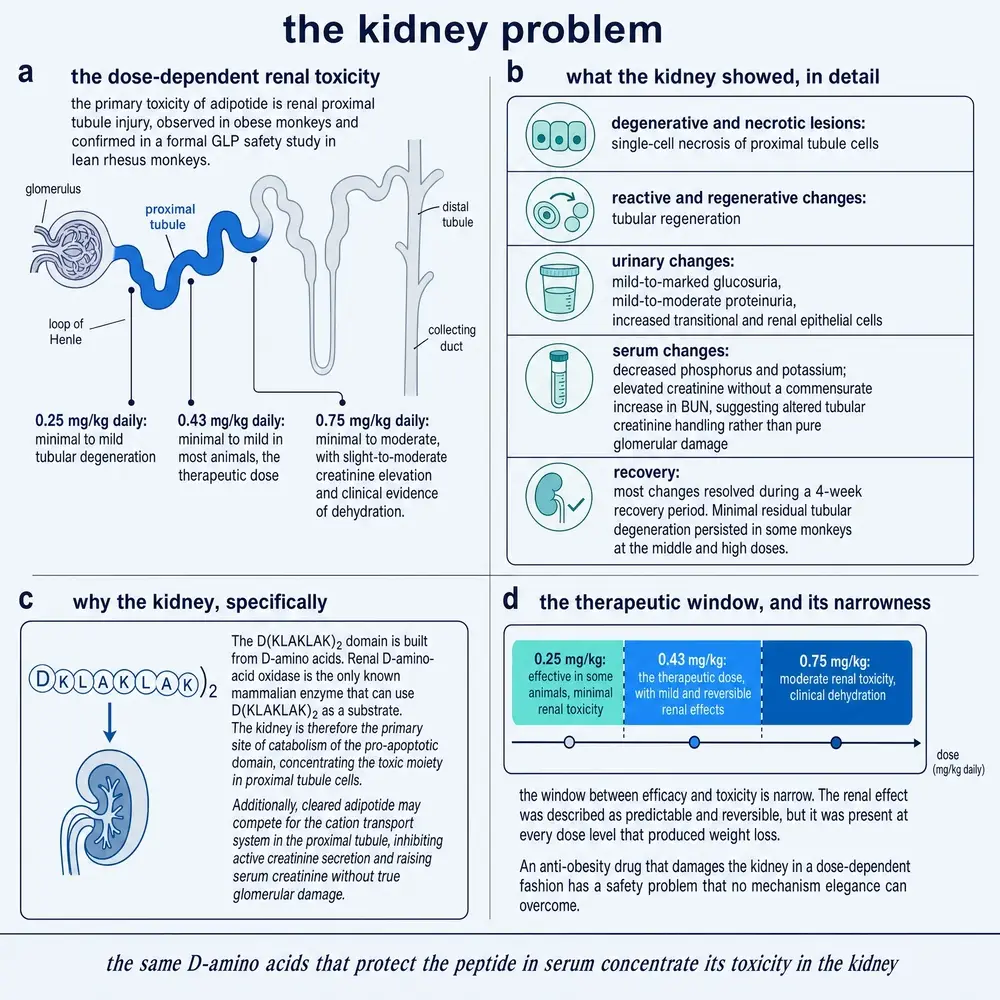
In the formal twenty-eight-day toxicology study, twenty lean rhesus macaques were divided into a saline group and three dose groups. Kidney lesions were found in every treated group and in none of the controls, graded minimal to mild at 0.25 mg/kg, minimal to mild in most animals at 0.43, and minimal to moderate at 0.75. The lesions were of two kinds: proximal tubule cells dying one at a time, and tubules visibly regenerating (Barnhart et al., 2011).
The blood chemistry has an odd signature that the authors examine at length. Serum creatinine rose in a dose-dependent way above 0.25 mg/kg — but blood urea nitrogen did not rise with it. In a straightforward loss of filtration both go up together. The dissociation suggests something more specific: adipotide may be competing with creatinine for the transporter that secretes it in the proximal tubule. Alongside this, glucose and protein appeared in the urine and serum phosphorus and potassium fell — the classic picture of a proximal tubule that is not reabsorbing properly.
Most of it reversed within twenty-eight days of stopping. Not all: at the end of recovery, minimal tubular degeneration was still present in one mid-dose and two high-dose animals, and one monkey in each efficacy study still had slightly raised creatinine and urinary glucose.
The mechanistic explanation the investigators offer is the one that makes this a design problem rather than a formulation problem. Renal D‑amino-acid oxidase is the only mammalian enzyme known to accept the D(KLAKLAK)₂ half of the molecule as a substrate. The kidney is where the warhead gets taken apart, and it is therefore where a warhead does its damage. The D‑amino acids that let the drug survive long enough to reach fat are the same feature that concentrates its disassembly in one organ.
In 2013, two separate reviews described this same body of work. One states that adipotide reversed obesity in mice “without any adverse sign of toxicity” (Thuaud et al., 2013). The other states that “the only observed side effect was mild renal degeneration, which was reversible” (Gray and Brown, 2014).
Both are defensible — the first describes the rodent work, the second the primate work — and neither says which it is describing. A reader of either one alone comes away with a materially wrong impression of the safety record. When the primary studies are read directly, renal injury is present in every treated dose group of the only formal toxicology study ever conducted.
15The trial that cannot be found
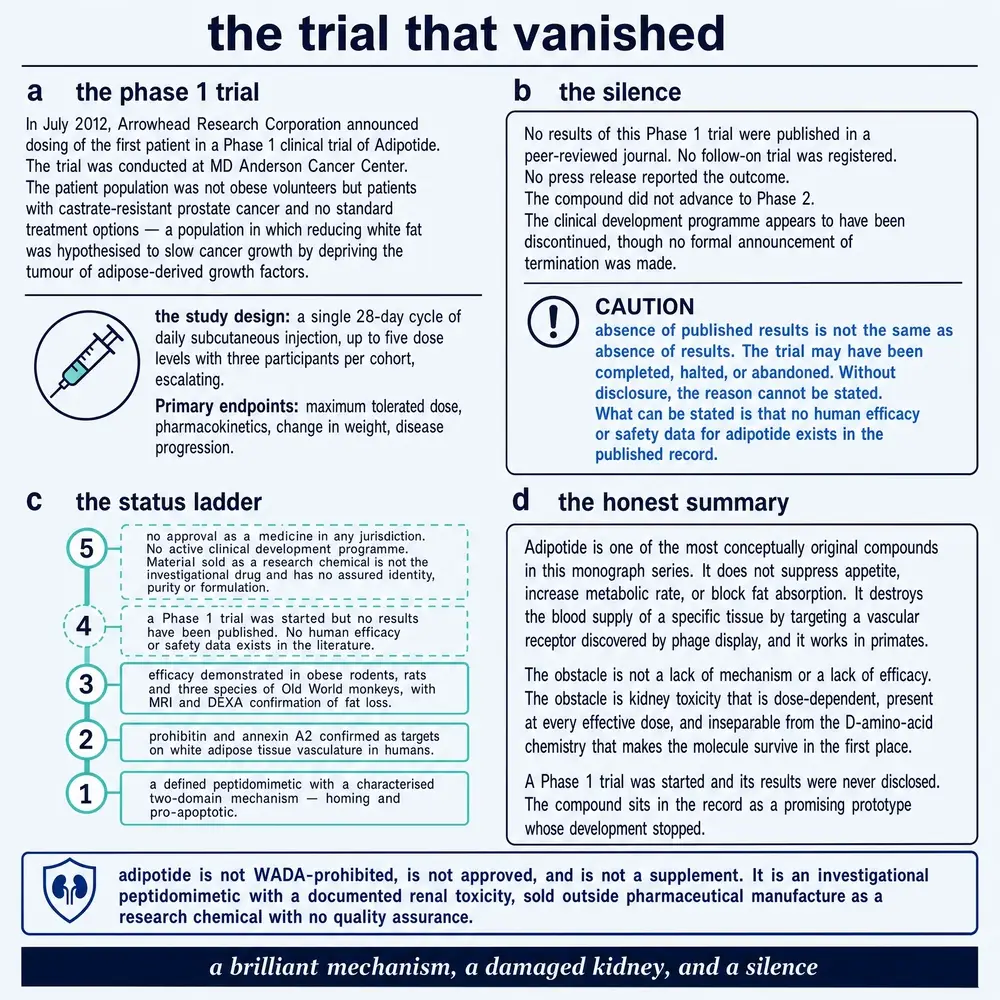
Search the United States clinical trials registry for “adipotide” and it returns nothing. Not a terminated study, not a withdrawn one — nothing at all. The same is true for the sequence CKGGRAKDC and for the name of the company that developed it.
The compound has nevertheless been given to human beings, in a study that has been sitting in the registry since December 2010. It is filed under a name almost nobody associates with the drug: Prohibitin‑TP01. The registration is NCT01262664, and its title is A First-in-Man, Phase I Evaluation of A Single Cycle of Prohibitin Targeting Peptide 1 in Patients With Metastatic Prostate Cancer and Obesity (ClinicalTrials.gov, NCT01262664).
This is worth dwelling on, because it is a small lesson in how evidence goes missing. A compound acquires a memorable name in the press — adipotide — while its regulatory paperwork carries a different one. Anyone afterwards who checks the registry for human evidence under the popular name concludes, reasonably and wrongly, that the drug was never taken into people at all.
The indication is also not the one the public story would predict. This was not an obesity trial. It was an oncology trial at the MD Anderson Cancer Center in men with metastatic prostate cancer for which no standard options remained, who were also obese. The reasoning stated in the protocol is that fat produces substances that promote prostate cancer growth, so reducing fat might slow the cancer. Weight loss was a secondary question, defined as a ten per cent reduction in body weight at twenty-eight days.
16Four patients
The design was a conventional dose-escalation. Up to five dose levels, three patients at each, starting at 0.03 mg/kg injected under the skin once daily for twenty-eight days, escalating only if the level below was tolerated. Up to thirty-nine patients would take part, all at MD Anderson. The primary endpoints were a tolerable dose and biological activity.
The study opened to enrolment on 24 May 2012.
It closed on 2 January 2019, terminated “per PI’s request,” having enrolled four patients.
Six and a half years, four participants, against a protocol that envisaged thirty-nine. No results have been posted to the registry, and no publication reporting human data from this study has been located in PubMed, in PubMed Central, or anywhere else searched for this monograph. Whatever those four people experienced — whether they lost weight, whether their kidneys were affected as the monkeys’ were, whether the drug was tolerable at all — is not in the public record.
It is important not to over-read this. A terminated Phase 1 with four patients is not evidence that the drug is dangerous, and it is not evidence that it failed. Trials in heavily pre-treated metastatic cancer patients recruit slowly for many reasons that have nothing to do with the drug. The honest statement is narrower and, for a compound sold on the strength of its reputation, more important: there is no human efficacy evidence and no human safety evidence for adipotide, of any kind, at any dose.
17A programme that simply stopped
The commercial history is thinly documented, and the shape of the documentation is itself informative.
Adipotide was licensed out of the academic work into industry. Contemporary sources name Arrowhead Research Corporation as the developer (Thuaud et al., 2013); a 2025 review clarifies the structure, recording that the compound is variously attributed to Arrowhead Pharmaceuticals and to Ablaris Therapeutics, and that Ablaris is a majority-owned subsidiary of Arrowhead (Liu et al., 2025). That review also lists five United States patents covering the compound, and records the Phase 1 programme as discontinued on 18 January 2019 — a date consistent with the registry’s termination entry two weeks earlier.
As to why, the literature is candid about not knowing. The same 2025 review states that further development “has been limited for unknown reasons” (Liu et al., 2025). A 2021 review of prohibitin biology puts it more starkly still: there has been no additional research on adipotide since 2012 (Belser and Walker, 2021).
That is the whole of it. There is no published termination announcement, no disclosed toxicity finding that stopped the programme, no regulatory action, no statement of intent from the sponsor. The compound has never been approved for any indication in any jurisdiction, and no evidence was found that it ever progressed beyond the Phase 1 registration described above.
It is tempting to read a discontinued programme as a verdict. In this case it is not one, because nothing was ever reported that could constitute a verdict. What the record shows is a drug that produced striking results in three primate species, entered a single small trial in a difficult patient population, recruited four people over six years, and was stopped without explanation.
Drugs are abandoned for reasons that have nothing to do with whether they work — a change in company strategy, the cost of a manufacturing route, a competing asset, the arrival of the GLP‑1 agonists in the same indication. Any of these is as consistent with the record as a safety problem would be. Stating that honestly is more useful than guessing.
18What is sold, and what is known
Adipotide is not a medicine and has never been one. It is, however, widely available. A survey of the commercial surface conducted for this monograph found it offered by more than a dozen suppliers, in five- and ten-milligram vials, frequently under the trade designation “FTPP,” a name that appears nowhere in the scientific literature at all.
That asymmetry is the finding worth recording. When the local research library was searched for this compound, it held a catalogue entry, a chemical structure record, five vendor listings and thirty-one commercial web pages — and zero scientific full texts. The entire evidence base had to be assembled from outside it.
Set the commercial claims against the record established in this document:
| What exists | Extent | What it establishes |
|---|---|---|
| Human beings given the compound | 4 | Nothing. No result was ever reported. |
| Non-human primate species | 3 | Large, reproducible fat loss and improved insulin sensitivity in obese animals |
| Rodent species | 2 | The same, plus the finding that most of the weight loss follows reduced eating |
| PubMed records under its own name | 7 | The complete indexed literature for the compound |
| Published binding constant for its receptor | none | The selectivity on which the safety case rests is unquantified |
| Formal toxicology studies | 1 | Dose-dependent renal tubular injury in every treated group |
| Approved indications, any country | none | — |
The gap between the two columns of that table is the point. This is not a compound with a thin evidence base in the ordinary sense — the primate work is better than most preclinical packages in this monograph series. It is a compound whose evidence stops precisely at the boundary where human evidence would begin, and whose one documented safety signal is organ injury that was found in every animal group that received it.
19The sequence that kept working
There is a measurement in this build’s own harvest that tells the rest of the story better than any narrative could.
Searching the full text of PubMed Central, the word “adipotide” appears in twenty-four documents. The sequence CKGGRAKDC appears in eighty-five. The address is cited three and a half times as often as the drug built on it.
Plot the records that name the compound by year and the shape is unmistakable. There is the 2004 discovery, a cluster around the 2011 primate paper and the 2012 argument about it, and then the line thins to almost nothing. The last PubMed record naming adipotide is from 2022, and it is not about treating obesity by killing fat — it is a nanoparticle paper that borrows the homing peptide for something else.
The drug’s literature stopped. The address’s did not.
20From killing fat to reprogramming it
What CKGGRAKDC became is a delivery module — a standard component that anyone wanting to get a molecule into fat tissue can bolt onto whatever they are carrying. The pattern of use over fifteen years reads as a slow inversion of the original idea.
In 2011 it was used to steer an enzyme inhibitor to fat so that the drug would not act on the whole body (Liu et al., 2011). In 2018 and again in 2021 it was hung on iron-oxide nanoparticles to make brown fat visible on magnetic resonance imaging — the address used as a contrast agent rather than a weapon (Hu et al., 2018; Hu et al., 2021). In 2019 it was fused to a string of arginines and used to carry a CRISPR interference system into white fat cells to silence a fat-storage gene (Chung et al., 2019). In 2020 it carried a gene for adiponectin (Banerjee et al., 2020). In 2022 it carried an inducer of a protective enzyme to fat and liver at once (Hong and Kim, 2022).
One study is worth singling out because it tested adipotide head-to-head against the alternative, and adipotide lost. In 2013 a group compared the pro-apoptotic peptide delivered as adipotide delivers it — welded directly to the homing sequence in a single chain — against the same warhead packaged inside a prohibitin-targeted nanoparticle. In diet-induced obese mice a low dose of the nanoparticle, rather than the bioconjugate, reduced body weight, cut ectopic fat in liver and muscle, raised adiponectin and produced no detectable liver toxicity (Hossen et al., 2013).
The reason the authors give is the one Section 13 anticipated. The nanoparticle’s advantage came from multivalent active targeting — many copies of the homing peptide gripping at once, which is how the peptide was selected in the first place and precisely what a single-chain molecule cannot do. Adipotide, in other words, may have been the weakest possible implementation of its own idea: one address, one warhead, one grip. That does not make the idea wrong. It suggests the therapeutic-index problem of Section 14 is at least partly a delivery problem, and that the field moved to nanoparticles for a reason.
By 2025 the approach had a literature of its own. A review of adipose-targeted drug delivery traces the whole field back to the 2004 discovery of the homing peptide, and catalogues the platforms built on it since — liposomes, polymeric nanoparticles, dual-targeted constructs, and peptide-guided gene carriers (Luo et al., 2025). The founding paper is cited there not as the origin of a drug but as the origin of an address.
The most recent work completes the inversion. A 2026 paper describes a dissolving microneedle patch loaded with nanoparticles that carry resveratrol, coated with the CKGGRAKDC peptide so they accumulate in subcutaneous fat, and activated by infrared light to warm the tissue gently. The aim is not to kill the fat but to convert it — to push white fat towards the brown-fat phenotype that burns energy instead of storing it (Li et al., 2026). That paper reports prohibitin as highly expressed on the vasculature and on mature fat cells, and uses the peptide to reach the cells themselves.
Same postcode. Opposite instruction.
There is a second lineage worth naming, because it belongs to the same laboratory and points the same way. In 2015 Kolonin’s group published a peptide aimed not at fat’s blood vessels but at the progenitor cells that make new fat cells. It spares the endothelium entirely, and treated mice ate more while burning more energy and accumulating less fat over three months (Daquinag et al., 2015). It is the mirror image of the adipotide result in every respect that matters — and it demonstrates that the group could and did measure increased food intake when it occurred, which lends weight to the 2010 finding that adipotide’s animals were eating less.
21What to take from this
Adipotide is easy to describe badly in either direction, and both bad descriptions are common.
The first is that it is a miracle that was suppressed — a drug that melted fat off monkeys and was quietly buried. The primate data are genuinely impressive and nothing in the record suggests suppression. What the record shows is a single small trial in a difficult population that recruited four patients in six years and was stopped by its own investigator without any result being reported.
The second is that it is a discredited failure. Nothing was ever shown not to work in a person, because the experiment that could have shown it was never completed. Adipotide is not a refuted drug. It is an unfinished one, and the difference matters.
What can be said with confidence is a shorter list than either story suggests:
- In obese animals of five species, including three primates, it produces large and reproducible loss of white fat and improvement in insulin sensitivity.
- In lean animals at the same dose it does almost nothing, which is a genuine specificity result and argues against simple toxicity.
- Most of the weight loss in the best-measured rodent study follows from the animals eating less, by a mechanism nobody has identified — a signal from fat to the brain that overrides falling leptin.
- Some of the metabolic benefit is independent of eating less, demonstrated against properly pair-fed controls, though only over days rather than weeks.
- It injures the kidney in a dose-dependent, largely reversible way, in every treated group of the only formal toxicology study conducted, for a reason that follows from the molecule’s design rather than from any impurity.
- It has been given to four human beings and no outcome has ever been published.
The most durable thing to come out of the programme is not on that list. It is the finding underneath it: that fat tissue has a vascular address distinct enough to be written to from the bloodstream. That result has survived everything. It is being used in laboratories in 2026, in work that has nothing to do with adipotide, to deliver genes and contrast agents and browning agents into fat with a precision that would not otherwise be available.
The drug was the hypothesis. The address was the discovery.
This document describes published research on a compound that is not approved as a medicine in any country, that has been administered to four people in a terminated Phase 1 study which reported no results, and for which no human efficacy or safety data of any kind exist in the published record.
Every dose, route and schedule named anywhere in this monograph is a reported parameter of an animal experiment or of a trial protocol, given with its species and duration attached. None is a recommendation. No human use of this compound is recommended here, and no dose, route or schedule is specified for any person. This is not medical advice.
22References
Generated from verified NCBI records rather than from recall. Every author list, journal name, volume, page range and identifier below was fetched from PubMed and read back before the build was permitted to run. That check is not a formality: on this build seven of the twenty citation keys drafted from memory named the wrong first author, and two of those also named the wrong year. The works were the right works; the attributions were not.
- Banerjee A, Sharma D, Trivedi R, Singh J. Treatment of insulin resistance in obesity-associated type 2 diabetes mellitus through adiponectin gene therapy. Int J Pharm. 2020;583:119357.
PMID 32334065 · doi:10.1016/j.ijpharm.2020.119357 · PMC7261390 - Barnhart KF, Christianson DR, Hanley PW, Driessen WH, Bernacky BJ, Baze WB, et al.. A peptidomimetic targeting white fat causes weight loss and improved insulin resistance in obese monkeys. Sci Transl Med. 2011;3(108):108ra112.
PMID 22072637 · doi:10.1126/scitranslmed.3002621 · PMC3666164 - Belser M, Walker DW. Role of Prohibitins in Aging and Therapeutic Potential Against Age-Related Diseases. Front Genet. 2021;12:714228.
PMID 34868199 · doi:10.3389/fgene.2021.714228 · PMC8636131 - Chung JY, Ain QU, Song Y, Yong SB, Kim YH. Targeted delivery of CRISPR interference system against Fabp4 to white adipocytes ameliorates obesity, inflammation, hepatic steatosis, and insulin resistance. Genome Res. 2019;29(9):1442-1452.
PMID 31467027 · doi:10.1101/gr.246900.118 · PMC6724665 - Criscione L. Comment on "a peptidomimetic targeting white fat causes weight loss and improved insulin resistance in obese monkeys". Sci Transl Med. 2012;4(131):131le2; author reply 131lr2.
PMID 22539771 · doi:10.1126/scitranslmed.3003760 - Daquinag AC, Tseng C, Salameh A, Zhang Y, Amaya-Manzanares F, Dadbin A, et al.. Depletion of white adipocyte progenitors induces beige adipocyte differentiation and suppresses obesity development. Cell Death Differ. 2015;22(2):351-63.
PMID 25342467 · doi:10.1038/cdd.2014.148 · PMC4291494 - Gray BP, Brown KC. Combinatorial peptide libraries: mining for cell-binding peptides. Chem Rev. 2014;114(2):1020-81.
PMID 24299061 · doi:10.1021/cr400166n · PMC4053476 - Hajitou A, Pasqualini R, Arap W. Vascular targeting: recent advances and therapeutic perspectives. Trends Cardiovasc Med. 2006;16(3):80-8.
PMID 16546688 · doi:10.1016/j.tcm.2006.01.003 · PMC7172921 - Hong J, Kim YH. Fatty Liver/Adipose Tissue Dual-Targeting Nanoparticles with Heme Oxygenase-1 Inducer for Amelioration of Obesity, Obesity-Induced Type 2 Diabetes, and Steatohepatitis. Adv Sci (Weinh). 2022;9(33):e2203286.
PMID 36209391 · doi:10.1002/advs.202203286 · PMC9685446 - Hossen N, Kajimoto K, Akita H, Hyodo M, Harashima H. A comparative study between nanoparticle-targeted therapeutics and bioconjugates as obesity medication. J Control Release. 2013;171(2):104-12.
PMID 23871959 · doi:10.1016/j.jconrel.2013.07.013 - Hu Q, Chen X, Liu J, Di W, Lv S, Tang L, et al.. Targeted Molecular Magnetic Resonance Imaging Detects Brown Adipose Tissue with Ultrasmall Superparamagnetic Iron Oxide. Biomed Res Int. 2018;2018:3619548.
PMID 30406134 · doi:10.1155/2018/3619548 · PMC6199858 - Hu Q, Cao H, Zhou L, Liu J, Di W, Lv S, et al.. Measurement of BAT activity by targeted molecular magnetic resonance imaging. Magn Reson Imaging. 2021;77:1-6.
PMID 33309921 · doi:10.1016/j.mri.2020.12.006 - Kim DH, Woods SC, Seeley RJ. Peptide designed to elicit apoptosis in adipose tissue endothelium reduces food intake and body weight. Diabetes. 2010;59(4):907-15.
PMID 20103704 · doi:10.2337/db09-1141 · PMC2844838 - Kim DH, Sartor MA, Bain JR, Sandoval D, Stevens RD, Medvedovic M, et al.. Rapid and weight-independent improvement of glucose tolerance induced by a peptide designed to elicit apoptosis in adipose tissue endothelium. Diabetes. 2012;61(9):2299-310.
PMID 22733798 · doi:10.2337/db11-1579 · PMC3425411 - Kolonin MG, Saha PK, Chan L, Pasqualini R, Arap W. Reversal of obesity by targeted ablation of adipose tissue. Nat Med. 2004;10(6):625-32.
PMID 15133506 · doi:10.1038/nm1048 - Li Y, Liu E, Wang P, Liu J, Jin W, Gao Z, et al.. NIR-activated adipose-targeted nanocarrier drives local browning and metabolic restoration. Regen Biomater. 2026;13:rbag052.
PMID 42109269 · doi:10.1093/rb/rbag052 · PMC13157220 - Liu D, Chen W, Guo Z, Gao Q, Wang B, Wang J, et al.. Advances and challenges of targeting epicardial adipose tissue (EAT) and perivascular adipose tissue (PVAT). Cardiovasc Diabetol. 2025;24(1):319.
PMID 40760703 · doi:10.1186/s12933-025-02763-z · PMC12323123 - Liu J, Wang L, Zhang A, Di W, Zhang X, Wu L, et al.. Adipose tissue-targeted 11β-hydroxysteroid dehydrogenase type 1 inhibitor protects against diet-induced obesity. Endocr J. 2011;58(3):199-209.
PMID 21325744 · doi:10.1507/endocrj.k10e-318 - Luo T, Chen L, Tu K, Jiang L, Liang S, Wang S, et al.. Adipose tissue-targeted drug delivery for treating obesity: current opportunities and challenges. Drug Deliv. 2025;32(1):2547751.
PMID 40844426 · doi:10.1080/10717544.2025.2547751 · PMC12377096 - Thuaud F, Ribeiro N, Nebigil CG, Désaubry L. Prohibitin ligands in cell death and survival: mode of action and therapeutic potential. Chem Biol. 2013;20(3):316-31.
PMID 23521790 · doi:10.1016/j.chembiol.2013.02.006 · PMC7111013
Registry and database sources
These carry no PubMed identifier and are listed separately so that the count of peer-reviewed references is never inflated by them.
- M.D. Anderson Cancer Center. A First-in-Man, Phase I Evaluation of A Single Cycle of Prohibitin Targeting Peptide 1 in Patients With Metastatic Prostate Cancer and Obesity. Clinical trial registration. Accessed 3 August 2026.
https://clinicaltrials.gov/study/NCT01262664
Phase 1; enrolment 4 (actual) against a protocol maximum of 39; status TERMINATED, “Terminated per PI’s request”; no results posted. - National Center for Biotechnology Information. Adipotide, PubChem Compound Summary CID 163360068. Chemical database record. Accessed 3 August 2026.
https://pubchem.ncbi.nlm.nih.gov/compound/163360068
Records the reduced, linear form C111H206N36O28S2, MW 2557.20; InChIKey GZESIPHLGJDZRG-VCWDIOOSSA-N.
23How this document was assembled
The first finding of this build was that the source library contains no literature about its subject. Project 05, the Therapeutic Peptide Research Library, holds 10,204 full-text scientific articles. Searched for adipotide, it returns zero. Searched for the homing sequence CKGGRAKDC, it returns zero. Its catalogue does carry the compound — a structure record, five vendor listings and thirty-one commercial web pages — together with a Radix-generated dossier of 704 words carrying no citations and twenty-four thin-data flags. That dossier is not evidence and was not used.
A control confirms the search itself was sound: the same index returns 689 files for semaglutide. A wider sweep for lineage terms returned sixty-one candidate files, and every one was a false positive — eighteen matches on the surname Pasqualini were reproductive-medicine papers by an unrelated author of that name, and all twenty-eight matches on prohibitin concerned mitochondrial biology rather than the adipose-vasculature receptor. The reading corpus was therefore built from NCBI.
The identity gate, and why this compound needed the opposite of the usual one
Most compounds in this series have a name that admits material it should not. Adipotide has the inverse problem, and it is equally damaging: the compound is mostly discussed without using its name. Measured on 3 August 2026, adipotide appears in 24 PubMed Central full texts while CKGGRAKDC appears in 85. A gate keyed on the trade name alone would have discarded three-quarters of the literature — and would have found no human trial at all, because the only registration is filed under Prohibitin-TP01.
The nine-residue sequence is therefore treated as a primary retrieval key rather than a corroborating one, since a sequence string cannot collide by accident. Three terms are guarded and never admit a document on their own: prohibitin, because the mitochondrial PHB literature is large and unrelated; KLAKLAK, because it is a generic pro-apoptotic module welded onto many unrelated constructs; and the surname Pasqualini, for the reason given above. The matcher was break-tested before the first sweep against eleven traps — six that must be admitted and five that must be refused. The first run failed one of them, which was a real defect in the gate rather than in the traps, and it was corrected before any document was screened.
Harvest, screen and corpus
Eleven PubMed queries returned 243 unique records, of which 137 carried a PubMed Central identifier. Because PubMed indexes only titles, abstracts and MeSH terms, a separate search of PubMed Central full text was run for the compound's designations; it returned 104 documents, most of them invisible to the first route. Retrieval of the union yielded 170 unique full texts — keyed by identifier and counted once, never summed — totalling roughly 4,302 printed-page equivalents at 1,800 characters per page.
Each was then classified by how substantively it uses the compound, because a corpus figure that silently includes single-mention papers reads as coverage it does not have:
| Class | Documents | Pages | Admitted |
|---|---|---|---|
| Compound named inside a Methods section | 10 | 299 | yes |
| Experimental paper, three or more mentions | 18 | 586 | yes |
| Review with substantive treatment | 3 | 97 | yes |
| Lineage and background, compound unnamed | 32 | 615 | yes |
| Passing mention only | 44 | 1,408 | no |
| No designation, no corroborated lineage | 63 | 1,298 | no |
| Reading corpus | 63 | 1,596 |
Of the admitted set, 31 documents (981 pages) treat adipotide as a subject rather than as background. The 107 documents that were read and discarded are reported here rather than omitted, because naming what was excluded is what makes the smaller number trustworthy.
What could not be read in full
One gap is material and is stated rather than papered over. The founding paper — Kolonin and colleagues, Nature Medicine, 2004 — has no PubMed Central identifier and is not open access. It could not be read in full for this monograph. Its findings are reported here from its structured abstract and from the detailed accounts given in later reviews that had access to it, and every claim sourced that way is attributed to the account it came from rather than to the original. The same applies to the author reply to the 2012 comment, which is paginated within the comment's own record and is not separately indexed.
| Stage | What it does | Result |
|---|---|---|
| 00 | Break-test of the identity gate against 11 traps | 1 defect found, fixed |
| 01 | Local project-05 sweep, three independent checks | 0 full texts |
| 02a | PubMed harvest, eleven queries | 243 records |
| 02b | PubMed Central full-text sweep | 104 documents |
| 03 | Open-access full-text retrieval of the union | 170 full texts |
| 03c | Substantive-use screen | 63 admitted |
| 04 | Trial registry, read directly | 1 study |
| 05a | Citation resolution against NCBI | 20 verified |
| 06 | Assembly of this document | 19 figures |
24Evidence handling
Findings are labelled by the kind of study that produced them, in the sentence that reports them. Animal and in-vitro results are never phrased so as to imply a human outcome, and the species is named every time. For this compound that discipline does most of the work, because the entire efficacy literature is animal and the human record consists of a registry entry and four participants with no reported outcome.
Recency is weighted but not blindly. A newer finding takes precedence over an older one unless a preponderance of evidence contradicts it. That rule decides the central conflict in this document: the 2004 report of unchanged food intake is superseded by the 2010 measurement showing that reduced intake accounts for 76 per cent of weight loss, because the later study measured the variable directly and frequently, identifies a specific reason the earlier measurement would have missed it, and has not been reversed. The rule cuts the other way as well — the 2025 and 2026 reviews are the most current literature and are treated as authoritative on development status and on present-day use of the homing peptide, while their pharmacological claims are traced back to the primary studies they rest on, which are from 2004 to 2012. Recency of publication is not recency of evidence.
Where two published summaries of the same work conflict, both are given with the conflict named — as with the two 2013 reviews that describe this compound as producing no toxicity and as producing reversible renal degeneration respectively. Where a widely repeated claim is not supported by the primary record, it is identified as unsupported rather than quietly dropped: there is no published binding constant for the interaction on which this compound's selectivity depends, and no study compares surface receptor density between fat vasculature and any other vascular bed.
Quantitative claims trace to the reading corpus or to the trial registry read directly. The molecular formula and mass in Section 01 were computed from the sequence and then checked against the public chemical record, rather than copied from it; the two agree, and the difference between the reduced and cyclised forms is stated because a structure drawing that does not say which form it shows is ambiguous.
Continue exploring