
TRH The first hypothalamic releasing hormone — three amino acids that opened the portal-blood era of neuroendocrinology
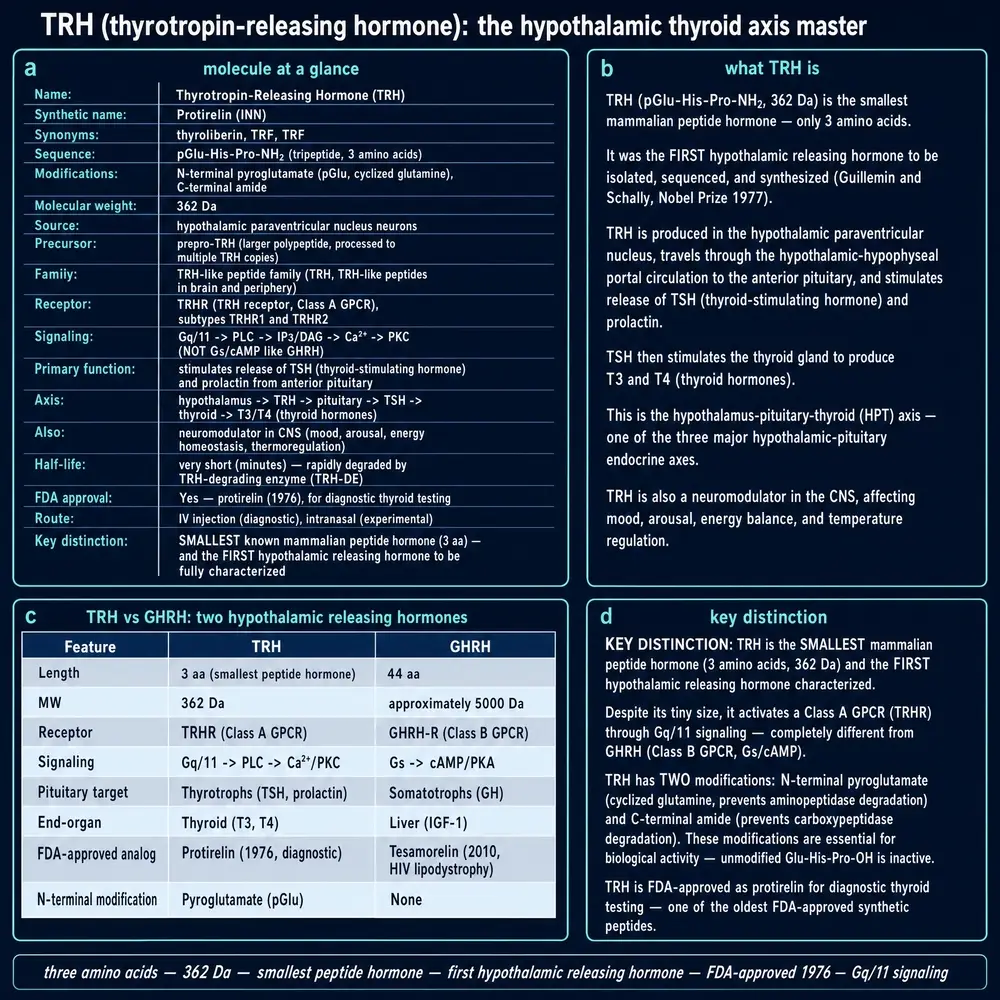
In 1969, after a decade of grinding extraction from hundreds of thousands of animal hypothalami, two rival laboratories announced that the long-sought thyrotropin-releasing factor was not a mysterious macromolecule but a tiny tripeptide: pyroglutamyl-histidyl-proline amide. That structure did more than name a hormone. It proved, in chemical form, Geoffrey Harris’s idea that the brain talks to the anterior pituitary through portal blood. It launched the releasing-hormone era. And it helped earn Roger Guillemin and Andrew Schally a share of the 1977 Nobel Prize with Rosalyn Yalow. The same molecule later revealed itself as a widespread neuromodulator as well as the top of the thyroid axis. This monograph tells that story, weighs endocrine and neural evidence across animals and humans, keeps synthetic analogues in a separate drawer, and recommends no human use of any kind.
Section 01What TRH is—and what it is not
Thyrotropin-releasing hormone is a tripeptide with the sequence pGlu-His-Pro-NH2: an N-terminal pyroglutamate, a central histidine, and a C-terminal prolinamide. Its molecular mass is about 362 daltons. The international nonproprietary name for the pharmaceutical substance is protirelin; older literature also calls it thyroliberin or thyrotropin-releasing factor (TRF). In the body it is cut from a larger precursor, preproTRH, which carries multiple copies of a Gln-His-Pro-Gly progenitor sequence. Post-translational chemistry—cyclisation of the N-terminal glutamine to pyroglutamate, and amidation of the C-terminus after glycine cleavage—produces the mature hormone. Those blocked ends are not decorative. They are why early chemists struggled to sequence the factor, and why the synthetic tripeptide matches the biological activity of the purified hypothalamic material.
Results are labelled by study type in the sentence that reports them: in vitro receptor or cell work, ex vivo slice physiology, in vivo animal experiment, human diagnostic observation, or clinical analogue study. Concentrations, routes and schedules appear only as parameters of named studies. Nothing here recommends that any person use TRH, protirelin, or any analogue.
Identity collisions matter less for TRH than for some compounds in this series, but they still exist. TSH (thyrotropin) is the pituitary hormone that TRH helps release; it is not TRH. Thyroid hormones (T4/T3) sit further downstream and feed back to restrain both TRH and TSH. Taltirelin (Ceredist) and related mimetics are synthetic analogues engineered for longer central action; their clinical literature is informative about the receptor class and must not be pooled as if it were native-TRH evidence. Bare “TRH” in a methods line can mean a stimulation-test reagent, a radioimmunoassay standard, or a passing mention in a thyroid paper. This monograph admits an asset when strong designations appear—protirelin, thyroliberin, thyrotropin-releasing hormone/factor, pGlu-His-Pro—or when bare TRH is dense enough to show the peptide is actually under discussion.
Section 02Discovery: Harris’s hypothesis, a race, and 1969
The intellectual starting gun was Geoffrey Harris’s mid-century argument that the anterior pituitary is not a free agent. It is driven by chemical signals arriving from the hypothalamus through a portal venous system. The idea was elegant and, for years, experimentally brutal. The putative “releasing factors” were present in vanishing amounts. Assay systems were crude. Many senior figures doubted the factors were real peptides at all. By the mid-1960s the National Institutes of Health—after years of funding the pursuit—seriously considered ending it.
Two groups refused to quit. Andrew V. Schally’s laboratory, working with collaborators including Karl Folkers, Cyril Bowers, Jan Bøler and Franz Enzmann, chased the factor from porcine hypothalamic extracts. Roger Guillemin’s laboratory, with Roger Burgus, Thomas Dunn, Dominic Desiderio and others, chased it from ovine material. The competition was personal, public, and exhausting. Accounts from the period describe roughly a million hypothalami processed across the race, chromatographic nightmares, and false turns—including a stretch when Guillemin’s circle wondered whether TRF was even a peptide.
In November 1969 the fog lifted from both sides almost at once. Bøler, Enzmann, Folkers, Bowers and Schally reported that synthetic pyroglutamyl-histidyl-proline amide was chemically and hormonally identical to purified porcine TRH (PMID 4982117). Burgus, Dunn, Desiderio and Guillemin reported the same PCA-His-Pro-NH2 sequence for ovine TRF by mass spectrometry in the French academy communications (PMID 4983502). Structure turned “factor” into “hormone.” Within a few years the same playbook—grind tissue, invent bioassays, synthesise—would yield GnRH, then other hypophysiotropic peptides. In 1977 Guillemin and Schally shared the Nobel Prize in Physiology or Medicine with Rosalyn Yalow, whose radioimmunoassay methods had made peptide endocrinology quantitatively modern. Nicholas Wade’s 1978 Science series remains the classic journalistic chronicle of how close the whole enterprise came to abandonment before it became textbook.
The discovery story matters for readers who only meet TRH as a catalogue SKU. This is not a boutique research chemical invented in a whitepaper. It is one of the foundation stones of modern neuroendocrinology—obtained the hard way, from animal brains, before cloning and before cryo-EM.
Section 03From precursor to tripeptide
Mature TRH is short enough to look simple. Its biosynthesis is not. Human preproTRH is a much larger polypeptide that contains multiple progenitor sequences of the form Gln-His-Pro-Gly, each flanked by paired basic residues that mark cleavage sites. After proteolytic excision, the C-terminal glycine donates the amide nitrogen of Pro-NH2, and the N-terminal glutamine cyclises to pyroglutamate. The result is a molecule resistant to ordinary aminopeptidases at the N-terminus and shaped for a specific GPCR pocket at the other.
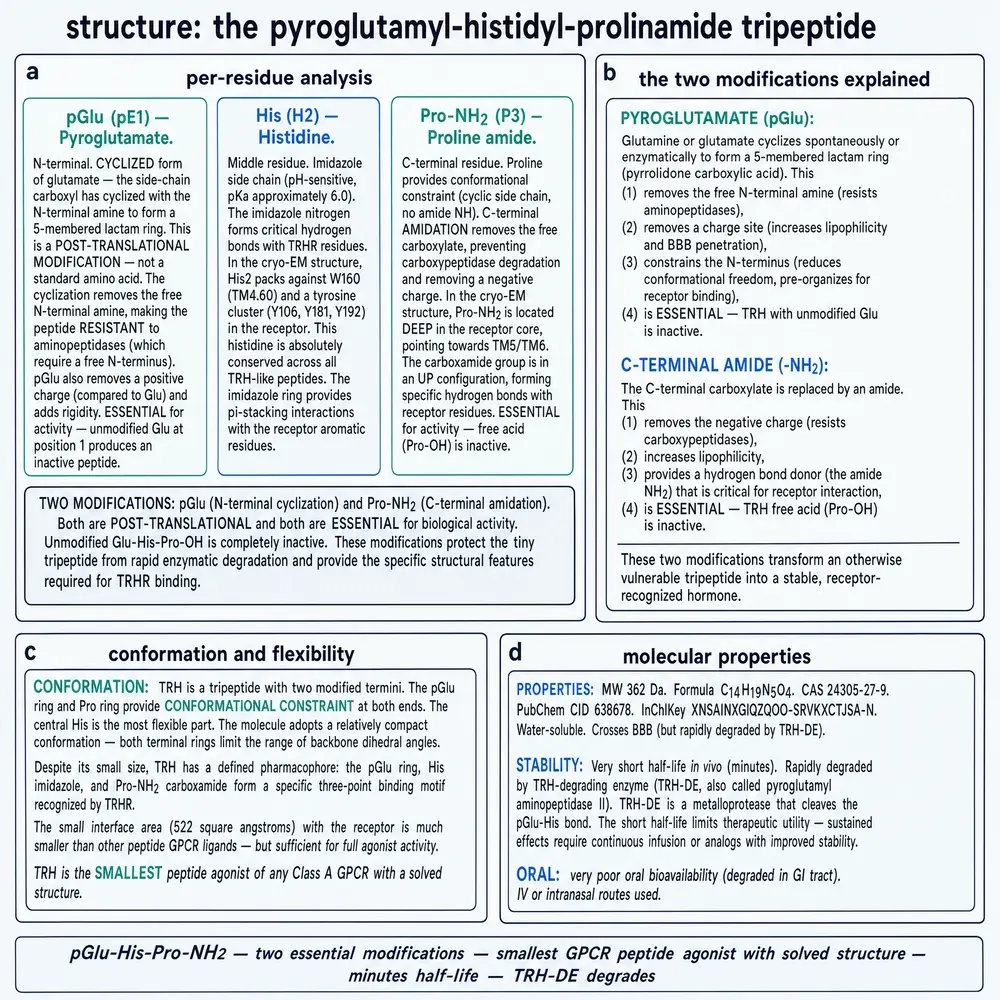
The authored schematic that follows places those same blocked ends in the preproTRH cleavage path—from Gln-His-Pro-Gly progenitors to the mature amide—so the chemistry on the plate and the biosynthetic path can be read together.
That architecture has evolutionary depth. A 2025 open-access study in echinoderms (Zheng et al.; PMID 39846199 / PMC11890989) is a reminder that TRH-related neuropeptides are older than mammalian thyroid axes. What mammals did with the motif—place it at the top of a portal endocrine cascade and also scatter it through the CNS—is a specialisation, not the whole evolutionary story. For this monograph the practical point is simpler: when a paper says “TRH,” it may mean the mature tripeptide, the precursor gene, immunoreactive TRH-like material, or a synthetic analogue. The citations below keep those layers apart.
Section 04The HPT axis, portal blood, and tanycytes
The textbook circuit is still the spine. Paraventricular nucleus (PVN) neurons synthesise TRH and release it into the median eminence. Portal capillaries carry it a few millimetres to the anterior pituitary. Thyrotrophs respond with thyroid-stimulating hormone; lactotrophs can respond with prolactin. TSH drives the thyroid to release T4 and T3. Thyroid hormones feed back at pituitary and hypothalamic levels to restrain the loop. Cold exposure, nutritional state, infection, and higher neural inputs modulate PVN TRH neurons so the axis is not a thermostat with one setting but a node in energy and stress physiology.
Between neuron and portal blood sits a cell type that recent work has refused to treat as wallpaper. Tanycytes—specialised glial cells lining the third ventricle—regulate how much TRH actually reaches the capillaries. The 2019 Frontiers review by Rodríguez-Rodríguez, Charli, Joseph-Bravo and colleagues (PMID 31293518 / PMC6603095) synthesises evidence that tanycytes can capture, degrade, and gate TRH flux. That matters conceptually: measuring hypothalamic TRH gene expression is not the same as measuring hormone delivery. A gate can close. Fresh circuit papers (including 2026 work on TRH neurons and energy expenditure; PMID 41980928 / PMC13083850) continue to refine which hypothalamic populations do what. Recency is welcome here; it does not overturn the portal-axis backbone, it anatomises it.
Section 05Receptors, Gq signalling, and the 2022 structures
TRH acts through class A G protein-coupled receptors historically called TRH-R1 and TRH-R2 (species and tissue distributions differ; TRH-R1 is the primary human pituitary receptor). Agonist binding couples preferentially to Gαq/G11, activates phospholipase C, and raises inositol trisphosphate and intracellular calcium. The Trubacova, Drastichova and Novotny 2022 review (PMID 36147745 / PMC9485831) is a solid open-access tour of that signalling landscape and its physiological readouts.
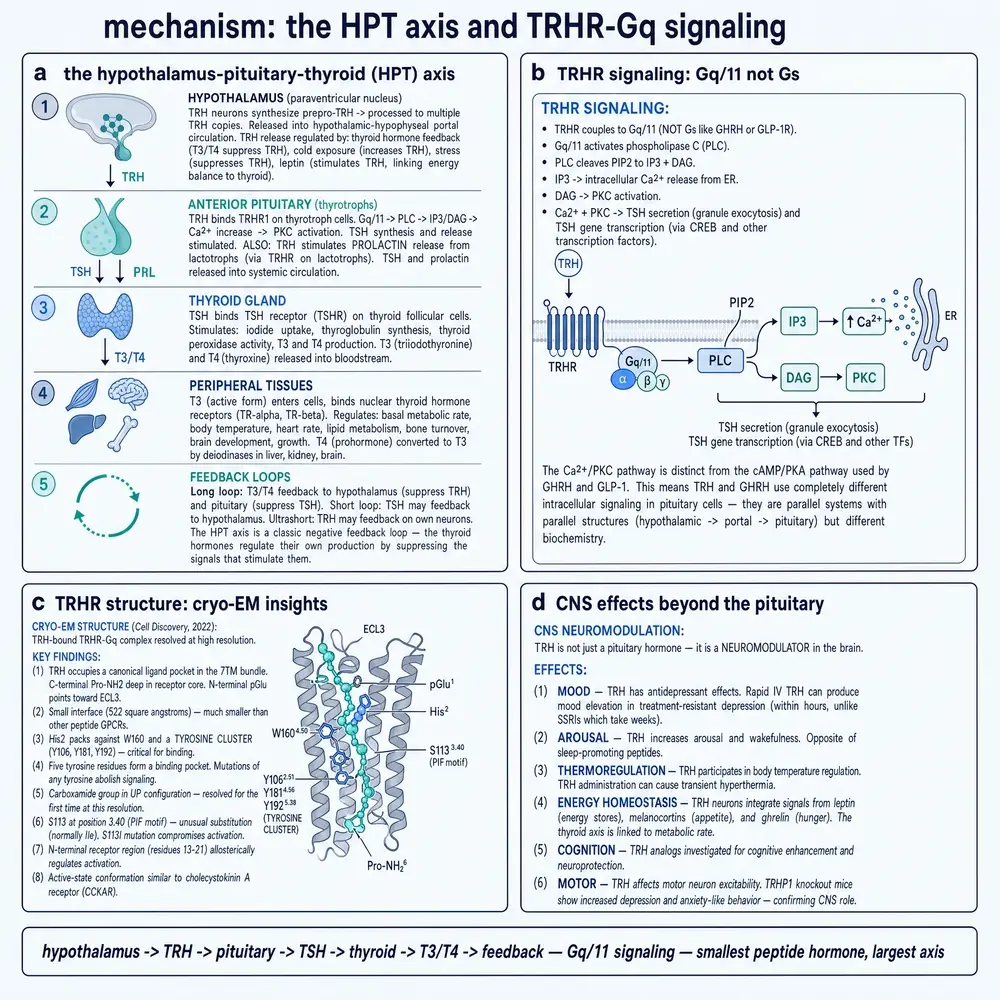
The receptor schematic below isolates the Gq / IP3 / Ca2+ cascade and the pocket residues that the 2022 cryo-EM structures put on the map. Read it as a wiring diagram for the pituitary receptor, not as a claim that native TRH is a practical CNS medicine.
Structural biology caught up in 2022. Yang, Zhang, Meng and colleagues reported cryo-EM structures of human TRHR–Gq bound to TRH (3.19 Å) and to the oral analogue taltirelin (3.26 Å) (PMID 35352031 / PMC9437008). The pocket residues that stabilise TRH—including Q1053.32, Y1063.33, Y1925.39, Y2826.51, N2896.58 and R3067.39—match earlier mutagenesis. Taltirelin occupies a wider pocket with weakened contacts at several of those sites, consistent with lower potency but, in their assays, higher downstream efficacy and the known pharmacology of a longer-acting CNS-preferring analogue. This is the right way to read analogue data in a native-hormone monograph: as receptor biology and medicinal chemistry context, not as a substitute trial of TRH itself.
Section 06Prolactin, and the diagnostic life of a hormone
TRH’s pituitary story was never only about TSH. Early clinical investigation showed a prompt prolactin rise after TRH administration in humans—an observation that helped map lactotroph responsiveness and later informed work on hypoprolactinemia assessment (see, for context, Urhan & Karaca 2024; PMID 39037546 / PMC11624249). For decades, a formal TRH stimulation test was part of clinical endocrinology’s toolkit for probing pituitary reserve and distinguishing certain thyroid states. As sensitive TSH assays improved, routine use of that test declined in many health systems. The decline is a story about assay technology and clinical utility, not a verdict that TRH stopped mattering biologically.
This monograph records that diagnostic history as history and as published observation. It does not translate historical test protocols into advice. Where papers report microgram-per-kilogram or microgram-per-person challenge doses, those numbers are experimental or historical parameters attached to named studies—not recommendations for any reader. The dual TSH–prolactin signature remains one of the cleanest demonstrations that a three-residue peptide can address more than one anterior-pituitary cell type.
Section 07TRH as a neuromodulator
If TRH had remained a pure portal hormone, this would be a shorter paper. It did not. TRH and TRH receptors are expressed widely in brain and spinal cord. Reviews and primary studies associate central TRH signalling with arousal, autonomic tone, motor function, and affective and cognitive readouts in animals. The endocrine and neural identities are the same covalent structure; the pharmacology diverges because systemic delivery floods the pituitary long before a stable central signal is easy to maintain.
A crisp open-access example is cerebellar physiology. Watanave and colleagues (2018; PMID 30618637 / PMC6299015)—the same paper that anchors the local Radix P219 dossier—showed that TRH-deficient mice have impaired cerebellar long-term depression at parallel fibre–Purkinje cell synapses and motor-learning deficits, with exogenous TRH able to restore LTD in that experimental context. That is in vivo genetics plus ex vivo/in vitro electrophysiology, not a human trial. It is also stronger evidence for a cerebellar role than another catalogue paragraph repeating “neuroprotective” as a vibe.
Older slice and in vivo rodent papers report excitatory thalamic effects, hippocampal GABA release, and interactions with orexin and thermogenic pathways. Those findings are real as experiments; their translation weight varies. The honest summary is that central TRH biology is broad and still being mapped at circuit resolution, while native TRH remains a difficult systemic probe because of clearance and endocrine spillover. When a secondary source collapses that entire map into a single adjective—“neuroprotective,” “analeptic,” “antidepressant”—it is summarising a literature, not reporting a single decisive trial. This monograph keeps the adjectives attached to the experiments that earned them.
Section 08Metabolism, food intake, and energy expenditure
TRH sits where endocrine thyroid tone meets hypothalamic energy control. Fasting suppresses the HPT axis partly through reduced PVN TRH expression—an adaptive brake when fuel is scarce. A 2024 Metabolites update by Vargas, Charli, Joseph-Bravo and colleagues (PMID 38921437 / PMC11205479) reviews how TRH pathways intersect food-intake circuits in mammals. The effects are site- and state-dependent; TRH is not a cartoon “satiety peptide.”
On the expenditure side, Constantinescu et al. (2026; PMID 41980928 / PMC13083850) report that TRH neurons in different hypothalamic nuclei can increase energy expenditure in mice. That is fresh, high-resolution, and weighted accordingly: strong enough to reshape mechanistic conversation, not yet a multi-lab clinical narrative. Earlier rodent work on leptin “gating” of hindbrain TRH thermogenic action belongs in the same family of ideas—TRH as a node in energy balance, not only as a TSH secretagogue.
Section 09Degradation: the clock that forces analogues into existence
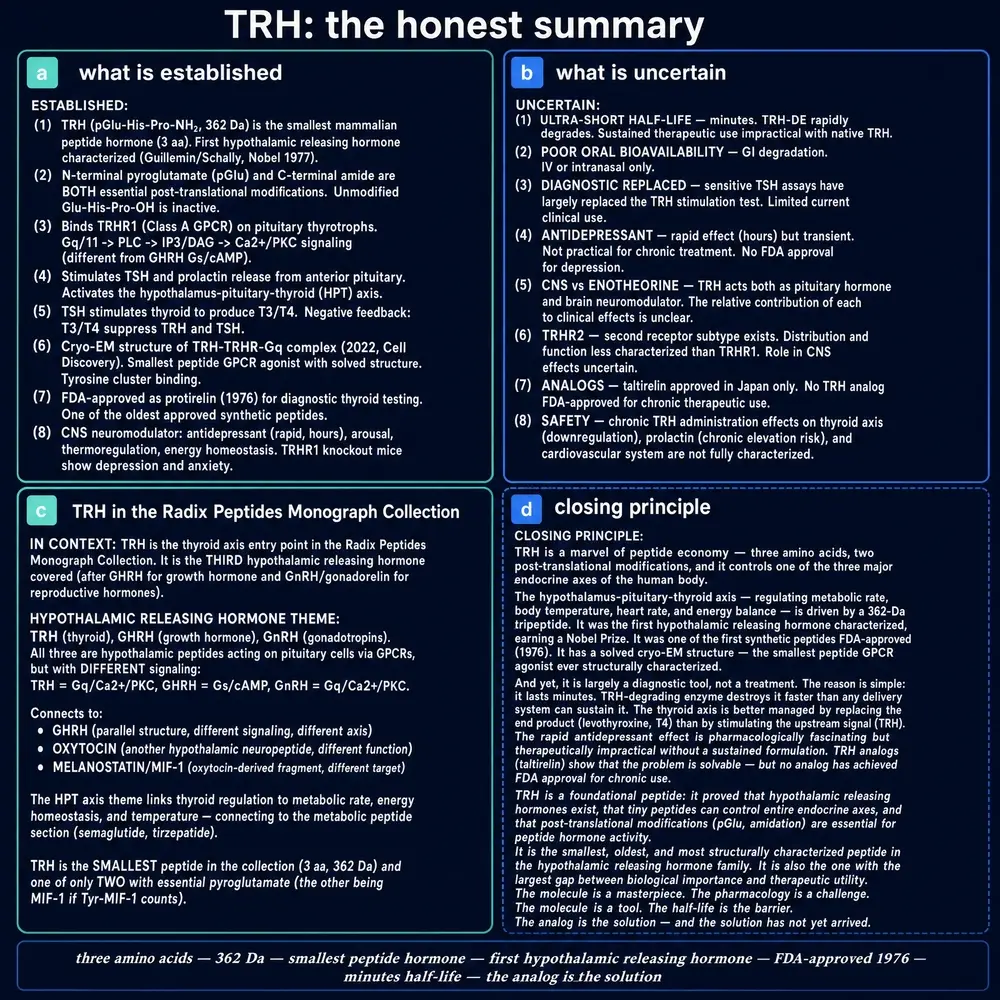
Native TRH is biologically expensive to keep around. Plasma half-life is repeatedly reported under ten minutes.
A specific ectoenzyme—thyrotropin-releasing hormone-degrading ectoenzyme (TRH-DE), also discussed as pyroglutamyl peptidase II—cleaves the peptide and has been reviewed as a possible control point and drug target (Charli et al., 2020; PMID 32457627 / PMC7225337). Hydrophilicity and poor blood–brain barrier penetration compound the problem for anyone hoping to use the native sequence as a durable CNS agent.
Those liabilities are not insults to the hormone. They are design constraints. Evolution optimised TRH for brief portal pulses and local synaptic action, not for oral tablets. Medicinal chemistry answered with analogues. The next part treats that answer as a neighbouring chapter, not as a silent rename of TRH.
Section 10The experimental ladder
Reading TRH across methods is less about picking a favourite paper and more about watching claims climb or stall on the ladder. At the bottom: receptor binding, IP-one and calcium assays, cryo-EM. Mid-ladder: brain slices, knockout mice, targeted neuron activation. Upper-middle: in vivo rodent physiology—respiration and arousal with analogues, metabolic rate, motor learning. Human tier: historical diagnostic endocrinology; limited native-TRH interventional literature; a clearer clinical path for certain analogues in specific jurisdictions. A claim that lives only at the bottom of the ladder can still be true; it is just not yet a claim about a person.
Preponderance still belongs to the endocrine core. Decades of concordant physiology establish TSH (and prolactin) release, feedback control, and the chemical identity of the peptide. Recency belongs to circuits, structures, and enzyme biology: tanycyte gating (2019), TRH-DE review (2020), TRHR structures (2022), food-intake synthesis (2024), neuron-resolved energy expenditure (2026). Where recent work elaborates mechanism without contradicting the core, this monograph gives it weight. Where marketing language jumps from a cerebellar slice to a human wellness claim, it does not.
Section 11Taltirelin and other mimetics—related, not identical
Taltirelin replaces TRH’s pyroglutamyl residue with a methyl-dihydroorotyl moiety. Relative to TRH it has been reported to show lower receptor potency, higher Gq signalling efficacy in some assays, roughly eightfold longer effective duration, and substantially stronger CNS stimulant activity in preclinical comparisons (summarised in Yang et al., 2022, and earlier pharmacology). It is approved in Japan for spinocerebellar degeneration. Recent randomised work on taltirelin hydrate in ataxia (for example Cho et al., reported 2024–2026 in movement-disorder literature) belongs to taltirelin, not to protirelin.
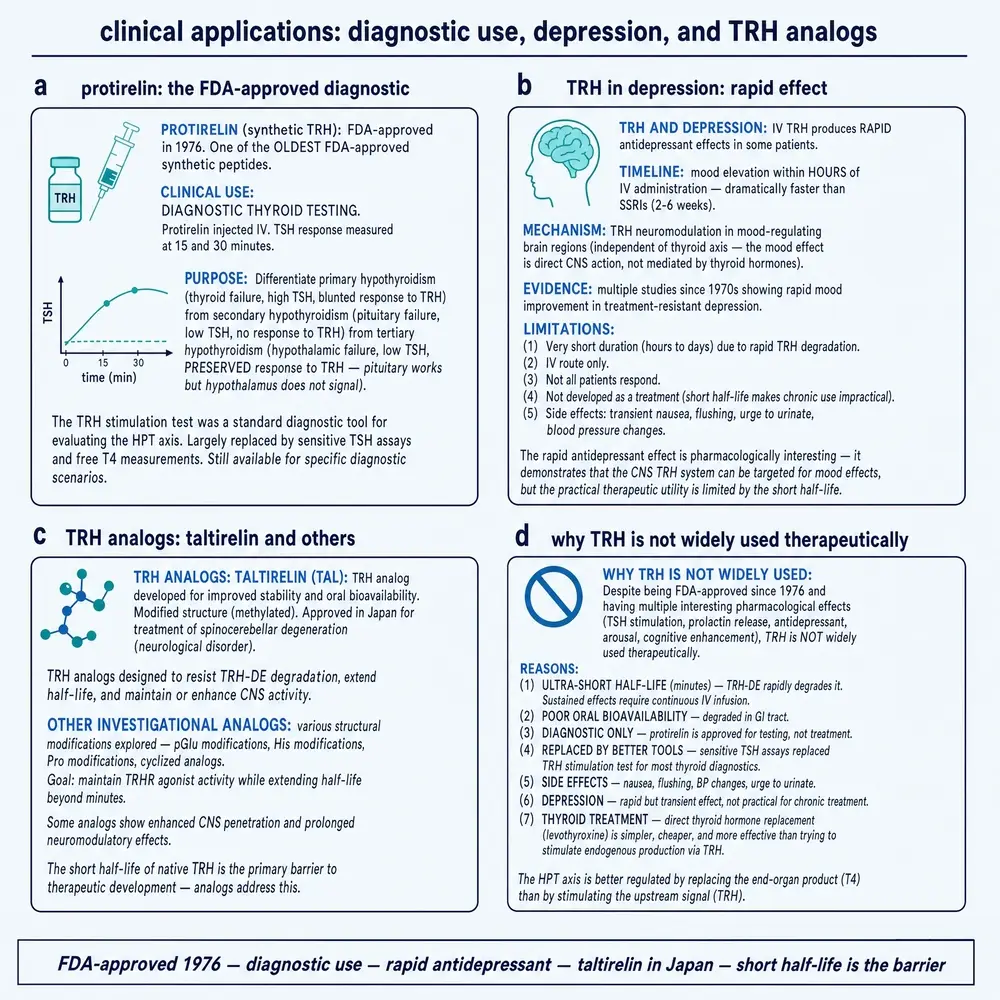
The comparison card below keeps native TRH and taltirelin on separate ledgers for potency, duration, and non-interchangeability.
Other TRH mimetics and experimental analogues appear in respiratory and arousal research—for example taltirelin as a stable upper-airway-preferring respiratory stimulant with arousal properties in rats (Liu et al., 2022; PMID 36135952 / PMC9602822), and reviews asking whether TRH or taltirelin could reverse opioid-induced respiratory depression (PMC9137104). Those lines are mechanistically interesting and clinically unfinished. They are cited here to show why chemists leave the native sequence behind, not to smuggle analogue outcomes into a TRH efficacy ledger. If a future trial succeeds with an analogue, that will be a result about the analogue—welcome, citable, and still not a silent rename of protirelin.
Section 12Human evidence without a use recommendation
For native TRH / protirelin, the strongest human footprint is diagnostic and physiological: TSH and prolactin responses, historical TRH testing, and the endocrine logic still taught in every medical school. Native TRH has also been studied and, in some countries and eras, used in neurological contexts (for example disturbance of consciousness or spinocerebellar disease in older literature), but those programmes largely migrated toward analogues with better pharmacokinetics. Cheng et al. (2023; PMID 38111381 / PMC10725963) survey receptor modulators across the HPT axis and are useful for placing TRH among a wider pharmacological landscape.
What this document will not do is convert any of that into a protocol. No dose, route, frequency, stacking suggestion, or wellness framing appears as advice. If a sentence mentions a study dose, it is because the study did—and the citation is the point of contact for anyone who needs the primary methods.
Section 13What is solid, what is moving, what is noise
Solid. The structure is pGlu-His-Pro-NH2. Independent 1969 reports from the Schally and Guillemin orbits agree. TRH releases TSH and prolactin via Gq-coupled pituitary receptors. Feedback from thyroid hormone closes the loop. Enzymatic degradation is fast. Extra-hypothalamic expression is real. Those statements survive changes of fashion in peptide marketing because they rest on convergent chemistry, physiology, and decades of assay practice.
Moving with good tools. Tanycyte control of portal delivery; neuron-type-specific metabolic effects; atomic-resolution views of TRHR with TRH versus taltirelin; continued mapping of feeding and thermogenic circuits. Fresh papers earn attention when they sharpen mechanism. They do not erase fifty years of endocrine concordance. A 2026 circuit paper that raises energy expenditure from a defined TRH population is more informative than a catalogue claim that TRH “boosts metabolism,” precisely because it specifies where, in which species, and with which readout.
Noise and category errors. Vendor pages that treat TRH as a lifestyle injectables story. Secondary blurbs that cite taltirelin SCD trials as if they were TRH trials. Dossier engines that remix one cerebellar paper into twelve thin sections. Bare TSH assay notes counted as TRH scholarship. This build’s local sweep found 87 unique mentioning files; only 38 met substantive thresholds, and a large share of filename hits were catalogue material. The scientific freeze used for drafting is the open full-text spine summarised in the inventory—on the order of two dozen good papers and roughly 440 page-equivalents—not the entire hit list.
Section 14Standing constraint
South Beach Longevity Research Monographs describe published research. They are not prescribing documents. TRH / protirelin is discussed here as a molecule with a consequential history and an active physiology literature. No reader should treat this text as permission, encouragement, or instruction to administer the compound. Research-use-only framing applies throughout.
Section 15Reading freeze (selected open full texts)
The following open-access full texts were frozen into this project and read for drafting. Page counts are approximate word-based equivalents except where noted. Vendor PDFs and the internal P219 dossier were inspected but are not listed as science.
| PMC / asset | Year | Focus |
|---|---|---|
| PMC7225337 | 2020 | TRH-degrading ectoenzyme review |
| PMC9485831 | 2022 | TRHR signalling physiology |
| PMC13083850 | 2026 | Hypothalamic TRH neurons & energy expenditure |
| PMC6603095 | 2019 | Tanycytes & portal TRH flux |
| PMC11205479 | 2024 | TRH and food intake update |
| PMC9437008 | 2022 | Cryo-EM TRHR–Gq with TRH / taltirelin |
| PMC10725963 | 2023 | HPT-axis receptor modulators |
| PMC6299015 | 2018 | Cerebellar LTD & motor learning (TRH-KO) |
| PMC9602822 | 2022 | Taltirelin respiratory / arousal (rat) |
| PMC9137104 | 2022 | TRH / taltirelin vs opioid depression |
| PMC11890989 | 2025 | Evolutionary TRH neuropeptides |
| PMC11624249 | 2024 | Hypoprolactinemia diagnosis context |
| PMC9418084 | 2022 | TRH neurons to tuberomammillary nuclei |
| Joseph-Bravo et al. JOE | 2015 | 60 years of TRH / HPT control (PMID 26101376) |
Discovery papers (Bøler et al. 1969; Burgus et al. 1969) and the Nobel / Wade historical record sit outside the open-PMC freeze but are cited from the verified PubMed and non-PubMed lists below.
Section 16References
Generated from verified NCBI records rather than from recall. Every PubMed identifier below was resolved against the harvest before this build was allowed to write the deliverable.
- Boler J, Enzmann F, Folkers K, Bowers CY, Schally AV. The identity of chemical and hormonal properties of the thyrotropin releasing hormone and pyroglutamyl-histidyl-proline amide. Biochemical and biophysical research communications. 1969. 37(4):705-10.
PMID 4982117 · doi:10.1016/0006-291x(69)90868-7 - Burgus R, Dunn TF, Desiderio D, Guillemin R. [Molecular structure of the hypothalamic hypophysiotropic TRF factor of ovine origin: mass spectrometry demonstration of the PCA-His-Pro-NH2 sequence]. Comptes rendus hebdomadaires des seances de l'Academie des sciences. Serie D: Sciences naturelles. 1969. 269(19):1870-3.
PMID 4983502 - Charli JL, Rodríguez-Rodríguez A, Hernández-Ortega K, Cote-Vélez A, Uribe RM, Jaimes-Hoy L, et al.. The Thyrotropin-Releasing Hormone-Degrading Ectoenzyme, a Therapeutic Target?. Frontiers in pharmacology. 2020. 11:640.
PMID 32457627 · doi:10.3389/fphar.2020.00640 · PMC7225337 - Cheng X, Zhang H, Guan S, Zhao Q, Shan Y. Receptor modulators associated with the hypothalamus -pituitary-thyroid axis. Frontiers in pharmacology. 2023. 14:1291856.
PMID 38111381 · doi:10.3389/fphar.2023.1291856 · PMC10725963 - Colson AO, Gershengorn MC. Thyrotropin-releasing hormone analogs. Mini reviews in medicinal chemistry. 2006. 6(2):221-6.
PMID 16472189 · doi:10.2174/138955706775476019 - Constantinescu A, Chandrasekar A, Kleindienst L, Höhne L, Da Silva Lima N, Richter M, et al.. Thyrotropin-releasing hormone neurons of different hypothalamic nuclei increase energy expenditure. Nature communications. 2026. 17(1).
PMID 41980928 · doi:10.1038/s41467-026-71617-3 · PMC13083850 - Crowther CA, Alfirevic Z, Haslam RR. Prenatal thyrotropin-releasing hormone for preterm birth. The Cochrane database of systematic reviews. 2000.
PMID 10796087 · doi:10.1002/14651858.CD000019 - Harris M, Aschkenasi C, Elias CF, Chandrankunnel A, Nillni EA, Bjøorbaek C, et al.. Transcriptional regulation of the thyrotropin-releasing hormone gene by leptin and melanocortin signaling. The Journal of clinical investigation. 2001. 107(1):111-20.
PMID 11134186 · doi:10.1172/JCI10741 · PMC198547 - Horita A, Carino MA, Lai H. Pharmacology of thyrotropin-releasing hormone. Annual review of pharmacology and toxicology. 1986. 26:311-32.
PMID 2872853 · doi:10.1146/annurev.pa.26.040186.001523 - Jackson IM. Thyrotropin-releasing hormone. The New England journal of medicine. 1982. 306(3):145-55.
PMID 6798440 · doi:10.1056/NEJM198201213060305 - Joseph-Bravo P, Jaimes-Hoy L, Uribe RM, Charli JL. 60 YEARS OF NEUROENDOCRINOLOGY: TRH, the first hypophysiotropic releasing hormone isolated: control of the pituitary-thyroid axis. The Journal of endocrinology. 2015. 226(2):T85-T100.
PMID 26101376 · doi:10.1530/JOE-15-0124 - Kamath J. Cancer-related fatigue, inflammation and thyrotropin-releasing hormone. Current aging science. 2012. 5(3):195-202.
PMID 23387883 · doi:10.2174/1874609811205030005 - Karydis I, Tolis G. Orexis, anorexia, and thyrotropin-releasing hormone. Thyroid : official journal of the American Thyroid Association. 1998. 8(10):947-50.
PMID 9827664 · doi:10.1089/thy.1998.8.947 - Kerns RD. Shining the LAMP on Efforts to Transform Pain Care in America. Annals of internal medicine. 2018. 168(7):517-518.
PMID 29482222 · doi:10.7326/M18-0061 - Liu WY, Ladha R, Liu H, Horner RL. Thyrotropin-releasing hormone analog as a stable upper airway-preferring respiratory stimulant with arousal properties. Journal of applied physiology (Bethesda, Md. : 1985). 2022. 133(5):1067-1080.
PMID 36135952 · doi:10.1152/japplphysiol.00414.2022 · PMC9602822 - Miller SC, Warnick JE. Protirelin (thyrotropin-releasing hormone) in amyotrophic lateral sclerosis. The role of androgens. Archives of neurology. 1989. 46(3):330-5.
PMID 2563937 · doi:10.1001/archneur.1989.00520390096025 - O'Leary R, O'Connor B. Thyrotropin-releasing hormone. Journal of neurochemistry. 1995. 65(3):953-63.
PMID 7643125 · doi:10.1046/j.1471-4159.1995.65030953.x - Ortiga-Carvalho TM, Sidhaye AR, Wondisford FE. Thyroid hormone receptors and resistance to thyroid hormone disorders. Nature reviews. Endocrinology. 2014. 10(10):582-91.
PMID 25135573 · doi:10.1038/nrendo.2014.143 · PMC4578869 - Pierpaoli W. Aging-reversing properties of thyrotropin-releasing hormone. Current aging science. 2013. 6(1):92-8.
PMID 23895526 · doi:10.2174/1874609811306010012 - Pittman JA Jr. Thyrotropin-releasing hormone. Advances in internal medicine. 1974. 19:303-25.
PMID 4205606 - Qi X, Chen Z, Yu X, Li L, Bai Y, Fang H, et al.. Characterisation of the Mentha canadensis R2R3-MYB transcription factor gene McMIXTA and its involvement in peltate glandular trichome development. BMC plant biology. 2022. 22(1):219.
PMID 35477355 · doi:10.1186/s12870-022-03614-9 · PMC9047286 - Rodríguez-Rodríguez A, Lazcano I, Sánchez-Jaramillo E, Uribe RM, Jaimes-Hoy L, Joseph-Bravo P, et al.. Tanycytes and the Control of Thyrotropin-Releasing Hormone Flux Into Portal Capillaries. Frontiers in endocrinology. 2019. 10:401.
PMID 31293518 · doi:10.3389/fendo.2019.00401 · PMC6603095 - Shibusawa N, Hashimoto K, Yamada M. Thyrotropin-releasing hormone (TRH) in the cerebellum. Cerebellum (London, England). 2008. 7(1):84-95.
PMID 18418668 · doi:10.1007/s12311-008-0033-0 - Sun Y, Lu X, Gershengorn MC. Thyrotropin-releasing hormone receptors -- similarities and differences. Journal of molecular endocrinology. 2003. 30(2):87-97.
PMID 12683933 · doi:10.1677/jme.0.0300087 - Trubacova R, Drastichova Z, Novotny J. Biochemical and physiological insights into TRH receptor-mediated signaling. Frontiers in cell and developmental biology. 2022. 10:981452.
PMID 36147745 · doi:10.3389/fcell.2022.981452 · PMC9485831 - Urhan E, Karaca Z. Diagnosis of hypoprolactinemia. Reviews in endocrine & metabolic disorders. 2024. 25(6):985-993.
PMID 39037546 · doi:10.1007/s11154-024-09896-8 · PMC11624249 - Utiger RD. Thyrotropin-releasing hormone and thyrotropin secretion. The Journal of laboratory and clinical medicine. 1987. 109(3):327-35.
PMID 3102657 - Vargas Y, Castro Tron AE, Rodríguez Rodríguez A, Uribe RM, Joseph-Bravo P, Charli JL. Thyrotropin-Releasing Hormone and Food Intake in Mammals: An Update. Metabolites. 2024. 14(6).
PMID 38921437 · doi:10.3390/metabo14060302 · PMC11205479 - Watanave M, Matsuzaki Y, Nakajima Y, Ozawa A, Yamada M, Hirai H. Contribution of Thyrotropin-Releasing Hormone to Cerebellar Long-Term Depression and Motor Learning. Frontiers in cellular neuroscience. 2018. 12:490.
PMID 30618637 · doi:10.3389/fncel.2018.00490 · PMC6299015 - Yamada M, Umezawa R. [Thyrotropin-releasing hormone (TRH)]. Nihon rinsho. Japanese journal of clinical medicine. 2005. 63 Suppl 8:220-3.
PMID 16149495 - Yang F, Zhang H, Meng X, Li Y, Zhou Y, Ling S, et al.. Structural insights into thyrotropin-releasing hormone receptor activation by an endogenous peptide agonist or its orally administered analogue. Cell research. 2022. 32(9):858-861.
PMID 35352031 · doi:10.1038/s41422-022-00646-6 · PMC9437008 - Zheng Y, Liu H, Dang X, Gaitán-Espitia JD, Chen M. Functional evolution of thyrotropin-releasing hormone neuropeptides: Insights from an echinoderm. Zoological research. 2025. 46(1):236-248.
PMID 39846199 · doi:10.24272/j.issn.2095-8137.2024.256 · PMC11890989 - [No authors listed]. Thyrotropin-releasing hormone. The New England journal of medicine. 1982. 306(24):1488-90.
PMID 6804869 · doi:10.1056/nejm198206173062417
Sources without a PubMed record
- Burgus R, Dunn TF, Desiderio D, Guillemin R. Molecular structure of the hypothalamic hypophysiotropic TRF factor of ovine origin: mass spectrometry demonstration of the PCA-His-Pro-NH2 sequence. C R Acad Sci Hebd Seances Acad Sci D. 1969;269(19):1870-1873. PMID 4983502 (French communication).
https://pubmed.ncbi.nlm.nih.gov/4983502/ - Wade N. Guillemin and Schally: the years in the wilderness (three-part Science series on the releasing-factor race). Science. 1978;200:279-282, 411-415, 510-513.
- Nobel Foundation. The Nobel Prize in Physiology or Medicine 1977 — Roger Guillemin, Andrew V. Schally, Rosalyn Yalow. Award citation covering peptide hormone production in the brain and radioimmunoassay development.
https://www.nobelprize.org/prizes/medicine/1977/summary/ - South Beach Longevity. Standard dossier draft P219 — Thyrotropin-releasing hormone. Internal library dossier (20 pp); sparse auto-summary anchored primarily on PMC6299015.
Section 17How this document was assembled
Project 05 (Therapeutic Peptide Research Library) was swept for full-text assets naming TRH / protirelin / thyroliberin / pGlu-His-Pro. Unique local hits: 87; substantive: 38 (~1,852 page-equivalents, inflated by peripheral textbooks). PubMed harvests for title-focused, recent, discovery, and structure queries returned 198 unique records (55 with PMCID). Twenty-four open full texts of at least 800 words were frozen into fulltext_txt/ (~221,000 words, ~442 page-equivalents) and read for drafting, together with the local P219 dossier and PeptideSciences catalogue PDFs (catalogued, not treated as science).
Figures are authored SVG using theme colour tokens so light and dark editions remain legible; five commissioned Higgsfield plates are encoded after an A8 printed-value audit. No third-party published figure is reproduced. The HTML body fragment is assembled by stage 06, printed through headless Chrome by stage 07, and finished by stage 07c, which paints the dark-edition navy underlay to the sheet edge and stamps running heads and folios inside the 20 mm margin band. Margin and density gates are run on the light edition before furniture is treated as content.
Series number assignment re-reads Desktop\\PEPTIDE MONOGRAPHS immediately before filing. Concurrent monographs had already taken numbers through 81; this build files as No. 82 unless the register moves again between render and copy.
Section 18Evidence handling rules
Claim → evidence → source → citation. Animal and cell findings are not silently upgraded to human outcomes. Analogue findings are labelled as analogue findings. Recency is favoured when it extends a settled core; it is not favoured when it contradicts a large, concordant record without cause. Uncertainty is stated in English, not hidden in a confident adjective.
Where a study reports a concentration, route, or schedule, that parameter is a property of the experiment. It is not rewritten here as advice. Where the local corpus is thin and the open literature is thick, the monograph says so in numbers rather than padding sparse shelves with adjectives. Where vendor pages dominate a filename search, they are counted once as catalogue noise and then ignored for scientific claims.
The controlling editorial test is simple: would a careful non-specialist reader, after finishing this document, understand what TRH is, who discovered it, what it does in the body, where the evidence is strong, and where enthusiasm has outrun the data—without being told to take anything? If yes, the monograph has done its job.
Continue exploring