
PT-141 Bremelanotide — a melanocortin agonist that acts on the brain
A drug discovered by accident in a programme designed to make a sunless tan, abandoned once as a nasal spray, and approved in 2019 for a narrow female indication on the strength of two questionnaire scales — while the outcome most people would have counted did not move. This is what the evidence supports and what it does not.
Every finding below is labelled by the kind of study that produced it, in the sentence that reports it. Cell and animal results are never phrased so as to imply a human outcome, because on this compound they diverge from one another sharply and in more than one direction. Human results are marked by phase, and a distinction is held throughout between a co-primary endpoint, a ranked secondary, a post-hoc analysis and a sponsor announcement that has not been peer reviewed.
Two compounds appear on almost every page and they are not the same thing. Bremelanotide, also called PT-141, is the approved drug. Melanotan II is the earlier compound it descends from, which was never approved and is sold illegally. They differ by one atom. Their harms, their potencies and their legal status do not transfer between them, and this document never lets a finding about one stand as a finding about the other.
Where two sources disagree, the disagreement is shown rather than settled. There is more of that here than in most monographs in this series: this drug's receptor selectivity, its mechanism and the meaning of its trial results are each genuinely contested in the published literature.
No human use, dose, route or schedule is recommended anywhere in this document. Doses appear only as the parameters of studies that have been published, always with the population and duration attached.
Section 01A hormone that did not last long enough
In the late 1970s a pair of researchers at the University of Arizona became interested in a hormone that almost nobody had a use for. Alpha-melanocyte stimulating hormone — α-MSH — is a short peptide released from the pituitary, and its most obvious job is to tell pigment cells to make pigment. In a frog it will darken the skin within minutes. In a human it does something similar and far less dramatic, and in the 1970s it was regarded as a curiosity of comparative endocrinology rather than as the starting point for a drug.
The two researchers were Mac E. Hadley, an endocrinologist who had spent his career on the pigment cells of frogs and lizards, and Victor J. Hruby, a peptide chemist. Their problem was practical. α-MSH is destroyed in the bloodstream within minutes, which makes it useless as a drug and awkward even as a laboratory tool. If you wanted to study what the hormone actually did, you first had to build a version of it that survived long enough to do it.
In 1980 they published one. The paper describes a molecule with two changes to the natural sequence: the methionine at position 4 replaced by norleucine, and the phenylalanine at position 7 flipped from its natural left-handed form to its mirror image, D-phenylalanine (Sawyer et al., 1980). Both changes attack the same weakness. Enzymes that chew up peptides in the blood recognise particular residues in particular orientations; a residue that is the wrong shape, or simply not the residue expected, is much harder to cut. The resulting compound, [Nle4, D-Phe7]-α-MSH, was twenty-six times more potent than the natural hormone in a melanoma cell assay and resisted degradation by serum enzymes. A companion study in frogs found skin darkening that persisted for six weeks after a single exposure (Hadley et al., 1981).
It is often written that this programme set out to invent a sunless tan. It did not, or at least the 1980 paper does not say so: it describes the new molecule as a tool for studying melanotropin receptors on normal and malignant pigment cells. The tanning rationale appears in print eight years later, when the same Arizona group began testing whether a peptide applied to skin could produce pigmentation without ultraviolet light, and named the goal explicitly as "pharmacologic tanning without the need for sunlight exposure" alongside a possible treatment for vitiligo (Dawson et al., 1988; Dorr et al., 1988).
The distinction matters because almost every popular account of this drug begins with the tanning story, and the tanning story is a second act rather than a first.
Section 02The reason for the tan
Once the idea did arrive, it was a good one, and Arizona was the right place to have it. Melanin is not decoration. Eumelanin, the darker of the two pigments human skin makes, absorbs ultraviolet light before it reaches DNA, and people who tan easily get less skin cancer than people who burn. A drug that produced the pigment without the radiation that normally induces it would, in principle, give the protection while skipping the damage that pays for it.
That logic has since been vindicated in a way the Arizona group would have recognised. Their first compound, under the names melanotan-I and then afamelanotide, was eventually approved — not as a cosmetic but as a treatment for erythropoietic protoporphyria, a rare disease in which sunlight causes severe pain. Human studies confirmed that it raises eumelanin specifically (Dorr et al., 2004). The first molecule out of the programme became a real drug, four decades later, for the reason the programme originally gave.
The second molecule is the one this document is about, and it got there by a stranger route.
Section 03Tying the molecule in a knot
Hruby's next move was structural rather than chemical. A short peptide in solution is floppy: it samples an enormous number of shapes, only one of which fits the receptor. If you could lock it into the shape that binds, you would get more potency for the same molecule, and fewer of the exposed backbone bonds that enzymes attack.
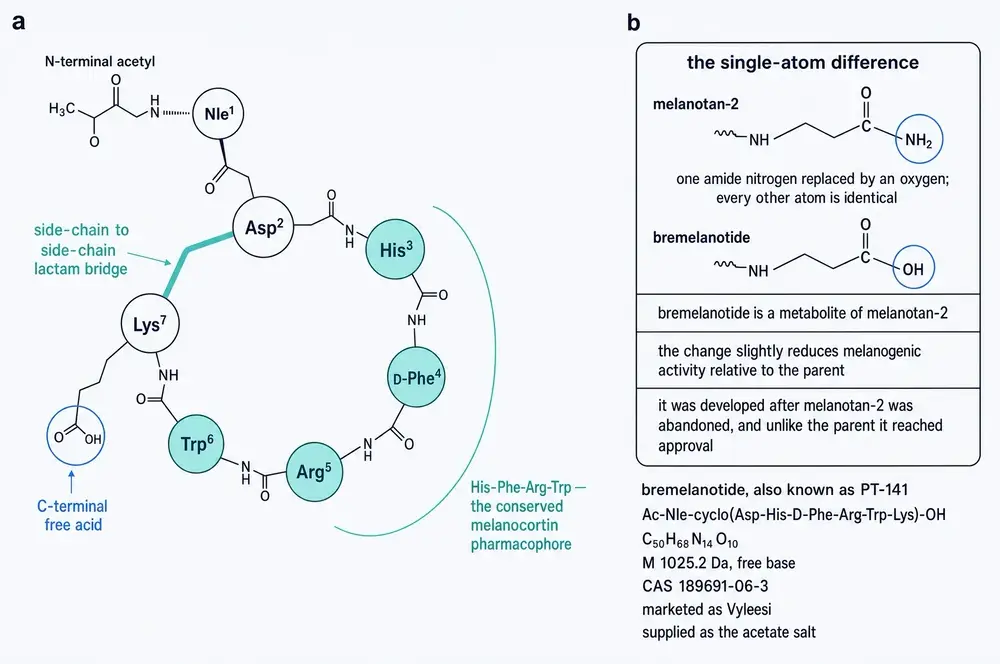
The way to lock it is to tie the ends together. In 1989 the group reported a new class of α-MSH analogues built by joining the side chain of an aspartate to the side chain of a lysine, forming a covalent bridge — a lactam — that closes part of the peptide into a ring (Al-Obeidi et al., 1989a). A companion paper the same year reported the biology: a twenty-three-membered ring was optimal, and the best compound was ninety times more potent than the natural hormone in a lizard-skin assay (Al-Obeidi et al., 1989b).
That compound was named melanotan II. It is a cyclic heptapeptide, and if you strip away the notation it is a small ring of six amino acids with a seventh residue hanging off it and an acetyl cap on the end. Inside the ring sit four residues — histidine, D-phenylalanine, arginine, tryptophan — which are conserved across the whole melanocortin family and which the receptors actually read. Everything else in the molecule exists to hold those four in position and to keep enzymes away from them.
Section 04The effect nobody was testing for
Melanotan II went into human testing as a tanning agent. What happened next is the part of this story that everyone has heard and that almost everyone gets wrong in at least one particular.
The version in general circulation is that a researcher on the project injected himself with twice the intended dose and experienced an erection lasting eight hours, and that the researcher was Mac Hadley. The first half of that is documented. The second half is not.
The incident appears in a peer-reviewed review of melanocortin receptors and penile erection, written by a group that included Hruby himself and Hunter Wessells, the urologist who ran the later clinical trials (King et al., 2007). It describes a self-described human pincushion who inadvertently took twice the expected concentration and, to his surprise, had an eight-hour erection along with nausea and vomiting. The review names nobody. Two of its authors were inside the programme and would have known who it was, and they still did not say. The attribution to Hadley by name traces to a single encyclopaedia sentence whose own editors flagged it as inadequately sourced, and which cites the review that names nobody. This document therefore reports the incident and not the name.
It is also worth noting that the anecdote is not load-bearing. The effect turned up in a formal clinical trial, and that trial is citable. In 1996 the Arizona group published a pilot phase 1 study of melanotan II in three male volunteers — a tanning study, single-blind, with alternating placebo days. Buried in its results is the observation that a complex of stretching and yawning appeared to correlate with the onset of spontaneous erections, which the volunteers experienced intermittently for one to five hours depending on the dose (Dorr et al., 1996). Nobody had administered a sexual stimulus. The drug was producing the response on its own.
Hadley later described the discovery in exactly those terms: the sexual actions of the peptide were found accidentally, while the group was studying its effects on human skin pigmentation (Hadley, 2005).
Section 05From a tanning peptide to a sex drug
The clinical follow-up was quick and, for a three-person pilot, unusually convincing. Wessells and colleagues ran a double-blind placebo-controlled crossover study in ten men with erectile dysfunction of psychological origin. Eight of the ten responded. Penile tip rigidity above eighty per cent lasted a mean of thirty-eight minutes on the drug against three minutes on placebo (Wessells et al., 1998). A second crossover study in twenty men found that seventeen responded to at least one of two injections, again without visual sexual stimulation, and — the more interesting finding — that increased sexual desire was reported after sixty-eight per cent of active doses against nineteen per cent of placebo doses (Wessells et al., 2000).
That last number is the hinge of the entire programme. A drug that produces erections is a drug in a crowded field; sildenafil had been approved in 1998 and worked on the plumbing. A drug that produces desire would be something nobody had. The melanocortin programme turned toward that.
But melanotan II itself was not a viable candidate. Its investigators doubted its clinical utility and no further trials were run. It was a potent pigment agonist — that was its original purpose — which meant that using it for sexual function required accepting tanning as a side effect, and it carried a narrow margin between the dose that worked and the dose that caused trouble.
The compound that Palatin Technologies took forward instead was the one this monograph is named for. Chemically it differs from melanotan II by a single functional group: where the parent ends in a primary amide, bremelanotide ends in a carboxylic acid. One nitrogen atom is replaced by an oxygen. Nothing else about the molecule changes.
Bremelanotide is almost universally described as the active metabolite of melanotan II, and the chemistry makes that plausible: converting an amide to an acid is a hydrolysis, exactly the reaction a body performs on peptides all day, and the change in molecular formula is precisely what that reaction would produce.
Plausible is not the same as demonstrated. The review most often cited for the claim calls bremelanotide a deaminated derivative and likely metabolite of the parent (King et al., 2007). The founding Palatin patent, which is where a company states what it believes it has invented, makes no metabolite claim at all: it presents the compound as novel and dramatically better, reporting that two micrograms per kilogram produced a penile response in rats where a hundred micrograms per kilogram of melanotan II was needed for the same effect, with a therapeutic window it puts at more than a thousandfold against three- to fourfold for the parent (Blood et al., 2003).
No primary study demonstrating bremelanotide as an in-vivo metabolite of melanotan II was located for this monograph. The relationship is best described as a described-and-likely one. It is repeated here because the distinction changes how the compound should be understood: not a happy accident scavenged from a failed drug, but a deliberately selected congener whose advantage over its parent was measured and patented.
Section 06What the accident was actually an accident of
It is tempting to file this under serendipity and move on, in the company of penicillin and the microwave oven. That framing is too generous, and it obscures the more interesting point.
The erection was not a random event. It was the predictable consequence of giving a potent, long-acting, brain-penetrant agonist for a receptor family that happens to be expressed all over the central nervous system, at a time when nobody had catalogued what those receptors did outside the skin. The melanocortin receptors were not even cloned until the early 1990s, several years after melanotan II was first made. The Arizona group built a superpotent ligand for a system whose extent was unknown, and then found out what the system controlled by watching what happened.
What makes the story worth telling is not the luck. It is that the same promiscuity which produced the discovery has followed the compound ever since. The receptor that made melanotan II a tanning agent is still there in bremelanotide, and in the approved drug it is no longer the therapeutic target — it is the reason a small number of patients develop patches of darkened skin. The programme changed its mind about which effect it wanted. The molecule did not change its mind about what it did.
Section 07One hormone family, five jobs
To understand what bremelanotide does, and why it does several things at once, you have to start with an unusual piece of biology. A single gene, proopiomelanocortin, produces a long precursor protein that is then cut into pieces — and the pieces are different hormones. Adrenocorticotropic hormone comes out of it. So do the melanocyte-stimulating hormones, alpha, beta and gamma. So does beta-endorphin. One transcript, several messages, depending on which enzymes are present in which tissue.
Those messages are read by five receptors, cloned in the early 1990s and named in order of discovery rather than of importance. All five are G-protein-coupled receptors of the same broad class, and all five conventionally signal by raising cyclic AMP inside the cell.
| Receptor | Where it sits | What it does | Relevance here |
|---|---|---|---|
| MC1R | Pigment cells in skin; also white blood cells | Shifts melanin production toward eumelanin, the dark UV-absorbing pigment; also enhances DNA repair and damps inflammation | The original target of the tanning programme. In this drug it is the source of the pigmentation side effect |
| MC2R | Adrenal cortex | Drives cortisol production | Essentially irrelevant: it responds only to ACTH, not to the MSH peptides, so a melanocortin analogue of this shape cannot activate it |
| MC3R | Brain — thalamus, ventral tegmental area, amygdala, hypothalamus | Energy partitioning, feed efficiency, food anticipation; linked to the timing of puberty | Engaged, but its contribution to this drug's effects is unresolved |
| MC4R | The most widely expressed brain melanocortin receptor — hypothalamus, brainstem, amygdala and more | Food intake, energy expenditure, blood pressure and heart rate, glucose and lipid handling, sexual function | The intended target, and the presumed basis of the approved indication |
| MC5R | Mostly peripheral, especially sebaceous glands | Sebum production, exocrine function, immune modulation | Engaged weakly; no established clinical consequence |
Two features of this system are worth holding on to. First, it is one of very few receptor families with endogenous antagonists — agouti-related peptide and agouti signalling protein actively switch these receptors off, rather than merely failing to switch them on. Melanocortin signalling is therefore a push-pull system with a resting tone that can be driven in either direction.
Second, MC4R is not a simple on-off switch. It couples not only to the cyclic-AMP pathway but also to at least four other intracellular routes, including one that bypasses G proteins entirely. That matters more than it sounds, and section 10 returns to it.
Section 08What bremelanotide binds, and why nobody agrees
Here is a fact that should be surprising about a drug approved in a major market: there is no published, single-laboratory, five-receptor potency table for bremelanotide. What exists instead is a scatter of measurements made by different groups, in different cell lines, mostly inside papers about other molecules that used bremelanotide as a reference compound. And they do not agree.
The approved labelling states a rank order — MC1R above MC4R, then MC3R, MC5R and MC2R — without printing the numbers behind it. Reviews reproduce that order (Böhm et al., 2024). But when independent laboratories have measured the compound directly, the top two positions swap depending on the system used.
The disagreement has a mundane explanation and an uncomfortable implication. The mundane explanation is that receptor pharmacology is sensitive to how many receptors a cell expresses and what else it expresses alongside them; the same compound can look like a different drug in BHK cells and HEK cells. The uncomfortable implication is that bremelanotide's own characterising paper — the 2003 account by the Palatin group that first described it as a melanocortin agonist for sexual dysfunction (Molinoff et al., 2003) — sits behind a paywall in a conference volume, so the numbers in general circulation have been reconstructed from other people's control experiments.
For the purposes of this monograph the practical position is this: the drug is a non-selective agonist that engages at least four of the five melanocortin receptors at concentrations achieved in use, and MC1R and MC4R are the two that matter clinically. Which of those two it prefers is not settled, and any source that states the rank order without naming an assay is repeating a label statement rather than reporting a measurement.
Section 09The pigment problem is the target problem
One consequence of that non-selectivity is worth stating plainly, because it is the neatest irony in the compound's history.
MC1R activation does exactly what the Arizona group designed it to do. The receptor sits on pigment cells; agonist binding raises cyclic AMP, which activates a transcription factor cascade ending at the enzymes that manufacture melanin, and the balance shifts toward eumelanin. This is the same pathway that ultraviolet light uses: UV damages DNA, the damage stabilises p53, p53 turns on proopiomelanocortin in skin cells, and the α-MSH produced locally activates MC1R on the neighbouring melanocyte. A melanocortin drug simply enters that circuit halfway along.
In the tanning programme this was the therapeutic effect. In the approved drug it is an adverse reaction: focal hyperpigmentation, reported in about one per cent of women receiving bremelanotide on the approved as-needed schedule (Böhm et al., 2024). Nothing about the molecule changed. The indication changed, and the same receptor moved from the benefit column to the harm column.
Section 10Why a brain receptor produces a nauseating drug
MC4R is not confined to whatever nucleus governs sexual desire. It is one of the most broadly distributed neuropeptide receptors in the brain, and the list of things it controls reads like a list of this drug's side effects: food intake, nausea and vomiting, blood pressure, heart rate.
Recent work has begun to explain why those effects can, in principle, be separated. MC4R couples to several intracellular pathways, and in mice they map onto different functions. Deleting the Gαq/11 pathway from a specific hypothalamic nucleus abolishes an MC4R agonist's appetite-suppressing effect while leaving energy expenditure and glucose handling intact; deleting the Gαs pathway from the same nucleus abolishes the blood pressure response. In principle a ligand that favoured one pathway over the other could suppress appetite without raising blood pressure — and that is the accepted explanation for why setmelanotide, a later melanocortin drug, has a cleaner cardiovascular profile.
Bremelanotide is classified as a balanced, unbiased agonist: it appears to engage the pathways roughly equally, which is consistent with its clinical profile of appetite effects and pressor effects and nausea and sexual effects arriving together. But that classification is inference rather than measurement. No pathway-profiling dataset for bremelanotide exists in the corpus assembled for this monograph — no bias factors, no transduction coefficients, no comparison of G-protein against arrestin recruitment. Everything said about this drug's signalling bias is extrapolated from its structural near-identity to melanotan II and back-inferred from which side effects patients report.
Section 11What the animals actually show
This is where the popular account of bremelanotide and the primary literature part company, and the gap is wide enough to be the most important finding in this Part.
The account usually given runs: the drug activates MC4R in the hypothalamus, which increases dopamine release in the brain's reward pathway — the projection from the ventral tegmental area to the nucleus accumbens — and that increase produces desire. It is a tidy story, it is repeated in clinical reviews, and it was drawn on one of the commissioned plates supplied for this monograph.
What the primary animal literature supports is considerably narrower.
What is demonstrated. Infusing bremelanotide directly into the medial preoptic area of the hypothalamus increases appetitive sexual behaviours in hormone-primed female rats — solicitations, hops and darts (Pfaus et al., 2007). Infusion into a neighbouring nucleus, the ventromedial hypothalamus, does not. In mice, MC4R is necessary for normal female sexual receptivity, and restoring the receptor only in one population of hypothalamic neurons fully normalises the reflex (Semple et al., 2023). Melanocortin agonists reliably activate the paraventricular nucleus in several rodent species. That is a real hypothalamic mechanism and it is well replicated.
What is not demonstrated, and is in fact contradicted. The dopamine arm of the story does not survive contact with the experiments. A 2025 study in female Syrian hamsters tested it directly and found that bremelanotide, at two doses, failed to enhance the rewarding value of sexual experience in a conditioned place preference paradigm — if anything the drug abolished the preference that saline-treated animals showed. Neither dose changed the sexual reflex itself. Mapping the receptors, the same group found MC4R messenger RNA to be rare in the nucleus accumbens and MC3R absent from it altogether; what MC4R there is sits mostly on fast-spiking inhibitory interneurons rather than on the projection neurons the reward model requires. Their conclusion is blunt: bremelanotide does not act on the ventral-tegmental-to-accumbens reward circuit and does not enhance sexual reward, and despite the drug's approval very little is known about its neurobiological mechanism (Borland et al., 2025).
An earlier study in female rats had already found no effect of bremelanotide on conditioned place preference for sexual experience (Pfaus et al., 2004), and the reviews that describe the drug's neurobiology concede that bremelanotide has no measured effect on dopamine release in the nucleus accumbens. The measurement that is often cited for the dopamine claim used α-MSH, not bremelanotide, injected directly into the ventral tegmental area, not given systemically.
Section 12An unexpected route: the social-context finding
One recent result deserves separating out, both because it is genuinely interesting and because it is routinely over-claimed.
Working in prairie voles, a 2024 study gave the parent compound melanotan II and mapped neuronal activation. In a non-social context the drug activated the paraventricular nucleus and nothing else. In a social context — thirty minutes with an unfamiliar animal of the opposite sex — it activated the paraventricular nucleus and the nucleus accumbens. In animals genetically lacking the oxytocin receptor, the paraventricular activation survived and the accumbens activation vanished entirely; blocking the oxytocin receptor pharmacologically reproduced that. A novel non-social object did not substitute for the social partner, so the requirement is sociality rather than novelty (Ford et al., 2024).
This is a real pharmacology-by-environment interaction: an effect the drug does not produce alone and the situation does not produce alone. It suggests that melanocortin agonism may work by recruiting endogenous oxytocin rather than by acting on reward circuitry directly — which would reconcile the accumbens findings with the negative reward results in section 11.
Three limits should travel with it. It used melanotan II and not bremelanotide. The activation marker used cannot distinguish which cell types responded, so an apparent increase could in principle reflect net inhibition. And the drug simultaneously reduced social investigation and increased self-grooming in both genotypes, so the neural effect happened despite less social interaction rather than because of more.
Section 13The one human mechanistic study
Everything above is animal work. There is exactly one study that looked inside the human brain while this drug was acting, and its results do not resemble the animal model at all.
Investigators at Imperial College London ran a randomised, double-blind, placebo-controlled crossover trial in premenopausal women with acquired generalised hypoactive sexual desire disorder, imaging each participant twice — once on bremelanotide 1.75 mg and once on placebo — while they watched erotic and control videos. Forty were randomised; thirty-one completed both visits (Thurston et al., 2022).
At twenty-four hours, more participants reported increased sexual desire on the drug than on placebo, twenty-one against eight. Inside the scanner, subjective arousal ratings did not differ between drug and placebo at all.
The brain changes were these: increased activity in the right cerebellum, decreased activity in the secondary somatosensory cortex on both sides, and increased activity in the supplementary motor area at the later scan. Connectivity between the amygdala and the insula was altered. That is the complete list.
There were no differences in the hypothalamus, the striatum, the nucleus accumbens, the ventral tegmental area, the amygdala considered alone, or the insula considered alone — and the hypothalamus and striatum were both included as regions of interest specified in advance, so their absence is a result and not an oversight.
The authors interpreted their findings in entirely cortical terms: reduced activity in secondary somatosensory cortex as diminished self-monitoring — the phenomenon clinicians call spectatoring, in which attention to one's own performance displaces attention to the experience — and supplementary motor activation as increased sexual motor imagery. They mapped this onto a model of the disorder as excessive top-down cortical inhibition, drawn from human imaging, and not onto the rodent melanocortin literature at all.
The connectivity findings should be read carefully in two respects. First, the direction: the paper's abstract describes enhanced amygdala–insula connectivity, but the results section shows the interaction was driven by the placebo condition, in which connectivity fell when the erotic video appeared. On the drug it stayed roughly level. The accurate statement is that the drug prevented a reduction, not that it produced an increase.
Second, the threshold: the authors state in their methods that for the connectivity analyses they lowered the significance threshold to 0.01 to adjust for the number of comparisons. The three interactions they report have P values of 0.025, 0.026 and 0.064, and so do not meet the threshold the paper set for itself.
The study also could not establish that the effects are MC4R-mediated. The drug is non-selective and no antagonist control was possible; the receptor attribution is an assumption carried in the paper's own shorthand.
Set the human study beside the animal work and the position is uncomfortable but clear. The animal literature supports a hypothalamic action and refutes a reward-circuit action. The human imaging finds neither, and points instead at cortex and cerebellum. A drug approved in 2019 has, in 2026, no established mechanism in the species it is prescribed to.
Section 14Why it is not a Viagra for women
The comparison is unavoidable in popular coverage and it is wrong in a specific, instructive way.
Phosphodiesterase type 5 inhibitors act on smooth muscle in genital vasculature. They work at the end of the chain, on the physical response, and they require sexual stimulation to do anything: they amplify a signal that is already being sent. That is why they were developed from human tissue pharmacology explaining an effect already observed in the clinic.
Melanocortin agonists act in the brain, upstream of the physical response, and they do not require stimulation. In the early human studies erections occurred without any sexual stimulus at all, which is the pharmacological signature of a central rather than a peripheral drug — and it is why melanotan II can cause priapism, a complication no phosphodiesterase inhibitor produces at therapeutic dose. Direct experiments in rats confirm the point negatively: bremelanotide's precursor produces erection through brain and spinal melanocortin receptors and has no effect on intracavernosal pressure when its access to the central nervous system is bypassed, which excludes a penile site of action (Wessells et al., 2003).
The two classes therefore sit at opposite ends of the same sequence. They are not competitors and not substitutes. The distinction also explains the drug's adverse-effect profile: because the target is a brain receptor with many jobs, the unwanted effects are largely central too, and the most common of them — nausea — is a brainstem phenomenon rather than a stomach one.
Section 15The nasal spray years
Palatin's first serious attempt at a product was not the drug that exists today. It was a nasal spray, and the intended patients were men.
The logic was sound. A peptide cannot be swallowed, and men with erectile dysfunction were a proven market that sildenafil had just created. The nasal route avoided a needle and gave rapid absorption. Through the middle 2000s the programme published a coherent sequence of studies: a phase 1 in thirty-two healthy men, in which ten- and twenty-milligram intranasal doses significantly prolonged the time spent at eighty per cent base rigidity; a phase 2A confirming the twenty-milligram effect with a mean duration around twenty-four minutes and onset near thirty; and subcutaneous studies showing significant erectile responses at four and six milligrams (Diamond et al., 2004; Rosen et al., 2004). A combination study found that low-dose intranasal bremelanotide added to sildenafil produced more erectile response than sildenafil alone (Diamond et al., 2005).
Then the programme stopped, and the reason was blood pressure. The doses that worked by the nasal route were an order of magnitude larger than the dose that is approved today — ten to twenty milligrams against 1.75 — and at those doses the pressor effect that this receptor family produces became the limiting problem.
It is widely repeated that the United States Food and Drug Administration placed a clinical hold on intranasal bremelanotide in 2007. That specific claim could not be verified against any regulatory document, company filing or primary source for this monograph, and a formal clinical hold, a voluntary discontinuation by the sponsor and an agency expressing benefit–risk concern are three legally distinct events that popular accounts run together.
What is documented is that the intranasal programme ended, that dose-dependent blood pressure elevation was the reason given, and that the compound returned years later at roughly a tenth of the dose by a different route. The registry cannot settle the question either: the pre-2008 intranasal male studies predate mandatory trial registration and none of them appears on ClinicalTrials.gov.
The lesson the programme drew is the one worth carrying forward, and it is stated well by the commissioned artwork later in this Part: the route and the dose, not the molecule, were what made the compound viable. Nothing about bremelanotide changed between the failed nasal spray and the approved autoinjector. The exposure changed.
Section 16Two trials that no longer count
Any reader going back to the older bremelanotide literature will encounter two substantial randomised trials that must now be set aside, and the reason is not scientific disagreement.
In 2008 the Journal of Sexual Medicine published a double-blind, placebo-controlled, fixed-dose randomised study of bremelanotide in women with arousal disorder. The same year the Journal of Urology published a randomised, double-blind, placebo-controlled trial of intranasal bremelanotide in 342 men who had not responded to sildenafil, reporting positive clinical results in 33.5 per cent of treated men against 8.5 per cent on placebo. Both were single-institution studies from the same investigator.
The first has been retracted. The retraction notice states that after retractions of the author's work by other journals, the journal re-reviewed all of his papers; that its reviewers raised multiple concerning questions about the methodology, results and statistical interpretation; that the author was asked to provide his original data and chose not to respond; and that the journal could therefore no longer verify the results or methods.
The second carries an expression of concern, issued in 2023.
Between them these were among the larger early human trials of the compound, and the male study is still occasionally cited for the proposition that bremelanotide works in sildenafil non-responders. It should not be. This monograph draws no conclusion from either, and readers encountering a favourable bremelanotide result from 2008 should check its provenance before relying on it.
Section 17Choosing a dose
The modern programme restarted with a subcutaneous phase 2b trial in premenopausal women, running from 2011 to 2012 across sixty-seven sites in the United States and Canada (Clayton et al., 2016). Three hundred and ninety-seven women were randomised in equal proportions to placebo or bremelanotide at 0.75, 1.25 or 1.75 milligrams, self-administered at home as desired for twelve weeks.
Two findings decided the shape of everything that followed.
First, the primary endpoint was the number of satisfying sexual events per month, and it was met: a gain of 0.7 events against 0.2 on placebo (p = 0.0180). Remember that, because it does not happen again.
Second, the lowest dose was declared ineffective and the highest was selected, on the stated grounds of optimal efficacy with an acceptable safety profile. The 1.75 milligram dose alone reached significance across the desire and distress instruments; the two higher doses pooled did so only on total and desire scores.
Two caveats travel with this trial and are rarely repeated. Its hierarchical statistical testing broke at the first secondary endpoint, which means the frequently quoted improvements in the desire and distress instruments are nominal p-values rather than protected ones. And the population was not the population that was eventually studied in phase 3 or described on the label: only 23 per cent had low desire alone, while 74 per cent had a mixed picture of low desire and impaired arousal.
Section 18What the phase 3 programme measured
The pivotal programme comprised two identical trials, known as studies 301 and 302 and together as RECONNECT, run between 2014 and 2016 (Kingsberg et al., 2019). Their design deserves attention because several of its features shape how the results should be read.
Women entered a four-week screening period, then a four-week single-blind period in which everyone received placebo and which established the baseline. Only then were they randomised, one to one, to bremelanotide 1.75 milligrams subcutaneously as needed or to placebo, for twenty-four weeks. A fifty-two-week open-label extension followed for those who completed.
The placebo run-in is not a neutral detail. Its stated purpose was to minimise the placebo effect, and it works by letting the initial response to being in a trial happen before the measurement starts. It is a legitimate and common design; it also means the reported treatment effect is measured from a baseline that has already absorbed some improvement.
| Feature | Value |
|---|---|
| Randomised | 1,267 women across the two trials |
| Efficacy population | 1,202 (modified intention to treat) |
| Mean age | 38.7 years |
| Race | 85.6 per cent white; 91.5 per cent not Hispanic or Latina |
| Sites | 96.6 per cent of participants enrolled in the United States |
| Required diagnosis | Acquired, generalised hypoactive sexual desire disorder for at least six months |
| Required relationship | Stable monogamous relationship |
| Excluded | Depression, psychosis, bipolar disorder or substance abuse within six months; antidepressants, neuroleptics, lithium, mood stabilisers or benzodiazepines within three months |
| Dosing permitted | Up to 12 doses per four weeks — more than the eight per month the approved labelling allows |
That exclusion list is the single most important limitation on how these results generalise. Low sexual desire in the real world is frequently associated with depression, or is a side effect of the antidepressants used to treat it. RECONNECT screened out precisely that population. The trials tested the drug in women whose low desire had no identified psychiatric or pharmacological cause — which is what the label's word "generalised" is doing — and the result cannot be carried across to the much larger group in whom it does.
Section 19The two endpoints that were met
Both co-primary endpoints were met, in both trials, in the direction of benefit. There is no ambiguity about that and this document does not manufacture any.
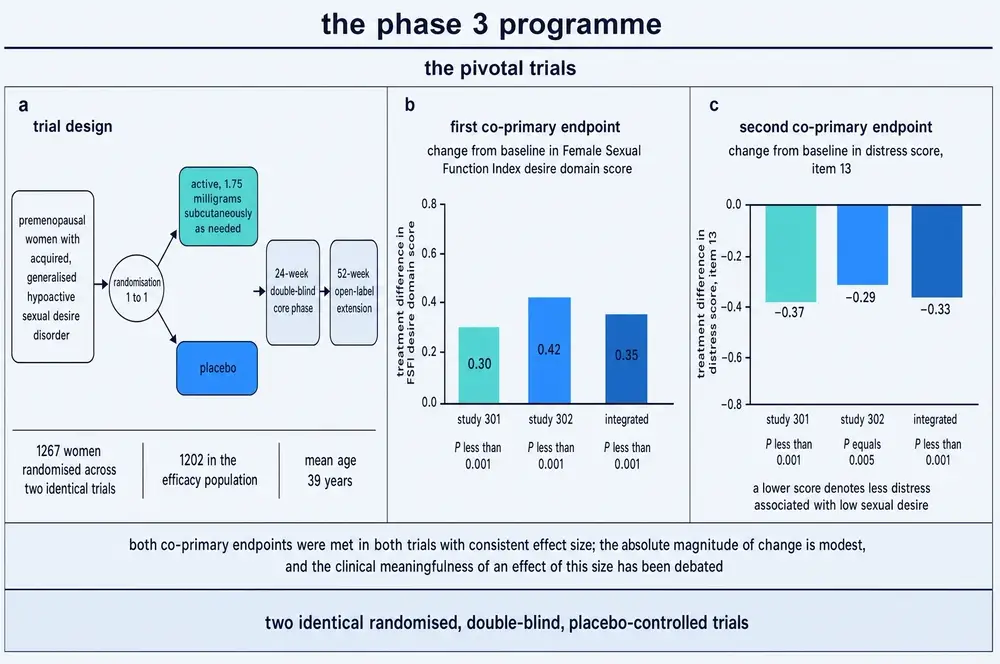
The first co-primary endpoint was the desire domain of the Female Sexual Function Index. It consists of two questions, and it runs from 1.2 to 6.0. Integrated across the two trials, bremelanotide beat placebo by 0.35 points.
The second was a single item — item 13 — from a distress questionnaire, asking how often the woman feels bothered by low sexual desire. It runs from 0 to 4, where the categories are never, rarely, occasionally, frequently and always. Integrated, bremelanotide beat placebo by 0.33 points, in the direction of less distress.
Put the differences next to the rulers they were measured with and the picture changes without a single number being disputed. A gain of 0.35 on a 4.8-point range is about seven per cent of the instrument. A reduction of 0.33 on a four-point range is about a third of one response category: not enough, on average, to move a woman from "frequently" to "occasionally."
The trials also anticipated this objection and answered it with a responder analysis, which is the fairer way to look at a mean difference: a small average can conceal a meaningful benefit in a minority. An independent committee set the responder threshold before unblinding, anchored to a global question asking women how much they thought they had benefited. On that anchor, 58.3 per cent of bremelanotide recipients were responders against 36.1 per cent on placebo in study 301, and 58.2 against 35.4 per cent in study 302.
That is a real difference of about twenty-two percentage points, and it is the strongest number in the programme. It also carries its own caution: more than a third of women on placebo judged themselves to have benefited.
Section 20The endpoint that failed
Beneath the two co-primary endpoints sat a ranked list of secondary endpoints, and at the top of that list was the outcome most people would consider the point of the exercise: the change in the number of satisfying sexual events.
It did not work.
| Change in satisfying sexual events | Bremelanotide | Placebo | P |
|---|---|---|---|
| Study 301 | 0.0 | −0.1 | 0.764 |
| Study 302 | 0.0 | 0.0 | 0.702 |
| Integrated | 0.0 | −0.1 | 0.630 |
Two consequences follow, and the second is larger than the first.
The immediate consequence is that a drug for low sexual desire, taken as needed before anticipated sexual activity, did not increase the number of satisfying sexual encounters women had. This is the endpoint that carried the phase 2b trial, where it was primary and where it succeeded. It was demoted to secondary for phase 3, and then it failed.
The structural consequence is that the trials' own statistical plan specified hierarchical testing, in which each endpoint is tested only if the one above it succeeded. Because the first ranked secondary failed, every endpoint below it lost inferential status and became, in the paper's own words, supportive and exploratory. The forest plot of secondary outcomes that appears in the primary publication, and the favourable numbers quoted from it in later reviews, all sit below that break.
What was reported in its place was a post-hoc analysis of a different quantity: not the number of satisfying events but the percentage of sexual encounters that were satisfying, which rose 25.0 per cent on bremelanotide against 9.8 per cent on placebo. That is a legitimate observation and it was labelled as post-hoc. It is not the endpoint the trial specified.
Section 21What it costs to take
The adverse-effect profile of this drug is not subtle and was never hidden. Nausea occurred in 40.0 per cent of women on bremelanotide against 1.3 per cent on placebo. Its character is well documented: median onset thirty minutes after the injection, median duration 2.4 hours, roughly 98 per cent of episodes mild or moderate, sporadic rather than after every dose. It caused 8.1 per cent of participants to discontinue. Flushing occurred in 20.3 per cent against 0.3 per cent, and headache in 11.3 per cent against 1.9 per cent.
The cardiovascular effect is the one the programme was built around, and it was characterised properly — with twenty-four-hour ambulatory monitoring at fifteen-minute intervals in the phase 2b trial, each participant compared against her own preceding placebo dose, with an independent blinded hypertension specialist adjudicating (White et al., 2017).
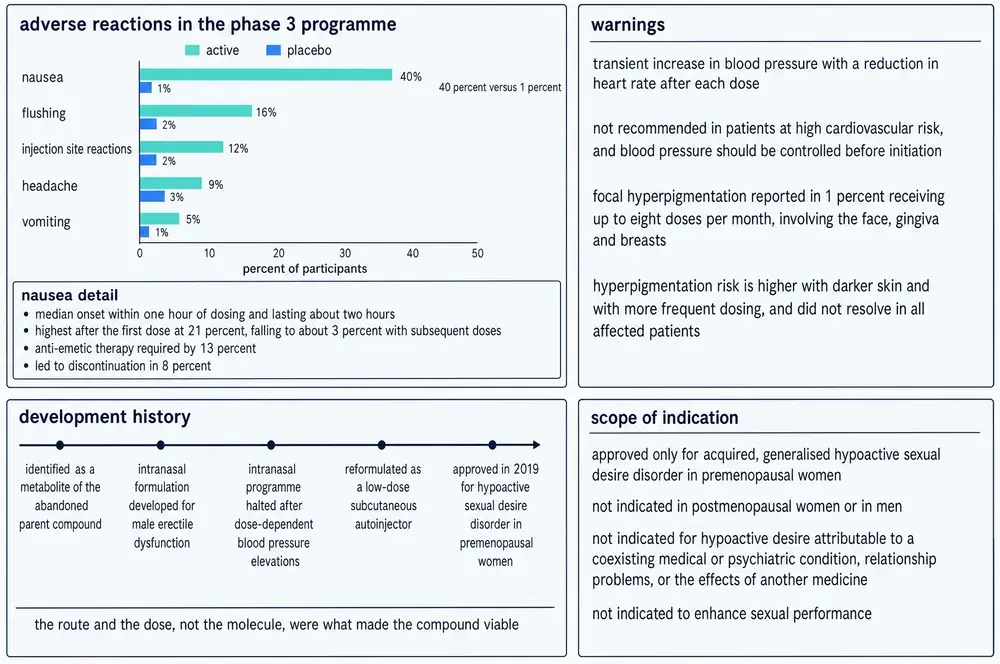
The third characteristic effect is the one the molecule was originally designed to produce. Focal hyperpigmentation was reported in about 1 per cent of the 627 women receiving bremelanotide in the placebo-controlled phase, with a further 1 per cent during open-label treatment. Two participants developed melanocytic naevi, both mild and both resolved, and no melanoma or other skin cancer occurred anywhere in the programme.
Reversibility is not assured. The approved labelling addresses this directly and its wording is careful: resolution of the focal hyperpigmentation was not confirmed in all patients after the drug was discontinued. The frequently quoted figure of resolution within about a month belongs to setmelanotide, a different melanocortin drug on a different schedule, and does not transfer. Patients with dark skin were more likely to be affected.
The incidence is dose-dependent, steeply. At the approved as-needed dose it is around one per cent. The label reports that 38 per cent of patients developed focal hyperpigmentation after eight consecutive daily doses, with a further 14 per cent developing new pigmentary changes over eight more days. In a phase 1 study that gave roughly 6.5 milligrams a day for fifteen days, it occurred in 19 of 30 women, 63.3 per cent (Spana et al., 2022). The gradient runs from one per cent to sixty-three across those regimens, and it is driven by cumulative exposure rather than by any single dose — which matters for anyone using this compound outside the approved schedule, the subject of Part Five.
Section 22Pharmacokinetics: a deliberately short-acting drug
Almost every peptide drug of the last decade has been engineered to last longer — acylated so that it binds albumin and circulates for days. Bremelanotide went the other way, and that is a design decision rather than an accident.
It is only 21 per cent bound to plasma protein, which is remarkably low for a peptide. Its terminal half-life is 2.7 hours, with a range of 1.9 to 4.0. Peak concentration arrives about half an hour to an hour after injection. Absolute bioavailability by the subcutaneous route is essentially complete, and it makes no difference whether the injection goes into the thigh or the abdomen. It is cleared by hydrolysis of the ring's own amide bonds, with no involvement of the liver's cytochrome enzymes, and eliminated about two-thirds in urine and a quarter in faeces.
For an as-needed drug taken before anticipated activity, short is the correct answer. A compound that produced a 3 mmHg pressor effect and 40 per cent nausea would be intolerable if it lasted a week.
Section 23Interactions, and one that matters
Bremelanotide slows the stomach. That single pharmacological fact generates its whole interaction profile: anything swallowed around the same time is absorbed more slowly and less completely. Two drugs are named specifically in the literature, indomethacin and naltrexone.
Naltrexone is the one worth pausing on. It is used to maintain abstinence in alcohol and opioid dependence, and it works by occupying opioid receptors. A drug that materially reduces its absorption could allow that blockade to lapse. The published guidance is to avoid the combination. Quantitative exposure ratios for either interaction were not found in the corpus assembled here and are not printed.
Against that, the interaction that everyone expects is absent: a phase 1 crossover study in twenty-four healthy volunteers found no pharmacokinetic interaction with alcohol and no clinically relevant blood-pressure change when the two were combined, and the phase 3 trials found no difference in adverse events by alcohol consumption. That is a genuine point of difference from flibanserin, the other approved drug for this indication, which carries a marked alcohol interaction. One qualification: the alcohol study used the intranasal route, not the subcutaneous one.
Section 24Who stayed
The most revealing numbers in the whole programme are not about efficacy. They are about who was still there at the end.
Nearly a third of participants — 411 of 1,267 — did not complete the twenty-four-week core phase, and withdrawal was strongly asymmetric between arms. In study 301, 41.9 per cent of women on bremelanotide withdrew against 16.0 per cent on placebo; in study 302, 43.8 against 28.4 per cent.
Then came the optional open-label extension, in which everyone who entered received active drug. Of those who had completed on placebo, 87 per cent chose to continue. Of those who had completed on bremelanotide, 70 per cent did. The women who had actually taken the drug for six months were markedly less willing to take it for another year than the women who had taken placebo and did not yet know what it was like.
Of the 684 who entered the extension, 272 — about forty per cent — completed the fifty-two weeks. The leading reason for leaving was adverse events, at 21.2 per cent pooled. Among those who had been on placebo and were now getting active drug for the first time, adverse-event discontinuation ran at around a quarter.
One further number puts the whole treatment in proportion. Women in the extension took a median of about twenty-five to twenty-seven injections over some four hundred days — roughly one dose a fortnight — despite being permitted many times that. Whatever this drug is, in practice it was not something most participants reached for often.
Section 25What the label actually says
Bremelanotide was approved on 21 June 2019 under new drug application 210557, held at the time by AMAG Pharmaceuticals. Two features of that approval are worth noting before the wording itself.
There was no advisory committee. The approval letter states that the application was not referred to one because outside expertise was not necessary and there were no controversial or significant safety or efficacy issues that would benefit from committee discussion. That is a striking sentence to find attached to this compound, given that the preceding drug for the same indication reached the market only at its third attempt and after a contested advisory committee, and given the published dispute described in Part Four. There is also no risk evaluation and mitigation strategy — again unlike its predecessor.
The indication is drawn narrowly and the label works hard to keep it there. It covers premenopausal women with acquired, generalised hypoactive sexual desire disorder, defined as low desire causing marked distress or interpersonal difficulty and not due to a co-existing medical or psychiatric condition, problems with the relationship, or the effects of a medication. A separate Limitations of Use section states that the drug is not indicated in postmenopausal women or in men, and not indicated to enhance sexual performance.
Almost everyone using PT-141 today falls outside every one of those clauses.
| What the label specifies | Value |
|---|---|
| Dose and form | 1.75 mg in 0.3 mL, single-dose autoinjector |
| Route and site | Subcutaneous, abdomen or thigh |
| Timing | As needed, at least 45 minutes before anticipated sexual activity |
| Maximum frequency | Not more than one dose in 24 hours; more than 8 doses per month not recommended |
| Stopping rule | Discontinue after 8 weeks if the patient does not report improvement |
| Contraindications | Uncontrolled hypertension; known cardiovascular disease. That is the entire section |
| Boxed warning | None |
| Risk management programme | None |
The label also records the duration of effect as unknown, and states that the optimal window for administration has not been fully characterised. For a drug taken before anticipated activity, that is an unusual admission.
The three warnings
Blood pressure and heart rate. The label reports maximal increases of 6 mmHg systolic and 3 mmHg diastolic, peaking two to four hours after the dose, with a corresponding fall in heart rate of up to 5 beats per minute, returning to baseline usually within twelve hours. Those are maximal figures and sit above the mean placebo-subtracted values from the ambulatory study in section 21 — the two describe different things and should not be conflated. Sixteen days of daily dosing produced no additive effect.
Focal hyperpigmentation. Here the label supplies the dose-response the trial reports do not. At up to eight doses a month, 1 per cent of patients were affected, involving the face, gingiva and breasts. In a separate study, 38 per cent developed focal hyperpigmentation after eight consecutive daily doses, and among those who continued for eight more days a further 14 per cent developed new pigmentary changes. Patients with dark skin were more likely to be affected. And on the question Part Three left open, the label is explicit rather than silent, though not reassuring: resolution was not confirmed in all patients after discontinuation.
Nausea. Forty per cent of treated patients, requiring anti-emetic therapy in 13 per cent and leading to premature discontinuation in 8 per cent. Incidence was 21 per cent after the first dose and fell to about 3 per cent afterwards.
The adverse reaction table, and the number that is not in it
The label's own pooled phase 3 table, covering 627 treated and 620 placebo patients, is the authoritative version of the safety profile and differs in several places from figures in circulation.
| Adverse reaction | Bremelanotide | Placebo |
|---|---|---|
| Nausea | 40.0% | 1.3% |
| Flushing | 20.3% | 0.3% |
| Injection site reactions | 13.2% | 8.4% |
| Headache | 11.3% | 1.9% |
| Vomiting | 4.8% | 0.2% |
| Cough | 3.3% | 1.3% |
| Fatigue | 3.2% | 0.5% |
| Hot flush | 2.7% | 0.2% |
| Paraesthesia | 2.6% | 0.0% |
| Dizziness | 2.2% | 0.5% |
| Nasal congestion | 2.1% | 0.5% |
The figure that matters most is not in that table but in the sentence beneath it. The discontinuation rate due to adverse reactions was 18 per cent on bremelanotide against 2 per cent on placebo. That is a ninefold difference on the label's own numbers, and it is the regulatory-record version of the odds ratio that the independent re-analysis in Part Four was criticised for surfacing.
One further item appears in the label and nowhere in the trial publications discussed above. A single case of acute hepatitis occurred in the open-label extension after ten doses over a year, with transaminases more than forty times the upper limit of normal and bilirubin six times it, resolving four months after the drug was stopped. The label states that the drug's role could not definitively be excluded, and the agency required three years of quarterly liver-injury safety reporting.
The clinical pharmacology section reports the ambulatory heart-rate result as a mean decrease of 0.5 beats per minute with a 95 per cent confidence interval of −1.6 to −0.7. The point estimate lies outside its own confidence interval, which cannot be correct. It is reproduced here as printed because it is what the approved labelling says, and noted because a reader checking this monograph against the label should not conclude the error is ours.
What was required afterwards
Three postmarketing requirements were imposed, and all three concern pregnancy and lactation rather than efficacy: a prospective pregnancy registry study and a retrospective claims-based cohort study, both due to complete in 2030, and a trial in lactating women to measure bremelanotide in breast milk.
That third study has been done. It ran in 2025 under the current owner, enrolled ten women, and completed in November of that year. Its results have not been posted, and the approved labelling still states that there is no information on the presence of bremelanotide in human milk or its effects on a breastfed infant. The measurement exists; the label does not yet reflect it.
Section 26A dispute conducted in print
Most drugs are argued about in conference corridors. This one has been argued about in journals, by name, with replies and counter-replies, and the exchange is unusually informative because both sides published their reasoning.
The critical case was made most forcefully by Glen Spielmans, a psychologist, in two papers four years apart. The first re-analysed the pivotal trials against the regulatory submission (Spielmans, 2021). Its findings were procedural rather than pharmacological, and they were these: that 72.7 per cent of the outcomes listed in the trial protocols were not reported in the primary publication; that fifteen secondary measures which were reported did not appear in the protocols; that no secondary outcome came with a stated rationale or evidence of validity; and that two findings unfavourable to the drug went unmentioned.
Those two findings are worth stating exactly, because they are the sharpest numbers in the debate. Discontinuation caused by adverse events was substantially higher on bremelanotide, with an odds ratio of 11.98 (95% CI 3.74–38.37) — a number needed to harm of six. And on a combined measure of completing the trial and then electing to enter the open-label study, participants preferred placebo: odds ratio 0.30 (95% CI 0.24–0.38), a number needed to harm of four.
The trial investigators replied under the title "Failure of a Meta-analysis" (Kingsberg et al., 2021). Spielmans returned in 2024 with a second paper concentrating on measurement: it reported that eight of the eleven efficacy outcomes specified on the trial registry had never been published, analysed them, and found effect sizes ranging from nil to small; and it found no validity evidence for the categorical response outcomes that had been published (Spielmans & Ellefson, 2024).
A separate critique came from a drug bulletin, framing the approval as a regulatory rather than a scientific event: it observed that in clinical trials flibanserin produced about one additional enjoyable sexual experience every two months and bremelanotide produced none, and argued that the second drug capitalised on the precedent set by the first (Mintzes et al., 2021).
Section 27The instruments measured the drug that validated them
There is a structural problem underneath the statistical one, and it has had less attention than it deserves.
The distress instrument used for the second co-primary endpoint — the Female Sexual Distress Scale for Desire, Arousal and Orgasm — was validated on the bremelanotide phase 2b dataset, by the same development programme that was using it to test the drug. The instrument and the compound were developed in the same exercise.
That is not automatically improper; new indications often require new instruments, and the validation was published. But the validation's own numbers are not reassuring. Test–retest reliability came out at 0.61, below the conventional threshold of 0.70. A confirmatory factor analysis returned a root-mean-square error of approximation of 0.142, which the authors concede did not meet recommended fit criteria. The responsiveness statistic was 0.13, and the authors state the reason plainly: the change in the treatment group was not much bigger than the change in the placebo group.
Nor is the first co-primary above criticism. The desire domain of the Female Sexual Function Index is two questions. The programme itself evidently regarded that as thin: it developed a further instrument, the Elements of Desire Questionnaire, explicitly because researchers and regulatory agencies had expressed concern that those two items might not capture the whole experience of women's desire. That instrument was carried in the pivotal trials as an exploratory endpoint, and its own daily-recall reliability came out at 0.33.
So the position is this: a drug whose approval rests on two questionnaire scales, one of them two items long and one of them a single item, where the distress scale was co-developed with the drug and falls short on its own psychometric criteria. Spielmans's 2024 conclusion — that the benefits are statistically modest and limited to outcomes for which scant validity evidence exists in this population — follows from the programme's own published validation work rather than from any hostile reanalysis.
Section 28The placebo problem
Female sexual dysfunction has one of the largest placebo responses in medicine, and any honest reading of this drug has to sit inside that fact.
A meta-analysis of eight randomised trials using the same functional index found that 1,723 women given placebo improved by 3.62 points on it (Weinberger et al., 2018). For scale, the entire index runs from 2 to 36, and the integrated bremelanotide effect on the desire subdomain was 0.35. Placebo, in this field, is a powerful intervention.
A second analysis, this one by investigators sympathetic to drug treatment, put the effect sizes side by side. Medications for low desire averaged a Cohen's d of 1.0; cognitive behavioural therapy and mindfulness training also averaged 1.0; placebo averaged 0.55 and a waiting list averaged 0.05 (Pyke & Clayton, 2018). Their argument was that recommending psychotherapy over medication is premature because the two perform similarly. The same numbers support a less comfortable reading: a bit more than half of what a medication delivers is delivered by placebo, and neither medication nor psychotherapy is much better than active engagement of any kind.
The pivotal trials acknowledged a placebo responder rate around 35 per cent and attributed it to expectation, anxiety and reward — which is a fair description and also a description of the mechanism the drug is supposed to be acting on.
Forty per cent of women on bremelanotide had nausea; 1.3 per cent on placebo did. Twenty per cent flushed against 0.3 per cent. In a trial whose endpoints are self-reported feelings, a substantial fraction of participants could reasonably infer which arm they were in.
The investigators addressed this by noting that overall adverse-event rates were more similar between arms — 76.6 against 58.2 per cent — and asserting that the randomised, placebo-controlled design shields the result from that concern. No formal assessment of blinding integrity is reported. This is an assertion rather than an analysis, and the question remains open.
Section 29Three measures, and only one of them moved
The most economical way to weigh this drug is to notice that the evidence base contains three different kinds of measurement of the same thing, and that they disagree in a consistent direction.
There is the self-report measurement: two questionnaire scales, on which the drug produced small, statistically robust, repeatable improvements. That is the basis of the approval.
There is the behavioural count: how many satisfying sexual events actually occurred. Zero change, in both trials, integrated P = 0.630.
And there is the physiological measurement. Here the finding is easy to miss because it sits in an older paper: bremelanotide was found to lack effect on vaginal responses to sexual stimuli in women with arousal disorder, in contrast to the same programme's finding that it improved erection in response to visual sexual stimuli in men. That contrast is drawn explicitly in a 2025 review of how sexual desire is evaluated, whose author concludes that bremelanotide enhances sexual motivation in men whereas there is no such effect in women (Ågmo, 2025).
Section 30The diagnosis itself is contested
There is one more layer, and it is the strangest.
Hypoactive sexual desire disorder, the condition bremelanotide is approved to treat, no longer exists as a diagnosis in American psychiatry. The fifth edition of the Diagnostic and Statistical Manual, published in 2013, merged it with female sexual arousal disorder into a single category called female sexual interest and arousal disorder. The International Classification of Diseases retained hypoactive sexual desire disorder, for both sexes. A specialist society maintains a third, broader definition. Three authorities, three incompatible constructs, one drug label.
The merger is itself contested among sexual-medicine specialists, largely because the new category lacks validity and clinical-utility data, and because its criteria would exclude from diagnosis a substantial number of women with moderate rather than severe symptoms. The consequence is that the entire evidence base for this drug — including its pivotal trials — rests on the older, superseded criteria, and reviews of the field say so explicitly because a literature on the replacement category barely exists (Clayton et al., 2018).
Underneath the nosology sits a longer-running objection: that low sexual desire in women is substantially a product of circumstance, relationship and social context, and that turning it into a receptor problem misplaces the cause. The strongest empirical version of that objection is not rhetorical. Women diagnosed with the interest and arousal disorder have been found to show genital responses to sexual stimuli in the laboratory that are indistinguishable from those of healthy controls — and in one study, normal in the laboratory but markedly reduced at home, in the same women. If the response is intact in one setting and absent in another, the disorder is situational rather than generalised, and "generalised" is the word in the approved indication.
Section 31Weighing it
The evidence supports the following, and this document commits to it.
The drug does something. Two pre-specified co-primary endpoints were met in two adequately powered, well-conducted, placebo-controlled trials, with consistent direction and magnitude across both, and a prespecified responder analysis with an anchor fixed before unblinding showed a twenty-two-point advantage in the proportion of women who judged themselves better. Nothing in the critical literature disputes those results as results. The dispute is about what they mean.
The effect is small, and smaller than the programme expected. The trials were powered on an assumed desire-domain difference of 1.0 and delivered 0.35. Both integrated differences fall below the thresholds the programme's own phase 2b work identified as minimally important, though the investigators do not apply them that way.
The countable outcome did not move. Satisfying sexual events did not increase, the trial's own hierarchy therefore collapsed below that point, and the physiological measure in women is also null. A reader who wants a single sentence should have this one: the drug reliably changes how women rate their desire and distress, and has not been shown to change what happens.
The tolerability cost is real and is paid by everyone. Forty per cent nausea, an eightfold-odds excess of adverse-event discontinuation, and a revealed preference in which women who had taken the drug were markedly less willing to continue it than women who had taken placebo.
And the mechanism is unknown. Part Two established that the animal model most often cited for this drug is contradicted by the primary animal literature, and that the only human mechanistic study found changes in cortex and cerebellum rather than in any of the regions the model predicts.
None of that makes the approval indefensible. The condition is real, the distress is real, the alternatives are few, and a modest average can contain a meaningful benefit for a minority — which the responder analysis suggests it does. What it makes indefensible is the confident language in which the compound is usually described, both by those selling it and by those dismissing it. The honest summary is that this is a drug of small and uncertain benefit, appreciable cost in tolerability, unknown mechanism, and a narrow licensed population — and that almost everyone taking it today, as Part Five shows, falls outside that population entirely.
Section 32The compound most people take is not the one that was approved
Everything in the preceding three Parts concerns a prescription medicine licensed for a narrow population: premenopausal women with acquired, generalised hypoactive sexual desire disorder, using a fixed 1.75 milligram dose from an autoinjector, no more than once in twenty-four hours and no more than eight times a month.
That is not how most people encounter PT-141. The compound is sold widely online as a research chemical, in vials, to be reconstituted and injected by the buyer, at doses the buyer chooses, overwhelmingly by men. This is the largest practical fact about the compound in 2026, and no monograph that omits it is describing the world.
The scale of the divergence showed up in the assembly of this document before any of its content did. A sweep of the project's literature stores for files naming the compound returned 466 documents. Fewer than twenty were science.
Section 33How the grey market works, and what it borrows
A 2026 review of unregulated peptide use describes the machinery in detail: direct-to-consumer websites, research-chemical vendors, telehealth and longevity clinics, informal sellers, international suppliers, and vendor communities on messaging platforms and forums (Hailu et al., 2026). Products carry "research use only" and "not for human consumption" labelling which, as the review puts it, functions as a liability shield rather than a safety warning — while the same vendors discuss human dosing openly. Certificates of analysis, purity percentages and third-party testing claims are deployed to manufacture an impression of rigour, and the review notes those certificates may not be independent, batch-specific, or sufficient to establish sterility, degradation, solvent quality or even that the tested sample matches the product shipped.
The review's central argument is the one worth carrying, and it is about bremelanotide specifically. It calls the phenomenon legitimacy spillover: approved melanocortin and peptide drugs lend borrowed credibility to unapproved ones. Bremelanotide is named as one of the drugs doing the lending. Its FDA approval — earned in a narrow female indication, on two questionnaire scales, with the countable endpoint null — is used as evidence that PT-141 "works," for people and purposes the trials never examined.
There is no published laboratory analysis of grey-market PT-141. No source located for this monograph reports assay data on the purity, potency, sterility, endotoxin content or adulteration of the product actually sold online. The 2026 review that catalogues the risk in most detail explicitly calls for that study to be done and cites, as its only comparable precedent, product testing performed on online semaglutide.
So the honest statement is not that grey-market PT-141 has been found impure. It is that nobody has looked, and that the certificates supplied with it are not evidence that anybody has.
A separate 2026 analysis measured the legitimate side of access across all fifty states and the District of Columbia, and found it uneven in a way that has nothing to do with medicine (Quesada et al., 2026). Thirty-two states permit telehealth prescribing to be initiated remotely and nineteen restrict it; twenty-six states have no compounding outsourcing facility registered within their borders at all. The regional differences are statistically significant, with the Northeast largely high-access and the South largely low-access. The same paper notes that bremelanotide is the only FDA-approved peptide for any sexual medicine indication, and that being approved, it can be prescribed off-label — including for low desire in men.
Where the material comes from, and what regulators have done about it
The supply side is not hidden. It is visible in the American drug regulator's own establishment listings, where alongside the finished product there are nine active bulk active-ingredient listings for bremelanotide, several of them explicitly categorised as bulk ingredient for human prescription compounding, registered to establishments in Shanghai, Qingdao, Nanjing, Shenzhen, Hangzhou and the United States, with entries appearing from 2020 through 2026. This is the documented channel that feeds compounded and grey-market product, and it is a matter of public record.
What is more surprising is what is not on record. Bremelanotide appears on none of the agency's bulk-substance lists for compounding — not in any category of the 503A nominated list, not on the 503B list, and it has never appeared on a pharmacy compounding advisory committee agenda. That absence is real rather than a gap in coverage: the same documents do name the other peptides sold through the same channels, among them BPC-157, TB-500, ipamorelin, kisspeptin-10, epitalon and thymosin alpha-1.
Enforcement has nonetheless touched the compound three times, and the three actions are instructively different. A Florida pharmacy received a warning letter in 2019 for distributing injectable bremelanotide assayed at 114.3 per cent of its labelled content — a superpotency and adulteration finding, not a licensing one. A Kentucky compounder received one in 2020 naming "Bremelanotide (PT-141)" among twenty-two bulk substances the agency considered ineligible for compounding. And an import alert first published in 2020 and still live carries a red-list entry for a Montreal firm shipping "PT 141 Peptide," detained without physical examination on the ground that no approved application exists for PT-141 — the alert naming the firm's own social-media dosing advice as the evidence of intended human use.
It is tempting to assume that bremelanotide never needed nominating for the compounding lists because the relevant statute permits bulk substances that are components of an approved drug, and bremelanotide is the active ingredient of an approved drug.
The only on-point regulatory statement says the opposite. The 2020 warning letter — issued nine months after the approval — states that products compounded from the listed substances, bremelanotide among them, are ineligible because they are not the subject of an applicable pharmacopoeial monograph, are not a component of an approved human drug, and do not appear on the bulks list. In fairness the underlying inspection ran entirely before the approval, so the present tense may describe the conduct period rather than the current position. But no source affirms the contrary, and this monograph does not assert it.
Who owns it, and where it is not sold
The commercial history is short and tells its own story. AMAG Pharmaceuticals licensed North American rights from Palatin in early 2017 and held the application at approval in 2019. The two companies mutually terminated that licence in July 2020 — thirteen months after launch — with rights reverting to Palatin. In December 2023 Cosette Pharmaceuticals acquired worldwide rights. Cosette is the current holder of record, the product is currently marketed in the United States, and there are no generics: a search of the regulator's application database on this active ingredient returns exactly one application.
The geography is the more telling fact. Bremelanotide is not approved anywhere in Europe, and the reason is not that it was refused — it was never filed. The European regulator's own medicines dataset, which lists refused and withdrawn applications as well as authorised ones, contains no entry for the compound in any status. It is likewise absent from the British, Canadian and Australian registers, and Canada is notable because AMAG's licence explicitly covered it. A Korean phase 3 bridging trial of 193 women completed in 2023; no bremelanotide product appears on the Korean register in any status.
So a drug approved in the United States in 2019, and described in its own approval letter as raising no controversial or significant safety or efficacy issues, has in seven years not been brought to market by any other major regulator — and in most cases was never put to them.
Section 34What the parent compound does to people
The clearest evidence of what can go wrong with unsupervised melanocortin use does not concern bremelanotide. It concerns melanotan II, and it is reported here for that reason and with that boundary explicit.
A 55-year-old man injected 2 milligrams of melanotan II subcutaneously to induce a tan — the same dose he had used each year for six years — and developed a painful sustained erection lasting thirty hours. Bedside management failed: intracavernosal phenylephrine to a total of 4,500 micrograms with repeated irrigation produced detumescence that reversed within minutes each time. He required operative decompression under general anaesthesia. At fifteen weeks he had new-onset erectile dysfunction, rigidity he rated four out of ten, fibrosis of the erectile tissue on examination, and no response to phosphodiesterase inhibitors (Mallory et al., 2021).
Two prior cases exist in the literature. One involved 6 milligrams and produced systemic toxicity with renal dysfunction and rhabdomyolysis, requiring three days of intensive care. At least five melanomas have been reported in melanotan II users, every one in a person with independent risk factors — fair skin, freckling, family history, or in two cases genetic variants that raise melanoma risk on their own.
None of this is bremelanotide. The doses are higher, the compound is a far more potent pigment agonist, and the priapism cases arise from a molecule whose sexual effect was strong enough that its own investigators doubted its clinical utility. But two features do transfer. The pigmentation effect is the same receptor and is steeply dose-dependent, reaching 63 per cent at supratherapeutic exposure in a controlled study of bremelanotide itself. And melanocortin analogues belong in the differential diagnosis for anyone presenting with priapism — which the treating urologists in the case above argue explicitly, because nobody asks.
It would be easy to assume that a drug which stimulates pigment cells raises melanoma risk. The evidence does not support that as a class effect, and the distinction is worth stating carefully.
Loss of MC1R function, not gain, is what tracks with melanoma: carrying one inactivating variant raises risk roughly 2.2-fold and two variants roughly 4.1-fold. Conditions of chronic melanocortin receptor activation point the other way — in a cohort of 3,299 people with Addison's disease followed over four decades, melanoma incidence was numerically below expectation. Afamelanotide, the sibling compound from the same Arizona programme, has been given to more than a thousand patients, some for over a decade, with no melanoma events (Böhm et al., 2024).
Against that, the bremelanotide exposure base is small and short. The defensible position is the reviewers' own: the class evidence argues against MC1R agonism as a melanoma driver, the pigment effect may make pre-existing lesions more visible, and dermatological surveillance remains sensible.
Section 35The second act: appetite
The most active current research on bremelanotide is not about sex. It is about weight, and it arrives from the opposite direction to every other drug in that field — an approved sexual-medicine compound being re-examined metabolically, rather than a metabolic drug that happened to cause arousal.
The pharmacology is sound and unsurprising: MC4R is one of the central regulators of food intake, and mutations in it are the commonest single-gene cause of severe human obesity. Two phase 1 inpatient studies in premenopausal women with obesity gave bremelanotide at roughly three to four times the approved dose, one to three times daily, for four to fifteen days (Spana et al., 2022). Caloric intake fell by about 400 kilocalories a day, consistently, from the first treatment day. Weight at day 16 fell 2.1 kilograms against 0.7 on placebo, a difference of 1.3 kilograms (95% CI −1.9 to −0.8).
Four qualifications should travel with those numbers. The doses were supratherapeutic and given daily, where the approved product is as-needed. The longest study ran sixteen days with no follow-up after stopping, so nothing is known about rebound. Waist circumference did not change. And the twenty-four-week phase 3 trials at the approved dose found no clinically significant effect on weight at all. This is a real short-term anorectic effect at high exposure, not evidence of durable weight loss.
The current programme therefore uses it as an adjunct rather than a monotherapy. A phase 2 trial combined bremelanotide with tirzepatide in 108 adults with obesity, running tirzepatide alone for four weeks and then adding bremelanotide or placebo (NCT06565611). It completed in early 2025.
Reported findings from that trial circulate in review articles that cite company communications rather than a publication, and the headline numbers do not agree with each other: one review gives the eight-week mean weight change as 1.9 per cent for tirzepatide alone and 2.8 per cent for the combination, while two others give 4.4 per cent for the combination against 1.6 per cent for placebo, one of them sourcing it explicitly to a press release.
The more interesting claim — that low-dose bremelanotide blunted weight regain after tirzepatide was stopped — would be genuinely important if it held, because regain after incretin withdrawal is the central unsolved problem of that drug class. It is reported from the same non-peer-reviewed source. This monograph records the claim, names its provenance, and draws no conclusion from it.
Section 36The melanocortin field's record in obesity
Bremelanotide is entering a field with a long history of failure, and the failures are instructive because they were not all the same failure.
| Compound | Sponsor | What ended it |
|---|---|---|
| MK-0493 | Merck | It did not work. No clinically significant weight loss in phase 2 at any dose tested. Notably it produced neither blood-pressure elevation nor sexual effects |
| LY2112688 | Eli Lilly | Blood pressure. Rises of 4.0 to 8.5 mmHg against placebo in every dose cohort in phase 1, with heart rate up about 3 beats per minute. Discontinued for cardiac effects. The trial was too short to measure weight at all |
| MC4-NN2-0453 | Novo Nordisk | Pigmentation. Two dose cohorts halted by investigators; melanocytic naevi in 45 per cent and increased skin pigmentation in 33 per cent. All benign, no melanomas. The effect on weight could not be determined |
| AZD2820 | AstraZeneca with Palatin | A serious adverse event. One participant had a severe allergic reaction after a single 6 milligram dose and was hospitalised; the trial was terminated |
Three different liabilities of the same receptor family — pressor effects, pigmentation, and simple inefficacy — and bremelanotide has demonstrably two of the three, at smaller magnitude, because it is given rarely and at low dose.
The one success is instructive in the opposite direction. Setmelanotide was approved in 2020 for obesity caused by specific genetic defects upstream of the receptor, and later for Bardet–Biedl syndrome. Its advantage is not that it is a better appetite drug in general: in general obesity it produced weight loss under three per cent in most trials and none at all in one. Its advantage is that it works where the endogenous signal is missing, which is a much smaller population and a much stronger effect. It is also not free of the class liabilities — pigmentation occurs in most patients who take it.
The deeper explanation now being offered for the whole record is that signalling matters more than potency: MC4R couples to several intracellular pathways, appetite suppression and blood-pressure elevation run through different ones, and a ligand biased toward the appetite pathway could separate them. That is a coherent hypothesis with mouse genetics behind it. As section 10 recorded, no such profiling has been published for bremelanotide, which is classified as balanced by structural analogy rather than by measurement.
Section 37The indication it is not approved for
There is an awkward coherence running through this monograph that deserves to be stated at the end rather than buried.
The erectile effect is the one melanocortin sexual finding that turns up unbidden and repeatedly, in programme after unrelated programme. It appeared in the 1996 tanning pilot, in the melanotan II crossover studies, in the intranasal male trials, and then as an incidental observation in obesity programmes run by three different companies for entirely different reasons — LY2112688 produced increased libido and erections in phase 1, MC4-NN2-0453 produced sexual arousal in 27 per cent of participants, AZD2820 produced erections at its higher doses, and setmelanotide produces sexual events in about a quarter of male patients.
It is arguably the best-replicated melanocortin sexual effect in the entire literature. It is not the approved indication. The approved indication rests on two questionnaire scales in women, where the physiological measure was null.
Development in men has not stopped. A phase 2 trial of a co-formulated single injection combining bremelanotide with a phosphodiesterase 5 inhibitor, for men who do not respond to phosphodiesterase inhibitors alone, is described as under way in a 2026 review. That is the combination the 2005 intranasal study first suggested, returning twenty years later at a survivable dose and by a survivable route — which has been this compound's pattern throughout.
Section 38What would settle it
This monograph has been more critical than complimentary, so it should be specific about what would change the assessment. Five studies would, and none of them is exotic.
A trial with a behavioural primary endpoint. The countable outcome failed in phase 3 as a secondary. A trial powered on satisfying sexual events as the primary endpoint, in the licensed population, would either vindicate or retire the drug. The phase 2b trial did exactly this and succeeded; nobody has repeated it at scale.
A blinding-integrity assessment. Ask participants at the end which arm they believe they were in. With 40 per cent nausea against 1.3, this is the single cheapest study that would materially change how the existing results are read, and it has not been reported.
A single-laboratory, five-receptor potency panel. The published binding data disagree about which receptor this drug prefers. One competent pharmacology paper would resolve a question that has been open since 2003.
Signalling-pathway profiling. If the appetite and pressor effects run through different intracellular routes, then measuring where bremelanotide sits between them would explain its side-effect profile and predict whether the obesity programme can work.
Laboratory analysis of what is actually being sold. Given that the overwhelming majority of human exposure to this compound now occurs outside the licensed indication, through vials bought online, the purity, potency and sterility of that product is a more urgent public-health question than any remaining efficacy question — and, as section 33 records, nobody has yet published an answer.
Section 39References
Generated from verified NCBI records rather than from recall. Author lists, journal names, volumes, pages and identifiers are taken from the PubMed record for each citation, and the build refuses to run if any identifier fails to resolve.
That gate earned its place during this build. Six of the identifiers first drafted for this list resolved to real but entirely unrelated papers — a multidrug-resistant Enterococcus genome, a microRNA study, a paper on acoustic comfort — because they had been recalled rather than derived. Every one was caught by reading the author and title line the generator prints beside each identifier, and replaced with the record found in the harvest. A populated citation field is not a correct citation field.
- Al-Obeidi F, Castrucci AM, Hadley ME, Hruby VJ. Potent and prolonged acting cyclic lactam analogues of alpha-melanotropin: design based on molecular dynamics. J Med Chem. 1989;32(12):2555-61.
PMID 2555512 · doi:10.1021/jm00132a010 - Borland JM, Kohut-Jackson AL, Peyla AC, Hall MA, Mermelstein PG, Meisel RL. Female Syrian hamster analyses of bremelanotide, a US FDA approved drug for the treatment of female hypoactive sexual desire disorder. Neuropharmacology. 2025;267:110299.
PMID 39793696 · doi:10.1016/j.neuropharm.2025.110299 · PMC12880176 - Böhm M, Robert C, Malhotra S, Clément K, Farooqi S. An overview of benefits and risks of chronic melanocortin-1 receptor activation. J Eur Acad Dermatol Venereol. 2025;39(1):39-51.
PMID 39082868 · doi:10.1111/jdv.20269 · PMC11664455 - Clayton AH, Althof SE, Kingsberg S, DeRogatis LR, Kroll R, Goldstein I, et al.. Bremelanotide for female sexual dysfunctions in premenopausal women: a randomized, placebo-controlled dose-finding trial. Womens Health (Lond). 2016;12(3):325-37.
PMID 27181790 · doi:10.2217/whe-2016-0018 · PMC5384512 - Clayton AH, Kingsberg SA, Portman D, Sadiq A, Krop J, Jordan R, et al.. Safety Profile of Bremelanotide Across the Clinical Development Program. J Womens Health (Larchmt). 2022;31(2):171-182.
PMID 35147466 · doi:10.1089/jwh.2021.0191 - Clayton AH, Kingsberg SA, Goldstein I. Evaluation and Management of Hypoactive Sexual Desire Disorder. Sex Med. 2018;6(2):59-74.
PMID 29523488 · doi:10.1016/j.esxm.2018.01.004 · PMC5960024 - Conde-Frieboes K, Thøgersen H, Lau JF, Sensfuss U, Hansen TK, Christensen L, et al.. Identification and in vivo and in vitro characterization of long acting and melanocortin 4 receptor (MC4-R) selective α-melanocyte-stimulating hormone (α-MSH) analogues. J Med Chem. 2012;55(5):1969-77.
PMID 22335602 · doi:10.1021/jm201489a - Dawson BV, Hadley ME, Kreutzfeld K, Dorr RT, Hruby VJ, Al-Obeidi F, et al.. Transdermal delivery of a melanotropic peptide hormone analogue. Life Sci. 1988;43(14):1111-7.
PMID 2845208 · doi:10.1016/0024-3205(88)90469-9 - Dhillon S, Keam SJ. Bremelanotide: First Approval. Drugs. 2019;79(14):1599-1606.
PMID 31429064 · doi:10.1007/s40265-019-01187-w - Diamond LE, Earle DC, Rosen RC, Willett MS, Molinoff PB. Double-blind, placebo-controlled evaluation of the safety, pharmacokinetic properties and pharmacodynamic effects of intranasal PT-141, a melanocortin receptor agonist, in healthy males and patients with mild-to-moderate erectile dysfunction. Int J Impot Res. 2004;16(1):51-9.
PMID 14963471 · doi:10.1038/sj.ijir.3901139 - Diamond LE, Earle DC, Garcia WD, Spana C. Co-administration of low doses of intranasal PT-141, a melanocortin receptor agonist, and sildenafil to men with erectile dysfunction results in an enhanced erectile response. Urology. 2005;65(4):755-9.
PMID 15833522 · doi:10.1016/j.urology.2004.10.060 - Dorr RT, Dawson BV, al-Obeidi F, Hadley ME, Levine N, Hruby VJ. Toxicologic studies of a superpotent alpha-melanotropin, [Nle4, D-Phe7]alpha-MSH. Invest New Drugs. 1988;6(4):251-8.
PMID 2852652 · doi:10.1007/BF00173642 - Dorr RT, Lines R, Levine N, Brooks C, Xiang L, Hruby VJ, et al.. Evaluation of melanotan-II, a superpotent cyclic melanotropic peptide in a pilot phase-I clinical study. Life Sci. 1996;58(20):1777-84.
PMID 8637402 · doi:10.1016/0024-3205(96)00160-9 - Dorr RT, Dvorakova K, Brooks C, Lines R, Levine N, Schram K, et al.. Increased eumelanin expression and tanning is induced by a superpotent melanotropin [Nle4-D-Phe7]-alpha-MSH in humans. Photochem Photobiol. 2000;72(4):526-32.
PMID 11045725 · doi:10.1562/0031-8655(2000)072<0526:ieeati>2.0.co;2 - Dorr RT, Ertl G, Levine N, Brooks C, Bangert JL, Powell MB, et al.. Effects of a superpotent melanotropic peptide in combination with solar UV radiation on tanning of the skin in human volunteers. Arch Dermatol. 2004;140(7):827-35.
PMID 15262693 · doi:10.1001/archderm.140.7.827 - Durek T, Kaas Q, White AM, Weidmann J, Fuaad AA, Cheneval O, et al.. Melanocortin 1 Receptor Agonists Based on a Bivalent, Bicyclic Peptide Framework. J Med Chem. 2021;64(14):9906-9915.
PMID 34197114 · doi:10.1021/acs.jmedchem.1c00095 - Durek T, Cromm PM, White AM, Schroeder CI, Kaas Q, Weidmann J, et al.. Development of Novel Melanocortin Receptor Agonists Based on the Cyclic Peptide Framework of Sunflower Trypsin Inhibitor-1. J Med Chem. 2018;61(8):3674-3684.
PMID 29605997 · doi:10.1021/acs.jmedchem.8b00170 · PMC5999400 - Ford CL, McDonough AA, Horie K, Young LJ. Melanocortin agonism in a social context selectively activates nucleus accumbens in an oxytocin-dependent manner. Neuropharmacology. 2024;247:109848.
PMID 38253222 · doi:10.1016/j.neuropharm.2024.109848 · PMC10923148 - Hadley ME, Anderson B, Heward CB, Sawyer TK, Hruby VJ. Calcium-dependent prolonged effects on melanophores of [4-norleucine, 7-D-phenylalanine]-alpha-melanotropin. Science. 1981;213(4511):1025-7.
PMID 6973820 · doi:10.1126/science.6973820 - Hadley ME. Discovery that a melanocortin regulates sexual functions in male and female humans. Peptides. 2005;26(10):1687-9.
PMID 15996790 · doi:10.1016/j.peptides.2005.01.023 - Hailu KT, Abriha FN, Duguma YM, Haddad RR, Liyew T, Kasagga A. Unregulated Peptide Use in the Age of Biohacking: Digital Promotion, Gray-Market Access, and Emerging Public Health Risks. Cureus. 2026;18(6):e110657.
PMID 42437212 · doi:10.7759/cureus.110657 · PMC13355462 - Hruby VJ, Sawyer TK, Yang YC, Bregman MD, Hadley ME, Heward CB. Synthesis and structure-function studies of melanocyte stimulating hormone analogues modified in the 2 and 4(7) positions: comparison of activities on frog skin melanophores and melanoma adenylate cyclase. J Med Chem. 1980;23(12):1432-7.
PMID 7452698 · doi:10.1021/jm00186a026 - King SH, Mayorov AV, Balse-Srinivasan P, Hruby VJ, Vanderah TW, Wessells H. Melanocortin receptors, melanotropic peptides and penile erection. Curr Top Med Chem. 2007;7(11):1098-1106.
PMID 17584130 · PMC2694735 - Kingsberg SA, Clayton AH, Portman D, Williams LA, Krop J, Jordan R, et al.. Bremelanotide for the Treatment of Hypoactive Sexual Desire Disorder: Two Randomized Phase 3 Trials. Obstet Gynecol. 2019;134(5):899-908.
PMID 31599840 · doi:10.1097/AOG.0000000000003500 · PMC6819021 - Kingsberg SA, Clayton AH, Portman D, Krop J, Jordan R, Lucas J, et al.. Failure of a Meta-analysis: A Commentary on Glen Spielmans's "Re-Analyzing Phase III Bremelanotide Trials for 'Hypoactive Sexual Desire Disorder in Women'". J Sex Res. 2021;58(9):1106-1107.
PMID 33835907 · doi:10.1080/00224499.2021.1902926 - Koochaki P, Revicki D, Wilson H, Pokrzywinski R, Jordan R, Lucas J, et al.. The Patient Experience of Premenopausal Women Treated with Bremelanotide for Hypoactive Sexual Desire Disorder: RECONNECT Exit Study Results. J Womens Health (Larchmt). 2021;30(4):587-595.
PMID 33538638 · doi:10.1089/jwh.2020.8460 - Mallory CW, Lopategui DM, Cordon BH. Melanotan Tanning Injection: A Rare Cause of Priapism. Sex Med. 2021;9(1):100298.
PMID 33460908 · doi:10.1016/j.esxm.2020.100298 · PMC7930850 - Mestria S, Odoardi S, Frison G, Strano Rossi S. LC-HRMS characterization of the skin pigmentation and sexual enhancers melanotan II and bremelanotide sold on the black market of performance and image enhancing drugs. Drug Test Anal. 2021;13(4):876-882.
PMID 33245851 · doi:10.1002/dta.2986 - Mintzes B, Tiefer L, Cosgrove L. Bremelanotide and flibanserin for low sexual desire in women: the fallacy of regulatory precedent. Drug Ther Bull. 2021;59(12):185-188.
PMID 34642243 · doi:10.1136/dtb.2021.000020 - Molinoff PB, Shadiack AM, Earle D, Diamond LE, Quon CY. PT-141: a melanocortin agonist for the treatment of sexual dysfunction. Ann N Y Acad Sci. 2003;994:96-102.
PMID 12851303 · doi:10.1111/j.1749-6632.2003.tb03167.x - Nelson ME, Bryant SM, Aks SE. Melanotan II injection resulting in systemic toxicity and rhabdomyolysis. Clin Toxicol (Phila). 2012;50(10):1169-73.
PMID 23121206 · doi:10.3109/15563650.2012.740637 - Pfaus J, Giuliano F, Gelez H. Bremelanotide: an overview of preclinical CNS effects on female sexual function. J Sex Med. 2007;4 Suppl 4:269-79.
PMID 17958619 · doi:10.1111/j.1743-6109.2007.00610.x - Pfaus JG, Shadiack A, Van Soest T, Tse M, Molinoff P. Selective facilitation of sexual solicitation in the female rat by a melanocortin receptor agonist. Proc Natl Acad Sci U S A. 2004;101(27):10201-4.
PMID 15226502 · doi:10.1073/pnas.0400491101 · PMC454387 - Pfaus JG, Sadiq A, Spana C, Clayton AH. The neurobiology of bremelanotide for the treatment of hypoactive sexual desire disorder in premenopausal women. CNS Spectr. 2022;27(3):281-289.
PMID 33455598 · doi:10.1017/S109285292100002X - Prindle CR, Bennett TL, Rajewski BH, Kelley KJ, Impastato AC, Potterfield R, et al.. The melanocortin receptors as targets for general obesity: contextualizing clinical failures and analyzing future perspectives. Front Endocrinol (Lausanne). 2026;17:1797586.
PMID 41907544 · doi:10.3389/fendo.2026.1797586 · PMC13017269 - Pyke RE, Clayton AH. Effect Size in Efficacy Trials of Women With Decreased Sexual Desire. Sex Med Rev. 2018;6(3):358-366.
PMID 29576442 · doi:10.1016/j.sxmr.2018.01.003 - Quesada SG, Ahmed Z, Nakamura HS, Kadakia YH, Chawareb EA, Hammad MAM, et al.. Access without approval: state-level determinants of peptide availability in sexual medicine. Sex Med. 2026;14(5):qfag050.
PMID 42394939 · doi:10.1093/sexmed/qfag050 · PMC13326628 - Rosen RC, Diamond LE, Earle DC, Shadiack AM, Molinoff PB. Evaluation of the safety, pharmacokinetics and pharmacodynamic effects of subcutaneously administered PT-141, a melanocortin receptor agonist, in healthy male subjects and in patients with an inadequate response to Viagra. Int J Impot Res. 2004;16(2):135-42.
PMID 14999221 · doi:10.1038/sj.ijir.3901200 - Rössler AS, Pfaus JG, Kia HK, Bernabé J, Alexandre L, Giuliano F. The melanocortin agonist, melanotan II, enhances proceptive sexual behaviors in the female rat. Pharmacol Biochem Behav. 2006;85(3):514-21.
PMID 17113634 · doi:10.1016/j.pbb.2006.09.023 - Safarinejad MR. RETRACTED: Evaluation of the safety and efficacy of bremelanotide, a melanocortin receptor agonist, in female subjects with arousal disorder: a double-blind placebo-controlled, fixed dose, randomized study. J Sex Med. 2008;5(4):887-897.
PMID 18179455 · doi:10.1111/j.1743-6109.2007.00698.x - Safarinejad MR, Hosseini SY. Salvage of sildenafil failures with bremelanotide: a randomized, double-blind, placebo controlled study. J Urol. 2008;179(3):1066-71.
PMID 18206919 · doi:10.1016/j.juro.2007.10.063 - Safarinejad MR, Hosseini SY. Expression of Concern: Salvage of Sildenafil Failures With Bremelanotide: A Randomized, Double-Blind, Placebo Controlled Study. J Urol. 2023:101097JU0000000000003117.
PMID 36626345 · doi:10.1097/JU.0000000000003117 - Sauter M, Uhl P, Burhenne J, Haefeli WE. Ultra-sensitive quantification of the therapeutic cyclic peptide bremelanotide utilizing UHPLC-MS/MS for evaluation of its oral plasma pharmacokinetics. J Pharm Biomed Anal. 2020;186:113276.
PMID 32353679 · doi:10.1016/j.jpba.2020.113276 - Sawyer TK, Sanfilippo PJ, Hruby VJ, Engel MH, Heward CB, Burnett JB, et al.. 4-Norleucine, 7-D-phenylalanine-alpha-melanocyte-stimulating hormone: a highly potent alpha-melanotropin with ultralong biological activity. Proc Natl Acad Sci U S A. 1980;77(10):5754-8.
PMID 6777774 · doi:10.1073/pnas.77.10.5754 · PMC350149 - Sawyer TK, Hruby VJ, Darman PS, Hadley ME. [half-Cys4,half-Cys10]-alpha-Melanocyte-stimulating hormone: a cyclic alpha-melanotropin exhibiting superagonist biological activity. Proc Natl Acad Sci U S A. 1982;79(6):1751-5.
PMID 6281785 · doi:10.1073/pnas.79.6.1751 · PMC346058 - Semple EA, Harberson MT, Xu B, Rashleigh R, Cartwright TL, Braun JJ, et al.. Melanocortin 4 receptor signaling in Sim1 neurons permits sexual receptivity in female mice. Front Endocrinol (Lausanne). 2023;14:983670.
PMID 37033219 · doi:10.3389/fendo.2023.983670 · PMC10080118 - Simon JA, Kingsberg SA, Portman D, Williams LA, Krop J, Jordan R, et al.. Long-Term Safety and Efficacy of Bremelanotide for Hypoactive Sexual Desire Disorder. Obstet Gynecol. 2019;134(5):909-917.
PMID 31599847 · doi:10.1097/AOG.0000000000003514 · PMC6819023 - Simon JA, Kingsberg SA, Portman D, Jordan R, Lucas J, Sadiq A, et al.. Prespecified and Integrated Subgroup Analyses from the RECONNECT Phase 3 Studies of Bremelanotide. J Womens Health (Larchmt). 2022;31(3):391-400.
PMID 35230162 · doi:10.1089/jwh.2021.0225 - Spana C, Jordan R, Fischkoff S. Effect of bremelanotide on body weight of obese women: Data from two phase 1 randomized controlled trials. Diabetes Obes Metab. 2022;24(6):1084-1093.
PMID 35170192 · doi:10.1111/dom.14672 · PMC9314948 - Spielmans GI. Re-Analyzing Phase III Bremelanotide Trials for "Hypoactive Sexual Desire Disorder" in Women. J Sex Res. 2021;58(9):1085-1105.
PMID 33678061 · doi:10.1080/00224499.2021.1885601 - Spielmans GI, Ellefson EM. Small Effects, Questionable Outcomes: Bremelanotide for Hypoactive Sexual Desire Disorder. J Sex Res. 2024;61(4):540-561.
PMID 36809187 · doi:10.1080/00224499.2023.2175192 - Sun Y, Abed M, Sohouli MH. The effect of melanocortin-4 receptor agonist drugs on obesity and metabolic risk factors: a systematic review and meta-analysis. Diabetol Metab Syndr. 2025;18(1):40.
PMID 41457234 · doi:10.1186/s13098-025-02071-2 · PMC12860172 - Thurston L, Hunjan T, Mills EG, Wall MB, Ertl N, Phylactou M, et al.. Melanocortin 4 receptor agonism enhances sexual brain processing in women with hypoactive sexual desire disorder. J Clin Invest. 2022;132(19).
PMID 36189794 · doi:10.1172/JCI152341 · PMC9525110 - Weinberger JM, Houman J, Caron AT, Patel DN, Baskin AS, Ackerman AL, et al.. Female Sexual Dysfunction and the Placebo Effect: A Meta-analysis. Obstet Gynecol. 2018;132(2):453-458.
PMID 29995725 · doi:10.1097/AOG.0000000000002733 - Wessells H, Fuciarelli K, Hansen J, Hadley ME, Hruby VJ, Dorr R, et al.. Synthetic melanotropic peptide initiates erections in men with psychogenic erectile dysfunction: double-blind, placebo controlled crossover study. J Urol. 1998;160(2):389-93.
PMID 9679884 - Wessells H, Gralnek D, Dorr R, Hruby VJ, Hadley ME, Levine N. Effect of an alpha-melanocyte stimulating hormone analog on penile erection and sexual desire in men with organic erectile dysfunction. Urology. 2000;56(4):641-6.
PMID 11018622 · doi:10.1016/s0090-4295(00)00680-4 - Wessells H, Levine N, Hadley ME, Dorr R, Hruby V. Melanocortin receptor agonists, penile erection, and sexual motivation: human studies with Melanotan II. Int J Impot Res. 2000;12 Suppl 4:S74-9.
PMID 11035391 · doi:10.1038/sj.ijir.3900582 - Wessells H, Hruby VJ, Hackett J, Han G, Balse-Srinivasan P, Vanderah TW. Ac-Nle-c[Asp-His-DPhe-Arg-Trp-Lys]-NH2 induces penile erection via brain and spinal melanocortin receptors. Neuroscience. 2003;118(3):755-62.
PMID 12710982 · doi:10.1016/s0306-4522(02)00866-7 - White AM, Dellsén A, Larsson N, Kaas Q, Jansen F, Plowright AT, et al.. Late-Stage Functionalization with Cysteine Staples Generates Potent and Selective Melanocortin Receptor-1 Agonists. J Med Chem. 2022;65(19):12956-12969.
PMID 36167503 · doi:10.1021/acs.jmedchem.2c00793 - White WB, Myers MG, Jordan R, Lucas J. Usefulness of ambulatory blood pressure monitoring to assess the melanocortin receptor agonist bremelanotide. J Hypertens. 2017;35(4):761-768.
PMID 27977473 · doi:10.1097/HJH.0000000000001221 · PMC5338879 - Zhang H, Chen LN, Yang D, Mao C, Shen Q, Feng W, et al.. Structural insights into ligand recognition and activation of the melanocortin-4 receptor. Cell Res. 2021;31(11):1163-1175.
PMID 34433901 · doi:10.1038/s41422-021-00552-3 · PMC8563965 - Ågmo A. Sexual Motivation (Desire): Problems with Current Preclinical and Clinical Evaluations of Treatment Effects and a Solution. Behav Sci (Basel). 2025;15(5).
PMID 40426419 · doi:10.3390/bs15050642 · PMC12109267
Section 40How this document was assembled
The corpus was built in two layers and they are reported separately, because they are not the same kind of evidence.
The external layer queried PubMed and PubMed Central. The PubMed query returned 121 records and a full-text sweep of PubMed Central returned 368 articles naming the compound anywhere in their body. Every candidate then passed through two screens in a fixed order.
The identity screen ran first. "PT-141" is a weak retrieval key: PT is one of the most overloaded abbreviations in the biomedical literature, and a boundaried search for the designation matches prothrombin time, physical therapy, photothermal series, patient numbering and — as this build found — Salmonella typhimurium phage type 141. The matcher therefore accepts an unambiguous name on its own but requires a bare designation to be corroborated by melanocortin subject matter nearby. It rejected a 1992 paper on Salmonella epidemiology, a Cas9 tag-switching method, and a clinical genomics platform, none of which concern this compound.
The substantive-use screen ran second, deciding by document structure rather than by title. Most articles that name a marketed peptide do so once, in a table of agents; that is evidence of the field's attention rather than evidence about the molecule, and pooling it inflates a corpus with nothing readable in it.
| Class | Count | Enters the corpus |
|---|---|---|
| Primary, compound named in a Methods section | 23 | yes |
| Primary experimental, named elsewhere | 12 | yes |
| Review, three or more mentions | 36 | yes |
| Passing mention, one or two | 116 | no |
| No mention in the retrieved body | 104 | no |
| No body text deposited | 70 | no |
| Matched the designation but not this compound | 3 | no |
The local layer swept the project 05 literature stores and found 466 files naming the compound and passing the identity gate, 435 after removing duplicate copies held in more than one store. That number is not reported as a corpus, because it is not one: 272 were archived web snapshots, 139 were affiliate or commercial blog posts, and 17 were scientific full texts, of which all but one had already been retrieved from PubMed Central. Section 32 gives the breakdown, because the ratio is itself a finding about this compound.
| Stage | Output |
|---|---|
| 01b — local store discovery, identity-gated | 466 files, 435 after deduplication |
| 02 — PubMed and PubMed Central harvest | 121 indexed records, 368 full-text hits |
| 02c — merged target selection | 364 full-text targets |
| 03 — full-text acquisition | 364 fetched, 351 carrying body text |
| 03c — identity and substantive-use screens | 71 retained |
| 04 — inventory and classification | 72 documents, 460,890 words, ~892 printed pages |
| 05 — reference generation from NCBI records | 62 references, 0 unresolved |
| 06 — assembly, with palette, numbering and shell gates | this document |
Section 41Evidence handling
Study type is stated in the sentence that reports the finding. On this compound that is not a formality. The animal literature and the human literature point in different directions about mechanism, and the two rodent species most used disagree with each other; a finding phrased without its species attached would be actively misleading.
Two compounds are held apart throughout. Bremelanotide and melanotan II differ by one atom and are routinely conflated, including by two of the papers in this corpus. Harms documented for the parent — priapism requiring surgery, rhabdomyolysis, reported melanomas — are reported in this document as parent-compound events and are never attributed to the approved drug.
Retracted work is excluded from every conclusion. Two randomised bremelanotide trials published in 2008 are affected: one has been retracted, the other carries an expression of concern issued in 2023. Both are listed in the references so that a reader can identify them, and section 16 states what the retraction notice says. No claim anywhere in this document rests on either.
Where the corpus cannot answer a question, the document says so. The volume of distribution, the quantitative magnitude of the naltrexone interaction, the reversibility of hyperpigmentation, the anatomical sites it affects, any signalling-bias profile for this compound, and any laboratory analysis of grey-market product are all absent from the material read for this monograph, and each is named as absent where it arises rather than filled from a neighbouring drug.
70 indexed records carry no open full text. Several are important — the compound's own 2003 characterising paper, the intranasal-era trials, and much of the critical commentary on effect size. Where this document relies on one of those, it relies on the structured abstract and the registry record, and the corpus figure above should not be read as implying that every cited work was read in full.
Commissioned artwork was treated as evidence to check, not as decoration. Six plates were supplied for this monograph and every value printed on them was verified against the corpus. Three were admitted and three were withheld. A receptor-potency plate carried a quantitative axis no published source supports, and whose rank order one of the two measured binding panels reverses. A pharmacokinetic plate drew a concentration curve peaking near ten times the measured value, in contradiction with a parameter printed on its own adjacent panel. A mechanism plate drew, as the drug's mode of action, the precise neural pathway that the most recent primary study set out to test and reported as absent. In each case the erroneous content was the plate's subject rather than an incidental label, and a caption cannot repair a figure whose subject is wrong, because the reader takes the picture. The three admitted plates carry caption qualifications where a printed value differs from the published record.
This document describes published research on PT-141. It does not recommend human use of this or any compound, and specifies no dose, route or schedule for any person. Doses appear only as the parameters of studies that have been published, always with the population and the duration attached. Nothing here is medical advice.
Continue exploring