
Melanotan-I The tanning drug that became a medicine for people who cannot go outside
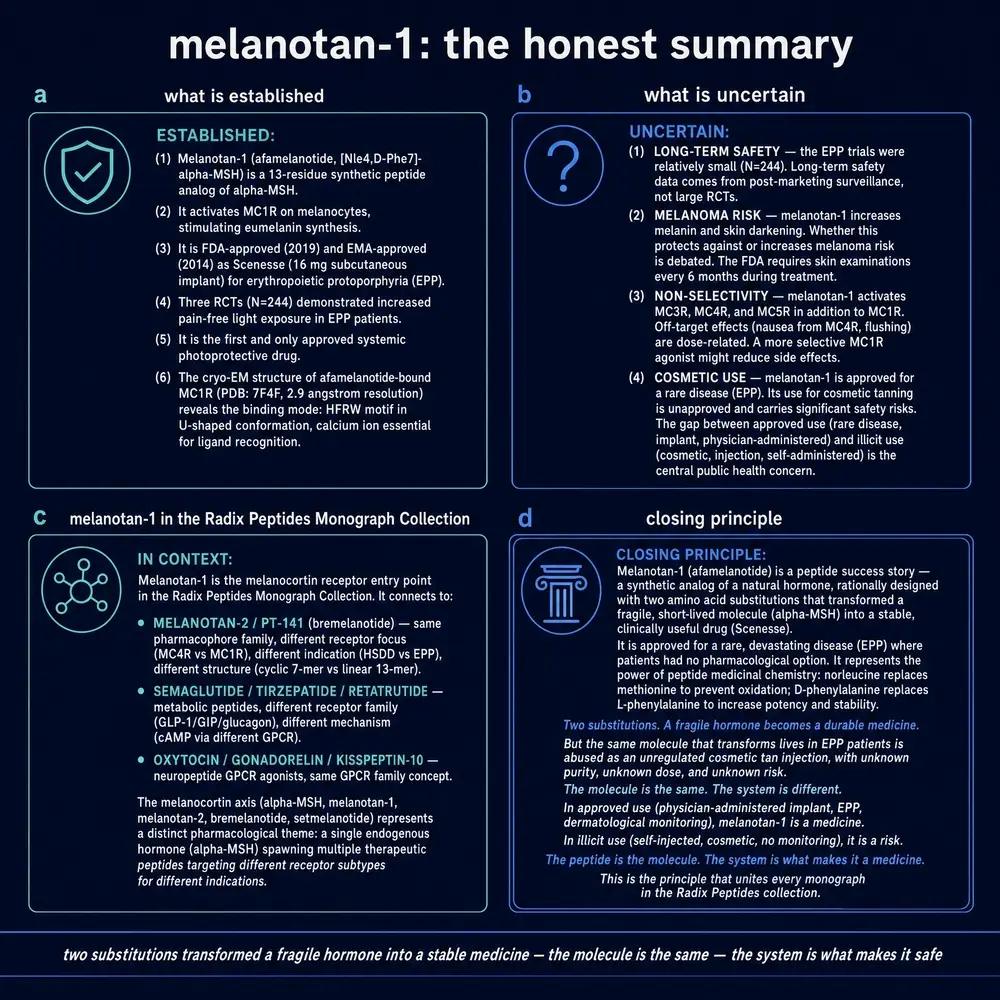
In 1980 a group in Arizona boiled a hormone in alkali and it worked better afterwards. That should not happen. Boiling things in alkali is how you destroy a peptide, and the hormone in question — the one that darkens human skin — was already known to survive in blood for only minutes. When they ran the wreckage through a gas chromatograph they found that the alkali had not destroyed the molecule at all. It had flipped two of its amino acids into their mirror images, and the mirror image was the better drug. So they built it on purpose. What they had made was a probe, and they said so in the paper: a tool for studying a receptor nobody had yet cloned. Forty years later the same thirteen residues are a licensed medicine, sold as a rod of plastic pushed under the skin of the hip, for a disease in which daylight causes pain that morphine does not touch. Along the way the same laboratory produced a second molecule that never went to a regulator at all, and which is now sold on the internet under a name one character away from this one. This monograph is about the first molecule. Keeping the two apart turned out to be most of the work.
Findings are labelled by the kind of study that produced them, in the sentence that reports them. A result in a mouse is called a result in a mouse. That rule does more work here than usual, because the great majority of what is known about this molecule beyond the skin comes from rodents and cell culture, and because the compound is also a standard laboratory reagent — the reference melanocortin agonist — so a great many papers name it once in their Methods while studying something else entirely.
Two further rules apply throughout. This compound has a sibling, melanotan-II, which shares its stem, came from the same programme, and has never been submitted to any regulator anywhere. Nothing in this document is evidence about melanotan-II, and nothing known about melanotan-II is treated here as evidence about this compound. It also has a parent, the natural hormone α-MSH, whose name is contained inside one of this compound's own designations; findings that belong to the hormone are attributed to the hormone. And no dose, route or schedule for any person is recommended anywhere in this document. Where a study's or a label's parameters are reported, they are reported as that study's or that label's, with the population and duration attached.
Section 01The hormone that darkens a frog
Put a live frog in a white bucket and it turns pale. Put it on dark gravel and within the hour it has gone dark. The colour change is not in the skin itself but inside particular cells in it — melanophores — which hold their pigment in granules that can be clustered tightly around the nucleus or dispersed evenly through the cell. Clustered, the animal looks pale; dispersed, dark. The signal that disperses them is a hormone from the pituitary called α-melanocyte-stimulating hormone, α-MSH.
For most of the twentieth century that frog was the instrument of an entire field. A strip of skin from Rana pipiens in a dish, wired to a photometer, is a live bioassay for melanotropic activity that is sensitive, cheap and quantitative, and it is what the potency numbers in the early literature were measured against.
The hormone itself is thirteen amino acids long. It is not made as a thirteen-residue peptide; it is cut out of a much larger precursor called pro-opiomelanocortin, POMC, the same precursor that yields ACTH and β-endorphin. Four residues in the middle — His-Phe-Arg-Trp — carry almost all of the receptor-binding information and are known as the message sequence. Everything either side of them is, to a first approximation, scaffolding.
α-MSH is also useless as a drug, and for a reason that is structural rather than biological. It is a short linear peptide with an exposed methionine, and the bloodstream is full of enzymes that cut short linear peptides. Its activity is measured in minutes. A hormone that has to be present continuously in order to do anything, and which is destroyed as fast as it is injected, cannot be given to a person on any practical schedule. For twenty years that was where the subject rested.
Section 02Heat, alkali, and a result that should not have happened
The observation that started this compound is one sentence long and it is the wrong way round. Treating α-MSH with heat and alkali — a standard way of degrading a peptide — made its biological activity last longer, not shorter (Sawyer et al., 1980).
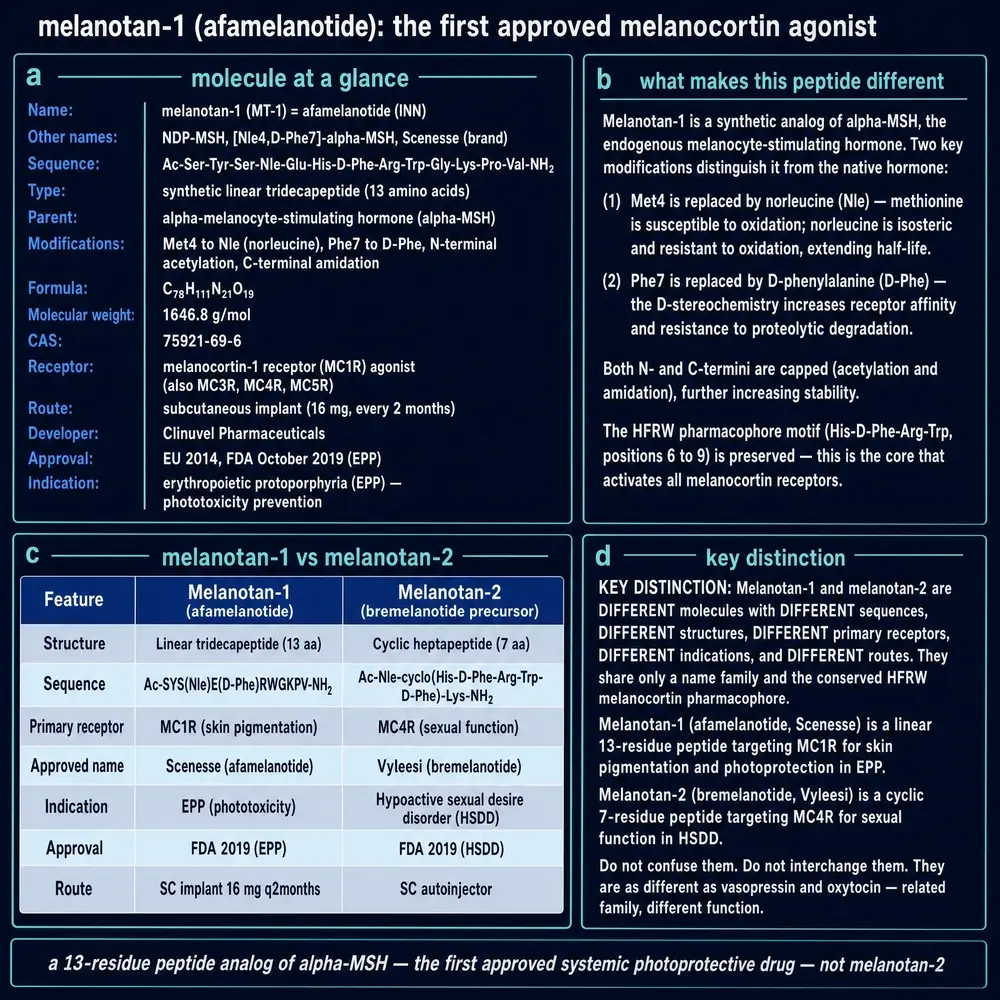
Most laboratories would file that as an artefact. The group at the University of Arizona took it apart instead. They hydrolysed the treated peptide and ran it through a quantitative gas chromatograph to ask which residues had changed, and found that the alkali had caused partial racemisation — the flipping of an amino acid from its natural left-handed form to the mirror-image right-handed one — and that it had done so particularly at two positions: residue 4, a methionine, and residue 7, a phenylalanine.
That is a diagnosis, and it converts an accident into a specification. If the prolonged activity came from racemisation at 4 and 7, then a molecule built with those two changes deliberately should show the same prolonged activity without any of the heat, the alkali, or the mixture of damaged products that came with them. They made two compounds to test it. Replacing the methionine at position 4 with norleucine — a residue with the same shape but no sulfur atom, and therefore nothing to oxidise — gave a peptide, [Nle4]-α-MSH, that behaved like the hormone and, like the hormone, gained prolonged activity after heat-alkali treatment. Then they made the one with both changes designed in: norleucine at 4, and D-phenylalanine, the mirror image, at 7.
The two substitutions solve two different problems, which is why the molecule needed both. Norleucine at position 4 removes a sulfur atom that oxidises, and oxidation of that methionine is one of the ways the natural hormone loses activity. D-phenylalanine at position 7 puts a right-handed residue into the middle of the message sequence. Mammalian proteases are built to cut between left-handed residues; a right-handed one in the wrong place is a bond they handle badly. The peptide is not made more stable in general — it is made unreadable to the specific machinery that destroys it.
Section 03What they had made
The designed molecule, [Nle4, D-Phe7]-α-MSH, reproduced the prolonged activity exactly, and it was also far more potent than the hormone it was derived from. In mouse melanoma adenylate cyclase it was reported as twenty-six times as potent as α-MSH, and it was resistant to degradation by serum enzymes; it was active in the frog-skin bioassay and it stimulated tyrosinase, the rate-limiting enzyme of pigment synthesis, in melanoma cells (Sawyer et al., 1980). Getting both things at once is unusual. Stability and potency are ordinarily traded against each other, because the modifications that hide a peptide from an enzyme generally also hide it from its receptor.
How long "prolonged" meant became clear the following year, and the number is still startling. A single injection into a frog produced near-maximum darkening of the animal's skin for at least six weeks; α-MSH and the norleucine analogue alone darkened the same animals for a few days (Hadley et al., 1981). Both dermal and epidermal melanophores stayed dispersed for the entire six weeks. The same prolonged darkening occurred in skin from the lizard Anolis carolinensis in vitro. In that preparation the darkening could be switched off by removing calcium from the bath and switched back on by adding it, repeatedly, with no further peptide added at all — which told the authors something about how the signal was being transduced, and tells a reader today that the peptide was still sitting on its receptor long after it had been washed out of the dish.
These are amphibian and reptile results, in whole animals and in isolated skin. They are the reason the compound existed, and they are not evidence about human skin. The point they establish is narrower and it is chemical: the molecule survives, and it keeps signalling.
Section 04A probe without a receptor
It is worth being precise about what this compound was for, because almost everything written about it since has assumed the answer. The 1980 paper says it in its own last sentence: the resistance to degradation and the potency "should make this analogue of α-MSH an important molecular probe for studying the melanotropin receptors of both normal and abnormal (melanoma) melanocytes." A probe. Not a treatment for anything, and not a cosmetic.
The receptors it was built to probe did not yet exist as objects anyone could hold. The melanocortin receptor family was not cloned until 1992 — twelve years later. For those twelve years, everything anyone knew about melanotropin receptors was inferred from what happened when you applied a ligand to a tissue, and this compound, being superpotent and long-lasting, was one of the best inference-generating tools available.
It was better than that, in fact. When the human MSH receptor was finally identified, the way its discoverers demonstrated that they had the right clone was by showing that cells transfected with it bound radioiodinated NDP-MSH specifically (Chhajlani & Wikberg, 1992). The analogue built to study a hypothetical receptor became the reagent that proved the receptor was real. That is the compound's most durable contribution and it has nothing to do with treating anybody: for most of the last forty years its principal use has been as a laboratory tool, and it still is.
When the receptors did arrive, the family had five members, and the compound's relationship with them defined everything that followed. It is a pan-agonist: it activates MC1R, MC3R, MC4R and MC5R with high potency, sparing only MC2R, which is the adrenal ACTH receptor and does not respond to α-MSH-derived ligands. For a probe, promiscuity across four receptors is a feature — one tool, four systems. For a drug it is a liability, because only one of those four receptors is in the skin. The others govern, variously, energy balance and feeding, sexual function, and the exocrine glands. Every adverse effect discussed later in this document that is not an implant-site reaction is, in principle, the price of that promiscuity.
The inferences were sometimes remarkably good. A 1983 rat study found that the analogue was equipotent with α-MSH at inducing grooming when injected into the ventricles of the brain, but had the opposite effect on a visual discrimination task: the hormone improved performance, the analogue degraded it. The authors concluded that they were looking at three distinct melanotropin receptor populations — a superagonist response on melanocytes, an equipotent one centrally for grooming, and possibly an antagonist one centrally for attention (Kobobun et al., 1983). They were reasoning about receptor subtypes from behaviour, nine years before anyone could sequence one.
Section 05Two molecules leave the same laboratory
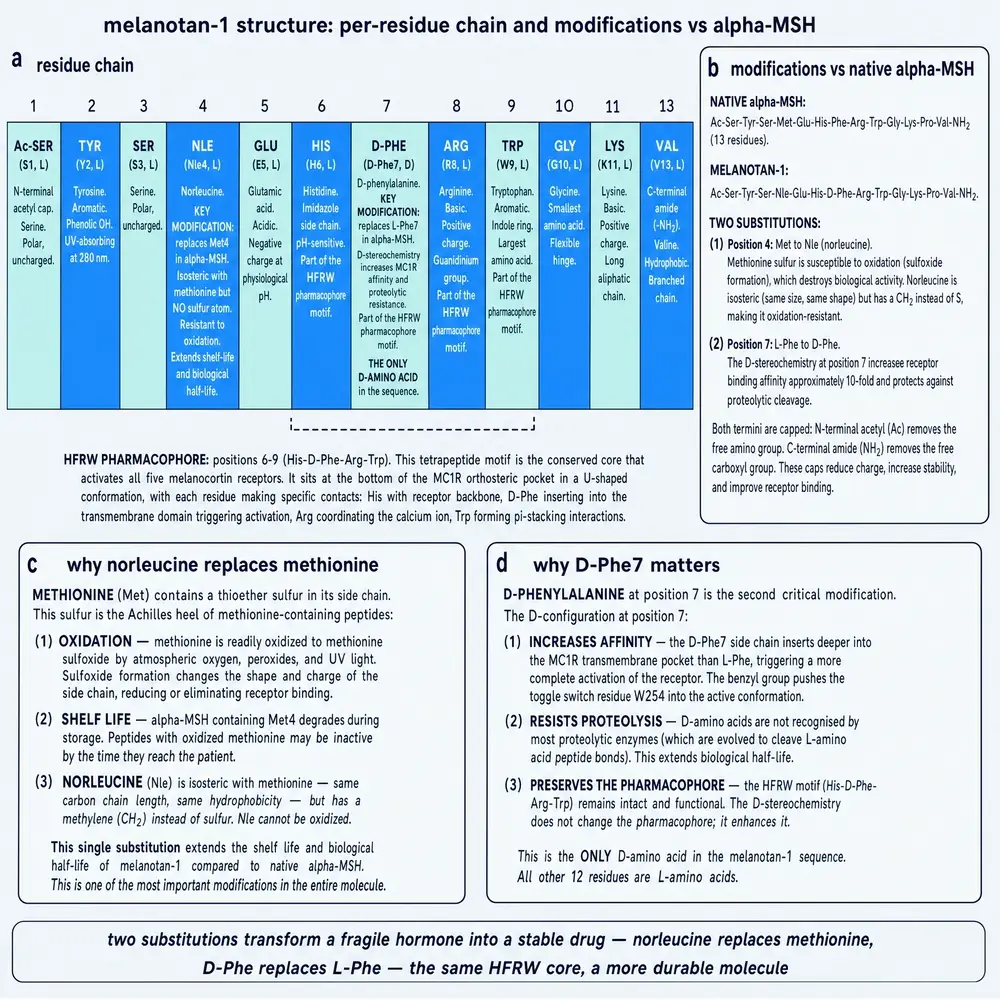
The Arizona programme did not stop at one analogue. Having established that the message sequence carried the activity and that the scaffolding could be altered, the obvious next move was to shorten and constrain the molecule — to lock the message into the shape the receptor wanted rather than letting a floppy linear peptide find it by chance. Cyclising the peptide through a lactam bridge produced a much smaller compound, seven residues in a ring, and that compound is melanotan-II.
The two molecules are not variants of one drug. They differ in size, in shape, in receptor selectivity and, decisively, in what happened to them next.
One line of that comparison needs saying in words. Bremelanotide, marketed as a treatment for hypoactive sexual desire disorder, descends from melanotan-II, not from this compound. It is a common and consequential confusion, and it runs in the direction that flatters the wrong molecule.
The divergence was not chemical destiny. It was a licensing decision, and an unusually literal one. The University of Arizona patent estate passed to a technology-licensing company, which in 2002 split it by indication: the sunless-tanning application went, through an intermediary, to an Australian company called Epitan, and the sexual-dysfunction application went to a different company altogether. Two molecules, two applications, two licensees, one chemistry. The tanning licence is the road that ends in an orphan drug for a photosensitivity disease; the sexual-function licence is the road that ends in bremelanotide.
It is worth being clear about where the word "melanotan" comes from, because it is doing a lot of work in this story and it is not a scientific name. It was the laboratory's own shorthand — melanotan-I and melanotan-II as the linear and cyclic compounds — and it later became a registered trade mark, filed by the Australian company in 2004, granted in 2007, and allowed to lapse in 2013. The scientific literature of the 1980s and 1990s does not use it. Neither, today, does either regulator: the approved product is afamelanotide, sold as SCENESSE. The name that both compounds are now known by on the open internet is a commercial coinage that outlived the trade mark and attached itself to two different molecules.
Melanotan-II travelled neither road commercially. It is the compound that was left over — the chemotype the erectile programme was derived from rather than the product it became — and it went where unlicensed peptides go. Section 24 returns to it, because a document about an approved medicine whose name is one Roman numeral away from an unapproved one cannot simply decline to mention the neighbour.
Section 06From receptor to pigment
MC1R sits on the surface of the melanocyte and is coupled to Gs. An agonist binding it raises intracellular cyclic AMP, which activates protein kinase A, which phosphorylates the transcription factor CREB, which drives expression of MITF — the master regulator of the melanocyte. MITF in turn switches on tyrosinase and the tyrosinase-related proteins TYRP1 and DCT, the enzymes that build pigment.
The output of that chain is not simply "more pigment". Melanocytes make two chemically distinct pigments from the same starting material: eumelanin, brown-black, and pheomelanin, red-yellow. What MC1R signalling changes is the ratio. Human evidence for that in this compound is direct and it is old: after dosing, forearm pigmentation rose by 98 per cent and forehead by 49 per cent, and the eumelanin-to-pheomelanin ratio moved from 51:1 to 86:1 (Dorr et al., 2000).
A second human result from the same programme is worth recording because it measures damage rather than colour. In three phase 1 trials combining the peptide with ultraviolet B or natural sunlight, irradiated skin showed 47 per cent fewer sunburn cells — keratinocytes caught dying of UV damage — at a treated site, and untreated controls needed about 50 per cent more time in the sun to reach an equivalent tan (Dorr et al., 2004). Reported toxicity in those studies was limited to nausea and transient facial flushing.
The distinction matters more than it sounds. Eumelanin absorbs and scatters light across the spectrum and scavenges free radicals; it behaves like a broadband filter with antioxidant properties. Pheomelanin does neither well, and under ultraviolet light it can generate reactive oxygen species and oxidative DNA damage rather than quenching them. So a shift toward eumelanin removes a liability at the same time as it adds a shield — a point that returns in Part Four, where it does most of the work in the argument that this drug should not promote skin cancer.
Section 07The receptor you inherit
MC1R is one of the most variable genes in the human genome, and its common loss-of-function variants are the reason some people have red hair, freckle rather than tan, and burn easily. Those same variants are established risk factors for melanoma.
This creates a genuine and under-discussed problem for a drug that works by agonising the receptor. The population with the greatest need for photoprotection overlaps substantially with the population whose receptor responds least. A receptor that couples poorly to Gs, or that never reaches the cell surface, cannot be rescued by supplying more ligand. In the licensed indication this is somewhat blunted — protoporphyria is a metabolic disease that occurs across skin types, not a disease of fair skin — but it bears on every proposal to use melanocortin agonists for photoprotection in the general population, which is a recurring idea in this literature.
The corpus contains cell-based work comparing wild-type and variant MC1R signalling, and work on melanoma-associated variants and redox protection. These are laboratory findings about receptor function. No trial of this compound has been designed to compare response by MC1R genotype, and this document does not report one.
Section 08Four receptors, one of them useful
Section 04 called this compound a pan-agonist. The numbers put that beyond argument. In a single human receptor panel the binding IC50 values were 0.51 nM at MC1R, 1.17 at MC3R, 1.16 at MC4R and 0.86 at MC5R, with cyclic-AMP EC50 values of 0.19, 4.1, 0.72 and 0.58 nM respectively (Haskell-Luevano et al., 1997). A second independent human panel agrees within a factor of a few (Koikov et al., 2003).
| Human receptor | Binding IC50 (nM) | cAMP EC50 (nM) | Principal role |
|---|---|---|---|
| MC1R | 0.51 | 0.19 | pigmentation, inflammation |
| MC2R | not activated — ACTH only | adrenal steroidogenesis | |
| MC3R | 1.17 | 4.1 | energy balance, inflammation |
| MC4R | 1.16 | 0.72 | appetite, sexual function |
| MC5R | 0.86 | 0.58 | exocrine and sebaceous glands |
Fewer than tenfold between the most and least potent of four receptors is not selectivity in any useful sense. That is worth stating flatly because this compound is repeatedly described in print — including in peer-reviewed reviews, not merely in marketing copy — as a "selective MC1R agonist". It is not. The error matters in two directions: it makes the drug's off-target effects look inexplicable when they are predictable, and it erases the distinction between this compound and the genuinely selective oral agonist described in Part Five.
MC2R is the exception, and for a structural reason: it responds only to ACTH, and additionally requires an accessory protein to reach the cell surface at all. So the compound cannot drive cortisol production, which removes the single most alarming thing a promiscuous melanocortin agonist could do.
Section 09Which residues carry the activity
An alanine scan — replacing each residue in turn with alanine and measuring what breaks — gives the cleanest picture of where the activity lives, and the published scan of this compound contains a genuine surprise.
Two residues are indispensable. Replacing D-phenylalanine at position 7 costs between 180-fold and 2,370-fold in potency depending on receptor subtype; replacing tryptophan at position 9 costs between 180-fold and 2,120-fold. Nothing else comes close: the three N-terminal residues and most of the C-terminal tail can be replaced with almost no measurable effect (Todorovic et al., 2016).
The surprise is histidine at position 6. His6 is part of the canonical His-Phe-Arg-Trp message sequence, the four residues every textbook identifies as the pharmacophore of the melanocortins. Replacing it in this compound changed potency at none of the four receptors. Replacing the same residue in the parent hormone costs 35- to 160-fold. The same is true at position 5: alanine substitution costs the hormone more than a thousandfold at MC1R and costs this compound essentially nothing.
The two substitutions did not merely make the hormone last longer. They changed which parts of the molecule the receptor is reading. A residue that is load-bearing in α-MSH is dispensable in its analogue, which is only possible if the analogue presents itself to the receptor in a different conformation — the D-phenylalanine is understood to stabilise a turn that the flexible natural peptide has to find by chance.
The practical consequence is the one the scan's authors draw themselves: structure-activity conclusions from one of these molecules do not transfer to the other. This document therefore does not use findings about α-MSH as evidence about this compound, or the reverse, even where the two differ by only two residues.
Section 10Pharmacokinetics, and why the drug is a rod
The word "ultralong", applied to this compound since 1981, describes what happens at the receptor, not what happens in the blood. The two are quite different and conflating them is the commonest error made about this molecule.
In human subjects the peptide given subcutaneously is fully bioavailable relative to intravenous dosing, and is not absorbed orally at all — no detectable plasma levels followed oral administration. Its β-phase half-life was 0.8 to 1.7 hours, with less than 4 per cent recovered in urine (Ugwu et al., 1997). Its half-life in human serum has been reported at about 30 minutes.
So the molecule that darkens a frog for six weeks is cleared from a human being in a matter of hours. The six weeks was never a property of the pharmacokinetics; it was a property of the receptor occupancy and the melanophore, in a cold-blooded animal, and it does not transfer.
That is the whole reason the product is an implant. The 1980 chemistry solved the problem of surviving contact with serum — a few minutes became a few hours, which is enough to be a usable drug substance. Only the dosage form addresses the calendar.
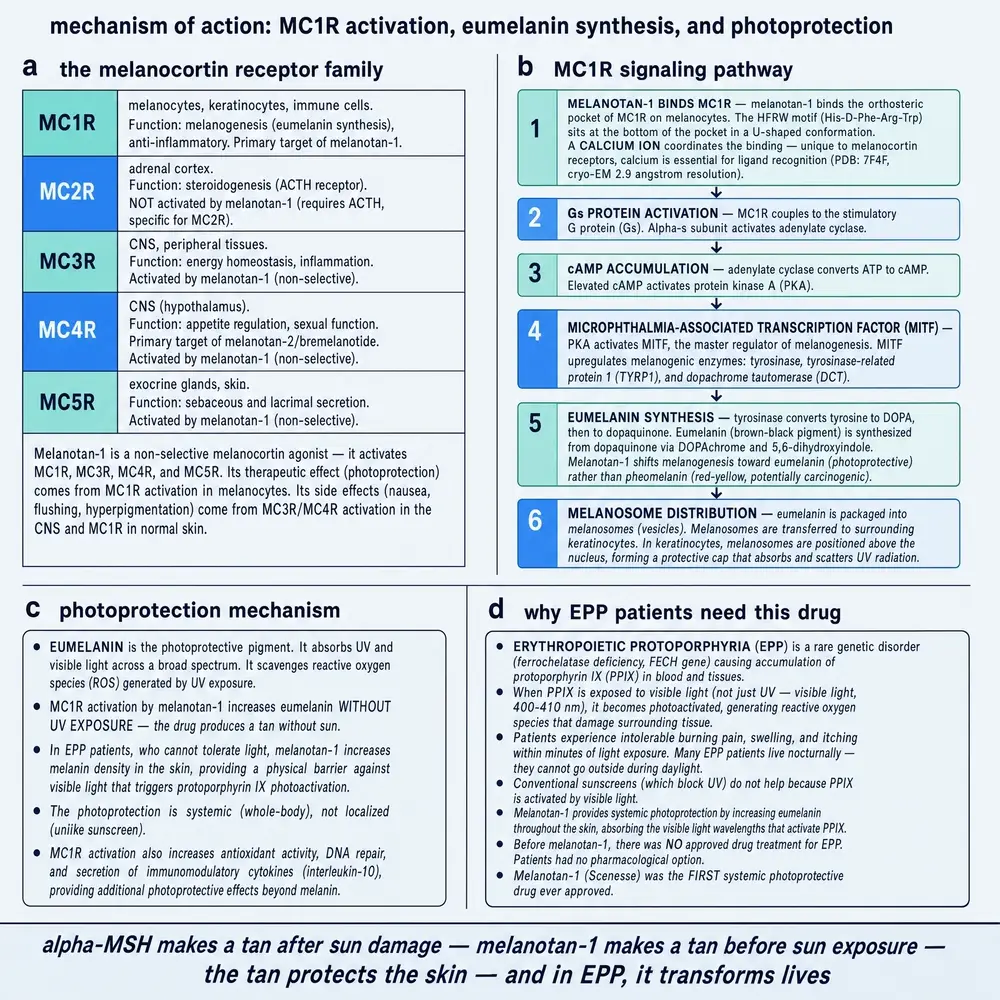
The obvious reading of a two-month dosing interval is that the rod releases peptide for two months. It does not. The implant releases the majority of its content within two days and more than 90 per cent within five, and afamelanotide is below the limit of quantification in plasma by about ten days — under a fifth of the interval it is given over. The rod itself is fully resorbed by day 60.
So for most of every dosing cycle there is no measurable drug in the patient. What persists is the pigment: melanin made during the days the drug was present, and then carried in the epidermis as it turns over. The drug is a trigger, not a maintained exposure.
That has a consequence patients feel. Photoprotection decays across the interval rather than holding steady, with effect reported falling away around days 40 to 45. In an observational series, tolerance to phototoxic burning correlated inversely with time since the last implant (Kendall's τ = −0.38 over 82 observations, P < 0.0001), and in the pivotal photoprovocation sub-study the measured advantage at 60 days after a dose was roughly half what it had been at 30 days.
Reported as pharmacokinetic study findings and product design. No dose, route or schedule is recommended for any person. Note also a gap: no peak concentration, time to peak or area-under-the-curve for afamelanotide in humans appears anywhere in the corpus assembled for this document, and one review states plainly that pharmacokinetic data are limited and absent altogether for its metabolites.
Section 11A disease in which daylight is the poison
Erythropoietic protoporphyria is an inherited disorder of haem synthesis. In most patients the last enzyme of the pathway, ferrochelatase, is deficient; its job is to insert an iron atom into a molecule called protoporphyrin IX to finish making haem. When it cannot keep up, the unfinished protoporphyrin accumulates in developing red cells in the bone marrow, is carried out into the blood, and reaches the small vessels of the skin and the liver. A minority of cases — between 2 and 10 per cent, depending on the series — have a different genetic cause, a gain-of-function mutation in the erythroid enzyme ALAS2, and are called X-linked protoporphyria (Langendonk et al., 2015).
Protoporphyrin IX is a photosensitiser. It absorbs light strongly at around 400 to 410 nanometres — violet, at the very edge of the visible spectrum — and when it absorbs a photon in a superficial blood vessel it hands the energy to oxygen, generating singlet oxygen and a cascade of free radicals in the vessel wall.
Three consequences of that wavelength decide what the disease is like to live with, and each of them is counter-intuitive.
First, this is not sunburn. Sunburn is ultraviolet damage, it appears hours later, and it looks like something. This reaction begins one to twenty minutes after exposure and produces burning, stinging neuropathic pain, typically on the hands and the face, which can last for days and which does not respond to analgesics, including narcotics (Langendonk et al., 2015). Second, because the trigger is visible violet light rather than ultraviolet, ordinary sunscreen and ordinary window glass — both designed against UV — do not stop it. Third, and cruellest for the patient trying to be believed, the skin frequently looks normal. There is often no rash to show anybody.
The disease usually announces itself in early childhood, which means the patient learns the association between sunlight and agony before they are old enough to reason about it. What follows is a lifetime of avoidance so complete that it becomes invisible: long sleeves in summer, driving at night, careers chosen indoors, a childhood spent at the window. The clinical literature calls this "adaptive behaviour". It is also the reason the drug was so hard to test, as the next section explains.
The liver is the other half of the disease and the part that kills. Excess protoporphyrin leaves the body in bile, and in transit it can precipitate, producing gallstones and cholestatic injury that can progress to liver failure requiring transplantation. Published estimates of how often differ, and the document reports both rather than choosing: the pivotal trial report puts cholestatic hepatitis at about 5 per cent of cases (Langendonk et al., 2015), while the Swiss centre that has treated these patients longest reports some sign of liver injury in about 20 per cent and terminal liver failure in 4 per cent (Minder et al., 2021). The risk rises with the protoporphyrin concentration.
Before this compound there was nothing. Beta carotene, N-acetylcysteine and vitamin C had all been tried; a systematic review of more than twenty studies found little to no benefit (Langendonk et al., 2015).
Section 12Why the trial was hard to design
Suppose you have a drug you believe lets these patients tolerate light. How do you show it?
There is no blood test for the benefit. The drug does not correct the enzyme and, on the pivotal trials' own measurements, it does not lower the protoporphyrin that causes the damage. What it is supposed to change is how much daylight a person can stand. So the primary endpoint of both pivotal trials was, quite literally, the number of hours the patient spent in direct sunlight without pain, recorded by the patient in a diary in fifteen-minute intervals (Langendonk et al., 2015).
Every difficulty in reading this drug's evidence base follows from that sentence. The endpoint is patient-reported, so it inherits recall and reporting effects. It depends on the weather, on the season, and on the latitude of the clinic. And it depends on the patient's willingness to test a fear built up since childhood — which is not a constant, and which the treatment itself may change independently of any pigment.
The drug tans you. That is its mechanism, and it is visible. The trial report states plainly that increased pigmentation partially unblinded the studies, and adds that "a few patients who received placebo were convinced that they received active drug and reportedly increased their sun exposure." It also notes the effect running the other way: patients who did not become pigmented "did not challenge themselves", which the authors argue probably reduced the measured benefit (Langendonk et al., 2015).
Both directions are plausible and they do not cancel out in any quantifiable way. A trial of a drug whose mechanism is visible on the patient's face cannot be fully blinded, and no amount of statistical care fixes that. It is a permanent feature of the evidence for this compound and it is the reason the objective sub-study described below matters more than its size suggests.
Section 13The trials
The evidence behind both approvals is two multicentre, randomised, double-blind, placebo-controlled trials, reported together (Langendonk et al., 2015). Patients received a 16 mg subcutaneous implant or an identical implant containing only the polymer carrier. One hundred and sixty-eight patients were enrolled; after one withdrawal before dosing, 86 received the drug and 81 the placebo.
| European trial | United States trial | |
|---|---|---|
| Registration | NCT01605136 (CUV039) | NCT00979745 (CUV029) |
| Enrolled | 74 | 94 |
| Implants | 5, over 240 days | 3, over 120 days |
| Study period | 270 days | 180 days |
| Conducted | Jan 2010 – May 2011 | May 2012 – Jul 2013 |
| Centres | 8, European Porphyria Network | 7 US porphyria centres |
| Latitude of centres | 48–60°N | 29–42°N |
| Sunlight window recorded | 10 a.m.–3 p.m. | 10 a.m.–6 p.m. |
Both trials met their primary endpoint.
| Pain-free time in direct sunlight | Drug | Placebo | P |
|---|---|---|---|
| United States, at 6 months | median 69.4 h | 40.8 h | 0.04 |
| Europe, at 9 months | median 6.0 h | 0.8 h | 0.005 |
Those two rows deserve a longer look than they usually get, because the same endpoint in the same drug produced medians an order of magnitude apart: sixty-nine hours in one trial, six in the other. The authors attribute the gap to the latitudes of the centres and to a difference in how the diaries defined the categories — the US trial recorded only "direct sunlight" or "shade", the European trial distinguished sun, shade and alternating conditions. Both explanations are reasonable. What follows from them is that the absolute number is a property of the study, not of the drug. The ratio between arms is the transferable finding; the headline hours are not.
The secondary endpoints were not uniformly positive, and this is where a summary that reports only the headline goes wrong. Phototoxic reactions fell significantly in the European trial — 77 against 146, P = 0.04 — but in the United States trial the counts were 46 against 43, P = 0.60: no difference at all. And the general-purpose quality of life instrument, the Dermatology Life Quality Index, did not change over time in either group in either study. The improvement in quality of life that the trials report, and which is quoted everywhere, comes entirely from EPP-QOL, a disease-specific instrument. That is a defensible choice — a general dermatology index asks about rashes and appearance, which is not this disease — but it should be reported as what it is.
The one objective measurement in the programme was a photoprovocation sub-study in 21 US patients, in which skin was irradiated under standardised conditions and the dose required to provoke symptoms was measured. Thirty days after the second implant the median increase from baseline in the minimum symptom dose was 208.3 against 56.2 J/cm² on the back of the hand (P = 0.01) and 227.5 against −2.4 on the lower back (P < 0.001); sixty days after that dose and before the next, the differences were smaller but still present (Langendonk et al., 2015). Twenty-one patients is a small study. It is also the only part of the evidence base that does not depend on a diary, and it points the same way.
Section 14Approval, and the conditions attached to it
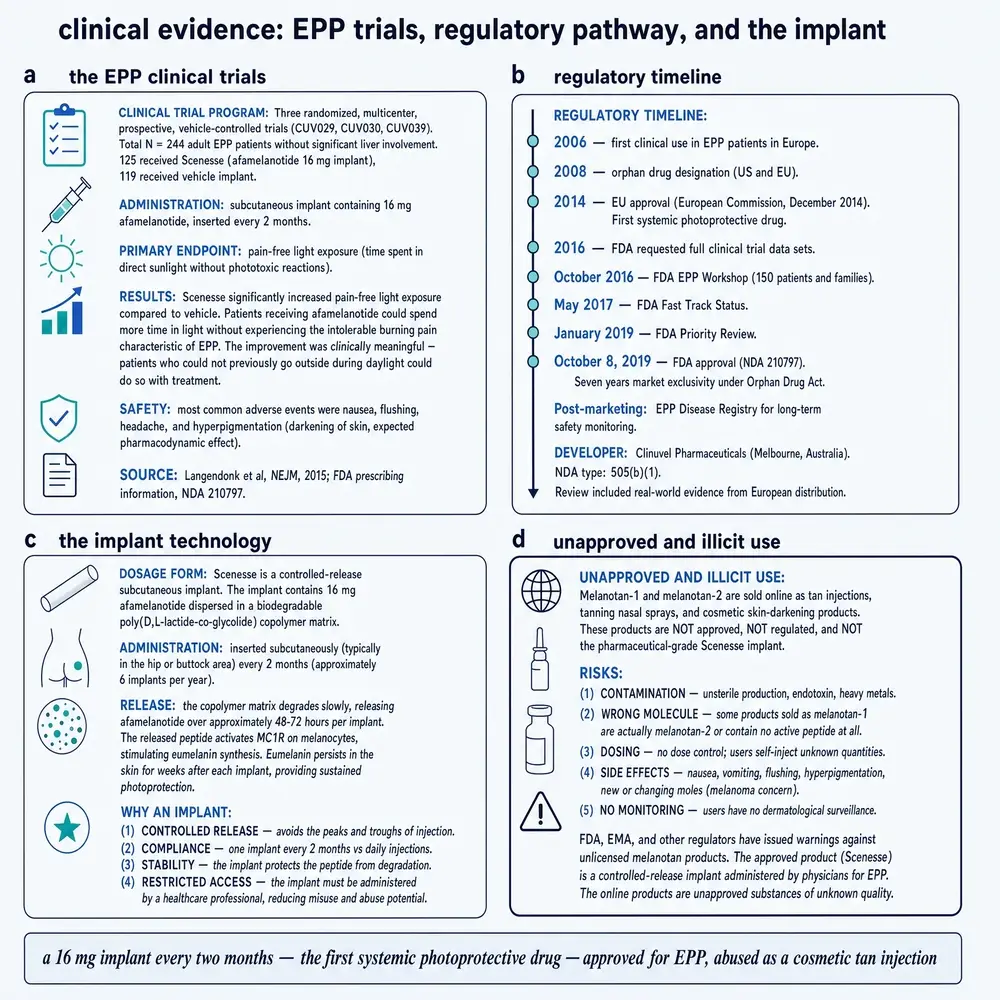
The European Medicines Agency authorised the product on 22 December 2014, for "prevention of phototoxicity in adult patients with erythropoietic protoporphyria". The Food and Drug Administration approved it on 8 October 2019, under NDA 210797, with the indication worded differently and more concretely: "to increase pain-free light exposure in adult patients with a history of phototoxic reactions from erythropoietic protoporphyria." The US review was a priority review, was not referred to an advisory committee, and completed in a single cycle.
The European authorisation was granted under exceptional circumstances, and that phrase is a term of art that a general reader should not have to guess at. It is the regulator saying that comprehensive evidence about this product cannot reasonably be obtained — because the disease is too rare, or the trials would be unethical, or the state of knowledge does not permit it — and that the authorisation is granted anyway, with obligations attached and an annual reassessment. It is not a statement that the evidence is complete. It is a statement that this is as complete as the evidence is going to get, and that the balance still favours approval.
The wider registered programme is worth stating as a whole, because it is unusual. Twenty-three trials of this compound are registered on ClinicalTrials.gov, and an intervention search and a sponsor search return the same twenty-three: every registered trial of this drug, anywhere, has one sponsor. None was withdrawn or terminated. Eighteen report actual enrolment, totalling 599 participants; five carry only planned figures, and four of those are registrations whose status has never been updated.
The obligations are substantial and they are the most interesting part of the regulatory record:
- A mandatory disease registry. The European authorisation requires that, before launch in any member state, the company establish a registry collecting long-term safety data and outcomes from both patients and physicians, reporting annually.
- Controlled access. The product is a restricted prescription, prescribable only by specialists in recognised porphyria centres, and implantable only by physicians who have completed a training and accreditation package supplied by the manufacturer.
- An eight-year US registry cohort. The FDA imposed postmarketing requirements under section 505(o)(3) after determining that spontaneous reporting "will not be sufficient to identify an unexpected serious risk of skin cancer and implant site reactions". The larger of the two is a prospective observational cohort of US patients followed for a minimum of eight years, whose named adverse events of interest are melanoma and non-melanoma skin cancer, with a final report due in 2031.
One change since: on 23 September 2025 the European label was amended to remove the previously recommended maximum of four implants per year, leaving the duration of treatment to the specialist's discretion, on the basis of the pivotal trials plus more than fifteen years of real-world use. It harmonises the European posology with the American one.
Section 15What the drug is, as an object
The product is not an injection. It is a bioresorbable rod about 1.7 centimetres long and 1.5 millimetres across, containing 16 mg of the peptide in a poly(lactide-co-glycolide) matrix, which is introduced into the subcutaneous fat above the iliac crest through a 14-gauge catheter needle and left to dissolve. In the trials the placebo was an identical rod containing only the polymer. The labelled schedule is one implant every two months.
Reported as label text and trial protocol. This document recommends no human use, dose, route or schedule for any person.
The dosage form is a direct answer to the problem in Section 01. Even a protease-resistant peptide is cleared eventually; what the implant supplies is not a long half-life but a long delivery. The 1980 chemistry made the molecule survive contact with serum. The polymer rod, thirty years later, made it survive the calendar.
Section 16Darkening the mole you are meant to be watching
Here is the problem in one sentence. This drug works by increasing the pigment in the skin, it is given so that patients will go outside more, and the principal way melanoma is caught early in a living person is by looking at whether their moles have changed colour.
Both regulators saw it. Both labels require regular full-body skin examination — twice a year — and the European label states the reasoning outright: the examinations are intended to "detect early any skin cancers and their precursors induced by UV-exposure, as EPP patients can be expected to significantly increase their exposure to sunlight and UV light while on treatment", and to allow "early detection of melanoma". The American label puts it more briefly: the drug "may induce darkening of pre-existing nevi and ephelides due to its pharmacological effect."
The European label goes further than the American one, and specifies particular caution in patients with a personal or family history of melanoma, with a known or suspected inherited susceptibility to cutaneous melanoma, or with any history of basal cell or squamous cell carcinoma, Merkel cell carcinoma, or premalignant skin lesions.
There is a practical dimension to that requirement which is easy to miss. Dermatological surveillance for melanoma is largely comparative: the question is not whether a mole is dark but whether it has changed since last time. A drug that darkens every pigmented lesion at once resets the reader's baseline, and it does so on a two-month cycle. The European post-authorisation requirement addresses this directly by asking for full-body photography rather than examination alone — that is, by rebuilding the baseline in a form that survives the drug.
The FDA converted the concern into an obligation rather than a warning. Its postmarketing requirement is an observational cohort of American patients followed for at least eight years, and the adverse events of interest it names first are melanoma and non-melanoma skin cancer. That study does not report finally until 2031. The plainest thing that can be said about the melanoma question, sixteen years after the first approval, is that the regulator that approved the drug is still formally waiting for the answer.
Section 17The argument that it is safe, and where it comes from
There is a substantial theoretical case that agonising MC1R should reduce melanoma risk rather than raise it, and it is worth setting out properly because it is not merely a company talking point.
The case has four legs. Eumelanin, the pigment this drug promotes, absorbs and scatters light and scavenges free radicals. Pheomelanin, the red-yellow pigment it promotes instead of, is itself a candidate independent risk factor for melanoma, because it amplifies reactive oxygen species and oxidative DNA damage — so the switch removes a hazard as well as adding a filter. MC1R signalling has been reported to enhance DNA repair and to raise catalase and ferritin, improving the cell's antioxidant position. And the strongest leg is genetic and runs the other way round: loss-of-function MC1R variants — the ones that give red hair and freckling — are established as melanoma risk factors. If a broken receptor raises risk, a stimulated one plausibly does not (Böhm et al., 2025).
There is even a natural experiment. Chronic MC1R activation occurs physiologically in Addison's disease and in the melasma of pregnancy, and the 2025 review that assembles this argument concludes that long-term MC1R activation, "either physiologically or pharmacologically, has not been associated with increased incidence of melanoma."
And there is now a reasonable quantity of exposure. Across the reported safety datasets: no melanoma in the drug arm of the pivotal trials; in a long-term observational series of 115 patients receiving over a thousand implants, two reported a new naevus and the one excised was benign; in a German post-authorisation study of 200 patients followed up to six years, nearly a third reported pigmentary events, nine naevi were biopsied in seven patients, and every histopathology came back benign; and cumulative exposure now exceeds a thousand patients, many for five years and some for more than ten, with no melanoma events reported.
Three things should be said about that, and none is an accusation.
The first is the natural experiment's own small print. In the Addison's cohort — 3,299 people followed forty years — melanoma was numerically less common than expected, with a standardised incidence ratio of 0.7 (95% CI 0.2–1.6). But non-melanoma skin cancer in the same cohort ran at a standardised incidence ratio of 2.1 (1.3–3.1). The experiment that is quoted as reassuring about melanoma is not reassuring about skin cancer generally, and the melanoma confidence interval is wide enough to contain a substantial increase.
The second is that the same review says, in the same abstract, that MC1R activation "importantly does not prevent melanoma, particularly in individuals with risk factors", and that regular skin examination remains critical. It makes three further concessions in its own voice: darkening of naevi is expected pharmacology rather than a side effect; the pigment change may unmask a pre-existing melanoma, so surveillance can generate apparent excess diagnoses that are really earlier ones; and protoporphyria patients, being a deliberately sun-avoiding population, are an unusually favourable cohort from which to generalise. No safety dataset described here was designed or powered to detect a melanoma signal.
The third is provenance, which is a checkable fact and therefore reportable. The two most prominent statements that this drug does not promote melanoma both originate inside the melanocortin-drug industry. The rebuttal in the pivotal trial report is mechanistic argument — not trial data — in a paper funded by the manufacturer. The 2025 review had writing and editorial assistance funded by Rhythm Pharmaceuticals, which markets a different melanocortin agonist; one author was a full-time Rhythm employee holding company stock at submission, and another is a principal investigator on that company's trials. None of that makes the argument wrong. It does mean that the argument and its evaluation have largely been conducted by the same community, and a reader is entitled to know that before deciding how much weight "has not been associated with" can carry.
In the two pivotal trials there were six serious adverse events. In the drug arm: a fractured humerus, a herniated disk, abdominal pain, and a benign compound naevus. In the placebo arm: a pulmonary embolus and a melanoma. All were judged unrelated to study drug by the principal investigator (Langendonk et al., 2015). The one melanoma in the pivotal programme occurred in a patient receiving placebo.
That is a real and relevant fact, and it is a very weak one. Two trials of 168 patients over six to nine months cannot detect a change in the incidence of a cancer that takes years to appear, in either direction. The FDA's safety population was wider than these two trials, and its review tabulates "malignant melanoma in situ" among serious adverse events; this document could not verify which arm that case belonged to and therefore does not attribute it.
Section 18Adverse events, as reported
The safety profile in the label is unremarkable for a subcutaneously implanted peptide, and the largest single category is the implant itself.
| US label, adverse reactions | Drug (n = 125) | Vehicle (n = 119) |
|---|---|---|
| Implant site reaction | 21% | 10% |
| Nausea | 19% | 14% |
| Oropharyngeal pain | 7% | 5% |
| Cough | 6% | 3% |
| Fatigue | 6% | 3% |
| Skin hyperpigmentation | 4% | 0% |
| Dizziness | 4% | 3% |
| Melanocytic naevus | 4% | 2% |
| Respiratory tract infection | 4% | 3% |
| Somnolence | 2% | 1% |
| Non-acute porphyria | 2% | 0% |
| Skin irritation | 2% | 0% |
The European summary of product characteristics reports pooled data from 425 patients and reaches the same shape with a longer tail. Nausea and headache are very common; implant-site reactions run at 21 per cent and are mostly discolouration, pain, haematoma and erythema. The common column contains what one would predict from the mechanism — melanocytic naevus, ephelides, erythema, pigmentation disorder — alongside dizziness, migraine, somnolence, flushing and gastrointestinal effects that are plausibly the price of agonising three melanocortin receptors that have nothing to do with skin. Hypersensitivity and anaphylaxis appear as uncommon, and are one of only two warnings in the US label.
The rare column contains one entry worth pausing on: vitiligo. A drug given to increase pigment lists loss of pigment among its rare adverse effects. Part Five returns to this from the other side, because vitiligo is also the indication in which this compound has been most extensively studied after protoporphyria.
Section 13 records that the general-purpose quality-of-life instrument did not move in either trial while the disease-specific one did. There is a third measurement and it is less comfortable than either: in a US observational cohort of patients on treatment, the PROMIS-57 global pain domain worsened (P = 0.007).
That is a single small uncontrolled cohort and it is not evidence that the drug causes pain. It is a reminder of what the licensed benefit actually is. The endpoint is time in sunlight without pain; a patient who spends more time outdoors has more opportunity to be hurt, and a treatment that widens the window is not the same as one that removes the disease. An instrument that asks "how much pain have you had?" rather than "how much sun could you take?" need not move in the same direction.
Section 19The evidence that does not exist
A monograph is more useful for naming gaps than for filling them, and this compound has four that matter.
There is no long-term randomised outcome evidence. The randomised evidence is two trials of six and nine months. Everything known about this drug over years is observational, largely from the small number of European centres that have used it since before it was licensed, and largely uncontrolled.
The cancer question is open by the regulator's own account, as Section 16 sets out, and will remain open until the registry cohorts report.
Nothing has been shown to change the underlying disease. The drug does not touch ferrochelatase. Whether it lowers protoporphyrin at all is disputed — see Section 21 — and the pivotal trials found no change.
There was, until very recently, nothing to compare it with. A drug approved as the only treatment for a disease has no active comparator by construction, and its trials are therefore against placebo, which answers "better than nothing?" and not "better than what?" That is changing now, and Section 25 describes how.
Section 20The receptor turns out to be everywhere
MC1R was named for the melanocyte and found there first. It is not confined there. It is expressed on macrophages, monocytes, neutrophils, endothelium, podocytes in the kidney, glia in the brain, and B cells — and in almost all of those places what it does when agonised is suppress inflammation: raising cyclic AMP, stabilising the inhibitor of NF-κB, and holding back the transcription of inflammatory cytokines.
Because this compound is a potent, stable, commercially available agonist at four melanocortin receptors, it has become the standard tool for asking what that anti-inflammatory arm does. The result is a large and internally consistent body of work across organ systems that have nothing to do with pigment. It is also, with two exceptions noted below, entirely preclinical. That is the single most important fact about this section and it is stated before the findings rather than after them.
| System | What was shown | In what |
|---|---|---|
| Kidney | Reduced proteinuria (by about 42 per cent) and glomerular damage in membranous nephropathy; direct suppression of plasma-cell differentiation and autoantibody production | mouse, active immunisation model |
| Kidney | Reduced albuminuria in focal segmental glomerulosclerosis and in lipopolysaccharide podocytopathy — equally in mice lacking a functional MC1R | mouse, receptor-null controls |
| Kidney | Protection in immune-mediated nephritis that requires MC1R on blood cells, shown by reciprocal bone-marrow transplant | mouse chimeras |
| Brain | Attenuated striatal dopamine depletion and nigral dopaminergic neuron loss; effects mediated partly through peripheral regulatory T cells | mouse, MPTP + LPS model of Parkinson's |
| Brain | Reduced microglial activation through TLR2 and TLR4; protection against α-synuclein pathology; reduced blood-brain-barrier disruption | mouse and cell culture |
| Vasculature | Marked diuresis and natriuresis, reversible by an MC3/4R antagonist; attenuated blood-pressure rise in DOCA-salt hypertension, with no effect on normotensive animals | mouse, 0.3 mg/kg/day intraperitoneally for 14 days |
Three features of that table are worth drawing out, because they are what make it more than a list — and the third is a warning.
Several effects are demonstrably receptor-mediated rather than incidental. The diuresis and natriuresis in hypertensive mice were abolished by SHU9119, an MC3/4R antagonist, and the blood-pressure effect appeared only in hypertensive animals, not in normal ones — the signature of a system being restrained rather than suppressed. In the Parkinson's work the protection disappeared in mice carrying a non-functional MC1R.
The Parkinson's result was obtained without the drug entering the brain. Investigators measured it: after intraperitoneal dosing, the compound was undetectable in mouse brain at every time point, even while the blood-brain barrier was transiently breached by the insult. It protected dopaminergic neurons anyway, by acting on immune cells in the periphery. That is mechanistically interesting and it is a mouse result.
The membranous nephropathy study that reported a 42 per cent fall in albuminuria also reported that the compound raised mean arterial pressure by roughly 15 mmHg, with tachycardia, in the same animals — which the authors attribute to MC3R and MC4R agonism and note may partly offset the benefit they measured. The hypertension study in Section 20's table reports the opposite direction in a different model.
Both belong in a document about a pan-agonist. Central MC4R activation is known to be sympathoexcitatory, and the hypertension paper's own authors recommend that future compounds neither cross the blood-brain barrier nor engage MC4R. This is the promiscuity of Section 08 showing up as a cardiovascular signal that points in two directions depending on the model.
And the receptor is not always the one the organ suggests. The kidney work is the clearest case and it cuts against the intuitive reading. MC1R turns out to be essentially absent from podocytes, so in models of podocyte injury the compound works just as well in animals whose MC1R does not function — the protection is real and MC1R is not delivering it. In immune-mediated nephritis the opposite holds: reciprocal bone-marrow transplants showed the effect requires MC1R on blood cells, not on the kidney at all. A finding that a melanocortin agonist protects an organ is not, by itself, a finding about which receptor or which cell did it, and this literature contains several careful demonstrations of exactly that distinction.
The one human study is the stroke feasibility trial, and it should be read for what it is. Six patients with acute ischaemic stroke, ineligible for revascularisation, received implants open-label; one died of a recurrent stroke attributed to a known carotid occlusion and judged unrelated; among survivors the median NIHSS score improved from 6 to 2 by day 7, and imaging showed perfusion-lesion volumes falling over nine days. Six patients, open label, no control arm. It establishes that the drug can be given in this setting and it establishes nothing about whether it works.
Section 21The liver signal, and a genuine contradiction
The one place where the non-pigmentary biology has been observed in actual patients on the licensed product is the liver, and the evidence there is in direct conflict with the pivotal trials. Both sides are reported here.
The Swiss centre that has treated protoporphyria patients with this drug since 2006 analysed 38 of them retrospectively, comparing laboratory values before and during treatment. Protoporphyrin fell from about 21.4 to about 16.7 µmol/L (P < 0.0001) and aspartate aminotransferase from 26.7 to 22.9 IU/L (P = 0.015), with the largest falls in the patients who started highest — the pattern you would want if the effect were real. Zinc-protoporphyrin fell and ferritin did not change, which the authors read as an effect on erythroblast maturation rather than on iron status. Over 240 patient-years they recorded no serious drug-related adverse events (Minder et al., 2021).
Two cautions about that result from the paper itself: only three of the 38 had a raised AST to begin with, and pre-treatment testing was not protocolised but left to the treating physician's judgement, which the authors acknowledge introduces baseline selection bias.
A second, larger analysis from the same centre — 70 patients, 1,659 implants, nearly three thousand liver-function tests — found protoporphyrin rising by about 0.008 µmol/L for every day since the last implant, falling by about 0.8 µmol/L for every implant given per year, with alanine aminotransferase and bilirubin also falling as cumulative dose rose. Its authors draw a pointed conclusion: the highest test values fell only in patients receiving more than four implants a year, which is more than the European label then permitted.
Two other datasets go the other way, and the stronger of them is the strongest study in the whole field.
| Study | Design | Protoporphyrin | Liver chemistry |
|---|---|---|---|
| Swiss, n = 38 | observational, retrospective | fell, P < 0.0001 | AST fell, P = 0.015 |
| Swiss, n = 70 | observational, dose-response | fell with cumulative dose | ALT and bilirubin fell |
| US, n = 20 | observational | rose, P = 0.014 | unchanged |
| Pivotal trials, n = 168 | randomised, placebo-controlled | unchanged | unchanged |
Design is not the only axis here, but it is the first one. The only randomised evidence is negative, and it measured protoporphyrin at every dose. The observational studies compare patients with their own earlier selves, without controls, and one of them found the opposite sign to the other two.
Two arguments run the other way and deserve to be stated rather than waved past. The randomised trials ran six and nine months; an effect mediated through erythroblast maturation would be expected to move slowly, over the years the observational cohorts cover. And the American group notes that protoporphyrin varies by up to a quarter within the same patient, and that their own draws were annual rather than tied to dosing — so a null or a reversal in a small cohort is weak evidence in either direction. That same group also found no correlation between erythrocyte protoporphyrin and either time to symptoms or quality of life, which questions whether the marker is the right one to argue about.
The position this document takes: no effect on protoporphyrin or on liver chemistry has been demonstrated by a design capable of demonstrating one. The proposed mechanism — an action on erythroblast maturation — rests on cell-culture work using the parent hormone and ACTH rather than this compound, and the Swiss authors say in their own paper that the effect of a non-selective melanocortin agonist on erythroblast maturation in an intact human being is unknown. If it were real it would mean the drug touches the disease and not only the symptom, which is a much larger claim than the one it is licensed for — and larger claims need the better design, not the longer one.
A small internal discrepancy, recorded because it bears on quoting these figures: the 38-patient paper's abstract gives the on-treatment protoporphyrin as 16.83 µmol/L and its own table gives 16.65. This document quotes the fall as approximate for that reason. The two Swiss cohorts also overlap — 38 of the 70 patients are the same people — so they are not independent replications of one another.
Section 22The same molecule, aimed at melanoma
There is a strand of this literature that sits oddly beside everything in Part Four, and it is worth reporting precisely because of the discomfort.
MC1R is expressed on melanoma cells — often at high density. A potent, stable, receptor-specific ligand is therefore a delivery vehicle for anything you can attach to it. So this compound has been used, in laboratory and animal work, as a homing device for melanoma: conjugated to radionuclides for imaging and radiotherapy, and to gold nanoparticles for photothermal ablation of tumours in mice.
That work is further along than most readers would expect. In mice, gold nanospheres carrying the peptide reached roughly three times the tumour concentration of untargeted particles and, after one minute of near-infrared light, cut tumour glucose uptake by 86 per cent; a radiolabelled cyclic analogue lit up lung metastases at twenty-five times the signal of normal lung and found deposits that a conventional PET scan in the same animal missed. Several agents in this family have now reached people. A gallium-labelled melanocortin ligand outperformed standard PET in first-in-human imaging, and early-phase alpha-emitter therapies have been given to patients with metastatic uveal melanoma.
Two cautions. Nearly all the preclinical work uses one aggressive, heavily pigmented mouse melanoma line whose receptor density is reported in this corpus at two figures differing more than sevenfold. And the approach carries a built-in limit that closes the loop back to Section 07: tumours in the people at highest inherited melanoma risk tend to carry the variant receptors, which bind the ligand less well. The population the imaging would help most is the population in whom it should work worst.
The irony is real and should not be overstated into an argument. The receptor that makes this compound photoprotective in normal skin is the receptor that makes melanoma findable. It does not follow that the drug feeds melanoma; binding a receptor on a tumour cell is not the same as stimulating its growth, and the pigment-related argument in Section 17 runs the other way. What it does establish is that melanocortin agonism and melanoma biology are not separate subjects, and that a reader encountering the reassurance in Section 17 is entitled to know that the same molecule is being developed elsewhere on the assumption that melanoma cells will take it up avidly.
Section 23Everything else that was tried
Twenty-three registered trials, one sponsor, one approved indication. The other twenty-two registrations are a map of where a company thought a melanocortin agonist might go, and the map is worth reading because most of the routes stop after a few hundred metres.
Vitiligo is the only other indication that reached Phase 3. The rationale is the mirror image of protoporphyria: instead of adding pigment to protect skin, add pigment to skin that has lost it. Three studies combined the implant with narrowband ultraviolet B phototherapy, which is the standard treatment, and all three found that adding the peptide produced better and earlier repigmentation than phototherapy alone. The largest was a randomised multicentre trial of 55 patients — 28 on the combination, 27 on phototherapy alone — in which the combination group responded better by day 56 (Lim et al., 2015). A later randomised and open-label study in 21 patients found significant reductions in Vitiligo Area Scoring Index across several body regions, and attributed the effect to enhanced differentiation and proliferation of melanoblasts (Toh et al., 2020). A Phase 3 vitiligo trial of 200 patients across 30 sites was active and no longer recruiting as of this compilation, with no results posted.
Note the design common to all three: the peptide is added to phototherapy, not tested against it. What these studies establish is that the combination beats phototherapy alone. They do not establish what the peptide does by itself, and none of them was designed to.
Everything else is small. The table below gives the registered non-EPP programme with actual enrolment where a trial reported it, because the difference between what was planned and what happened is the most informative column.
| Indication | Phase | Status | Enrolled | Results |
|---|---|---|---|---|
| Vitiligo (5 registrations) | 1–3 | 1 active, 1 unknown, 3 completed | 15, 21, 56 actual; 200 and 6 planned | 1 of 5 |
| Polymorphic light eruption | 3 | Completed | 31 | Yes |
| Polymorphic light eruption | observational | Completed | 18 | No |
| Adjunct to photodynamic therapy | 2 | Completed | 16 | Yes |
| Actinic keratosis in transplant recipients | 2 | Unknown | 200 planned, never confirmed | No |
| Variegate porphyria | 2a | Completed | 6 | Yes |
| Arterial ischaemic stroke | 2a | Completed | 6 | Yes |
| Xeroderma pigmentosum (2 registrations) | 2a | Unknown | 6 planned each | No |
| Solar urticaria | 2 | Completed | 5 | No |
| Acne vulgaris | 2 | Completed | 3 | Yes |
Trials of three, five and six patients are not failed trials; they are feasibility studies, and a feasibility study that completes and posts its results has done its job. But the shape of the whole programme is worth naming. Outside protoporphyria and vitiligo, this compound has been given to fewer than a hundred people in registered studies, in eight different diseases, and the largest such registration — two hundred transplant recipients with actinic keratosis — has sat at status unknown with no posted enrolment and no results. That is the signature of a single-sponsor programme with one approved product, exploring widely and finishing rarely.
Section 24The other melanotan
A document about this compound has to address its sibling, for a reason that is epistemic rather than moral: the two share a stem, one is a licensed medicine and the other is an unlicensed injectable sold online, and material about either routinely becomes material about "melanotan".
Melanotan-II is the cyclic seven-residue compound described in Section 05. It has never been submitted to any regulator. It is bought as a lyophilised powder, reconstituted and injected by the purchaser, and it is used for cosmetic tanning. Its pharmacology is not the same as this compound's — it is a smaller, conformationally constrained molecule with a different selectivity profile, and its best-known effects in people, including the ones that bring users to hospital, are not pigmentary.
The interesting question for this document is how far the two are actually confused in the material a reader is likely to meet, and that is measurable rather than assertable, so it was measured. This project holds a large body of commercial writing about peptides — vendor product pages, archived catalogue snapshots and affiliate copy — alongside peer-reviewed full text. Every document in it that used the bare stem was classified by whether it also carried an unambiguous designation of one compound, the other, or both.
The expected finding was a body of commercial writing that says "melanotan" and never says which. That is not what is there. All 355 commercial documents that name the stem also name at least one compound unambiguously, and 351 of them name both. At the level of the whole document, the two are not conflated in this corpus, and this monograph does not claim they are.
What the measurement does show is a difference in habit. The commercial corpus uses the ambiguous bare stem 2,220 times across 355 documents — about six times per document — while the peer-reviewed corpus uses it three times across eight documents. The scientific literature names the molecule and then keeps naming it. The commercial literature identifies it once, somewhere on the page, and then spends the rest of the page talking about "melanotan". A reader who arrives midway through — which is how search results are read — is given a stem that belongs to two drugs with opposite regulatory status.
That is a narrower finding than the one this section was written to report, and it is the one the evidence supports.
Where the conflation does real damage is in the case literature. At least five melanomas have been reported in people who used melanotan-II, every one of them in a person carrying other risk factors — fair skin, tanning beds, family history, and in one case both an MC1R and a CDKN2A variant. Those are melanotan-II reports and this document attributes them to melanotan-II.
The most-cited recent case shows exactly how the attribution slips. A 49-year-old man with fair skin and a heavy naevus burden was found to have melanoma in situ in five separate dysplastic naevi. He had used melanotan-II first, escalating over weeks, and then melanotan-I; his naevi began darkening within about a week of starting — that is, during the melanotan-II phase, before he had taken the compound this monograph is about. He had also had roughly twelve tanning-bed sessions in the same few weeks, two prior blistering sunburns, a family history, and two to three years of testosterone from an unregulated source. The authors state their own limits plainly: total peptide exposure was two to three weeks, the lesions may well have been pre-existing and merely made visible by the pigment change, and the tanning beds are "a well-established and likely significant independent risk factor … serving as a major confounding variable."
A related pattern worth naming because it cuts the other way: reviews note that naevus darkening reported after self-administration of α-MSH analogues bought online reversed shortly after the person stopped. Darkening is the pharmacology working, not a lesion changing. Distinguishing the two is the entire purpose of the surveillance requirement in Section 16.
Section 25The pill arriving to replace the implant
For its whole licensed life this drug has had no competitor. That is ending.
Dersimelagon, developed as MT-7117, is an oral, non-peptide, selective MC1R agonist — three differences from this compound in one clause, and each of them matters. Oral rather than implanted removes the accredited physician, the specialist centre and the 14-gauge needle. Non-peptide removes the protease problem that the 1980 chemistry existed to solve. And selective for MC1R, rather than pan-agonist across four melanocortin receptors, is precisely the property this compound was never designed to have, because it was designed as a probe.
In March 2026 the sponsor reported that its Phase 3 INSPIRE trial in erythropoietic protoporphyria and X-linked protoporphyria met its primary endpoint. The endpoint is a familiar one: average daily time in sunlight before the first prodromal symptom. The placebo-adjusted difference over weeks 12 to 16 was 23.19 minutes (P = 0.004); at week 16 it was 29.64 minutes (P = 0.004). Total pain events fell by 39 per cent. The commonest adverse events above placebo were melanocytic naevi, headache, nausea, diarrhoea and skin hyperpigmentation — which is to say, the same mechanism producing the same signals, including the same one about moles.
As of this compilation dersimelagon is not approved by any regulator; the sponsor states it has begun preparing a rolling New Drug Application. It holds FDA Fast Track designation. No approval or review date has been announced.
Two things follow. The first is that the field now has, for the first time, a way to ask whether pan-agonism was ever necessary. If a selective MC1R agonist delivers comparable photoprotection, the promiscuity that this compound carries — and the nausea, dizziness and flushing plausibly attributable to it — was a cost paid for nothing but the accident of which molecule got developed.
The second is a comment on the ceiling of the whole therapeutic idea. Both drugs are measured in minutes and hours of daylight tolerated. That is not a criticism of either; it is what the disease permits as an endpoint, and for a patient who has never been able to stand in the sun, twenty-three minutes is not nothing. But it should be stated plainly, because the language around this compound — "photoprotection", "increased sun exposure" — can be read as restoring a normal relationship with daylight. Neither drug does that. They widen a very narrow window.
Section 26Standing constraint
This document describes published research and the contents of two regulatory labels. It does not recommend human use of any compound, and it specifies no dose, route or schedule for any person. Where a dose, an interval or a route appears above, it is reported as the parameter used in a named study or written in a named label, with the population and duration attached, and it is reported because a reader cannot evaluate a finding without knowing what was given.
Two further constraints specific to this compound. Nothing here is evidence about melanotan-II, bremelanotide or any other melanocortin ligand, and nothing known about those compounds has been used as evidence about this one. And the great majority of what is known about this molecule outside the skin is preclinical: where a finding is from a mouse, a rat or a dish, the sentence reporting it says so.
Section 27References
Every reference below was resolved against the NCBI record during this build and read back against its own author, journal and title line. None was written from memory. That check is not a formality: three attributions in the draft of this document were written from working memory and all three were wrong — an alanine scan credited to the wrong first author, a receptor panel credited to a paper by a different group, and the Swiss liver cohort credited to the first author of a different paper by the same centre. Each was correctly formatted and attached to the wrong record, which is precisely the failure a formatted citation cannot show.
- Al-Obeidi F, Castrucci AM, Hadley ME, Hruby VJ. Potent and prolonged acting cyclic lactam analogues of alpha-melanotropin: design based on molecular dynamics. J Med Chem. 1989;32(12):2555-61.
PMID 2555512 · doi:10.1021/jm00132a010 - Barman-Aksözen J, Nydegger M, Schneider-Yin X, Minder AE. Increased phototoxic burn tolerance time and quality of life in patients with erythropoietic protoporphyria treated with afamelanotide - a three years observational study. Orphanet J Rare Dis. 2020;15(1):213.
PMID 32811524 · doi:10.1186/s13023-020-01505-6 · PMC7437008 - Beaumont KA, Wong SS, Ainger SA, Liu YY, Patel MP, Millhauser GL, et al.. Melanocortin MC₁ receptor in human genetics and model systems. Eur J Pharmacol. 2011;660(1):103-10.
PMID 21199646 · doi:10.1016/j.ejphar.2010.11.040 · PMC3095693 - Biolcati G, Aurizi C, Barbieri L, Cialfi S, Screpanti I, Talora C. Efficacy of the melanocortin analogue Nle4-D-Phe7-α-melanocyte-stimulating hormone in the treatment of patients with Hailey-Hailey disease. Clin Exp Dermatol. 2014;39(2):168-75.
PMID 24256215 · doi:10.1111/ced.12203 · PMC4255790 - Böhm M, Robert C, Malhotra S, Clément K, Farooqi S. An overview of benefits and risks of chronic melanocortin-1 receptor activation. J Eur Acad Dermatol Venereol. 2025;39(1):39-51.
PMID 39082868 · doi:10.1111/jdv.20269 · PMC11664455 - Cai W, Srivastava P, Feng D, Lin Y, Vanderburg CR, Xu Y, et al.. Melanocortin 1 receptor activation protects against alpha-synuclein pathologies in models of Parkinson's disease. Mol Neurodegener. 2022;17(1):16.
PMID 35197079 · doi:10.1186/s13024-022-00520-4 · PMC8867846 - Castejón-Griñán M, Cerdido S, Sánchez-Beltrán J, Lambertos A, Abrisqueta M, Herraiz C, et al.. Melanoma-associated melanocortin 1 receptor variants confer redox signaling-dependent protection against oxidative DNA damage. Redox Biol. 2024;72:103135.
PMID 38565069 · doi:10.1016/j.redox.2024.103135 · PMC11002308 - Cerdido S, Sánchez-Beltrán J, Lambertos A, Abrisqueta M, Padilla L, Herraiz C, et al.. A Side-by-Side Comparison of Wildtype and Variant Melanocortin 1 Receptor Signaling with Emphasis on Protection against Oxidative Damage to DNA. Int J Mol Sci. 2023;24(18).
PMID 37762683 · doi:10.3390/ijms241814381 · PMC10532403 - Chhajlani V, Wikberg JE. Molecular cloning and expression of the human melanocyte stimulating hormone receptor cDNA. FEBS Lett. 1992;309(3):417-20.
PMID 1516719 · doi:10.1016/0014-5793(92)80820-7 - Dechant C, Wäscher S, Granata F, Gusset N, Pettersson M, Aksözen MH, et al.. New pharmacotherapies for the erythropoietic protoporphyrias: an analysis of trial protocols from a patient perspective. Orphanet J Rare Dis. 2025;20(1):637.
PMID 41466311 · doi:10.1186/s13023-025-04170-9 · PMC12751534 - Dorr RT, Dvorakova K, Brooks C, Lines R, Levine N, Schram K, et al.. Increased eumelanin expression and tanning is induced by a superpotent melanotropin [Nle4-D-Phe7]-alpha-MSH in humans. Photochem Photobiol. 2000;72(4):526-32.
PMID 11045725 · doi:10.1562/0031-8655(2000)072<0526:ieeati>2.0.co;2 - Dorr RT, Ertl G, Levine N, Brooks C, Bangert JL, Powell MB, et al.. Effects of a superpotent melanotropic peptide in combination with solar UV radiation on tanning of the skin in human volunteers. Arch Dermatol. 2004;140(7):827-35.
PMID 15262693 · doi:10.1001/archderm.140.7.827 - Ericson MD, Lensing CJ, Fleming KA, Schlasner KN, Doering SR, Haskell-Luevano C. Bench-top to clinical therapies: A review of melanocortin ligands from 1954 to 2016. Biochim Biophys Acta Mol Basis Dis. 2017;1863(10 Pt A):2414-2435.
PMID 28363699 · doi:10.1016/j.bbadis.2017.03.020 · PMC5600687 - Guan X, Chen B, Malhotra DK, Gohara AF, Dworkin LD, Gong R. Hematopoietic-specific melanocortin 1 receptor signaling protects against nephrotoxic serum nephritis and mediates the beneficial effect of melanocortin therapy. Kidney Int. 2023;103(2):331-342.
PMID 36374665 · doi:10.1016/j.kint.2022.09.025 · PMC10431720 - Guo H, Shenoy N, Gershman BM, Yang J, Sklar LA, Miao Y. Metastatic melanoma imaging with an (111)In-labeled lactam bridge-cyclized alpha-melanocyte-stimulating hormone peptide. Nucl Med Biol. 2009;36(3):267-76.
PMID 19324272 · doi:10.1016/j.nucmedbio.2009.01.003 · PMC2685149 - Hadley ME, Anderson B, Heward CB, Sawyer TK, Hruby VJ. Calcium-dependent prolonged effects on melanophores of [4-norleucine, 7-D-phenylalanine]-alpha-melanotropin. Science. 1981;213(4511):1025-7.
PMID 6973820 · doi:10.1126/science.6973820 - Haskell-Luevano C, Nikiforovich G, Sharma SD, Yang YK, Dickinson C, Hruby VJ, et al.. Biological and conformational examination of stereochemical modifications using the template melanotropin peptide, Ac-Nle-c[Asp-His-Phe-Arg-Trp-Ala-Lys]-NH2, on human melanocortin receptors. J Med Chem. 1997;40(11):1738-48.
PMID 9171884 · doi:10.1021/jm960845e - Heyder NA, Kleinau G, Speck D, Schmidt A, Zschunke S, Szczepek M, et al.. Structures of active melanocortin-4 receptor-Gs-protein complexes with NDP-α-MSH and setmelanotide. Cell Res. 2021;31(11):1176-1189.
PMID 34561620 · doi:10.1038/s41422-021-00569-8 · PMC8563958 - Homey B, Schelonke K, Schlegel CM, Bruch-Gerharz D, Weller K, Kiefer L, et al.. German Cohort Observational Study to Investigate the Short- and Long-Term Safety and Clinical Effectiveness of Afamelanotide 16 mg (SCENESSE) in Patients With Erythropoietic Protoporphyria (EPP). Photodermatol Photoimmunol Photomed. 2025;41(2):e13012.
PMID 40082741 · doi:10.1111/phpp.13012 · PMC11906902 - Hruby VJ, Cai M. Design of peptide and peptidomimetic ligands with novel pharmacological activity profiles. Annu Rev Pharmacol Toxicol. 2013;53:557-80.
PMID 23294313 · doi:10.1146/annurev-pharmtox-010510-100456 · PMC5079645 - Hruby VJ, Cai M, Nyberg J, Muthu D. Approaches to the rational design of selective melanocortin receptor antagonists. Expert Opin Drug Discov. 2011;6(5):543-57.
PMID 22646078 · doi:10.1517/17460441.2011.565743 · PMC4608743 - Hruby VJ, Lu D, Sharma SD, Castrucci AL, Kesterson RA, al-Obeidi FA, et al.. Cyclic lactam alpha-melanotropin analogues of Ac-Nle4-cyclo[Asp5, D-Phe7,Lys10] alpha-melanocyte-stimulating hormone-(4-10)-NH2 with bulky aromatic amino acids at position 7 show high antagonist potency and selectivity at specific melanocortin receptors. J Med Chem. 1995;38(18):3454-61.
PMID 7658432 · doi:10.1021/jm00018a005 - Joshi AD, Li X, Kraft P, Han J. Hierarchical modeling of melanocortin 1 receptor variants with skin cancer risk. Genet Epidemiol. 2018;42(6):571-586.
PMID 29968341 · doi:10.1002/gepi.22137 · PMC6484855 - Kobobun K, O'Donohue TL, Handelmann GE, Sawyer TK, Hruby VJ, Hadley ME. Behavioral effects of [4-norleucine, 7-D-phenylalanine]-alpha-melanocyte-stimulating hormone. Peptides. 1983;4(5):721-4.
PMID 6657517 · doi:10.1016/0196-9781(83)90025-6 - Koikov LN, Ebetino FH, Solinsky MG, Cross-Doersen D, Knittel JJ. Sub-nanomolar hMC1R agonists by end-capping of the melanocortin tetrapeptide His-D-Phe-Arg-Trp-NH(2). Bioorg Med Chem Lett. 2003;13(16):2647-50.
PMID 12873485 · doi:10.1016/s0960-894x(03)00552-3 - Lane AM, McKay JT, Bonkovsky HL. Advances in the management of erythropoietic protoporphyria - role of afamelanotide. Appl Clin Genet. 2016;9:179-189.
PMID 28003770 · doi:10.2147/TACG.S122030 · PMC5161401 - Langendonk JG, Balwani M, Anderson KE, Bonkovsky HL, Anstey AV, Bissell DM, et al.. Afamelanotide for Erythropoietic Protoporphyria. N Engl J Med. 2015;373(1):48-59.
PMID 26132941 · doi:10.1056/NEJMoa1411481 · PMC4780255 - Leaf RK, Naik H, Jiang PY, Elmariah SB, Hodges P, Mead J, et al.. Afamelanotide for Treatment of the Protoporphyrias: Impact on Quality of Life and Laboratory Parameters in a US Cohort. Life (Basel). 2024;14(6).
PMID 38929673 · doi:10.3390/life14060689 · PMC11204624 - Levine N, Sheftel SN, Eytan T, Dorr RT, Hadley ME, Weinrach JC, et al.. Induction of skin tanning by subcutaneous administration of a potent synthetic melanotropin. JAMA. 1991;266(19):2730-6.
PMID 1658407 - Lim HW, Grimes PE, Agbai O, Hamzavi I, Henderson M, Haddican M, et al.. Afamelanotide and narrowband UV-B phototherapy for the treatment of vitiligo: a randomized multicenter trial. JAMA Dermatol. 2015;151(1):42-50.
PMID 25230094 · doi:10.1001/jamadermatol.2014.1875 - Lu W, Xiong C, Zhang G, Huang Q, Zhang R, Zhang JZ, et al.. Targeted photothermal ablation of murine melanomas with melanocyte-stimulating hormone analog-conjugated hollow gold nanospheres. Clin Cancer Res. 2009;15(3):876-86.
PMID 19188158 · doi:10.1158/1078-0432.CCR-08-1480 · PMC2727065 - Madigan KE, Rudnick SR, Agnew MA, Urooj N, Bonkovsky HL. Illuminating Dersimelagon: A Novel Agent in the Treatment of Erythropoietic Protoporphyria and X-Linked Protoporphyria. Pharmaceuticals (Basel). 2023;17(1).
PMID 38256864 · doi:10.3390/ph17010031 · PMC10819203 - Minder AE, Barman-Aksoezen J, Schmid M, Minder EI, Zulewski H, Minder CE, et al.. Beyond pigmentation: signs of liver protection during afamelanotide treatment in Swiss patients with erythropoietic protoporphyria, an observational study. Ther Adv Rare Dis. 2021;2:26330040211065453.
PMID 37181106 · doi:10.1177/26330040211065453 · PMC10032460 - Minder AE, Schneider-Yin X, Zulewski H, Minder CE, Minder EI. Afamelanotide Is Associated with Dose-Dependent Protective Effect from Liver Damage Related to Erythropoietic Protoporphyria. Life (Basel). 2023;13(4).
PMID 37109595 · doi:10.3390/life13041066 · PMC10143433 - Mountjoy KG, Robbins LS, Mortrud MT, Cone RD. The cloning of a family of genes that encode the melanocortin receptors. Science. 1992;257(5074):1248-51.
PMID 1325670 · doi:10.1126/science.1325670 - Mun Y, Kim W, Shin D. Melanocortin 1 Receptor (MC1R): Pharmacological and Therapeutic Aspects. Int J Mol Sci. 2023;24(15).
PMID 37569558 · doi:10.3390/ijms241512152 · PMC10418475 - Qiao Y, Wang P, Chang M, Chen B, Ge Y, Malhotra DK, et al.. Melanocortin therapy ameliorates podocytopathy and proteinuria in experimental focal segmental glomerulosclerosis involving a podocyte specific non-MC1R-mediated melanocortinergic signaling. Clin Sci (Lond). 2020;134(7):695-710.
PMID 32167144 · doi:10.1042/CS20200016 · PMC9870294 - Rinne P, Penttinen AM, Nordlund W, Ahotupa M, Savontaus E. α-MSH analogue attenuates blood pressure elevation in DOCA-salt hypertensive mice. PLoS One. 2013;8(8):e72857.
PMID 23977363 · doi:10.1371/journal.pone.0072857 · PMC3745458 - Sawyer TK, Sanfilippo PJ, Hruby VJ, Engel MH, Heward CB, Burnett JB, et al.. 4-Norleucine, 7-D-phenylalanine-alpha-melanocyte-stimulating hormone: a highly potent alpha-melanotropin with ultralong biological activity. Proc Natl Acad Sci U S A. 1980;77(10):5754-8.
PMID 6777774 · doi:10.1073/pnas.77.10.5754 · PMC350149 - Simamura E, Arikawa T, Ikeda T, Shimada H, Shoji H, Masuta H, et al.. Melanocortins contribute to sequential differentiation and enucleation of human erythroblasts via melanocortin receptors 1, 2 and 5. PLoS One. 2015;10(4):e0123232.
PMID 25860801 · doi:10.1371/journal.pone.0123232 · PMC4393082 - Srivastava P, Nishiyama S, Zhou F, Lin SH, Srivastava A, Su C, et al.. Peripheral MC1R Activation Modulates Immune Responses and is Neuroprotective in a Mouse Model of Parkinson's Disease. J Neuroimmune Pharmacol. 2023;18(4):704-717.
PMID 38110615 · doi:10.1007/s11481-023-10094-7 · PMC10769915 - Stanislaus V, Kam A, Murphy L, Wolgen P, Walker G, Bilbao P, et al.. A feasibility and safety study of afamelanotide in acute stroke patients - an open label, proof of concept, phase iia clinical trial. BMC Neurol. 2023;23(1):281.
PMID 37496004 · doi:10.1186/s12883-023-03338-9 · PMC10373257 - Suzuki T, Kawano Y, Matsumoto A, Kondo M, Funayama K, Tanemura S, et al.. Melanogenic effect of dersimelagon (MT-7117), a novel oral melanocortin 1 receptor agonist. Skin Health Dis. 2022;2(1):e78.
PMID 35665216 · doi:10.1002/ski2.78 · PMC9060023 - Swope VB, Abdel-Malek ZA. MC1R: Front and Center in the Bright Side of Dark Eumelanin and DNA Repair. Int J Mol Sci. 2018;19(9).
PMID 30205559 · doi:10.3390/ijms19092667 · PMC6163888 - Sánchez-Laorden BL, Herraiz C, Valencia JC, Hearing VJ, Jiménez-Cervantes C, García-Borrón JC. Aberrant trafficking of human melanocortin 1 receptor variants associated with red hair and skin cancer: Steady-state retention of mutant forms in the proximal golgi. J Cell Physiol. 2009;220(3):640-54.
PMID 19452503 · doi:10.1002/jcp.21804 · PMC2705480 - Todorovic A, Ericson MD, Palusak RD, Sorensen NB, Wood MS, Xiang Z, et al.. Comparative Functional Alanine Positional Scanning of the α-Melanocyte Stimulating Hormone and NDP-Melanocyte Stimulating Hormone Demonstrates Differential Structure-Activity Relationships at the Mouse Melanocortin Receptors. ACS Chem Neurosci. 2016;7(7):984-94.
PMID 27135265 · doi:10.1021/acschemneuro.6b00098 · PMC5596636 - Toh JJH, Chuah SY, Jhingan A, Chong WS, Thng STG. Afamelanotide implants and narrow-band ultraviolet B phototherapy for the treatment of nonsegmental vitiligo in Asians. J Am Acad Dermatol. 2020;82(6):1517-1519.
PMID 31987791 · doi:10.1016/j.jaad.2020.01.035 - Ugwu SO, Blanchard J, Dorr RT, Levine N, Brooks C, Hadley ME, et al.. Skin pigmentation and pharmacokinetics of melanotan-I in humans. Biopharm Drug Dispos. 1997;18(3):259-69.
PMID 9113347 · doi:10.1002/(sici)1099-081x(199704)18:3<259::aid-bdd20>3.0.co;2-x - Upadhyay PR, Swope VB, Starner RJ, Koikov L, Abdel-Malek ZA. Journey through the spectacular landscape of melanocortin 1 receptor. Pigment Cell Melanoma Res. 2024;37(5):667-680.
PMID 38857302 · doi:10.1111/pcmr.13180 · PMC11479856 - Vadner DJ, Smith S. Five primary melanomas in situ in a patient with recent tanning bed use, melanotan exposure, and anabolic hormone use. JAAD Case Rep. 2026;73:111-114.
PMID 42328529 · doi:10.1016/j.jdcr.2026.05.009 · PMC13279914 - Zhang M, Chen M, Ge Y, Gunning W, Gong R. The Synthetic Melanocortin Agonist NDP-MSH Ameliorates THSD7A-Associated Membranous Nephropathy in an Active Immunization Mouse Model. FASEB J. 2026;40(13):e72044.
PMID 42394403 · doi:10.1096/fj.202600817R · PMC13329422
Regulatory instruments and registries
Every regulatory and trial-registry claim in this document was read from the instrument itself rather than from a summary of it. Where a fact could not be verified against a primary source it is either omitted or marked in the text as unverified.
- European Medicines Agency. SCENESSE (afamelanotide) — summary of product characteristics and annexes, EU/1/14/969/001. Marketing authorisation 22 December 2014, under exceptional circumstances; label variation 23 September 2025.
https://www.ema.europa.eu/en/medicines/human/EPAR/scenesse - US Food and Drug Administration. SCENESSE (afamelanotide) implant — approval letter, NDA 210797. Approved 8 October 2019; postmarketing requirements 3726-1 and 3726-2 under section 505(o)(3).
https://www.accessdata.fda.gov/drugsatfda_docs/appletter/2019/210797Orig1s000l - US Food and Drug Administration. SCENESSE (afamelanotide) — multidiscipline review, NDA 210797. Priority review; safety population CUV029, CUV030 and CUV039.
https://www.accessdata.fda.gov/drugsatfda_docs/nda/2019/210797Orig1s000Multidi - US National Library of Medicine. ClinicalTrials.gov — the 23 registered afamelanotide studies, and the dersimelagon programme. Enrolment figures in this document are ACTUAL where a registration reports one; queried 3 August 2026.
https://clinicaltrials.gov/ - European Medicines Agency. Orphan designation EU/3/08/541 — afamelanotide for erythropoietic protoporphyria. Designated 8 May 2008.
https://www.ema.europa.eu/en/medicines/human/orphan-designations/eu-3-08-541 - European Bioinformatics Institute. ChEMBL441738 — afamelanotide. C₂₃H₁₁₁N₂₁O₁₉, 1646.87; HELM sequence; synonyms Melanotan, Melanotan-1, NDP-alpha-MSH, CUV1647, Scenesse.
https://www.ebi.ac.uk/chembl/compound_report_card/CHEMBL441738/ - Australian Therapeutic Goods Administration. ARTG 327947 — SCENESSE afamelanotide (as acetate) 16 mg implant vial. ARTG entry dated 18 November 2020.
https://www.tga.gov.au/resources/artg/327947
Two entries are deliberately absent. There is no reference here for any claim about this compound in Hailey-Hailey disease, because a search of that condition on ClinicalTrials.gov returns six registrations and none of them involves this drug. And there is no citation for an FDA orphan designation date: the European date is verified, the American one is widely repeated and could not be confirmed against the agency's own database, so it is not stated anywhere in this document.
Section 28How this document was assembled
This compound's difficulty is not that its literature is large. It is that almost every string that names it also names something else, and the something else is usually bigger. Before a single document was read, six collision classes were written down and a matcher was built against them; before the matcher was used, it was deliberately broken to see whether it worked.
The identity problem, in numbers
Measured on PubMed during this build rather than recalled. Each row is the size of a literature that a naive query for this compound can reach.
| Query | Records | Against the subject |
|---|---|---|
| The subject, every unambiguous designation | 388 | — |
| The parent hormone, α-MSH | 6,396 | 16× |
| The sibling, melanotan-II and its line | 359 | 0.9× |
| The MT-1 abbreviation namespace | 19,851 | 51× |
| Publications indexed as clinical trials of the subject | 11 | — |
The six classes, and what each required:
- The sibling's name contains the subject's. melanotan-I is a proper prefix of melanotan-II. The break-test narrowed this before the first sweep: a trailing word boundary does protect the plain form, because the character after the first I is another word character. It fails only where a non-word character restores the boundary — Melanotan-I/II, Melanotan I & II, MT-I/II — which is how review tables and seizure reports write the pair. Those spans are consumed whole and routed to the sibling's counter before any subject matcher runs.
- The subject's name contains the parent's. NDP-alpha-MSH contains alpha-MSH, and the parent's literature is 16 times the subject's. An unguarded parent counter therefore counts every mention of the subject for the parent and then refuses the subject's own papers by dominance — a failure that admits nothing wrong and so appears in no rejection count. Measured on a sentence naming the parent twice and the subject three times: with the strip, 2 against 3 and the document is admitted; reverting it, 5 against 3 and the parent wins.
- The subject is a standard laboratory reagent. NDP-MSH is the reference melanocortin agonist and appears once in the Methods of a large part of the pigment-cell literature. This is why the substantive-use screen exists and why, on this compound, "named in Methods" could not be an automatic keep — for a reagent it is the signature of a paper about something else.
- The abbreviation is a namespace, not a name. Metallothionein, MT1-MMP and the melatonin MT1 receptor together return 19,851 records. The abbreviation never admits alone, is gated on melanocortin subject matter in the same window, and is refused outright beside any of those expansions.
- The analogue field shares every corroboration term. Setmelanotide, bremelanotide, SHU9119 and dersimelagon appear beside the subject constantly; dersimelagon is an MC1R agonist in Phase 3 for the same disease, so it shares the indication terms as well as the receptor ones. Each has its own counter.
- The founding literature uses none of the marketing names. The molecule was made in 1980 and called what it is for two decades. Requiring any trade or INN name deletes the discovery decade including the paper that made the compound, so the systematic designation admits on its own in every typographic form the corpus writes it in.
Two defects the gate had, found by reading what it admitted
Growing a disqualify list from the rejected pile is standard practice. Both of this build's real defects were found in the other pile.
The first: melanotropin was admitted as a name for the subject. It is not one — it is the generic term for MSH, that is, for the parent — and it admitted a review of pituitary hormones in fatty liver disease that never mentions this compound.
The second was more serious. A case report titled "Melanotan Tanning Injection: A Rare Cause of Priapism" was admitted as being about this compound. It carries twenty occurrences of the sibling's designation and none of the subject's. Strict dominance could not refuse it, because the paper writes the bare stem more often than it writes the sibling's full name, so the subject's counter out-voted the sibling's on a document that never names the subject once. The remedy is absolute rather than proportional: a document carrying the sibling's designation and not one unambiguous designation of the subject is about the sibling, at any ratio.
The corpus
Project 05, the therapeutic-peptide research library, was swept XML-first over both of its registered ingest directories — 10,204 documents. 21 carried a designation anywhere in their text; 8 survived the identity gate, 2 of them substantively, for about 186 printed-page equivalents. That is a small number and it is reported rather than padded: the curated peptide library holds very little on this compound, and almost everything it does hold about the stem belongs to the sibling.
The wider machine was then swept across every store that holds documents. 438 assets were admitted, and re-gated afterwards with the corrected matcher — a step that is not optional, because a sweep of that size takes about an hour and pins the version of every module it imported when it started, so a gate fixed during the run has not been applied to its output and nothing in the output says so.
Classifying what survived produces the finding that most deserves to be a number:
| Document class | Unique assets | Page equivalents |
|---|---|---|
| Vendor web snapshots | 283 | 1,259 |
| Trade and affiliate copy | 71 | 1,591 |
| Vendor product pages | 1 | 6 |
| Peer-reviewed full text | 14 | 830 |
| Internal derived write-ups | 2 | 37 |
25.4 commercial documents for every scientific one. Only the peer-reviewed class enters the corpus this document quotes. For a compound whose sibling is sold grey-market under the same stem, that ratio is a finding rather than a nuisance.
A measurement that refuted its own hypothesis
That corpus made a claim checkable, so it was checked. The expectation was a commercial literature that says "melanotan" and never says which compound. That is not what is there. All 355 commercial documents naming the stem also name at least one compound unambiguously, and 351 of them name both. There is no document-level conflation in this corpus and this monograph does not claim there is.
What survived is narrower and is about habit rather than ambiguity. The commercial corpus writes the bare stem 2,220 times across 355 documents — 6.3 per document — while the peer-reviewed corpus writes it 3 times across 8. The scientific literature names the molecule and keeps naming it; the commercial literature identifies it once and then talks about "melanotan".
The external harvest
| Stage | Output |
|---|---|
| Indexed harvest, five-arm PubMed query | 1,849 records retained of 2,073 |
| PubMed records carrying a PMCID | 680 |
| PubMed Central body-text sweep | 1,194 |
| Title/abstract-indexed query | 1,341 |
| Naive sum of the two routes | 2,889 — wrong |
| Keyed union, the fetch target | 2,311 (overstatement avoided: 578) |
| Full texts fetched and screened | 2,311 |
| Reading corpus | 315 articles, ~4,036 printed-page equivalents |
One inherited assumption did not hold and is recorded rather than quietly dropped. On the previous compound the title/abstract query was a strict subset of the body-text surface, which is what makes a screen in front of the fetch meaningful. Here it is not: the indexed query carries receptor and indication terms the body-text query does not, and it returned more records than the surface it was supposed to narrow. The union of both was fetched instead, and nothing was counted without being read.
| Screen class | Articles | What it means |
|---|---|---|
| substantive | 134 | studies the compound; enters the corpus |
| tool_use | 181 | names it in Methods AND above threshold; enters the corpus |
| reagent_passing | 37 | names it in Methods and nowhere else; counted, not read |
| passing | 329 | below the substantive-use threshold; counted, not read |
| sibling_only | 15 | about melanotan-II or an analogue |
| identity_refused | 8 | reached the harvest but is not about the subject |
| not_this_compound | 1,562 | no designation present in the body text |
| no_text | 45 | abstract-only or embargoed deposit |
Section 29Evidence handling
Study type is attached to the finding, in the sentence that reports it. That rule carries an unusual load in this document, because the compound has one licensed indication supported by two randomised trials and a large second literature — kidney, brain, vasculature, liver — that is almost entirely mouse and cell culture. Where a finding is preclinical, the sentence says so. Where a human study is uncontrolled, open-label or six patients in size, the sentence says that too.
The sibling supplies no evidence, in either direction. Nothing known about melanotan-II, bremelanotide or any other melanocortin ligand is used as evidence about this compound, and nothing here is evidence about them. Where a case report involves both compounds, the document says which came first and in what quantity.
The parent supplies no evidence either. α-MSH and this compound differ by two residues and are read differently by the receptor: an alanine scan run on both in parallel found a residue that is load-bearing in the hormone and dispensable in the analogue. The scan's own authors warn against transferring structure-activity conclusions between them, and this document does not.
Conflicting evidence is presented as conflict. Four datasets disagree about whether this drug lowers protoporphyrin, and they are printed side by side with their designs rather than resolved to whichever direction reads better. The only randomised evidence is negative, and that is stated as the governing fact while the arguments against it are given their weight.
Provenance is reported where it is checkable. The two most prominent statements that this compound does not promote melanoma both originate inside the melanocortin-drug industry — one in a manufacturer-funded trial report, one in a review whose editorial assistance was funded by a company marketing a different melanocortin agonist. That is a fact about the literature, not an argument about the science, and the argument is then weighed on its merits.
Registry and regulatory claims are verified against the instrument. Approval dates, indication wording, authorisation type, postmarketing obligations, label warnings and every trial enrolment figure in this document were read from the summary of product characteristics, the approval letter, the review document, the product label and the ClinicalTrials.gov records themselves. Enrolment is quoted as actual wherever a registration reports one.
Absence is reported as a finding. Where a trial exists but has never posted results, where a registration has sat at status unknown with no confirmed enrolment, where no pharmacokinetic profile has ever been published, and where a fact could not be verified against a primary source — this document says so rather than filling the gap.
Continue exploring