
Melanotan-II A molecule designed to prevent skin cancer, and what became of it
Melanotan-II was built in 1989 to give fair-skinned people a protective tan without ultraviolet light. It was designed three years before the first of the five receptors it acts on had been cloned, abandoned by its licensee in 2000, and never approved anywhere. It is now among the most widely used research probes in neuroendocrinology and among the most widely sold unlicensed injectables on the internet. This monograph separates what has been measured from what has been claimed.
Every finding below is labelled by study type in the sentence that reports it. Animal and in-vitro results are never phrased to imply a human outcome, because for this compound the gap between the two is the whole story. Where the evidence conflicts, the conflict is shown rather than resolved. Doses and schedules appear only where a published study or a clinical report states them, and always with the population attached. No human use, dose, route or schedule is recommended anywhere in this document.
01The molecule that changed sides
Melanotan-II was invented to prevent skin cancer. Today it is sold in unmarked vials to people who inject it before sunbed sessions, and the published case reports about it are mostly about moles.
That inversion is not an irony imposed on the compound by a writer. It is the documented arc of a real molecule, and almost everything strange about melanotan-II follows from three facts that can each be checked. It was designed in 1989, three years before anyone cloned the first of the five receptors it turns out to act on. Its most famous effect was discovered by accident, in a professor who had injected himself with it. And it was abandoned by its licensee in 2000 without ever being withdrawn, because a drug that was never approved cannot be withdrawn — leaving a published sequence, a published synthesis, and no owner.
What follows is an account of what the scientific record actually says about this compound: where it came from, what it does at a molecular level, what happened in the small number of people who received it under supervision, and what has been observed in the far larger number who have taken it without.
02Why a tan looked like medicine
In the 1980s the argument for a drug-induced tan was straightforward. Fair skin burns; burned skin develops cancer; a tan is the skin's own defence, built out of a pigment called eumelanin that absorbs ultraviolet light before it reaches nuclear DNA. The catch is that the only way to acquire the defence is to sustain the injury that triggers it. A drug that produced the pigment without the ultraviolet exposure would break that loop.
This was the stated goal, and it is on the record rather than reconstructed from hindsight. A 1994 formulation study from the University of Arizona is titled, without hedging, "Preformulation studies with melanotan-II: a potential skin cancer chemopreventive peptide", and its opening sentence says the compound "tans the skin and is currently being evaluated for the prevention of sunlight-induced skin cancers" (Lan et al., 1994). The US National Library of Medicine still indexes the melanotan papers of that period under the subject heading Anticarcinogenic Agents. The phase-1 trial was run out of a cancer centre.
03Tucson, and a strip of frog skin
The work was done at the University of Arizona by two men whose fields did not obviously overlap. Victor J. Hruby was a peptide chemist who had trained under Vincent du Vigneaud, the Nobel laureate who first synthesised oxytocin; his interest was not tanning but a general problem — how to take a floppy, short-lived peptide and lock it into a single shape so that it would bind one receptor and not its relatives. Mac E. Hadley was a comparative endocrinologist whose experimental animals were frogs and lizards.
Hadley's assay is worth pausing on, because it explains a great deal about what followed. The hormone the group was modifying, alpha-melanocyte-stimulating hormone, causes pigment granules inside amphibian skin cells to disperse. Apply it to a strip of skin from the frog Rana pipiens or the lizard Anolis carolinensis, and the skin visibly darkens. The potency of a new analogue could therefore be read off by eye. Every potency figure in the foundational papers — including the numbers that selected melanotan-II over its six siblings — comes from watching cold-blooded skin change colour in a dish.
It was a superb instrument for the question they were asking and completely blind to the question they were not. A frog skin reports pigmentation. It says nothing about appetite, nausea, blood pressure or sexual function, and it could not have, because the receptors responsible for those effects had not been discovered.
04The accident that started everything
The first step was not designed. Somebody noticed that boiling alpha-MSH in alkali made it work for longer, which is not what usually happens when you boil a hormone. Gas chromatography of the treated peptide explained why: the harsh treatment had partially flipped two residues from their natural left-handed form into the mirror-image right-handed one, at positions 4 and 7. The group then made that change on purpose, substituting norleucine at position 4 and D-phenylalanine at position 7.
The result was a molecule 26 times more potent than the parent hormone in the adenylate cyclase assay, resistant to the serum enzymes that normally destroy it, and dramatically longer-acting (Sawyer et al., 1980). The paper closes by predicting that the compound would prove "an important molecular probe for studying the melanotropin receptors of both normal and abnormal (melanoma) melanocytes" — a prediction that came true twelve years later in a way Section 08 describes.
That 1980 molecule is melanotan-I. It is also called NDP-MSH, and it is now an approved drug marketed as Scenesse. It is not the subject of this monograph. Melanotan-II, published nine years later, is a different, smaller, cyclic molecule that was never approved anywhere. The two names differ by one numeral and the literature conflates them constantly. Where a source is ambiguous about which compound it studied, this document says so.
05Closing the ring
Making a peptide more potent by locking its shape is now a standard manoeuvre; in the early 1980s it was still being established. The Arizona group demonstrated it emphatically in 1982 by joining positions 4 and 10 of the hormone with a disulfide bridge. The resulting cyclic analogue was more than ten thousand times as potent as alpha-MSH in the frog skin assay (Sawyer et al., 1982).
The reason is entropy. A linear peptide in solution is not one shape but a crowd of shapes, most of which do not fit the receptor; binding costs energy because the molecule must be marshalled into the right one. A ring has already paid that cost. Constrain the peptide into the shape the receptor wants and you raise potency without touching the chemistry that does the actual binding.
The 1989 paper took this further in two ways. It replaced the disulfide with a lactam — an ordinary amide bond formed between the acidic side chain of an aspartate and the basic side chain of a lysine, which is more stable than a sulfur-sulfur bond and cannot be reduced apart. And it threw away six of the thirteen residues, keeping only positions 4 to 10.
Two substitutions made the ring possible. Glutamate at position 5 became aspartate, one methylene shorter. Glycine at position 10 — which has no side chain at all — became lysine, which has a long one ending in an amine. Those two new side chains were then joined to each other (Al-Obeidi et al., 1989).
Hadley later gave the reason for the truncation, and it is more prosaic than the chemistry suggests: the smaller molecule "is just as active as the larger MTI; it is cheaper to synthesize and might gain access more readily into the body" (Hadley, 2005). The property that would eventually make melanotan-II a sex drug rather than a tanning agent was pursued as a manufacturing economy.
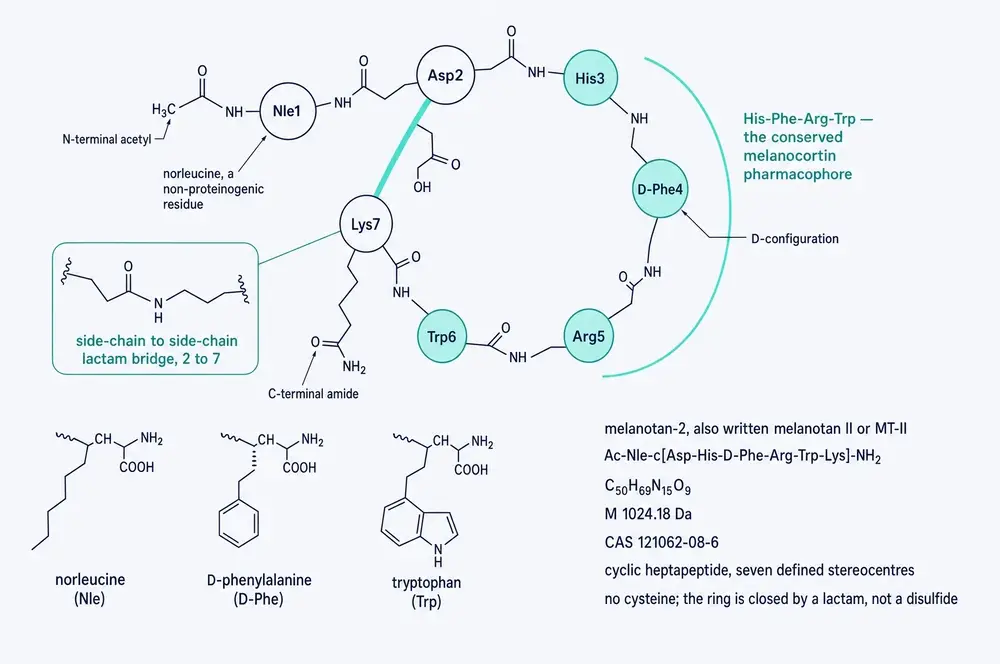
Ac-Nle-c[Asp-His-D-Phe-Arg-Trp-Lys]-NH2: seven residues, six of
them inside a macrocycle closed by a side-chain-to-side-chain lactam between
aspartate 2 and lysine 7. Norleucine sits outside the ring under an
acetyl cap. Two residues are non-standard — norleucine is not one of the
twenty the body builds proteins from, and phenylalanine is in the D
configuration. The identity data printed on this plate were checked against
PubChem and are correct in every particular: C50H69N15O9, 1024.2 Da,
CAS 121062-08-6, seven defined stereocentres and no undefined ones, and
no sulfur anywhere — the ring is an amide, not a disulfide.
One rendering error, uncorrected: the aspartate side chain is drawn
with a free terminal group as well as the bridge. In the real molecule
that carboxyl is the bridge and cannot also be free; the plate's own
magnified inset shows the correct amide linkage.06Why twenty-three
The 1989 paper did not make one molecule. It made seven, varying the two bridging residues to change the size of the ring, and then measured them all on lizard skin. The result is the most quietly instructive number in the whole programme.
A twenty-three-membered ring — aspartate to lysine — scored 90 times the potency of the native hormone. Substituting glutamate for aspartate, which adds a single carbon and makes the ring twenty-four-membered, dropped it to 9. Shortening the lysine to ornithine, diaminobutyric acid or diaminopropionic acid, giving rings of twenty-two, twenty-one and twenty members, gave 20, 5 and 5. Only the twenty-three and twenty-four-membered rings showed the prolonged activity the group was chasing at all.
One methylene group — a single carbon and two hydrogens, the smallest change organic chemistry can make to a molecule of this size — is a factor of ten in potency. The winner of that comparison is melanotan-II. The twenty-three-membered ring is not a stylistic detail; it is independently recorded in the compound's systematic name, which identifies it as a cyclotricosane.
07A name, and an orphan
The 1989 design paper never uses the word melanotan. It calls the compound Ac-[Nle4,Asp5,D-Phe7,Lys10]-alpha-MSH(4-10)-NH2 throughout. The name first appears in the indexed literature three years later, in a 1992 assay paper from the Arizona College of Pharmacy describing "Melanotan-II, a cyclic heptapeptide which promotes rapid tanning of the skin" (Ugwu and Blanchard, 1992). No source identifies who coined it. What can be dated is the transition it marks: the compound acquired a brand name at the point it stopped being a structure and started being a product.
By then it belonged to somebody. The Arizona patents — naming Hruby, Hadley and Al-Obeidi as inventors, with priority running back to a 1987 application — were assigned to Competitive Technologies, a technology-transfer company acting for the university. Competitive Technologies licensed the tanning line to an Australian startup, EpiTan, which renamed itself Clinuvel in 2006; and it licensed melanotan-II, under an agreement dated 31 March 1998, to Palatin Technologies for sexual dysfunction. Both patents have since expired.
One further fact about the chemistry matters for everything in Part Five. Melanotan-II is not difficult to make. A 2008 paper reported a preparative solution-phase synthesis in twelve steps giving material more than 90 per cent pure without preparative chromatography (Ryakhovsky et al., 2008). A published sequence, an expired patent and an easy synthesis are, between them, the entire supply chain of the grey market.
08Designed against a target nobody had seen
Melanotan-II was published in December 1989. The first melanocortin receptor was cloned in August 1992 (Mountjoy et al., 1992). The fifth was cloned in May 1994 (Gantz et al., 1994).
Read those three dates together and the rest of this document follows. When the Arizona group ran molecular-dynamics simulations to decide how big the ring should be, no melanocortin receptor had ever been sequenced by anyone. They knew a receptor existed because skin darkened; they could measure how hard their molecules pushed on it; they could not know how many receptors there were, where else in the body they sat, or what else those receptors did. The compound's promiscuity is not a design failure. It is a molecule built to a specification that could not yet include the word "selective", because the things it would need to be selective between had not been found.
The group was in fact seeing receptor subtypes without being able to name them. The 1989 paper reports its analogues as selective "for the lizard melanocyte receptors over the frog melanocyte receptors" — a difference that could only be described taxonomically, because the molecular vocabulary did not exist.
There is a reciprocal detail here that is easy to miss and hard to improve on. The peptide was the instrument that found the receptors. When Chhajlani and Wikberg cloned the human melanocyte-stimulating hormone receptor in 1992, they identified their clone by showing that transfected cells bound radioiodinated NDP-MSH — melanotan-I, the Arizona molecule from 1980, whose own paper had predicted exactly that use twelve years earlier.
09What the five receptors turned out to be
The melanocortin receptors are all G-protein-coupled receptors of the same family, all signalling through the same second messenger, cyclic AMP. What differs is where they sit and what they are wired to.
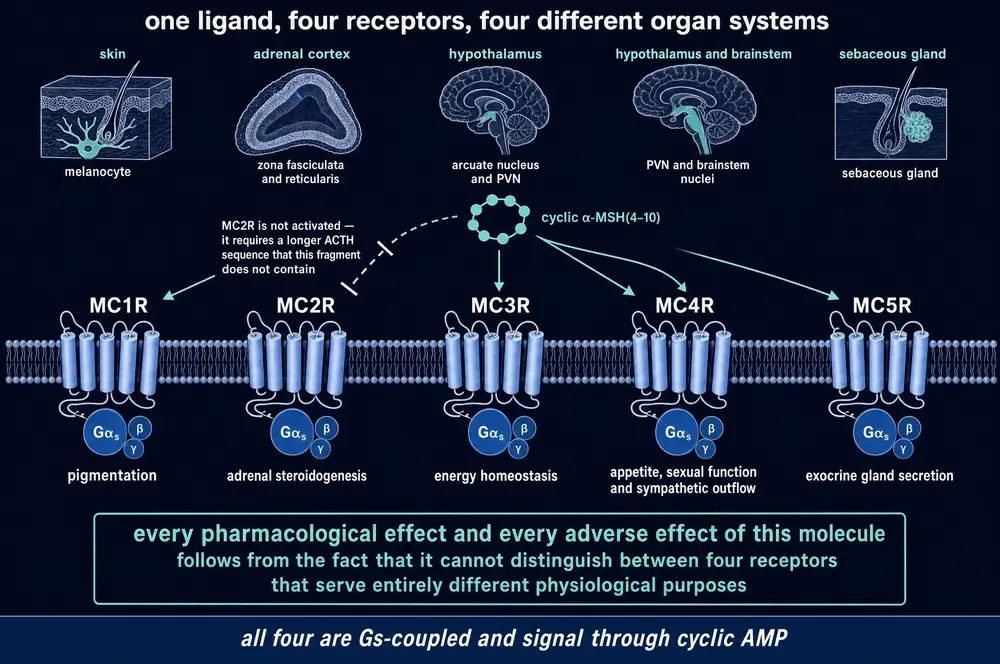
MC1R is on the melanocyte and governs pigmentation. MC2R is in the adrenal cortex and governs steroid output. MC3R and MC4R are in the hypothalamus and brainstem and govern appetite, energy expenditure, sexual function and sympathetic outflow. MC5R is on the sebaceous gland. They are, in other words, five receptors doing five unrelated jobs in five different organs, which happen to share an ancestral binding site.
Melanotan-II activates four of the five. MC2R is spared, and the reason is structural rather than fortunate: MC2R responds only to the much longer ACTH sequence, and this seven-residue fragment does not contain what it needs.
10How unselective is unselective
"Non-selective" is a soft phrase, and the numbers are harder than it suggests. When melanotan-II is measured at all four mouse melanocortin receptors in a single laboratory, the concentrations producing half-maximal response are 0.06, 0.18, 0.15 and 0.14 nanomolar at MC1R, MC3R, MC4R and MC5R respectively. The same experiment run on an independently synthesised batch gave 0.05, 0.15, 0.14 and 0.12.
That is a three-fold spread across four receptors serving four organ systems, reproduced across two separately sourced preparations. Melanotan-II is not merely unselective in the ordinary sense of preferring one target modestly over another. It is close to equipotent, which is a harder thing to be, and it means there is no dose at which one arm of its pharmacology can be engaged without the others.
The contrast with what came later is the whole argument for the successors. Setmelanotide, designed thirty years afterwards with the receptor map in hand, is described by its own prescribing information as a melanocortin-4 receptor agonist and leads clearly at that receptor. It was built so that the arm of the pharmacology a physician wants can be engaged ahead of the arms they do not. Melanotan-II offers no such lever.
11Where the molecule actually goes
Here the literature contradicts itself, and the contradiction is worth setting out rather than smoothing over, because it changes how the compound's best-known effects should be understood.
The designers' own reviews state plainly that melanotan-II crosses the blood-brain barrier. Hadley reasoned his way to that conclusion from a symptom, as Section 14 describes, and the claim is repeated in later Arizona review articles as settled.
The tracer work says something different. Trivedi and colleagues gave rats radioiodinated melanotan-II intravenously at doses that reliably suppressed feeding, then looked for it. They could not detect significant radioactivity in brain parenchyma at all. What they found instead was intense labelling of the circumventricular organs — the subfornical organ, the median eminence, the area postrema and the choroid plexus — which are the handful of structures that sit anatomically outside the barrier, and which are there precisely so that the brain can sample the blood. The binding was displaced by excess unlabelled peptide, so it was the receptor rather than non-specific stickiness (Trivedi et al., 2003). Mass spectrometry in mice four years later found low brain penetration by direct measurement (Hatziieremia et al., 2007).
Both observations can be true. The compound acts centrally; it does not do so by crossing the barrier. It works on the parts of the brain that are already reaching into the bloodstream.
The area postrema is the chemoreceptor trigger zone: the structure whose job is to detect toxins in the circulation and induce vomiting. It is on the list of circumventricular organs that melanotan-II labels most intensely. A molecule that reaches the vomiting centre reliably, and the rest of the brain barely, will have nausea as its most dependable effect — and nausea is precisely what limited the dose in every human study of this compound. Section 14 gives the figures.
One further disposition finding is worth recording because it bears on duration. When melanocortin-4 receptors are exposed to melanotan-II and then washed, the cyclic AMP signal does not switch off. The natural hormone and a selective synthetic agonist both wash out completely and the receptor resets; melanotan-II shows no reversal at all (Molden et al., 2015). The molecule's prolonged action, first noticed as prolonged darkening of frog skin, is visible at the level of a single receptor refusing to let go.
Reported plasma half-lives vary considerably — from roughly twenty minutes by mass spectrometry in mice to one or two hours in secondary accounts — and the disagreement is unresolved. The functional persistence above may be part of why: how long the peptide stays in blood and how long its effect lasts are not the same question.
12How little human evidence there is
It is worth stating the size of the human record before describing it, because it is smaller than the compound's reputation implies.
Melanotan-II has been given to human beings under supervision in a handful of studies from one group at one university. The phase-1 trial enrolled three volunteers. The two erectile-dysfunction trials enrolled ten each, and the twenty men involved are the same twenty in every subsequent summary. A search of ClinicalTrials.gov returns no genuine registered trial of melanotan-II, ever: the single record the registry holds is a February 2026 entry whose own summary describes it as an example record. Every human observation in this document either predates the registry or sits outside it.
The photoprotection evidence that gives the compound its scientific respectability is not its own. The 1991 JAMA tanning trial in twenty-eight men (Levine et al., 1991), the eumelanin measurements (Dorr et al., 2000) and the three ultraviolet-combination trials reporting 47 per cent fewer sunburn cells (Dorr et al., 2004) were all conducted with melanotan-I. That compound went on to be approved. This one did not.
13Three volunteers
The pilot phase-1 study was single-blind and placebo-controlled, alternating melanotan-II with saline on successive days in three normal male volunteers, starting at 0.01 mg/kg and escalating in 0.005 mg/kg steps. Two subjects reached 0.03 mg/kg and one 0.025 mg/kg (Dorr et al., 1996).
What it found, in the order the paper reports it: at the top dose, one of two subjects developed grade II somnolence and fatigue. Mild nausea occurred at most dose levels, not requiring treatment. Two of the three subjects showed increased pigmentation of the face, upper body and buttock by quantitative reflectance a week after dosing ended. The recommended dose for future phase-1 work was 0.025 mg/kg per day.
And then, in the same paragraph as the tanning: "A stretching and yawning complex appeared to correlate with the onset of spontaneous, penile erections which were intermittently experienced for 1–5 hours after MT-II dosing, depending on the MT-II dose."
14The human pincushion
That sentence in a 1996 pharmacology paper is the sanitised version of an event Hadley described himself, nine years later, in a first-person memoir published in Peptides (Hadley, 2005).
He had been testing the tanning peptides on himself — "a proverbial 'human pincushion'", in his phrase. Melanotan-I had been given at doses up to 10 mg with no consequence beyond a tan. So he took 10 mg of melanotan-II.
The error was not a slipped decimal. It was a units error of a subtler kind: melanotan-II is roughly half the molecular weight of melanotan-I, so an equal mass is twice the number of molecules. He matched the milligrams and doubled the dose without noticing.
What followed was nausea and an erection lasting about eight hours which, he records, "could not be subdued even with a cold pack". His wife found him and said he must be crazy. He reports replying that he thought they might become rich.
The scientifically consequential observation was not the erection. Lying there, Hadley noticed he was "constantly vigorously stretching and yawning (acting like a rat)" — and recognised it. Italian work had shown that melanocortins injected into the third ventricle of rats produce a stretching-and-yawning syndrome together with sexual behaviour. From a symptom in his own body he inferred a site of action in the brain, and concluded that melanotan-II, unlike its predecessor, was acting centrally. That inference launched the whole field of melanocortin sexual medicine.
He was right about the destination and wrong about the route. As Section 11 sets out, the tracer studies published eight years earlier than his memoir show the compound reaching circumventricular organs rather than crossing the barrier. The action is central; the access is around the wall rather than through it. Notably, the same anatomy accounts for the nausea he experienced in the same hour.
Hadley's account is an uncontrolled self-report in a single person, written
some fifteen years after the events, by a man with a financial interest in the
compound — the email address printed on the paper is
erectide@aol.com, after his own preferred name for it.
The same paper claims the drug works "with minimal or no undesirable side effects" and calls it "failsafe". Those claims are contradicted by the trials his own colleagues ran, which found severe nausea in 12.9 per cent of subjects. The anecdote is well evidenced; the editorialising around it is not, and where the memoir and the trial disagree, the trial wins.
15Twenty men, and a RigiScan
The accident became a controlled question quickly. Two double-blind, placebo-controlled crossover trials at the same institution measured penile rigidity directly with a RigiScan over six hours, at 0.025 mg/kg subcutaneously.
In ten men whose erectile dysfunction had no known organic cause, clinically apparent erections developed in eight; mean duration of tip rigidity above 80 per cent was 38.0 minutes against 3.0 on placebo (Wessells et al., 1998). In ten men with organic risk factors, erections followed 12 of 19 injections against 1 of 21 placebo doses, with 45.3 minutes of tip rigidity against 1.9 (Wessells et al., 2000). Pooled across all twenty, erections occurred in 17 of 20 in the absence of sexual stimulation.
The finding that mattered commercially was quieter. Increased sexual desire was reported after 13 of 19 melanotan-II doses against 4 of 21 placebo doses. A drug that changed wanting, rather than only mechanism, was a different kind of product from the phosphodiesterase inhibitors then arriving on the market, and it is the reason a female-sexual-dysfunction programme became conceivable at all.
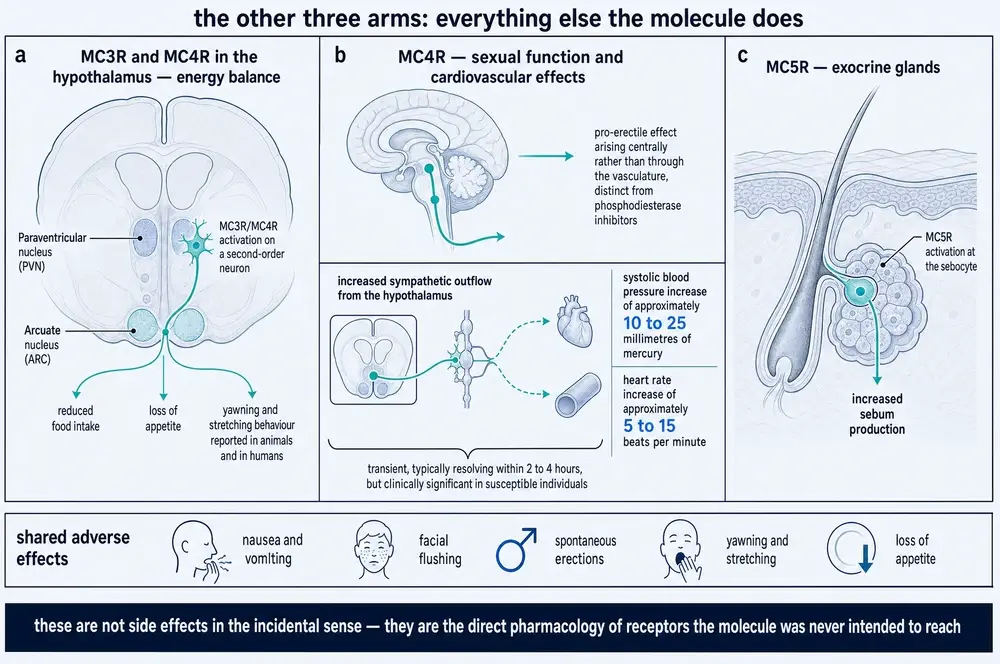
The ceiling was reported in the same papers. Severe nausea occurred in 12.9 per cent of subjects at 0.025 mg/kg, and in 4 of 19 injections in the organic-dysfunction trial. There is no dose in these studies at which the erection appears and the nausea does not, which is what Section 10's flat selectivity profile predicts.
16Why it was stopped
Two primary documents fix the date. In a letter to the Securities and Exchange Commission dated 22 February 2008, Palatin Technologies wrote of the licensed peptide: "We had ceased developing that peptide in 2000." Its own press release of the preceding month says the same thing. Palatin began human trials of bremelanotide in the first quarter of 2001; the handover was immediate.
The reason given by a regulator reviewing the compound a decade later is that development "has been abandoned due to side effects associated with the immune and cardiovascular systems" (Australian Therapeutic Goods Administration, delegate's decision, December 2010).
The programme's own logic points the same way, and it is the logic of Section 10. If the tan, the erection and the vomiting all come from different receptors, and the molecule engages them at indistinguishable concentrations, then no amount of dose-finding separates them. The way forward is not a better schedule. It is a better molecule.
What nobody arranged was for the abandoned one to go away.
17An orphan with a published recipe
A drug that fails in development normally disappears, because the only people able to make it lose interest in doing so. Melanotan-II did not disappear, and the reason is a structural accident rather than a conspiracy. Its sequence was published in 1989. Its patents expired. Its synthesis was published in a peer-reviewed journal in 2008 in a form any competent peptide laboratory can follow. And because it was never approved, there was no marketing authorisation to withdraw — nothing to revoke, no recall to issue, no product to take off a shelf.
What regulators could do was tell people to stop selling it, and from 2007 they began to. The United States Food and Drug Administration wrote to a Tennessee vendor in August 2007 setting out that melanotan-II "is a drug… Moreover, this product is a new drug… because it is not generally recognized as safe and effective for its labeled uses." A second letter, in January 2009, disposed of the disclaimer that still appears on almost every vendor site today: "Regardless of your statement, 'for non-human experimental purposes only,' the circumstances surrounding the promotion of your products demonstrate that your disclaimer is ineffectual and your products are, in fact, intended for human use." The agency had test-purchased, and received a 10 mg vial together with syringes, needles, alcohol pads and bacteriostatic water.
Enforcement has continued and escalated. Melanotan-II appears on the FDA's import-alert list for detention without physical examination. Three principals of the first company pleaded guilty in 2015 to conspiring to defraud the FDA; the record notes the company sold more than $929,000 of product after receiving its warning letter. Ireland's regulator removed more than 500 online listings in a single year to June 2023. In May 2026 the Australian regulator issued one individual 27 infringement notices totalling $101,412.
The market has nonetheless grown, and it grew through a specific channel. The British Medicines and Healthcare products Regulatory Agency recorded in its 2008/09 annual report that melanotan "is unlicensed, and so there has been no opportunity to review how well it works, the standards to which it is made or its safety profile", and noted evidence of product being sold "with insufficient needles, raising concerns about re-use or sharing of needles."
The clearest marker of when melanotan stopped being a rumour is a 2009 editorial in the BMJ. Its authors, at a public-health centre in Liverpool, reported that in 2008 "several workers at needle and syringe programmes in the United Kingdom contacted the substance use team… after their clients reported injecting these drugs. Over the next year around 30 needle and syringe programmes in England and Wales… have sought our advice" (Evans-Brown et al., 2009). The people who noticed first were harm-reduction staff whose ordinary business is heroin, calling a university because their clients were injecting a suntan.
One demographic fact should be stated plainly because its absence is frequently filled with invention: there is no reliable prevalence estimate for melanotan-II use in any general population. The 2009 editorial said the prevalence was unknown; a 2021 study of online forums said it again. What exists is qualitative — 623 discussion entries from 205 participants on British and Irish forums, describing motivations centred on holidays and bodybuilding competitions, dosing improvised from user accounts, and concurrent sunbed use (Gilhooley et al., 2021).
18What is actually in the vial
This is the best-evidenced section of the entire safety literature, and it governs how every other section should be read.
When a Danish and British group bought injectable melanotan-II from three online shops and assayed it by liquid chromatography with tandem mass spectrometry, every vial was labelled 10 mg and every vial was under-strength: actual content ranged from 4.32 to 8.84 mg, between 43 and 88 per cent of label. Two of the three shops' vials carried unknown impurities at 4.1 to 5.9 per cent (Breindahl et al., 2014). A Belgian forensic laboratory characterising two seized vials of "pharmaceutical appearance" in 2024 measured a purity of 30 per cent (Deville and Charlier, 2024).
Looking wider, at the ten most frequently encountered falsified peptide drugs on the Belgian market, purity ran from 5 to 75 per cent, and the samples contained arsenic and lead — in some cases at ten times the international toxicity limit for injectable products, with speciation confirming the arsenic was entirely in its more toxic inorganic form (Janvier et al., 2018). A companion study isolated haemolytic Bacillus cereus from two illegal injectable peptide products (Janvier et al., 2018). Those two findings are for the product class rather than for a named melanotan-II vial, and are reported here as such.
There is also a reason this compound is hard to police. At 1024 daltons melanotan-II sits above the roughly 1000-dalton upper limit that many forensic mass-spectrometry methods are configured for, and it carries multiple charges, which is unusual among the compounds those methods are built to find. Its ultraviolet spectrum was not in the literature, so no library match was available either. The authors of the 2024 study concluded that the difficulty of detecting it "may explain its popularity on the illicit market."
In every published adverse-event case involving melanotan-II but one, the substance actually injected was never analysed. Only the 2012 rhabdomyolysis report confirmed its sample by mass spectrometry against a reference standard. Any claim that attributes a melanoma, a seizure or an organ injury to the melanocortin peptide — rather than to an impurity, a heavy metal, a bacterial contaminant, a different peptide altogether, or a co-administered anabolic steroid — is a claim that the product analysis does not support.
19What clinicians have seen
The serious systemic events reported in the literature are few, individually severe, and individually uncontrolled.
Rhabdomyolysis. A 39-year-old man injected 6 mg — six times his own stated starting dose — and presented two hours later with blood pressure 151/85, a heart rate rising to 146, dilated pupils, sweating and tremor. Creatine kinase rose from 1,760 to a peak of 17,773 IU/L at twelve hours and creatinine reached 2.25 mg/dL. He spent three days in intensive care and recovered (Nelson et al., 2012). This is the case in which the injected material was chemically confirmed to be melanotan-II.
Priapism. Three published cases, all requiring invasive intervention. A 41-year-old presented 22 hours into an ischaemic episode; roughly 700 mL of blood was aspirated and phenylephrine given to about 1 mg; at four weeks his erectile function had not recovered (Dreyer et al., 2019). A 55-year-old who had injected 2 mg presented at 30 hours, failed phenylephrine to a total of 4,500 micrograms, and required penoscrotal decompression surgery; at fifteen weeks he had new-onset erectile dysfunction with corporal fibrosis unresponsive to phosphodiesterase inhibitors (Mallory et al., 2021). The original mechanism, uncontrolled, is a urological emergency.
Encephalopathy and renal infarction. One case each — posterior reversible encephalopathy syndrome in a young woman (Kaski et al., 2013) and renal infarction attributed on temporal association without product analysis (Peters et al., 2020). Both are single reports, and the clinical detail of the first could not be retrieved for this document; it is cited for its existence, not for particulars.
Against that, an explicit negative finding worth stating because its absence is otherwise read as evidence: no published case attributes myocardial infarction, stroke, cardiac arrest or arrhythmia to melanotan-II. The human cardiovascular signal is confined to the acute sympathomimetic picture above and the single renal arterial event.
The most detailed recent human observation in this corpus is not an emergency. A dental case report published in 2026 followed a 42-year-old man who had self-administered 400 micrograms subcutaneously every other day for 64 days — 32 injections, 12.8 mg in total — from an online research-peptide retailer, alongside five sunbed sessions. He developed near-symmetrical brown pigmentation of the attached gingiva in both jaws and irregular patches on both cheeks, sparing the tongue, palate and lips. He reported increased libido and darkening of pre-existing moles. Twenty-eight days after stopping, the cheek pigmentation had largely faded; at three months the gum pigmentation had lessened but had not resolved (Bonchev et al., 2026). The regimen is recorded here because the paper records it, as an observation of what one person did.
20The mole question
This is the question everyone asks about melanotan-II, and the honest answer has two halves that do not collapse into each other.
What is established. Melanotan-II reliably darkens existing moles and produces new ones. The case literature is consistent on this from 2009 onward, and it extends beyond skin: transverse melanonychia in a nail (Paurobally et al., 2013), and gum and cheek pigmentation in the 2026 dental case. A proportion of the new lesions are histologically dysplastic. Some of the change reverses on stopping — in one early series the naevi "progressively lightened and lost growth features" after discontinuation (Cardones and Grichnik, 2009).
None of that is mysterious. It is the MC1R arm of Section 09 doing exactly what it does, in every melanocyte the drug reaches rather than only the ones exposed to sunlight.
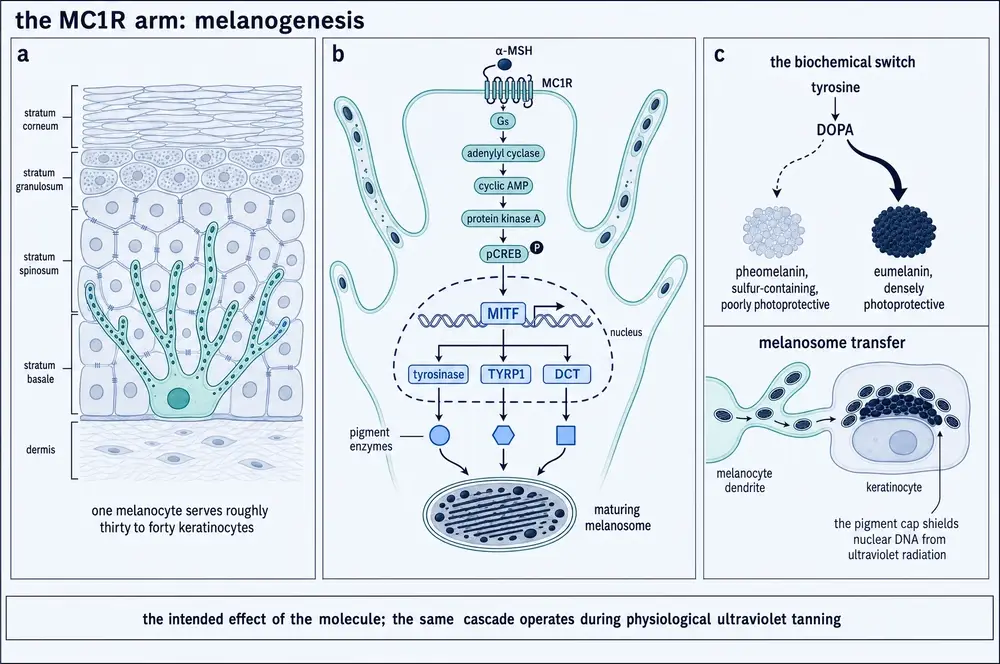
There is a clinical consequence of this that is under-appreciated and independent of cancer risk. A 2012 report used sequential videodermoscopy before and during use and found changes that "made it difficult to differentiate a nevus from a melanoma"; the record is indexed under False Positive Reactions (Mang et al., 2012). Whatever melanotan-II does or does not do to cancer risk, it degrades the reliability of the surveillance used to detect it.
What is not established is causation of melanoma. Seven or so melanoma case reports exist. Every one is a single patient with self-reported exposure to an unanalysed product, and almost every one carries a confounder sufficient to explain the outcome on its own: concurrent sunbed use, fair phototype, a high mole count, or a genetic predisposition. The most detailed report, describing five melanomas in situ in a 49-year-old man, names its own confounders — about twelve tanning-bed sessions taken simultaneously with the peptide, years of unregulated testosterone, two prior blistering sunburns, family history — and its authors conclude that "causality remains unproven", raising the possibility that the lesions were pre-existing and became visible through pigmentary change rather than arising fresh (Vadner and Smith, 2026). In several cases the interval between injection and lesion is days to weeks, which is too short for a new cancer to form.
The confounder is not hypothetical. A prospective survey of 104 consecutive patients at a pigmented-lesion clinic found that users of tan-enhancing agents used sunbeds more frequently than non-users (Lai et al., 2025). The two exposures travel together, and the ultraviolet one is a fully established carcinogen.
The most interesting exception is a 2025 report of oral mucosal melanoma in a 22-year-old woman who had used melanotan-II nasal spray (Yassin Alsabbagh et al., 2025). Mucosal melanoma is not driven by ultraviolet light, so the sunbed confounder does not apply — which makes it the single strongest case in the literature for an ultraviolet-independent mechanism. It is also one patient, with self-reported exposure, and mucosal melanoma at 22 is vanishingly rare in any case.
And there is a finding that points the other way, which a document presenting only the harm signal would be concealing. In mouse melanoma, topical melanotan-II suppressed tumour progression: it did not affect proliferation but inhibited migration, invasion and colony formation, induced apoptosis and reduced new blood-vessel growth, working through MC1R-dependent upregulation of the tumour suppressor PTEN (Wu et al., 2020). That is mouse and cell-culture work and says nothing directly about human risk. Its authors' own summary of the field — that "the carcinogenic consequence of topical MTII has been equivocal" — is a fair description of where the evidence stands.
The most careful appraisal anyone has published looked at 179 patients with eruptive melanocytic naevi from all causes and concluded that "the nature of the data precluded assessment of risk of malignant transformation" (Burian and Jemec, 2019). That remains the position. The association is documented; the causal direction is not resolved; and because use is unsupervised and unrecorded, under-reporting is likely in both directions.
21The three heirs
The Arizona pharmacology did reach patients, three times, by being taken apart.
Afamelanotide — the linear 1980 molecule, melanotan-I — was authorised in the European Union in December 2014 and by the FDA in October 2019, for erythropoietic protoporphyria, a rare disorder in which sunlight causes severe pain. It is a subcutaneous implant given every two months, and it binds predominantly to MC1R. Its label carries a requirement for full-body skin examination twice yearly, and its trials recorded skin hyperpigmentation in 4 per cent of treated patients against none on vehicle, and melanocytic naevi in 4 per cent against 2.
Bremelanotide was approved by the FDA in June 2019 for hypoactive
sexual desire disorder in premenopausal women, at 1.75 mg subcutaneously as
needed. Structurally it is melanotan-II with one change: the FDA label prints
Ac-Nle-cyclo-(Asp-His-D-Phe-Arg-Trp-Lys-OH) against melanotan-II's
identical sequence ending -NH2. A primary amide has become a free
acid, and that is the entire difference between an unapproved grey-market
tanning agent and a licensed medicine.
It is often said that each successor isolated one arm of the parent pharmacology. That is true of afamelanotide and setmelanotide. It is not true of bremelanotide. Its own FDA label states that it "nonselectively activates several receptor subtypes with the following order of potency: MC1R, MC4R, MC3R, MC5R, MC2R", and that "the mechanism by which VYLEESI improves HSDD in women is unknown." The tanning liability came with it: the label carries a focal hyperpigmentation warning, reported in 1 per cent of patients, affecting face, gums and breasts, with resolution not confirmed in some. Its most common adverse effect is nausea, in 40.0 per cent of treated patients against 1.3 per cent on placebo, causing 8 per cent to stop treatment. Thirty years on, the same four receptors are still producing the same three effects.
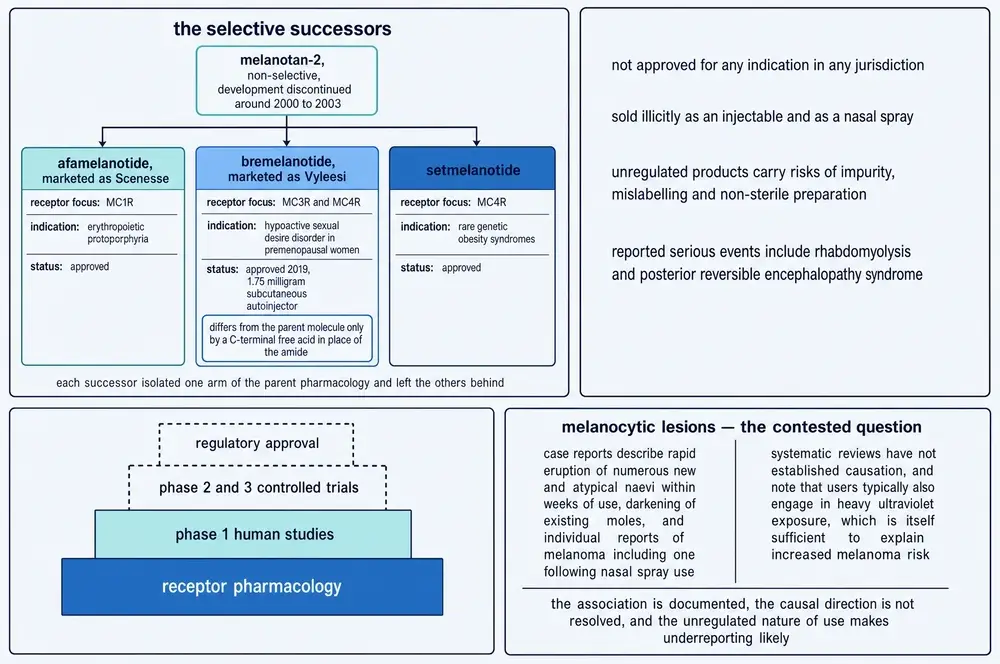
Setmelanotide, approved in November 2020 and since extended to Bardet-Biedl syndrome, to children as young as two, and in March 2026 to acquired hypothalamic obesity, is the only one of the three that is genuinely receptor-selective. Even so its label warns of skin hyperpigmentation, darkening of pre-existing naevi and development of new ones. The MC1R signature is faint, but it is still there.
22The instrument
There is a last chapter that the tanning story tends to obscure, and by volume it is much the largest.
Of the 229 scientific full texts in this monograph's corpus, the great majority do not treat melanotan-II as a candidate drug at all. They use it as a reagent — the standard, reliable, non-selective melanocortin agonist you inject when you want to switch the system on and see what happens. Precisely the promiscuity that killed it as a medicine makes it excellent for that: one compound activates the whole family, and pairing it with selective antagonists lets an experimenter work out which receptor was responsible.
The results in this corpus are a fair map of what the melanocortin system does. Melanotan-II is the tool with which the hypothalamic control of appetite was characterised, and the tool that showed the effect does not last — in rats, continuous infusion produces "almost full anorexia for 1–2 days but then feeding gradually returned to normal despite continued MT-II infusion" (Raposinho et al., 2003). It produced a profound and rapid fall in body temperature in mice that turned out not to require MC4R at all (Xu et al., 2014). It reduces voluntary alcohol consumption in rodents and augments the effect of naltrexone. It is used to probe sympathetic outflow, puberty and fertility through kisspeptin neurons, social behaviour, and cardiac recovery after infarction.
That last point is worth holding beside Section 19: chronic activation of the same central pathway protected rodents against progressive heart failure after severe myocardial infarction (Gava et al., 2021). The melanocortin system is not a hazard with a tan attached. It is a control system with many outputs, and melanotan-II is the crowbar that opened it.
Melanotan-II is frequently described as suppressing appetite in humans. The entire published human evidence for that is a single clause in the 1998 erectile-dysfunction trial, listing "nausea, stretching and yawning, and decreased appetite" among side effects reported more often than on placebo in ten men. There is no measured intake, no weight, no scale, and no trial with appetite as an endpoint; the two later studies by the same group do not mention it. A systematic review of melanocortin-4 approaches to obesity found that "almost all studies are in the preclinical phase" (Fani et al., 2014). The rodent evidence is extensive — and shows the effect fading within two days.
A compound that failed every test set for a drug has passed, comprehensively, the one set for a reagent. Melanotan-II's real legacy is not a tan. It is a substantial fraction of what is known about how the brain regulates eating, arousal and body weight — findings that were extracted from it by people who were never trying to sell it to anyone.
This document describes published research. It does not recommend human use of melanotan-II and specifies no dose, route or schedule for any person. Where quantities appear above — 0.025 mg/kg in the Arizona trials, 400 micrograms every other day in the 2026 dental case, 6 mg in the rhabdomyolysis report — they are reported study parameters or reported clinical histories, given with their populations, and are not schedules. The compound is not approved in any jurisdiction, has never completed a controlled trial beyond phase 1, and the material sold under its name has been shown repeatedly to contain between 30 and 88 per cent of what its label claims.
23References
Generated from verified NCBI records rather than from recall. Author lists, journal names, volumes, pages and identifiers were re-fetched from PubMed for every entry below, and the returned title of each was read back and confirmed to be the paper intended. This series has twice shipped reference lists drafted from memory in which identifiers pointed at real but unrelated papers, and the build refuses to run if any identifier fails to resolve. All 82 resolved.
- Adank DN, Lunzer MM, Lensing CJ, Wilber SL, Gancarz AM, Haskell-Luevano C. Comparative in Vivo Investigation of Intrathecal and Intracerebroventricular Administration with Melanocortin Ligands MTII and AGRP into Mice. ACS Chem Neurosci. 2018;9(2):320-327.
PMID 28968061 · doi:10.1021/acschemneuro.7b00330 · PMC5821609 - Adler NR, Dowling JP, Pan Y. The unregulated use of melanotan-II is of public health interest to Australian dermatologists. Australas J Dermatol. 2017;58(4):327-329.
PMID 28905366 · doi:10.1111/ajd.12711 - Affleck A. Consider underlying body dysmorphic disorder in users of melanotan. Br J Dermatol. 2010;162(2):459-60.
PMID 19919633 · doi:10.1111/j.1365-2133.2009.09553.x - Al-Obeidi F, Castrucci AM, Hadley ME, Hruby VJ. Potent and prolonged acting cyclic lactam analogues of alpha-melanotropin: design based on molecular dynamics. J Med Chem. 1989;32(12):2555-61.
PMID 2555512 · doi:10.1021/jm00132a010 - Al-Obeidi F, Hruby VJ, Castrucci AM, Hadley ME. Design of potent linear alpha-melanotropin 4-10 analogues modified in positions 5 and 10. J Med Chem. 1989;32(1):174-9.
PMID 2535874 · doi:10.1021/jm00121a032 - Bonchev A. Changes in Oral Mucosa Associated with Melanotan II Injections: A Case Report. Life (Basel). 2026;16(2).
PMID 41752902 · doi:10.3390/life16020265 · PMC12942211 - Breindahl T, Evans-Brown M, Hindersson P, McVeigh J, Bellis M, Stensballe A, et al.. Identification and characterization by LC-UV-MS/MS of melanotan II skin-tanning products sold illegally on the Internet. Drug Test Anal. 2015;7(2):164-72.
PMID 24771717 · doi:10.1002/dta.1655 - Burian EA, Jemec GBE. Eruptive Melanocytic Nevi: A Review. Am J Clin Dermatol. 2019;20(5):669-682.
PMID 31119650 · doi:10.1007/s40257-019-00444-8 - Cardones AR, Grichnik JM. alpha-Melanocyte-stimulating hormone-induced eruptive nevi. Arch Dermatol. 2009;145(4):441-4.
PMID 19380666 · doi:10.1001/archdermatol.2008.623 - Chhajlani V, Wikberg JE. Molecular cloning and expression of the human melanocyte stimulating hormone receptor cDNA. FEBS Lett. 1992;309(3):417-20.
PMID 1516719 · doi:10.1016/0014-5793(92)80820-7 - Cousen P, Colver G, Helbling I. Eruptive melanocytic naevi following melanotan injection. Br J Dermatol. 2009;161(3):707-8.
PMID 19575725 · doi:10.1111/j.1365-2133.2009.09362.x - da Silva AA, Freeman JN, Hall JE, do Carmo JM. Control of appetite, blood glucose, and blood pressure during melanocortin-4 receptor activation in normoglycemic and diabetic NPY-deficient mice. Am J Physiol Regul Integr Comp Physiol. 2018;314(4):R533-R539.
PMID 29351428 · doi:10.1152/ajpregu.00293.2017 · PMC5966815 - Deconinck E, Vanhee C, Keizers P, Guinot P, Mihailova A, Syversen PV, et al.. The occurrence of non-anatomical therapeutic chemical-international nonproprietary name molecules in suspected illegal or illegally traded health products in Europe: A retrospective and prospective study. Drug Test Anal. 2021;13(4):833-840.
PMID 33453144 · doi:10.1002/dta.3001 - Deville M, Charlier C. Barbie drug identification: Not a child's play. J Forensic Sci. 2024;69(6):2331-2338.
PMID 39302005 · doi:10.1111/1556-4029.15633 - Devlin J, Pomerleau A, Foote J. Melanotan II overdose associated with priapism. Clin Toxicol (Phila). 2013;51(4):383.
PMID 23537392 · doi:10.3109/15563650.2013.784775 - Dickson D, Hlaing Htwe S. Pyoderma Gangrenosum Secondary to Melanotan. Cureus. 2025;17(12):e98297.
PMID 41487785 · doi:10.7759/cureus.98297 · PMC12756945 - Dorr RT, Lines R, Levine N, Brooks C, Xiang L, Hruby VJ, et al.. Evaluation of melanotan-II, a superpotent cyclic melanotropic peptide in a pilot phase-I clinical study. Life Sci. 1996;58(20):1777-84.
PMID 8637402 · doi:10.1016/0024-3205(96)00160-9 - Dorr RT, Dvorakova K, Brooks C, Lines R, Levine N, Schram K, et al.. Increased eumelanin expression and tanning is induced by a superpotent melanotropin [Nle4-D-Phe7]-alpha-MSH in humans. Photochem Photobiol. 2000;72(4):526-32.
PMID 11045725 · doi:10.1562/0031-8655(2000)072<0526:ieeati>2.0.co;2 - Dorr RT, Ertl G, Levine N, Brooks C, Bangert JL, Powell MB, et al.. Effects of a superpotent melanotropic peptide in combination with solar UV radiation on tanning of the skin in human volunteers. Arch Dermatol. 2004;140(7):827-35.
PMID 15262693 · doi:10.1001/archderm.140.7.827 - Dreyer BA, Amer T, Fraser M. Melanotan-induced priapism: a hard-earned tan. BMJ Case Rep. 2019;12(2).
PMID 30796078 · doi:10.1136/bcr-2018-227644 · PMC6388891 - Eliason NL, Martin L, Low MJ, Sharpe AL. Melanocortin receptor agonist melanotan-II microinjected in the nucleus accumbens decreases appetitive and consumptive responding for food. Neuropeptides. 2022;96:102289.
PMID 36155088 · doi:10.1016/j.npep.2022.102289 · PMC10152796 - Evans-Brown M, Dawson RT, Chandler M, McVeigh J. Use of melanotan I and II in the general population. BMJ. 2009;338:b566.
PMID 19224885 · doi:10.1136/bmj.b566 - Fani L, Bak S, Delhanty P, van Rossum EF, van den Akker EL. The melanocortin-4 receptor as target for obesity treatment: a systematic review of emerging pharmacological therapeutic options. Int J Obes (Lond). 2014;38(2):163-9.
PMID 23774329 · doi:10.1038/ijo.2013.80 - Gantz I, Konda Y, Tashiro T, Shimoto Y, Miwa H, Munzert G, et al.. Molecular cloning of a novel melanocortin receptor. J Biol Chem. 1993;268(11):8246-50.
PMID 8463333 - Gantz I, Miwa H, Konda Y, Shimoto Y, Tashiro T, Watson SJ, et al.. Molecular cloning, expression, and gene localization of a fourth melanocortin receptor. J Biol Chem. 1993;268(20):15174-9.
PMID 8392067 - Gantz I, Shimoto Y, Konda Y, Miwa H, Dickinson CJ, Yamada T. Molecular cloning, expression, and characterization of a fifth melanocortin receptor. Biochem Biophys Res Commun. 1994;200(3):1214-20.
PMID 8185570 · doi:10.1006/bbrc.1994.1580 - Gava FN, da Silva AA, Dai X, Harmancey R, Ashraf S, Omoto ACM, et al.. Restoration of Cardiac Function After Myocardial Infarction by Long-Term Activation of the CNS Leptin-Melanocortin System. JACC Basic Transl Sci. 2021;6(1):55-70.
PMID 33532666 · doi:10.1016/j.jacbts.2020.11.007 · PMC7838051 - Gilhooley E, Daly S, McKenna D. Melanotan II User Experience: A Qualitative Study of Online Discussion Forums. Dermatology. 2021;237(6):995-999.
PMID 34464955 · doi:10.1159/000514492 - Greenfield JR, Miller JW, Keogh JM, Henning E, Satterwhite JH, Cameron GS, et al.. Modulation of blood pressure by central melanocortinergic pathways. N Engl J Med. 2009;360(1):44-52.
PMID 19092146 · doi:10.1056/NEJMoa0803085 - Habbema L, Halk AB, Neumann M, Bergman W. Risks of unregulated use of alpha-melanocyte-stimulating hormone analogues: a review. Int J Dermatol. 2017;56(10):975-980.
PMID 28266027 · doi:10.1111/ijd.13585 - Hadley ME, Hruby VJ, Blanchard J, Dorr RT, Levine N, Dawson BV, et al.. Discovery and development of novel melanogenic drugs. Melanotan-I and -II. Pharm Biotechnol. 1998;11:575-95.
PMID 9760697 · doi:10.1007/0-306-47384-4_25 - Hadley ME. Discovery that a melanocortin regulates sexual functions in male and female humans. Peptides. 2005;26(10):1687-9.
PMID 15996790 · doi:10.1016/j.peptides.2005.01.023 - Hadley ME, Dorr RT. Melanocortin peptide therapeutics: historical milestones, clinical studies and commercialization. Peptides. 2006;27(4):921-30.
PMID 16412534 · doi:10.1016/j.peptides.2005.01.029 - Hatziieremia S, Kostomitsopoulos N, Balafas V, Tamvakopoulos C. A liquid chromatographic/tandem mass spectroscopic method for quantification of the cyclic peptide melanotan-II. Plasma and brain tissue concentrations following administration in mice. Rapid Commun Mass Spectrom. 2007;21(15):2431-8.
PMID 17610239 · doi:10.1002/rcm.3106 - Hibbert MP, Brett CE, Porcellato LA, Hope VD. Image and performance enhancing drug use among men who have sex with men and women who have sex with women in the UK. Int J Drug Policy. 2021;95:102933.
PMID 32912823 · doi:10.1016/j.drugpo.2020.102933 - Hjuler KF, Lorentzen HF. Melanoma associated with the use of melanotan-II. Dermatology. 2014;228(1):34-6.
PMID 24355990 · doi:10.1159/000356389 - Hruby VJ. Professor Mac E. Hadley: creative scientist, superb teacher, dynamic collaborator and wonderful friend. Gen Comp Endocrinol. 2007;151(3):358-60.
PMID 17590901 · doi:10.1016/j.ygcen.2007.02.033 - Janvier S, Cheyns K, Canfyn M, Goscinny S, De Spiegeleer B, Vanhee C, et al.. Impurity profiling of the most frequently encountered falsified polypeptide drugs on the Belgian market. Talanta. 2018;188:795-807.
PMID 30029448 · doi:10.1016/j.talanta.2018.06.023 - Janvier S, Wattijn E, Botteldoorn N, De Spiegeleer B, Deconinck E, Vanhee C. Are injectable illegal polypeptide drugs safe? Case report demonstrating the presence of haemolytic Bacillus cereus in 2 illegal peptide drugs. Drug Test Anal. 2018;10(4):791-795.
PMID 28941153 · doi:10.1002/dta.2304 - Janvier S, De Spiegeleer B, Vanhee C, Deconinck E. Falsification of biotechnology drugs: current dangers and/or future disasters?. J Pharm Biomed Anal. 2018;161:175-191.
PMID 30165334 · doi:10.1016/j.jpba.2018.08.037 - Kaski D, Stafford N, Mehta A, Jenkins IH, Malhotra P. Melanotan and the posterior reversible encephalopathy syndrome. Ann Intern Med. 2013;158(9):707-8.
PMID 23648958 · doi:10.7326/0003-4819-158-9-201305070-00020 - Kievit P, Halem H, Marks DL, Dong JZ, Glavas MM, Sinnayah P, et al.. Chronic treatment with a melanocortin-4 receptor agonist causes weight loss, reduces insulin resistance, and improves cardiovascular function in diet-induced obese rhesus macaques. Diabetes. 2013;62(2):490-7.
PMID 23048186 · doi:10.2337/db12-0598 · PMC3554387 - Kuo JJ, Silva AA, Hall JE. Hypothalamic melanocortin receptors and chronic regulation of arterial pressure and renal function. Hypertension. 2003;41(3 Pt 2):768-74.
PMID 12623994 · doi:10.1161/01.HYP.0000048194.97428.1A - Lai FY, Quigley C, Murray G, Gordon A, Yong JF, Yoo H, et al.. A single-centre, prospective, qualitative analysis of knowledge, attitudes and behaviour of sunbed use among patients attending a pigmented lesion clinic in a tertiary referral centre. Skin Health Dis. 2025;5(3):210-213.
PMID 40584950 · doi:10.1093/skinhd/vzaf014 · PMC12202866 - Lan EL, Ugwu SO, Blanchard J, Fang X, Hruby VJ, Sharma S. Preformulation studies with melanotan-II: a potential skin cancer chemopreventive peptide. J Pharm Sci. 1994;83(8):1081-4.
PMID 7983590 · doi:10.1002/jps.2600830805 - Langan EA, Nie Z, Rhodes LE. Melanotropic peptides: more than just 'Barbie drugs' and 'sun-tan jabs'?. Br J Dermatol. 2010;163(3):451-5.
PMID 20545686 · doi:10.1111/j.1365-2133.2010.09891.x - Levine N, Sheftel SN, Eytan T, Dorr RT, Hadley ME, Weinrach JC, et al.. Induction of skin tanning by subcutaneous administration of a potent synthetic melanotropin. JAMA. 1991;266(19):2730-6.
PMID 1658407 - Li P, Cui BP, Zhang LL, Sun HJ, Liu TY, Zhu GQ. Melanocortin 3/4 receptors in paraventricular nucleus modulate sympathetic outflow and blood pressure. Exp Physiol. 2013;98(2):435-43.
PMID 22872662 · doi:10.1113/expphysiol.2012.067256 - Mallory CW, Lopategui DM, Cordon BH. Melanotan Tanning Injection: A Rare Cause of Priapism. Sex Med. 2021;9(1):100298.
PMID 33460908 · doi:10.1016/j.esxm.2020.100298 · PMC7930850 - Mang R, Krahl D, Assmann T. [Dermoscopic changes in melanocytic nevi during use of melanotan II]. Hautarzt. 2012;63(11):880-4.
PMID 23052015 · doi:10.1007/s00105-012-2420-1 - McVeigh J, Salinas M, Ralphs R. A sentinel population: The public health benefits of monitoring enhanced body builders. Int J Drug Policy. 2021;95:102890.
PMID 32912824 · doi:10.1016/j.drugpo.2020.102890 - Mestria S, Odoardi S, Frison G, Strano Rossi S. LC-HRMS characterization of the skin pigmentation and sexual enhancers melanotan II and bremelanotide sold on the black market of performance and image enhancing drugs. Drug Test Anal. 2021;13(4):876-882.
PMID 33245851 · doi:10.1002/dta.2986 - Molden BM, Cooney KA, West K, Van Der Ploeg LH, Baldini G. Temporal cAMP Signaling Selectivity by Natural and Synthetic MC4R Agonists. Mol Endocrinol. 2015;29(11):1619-33.
PMID 26418335 · doi:10.1210/me.2015-1071 · PMC4627605 - Mountjoy KG, Robbins LS, Mortrud MT, Cone RD. The cloning of a family of genes that encode the melanocortin receptors. Science. 1992;257(5074):1248-51.
PMID 1325670 · doi:10.1126/science.1325670 - Mountjoy KG, Mortrud MT, Low MJ, Simerly RB, Cone RD. Localization of the melanocortin-4 receptor (MC4-R) in neuroendocrine and autonomic control circuits in the brain. Mol Endocrinol. 1994;8(10):1298-308.
PMID 7854347 · doi:10.1210/mend.8.10.7854347 - Navarro M, Carvajal F, Lerma-Cabrera JM, Cubero I, Picker MJ, Thiele TE. Evidence that Melanocortin Receptor Agonist Melanotan-II Synergistically Augments the Ability of Naltrexone to Blunt Binge-Like Ethanol Intake in Male C57BL/6J Mice. Alcohol Clin Exp Res. 2015;39(8):1425-33.
PMID 26108334 · doi:10.1111/acer.12774 · PMC4515169 - Nelson ME, Bryant SM, Aks SE. Melanotan II injection resulting in systemic toxicity and rhabdomyolysis. Clin Toxicol (Phila). 2012;50(10):1169-73.
PMID 23121206 · doi:10.3109/15563650.2012.740637 - Ong S, Bowling J. Melanotan-associated melanoma in situ. Australas J Dermatol. 2012;53(4):301-2.
PMID 22724573 · doi:10.1111/j.1440-0960.2012.00915.x - Paurobally D, Jason F, Dezfoulian B, Nikkels AF. Melanotan-associated melanoma. Br J Dermatol. 2011;164(6):1403-5.
PMID 21564053 · doi:10.1111/j.1365-2133.2011.10273.x - Paurobally D, El Hayderi L, Richert B, Andre J, Nikkels AF. Melanotan-associated transverse melanonychia. J Eur Acad Dermatol Venereol. 2013;27(1):128-9.
PMID 22182016 · doi:10.1111/j.1468-3083.2011.04399.x - Peters B, Hadimeri H, Wahlberg R, Afghahi H. Melanotan II: a possible cause of renal infarction: review of the literature and case report. CEN Case Rep. 2020;9(2):159-161.
PMID 31953620 · doi:10.1007/s13730-020-00447-z · PMC7148395 - Raposinho PD, White RB, Aubert ML. The melanocortin agonist Melanotan-II reduces the orexigenic and adipogenic effects of neuropeptide Y (NPY) but does not affect the NPY-driven suppressive effects on the gonadotropic and somatotropic axes in the male rat. J Neuroendocrinol. 2003;15(2):173-81.
PMID 12535159 · doi:10.1046/j.1365-2826.2003.00962.x - Rinne P, Tikka S, Mäkelä S, Streng T, Savontaus E. Hemodynamic actions and mechanisms of systemically administered α-MSH analogs in mice. Peptides. 2012;38(1):150-8.
PMID 22982611 · doi:10.1016/j.peptides.2012.09.004 - Ryakhovsky VV, Khachiyan GA, Kosovova NF, Isamiddinova EF, Ivanov AS. The first preparative solution phase synthesis of melanotan II. Beilstein J Org Chem. 2008;4:39.
PMID 19043625 · doi:10.3762/bjoc.4.39 · PMC2587946 - Sawyer TK, Sanfilippo PJ, Hruby VJ, Engel MH, Heward CB, Burnett JB, et al.. 4-Norleucine, 7-D-phenylalanine-alpha-melanocyte-stimulating hormone: a highly potent alpha-melanotropin with ultralong biological activity. Proc Natl Acad Sci U S A. 1980;77(10):5754-8.
PMID 6777774 · doi:10.1073/pnas.77.10.5754 · PMC350149 - Sawyer TK, Hruby VJ, Darman PS, Hadley ME. [half-Cys4,half-Cys10]-alpha-Melanocyte-stimulating hormone: a cyclic alpha-melanotropin exhibiting superagonist biological activity. Proc Natl Acad Sci U S A. 1982;79(6):1751-5.
PMID 6281785 · doi:10.1073/pnas.79.6.1751 · PMC346058 - Shadiack AM, Sharma SD, Earle DC, Spana C, Hallam TJ. Melanocortins in the treatment of male and female sexual dysfunction. Curr Top Med Chem. 2007;7(11):1137-44.
PMID 17584134 · doi:10.2174/156802607780906681 - Shi Z, Li B, Brooks VL. Role of the Paraventricular Nucleus of the Hypothalamus in the Sympathoexcitatory Effects of Leptin. Hypertension. 2015;66(5):1034-41.
PMID 26370892 · doi:10.1161/HYPERTENSIONAHA.115.06017 · PMC4798233 - Sivyer GW. Changes of melanocytic lesions inducedby Melanotan injections and sun bed use ina teenage patient with FAMMM syndrome. Dermatol Pract Concept. 2012;2(3):203a10.
PMID 23785612 · doi:10.5826/dpc.0203a10 · PMC3663356 - Trivedi P, Jiang M, Tamvakopoulos CC, Shen X, Yu H, Mock S, et al.. Exploring the site of anorectic action of peripherally administered synthetic melanocortin peptide MT-II in rats. Brain Res. 2003;977(2):221-30.
PMID 12834882 · doi:10.1016/s0006-8993(03)02683-0 - Ugwu SO, Blanchard J. High-performance liquid chromatographic assay for the alpha-melanotropin[4,10] fragment analogue (Melanotan-II) in rat plasma. J Chromatogr. 1992;584(2):175-80.
PMID 1336500 · doi:10.1016/0378-4347(92)80573-9 - Ugwu SO, Blanchard J, Nguyen LD, Hadley ME, Dorr RT. A comparison of HPLC and bioassay methods for plasma melanotan-II (MT-II) determination: application to a pharmacokinetic study in rats. Biopharm Drug Dispos. 1994;15(5):383-90.
PMID 7981427 · doi:10.1002/bdd.2510150505 - Vadner DJ, Smith S. Five primary melanomas in situ in a patient with recent tanning bed use, melanotan exposure, and anabolic hormone use. JAAD Case Rep. 2026;73:111-114.
PMID 42328529 · doi:10.1016/j.jdcr.2026.05.009 · PMC13279914 - Van Hout MC, Brennan R. An in-depth case examination of an exotic dancer's experience of melanotan. Int J Drug Policy. 2014;25(3):444-50.
PMID 24280586 · doi:10.1016/j.drugpo.2013.10.008 - Venhuis BJ, Keizers PH, Klausmann R, Hegger I. Operation resistance: A snapshot of falsified antibiotics and biopharmaceutical injectables in Europe. Drug Test Anal. 2016;8(3-4):398-401.
PMID 26456392 · doi:10.1002/dta.1888 - Wessells H, Fuciarelli K, Hansen J, Hadley ME, Hruby VJ, Dorr R, et al.. Synthetic melanotropic peptide initiates erections in men with psychogenic erectile dysfunction: double-blind, placebo controlled crossover study. J Urol. 1998;160(2):389-93.
PMID 9679884 - Wessells H, Gralnek D, Dorr R, Hruby VJ, Hadley ME, Levine N. Effect of an alpha-melanocyte stimulating hormone analog on penile erection and sexual desire in men with organic erectile dysfunction. Urology. 2000;56(4):641-6.
PMID 11018622 · doi:10.1016/s0090-4295(00)00680-4 - Wessells H, Levine N, Hadley ME, Dorr R, Hruby V. Melanocortin receptor agonists, penile erection, and sexual motivation: human studies with Melanotan II. Int J Impot Res. 2000;12 Suppl 4:S74-9.
PMID 11035391 · doi:10.1038/sj.ijir.3900582 - Wu JC, Tsai HE, Hsiao YH, Wu JS, Wu CS, Tai MH. Topical MTII Therapy Suppresses Melanoma Through PTEN Upregulation and Cyclooxygenase II Inhibition. Int J Mol Sci. 2020;21(2).
PMID 31968661 · doi:10.3390/ijms21020681 · PMC7013727 - Xu Y, Kim ER, Fan S, Xia Y, Xu Y, Huang C, et al.. Profound and rapid reduction in body temperature induced by the melanocortin receptor agonists. Biochem Biophys Res Commun. 2014;451(2):184-9.
PMID 25065745 · doi:10.1016/j.bbrc.2014.07.079 · PMC4162093 - Yassin Alsabbagh A, Bhujel N, Singh RP. Melanotan II nasal spray: a possible risk factor for oral mucosal malignant melanoma?. Int J Oral Maxillofac Surg. 2025;54(9):806-808.
PMID 40210573 · doi:10.1016/j.ijom.2025.03.014 - Zhou Y, Mowlazadeh Haghighi S, Liu Z, Wang L, Hruby VJ, Cai M. Development of Ligand-Drug Conjugates Targeting Melanoma through the Overexpressed Melanocortin 1 Receptor. ACS Pharmacol Transl Sci. 2020;3(5):921-930.
PMID 33073191 · doi:10.1021/acsptsci.0c00072 · PMC7551717
Several sources cited in the text carry no PubMed identifier and are therefore not listed above: the FDA warning letters of 30 August 2007 and 6 January 2009 and Import Alert 66-41; the Australian Therapeutic Goods Administration delegate’s scheduling decision of December 2010 and its safety warnings of 2025 and 2026; the MHRA Annual Report and Accounts 2008/09; the Irish, Danish, Swedish and Norwegian regulators’ notices; the FDA prescribing information for SCENESSE, VYLEESI and IMCIVREE and the European Medicines Agency product information for SCENESSE and IMCIVREE; United States patents 5,674,839 and 5,714,576; Palatin Technologies’ filings with the Securities and Exchange Commission of January and February 2008; UniProt P01189; and PubChem CID 92432. Each is cited in place with its date.
24How this document was assembled
The corpus was built against project 05, the Therapeutic Peptide Research Library, and then extended outward through PubMed and PubMed Central. The final corpus is 229 unique scientific full texts carrying approximately 2,840 printed-page equivalents, merged by PMCID and counted once rather than summed.
| Stage | Documents | Kept |
|---|---|---|
| Local project-05 files opened | 45,960 | — |
| Local assets naming the compound | 498 | — |
| — of which scientific full texts | 23 | yes |
| — of which commercial or vendor material | 266 | no |
| PubMed records after relevance screen | 260 | metadata |
| PubMed Central full-text surface | 711 | — |
| Retrieved as full text | 711 | — |
| Admitted after the substantive-use screen | 219 | yes |
Three identity traps, and what each would have cost
A compound name is not a reliable retrieval key, and this one carries three separate problems. The matcher used at every stage is case-sensitive, bounded on both sides, and refuses a bare abbreviation unless melanocortin subject matter appears within a few hundred characters.
| Trap | The string | What it also means |
|---|---|---|
| The abbreviation | MT-2, MT2, MTII |
metallothionein-2; the melatonin receptor MT2; the HTLV-1-transformed MT-2 T-cell line |
| The sibling | melanotan |
melanotan-I — afamelanotide, NDP-MSH, Scenesse: a different molecule, approved, MC1R-preferring |
| The descendant | shared pharmacology | bremelanotide (PT-141, Vyleesi), one terminal group away, with its own approval |
The sibling trap is not hypothetical. Querying the ChEMBL database for the
bare string melanotan returns exactly one compound —
afamelanotide — which lists Melanotan and
Melanotan-1 among its synonyms. A matcher keyed on the stem alone
would have pooled an approved photoprotective drug with an unapproved
pan-agonist and reported the result as one literature. In the local sweep,
105 assets matched only an ambiguous string and were
refused.
The substantive-use screen
A PubMed Central body-text sweep finds every paper that names the compound anywhere, including papers that mention it once in a table of melanocortin ligands. Admitting those wholesale would more than treble the reported corpus with material containing nothing readable about the molecule. Each retrieved document was therefore classified by how substantively it uses the compound, deciding primary from secondary by document structure — whether the article has a real Methods section and names the compound inside it — rather than by its title.
| Class | Documents | Pages | Enters the corpus |
|---|---|---|---|
| Primary, named in a Methods section | 18 | 190 | yes |
| Primary experimental paper, named elsewhere | 104 | 1,289 | yes |
| Review, three or more mentions | 97 | 1,018 | yes |
| Passing mention, one or two | 198 | 2,683 | no |
| Names only melanotan-I / afamelanotide | 30 | 377 | no |
| Names only bremelanotide / PT-141 | 4 | 49 | no |
| Names both relatives, not this compound | 4 | 34 | no |
| No mention in the retrieved body | 256 | 1,481 | no |
Reporting the discarded classes is the point. A corpus figure that silently absorbed the 198 passing mentions would read as coverage this document does not have.
What the local stores actually contained
The local sweep returned 498 assets naming this compound, and they divide sharply. 23 are scientific full texts. The remaining 266, carrying 3,719 pages between them, are retailer catalogue pages, vendor-review blog posts and archived product listings. They establish that the compound is widely sold. They report no measurement, and none of them enters the evidence base.
One local document deserves specific mention. This project’s own internally generated dossier for the compound runs to 32 pages and reports 123 cited claims and zero thin flags. Read, it consists almost entirely of template sentences of the form “the cited source record reported section-relevant observations”, repeated across every section against a rotation of five document identifiers. It carries no extractable finding. It was excluded, and it is named here because a claim count is not an evidence count.
The commissioned artwork, and the plate that was withheld
Six illustrated plates were supplied for this monograph with a caption list. Every printed value on every plate was checked against the evidence dossier and against primary structural sources. Five plates were admitted, three of them with corrections stated in their captions. One was withheld.
The withheld plate showed the design lineage from alpha-MSH to melanotan-II — and it printed the native hormone’s sequence with a lysine at position 10, where UniProt P01189 gives glycine, frameshifting three residues and inventing a fourteenth that is not an amino acid. It repeated the error in the truncation panel. And its cyclisation panel drew the ring closing on a glutamate where melanotan-II has an aspartate — a different analogue which the originating paper measured at one tenth the potency, because it forms a twenty-four-membered ring rather than a twenty-three-membered one.
House style permits a discrepancy on an otherwise sound plate to be captioned in place. It does not permit that where the erroneous content is the plate’s payload, because a reader of a lineage diagram reads the lineage. The plate was replaced by an authored figure printing the verified sequence and the measured potency series. The full audit, value by value across all six plates, is recorded with the project sources.
25Evidence handling
Study type is named in the sentence that reports the finding. For this compound the distinction is not a formality: the great majority of what is known about melanotan-II comes from rodents, and the human record consists of three volunteers, twenty men and a scattering of case reports. Animal and in-vitro results are never phrased to imply a human outcome.
Conflicting evidence is presented as conflict. Two live disagreements run through this document and neither is resolved here. The first is whether the compound crosses the blood-brain barrier: its designers said it does, and radiolabelled tracer studies found it only in structures lying outside the barrier. The second is whether it causes melanoma: the association is documented, the causal direction is not, the confounding by ultraviolet exposure is severe and quantified, and at least one animal study points the other way.
Where a number does not exist, this document says so rather than importing a plausible one. There is no published human blood-pressure or heart-rate measurement for melanotan-II; there is no prevalence estimate for its use in any population; and there is no controlled human trial of it beyond phase 1. A widely circulated figure for its effect on blood pressure belongs to a different, selective compound in a different trial, and is identified as such where it appears.
Product identity is treated as unknown unless it was measured. In every published adverse-event case but one, nobody analysed what was injected. Given that assayed illicit vials have contained between 30 and 88 per cent of their labelled content, and that the falsified injectable-peptide class has been shown to carry inorganic arsenic, lead and bacterial contamination, this is not a pedantic reservation. It is the principal limitation on every safety inference in Part Five.
Continue exploring