
Kisspeptin-10 The ten residues that switch on puberty, and the gene named after a chocolate
In 1996, in a small Pennsylvania town famous for making chocolate kisses, a laboratory hunting the genes that stop cancer spreading found one and named it after the sweets. For five years nobody knew that KiSS-1 made a hormone at all. Then, in a single year, three pharmaceutical laboratories discovered independently that it did — and gave the system three different names. Two years after that, two clinical groups working on infertile families found the real answer: the metastasis gene was the switch that starts puberty. Every mammal that has ever reached sexual maturity did so because this molecule bound this receptor. Kisspeptin-10 is the working end of it, ten amino acids long. Twenty-five years on, it is not an approved medicine anywhere on earth, every company that tried to develop a drug from it has stopped, and most of what you have read attributed to “kisspeptin” was measured with a different, longer version of the molecule.
Findings are labelled by the kind of study that produced them, in the sentence that reports them. A result in a cow is called a result in a cow. A result in a dish of stellate cells is called that. Where a number appears, the species, the route and the duration travel with it.
And one thing more, which is specific to this compound. There is not one kisspeptin. There are four — kisspeptin-54, -14, -13 and -10 — and they are cut from the same precursor, end in the same two amino acids, and bind the same receptor. The literature calls all of them “kisspeptin”. Of the 3,445 indexed papers on the family, 3,081 never name which one they used. The consequence is not academic: the best-known human results attributed to kisspeptin — the fertility treatment, the bone data, the sexual-desire trials — were obtained with kisspeptin-54, not with the subject of this document. Every human finding below names the molecule that was actually administered. Where a source does not say, this document says that it does not say.
A third molecule appears throughout and does the opposite thing. Peptide 234 is a modified kisspeptin-10 used across the field as a receptor blocker. Results obtained with it describe the receptor being switched off, and are never evidence of what kisspeptin-10 does.
Doses appear only as reported experimental parameters. Nothing in this document recommends human use of any compound, and it specifies no dose, route or schedule for any person.
01Ten amino acids, and the two that matter
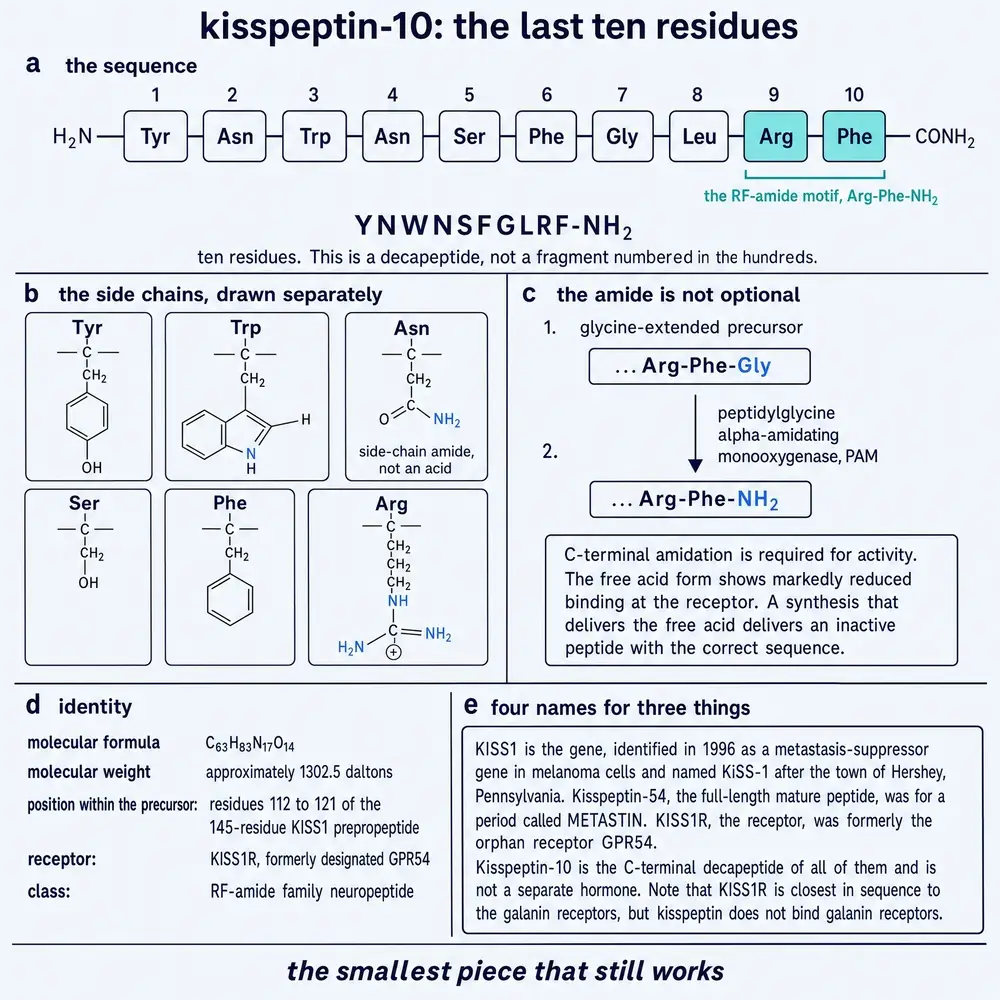
Kisspeptin-10 is a chain of ten amino acids: tyrosine, asparagine, tryptophan, asparagine, serine, phenylalanine, glycine, leucine, arginine, phenylalanine. Written in the one-letter shorthand biochemists use, that is YNWNSFGLRF. The final nitrogen carries two hydrogens rather than the acid group a protein chain normally ends with — the molecule is amidated — and that detail is not cosmetic. Remove the amide and the molecule stops working.
Its formula is C63H83N17O14 and it weighs about 1,302 daltons. Those numbers are worth a sentence about how they were obtained, because in this series they have been wrong before when taken from a database and believed. Ten free amino acids, added together, come to C63H100N16O24. Joining them into a chain forms nine peptide bonds and each one expels a molecule of water. Capping the end with an amide swaps an oxygen for a nitrogen. Do that arithmetic and you get C63H83N17O14, which is what the reference database prints, and a mass that agrees with the published figure to six hundredths of a dalton. The molecule and its label describe the same thing.
The last two residues, arginine and phenylalanine, are the reason this molecule exists in the form it does. Together with the terminal amide they compose the RFamide motif, a signature shared by a whole superfamily of signalling peptides across the animal kingdom. The receptor reads that motif. Almost everything else in the chain is scaffolding that holds it in the right shape.
Which brings us immediately to the difficulty this document is organised around.
02Not one kisspeptin, but four
The gene does not make kisspeptin-10. It makes a precursor protein 145 residues long, which is then cut down — first to a 54-residue peptide, then to shorter forms of 14, 13 and 10 residues (Skorupskaite et al., 2014). All four share the same C-terminus. All four carry the same RFamide motif. All four bind the same site on the same receptor.
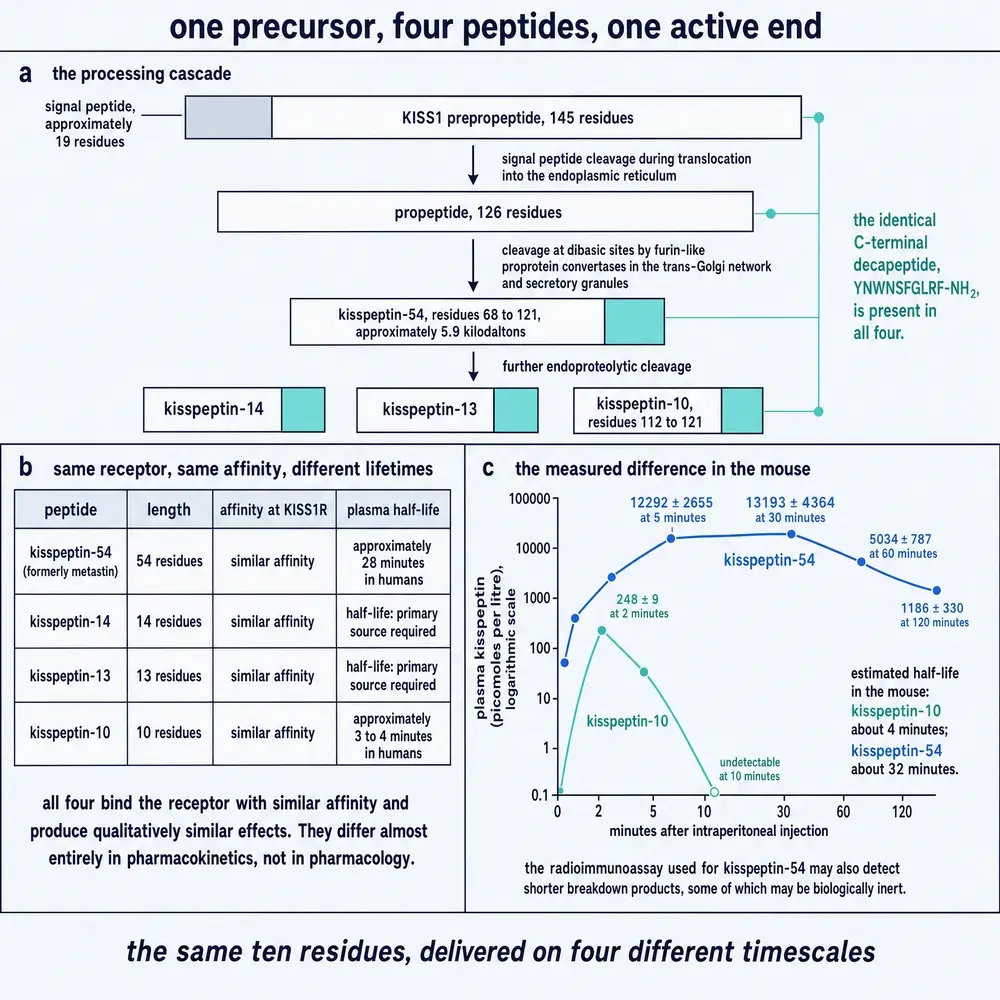
So kisspeptin-10 is not a fragment of the active molecule in the way that, say, a broken-off piece of an enzyme is a fragment. It is the active molecule, with the front end removed. The longer forms are the same business end with more chain attached in front of it.
This is elegant biology and a serious problem for anyone trying to read the literature. When a paper reports that “kisspeptin” raised luteinising hormone in a group of volunteers, that sentence is true of a family whose members differ five-fold in length, differ several-fold in how long they survive in blood, and in at least one case differ in whether they work at all by a given route. Sorting out which member did what is the analytical spine of this document, and Part Four does it study by study.
03Hershey, Pennsylvania, 1996
The molecule was not discovered. Its gene was, and it was discovered by people looking for something else entirely.
In the mid-1990s the question of why some tumours spread and others do not was being attacked genetically. It was known that pushing a normal human chromosome 6 into malignant melanoma cells made those cells much less able to metastasise, without making them any less able to grow. Something on that chromosome was suppressing metastasis specifically. A group at the Penn State College of Medicine, in Hershey, Pennsylvania, went looking for it by subtractive hybridisation — comparing the genes switched on in metastasis-suppressed hybrid cells against those in the aggressive parent line, and keeping the difference. They found a novel gene (Lee et al., 1996).
They called it KiSS-1. Hershey is the town where Hershey’s Kisses are made, and the laboratory named the gene after the local product; the capitalised SS stands for suppressor sequence (Skorupskaite et al., 2014). It is the only gene in mainstream human endocrinology named after a confectionery, and the name has survived thirty years of increasingly serious science being done under it.
That the gene encoded a secreted hormone. That the hormone had a receptor. That the receptor was already sitting in other laboratories’ freezers, catalogued and unexplained. Or that the whole thing had anything whatever to do with reproduction. KiSS-1 was, for five years, a cancer gene.
The follow-up work stayed in oncology. Transfecting the gene into human breast carcinoma cells suppressed their metastasis too, and the gene was mapped to the long arm of chromosome 1. Its structure was worked out: four exons, of which the first two are not translated. Nothing about any of this suggested a hormone that governs fertility.
04Three laboratories, one orphan, 2001
Meanwhile a different problem was being worked on in industry. The human genome contains a large number of orphan G-protein-coupled receptors — receptors identified by their DNA sequence, obviously built to receive some chemical signal, with no known signal to receive. Each one is a lock without a key, and each one is potentially a drug target, so pharmaceutical companies invested heavily in finding the keys. One such orphan, cloned from rat brain in 1999 and given the catalogue name GPR54, sat unclaimed.
In 2001 three groups solved it, effectively simultaneously, and each named what they had found differently.
A team at Takeda reported in Nature that the ligand for the receptor was a peptide encoded by KiSS-1, and named the 54-residue peptide metastin, for its metastasis-suppressing properties (Ohtaki et al., 2001). A team at what was then SmithKline Beecham reported the same receptor under the name AXOR12, activated by the KiSS-1 peptide (Muir et al., 2001). A third group described the receptor as the natural target of a set of peptides they called kisspeptins — the name that eventually won (Kotani et al., 2001). A fourth designation, hOT7T175, was in circulation at the same time. The receptor is now called KISS1R by convention.
One molecule and one receptor acquired at least six names in twelve months: metastin, kisspeptin, KiSS-1 peptide, GPR54, AXOR12, hOT7T175. Anyone searching the literature for this compound must search all of them, and any automated system that does not will silently lose the discovery decade. This document’s corpus was built to admit every one of those designations; section 31 reports what that decision cost and what it recovered.
The receptor itself turned out to be a 398-residue protein with the seven membrane-spanning helices characteristic of its class, encoded on the short arm of chromosome 19. Its closest relatives are the galanin receptors, with which it shares about 40 per cent of its sequence — and yet it binds neither galanin nor galanin-like peptide (Muir et al., 2001). It is a specialist.
05The reversal, 2003
The two 2003 papers are worth separating, because they did different things. One was a study of consanguineous families in which the condition segregated, and it identified the causal mutations in the receptor gene by linkage and sequencing. The other paired human genetics with a mouse carrying a disrupted version of the same gene, so that the human observation and the animal model appeared together. Between them they closed the argument in a single year: the association was causal, and it was causal in both species.
Two years later the story turned over completely, and it turned over in the clinic rather than the laboratory.
Hypogonadotropic hypogonadism is the condition of never entering puberty because the brain does not issue the instruction. The gonads are capable; the pituitary is capable; the signal never comes. In its inherited forms it runs in families, and by 2003 those families had been under genetic investigation for years without a full answer.
Two groups, working separately, found that loss-of-function mutations in GPR54 caused it. One reported the finding in families with the condition (de Roux et al., 2003); the other reported it alongside a mouse model carrying the same defect (Seminara et al., 2003). Break this receptor and puberty does not happen. The reciprocal case followed: activating changes in the same pathway are associated with puberty arriving too early (Ghaemi et al., 2019).
It is worth pausing on how strange this is. A gene identified because it stopped melanoma cells from spreading, named after a chocolate, turned out seven years later to encode the hormone without which no mammal reaches sexual maturity. The metastasis work was not wrong — the suppressor effect is real and section 17 returns to it — but it was, in the event, the minor half of the story. Few molecules in modern endocrinology have been recharacterised so completely.
And it established the fact that governs everything in Parts Two and Four: kisspeptin does not act on the pituitary. It acts on the neurons upstream of the pituitary, the ones that make gonadotropin-releasing hormone. It is a signal to the part of the brain that issues signals.
06Switching the receptor on
KISS1R is a G-protein-coupled receptor, which means it does not do anything itself. It converts an event outside the cell — a peptide arriving and sticking — into an event inside it, by changing shape and releasing a G-protein that was waiting on the inner face of the membrane.
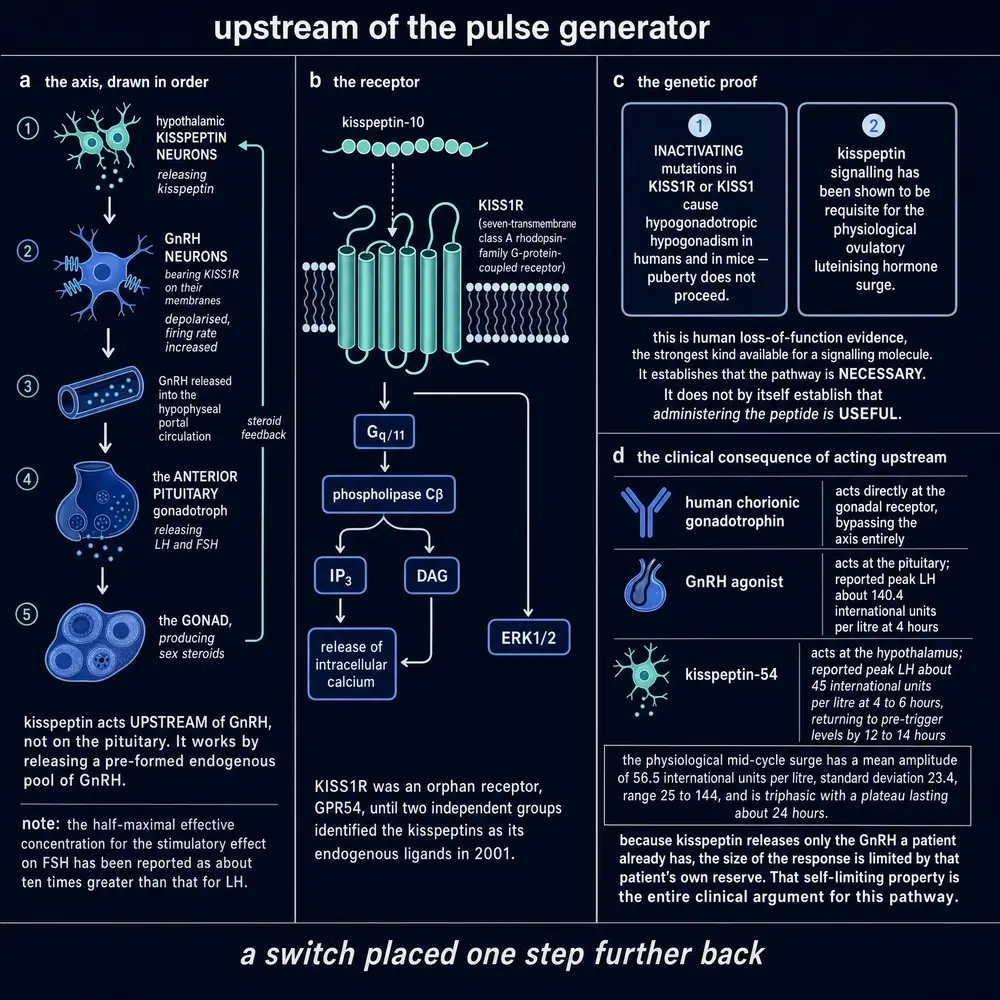
The chain is well worked out. Kisspeptin binds; the receptor couples through the Gq/11 family; that activates phospholipase C, which cuts a membrane lipid into two second messengers, inositol trisphosphate and diacylglycerol; the first releases calcium from internal stores and the second activates protein kinase C (Muir et al., 2001; Skorupskaite et al., 2014). It is one of the standard cascades in cell biology, and by itself it explains nothing interesting about this compound.
What is interesting is the shape of the calcium signal. It is biphasic: a rapid spike, then a slower sustained phase. And holding that second phase open turns out to require the cell to keep physically moving receptor around — internalising it, recycling it, and pulling fresh receptor up from an intracellular reserve. Where that trafficking does not happen, the receptor desensitises after the initial burst (Skorupskaite et al., 2014).
This is the most consequential mechanistic fact in the document, and it is worth stating in plain terms before it reappears in three later sections. Continuous exposure to kisspeptin and pulsed exposure to kisspeptin are not the same intervention. A receptor that is being continuously occupied stops responding. This is not a peculiarity of kisspeptin — it is exactly why continuous GnRH shuts the reproductive axis down while pulsed GnRH switches it on, and it is the basis of an entire class of existing medicines. It predicts, correctly, that a kisspeptin analogue designed for stability and long action might suppress the axis rather than stimulate it. Section 26 records what happened when a company built one.
07Two populations, opposite jobs
Kisspeptin neurons are not distributed evenly through the brain. In mammals they cluster in two hypothalamic regions that do different things.
The arcuate nucleus population is the pulse generator: it drives the rhythmic, roughly hourly discharges of gonadotropin-releasing hormone that keep the reproductive axis ticking over in both sexes. The anteroventral periventricular region — the preoptic area in humans — is the surge generator, responsible in females for the large co-ordinated burst that triggers ovulation. The two populations respond to circulating sex steroids in opposite directions, which is how one negative feedback signal can produce both restraint and, once a month, release.
The arcuate cells have a further feature that has reorganised the field. They co-express two other transmitters alongside kisspeptin: neurokinin B and dynorphin. The three are made in the same cells, and the shorthand for those cells is KNDy neurons. The model is that neurokinin B excites the network and dynorphin inhibits it, so that the cluster alternately drives itself and brakes itself, producing a rhythm; kisspeptin is the output that the GnRH neurons actually read. Accelerator, brake and output wired into one cell type.
In humans these neurons have been mapped in post-mortem hypothalamic tissue and the two sexes are not alike: the infundibular kisspeptin and neurokinin B populations show marked sexual dimorphism (Hrabovszky et al., 2011). That is an anatomical observation in fixed human tissue, not a functional one, and it does not by itself establish that the sexes respond differently to administered peptide.
The KNDy model has been tested directly in people, by giving kisspeptin, neurokinin B and an opioid-receptor antagonist together and watching what the combinations do to gonadotropin secretion (Narayanaswamy et al., 2016). That study is unusual and valuable precisely because the hypothesis it tests was built almost entirely from rodent and sheep work.
More recent work has watched preoptic kisspeptin neurons oscillate over prolonged periods and related that activity to the surge (Zhou et al., 2026). It is an animal study, and it is the newest mechanistic evidence in this corpus.
08The conductor, not the orchestra
Because kisspeptin acts on GnRH neurons rather than on the pituitary, there is a hard limit on what it can ever do therapeutically, and it follows directly from the anatomy: kisspeptin cannot work in a person whose GnRH neurons are missing or non-functional. It is upstream. If the orchestra is absent, a better conductor changes nothing.
This sounds like a technicality and is not. A substantial share of congenital infertility is precisely the absence of functioning GnRH neurons — Kallmann syndrome and its relatives — and those are exactly the patients for whom a new fertility hormone sounds most promising. They are the patients kisspeptin can least help. Conversely, where the GnRH neurons are intact but under-driven, kisspeptin has something to work with, and Part Four shows that this is where the human results are.
09How long it lasts, and why that governs everything
The four kisspeptins are cleared at different rates, and this is the one pharmacological difference between them that is firmly established in humans: the plasma half-life of kisspeptin-10 is roughly six times shorter than that of kisspeptin-54 (Jayasena et al., 2015).
Everything else about the two molecules — the receptor they bind, the cascade they trigger, the motif they present — is the same. Their durability is not. A great deal of what looks like a difference in potency between kisspeptin-10 and kisspeptin-54 in the older literature is, on inspection, a difference in how long each one is still present to act.
The consequence shows up in study design. When a 2025 mouse study of kisspeptin-10 in diet-induced obesity chose to inject twice daily, the authors said plainly that they did so “owing to the relatively short half-life of kisspeptin-10” (Sridhar et al., 2025). When human investigators want steady exposure they infuse continuously rather than giving a bolus. And the one route comparison that exists is unflattering: intravenous kisspeptin-10 raises gonadotropins, but a subcutaneous bolus of kisspeptin-10 failed to do so in healthy women in the follicular phase — a negative result reported in the same body of work that established the positive ones (Jayasena et al., 2015).
For a receptor that desensitises under continuous occupancy, rapid clearance is arguably the desirable property: it produces something closer to the pulses the system is built to read. The molecule that survives longest in blood is not necessarily the one that works best on a receptor like this one. Section 26 describes an analogue engineered for stability whose trials were terminated.
10What each residue does
Because the molecule is only ten residues long, it has been possible to ask what every one of them contributes, by replacing each in turn with alanine and measuring what happens to binding at the human receptor. Few peptides of clinical interest have been mapped this completely.
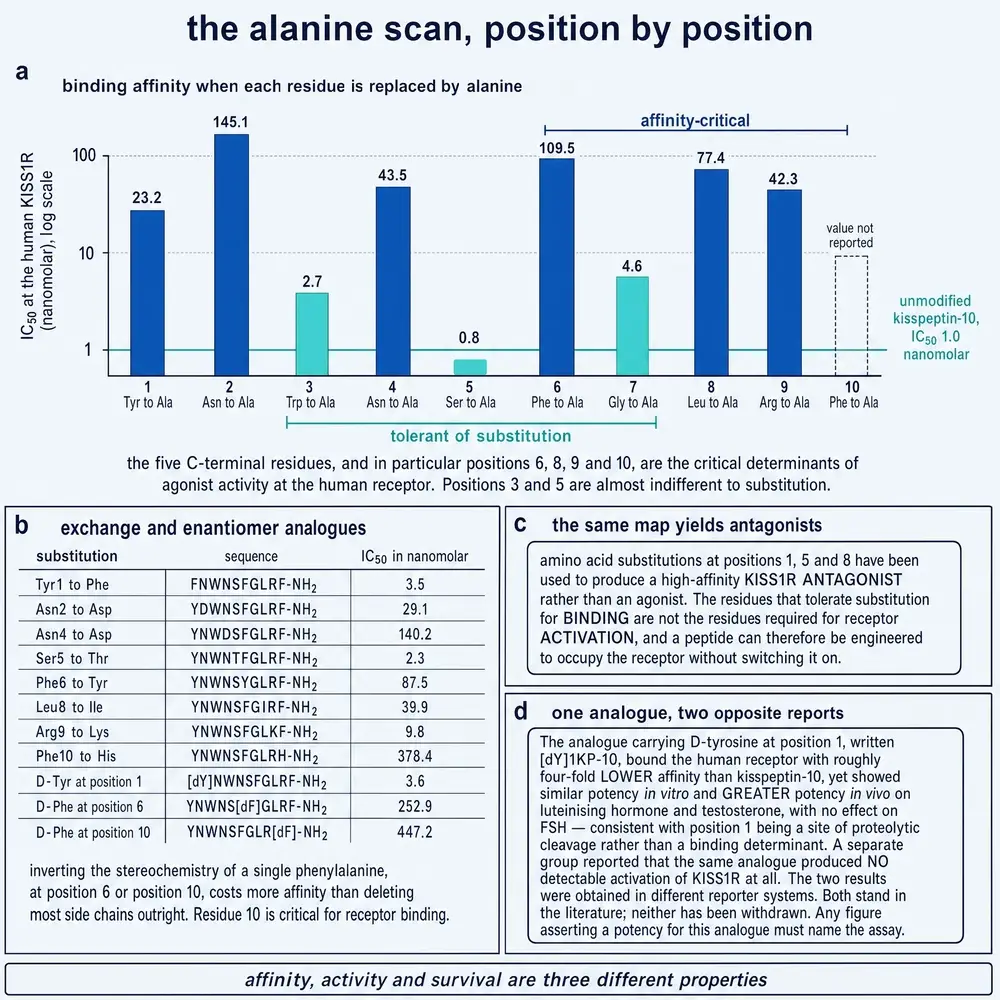
The answer is lopsided. The five C-terminal residues carry the activity, and positions 6, 8, 9 and 10 in particular: replacing any of them costs one to two orders of magnitude of affinity. Positions 3 and 5 are close to indifferent, and substituting the serine at position 5 slightly improves binding. That asymmetry is the structural reason the family behaves as section 02 described — everything N-terminal to the business end is scaffolding, which is why a 54-residue peptide and a 10-residue one bind the same site.
Two further points follow, and both matter later. Inverting the stereochemistry of a single phenylalanine, at position 6 or position 10, costs more affinity than deleting most side chains outright — the receptor is reading shape, not merely composition. And the same map yields antagonists: substitutions at positions 1, 5 and 8 produce a peptide that occupies the receptor without switching it on, which is where the blocking tool of section 11 comes from. Affinity, activity and survival in plasma are three different properties, and a substitution can move one without moving the others.
11The blocker made of the same thing
One further molecule has to be introduced before the evidence sections, because it appears constantly and it does the opposite of what the subject of this document does.
Peptide 234 — also written p234, and sometimes, unhelpfully, kisspeptin-234 — is a substituted analogue of kisspeptin-10 that binds KISS1R and blocks it. It is the field’s standard antagonist, used to prove that an observed effect really was mediated by this receptor. It is a good tool and the experiments using it are often the most rigorous in a given paper.
But its designation contains the parent’s, its literature sits inside the same journals and the same paragraphs, and its results are statements about what happens when kisspeptin signalling is removed. A finding that blocking the receptor abolishes an effect tells you the receptor was necessary. It tells you nothing about what administering kisspeptin-10 would do to a person. This document keeps the two apart, and the corpus that produced it strips the antagonist’s designation before deciding whether a paper is about the subject at all — a step described in section 31.
12What the animals established
The reproductive effect of kisspeptin reproduces across an unusually wide range of species. Exogenous kisspeptin stimulates release of the pituitary gonadotropins in rats, mice, sheep, cattle, monkeys and humans, and the consistency of that finding across mammals is one of the stronger things this document can say (Jayasena et al., 2015). Genetic evidence points the same way from the other direction: animals lacking a functional receptor fail to enter puberty, which is the model that corroborated the human genetics of 2003 (Seminara et al., 2003).
Two cautions attach to the animal literature and both are easy to lose.
The first is sequence. Rodent kisspeptin-10 ends in tyrosine where the human peptide ends in phenylalanine. A rodent study may be administering the human molecule or its own; the two are not identical, and papers do not always say which was used. Where this document reports a rodent result it reports the route and the dose, and where the source names the sequence it says so.
The second is route. Injecting a peptide into the brain’s ventricles and injecting it into a vein are different experiments answering different questions, and a great deal of the early rodent literature is intracerebroventricular. Peripheral administration has to cross from blood into a brain region to reach its target, and the extent to which it does so is a real question rather than an assumption.
That question has been examined carefully in cattle, where the mechanism of luteinising-hormone release after peripheral kisspeptin administration was worked out directly (Leonardi et al., 2022). Livestock work of this kind is often better designed than its profile suggests: the animals are large enough for serial blood sampling, the reproductive endpoints are economically important, and ovulation can actually be observed rather than inferred.
13The heart
Outside reproduction, the best-supported peripheral claim concerns the cardiovascular system, and it is supported in a way most of the others are not: by a causal control.
Receptor messenger RNA has been found in human cardiomyocytes and receptor protein in human atrial and ventricular myocardium. Radioligand binding in human right atrium gives a dissociation constant of 0.12 ± 0.05 nM with a receptor density of 8 ± 5 fmol per milligram of protein — from three individuals — and rat heart gives a comparable sub-nanomolar affinity of 0.44 ± 0.14 nM. Functionally, kisspeptins produced a potent inotropic effect in human paced atrial strips: the tissue contracted harder. And that inotropic response was lost in mice whose receptor gene had been disrupted, which is what turns a correlation into a demonstration that the receptor mediated it (Maguire et al., 2011).
The same body of work reported that kisspeptin is a potent vasoconstrictor in human coronary artery and umbilical vein, and that receptor expression in human vasculature is restricted to vessels sharing a common developmental origin — aorta, coronary artery, umbilical vein (Sawyer et al., 2011). A separate observation from the cardiac study is that kisspeptin levels were reduced in the hearts of patients with ischaemic heart disease.
Rat work has reported that kisspeptin-10 increases collagen content in the myocardium through focal adhesion kinase signalling (Radwańska et al., 2023). It is worth noticing that increasing myocardial collagen is not obviously a benefit — fibrosis is how hearts stiffen — and the paper is reporting a mechanism rather than a therapy.
A molecule that constricts human coronary artery is not a neutral finding in a compound sold informally for other purposes. No human study in this corpus reports an adverse cardiovascular event from kisspeptin administration — but no human study has been designed to look for one either, and the exposures have been minutes to hours.
14Bone
Kisspeptin-10 binding to the receptor on osteoclasts has been reported to prevent bone loss, through a phosphatase-mediated dephosphorylation of Src (Li et al., 2024). This is a mouse and cell study, and it is the mechanistic counterpart to the human bone work in section 22. Readers consulting the original should note that it carries a published author correction; the correction concerns the article as issued and this document cites the study itself.
15Metabolism, liver and pancreas — and a warning about who did what
This is the part of the peripheral literature where the attribution problem does the most damage, and the damage is not hypothetical.
In isolated murine islets, kisspeptin-10 potentiates insulin secretion at elevated glucose while leaving basal secretion alone, apparently by raising cellular redox potential rather than by altering calcium signalling (Schwetz et al., 2014). In high-fat-fed female mice, kisspeptin-10 given intraperitoneally twice daily for 21 days reduced body weight and non-fasting glucose to the levels of healthy controls — 32.4 ± 0.9 g against 35.1 ± 1.5 g, and 7.2 mmol/L in both groups — and restored energy intake to normal (Sridhar et al., 2025). That study also produced an internal discordance its authors flagged: the counts of gut hormone-producing cells rose while the circulating concentrations of those same hormones fell.
Now the two papers that a casual reader would file alongside those. One is titled to the effect that kisspeptin mitigates hepatic de novo lipogenesis; the other, that kisspeptin alleviates human hepatic fibrogenesis. Both are careful, interesting studies. Neither administered kisspeptin-10. Both used TAK-448, a stabilised analogue, referred to throughout as “KPA” (Izarraras et al., 2025; Prasad et al., 2024). The liver findings in this corpus belong to an engineered analogue whose own clinical trials were terminated, not to the decapeptide.
There is a second problem with the non-reproductive literature, and it is about dose.
Resting circulating kisspeptin in humans is below 2 pM, rising perhaps a thousand- to seven-thousand-fold in pregnancy (Hill et al., 2024). Several of the headline mechanistic findings were obtained at 1 µM — around five hundred thousand times the resting concentration, and still roughly seventy times the peak of human pregnancy. That does not make them wrong. Receptor pharmacology is legitimately done at saturating concentrations. It does mean they are statements about what the receptor can do, not statements about what a body does, and they should not be read across.
The same paper that supplies that benchmark is also the best-quantified in this cluster: kisspeptin-10 at 1 µM raised islet Ccnd1 expression by 32 per cent and Tph-1 by 4.32-fold at stimulatory glucose, with no effect at low glucose, while a receptor knockdown reduced the proportion of high-serotonin beta cells from 28.7 ± 2.2 per cent to 20.3 ± 2.2 per cent (P = 0.025). Its authors also report, against their own interest, that the effect disappears at a stricter counting threshold, and that kisspeptin-10 has elsewhere been found to inhibit serotonin synthesis in a hypothalamic cell line (Hill et al., 2024). That is how a disputed result should be presented.
Applied directly to islets, kisspeptins stimulate glucose-induced insulin secretion. In a competing model, liver-derived kisspeptin suppresses it — which has led some authors to propose blocking the receptor as a diabetes strategy, the opposite therapeutic direction to the animal studies above. Both positions are held in the current literature. This document reports the disagreement rather than choosing a side, because the evidence does not settle it.
Two further limits belong here. No two papers in this metabolic cluster independently replicate the same endpoint in the same model; five of them describe themselves as first reports. And of the papers that administered anything, four are female-only and three male-only, with none studying both sexes in parallel — in an axis that is sexually dimorphic by construction.
16Placenta, and other organs
Kisspeptin is produced in enormous quantity by the placenta, which is why circulating concentrations rise so steeply in pregnancy, and it has been implicated in trophoblast invasion — a process that resembles metastasis closely enough that the connection to the original cancer work is not a coincidence. Circulating kisspeptin has also been examined as a marker in early-pregnancy complications. These are measurements of the body’s own peptide, not administration studies, and the distinction matters: a biomarker association tells you the molecule is involved, not that giving more of it helps.
17The cancer question, thirty years on
Does the finding that started everything still stand?
Partly. Kisspeptin retains antitumour activity in some systems — it has been reported to act against human malignant mesothelioma cells (Ciaramella et al., 2018) — and the mechanism proposed in 1996, suppression of motility and invasion without suppression of growth, is consistent with what is known about receptor signalling.
But the picture has not stayed clean. Expression of the gene does not track prognosis in one direction across all tumour types, and in some tissues kisspeptin signalling has been associated with pro-invasive rather than anti-invasive behaviour. The honest summary is that KISS1 is a metastasis suppressor in the melanoma and breast models where it was characterised, that the effect is real, and that it has not generalised into a therapy in thirty years of trying.
Which is itself the pattern of this compound, and Part Five is about why.
18First in human, 2005
Kisspeptin reached people four years after its receptor was identified. A group at Imperial College London gave it to healthy men and showed that it stimulated the hypothalamic-pituitary-gonadal axis (Dhillo et al., 2005). Two years later the same group extended the work to women and found something the animal literature had predicted: the response depends on where in the menstrual cycle it is given, and is most potent in the preovulatory phase (Dhillo et al., 2007).
Both papers name their molecule in their titles. It was kisspeptin-54.
That is not a criticism of the studies, which are careful and were first. It is the beginning of a pattern that runs through the entire human literature, and the reason this document was organised the way it is.
19The one direct comparison
In 2015 the same group did the experiment that the field needed: it gave healthy men vehicle, kisspeptin-10, kisspeptin-54 and GnRH intravenously on separate days, at equimolar doses, by three-hour infusion, in a single-blinded placebo-controlled design (Jayasena et al., 2015).
At the highest dose tested, 1.0 nmol/kg/h, the area under the curve for serum luteinising hormone during the infusion was 10.81 ± 1.73 h·IU/L for kisspeptin-10, 14.43 ± 1.27 for kisspeptin-54 and 34.06 ± 5.18 for GnRH. GnRH was about three times as potent as kisspeptin-10 (P < 0.001) and about twice as potent as kisspeptin-54 (P < 0.01). Five participants were studied per dosing group, and the authors name the small sample as a limitation.
Three things follow, and they are the load-bearing conclusions of this document.
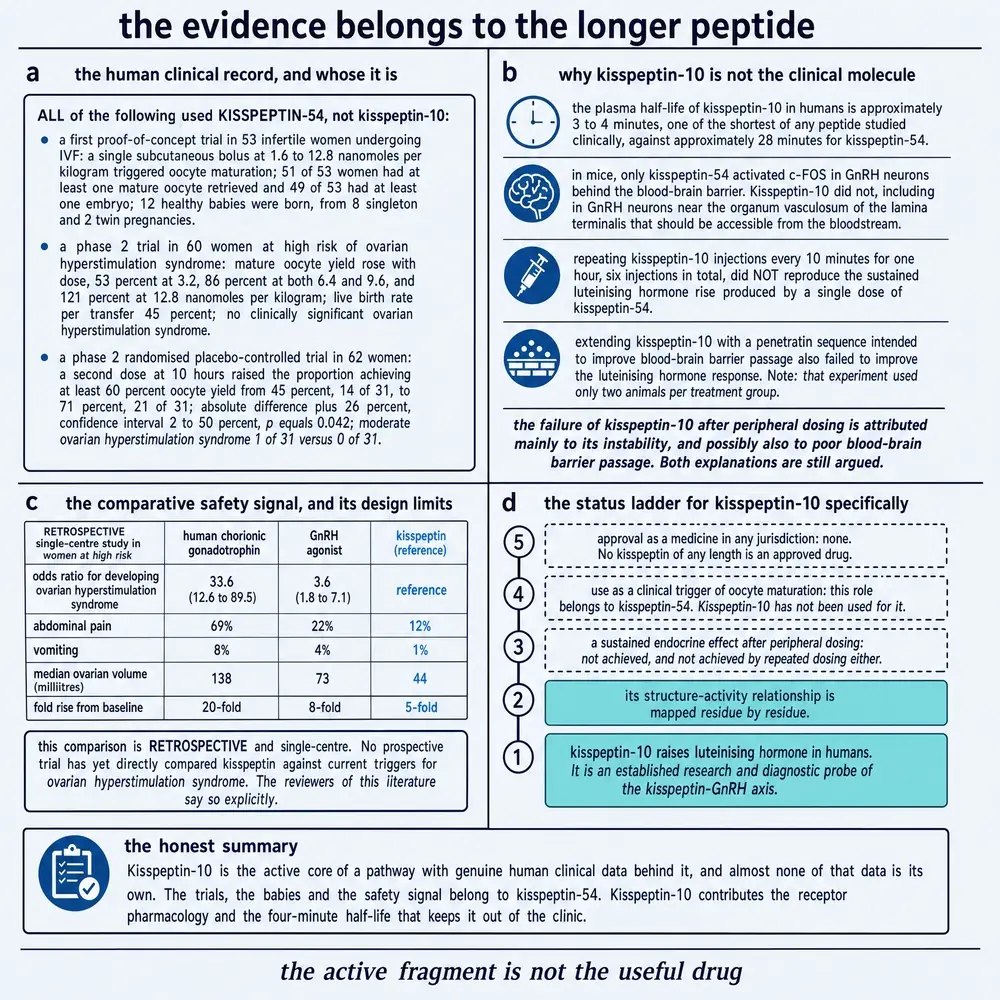
First, the two kisspeptins were similar to each other. Rodent work had predicted that kisspeptin-54 would be the more potent; in humans, at these doses, by this route, it was not. The six-fold difference in half-life did not translate into a proportionate difference in gonadotropin output over a three-hour infusion.
Second, the older molecule beat both of them. GnRH — cheap, available for decades, and acting one step further down the same axis — produced roughly three times the luteinising-hormone response of kisspeptin-10. Any clinical case for kisspeptin therefore cannot rest on raw potency. It has to rest on the claim that kisspeptin stimulates the axis in a more physiological way, which is plausible, mechanistically motivated, and not the same as demonstrated.
Third, route matters more than the literature admits. Intravenous kisspeptin-10 works. A subcutaneous bolus of kisspeptin-10 failed to raise gonadotropins significantly in healthy women in the follicular phase. A negative result of that kind, in a compound whose informal reputation rests on injection, deserves more prominence than it usually gets.
20An audit: which molecule was actually given
Because the point is easy to state and easy to forget, here it is as a table.
The best-known human results attributed to kisspeptin — the fertility work, the bone data, the sexual-desire trials — were obtained with kisspeptin-54. The studies that used kisspeptin-10 are smaller, more physiological, and much less well known: responses across the stages of puberty in boys, insulin-secretion protocols, and the comparison above.
This is not a flaw in those studies. It is a flaw in how they are summarised downstream. A reader who encounters “kisspeptin improves sexual desire” and buys a vial labelled kisspeptin-10 has made an inference the evidence does not support, and nothing in the source material warned them.
21Puberty, measured directly
The most direct human work on kisspeptin-10 concerns the process it was famous for governing. Boys classified into the five Tanner stages of pubertal development, plus adult men, were given an intravenous bolus of kisspeptin-10 — identified in the methods as metastin(45–54) — and their luteinising hormone and testosterone followed (Nabi et al., 2018). The responsiveness of the axis changed across pubertal transition, with the earliest stages not responding significantly. Twenty-five children and five adults took part.
The design has the virtue of asking a question only a human study can answer and the limitation of a small sample per stage. It is registered as a Phase 3 study, which section 26 explains is a label rather than a description.
22Bone
Kisspeptin’s effect on human bone metabolism has been examined in both directions at once: in human cells and in a randomised trial (Comninos et al., 2022).
In vitro, one nanomolar kisspeptin raised alkaline phosphatase activity in human mesenchymal stem cells by 41.1 per cent (P = 0.0022), indicating enhanced osteoblast differentiation, and suppressed osteoclast resorptive activity dose-dependently by up to 53.4 per cent (P < 0.0001). The osteoclast effect was consistent across all eight human donors, which is a stronger form of evidence than a single-cell-line result.
Clinically, 26 healthy eugonadal men took part in a randomised, double-blind, placebo-controlled, two-way crossover study. Kisspeptin increased total osteocalcin by up to 20.3 per cent (P = 0.021) and carboxylated osteocalcin by up to 24.3 per cent (P = 0.014), without changing resorption markers, and independently of downstream sex steroids.
Two qualifications must travel with those numbers. The men received kisspeptin-54, at 1 nmol/kg/h intravenously. And the infusion lasted ninety minutes. Osteocalcin is a marker of bone formation; an acute change in a turnover marker over ninety minutes is a signal that something is happening to osteoblasts, not evidence about bone density, and certainly not evidence about fractures. The in-vitro concentrations, unusually for the non-reproductive literature, sit within the range a human body actually reaches.
23Fertility treatment, and the problem it might solve
The strongest clinical case anyone has made for a kisspeptin is in in-vitro fertilisation, and it turns on a specific harm.
In conventional IVF, final maturation of the eggs is triggered with human chorionic gonadotropin. It works, and it carries a risk: ovarian hyperstimulation syndrome, an iatrogenic complication that can be severe and occasionally fatal in otherwise healthy women. Part of why hCG causes it is that hCG lasts a long time in the body. A trigger that did the same job and then went away would be safer by construction.
Kisspeptin does that job by a different mechanism: instead of imitating the luteinising-hormone surge, it asks the woman’s own hypothalamus to produce one. Kisspeptin-54 has been shown to trigger oocyte maturation in women at high risk of ovarian hyperstimulation syndrome (Abbara et al., 2015), and a second dose was subsequently shown to improve oocyte maturation in the same high-risk population (Abbara et al., 2017).
This is a genuine and rather elegant clinical idea. It is also kisspeptin-54’s, not kisspeptin-10’s. And the largest registered trial in the programme records its intervention only as “Kisspeptin” at doses in nmol/kg, without naming the form — so a reader working from the registry alone cannot tell which molecule was given. Section 26 returns to that.
24Brain, mood and sexual desire
The most publicised recent human work concerns sexual function, and it deserves both credit and care.
In men with hypoactive sexual desire disorder, kisspeptin modulated activity in the brain’s sexual-processing network against placebo, with a Cohen’s d of 0.81 (95 per cent CI 0.41 to 1.21, P = 0.003) on whole-brain analysis (Mills et al., 2023). Thirty-seven men were randomised and 32 completed a double-blind, two-way crossover, placebo-controlled protocol. That was the primary endpoint, and it was met. Secondary findings included increased penile tumescence in response to sexual stimuli, up to 56 per cent above placebo (mean difference 0.28 units, 95 per cent CI 0.04 to 0.52, P = 0.02), and an increase in self-reported happiness about sex of 0.63 points (95 per cent CI 0.10 to 1.15, P = 0.02). A companion trial studied women with the same condition (Thurston et al., 2022).
The findings a general reader is most likely to have encountered are the secondary ones. They are real, they are pre-specified, and they come from a crossover trial of 32 people with an infusion lasting 75 minutes. That is a reason to run a larger and longer trial. It is not a demonstration of clinical benefit, and the trials themselves do not claim otherwise — the published conclusion is that kisspeptin has potential as a treatment.
Both trials administered kisspeptin-54.
The same programme has reported a useful negative: kisspeptin administration stimulates reproductive hormones but does not affect anxiety in humans (Mills et al., 2025). Null results in this area are worth as much as positive ones, because a peptide that alters limbic activity invites broad claims about mood, and this one has been tested and did not move that endpoint.
25Routes, disorders, and what has not been tested
Intranasal administration has been shown to stimulate gonadotropin release rapidly in humans (Mills et al., 2025), which matters because the route is non-invasive and the peptides are short-lived. Kisspeptin has also been used as a diagnostic probe rather than a treatment: it helps discriminate between functional hypothalamic amenorrhoea and other causes of the same presentation (Phylactou et al., 2021). That diagnostic role is under-discussed and may be the most durable clinical use the family has.
Against all of this stands a plain statement of what has never been done. Human exposures to any kisspeptin have been measured in minutes to hours. The largest interventional study of kisspeptin-10 on the public registry enrolled 256 people and was a Phase 1 physiological protocol. There is no chronic-dosing safety database for any kisspeptin, in any population. No significant acute or chronic adverse effects have been reported across the human programme — and that sentence must be read alongside the fact that no study has been designed or powered to detect them over any extended period.
26What the registry says
Read on 3 August 2026, ClinicalTrials.gov holds 36 studies of kisspeptin: 23 completed, six recruiting, four terminated, two withdrawn and one of unknown status.
Seventeen of them administer kisspeptin-10 — most often under the name kisspeptin 112-121, its residue-span designation, which is the single commonest intervention string in the whole set. Ten are observational studies measuring the body’s own peptide rather than giving any. Three used the analogue TAK-448. And six record only the bare word “kisspeptin”, so the registry alone cannot say which molecule was given. That last group includes the largest interventional trial in the set, the IVF programme of section 23, whose publications specify kisspeptin-54.
Three points in that record deserve to be stated plainly.
Every industry registration was terminated. All three TAK-448 studies — the only commercial development programme for a kisspeptin receptor agonist the registry contains — are recorded as terminated. Two state why, in the registry’s own words: a Phase 2a study in hypogonadotropic hypogonadism stopped because “the study did not achieve the primary efficacy objective”, and a Phase 2 study in older men with low testosterone because it “did not meet the primary endpoint”. The third stopped to develop a new formulation. Enrolments were 15, 17 and 9.
Two kisspeptin-10 studies were withdrawn before enrolling anyone, both metabolic protocols; one gives its reason as futility, the other that the planned enrolment was insufficiently powered.
And the three registrations labelled Phase 3 are not what the label suggests. They enrolled 30, 15 and 14 people and are investigator-registered physiological studies. The phase field on ClinicalTrials.gov is supplied by the sponsor and is not audited. A summary that reported “three Phase 3 trials” would be accurate about the registry and misleading about the evidence. Report the enrolment.
27Why a molecule this important has no medicine
Kisspeptin signalling is not marginal biology. Without it, human puberty does not occur. It would be reasonable to expect that a hormone of that standing, identified twenty-five years ago and administered safely to hundreds of people, would by now be a drug. It is not one, anywhere. Four reasons, in the order they bite.
The receptor desensitises. Sustained occupancy shuts the response down, as section 06 described. A conventional drug-development instinct — make it last longer, dose it once a day — works against the target’s own biology. TAK-448 was engineered for exactly that stability, and both of its efficacy trials missed their endpoints.
It needs the neurons to be there. Kisspeptin acts upstream of GnRH, so it can only amplify a system that is present and under-driven. The patients for whom a new fertility hormone sounds most attractive — those without functioning GnRH neurons — are precisely the ones it cannot help.
An older, cheaper molecule is more potent. GnRH produced roughly three times the luteinising-hormone response of kisspeptin-10 in the only direct comparison. Kisspeptin’s case has to be made on the quality of the stimulus rather than its size, and quality is a much harder thing to demonstrate to a regulator.
And where kisspeptin genuinely does something no existing drug does — triggering oocyte maturation without the hyperstimulation risk of hCG — the commercial prize is a single-dose adjunct in one procedure. That is a real clinical benefit and a difficult business case.
28What the evidence supports
Graded honestly, and separating the family members.
Well supported. That kisspeptin signalling is necessary for puberty in humans, from genetics in both directions. That kisspeptin-10 given intravenously raises luteinising hormone and follicle-stimulating hormone in healthy people. That the receptor acts through Gq/11 and phospholipase C and desensitises without trafficking. That the effect reproduces across mammals.
Reasonably supported, for kisspeptin-54 specifically. Oocyte maturation triggering in IVF. Acute increases in bone-formation markers. Modulation of sexual brain processing in hypoactive sexual desire disorder, on a met primary endpoint in a trial of 32 men.
Supported but narrow. Receptor expression and inotropic action in human myocardium, with a knockout control. Vasoconstriction in human coronary artery. Diagnostic discrimination in hypothalamic amenorrhoea.
Single-paper, or resting on concentrations bodies do not reach, or belonging to an analogue rather than to this compound. Most of the metabolic and hepatic literature. The liver findings specifically belong to TAK-448. The serotonin and insulin mechanisms were obtained at roughly half a million times the resting circulating concentration.
Unresolved. Whether kisspeptin stimulates or suppresses insulin secretion, on which the current literature holds both positions. Whether the metastasis-suppressor effect generalises beyond the models it was found in.
29Where the evidence stops
No kisspeptin of any length is an approved medicine in any jurisdiction. There is no approved indication, no marketing authorisation and no proprietary product. Every human exposure on record is research administration under a protocol.
There is no chronic human safety data for any kisspeptin. Exposures have run minutes to hours. A peptide that constricts human coronary artery, alters limbic activity and sits at the head of the reproductive axis has not been given to anyone for a month.
And the attribution problem is not merely an inconvenience for readers: it is a systematic bias in what the secondary literature reports. Because kisspeptin-54 carries the striking clinical results and kisspeptin-10 carries the small physiological ones, and because both are called “kisspeptin”, summaries drift consistently in one direction — towards crediting the shorter, cheaper, more available molecule with the longer one’s achievements. Of 3,445 indexed papers on the family, 3,081 never name which member they studied.
This document describes published research. It does not recommend human use of kisspeptin-10 or of any other compound, and it specifies no dose, route or schedule for any person. Every dose that appears above is a reported experimental parameter, given with the species, the population, the route and the duration to which it applied. Kisspeptin-10 has no approved therapeutic or diagnostic indication in any jurisdiction.
30References
Generated from verified NCBI records rather than from recall. Author lists, journal names, volumes, pages and identifiers are taken from the PubMed record for each citation, and the build refuses to run if any identifier fails to resolve. A separate stage reads every author–year citation back out of the finished prose and checks the surname and the year against the record the identifier resolved to; on this document it verified 52 citations.
- Abbara A, Jayasena CN, Christopoulos G, Narayanaswamy S, Izzi-Engbeaya C, Nijher GM, et al.. Efficacy of Kisspeptin-54 to Trigger Oocyte Maturation in Women at High Risk of Ovarian Hyperstimulation Syndrome (OHSS) During In Vitro Fertilization (IVF) Therapy. J Clin Endocrinol Metab. 2015;100(9):3322-31.
PMID 26192876 · doi:10.1210/jc.2015-2332 · PMC4570165 - Abbara A, Clarke S, Islam R, Prague JK, Comninos AN, Narayanaswamy S, et al.. A second dose of kisspeptin-54 improves oocyte maturation in women at high risk of ovarian hyperstimulation syndrome: a Phase 2 randomized controlled trial. Hum Reprod. 2017;32(9):1915-1924.
PMID 28854728 · doi:10.1093/humrep/dex253 · PMC5850304 - Ciaramella V, Della Corte CM, Di Mauro C, Tomassi S, Di Maro S, Troiani T, et al.. Antitumor efficacy of Kisspeptin in human malignant mesothelioma cells. Oncotarget. 2018;9(27):19273-19282.
PMID 29721201 · doi:10.18632/oncotarget.25018 · PMC5922395 - Comninos AN, Hansen MS, Courtney A, Choudhury S, Yang L, Mills EG, et al.. Acute Effects of Kisspeptin Administration on Bone Metabolism in Healthy Men. J Clin Endocrinol Metab. 2022;107(6):1529-1540.
PMID 35244717 · doi:10.1210/clinem/dgac117 · PMC9113799 - de Roux N, Genin E, Carel JC, Matsuda F, Chaussain JL, Milgrom E. Hypogonadotropic hypogonadism due to loss of function of the KiSS1-derived peptide receptor GPR54. Proc Natl Acad Sci U S A. 2003;100(19):10972-6.
PMID 12944565 · doi:10.1073/pnas.1834399100 · PMC196911 - Dhillo WS, Chaudhri OB, Patterson M, Thompson EL, Murphy KG, Badman MK, et al.. Kisspeptin-54 stimulates the hypothalamic-pituitary gonadal axis in human males. J Clin Endocrinol Metab. 2005;90(12):6609-15.
PMID 16174713 · doi:10.1210/jc.2005-1468 - Dhillo WS, Chaudhri OB, Thompson EL, Murphy KG, Patterson M, Ramachandran R, et al.. Kisspeptin-54 stimulates gonadotropin release most potently during the preovulatory phase of the menstrual cycle in women. J Clin Endocrinol Metab. 2007;92(10):3958-66.
PMID 17635940 · doi:10.1210/jc.2007-1116 - Ghaemi N, Ghahraman M, Noroozi Asl S, Vakili R, Fardi Golyan F, Moghbeli M, et al.. Novel DNA variation of GPR54 gene in familial central precocious puberty. Ital J Pediatr. 2019;45(1):10.
PMID 30635063 · doi:10.1186/s13052-019-0601-6 · PMC6329138 - Hill TG, Smith LIF, Ruz-Maldonado I, Jones PM, Bowe JE. Kisspeptin upregulates β-cell serotonin production during pregnancy. J Endocrinol. 2024;260(2).
PMID 37997938 · doi:10.1530/JOE-23-0218 · PMC10762540 - Hrabovszky E, Molnár CS, Sipos MT, Vida B, Ciofi P, Borsay BA, et al.. Sexual dimorphism of kisspeptin and neurokinin B immunoreactive neurons in the infundibular nucleus of aged men and women. Front Endocrinol (Lausanne). 2011;2:80.
PMID 22654828 · doi:10.3389/fendo.2011.00080 · PMC3356022 - Izarraras K, Shah A, Prasad K, Tan H, Zhou Z, Bhattacharya M. Kisspeptin Mitigates Hepatic De Novo Lipogenesis in Metabolic Dysfunction-Associated Steatotic Liver Disease. Cells. 2025;14(16).
PMID 40862768 · doi:10.3390/cells14161289 · PMC12384258 - Jayasena CN, Abbara A, Narayanaswamy S, Comninos AN, Ratnasabapathy R, Bassett P, et al.. Direct comparison of the effects of intravenous kisspeptin-10, kisspeptin-54 and GnRH on gonadotrophin secretion in healthy men. Hum Reprod. 2015;30(8):1934-41.
PMID 26089302 · doi:10.1093/humrep/dev143 · PMC4507333 - Kotani M, Detheux M, Vandenbogaerde A, Communi D, Vanderwinden JM, Le Poul E, et al.. The metastasis suppressor gene KiSS-1 encodes kisspeptins, the natural ligands of the orphan G protein-coupled receptor GPR54. J Biol Chem. 2001;276(37):34631-6.
PMID 11457843 · doi:10.1074/jbc.M104847200 - Lee JH, Miele ME, Hicks DJ, Phillips KK, Trent JM, Weissman BE, et al.. KiSS-1, a novel human malignant melanoma metastasis-suppressor gene. J Natl Cancer Inst. 1996;88(23):1731-7.
PMID 8944003 · doi:10.1093/jnci/88.23.1731 - Leonardi CEP, Carrasco RA, Dias FCF, Zwiefelhofer EM, Adams GP, Singh J. Mechanism of LH release after peripheral administration of kisspeptin in cattle. PLoS One. 2022;17(12):e0278564.
PMID 36459509 · doi:10.1371/journal.pone.0278564 · PMC9718405 - Li Z, Yang X, Fu R, Wu Z, Xu S, Jiao J, et al.. Kisspeptin-10 binding to Gpr54 in osteoclasts prevents bone loss by activating Dusp18-mediated dephosphorylation of Src. Nat Commun. 2024;15(1):1300.
PMID 38346942 · doi:10.1038/s41467-024-44852-9 · PMC10861593 - Maguire JJ, Kirby HR, Mead EJ, Kuc RE, d'Anglemont de Tassigny X, Colledge WH, et al.. Inotropic action of the puberty hormone kisspeptin in rat, mouse and human: cardiovascular distribution and characteristics of the kisspeptin receptor. PLoS One. 2011;6(11):e27601.
PMID 22132116 · doi:10.1371/journal.pone.0027601 · PMC3222648 - Mills EG, Silva MSB, Delli V, Decoster L, Ternier G, Tsoutsouki J, et al.. Intranasal kisspeptin administration rapidly stimulates gonadotropin release in humans. EBioMedicine. 2025;115:105689.
PMID 40215751 · doi:10.1016/j.ebiom.2025.105689 · PMC12018048 - Mills EG, Ertl N, Wall MB, Thurston L, Yang L, Suladze S, et al.. Effects of Kisspeptin on Sexual Brain Processing and Penile Tumescence in Men With Hypoactive Sexual Desire Disorder: A Randomized Clinical Trial. JAMA Netw Open. 2023;6(2):e2254313.
PMID 36735255 · doi:10.1001/jamanetworkopen.2022.54313 · PMC9898824 - Mills EG, Thurston L, Yang L, Hunjan T, Phylactou M, Patel B, et al.. Kisspeptin Administration Stimulates Reproductive Hormones but Does Not Affect Anxiety in Humans. J Clin Endocrinol Metab. 2025;110(11):3133-3141.
PMID 40036336 · doi:10.1210/clinem/dgaf128 · PMC12527446 - Muir AI, Chamberlain L, Elshourbagy NA, Michalovich D, Moore DJ, Calamari A, et al.. AXOR12, a novel human G protein-coupled receptor, activated by the peptide KiSS-1. J Biol Chem. 2001;276(31):28969-75.
PMID 11387329 · doi:10.1074/jbc.M102743200 - Nabi G, Ullah H, Khan S, Wahab F, Duan P, Ullah R, et al.. Changes in the Responsiveness of the Hypothalamic-Pituitary-Gonadal Axis to Kisspeptin-10 Administration during Pubertal Transition in Boys. Int J Endocrinol. 2018;2018:1475967.
PMID 30046307 · doi:10.1155/2018/1475967 · PMC6038494 - Narayanaswamy S, Prague JK, Jayasena CN, Papadopoulou DA, Mizamtsidi M, Shah AJ, et al.. Investigating the KNDy Hypothesis in Humans by Coadministration of Kisspeptin, Neurokinin B, and Naltrexone in Men. J Clin Endocrinol Metab. 2016;101(9):3429-36.
PMID 27379743 · doi:10.1210/jc.2016-1911 · PMC5010567 - Ohtaki T, Shintani Y, Honda S, Matsumoto H, Hori A, Kanehashi K, et al.. Metastasis suppressor gene KiSS-1 encodes peptide ligand of a G-protein-coupled receptor. Nature. 2001;411(6837):613-7.
PMID 11385580 · doi:10.1038/35079135 - Phylactou M, Clarke SA, Patel B, Baggaley C, Jayasena CN, Kelsey TW, et al.. Clinical and biochemical discriminants between functional hypothalamic amenorrhoea (FHA) and polycystic ovary syndrome (PCOS). Clin Endocrinol (Oxf). 2021;95(2):239-252.
PMID 33354766 · doi:10.1111/cen.14402 · PMC11497304 - Prasad K, Bhattacharya D, Shams SGE, Izarraras K, Hart T, Mayfield B, et al.. Kisspeptin Alleviates Human Hepatic Fibrogenesis by Inhibiting TGFβ Signaling in Hepatic Stellate Cells. Cells. 2024;13(19).
PMID 39404414 · doi:10.3390/cells13191651 · PMC11476267 - Radwańska P, Gałdyszyńska M, Piera L, Drobnik J. Kisspeptin-10 increases collagen content in the myocardium by focal adhesion kinase activity. Sci Rep. 2023;13(1):19977.
PMID 37968564 · doi:10.1038/s41598-023-47224-3 · PMC10651918 - Sawyer I, Smillie SJ, Bodkin JV, Fernandes E, O'Byrne KT, Brain SD. The vasoactive potential of kisspeptin-10 in the peripheral vasculature. PLoS One. 2011;6(2):e14671.
PMID 21347414 · doi:10.1371/journal.pone.0014671 · PMC3036649 - Schwetz TA, Reissaus CA, Piston DW. Differential stimulation of insulin secretion by GLP-1 and Kisspeptin-10. PLoS One. 2014;9(11):e113020.
PMID 25401335 · doi:10.1371/journal.pone.0113020 · PMC4234631 - Seminara SB, Messager S, Chatzidaki EE, Thresher RR, Acierno JS, Shagoury JK, et al.. The GPR54 gene as a regulator of puberty. N Engl J Med. 2003;349(17):1614-27.
PMID 14573733 · doi:10.1056/NEJMoa035322 - Skorupskaite K, George JT, Anderson RA. The kisspeptin-GnRH pathway in human reproductive health and disease. Hum Reprod Update. 2014;20(4):485-500.
PMID 24615662 · doi:10.1093/humupd/dmu009 · PMC4063702 - Sridhar A, Khan D, Muthukumar R, Sampathkumar S, Irwin N, Flatt PR, et al.. Kisspeptin-10 Ameliorates Obesity-Diabetes with Diverse Effects on Ileal Enteroendocrine Cells and Pancreatic Islet Morphology in High-Fat Fed Female Mice. Biomolecules. 2025;15(11).
PMID 41301510 · doi:10.3390/biom15111591 · PMC12650608 - Thurston L, Hunjan T, Ertl N, Wall MB, Mills EG, Suladze S, et al.. Effects of Kisspeptin Administration in Women With Hypoactive Sexual Desire Disorder: A Randomized Clinical Trial. JAMA Netw Open. 2022;5(10):e2236131.
PMID 36287566 · doi:10.1001/jamanetworkopen.2022.36131 · PMC9606846 - Zhou Z, Huang CY, Herbison AE. Prolonged oscillating preoptic area kisspeptin neuron activity underlies the preovulatory luteinizing hormone surge in mice. Elife. 2026;14.
PMID 42095546 · doi:10.7554/eLife.109215 · PMC13152274
Sources without a PubMed record
Registry searches and reference-database entries have no PubMed record and are listed separately, so that the generated list above remains wholly machine-verified. Each states the instrument consulted and the date it was read.
- United States National Library of Medicine. ClinicalTrials.gov - interventional and observational studies of kisspeptin. Queried through API v2 on 3 August 2026 with query.intr=kisspeptin; 36 studies returned. Status, phase, enrolment and the whyStopped field were read directly from the returned records rather than from any summary. The three TAK-448 registrations NCT01132404, NCT02369796 and NCT02381288 are all TERMINATED.
https://clinicaltrials.gov/ - National Center for Biotechnology Information. PubChem Compound Summary CID 25240297, kisspeptin-10. Read 3 August 2026. Molecular formula C₃₃H₃N₁₇O₁₄ as printed there, and average mass 1302.4 Da. Both were independently recomputed from the published residue sequence before use and agree to 0.06 Da.
https://pubchem.ncbi.nlm.nih.gov/compound/25240297
31How this document was assembled
The corpus was built in two layers: the local Therapeutic Peptide Research Library, and an external harvest from PubMed and PubMed Central.
Thirteen thousand local files were opened. Three hundred and ninety-nine named the compound by some designation; 16 were refused by the identity gate and 383 admitted. Of those 383, only 144 are peer-reviewed full texts. The remaining 239 are vendor page snapshots, trade and affiliate copy, and this project’s own earlier internal write-ups — counted, classified by source kind after de-duplication by content hash, and reported here rather than folded into a corpus figure. The ratio of commercial to scientific material, roughly 1.7 to 1, is unusually low for this series; for several compounds previously documented it has run to 20, 45 and even 63 to 1. Kisspeptin-10 still lives mostly in the scientific literature, and that is itself a finding about the compound.
Externally, a five-arm PubMed query returned 3,830 records of which 3,300 were kept as relevant. Because PubMed indexes only titles, abstracts and subject headings, a separate PubMed Central body-text sweep was run — kisspeptin-10 is above all a reagent, named in methods sections of papers whose titles say only “kisspeptin”. That sweep matched 1,267 articles, 758 of them new. In total 2,223 full texts were fetched and screened; 592 were refused by the identity gate as belonging to a relative or another molecule entirely, and 334 more were discarded as passing mentions. The keyed union of the local and external sets, after removing 66 documents present in both, is 1,256 unique scientific full texts, about 14,095 printed-page equivalents.
The identity problem, and what was done about it
Four separate failure modes had to be handled before any counting was trustworthy.
The compound is the active core of its own parent. Requiring the discriminating “-10” would have deleted 3,081 of 3,445 papers, including most of the receptor pharmacology; admitting the bare word “kisspeptin” would have swallowed the kisspeptin-54 clinical programme. The gate therefore admits an unambiguous designation outright, admits the bare notation only with subject-matter corroboration, and then withdraws that admission where any named relative is mentioned at least as often.
The abbreviation is badly overloaded. Of 244 PubMed records containing “Kp10” or “KP-10”, 60 have nothing to do with kisspeptin: they are bacterial strain designators (Paenibacillus polymyxa Kp10, Pediococcus acidilactici Kp10), Klebsiella pneumoniae, the geomagnetic Kp index, ketoprofen, kaempferol, ketamine and a krypton-85 gas standard. No biomedical corroboration separates a geomagnetic index from a peptide, so the abbreviation arm carries an explicit disqualification list.
The designation is a prefix of an unrelated one. “KP-10” is a strict prefix of KP-102, which is pralmorelin — a growth-hormone secretagogue documented elsewhere in this same monograph series and unrelated to kisspeptin. A trailing-digit veto handles it.
And the antagonist is built from the subject. Peptide 234’s designations are stripped from every document before identity is tested at all, so that a paper about blocking the receptor cannot be admitted as a paper about activating it.
The matcher was break-tested against 32 constructed traps — every one of the collisions above, each sibling in isolation, a kisspeptin-54-dominant trial paper, the analogues, the gene and receptor without any peptide, and the RFamide relatives — before the first sweep was run. All 32 behaved as specified.
What was verified against the instrument, and what was not
The trial-registry statements in section 26 were read directly from ClinicalTrials.gov through its API on 3 August 2026, including the reasons for termination, which are quoted verbatim from the registry’s own field rather than from any summary. The molecular formula and mass in section 01 were recomputed from the residue sequence and then compared against the reference database, rather than copied from it.
Two citation errors were caught during assembly and are recorded because the mechanism that caught them is not a gate. The 1996 discovery paper was first identified by a title-pattern search that returned a later paper merely naming the gene; and the osteoclast study was first identified as its own published author correction rather than the study. Both resolve cleanly, both look correct in a reference list, and both were found only by reading the resolved record back. No PMID in this document was written from memory.
32Evidence handling
Findings are labelled by study type in the sentence that reports them. In-vitro results are not phrased to imply an animal outcome and animal results are not phrased to imply a human one. Where a number appears, the species, the population, the route and the duration travel with it.
This document adds one rule of its own, because its subject requires it: every human finding is labelled by the kisspeptin variant actually administered. Where a source names the variant only once, in its methods, that is where the label came from. Where a source does not name it, this document says so rather than guessing.
Conflicting evidence is presented as conflict. Where a newer result does not supersede an older one — as with the insulin-secretion direction dispute in section 15 — both are reported and the disagreement is named. Negative and null findings appear alongside positive ones in the same sections, not quarantined: the failure of subcutaneous kisspeptin-10 to raise gonadotropins in women, the absence of any effect on anxiety, the terminated industry trials and the withdrawn metabolic protocols are all part of the record.
All figures in this document are original works generated from the cited numerical results. No third-party figure has been reproduced. Where a figure shows a schematic pathway rather than measured values, its caption says so.
33Figures
Twelve figures. Seven are authored inline vector graphics generated from the numerical results cited in the sections they accompany. Five are commissioned artwork prepared for this document. No third-party published figure has been reproduced anywhere.
Every commissioned plate was audited before it was admitted, and three were altered. Figure 1 carried a misspelling in its strapline, corrected using the plate’s own letterforms so the typeface matches exactly. Figure 8 carried a misspelling in a panel header, corrected the same way by duplicating the word’s own capital. Figure 5 required a substantive correction: the bar for position 5 of the alanine scan was drawn at roughly 1.4 nM, above the plate’s own 1.0 nM reference line, when its printed value of 0.8 nM places it below — an error that reversed the direction of the finding. The bar was redrawn at its printed value, and a spurious word was removed from that panel’s header. Every alteration is recorded plate by plate in the delivery bundle’s MAPPING.md.
One discrepancy was found and deliberately not corrected, because it belongs to the published source rather than to the artwork: the second-dose trial reproduced in Figure 8 prints “21/31, 71%” in its own abstract, and 21 of 31 is 67.7 per cent. The plate reproduces the paper faithfully and the caption says so.
Each figure’s canvas height is computed from the extent of its own content rather than supplied as a constant, so that no drawing can overflow its own frame and print through the caption beneath it. Where a figure shows a pathway rather than measured values — the signalling cascade, the family diagram — its caption says so and names what is not being asserted. The concentration audit is drawn on a logarithmic axis and says so on the axis itself.
Continue exploring