
HMG The fertility drug distilled from the urine of nuns, and what sixty years of trials could and could not settle
Almost every drug has a molecule. This one has a recipe. Human menopausal gonadotropin is not a compound that was designed, or even discovered in the ordinary sense — it is a fraction, precipitated out of human urine, containing two hormones and an unknown quantity of everything else that happened to come with them. It was first registered in 1950. It produced its first pregnancy at the beginning of the 1960s, at a moment when nobody could yet measure what was in the vial. And it is still on the market today, still sold by the unit of biological activity rather than by weight, still released on the strength of what a dose does to the ovaries of immature rats. Recombinant technology was supposed to retire it thirty years ago. Instead, the most recent systematic review of the question — published in 2026, across fifty-nine trials and eighteen thousand women — found that the urine-derived preparation was associated with more live births and less ovarian hyperstimulation than its engineered replacement. This document is about how a substance nobody can fully specify came to outlast the technology built to replace it, and about how much of that story the evidence will actually carry.
Findings are labelled by the kind of study that produced them, in the sentence that reports them. A result in a rat is called a result in a rat. A pooled estimate across trials is called that, and is not reported as though it were a single measurement. Where a number appears, the population, the protocol and the endpoint travel with it.
Several preparations appear in these pages and they are not interchangeable. HMG — menotropin — is the subject: a urinary extract carrying both follicle-stimulating and luteinising activity. HP-hMG is the same substance at modern purity and is also the subject. Urinary FSH (urofollitropin, Metrodin, Bravelle) is made from the same urine by the same industry with the luteinising activity removed, and is a different product. Recombinant FSH (follitropin alfa and beta, Gonal-F, Puregon) is the engineered comparator against which almost every modern trial of HMG has been run. hCG is a fourth thing again: a related hormone, the trigger injection used at the end of most protocols, and — this is the part that surprises people — a component of the subject itself.
And the abbreviation is not the subject’s property. In the wider biomedical literature “HMG” far more often means HMG-CoA reductase, the enzyme every statin inhibits, or the high-mobility-group proteins that bind DNA. Neither has anything to do with reproduction. How this document kept them out is set out in Section 01 and in the Apparatus, because on this compound it is not a technicality — it is most of the work.
Doses appear only as reported study parameters. Nothing in this document recommends human use of any preparation, and it specifies no dose, route or schedule for any person.
01Three literatures, one abbreviation
Most monographs in this series begin with a structure. This one has to begin with a disambiguation, because the three letters on the label belong to at least three unrelated sciences and the subject of this document is comfortably the smallest of them.
Searching the biomedical literature for “HMG” on 3 August 2026 returns 17,400 records. Searching for HMG-CoA — 3-hydroxy-3-methylglutaryl coenzyme A, the substrate of the enzyme that every statin in the world was built to inhibit — returns 14,694. Searching for the high-mobility-group proteins, a family of DNA-binding molecules that includes HMGB1, HMGA2 and the HMG-box fold carried by the sex-determining factor SRY, returns 23,271. Searching for menotropin, which is what this document is about, returns 3,281.
This is worse than an inconvenience, and it is worse than the usual kind of name collision. The standard defence against an ambiguous drug name is to demand that the match be case-sensitive and bounded on both sides — that the letters stand alone as a word rather than turning up inside a longer one. That defence does nothing here. In the phrase HMG-CoA reductase the string HMG genuinely is present, genuinely does stand alone, and is capitalised in exactly the way menotropin papers capitalise it. A matcher built to the usual standard admits fourteen thousand papers about cholesterol.
Nor can the problem be solved by demanding that reproductive vocabulary appear nearby. Cholesterol is the raw material from which the ovary makes its steroids, so papers about HMG-CoA reductase in granulosa cells are not a freak occurrence — they are a research field. Ovarian tissue, oestradiol, follicles and the mevalonate pathway legitimately co-occur.
What works is to invert the question. Every one of these literatures spells its own expansion out, because it has to, for its own readers: a statin paper writes “HMG-CoA” and a chromatin paper writes “high mobility group”. So rather than trying to prove that a document is about menotropin, it is cheaper and far more reliable to disqualify a bare match that sits beside a known non-subject expansion, and to admit on the unambiguous designations — menotropin, human menopausal gonadotropin, the brand names — which no other field uses. Applied to this project’s own peptide library, that gate refused roughly a third of everything the string match proposed, specifically because those documents were about a different molecule. The measurement is in Section 19.
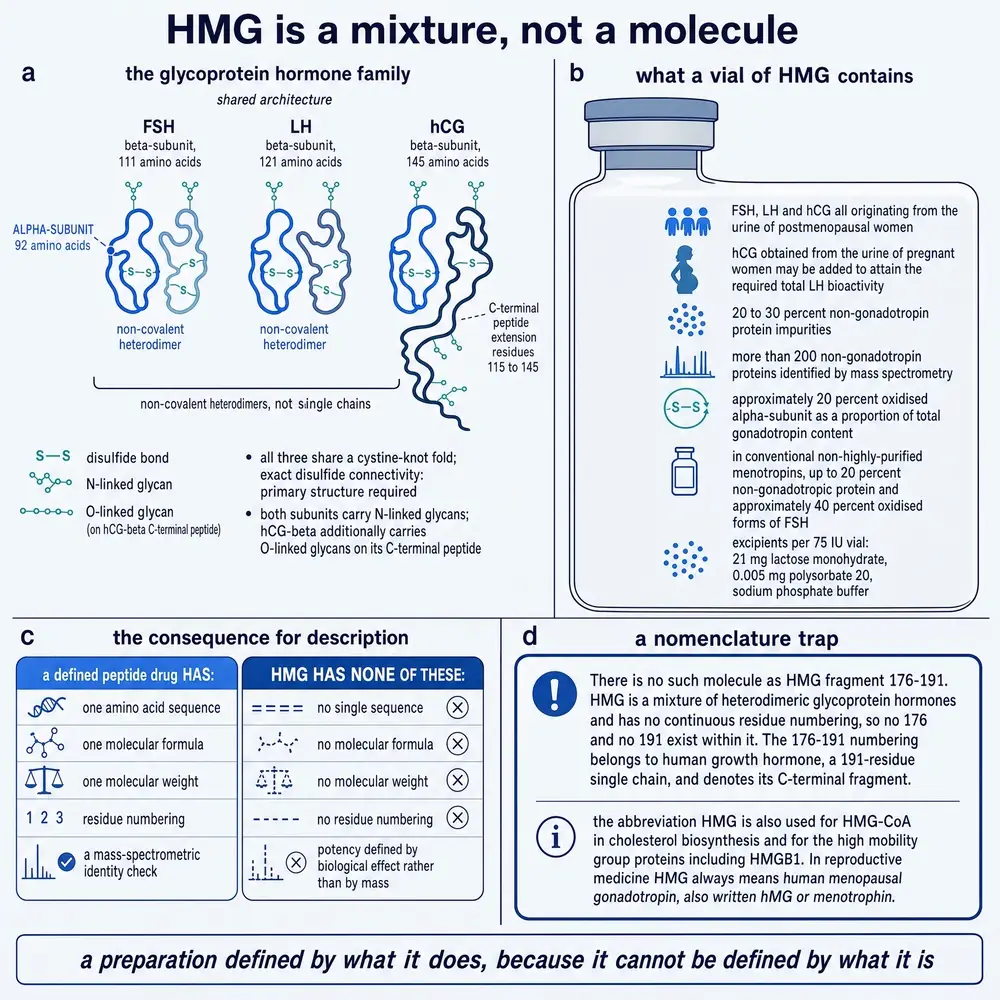
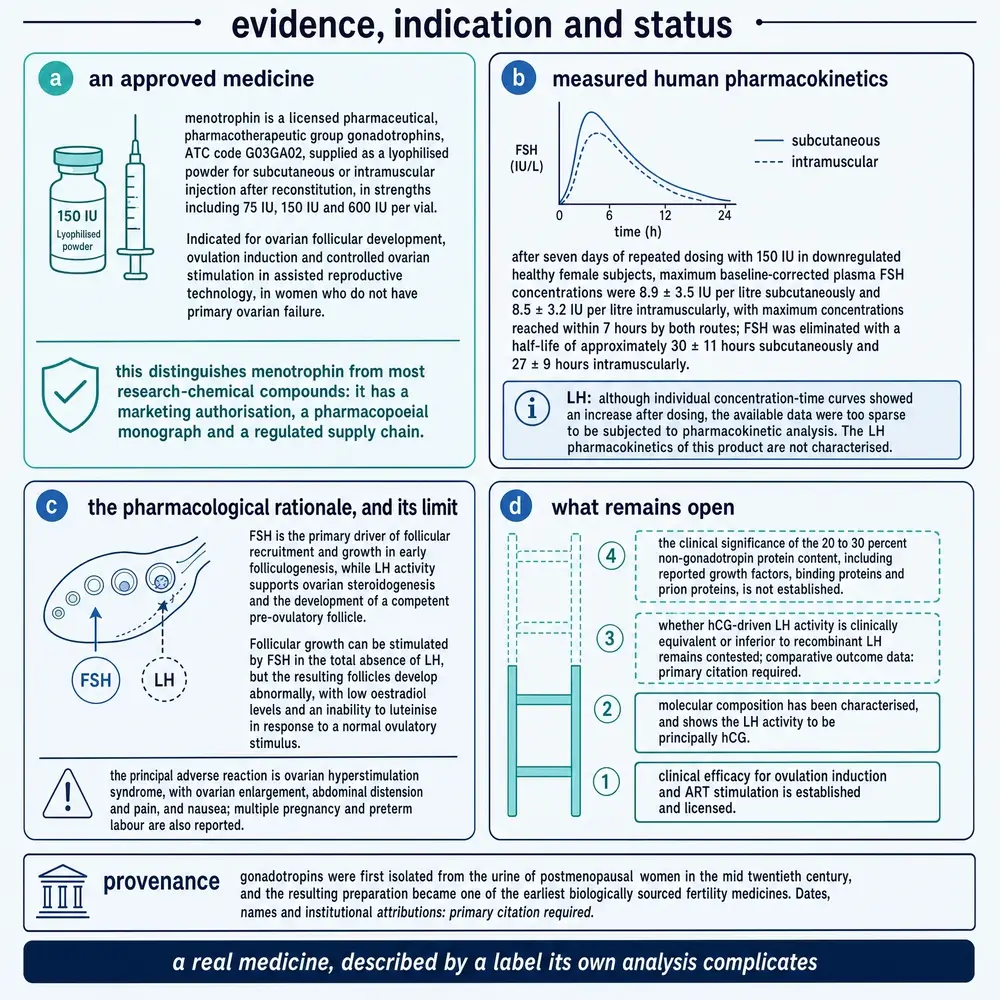
HMG is not a single molecule and no amount of careful writing will make it one. It is a preparation: a mixture of glycoprotein hormones extracted from the urine of postmenopausal women, whose active components are follicle-stimulating hormone, luteinising hormone and chorionic gonadotropin, together with — in the words of a 2026 analysis of sixty-nine manufacturing batches — “many unknown components” (Sun et al., 2026). Everywhere in this document that a claim would be cleaner if the subject were one molecule, the fact that it is not is the reason the claim is not clean.
02The chemist, the convent, and the company
The problem that produced this drug was arithmetic. By the late 1930s it was understood that the pituitary gland governs the ovary through gonadotropic hormones, and that supplying those hormones from outside might make an ovary ovulate that otherwise would not. The difficulty was obtaining them. Hormones extracted from animal pituitaries worked for a while and then stopped working, because the recipient’s immune system learned to recognise them — gonadotropin from a pregnant mare’s serum provoked neutralising antibodies and had to be abandoned. Human material was needed, and human pituitary glands are only available from the dead.
The insight that produced HMG was that you do not need the gland. After the menopause the ovaries stop responding, the feedback loop that normally restrains the pituitary is released, and the pituitary pours out gonadotropins — which are excreted, in small quantities, in urine. Postmenopausal women are, in effect, a renewable source of the very hormones that infertile younger women lack. The raw material is free, continuously produced, and requires nobody to die.
The extraction is attributed to Piero Donini, a chemist at the Istituto Farmacologico Serono in Rome, working around 1949, and the product he obtained was named Pergonal — from the Italian per gonadi, from the gonads. It is worth being precise about the standing of that account. It appears in the corporate history published by Serono’s successor company and is repeated widely in popular writing; it does not appear in the peer-reviewed historical reviews of gonadotropin development that this document relies on elsewhere, and Donini himself has no indexed authorship in the biomedical literature for this work at all. What the peer-reviewed record does establish is the outcome: the first HMG preparations were registered by Serono in Italy in 1950, and they were impure in protein content with no standardised proportion of the two hormones (Lunenfeld, 2019).
Then came the supply problem, and with it the part of the story that has outlived every other detail. Extracting a useful quantity of gonadotropin required urine in industrial volumes — thousands of litres a year, rising into far larger quantities as the product succeeded. Ordinary collection could not sustain it. The solution, as the company’s own history and a large popular literature describe it, was to recruit postmenopausal women living in religious communities: nuns in convents across Italy, collecting into supplied containers, with the material transported to Rome for processing. The arrangement is often said to have been facilitated by the Pacelli family, and to have carried the blessing of Pope Pius XII.
Two things should be said about that story. The first is that its significance is real and not merely colourful: a pharmaceutical supply chain that depends on the biology of its donors is fragile in a way a chemical synthesis is not, and the constraint shaped everything that followed — the purity, the batch variability, the eventual commercial pressure toward a recombinant product. The second is that the details of the ecclesiastical arrangement rest on corporate and popular sources rather than on the scientific record, and this document reports them as such. Where a claim in these pages rests on a company’s account of its own past, that is stated rather than smoothed over.
03The rival made from the dead, and why it lost
HMG did not win its position unopposed. Through the 1960s and 1970s the serious competitor was human pituitary gonadotropin, extracted from the pituitary glands of cadavers — the approach associated with Carl Gemzell in Sweden. It worked, and for a period it worked at least as well as the urinary product.
It ended in disaster. Human pituitary extract was found to transmit Creutzfeldt–Jakob disease, a fatal and untreatable spongiform encephalopathy with an incubation period long enough that recipients were exposed for years before anyone understood the risk. That, together with a supply which could never be scaled and the arrival of recombinant technology, drove human pituitary gonadotropin off the market by the late 1980s (Lunenfeld, 2004; Lunenfeld, 2019).
The episode matters to this document for three reasons. It is the reason gonadotropin therapy is unusually alert to the provenance of its raw material, a sensitivity that would later be turned on urinary products too. It is a demonstration that in this field a preparation can be effective and still be unacceptable. And it establishes the pattern that recurs through the rest of this story: of the sources of gonadotropin that have been tried, animal pituitary and equine serum were abandoned for immunogenicity and human pituitary for infectious risk, while the urinary preparation — the crudest of them — is the one that is still being prescribed seventy-six years later.
04One shared subunit, three hormones
Follicle-stimulating hormone, luteinising hormone and chorionic gonadotropin are built to the same plan. Each is a heterodimer: a common alpha subunit, identical across all three, paired non-covalently with a beta subunit that differs and that determines which receptor the hormone will engage. They are glycoproteins, meaning each carries branched sugar chains, and those sugars are not decoration — they govern how long the hormone survives in the circulation and how strongly it signals once it arrives.
The shared alpha subunit is not merely a structural curiosity; it is an analytical obstacle, and it explains why this preparation is so hard to specify. Because FSH, LH and chorionic gonadotropin are identical across two thirds of their mass, no assay directed at the alpha chain can tell them apart, and quantifying each one in a mixture that contains all three means resolving three beta subunits that differ in length, in sequence and in how heavily they are decorated with sugar. That is why the composition of menotropin went unmeasured for so long, and why the analytical work that finally settled it — reported in Section 05 — had to proceed by mass spectrometry on the subunits rather than by an immunoassay on the intact hormones.
Two consequences follow, and both matter later. The first is that hCG and LH act at the same receptor. They are not merely similar; they are functionally interchangeable at the point of action, differing mainly in duration — chorionic gonadotropin circulates far longer, which is exactly why it is used to trigger ovulation and why its presence in a menotropin preparation is pharmacologically consequential rather than a trace contaminant.
The second is that glycosylation differs between a hormone purified from urine and the same hormone expressed in a cultured cell line. Urinary preparations carry a heterogeneous mixture of isoforms, more acidic on average; recombinant preparations are more uniform. Whether that difference translates into any clinical difference is one of the genuinely open questions in this literature, and Part Three is largely the record of attempts to answer it.
05The ampoule and its label
A vial of menotropin is labelled in international units of FSH and of LH activity. The classic formulation pairs them one to one: Pergonal 75 contained 75 IU of follicle-stimulating activity and 75 IU of luteinising activity. What the label does not state, and cannot state, is how much protein is in the vial or what most of it is.
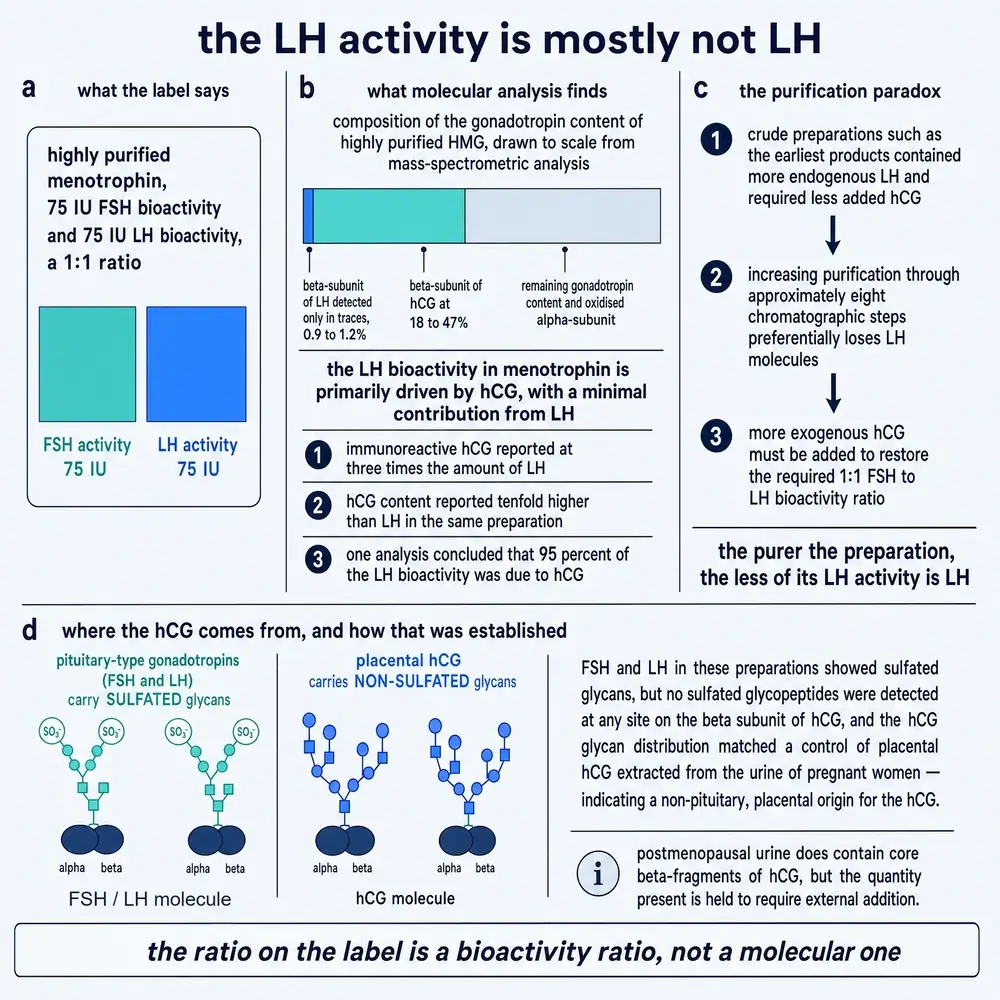
In the earliest preparations the gonadotropin fraction was a small minority of the total protein; the rest was whatever else the extraction carried over from urine. Successive generations of purification reduced that burden, and the highly purified preparations of the 1990s were characterised as containing under five per cent unidentified urinary protein. Five per cent of the material in an injectable product being unidentified would be remarkable in almost any other drug class. Here it was the improvement.
There is a further subtlety in modern highly purified menotropin, and it is the single fact about this preparation that is most often reported incorrectly. A substantial part of the luteinising activity in the product is not luteinising hormone. It is chorionic gonadotropin — present because postmenopausal urine contains it and because manufacturers standardise the product’s LH activity using it. The preparation is therefore, in a strict sense, a three-hormone product sold on a two-hormone label. A 2026 characterisation study states the composition plainly: the active components are FSH, LH and hCG, in addition to many unknown components (Sun et al., 2026).
How much of it is hCG was, until recently, a matter of assertion. It is now measured. A 2024 analytical study of highly purified menotropin found the beta subunit of luteinising hormone present only in traces — 0.9 to 1.2 per cent of gonadotropin content — while the beta subunit of chorionic gonadotropin accounted for 18 to 47 per cent (Capolupo et al., 2024). The same work put total protein impurities at 20 to 30 per cent of the preparation, identified more than two hundred separate non-gonadotropin proteins in it, and found oxidised forms of the alpha subunit — which lower biological potency — running to around a fifth of gonadotropin content.
That is a striking set of numbers for a product whose label declares equal quantities of two activities. Read plainly, the luteinising activity in a modern highly purified menotropin is principally chorionic gonadotropin, with luteinising hormone itself contributing very little. Independent analyses have put immunoreactive hCG at three times, and hCG content at ten times, the amount of LH in the same preparation, with one concluding that 95 per cent of the luteinising bioactivity was attributable to hCG.
The obvious question is whether that hCG is simply what postmenopausal urine contains, or whether it is added. The 2024 analysis answers it by sugar chemistry rather than by asking the manufacturer. Gonadotropins made in the pituitary carry sulfated glycans; hormones of placental origin do not. The FSH and LH in these preparations duly showed sulfated glycans — and no sulfated glycopeptide was detected at any site on the hCG beta subunit, whose glycan distribution instead matched a control of placental hCG extracted from the urine of pregnant women (Capolupo et al., 2024).
The luteinising activity of this preparation is therefore, in substantial part, a hormone of pregnancy collected from a different population of donors and added to reach a number on a label. That is not a scandal — it is disclosed in product information, and Section 07 explains why purification makes it necessary — but it is a long way from what “75 IU FSH and 75 IU LH” suggests to a reader.
06A unit of this drug is a biological effect in a rat
Because the contents cannot be specified by mass, potency is defined by effect. The international unit of follicle-stimulating activity is established by the Steelman–Pohley bioassay: the test preparation is administered to immature female rats together with a large dose of chorionic gonadotropin, the ovaries are removed and weighed, and the increase in ovarian weight is compared against a World Health Organization reference standard. Potency is a ratio to that standard, not a quantity of anything.
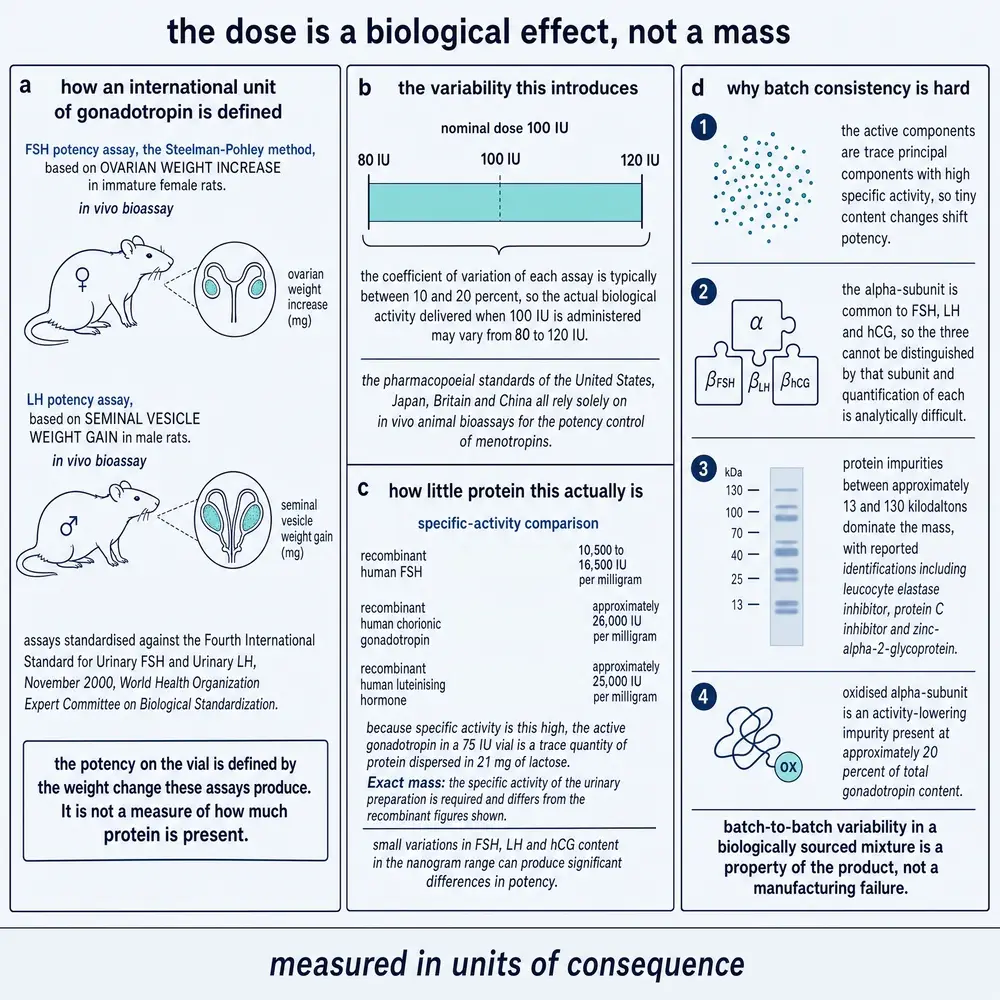
The circularity in the history is worth pausing on. In 1972 the international unit for both FSH and LH was defined as the respective activity contained in 0.2295 mg of the international reference preparation of human menopausal gonadotropin (Lunenfeld, 2019). For a period, in other words, the unit in which this drug is measured was defined by reference to this drug.
The obvious objection to an animal bioassay is that it is imprecise, and that objection has been sustained rather than resolved. A 2026 study developing a chromatographic alternative, working across sixty-nine manufacturing batches, states that current standards for menotropins rely exclusively on in-vivo animal models for the bioactivity control of FSH and LH, that these methods are complex and highly variable, and that this variability impairs batch-to-batch consistency of the final product (Sun et al., 2026). A 2023 review of the same problem puts the consequence in terms of the endpoint that matters: the international unit is a relative measure that depends on the assay used to obtain it, and a biopotency established in the rat does not necessarily translate into the same biological activity in a human being (Lispi et al., 2023). Glycosylation is what drives the gap — the charge and sialic-acid content of an FSH preparation affect receptor affinity and clearance — which is precisely the respect in which a urinary and a recombinant product differ.
That is a 2026 assessment of a 1950 product, and it is one of the cleanest through-lines in this whole document: the technique that defines a dose of menotropin today is recognisably the technique that defined it when the first ampoules were registered.
07Purification, generation by generation
The history of this product is largely a history of taking things out of it, and the sequence is instructive because at each step the industry removed what it could remove rather than what it had established should go.
The first preparations, from 1950, were impure and carried no standardised ratio of the two activities. The Pergonal generation fixed the ratio at one to one. Immunopurification then made it possible to strip the luteinising activity out altogether, producing urinary FSH; monoclonal antibodies against FSH took this further, yielding a highly purified product containing under 0.1 IU of LH activity and under five per cent unidentified protein, pure enough to be injected subcutaneously in a small volume rather than intramuscularly (Lunenfeld, 2019). Highly purified menotropin — the modern form of the subject — applied the same purification while deliberately retaining the luteinising activity. Recombinant FSH, first approved in 1995, dispensed with urine entirely.
There is a paradox buried in that ladder, and it explains the previous section. Purification is not selective in the way one would wish: the roughly eight chromatographic steps that strip out unwanted urinary protein preferentially remove luteinising hormone as well. A crude 1950s preparation retained more of the endogenous LH that came with the urine. A modern highly purified one has lost most of it — and because the product must still deliver the declared luteinising activity, more chorionic gonadotropin has to be added to make the number up. The purer the preparation, the less of its luteinising activity is luteinising hormone.
That is a genuinely counter-intuitive consequence of doing the obviously right thing, and it is the mechanism behind the composition reported in Section 05. It also explains a figure that otherwise looks backwards: the 20 to 30 per cent protein impurity measured in highly purified menotropin sits alongside a figure of up to 20 per cent for conventional product. The two come from different measurements of different things and are not a contradiction, but they are a warning against reading “highly purified” as a synonym for “mostly hormone”.
The important observation is the one embedded in that sequence. The ability to remove luteinising activity arrived decades before any evidence that removing it was beneficial. Purity was pursued because it was achievable, measurable and marketable; whether the thing being purified away was inert, useful or harmful was a separate question, and it is the question that the next Part is about.
08The first pregnancies
The clinical programme began with women who had no gonadotropin of their own. In 1959 human menopausal gonadotropin was shown to produce the expected changes in the endometrium and vaginal epithelium and to induce steroid secretion in women with anovulatory, hypogonadotropic and primary amenorrhoea. Three years later Bruno Lunenfeld and colleagues reported the first pregnancy following ovulation induction with HMG and final oocyte maturation with hCG, in a woman with hypopituitary hypogonadotropic amenorrhoea; no adverse events were reported for that pregnancy (Lunenfeld, 2019). The two-step protocol it established — stimulate with gonadotropin, trigger with hCG — is still the shape of almost every stimulation cycle performed today.
There is a small discrepancy in the dating that is worth recording rather than resolving by preference. The peer-reviewed historical literature places the first reported pregnancy in 1962. Lunenfeld’s own later account states that the first child was delivered by his group in 1961 (Lunenfeld, 2012). Both can be true — a conception and delivery in one year, reported in the next — and this document does not have the primary case report in hand to settle it. It is noted because the 1962 date is quoted everywhere and its apparent precision is not something the sources actually support.
What that founding evidence establishes is narrow and solid: in women whose pituitary does not supply gonadotropin, supplying it from outside induces follicular growth, ovulation and pregnancy. That indication has never been seriously contested, and no trial in the sixty years since has needed to re-establish it. Almost everything else in this Part concerns a different and much harder question.
09Why luteinising activity was thought to matter
The harder question arrived with in-vitro fertilisation. Once the goal stopped being one ovulation and became a cohort of oocytes, the composition of the stimulating preparation became a live pharmacological issue, and there was a respectable mechanistic reason to think that a product containing both activities might behave differently from one containing only FSH.
But the model assumes the luteinising activity is luteinising hormone, and Section 05 has already shown that in a modern preparation it mostly is not. That matters because LH and chorionic gonadotropin, while they act at the same receptor, are not the same drug: hCG has the longer half-life, the higher receptor affinity, and — as reported — an intracellular signal that differs qualitatively as well as quantitatively at that shared receptor. Whatever menotropin's luteinising activity is doing, it is being done by a hormone of pregnancy at a receptor evolved to see a hormone of the cycle.
The classical account of ovarian steroidogenesis assigns the two hormones to two different cells. Luteinising activity drives the theca cell to convert cholesterol into androgens; follicle-stimulating activity drives the granulosa cell, and the aromatase that converts those androgens into oestradiol. On that model, FSH alone supplies one half of a two-part process and relies on the patient’s own luteinising hormone for the other — which is fine when she has some, and less obviously fine when pituitary suppression has been deliberately imposed as part of the protocol.
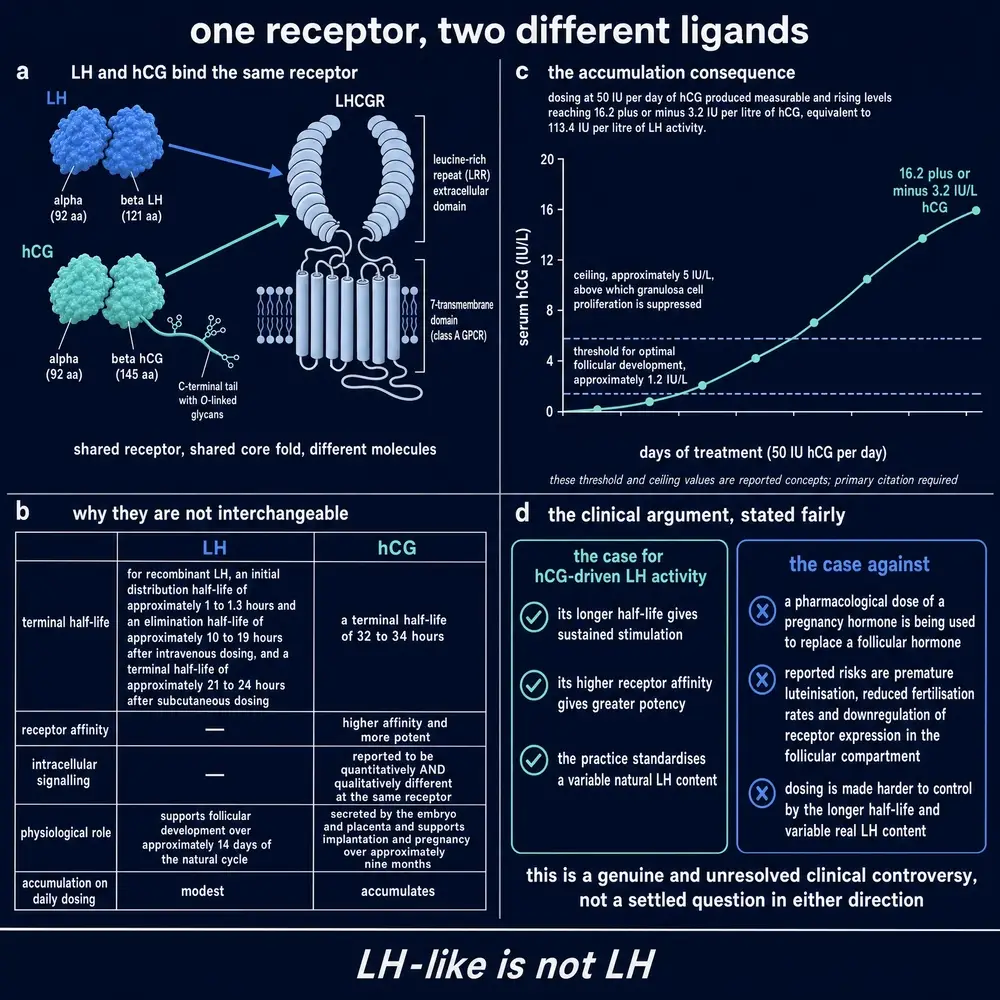
This is a rationale, not a finding, and the distinction has been blurred persistently in writing about this drug. The two-cell model predicts that luteinising activity could matter. Whether it does, by how much, in whom, and whether any of it reaches the outcome patients actually care about, are empirical questions that took three decades and tens of thousands of randomised participants to address — and, as the rest of this Part shows, are still not fully settled.
10The comparison that defined the field
From the mid-1990s the field organised itself around a single comparison: menotropin against recombinant FSH. The commercial stakes were substantial on both sides, the endpoint was slippery, and the result has moved more than once.
The pivotal European and Israeli Study Group trial, published in 2002, randomised 781 women across twenty-two centres in six countries to highly purified menotropin or recombinant FSH under a long agonist protocol. Ongoing pregnancy rates in the per-protocol population were 25 per cent (85 of 344) with HP-hMG against 22 per cent (71 of 317) with recombinant FSH. The trial was designed and reported as a demonstration of equivalence, and its conclusion was that the two were comparably effective with similar safety and tolerability (European and Israeli Study Group, 2002). A three-point difference in a trial of that size is not a demonstration that one is better.
Around the same trial programme a set of mechanistic sub-studies asked what the two preparations were doing differently rather than which won. They reported that the endocrine profile in serum and follicular fluid differs between HP-hMG and recombinant FSH (Smitz et al., 2007), and that embryo-quality parameters differ as well (Ziebe et al., 2007). Further randomised and observational comparisons followed across protocols and populations — under GnRH antagonist rather than agonist suppression (Bosch et al., 2008), in ICSI cycles comparing menotropin against its own highly purified form and against follitropin alfa (Esteves et al., 2009), in a large non-interventional German cohort (Bühler et al., 2021), and in economic terms (Barriere et al., 2018; Levi Setti et al., 2015).
Meta-analysis then began to find a consistent small advantage. A 2008 pooled analysis reported a live-birth odds ratio of 1.20 (95% CI 1.01–1.42) favouring HMG over recombinant FSH, with no significant difference in ovarian hyperstimulation (OR 1.21, 95% CI 0.78–1.86), alongside the observation — consistent across the literature — that the recombinant arm required fewer treatment days, a lower total dose, and produced more embryos (Al-Inany et al., 2008). That last cluster is important and is easy to skate past: the preparation that produced more eggs was the one associated with fewer live births.
It should also be said plainly that this evidence base has been unusually unstable as an institution, not merely as a set of numbers. Two Cochrane reviews addressing this comparison have been formally withdrawn (Daya, 1996; Westergaard et al., 2011), and the question has been re-asked and re-answered by successive review teams for more than twenty years (Daya, 2000; Al-Inany et al., 2003; Van Wely et al., 2003). A reader encountering a confident statement about HMG versus recombinant FSH should always check its date.
11The most recent synthesis
The current best answer, and the one this document weights most heavily, is the 2026 Cochrane review by Berkhout and colleagues: fifty-nine randomised trials, 18,119 women, with searches to 31 March 2025.
Against menotropin preparations, recombinant FSH was associated with lower live birth (OR 0.83, 95% CI 0.73–0.95; fifteen studies, 4,793 participants), lower clinical pregnancy (OR 0.87, 95% CI 0.76–0.98; fifteen studies, 4,839 participants) and more ovarian hyperstimulation syndrome (OR 1.42, 95% CI 1.12–1.80; thirty-seven studies, 9,813 participants). All three estimates are graded moderate certainty (Berkhout et al., 2026).
An odds ratio of 0.83 is worth translating, because it is smaller than the confidence with which it is usually repeated. Against a live-birth rate of around 30 per cent, it corresponds to a difference of roughly three or four percentage points — real, clinically worth having, and nothing like the difference between a treatment that works and one that does not. Both preparations produce live births in a large minority of cycles; the question this literature has spent twenty-five years on is which of them does so slightly more often.
Three qualifications belong with those numbers rather than after them. The review applied a trustworthiness checklist and excluded studies it judged potentially problematic — a step earlier syntheses of this question did not take. It records that many of the included studies were sponsored by the pharmaceutical industry, on both sides of a commercially contested comparison. And moderate certainty means the estimate could still move: the review’s own stated limitations are unclear selection bias, selective reporting and a high risk of other bias in the included trials.
The same review also compared recombinant FSH against highly purified urinary FSH — the same urine, the same extraction industry, the luteinising activity removed — and found essentially nothing: live birth OR 1.02 (95% CI 0.86–1.21), OHSS OR 1.01 (0.67–1.53), clinical pregnancy OR 1.00 (0.88–1.14), all moderate certainty (Berkhout et al., 2026).
That pairing is the most analytically useful thing in the whole literature, and it is rarely quoted. If the advantage attributed to menotropin were simply a urinary-versus-recombinant effect — isoform heterogeneity, glycosylation, some property of extraction — it should appear here too. It does not. Whatever is responsible sits with the luteinising activity that menotropin retains and urinary FSH does not, which is precisely what the two-cell rationale predicted. This is the closest thing to mechanistic corroboration that the clinical evidence base contains. It is an indirect comparison across different trial sets and is not the same as a trial designed to test it.
Which raises the question that follows immediately, and on which a second 2026 synthesis points the other way. If menotropin’s advantage over recombinant FSH is the luteinising activity, what happens when the comparator also carries luteinising activity — supplied as recombinant LH rather than as chorionic gonadotropin? Six studies covering 5,287 cycles were pooled to ask exactly that, comparing recombinant FSH and recombinant LH in a 2:1 ratio against highly purified menotropin alone. Recombinant FSH with recombinant LH produced more oocytes per cycle (mean difference 1.43, 95% CI 0.18–2.69) and a higher clinical pregnancy rate per started cycle (rate ratio 1.18, 95% CI 1.06–1.33) (Dahan et al., 2026).
That evidence is much weaker than the Cochrane synthesis and must not be read as its equal: of the six included studies only one was a randomised controlled trial, the remainder being non-interventional, and the authors state that the data were insufficient to draw firm conclusions about live birth — the endpoint that decides the question. But the direction is worth holding onto, because it is the first evidence in this document that cuts against menotropin, and it does so on precisely the mechanism the previous callout identified. Menotropin may beat recombinant FSH because it supplies luteinising activity, and still lose to a recombinant preparation that supplies that activity as the hormone the follicle actually sees. Both 2026 syntheses can be right; they are answering different questions.
12One trial where the answer depends on where you stop counting
If Section 11 were the whole story this would be a simpler document. The complication is supplied by the most methodologically modern trial in the literature.
Witz and colleagues, reporting in 2020, randomised 620 women with anti-Müllerian hormone at or above 5 ng/mL — predicted high responders, the population most at risk of overstimulation — to highly purified menotropin or recombinant FSH in GnRH-antagonist cycles, with fresh single-blastocyst transfer and frozen transfers within six months. It was assessor-blinded, registered as NCT02554279, and powered for non-inferiority (Witz et al., 2020).
On the primary endpoint it succeeded: ongoing pregnancy after fresh transfer was 35.5 per cent with HP-hMG against 30.7 per cent with recombinant FSH, a difference of 4.7 points with a confidence interval running from −2.7 to 12.1. Non-inferiority was established. Superiority was not, and the interval crosses zero.
Two safety differences were unambiguous and both favoured menotropin. Ovarian hyperstimulation syndrome occurred in 9.7 per cent of the HP-hMG arm against 21.4 per cent of the recombinant arm, a difference of −11.7 points (95% CI −17.3 to −6.1). Cumulative early pregnancy loss was 14.5 per cent against 25.5 per cent, a difference of −11.0 points (95% CI −18.8 to −3.14).
And then the endpoint that complicates everything: cumulative live birth was 50.6 per cent with HP-hMG and 51.5 per cent with recombinant FSH — a difference of −0.8 points, confidence interval −8.7 to 7.1 — despite forty-three more transfers being performed in the recombinant arm.
Read carefully, that is not a contradiction of Section 11 so much as a specification of it. Recombinant FSH produces more oocytes and more embryos; a fresh-cycle endpoint captures the menotropin advantage but not the recombinant arm’s larger reserve of frozen embryos, which is then cashed in over subsequent transfers. Where a trial stops counting determines which preparation looks better. The 2026 Cochrane synthesis is built predominantly on live birth per started cycle, and most of its constituent trials predate routine freeze-all practice.
This document therefore does not report a winner. It reports that menotropin is associated with at least equivalent live birth in fresh cycles and probably a small advantage; with materially less ovarian hyperstimulation; and with no demonstrated advantage in cumulative live birth once frozen transfers are included. Those three statements are compatible, and each rests on different evidence.
13Ovarian hyperstimulation, the complication that shaped the drug
Ovarian hyperstimulation syndrome is the iatrogenic hazard of this entire field: an exaggerated ovarian response with fluid shifts, effusions, haemoconcentration and, in its severe form, thromboembolism and critical illness. It is caused by the treatment. It is the reason stimulation protocols have grown steadily more conservative, and the reason a preparation that delivers comparable pregnancy rates with fewer such events has a genuine clinical argument in its favour independent of efficacy.
The evidence here is more consistent than the efficacy evidence. The 2026 pooled estimate has recombinant FSH carrying about 42 per cent higher odds of OHSS than menotropin across thirty-seven trials and nearly ten thousand women; the 2020 randomised trial in high responders found less than half the incidence on menotropin. The 2008 meta-analysis did not find a significant difference (Al-Inany et al., 2008), which is a real inconsistency and belongs in the record. A contemporaneous commentary set out why apparently small differences in live birth between these preparations are so hard to establish (Afnan, 2009).
The mechanism most often proposed is that chorionic gonadotropin drives OHSS, and that a preparation containing hCG might therefore be expected to cause more of it rather than less. That the opposite is observed is not explained by the evidence base assembled here. The most frequently offered account — that menotropin cycles yield somewhat fewer oocytes and somewhat lower peak oestradiol, and that this rather than the preparation itself carries the difference — is plausible, consistent with the observation that the recombinant arm reliably produces more eggs, and has not been established by any trial designed to test it.
14Outside the IVF laboratory
Almost everything above concerns IVF and ICSI, because that is where the trials were run and the money was. Three other uses have their own, thinner, evidence.
Ovulation induction without IVF. This is the original indication and it remains in use, particularly in polycystic ovary syndrome after clomifene has failed. A 2025 Cochrane review addresses gonadotropins for ovulation induction in that population (Weiss et al., 2025). The distinctive risk here is different from the IVF setting: without oocyte retrieval, a multi-follicular response leads directly to multiple pregnancy, and the historical record of gonadotropin ovulation induction includes high-order multiples that modern practice takes considerable trouble to avoid.
Intrauterine insemination. Menotropin is used to stimulate a small cohort of follicles before insemination, frequently in combination with an oral agent. The corpus assembled here contains recent comparative work of this kind, including trials pairing letrozole or clomifene with HMG in clomifene-resistant anovulation (Barman et al., 2025). The trials are individually small.
Men. In male hypogonadotropic hypogonadism, gonadotropin therapy can initiate and maintain spermatogenesis, generally with hCG to support testosterone production and an FSH-containing preparation such as menotropin added to drive the seminiferous tubule. A 2024 systematic review and meta-analysis addresses gonadotropins for pubertal induction in males with hypogonadotropic hypogonadism (Alexander et al., 2024). This is a small literature relative to the female indications, and the timescales — months to years — make randomised evidence correspondingly harder to obtain.
15The unknown fraction
Every safety discussion of this preparation runs into the same wall. The active components are known. The rest is not fully characterised, and the manufacturers do not claim that it is.
The phrase used in the regulatory and technical literature for the early generations was “unidentified urinary proteins”, and the achievement recorded for the highly purified products of the 1990s was getting that fraction below five per cent. The 2026 characterisation study quoted earlier describes menotropin’s composition as complex, with active components including FSH, LH and hCG “in addition to many unknown components” (Sun et al., 2026).
This is not an accusation of negligence. It is a structural feature of a drug obtained by fractionating a biological fluid, and the industry has spent seventy years reducing it. But it does constrain what can honestly be said. A claim that menotropin has no long-term effect attributable to its unidentified fraction is not a claim the evidence base can support in the strong form; what can be said is that no such effect has been identified across six decades of extremely widespread clinical use, in a treatment whose recipients are followed intensively and whose offspring are followed for years.
That last clause carries more weight than it might appear to. Assisted reproduction is one of the most intensively surveilled interventions in medicine. Its recipients are healthy, motivated, and in contact with a clinic weekly through a treatment cycle; its outcome is a pregnancy that is monitored by ultrasound and delivered in a hospital; and its product is a child who is registered, followed and, in several countries, entered into a national registry linked to the treatment that produced them. If a urinary gonadotropin preparation carried a meaningful hazard attributable to its unidentified fraction, this is close to the best-instrumented setting in which such a signal could have emerged. The absence of one is genuine evidence. It is not proof, and it is weakest exactly where surveillance is weakest — for outcomes with long latency and no obvious link back to a treatment given decades earlier.
There is also a subtler point about what “unidentified” means here. It does not mean unexamined. Regulatory approval of these products requires characterisation of the active components, batch release against a potency standard, and a manufacturing process held constant under inspection. What is not available is a complete inventory of every protein species present. The distinction matters because the two are routinely conflated in consumer writing about this drug, in both directions — by those who present the preparation as essentially unknown, and by those who present it as fully specified. Neither is accurate.
16Prions, and a risk that was real for the rival
Because human pituitary gonadotropin transmitted Creutzfeldt–Jakob disease, the question was inevitably asked of the urinary product, and it is asked routinely in consumer writing about this drug to this day.
The honest answer has three parts, and they need to be kept separate. First, the demonstrated transmission occurred with pituitary extract — central nervous system tissue, the highest-risk material for a spongiform agent — and not with urine. Second, urinary-derived gonadotropins have been in continuous large-scale clinical use since 1950, and this document’s corpus contains no demonstrated case of transmission of any infectious agent from a urinary gonadotropin preparation to a recipient. Third, and against the temptation to round that up: an absence of demonstrated transmission is not the same as a demonstration of absence, and manufacturers and regulators have continued to treat donor screening, viral inactivation and source control as live obligations rather than settled ones.
The more consequential legacy of the CJD episode is not a residual risk but a commercial and regulatory disposition. It established that in this field the provenance of the raw material is a first-order concern, and that disposition is a substantial part of why recombinant gonadotropins were developed and adopted — the case for them was framed as much around freedom from human source material as around efficacy.
It is worth being clear about how much of the recombinant argument was therefore not an efficacy argument. A product free of human source material, produced from a characterised cell line, with a defined glycosylation profile and a supply that scales with fermenter capacity rather than with the number of donors, is a better pharmaceutical on every axis a manufacturer or a regulator cares about — independently of whether it produces more children. Part Three showed that on the clinical endpoints that case is at best unproven, and by the most recent reading runs the other way. Both things can be true at once, and the reason menotropin has survived is that the axis on which it appears to win is the one patients are counting.
17Batch to batch
The unglamorous safety issue with this drug is not contamination. It is consistency.
A product defined by a bioassay in rats, extracted from a pooled biological fluid whose composition varies with the donors, is intrinsically harder to hold to a tight specification than a protein expressed from a single characterised cell line. Batch-to-batch variability was one of the two problems — alongside a finite donor supply — explicitly named in the historical literature as the reason recombinant products were pursued.
The striking thing is how recent the concern remains. The 2026 study developing a chromatographic assay across sixty-nine batches of menotropin for injection frames its entire rationale in these terms: current standards rely exclusively on in-vivo animal models, those methods are complex and highly variable, they fail to quantify the trace high-specific-activity components accurately, and this impairs batch-to-batch consistency of the final product (Sun et al., 2026). Seventy-six years after registration, the analytical chemistry needed to say precisely what is in a vial of this drug is still being published.
18Multiple pregnancy
The characteristic harm of gonadotropin therapy is not a toxicity. It is a twin, or a triplet.
Any treatment that recruits several follicles where the body would have selected one raises the probability of multiple gestation, and multiple gestation is the single largest driver of adverse obstetric and neonatal outcome in assisted reproduction — preterm birth, low birthweight, neonatal intensive care, and elevated maternal risk. The historical record of gonadotropin ovulation induction includes high-order multiples, and one of the case reports in the founding era of this drug is a successful quadruplet pregnancy (Neuwirth et al., 1965).
Two things have changed since, and neither is a property of the drug. In IVF, the shift to elective single-embryo transfer decoupled the number of oocytes obtained from the number of embryos replaced, which is why a preparation that yields more eggs is no longer straightforwardly a preparation that yields more twins. In ovulation induction, where no such decoupling is possible, cycle cancellation for excessive response remains the principal control.
This matters for how the comparative evidence in Part Three should be read. The trials in that literature were conducted across a period in which transfer policy changed fundamentally. A multiple-pregnancy rate from a 2002 trial and one from a 2020 trial are not measuring the same clinical system, and pooling them without regard to that is one of the reasons pooled estimates in this field deserve their moderate-certainty grading.
19The shape of the literature
It is worth looking at when this drug was studied, because the shape of the curve is itself an argument about how much more there is to learn.
Research on menotropin rises through the 1970s and 1980s, peaks in the 1990s, and declines steadily thereafter without ever stopping. The peak is not mysterious: it coincides with the arrival of recombinant FSH and the commercial imperative, felt on both sides, to establish which preparation was better. Once that question had been asked several dozen times the marginal value of asking it again fell, and the field moved on to protocol design, individualised dosing and the freeze-all strategies that Part Three showed can change the answer.
A literature with this profile has most of its evidence behind it. The practical consequence is that the recency principle — prefer the newest data unless a preponderance of evidence contradicts it — has to be applied with care here, because the newest primary data are sparse. What is new is mostly synthesis: the 2026 Cochrane review (Berkhout et al., 2026), the 2025 network meta-analysis of stimulation protocols across 338 studies (Melo et al., 2025), the 2025 review of ovulation induction in polycystic ovary syndrome (Weiss et al., 2025). Those are new readings of largely old trials. The genuinely new primary work in this corpus is concentrated in analytical chemistry — characterising what is in the vial — rather than in clinical outcomes.
That distribution has a consequence worth stating plainly, because it cuts against the way evidence is usually weighted. Ordinarily, preferring recent work is a way of preferring better-designed work. Here it is mostly a way of preferring better-analysed work: the 2026 Cochrane review is more trustworthy than its predecessors not because it has newer trials but because it applied a trustworthiness screen to the old ones and excluded those it judged unreliable. The improvement is in the filtering, not in the raw material. Any future synthesis of this question will be drawing on substantially the same pool of trials, which places a ceiling on how much more certain the answer can become without new primary research — and Section 21 sets out what that research would have to look like.
20The identity problem, measured
Section 01 argued that the abbreviation is the central practical obstacle to assembling a corpus about this compound. Here is what that cost, measured on this project’s own peptide library.
Of the documents in the project-05 library containing a candidate string, roughly a third were refused specifically because they were about HMG-CoA or about the high-mobility-group proteins — different molecules that share the abbreviation. Those refusals are reported separately from documents that simply carried no subject designation, because the two mean opposite things: the first says the identity gate is doing real work, the second says the string match was too generous.
The external harvest tells the mirror-image story, and the contrast is the most useful methodological observation in this build. The literature search was deliberately built on unambiguous designations — menotropin, human menopausal gonadotropin, the brand names — and never on the bare abbreviation. As a result the identity gate refused almost nothing on the far side: a handful of documents out of more than four thousand fetched. The same gate, applied to a loose local string match, refused about a third. A low rejection rate is therefore not evidence that a gate is asleep; here it is evidence that the query in front of it was precise. Both numbers only mean something because both are reported.
21Regulatory standing, the market, and what would settle the open questions
Menotropin is an approved medicine. That single fact separates it from most compounds in this series and should be stated plainly: it is licensed, sold under brand names including Menopur and Merional, prescribed by fertility clinics in essentially every developed health system, and manufactured to pharmacopoeial standards. It is not an experimental agent and it is not a grey-market compound.
What that status buys is worth spelling out, because it is the practical difference this document keeps returning to. A licensed product carries a marketing authorisation naming its indications; a pharmacopoeial monograph specifying how its potency is established; a batch-release process that runs the bioassay of Section 06 on every lot before it ships; a donor-screening and viral-safety regime applied to the starting material; an adverse-event reporting obligation; and a regulator with the power to compel a recall. None of those is a claim about efficacy. They are claims about traceability — the ability, if something goes wrong, to find out what was in the vial and who else received it. For a preparation whose active content is a biological activity rather than a mass, and whose starting material is pooled human urine, that is the difference that matters most.
It is nonetheless also sold as a research chemical. This project’s vendor records include an offering of “HMG 75 IU” from a research-chemical supplier, catalogued alongside the peptides that make up the rest of that market. That is worth naming because the two channels are not equivalent in any respect that matters. A licensed menotropin product carries a batch released against a pharmacopoeial bioassay, a defined donor-screening and viral-safety regime, and a regulator who can compel a recall. Material purchased outside that chain carries none of those things, and for a product whose potency cannot be verified by inspection, whose active content is a biological activity rather than a mass, and whose starting material is pooled human urine, the absence of that chain is not a paperwork difference.
What would actually settle the questions this document has left open? Three things, none of which is likely to be done.
The first is a trial powered for cumulative live birth as its primary endpoint, with a modern freeze-all-capable design, comparing menotropin against recombinant FSH. Part Three showed that the fresh-cycle advantage and the cumulative equivalence are the two findings most in tension, and no trial has been built to adjudicate between them directly.
The second is a trial that isolates the luteinising activity itself — and this one is no longer hypothetical, which is the single largest change between this document’s first draft and its present state. The indirect comparison in Section 11 points hard at the LH activity as the operative difference, and the pooled comparison of recombinant FSH plus recombinant LH against menotropin (Dahan et al., 2026) begins to test it directly. What that synthesis cannot yet do is decide the question, because it rests on one randomised trial and five non-interventional studies and reports insufficient data on live birth. The trial that would settle it is a randomised comparison of recombinant FSH plus recombinant LH against menotropin, powered for live birth, and it is a smaller and more tractable study than the cumulative-outcome trial above. Its result would also determine how much of menotropin’s case survives: if defined recombinant luteinising activity does the same work, then what menotropin offers is a cheaper route to it rather than a better one.
The third is simply analytical: a characterisation of the unknown fraction sufficient to say what a vial contains. The 2026 chromatographic work is a step toward it. Until something like it is complete, every mechanistic claim about this preparation is a claim about a mixture whose composition is partly unspecified, and the honest form of such a claim carries that qualification.
It is a strange position for a drug to occupy after seventy-six years. The substance works, in the sense that matters most: women who could not conceive have children because of it, and the founding indication has never needed re-litigating. It survived two rivals that were withdrawn for harm. It has held its ground against an engineered replacement that was expected to retire it, and by the most recent reading it is holding that ground on outcomes rather than on price. And nobody can yet tell you exactly what is in the bottle.
This document describes published research. It does not recommend human use of any preparation described in it, and it specifies no dose, route or schedule for any person. Every dose, duration and protocol reported above is a study parameter drawn from the cited literature, given so that the finding attached to it can be understood, and is not a recommendation.
Menotropin is a prescription medicine in the jurisdictions where it is licensed. Decisions about fertility treatment involve individual clinical assessment that no document of this kind can substitute for.
25References
Generated from verified NCBI records rather than from recall. Author lists, journal names, volumes, pages and identifiers are taken from the PubMed record for each citation, and the build refuses to run if any identifier fails to resolve. This series has twice shipped reference lists drafted from memory in which identifiers pointed at real but unrelated papers.
- Afnan M. Identifying real differences in live birth rates between HMG and rFSH in IVF. Reprod Biomed Online. 2009;18 Suppl 2:25-30.
PMID 19406028 · doi:10.1016/s1472-6483(10)60445-2 - Al-Inany H, Aboulghar M, Mansour R, Serour G. Meta-analysis of recombinant versus urinary-derived FSH: an update. Hum Reprod. 2003;18(2):305-13.
PMID 12571166 · doi:10.1093/humrep/deg088 - Al-Inany HG, Abou-Setta AM, Aboulghar MA, Mansour RT, Serour GI. Efficacy and safety of human menopausal gonadotrophins versus recombinant FSH: a meta-analysis. Reprod Biomed Online. 2008;16(1):81-8.
PMID 18252052 · doi:10.1016/s1472-6483(10)60559-7 - Alexander EC, Faruqi D, Farquhar R, Unadkat A, Ng Yin K, Hoskyns R, et al.. Gonadotropins for pubertal induction in males with hypogonadotropic hypogonadism: systematic review and meta-analysis. Eur J Endocrinol. 2024;190(1):S1-S11.
PMID 38128110 · doi:10.1093/ejendo/lvad166 · PMC10773669 - Barman T, Singh V, Bagde ND. Comparison of Letrozole Versus Clomiphene Citrate Combined With Human Menopausal Gonadotropin in Women With Clomiphene-Resistant Anovulatory Infertility Undergoing Intrauterine Insemination: A Retrospective Cohort Study. Cureus. 2025;17(7):e88802.
PMID 40873816 · doi:10.7759/cureus.88802 · PMC12378508 - Barriere P, Porcu-Buisson G, Hamamah S. Cost-Effectiveness Analysis of the Gonadotropin Treatments HP-hMG and rFSH for Assisted Reproductive Technology in France: A Markov Model Analysis. Appl Health Econ Health Policy. 2018;16(1):65-77.
PMID 29124676 · doi:10.1007/s40258-017-0361-7 - Berkhout RP, Kostova EB, van Wely M. Recombinant follicle-stimulating hormone (rFSH) versus other recombinant or urinary gonadotropins for ovarian stimulation in assisted reproductive technology cycles. Cochrane Database Syst Rev. 2026;7(7):CD005354.
PMID 42445958 · doi:10.1002/14651858.CD005354.pub3 · PMC13366490 - Bosch E, Vidal C, Labarta E, Simon C, Remohi J, Pellicer A. Highly purified hMG versus recombinant FSH in ovarian hyperstimulation with GnRH antagonists--a randomized study. Hum Reprod. 2008;23(10):2346-51.
PMID 18583332 · doi:10.1093/humrep/den220 - Bühler KF, Fischer R, Verpillat P, Allignol A, Guedes S, Boutmy E, et al.. Comparative effectiveness of recombinant human follicle-stimulating hormone alfa (r-hFSH-alfa) versus highly purified urinary human menopausal gonadotropin (hMG HP) in assisted reproductive technology (ART) treatments: a non-interventional study in Germany. Reprod Biol Endocrinol. 2021;19(1):90.
PMID 34134695 · doi:10.1186/s12958-021-00768-3 · PMC8207759 - Capolupo A, Petrocchi S, Melchiorre M, Jonas K, D'Hooghe T, Hanyaloglu A, et al.. Analytical Investigation of the Profile of Human Chorionic Gonadotropin in Highly Purified Human Menopausal Gonadotrophin Preparations. Int J Mol Sci. 2024;25(17).
PMID 39273352 · doi:10.3390/ijms25179405 · PMC11395176 - Dahan MH, Schwarze JE, Gupta SS, Hayward B, Fischer R, Esteves SC, et al.. Comparative Effectiveness of Recombinant Human Follicle-Stimulating Hormone:Recombinant Human Luteinizing Hormone in a 2:1 Ratio versus Highly Purified Human Menopausal Gonadotropin Alone in Ovarian Stimulation for Medically Assisted Reproduction Treatment Using in vitro Fertilization/Intracytoplasmic Sperm Injection: A Systematic Review and Meta-Analysis. Gynecol Obstet Invest. 2026:1-14.
PMID 41729769 · doi:10.1159/000550420 · PMC13065304 - Daya S. Follicle-stimulating hormone and human menopausal gonadotropin for ovarian stimulation in assisted reproduction cycles. Cochrane Database Syst Rev. 2000;1996(2):CD000061.
PMID 10796481 · doi:10.1002/14651858.CD000061 · PMC10866117 - Daya S. WITHDRAWN: Follicle-stimulating hormone and human menopausal gonadotropin for ovarian stimulation in assisted reproduction cycles. Cochrane Database Syst Rev. 1996:CD000061.
PMID 17636580 · doi:10.1002/14651858.CD000061 - Esteves SC, Schertz JC, Verza S, Schneider DT, Zabaglia SF. A comparison of menotropin, highly-purified menotropin and follitropin alfa in cycles of intracytoplasmic sperm injection. Reprod Biol Endocrinol. 2009;7:111.
PMID 19828024 · doi:10.1186/1477-7827-7-111 · PMC2768716 - European and Israeli Study Group on Highly Purified Menotropin versus Recombinant Follicle-Stimulating Hormone. Efficacy and safety of highly purified menotropin versus recombinant follicle-stimulating hormone in in vitro fertilization/intracytoplasmic sperm injection cycles: a randomized, comparative trial. Fertil Steril. 2002;78(3):520-8.
PMID 12215327 · doi:10.1016/s0015-0282(02)03250-8 - Levi Setti PE, Alviggi C, Colombo GL, Pisanelli C, Ripellino C, Longobardi S, et al.. Human recombinant follicle stimulating hormone (rFSH) compared to urinary human menopausal gonadotropin (HMG) for ovarian stimulation in assisted reproduction: a literature review and cost evaluation. J Endocrinol Invest. 2015;38(5):497-503.
PMID 25480425 · doi:10.1007/s40618-014-0204-4 · PMC4555088 - Lispi M, Humaidan P, Bousfield GR, D'Hooghe T, Ulloa-Aguirre A. Follicle-Stimulating Hormone Biological Products: Does Potency Predict Clinical Efficacy?. Int J Mol Sci. 2023;24(10).
PMID 37240364 · doi:10.3390/ijms24109020 · PMC10218858 - Lunenfeld B, Bilger W, Longobardi S, Alam V, D'Hooghe T, Sunkara SK. The Development of Gonadotropins for Clinical Use in the Treatment of Infertility. Front Endocrinol (Lausanne). 2019;10:429.
PMID 31333582 · doi:10.3389/fendo.2019.00429 · PMC6616070 - Lunenfeld B. Historical perspectives in gonadotrophin therapy. Hum Reprod Update. 2004;10(6):453-67.
PMID 15388674 · doi:10.1093/humupd/dmh044 - Lunenfeld B. Gonadotropin stimulation: past, present and future. Reprod Med Biol. 2012;11(1):11-25.
PMID 29699102 · doi:10.1007/s12522-011-0097-2 · PMC5906949 - Melo P, Eapen A, Chung Y, Jeve Y, Price MJ, Sunkara SK, et al.. Controlled ovarian stimulation protocols for assisted reproduction: a network meta-analysis. Cochrane Database Syst Rev. 2025;7(7):CD012586.
PMID 40590303 · doi:10.1002/14651858.CD012586.pub2 · PMC12210349 - NEUWIRTH RS, TODD WD, TURKSOY RN, VANDEWIELE RL. SUCCESSFUL QUADRUPLET PREGNANCY IN A PATIENT TREATED WITH HUMAN MENOPAUSAL GONADOTROPINS. Am J Obstet Gynecol. 1965;91:982-4.
PMID 14268321 · doi:10.1016/0002-9378(65)90566-1 - Smitz J, Andersen AN, Devroey P, Arce JC, MERIT Group. Endocrine profile in serum and follicular fluid differs after ovarian stimulation with HP-hMG or recombinant FSH in IVF patients. Hum Reprod. 2007;22(3):676-87.
PMID 17110397 · doi:10.1093/humrep/del445 - Sun Y, Li H, Hu X, Luo S, Zhang X, Wang L, et al.. Quantitative determination of trace principal components with high specific activity in menotropins. Front Bioeng Biotechnol. 2026;14:1783311.
PMID 42158454 · doi:10.3389/fbioe.2026.1783311 · PMC13180910 - Van Wely M, Westergaard LG, Bossuyt PM, Van der Veen F. Human menopausal gonadotropin versus recombinant follicle stimulation hormone for ovarian stimulation in assisted reproductive cycles. Cochrane Database Syst Rev. 2003:CD003973.
PMID 12535497 · doi:10.1002/14651858.CD003973 - Weiss NS, Kostova EB, Mol BWJ, van Wely M. Gonadotropins for ovulation induction in women with polycystic ovary syndrome. Cochrane Database Syst Rev. 2025;4(4):CD010290.
PMID 40193219 · doi:10.1002/14651858.CD010290.pub4 · PMC11975188 - Westergaard LW, Bossuyt PM, Van der Veen F, van Wely M. WITHDRAWN: Human menopausal gonadotropin versus recombinant follicle stimulation hormone for ovarian stimulation in assisted reproductive cycles. Cochrane Database Syst Rev. 2011;2011(2):CD003973.
PMID 21328264 · doi:10.1002/14651858.CD003973.pub2 · PMC10680421 - Witz CA, Daftary GS, Doody KJ, Park JK, Seifu Y, Yankov VI, et al.. Randomized, assessor-blinded trial comparing highly purified human menotropin and recombinant follicle-stimulating hormone in high responders undergoing intracytoplasmic sperm injection. Fertil Steril. 2020;114(2):321-330.
PMID 32416978 · doi:10.1016/j.fertnstert.2020.03.029 - Ziebe S, Lundin K, Janssens R, Helmgaard L, Arce JC, MERIT (Menotrophin vs Recombinant FSH in vitro Fertilisation Trial) Group. Influence of ovarian stimulation with HP-hMG or recombinant FSH on embryo quality parameters in patients undergoing IVF. Hum Reprod. 2007;22(9):2404-13.
PMID 17640944 · doi:10.1093/humrep/dem221
Sources without a PubMed record
Regulatory instruments, patents and registry searches have no PubMed record and are therefore listed separately, so that the generated list above remains wholly machine-verified.
- Merck KGaA / EMD Group. Corporate history: infertility — the development of Pergonal from postmenopausal urine. Company account of its own past, consulted 3 August 2026. This is the source for the attribution to Piero Donini, the derivation of the name Pergonal from <i>per gonadi</i>, and the collection of urine from religious communities in Italy. None of these details appears in the peer-reviewed historical reviews cited above, and Donini has no indexed authorship in PubMed for this work. Reported in Section 02 as a corporate account rather than as a scientific record.
https://www.emdgroup.com/en/company/history.html - South Beach Longevity. Project-05 vendor offering records — research-chemical listing of “HMG 75 IU”. Internal catalogue record drawn from this project's own vendor-offering table, observed in the project-05 library database. Cited in Section 21 as evidence that an approved medicine is also offered through the research-chemical channel; it is a record of an offering, not a purchase or an assay.
26How this document was assembled
The corpus was built against project 05, the Therapeutic Peptide Research Library, and the interesting part of the arithmetic is how much had to be thrown away.
The identity problem, in numbers. Every file with a document extension in the project's stores was opened — 45,975 of them — and its extracted text searched. 2285 files contained a designation. 2082 were refused, and the reasons were recorded separately because they mean different things. Sixteen named only D-[Lys3]-GHRP-6, the receptor antagonist, whose designation contains this compound's designation in full. Eleven were dominated by hexarelin, twelve by other secretagogues, seven by the numbered siblings and ten by growth hormone-releasing hormone — which is one letter away from this compound's abbreviation and appears in the same paragraph as it constantly. That leaves 203 admitted.
The antagonist was the serious one, and it was found by reading rather than by any gate. Across the fetched literature, 111 articles were dominated by D-[Lys3]-GHRP-6 and 90 of those never named the agonist at all. Papers on alcohol craving, on blood pressure during hibernation, and on pregnancy complications had all entered the corpus, and any of them could have supplied a confident sentence about what GHRP-6 does — describing an experiment in which the receptor was being switched off. Correcting the matcher and re-running every stage took the reading corpus from 229 documents to 2408. That is not a small correction, and no gate in this pipeline would have caught it.
The source-kind problem, in numbers. Of those 203 admitted local files, only 0 were peer-reviewed scientific full texts. The other 0 were vendor product pages captured repeatedly over several years, affiliate and trade blog copy collected as writing samples, and this project's own earlier internal write-ups. Reporting the larger number as a corpus would be true and useless; for a compound with a large research-chemical market the split is itself a finding.
The external harvest. A scoped PubMed query returned 5095 records, of which 3288 survived a relevance screen. The wider class surface — 17,400 records naming the bare term GHRP or the spelled-out class — was counted and deliberately not read, because most of it is about the siblings and about ghrelin rather than about this molecule. Because PubMed indexes only titles, abstracts and MeSH terms, a second route searched PubMed Central's full text and returned 4201 matches, of which 3827 were invisible to the first route. Stage 03 fetched the union: 4228 documents.
The far-side screen. Of those 4228 fetched documents, 1094 never named the compound in their retrieved body at all — they had been returned because they cite a paper about it. A further 3 named something else by the same string. 533 mentioned it in passing, below the substantive-use threshold, and 186 carried no retrievable body text. That leaves 2408 articles that actually discuss the compound.
Merging the local and fetched sets by PMCID and removing the 0 documents present in both gives the reading corpus this monograph is written from: 2408 unique scientific full texts, roughly 22,399 printed-page equivalents, together with the complete 3288-record metadata layer.
| Stage | What it does | Result |
|---|---|---|
| 01b | Targeted scan of the project's document stores | 45,975 files opened |
| 01c | Interrogation of the curated library database | SQL prefilter, gated in Python |
| 01g | Classification of local hits by source kind | 0 of 203 are literature |
| 02 | PubMed E-utilities harvest, date-partitioned | 5095 records |
| 02b | PubMed Central full-text search | 4201 matches |
| 03 | Open-access full-text retrieval of the union | 4228 documents |
| 03c | Identity gate and substantive-use screen | 2408 retained |
| 04 | Keyed union, de-duplication, inventory | 2408 unique full texts |
| 05 | Reference list from verified NCBI records | 29 citations |
| 06 | Assembly of this document | 1 deliverable |
Figures
Fourteen of the fifteen figures are authored vector charts generated from values traceable to the evidence dossier, and every colour in them resolves through the document's own design tokens so that the artwork re-themes with the page. Where a figure is schematic rather than plotted — the design lineage, the 1984 time course, the signalling diagram — its caption says so and names what is not being asserted.
Fifteen figures, of two kinds. Ten are original inline SVG generated by the project's own figure code from values held in the evidence dossier, which is why each can state where its numbers came from; three of those — the corpus funnel, the classification of the local sweep and the publication-year histogram — are computed at build time from this build's own manifests and therefore cannot drift away from the counts reported elsewhere in this Apparatus. The remaining five are commissioned plates prepared for this document and delivered after the first edition had been gated and filed.
The commissioned plates were audited before use, and four corrections were made to them. Two were substantive. A potency plate printed bioassay durations of “21 days” and “10 days” that no source in this corpus carries and that are not correct for either assay; both labels and their measurement brackets were removed rather than replaced with invented numbers. A glycan plate captioned both of its molecule groups “hCG molecule” when the left group is the pituitary FSH/LH comparator that carries the panel's entire argument; it was relabelled. Two were presentational: a specific-activity panel drew bars that were not proportional to the values printed beside them — the lowest figure drew the longest bar — so the bars were removed and the figures kept; and an accumulation curve carried x-axis tick values on a timescale that was not supplied, so the tick numbers were stripped and the axis left generic. The supplied originals, the corrected copies and a record of every value checked travel with the delivery bundle, so each of these decisions is checkable against the artwork rather than being a claim the reader must accept.
Three authored figures were retired when the plates arrived, on the test that decides such things in this series: does the authored figure carry a verified number the plate does not? A schematic of subunit architecture, a diagram of vial contents and a drawing of the FSH bioassay each answered no, while the plates replacing them added residue counts, measured impurity fractions and the second bioassay. The one value the retired bioassay figure carried that its replacement does not — the 1972 definition of the international unit — is stated in the prose of Section 06.
Two limitations of the authored figures are worth stating plainly. Such a figure can only show what the evidence dossier holds, so where the literature carries no series of measurements this document draws no curve. And an authored figure is not independent corroboration of the prose beside it, since both come from the same dossier. Each caption therefore names what its figure is not — which quantities are schematic, which are proportional, and which are drawn to sequence a history rather than to measure it.
27Evidence handling
Findings are labelled by the kind of study that produced them, in the sentence that reports them, and the species is named every time. Animal and in-vitro results are never phrased so as to imply a human outcome. On this compound the discipline has a specific job: there is substantial human evidence, and it is entirely endocrine. GHRP-6 unquestionably releases growth hormone in people and unquestionably raises insulin-like growth factor 1. The protective effects that the last twenty-five years of work rest on have been shown only in animals. Conflating the two would be the easiest available error and the most misleading.
Several molecules, kept apart. GHRP-6, hexarelin, GHRP-1, GHRP-2, ipamorelin, MK-0677, anamorelin, macimorelin and ghrelin share a receptor, share disease models, share journals and share investigators, and the vocabulary that identifies one identifies all of them. Hexarelin differs from this compound by a single methyl group. Every finding in this document names the molecule that was actually administered, and the consequences of not doing so would be material in both directions: the human cardiac inotropic studies are hexarelin's, the human appetite trials are GHRP-2's, the failed frailty and Alzheimer programmes are MK-0677's, and the two regulatory approvals in the class belong to GHRP-2 and macimorelin. None of that is GHRP-6's record.
The combination problem. Every clinical result reported in Part Four belongs to GHRP-6 given together with epidermal growth factor. GHRP-6 alone has never been tested against a clinical endpoint in a published trial. Wherever a stroke result appears in this document, the combination is named.
Gaps in the corpus, stated plainly. Three matter. The founding observation of the whole programme is a 1977 book chapter that is not indexed anywhere and could not be read; it is cited from later bibliographies and flagged as unverified. The most-repeated anti-fibrotic claim about this compound — reversal of established liver fibrosis — rests on a paper in a Cuban journal with no PubMed record and no digital object identifier, from the originating group, never replicated. And a binding constant for GHRP-6 at its own receptor could not be obtained from a primary source in this pass, because the values sit in paywalled tables; rather than quote a review's figure, this document does not print one.
Recency is weighted, but not blindly. A newer finding takes precedence over an older one unless a preponderance of evidence contradicts it. Applied here, that rule cuts against the compound: the newest human evidence is a phase III trial reported in July 2026 that missed its primary endpoint, and it supersedes the encouraging phase I/II result that preceded it. The newest animal study, from 2026, is reported with its own limits — it measured no infarct size, and neither its fibrosis nor its mortality difference reached significance — rather than as the strongest result because it is the latest.
Conflicts are presented as conflicts. Five are live in this literature and none is resolved here: whether GHRP-6's effect requires endogenous growth hormone-releasing hormone, on which three human studies give three incompatible answers; whether the compound is orally active in humans, on which two groups using the identical dose reported a large response and no response; whether the human plasma half-life is twenty minutes or two and a half hours, which this document treats as two different measurements rather than a contradiction; whether the CD36 mechanism demonstrated for related compounds applies to this one, which has never been tested; and what the “6” in the compound's name denotes, for which no primary source could be found at all. Where a widely repeated claim is not supported by the primary record — the facial flushing that belongs to a different drug in the same experiment, the oral bioavailability figure that is really a ratio of biological activity — it is named as unsupported rather than quietly omitted.
Continue exploring