
hCG The pregnancy hormone that built the pregnancy test, and the diet it never worked for
Almost everyone meets this molecule once, as a line on a plastic stick, and never thinks about it again. It is worth thinking about. Human chorionic gonadotropin is half-borrowed: one of its two chains is identical to a chain in three other hormones, which is why a test that could tell pregnancy from an ordinary hormonal surge took forty-four years to invent after the hormone was found. It is a third sugar by weight, and those sugars — not the protein — are the reason it is a useful medicine at all. It is not one molecule but a family of them, and roughly half of what a laboratory measures in urine is a fragment most assays cannot see. And for seventy years it has been sold as a weight-loss drug on the strength of a claim that was refuted in 1977 and again in 1995, and that has outlived both refutations comfortably.
Findings are labelled by the kind of study that produced them, in the sentence that reports them. A result in a mouse is called a result in a mouse. A result in a dish of cultured cells is called that. Where a number appears, the species, the design and the size travel with it.
Several things in these pages share a name and are not the same thing. hCG is the subject. Equine chorionic gonadotropin — still widely called PMSG — is a different molecule with different biology, and “chorionic gonadotropin” is a class name across species rather than this molecule’s name. Luteinizing hormone shares this hormone’s alpha chain exactly and its receptor completely, and a great deal of what is said about one is measured with the other. Hyperglycosylated hCG, free beta subunit and the beta-core fragment are members of this hormone’s own family, and the document keeps them apart because the live scientific dispute in this field is about whether they do the same job.
01A line on a stick
A home pregnancy test is a strip of nitrocellulose with two stripes of antibody printed across it. Urine wicks along the strip; if it contains human chorionic gonadotropin, the hormone is captured by a labelled antibody, carried to the first stripe, and held there by a second antibody that binds a different part of the same molecule. Two antibodies, two different handholds on one hormone, and a coloured line appears. The whole apparatus costs less than a sandwich and gives an answer in three minutes.
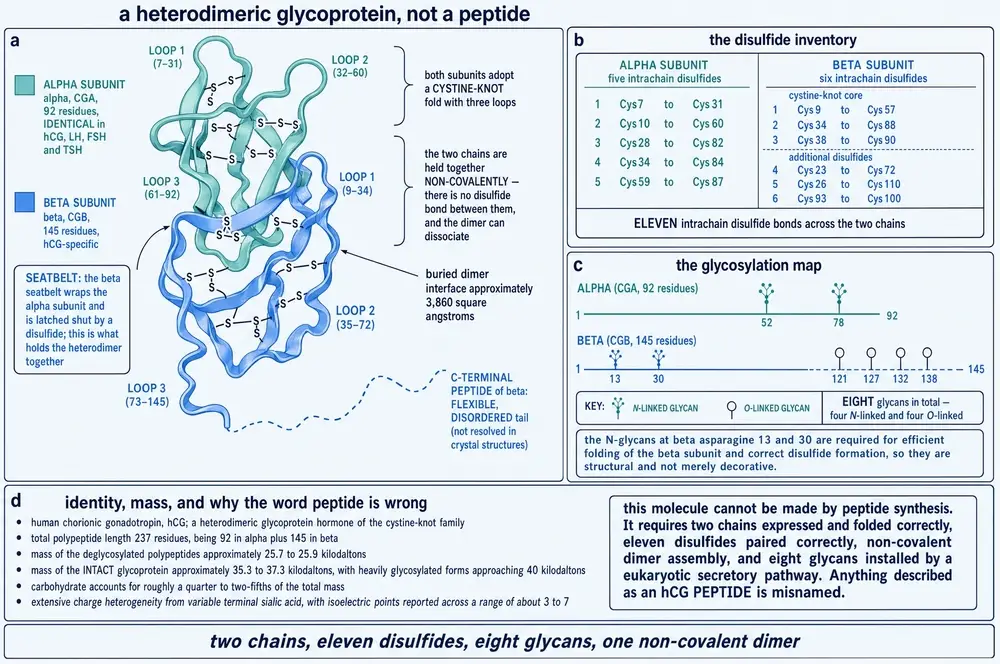
It is easy to miss how strange the underlying molecule is. hCG is not a peptide, and the research-chemical market that sells it under that description is wrong on the chemistry: it is a heterodimeric glycoprotein of two separate chains, held together by no covalent bond at all, carrying eleven internal disulfide bridges and eight sugar trees, and roughly a third of its mass is carbohydrate rather than protein. It cannot be made by peptide synthesis. It has to be grown.
Nor is it really a pregnancy hormone in the sense the test implies. Its actual job is narrower and stranger than that: it is a signal from an embryo that overrides its mother’s hormonal cycle, sent in the days before she could know she is pregnant, telling a structure in her ovary that was scheduled to die to keep going instead. Everything else the hormone is used for — triggering ovulation in a fertility clinic, raising testosterone in a man whose pituitary has failed, coaxing an undescended testis downward — is a repurposing of that one embryonic instruction.
And it is measured more than almost any other hormone in medicine, which turns out to be where most of its trouble lies. A number that everyone trusts, produced by assays that disagree with each other, reading a molecule that exists in at least six forms of which the commonest in urine is one most assays cannot detect. This document is organised around that gap — between what hCG is, and what the instrument reading it can see.
02Berlin, 1927
On 12 January 1926 two physicians at the Charité in Berlin presented work in excerpt to the Berlin Society for Gynaecology and Obstetrics. Selmar Aschheim was then in his late forties, a histologist who had spent nearly two decades in the hospital’s gynaecological laboratory. Bernhard Zondek was thirteen years younger. What they had found was that something in the urine of pregnant women, injected into immature female mice, drove those mice’s ovaries into a state they should not have reached for weeks — follicles ripening, corpora lutea forming, haemorrhage into the ovarian stroma.
By 1928 they had turned it into a diagnostic test, and the paper that describes it is the founding document of hormone testing in medicine: the first time a hormone was measured to answer a clinical question about a particular patient (Schneck, 1997; Rohde, 2010).
They also got the source wrong, and their own titles say so. The 1927 and 1928 papers are called Das Hormon des Hypophysenvorderlappens and — for the test itself — Die Schwangerschaftsdiagnose aus dem Harn durch Nachweis des Hypophysenvorderlappenhormons: the hormone of the anterior pituitary lobe. They had traced a gonad-stimulating substance to the gland already known to stimulate gonads. Zondek extended the error productively in 1929 by proposing that this pituitary output came in two forms, which he named Prolan A and Prolan B, and which became follicle-stimulating hormone and luteinizing hormone. The placental origin of the substance in pregnancy urine was established afterwards, by Georgeanna Seegar Jones — first reported in 1936, and settled in 1943 by growing placental cells in culture, where there was no pituitary present to make it.
There is an earlier claim, and it is documented. Between 1919 and 1920 a Japanese investigator, Hirose, reported that extracts of human placenta injected into immature rabbits produced corpus luteum formation. He had the source right — he was working with placenta — and no assay anyone could use. This document has not been able to read those papers directly and reports them as they are cited by others.
Five immature female mice, three to four weeks old and weighing six to eight grams. Urine injected under the skin twice a day for three consecutive days at varying sites — thirty injections for one answer. At exactly one hundred hours after the first injection the animals were killed and dissected, and the ovaries read: congestion, haemorrhagic follicles and corpora lutea meant pregnant.
Five animals rather than one was deliberate. Individual mice vary, and an infant mouse could not tolerate the whole dose at once. The Edinburgh service that ran this test commercially returned a result by post within six days of receiving the specimen.
03What happened next to the men who found it
In 1931 the Nobel Committee considered recognising them. The prize that year went to Otto Warburg.
Both men were Jewish. In 1933 Aschheim was dismissed from the Charité — on grounds of Jewish descent and of being considered politically unreliable — and Zondek lost his posts in the same year. Zondek went first to Stockholm, where he worked unpaid at the Biochemical Institute and where his application for a Swedish medical licence drew an organised protest from local practitioners; in the autumn of 1934 he emigrated to Mandatory Palestine, and became professor of obstetrics and gynaecology at the Hebrew University of Jerusalem. Aschheim remained in Germany four years longer and fled to France in 1937. He took French citizenship after the war, became a research director at the CNRS, and died in Paris in 1965. Zondek died in November 1966, aged seventy-five (Schneck, 1997).
The test they built outlived the institution that expelled them, and by the mid-1930s a single laboratory in Edinburgh was running more than ten thousand of them a year.
04Mice, rabbits, toads
For thirty years the assay for this hormone was an animal. The successors to the Aschheim–Zondek reaction are best read as a history of what a laboratory could be asked to do in a given decade, and of how long a woman had to wait.
The Edinburgh service is worth dwelling on, because it shows what the test was actually for. It ran from about 840 specimens in 1929 to over ten thousand in 1939. The mice came from a commercial supplier in Essex reported to house two hundred thousand animals and to dispatch up to three thousand a day. Urine travelled by post, in strong cases marked Pathological specimen, and arrived too old, too little, or broken in transit. The fee started at five shillings and had to be doubled in the second year because the station was losing money (Olszynko-Gryn, 2014).
And its main use was never a simple yes or no. It was differential diagnosis: suspected fetal death, hydatidiform mole and choriocarcinoma monitoring, ectopic pregnancy, pseudocyesis, and medico-legal work. The laboratory staff kept telling clinicians that a positive result meant placental activity and nothing more — that it was, in the head of the station’s own words, simply not a pregnancy test. That distinction is the same one Section 18 of this document has to make again, ninety years later, about a modern immunoassay.
One social fact deserves recording. The Edinburgh station refused between two and three hundred specimens a year sent in by women themselves, or by chemists on their behalf, because it dealt only with the medical profession. A woman with a sympathetic doctor could obtain a test for any reason she liked; a woman without one could not obtain it at all. The home test, when it finally arrived in British pharmacies in 1971, removed that gatekeeper, and the laboratory history of this hormone is inseparable from the question of who was allowed to ask it a question.
05Two subunits, one of them borrowed
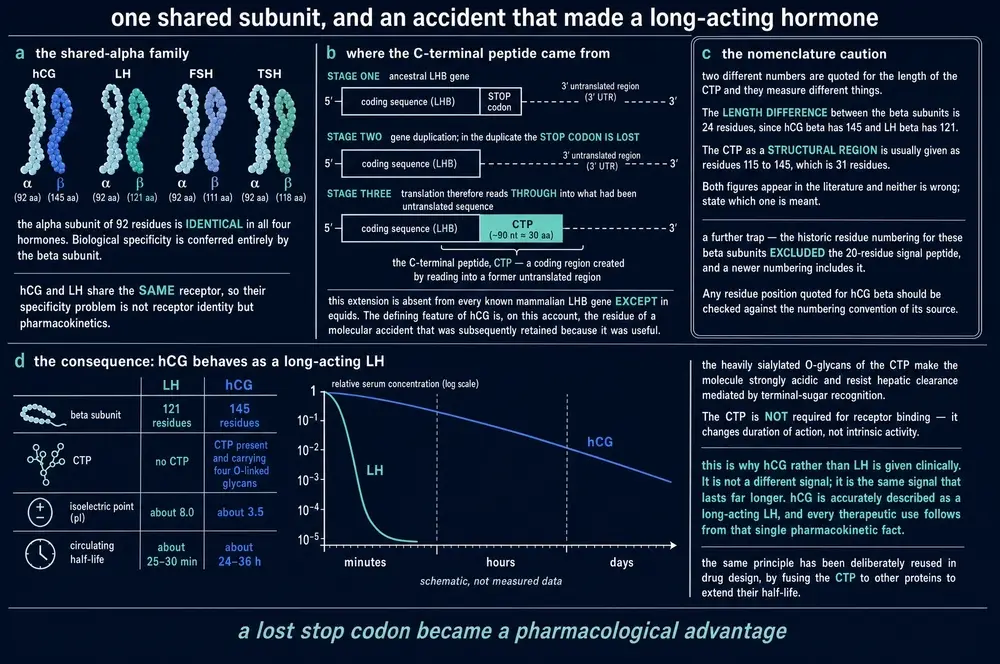
Four human hormones are built to the same plan. Luteinizing hormone, follicle-stimulating hormone, thyroid-stimulating hormone and chorionic gonadotropin each consist of two chains: an alpha chain and a beta chain, folded together. The alpha chain is not merely similar between them. It is the same molecule — ninety-two residues, one gene, CGA — in all four.
Everything that distinguishes these hormones from one another is carried by the beta chain: which receptor they engage, how long they last in the blood, what they do. hCG’s beta chain is a hundred and forty-five residues, from a cluster of genes on chromosome 19, and it is the only one of the four that is not made by the pituitary.
Three consequences run through the rest of this document, and it is worth setting them out together because they look unrelated and are not.
The first is diagnostic. Because identity lives in the beta chain, an antibody raised against the whole hormone also recognises luteinizing hormone — which surges in the middle of an ordinary menstrual cycle. Every assay built before 1972 therefore reported a positive result at ovulation. Section 15 is about the fix.
The second is pharmacological. hCG and luteinizing hormone bind the same receptor. They are not two signals; they are one signal with two durations. That is the whole basis of hCG’s therapeutic use, and Section 07 explains where the difference comes from.
The third is a clinical hazard. The alpha chain hCG shares with thyroid-stimulating hormone is the chain that hormone also uses. At ordinary pregnancy concentrations this does not matter. At the concentrations reached in a molar pregnancy it matters a great deal, and Section 13 gives the numbers.
06The knot and the seat belt
Both subunits fold around a cystine knot — three disulfide bonds arranged so that two of them form a ring and the third threads through it. It is the same motif found in several protein growth factors, and finding it here was a surprise: these two chains share that architecture while sharing almost no sequence, about ten per cent identity by the measurement of the 1994 structure (Wu et al., 1994).
The fold is not what holds the hormone together. A segment of the beta chain wraps around the alpha chain like a strap and is buckled shut by a single disulfide bond, Cys26–Cys110. Lapthorn and colleagues, publishing the crystal structure in Nature in June 1994, called it a seat belt, and noted that it appears essential not only for the two halves to associate but for the assembled hormone to bind its receptor at all (Lapthorn et al., 1994).
It is worth being concrete about why that matters, because “holds the dimer together” understates it. The two chains are not bonded to each other at all. Nothing covalent joins the alpha subunit to the beta subunit; the assembly is held by shape and by the strap, and it can come apart. That is not a theoretical possibility — free alpha and free beta subunits circulate in blood as species in their own right, and Section 08 is about what happens when they do. A hormone that can dissociate into two inactive halves, each of which is separately measurable and separately meaningful, is a different kind of analyte from one that cannot.
Two structures of this molecule were published six days apart in June 1994, by different groups using different methods — and they share an author. Robert Canfield, who appears on the Structure paper, had led the team that sequenced both chains of the hormone nineteen years earlier (Morgan et al., 1975). It is unusual for one person to be present at both the sequence and the fold of the same molecule.
07A third of it is sugar
Eight sugar trees hang off this hormone: four attached to asparagines through nitrogen, and four attached to serines through oxygen. The four O-linked ones are all on the same stretch of the beta chain — the last twenty-four residues, a tail that luteinizing hormone does not have at all.
That tail is called the carboxy-terminal peptide, and it is the reason hCG is a medicine. Its heavily sialylated sugars make the molecule strongly acidic and shield it from the liver’s terminal-sugar clearance machinery. Luteinizing hormone, lacking it, is cleared in something under half an hour. hCG persists for a day and a half. Same receptor, same signal, two orders of magnitude of duration.
The corpus disagrees with itself on the comparison, and the disagreement is worth stating rather than averaging. Values quoted for hCG’s circulating half-life cluster at 24 to 36 hours and are consistent. Values quoted for luteinizing hormone run from 30 minutes to 21–24 hours — a fortyfold spread — because some sources give the plasma half-life of the endogenous hormone and others the terminal half-life of a recombinant preparation given by injection. Those are not the same quantity and should not be pooled.
08Not one molecule but a family
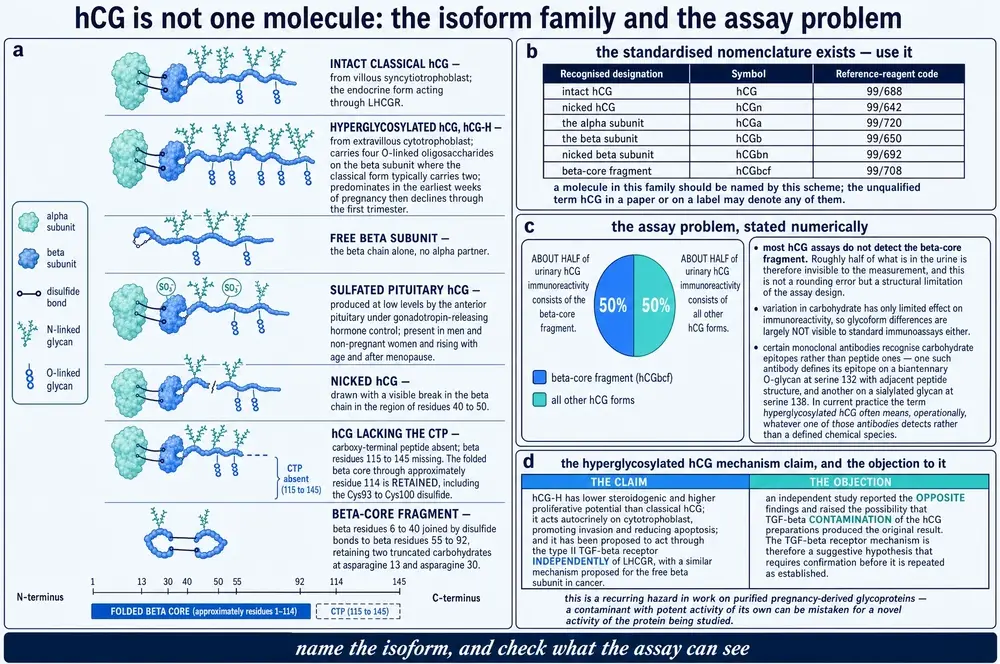
“hCG” on a laboratory report is a category, not a substance. The intact hormone from the villous syncytiotrophoblast is one member. There is a hyperglycosylated form from a different cell type, a free beta subunit circulating without its partner, a sulfated form made by the pituitary in men and non-pregnant women, a nicked form cut by placental proteases, and a beta-core fragment produced by the kidney which is the dominant species in urine and essentially absent from serum (Cole, 2012).
This matters for two reasons that pull in opposite directions. Clinically, it means an assay result depends on which forms that assay can see — Section 16. Scientifically, it is the site of the field’s liveliest unresolved argument.
The proposal, associated principally with Laurence Cole, is that hyperglycosylated hCG is not a variant of the hormone but a different kind of agent: an autocrine factor acting on the cytotrophoblast that makes it, driving invasion and blocking apoptosis by antagonising a TGF-beta receptor rather than by engaging the hormone’s own receptor. On that account the five circulating forms split into two groups — hormones and growth factors — that happen to share a protein backbone.
Every statement of that mechanism in this reading corpus is a review restating the proposal. There is no primary experiment in the corpus testing whether hyperglycosylated hCG binds a TGF-beta receptor: no binding data, no competition assay, no knockdown. The counter-claim — that the hyperglycosylated form is simply a weaker agonist at the ordinary receptor — exists in the corpus only as a second-hand sentence. A third proposal, that hCG acts on uterine natural killer cells through the mannose receptor, appears once. Both sides of this disagreement are, in the material read for this document, citation-level only, and a reader should treat the TGF-beta account as a hypothesis that has been repeated often rather than as a finding that has been reproduced.
09How the switch is thrown
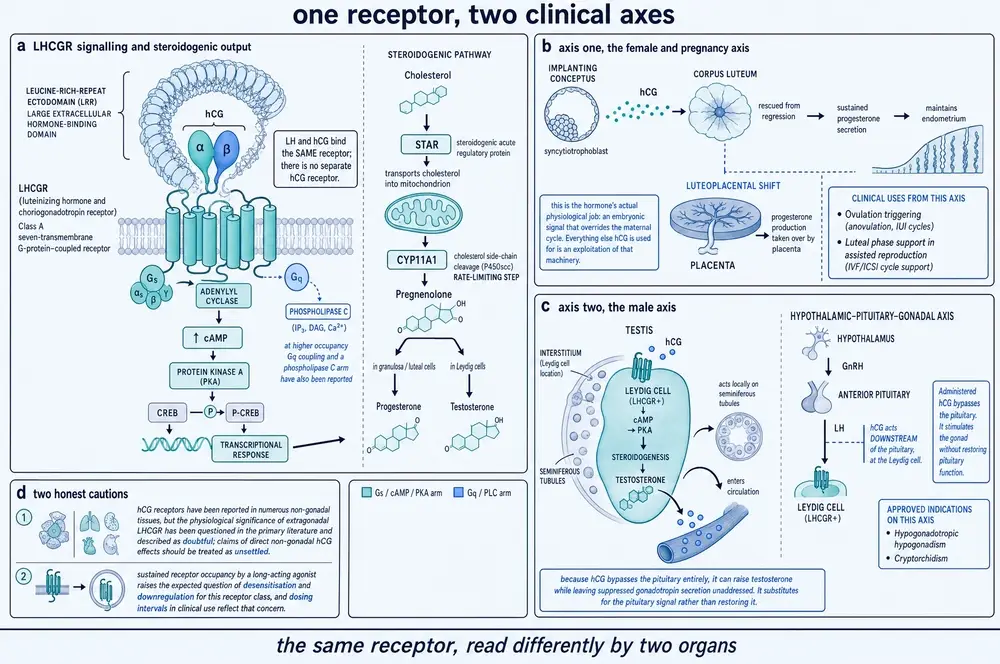
hCG acts at a single receptor, LHCGR, which luteinizing hormone also uses. It is a class A G-protein-coupled receptor with an unusually large extracellular domain built from leucine-rich repeats, and for decades what happened when a hormone landed on that domain was a matter of inference.
In 2021 Duan and colleagues published four cryo-electron microscopy structures of the receptor in Nature: the wild-type protein inactive and active, and two constitutively active mutants. The active structures carry chorionic gonadotropin and the stimulatory G protein, and one of them also carries Org43553, a small molecule that activates the receptor from a site inside the membrane-spanning bundle rather than at the hormone-binding surface. The mechanism they describe is a push and a pull: the hormone pushes the extracellular domain upright, and a flexible hinge below it pulls the assembly into the active conformation (Duan et al., 2021).
The description repays a moment, because it explains a clinical fact. Everything about this receptor is built for a hormone that arrives, binds and leaves. It is engaged briefly and rhythmically by luteinizing hormone across a menstrual cycle. hCG engages it for a day and a half at a time, and does so at concentrations that in early pregnancy are orders of magnitude above anything the ovary meets otherwise. A receptor occupied that continuously does what receptors do when they are occupied continuously — it is internalised and its numbers fall — and Section 19 gives the measurement: after a trigger injection, granulosa-cell expression of this receptor drops to a few per cent of baseline within a day and a half, which is roughly when the injected hormone reaches its peak inside the follicle.
Org43553 is worth a sentence of its own, because it shows what the structure is for. It is a small molecule, orally available, and it does not bind where the hormone binds — it acts from a pocket inside the membrane-spanning bundle, below the whole hormone-binding apparatus. A receptor that can be switched on from underneath is a receptor that could in principle be switched on by a tablet.
Two honest qualifications belong here. The hinge that does the pulling is not resolved in those structures — it is too flexible to see — so the mechanism’s central moving part is inferred rather than observed, and the detailed accounts of it in this corpus come from molecular-dynamics simulation rather than from experiment. And the corpus contains no measured binding constant for hCG at its own receptor: no radioligand study, no dissociation constant. The closest quantitative statement available is that the concentration producing a half-maximal cyclic-AMP response is roughly twenty times lower than the concentration needed to engage the calcium arm.
10Rescuing the corpus luteum
After ovulation the ruptured follicle becomes a corpus luteum, a temporary endocrine organ that makes progesterone and is scheduled to die. If it dies, the endometrium is shed and the cycle restarts. An implanting embryo therefore has about a fortnight to countermand that instruction, and hCG is the countermand. The syncytiotrophoblast begins secreting it around the time of implantation; it reaches the ovary, engages the receptor that luteinizing hormone would otherwise have engaged, and the corpus luteum keeps making progesterone instead of regressing.
The arrangement is temporary. Over the first trimester the placenta takes over progesterone production — the luteoplacental shift — and hCG, having done the job, falls from its peak to a much lower plateau for the rest of the pregnancy. That rise and fall is what a clinician reads in serial measurements in early pregnancy, and it is the basis of every use in Part Four.
This is the hormone’s actual physiological function, and it is worth noticing how narrow it is. Everything else in this document — the trigger injection, the testosterone, the tumour marker, the diet — is an exploitation of machinery built for one fortnight.
11Talking to the lining
Whether hCG also acts directly on the endometrium is genuinely unsettled, and the corpus contains a clean contradiction between primary studies rather than a consensus with dissent.
Against. A 2022 study found the receptor’s transcripts undetectable in bulk sequencing of whole cycling human endometrium and in cultured endometrial stromal cells. The same laboratory obtained robust cyclic-AMP, calcium and ERK responses from cells engineered to express the receptor, and none of those responses from the primary cells; proliferation, viability and decidual transformation were all refractory to the hormone (Mann et al., 2022).
For. A human study in which twelve women received intrauterine hCG at the implantation window found significantly more endometrial cells expressing VE-cadherin and CD146 after treatment, with CD31 and both VEGF receptors unchanged — a change in junctional cohesion between existing vessels rather than the growth of new ones (Bienert et al., 2021). That study was, by its own account, badly underpowered: it calculated a required sample of 74 to 107 and enrolled twelve.
A third primary study cuts against the usual narrative in a different way. In a transwell invasion assay using a trophoblast cell line, hCG alone had no significant effect on invasion at all. The effect appeared only when peripheral blood mononuclear cells were present, and the hormone acted by changing what those immune cells secreted — raising matrix metalloproteinases 2 and 9 and lowering their inhibitors (Yu et al., 2015). If that is right, the pro-invasive action so often attributed to hCG acting on trophoblast is indirect.
12Tolerating a foreign body
A fetus is genetically half foreign and is not rejected, and hCG is routinely named among the reasons. The corpus supports the association. It does not, on the material read here, support the mechanism at the confidence the review literature uses.
Effects on regulatory T cells, on uterine natural killer cell distribution and on dendritic cells are reported, and the underlying observations are real. But they are distributed across mouse work, cultured cell lines and small human studies, and the reviews that summarise them routinely narrate mouse and cell-line findings in the register of human physiology. This document reports the direction of the evidence — that hCG modulates several immune populations in the uterus — and declines to state a human mechanism the corpus does not contain.
One well-defined use belongs here rather than in Part Five, because it is the same biology pointed somewhere unexpected. A phase II open-label trial has tested urinary-derived hCG in graft-versus-host disease after stem-cell transplantation (Holtan et al., 2023). That is an immune-tolerance hypothesis taken seriously enough to put into people, and it is early-phase and uncontrolled.
13When the borrowed subunit misfires
Section 05 said the shared alpha chain would produce a clinical hazard. This is it.
Thyroid-stimulating hormone uses the same alpha chain, and its receptor will respond to hCG — weakly. The two potency estimates in this corpus disagree by roughly fivefold and both are second-hand citations rather than measurements: one gives a unit of hCG as equivalent to 0.0013 microunits of thyrotropin, the other says hCG is about four thousand times weaker. There is no primary in-vitro pharmacology for hCG at the thyroid receptor anywhere in this corpus — no named cell line, no dose-response curve, no binding constant.
That the effect is real at high concentrations is not in doubt, because the clinical data are unambiguous. In a retrospective series of forty-four women with gestational trophoblastic disease, thyrotropin was suppressed in 63.6 per cent and free thyroxine raised in 40.9 per cent; among those with hCG above 200,000 units per litre, thyrotropin was suppressed in 82.8 per cent (Khomphaiboonkij et al., 2021). The same mechanism appears in men: in a series of twenty males with hCG-secreting testicular germ cell tumours, two had undetectable thyrotropin, both with extreme hCG, and one presented in thyroid storm refractory to antithyroid drugs and required total thyroidectomy (Rohayem et al., 2025).
The relationship is not deterministic, and the same paper says so. Two other men in that series, with hCG of 370,750 and 693,390 units per litre, showed no thyrotropin suppression whatever. Concentration alone does not predict the thyroid effect, and the authors attribute the discrepancy to differences in glycosylation between one tumour’s hCG and another’s — which returns the argument to Section 08.
Nausea and vomiting in pregnancy sit on the same axis. In a randomised trial of 111 women, maternal serum hCG correlated with a validated nausea score at r = 0.70, and maternal thyroxine was independently associated with the same score, while histamine showed no association at all (Foessleitner et al., 2024). A meta-analysis of hyperemesis gravidarum found consistent associations with preeclampsia, preterm delivery, small-for-gestational-age birth and low birth weight — and graded the certainty of every one of those outcomes as very low (Moberg et al., 2023).
14Reading the placenta from a blood sample
hCG is measured in early-pregnancy screening, and the obvious question is whether it predicts the placental syndromes. The corpus is directionally split, and the split is not noise.
| Study | Design | Finding |
|---|---|---|
| Li 2026 | 350 women, case–control, 11–13 weeks | free beta-hCG higher in preeclampsia — 1.12 against 0.99 MoM; adjusted odds ratio 1.358 per 0.1 MoM |
| Chen 2024 | 22,745 singletons, second trimester | free beta-hCG at or above 2.50 MoM: preeclampsia relative risk 1.469; growth restriction 1.641 |
| Huang 2022 | 15,640 singletons, Toronto | first-trimester free beta lower in preeclampsia (0.81 against 0.98 MoM); second-trimester total hCG higher in the same women |
| Parry 2022 | nuMoM2b, about 9,200 women, prospective | free beta lower; preeclampsia odds ratio 0.81. Areas under the curve 0.51–0.56 — no useful discrimination |
| Keikkala 2016 | case–control, 8–13 weeks | the hyperglycosylated fraction lower in preeclampsia: 10.2 % against 12.4 %, and 8.1 % in early-onset disease |
Two things reconcile most of this. The analytes are different: free beta subunit, total hormone and hyperglycosylated fraction are three measurements, and the last moves in the opposite direction to the first two. And the trimester matters — the Toronto cohort found low free beta at eleven weeks and high total hCG at seventeen weeks in the same pregnancies.
What none of it supports is causation, and every human study in this corpus disclaims it explicitly. The only mechanistic work available found placental hCG-beta protein raised roughly eightfold in growth restriction and tenfold in preeclampsia with growth restriction — and then showed, in cell lines, that inhibiting mitochondrial translation induces hCG, while hCG itself did not alter the mitochondrial markers. That places the high hormone downstream of the placental problem rather than upstream of it. There is no animal model of hCG-induced hypertension or preeclampsia anywhere in this corpus.
15Why the beta subunit was the breakthrough
By the mid-1960s hCG could be measured by radioimmunoassay, and the assay could not tell it from luteinizing hormone (Midgley, 1966). The workaround was to run the assay at a concentration where luteinizing hormone did not interfere, which cost sensitivity — and sensitivity was the entire point, because the clinical value of measuring this hormone lies in the days before anything else is detectable.
In July 1972 Vaitukaitis, Braunstein and Ross published the solution: raise the antiserum against the beta subunit alone. Because the alpha chain is shared and the beta chain is not, an antibody that sees only beta sees only hCG. The paper’s title says exactly that — an assay which measures hCG in the presence of luteinizing hormone — and it reports that high concentrations of luteinizing hormone, in luteal-phase and castrate samples, had no effect on the result (Vaitukaitis et al., 1972).
Everything downstream follows: measurement in early implantation, in unruptured ectopic pregnancy, in threatened miscarriage, and in trophoblastic disease under chemotherapy. Monoclonal antibodies in the early 1980s made the two-site format cheap and specific, and the modern strip test is that format dried onto paper. The first home kits reached British pharmacies in 1971 — before the beta-specific assay existed — and were complement-fixation kits needing a rack of test tubes, a vibration-free surface and about two hours (Braunstein, 2014; Olszynko-Gryn, 2019).
16What a number does and does not mean
A serum hCG result looks like a measurement of a substance. It is a measurement of whatever a particular assay’s two antibodies can hold on to, and different manufacturers have chosen differently.
A survey of specialist laboratories monitoring trophoblastic disease found that the beta-core fragment — the dominant urinary species — is detected by some commercial platforms and not others; that thresholds for a “normal” result range from below 1.0 to below 8.0 units per litre across manufacturers; and that the concentration at which each platform suffers the high-dose hook effect, where extreme hCG paradoxically reads low, varies from 750,000 to 2,000,000 units per litre. Most laboratories were still calibrating to the third or fourth international standard rather than the fifth (McMahon et al., 2024).
The consequences are not hypothetical. In an educational case from that survey, a woman six months post-partum with metastatic disease had a local result of 2,500 units per litre and a reference-centre result, on the same sample, of 4.5 million. The falsely low value would have produced a lower risk score and a different treatment.
A parallel finding: four analysers compared across 1,136 pregnancies were not interchangeable. No pair agreed on both first-trimester markers at once, and false-positive rates for trisomy 21 risk ranged from 2.3 to over 5 per cent depending only on which machine ran the sample. Combined first-trimester screening is nonetheless one of the genuine successes of this molecule: in a study of 25,155 singleton pregnancies, ultrasound plus free beta-hCG and PAPP-A detected 94.9 per cent of trisomy 21 at a 2.5 per cent false-positive rate (Ye et al., 2024).
17The tumour marker
hCG is the monitoring analyte for gestational trophoblastic disease, and here it works. The largest evidence in this corpus is a national study of 17,424 women whose hCG normalised after evacuation of a complete hydatidiform mole: 99.8 per cent never developed neoplasia. The residual risk was 0.06 per cent if the hormone normalised within fifty-six days and 0.22 per cent if it took longer, and all thirty-one women who did develop disease achieved sustained remission (Swift et al., 2025). Seventy-one per cent of those cases were diagnosed after the standard six-month surveillance window had closed.
In germ cell tumours it works considerably less well, and a 2025 review asks the question in its title. Taking seminomas and non-seminomas together, hCG is the most reliable of the three standard markers — at a sensitivity of thirty-five per cent. Pure teratomas and yolk sac tumours show no hCG at all, and only 40 to 50 per cent of relapses under surveillance show any marker rise (Marroncelli et al., 2025).
A useful negative from the same literature: among 1,031 seminoma patients, thirty-nine had hCG above 1,000 units per litre, and every sample investigated was pure seminoma containing syncytiotrophoblastic cells. A very high hCG does not by itself imply a non-seminomatous component.
And hCG-beta is made by tumours with nothing to do with pregnancy. Among 369 patients undergoing cystectomy for urothelial carcinoma, an abnormal preoperative beta-hCG occurred in 1.1 per cent of organ-confined disease and 14.3 per cent of locally advanced disease, and independently predicted overall survival with a hazard ratio of 3.88 (Yuk et al., 2024). A systematic transcriptomic analysis across twenty cancer types — a preprint, not peer-reviewed — reports the beta genes expressed in most urothelial bladder cancers, one of them associated with an immunosuppressed tumour microenvironment and worse survival (McKellar et al., 2025).
Therapeutic targeting of hCG-beta remains preclinical. A 2026 report of an antisense morpholino describes reduced viability, clonogenicity and migration across eight cell lines, with the authors stating plainly that the work is exclusively in vitro and that in-vivo validation remains to be done (Kinion et al., 2026). An earlier vaccine programme reached an early phase II trial and failed. Two mechanistic papers underpinning the hCG-beta-drives-cancer literature are compromised: one retracted for duplicated image panels, one carrying a corrigendum for reused blots.
18The false positive that reaches the operating theatre
Because a positive hCG is treated as near-proof of pregnancy or malignancy, a false one is dangerous in a way a false negative is not.
The commonest cause is a heterophilic antibody — a patient’s own antibody bridging the two assay antibodies and producing signal with no hormone present. In one published series of eighty-three false-positive cases, sixty-two received chemotherapy or hysterectomy for disease they did not have. A 2023 case report describes a woman with a result of about 1,450 units per litre who underwent two uterine cavity revisions and a laparoscopy, with methotrexate under consideration, before the same sample run on a different platform returned below 1.0 (Racek et al., 2023).
Other causes are pituitary hCG around the menopause, impaired clearance in renal failure, familial hCG syndrome, and quiescent trophoblastic disease. The distinguishing test is simple in principle: heterophilic antibodies are too large to be filtered into urine, so a positive serum with a negative urine points to interference (Oyatogun et al., 2021). It is not infallible — one reported case had intermittently positive urine on the affected platform and negative urine on two others.
The American College of Obstetricians and Gynecologists issued a clinical consensus on this in 2026, framing the problem as one of systematic evaluation before invasive intervention and noting that positive results have been associated with unnecessary workup and treatment, including chemotherapy (ACOG, 2026).
19The trigger
In assisted reproduction, follicles are grown with gonadotropins and then given a single injection that mimics the mid-cycle luteinizing hormone surge and sets final maturation and ovulation in motion. hCG is the classical trigger, and the reason is Section 07: it is the same signal as luteinizing hormone with a half-life two orders of magnitude longer, so one injection does what a surge does.
A 2026 human study makes the mechanistic trade-off unusually clear. Fifty women had follicles aspirated at intervals after either a GnRH-agonist trigger or hCG. The agonist produced a luteinizing hormone peak of roughly 120 to 140 units per litre at twelve hours and a rise in follicle-stimulating hormone. hCG produced no follicle-stimulating hormone component at all — circulating levels fell to about 40 per cent of baseline by seventeen hours — and its own concentration inside the follicle rose sharply only between seventeen and thirty-two hours. Meanwhile granulosa-cell expression of its receptor had fallen to about 3 to 5 per cent of baseline by thirty-two hours. hCG arrives after most of its own receptor has gone (Poulsen et al., 2026).
Whether that matters clinically is less clear than the mechanism suggests. Meta-analyses of the dual trigger — hCG plus an agonist — report live birth improved, with one pooling 1,048 participants at a relative risk of 1.37 and another ten trials at an odds ratio of 1.61. But several individual randomised trials and large cohorts find nothing: a trial of 164 women aged 35 to 42 found mature oocyte counts of 6.07 against 5.78 (p = 0.62); a trial of 100 women found more mature oocytes and more good embryos with no difference in clinical pregnancy (21 % against 19.6 %, p = 0.770); and a retrospective series of 1,040 cycles found cumulative live birth identical at 24.9 per cent in both arms.
Dose matters and can run the wrong way. In 963 women, a dual trigger using only 1,000 units of hCG produced lower live birth than hCG alone — 33.4 against 45.8 per cent — despite the dual group being younger, with higher ovarian reserve and more oocytes; the authors attributed it to inadequate luteal support and changed their protocol. And in a double-blind placebo-controlled trial of 619 women across five countries, adding a recombinant hCG to the stimulation phase reduced oocyte yield and ongoing pregnancy in a dose-related way.
Two further findings deserve recording because they are counter-intuitive. The optimal interval between trigger and retrieval runs in opposite directions for the two trigger types — in 59,206 cycles, agonist-triggered patients yielded more mature oocytes with a longer interval and hCG-triggered patients fewer (Enatsu et al., 2025). And a purely analytical study found that highly purified human menopausal gonadotropin, sold for its luteinizing-hormone activity, contains 18 to 47 per cent beta-hCG by gonadotropin content, with luteinizing hormone beta present only in traces — and glycan mapping identifies that hCG as placental rather than pituitary (Capolupo et al., 2024). A widely used fertility drug is substantially this hormone under another name.
20The add-ons, and what happened when someone asked for the data
Around the core use sit the add-ons: hCG instilled into the uterus before embryo transfer, hCG given as luteal support, hCG for recurrent implantation failure. These are the interventions a patient pays extra for, and they are where this document’s single most important finding sits.
Intrauterine hCG before embryo transfer had a strong evidence base. A Cochrane review reported clinical pregnancy improved with a relative risk of 1.49; later syntheses agreed; one review of 188 trials of peri-transfer interventions put it at 1.232 while noting significant publication bias across the whole field.
In 2026 a group led from Monash did something different. Rather than pooling published summaries, they requested individual participant data from every eligible randomised trial and assessed each against a trustworthiness checklist. Twenty-eight trials were eligible, covering 5,534 participants. Data arrived for eight. One was excluded outright for a history of multiple retractions. Seven remained, comprising 2,244 participants (Zou et al., 2026).
Among those seven the intervention did nothing: an odds ratio for live birth of 0.99, with a confidence interval from 0.83 to 1.19 and no heterogeneity at all. Among the trials that did not supply data, the same intervention raised clinical pregnancy by an odds ratio of 1.87. The difference between the two groups is itself statistically significant — interaction P < 0.001 for live birth.
The authors report that all fourteen trials assessed on the trustworthiness checklist failed in at least one domain, most often trial registration, sample size or the primary outcome. Of twenty-one reports whose data were requested and not supplied, fifteen authors never replied, four stopped replying, one could not share because the corresponding author had died, and one declined for regulatory reasons. Their conclusion is that intrauterine hCG should not be offered as an add-on in clinical practice.
Two retracted trials of hCG in recurrent implantation failure sit in this document’s own reading corpus, with their reasons stated: one was withdrawn after review of the raw data found duplicate entries and cases recording more mature oocytes than total oocytes retrieved; the other after the authors could not produce raw data at all.
Luteal support runs the same way. An open-label randomised trial in 245 women found ongoing pregnancy of 58.9 against 62.0 per cent, an odds ratio of 0.88. A retrospective study of 4,762 natural frozen-transfer cycles found hCG luteal support associated with lower clinical pregnancy and lower live birth, and the association was strongest in women who had ovulated spontaneously (Wen et al., 2024).
The mechanistic work, meanwhile, is sound. Intrauterine hCG measurably changes endothelial junction proteins in human endometrium. The biology is real and the clinical effect is not demonstrable, and those two statements are compatible.
21The male axis
Because hCG acts at the Leydig cell, it raises testosterone without going through the pituitary. That gives it two established roles and one contested one.
Hypogonadotropic hypogonadism is where it works. In 99 men followed across 160 treatment cycles from 1983 to 2024, gonadotropin therapy produced sperm in the ejaculate in 78 per cent by five months, and concentrations above five million per millilitre in 49 per cent by fourteen months. The single strongest determinant of whether a pregnancy followed was not the man at all: adverse female-partner factors carried a hazard ratio of 0.20, with time to pregnancy of 15 against 43 months (Gialouris et al., 2026). A separate cohort of 35 azoospermic men achieved spermatogenesis in 74 per cent overall — and in 78 per cent with hCG plus follicle-stimulating hormone against 33 per cent with hCG alone (Huijben et al., 2026).
Cryptorchidism is where it mostly does not. A review covering the literature from 1930 gives the arithmetic plainly: in randomised studies hCG achieved testicular descent in about 19 per cent and placebo in 4 per cent, while non-randomised studies reported 33 per cent — a gap attributed to retractile testes being counted as successes. Its summary sentence is worth quoting in substance: surgery succeeds in about 90 per cent where randomised studies put hormonal treatment at 19 to 25. A quarter of the testes that do respond return to their original position (Abacı et al., 2013).
The same review reports evidence of harm: interstitial oedema, inflammatory change with leukocyte extravasation, and germ-cell apoptosis. One cited follow-up found apoptosis three to four times higher two decades later in men treated with hCG before puberty, with smaller testicular volume and higher follicle-stimulating hormone — while other work in the same review reports the germ-cell effect as transient. This document reports the disagreement.
The contested use is fertility preservation during testosterone therapy. The primary trials most often cited for it are cited by this corpus and absent from it. What the corpus does contain is a five-year observational study of 53 men in which adding hCG protected sperm concentration but not motility or morphology, and a retrospective series of 152 men with non-obstructive azoospermia in which pre-treatment made no difference to surgical sperm retrieval — 45 per cent against 50 (p = 0.53).
22The diet that would not die
In 1954 The Lancet published a short paper by A. T. W. Simeons, a British physician working in Rome, titled “The action of chorionic gonadotrophin in the obese” (Simeons, 1954). He proposed that injections of the hormone, given alongside a diet of a few hundred kilocalories a day, produced weight loss preferentially from abnormal fat deposits, suppressed hunger, and improved mood. He published the claim twice more in the following decade (Simeons, 1963; 1964).
There is no mechanism. hCG acts at a receptor that drives gonadal steroidogenesis, and no established pathway connects that receptor to fat mobilisation. The claim was pharmacologically unmotivated when it was made.
It was tested. In 1977 Greenway and Bray ran a double-blind randomised trial of hCG against placebo injections and reported the result in one sentence: weight loss was identical between the two groups, with no differential effect on hunger, mood or localised body measurements (Greenway & Bray, 1977). In 1995 Lijesen and colleagues assembled every controlled and uncontrolled trial they could find — twenty-four in all — and scored each for methodological quality on a hundred-point scale. Scores ran from 16 to 73. Of the twelve studies scoring 50 or better, one concluded hCG was a useful adjunct (Lijesen et al., 1995).
The confounding is total and it is structural: every version of this protocol pairs the injection with a severely restricted diet. A person eating five hundred kilocalories a day loses weight. The injection is the uncontrolled variable that the protocol, as marketed, never isolates — and the two studies that did isolate it found nothing.
The harm is not only the wasted money. A 2024 case report describes a 34-year-old woman receiving hCG injections for weight loss alongside a calorie-restricted ketogenic diet who presented with abdominal and chest pain, peripheral neuropathy, tachycardia, hypertension, hypokalaemia and hyponatraemia. She was initially diagnosed with “keto flu”. Brown urine and abnormal porphyrins led to a diagnosis of late-onset acute intermittent porphyria, confirmed by a pathogenic HMBS mutation, with the hCG injections named among the precipitants (Ali et al., 2024).
The weight-loss use has attracted regulatory action in some jurisdictions, including requirements on how such products are labelled. The research pass that was to verify the specific instruments — the agency documents, the exact mandated wording and the dates — did not complete, and no primary regulatory instrument was read for this document.
Following the standard’s rule for exactly this situation: the scientific record above is reported because it was read, and the regulatory history is named as unverified rather than repeated from secondary summary. A reader who needs the regulatory position should go to the primary documents. What can be said without them is that the pharmacology has no mechanism and the two competent trials found no effect.
23Sport, contraception, and a rumour
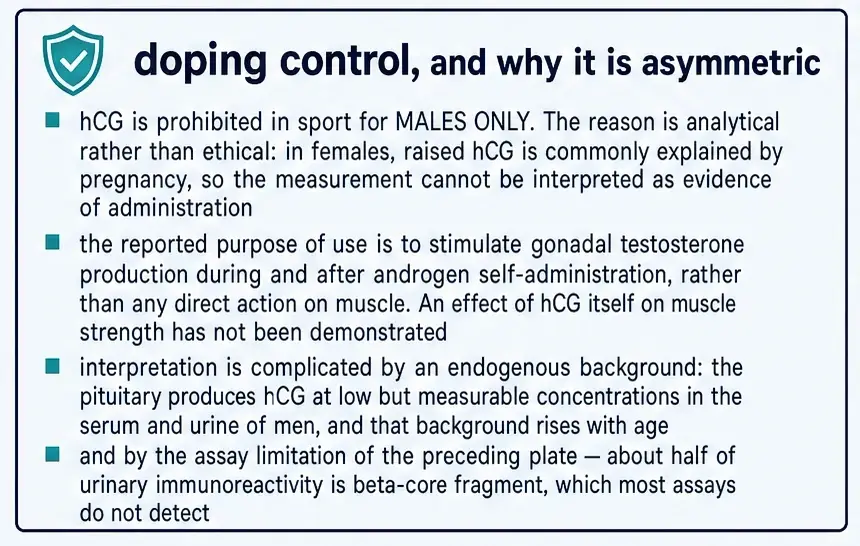
hCG is used by people taking anabolic androgens, and the stated purpose is not muscle. Androgen self-administration suppresses the pituitary, the testes shrink, and hCG is used to stimulate them directly during and after a course — a use that follows from Section 21’s biology rather than from any action on muscle. This document found no demonstration of an effect of hCG itself on muscle strength anywhere in its reading corpus.
The doping-control position has an asymmetry worth understanding, because it is analytical rather than moral. A raised hCG in a woman is commonly explained by pregnancy, so the measurement cannot by itself be read as evidence that anything was administered. In a man it can — but even there the reading is complicated by two facts from earlier in this document: the pituitary makes small quantities of hCG in men, and that background rises with age (Section 08); and roughly half of what is in urine is the beta-core fragment, which most assays do not detect (Section 16). An anti-doping result for this hormone is a measurement made against a moving endogenous baseline with a known blind spot.
The most ambitious thing ever attempted with this molecule was to vaccinate against it. If hCG is the signal that rescues the corpus luteum, then antibodies against hCG should prevent a pregnancy from establishing without touching ovulation — a contraceptive that works one step later than every other. A programme led from India pursued exactly that for decades, building immunogens around the beta subunit and its carboxy-terminal peptide, and later around genetically engineered constructs (Talwar, 2011; Talwar, 2015). It reached clinical testing and it is not a marketed product. The obstacles are the ones this document has already described: the antigen is a self protein whose alpha chain is shared with three other hormones, the immune response to it varies between people, and an antibody titre that falls below a threshold leaves a person neither protected nor informed.
That work has an unfortunate afterlife. During the COVID-19 vaccination campaign a claim circulated that the vaccines would cause infertility by raising antibodies that cross-react with hCG. The premise is the one thing in it that is real: a vaccine against hCG had genuinely been attempted, which is why the claim sounded informed. What it requires and does not have is meaningful shared structure between the vaccine antigen and this hormone, and the short incidental similarities between unrelated proteins that can always be found by searching are not that. The reason to set it out here is that the rumour is a precise inversion of the science: the difficulty of making an anti-hCG contraceptive deliberately, over decades, with the whole molecule in hand and adjuvants chosen for the purpose, is the strongest available evidence that it does not happen by accident.
24What is actually approved
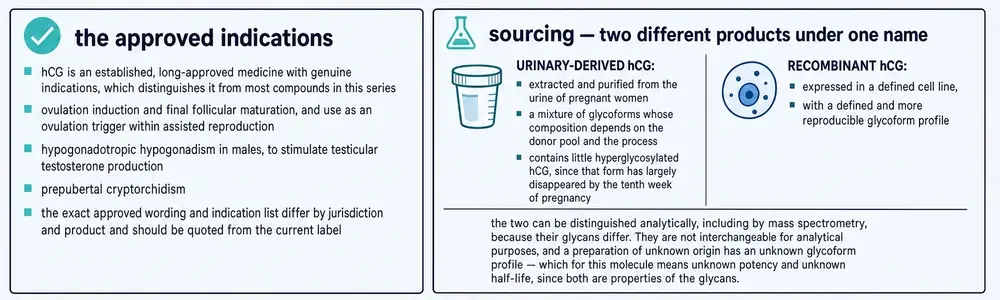
It is worth ending on the plain fact that distinguishes this compound from most others in this series: hCG is a long-established, properly approved medicine. It is not a research chemical with a marketing story. The indications are real, the evidence behind them is decades deep, and Section 21 shows one of them working well.
Two products share the name and are not the same material. Urinary-derived hCG is purified from the urine of pregnant women and is a mixture of glycoforms whose composition depends on the donor pool and the process. Recombinant hCG is expressed in a defined cell line with a more reproducible glycoform profile. The two are analytically distinguishable by mass spectrometry, because their glycans differ — and since Section 07 established that potency and half-life are properties of the glycans, a preparation of unknown origin has unknown potency and unknown duration of action.
That last point is where this document ends, because it joins the two halves of the story. The molecule’s entire clinical value rests on one accident: a duplicated gene that lost its stop codon, appending a sugar-laden tail that made a short-lived hormone long-lived. The same sugars that created the medicine are what make an unregulated preparation of it pharmacologically unknowable.
This document describes published research. It does not recommend human use of any compound and specifies no dose, route or schedule for any person. Where a dose or schedule appears in these pages it is reported as a parameter of a named study, with its population and duration attached, and for no other purpose. It is not medical advice.
25References
Generated from verified NCBI records rather than from recall. Author lists, journal names, volumes, pages and identifiers are taken from the PubMed record for each citation, and the build refuses to run if any identifier fails to resolve. This series has twice shipped reference lists drafted from memory in which identifiers pointed at real but unrelated papers.
- Abacı A, Çatlı G, Anık A, Böber E. Epidemiology, classification and management of undescended testes: does medication have value in its treatment?. J Clin Res Pediatr Endocrinol. 2013;5(2):65-72.
PMID 23748056 · doi:10.4274/Jcrpe.883 · PMC3701924 - Al-Zubi M, Ghassab Deameh M, Awawdeh AK, Mohammad RJ, Shannaq AA, Qdisat SM, et al.. Clomiphene citrate and human chorionic gonadotropin treatment before microdissection testicular sperm extraction in non-obstructive azoospermia: a retrospective non-randomized series. Front Reprod Health. 2026;8:1696244.
PMID 42088652 · doi:10.3389/frph.2026.1696244 · PMC13136116 - Ali M, Iqbal S. Human Chorionic Gonadotropin (hCG) Injections Exacerbating Acute Intermittent Porphyria in a 34-Year-Old Woman. Cureus. 2024;16(9):e68651.
PMID 39371821 · doi:10.7759/cureus.68651 · PMC11452356 - Bahl OP. Human chorionic gonadotropin. I. Purification and physicochemical properties. J Biol Chem. 1969;244(4):567-74.
PMID 5768856 - Bakry MS, Eldesouky E, Alghazaly MM, Farag E, Sultan EEK, Elazzazy H, et al.. Retraction Note: Granulocyte colony stimulating factor versus human chorionic gonadotropin for recurrent implantation failure in intra cytoplasmic sperm injection: a randomized clinical trial. BMC Pregnancy Childbirth. 2025;25(1):1093.
PMID 41094668 · doi:10.1186/s12884-025-08366-6 · PMC12522443 - Barnett MJ, Eidbo S, Casipit C, Lam J, Anastasopoulou C. Human Chorionic Gonadotropin as a Marker of Parathyroid Carcinoma: Findings From a Scoping Review. Cureus. 2025;17(6):e86141.
PMID 40530390 · doi:10.7759/cureus.86141 · PMC12170258 - Berger P, Lapthorn AJ. Standardization of Epitopes for Human Chorionic Gonadotropin (hCG) Immunoassays. Curr Med Chem. 2016;23(30):3481-3494.
PMID 27237818 · doi:10.2174/0929867323666160530145503 - Berger P, Sturgeon C, Bidart JM, Paus E, Gerth R, Niang M, et al.. The ISOBM TD-7 Workshop on hCG and related molecules. Towards user-oriented standardization of pregnancy and tumor diagnosis: assignment of epitopes to the three-dimensional structure of diagnostically and commercially relevant monoclonal antibodies directed against human chorionic gonadotropin and derivatives. Tumour Biol. 2002;23(1):1-38.
PMID 11893904 · doi:10.1159/000048686 - Bienert M, Habib P, Buck V, Classen-Linke I, Skoblo R, Rösing B. Intrauterine hCG application increases expression of endothelial cell-cell adhesion molecules in human. Arch Gynecol Obstet. 2021;304(6):1587-1597.
PMID 33903941 · doi:10.1007/s00404-021-06031-9 · PMC8553705 - Birken S, Armstrong EG, Kolks MA, Cole LA, Agosto GM, Krichevsky A, et al.. Structure of the human chorionic gonadotropin beta-subunit fragment from pregnancy urine. Endocrinology. 1988;123(1):572-83.
PMID 2454811 · doi:10.1210/endo-123-1-572 - Braunstein GD. The long gestation of the modern home pregnancy test. Clin Chem. 2014;60(1):18-21.
PMID 24025847 · doi:10.1373/clinchem.2013.202655 - Capolupo A, Petrocchi S, Melchiorre M, Jonas K, D'Hooghe T, Hanyaloglu A, et al.. Analytical Investigation of the Profile of Human Chorionic Gonadotropin in Highly Purified Human Menopausal Gonadotrophin Preparations. Int J Mol Sci. 2024;25(17).
PMID 39273352 · doi:10.3390/ijms25179405 · PMC11395176 - Castinetti F, Guerin C, Louiset E, Lacroix A. HCG-responsive aldosteronoma with transient secretion during pregnancy confirmed through HCG-stimulated adrenal venous sampling. Front Endocrinol (Lausanne). 2023;14:1153374.
PMID 36926028 · doi:10.3389/fendo.2023.1153374 · PMC10011616 - Chang C, Chen YL, Wang YW, Chen HW, Hsu CW, Lin KC, et al.. Aberrant trophoblastic differentiation in human cancer: An emerging novel therapeutic target (Review). Oncol Rep. 2024;51(3).
PMID 38240107 · doi:10.3892/or.2024.8701 · PMC10823338 - Chen Y, Dai X, Wu B, Jiang C, Yin Y. Relationship between increased maternal serum free human chorionic gonadotropin levels in the second trimester and adverse pregnancy outcomes: a retrospective cohort study. BMC Womens Health. 2024;24(1):323.
PMID 38835013 · doi:10.1186/s12905-024-03105-z · PMC11149239 - Cole LA. hCG, the wonder of today's science. Reprod Biol Endocrinol. 2012;10:24.
PMID 22455390 · doi:10.1186/1477-7827-10-24 · PMC3351023 - Cole LA. Hyperglycosylated hCG and pregnancy failures. J Reprod Immunol. 2012;93(2):119-22.
PMID 22386126 · doi:10.1016/j.jri.2012.01.001 - Cole LA. HCG variants, the growth factors which drive human malignancies. Am J Cancer Res. 2012;2(1):22-35.
PMID 22206043 · PMC3236569 - Cole LA. Proportion hyperglycosylated hCG: a new test for discriminating gestational trophoblastic diseases. Int J Gynecol Cancer. 2014;24(9):1709-14.
PMID 25275660 · doi:10.1097/IGC.0000000000000280 - Cole LA. The hCG assay or pregnancy test. Clin Chem Lab Med. 2012;50(4):617-30.
PMID 22149742 · doi:10.1515/CCLM.2011.808 - Conforti A, Di Girolamo R, Guida M, Alviggi C, Casarini L. Pharmacogenomic of LH and its receptor: are we ready for clinical practice?. Reprod Biol Endocrinol. 2025;23(Suppl 1):29.
PMID 40001128 · doi:10.1186/s12958-025-01359-2 · PMC11863420 - Duan J, Xu P, Cheng X, Mao C, Croll T, He X, et al.. Structures of full-length glycoprotein hormone receptor signalling complexes. Nature. 2021;598(7882):688-692.
PMID 34552239 · doi:10.1038/s41586-021-03924-2 - Duan J, Xu P, Luan X, Ji Y, He X, Song N, et al.. Hormone- and antibody-mediated activation of the thyrotropin receptor. Nature. 2022;609(7928):854-859.
PMID 35940204 · doi:10.1038/s41586-022-05173-3 - Duan J, Xu P, Zhang H, Luan X, Yang J, He X, et al.. Mechanism of hormone and allosteric agonist mediated activation of follicle stimulating hormone receptor. Nat Commun. 2023;14(1):519.
PMID 36720854 · doi:10.1038/s41467-023-36170-3 · PMC9889800 - Enatsu N, Furuhashi K, Otsuki J, Enatsu K, Okamoto E, Kokeguchi S, et al.. Optimal timing for triggering oocyte maturation during in vitro fertilization cycles varies between gonadotropin-releasing hormone agonist and human chorionic gonadotropin use. F S Rep. 2025;6(4):446-454.
PMID 41473569 · doi:10.1016/j.xfre.2025.07.009 · PMC12746871 - Errico A, Ambrosini G, Vinco S, Bottani E, Dalla Pozza E, Marroncelli N, et al.. In vitro effect of hCG on cryptorchid patients' gubernacular cells: a predictive model for adjuvant personalized therapy. Cell Commun Signal. 2025;23(1):19.
PMID 39794843 · doi:10.1186/s12964-024-01979-y · PMC11724491 - Fan QR, Hendrickson WA. Structural biology of glycoprotein hormones and their receptors. Endocrine. 2005;26(3):179-88.
PMID 16034172 · doi:10.1385/endo:26:3:179 - Foessleitner P, Rager L, Mikula F, Hager M, Granser S, Haslacher H, et al.. The Role of hCG and Histamine in Emesis Gravidarum and Use of a Chewing Gum Containing Vitamin C as a Treatment Option: A Double-Blinded, Randomized, Controlled Trial. J Clin Med. 2024;13(17).
PMID 39274311 · doi:10.3390/jcm13175099 · PMC11396101 - GALLI MANINI C. Pregnancy test using the male toad. J Clin Endocrinol Metab. 1947;7(9):653-8.
PMID 20264656 · doi:10.1210/jcem-7-9-653 - Gialouris JV, Conway AJ, Idan A, Savkovic S, Hermosilla R, Muir CA, et al.. Efficacy of Gonadotropin Therapy to Induce Spermatogenesis and Fertility in Men with Pathologic Gonadotropin Deficiency. J Clin Endocrinol Metab. 2026;111(5):1450-1458.
PMID 41165146 · doi:10.1210/clinem/dgaf588 · PMC13099210 - Greenway FL, Bray GA. Human chorionic gonadotropin (HCG) in the treatment of obesity: a critical assessment of the Simeons method. West J Med. 1977;127(6):461-3.
PMID 595585 · PMC1237915 - He X, Duan J, Ji Y, Zhao L, Jiang H, Jiang Y, et al.. Hinge region mediates signal transmission of luteinizing hormone and chorionic gonadotropin receptor. Comput Struct Biotechnol J. 2022;20:6503-6511.
PMID 36467583 · doi:10.1016/j.csbj.2022.11.039 · PMC9706539 - Herghelegiu CG, Veduta A, Stefan MF, Magda SL, Ionascu I, Radoi VE, et al.. Hyperglycosylated-hCG: Its Role in Trophoblast Invasion and Intrauterine Growth Restriction. Cells. 2023;12(12).
PMID 37371117 · doi:10.3390/cells12121647 · PMC10297647 - Holtan SG, Hoeschen A, Cao Q, Ustun C, Betts BC, Jurdi NE, et al.. Phase II, Open-Label Clinical Trial of Urinary-Derived Human Chorionic Gonadotropin/Epidermal Growth Factor for Life-Threatening Acute Graft-versus-Host Disease. Transplant Cell Ther. 2023;29(8):509.e1-509.e8.
PMID 37279855 · doi:10.1016/j.jtct.2023.05.021 · PMC11015887 - Huang T, Bedford HM, Rashid S, Rasasakaram E, Priston M, Mak-Tam E, et al.. Modified multiple marker aneuploidy screening as a primary screening test for preeclampsia. BMC Pregnancy Childbirth. 2022;22(1):190.
PMID 35260099 · doi:10.1186/s12884-022-04514-4 · PMC8903171 - Huijben M, Prinsen AMA, de Keyser CE, van der Leij SM, Peeters EFHI, Stades AME, et al.. Therapeutic benefits of gonadotropins in male hypogonadotropic hypogonadism: a focus on spermatogenesis and fertility. Reprod Fertil. 2026;7(2).
PMID 42189927 · doi:10.1530/RAF-25-0100 · PMC13280620 - Joyce C, O'Shea PM, Lynch R, Costelloe SJ, McCarthy TV, Coulter J, et al.. Use of the Abbott i-STAT®1 point of care device for hCG quantification in early pregnancy. Int J Gynaecol Obstet. 2025;171(2):736-742.
PMID 40387414 · doi:10.1002/ijgo.70217 · PMC12553100 - Kaur J, Singhania N, Adhikari U, Vatsa R, Gorsi U, Bansal A, et al.. Comparison of FSH Pre-treatment Versus Upfront hCG and FSH Regimens for Inducing Spermatogenesis in Congenital Hypogonadotropic Hypogonadism: A Pilot Study. Indian J Endocrinol Metab. 2025;29(3):332-336.
PMID 40688612 · doi:10.4103/ijem.ijem_307_24 · PMC12274034 - Keikkala E, Koskinen S, Vuorela P, Laivuori H, Romppanen J, Heinonen S, et al.. First trimester serum placental growth factor and hyperglycosylated human chorionic gonadotropin are associated with pre-eclampsia: a case control study. BMC Pregnancy Childbirth. 2016;16(1):378.
PMID 27887594 · doi:10.1186/s12884-016-1169-4 · PMC5124279 - Khomphaiboonkij U, Termsarasab C. Can Pretreatment Serum Beta-hCG be Used for Predicting Thyrotoxicosis in Gestational Trophoblastic Disease?. Asian Pac J Cancer Prev. 2021;22(11):3461-3465.
PMID 34837900 · doi:10.31557/APJCP.2021.22.11.3461 · PMC9068195 - Kinion JH, McAllister MB, Summerton JE, Dolan BP. LK-1: an investigational therapy targeting hCG-β in metastatic breast, bladder, ovarian, and cervical cancers. Sci Rep. 2026;16(1).
PMID 41720851 · doi:10.1038/s41598-026-38909-6 · PMC13021918 - Lapthorn AJ, Harris DC, Littlejohn A, Lustbader JW, Canfield RE, Machin KJ, et al.. Crystal structure of human chorionic gonadotropin. Nature. 1994;369(6480):455-61.
PMID 8202136 · doi:10.1038/369455a0 - Larson SB, McPherson A. The crystal structure of the β subunit of luteinizing hormone and a model for the intact hormone. Curr Res Struct Biol. 2019;1:1-5.
PMID 34235462 · doi:10.1016/j.crstbi.2019.07.001 · PMC8244496 - Lazzaretti C, Simoni M, Casarini L, Paradiso E. Allosteric modulation of gonadotropin receptors. Front Endocrinol (Lausanne). 2023;14:1179079.
PMID 37305033 · doi:10.3389/fendo.2023.1179079 · PMC10248450 - Li X, Ying J, Xu B, Cui X, Tong Q. First-trimester β-hCG, PAPP-A, and NLR in relation to preeclampsia and perinatal outcomes: A case-control study. Sci Prog. 2026;109(1):368504261430053.
PMID 41816880 · doi:10.1177/00368504261430053 · PMC12982842 - Lijesen GK, Theeuwen I, Assendelft WJ, Van Der Wal G. The effect of human chorionic gonadotropin (HCG) in the treatment of obesity by means of the Simeons therapy: a criteria-based meta-analysis. Br J Clin Pharmacol. 1995;40(3):237-43.
PMID 8527285 · doi:10.1111/j.1365-2125.1995.tb05779.x · PMC1365103 - Lis K. From Cereal Grains to Immunochemistry-What Role Have Antibodies Played in the History of the Home Pregnancy Test. Antibodies (Basel). 2023;12(3).
PMID 37753970 · doi:10.3390/antib12030056 · PMC10525168 - Lunenfeld B, Bilger W, Longobardi S, Alam V, D'Hooghe T, Sunkara SK. The Development of Gonadotropins for Clinical Use in the Treatment of Infertility. Front Endocrinol (Lausanne). 2019;10:429.
PMID 31333582 · doi:10.3389/fendo.2019.00429 · PMC6616070 - Lustbader JW, Birken S, Pileggi NF, Kolks MA, Pollak S, Cuff ME, et al.. Crystallization and characterization of human chorionic gonadotropin in chemically deglycosylated and enzymatically desialylated states. Biochemistry. 1989;28(24):9239-43.
PMID 2611225 · doi:10.1021/bi00450a001 - Mann ON, Kong CS, Lucas ES, Brosens JJ, Hanyaloglu AC, Brighton PJ. Expression and function of the luteinizing hormone choriogonadotropin receptor in human endometrial stromal cells. Sci Rep. 2022;12(1):8624.
PMID 35597810 · doi:10.1038/s41598-022-12495-9 · PMC9124191 - Marroncelli N, Ambrosini G, Errico A, Vinco S, Dalla Pozza E, Cogo G, et al.. Is Human Chorionic Gonadotropin a Reliable Marker for Testicular Germ Cell Tumor? New Perspectives for a More Accurate Diagnosis. Cancers (Basel). 2025;17(14).
PMID 40723290 · doi:10.3390/cancers17142409 · PMC12294098 - McKellar SA, Pineda JMB, Lattupally R, Codd AS, Newell EW, Lu SX, et al.. Chorionic Gonadotropin Beta 7 is a marker of immune evasion in cancer. bioRxiv. 2025.
PMID 40501795 · doi:10.1101/2025.05.28.656535 · PMC12157434 - McMahon LM, Joyce CM, Cuthill L, Mitchell H, Jabbar I, Sweep F, et al.. Measurement of Human Chorionic Gonadotrophin in Women with Gestational Trophoblastic Disease. Gynecol Obstet Invest. 2024;89(3):178-197.
PMID 37307803 · doi:10.1159/000531499 · PMC11151977 - Meamar FZ, Savabi-Esfahani M, Farajkhoda T. Prenatal screening of Down syndrome in assisted reproductive techniques pregnancies: A systematic review. Int J Reprod Biomed. 2025;23(3):225-240.
PMID 40567908 · doi:10.18502/ijrm.v23i3.18773 · PMC12186174 - Menon KM, Menon B. Structure, function and regulation of gonadotropin receptors - a perspective. Mol Cell Endocrinol. 2012;356(1-2):88-97.
PMID 22342845 · doi:10.1016/j.mce.2012.01.021 · PMC3327826 - Midgley AR. Radioimmunoassay: a method for human chorionic gonadotropin and human luteinizing hormone. Endocrinology. 1966;79(1):10-8.
PMID 5950482 · doi:10.1210/endo-79-1-10 - Miller B, Crider A, Aravamuthan B, Galindo R. Human chorionic gonadotropin decreases cerebral cystic encephalomalacia and parvalbumin interneuron degeneration in a pro-inflammatory model of mouse neonatal hypoxia-ischemia. Sci Rep. 2026;16(1):6851.
PMID 41620482 · doi:10.1038/s41598-026-35852-4 · PMC12916779 - Moberg T, Van der Veeken L, Persad E, Hansson SR, Bruschettini M. Placenta-associated adverse pregnancy outcomes in women experiencing mild or severe hyperemesis gravidarum - a systematic review and meta-analysis. BMC Pregnancy Childbirth. 2023;23(1):375.
PMID 37226133 · doi:10.1186/s12884-023-05691-6 · PMC10207696 - Morgan FJ, Birken S, Canfield RE. The amino acid sequence of human chorionic gonadotropin. The alpha subunit and beta subunit. J Biol Chem. 1975;250(13):5247-58.
PMID 1150658 - Morley LC, Simpson N, Tang T. Human chorionic gonadotrophin (hCG) for preventing miscarriage. Cochrane Database Syst Rev. 2013;2013(1):CD008611.
PMID 23440828 · doi:10.1002/14651858.CD008611.pub2 · PMC11682857 - Olszynko-Gryn J. The demand for pregnancy testing: the Aschheim-Zondek reaction, diagnostic versatility, and laboratory services in 1930s Britain. Stud Hist Philos Biol Biomed Sci. 2014;47 Pt B:233-47.
PMID 24388014 · doi:10.1016/j.shpsc.2013.12.002 · PMC4275600 - Olszynko-Gryn J. The feminist appropriation of pregnancy testing in 1970s Britain. Womens Hist Rev. 2019;28(6):869-894.
PMID 31709001 · doi:10.1080/09612025.2017.1346869 · PMC6817328 - Oyatogun O, Sandhu M, Barata-Kirby S, Tuller E, Schust DJ. A rational diagnostic approach to the "phantom hCG" and other clinical scenarios in which a patient is thought to be pregnant but is not. Ther Adv Reprod Health. 2021;15:26334941211016412.
PMID 34179786 · doi:10.1177/26334941211016412 · PMC8207263 - Palomaki GE, Lambert-Messerlian G. Down syndrome screening: suitability of a WHO 5 standardized total hCG assay. Clin Biochem. 2014;47(7-8):629-31.
PMID 24462966 · doi:10.1016/j.clinbiochem.2014.01.013 - Parry S, Carper BA, Grobman WA, Wapner RJ, Chung JH, Haas DM, et al.. Placental protein levels in maternal serum are associated with adverse pregnancy outcomes in nulliparous patients. Am J Obstet Gynecol. 2022;227(3):497.e1-497.e13.
PMID 35487327 · doi:10.1016/j.ajog.2022.03.064 · PMC9420814 - Poulsen LC, Johannsen ML, Grøndahl ML, Wissing ML, Yding Andersen C. The ovulation trigger method affects gonadotropin concentrations and gonadotropin receptor expression during final oocyte maturation in women. Front Endocrinol (Lausanne). 2026;17:1791342.
PMID 41918970 · doi:10.3389/fendo.2026.1791342 · PMC13033531 - Racek J, Potočová I, Rajdl D, Trefil L, Šolcová M. False positive result of human chorionic gonadotropin caused by human anti-mouse antibodies. Biochem Med (Zagreb). 2023;33(1):010802.
PMID 36817853 · doi:10.11613/BM.2023.010802 · PMC9927729 - Rohayem J, Idkowiak J, Huss S, Balke T, Schürmann H, Heitkötter B, et al.. Hyperthyroidism induced by paraneoplastic human chorionic gonadotropin (hCG) production from testicular tumours: a retrospective clinical and histopathological study. Endocr Connect. 2025;14(1).
PMID 39565383 · doi:10.1530/EC-24-0341 · PMC11728933 - Rohde W. The contributions of Aschheim and Zondek to endocrinology. Pediatr Endocrinol Rev. 2010;7(4):323-7.
PMID 20679993 - Ryu V, Gumerova A, Korkmaz F, Kang SS, Katsel P, Miyashita S, et al.. Brain atlas for glycoprotein hormone receptors at single-transcript level. Elife. 2022;11.
PMID 36052994 · doi:10.7554/eLife.79612 · PMC9473692 - Schneck P. [Selmar Aschheim (1878-1965) and Bernhard Zondek (1891-1966). On the fate of 2 Jewish physicians and researchers at the Berlin Charité Hospital]. Z Arztl Fortbild Qualitatssich. 1997;91(2):187-94.
PMID 9244663 - SIMEONS AT. The action of chorionic gonadotrophin in the obese. Lancet. 1954;267(6845):946-7.
PMID 13213083 · doi:10.1016/s0140-6736(54)92556-8 - Simeons AT. CHORIONIC GONADOTROPHIN IN THE TREATMENT OF OBESE WOMEN. Am J Clin Nutr. 1963;13:197-8.
PMID 14061592 · doi:10.1093/ajcn/13.3.197-a - Simeons AT. CHORIONIC GONADOTROPHIN IN THE TREATMENT OF OBESITY. Am J Clin Nutr. 1964;15:188-90.
PMID 14212755 · doi:10.1093/ajcn/15.3.188 - Swaminathan N, Bahl OP. Dissociation and recombination of the subunits of human chorionic gonadotropin. Biochem Biophys Res Commun. 1970;40(2):422-7.
PMID 5474793 · doi:10.1016/0006-291x(70)91026-0 - Swift BE, Coopmans L, Singh K, Coyle C, Wilkes EH, Jabbar I, et al.. Monitoring complete hydatidiform molar pregnancies after normalisation of human chorionic gonadotrophin: national retrospective population study. BMJ Med. 2025;4(1):e001017.
PMID 40309224 · doi:10.1136/bmjmed-2024-001017 · PMC12041671 - Talwar GP, Gupta JC, Rulli SB, Sharma RS, Nand KN, Bandivdekar AH, et al.. Advances in development of a contraceptive vaccine against human chorionic gonadotropin. Expert Opin Biol Ther. 2015;15(8):1183-90.
PMID 26160491 · doi:10.1517/14712598.2015.1049943 - Talwar GP, Gupta JC, Shankar NV. Immunological approaches against human chorionic gonadotropin for control of fertility and therapy of advanced-stage cancers expressing hCG/subunits. Am J Reprod Immunol. 2011;66(1):26-39.
PMID 21501278 · doi:10.1111/j.1600-0897.2011.01002.x - Usui H, Mikiya A, Katayama E, Nakamura N, Sato A, Matsui H, et al.. Total human chorionic gonadotropin is a more suitable diagnostic marker of gestational trophoblastic diseases than the free β-subunit of human chorionic gonadotropin. Pract Lab Med. 2023;37:e00343.
PMID 38025990 · doi:10.1016/j.plabm.2023.e00343 · PMC10661586 - Vaitukaitis JL. Human chorionic gonadotropin--a hormone secreted for many reasons. N Engl J Med. 1979;301(6):324-6.
PMID 450020 · doi:10.1056/NEJM197908093010609 - Vaitukaitis JL. Radioimmunoassay of human choriogonadotropin. Clin Chem. 1985;31(10):1749-54.
PMID 4042339 - Vaitukaitis JL, Braunstein GD, Ross GT. A radioimmunoassay which specifically measures human chorionic gonadotropin in the presence of human luteinizing hormone. Am J Obstet Gynecol. 1972;113(6):751-8.
PMID 4673805 · doi:10.1016/0002-9378(72)90553-4 - Wen W, Li N, Shi J, Zhou H, Fan L. Use of hCG for luteal support in natural frozen-thawed blastocyst transfer cycles: a cohort study. Front Endocrinol (Lausanne). 2024;15:1391902.
PMID 39205683 · doi:10.3389/fendo.2024.1391902 · PMC11349708 - WIDE L, GEMZELL CA. An immunological pregnancy test. Acta Endocrinol (Copenh). 1960;35:261-7.
PMID 13785019 · doi:10.1530/acta.0.xxxv0261 - Wu H, Lustbader JW, Liu Y, Canfield RE, Hendrickson WA. Structure of human chorionic gonadotropin at 2.6 A resolution from MAD analysis of the selenomethionyl protein. Structure. 1994;2(6):545-58.
PMID 7922031 · doi:10.1016/s0969-2126(00)00054-x - Ye C, Duan H, Liu M, Liu J, Xiang J, Yin Y, et al.. The value of combined detailed first-trimester ultrasound-biochemical analysis for screening fetal aneuploidy in the era of non-invasive prenatal testing. Arch Gynecol Obstet. 2024;310(2):843-853.
PMID 37938359 · doi:10.1007/s00404-023-07267-3 · PMC11258060 - Yoo SK, Mehdi SF, Pusapati S, Mathur N, Anipindi M, Lunenfeld B, et al.. Human Chorionic Gonadotropin and Related Peptides: Candidate Anti-Inflammatory Therapy in Early Stages of Sepsis. Front Immunol. 2021;12:714177.
PMID 34589085 · doi:10.3389/fimmu.2021.714177 · PMC8475184 - Yu N, Yan W, Yin T, Wang Y, Guo Y, Zhou D, et al.. HCG-Activated Human Peripheral Blood Mononuclear Cells (PBMC) Promote Trophoblast Cell Invasion. PLoS One. 2015;10(6):e0125589.
PMID 26087261 · doi:10.1371/journal.pone.0125589 · PMC4472760 - Yuk HD, Han JH, Jeong SH, Jeong CW, Kwak C, Ku JH. Beta-human chorionic gonadotropin, carbohydrate antigen 19-9, cancer antigen 125, and carcinoembryonic antigen as prognostic and predictive biological markers in bladder cancer. Front Oncol. 2024;14:1479988.
PMID 39763612 · doi:10.3389/fonc.2024.1479988 · PMC11700811 - Zou H, Abdallah KS, Wirleitner B, Hong KH, Thanaboonyawat I, Laokirkkiat P, et al.. Intrauterine human chorionic gonadotropin administration before embryo transfer (IHABT): an individual participant data meta-analysis of randomized controlled trials. Hum Reprod Update. 2026;32(4):458-470.
PMID 41990228 · doi:10.1093/humupd/dmag009 · PMC13319334 - ACOG Clinical Consensus No. 11: Management of Positive Human Chorionic Gonadotropin Test Results in Nonpregnant Patients Without Gynecologic Malignancy. Obstet Gynecol. 2026;147(2):e32-e38.
PMID 41538809 · doi:10.1097/AOG.0000000000006155
Sources without a PubMed record
Regulatory instruments, patents and registry searches have no PubMed record and are therefore listed separately, so that the generated list above remains wholly machine-verified.
- UniProt Consortium. P01215 · Glycoprotein hormones alpha chain (CGA), Homo sapiens. UniProtKB reviewed entry; mature chain, disulfide bonds and glycosylation sites retrieved 3 August 2026.
https://www.uniprot.org/uniprotkb/P01215/entry - UniProt Consortium. P0DN86 · Choriogonadotropin subunit beta 3 (CGB3), Homo sapiens. UniProtKB reviewed entry; retrieved 3 August 2026. The source against which the commissioned architecture plate was audited.
https://www.uniprot.org/uniprotkb/P0DN86/entry - UniProt Consortium. P01229 · Lutropin subunit beta (LHB), Homo sapiens. UniProtKB reviewed entry; retrieved 3 August 2026.
https://www.uniprot.org/uniprotkb/P01229/entry - UniProt Consortium. P01225 · Follitropin subunit beta (FSHB), Homo sapiens. UniProtKB reviewed entry; retrieved 3 August 2026.
https://www.uniprot.org/uniprotkb/P01225/entry - UniProt Consortium. P01222 · Thyrotropin subunit beta (TSHB), Homo sapiens. UniProtKB reviewed entry; retrieved 3 August 2026. Gives the mature chain as 112 residues, against the 118 printed on the commissioned plate.
https://www.uniprot.org/uniprotkb/P01222/entry
26How this document was assembled
The corpus was built against project 05, the Therapeutic Peptide Research Library, and the interesting part of the arithmetic is how much had to be thrown away.
The identity problem, in numbers. Every file with a document extension in project 05's stores was opened — 10,209 of them — and its extracted text searched. 732 carried a designation and 8 were refused, all of them papers about the equine hormone and not this one. That leaves 671 admitted, of which 324 use the hormone substantively rather than naming it once in a methods line.
Four things share this molecule's name, and two of them had to be removed from the text before any matcher ran. HCG is the approved gene-symbol prefix for the HLA complex group of long non-coding RNAs — HCG11, HCG18 and their neighbours — which are transcribed from the major histocompatibility region and have nothing to do with the hormone. And “chorionic gonadotropin” is a class name across species: equine chorionic gonadotropin, still widely called PMSG, is a different molecule with intrinsic follicle-stimulating activity and is the standard superovulation reagent. Neither collider can be separated by a lookaround, because each contains the subject's own designation, so both are stripped first. The receptor's solid form LHCGR contains the string too, and is normalised rather than deleted — it is this hormone's own receptor, and a paper about it belongs in this literature. The bare initialism CG never admits under any corroboration: in the local stores it appears 2,122 times as CpG dinucleotide, control group, Cockcroft-Gault and chromogranin.
The gate was break-tested before its first sweep, and it failed. Twenty-six constructed cases were run against the matcher. Three failed on the first attempt, all of them bare-CG traps that the draft admitted: CpG density “across the promoter of a placental gene”, a “control group (CG)” in an obstetric trial, and the Cockcroft-Gault equation “in patients with luteal phase defects”. The draft had tried to separate them with a same-sentence subject-matter window, and that cannot work here for a structural reason rather than a tuning one: every one of those collisions occurs inside human reproductive research, which is this compound's own subject matter, so the corroborating terms are present by construction. The arm was removed and all twenty-six cases pass.
The external surface is the largest in this series, and most of it was counted and not read. An unscoped query on this compound returns 50,729 PubMed records and its PubMed Central body-text surface is 56,745. Neither number is a corpus. hCG is simultaneously a reagent — the ovulatory trigger in essentially every assisted- reproduction and rodent superovulation protocol — and an assay, the pregnancy test, and therefore an inclusion criterion across obstetric research. A paper can name it fifteen times in a methods section without being about it, so no threshold of mentions separates aboutness from use. The pre-fetch screen is therefore the indexer's own judgement — the compound as a MeSH major topic, or in the title — applied across nine named arms scoped to the questions this document had to answer. That returned 7779 records, of which 6934 survived a relevance screen and 2301 carried a PubMed Central identifier and were retrieved.
The far-side screen. Of those 2301 retrieved documents, 151 never named the hormone in their retrieved body at all, 658 named it below the substantive-use threshold and 56 carried no retrievable body text. The largest single class is 1042 articles that name it in a methods section — the reagent role, which is evidence of the field's dependence on this hormone rather than evidence about it, and which is why the threshold was set higher here than for any previous compound in this series.
That leaves the reading corpus this monograph is written from: 1436 unique scientific full texts, roughly 10,568 printed-page equivalents, together with the 6934-record metadata layer. Roughly 43,800 documents were counted and not read, and that figure is stated here so the corpus number is not mistaken for coverage.
Where the evidence is not. Of the screened records, 5478 carry no PubMed Central identifier and could not be retrieved in full. The founding literature is entirely in that class: the Aschheim–Zondek papers are 1927–28 German journal articles that are not indexed, and Simeons' 1954 Lancet paper carries no abstract in its record, let alone full text. Claims resting on such material are identified as such in the text.
| Stage | What it does | Result |
|---|---|---|
| 00b | Break-test of the identity matcher | 26 cases, 3 failed first run |
| 00c | Audit of the pipeline against the standard's amendments | 22 fixes verified present |
| 01b | Tiered scan of project 05's document stores | 10,209 files opened |
| 02 | PubMed E-utilities harvest, date-partitioned | 7779 records |
| 02c | Screen moved in front of the fetch | 50,729 surface → 7779 |
| 03 | Open-access full-text retrieval of the union | 2301 documents |
| 03c | Identity gate and substantive-use screen | 1436 retained |
| 08 | Audit and encoding of the commissioned plates | 4 whole, 2 crops, 1 quadrant dropped |
| 04 | Keyed union, de-duplication, inventory | 1436 unique full texts |
| 05 | Reference list from verified NCBI records | 91 citations |
| 06 | Assembly of this document | 1 deliverable |
Figures
Twelve figures appear in this document: six authored vector charts generated from values traceable to the evidence dossier, and six from a set of commissioned plates. Every colour in the authored figures resolves through the document's own design tokens, so the artwork re-themes with the page, and every canvas is measured from its own content rather than given a fixed height — which is what stops a drawing being printed through its own caption.
The commissioned plates were audited before they were used, and the audit changed three captions and dropped one panel. Every residue-level assertion was checked against the UniProt records for the two subunits. The beta subunit came back perfect: all twelve cysteine positions, all six disulfide bonds and all eight glycosylation sites correct. The alpha subunit carried one bond in the wrong numbering convention, and the check that settles it needs no judgement at all — the mature alpha chain has no cysteine at position 34, so the printed Cys34–Cys84 cannot be a disulfide; the bond is Cys32–Cys84, and the printed pair is that region's numbering in the precursor sequence. That is precisely the trap another plate in the same set warns the reader about. It is captioned in place with the correct value, because one wrong bond in eleven does not make an architecture diagram unusable.
Two further values are captioned: a residue count for thyroid-stimulating hormone's beta subunit that disagrees with its UniProt record, and a statement about the number of O-linked sugars on the classical hormone that disagrees with the plate printed two pages earlier. The second is instructive rather than careless — the review literature genuinely carries both figures — but a set of plates should not contradict itself in silence.
One quadrant was dropped rather than shipped. The fifth plate printed the words “requires primary citation” as visible ink in the middle of its weight-loss panel: an instruction to the author that became part of the artwork. A published figure may not carry its own to-do list. The plate was therefore split into two crops covering the three sound quadrants, and the weight-loss subject is carried instead by an authored figure that encodes the actual trial evidence — the 1977 double-blind trial and the 1995 criteria-based meta-analysis — which the plate did not have. Every decision above, and the disposition of every printed value, is recorded in the project's artwork mapping file, and the supplied originals travel with the delivery bundle so that each judgement can be checked against the artwork.
27Evidence handling
Findings are labelled by the kind of study that produced them, in the sentence that reports them, and the species is named every time. On this compound that discipline has a specific job, because the literature is enormous and unusually prone to a particular slide: from a measured association in a screening cohort, to a mechanism in a cell line, to a sentence in a review that reads as human physiology. Several of the most confidently repeated statements about this hormone — its role in immune tolerance of the fetus, its action on the endometrium, its effects in the brain — are supported in this corpus by mouse work and cultured cells, and are narrated elsewhere as established human biology. Where that is the case, this document says so.
Several molecules, kept apart. “Chorionic gonadotropin” is a class name across species, and the equine hormone is a different molecule with different biology that is co-administered with this one in the standard rodent superovulation protocol. Luteinizing hormone shares this hormone's alpha chain exactly and its receptor completely. And the hormone's own glycoforms — hyperglycosylated, free beta, nicked, sulfated, beta-core fragment — are not interchangeable, which is the whole subject of Sections 08 and 16. Every finding here names the species and the form that was actually measured.
Where the evidence is absent, that is reported as a finding. Four absences in this corpus are load-bearing. There is no measured binding constant for this hormone at its own receptor — no radioligand study of any kind. There is no primary in-vitro pharmacology for it at the thyroid receptor, despite the clinical thyrotoxicosis being well documented. The hyperglycosylated form's proposed mechanism, which is repeated across the review literature, rests on no primary experiment in this corpus on either side of the argument. And the primary trials most often cited for hCG preserving spermatogenesis during testosterone therapy are cited by this corpus and absent from it.
One area was deliberately left unstated rather than filled from recall. The regulatory history of the weight-loss claim — which agency acted, when, and what labelling was mandated — requires primary instruments, and the research pass that was to retrieve them did not complete. No agency document was read for this monograph. Rather than repeat a secondary summary, Section 22 reports the scientific record it did read and names the regulatory question as unverified. The same applies to the sporting-authority status in Section 23 and to the product labelling in Section 24.
Recency is weighted, but not blindly. A newer finding takes precedence over an older one where the evidence supports it, and not otherwise. On this compound the rule cuts hardest in Section 20: a 2026 individual-participant meta-analysis reporting no effect supersedes a body of earlier aggregate syntheses reporting a large one, because it obtained the underlying data and they did not. It cuts the other way in Section 22, where a randomised trial from 1977 and a meta-analysis from 1995 still stand, unrefuted and unreplaced, against a claim that has continued to be marketed for the fifty years since.
Conflicts are presented as conflicts. Five are live in this literature and none is resolved here: whether the hyperglycosylated form acts through a different receptor from the hormone itself, on which both sides of the argument are citation-level only; whether the receptor is functionally expressed in human endometrium, on which primary studies directly contradict one another; whether first-trimester free beta rises or falls in preeclampsia, on which large cohorts split by direction; how much weaker this hormone is than thyrotropin at the thyroid receptor, for which the two available figures differ fivefold and both are second-hand; and how long luteinizing hormone circulates, quoted across a fortyfold range because different sources are measuring different quantities and this document declines to average them.
Continue exploring