
SNAP‑8 A peptide designed to relax a muscle it may never reach — and the twenty-year skincare industry built on that hope
SNAP‑8 is eight amino acids arranged to imitate a small piece of a nerve protein, so that the imitation will get in the way of the signal that tells facial muscles to contract. It is sold, in thousands of creams and serums, as a needle-free stand-in for botulinum toxin — “Botox in a bottle.” The idea is genuinely clever and the mechanism is real in a test tube. The difficulty is everything in between: the muscles the peptide is meant to quiet lie millimetres below the surface, and SNAP‑8 is a large, water-loving, electrically charged molecule that, by direct measurement, barely crosses the dead outer layer of the skin at all. This document is about the distance between an elegant mechanism and a target on the far side of a wall.
01Botox without the toxin
The wrinkles that SNAP‑8 is aimed at are a particular kind. Skin ages in two ways that are easy to confuse and important to separate. Static wrinkles are the folds that remain when the face is at rest: they come from the slow loss of collagen, elastin and water in the dermis, and they are the target of retinoids, fillers and peptides that act on the matrix. Dynamic wrinkles — the horizontal lines of the forehead, the vertical frown lines between the brows, the crow’s feet at the corners of the eyes — are different. They are creases pressed into the skin by the repeated contraction of the small muscles of facial expression, in the same way a sheet of paper folded in the same place a thousand times keeps the crease. Relax the muscle and the skin above it is no longer being folded.
That is what botulinum toxin does. Injected in tiny, purified, non-poisoning amounts, it silences the nerve endings that drive those muscles, the muscle goes slack, and over weeks the dynamic lines soften. It became the reference cosmetic procedure of the last quarter-century for exactly this reason, and it works well (Kumar & Singh, 2025; Monash et al., 2025). But it is a bacterial neurotoxin — the most acutely poisonous substance known — delivered by needle by a trained injector, with real if uncommon risks, a recurring cost, and a recovery of effect that requires re-treatment every few months (Adnan et al., 2026). The commercial wish that produced SNAP‑8 is simple to state: the result of the injection, from a cream, without the needle and without the toxin.
02The machine the toxin breaks
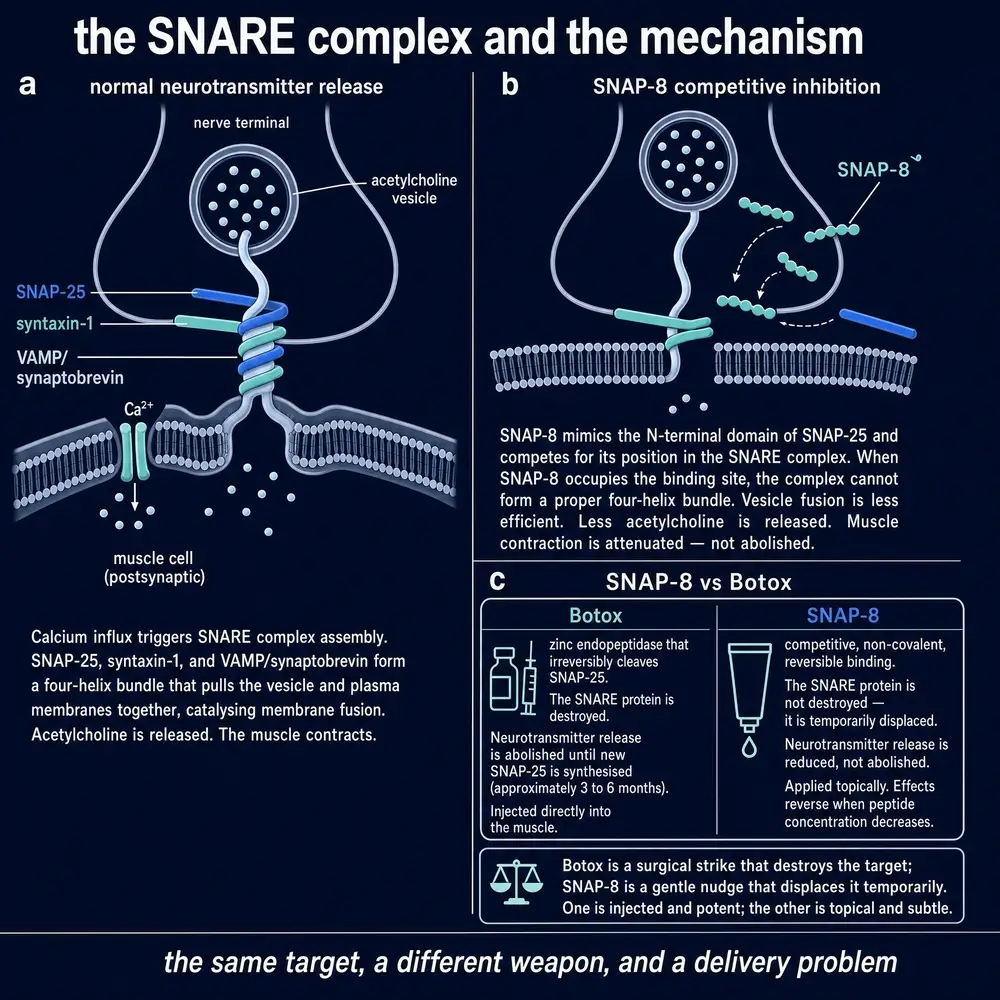
To see how a peptide might substitute for the toxin, it helps to know what the toxin actually does, because SNAP‑8 is built to interfere with the very same machine. When a nerve signal reaches the end of a motor neuron, the neuron has to release a chemical messenger — at the muscle, that messenger is acetylcholine — to pass the instruction across the gap to the muscle fibre. The messenger is pre-packed in tiny membrane bubbles called vesicles, and releasing it means fusing a vesicle with the outer membrane of the nerve ending so its contents spill out. That fusion is not spontaneous; it is driven by a piece of molecular hardware called the SNARE complex (Rizo & Xu, 2015; Rizo, 2018).
The SNARE complex is a bundle of proteins that zippers together to pull the vesicle and the cell membrane into contact. Three proteins supply the strands of the zipper: synaptobrevin, anchored in the vesicle; syntaxin, anchored in the cell membrane; and SNAP‑25 (synaptosomal-associated protein of 25 kilodaltons), also on the cell membrane. SNAP‑25 is unusual: it contributes two of the four helical strands to the bundle, giving it a large footprint and a central role in whether the complex assembles and holds (Graham et al., 2002; Han et al., 2017; Antonucci et al., 2016). When the complex zips up and a pulse of calcium arrives, the vesicle fuses and the messenger is released. Break any one strand and the machine jams; the vesicle cannot fuse, and the muscle receives no instruction to contract.
Botulinum toxin type A works by breaking exactly one strand. Its enzymatic half is a zinc protease that slips into the nerve ending and cuts SNAP‑25, snipping off its tail so it can no longer complete the complex (Binz et al., 2010; Kumar & Singh, 2025). The cut is permanent for the life of that protein; the nerve stays silent until it manufactures fresh SNAP‑25, which is why an injection lasts months. That single fact — that the toxin’s target is SNAP‑25 — is the hinge of the whole SNAP‑8 story, because it tells a designer exactly which strand of the machine to imitate.
03A peptide that imitates the target
If the toxin disables the machine by destroying SNAP‑25, an alternative is to disable it by impersonating SNAP‑25. This is the idea a research programme in Spain turned into a product at the turn of the century. A group associated with the laboratory of Professor Antonio Ferrer-Montiel at the Universitas Miguel Hernandez in Alicante, working with the Barcelona company Lipotec, reasoned that a short synthetic peptide copied from the business end of SNAP‑25 — its N-terminal segment, the part that helps nucleate the complex — might compete with the real protein for a place in the assembling bundle. A decoy in the slot would leave the complex incomplete, and an incomplete complex cannot drive fusion (Blanes-Mira et al., 2002).
The peptide they settled on was six residues long, N-terminally acetylated and C-terminally amidated: Ac-Glu-Glu-Met-Gln-Arg-Arg-NH2, coined Argireline. In the founding paper, an oil-in-water emulsion carrying ten per cent of the hexapeptide reduced wrinkle depth by up to thirty per cent over thirty days in a panel of healthy women; in cell assays the peptide inhibited neurotransmitter release with a potency similar to botulinum toxin A but, crucially, with much lower efficacy — it nudges the machine rather than destroying it — and it showed no oral toxicity or skin irritation at high doses (Blanes-Mira et al., 2002). The mechanism was pinned to interference with SNARE-complex formation, the same complex the toxin attacks. This is the intellectual foundation of the entire “topical Botox” peptide category, and every claim later made for SNAP‑8 traces back to it.
Two features of that founding result deserve to be carried forward, because they are easy to lose. First, “potency similar, efficacy much lower” is not a quibble: it means the peptide can begin to act at concentrations in the same range as the toxin but can never produce the same degree of silencing, no matter how much is applied. Second, the thirty-per-cent figure came from a peptide placed directly on cultured cells and into a controlled emulsion on skin — not from a demonstration that the peptide had travelled through skin to a nerve. That gap is the subject of Part Three.
04From six residues to eight
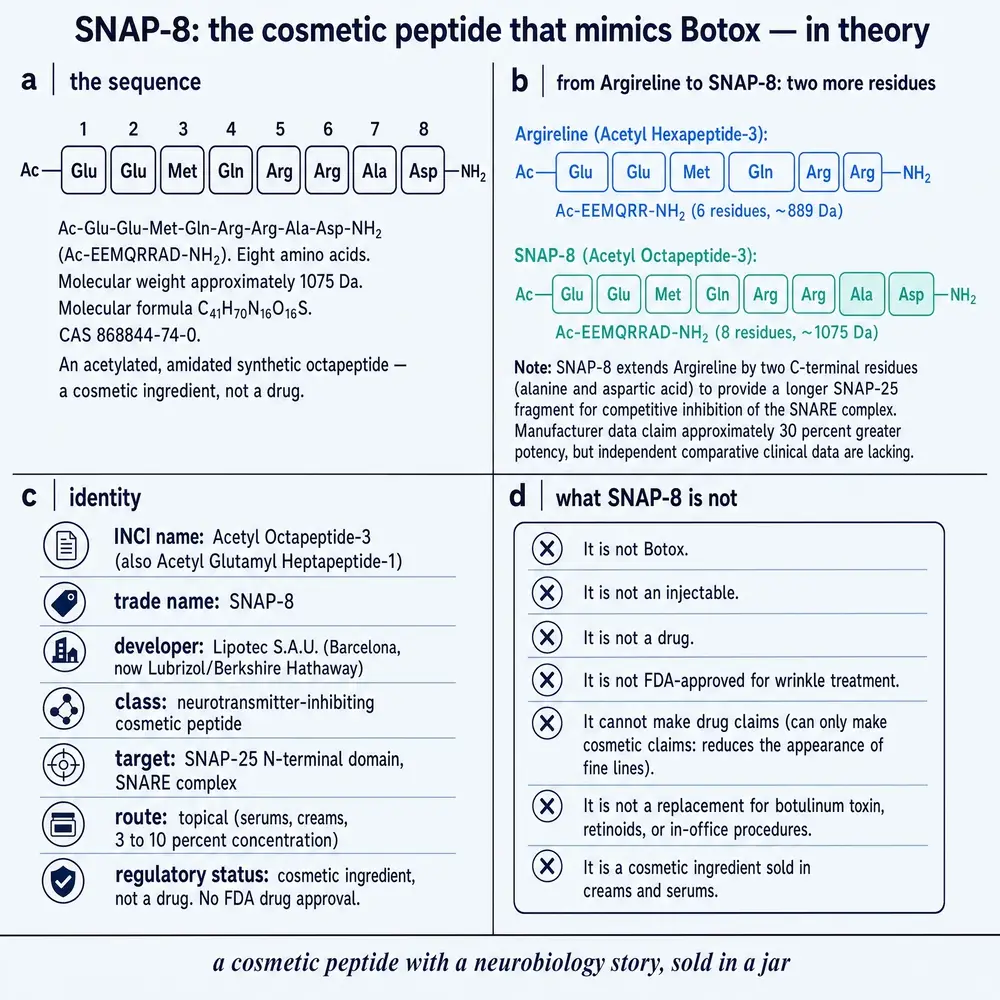
Argireline was a commercial sensation, and success invited a sequel. If the peptide worked by presenting a fragment of SNAP‑25’s N-terminus to the SNARE machinery, then presenting a longer fragment — a larger piece of the real protein — might grip the assembly more firmly and compete more effectively. Around 2005 Lipotec introduced that longer peptide as SNAP‑8. It is Argireline with two more residues added to the tail: Ac-Glu-Glu-Met-Gln-Arg-Arg-Ala-Asp-NH2, an octapeptide of molecular weight about 1075 against the hexapeptide’s 889 (PubChem CID 76283482; Lipotec product literature, 2010). The name is a compression of its target: an eight-residue analogue of SNAP‑25.
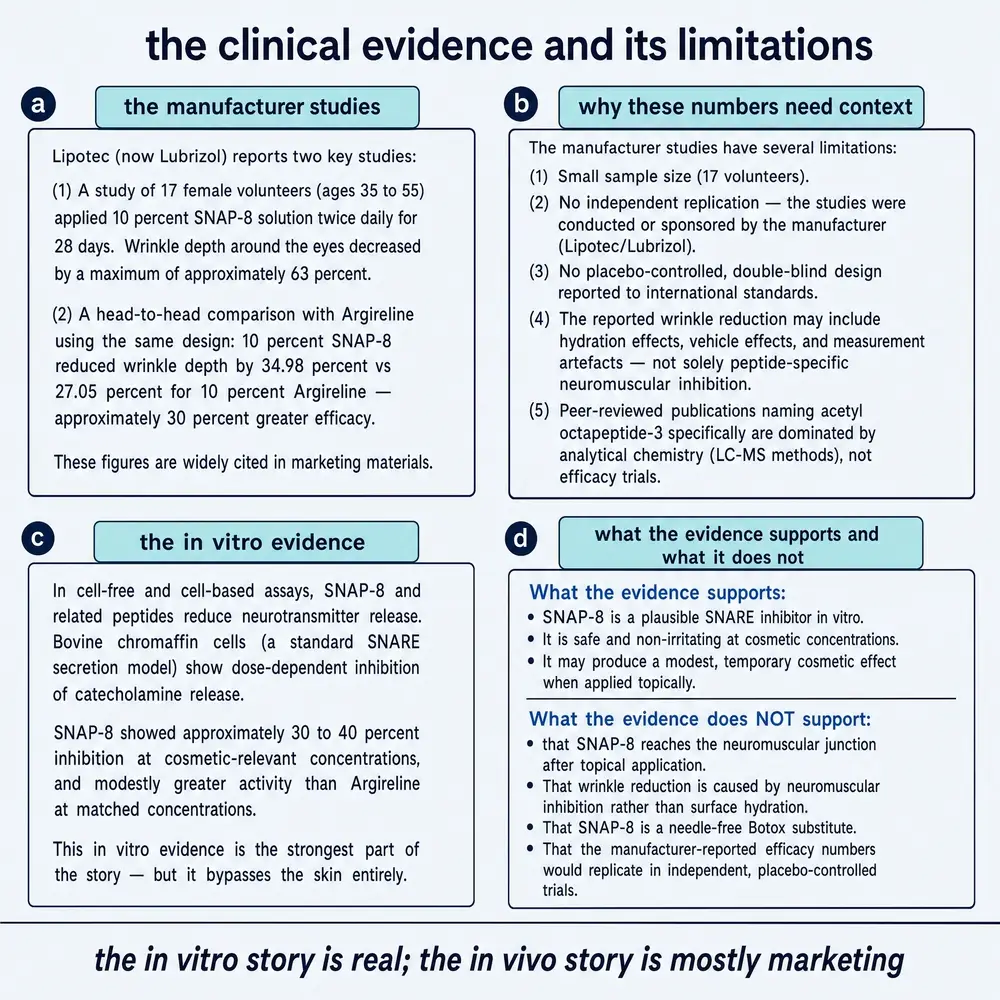
The design rationale is entirely coherent. The two extra amino acids extend the stretch of SNAP‑25 that the decoy reproduces, and the manufacturer reports that this translates into greater in-vitro inhibition of SNARE assembly and of neurotransmitter release than the parent achieves at the same concentration — the widely repeated claim of roughly thirty per cent greater activity (Lipotec product literature, 2010). It is important to be exact about what that claim is: it is a comparison generated by the company that sells the ingredient, presented in product literature rather than in a peer-reviewed paper, and the headline efficacy number attached to it — a wrinkle reduction of 34.98 per cent for ten-per-cent SNAP‑8 solution against 27.05 per cent for ten-per-cent Argireline over twenty-eight days — is manufacturer marketing data. It is reported here as a manufacturer claim, and weighed as one.
05An exact identity
For a compound surrounded by marketing language, SNAP‑8 has a reassuringly precise chemical identity, and it is worth fixing the facts before the story continues. It is a single, fully defined synthetic octapeptide. Its sequence in one-letter code is Ac-EEMQRRAD-NH2; written out, that is N-acetyl-glutamyl-glutamyl-methionyl-glutaminyl-arginyl-arginyl-alanyl-aspartate with an amidated C-terminus. Both ends are chemically capped — acetyl at the head, amide at the tail — which is a deliberate choice: capping removes the free charges that peptidases most readily attack and buys the molecule a little stability. Its molecular formula is C41H70N16O16S and its average mass is about 1075 daltons; its CAS registry number is 868844-74-0 (PubChem CID 76283482).
Two of those facts do most of the work in Part Three, so notice them now. The sequence is dominated by charged residues — two glutamates and an aspartate (each carrying a negative charge at skin pH), and two arginines (each carrying a positive charge) — which makes the peptide strongly hydrophilic, meaning it prefers water to oil. And at roughly 1075 daltons it is a large molecule by the standards of things that cross skin. Skin is built to keep large, charged, water-loving molecules out. SNAP‑8 is large, charged and water-loving. The tension in the whole enterprise is written into the formula.
| Attribute | Value | Note |
|---|---|---|
| Trade / research name | SNAP‑8 | from “SNAP‑25, 8 residues” |
| INCI name | Acetyl Octapeptide‑3 | the cosmetic-labelling name |
| Alternative INCI | Acetyl Glutamyl Heptapeptide‑1 | an older synonym seen on some labels |
| Sequence | Ac‑EEMQRRAD‑NH2 | Argireline + Ala‑Asp |
| Formula | C41H70N16O16S | — |
| Average mass | ~1075 Da | hexapeptide parent is ~889 Da |
| CAS number | 868844‑74‑0 | PubChem CID 76283482 |
| Class | Neurotransmitter-inhibiting cosmetic peptide | SNAP‑25 / SNARE-competitive decoy |
06The Alicante laboratory and the Barcelona company
SNAP‑8 did not emerge from a hospital or a drug company but from the meeting of an academic ion-channel laboratory and a cosmetic-ingredients firm. The science came from the Universitas Miguel Hernandez in Elche, near Alicante on the Spanish Mediterranean coast, and specifically from the circle around Professor Antonio Ferrer-Montiel, a biophysicist whose work centred on the membrane proteins and channels that govern how neurons signal. The first author of the founding 2002 paper was Clara Blanes-Mira, and the study appeared in the International Journal of Cosmetic Science — a placement that tells you the intended destination was a jar, not a syringe (Blanes-Mira et al., 2002).
The commercial partner was Lipotec, a Barcelona-based developer of active ingredients for the cosmetics industry, founded in 1987 by Jose Maria Garcia Anton and Antonio Parente (Biocat, 2012). Lipotec turned the hexapeptide into the branded ingredient Argireline — launched in 2001 after roughly a decade of development (Lubrizol, 2018) — and, a few years later, developed and marketed the octapeptide as SNAP‑8. The lineage matters for how the evidence should be read: these compounds were conceived, developed, tested and sold by the same commercial ecosystem, and the great majority of the head-to-head efficacy data — including the claim that SNAP‑8 outperforms Argireline — originates in that ecosystem’s own product literature rather than in independent laboratories. Lipotec was later acquired and today its cosmetic-ingredient portfolio sits under Lubrizol, the American specialty-chemicals company; the SNAP‑8 brand travelled with it (Lipotec / Lubrizol product literature).
This is a discovery story with an unusual centre of gravity. The intellectual achievement — recognising that the SNAP‑25 fragment could be turned into a competitive decoy, and demonstrating the mechanism in cells — is real and belongs to the Alicante group and the founding paper. But the compound that most people encounter, SNAP‑8, is essentially a product-development extension of that achievement rather than a fresh scientific discovery with its own independent literature. The peptide was, in a sense, discovered by a marketing logic as much as by an experiment: make the good idea longer, and claim it works better.
07A note on names, and a warning about a look-alike
Few small molecules are burdened with as many names as this one, and the confusion is not harmless — it affects what you can find in a database and what you might be sold. On a cosmetic label SNAP‑8 appears under its INCI name Acetyl Octapeptide‑3; older or alternative labelling sometimes uses Acetyl Glutamyl Heptapeptide‑1, which describes the same material differently. Its parent, Argireline, is Acetyl Hexapeptide‑8 (and, in older nomenclature, Acetyl Hexapeptide‑3) — two names, one peptide — which is a frequent source of literature confusion in its own right.
More important is a genuine trap for anyone searching the scientific literature. The abbreviation “SNAP” is heavily overloaded in biology. It is the name of the nerve protein SNAP‑25 that this compound imitates; it is the family label for the related proteins SNAP‑23 and SNAP‑29; and, most dangerously, “SNAP” on its own is a long-standing abbreviation for S-nitroso-N-acetyl-D,L-penicillamine, a completely unrelated nitric-oxide-donor chemical used in cardiovascular and cell-signalling research. A naive search for “SNAP” returns a large literature that has nothing to do with cosmetic peptides. For that reason, the corpus behind this document was assembled by matching the unambiguous identifiers — the full sequence, the INCI names, the CAS number and the term “acetyl octapeptide” — and by explicitly excluding the nitric-oxide-donor sense of the abbreviation. How that was done, and what it turned up, is the subject of the final section.
08Why skin is a wall
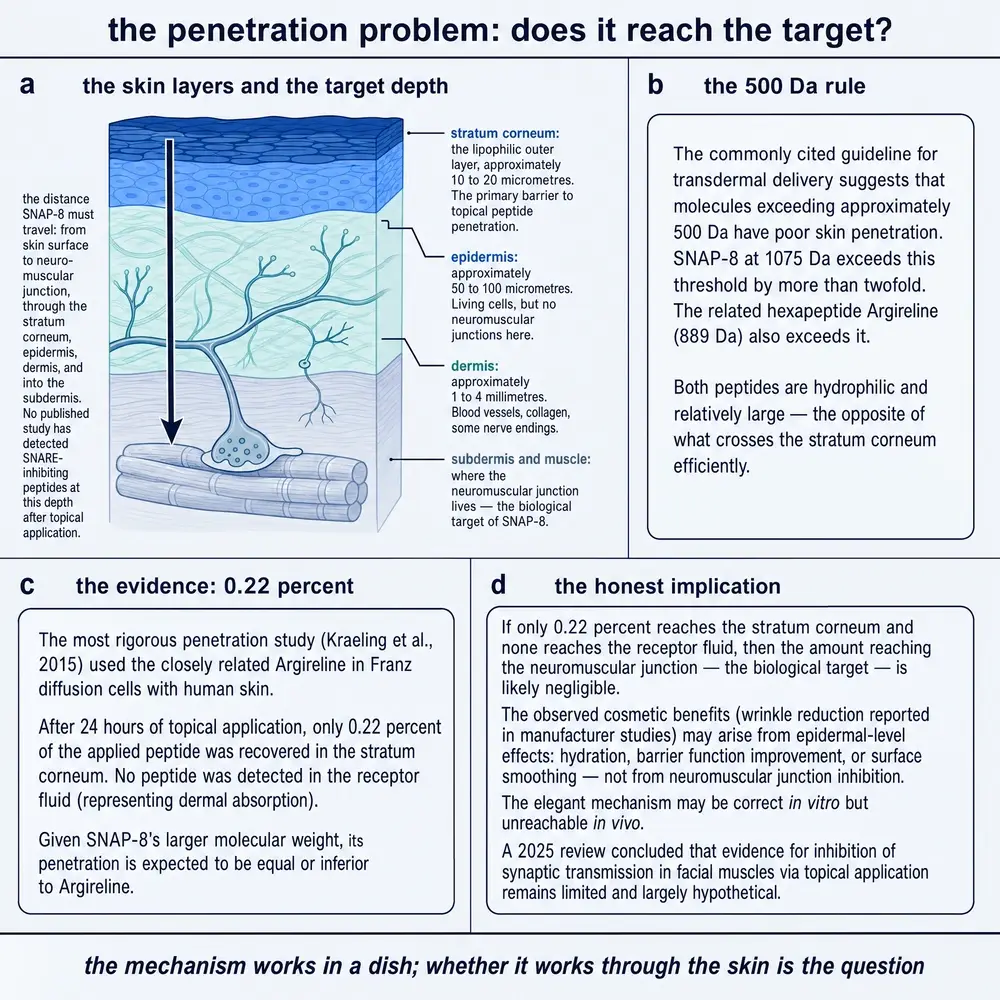
Everything in Parts One and Two was about whether SNAP‑8 can quiet a nerve. This part is about whether it can ever reach one, and it is where the elegant story runs into a physical barrier that no amount of mechanistic cleverness removes. The outermost layer of skin, the stratum corneum, is roughly ten to twenty micrometres of flattened dead cells embedded in a matrix of lipids — a brick-and-mortar wall whose entire evolutionary job is to keep the outside out and the body’s water in. It is very good at that job, and it is especially good at excluding exactly the kind of molecule SNAP‑8 is.
Dermatologists use a rough rule of thumb, the “500-dalton rule,” which says that molecules much heavier than about 500 daltons rarely cross intact skin in useful amounts by passive diffusion. It is a rule of thumb, not a law, but the reasoning behind it is sound and it points the wrong way for SNAP‑8. The peptide is roughly 1075 daltons — more than twice the guideline weight — and it is not merely large but hydrophilic and electrically charged, so the oily mortar of the stratum corneum repels it. To have any cosmetic effect on a muscle, a topically applied SNAP‑8 molecule would need to cross this wall, then traverse the living epidermis, then the dermis, and only then reach the level of the small facial muscles and the nerve endings that drive them. That is a long journey for a molecule that struggles with the first step.
09What the penetration studies actually show
Here the evidence is unusually direct, and it is worth dwelling on because it is the most decisive data in this entire document. In a study performed at the United States Food and Drug Administration’s own laboratory, Kraeling and colleagues applied a cosmetic oil-in-water emulsion of the hexapeptide — Argireline, Ac-EEMQRR-amide, the smaller parent of SNAP‑8 — to hairless guinea-pig skin and to human cadaver skin mounted in diffusion cells, and then measured, layer by layer, where the peptide ended up using tandem mass spectrometry (Kraeling et al., 2015). The result is stark. Most of the applied peptide simply washed off the surface. Of what remained, the peptide sat almost entirely in the dead stratum corneum — 0.54 per cent of the applied dose in guinea-pig skin, 0.22 per cent in human skin — with only about 0.01 per cent reaching the living epidermis. And in the dermis, and in the buffer collected beneath the skin, no peptide was detected at all.
Read that finding carefully, because two things about it make it heavier than a single study normally is. First, it is a direct measurement of the thing that matters: not a proxy, not a marker, but the peptide itself, quantified in each skin layer, with none of it crossing to the depth where a muscle lives. Second, it was done on the smaller peptide. SNAP‑8, at 1075 daltons against the hexapeptide’s 889, is larger and would be expected to penetrate less, not more. A recent independent review of acetyl hexapeptide-8 reaches the same conclusion in general terms: because the peptide is hydrophilic and relatively large, its permeability through the lipid stratum corneum is limited, its bioavailability from a simple topical is low, and this — not any doubt about the mechanism — is the factor that caps its real-world potential (Zdrada-Nowak et al., 2025).
None of this proves that topical SNAP‑8 does nothing visible. It proves something narrower and more useful: that whatever a conventional SNAP‑8 cream does, it is very unlikely to be doing it by blocking nerve signals in a muscle, because the peptide is not arriving there in detectable quantity. If users and short trials report a smoother appearance, the honest scientific position is that the cause has not been established and that a surface film, transient hydration, or the other ingredients in the formulation are live alternative explanations. The mechanism is real; the delivery is the problem; and the two must not be quietly merged into a claim that the mechanism operates in ordinary use.
That measurement is about the smaller parent. SNAP‑8 is larger still, and no published study has detected either peptide at neuromuscular-junction depth after a conventional topical application (Kraeling et al., 2015; Zdrada-Nowak et al., 2025).
10Weighing the efficacy claims
With the delivery problem in view, the efficacy claims sort themselves into tiers of very different weight. At the top sit the manufacturer’s head-to-head numbers — the widely quoted figures of a roughly 35 per cent reduction in wrinkle depth for SNAP‑8 against roughly 27 per cent for Argireline over four weeks. These come from sponsor product literature, were not generated by an independent laboratory, and describe wrinkle appearance rather than any measured nerve effect; they are marketing data and are weighted accordingly (Lipotec / Lubrizol product literature). One rung down, the parent compound Argireline has genuine independent human trials: randomized, placebo-controlled studies in human volunteers — some paired with mouse experiments — reported measurable reductions in wrinkle parameters (Wang et al., 2013, three reports; Raikou et al., 2017). These are real evidence, but they are evidence about the hexapeptide, not the octapeptide, and they still measure appearance rather than delivery to muscle.
At the bottom, and most telling, is the evidence for SNAP‑8 itself in humans. It is almost entirely confined to studies in which the peptide was not applied as a simple cream at all, but was delivered through the skin barrier by a device — a dissolving microneedle patch carrying acetyl octapeptide-3 among other actives, which reported a roughly 26 per cent decrease in fine lines and wrinkles over the study (Shin et al., 2024). That is a genuinely encouraging human result for the compound, but notice what it quietly concedes: the peptide was given a physical shortcut past the wall. When the field wants SNAP‑8 to work, it stops relying on the cream and reaches for a needle-like device — which is the strongest possible evidence that the cream alone does not deliver. The next part is about those shortcuts.
11Persuading the barrier: emulsions and molecular tricks
If the honest problem with SNAP‑8 is delivery, then the interesting science of the last decade is not about the peptide at all — it is about the vehicle. The gentlest approach keeps the molecule unchanged and reformulates the cream around it. A careful study of acetyl hexapeptide-8 showed that a multiple water-in-oil-in-water emulsion — a more elaborate architecture than a plain oil-in-water cream — significantly increased how much peptide entered porcine skin compared with simple emulsions (Hoppel et al., 2015). The gain is real but modest, and it is measured as entry into skin, not arrival at muscle; it moves the needle on the first step of the journey, not the last.
A more aggressive approach changes the molecule itself. Because the peptide’s charge is part of what the oily barrier repels, chemists have built analogues that mask or balance that charge — adding residues to create a zwitterion, a molecule carrying both positive and negative charges that sum toward neutrality. In one study, modified anti-wrinkle peptide analogues showed enhanced permeation through human skin in vitro relative to the unmodified peptide (Lim et al., 2018). Others have pursued deep-eutectic-solvent systems that self-assemble with the peptide and disrupt the stratum corneum’s lipids to promote transdermal penetration, reporting improved delivery in laboratory models (Bai et al., 2026). These are ingenious, and they concede the same point every time: the native peptide in a native cream does not get where it needs to go, so either the vehicle or the molecule has to be re-engineered.
12Punching through: microneedles and current
The most effective strategies stop trying to persuade the barrier and simply bypass it. Microneedle patches are arrays of micrometre-scale projections — often made of dissolving hyaluronic acid — that pierce the stratum corneum painlessly and deposit their cargo in the living skin beneath, skipping the wall entirely. This approach has strong support for hydrophilic peptides in general (Zhang et al., 2014) and, specifically for this peptide family, in randomized human trials: a cross-linked hyaluronic-acid microneedle patch carrying acetyl hexapeptide-8 improved wrinkle measures against control (An et al., 2019), and hyaluronic-acid microneedle patches loaded with bioactive peptides produced measurable gains in wrinkles, hydration and dermal density (Avcil et al., 2020). Most directly of all, the one substantial human study of SNAP‑8 itself used a dissolving microneedle patch, and it worked well enough to report a roughly 26 per cent reduction in fine lines with a good safety profile (Shin et al., 2024).
Electric current offers another route. Iontophoresis uses a small voltage to push charged molecules through skin, and because SNAP‑8 is charged it is in principle a good candidate; a systematic study of iontophoretic peptide permeation — including Argireline — mapped how molecular charge, pH, concentration and current together govern how much peptide crosses (Krishnan et al., 2014). The broad research direction is now explicit in the field’s own reviews: the future of these compounds is being framed as a transition “from bioactive peptides to transdermal peptides,” in which delivery engineering, not the discovery of new sequences, is the rate-limiting science (Yang et al., 2026). New test systems are being built specifically to measure that last step — for instance a sensory-neuron-integrated skin spheroid designed to evaluate whether a delivered neuropeptide actually reaches and affects nerves (Martin et al., 2025).
13The animal, cell, and human evidence, sorted
Because the compound’s own literature is thin, it is worth stating plainly what kind of evidence exists and at what level, since a reader is owed the tier along with the claim. The mechanism — competition with SNAP‑25 for the SNARE complex, and consequent inhibition of neurotransmitter release — rests on in-vitro cell and biochemical work, originally on the hexapeptide, and is well supported at that level (Blanes-Mira et al., 2002). The animal evidence is largely for the parent: Argireline was tested in mouse models alongside its human trials, with reported anti-wrinkle and skin effects (Wang et al., 2013). The human evidence divides sharply by delivery: for conventional topical use it is dominated by sponsor appearance data and by the smaller parent’s trials, while for SNAP‑8 specifically the substantive human efficacy signal comes from device-delivered studies (Shin et al., 2024). And the delivery evidence — the FDA penetration measurement showing no dermal arrival from a cream — is in vitro on animal and human skin, and is the most direct data of all (Kraeling et al., 2015).
Weighed together, and giving proper credit to the most recent and most direct work, the picture is coherent rather than contradictory. Recent reviews and new delivery studies do not overturn the old penetration finding; they build on it, treating limited delivery as the accepted starting problem and delivery engineering as the frontier (Zdrada-Nowak et al., 2025; Yang et al., 2026; Bai et al., 2026). That is the mark of a field that has quietly accepted where the truth lies: the mechanism was never the weak link, and the newest science spends its energy on the wall, not the peptide. What remains is to put those tiers side by side, grade the claims they can and cannot support, and say plainly where the evidence stops.
14A candid weighing
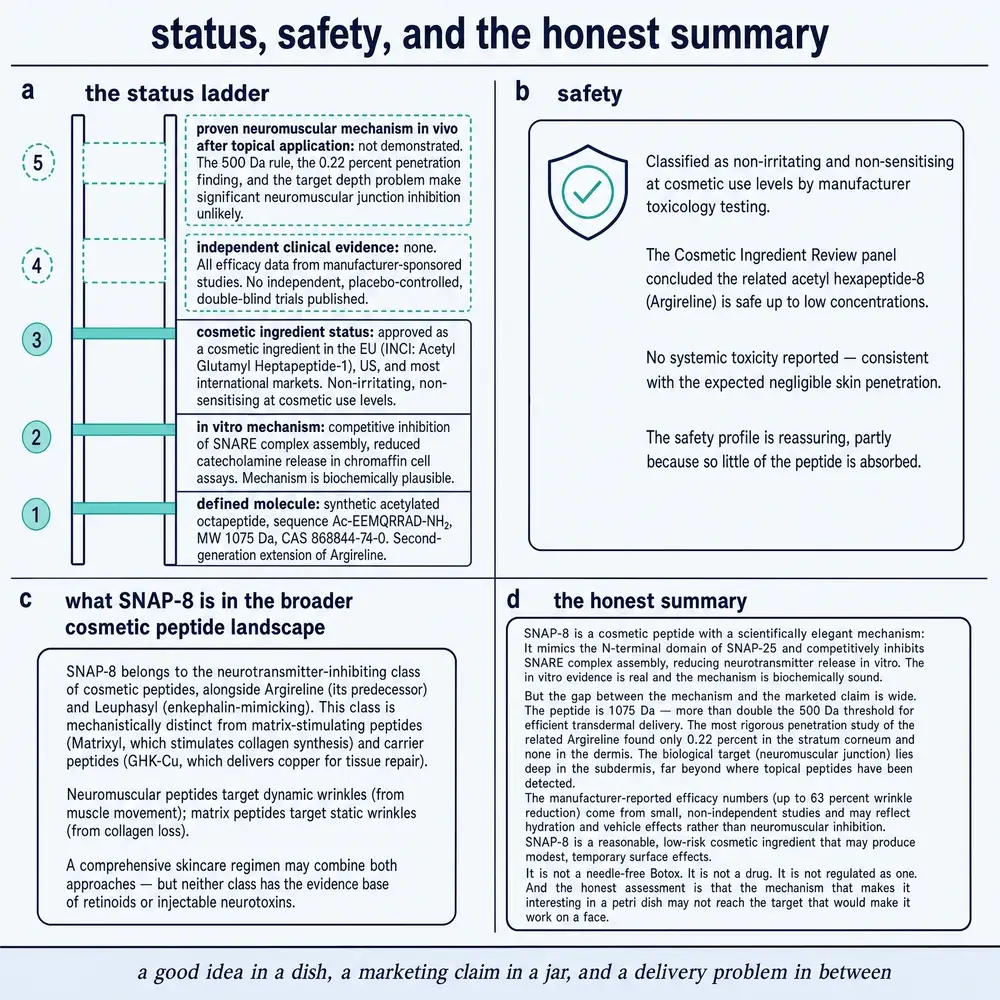
It is possible to hold two apparently opposed ideas about SNAP‑8 at once, and doing so is the whole point of an honest reading. The mechanism is genuine and rather beautiful; the topical product built on it rests on evidence that is far weaker than its marketing implies. The table below sets out the main claims and grades each by the quality and directness of its support. The verb matters in every row: “shown” is not “claimed,” and “in a dish” is not “in a person.”
| Claim | Best evidence | Level | Weight |
|---|---|---|---|
| SNAP‑8 competes with SNAP‑25 and inhibits neurotransmitter release | Founding mechanism work on the peptide class | In vitro (cells / biochemistry) | Well supported |
| The mechanism is the same one botulinum toxin exploits | SNARE / SNAP‑25 and toxin literature | Established biology | Well supported |
| Applied as a conventional cream, the peptide reaches facial muscle | FDA layer-by-layer penetration study (hexapeptide) | In vitro, human + animal skin | Contradicted |
| SNAP‑8 reduces wrinkle appearance in short cosmetic testing | Manufacturer product literature; parent-peptide trials | Sponsor data + human RCT (parent) | Weak / indirect |
| SNAP‑8 beats Argireline by roughly 35% vs 27% | Manufacturer head-to-head literature | Sponsor data, not independent | Marketing claim |
| Delivered by microneedle, SNAP‑8 improves wrinkles in people | Dissolving-microneedle human study | Human, device-delivered | Moderately supported |
| The visible smoothing from a cream is caused by nerve blockade | No direct evidence; delivery data argue against | Unestablished | Not established |
The shape of the table is the argument. Where the claim is about biology — what the peptide does when it meets its target — the evidence is solid. Where the claim is about geography — whether the peptide meets its target after being rubbed on skin — the evidence is either weak, borrowed from the smaller parent, generated by the seller, or flatly contradicted. And the single claim that would join the two, that a cream’s cosmetic effect is its mechanism in action, is exactly the one nobody has established.
15Safety, which is the compound’s real strength
If the delivery story is SNAP‑8’s weakness, safety is its genuine strength, and it deserves a fair hearing. The same features that limit the peptide’s reach also limit its capacity for harm. It penetrates skin poorly, so systemic exposure from cosmetic use is minimal; it is a short sequence of ordinary amino acids that the body degrades by routine means; and the founding work reported no oral toxicity and no skin irritation even at high doses (Blanes-Mira et al., 2002). Independent toxicity work on the parent found low cellular cytotoxicity (Grosicki et al., 2014), and a formal cosmetic-industry safety assessment concluded that acetyl hexapeptide-8 is safe as used in cosmetics under the reported conditions (Johnson et al., 2025). A recent framework paper places these peptides within a systematic approach to evaluating cosmetic-peptide safety, reflecting a field that now treats such assessment as routine rather than novel (Bjerke et al., 2026).
Two honest caveats belong beside that reassurance. First, “safe because it barely gets in” is a double-edged sentence: the property that makes the compound benign is the same one that undercuts its claimed action, so safety and efficacy are inversely tied here in an unusual way. Second, the strategies that would make SNAP‑8 work better — microneedles, iontophoresis, penetration enhancers, molecular modification — are precisely the ones that would deliver more of it deeper, which shifts the safety question onto new ground that the classic “low-penetration” reassurance no longer covers. A peptide that is safe because it stays in the dead surface layer is not automatically safe once a device places it in living tissue in quantity. Consistent with this document’s constraint, none of this is a recommendation for or against use by any person; it is a description of where the safety evidence is solid and where it stops.
16The honest verdict
SNAP‑8 is a case study in the difference between a mechanism and a medicine — or here, a mechanism and a cosmetic. The idea at its heart is sound: lengthen a SNAP‑25 decoy, jam the release machinery a little harder, and in a dish that is exactly what happens. The compound is well-defined, well tolerated, and built on real neuroscience with an honest pedigree in a Spanish academic laboratory and a Barcelona ingredients company. What the twenty years since have not produced is direct evidence that, rubbed on a face, the peptide reaches the muscle whose relaxation is its entire selling point. The most decisive measurement in the literature found none of the smaller parent reaching even the dermis, let alone the muscle, and the field’s own response has been to invest in devices that carry the peptide past the barrier rather than to show that it crosses on its own.
So the fair verdict is neither dismissal nor endorsement. As a topical cosmetic promising a needle-free version of botulinum toxin, SNAP‑8 is a molecule whose advertised mechanism almost certainly does not operate in ordinary use, whatever surface improvements users perceive. As a delivery problem waiting for a solution — a real, safe, mechanistically grounded neuromodulatory peptide that simply cannot get where it needs to go — it is genuinely interesting, and the recent microneedle work suggests the gap may eventually be closed by the vehicle rather than the molecule. The peptide was always the easy part. The wall was always the hard part. Two decades of research have mostly served to make that division of labour clear.
17How this document was assembled
This monograph was built from the South Beach Longevity Therapeutic Peptide Research Library — twenty local full-text stores — together with a fresh harvest of PubMed and PubMed Central. The defining feature of the corpus is a scarcity that shaped every section. SNAP‑8 has almost no primary scientific literature of its own: the local library holds a single peer-reviewed full text that even names the compound, and PubMed indexes only two original studies under “acetyl octapeptide-3,” both of which test it inside multi-ingredient microneedle patches rather than on its own. There is no indexed study of SNAP‑8 as a sole active in humans.
Because of that scarcity the reading corpus was assembled deliberately rather than swept up in bulk. A local sweep opened 12,681 documents and matched 305 to the compound’s names, but almost none of those matches were science: 283 were vendor product-page snapshots, 16 were vendor review or blog copy, and only one was peer-reviewed full text. The 48 references behind this document were therefore chosen outward in rings — the compound itself (2), its parent Argireline (8), the SNARE and SNAP‑25 mechanism it borrows (5), the botulinum-toxin comparator it is sold against (4), the skin-delivery problem that decides the whole question (11), the cosmetic-peptide field it sits in (7), and eight non-PubMed sources for identity, corporate history and manufacturer claims. Each ring is labelled in the prose as belonging to SNAP‑8, to its parent, or to shared biology, so that borrowed evidence is never passed off as the compound’s own.
18Evidence handling and limits
Three rules governed how the evidence was weighed. First, level was always attached to claim: a result in cultured cells was reported as such, a result in excised skin as such, and a result in living people as such, and manufacturer data were named as manufacturer data every time they appeared. Second, recency was given weight where it did not contradict settled chemistry and mechanism: of the 40 PubMed references, 24 are from 2024 or later, but the two anchors are deliberately old — the 2002 founding paper and the 2002 SNAP‑25 exocytosis study — because that is where the mechanism was established, and the newest work builds on rather than overturns the older penetration finding. Third, the single most decisive datum — that a cosmetic emulsion delivered none of the peptide to the dermis — was given its full weight precisely because it is a direct measurement of the quantity that matters, even though it was performed on the smaller parent.
The limits should be equally explicit. Much of what can be said about SNAP‑8 is inferred from Argireline and from shared neurobiology, because the octapeptide’s own record is so thin; the central head-to-head efficacy claim is manufacturer-generated and unverified independently; and no study reviewed here directly measured SNAP‑8 reaching a human facial muscle after topical application. Five commissioned plates from the Higgsfield figure set were admitted after an A8 value check (sequence, formula, CAS, Kraeling attribution, manufacturer percentages); none was withheld. Manufacturer concentrations and efficacy percentages printed on those plates are captioned as sponsor data, not as recommendations. This is a research monograph, not a released evidence dossier: it does not include reviewed study cards with claim-level outcome extraction, formal methodological appraisal of each combination-product trial, or a dated regulatory-status review. Those belong to a dossier edition and are not substituted for here.
Glossary
| SNARE complex | The bundle of proteins (synaptobrevin, syntaxin, SNAP‑25) that zippers together to fuse a vesicle with the cell membrane and release a chemical messenger. |
| SNAP‑25 | Synaptosomal-associated protein of 25 kDa; supplies two strands to the SNARE complex. The protein SNAP‑8 imitates and botulinum toxin cleaves. |
| Argireline | Acetyl hexapeptide-8 (older name -3); the six-residue parent of SNAP‑8, Ac‑EEMQRR‑NH2. |
| Stratum corneum | The dead, lipid-rich outer layer of the skin; the principal barrier a topical peptide must cross. |
| Hydrophilic | Water-loving; such molecules are repelled by the oily stratum corneum and cross skin poorly. |
| In vitro / in vivo | In a dish or isolated tissue / in a living organism. The distinction that separates most SNAP‑8 mechanism data from its delivery reality. |
| Iontophoresis | Using a small electric current to drive charged molecules through skin. |
| Microneedle patch | An array of micrometre-scale needles, often dissolving, that pierces the stratum corneum to deposit a cargo beneath it. |
| INCI | International Nomenclature of Cosmetic Ingredients; the standardised label name, e.g. Acetyl Octapeptide-3. |
19References
48 references. PubMed-indexed entries were resolved against NCBI records; identifiers link to PubMed, DOI or PubMed Central. Non-PubMed sources — registries, manufacturer literature and corporate history — are listed last and labelled by what they are. Manufacturer and vendor material is not independent evidence and is marked as such.
- Adnan M, Waqar M, Ahmed R, Afzal H, Mueen MA, Qayyum U, et al.. Botulinum toxin from foodborne hazard to aesthetic and biomedical tool: mechanisms, applications, detection strategies, and future perspectives. Arch Microbiol. 2026;208(7).
PMID 41989572 · doi:10.1007/s00203-026-04877-8 - An JH, Lee HJ, Yoon MS, Kim DH. Anti-Wrinkle Efficacy of Cross-Linked Hyaluronic Acid-Based Microneedle Patch with Acetyl Hexapeptide-8 and Epidermal Growth Factor on Korean Skin. Ann Dermatol. 2019;31(3):263-271.
PMID 33911590 · doi:10.5021/ad.2019.31.3.263 · PMC7992733 - Antonucci F, Corradini I, Fossati G, Tomasoni R, Menna E, Matteoli M. SNAP-25, a Known Presynaptic Protein with Emerging Postsynaptic Functions. Front Synaptic Neurosci. 2016;8:7.
PMID 27047369 · doi:10.3389/fnsyn.2016.00007 · PMC4805587 - Ashaolu TJ. Applications of bioactive peptides in cosmeceuticals: a review. J Zhejiang Univ Sci B. 2025;26(6):527-545.
PMID 40571658 · doi:10.1631/jzus.B2400029 · PMC12219483 - Avcil M, Akman G, Klokkers J, Jeong D, Çelik A. Efficacy of bioactive peptides loaded on hyaluronic acid microneedle patches: A monocentric clinical study. J Cosmet Dermatol. 2020;19(2):328-337.
PMID 31134751 · doi:10.1111/jocd.13009 - Badilli U, Inal O. Current Approaches in Cosmeceuticals: Peptides, Biotics and Marine Biopolymers. Polymers (Basel). 2025;17(6).
PMID 40292641 · doi:10.3390/polym17060798 · PMC11946782 - Bai D, Wang Z, Liu T, Wang M, Zhang J. DES-mediated self-assembled polypeptides: Synergistic neuromuscular signaling inhibition for anti-aging. Biomater Adv. 2026;187:214954.
PMID 42202650 · doi:10.1016/j.bioadv.2026.214954 - Binz T, Sikorra S, Mahrhold S. Clostridial neurotoxins: mechanism of SNARE cleavage and outlook on potential substrate specificity reengineering. Toxins (Basel). 2010;2(4):665-82.
PMID 22069605 · doi:10.3390/toxins2040665 · PMC3153214 - Bjerke DL, Li J, Gao Y, Hu P, Lintner K, Hakozaki T. A framework for the safety evaluation of peptides in cosmetics. Curr Res Toxicol. 2026;10:100291.
PMID 41953401 · doi:10.1016/j.crtox.2026.100291 · PMC13054063 - Blanes-Mira C, Clemente J, Jodas G, Gil A, Fernández-Ballester G, Ponsati B, et al.. A synthetic hexapeptide (Argireline) with antiwrinkle activity. Int J Cosmet Sci. 2002;24(5):303-10.
PMID 18498523 · doi:10.1046/j.1467-2494.2002.00153.x - Chan LKW, Lee KWA, Lee CH, Lam KWP, Lee KFV, Wu R, et al.. Cosmeceuticals in photoaging: A review. Skin Res Technol. 2024;30(9):e13730.
PMID 39233460 · doi:10.1111/srt.13730 · PMC11375026 - Graham ME, Washbourne P, Wilson MC, Burgoyne RD. Molecular analysis of SNAP-25 function in exocytosis. Ann N Y Acad Sci. 2002;971:210-21.
PMID 12438121 · doi:10.1111/j.1749-6632.2002.tb04465.x - Grosicki M, Latacz G, Szopa A, Cukier A, Kieć-Kononowicz K. The study of cellular cytotoxicity of argireline - an anti-aging peptide. Acta Biochim Pol. 2014;61(1):29-32.
PMID 24644551 - Han J, Pluhackova K, Böckmann RA. The Multifaceted Role of SNARE Proteins in Membrane Fusion. Front Physiol. 2017;8:5.
PMID 28163686 · doi:10.3389/fphys.2017.00005 · PMC5247469 - He Q, Liao Y, Wu Y, Zhang H, Long X, Zhang Y. Bioactive oligopeptides and the application in skin regeneration and rejuvenation. J Appl Biomater Funct Mater. 2025;23:22808000251330974.
PMID 40269538 · doi:10.1177/22808000251330974 - Hoppel M, Reznicek G, Kählig H, Kotisch H, Resch GP, Valenta C. Topical delivery of acetyl hexapeptide-8 from different emulsions: influence of emulsion composition and internal structure. Eur J Pharm Sci. 2015;68:27-35.
PMID 25497319 · doi:10.1016/j.ejps.2014.12.006 - Johnson W, Bergfeld WF, Belsito DV, Cohen DE, Klaassen CD, Liebler DC, et al.. Safety Assessment of Acetyl Hexapeptide-8 Amide as Used in Cosmetics. Int J Toxicol. 2025;44(2_suppl):54S-63S.
PMID 40673537 · doi:10.1177/10915818251340391 - Kraeling ME, Zhou W, Wang P, Ogunsola OA. In vitro skin penetration of acetyl hexapeptide-8 from a cosmetic formulation. Cutan Ocul Toxicol. 2015;34(1):46-52.
PMID 24754410 · doi:10.3109/15569527.2014.894521 - Krishnan G, Roberts MS, Grice J, Anissimov YG, Moghimi HR, Benson HA. Iontophoretic skin permeation of peptides: an investigation into the influence of molecular properties, iontophoretic conditions and formulation parameters. Drug Deliv Transl Res. 2014;4(3):222-32.
PMID 25786877 · doi:10.1007/s13346-013-0181-8 - Kumar R, Singh BR. Botulinum Toxin: A Comprehensive Review of Its Molecular Architecture and Mechanistic Action. Int J Mol Sci. 2025;26(2).
PMID 39859491 · doi:10.3390/ijms26020777 · PMC11766063 - Lim SH, Sun Y, Thiruvallur Madanagopal T, Rosa V, Kang L. Enhanced Skin Permeation of Anti-wrinkle Peptides via Molecular Modification. Sci Rep. 2018;8(1):1596.
PMID 29371611 · doi:10.1038/s41598-017-18454-z · PMC5785486 - Lum K, M Hirpara M, Pham C, Nguyen M, Mesinkovska N. Acetyl Hexapeptide-8 as a Topical Alternative to Botulinum Toxin: A Review of the Literature. J Drugs Dermatol. 2025;24(4):e31-e32.
PMID 40196949 - Lungu C, Considine E, Zahir S, Ponsati B, Arrastia S, Hallett M. Pilot study of topical acetyl hexapeptide-8 in the treatment for blepharospasm in patients receiving botulinum toxin therapy. Eur J Neurol. 2013;20(3):515-518.
PMID 23146065 · doi:10.1111/ene.12009 · PMC4747634 - Martin BA, Viegas J, Dalmolin LF, Santos ES, Vatanabe IP, Lisboa SF, et al.. Development of a Sensory Neuron-Integrated Skin Spheroid Model for the Evaluation of Neuropeptide-Based Topical Delivery Systems. ACS Biomater Sci Eng. 2025;11(6):3503-3522.
PMID 40410664 · doi:10.1021/acsbiomaterials.5c00141 · PMC12818723 - Monash A, Tam J, Rosen O, Soreq H. Botulinum Neurotoxins: History, Mechanism, and Applications. A Narrative Review. J Neurochem. 2025;169(8):e70187.
PMID 40762356 · doi:10.1111/jnc.70187 · PMC12323300 - Olsson SE, Sreepad B, Lee T, Fasih M, Fijany A. Public Interest in Acetyl Hexapeptide-8: Longitudinal Analysis. JMIR Dermatol. 2024;7:e54217.
PMID 38376906 · doi:10.2196/54217 · PMC10915729 - Pintea A, Manea A, Pintea C, Vlad RA, Bîrsan M, Antonoaea P, et al.. Peptides: Emerging Candidates for the Prevention and Treatment of Skin Senescence: A Review. Biomolecules. 2025;15(1).
PMID 39858482 · doi:10.3390/biom15010088 · PMC11762834 - Raikou V, Varvaresou A, Panderi I, Papageorgiou E. The efficacy study of the combination of tripeptide-10-citrulline and acetyl hexapeptide-3. A prospective, randomized controlled study. J Cosmet Dermatol. 2017;16(2):271-278.
PMID 28150423 · doi:10.1111/jocd.12314 - Rizo J, Xu J. The Synaptic Vesicle Release Machinery. Annu Rev Biophys. 2015;44:339-67.
PMID 26098518 · doi:10.1146/annurev-biophys-060414-034057 - Rizo J. Mechanism of neurotransmitter release coming into focus. Protein Sci. 2018;27(8):1364-1391.
PMID 29893445 · doi:10.1002/pro.3445 · PMC6153415 - Ruiz MA, Clares B, Morales ME, Cazalla S, Gallardo V. Preparation and stability of cosmetic formulations with an anti-aging peptide. J Cosmet Sci. 2007;58(2):157-71.
PMID 17520155 - Shin JY, Han D, Yoon KY, Jeong DH, Park YI. Clinical Safety and Efficacy Evaluation of a Dissolving Microneedle Patch Having Dual Anti-Wrinkle Effects With Safe and Long-Term Activities. Ann Dermatol. 2024;36(4):215-224.
PMID 39082657 · doi:10.5021/ad.23.136 · PMC11291098 - Wang M, Xia H, Wang C, Zhang T, Zhang M, Li X, et al.. From precision synthesis to cross-industry applications: The future of emerging peptide technologies. Pharmacol Res. 2025;218:107839.
PMID 40578721 · doi:10.1016/j.phrs.2025.107839 - Wang Y, Wang M, Xiao S, Pan P, Li P, Huo J. The anti-wrinkle efficacy of argireline, a synthetic hexapeptide, in Chinese subjects: a randomized, placebo-controlled study. Am J Clin Dermatol. 2013;14(2):147-53.
PMID 23417317 · doi:10.1007/s40257-013-0009-9 - Wang Y, Wang M, Xiao XS, Huo J, Zhang WD. The anti-wrinkle efficacy of Argireline. J Cosmet Laser Ther. 2013;15(4):237-41.
PMID 23464592 · doi:10.3109/14764172.2013.769273 - Wang Y, Wang M, Xiao XS, Pan P, Li P, Huo J. The anti wrinkle efficacy of synthetic hexapeptide (Argireline) in Chinese Subjects. J Cosmet Laser Ther. 2013.
PMID 23607739 · doi:10.3109/14764172.2012.759234 - Wyrzykowski D, Wieczorek R, Kloska A, Errante F, Papini AM, Makowska J. Influence of the modification of the cosmetic peptide Argireline on the affinity toward copper(II) ions. J Pept Sci. 2024;30(3):e3547.
PMID 37752675 · doi:10.1002/psc.3547 - Yang G, Li Y, Tian J, Ding W, Li X, Ma X, et al.. From Bioactive Peptides to Transdermal Peptides: An Emerging Strategy for Revolutionizing Drug Delivery. Macromol Biosci. 2026;26(1):e00485.
PMID 41531394 · doi:10.1002/mabi.202500485 - Zdrada-Nowak J, Surgiel-Gemza A, Szatkowska M. Acetyl Hexapeptide-8 in Cosmeceuticals-A Review of Skin Permeability and Efficacy. Int J Mol Sci. 2025;26(12).
PMID 40565185 · doi:10.3390/ijms26125722 · PMC12193160 - Zhang S, Qiu Y, Gao Y. Enhanced delivery of hydrophilic peptides in vitro by transdermal microneedle pretreatment. Acta Pharm Sin B. 2014;4(1):100-4.
PMID 26579370 · doi:10.1016/j.apsb.2013.12.011 · PMC4590292 - PubChem, National Center for Biotechnology Information. Compound summary for CID 76283482, Acetyl octapeptide-3 (C41H70N16O16S; average mass 1075.2; CAS 868844-74-0). Source of the molecular formula, mass and the verified single-preferred-name match used in section 03.
https://pubchem.ncbi.nlm.nih.gov/compound/76283482 - Lipotec S.A. (Lubrizol Life Science). SNAP-8: an octapeptide to express yourself at ease. Product information, Cossma archive, 2010. Manufacturer literature. Source of the SNARE-assembly assay design and of the 34.98 per cent versus 27.05 per cent wrinkle-reduction figure for 10 per cent SNAP-8 solution against 10 per cent Argireline over 28 days. Sponsor-generated marketing data; not peer-reviewed and reported here as a manufacturer claim rather than as independent evidence.
https://www.cossma.com/fileadmin/all/cossma/Archiv/ProductInfo/COS1005_14_ProdSnap8.pdf - European Commission. CosIng - Cosmetic Ingredient Database: entry for Acetyl Glutamyl Heptapeptide-1 (INCI), functions: skin conditioning. Source of the current INCI name and of the naming discrepancy discussed in section 04 (the octapeptide is registered under a ‘heptapeptide’ INCI name and separately as Acetyl Octapeptide-3).
https://ec.europa.eu/growth/tools-databases/cosing/ - Kim H-J, Ahn S, Yang J-H, et al. Method development for acetyl octapeptide-3 analysis by liquid chromatography-tandem mass spectrometry. Journal of Analytical Science and Technology. 2020;11:39. An independent LC-MS/MS assay for SNAP-8; material sourced from Lipotec (Barcelona) and microneedle patches from Raphas (Seoul). Not indexed in PubMed.
https://doi.org/10.1186/s40543-020-00232-8 - Biocat. Lubrizol Corporation acquires Catalan biotechnology firm Lipotec. 20 June 2012. Contemporaneous reporting of the acquisition; source of the founding date (1987), the founders (José María García Antón and Antonio Parente) and the Argireline / Snap-8 / Antarcticine / Eyeseryl brand portfolio named in section 05.
https://www.biocat.cat/en/current-news/news/lubrizol-corporation-acquires-catalan-biotechn - Lubrizol Life Science. ARGIRELINE peptide still sets the standard. Company insight, December 2018. Source of the statement that Argireline was launched in 2001 after roughly ten years in development and remains in hundreds of skincare formulations.
https://www.lubrizol.com/company/insights/2018/12/argireline-still-sets-the-standard - Peptide Sciences. SNAP-8 200 mg (Topical). Archived product page, 2023-2024 catalogue edition (capture 16 June 2023). Historical vendor material preserved as provenance: source of the stated sequence Ac-Glu-Glu-Met-Gln-Arg-Arg-Ala-Asp-NH2, the 0.05 per cent powder presentation and the research-use-only / not-for-human-use disclaimer noted in sections 04 and 09. Not independently validated and not scientific evidence.
- South Beach Longevity. Research Intake & Evidence Map P074 - Acetyl octapeptide-3 (library edition), generated 19 July 2026. The local identity and provenance record: PubChem CID 76283482, cosmetic-peptide class, one lawful local full-text route and seventeen candidate links, most of which resolve to the S-nitroso-N-acetylpenicillamine homograph. Not a released evidence dossier.
Continue exploring