
Gonadorelin The brain’s ten-letter instruction to the body’s reproductive engine — synthetic gonadotropin-releasing hormone
A laboratory-made copy of the brain’s own reproductive command signal: ten amino acids that tell the pituitary to release luteinizing hormone and follicle-stimulating hormone. Whether that signal switches the reproductive axis on or off depends entirely on rhythm — pulses stimulate; continuous exposure suppresses. That single fact explains half a century of medicine, veterinary practice, anti-doping chemistry, and a recent off-label revival that the controlled evidence has not yet caught up with.
Every finding below is labelled by the kind of study that produced it, in the sentence that reports it. “In young men with congenital hypogonadotropic hypogonadism” and “in lactating dairy cows under an Ovsynch protocol” are not throat-clearing; they are the boundary of the claim. Animal and in-vitro observations are never converted into human-use claims. Doses appear only as reported study parameters, always attributed. Nothing here is a recommendation.
Throughout, “the axis” means the hypothalamic–pituitary–gonadal (HPG) axis. “Gonadotropins” are LH and FSH. Native gonadorelin is a full GnRH-receptor agonist; whether it stimulates or suppresses depends on how often it is given.
01Research summary
Gonadorelin is the pharmaceutical name for a laboratory-made copy of gonadotropin-releasing hormone (GnRH), the hypothalamic signal at the top of the body’s reproductive command chain. It is a decapeptide — ten amino acids — identical in sequence to the natural human hormone once called luteinizing-hormone-releasing hormone (LHRH).16,17 Its purpose is to tell the pituitary to release LH and FSH, which drive the ovaries and testes.16,19
What makes it scientifically interesting is not the molecule so much as the rhythm it demands. The receptor responds to pulses, not to a steady stream: short bursts every one to two hours switch the axis on; continuous exposure shuts it down.15,19 That single pharmacodynamic fact explains pulsatile infusion pumps that restore fertility, a one-shot diagnostic test of pituitary function, and the paradoxical use of longer-acting cousins to suppress hormones entirely.
The local research corpus links gonadorelin to 340 study records, of which 24 full texts were retained and screened here (1978–2026). Four evidence lanes dominate: pulsatile-pump therapy in congenital hypogonadotropic hypogonadism;1–3 diagnostic stimulation testing, including recent pediatric work;6 a large veterinary reproduction literature;7–10 and analytical / formulation chemistry, including anti-doping detection.4,5 The strongest human data concern a rare disorder and a cumbersome pump. The recent popularity of compounded gonadorelin as a testosterone-therapy adjunct rests largely on indirect reasoning and clinic observation.23,24 The compound is prohibited in sport.21
02Identity and nomenclature
Gonadorelin is the International Nonproprietary Name for synthetic GnRH.18 Three research communities named it in their own idiom. In older literature it is LH-RH, LHRH, or luliberin; in modern usage it is GnRH (specifically GnRH-I).16,17 Human brand names have included Factrel, Lutrepulse, Lutrelef, Relefact, Cryptocur, and Fertiral; veterinary brands include Fertagyl, Cystorelin, OvaCyst, Ovsynch, and Gonavet.20
| Field | Value |
|---|---|
| INN / common names | Gonadorelin (GnRH, LHRH, luliberin, GnRH-I) |
| Class | Peptide hormone; endogenous GnRH agonist (decapeptide) |
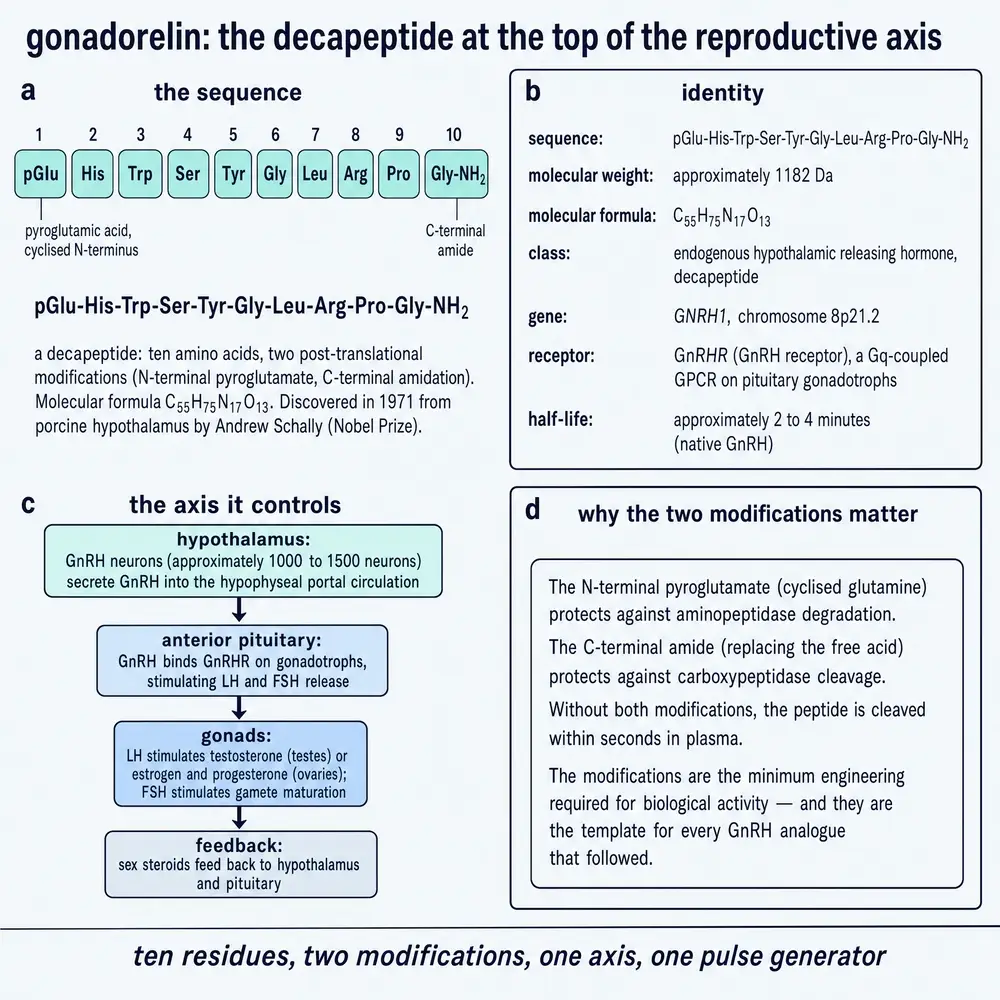
| Sequence | pGlu-His-Trp-Ser-Tyr-Gly-Leu-Arg-Pro-Gly-NH₂ |
| Molecular formula | C₅₅H₇₅N₁₇O₁₃ |
| Molecular weight | 1182.3 g/mol (average) |
| Registry IDs | PubChem CID 638793 · ChEBI 5520 · DrugBank DB00644 · UNII 9O7312W37G · CAS 33515-09-2 |
| Radix library | P138 · reproductive-axis category |
Identity fields consolidated from PubChem, ChEBI, DrugBank/UNII and INN records.17–19
03Physical and chemical properties
At roughly 1,182 daltons gonadorelin occupies the peptide middle ground — tiny by protein standards, large for a small molecule.17,18 Both ends are chemically capped: an N-terminal pyroglutamate and a C-terminal amide. Those caps are part of what the receptor recognises, and they blunt exopeptidases.15,17 The molecule is water-soluble, modestly cationic near physiological pH (Arg⁸), and UV-absorbent via Tyr and Trp — useful for analytical detection.4,18 Its defining trait is impermanence: plasma hydrolysis clears functional activity within minutes, with reported elimination on the order of ten to forty minutes.19,20 A signal meant to be pulsed cannot linger; that is why historical therapeutic use required an infusion pump.
A hormone that vanishes in minutes can encode information in its timing. The hypothalamus releases GnRH in discrete pulses; the pituitary reads pulse frequency. Mimicking that signal is far harder than keeping a drug in the blood.
04Origin, history and development
For the first half of the twentieth century, physiologists suspected that the brain governed the pituitary, but no one could prove it chemically. The breakthrough came from two laboratories locked in a decades-long competition: Roger Guillemin’s group (sheep hypothalami) and Andrew Schally’s group (pig hypothalami).13,14 Schally later recounted isolating roughly 800 µg of the hormone from about 160,000 pig hypothalami before Hisayuki Matsuo and Yoshihiko Baba determined its structure.14
In 1971 Schally’s team published the porcine decapeptide sequence and confirmed it by synthesis; Guillemin’s group established the identical ovine structure shortly afterward.11,12 The two shared half of the 1977 Nobel Prize in Physiology or Medicine “for their discoveries concerning the peptide hormone production of the brain” (the other half went to Rosalyn Yalow for radioimmunoassay).13 The finding founded modern neuroendocrinology: tiny brain peptides command the hormonal periphery.15
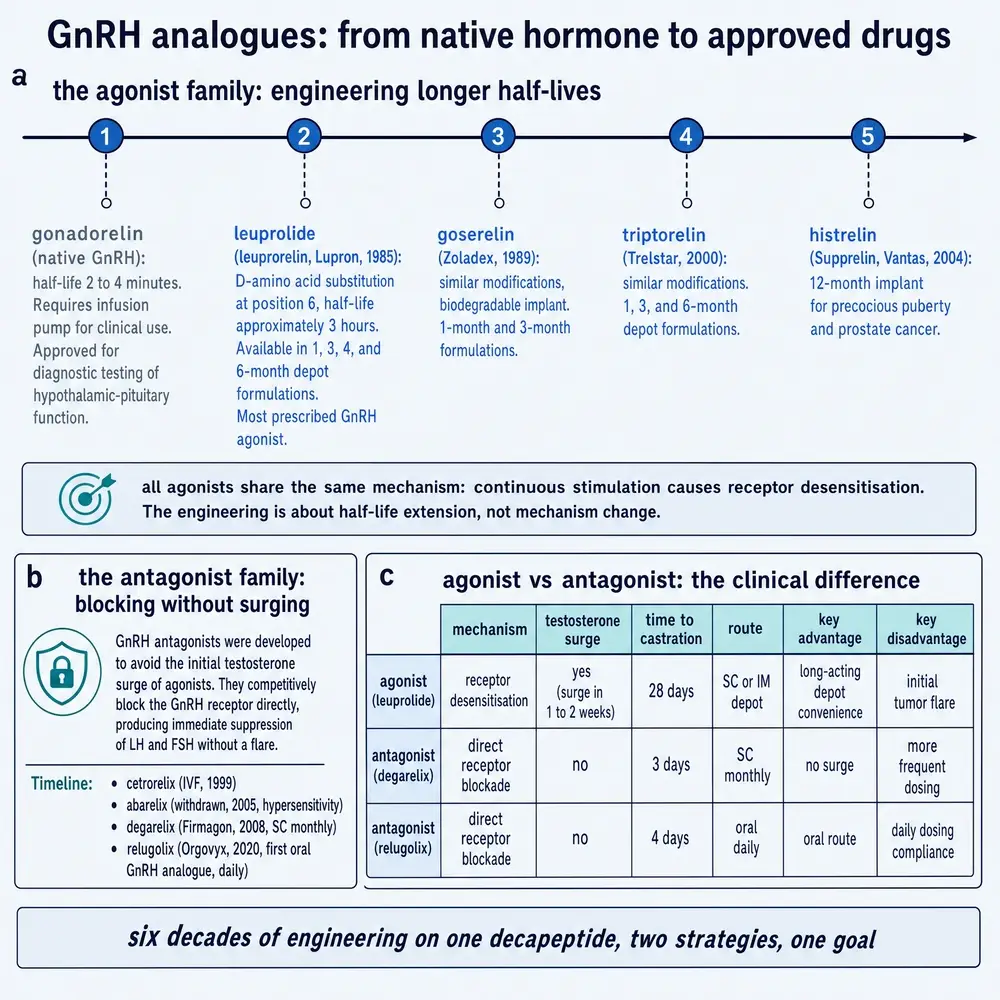
The natural decapeptide entered medicine as gonadorelin. Factrel (diagnostic) reached FDA approval in 1982; Lutrepulse / Lutrelef (pulsatile pump) followed in 1989 for hypothalamic infertility.20,22 The longer legacy was the analogue family. Chemists modified the fragile Gly⁶ position to create stabilised agonists (leuprolide, triptorelin, goserelin) and later antagonists (ganirelix, cetrorelix, degarelix, relugolix). Those descendants — not gonadorelin itself — became the major clinical tools for prostate cancer, endometriosis, IVF, and precocious puberty, by exploiting continuous-exposure desensitisation.15
05Mechanism of action
Gonadorelin binds the GnRH receptor on anterior-pituitary gonadotrophs. Activation drives synthesis and secretion of LH and FSH. In men, LH stimulates Leydig-cell testosterone and FSH supports spermatogenesis; in women the two gonadotropins orchestrate follicle growth, ovulation, and the corpus luteum.16,19 Gonadorelin acts at the first relay of the HPG axis — one step above hCG or LH, which act at the gonad.
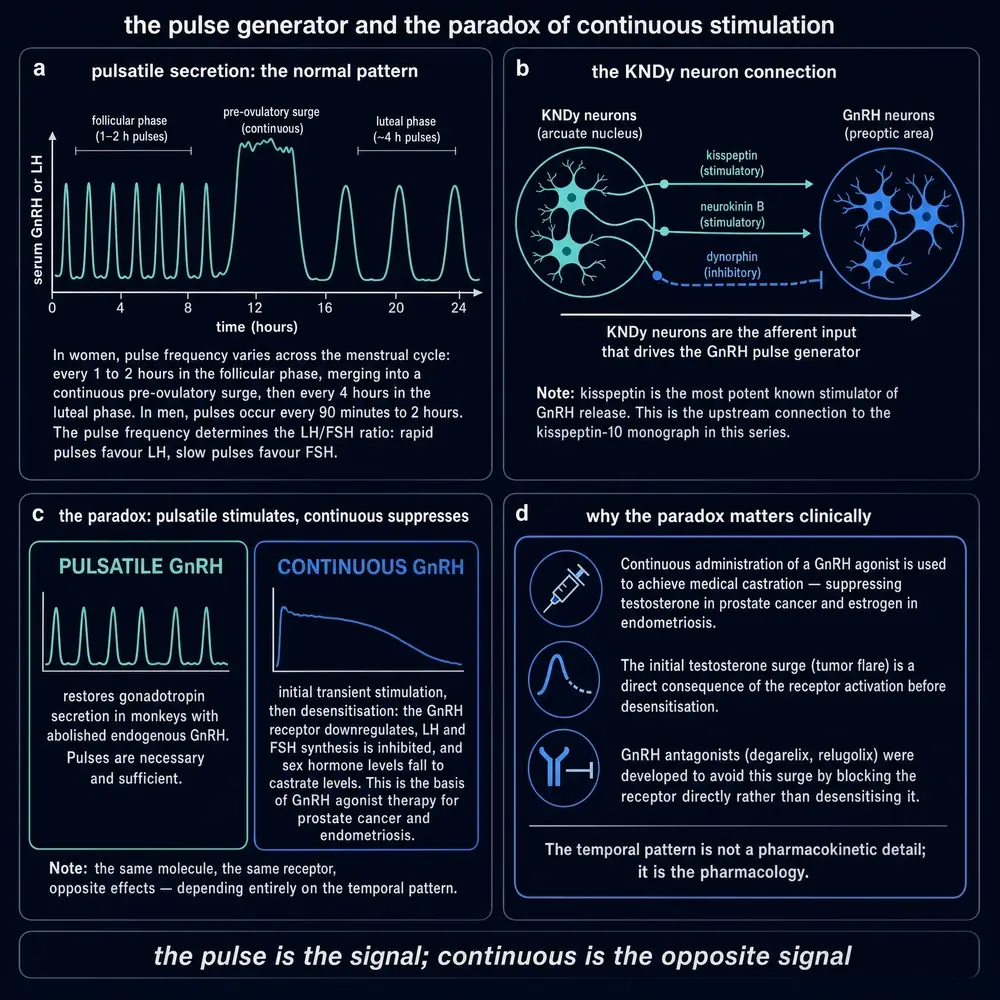
The receptor is tuned to intermittent stimulation. Pulses every 60–120 minutes keep gonadotrophs responsive. Continuous or constantly high GnRH causes desensitisation and receptor internalisation after an initial surge, and gonadotropin output collapses.15,19 That is not a defect; it is the switch the clinical field is built on.
Upstream of the pituitary, a hypothalamic network of KNDy neurons — co-expressing kisspeptin, neurokinin B, and dynorphin — sets the pulse tempo that GnRH neurons deliver to the portal circulation.15,16 Kisspeptin is the proximate excitatory drive; altering that tempo changes the LH/FSH ratio the gonadotrophs emit. The clinical analogues do not rewrite that circuitry: they either mimic a pulse (native gonadorelin by pump) or overwhelm the receptor so the switch flips to suppression.
The same receptor that gonadorelin pulses to restore fertility is the receptor that leuprolide floods to suppress hormones in prostate cancer. Frequency is the difference between the two.
Pulse frequency is not cosmetic. Faster pulses favour LH release; slower pulses favour FSH. Across the menstrual cycle that ratio shifts as the hypothalamus changes tempo, which is why a fixed continuous exposure cannot reproduce a physiological gonadotropin pattern even when the average daily dose looks similar on paper.15,16
Continuous agonists exploit the opposite limb of the same curve. After an initial flare of LH and sex steroids, receptor desensitisation and internalisation collapse gonadotropin output — medical castration by rhythm rather than by receptor blockade. Antagonists were developed to reach the same suppressed state without the flare.15,19
06Structure–activity relationships
The native decapeptide binds and activates efficiently, but it was never built to last. Enzymes cleave preferentially around Gly⁶–Leu⁷ and at the C-terminal Gly-NH₂.15 Replacing Gly⁶ with a bulky D-amino acid slows attack and raises affinity; C-terminal modification does the same.5,15 The resulting super-agonists (leuprolide, triptorelin, buserelin, goserelin) can be dosed as depots lasting weeks or months — and because that dosing is effectively continuous, they suppress rather than stimulate.
A local materials study makes the position-6 story concrete. GnRH[6-D-Phe] resisted enzymatic degradation and, with zinc under a controlled pH shift, self-assembled into nanostructures and fibrils explored as a slow-release depot.5 The same position nature made fragile becomes, once stabilised, the handle for long-acting formulations. Native gonadorelin keeps the vulnerable sequence because the goal is to imitate a short physiological pulse, not to override it.
07Pharmacokinetics, distribution and metabolism
Gonadorelin is cleared by hydrolytic cleavage of peptide bonds, without needing cytochrome machinery, yielding short fragments and free amino acids.20 Reported elimination half-life is short — minutes — consistent with the fleeting natural pulse.19,20 Routes described in the literature include intravenous, subcutaneous, and (historically) nasal spray.20
To reproduce the hypothalamic rhythm, the historical therapeutic product was a wearable infusion pump delivering micro-doses on a fixed clock. Approved pulsatile products used on the order of a few micrograms per pulse every 60–120 minutes.3,20 A 2025 infant CHH series used subcutaneous infusion of 5 µg every 90 minutes, reported strictly as that study’s protocol.3 The pump requirement — inconvenient, costly, easy to get wrong — is why human branded products struggled commercially and why formulation scientists keep trying to engineer hardware-free depots.
08Testing and study landscape
In the local research corpus, gonadorelin is linked to 340 study records, of which 85 are probable direct-title matches and 43 are open-access; 24 full-text papers were retained locally for screening, spanning 1978 to 2026. A direct full-text scan found the compound named in 55 papers, of which roughly two dozen discuss it substantively. That footprint is broader than most research peptides because gonadorelin lives in three worlds at once: human reproductive medicine, veterinary animal breeding, and analytical / anti-doping chemistry.
09Findings by evidence domain
Weighing the corpus by directness and design, three tiers emerge.
The strongest direct human evidence concerns pulsatile gonadorelin in congenital hypogonadotropic hypogonadism (CHH): a comparative study found the pulsatile pump induced spermatogenesis faster than cyclical gonadotropin therapy (median six versus fourteen months to first sperm), and a separate cohort reported gains in bone mineral density and metabolic markers after six months of pulsatile treatment.1,2 These are small studies in a rare condition, but they are direct uses of the exact molecule.
The largest and most consistent body of hands-on data is veterinary, where gonadorelin is a workhorse for timing ovulation in cattle synchronisation protocols and has been studied head-to-head against related agonists in cattle and pigs, and used to induce ovulation in cats.7–10 This literature is informative about core pharmacology — a reliable LH surge and ovulation — but it is animal evidence and is treated here as such.
The fastest-growing use has the thinnest direct evidence. Gonadorelin as a compounded adjunct to testosterone therapy is supported mainly by mechanistic plausibility and clinic observation, not controlled trials; some independent analyses argue the pivot was driven by drug-access regulation rather than evidence of superiority.23,24 Recency is given weight throughout, but recency alone cannot promote a claim past the strength of its study design.
10Human evidence
Diagnostic stimulation testing
The oldest durable human application is diagnostic. A single dose of gonadorelin provokes a measurable LH and FSH rise in a functioning pituitary; the size and timing of that rise help distinguish a hypothalamic problem from a pituitary one, and gauge the onset of puberty.19,20 A 2025 study in girls evaluated for central precocious puberty compared intravenous gonadorelin against subcutaneous triptorelin as the stimulating agent in 341 children; both produced diagnostically useful LH peaks, with gonadorelin offering high sensitivity at an early LH threshold.6 The study is reported here as diagnostic-accuracy research, not as an endorsement of any protocol.
Pulsatile pump therapy in hypogonadotropic hypogonadism
The signature therapeutic use restores a missing GnRH pulse. In men with CHH — whose hypothalamus fails to pulse GnRH — a pump delivering micro-pulses can switch the dormant axis back on. In one comparative cohort the pulsatile gonadorelin pump induced spermatogenesis significantly earlier than cyclical gonadotropin injections, and several participants went on to father children.2 A 2025 case series extended the concept to infants with congenital hypogonadotropic hypogonadism, reporting growth of penile length and testicular volume and rises in inhibin B and anti-Müllerian hormone, using a subcutaneous 5 µg/90-minute regimen described as the study protocol.3 A further cohort documented improvements in bone mineral density, insulin resistance, and lipid markers after six months of pulsatile treatment in young men with the disorder.1
They are consistent and biologically coherent, but they come from small cohorts in an uncommon disease. They establish that pulsatile gonadorelin can reactivate a broken axis; they do not, by themselves, speak to the very different, high-volume off-label use in otherwise-healthy men on testosterone therapy.
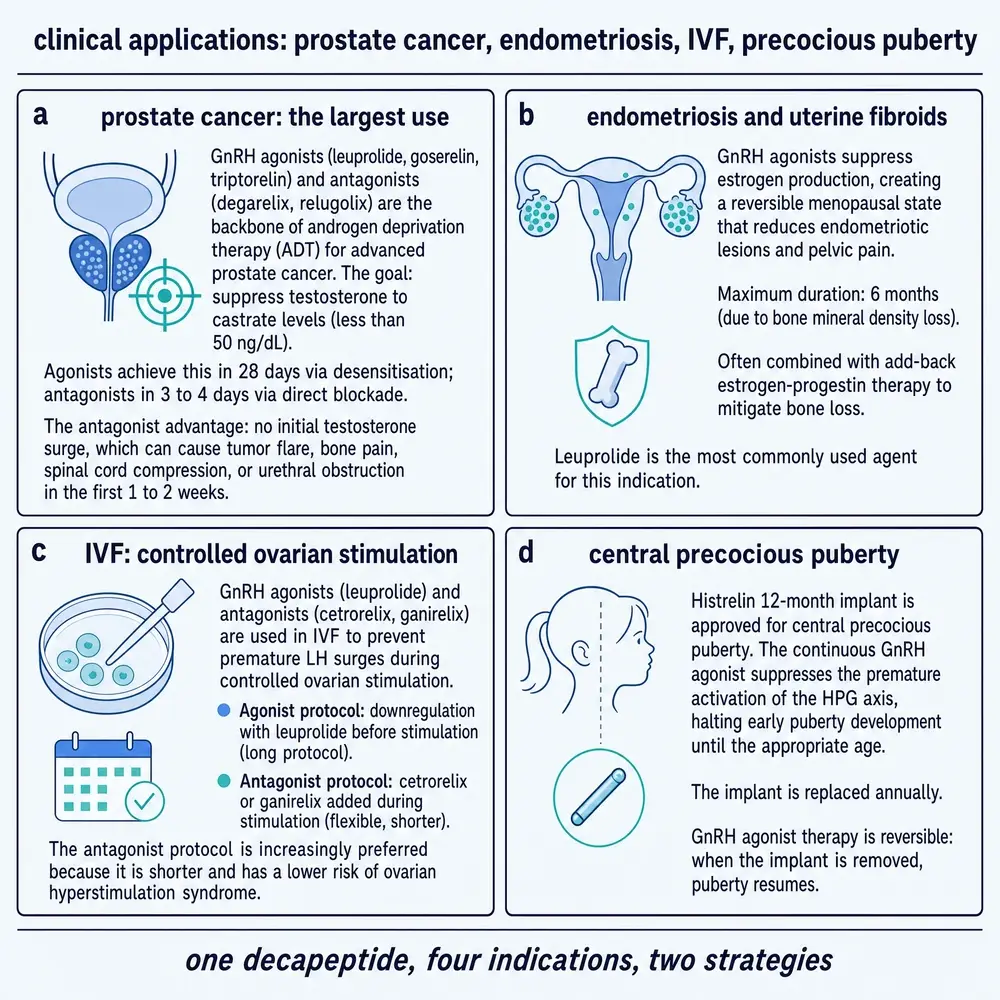
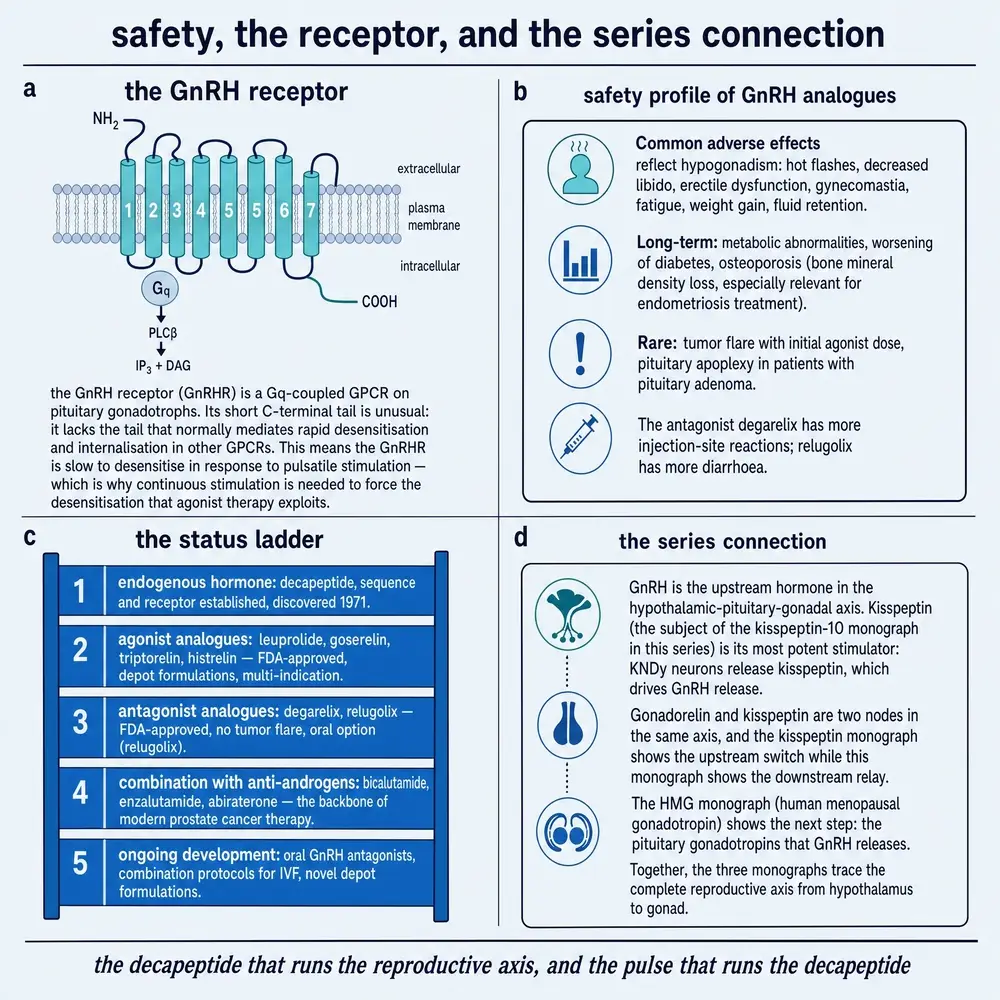
The approved long-acting GnRH analogues occupy a different clinical niche from the native hormone: continuous exposure for prostate cancer, endometriosis, IVF pituitary downregulation, and central precocious puberty. Those indications belong to the depot agonists and antagonists, not to pulsed gonadorelin; they are mapped in the plate that follows so the boundary stays visible.2,6,15
11Animal and preclinical evidence
Across the recent corpus, gonadorelin is a standard reagent in animal reproduction, where its dependable induction of an LH surge is used to time ovulation. In cattle it is the opening and closing hormone of the “Ovsynch” family of fixed-time artificial-insemination protocols; a study in Boran and Boran×Holstein cows quantified ovulation rates and follicle dynamics in response to gonadorelin within such a protocol.7 A 2025 trial compared GnRH agonists (including gonadorelin) by molecule and route for LH surge and pregnancy outcomes in cows,8 and a swine study contrasted gonadorelin with buserelin for the estrus-to-ovulation interval and litter outcomes in gilts.9 In small-animal practice, a 2025 feline case report used gonadorelin (as Fertagyl) to induce ovulation as part of a diagnostic work-up.10
These are controlled livestock and companion-animal studies with defined species, breeds, group sizes, comparators, and endpoints such as ovulation rate, follicle size, progesterone, and conception. They robustly demonstrate the molecule’s core pharmacology — a reliable, dose-responsive gonadotropin surge — but they are animal-model observations. They are not translated here into any human-use claim.
12In vitro and mechanistic evidence
Beyond whole-animal work, the corpus contains mechanistic and materials studies. The zinc self-assembly work on GnRH[6-D-Phe] showed that a stabilised analogue can form nanostructures and fibrils under a controlled pH shift in the presence of zinc, forming a reservoir from which the peptide releases slowly — a proof-of-concept for a hardware-free depot.5 The choice of a position-6 D-amino-acid analogue rather than native gonadorelin is itself a structure–activity lesson: the native peptide is too labile to make a good depot.
Analytical chemistry supplies a second window. A biomimetic ELISA (BELISA) built on molecularly imprinted polymers was developed specifically to detect gonadorelin in human urine, using biotinylated gonadorelin and a European Pharmacopoeia reference standard, and validated against LC-MS/MS down to picomolar detection limits.4 The work exists because gonadorelin is a doping target — a molecule whose misuse in sport created demand for sensitive tests.
13Safety and tolerability signals
As a copy of an endogenous hormone given at physiological micro-doses, gonadorelin has historically been regarded as well tolerated, but the corpus reports concrete adverse events rather than reassurances. In the comparative CHH fertility study, adverse events were noted “quite often” across treatment groups.2 General pharmacology references list local injection-site reactions and, rarely, hypersensitivity as recognised effects of the diagnostic and pulsatile products, and note the theoretical potential for an initial gonadotropin “flare” consistent with the receptor mechanism.20
Two framing points follow from the mechanism. First, because gonadorelin acts one step above the gonad and remains under feedback control, its hormonal effects are in principle more self-limiting than direct gonadal stimulation — a mechanistic expectation, not a measured safety endpoint. Second, the safety of the native pulsed peptide must not be conflated with the profile of continuous long-acting analogues, which deliberately induce a hypogonadal state. This monograph makes no dosing or safety recommendation; it records only what the cited studies observed.
The receptor itself explains why continuous analogues need a different safety conversation. GnRHR is a Gq-coupled GPCR whose unusually short C-terminal tail slows desensitisation under pulsatile stimulation — which is why continuous exposure is required to force the agonist shut-off that depot products exploit.15,16 Hot flashes, libido and metabolic changes, bone loss, and rare tumour flare belong to that continuous-analogue profile, not to native pulsed gonadorelin.
14Regulatory, legal and sports-governance status
In the United States, gonadorelin was approved as Factrel (gonadorelin hydrochloride) in 1982 for diagnostic use and as Lutrepulse / Lutrelef (gonadorelin acetate) in 1989 for pulsatile-pump therapy in hypothalamic infertility.20,22 Both branded human products were later voluntarily discontinued — not for safety reasons, but because demand was low, pulsatile administration was cumbersome, and simpler alternatives had taken over their niches.24 No commercial FDA-approved finished gonadorelin product is currently marketed in the United States.24
| Product / form | Salt | Original role | Status |
|---|---|---|---|
| Factrel | hydrochloride | Single-dose diagnostic | Discontinued |
| Lutrepulse / Lutrelef | acetate | Pulsatile pump for hypothalamic infertility | Discontinued |
| Fertagyl, Cystorelin, Ovsynch, etc. | acetate / diacetate | Veterinary ovulation induction | Marketed (veterinary) |
| Compounded gonadorelin | acetate | Off-label human use via 503A pharmacies | Available (compounded) |
The recent revival came through compounding pharmacies. A 2020 U.S. regulatory decision reclassified hCG as a biologic, removing it from substances that 503A pharmacies could readily compound; clinics providing testosterone therapy pivoted to gonadorelin because it remains a small synthetic peptide eligible for compounding.23,24 Independent commentators emphasise that this switch was driven primarily by drug-access rules rather than evidence that gonadorelin outperforms hCG for that purpose.24
In sport, gonadorelin is prohibited. WADA lists “gonadotrophin-releasing hormone (GnRH, gonadorelin) and its agonist analogues” among testosterone-stimulating peptides in category S2.21 That prohibition is why sensitive detection assays were developed.4
15Quality and analytical verification
Gonadorelin is a defined, single-sequence peptide with an established European Pharmacopoeia reference standard.4 Analytically it is favourable: Tyr and Trp give strong UV absorbance near 280 nm, and mass spectrometry resolves its ~1,182-dalton mass.4,18 The BELISA study validated a molecularly imprinted-polymer assay against LC-MS/MS to picomolar limits and examined freeze–thaw stability.4 Commercial material is typically an acetate or hydrochloride salt.18 For compounded human preparations — which now dominate U.S. supply — verification of identity, purity, and content is a live concern precisely because such products sit outside the finished-drug approval system.
16Current research directions
Three threads are active. The first is formulation: the inconvenience of pulsatile pumping keeps motivating depots and self-assembling systems, exemplified by zinc-triggered nanostructures of a stabilised analogue.5 The second is diagnostics: as native gonadorelin became scarce, recent pediatric work has tested whether stabilised agonists such as triptorelin can substitute in the GnRH stimulation test.6 The third, and least settled, is the testosterone-therapy question. Gonadorelin is widely prescribed off-label to preserve testicular function on testosterone, yet controlled evidence for this specific use is limited; for men actively seeking conception the stronger evidence base still favours hCG with or without FSH.23,24 A well-designed trial of compounded gonadorelin for fertility preservation on testosterone therapy is the clearest missing piece in the record.
17Conclusions
Gonadorelin is one of the foundational molecules of neuroendocrinology: the ten-amino-acid signal whose 1971 sequencing earned a Nobel Prize.11,13 Its pharmacology hinges on a single elegant fact — the GnRH receptor responds to rhythm, so pulsed delivery stimulates the reproductive axis while continuous delivery suppresses it.15
The evidence, weighed by strength and recency, points in three directions. Direct human data most firmly support pulsatile gonadorelin for restoring fertility and hormonal function in CHH, and support its long-standing diagnostic role.1–3,6 The largest hands-on evidence is veterinary and confirms reliable gonadotropin-surge pharmacology, but it is animal evidence.7–10 The most visible current use — a compounded adjunct to testosterone therapy — is also the least substantiated by controlled trials.23,24 Gonadorelin is prohibited in sport.21
The central gaps are not about whether gonadorelin raises LH and FSH — that is beyond doubt — but about delivery and about the specific modern indication that made it familiar in men’s-health circles. This monograph presents the source-supported research picture only; it makes no recommendation for human use or dosing beyond reporting what cited studies did under their own stated conditions.
18Bibliography
Ruleset: research-use-only. Human dosing figures appear only as descriptions of what specific cited studies administered. Animal and in-vitro findings are labelled as model observations.
Perceived/marketed uses are separated from investigated and demonstrated uses. The WADA prohibition is stated explicitly. Evidence gaps are surfaced rather than padded.
Retained full-text corpus (Refs 1–10) and authoritative identity, history, and governance sources (Refs 11–24).
- Li CX, Tang ST, Zhang Q. Changes in Bone Mineral Density and Metabolic Parameters after Pulsatile Gonadorelin Treatment in Young Men with Hypogonadotropic Hypogonadism. Int J Endocrinol. 2015. PMC4568382
- Zhang L, Cai K, Wang Y, et al. The Pulsatile Gonadorelin Pump Induces Earlier Spermatogenesis Than Cyclical Gonadotropin Therapy in Congenital Hypogonadotropic Hypogonadism Men. 2019. PMC6775549
- Wang X, Zhang ZX, Chen J, et al. Efficacy and safety of pulsatile GnRH pump therapy in male infants with congenital hypogonadotropic hypogonadism. 2025. PMC11964480
- Torrini F, Caponi L, Bertolini A, et al. A biomimetic enzyme-linked immunosorbent assay (BELISA) for the analysis of gonadorelin by using molecularly imprinted polymer-coated microplates. Anal Bioanal Chem. 2022. PMC9242967
- Yordanova Y, Vanderlinden W, Stoll R, et al. Zn2+-triggered self-assembly of Gonadorelin [6-D-Phe] to produce nanostructures and fibrils. 2018. PMC6062538
- Diagnostic accuracy of subcutaneous triptorelin versus intravenous gonadorelin in the GnRH stimulation test for central precocious puberty in girls. Endocr Connect. 2025. PMC12703463
- Ovulation rate and follicular dynamics in response to gonadorelin within Ovsynch/CIDR fixed-time AI protocols in Boran and Boran×Holstein cows. BMC Vet Res. 2023. PMC10233989
- Comparison of GnRH analogues and route on LH surge, ovulation, and fertility in an Ovsynch protocol in cattle. BMC Vet Res. 2025. PMC13277028
- Buserelin shortens the estrus-to-ovulation interval and improves pregnancy outcomes versus gonadorelin in gilts treated with fixed-time artificial insemination. Front Vet Sci. 2025. PMC12214088
- Moore et al. Ovarian remnant syndrome in a 2-year-old cat with inconclusive diagnostics (gonadorelin/Fertagyl ovulation induction). JFMS Open Rep. 2025. PMC13168725
- Matsuo H, Baba Y, Nair RMG, Arimura A, Schally AV. Structure of the porcine LH- and FSH-releasing hormone. I. The proposed amino acid sequence. Biochem Biophys Res Commun. 1971;43(6):1334–1339.
- Burgus R, Butcher M, Amoss M, et al. Primary structure of the ovine hypothalamic luteinizing hormone-releasing factor (LRF). Proc Natl Acad Sci USA. 1972;69(1):278–282.
- The Nobel Prize in Physiology or Medicine 1977 — Roger Guillemin & Andrew V. Schally (and Rosalyn Yalow). Press release. nobelprize.org
- Schally AV. Biographical. NobelPrize.org, 1977. nobelprize.org
- Gonadotropin-releasing hormone: incredible 50 years. 2023. PMC10201296
- Physiology of GnRH and Gonadotrophin Secretion. Endotext (NCBI Bookshelf) NBK279070. NBK279070
- Gonadorelin, CID 638793. PubChem, U.S. National Library of Medicine. pubchem.ncbi.nlm.nih.gov/compound/638793
- Gonadorelin (CHEBI:5520). ChEBI, EMBL-EBI. CHEBI:5520
- Gonadorelin (DB00644) · UNII 9O7312W37G. DrugBank / FDA Substance Registration System. drugs.ncats.io
- Gonadorelin: nomenclature, formulations, routes, brand names, and pharmacokinetics (tertiary reference summary). en.wikipedia.org/wiki/Gonadorelin
- World Anti-Doping Agency Prohibited List, category S2: GnRH, gonadorelin and agonist analogues (men). 2025 List. NBK305894
- FDA regulatory history: Factrel (NDA 018123, 1982); Lutrepulse/Lutrelef (NDA 019687, 1989). PharmaKB / Drugs@FDA. pharmakb.com
- 2020 FDA reclassification of hCG (BPCIA biologic) and gonadorelin adoption as a compounded TRT adjunct (industry/clinical context). shotfreetrt.com
- Gonadorelin versus hCG for testicular function and fertility on testosterone therapy: evidence, access, and context. formblends.com
Corpus provenance: Radix library coverage for compound P138 (Gonadorelin) — 340 linked studies, 85 direct-title matches, 43 open-access, 24 locally retained full texts, publication span 1978–2026 (library/compound_coverage_map.csv).
Series neighbours on the same axis include kisspeptin-10 (upstream pulse-generator drive) and gonadotropin preparations such as HMG (the LH/FSH effectors GnRH releases). Those monographs take up the circuitry and the downstream hormones; this one stays with the native decapeptide and the rhythm that makes it work.
Continue exploring