
Semaglutide
The once-weekly GLP-1 drug sold as Ozempic, Wegovy, and Rybelsus — what it is, and what its trials actually show across weight, blood sugar, the heart, the kidney, and the liver.
Abstract
Semaglutide is a once-weekly glucagon-like peptide-1 (GLP-1) receptor agonist: a re-engineered copy of a gut hormone, redesigned to bind blood albumin so it lasts about a week instead of minutes. Sold as Ozempic for type 2 diabetes, Wegovy for obesity, and the oral tablet Rybelsus, it produced mean weight loss near 15% in non-diabetic obesity across the STEP program and, in separate outcome trials, fewer cardiovascular events (SELECT, SUSTAIN-6), slower kidney-disease progression (FLOW), and improved liver histology in MASH (ESSENCE). The benefits arrive with trade-offs kept in the same frame: gastrointestinal side effects, near-total weight regain after stopping, a retinopathy signal in diabetes, a rodent-derived thyroid-tumor warning, and a rare, unresolved eye-stroke question. This review reports the verified trial figures with their populations and doses, distinguishes approved medicine from compounded and research-use-only product, and gives no dosing or medical advice.
Key findings
- Semaglutide is one engineered molecule sold under three names — Ozempic for type 2 diabetes (2017), Rybelsus as an oral tablet (2019), and Wegovy for obesity (2021) — redesigned so it lasts about a week in the blood instead of the minute or two of the natural hormone (Lau et al., 2015).
- In non-diabetic obesity, mean weight loss clustered near 15% across the STEP trials (−14.9% in STEP 1) and held to two years while on drug, but was about a third smaller in people who also had type 2 diabetes (−9.6% in STEP 2) (Wilding et al., 2021; Davies et al., 2021).
- The benefits reach past weight: fewer major cardiovascular events in obesity without diabetes (SELECT, HR 0.80) and in diabetes (SUSTAIN-6, HR 0.74), slower kidney-disease progression (FLOW, HR 0.76), and improved liver histology in MASH (ESSENCE, resolution 62.9% vs 34.3%) (Lincoff et al., 2023; Marso et al., 2016; Perkovic et al., 2024; Sanyal et al., 2025).
- Harms belong in the same frame: SUSTAIN-6 cut cardiovascular events but significantly raised diabetic-retinopathy complications (HR 1.76), and about two-thirds of lost weight returns within a year of stopping (Marso et al., 2016; Wilding et al., 2022).
- The thyroid-tumor boxed warning derives from rodents with uncertain human relevance; the reported eye-stroke (NAION) signal is rare and unresolved; and an early suicidality signal did not survive larger analysis (Bjerre Knudsen et al., 2010; Hathaway et al., 2024; Wang et al., 2024).
- Approved semaglutide, compounded copies, and research-use-only chemicals bearing the name are not equivalent — only the approved drug has been reviewed for safety, purity, and dose.
Semaglutide is one molecule sold under three names. As Ozempic it lowers blood sugar in type 2 diabetes; as Wegovy, at a higher dose, it treats obesity; as Rybelsus it does the diabetes job as a daily tablet. Each is the same engineered peptide — a rebuilt copy of a hormone the gut releases after every meal — packaged and dosed for a different purpose.
At its core semaglutide is a once-weekly GLP-1 receptor agonist. The natural hormone it imitates, glucagon-like peptide-1, is destroyed within a minute or two of being released; semaglutide was redesigned to survive in the blood for about a week (Lau et al., 2015; Marso et al., 2016). That shift, from minutes to days, is the whole reason a fleeting bodily signal can be turned into a drug taken once a week.
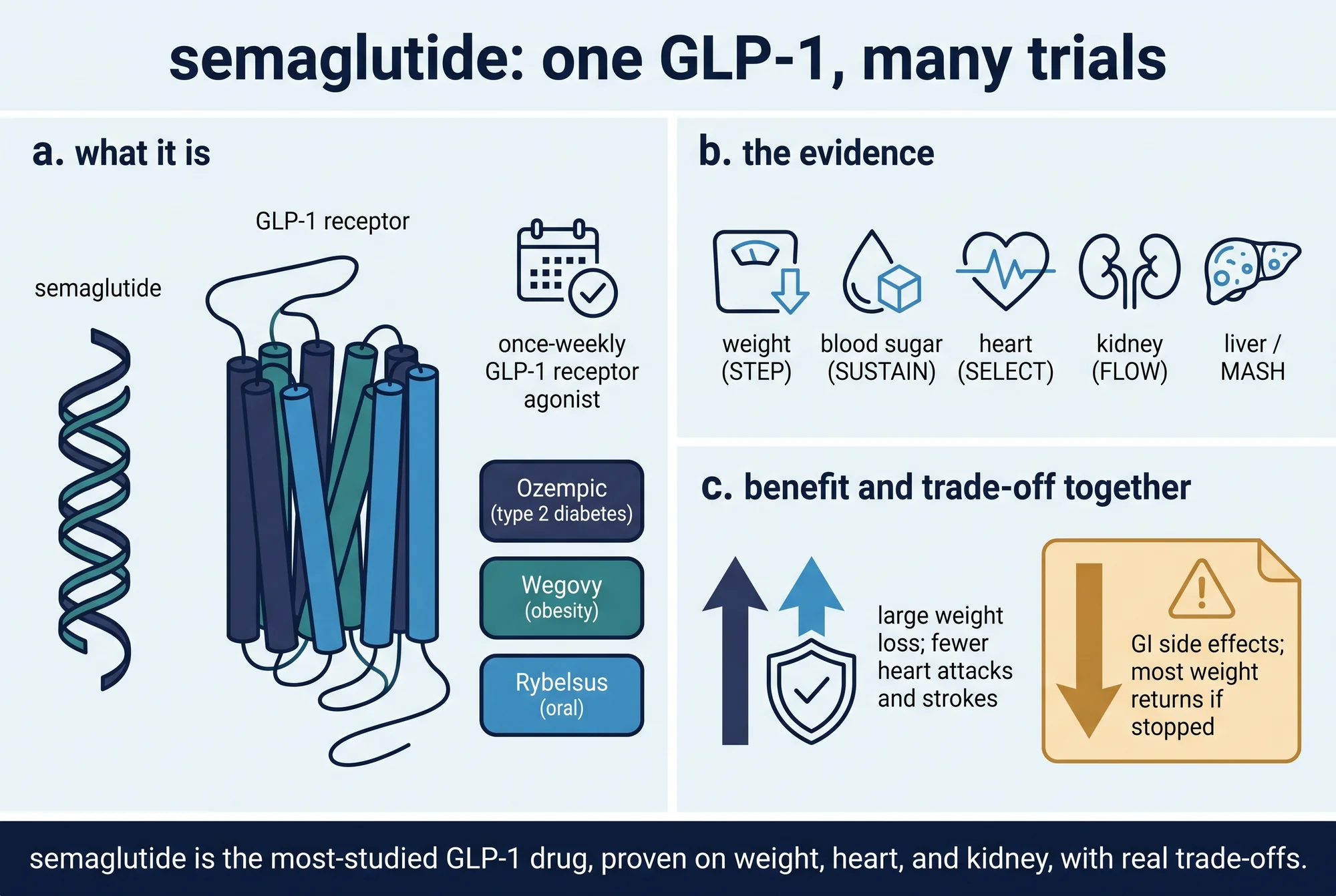
One molecule, three brands
Semaglutide began as a chemistry problem. Native GLP-1 works well but vanishes almost immediately, cleared within a minute or two by an enzyme called DPP-4. Semaglutide's designers made two amino-acid substitutions — one of which blocks DPP-4 — and added a long fatty-acid chain that makes the molecule cling to albumin, the most abundant protein in blood (Lau et al., 2015). Tethered to albumin, it is released slowly and lasts about a week, long enough for a once-weekly injection (Marso et al., 2016).
The counterintuitive part is that semaglutide does not grip its receptor especially tightly — its affinity is about threefold weaker than the older drug liraglutide. The engineering bought duration, not strength (Lau et al., 2015): staying in the body matters more than binding hard.
That single molecule now carries several brand names and a widening set of approvals. Ozempic, the weekly injection for type 2 diabetes, was cleared in December 2017; Rybelsus, the first oral GLP-1 tablet and also a diabetes drug, in September 2019; and Wegovy, the 2.4 mg weekly injection for chronic weight management, in June 2021. Wegovy's label has since expanded twice on the strength of outcome trials — to cardiovascular risk reduction in March 2024, and, under an accelerated pathway, to metabolic liver disease in August 2025 — while Ozempic gained a chronic-kidney-disease indication in January 2025 (U.S. FDA, 2026). Same molecule; different doses, and different jobs.
One distinction matters before going further: semaglutide is an FDA-approved prescription drug, not a research-use-only peptide, and not the same as the compounded versions sold during shortages — a difference with real consequences, taken up in its own section below.
How it works, in brief
As a GLP-1 receptor agonist, semaglutide does four things, and all four are mechanism rather than proven outcome. It prompts the pancreas to release insulin, but chiefly when blood glucose is high, which is why it carries little intrinsic risk of dangerous low blood sugar. It suppresses glucagon, the hormone that tells the liver to pour out glucose. It slows the rate at which the stomach empties. And it acts on appetite centres in the brain to reduce hunger (Drucker, 2018).
Those are the levers. What they add up to — pounds lost, events prevented — is the work of the trials that follow, and the two should not be run together: a receptor action in the hypothalamus is not the same as a measured drop in heart attacks. The fuller mechanism, including how the natural hormone works and why it had to be re-engineered at all, lives in the companion explainer, What Is GLP-1 and How Does It Work?.
Weight: the STEP program
The weight-loss evidence comes from STEP, a family of phase 3 randomized trials that tested semaglutide 2.4 mg once weekly against placebo, and in one case against an older drug. Read together, they are unusually consistent.
In STEP 1, the headline trial, adults with obesity but not diabetes lost a mean of 14.9% of body weight over 68 weeks, against 2.4% on placebo, and half of them — 50.5% versus 4.9% — lost at least 15% (Wilding et al., 2021). STEP 3 added intensive behavioral therapy to both arms and still reached 16.0% versus 5.7% — even maximal lifestyle support did not close the drug-versus-placebo gap (Wadden et al., 2021). STEP 5 followed people for two full years and found the loss held — 15.2% versus 2.6% at 104 weeks — as long as they kept taking the drug (Garvey et al., 2022). And STEP 8 set semaglutide directly against liraglutide, until then the leading GLP-1 drug for obesity, and won: 15.8% versus 6.4%, with fewer people dropping out (Rubino et al., 2022).
The exception is informative. In STEP 2, in people who had type 2 diabetes as well as obesity, the same drug at the same dose produced only 9.6% versus 3.4% (Davies et al., 2021). This diabetes gap — roughly a third less weight loss — is one of the most reliable patterns in the program, and a caution against reading 15% as a universal promise: the result is real and reproducible in non-diabetic obesity, simply smaller when diabetes is in the picture.
Semaglutide is no longer the most potent weight-loss drug available: newer multi-receptor medicines such as the dual agonist tirzepatide post larger average losses in their own trials. But it remains the most extensively studied, and the drug the newcomers are measured against.
Blood sugar: the SUSTAIN trials
Before the weight results made it famous, semaglutide was a diabetes drug, and the SUSTAIN program is where that evidence sits — SUSTAIN 1 through 10 plus extensions, more than this overview needs, but one head-to-head makes the point. In SUSTAIN 7, semaglutide was compared against dulaglutide, another weekly GLP-1 drug, in type 2 diabetes over 40 weeks. It lowered HbA1c more — by 1.5 versus 1.1 percentage points at the low dose, 1.8 versus 1.4 at the high — and produced more weight loss at the same time (Pratley et al., 2018). Across the program, semaglutide generally beat the comparators it was tested against on both glucose and weight, the combination that made it distinctive.
The heart: benefit and a warning together
The trials that changed how these drugs are seen asked a harder question than weight or glucose: do they prevent cardiovascular events? Two answered yes, in different populations — and one came with a signal that has to be reported in the same breath.
SELECT is the landmark. It enrolled 17,604 people with established cardiovascular disease and overweight or obesity but not diabetes, and followed them for a mean of nearly 40 months. Semaglutide 2.4 mg cut major adverse cardiovascular events — cardiovascular death, nonfatal heart attack, or nonfatal stroke — from 8.0% to 6.5%, a hazard ratio of 0.80, about a 20% relative reduction (Lincoff et al., 2023). This is the "benefit beyond weight" result: a weight-management drug lowering hard cardiovascular outcomes in people without diabetes. Its cost sits in the same trial — 16.6% discontinued for adverse events, against 8.2% on placebo.
SUSTAIN-6, the earlier cardiovascular trial in type 2 diabetes, pointed the same direction, cutting major events from 8.9% to 6.6% (hazard ratio 0.74) over about two years (Marso et al., 2016). But it also found something that belongs permanently attached to the benefit: a significant increase in diabetic retinopathy complications, hazard ratio 1.76. The great majority of the affected patients — 83.5% — already had retinopathy at the start, consistent with the "early worsening" that can follow any rapid improvement in blood sugar. Benefit and harm are both real here, and both depend on who is taking the drug. A dedicated retinopathy trial, FOCUS, has not yet reported, so the question is not closed.
The kidney: the FLOW trial
FLOW tested whether semaglutide protects the kidneys in the people most at risk. It enrolled 3,533 patients with type 2 diabetes and chronic kidney disease, and used the 1.0 mg diabetes dose rather than the 2.4 mg obesity dose. It was stopped early for efficacy: over a median of 3.4 years, major kidney-disease events fell by about 24% (hazard ratio 0.76), and cardiovascular death (hazard ratio 0.71) and all-cause death (0.80) fell as well (Perkovic et al., 2024). And in this sicker population, serious adverse events were lower on the drug than on placebo, 49.6% versus 53.8%. FLOW is the basis for the chronic-kidney-disease indication added to Ozempic in 2025.
The liver: a result that changed
The liver story is worth telling in full because it reversed. Metabolic dysfunction-associated steatohepatitis, or MASH — a fatty, inflamed, scarring liver — is a major driver of end-stage liver disease, and for years the semaglutide evidence was ambiguous. A phase 2 trial in 2021 resolved the inflammation in 59% of patients versus 17% on placebo, but did not significantly improve fibrosis, the scarring that actually predicts liver failure (43% versus 33%; Newsome et al., 2021). Real progress on inflammation; unproven, there, on scarring.
The phase 3 trial, ESSENCE, answered the harder question. At 72 weeks, in people with MASH and moderate-to-advanced fibrosis, semaglutide 2.4 mg resolved steatohepatitis without worsening fibrosis in 62.9% of patients versus 34.3% on placebo, and improved fibrosis without worsening steatohepatitis in 36.8% versus 22.4% — both statistically significant (Sanyal et al., 2025). This is the evidence behind the FDA's accelerated approval for non-cirrhotic MASH in August 2025. The word accelerated is doing real work: the approval rests on liver histology at 72 weeks, the trial's clinical-outcomes phase does not read out until around 2029, and patients with cirrhosis were excluded. It is a strong interim result, not yet a demonstrated reduction in liver failure or death.
The tablet: oral semaglutide
Making a peptide survive the stomach is difficult, which is why the oral form is a separate achievement rather than a simple repackaging. The tablet co-formulates semaglutide with an absorption enhancer called SNAC, which lets a small amount of the peptide cross the stomach lining in the immediate vicinity of the dissolving tablet, locally shielding it from acid. The trade-off is efficiency: only around 1% of the dose is absorbed, so the tablet is taken fasting, once a day (Buckley et al., 2018).
It works, within the populations tested. In PIONEER 5, oral semaglutide 14 mg lowered HbA1c and body weight in people with type 2 diabetes and moderate kidney impairment (Mosenzon et al., 2019) — a specific subpopulation, so the result reads as evidence that the oral form works in diabetes, not as a general weight-loss claim. And the oral form now has its own cardiovascular-outcomes evidence: in SOUL, oral semaglutide reduced major cardiovascular events in high-risk type 2 diabetes (hazard ratio 0.86), extending the cardiovascular benefit from the injection to the pill, though the trial's secondary outcomes, including kidney events, were not significantly changed (McGuire et al., 2025).
Two oral products should not be confused. Rybelsus, approved in 2019, is the diabetes tablet; oral Wegovy, a separate and higher-strength application for weight management, was approved at the end of 2025. Six years and different indications separate them.
Side effects and limits
Each of those results carries a cost, and they are not fine print.
Gut side effects are the common, expected price — nausea, vomiting, diarrhea, constipation — and they cluster during the weeks when the dose is being raised. In pooled data from STEP 1 through 3, 98.1% of these events were mild to moderate and 99.5% were non-serious, though 4.3% of people stopped permanently because of them (Wharton et al., 2022). In STEP 1, nausea affected 44% on the drug against 17% on placebo (Wilding et al., 2021). A common folk explanation holds that the drug simply makes people too queasy to eat, but the same pooled analysis undercuts it: gastrointestinal side effects accounted for less than one percentage point of the 7.6-to-14.4-point weight-loss difference. The appetite effect, not the nausea, does the work.
Stopping the drug reverses most of the weight loss. In STEP 4, people switched to placebo regained 6.9% while those who continued lost a further 7.9% (Rubino et al., 2021); in the STEP 1 extension, participants regained about two-thirds of what they had lost within a year of stopping, and their metabolic improvements faded with it (Wilding et al., 2022). This is the evidence for treating obesity as a chronic condition the drug manages rather than cures — a shift whose downstream consequences we take up separately in After the Weight Comes Off.
Some of the loss is lean mass, and its meaning is disputed. Rapid weight loss of any kind sheds some lean mass, and estimates for GLP-1 drugs range widely. But "lean mass" on a body scan includes organs, bone, and water, and is not the same as contractile muscle; imaging work suggests much of the change is the body's expected adaptation to a smaller frame, with the real concern reserved for older and frailer patients (Neeland et al., 2024). It is an open question, not a settled harm.
The thyroid-tumor warning traces to rodents. GLP-1 drugs carry a boxed warning about medullary thyroid cancer, and its basis is that these drugs caused thyroid C-cell tumors in rats and mice. The effect appears to be species-specific: humans and monkeys have far fewer of the relevant receptors in the thyroid, and monkeys given more than sixty times the human exposure for nearly two years did not develop the changes (Bjerre Knudsen et al., 2010). The warning is a real precaution; its long-term human relevance is, in the authors' own word, unknown.
The eye-stroke (NAION) signal is rare and unresolved. A single-center study reported a raised risk of nonarteritic anterior ischemic optic neuropathy, a rare loss of blood flow to the optic nerve, among semaglutide users (Hathaway et al., 2024). But analyses using active comparators have found little or no excess, and Europe's drug-safety regulator concluded in 2025 that the effect, if real, is "very rare" — on the order of one extra case per 10,000 person-years. It warrants neither dismissal nor alarm.
An early suicidality signal did not survive scrutiny. After 2023 reports of suicidal thoughts among users, the largest matched study found lower rates of suicidal ideation on semaglutide, and European regulators found no causal link (Wang et al., 2024). The weight of evidence points away from a real effect.
Approved, compounded, and investigational
For this drug more than most, the label matters: three categories bear the name semaglutide, and they are not equivalent.
The approved medicines — Ozempic, Rybelsus, Wegovy, and oral Wegovy, all from Novo Nordisk — have been reviewed for safety, purity, and efficacy at defined doses. Compounded semaglutide, sold widely during the shortages, is a separate and lower-assurance category. Per FDA and WHO advisories, compounders have sold different chemical forms of the drug — semaglutide sodium and acetate salts rather than the approved base — and dosing errors have occurred with unfamiliar multi-dose vials; the WHO has also flagged falsified Ozempic circulating within the regulated supply chain (U.S. FDA and WHO, 2024). The specific casualty counts sometimes attached to these reports are secondary and unverified, and are not repeated here; the point that stands is categorical, not numerical — compounded product has not passed the review the approved drug has. A generic has so far been granted only tentative approval and cannot yet be sold.
Investigational uses are the third category, and honesty means reporting the failures alongside the hopes. Semaglutide was tested for Alzheimer's disease in two large trials and was not superior to placebo — a clean negative against a promising preclinical background. It is being studied for alcohol use disorder, but on the strength of a single small trial. Neither is an approved use, and neither should be read as established.
What remains uncertain
The genuine open questions are worth stating plainly. Long-term safety and efficacy are not established: the longest randomized exposure, in SELECT, averages about 40 months, and with Ozempic dating only to 2017 and Wegovy to 2021, a decade-long user population does not yet exist to study. Durability off the drug is poor — regain is the rule, which is why these are chronic therapies. The significance of lean-mass loss is unsettled. The retinopathy signal and the NAION question are reminders that benefit and risk coexist and depend on who is treated, and the confirmatory eye trial has not reported. The thyroid warning still rests on rodent data of uncertain human relevance, and the MASH approval is accelerated, its clinical-outcomes evidence years away. None of this erases the demonstrated benefits; it marks the edges of what is known.
This review summarizes published human and mechanistic evidence on semaglutide through 2025, with FDA-approval status re-verified against the openFDA record in 2026. Every trial figure is drawn from the primary publication and reported with its population and dose, and no dosing or medical advice is given. It is educational, and it is not a prescription or a recommendation to use any drug; approved medicines, compounded copies, and research-use-only chemicals bearing the name "semaglutide" are not equivalent. For the underlying biology, see What Is GLP-1 and How Does It Work? and What Is Metabolic Health?; for the multi-receptor successor drugs, see tirzepatide; and browse the GLP-1s hub for related explainers.
References
- 1.Bjerre Knudsen L, Madsen LW, Andersen S, et al. Glucagon-like peptide-1 receptor agonists activate rodent thyroid C-cells causing calcitonin release and C-cell proliferation. Endocrinology. 2010;151(4):1473-1486. doi:10.1210/en.2009-1272
- 2.Buckley ST, Baekdal TA, Vegge A, et al. Transcellular stomach absorption of a derivatized glucagon-like peptide-1 receptor agonist. Sci Transl Med. 2018;10(467):eaar7047. doi:10.1126/scitranslmed.aar7047
- 3.Davies M, Faerch L, Jeppesen OK, et al. Semaglutide 2.4 mg once a week in adults with overweight or obesity, and type 2 diabetes (STEP 2): a randomised, double-blind, double-dummy, placebo-controlled, phase 3 trial. Lancet. 2021;397(10278):971-984. doi:10.1016/S0140-6736(21)00213-0
- 4.Drucker DJ. Mechanisms of action and therapeutic application of glucagon-like peptide-1. Cell Metab. 2018;27(4):740-756. doi:10.1016/j.cmet.2018.03.001
- 5.U.S. Food and Drug Administration. Drugs@FDA approval record for semaglutide (Ozempic NDA 209637; Rybelsus NDA 213051/213182; Wegovy NDA 215256; oral Wegovy NDA 218316; Apotex ANDA 220314, tentative), verified via the openFDA drug/drugsfda.json API, 2026. Link
- 6.U.S. Food and Drug Administration and World Health Organization advisories on compounded and falsified semaglutide (FDA compounding and adverse-event communications, 2024-2025; WHO Medical Product Alert No. 2/2024). Link
- 7.Garvey WT, Batterham RL, Bhatta M, et al. Two-year effects of semaglutide in adults with overweight or obesity: the STEP 5 trial. Nat Med. 2022;28(10):2083-2091. doi:10.1038/s41591-022-02026-4
- 8.Hathaway JT, Shah MP, Hathaway DB, et al. Risk of nonarteritic anterior ischemic optic neuropathy in patients prescribed semaglutide. JAMA Ophthalmol. 2024;142(8):732-739. doi:10.1001/jamaophthalmol.2024.2296
- 9.Lau J, Bloch P, Schaffer L, et al. Discovery of the once-weekly glucagon-like peptide-1 (GLP-1) analogue semaglutide. J Med Chem. 2015;58(18):7370-7380. doi:10.1021/acs.jmedchem.5b00726
- 10.Lincoff AM, Brown-Frandsen K, Colhoun HM, et al. Semaglutide and cardiovascular outcomes in obesity without diabetes (SELECT). N Engl J Med. 2023;389(24):2221-2232. doi:10.1056/NEJMoa2307563
- 11.Marso SP, Bain SC, Consoli A, et al. Semaglutide and cardiovascular outcomes in patients with type 2 diabetes (SUSTAIN-6). N Engl J Med. 2016;375(19):1834-1844. doi:10.1056/NEJMoa1607141
- 12.McGuire DK, Marx N, Mulvagh SL, et al. Oral semaglutide and cardiovascular outcomes in high-risk type 2 diabetes (SOUL). N Engl J Med. 2025;392(20):2001-2012. doi:10.1056/NEJMoa2501006
- 13.Mosenzon O, Blicher TM, Rosenlund S, et al. Efficacy and safety of oral semaglutide in patients with type 2 diabetes and moderate renal impairment (PIONEER 5): a placebo-controlled, randomised, phase 3a trial. Lancet Diabetes Endocrinol. 2019;7(7):515-527. doi:10.1016/S2213-8587(19)30192-5
- 14.Neeland IJ, Linge J, Birkenfeld AL. Changes in lean body mass with glucagon-like peptide-1-based therapies and mitigation strategies. Diabetes Obes Metab. 2024;26(Suppl 4):16-27. doi:10.1111/dom.15728
- 15.Newsome PN, Buchholtz K, Cusi K, et al. A placebo-controlled trial of subcutaneous semaglutide in nonalcoholic steatohepatitis. N Engl J Med. 2021;384(12):1113-1124. doi:10.1056/NEJMoa2028395
- 16.Perkovic V, Tuttle KR, Rossing P, et al. Effects of semaglutide on chronic kidney disease in patients with type 2 diabetes (FLOW). N Engl J Med. 2024;391(2):109-121. doi:10.1056/NEJMoa2403347
- 17.Pratley RE, Aroda VR, Lingvay I, et al. Semaglutide versus dulaglutide once weekly in patients with type 2 diabetes (SUSTAIN 7): a randomised, open-label, phase 3b trial. Lancet Diabetes Endocrinol. 2018;6(4):275-286. doi:10.1016/S2213-8587(18)30024-X
- 18.Rubino D, Abrahamsson N, Davies M, et al. Effect of continued weekly subcutaneous semaglutide vs placebo on weight loss maintenance (STEP 4). JAMA. 2021;325(14):1414-1425. doi:10.1001/jama.2021.3224
- 19.Rubino DM, Greenway FL, Khalid U, et al. Effect of weekly subcutaneous semaglutide vs daily liraglutide on body weight in adults with overweight or obesity without diabetes (STEP 8). JAMA. 2022;327(2):138-150. doi:10.1001/jama.2021.23619
- 20.Sanyal AJ, Newsome PN, Kliers I, et al. Phase 3 trial of semaglutide in metabolic dysfunction-associated steatohepatitis (ESSENCE). N Engl J Med. 2025;392(21):2089-2099. doi:10.1056/NEJMoa2413258
- 21.Wadden TA, Bailey TS, Billings LK, et al. Effect of subcutaneous semaglutide vs placebo as an adjunct to intensive behavioral therapy on body weight in adults with overweight or obesity (STEP 3). JAMA. 2021;325(14):1403-1413. doi:10.1001/jama.2021.1831
- 22.Wang W, Volkow ND, Berger NA, Davis PB, Kaelber DC, Xu R. Association of semaglutide with risk of suicidal ideation in a real-world cohort. Nat Med. 2024;30(1):168-176. doi:10.1038/s41591-023-02672-2
- 23.Wharton S, Calanna S, Davies M, et al. Gastrointestinal tolerability of once-weekly semaglutide 2.4 mg in adults with overweight or obesity, and the relationship between gastrointestinal adverse events and weight loss (pooled STEP 1-3). Diabetes Obes Metab. 2022;24(1):94-105. doi:10.1111/dom.14551
- 24.Wilding JPH, Batterham RL, Calanna S, et al. Once-weekly semaglutide in adults with overweight or obesity (STEP 1). N Engl J Med. 2021;384(11):989-1002. doi:10.1056/NEJMoa2032183
- 25.Wilding JPH, Batterham RL, Davies M, et al. Weight regain and cardiometabolic effects after withdrawal of semaglutide: the STEP 1 trial extension. Diabetes Obes Metab. 2022;24(8):1553-1564. doi:10.1111/dom.14725
Disclosures
Educational review of published evidence. Not medical advice, a prescription, or a recommendation to use any drug. Trial doses, durations, and populations are reported as study parameters, not instructions. FDA-approval status is stated as of 2026 and was re-verified against the openFDA record; compounded and research-use-only products are not the approved medicine, and investigational uses named here (including Alzheimer's disease and alcohol use disorder) are not approved indications.