
What Is Tirzepatide?
The dual-receptor drug behind Mounjaro and Zepbound — what it is, what the trials actually show against obesity, diabetes, and sleep apnea, and where the evidence stops.
Abstract
Tirzepatide is a once-weekly injectable peptide that activates two incretin receptors — GLP-1 and GIP — in a single molecule, which is why it is called a dual agonist or 'twincretin.' Sold as Mounjaro for type 2 diabetes and Zepbound for obesity and obstructive sleep apnea, it produced up to 20.9% mean weight loss in SURMOUNT-1 and outperformed semaglutide head-to-head on both weight and glucose. This review separates what tirzepatide does at the receptor (mechanism, including the unproven hypothesis that the GIP component drives its edge) from what randomized trials measured in people, states the cardiovascular evidence precisely — noninferior to an active comparator, with no placebo-controlled event reduction of the kind semaglutide earned — and places the side effects, weight regain, and open questions beside the efficacy.
Key findings
- Tirzepatide is one molecule that activates two incretin receptors, GIP and GLP-1, engineered for once-weekly subcutaneous dosing — a 'dual agonist' or twincretin, not a combination of two drugs (Coskun et al., 2018).
- In obesity without diabetes it produced mean weight loss of 20.9% at the top dose over 72 weeks versus 3.1% on placebo (SURMOUNT-1), and beat semaglutide head-to-head, 20.2% versus 13.7%, in SURMOUNT-5 (Jastreboff et al., 2022; Aronne et al., 2025).
- It also lowered HbA1c more than semaglutide in type 2 diabetes (SURPASS-2) and became the first drug ever approved for obstructive sleep apnea, in December 2024 (Frias et al., 2021; Malhotra et al., 2024).
- The cardiovascular story is not semaglutide's: SURPASS-CVOT compared tirzepatide against an active drug (dulaglutide) and met noninferiority but not superiority, so no placebo-referenced reduction in heart attacks and strokes has been shown (Nicholls et al., 2025).
- The costs sit beside the benefits — gastrointestinal effects, a gallbladder signal, near-complete weight regain after stopping, a muscle-volume decline broadly proportionate to the weight lost, and a rodent-derived thyroid boxed warning (Aronne et al., 2024; Gong et al., 2025; Sattar et al., 2025; Bjerre Knudsen et al., 2010).
Tirzepatide is a single engineered molecule that switches on two of the body's own gut-hormone receptors at once — the receptor for GLP-1 and the receptor for a sister hormone called GIP. Both belong to the family of incretins, the signals the intestine releases after a meal to help the body handle blood sugar and appetite. Most of the earlier metabolic drugs, semaglutide among them, act on the GLP-1 receptor alone. Tirzepatide adds the GIP receptor, which is why it is called a dual agonist, or a "twincretin." It was built as a fatty-acid-modified peptide that survives in the blood long enough to be injected once a week under the skin (Coskun et al., 2018).
The same molecule is sold under two brand names for three approved purposes. As Mounjaro it was approved by the FDA in 2022 for type 2 diabetes; as Zepbound it was approved in 2023 for chronic weight management in obesity and, in December 2024, for moderate-to-severe obstructive sleep apnea in adults with obesity — the first medicine ever approved for that condition. One drug, two receptors, once a week, three doors.
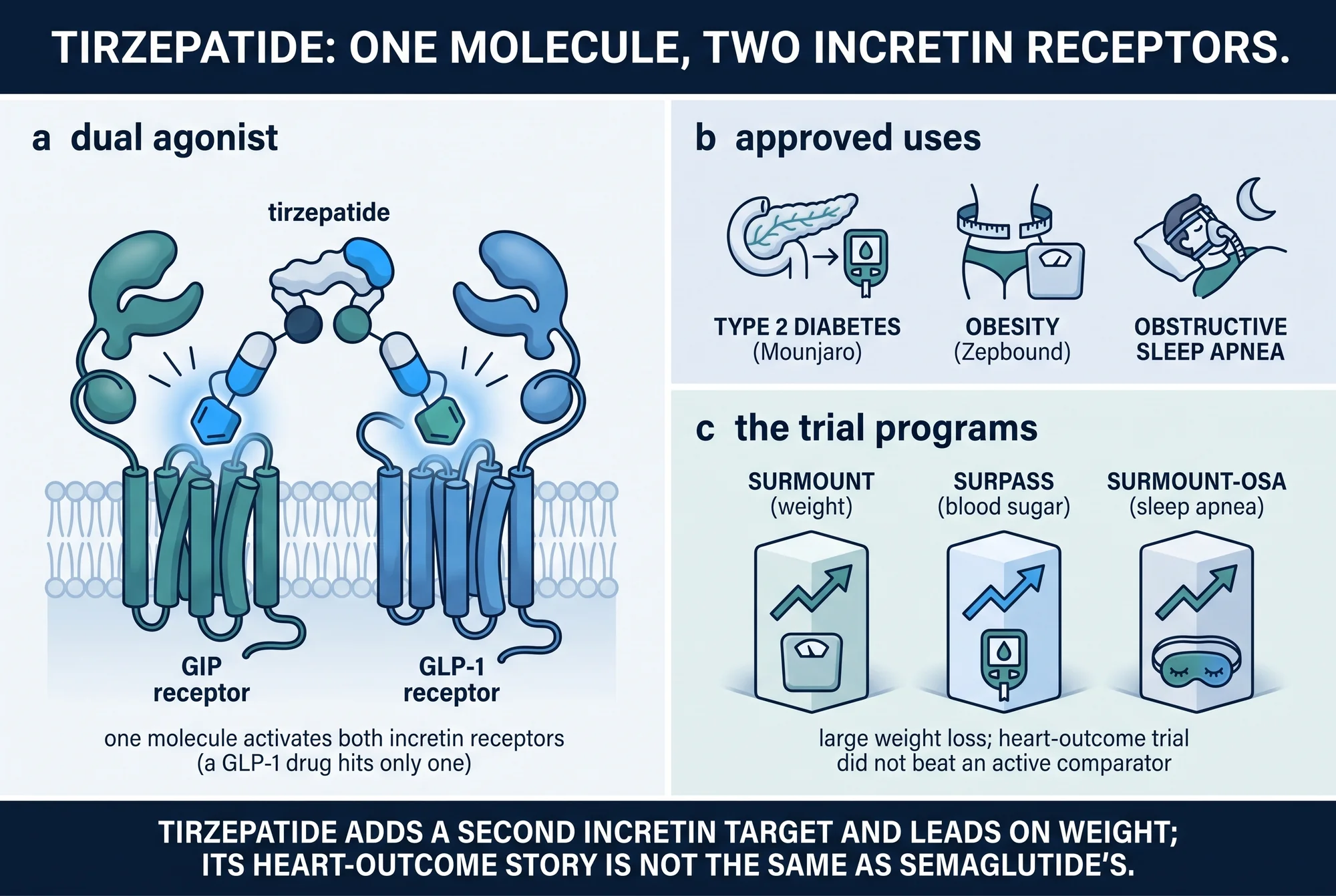
One molecule, two incretin receptors
Tirzepatide belongs to the same story as semaglutide and the other GLP-1 medicines, and the sibling explainer on what GLP-1 is and how it works covers the shared machinery: after a meal the gut releases incretin hormones that prompt insulin only when blood sugar is high, suppress the glucose-releasing hormone glucagon, slow the stomach, and quiet appetite in the brain. Tirzepatide reproduces the GLP-1 side of that and adds a second receptor, the one for GIP (glucose-dependent insulinotropic polypeptide).
Adding GIP was not the obvious move. For years GIP looked like the weaker incretin. In people with type 2 diabetes its ability to stimulate insulin is blunted — in one classic infusion study the maximal effect was roughly 54% lower than in people without diabetes — while GLP-1 keeps most of its activity and, unlike GIP, also lowers glucagon (Nauck et al., 1993). On paper, GIP was the incretin you would leave out.
The counter-idea came from pharmacology. A single peptide built to activate both receptors in balance outperformed selective GLP-1 agonists across species from rodents to primates, and reduced fat mass in a way that a GIP-only agonist — which barely moved weight on its own — did not (Finan et al., 2013). Tirzepatide is the drug that grew out of that concept.
What it does at the receptor, and the hypothesis about why that might matter
At the molecular level tirzepatide is not a simple "GLP-1 plus GIP." Receptor-occupancy work describes it as imbalanced, engaging the GIP receptor more than the GLP-1 receptor, and as biased at the GLP-1 receptor — favouring one internal signal (cAMP) over another (beta-arrestin recruitment), and pulling the receptor back inside the cell less than natural GLP-1 does (Willard et al., 2020). Whether those quirks explain the drug's power in people is a separate question. The leading proposal — that engineering GIP activity onto a GLP-1 backbone may widen the therapeutic window and pair GIP's effects on fat tissue with GLP-1's appetite suppression — is presented by its own authors as a hypothesis, in a review whose title ends in a question mark (Samms et al., 2020).
The trials below show tirzepatide outperforming a GLP-1-only drug, and it is natural to read the mechanism as the reason. But dose, potency, and how long each drug lingers in the blood differ too: the superiority is a measured outcome, and the GIP explanation is a plausible but separate story.
How much weight, and what happens after
Tirzepatide's weight evidence is the SURMOUNT program, and the headline is SURMOUNT-1: 2,539 adults with obesity but not diabetes, treated for 72 weeks (Jastreboff et al., 2022).
Mean body weight fell 15.0% on the 5 mg dose, 19.5% on 10 mg, and 20.9% on 15 mg, against 3.1% on placebo. More than half of participants on the higher doses lost at least a fifth of their body weight — 50% at 10 mg and 57% at 15 mg, versus 3% on placebo.
Two cautions travel with that number. First, people who also have type 2 diabetes lose less. In SURMOUNT-2, in adults with obesity and diabetes, the same two top doses produced 12.8% and 14.7% loss versus 3.2% on placebo (Garvey et al., 2023) — a real effect, but meaningfully smaller, and the honest comparison pairs the two trials rather than quoting the bigger one alone. Second, the drug adds to lifestyle change rather than replacing it: in SURMOUNT-3, after a 12-week diet-and-exercise lead-in that every participant completed, tirzepatide produced a further 18.4% loss while the placebo group regained 2.5% (Wadden et al., 2023).
The most consequential finding is what happens when the drug stops. SURMOUNT-4 ran a 36-week lead-in — mean loss 20.9% — then split participants into continuing tirzepatide or switching to placebo. Those who continued lost a further 5.5%; those switched to placebo regained 14.0%, and only about one in six kept most of what they had lost, against nine in ten who stayed on treatment (Aronne et al., 2024). The plain reading is that tirzepatide manages weight while it is taken and does not reset the body to a new set point. These are maintenance therapies.
Blood sugar: the first thing it was approved for
Before it was a weight drug, tirzepatide was a diabetes drug, and its glucose evidence is the SURPASS program. In SURPASS-1, used alone against placebo, it lowered HbA1c — the roughly three-month average of blood sugar — by 1.87% to 2.07% across doses, while placebo drifted up 0.04%, with weight loss of 7.0 to 9.5 kg and no clinically significant or severe low-blood-sugar episodes (Rosenstock et al., 2021). That last point follows from the incretin mechanism: because the insulin push is glucose-dependent, it eases off as blood sugar comes down.
The contrast that made clinicians take notice came against insulin. In SURPASS-3, against titrated insulin degludec, tirzepatide lowered HbA1c more (up to 2.37% versus 1.34%) and, tellingly, produced weight loss of 7.5 to 12.9 kg where insulin produced a 2.3 kg gain (Ludvik et al., 2021) — it did the job insulin does while moving weight in the opposite direction. A fourth trial, SURPASS-4, deliberately enrolled people at high cardiovascular risk and compared tirzepatide against insulin glargine, so the program included a sicker population; its cardiovascular numbers are not asserted here (Del Prato et al., 2021). The proof of concept was an earlier phase 2 trial, in which tirzepatide already beat the GLP-1-only agent dulaglutide on both glucose and weight (Frias et al., 2018).
Sleep apnea: a genuinely new indication
Obstructive sleep apnea — the repeated collapse of the airway during sleep — is tightly linked to obesity, and SURMOUNT-OSA asked whether losing weight on tirzepatide would ease it. The measure is the apnea-hypopnea index (AHI), the number of breathing interruptions per hour of sleep; participants started severe, with mean indices around 50. Over 52 weeks, in people not using a breathing machine, tirzepatide cut the index by 25.3 events per hour against 5.3 on placebo (a treatment difference of 20.0, 95% CI 14.2 to 25.8); in people already using PAP therapy, the reductions were 29.3 versus 5.5, a difference of 23.8 (Malhotra et al., 2024). On that evidence the FDA approved Zepbound for moderate-to-severe sleep apnea in adults with obesity in December 2024 — the first drug ever approved for a condition previously managed almost entirely with a machine or surgery.
Tirzepatide versus semaglutide
Two randomized trials put tirzepatide directly against semaglutide, and both favoured tirzepatide — one on glucose, one on weight.
On glucose, SURPASS-2 compared the two in type 2 diabetes and found tirzepatide both noninferior and superior: HbA1c fell 2.30% on the top dose against 1.86% for semaglutide, with greater weight loss (differences up to 5.5 kg) (Frias et al., 2021). One caveat matters here — semaglutide was capped at 1 mg, its diabetes dose, not the 2.4 mg used for obesity. The weight comparison at full obesity doses came later, in SURMOUNT-5: in adults with obesity but not diabetes, tirzepatide produced 20.2% loss against 13.7% for semaglutide at up to 2.4 mg, with a larger waist reduction (18.4 versus 13.0 cm) (Aronne et al., 2025). That is the fairer weight contest, run at each drug's real dose, and tirzepatide still won.
What these trials establish is that tirzepatide is more effective than semaglutide in these settings. What they do not establish is why. The obvious guess is the extra GIP receptor, but the trials were not designed to isolate it, and the mechanism remains the hypothesis described earlier rather than a demonstrated cause. Keep the superiority and the GIP explanation in separate sentences: the first is measured, the second is not.
The cardiovascular question, read carefully
This is the area most easily overstated, so it is worth stating exactly what exists and what does not.
Tirzepatide has now completed a cardiovascular outcomes trial, SURPASS-CVOT, in 13,299 people with type 2 diabetes and established cardiovascular disease. It compared tirzepatide not against placebo but against dulaglutide — another GLP-1 drug already shown to protect the heart. Over the trial, major adverse cardiovascular events (cardiovascular death, heart attack, or stroke) occurred in 12.2% on tirzepatide versus 13.1% on dulaglutide, a hazard ratio of 0.92 (95.3% CI 0.83 to 1.01). That met the bar for noninferiority — tirzepatide is not worse (P=0.003) — but not the bar for superiority (P=0.09) (Nicholls et al., 2025).
The design is the whole point. Because the comparator itself lowers cardiovascular risk, a result of "as good as dulaglutide" cannot, by itself, prove a benefit against no treatment. There is no placebo-controlled cardiovascular outcomes trial for tirzepatide. This is the sharp contrast with semaglutide, which earned a placebo-controlled reduction in major cardiovascular events in people with obesity and no diabetes in its SELECT trial — the evidence covered in the semaglutide and GLP-1 explainers. Tirzepatide has not yet earned that specific claim, and "tirzepatide prevents heart attacks and strokes" should not be written as if it had.
Where tirzepatide does have placebo-controlled outcome evidence, it is in a narrower group. SUMMIT enrolled 731 people with heart failure with preserved ejection fraction and obesity, and found that tirzepatide lowered the combined rate of cardiovascular death or worsening heart failure — 9.9% versus 15.3%, hazard ratio 0.62 (95% CI 0.41 to 0.95) (Packer et al., 2025). But the composite was driven by the heart-failure side; cardiovascular death alone was not significantly reduced (2.2% versus 1.4%). The strongest placebo-controlled cardiovascular signal, in other words, is the relief of heart-failure symptoms in a specific population, not a general reduction in heart attacks and strokes.
The side effects, beside the benefits
The costs belong in the same view as the numbers above, not in a quarantined afterthought.
Gastrointestinal effects — nausea, diarrhea, vomiting, constipation — are the common, expected downside, usually mild to moderate and clustered while the dose is being escalated. In the phase 2 trial they ran from 23% at the lowest dose to 66% at the highest (Frias et al., 2018), and in SURMOUNT-1 they drove up to 7.1% of participants to stop the drug, against 2.6% on placebo (Jastreboff et al., 2022). They are the flip side of the same slowed stomach that produces fullness. A second, tirzepatide-specific signal is gallbladder disease: a meta-analysis of 12 randomized trials and 12,351 patients found a raised risk of gallbladder or biliary disease (relative risk 1.52, 95% CI 1.17 to 1.98) and of gallstones (1.67, 1.14 to 2.44), with no clear dose-response (Gong et al., 2025).
Two further points are widely misread. The first is muscle. Rapid weight loss sheds some lean tissue, and an MRI substudy of SURPASS-3 did find thigh muscle volume falling by about 0.64 litres — but the loss was close to what population data predict for that amount of weight lost (the gap from prediction was not statistically significant), and the fat infiltrating the muscle, a marker of its quality, actually improved (Sattar et al., 2025). Muscle volume declines, roughly in proportion to the weight lost, and muscle quality did not deteriorate; the finding is reassuring but still exploratory, and neither "no muscle loss" nor "dangerous muscle wasting" is an accurate summary. The second is the boxed warning for thyroid C-cell tumours that tirzepatide carries as a class effect. Its basis is that incretin drugs caused these tumours in rats and mice; humans and monkeys have far fewer of the relevant receptors in the thyroid, and monkeys dosed for 20 months at more than 60 times human exposure developed no such changes (Bjerre Knudsen et al., 2010). The warning is a genuine precaution built on rodent data, and its long-term relevance to humans is, by the authors' own account, unknown.
Approved, compounded, and research-use-only are not the same thing
Every trial figure in this explainer comes from the FDA-approved, manufactured drug — Mounjaro or Zepbound. That matters, because two other things carry the name "tirzepatide." Compounded versions, produced by pharmacies during the 2023–2024 shortage, are not FDA-approved formulations, were not the product studied in SURMOUNT or SURPASS, and are not verified by the FDA for identity or purity. And research-use-only peptides sold with "not for human consumption" labels — the gray-market category an SBL reader is most likely to encounter online — carry no approved indication and no clinical evidence at all. Nothing in the evidence above transfers to them. The molecule may be nominally the same; the assurance that comes with an approved medicine is not.
What remains uncertain
- No placebo-controlled heart-attack-and-stroke trial exists for tirzepatide. Cardiovascular safety looks reassuring — noninferior to an active agent, with a benefit in one heart-failure group — but the placebo-referenced event reduction that semaglutide earned has not been shown here (Nicholls et al., 2025; Packer et al., 2025).
- Beating semaglutide is not proof of the GIP mechanism. The head-to-head superiority is real; the reason is still a hypothesis, because dose, potency, and pharmacokinetics differ alongside the extra receptor (Willard et al., 2020; Samms et al., 2020).
- The weight returns when the drug stops (Aronne et al., 2024), which frames it as a long-term treatment, not a fixed course; the data to support decades of continuous use do not yet exist.
- Muscle and long-horizon safety remain open. The muscle picture is reassuring but exploratory (Sattar et al., 2025), and the longest tirzepatide follow-ups run only a few years.
This review summarizes published human and mechanistic evidence on tirzepatide through 2025, with FDA-approval status as of 2026. Every trial figure is drawn from the primary publication, and each source's DOI is preserved in the references. It is educational and is not medical advice, a prescription, or a recommendation to use any drug; trial doses and durations are reported as study parameters with their populations. Approved medicines (Mounjaro, Zepbound), compounded copies, and research-use-only chemicals bearing the name tirzepatide are not equivalent. For the shared biology, see What Is GLP-1 and How Does It Work?; for the single-receptor comparator, semaglutide; for the metabolic backdrop, What Is Metabolic Health?; for what happens after the weight comes off, After the Weight Comes Off; and for the topic hub, GLP-1s.
References
- 1.Aronne LJ, Sattar N, Horn DB, et al. Continued treatment with tirzepatide for maintenance of weight reduction in adults with obesity: the SURMOUNT-4 randomized clinical trial. JAMA. 2024;331(1):38-48. doi:10.1001/jama.2023.24945
- 2.Aronne LJ, Horn DB, le Roux CW, et al. Tirzepatide as compared with semaglutide for the treatment of obesity (SURMOUNT-5). N Engl J Med. 2025;393(1):26-36. doi:10.1056/NEJMoa2416394
- 3.Bjerre Knudsen L, Madsen LW, Andersen S, et al. Glucagon-like peptide-1 receptor agonists activate rodent thyroid C-cells causing calcitonin release and C-cell proliferation. Endocrinology. 2010;151(4):1473-1486. doi:10.1210/en.2009-1272
- 4.Coskun T, Sloop KW, Loghin C, et al. LY3298176, a novel dual GIP and GLP-1 receptor agonist for the treatment of type 2 diabetes mellitus: from discovery to clinical proof of concept. Mol Metab. 2018;18:3-14. doi:10.1016/j.molmet.2018.09.009
- 5.Del Prato S, Kahn SE, Pavo I, et al. Tirzepatide versus insulin glargine in type 2 diabetes and increased cardiovascular risk (SURPASS-4): a randomised, open-label, parallel-group, multicentre, phase 3 trial. Lancet. 2021;398(10313):1811-1824. doi:10.1016/S0140-6736(21)02188-7
- 6.Finan B, Ma T, Ottaway N, et al. Unimolecular dual incretins maximize metabolic benefits in rodents, monkeys, and humans. Sci Transl Med. 2013;5(209):209ra151. doi:10.1126/scitranslmed.3007218
- 7.Frias JP, Nauck MA, Van J, et al. Efficacy and safety of LY3298176, a novel dual GIP and GLP-1 receptor agonist, in patients with type 2 diabetes: a randomised, placebo-controlled and active comparator-controlled phase 2 trial. Lancet. 2018;392(10160):2180-2193. doi:10.1016/S0140-6736(18)32260-8
- 8.Frias JP, Davies MJ, Rosenstock J, et al. Tirzepatide versus semaglutide once weekly in patients with type 2 diabetes (SURPASS-2). N Engl J Med. 2021;385(6):503-515. doi:10.1056/NEJMoa2107519
- 9.Garvey WT, Frias JP, Jastreboff AM, et al. Tirzepatide once weekly for the treatment of obesity in people with type 2 diabetes (SURMOUNT-2). Lancet. 2023;402(10402):613-626. doi:10.1016/S0140-6736(23)01200-X
- 10.Gong J, Gao F, Jiang K, et al. Risk of biliary diseases in patients with type 2 diabetes or obesity treated with tirzepatide: a meta-analysis. J Diabetes Investig. 2025;16(1):83-92. doi:10.1111/jdi.14340
- 11.Jastreboff AM, Aronne LJ, Ahmad NN, et al. Tirzepatide once weekly for the treatment of obesity (SURMOUNT-1). N Engl J Med. 2022;387(3):205-216. doi:10.1056/NEJMoa2206038
- 12.Ludvik B, Giorgino F, Jódar E, et al. Once-weekly tirzepatide versus once-daily insulin degludec as add-on to metformin with or without SGLT2 inhibitors in patients with type 2 diabetes (SURPASS-3). Lancet. 2021;398(10300):583-598. doi:10.1016/S0140-6736(21)01443-4
- 13.Malhotra A, Grunstein RR, Fietze I, et al. Tirzepatide for the treatment of obstructive sleep apnea and obesity (SURMOUNT-OSA). N Engl J Med. 2024;391(13):1193-1205. doi:10.1056/NEJMoa2404881
- 14.Nauck MA, Heimesaat MM, Ørskov C, Holst JJ, Ebert R, Creutzfeldt W. Preserved incretin activity of glucagon-like peptide 1 [7-36 amide] but not of synthetic human gastric inhibitory polypeptide in patients with type-2 diabetes mellitus. J Clin Invest. 1993;91(1):301-307. doi:10.1172/JCI116186
- 15.Nicholls SJ, Pavo I, Bhatt DL, et al. Cardiovascular outcomes with tirzepatide versus dulaglutide in type 2 diabetes (SURPASS-CVOT). N Engl J Med. 2025;393(24):2409-2420. doi:10.1056/NEJMoa2505928
- 16.Packer M, Zile MR, Kramer CM, et al. Tirzepatide for heart failure with preserved ejection fraction and obesity (SUMMIT). N Engl J Med. 2025;392(5):427-437. doi:10.1056/NEJMoa2410027
- 17.Rosenstock J, Wysham C, Frías JP, et al. Efficacy and safety of a novel dual GIP and GLP-1 receptor agonist tirzepatide in patients with type 2 diabetes (SURPASS-1): a double-blind, randomised, phase 3 trial. Lancet. 2021;398(10295):143-155. doi:10.1016/S0140-6736(21)01324-6
- 18.Samms RJ, Coghlan MP, Sloop KW. How may GIP enhance the therapeutic efficacy of GLP-1? Trends Endocrinol Metab. 2020;31(6):410-421. doi:10.1016/j.tem.2020.02.006
- 19.Sattar N, Neeland IJ, Dahlqvist Leinhard O, et al. Tirzepatide and muscle composition changes in people with type 2 diabetes (SURPASS-3 MRI): a post-hoc analysis of a randomised, open-label, parallel-group, phase 3 trial. Lancet Diabetes Endocrinol. 2025;13(6):482-493. doi:10.1016/S2213-8587(25)00027-0
- 20.Wadden TA, Chao AM, Machineni S, et al. Tirzepatide after intensive lifestyle intervention in adults with overweight or obesity: the SURMOUNT-3 phase 3 trial. Nat Med. 2023;29(11):2909-2918. doi:10.1038/s41591-023-02597-w
- 21.Willard FS, Douros JD, Gabe MB, et al. Tirzepatide is an imbalanced and biased dual GIP and GLP-1 receptor agonist. JCI Insight. 2020;5(17):e140532. doi:10.1172/jci.insight.140532
- 22.U.S. Food and Drug Administration. Mounjaro (tirzepatide) injection — first approval May 2022 for type 2 diabetes; first-in-class dual GIP and GLP-1 receptor agonist. FDA approval record. Link
- 23.U.S. Food and Drug Administration. Zepbound (tirzepatide) injection — approved November 2023 for chronic weight management in obesity or overweight with a weight-related condition. FDA approval record. Link
- 24.U.S. Food and Drug Administration. Zepbound (tirzepatide) injection — approved December 2024 for moderate-to-severe obstructive sleep apnea in adults with obesity; first drug approved for OSA. FDA approval record. Link
Disclosures
Educational review of published evidence. Not medical advice, a prescription, or a recommendation to use any drug. Trial doses and durations are reported as study parameters with their populations. FDA-approval status is stated as of 2026; approved branded tirzepatide (Mounjaro, Zepbound) is distinct from compounded and research-use-only products, which are not FDA-approved formulations and were not the products tested in the trials cited here.