
Tesamorelin A hormone found in a tumour, one acyl group, and the long argument about what growth hormone is for
Tesamorelin is the only growth-hormone-releasing hormone analogue with a regulatory-grade human evidence base. That makes it the most useful case study available for a harder question: how far does good evidence about a narrow indication actually reach?
01The tumour that gave up the secret
By 1980, the hypothalamus had given up almost everything. Across the previous decade, researchers had pulled one releasing factor after another out of the base of the brain — the small peptides that tell the pituitary gland when to release its hormones. Each isolation had been a feat of brute biochemistry, requiring hundreds of thousands of animal hypothalami processed down to a few milligrams of pure material. The work was famously punishing and famously competitive.
One factor held out. The peptide that told the pituitary to release growth hormone — growth hormone-releasing factor, GRF, later growth hormone-releasing hormone or GHRH — resisted every attempt. The reason was mundane and maddening: the hypothalamus contains almost none of it. The signal that governs human growth is present in the tissue that makes it at concentrations too low to isolate by the methods of the day.
The answer arrived from a completely different direction. A small number of patients were turning up with acromegaly — the coarsening of features and overgrowth of hands, feet and jaw that follows years of excess growth hormone — but without the pituitary tumour that normally causes it. Their pituitaries were merely enlarged and overworked. Something else was giving the orders. In several of these patients the culprit was a tumour of the pancreas, and that tumour was manufacturing the missing hormone in quantities the hypothalamus never would.
The disease revealed the hormone. Where a decade of dissection had failed, pathology delivered the material in bulk.
In 1982 two laboratories, working a short walk apart in La Jolla, California, published the answer within weeks of each other. Roger Guillemin's group at the Salk Institute reported the isolation and characterisation of a growth hormone-releasing factor from the pancreatic tumour of a patient with acromegaly, describing a 44-amino-acid amidated peptide (Guillemin et al., 1982). Wylie Vale's group, with Jean Rivier and Joachim Spiess, characterised a factor from a second patient's pancreatic islet tumour and published its sequence (Rivier et al., 1982; Spiess et al., 1982).
Guillemin's team named their peptide somatocrinin and showed that it did what a releasing factor should do: applied to pituitary cells in culture, it caused them to release growth hormone (Brazeau et al., 1982), and injected into anaesthetised rats it raised circulating growth hormone in the living animal (Wehrenberg et al., 1982).
02Confirming it was the real thing
A hormone found in a tumour raises an obvious objection: perhaps the tumour was making something the brain does not. Guillemin's laboratory closed that gap over the following two years by going back to the hypothalamus with a known target to hunt for. Having a sequence made the search tractable where blind isolation had not been. Porcine hypothalamic GRF was isolated and characterised in 1983 (Böhlen et al., 1983), bovine in the same year (Esch et al., 1983), and ovine, caprine and rat forms in 1984 (Brazeau et al., 1984; Böhlen et al., 1984). The tumour peptide and the hypothalamic peptide were the same molecule.
The functional proof came from a different experiment. The group raised monoclonal antibodies against hypothalamic GRF (Luben et al., 1982) and then used them as a blockade. In animals given the antibodies, the pulsatile secretion of growth hormone was inhibited (Wehrenberg et al., 1982). Remove the signal and the rhythm stops. That is the experiment that establishes GHRH as the physiological driver of growth hormone pulses rather than merely a substance capable of releasing growth hormone when injected — a distinction that matters enormously forty years later, when the therapeutic argument for tesamorelin rests entirely on the difference between a pulse and a plateau.
The field then forked. Guillemin's line of work led, eventually and indirectly, to agonists like tesamorelin. Andrew Schally's laboratory, which had competed with Guillemin's for two decades over the hypothalamic hormones, pursued the opposite chemistry: antagonists of the GHRH receptor, developed as candidate anticancer agents on the reasoning that many tumours express GHRH receptors and use the pathway for their own growth. That branch is still active — compounds such as MIA-690 continue to be tested in prostate and other cancer models (Muñoz-Moreno et al., 2024) — but it is a different story with different endpoints, and the results are animal and cell-culture findings rather than human ones.
03Why a good hormone made a bad drug
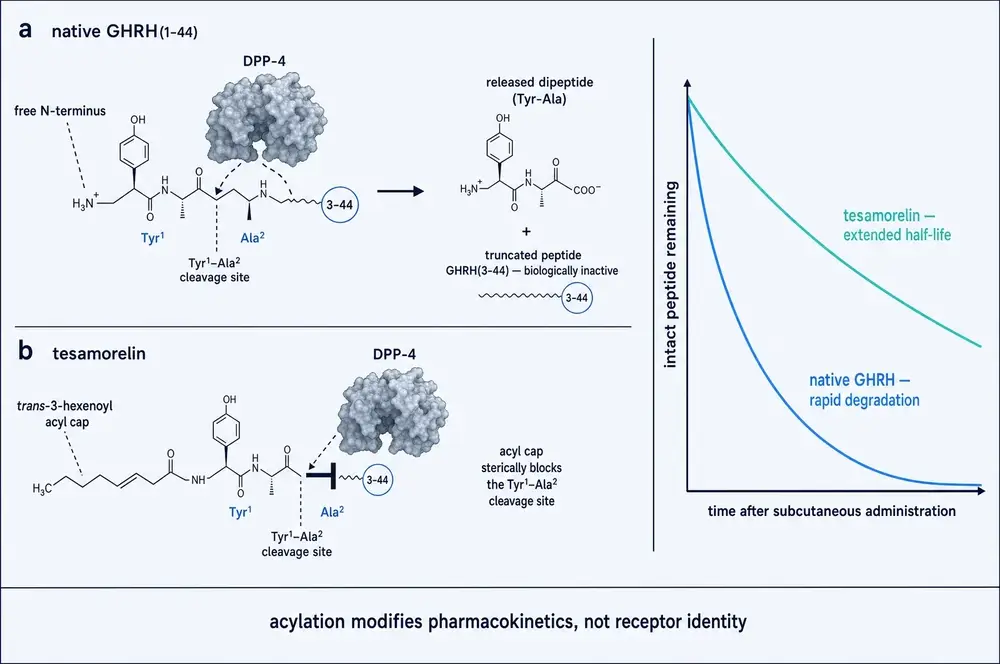
Native GHRH does not survive in blood. An enzyme called dipeptidyl peptidase-4 (DPP-4) circulates in plasma and clips two amino acids off the peptide's amino terminus. Those two residues are precisely the ones the receptor needs. The hormone is not merely diluted or excreted; it is disarmed, in minutes (Bedimo et al., 2011).
This is not a flaw. It is the design. A signal that governs a pulsatile rhythm must be extinguishable between pulses, or there is no rhythm. The hypothalamus releases GHRH in bursts into a private circulation running directly to the pituitary, a few centimetres away; the peptide does its work and is destroyed before it can do anything else. Rapid degradation is what makes GHRH a good hormone. It is also exactly what makes it useless as an injected drug.
Any attempt to turn GHRH into a medicine therefore has to solve one problem: keep the molecule intact long enough to reach the pituitary from a subcutaneous injection, without destroying the receptor binding that the intact amino terminus provides.
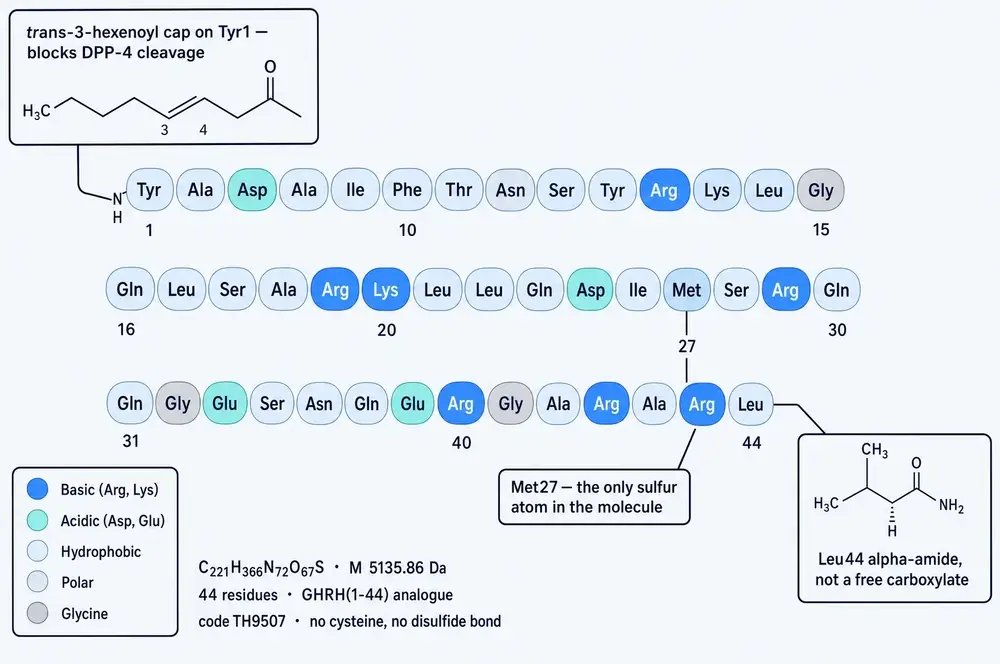
That is what tesamorelin is. The compound, originally designated TH9507 and developed by Theratechnologies in Quebec, is the 44-amino-acid sequence of human GHRH carrying a trans-3-hexenoyl group on the tyrosine at the amino terminus (Bedimo et al., 2011; Baker et al., 2012). The hydrophobic tail gets in the enzyme's way. In preclinical work the modified peptide resisted DPP-4 degradation and raised plasma growth hormone and IGF-1 with once-daily dosing — an animal finding, and the basis on which human trials were justified rather than a human result in itself.
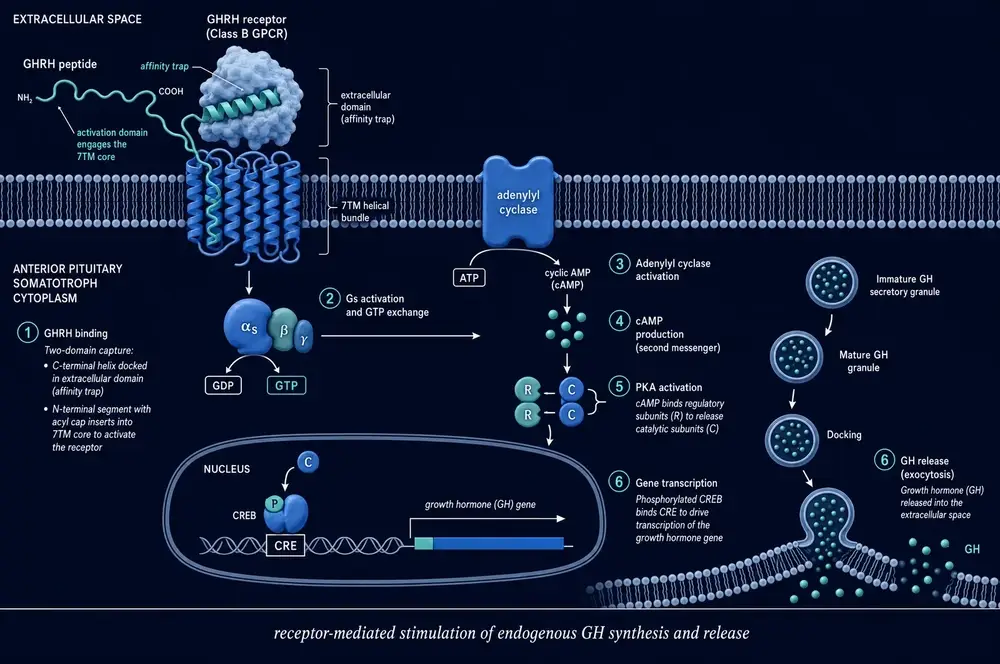
The receptor end is untouched, which is the entire point. Tesamorelin binds the same pituitary GHRH receptor as the natural hormone, activating adenylyl cyclase and raising cyclic AMP in the somatotroph cells that store growth hormone (Stewart et al., 2026). Downstream, growth hormone drives the liver and other tissues to produce insulin-like growth factor 1 (IGF-1), and IGF-1 feeds back to restrain further growth hormone release. The loop stays closed.
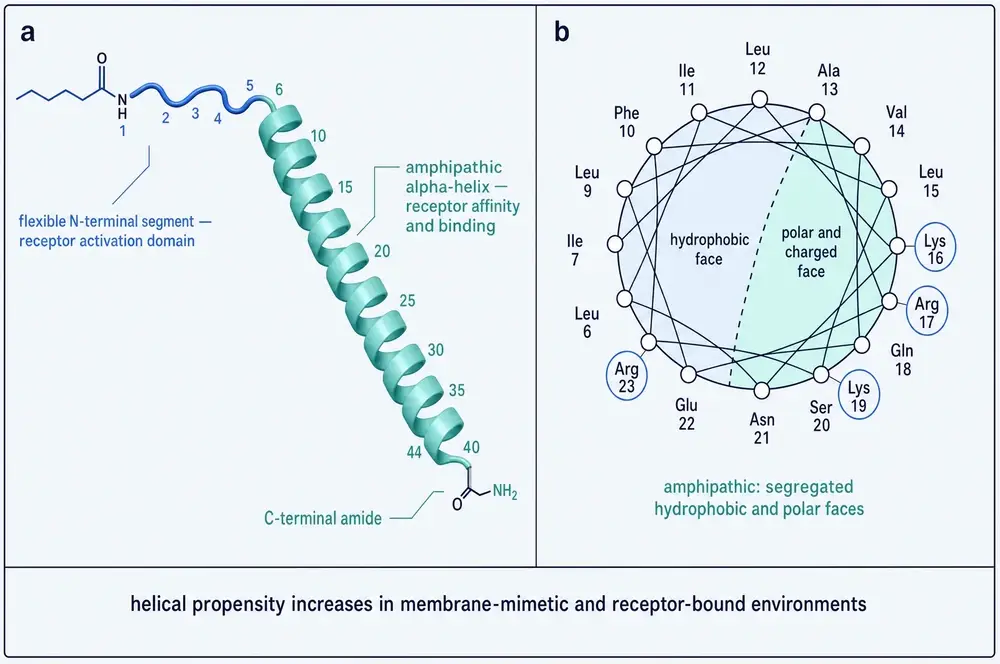
How that binding works is worth a moment, because it explains why the cap can be added at one end without costing activity. The peptide is not a rigid key. Everything from about residue 6 onward folds into an amphipathic helix — one face hydrophobic, the opposite face carrying the charged lysines and arginines — and that helix is what supplies affinity, docking into the receptor's extracellular domain. The N-terminal segment stays flexible and does something different: it inserts into the receptor's transmembrane core and switches it on. Affinity and activation are handled by different parts of the same molecule.
04The bodies that antiretrovirals rebuilt
When GHRH was isolated in 1982, the disease tesamorelin would eventually be approved to treat had not been described. HIV had barely been identified. The drugs that would cause the condition would not exist for another decade.
Protease inhibitors entered combination antiretroviral therapy in the mid-1990s and produced one of the sharpest mortality reversals in the history of medicine. Then, within a few years, clinicians began reporting something unexpected in patients who were otherwise doing well: their bodies were changing shape. Fat vanished from the face, arms, legs and buttocks. Fat accumulated in the abdomen, and sometimes in a pad at the back of the neck. The cluster was named the lipodystrophy syndrome (Bedimo et al., 2011).
Two features of the syndrome matter for what follows. First, the wasting and the accumulation turned out to be separate phenomena, not two ends of a single redistribution — they occur independently, arise from different mechanisms, and were associated with different drug classes. The peripheral fat loss tracked most closely with nucleoside reverse-transcriptase inhibitors and their toxicity to mitochondria; the central accumulation tracked with protease inhibitors and their interference with the transcription factors that let fat cells mature. Second, nobody could agree how to measure it. Reported prevalence ranged from 8% to 84% depending on who was counting and how, and a proposed 2003 case definition never caught on because it required computed tomography and DXA scanning to apply.
The consequences were not cosmetic in any trivial sense. Visible body changes were stigmatising and distressing, and that distress fed back into whether people kept taking the drugs keeping them alive. Meanwhile visceral adipose tissue — the fat packed around the abdominal organs, as opposed to the subcutaneous fat under the skin — is an independent predictor of cardiovascular illness and death in the general population. A syndrome that piled fat specifically into that compartment was not merely a matter of appearance.
Everything tried against it worked badly. Switching antiretroviral drugs gave inconsistent results and mostly failed to shift abdominal fat. Insulin sensitisers such as metformin and rosiglitazone produced conflicting effects, and metformin tended to strip subcutaneous and peripheral fat along with the visceral kind — the opposite of what these patients needed. Surgery and liposuction could remove a dorsocervical fat pad, but it often came back. Dermal fillers addressed facial wasting without touching the underlying process. Diet and exercise produced modest, real, but limited reductions (Bedimo et al., 2011).
05The clue in the growth hormone axis
Then came an observation that reframed the problem. Men with HIV and body fat changes had blunted growth hormone secretion compared with men without those changes and with healthy controls — lower mean levels, lower baseline concentrations, and smaller pulse amplitude. When given a GHRH stimulation test, nearly half of lipodystrophic patients failed to mount an adequate growth hormone response by the standard threshold. In a separate group of antiretroviral-experienced men with body-fat changes, roughly one in five met criteria for functional growth hormone deficiency on GHRH–arginine testing (Bedimo et al., 2011).
This was suggestive in both directions. Growth hormone is lipolytic: it drives the breakdown of stored fat, with a known preference for visceral depots, and it does so partly by activating hormone-sensitive lipase. Excess abdominal fat also suppresses growth hormone secretion. Cause and consequence were tangled together. But the therapeutic implication was clear enough to act on. If these patients had a deficient growth hormone axis and a fat distribution that growth hormone is known to act on, then restoring the axis was worth trying.
06Why not just give growth hormone?
It was tried first, and the way it failed is the reason tesamorelin exists.
Recombinant human growth hormone at supraphysiological doses — 2 to 4 mg daily for twelve weeks in the trials of that era — did reduce visceral fat and improve lipid measures in people with HIV and abdominal fat accumulation. It also produced a consistent set of adverse effects: peripheral oedema, joint pain, and rising blood glucose. In one placebo-controlled trial of 245 patients, daily 4 mg dosing cut visceral adipose tissue by 8.6% from baseline; the price was the growth-hormone side-effect profile. A second trial in 325 subjects reproduced both halves of the result (Bedimo et al., 2011).
The explanation offered at the time, and still the standard one, is that injecting growth hormone directly produces sustained high concentrations rather than the sharp peaks and deep troughs of natural secretion. The body's tissues are tuned to a rhythm. Flood them with a continuous signal and you get the metabolic effects you wanted along with the fluid retention and insulin resistance you did not. Longer, gentler dosing helped: eighteen months of low-dose growth hormone titrated to keep IGF-1 in the upper physiological range reduced visceral fat and triglycerides with a better safety profile — but it also raised two-hour glucose on tolerance testing, and, notably, it did not change carotid intima-media thickness. Reducing the fat did not visibly reduce the arterial disease.
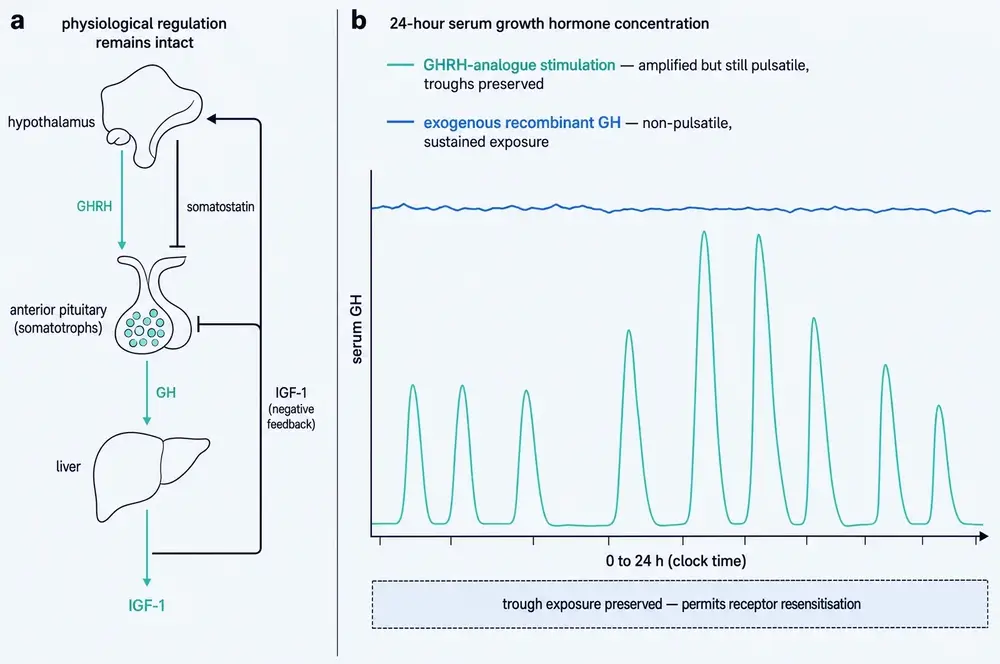
The proof of concept came from unmodified GHRH itself. In a randomised placebo-controlled trial, men with HIV and increased abdominal girth received 1 mg of GHRH subcutaneously twice daily for twelve weeks. IGF-1 rose sharply (+104 versus +6 ng/mL, P=0.004). Lean body mass increased (+0.9 versus −0.3 kg, P=0.04). Visceral adipose tissue fell by 19.2 cm² against a 2.3 cm² gain on placebo — a substantial-looking difference that did not reach statistical significance (P=0.07) in a trial of that size (Bedimo et al., 2011).
Twice-daily injections of a peptide with a half-life measured in minutes, producing a result that just missed significance, is not a drug. It is an argument for building one.
07The pivotal programme
A dose-ranging study came first: 61 patients randomised to 1 mg or 2 mg of tesamorelin or placebo for twelve weeks. The 2 mg arm produced greater IGF-1 increases and greater declines in visceral fat, triglycerides and the cholesterol-to-HDL ratio, with no increase in glucose. That set the dose carried into the pivotal trials (Bedimo et al., 2011).
Two phase 3 trials followed, of near-identical design and substantial size. Patients with HIV on stable antiretroviral therapy, with waist circumference and waist-to-hip ratio above defined thresholds, were randomised 2:1 to 2 mg of tesamorelin daily by subcutaneous injection or matching placebo. The primary phase ran 26 weeks with percentage change in visceral adipose tissue by CT as the primary endpoint; a 26-week extension followed to assess longer-term safety, with re-randomisation. The first trial enrolled 412 patients, 86% of them men (Falutz et al., 2007). The second enrolled 404, 84% men (Falutz et al., 2010a).
Both hit their primary endpoint, and they did not agree about how much.
In the first trial, visceral adipose tissue fell 27.8 cm² against a 5.1 cm² gain on placebo, a relative difference of −20.2% (P<0.001). In the second, it fell 21 cm² against 1 cm² on placebo, a relative difference of −10.3% (P<0.001). Pooled across both, the net reduction was 15.4% relative to placebo over 26 weeks (Falutz et al., 2010b). The gap between −20.2% and −10.3% is not trivial, and it is worth registering rather than averaging away: a subgroup analysis in the FDA briefing documents found the effect was similar for women across the two studies but differed for men, with larger reductions in the first.
Three features of the result are more informative than the headline number.
The effect was visceral-selective. Waist reduction came almost entirely from the visceral compartment; abdominal subcutaneous fat did not significantly change. This is the opposite of the metformin problem, and it is the strongest evidence that the drug was doing something specific rather than causing general weight loss. Body weight and BMI largely did not move.
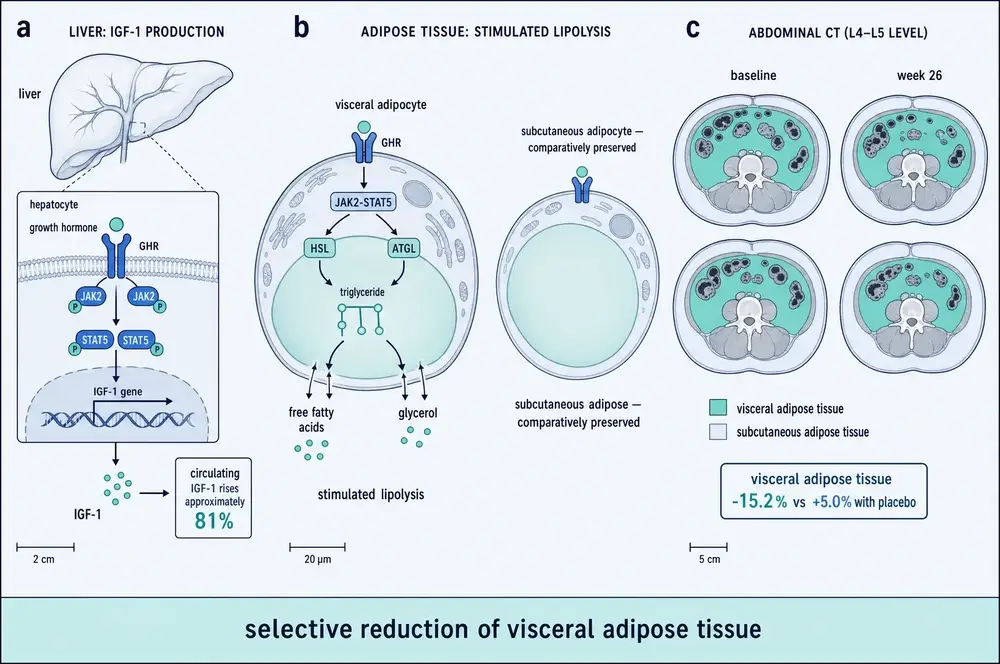
The lipid results were inconsistent. Triglycerides fell in both trials, but significantly only in the first (−59 mg/dL relative to placebo, P<0.001; versus −26 mg/dL, P=0.10 in the second). The same split appeared for the total-cholesterol-to-HDL ratio. Only in the pooled analysis did both reach significance (triglycerides −37 versus +6 mg/dL; ratio −0.18 versus +0.18, both P<0.001). Pooling two trials to rescue a secondary endpoint that one of them failed is a legitimate thing to do and a reason for caution about that endpoint.
The IGF-1 response was reproducible where the fat response was not: +109 and +106 ng/mL in the two trials. The pharmacology was consistent; the clinical effect it produced was more variable. Roughly 70% of treated patients met the prespecified 8% visceral-fat-reduction threshold that was later used to define a "responder" (Adrian et al., 2019). The other 30% took the drug and did not get that result.
08The catch that defines the compound
In the extension phase, patients who had received tesamorelin were re-randomised: some continued, some switched to placebo. Those who continued held their visceral fat reduction and extended it. Those switched to placebo re-accumulated visceral fat back toward baseline (Bedimo et al., 2011). The lipid improvements followed the same pattern — maintained only in those still taking the drug.
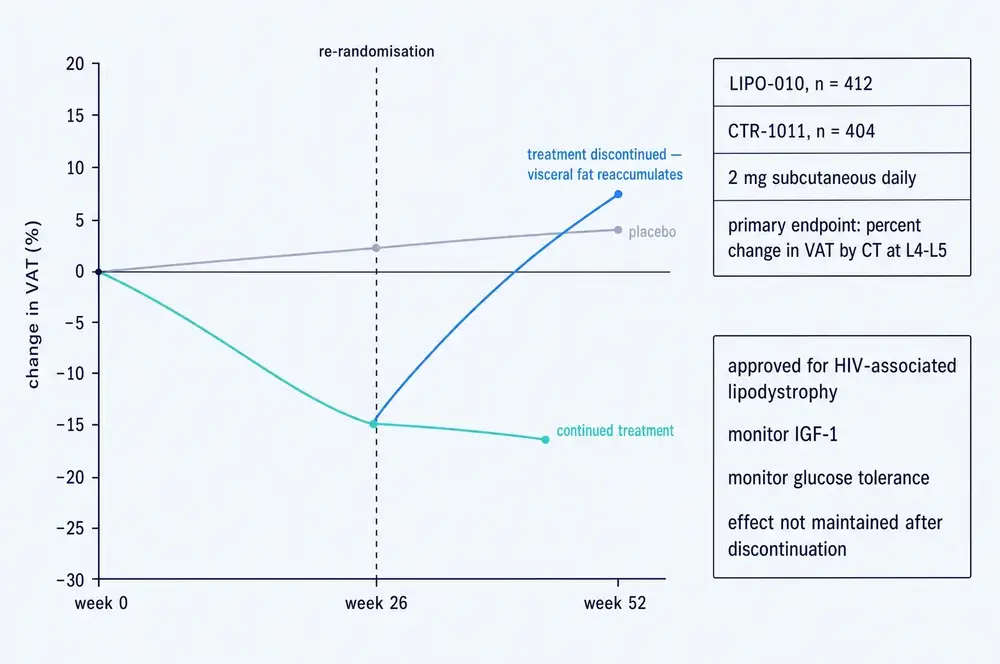
The mechanism of the reversal is not mysterious. IGF-1 concentrations in patients kept on tesamorelin stayed at the level reached by week 26; in those switched to placebo they returned to baseline. Remove the stimulus and the axis returns to where it was, and so does the fat.
This is the single most consequential fact about tesamorelin, and it reframes every other result in this document. The drug does not correct anything. It maintains a state for as long as it is administered. A 26-week efficacy question therefore becomes an indefinite safety question, because chronic stimulation of the growth hormone axis is the actual exposure, not six months of it.
09Approval, and the shape of the label
The United States Food and Drug Administration approved tesamorelin as Egrifta in November 2010, for the reduction of excess abdominal fat in HIV-infected patients with lipodystrophy (Adrian et al., 2019). The indication is narrow, and worth reading closely for what it does not say. It is a body-composition indication. It does not claim reduced cardiovascular risk, reduced mortality, improved physical function, or improved quality of life. It claims that the drug reduces a measurable fat compartment in a defined population.
Reformulations followed. The most recent, Egrifta WR, was approved in March 2025, offering weekly reconstitution for daily administration and a smaller injection volume — convenience changes built on the existing efficacy and safety platform rather than new clinical claims (Dominikowski et al., 2026). Tesamorelin remains the only GHRH analogue with active FDA approval.
Approval is usually the end of a compound's interesting period. For tesamorelin it was the beginning. The drug was licensed to shrink a fat depot; the decade that followed asked what shrinking that depot actually does, and the most durable answer turned out to be about the liver.
10The liver
Non-alcoholic fatty liver disease — excess triglyceride stored in liver cells, now more often called metabolic dysfunction-associated steatotic liver disease — is common in people with HIV and behaves worse there than in the general population, with more steatohepatitis and faster fibrosis progression (Gattu et al., 2025). It is also, unlike lipodystrophy, a condition with a hard clinical endpoint at the end of it: fibrosis stage is the strongest predictor of mortality in fatty liver disease, and fibrosis leads to cirrhosis.
An early signal appeared in a randomised trial that measured both visceral and liver fat in people with HIV and abdominal fat accumulation (Stanley et al., 2014). The definitive test came five years later.
Sixty-one men and women with HIV and a hepatic fat fraction of at least 5% on magnetic resonance spectroscopy were randomised to tesamorelin 2 mg daily or identical placebo for twelve months at Massachusetts General Hospital and the National Institutes of Health. Liver biopsies were taken before and after. A subset underwent euglycaemic hyperinsulinaemic clamp studies, the reference method for measuring insulin sensitivity (Stanley et al., 2019).
Liver fat fell by 37% relative to baseline against placebo (absolute effect −4.1%, 95% CI −7.6 to −0.7, P=0.02). Thirty-five percent of tesamorelin-treated participants dropped below the 5% threshold that defines steatosis, against 4% on placebo (P=0.007).
The result that mattered more was the one nobody had a right to expect from a fat-reduction drug. Fibrosis progressed in 10.5% of tesamorelin-treated participants and 37.5% of those on placebo (P=0.04). The placebo figure is itself a finding: more than a third of this population's livers got measurably worse over a single year, which is a rate of progression that makes the case for treating them at all.
Three honest qualifications belong in the same breath. Tesamorelin did not improve fibrosis that already existed — it slowed the arrival of more. The trial was not designed as a steatohepatitis trial, and the composite histological activity score did not significantly change overall. And the paired-biopsy sample was 43 people, which is small for a histological endpoint. What the trial establishes is that a strategy aimed at liver fat also affected the trajectory of liver scarring; it does not establish how large that effect is.
Secondary findings pointed the same way. In participants whose ALT was elevated at baseline, it fell by 29 U/L relative to placebo (P=0.03). C-reactive protein, a general marker of inflammation, fell by 4.7 mg/L (P=0.04). Glucose control did not deteriorate over the year, either by fasting measures or by clamp — a meaningful null result given the growth hormone axis's reputation.
11Reading the liver's transcriptome
Because the trial took liver biopsies before and after, it left behind something rare: paired tissue from a randomised, placebo-controlled human experiment. The investigators sequenced the RNA from those samples and asked which biological programmes had changed (Fourman et al., 2020).
The method, gene set enrichment analysis, does not look at genes one at a time. It takes predefined sets of genes that represent a coherent biological process — oxidative phosphorylation, say, or inflammatory response — and asks whether the members of that set moved together in one direction. The output, a normalised enrichment score, is positive when a programme was turned up and negative when it was turned down. Fourteen programmes separated the two treatment groups at a false-discovery threshold of 5%.
Oxidative phosphorylation — the mitochondrial machinery that burns fat for energy — was the strongest upward signal (NES 1.94, q=0.0005). The genes driving it encoded subunits of all five complexes of the electron transport chain, plus enzymes of fatty acid beta-oxidation and the tricarboxylic acid cycle. Mitochondrial dysfunction is one of the accepted mechanisms by which fatty liver progresses to inflammation and scarring, so a therapy that turns the mitochondria back up is acting on a plausible root rather than a symptom.
Thirteen programmes went down, and they cluster into three themes. Inflammation: TNF-alpha signalling through NF-kappa-B, IL-6 through JAK/STAT3, and the general inflammatory response. Tissue repair: TGF-beta signalling — the single most important fibrogenic pathway in the liver — along with apoptosis and epithelial-mesenchymal transition. Cell division: the G2M checkpoint, E2F targets, mitotic spindle machinery.
Read together, that is a coherent picture of a liver doing less emergency repair. And the changes correlated with a gene-expression score for fibrosis: the more a participant's oxidative phosphorylation genes went up and inflammatory and repair genes went down, the more their fibrosis signature improved. The transcriptomic story and the histological story pointed the same way, which is the strongest form of internal corroboration this kind of trial can produce.
One further result deserves attention because it addresses the field's main theoretical fear. Chronic elevation of growth hormone and IGF-1 is a plausible cancer risk in principle, since both are growth signals. The investigators tested curated gene sets prognostic of hepatocellular carcinoma. Genes associated with favourable prognosis went up (NES 1.87, q=0.0003); a hepatic stellate cell signature associated with poor prognosis went down (NES −1.63), as did the YAP/TAZ pathway implicated in fibrosis and carcinogenesis. This runs counter to the theoretical concern rather than confirming it. It is gene expression in 39 people over one year, not cancer incidence, and it should be weighted accordingly — but it is the only direct human tissue evidence on the question that this corpus contains.
12Muscle
The phase 3 trials had produced hundreds of abdominal CT scans for the purpose of measuring fat. Those same scans contain muscle. A later analysis went back and measured it (Adrian et al., 2019).
Restricted to the visceral-fat responders (n=193) versus placebo (n=148), tesamorelin was associated with increased density in all four trunk muscle groups examined, with coefficients from 1.56 to 4.86 Hounsfield units (all P<0.005). Muscle density on CT is a proxy for how much fat is infiltrating the muscle: higher density means leaner muscle, and it correlates with intramuscular lipid measured directly by biopsy. Lean muscle area rose in all four groups as well.
The genuinely interesting result is a dissociation. When the analysts adjusted for change in visceral fat, the density effects largely disappeared; adjusting for change in IGF-1 barely touched them. For muscle area, the reverse held: adjusting for IGF-1 explained most of the effect, adjusting for visceral fat did not. Two different mechanisms appear to be operating — the fat leaving the muscle travels with the fat leaving the abdomen, while the muscle growing travels with the hormone. That is a more specific mechanistic claim than "growth hormone builds muscle," and it came from reanalysing scans collected for another purpose.
The limitation is severe and the authors state it plainly: the phase 3 trials collected no objective or subjective measure of muscle function. Nobody tested whether any participant could stand up faster, walk further or lift more. Denser muscle on a CT scan is a reasonable proxy for better muscle, and proxies of exactly this kind have misled the field before.
13Cognition: the strongest positive and the strongest null
Growth hormone and IGF-1 fall with age. IGF-1 crosses the blood-brain barrier, binds receptors densely distributed in the hippocampus and cortex, and has neurotrophic effects in animal models. Lower levels track with poorer executive function in cross-sectional human studies. That reasoning motivated a serious clinical trial.
At the University of Washington, 152 adults aged 55 to 87 — 66 of them with amnestic mild cognitive impairment, the rest cognitively healthy — were randomised to tesamorelin 1 mg daily or placebo, injected thirty minutes before bedtime, for twenty weeks. Cognitive testing used parallel versions of a battery covering executive function, verbal memory and visual memory (Baker et al., 2012).
The intention-to-treat analysis found a favourable effect on cognition (P=.03); the completer analysis was stronger (P=.002). Breaking it down, executive function improved with a medium effect size (f=0.37, P=.005) and verbal memory showed a trend (P=.08). Visual memory did not move. The benefit was comparable in the cognitively impaired and the healthy participants, with no interaction between treatment and diagnosis. IGF-1 rose 117% and stayed within the physiological range; body fat fell 7.4%; lean mass rose 3.7%.
Two details in that trial are more informative than the headline. First, when the models were adjusted for IGF-1, the cognitive effect vanished — implicating IGF-1 as the mediator rather than any direct central action of the peptide. Second, the changes in body composition did not correlate with the cognitive change, so this was not simply a matter of healthier bodies producing sharper minds. The authors were careful about what they had: improvement on individual tests was around a quarter of a standard deviation, functional status was never measured, and the clinical meaning was therefore unclear. Adverse events were reported by 68% of treated participants versus 36% on placebo.
Fourteen years later, a second trial reported almost nothing.
A pilot study at the University of Texas Medical Branch randomised 22 completers aged 55 to 85 to ten weeks of tesamorelin 1 mg or placebo, with cognitive testing, MRI morphometry and resting-state functional connectivity (Stewart et al., 2026). Nothing reached significance. Not IGF-1 (p=0.499). Not body composition, glucose tolerance, fatigue, sleep, or six-minute walk distance. Not the ADAS-cog total score. Only delayed word recall showed a trend (p=0.051). Applying machine-learning models to 159 predictor variables surfaced right anterior cingulate connectivity and left superior fronto-occipital fasciculus integrity as discriminating between groups, with a random-forest area under the curve of 0.81.
Supporting mechanistic work exists in both directions. GHRH administration raised cortical GABA levels in people with mild cognitive impairment (Friedman et al., 2013), and declining GABA tracks with worsening executive function — a plausible route by which the peptide could act on the brain. In mice, a GHRH agonist reduced amyloid-beta deposition, tau phosphorylation and inflammatory cytokine expression without changing systemic growth hormone or IGF-1, which would imply a direct central mechanism. That last finding is an animal result, and it has not been demonstrated in humans.
A randomised trial of tesamorelin for neurocognitive impairment in people with HIV and abdominal obesity was published in 2025 but has no open-access full text in this corpus; its result is not incorporated here.
14Frailty, and the trial now running
People with HIV now approach normal life expectancy but lose healthy years earlier, with faster declines in muscle mass and physical function and accelerated progression to frailty. Exercise remains the most effective intervention, but in a previous six-month supervised programme, participants with HIV gained less lean mass and less mitochondrial function than participants without HIV, and their activity dropped off faster afterwards (Erlandson et al., 2026).
TRIUMPH is testing whether tesamorelin can augment what exercise achieves. The trial randomises 100 sedentary adults aged 50 to 80 with HIV, at least one frailty criterion, and excess abdominal adiposity, to Egrifta WR 1.28 mg daily or placebo alongside a 24-week home-based semi-supervised exercise programme, followed by a 24-week extension in which participants exercise independently off drug. The primary endpoint is percent change in the time to complete ten repeated chair stands. Muscle biopsies at baseline and week 24 will measure mitochondrial content and respiratory chain enzyme activity.
Two things make this trial worth watching. It measures function directly — the thing the phase 3 programme never did — and the extension phase tests whether anything persists after the drug stops, which is the question tesamorelin's reversibility makes urgent. The investigators also name the design's central limitation themselves: because both interventions are given concurrently, the trial cannot separate the contribution of tesamorelin from the contribution of exercise.
Recruitment began on 10 July 2025 at Massachusetts General Hospital and the University of Colorado Anschutz Medical Campus, funded by the National Institute on Aging, with completion estimated for 1 December 2028. Nothing has been reported. It is listed here because it is the most substantial open question about the compound, not because it supports any claim.
15Safety, at the same volume as efficacy
Across the randomised trials tesamorelin was generally well tolerated, with predominantly mild-to-moderate adverse effects (Dominikowski et al., 2026). Injection-site complaints were the most common difference from placebo. That summary is accurate and incomplete, and the incomplete part is where the useful information is.
Glucose. An FDA briefing document for the original application reported a statistically significant excess of treatment-emergent diabetes in the tesamorelin arm, with odds ratios of 3.4 (95% CI 1.3–11.5) or 3.6 (1.5–12.0) depending on whether patients with diabetes at baseline were excluded (Bedimo et al., 2011). Those confidence intervals are wide, which reflects small numbers of events, but the lower bound sits above 1 in both formulations. Set against this, the twelve-month liver trial found no deterioration in fasting glucose, HbA1c, or clamp-measured insulin sensitivity, and earlier work suggests a modest worsening of insulin resistance in the first weeks that returns to baseline with continued treatment. In pooled phase 3 data, greater visceral fat reduction was associated with lower HbA1c — the fat loss and the hormonal effect may pull in opposite directions on glucose, with the net result depending on how much fat a given person loses. A twelve-week randomised trial in 53 people with type 2 diabetes found no significant deterioration in insulin dynamics or glycaemic control (Clemmons et al., 2017).
IGF-1. Treated patients were more likely than placebo recipients to have IGF-1 above the upper limit of normal (Bedimo et al., 2011). This matters because the entire safety argument for a GHRH analogue over growth hormone rests on feedback keeping IGF-1 within physiological bounds. Mostly it does; sometimes it does not. Every serious trial since has monitored IGF-1 Z-scores with prespecified thresholds triggering dose reduction — a Z-score above 3 in the liver trial, above 2.5 in TRIUMPH — which is an implicit acknowledgement that the loop is not self-limiting enough to leave unwatched.
Fluid retention. Peripheral oedema, paraesthesias and joint or muscle pain are documented in the peer-reviewed human literature for tesamorelin specifically (Dominikowski et al., 2026). These are the classic growth-hormone effects, present in attenuated form.
Carpal tunnel syndrome. The newest safety finding in this corpus comes from a 2025 pharmacovigilance analysis of nearly 13 million adverse-event reports. Tesamorelin emerged among ten drugs significantly over-reported for carpal tunnel syndrome, with a reporting odds ratio of 20.7 (95% CI 13.7–31.3), based on 23 of 2,130 tesamorelin reports (Mihalache et al., 2025). The proposed mechanism is exactly what the fluid-retention profile predicts: growth hormone and IGF-1 driving soft-tissue swelling, extracellular matrix production, and sodium and water retention, narrowing a canal in the wrist that has no room to give. Disproportionality analysis of spontaneous reports cannot establish causation or incidence — reporting is voluntary and biased — but a signal of that magnitude with a coherent mechanism is not nothing.
Malignancy. Theoretical concerns about chronic growth hormone axis stimulation include pituitary hyperplasia and benign pituitary adenoma (Bedimo et al., 2011). Against the theory sits the hepatic transcriptomic evidence described above, which moved cancer-prognostic gene signatures in the favourable direction. Neither settles the question; long-term malignancy outcomes in chronically treated patients are not available in this corpus.
The largest gap is not an adverse effect at all. Visceral adipose tissue independently predicts cardiovascular illness and death, and that is the justification for reducing it. Whether reducing it with this drug reduces those events has never been investigated. Sixteen years after approval, the outcome that motivates the indication remains unmeasured. The one adjacent data point is discouraging by analogy: eighteen months of growth hormone in this population reduced visceral fat and left carotid intima-media thickness unchanged.
16Where tesamorelin sits among the peptides it is sold beside
Tesamorelin is now discussed in a context its developers did not design for. It appears in online protocols and clinic menus alongside a long list of peptides marketed as research compounds that modulate the same axis: sermorelin, CJC-1295 with and without a drug affinity complex, GHRP-2, GHRP-6, hexarelin, ipamorelin, AOD9604, PEG-MGF, IGF-1 LR3.
A 2026 narrative review assessed that whole class and assigned each compound to an evidentiary tier (Dominikowski et al., 2026). The result is the single most useful orientation device in this literature.
Tesamorelin occupies tier A by itself. At the far end, CJC-1295 without DAC, PEG-MGF and IGF-1 LR3 sit in tier D, defined by the complete absence of peer-reviewed human studies — supported, in the reviewers' phrasing, only by preclinical extrapolation and grey-literature user narratives. Most of the rest fall in tier B: real phase I or II human data, none of it addressing the endpoints people actually take these compounds for.
Two consequences follow, and the reviewing authors draw both explicitly.
First, mechanistic plausibility is not clinical evidence, and the fact that several of these compounds act on the same receptor as tesamorelin does not transfer any of tesamorelin's evidence to them. Second — and this cuts the other way, against the compound rather than for it — tesamorelin's own trial data should not be extrapolated to hypertrophy or athletic indications. Everything in Parts Three and Four of this monograph was measured in people with HIV and excess visceral fat, or in older adults with cognitive concerns. None of it was measured in healthy people seeking body composition changes, and the review notes that claims about recovery, anti-inflammatory action and tissue healing circulating in fitness discourse extend beyond any trial endpoint.
Tesamorelin is also a controlled substance in sport. It appears on the World Anti-Doping Agency's prohibited list and is a target analyte in doping-control assays, detectable in both urine and blood by liquid chromatography coupled to high-resolution mass spectrometry (Thomas et al., 2022).
One genuinely new direction is worth noting because it is a trial rather than a claim: a phase 2 randomised study is recruiting to test tesamorelin as an adjunct to surgical repair after upper-extremity peripheral nerve injury, with functional motor and sensory outcomes over twelve months. Results are not available (Dominikowski et al., 2026).
17The collision with the GLP-1 era
A drug approved in 2010 for a complication of HIV therapy re-entered the mainstream conversation in 2026 for an unrelated reason.
Weight loss costs lean mass. This is true of caloric restriction, true of bariatric surgery, and true of incretin drugs. The rough heuristic is the "quarter rule": about a quarter of the total weight lost by any method is fat-free mass. In the SURMOUNT-1 trial, tirzepatide produced 20.9% total weight loss, of which 24% was fat-free mass. In STEP-1, semaglutide produced 14.9% weight loss, of which 39% was fat-free mass (Arora et al., 2026).
Because the number of people losing large amounts of weight pharmacologically has increased enormously, and because the populations doing so skew older and more metabolically compromised, preserving lean mass has become a live commercial and clinical problem. A field of candidate agents has appeared: bimagrumab and other antibodies against the myostatin/activin pathway, the selective androgen receptor modulator enobosarm, the myostatin-directed biologic apitegromab. Reported results are striking — bimagrumab combined with semaglutide produced 92.8% of weight loss as fat versus 71.8% for semaglutide alone; apitegromab added 1.9 kg of lean body mass over tirzepatide alone.
Tesamorelin appears on that candidate list (Arora et al., 2026). The rationale is legible: it raises IGF-1, which activates PI3K–Akt–mTOR anabolic signalling in muscle, and it has documented effects of increasing abdominal muscle density and area while decreasing intramuscular and visceral fat.
18What one acyl group bought
Return to the pancreatic tumours. A hormone that the hypothalamus makes in quantities too small to isolate was recovered from the tissue of patients whose disease consisted of making too much of it. Two laboratories a few hundred metres apart published the answer in the same season of 1982. Within two years the same peptide had been pulled from the hypothalami of four species, and antibody blockade had shown it to be the metronome of growth hormone release.
Then the molecule sat, undruggable, because the property that makes it work as a hormone — destruction within minutes — makes it useless as an injection. The fix, when it came, was one acyl group on one end, positioned to block one enzyme. Everything else about the molecule was left alone.
What that bought was real and specific. In two large randomised trials in a population that had few options, tesamorelin reduced a fat compartment that nothing else would touch, without stripping the subcutaneous fat these patients had already lost too much of. It did so while preserving the pulses and the feedback that made direct growth hormone unpleasant to take. It earned a regulatory approval that, sixteen years later, no other GHRH analogue has matched.
And the most durable finding turned out not to be the one on the label. A drug licensed to reshape an abdomen was later shown, in a twelve-month randomised trial with paired liver biopsies, to reduce liver fat by 37% and to cut the rate of fibrosis progression from 37.5% to 10.5%. When the same tissue was sequenced, the pattern was coherent all the way down: mitochondrial energy production up, inflammation and fibrogenic signalling and cell division down, cancer-prognostic signatures moving in the favourable direction. That is a stronger mechanistic account than most approved drugs can offer for their primary indication, and tesamorelin produced it for something it is not approved to treat.
The honest ledger looks like this.
What tesamorelin finally demonstrates is narrower and more interesting than either its promoters or its detractors tend to allow. It is proof that acting upstream on a hormonal axis can produce a real, reproducible, tissue-specific effect with a tolerable safety profile — and simultaneous proof of how little that guarantees. Sixteen years after approval, the compound has an excellent mechanistic account of what it does to a liver, a serviceable one of what it does to fat, and no answer at all to the question that justified making it: whether any of this makes people live longer or better.
The hormone was found because a disease made too much of it. The drug was made because a cure caused a disease. The best evidence about it concerns an organ nobody was aiming at. That is not a tidy story, but it is an unusually honest one, and in a field where most compounds sold beside it have no human evidence at all, the mess is a mark of seriousness rather than the reverse.
19References
Generated from verified NCBI records rather than from recall. Author lists, journal names, volumes, pages and identifiers are taken from the PubMed record for each citation. An earlier draft of this list was written from memory and eleven of its identifiers pointed at unrelated papers; every entry below was re-derived from the harvest and checked against its title.
- Adrian S, Scherzinger A, Sanyal A, Lake JE, Falutz J, Dubé MP, et al.. The Growth Hormone Releasing Hormone Analogue, Tesamorelin, Decreases Muscle Fat and Increases Muscle Area in Adults with HIV. The Journal of frailty & aging. 2019;8(3):154-159.
PMID 31237318 · doi:10.14283/jfa.2018.45 · PMC6766405 - Arora G, Conde KR, Desouza CV. Pharmacologic Treatments for the Preservation of Lean Body Mass During Weight Loss. Journal of clinical medicine. 2026;15(2).
PMID 41598480 · doi:10.3390/jcm15020541 · PMC12842597 - Baker LD, Barsness SM, Borson S, Merriam GR, Friedman SD, Craft S, et al.. Effects of growth hormone–releasing hormone on cognitive function in adults with mild cognitive impairment and healthy older adults: results of a controlled trial. Archives of neurology. 2012;69(11):1420-9.
PMID 22869065 · doi:10.1001/archneurol.2012.1970 · PMC3764914 - Bedimo R. Growth hormone and tesamorelin in the management of HIV-associated lipodystrophy. HIV/AIDS (Auckland, N.Z.). 2011;3:69-79.
PMID 22096409 · doi:10.2147/HIV.S14561 · PMC3218714 - Braun LR, Feldpausch MN, Czerwonka N, Torriani M, Grinspoon SK, Stanley TL. Fibroblast growth factor 21 decreases after liver fat reduction via growth hormone augmentation. Growth hormone & IGF research : official journal of the Growth Hormone Research Society and the International IGF Research Society. 2017;37:1-6.
PMID 29031905 · doi:10.1016/j.ghir.2017.10.002 · PMC5705434 - Brazeau P, Ling N, Böhlen P, Esch F, Ying SY, Guillemin R. Growth hormone releasing factor, somatocrinin, releases pituitary growth hormone in vitro. Proc Natl Acad Sci U S A. 1982;79(24):7909-13.
PMID 6130528 · doi:10.1073/pnas.79.24.7909 · PMC347459 - Brazeau P, Böhlen P, Esch F, Ling N, Wehrenberg WB, Guillemin R. Growth hormone-releasing factor from ovine and caprine hypothalamus: isolation, sequence analysis and total synthesis. Biochem Biophys Res Commun. 1984;125(2):606-14.
PMID 6440561 · doi:10.1016/0006-291x(84)90582-5 - Böhlen P, Esch F, Brazeau P, Ling N, Guillemin R. Isolation and characterization of the porcine hypothalamic growth hormone releasing factor. Biochem Biophys Res Commun. 1983;116(2):726-34.
PMID 6418166 · doi:10.1016/0006-291x(83)90585-5 - Böhlen P, Wehrenberg WB, Esch F, Ling N, Brazeau P, Guillemin R. Rat hypothalamic growth hormone-releasing factor: isolation, sequence analysis and total synthesis. Biochem Biophys Res Commun. 1984;125(3):1005-12.
PMID 6440563 · doi:10.1016/0006-291x(84)91383-4 - Clemmons DR, Miller S, Mamputu JC. Safety and metabolic effects of tesamorelin, a growth hormone-releasing factor analogue, in patients with type 2 diabetes: A randomized, placebo-controlled trial. PloS one. 2017;12(6):e0179538.
PMID 28617838 · doi:10.1371/journal.pone.0179538 · PMC5472315 - Dominikowski A, Rękoś Z, Olejarz M, Szczepanek-Parulska E, Domin R, RuchaŁa M. The emerging landscape of performance-enhancing peptides modulating GH-IGF1 axis: bridging the gap between clinical evidence and patient self-administration. Frontiers in endocrinology. 2026;17:1822475.
PMID 42395176 · doi:10.3389/fendo.2026.1822475 · PMC13322892 - Erlandson KM, Gustafson L, Johnson JE, Kulik GL, Khuu V, Chahal N, et al.. Tesamorelin as an Adjunct to Exercise for Improving Physical Function in HIV (TRIUMPH): a clinical trial protocol. BMJ open. 2026;16(7):e120740.
PMID 42419889 · doi:10.1136/bmjopen-2026-120740 · PMC13347827 - Esch F, Böhlen P, Ling N, Brazeau P, Guillemin R. Isolation and characterization of the bovine hypothalamic growth hormone releasing factor. Biochem Biophys Res Commun. 1983;117(3):772-9.
PMID 6421287 · doi:10.1016/0006-291x(83)91664-9 - Falutz J, Allas S, Blot K, Potvin D, Kotler D, Somero M, et al.. Metabolic effects of a growth hormone-releasing factor in patients with HIV. The New England journal of medicine. 2007;357(23):2359-70.
PMID 18057338 · doi:10.1056/NEJMoa072375 - Falutz J, Potvin D, Mamputu JC, Assaad H, Zoltowska M, Michaud SE, et al.. Effects of tesamorelin, a growth hormone-releasing factor, in HIV-infected patients with abdominal fat accumulation: a randomized placebo-controlled trial with a safety extension. Journal of acquired immune deficiency syndromes (1999). 2010;53(3):311-22.
PMID 20101189 · doi:10.1097/QAI.0b013e3181cbdaff - Falutz J, Mamputu JC, Potvin D, Moyle G, Soulban G, Loughrey H, et al.. Effects of tesamorelin (TH9507), a growth hormone-releasing factor analog, in human immunodeficiency virus-infected patients with excess abdominal fat: a pooled analysis of two multicenter, double-blind placebo-controlled phase 3 trials with safety extension data. The Journal of clinical endocrinology and metabolism. 2010;95(9):4291-304.
PMID 20554713 · doi:10.1210/jc.2010-0490 - Fourman LT, Billingsley JM, Agyapong G, Ho Sui SJ, Feldpausch MN, Purdy J, et al.. Effects of tesamorelin on hepatic transcriptomic signatures in HIV-associated NAFLD. JCI insight. 2020;5(16).
PMID 32701508 · doi:10.1172/jci.insight.140134 · PMC7455119 - Friedman SD, Baker LD, Borson S, Jensen JE, Barsness SM, Craft S, et al.. Growth hormone-releasing hormone effects on brain γ-aminobutyric acid levels in mild cognitive impairment and healthy aging. JAMA neurology. 2013;70(7):883-90.
PMID 23689947 · doi:10.1001/jamaneurol.2013.1425 · PMC3764915 - Gattu AK, Fourman LT. Metabolic dysfunction-associated steatotic liver disease in people with HIV. Current opinion in HIV and AIDS. 2025;20(4):350-358.
PMID 40397552 · doi:10.1097/COH.0000000000000952 · PMC12314779 - Granata R, Leone S, Zhang X, Gesmundo I, Steenblock C, Cai R, et al.. Growth hormone-releasing hormone and its analogues in health and disease. Nat Rev Endocrinol. 2025;21(3):180-195.
PMID 39537825 · doi:10.1038/s41574-024-01052-1 - Guillemin R, Brazeau P, Böhlen P, Esch F, Ling N, Wehrenberg WB. Growth hormone-releasing factor from a human pancreatic tumor that caused acromegaly. Science. 1982;218(4572):585-7.
PMID 6812220 · doi:10.1126/science.6812220 - Lake JE, La K, Erlandson KM, Adrian S, Yenokyan G, Scherzinger A, et al.. Tesamorelin improves fat quality independent of changes in fat quantity. AIDS (London, England). 2021;35(9):1395-1402.
PMID 33756511 · doi:10.1097/QAD.0000000000002897 · PMC8243807 - Luben RA, Brazeau P, Böhlen P, Guillemin R. Monoclonal antibodies to hypothalamic growth hormone-releasing factor with picomoles of antigen. Science. 1982;218(4575):887-9.
PMID 6813967 · doi:10.1126/science.6813967 - Makimura H, Murphy CA, Feldpausch MN, Grinspoon SK. The effects of tesamorelin on phosphocreatine recovery in obese subjects with reduced GH. The Journal of clinical endocrinology and metabolism. 2014;99(1):338-43.
PMID 24178787 · doi:10.1210/jc.2013-3436 · PMC3879673 - Mihalache A, Volfson E, Huang R, Zuo K, Persitz J. Carpal Tunnel Syndrome Attributed to Medication Use: A Pharmacovigilance Study. Cureus. 2025;17(5):e83972.
PMID 40510111 · doi:10.7759/cureus.83972 · PMC12159276 - Muñoz-Moreno L, Gómez-Calcerrada MI, Arenas MI, Carmena MJ, Prieto JC, Schally AV, et al.. Antagonist of Growth Hormone-Releasing Hormone Receptor MIA-690 Suppresses the Growth of Androgen-Independent Prostate Cancers. Int J Mol Sci. 2024;25(20).
PMID 39456984 · doi:10.3390/ijms252011200 · PMC11508372 - Rivier J, Spiess J, Thorner M, Vale W. Characterization of a growth hormone-releasing factor from a human pancreatic islet tumour. Nature. 1982;300(5889):276-8.
PMID 6292724 · doi:10.1038/300276a0 - Spiess J, Rivier J, Thorner M, Vale W. Sequence analysis of a growth hormone releasing factor from a human pancreatic islet tumor. Biochemistry. 1982;21(24):6037-40.
PMID 6295453 · doi:10.1021/bi00267a002 - Stanley TL, Feldpausch MN, Oh J, Branch KL, Lee H, Torriani M, et al.. Effect of tesamorelin on visceral fat and liver fat in HIV-infected patients with abdominal fat accumulation: a randomized clinical trial. JAMA. 2014;312(4):380-9.
PMID 25038357 · doi:10.1001/jama.2014.8334 · PMC4363137 - Stanley TL, Fourman LT, Feldpausch MN, Purdy J, Zheng I, Pan CS, et al.. Effects of tesamorelin on non-alcoholic fatty liver disease in HIV: a randomised, double-blind, multicentre trial. The lancet. HIV. 2019;6(12):e821-e830.
PMID 31611038 · doi:10.1016/S2352-3018(19)30338-8 · PMC6981288 - Stanley TL, Fourman LT, Wong LP, Sadreyev R, Billingsley JM, Feldpausch MN, et al.. Growth Hormone Releasing Hormone Reduces Circulating Markers of Immune Activation in Parallel with Effects on Hepatic Immune Pathways in Individuals with HIV-infection and Nonalcoholic Fatty Liver Disease. Clinical infectious diseases : an official publication of the Infectious Diseases Society of America. 2021;73(4):621-630.
PMID 33852720 · doi:10.1093/cid/ciab019 · PMC8366828 - Stewart CE, French KP, Wright TJ, Wilhoit K, Randolph KM, Danesi CP, et al.. The effect of growth hormone-releasing hormone on cognition and brain connectivity in adults with cognition ranging from normal to mild cognitive impairment. eNeurologicalSci. 2026;44:100616.
PMID 42382101 · doi:10.1016/j.ensci.2026.100616 · PMC13316082 - Thomas A, Thilmany S, Hofmann A, Thevis M. Probing for peptidic drugs (2-10 kDa) in doping control blood samples. Analytical science advances. 2022;3(7-8):235-243.
PMID 38716080 · doi:10.1002/ansa.202200027 · PMC10989627 - Wehrenberg WB, Ling N, Brazeau P, Esch F, Böhlen P, Baird A, et al.. Somatocrinin, growth hormone releasing factor, stimulates secretion of growth hormone in anesthetized rats. Biochem Biophys Res Commun. 1982;109(2):382-7.
PMID 6817757 · doi:10.1016/0006-291x(82)91732-6 - Wehrenberg WB, Brazeau P, Luben R, Böhlen P, Guillemin R. Inhibition of the pulsatile secretion of growth hormone by monoclonal antibodies to the hypothalamic growth hormone releasing factor (GRF). Endocrinology. 1982;111(6):2147-8.
PMID 6128220 · doi:10.1210/endo-111-6-2147
20How this document was assembled
The corpus was built by a six-stage pipeline against project 05, the Therapeutic Peptide Research Library. Every file with a document extension in the project's document stores was opened and its extracted text searched for explicit mentions of tesamorelin, TH9507 or Egrifta; generic matches on GHRH or growth hormone-releasing hormone were recorded but never counted on their own. That sweep opened 45,807 files and returned 512 raw matches, which collapsed to 380 after de-duplication.
Classifying those by kind of source is the step that matters. Only 17 were peer-reviewed scientific full texts. The remainder were vendor catalogue material, consumer web content captured for style training, bulk acquisition files and internal working documents — none of which is evidence about the compound. Because the local snapshot was thin, the pipeline queried PubMed directly, retrieving 122 indexed records spanning 2003 to 2026 and fetching 49 open-access full texts from PubMed Central. Merging the local and fetched sets and removing the 11 documents present in both gives the reading corpus this monograph is written from: 55 unique scientific full texts, roughly 649 printed-page equivalents.
| Stage | What it does | Result |
|---|---|---|
| 01b | Targeted scan of the project's document stores | 45,807 files opened |
| 02 | PubMed E-utilities harvest, complete publication record | 122 records |
| 03 | PubMed Central open-access full-text retrieval | 49 full texts |
| 04 | De-duplication, classification, inventory report | 55 unique |
| 05 | Reference list generation from verified records | 35 citations |
| 06 | Assembly of this document | 1 deliverable |
A note on one recurring trap. A PubMed article record contains reference and comment lists that are themselves full of identifier nodes belonging to other papers. Parsing those without scoping each lookup to the article's own subtree silently assigns a bibliography entry's PMID and DOI to the article being read. Every lookup in stage 02 is scoped for this reason.
21Evidence handling
Findings in this document are labelled by the kind of study that produced them. Randomised human trials, single-arm human studies, animal experiments, cell and tissue measurements, spontaneous-report registries and narrative reviews are different kinds of claim, and the differences are stated in the sentence that reports the result rather than left to the reader. Animal and in-vitro findings are never phrased so as to imply a human outcome.
Where evidence conflicts, both sides are given. The 2012 cognition trial and the 2026 pilot that failed to replicate it are presented together, with the reasons the newer null result does not simply supersede the older positive one. Where a secondary endpoint reached significance only after pooling two trials, that is said. Where an effect reverses on withdrawal, it is said next to the effect rather than in a later section.
Continue exploring