
Glutathione The most abundant antioxidant in the human body, and the century-long argument about whether swallowing it does anything
Glutathione is the most abundant thiol in the human body, present inside cells at a concentration a thousand times higher than in the blood, and the molecule on which the disposal of reactive chemistry depends. It is also sold, by the tonne, on the strength of that importance. This document separates what a century of biochemistry has established about the molecule from what the last thirty years of trials have established about taking it — and the two are not the same size.
Every finding is labelled by the kind of study that produced it, in the sentence that reports it, and the species is named every time. Human randomised trials, human open-label studies, observational associations, animal work and cell-culture work are never allowed to stand in for one another. Where two sources conflict, both are given, together with the reason one might supersede the other.
Three distinctions do more work here than in most monographs, because this compound's literature blurs all three. Glutathione is not glutathione S-transferase or glutathione peroxidase — those are enzymes named after it. Glutathione is not N-acetylcysteine, which is a different molecule with its own approved uses. And an association is not an intervention: that a molecule is low in a disease is not evidence that raising it treats the disease.
Doses, routes and durations appear throughout as the reported parameters of the studies that used them, with population and duration attached. Nothing in this document is a recommendation, and no dose, route or schedule is proposed for any person.
Section 01The student and the sulfur
In 1888 a French chemist named Joseph de Rey-Pailhade sent two short notes to the Académie des Sciences in Paris describing an experiment that sounds, at this distance, like a conjuring trick. He took an extract of brewer’s yeast, added powdered sulfur to it, and waited. The mixture began to give off hydrogen sulfide — the smell of rotten eggs — on its own, at room temperature, with no heat and no acid to drive it.
The load-bearing phrase is in his title: à froid, in the cold. Sulfur can be reduced to hydrogen sulfide by plenty of ordinary chemistry, but not spontaneously in a beaker on a bench. Something in the yeast was handing hydrogen to elemental sulfur at body temperature, which is the sort of thing only living matter does. He named the responsible substance philothion, from the Greek for love and for sulfur: the sulfur-lover.
And then nothing happened for thirty-three years. He had an activity, not a molecule. He could not purify it, could not weigh it, could not say what it was made of, and published in French in the proceedings of a French society and in the bulletin of a natural history society in Toulouse. There was no method anyone else could pick up and repeat.
It is routine to write that glutathione was discovered in 1888. That is tidier than the record. De Rey-Pailhade established a reducing activity in yeast; the identification of his philothion with the molecule Hopkins later named is a judgement made retrospectively by others.
He did not accept it himself. He maintained that glutathione was a side chain of philothion, and that philothion was a protein (Meister, 1988; Aoyama, 2021). Throughout this document the 1888 work is treated as the first observation of the activity, not as the isolation of the compound.
Section 02Hopkins, and the constituent that oxidised itself
The man who picked the thread up was Frederick Gowland Hopkins, and by 1921 he was as close to biochemical royalty as Britain had. He had built the biochemistry department at Cambridge more or less from nothing. He would be knighted four years later. In 1921 he published a paper in the Biochemical Journal with the plain title “On an Autoxidisable Constituent of the Cell,” describing a substance he had pulled out of yeast and animal tissue that would oxidise in air and could be reduced back again — a chemical that could be switched between two states and switched back, over and over, inside a living cell.
He named it glutathione, for the glutamic acid and the sulfur it contained. The name has outlasted almost everything else in the paper.
Because what Hopkins also did, on the strength of his elemental analysis, was declare the molecule a dipeptide — two amino acids, glutamic acid joined to cysteine. This is not a matter of later interpretation. The tables in the 1921 paper carry his own column heading: Oxidised dipeptide added. He was missing an entire amino acid, and he printed the error in his own data tables.
It is worth being clear about why an excellent chemist got this wrong, because the reason is not carelessness. Determining a structure in 1921 meant burning a sample and weighing what came off — carbon as carbon dioxide, nitrogen by Kjeldahl digestion, sulfur as sulfate. From those percentages you calculate an empirical formula. The method is exact only if the sample is pure, and the purification methods available could not tell Hopkins how pure his sample was. His numbers were consistent with a dipeptide. They were also consistent with a tripeptide contaminated with something, or a tripeptide whose glycine his analysis had partly missed. He had no way to choose between those readings, and he chose the simpler one.
Section 03The correction
In 1927 two comparatively obscure workers, George Hunter and Blythe Eagles, repeated the isolation using Hopkins’s own published procedure and got a product with substantially less sulfur per unit mass than he had reported. Less sulfur per unit mass means a bigger molecule around the same single sulfur atom. They suggested, carefully, that the compound might be a tripeptide.
What happened next is a detail worth pausing on. The editors of the Journal of Biological Chemistry, with the authors’ permission, sent Hopkins a copy of the manuscript before it was published so that he could reply in the same issue. He did. He wrote that their preparation was impure and restated the dipeptide structure. Both papers, and three of Hunter and Eagles’s companion papers, sit inside sixty-five pages of a single 1927 issue: the attack, and the defence, printed together.
The defence was wrong. Two years later Edward Calvin Kendall’s group at the Mayo Clinic, working on the sulfur chemistry of tissue for entirely their own reasons, managed something nobody had managed before: they got glutathione to crystallise. A crystal is a purity argument. It is very hard to grow one out of a mixture, and once you have it, the elemental analysis means what it says. Their analysis said tripeptide, and named the missing residue: glycine. That report appeared in the Mayo Clinic’s own proceedings on 4 September 1929.
In October, Hopkins published a reinvestigation of his own, having developed a new crystallisation method independently. Its opening concedes the point in as many words: “Hunter and Eagles were right in doubting that the substance is a simple dipeptide of glutamic acid and cysteine.” A few lines later he adds the sentence for which, if there were any justice in how scientists are remembered, he would be better known than for the error itself:
“The grave discomfort involved in making an admission of previous error is mitigated by the circumstance that I am now able to describe a method, not without special interest in itself, which with ease and rapidity separates from yeast and red blood cells a pure crystalline thiol compound with a…tripeptide structure.”
Quoted from Hopkins’s 1929 Journal of Biological Chemistry paper as reproduced in the journal’s own Classics series (Simoni et al., 2002). The 1929 original was not machine-readable to this project; the quotation is therefore at one remove from the source and is labelled as such.
Two months after that, in December 1929, Hopkins travelled to Stockholm and collected the Nobel Prize in Physiology or Medicine — awarded, the official citation reads, “for his discovery of the growth-stimulating vitamins.” He was crowned and corrected inside the same calendar year, and for different work.
No source located by this project frames that co-occurrence as ironic. The two dates are separately verified; the reading is this document’s own.
And then, because scientific history rarely resolves as neatly as a summary would like, Kendall’s group published once more, on 11 December, and got the next question wrong. Having established that the molecule contained three residues, they proposed an order for them: glycine attached to glutamic acid, glutamic acid attached to cysteine. That is not the order. They were careful about it — the paper says the evidence was partly negative and that “the structural configuration would remain in doubt” — but the tentative answer was still wrong, and Hopkins’s own guess at the order, glutamate to cysteine to glycine, was right.
So in the space of fifteen weeks the composition was settled twice, the connectivity was proposed incorrectly by the group that had settled the composition, a decade-old error was publicly retracted by the most eminent biochemist in the country, and that man collected a Nobel Prize. Nobody in 1929 knew how the molecule was actually put together.
Section 04The bond in the wrong place
The remaining question sounds pedantic and turns out to be the whole story.
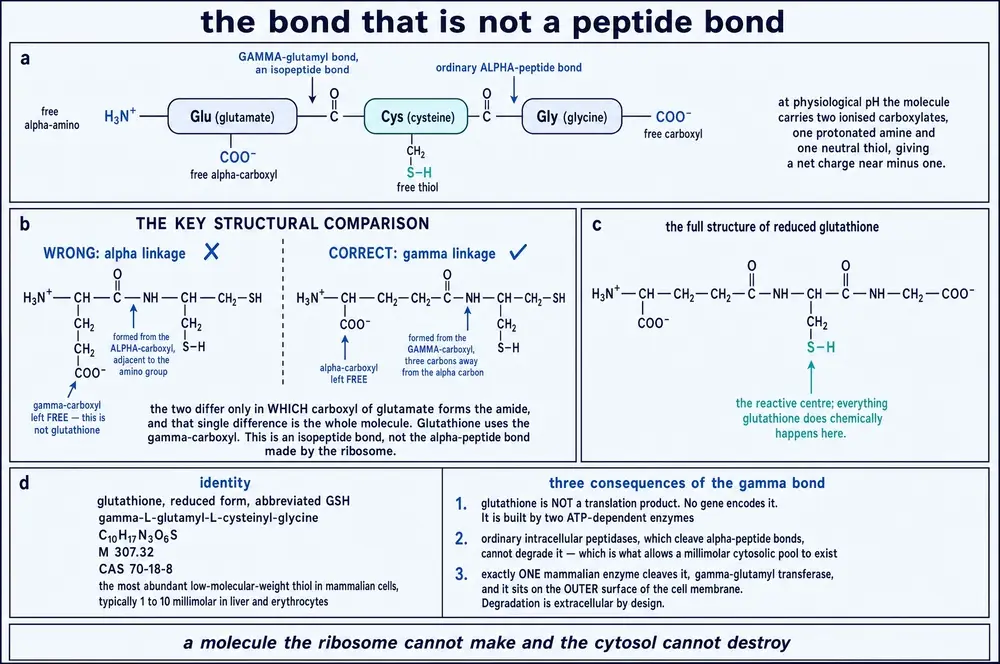
Glutamic acid has two acid groups: the one every amino acid has, on the carbon next to its amino group, and a second one at the far end of its side chain. When proteins are built, the first of those is used and the second is left hanging. Every peptide bond in every protein in your body is made the same way, and enzymes called peptidases are built to recognise exactly that arrangement and cut it.
Glutathione does not use it. The bond joining its glutamate to its cysteine is made from the side-chain acid group — the γ-carboxyl, glutamate’s fifth carbon rather than its first. The consequence is that the glutamate sits in the molecule sideways. Its own amino group and its own principal acid group are both left free, sticking out, unused. To a peptidase the junction simply does not read as a peptide bond, and the molecule sails past.
That is why a cell can keep glutathione at millimolar concentration in a compartment swarming with proteases. It is why the body cannot make glutathione on a ribosome like a protein and needs two dedicated enzymes and two molecules of ATP to build it instead. It is why only one enzyme in human biology can take the molecule apart, and why that enzyme lives on the outside of the cell membrane rather than the inside. And it is, at one remove, why swallowing glutathione is a harder proposition than swallowing almost anything else that gets sold as a supplement. Every argument in the second half of this document runs back to this one bond.
Establishing it took another six years and required building the molecule from scratch. Charles Harington and Thomas Mead synthesised glutathione in 1935 and showed the synthetic material was identical to the natural product, which settles a structure in a way no amount of analysis can. Vincent du Vigneaud repeated the feat by a different route the following year, and in his 1955 Nobel lecture — awarded for work on oxytocin, not on this — conceded Harington and Mead’s priority in one sentence and then noted that the glutathione synthesis was the foundation of everything he did afterwards.
This document does not name one discoverer, because the record does not support one. Secondary sources routinely credit Pirie and Pinhey’s 1929 titration study — printed, as it happens, on the page immediately after Hopkins’s retraction in the same issue. But du Vigneaud’s Nobel lecture credits Hopkins and Kendall’s group and does not mention Pirie and Pinhey at all.
The assignment is best read as emerging from the whole 1929 cluster and being proved by the 1935 synthesis. Where this project could not read a primary paper — and neither Pirie and Pinhey nor Harington and Mead is machine-readable today — it says so rather than picking a name.
Section 05What it is, in numbers
Glutathione is C10H17N3O6S: ten carbons, one sulfur, a molecular weight of 307.33. It is small: an average protein outweighs it by a factor of a hundred or more, and even by the standards of the vitamins it gets shelved beside on a shop shelf it is unremarkable in size.
It is also, by a wide margin, the most abundant small sulfur-containing molecule in the human body. Most cell types hold it at somewhere between one and ten millimolar — a concentration in the same range as the cell’s potassium, and orders of magnitude above the vitamins and cofactors it is usually grouped with in advertising. It is not a trace nutrient. It is a bulk chemical that the body manufactures for itself, continuously, and that no diet supplies at anything like the same scale.
The number worth holding on to is not the concentration but the difference between two of them. Inside a cell glutathione runs at one to ten millimolar. In the plasma just outside, it runs at one to six micromolar — a gradient of roughly a thousandfold, maintained continuously, across every cell membrane in the body. Nothing sustains a thousandfold gradient by accident. It is built and paid for, and Part Two is the account of how; Part Four is what happens when someone tries to raise the small number in the hope of moving the large one.
That last fact is the one to keep hold of, because it is the fact that most of the commercial literature quietly declines to mention.
Section 06Two enzymes, two ATP, and a bottleneck that is not glutathione
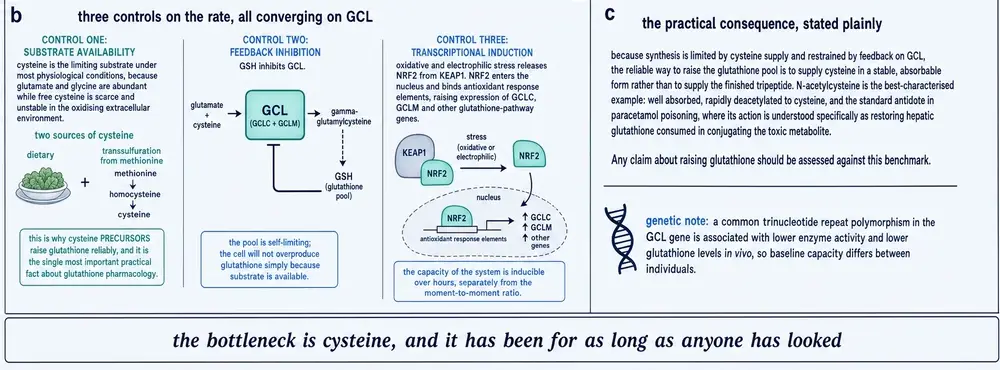
Because of the γ linkage, glutathione cannot be made the way proteins are made. There is no gene for it and no ribosome involved. It is assembled by two enzymes working in sequence, each spending a molecule of ATP.
The first, glutamate-cysteine ligase, joins glutamate to cysteine through the side-chain carboxyl — the awkward bond, made deliberately. The second, glutathione synthetase, adds the glycine. Two steps, two ATP, and the cell has its molecule.
The first step is the one that governs the whole system, and it is controlled in two ways that matter for everything downstream. Glutamate-cysteine ligase is inhibited by its own end product, so a cell with plenty of glutathione stops making more; and the substrate it runs short of is not glutamate, which is everywhere, but cysteine, which is not. Cysteine is the scarce input. In practice, a cell’s capacity to make glutathione is usually a question of how much cysteine it can get hold of.
Hold that thought. It reappears in Part Four as the single most awkward fact about glutathione supplementation.
Section 07Meister’s cycle, and the enzyme facing the wrong way
Between 1970 and the early 1980s Alton Meister’s laboratory worked out what happens to glutathione after it is made, and named the answer the γ-glutamyl cycle (Orlowski & Meister, 1970; Meister & Anderson, 1983). Six enzymes, running in a loop: two to build the molecule, and four to take it apart and recover the pieces.
One member of that loop deserves its own paragraph, because it decides most of what follows. The γ bond that makes glutathione invisible to ordinary peptidases is not invisible to everything. One enzyme can open it: γ-glutamyl transpeptidase, usually shortened to GGT. And GGT is an ectoenzyme — it sits anchored in the cell membrane with its working end pointing outward, into the space between cells.
Glutathione is built inside cells and can only be dismantled outside them. Nothing in the interior of a cell can take the molecule apart, and the one enzyme that can is facing the other way.
That arrangement is why a cell can hold glutathione at roughly a thousand times the concentration in the fluid around it — on the order of one to ten millimolar inside against a few micromolar in plasma. It is also why anything you swallow meets GGT on the way in, at the brush border of the gut, before it ever reaches a cell that could use it.
Meister did not merely name the cycle; he proposed a purpose for it. His 1970 paper argued that the loop functions as an amino-acid transport system — that glutathione is a carrier, picking up amino acids outside the cell and handing them over inside. It was an elegant idea and it appeared in textbooks for decades.
It has not held up. Reviewing five decades of work on the cycle, Inoue (2016) states flatly that the γ-glutamyl cycle “does not function as the putative amino acid transporter,” and assigns it instead a role in the handling of free radicals and foreign chemicals. The enzymes are real, the loop is real, and the job it was named for is not its job. A monograph that presented Meister’s cycle as settled fact would be forty years out of date on the part that matters.
Section 08Not one pool, but several
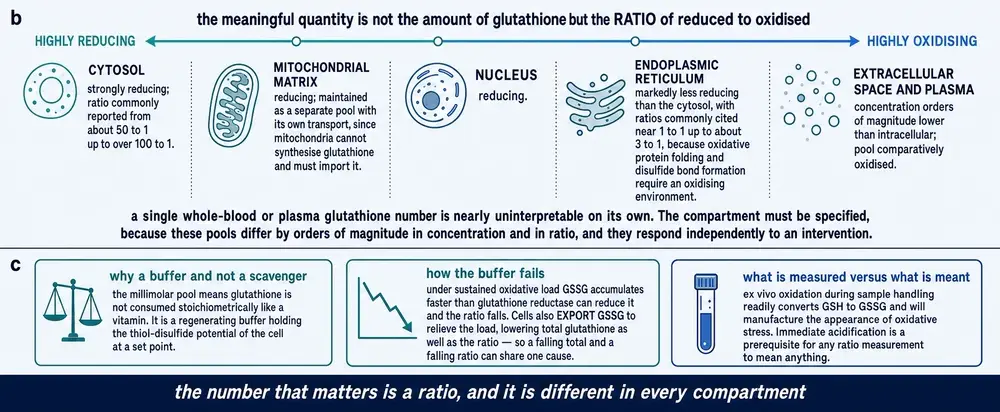
“Glutathione level” is a phrase that hides more than it reveals, because a cell does not have one glutathione level. It has several, kept deliberately different from each other.
The cytosol — the bulk interior — is held strongly reducing. Mitochondria maintain their own separate pool, imported rather than synthesised locally, and it is the pool whose loss is most closely tied to cell death. And the endoplasmic reticulum, where secreted proteins are folded, is deliberately kept oxidising, because forming the disulfide bridges that hold a secreted protein together requires an oxidising environment. A cell that made its ER as reducing as its cytosol would be unable to fold its own exports.
This is worth stating because of what it implies for measurement. When a study reports that a supplement raised glutathione, the first question is: raised it where? Plasma, whole blood, erythrocytes, lymphocytes and buccal cells are five different compartments with different kinetics, and the number that is easiest to measure — plasma — is the one furthest from where the molecule does its work. Part Four turns on exactly this distinction.
Section 09Depletion, and what it costs
The cleanest way to learn what a molecule does is to take it away. Glutathione can be removed experimentally with buthionine sulfoximine, which blocks the first synthetic enzyme, and it is removed accidentally, in people, by paracetamol.
Paracetamol is the standard textbook case and it is a good one. At ordinary quantities the liver disposes of it by two conjugation routes and a small fraction goes down a third path that produces a reactive intermediate. That intermediate is mopped up by glutathione. The system has capacity, and within that capacity nothing happens. Past it, the glutathione runs out, the reactive intermediate starts binding to liver proteins instead, and the liver fails. Overdose is not a poisoning by paracetamol so much as an exhaustion of glutathione.
Two clinical consequences follow, and both are documented rather than theoretical.
The first is the antidote. The treatment for paracetamol overdose is N-acetylcysteine, which supplies cysteine so the liver can rebuild its own glutathione. It is not glutathione. This is the first appearance of a pattern that runs through the whole compound: where a glutathione problem is successfully treated in medicine, the treatment is usually a precursor.
The second is subtler and recent. Paracetamol taken together with the antibiotic flucloxacillin can deplete glutathione far enough to cause a metabolic acidosis driven by the accumulation of an intermediate of the cycle, 5-oxoproline. Billet et al. (2023) report two cases in frail older patients, both fatal, alongside a review of the published series; the risk factors they list — old age, malnutrition, existing kidney or liver disease, sepsis — are all conditions in which the glutathione reserve is already low. These are case reports, not a trial, and they describe a drug interaction rather than a supplement.
Section 10The human knockout
Nature runs the depletion experiment too. Hereditary deficiencies have been found in five of the six enzymes of the γ-glutamyl cycle (Ristoff & Larsson, 2007). All are autosomal recessive, all are described as very rare, and most of the mutations are “leaky” — patients retain some residual enzyme activity.
Glutathione synthetase deficiency is the most frequently recognised. In its severe form it presents with haemolytic anaemia, metabolic acidosis, 5-oxoprolinuria, damage to the central nervous system, and recurrent bacterial infection. The largest cohort assembled — 28 patients, followed retrospectively (Ristoff et al., 2001) — found 16 with neurological involvement, 5 with recurrent bacterial infections, and 7 who had died.
Two findings from that cohort are worth carrying forward.
The first is negative and surprising: residual enzyme activity did not predict the phenotype. There was no significant difference in enzyme activity, or in red-cell or fibroblast glutathione, between the patients with neurological symptoms and those without. Whatever determines how badly an individual is affected, it is not simply how much glutathione they can make.
The second is the one this document keeps returning to. In the single human condition that is unambiguously a glutathione-deficiency disease, the established management is not glutathione. It is correction of the acidosis plus supplementation with vitamins C and E. The authors’ own treatment signal — that none of the severely affected patients had received both vitamins from the neonatal period — is a retrospective, non-randomised comparison in 28 people and is vulnerable to the obvious bias, since patients diagnosed early are also the ones most likely to survive. But the direction of practice is clear enough, and it is not toward giving the missing molecule.
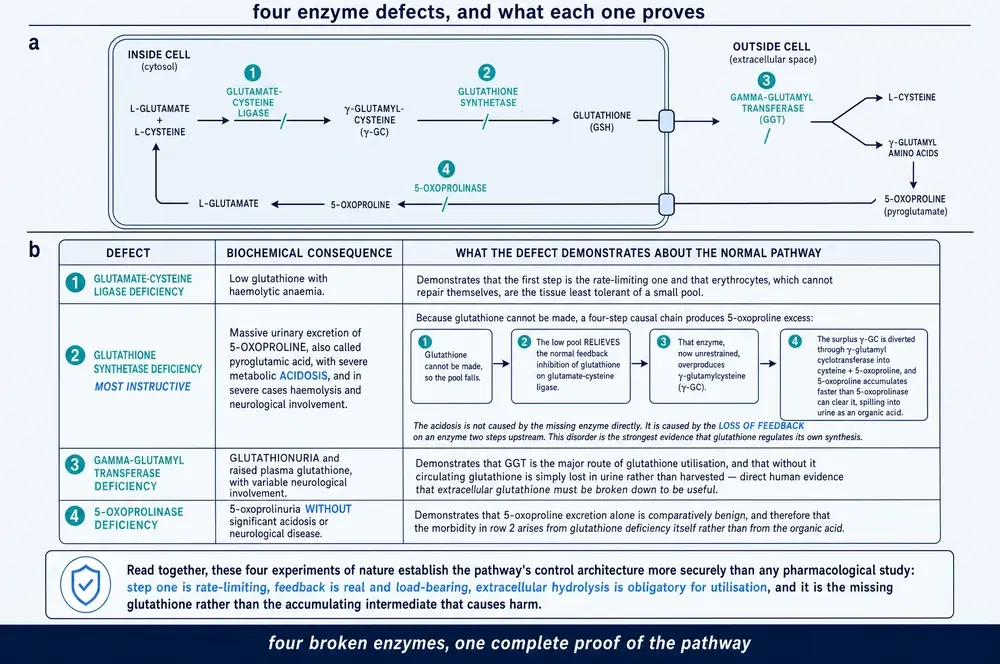
Everything above concerns the endogenous molecule: how the body makes it, moves it, spends it and fails without it. None of it is evidence that taking glutathione does anything. That is a separate question, it has its own literature, and that literature is the subject of Part Four.
Section 11The exit route for anything reactive
The word attached to glutathione in advertising is “antioxidant.” The function with the longest and least contested evidence behind it is something else: conjugation.
A great many of the chemicals a body meets — drug metabolites, products of combustion, plant defence compounds, industrial solvents — are electrophiles. They are short of electrons and will attack whatever nucleophile they meet first, which in a cell usually means DNA or a protein. Glutathione is a nucleophile, present in bulk, and the family of glutathione S-transferases exists to accelerate the reaction between the two. The electrophile is captured, the resulting conjugate is processed down the mercapturic acid pathway, and the product leaves in urine.
This is not a fringe pathway. It is one of the principal routes by which the body disposes of reactive chemistry, and it is the reason glutathione depletion and chemical toxicity are so tightly linked. It is also the reason the compound appears in cancer biology as a problem rather than a benefit: tumour cells with high glutathione are harder to kill with alkylating chemotherapy, because the drug is conjugated and exported before it can do its work.
Glutathione S-transferase, glutathione peroxidase, glutathione reductase and glutathione synthetase are enzymes. They are named after glutathione because they act on it. They are not glutathione, and evidence about them is not evidence about it.
This is not a pedantic distinction. On the day this document was compiled, PubMed held 6,152 papers with “glutathione S-transferase” in the title and 3,568 with “glutathione peroxidase,” against 33,561 containing “glutathione” at all. Roughly one title in three that appears to be about glutathione is about a protein named after it. Marketing copy that cites “over 100,000 studies on glutathione” is counting those, and a great deal else besides.
Section 12Peroxide, iron, and a death that was renamed
The second job is the antioxidant one, and it is more specific than the word suggests. Glutathione does not float about neutralising free radicals on its own account so much as it serves as the fuel for a family of enzymes, the glutathione peroxidases, which reduce peroxides to water and alcohols. Two glutathione molecules are spent per reaction, joining into the disulfide GSSG, which is then reduced back by another enzyme at the cost of NADPH. The molecule is a currency, constantly spent and constantly recovered.
One member of that family gave the field a second life. GPX4 is the only enzyme that can reduce lipid peroxides while they sit inside a membrane. Block it, or starve it of glutathione, and membrane lipids oxidise in a self-propagating chain until the cell dies — a form of death distinct from apoptosis, named ferroptosis in 2012. Ferroptosis is now one of the busiest subjects in cell biology, and it has pulled a great deal of attention back to glutathione.
It is worth being careful about what that attention means. Most ferroptosis work is about the enzyme and the lipid chemistry; glutathione appears in it as a substrate whose withdrawal triggers the phenomenon. The finding is that removing glutathione kills cells in a particular way. It is not a finding that adding glutathione does anything, and the corpus assembled for this document contains a great deal of the former and very little of the latter.
Section 13A switch, not a sponge
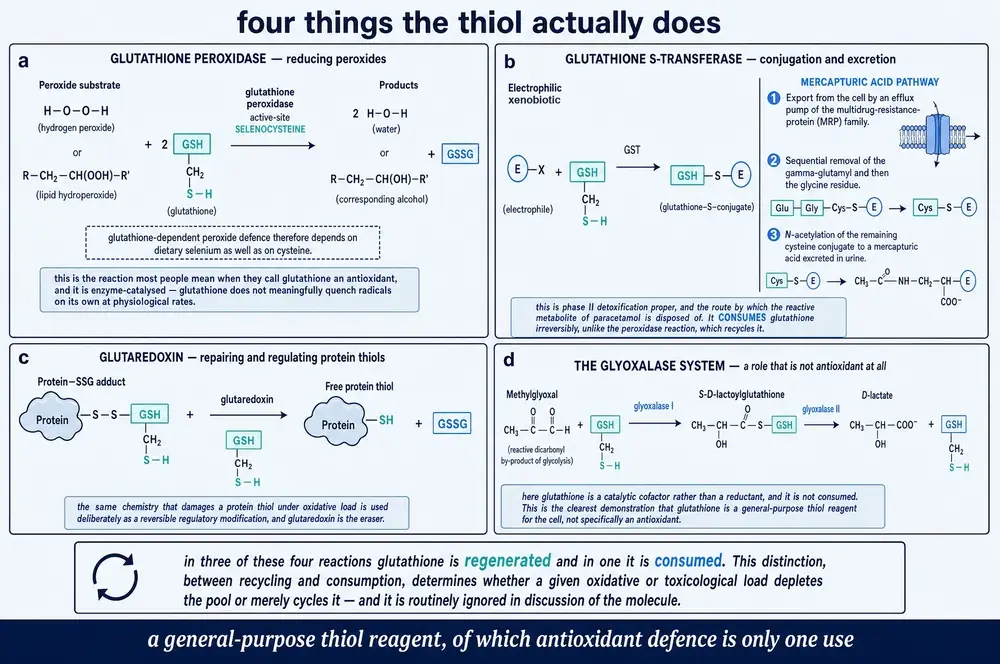
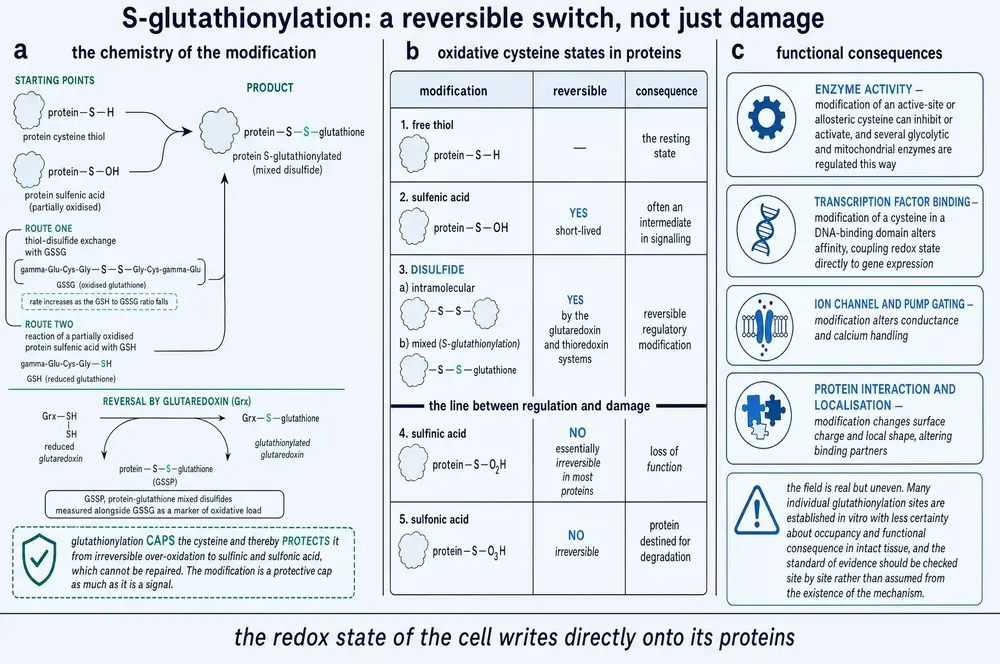
The third job is the one that most changes how the molecule should be thought about. Glutathione can attach itself reversibly to the cysteine residues of proteins — a modification called S-glutathionylation — and in doing so it changes what those proteins do. Enzymes are switched off and on; transcription factors change their behaviour; the modification is removed again by a small family of enzymes called glutaredoxins when conditions change.
This is signalling, not scavenging. It puts glutathione in the same category as phosphorylation: a reversible chemical mark that the cell uses to carry information about its own state. The consequence for the consumer framing is direct. If a large part of what glutathione does is to encode a signal, then “more is better” stops being obviously true, because a switch that is jammed in one position carries no information at all.
Section 14The fourth job, and the fashionable associations
The fourth is immunological. Lymphocytes need to hold their redox state within a range in order to proliferate and to produce the cytokines they are supposed to produce, and glutathione is central to holding it there. This is well-established cell biology and it is the mechanistic root of most of the claims made for glutathione in infection and in ageing.
It is also where the evidence starts to be worth reading carefully, because the step from “glutathione is involved” to “glutathione is depleted in this disease” to “replacing it would help” is taken very freely in the secondary literature, and the primary evidence does not support it as a general rule.
Consider what the best recent studies actually report, condition by condition.
In schizophrenia, brain glutathione has been measured non-invasively by magnetic resonance spectroscopy for two decades, and a 2019 meta-analysis of 18 studies found it modestly reduced. A larger and more recent synthesis — 21 studies, 639 patients against 704 controls (Murray et al., 2023) — reports a pooled effect of d = −0.09 (95% CI −0.28 to 0.10, p = 0.37). That is null. Its meta-regression found that older studies showed larger reductions, which is the signature of a finding that shrinks as methods improve. Here the newer analysis should supersede the older one, and the reason is not merely recency: it has more studies, better methods, and an internal explanation for the discrepancy.
In autism, a 2024 case-control study of 59 children against 40 controls found the glutathione-to-GSSG ratio markedly lower in cases — and both glutathione and GSSG higher in absolute terms (Wang et al., 2024). That is a redox-ratio finding, not a depletion finding. Papers reporting “low glutathione in autism” almost always mean the ratio, and a reader who assumes they mean the amount will draw the wrong conclusion about what supplementation could possibly fix. A systematic review of brain spectroscopy in autism published the same year found GABA and NAA significantly lower and glutathione not (Thomson et al., 2024).
In sickle cell disease, the two best sources disagree, and the disagreement is instructive. An Indian case-control metabolomic study found glutathione among 135 deregulated red-cell features (Bhatt et al., 2024) — on five samples per group. A study that measured red-cell glutathione directly in adults with sickle cell disease found it only slightly lower than in controls, with protein carbonyls, the NAD pool and the response to a peroxide challenge all no different, and concluded that oxidative stress in steady-state disease is well compensated (Detterich et al., 2019). The approved drug in sickle cell that is routinely relabelled as glutathione evidence is L-glutamine, a different molecule, tested in 230 patients over 48 weeks, and its authors invoke the NAD ratio rather than glutathione repletion as the mechanism (Niihara et al., 2018).
In COVID-19, 60 hospitalised adults were found to have severe glutathione deficiency and raised markers of oxidative damage across all age groups (Kumar et al., 2022). It is a cross-sectional measurement study. Its title nonetheless carries the phrase “Implications for GlyNAC… Supplementation,” and no supplement was given to anyone in it.
“Glutathione falls in disease and in ageing, therefore restoring it should help” is the load-bearing claim of the entire consumer market for this compound. Taken condition by condition against the best current evidence, the first half of that sentence is not reliably true. It is null in schizophrenia, inverted in autism, compensated in sickle cell, and measured only cross-sectionally in COVID-19.
Where the fall is real — and in acute paracetamol poisoning, in advanced liver disease and in the inborn errors it certainly is — the second half still does not follow automatically, because a molecule falling as a consequence of illness is not thereby a treatment for it.
Section 15Why the question is harder than it looks
The question at the centre of this document is short: does taking glutathione raise glutathione?
Three features of the molecule make it difficult to answer, and all three follow from Part Two.
The first is the enzyme. GGT — the only enzyme that can open the γ bond — is concentrated at exactly the surfaces a swallowed molecule must cross: the brush border of the small intestine and, after that, the liver. Witschi and colleagues attributed the failure of oral glutathione to reach the circulation to precisely this, in 1992, and the attribution has never been seriously challenged.
The second is the arithmetic. The body already holds glutathione at millimolar concentration in nearly every cell and turns it over continuously. A capsule containing a few hundred milligrams is being added to a pool that is very large, very actively managed, and subject to feedback inhibition at its synthetic step. Even perfect absorption would be a small perturbation of a regulated system, and the system’s regulation exists specifically to resist perturbation.
The third is what to measure. Plasma glutathione is a few micromolar; inside a cell it is a few millimolar. Plasma is the compartment that is easy to sample and the one furthest from where the molecule works. Whole blood, red cells, lymphocytes and cheek cells all give different answers with different kinetics. A trial can therefore find a positive result in one compartment and nothing in another, honestly, in the same subjects. Several have.
Section 16The trials, in order
There are seven human studies of any consequence on this question and they do not agree. Each is described here by what it actually did, because the disagreement between them is largely a disagreement about design.
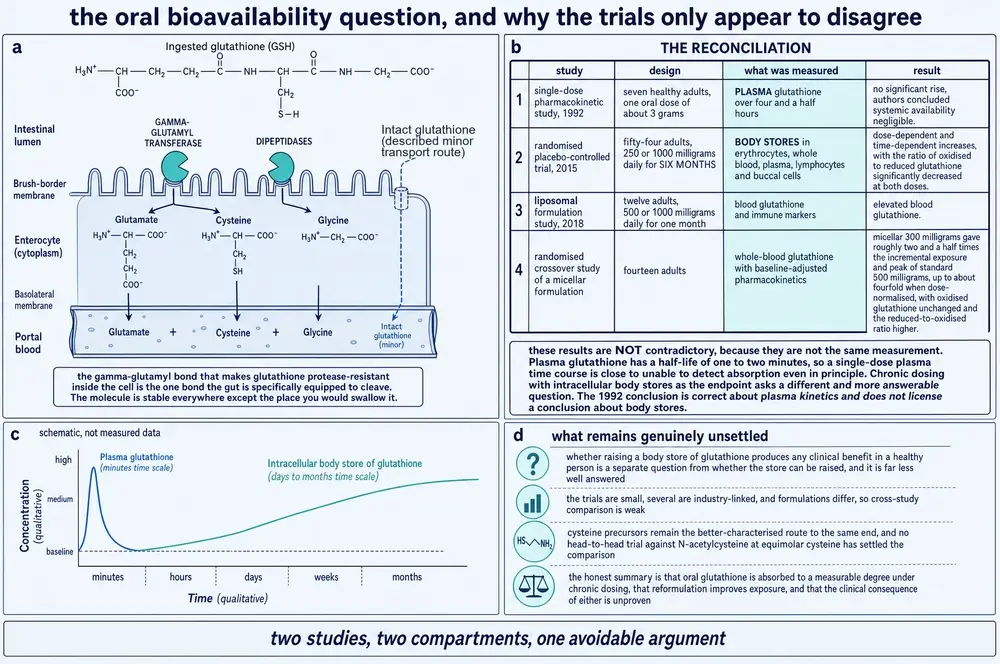
Witschi et al. (1992) gave seven healthy adults a single oral dose of about three grams and sampled plasma for four and a half hours. Plasma glutathione, cysteine and glutamate did not rise significantly. The authors’ conclusion — that systemic availability is “negligible in man” — is the most-quoted sentence in the field. It is also routinely over-read: this was a single dose, in seven people, measuring plasma only, over four hours. It says nothing about chronic dosing or about intracellular compartments.
Allen and Bradley (2011) ran the trial that Witschi could not: a randomised, double-blind, placebo-controlled study in 40 adults taking 1,000 mg a day for four weeks, funded by the National Institutes of Health. Urinary F2-isoprostanes did not change (p = 0.38); urinary 8-OHdG did not change (p = 0.27); and total, oxidised and ratio measures of glutathione status were, in the authors’ words, “unchanged.”
Park et al. (2014) gave a single oral dose of 50 mg/kg and looked in a place nobody had looked before. Free glutathione in plasma did not rise, and neither did glutathione in blood cells — confirming Witschi. But glutathione bound to plasma protein rose significantly between 60 and 120 minutes. That is a real finding and a small one: a two-hour observation in a fraction that had not previously been measured. It is not evidence of raised tissue glutathione and it is not evidence of benefit.
Richie et al. (2015) is the trial the positive case rests on, and it is the best-designed study in the field: randomised, double-blind, placebo-controlled, three arms, 54 adults, six months, with a month of washout and five compartments measured. At six months, whole-blood glutathione was about 31 per cent above baseline on 1,000 mg a day and 20 per cent on 250 mg; red cells rose about 35 per cent; lymphocytes about 30 per cent in the high-dose arm only; and buccal cells rose by the figure that became the headline, around 260 per cent, in the high-dose arm at six months only, with the authors noting that variation between subjects was high. The ratio of oxidised to reduced glutathione fell in both dose groups.
Schmitt et al. (2015) compared a sublingual preparation against oral glutathione and against N-acetylcysteine in 20 people with metabolic syndrome, three weeks per arm, crossover. The sublingual form came out ahead of the oral one on the glutathione ratio (p = 0.003). There was no placebo arm.
Solnier et al. (2026) is the newest entry and the only one to compare formulations head to head. Fourteen adults took single doses in a randomised, double-blind crossover: a micellar preparation at 300 mg against a standard one at 500 mg. The micellar form produced about 2.5 times the incremental whole-blood exposure (1287.5 ± 179.0 against 517.8 ± 180.0 µg·mL·h, p = 0.0064) and about 2.4 times the peak, rising to roughly fourfold when normalised for dose. Oxidised glutathione did not differ and the reduced-to-oxidised ratio was higher. Two things it does not show, and does not claim to: there is no placebo arm — the comparison is between two products — and the thirty-day safety follow-up is single-arm. Its authors are affiliated to the manufacturer of the winning formulation.
Sinha et al. (2018) is the study everyone cites for liposomal glutathione. It is an open-label pilot in twelve people — six per dose arm — over one month, with no placebo control, using product supplied by its manufacturer. The authors say so explicitly. Reported peaks were above 40 per cent in whole blood and roughly two-fold in mononuclear cells, at two weeks, with effects declining by four weeks.
Section 17Reading the conflict
Set out as a table, the pattern is hard to miss and it is not primarily about dose, duration or route.
Every study that found supplemental glutathione raises body stores had a commercial sponsor with a direct interest in that result. The independently funded randomised trial, at the identical dose, found nothing.
Richie et al. (2015) was supported by Kyowa Hakko Bio, which supplied the branded product and the placebo and funded author travel; the paper states this. Schmitt et al. (2015) has two authors employed by the manufacturer of the sublingual form the study concluded was superior. Sinha et al. (2018) used product supplied by its manufacturer. Allen and Bradley (2011), which found nothing, was funded by the NIH.
That observation does not settle the question, and it should not be used as though it does. Industry-funded trials can be right, disclosure is a sign of good practice rather than bad, and Richie et al. state that the sponsor had no role in conduct, analysis or writing. The honest position is that the field lacks the study that would settle it: a six-month, independently funded, placebo-controlled trial with the same compartment panel. It has never been done.
What can be said is that three things internal to the positive evidence weaken it, independently of who paid.
The mechanism is missing from the trial’s own data. If oral glutathione is hydrolysed and its parts reassembled inside cells — the only explanation most reviews offer for how a rise could occur — then the precursor pool or the rate-limiting enzyme should move. Richie et al. report that neither did: “no changes were observed in cyst(e)ine concentrations or GCL activity in any of the groups.” The route by which the intracellular rise happened is unexplained by the study that reported it.
Two studies from the same senior author contradict each other on whether depletion predicts response. Sinha et al. (2018) report strong inverse correlations between baseline glutathione and the change on supplement, the finding that would justify targeting the depleted. Richie et al. (2015) found no such correlation in any compartment and no difference between subjects above and below the median at baseline. Both cannot be right; the larger, longer, placebo-controlled study is Richie.
The only pooled estimate is null. A 2024 meta-analysis able to pool three studies reports SMD 0.74 (95% CI −0.44 to 1.91) for erythrocytes and SMD 0.44 (95% CI −0.21 to 1.09) for plasma. Neither reaches significance. That is a small and imperfect pool in a journal PubMed does not index, and it is the only quantitative synthesis that exists.
Oral glutathione at 1,000 mg a day for six months may produce a modest rise — on the order of 20 to 35 per cent — in blood-compartment glutathione. That statement rests on a single manufacturer-funded trial whose results were never posted to the registry it was registered on, which is contradicted at the same dose by the only independently funded randomised trial, which is unsupported by the one pooled estimate available, and for which no mechanism has been demonstrated.
It should not be presented as settled in either direction. What can be said without qualification is narrower and more useful: no study has shown that raising a blood glutathione measurement produces a clinical benefit. The biomarker and the outcome have never been joined.
Section 18The routes that go around the gut
If the intestine is the obstacle, the obvious move is to bypass it. Four routes have been tried and each has a different answer.
Intravenous delivery removes the gut entirely, and it is the basis of the drip-clinic industry. It also has the most decisive pharmacokinetic finding in this document. Glutathione given intravenously has a plasma half-life of roughly eleven to fifteen minutes and is back to baseline concentrations within half an hour — and as it disappears, plasma cysteine rises. It is not being distributed to tissues; it is being taken apart, in the circulation, into its constituent amino acids. These figures are reported in FDA’s own 2022 review of the compound, citing pharmacokinetic studies from 1991 and 2005.
Intranasal delivery is the one route with a clean demonstration that the molecule arrives where it is aimed. Fifteen people with Parkinson’s disease took a single 200 mg intranasal dose inside an MRI scanner, and brain glutathione measured by spectroscopy rose significantly and stayed up for at least an hour (Mischley et al., 2016). No clinical outcome was measured. It is a delivery proof of concept and nothing more — but as proofs of concept go it is unusually clean, and it is the strongest delivery evidence for any route.
Sublingual and liposomal preparations are attempts to survive the gut chemically rather than avoid it. The evidence for both is described in Section 16: one crossover study with no placebo arm, and one uncontrolled pilot in twelve people. Neither supports the confident claims made for these formulations, and the confirmatory work that would have settled them was registered and then abandoned — three separate trials of oral or liposomal glutathione, including a manufacturer-linked immune-function study and a hospital study of liposomal glutathione, were withdrawn with zero participants enrolled.
Inhaled glutathione is the route with the best-quantified evidence of all, and it comes with a warning. In cystic fibrosis, a Cochrane review pooling 20 studies in 924 people found inhaled glutathione improved FEV1 by +3.50 per cent predicted (95% CI 1.38 to 5.62) at three months — and by +2.30 per cent (95% CI −0.12 to 4.71) at six months, which does not reach significance. There was no effect on quality of life, body-mass index or time to exacerbation, and only one of the twenty studies was judged free of bias. The largest single trial, in 54 adults and 51 children over twelve months, missed its pre-specified primary endpoint outright.
And the reason may be the enzyme again. Corti et al. (2017) report that the cystic fibrosis airway carries elevated GGT, which degrades inhaled glutathione and can generate pro-oxidant products — so that patients whose sputum GGT is rising may be harmed rather than helped. The same enzyme that destroys glutathione in the gut destroys it in the lung, by the same chemistry, for the same structural reason.
Section 19The precursor route, and the paradox at the centre of it
There is a way to raise tissue glutathione that has better evidence behind it than any glutathione preparation, and it consists of not giving glutathione.
Since cysteine is the limiting input (Section 06), supplying cysteine lets the cell build its own. N-acetylcysteine does exactly that, and it is the approved antidote for paracetamol poisoning — the one clinical situation in which restoring glutathione is unambiguously life-saving, treated with a molecule that is not glutathione.
The modern version of this idea is GlyNAC: glycine plus N-acetylcysteine, on the reasoning that the two amino acids the body needs are glycine and cysteine, and that supplying both raises synthesis further than supplying either. A series of studies from one laboratory reports that older adults given GlyNAC recover from glutathione deficiency along with improvements in oxidative stress, mitochondrial function, inflammation, insulin sensitivity, strength and cognition.
Two things must be said about that series, and the monograph would be misleading without both.
The first is a scope statement. GlyNAC is not glutathione. It contains none. Every GlyNAC result is evidence about precursor supplementation, and transferring it to a claim about glutathione capsules inverts the logic — because GlyNAC’s entire rationale is that giving glutathione itself does not work.
The second is about the evidence’s size. The most-cited “GlyNAC randomised trial” of 2021 is an open-label study of eight older adults with no control group. The actual randomised trial (Kumar et al., 2023) enrolled 24 older adults, twelve per arm, against an isonitrogenous placebo, for sixteen weeks — a genuinely well-chosen control and independent funding from the National Institute on Aging, which is a real contrast with the rest of this literature. But its abstract reports no effect sizes, no confidence intervals and no p-values for any individual outcome, its registry entry has been open since 2013 with no results posted, and a very large number of outcomes are reported as improved with no visible correction for multiplicity. “Reverses hallmarks of ageing” is not what twelve people per arm can establish.
Doses, routes and durations are stated throughout this Part only as reported by the studies that used them, with the population and the length of exposure attached. Nothing here is a recommendation. This document does not recommend human use of glutathione by any route, and specifies no dose or schedule for any person.
Section 20Parkinson’s disease, and the shape of a disappearing result
Parkinson’s disease has been the most persistent clinical target for glutathione, and its literature has a shape that recurs across the whole compound.
It began in 1996, when Sechi and colleagues gave intravenous glutathione twice daily for thirty days to nine patients with early, untreated Parkinson’s disease and reported that all of them improved, with a 42 per cent decline in disability that persisted for two to four months after stopping. That figure is the most-quoted number in the intravenous glutathione literature. It comes from an unblinded study of nine people with no control group, in a disease with one of the largest and best documented placebo responses in medicine.
Thirteen years later it was tested properly. Hauser and colleagues randomised 21 patients to intravenous glutathione or placebo, three times a week for four weeks, double-blind, with eight weeks of follow-up. Over the treatment period the glutathione group improved by 2.8 UPDRS units more than placebo (p = 0.32); over the following eight weeks it worsened by 3.5 units more than placebo (p = 0.54). Neither approached significance. The 42 per cent did not reappear.
The intranasal route was then tried in three stages, and the sequence is a model of how a delivery question should be answered. A phase I/IIa study in 30 patients established that intranasal glutathione is safe and tolerable and made no efficacy claim. The spectroscopy study described in Section 18 showed the molecule reaches the brain. Then the phase IIb trial randomised 45 patients to placebo or one of two doses for three months (Mischley et al., 2017), and found that everyone improved, including placebo. The high-dose group improved by 4.6 UPDRS points from its own baseline (p = 0.0025) — and “neither treatment group was superior to placebo.” The authors noted that the placebo response was larger than in previous Parkinson’s studies and deserved investigation in its own right.
“Improved by 4.6 points, p = 0.0025” is a true statement about the high-dose arm of that trial. It is also a within-group comparison — the group against its own starting point — and the placebo group improved too. Quoted without the placebo arm, it reads as an efficacy result. It is the opposite of one.
The largest and best-designed intravenous glutathione trial ever run is in a different disease and is under-cited almost everywhere. Leal and colleagues (2014) randomised 185 patients receiving paclitaxel and carboplatin to intravenous glutathione or placebo before each cycle, phase 3, double-blind, across 390 sites, funded by the NIH. There was no difference in peripheral neuropathy on the patient-reported scale (p = 0.21) or the clinician-graded one (p = 0.449). Two secondary endpoints favoured placebo: time to grade 2 neuropathy (p = 0.039) and, in patients on weekly paclitaxel, acute pain syndrome (p = 0.002). No subgroup benefited.
Section 21Skin lightening, the largest use and the smallest evidence
By volume, the dominant human use of glutathione is not any of the above. It is cosmetic: pills, lozenges, creams and intravenous infusions sold to lighten skin, principally across South and South-East Asia, in a market large enough to have prompted national regulatory intervention.
The mechanistic rationale is real. Melanin comes in two forms: dark brown-black eumelanin and lighter red-yellow pheomelanin. Thiols push the synthetic pathway toward the lighter one, and glutathione is the cell’s dominant thiol. The idea is not chemically absurd.
The trials are another matter, and they need reading past the abstracts.
Arjinpathana and Asawanonda (2012) randomised 60 healthy medical students to oral glutathione 500 mg a day or placebo for four weeks and measured melanin index at six body sites. Melanin fell at all six sites in the treated group, but the reduction was significantly greater than placebo at two sites of six — the right side of the face (p = 0.021) and the sun-exposed left forearm (p = 0.036) — with no reported correction for testing six sites. The authors’ own conclusion is careful: lightening “in a small number of subjects,” with long-term safety not established.
Weschawalit et al. (2017) is the most-cited positive trial and the most important to read carefully. Sixty women, three arms — oral glutathione, oral GSSG, placebo — twelve weeks, melanin index as the primary endpoint. The primary endpoint was not met. In the paper’s own words, melanin index and UV spots at all sites “tended to be lower than placebo… but were not statistically significant (P > 0.05).” The one significant pigment result is a subgroup of subjects over 40, at one forearm, with seven treated subjects against ten controls (p = 0.031) — and the opposite forearm in the same subgroup did not reach significance (p = 0.057). The paper’s title and conclusion nonetheless assert antimelanogenic effect. Its products were supplied by the same manufacturer that funded the oral bioavailability trial in Part Four.
Handog et al. (2016) gave a glutathione lozenge to 30 Filipino women for eight weeks and reported falling melanin indices. It is single-arm and open-label: no placebo, no randomisation, no blinding.
The one design in this section that is genuinely strong belongs to the topical route. Watanabe et al. (2014) applied 2 per cent oxidised glutathione lotion to one side of the face and placebo to the other in 30 women for ten weeks — a split-face matched-pair design in which each subject is her own control. Melanin index was significantly lower on the treated side (p < 0.001 at ten weeks). Two scope limits apply and are usually dropped when this study is cited: it tested the oxidised form, and it was topical, so it carries no information whatever about swallowing anything. And three of its four authors are employees of the manufacturer whose product it tests — this study is not merely industry-funded but industry-authored, and one of those employees is thanked by name in the acknowledgments of the Richie oral trial for support in its “design and implementation.”
Two systematic reviews have looked at the whole set. The earlier concluded that evidence for a skin-whitening effect is “still inconclusive due to the quality of included studies and inconsistent findings” (Dilokthornsakul et al., 2019), finding effects confined to sun-exposed sites and none on sun-protected skin. A 2025 review over a longer window reports significant melanin reduction across five randomised trials of oral glutathione, while recording that risk of bias is high in about as many studies as it is low, and concluding that intravenous glutathione “is contraindicated due to lack of efficacy and side effects” (Sarkar et al., 2025).
On the intravenous form specifically, there is exactly one placebo-controlled trial, and it fails three ways at once. The active arm was a multi-ingredient infusion containing vitamin C and hydrolysed collagen as well as glutathione, so nothing can be attributed to any one component; the result did not reach significance (p = 0.054); and whatever lightening occurred had disappeared within six months in 24 of 25 patients.
Section 22Safety, and the injection clinics
The safety picture is genuinely mixed, and it is misrepresented in both directions — understated by sellers and overstated by critics. The most useful source is the United States Food and Drug Administration’s own 2022 pharmacovigilance review, because it counts things rather than asserting them.
Real signals exist, and they cluster by route. Intravenous glutathione has produced anaphylaxis, in one case recurring when the patient was re-exposed. One case of hepatotoxicity was recorded with transaminases at roughly twenty-five times the upper limit of normal, resolving within two months. Across five intravenous studies, eight patients had liver function tests deranged enough to warrant stopping. Nebulised glutathione has caused bronchoconstriction with severe wheezing. One participant in the intranasal phase IIb trial developed a cardiomyopathy, which resolved when glutathione was stopped — the only serious adverse event located inside a randomised controlled trial of this compound. In oral trials the signal is milder but not absent: two of sixty subjects in the twelve-week skin trial withdrew with raised liver enzymes that resolved within weeks, and the authors’ own comment is that blood chemistry is worth checking even for over-the-counter supplements.
Equally, several claims that circulate widely do not survive checking.
“77 hospitalisations and 13 life-threatening events.” Of 195 adverse-event reports naming glutathione in FDA’s consumer-product database, 194 are confounded by other ingredients in the same product and exactly one implicates glutathione alone — with three non-serious skin events. The larger figures come from the confounded 194 and FDA says so.
“Liver dysfunction in 32 per cent of participants.” No study reporting this figure could be located. It should not be printed until one is.
Deaths. No glutathione-attributed death was found anywhere — not in FDA’s adverse-event tabulations, not in the trial literature. Agency documents describe Stevens-Johnson syndrome as “potentially fatal,” which is a statement about the syndrome, not a report of a death from this compound.
The sharpest American record is not about the molecule at all. In January 2019 seven patients at one outpatient clinic were each given 1,400 mg of intravenous glutathione from a single batch and, within minutes, developed nausea, vomiting, chills and body aches; one became hypotensive and breathless and was admitted to hospital. A second report followed of a patient given 2,400 mg who was hospitalised with fever and rigors. FDA tested the bulk powder and found bacterial endotoxin at up to five times the permitted limit. The container was labelled “Caution: Dietary Supplement,” and FDA’s conclusion was that it “should not have been used to compound sterile injectable drugs.” That is a supply-chain failure rather than a pharmacological one, and distinguishing the two is the whole point of reading these reports rather than counting them.
What is documented is one published case of Stevens-Johnson syndrome and toxic epidermal necrolysis in a 33-year-old woman after an intravenous infusion containing glutathione, vitamin C and vitamin D (Johnson et al., 2025). The infusion was multi-component, so the case cannot isolate glutathione as the cause; the authors explicitly connect it to the growth of lightly regulated intravenous hydration clinics.
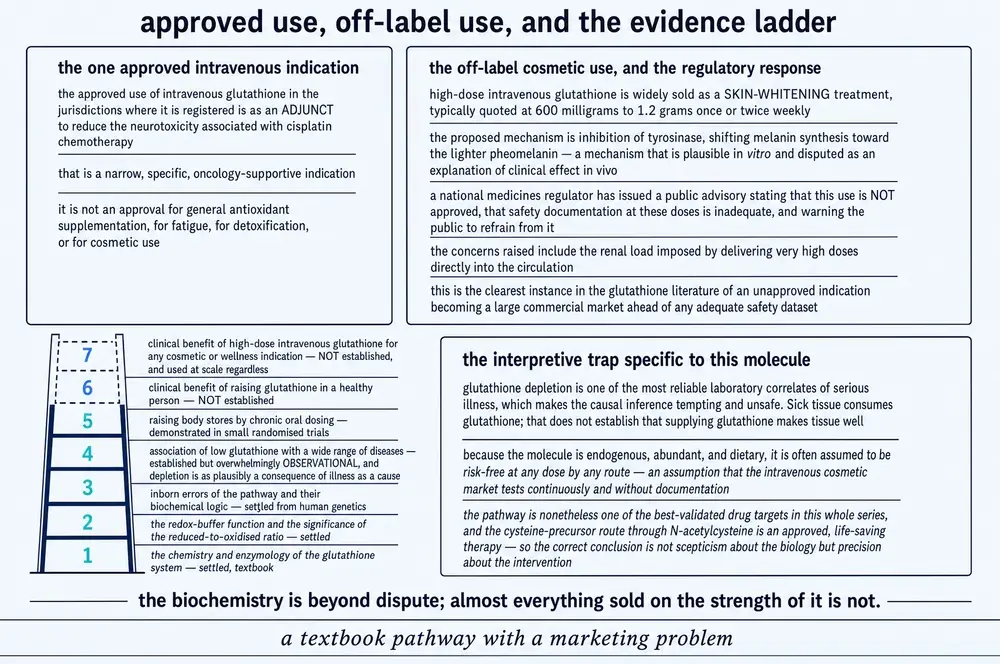
That is where the real hazard sits, and it is worth naming precisely. The Philippine Food and Drug Administration’s Advisory 2019-182, issued on 5 July 2019, warns against injectable glutathione for skin lightening on the grounds that there are “no published clinical trials” supporting it and that the agency has approved no injectable product for that use. Alongside the pharmacological concerns it lists a set of risks that are not pharmacology at all — transmission of HIV and hepatitis B and C through non-sterile technique by people who are not medical practitioners. Those are hazards of an unregulated injection market, not properties of a molecule, and conflating the two does the reader no favours in either direction.
The same advisory contains a detail that is easy to miss and hard to forget: injectable glutathione is approved in the Philippines — as an adjunct in cisplatin chemotherapy. Which is the indication on which the largest independent trial in this document returned a negative result.
Section 23The regulatory record
Three facts make up the regulatory position, and each is more interesting than the summaries of it.
An approved product does contain glutathione — in the wrong form, by an unexpected route, at a very small quantity, for no stated purpose. BSS PLUS is a sterile solution used to irrigate the eye during intraocular surgery, approved under NDA 018469. Its concentrate contains glutathione disulfide — the oxidised dimer — at 4.6 mg/mL, which after reconstitution becomes 0.184 mg per millilitre of the working solution. The label states no purpose for it. That an FDA-approved product contains glutathione is true, and it supports nothing whatever about swallowing or injecting the reduced form.
Queried for glutathione as a generic name, FDA’s own drug database returns that product and nothing else. The distinction this forces is worth making precisely, because the looser word is used almost universally: intravenous glutathione is not an off-label use. Off-label presupposes a label — an approved product being used outside its approved indication. No approved product with reduced glutathione as an active ingredient exists, so there is no label to be off. It is an unapproved drug, which is a different regulatory category and a different argument.
For compounding, glutathione is under evaluation and has been for years. It sits in Category 1 of FDA’s 503A bulk drug substances list — “under evaluation” — as of the list revised 14 May 2026, alongside NAD, coenzyme Q10 and alpha lipoic acid. Category 1 is not approval. It is a statement that the agency does not currently intend to act against compounders using it while it makes up its mind.
And in 2022 the agency did make up its mind, and its own advisory committee overruled it. This is the most useful and least cited artefact in the whole record, and it is worth setting out in full.
Glutathione had been nominated for the final 503A list in eight dosage forms — capsule, troche, nasal spray, sublingual, inhalation, cream, gel, rectal and injection — and for twenty-four separate uses. FDA reviewed all of them. For comparison, the three other substances considered at the same meeting were nominated for one disease area each.
FDA’s conclusion, in its own words, was that “there is either no available information or insufficient evidence of effectiveness of glutathione with any of the proposed uses,” and it recommended that glutathione not be included on the list.
The Pharmacy Compounding Advisory Committee then voted 8 to 5, with one abstention, to include it anyway — the only one of four substances that day on which the committee disagreed with the agency. The minutes record the reasoning on both sides, and it is not what one might guess. Those voting to include cited patient access to compounded formulations, the demonstrated physical and chemical stability of the substance, and the absence of compelling evidence of a safety problem. Those voting against cited the lack of evidence of effectiveness and the fact that glutathione “has been used for a wide range of indications without clear evidence of effectiveness despite well-established alternate therapies for those indications.” The single abstention explained that the mixed evidence, across such a variety of indications, was not convincing enough to vote either way.
Nobody on either side argued that the compound works. The argument was about access and stability. The vote is advisory, FDA has not acted on it, and as of the list revised in May 2026 glutathione remains where it was.
Section 24What is known, and what is sold
Set out plainly, without softening, the position is this.
Beyond dispute. Glutathione is the most abundant thiol in the human body and one of its most important molecules. Its structure is unusual and that structure explains its stability, its dedicated synthetic pathway and its resistance to digestion. It is central to the disposal of reactive chemicals, to the reduction of peroxides, to a large class of reversible protein modifications, and to the redox control of immune cells. Its depletion by paracetamol is lethal and its restoration by a precursor is the antidote. Inherited failures of its synthesis cause severe human disease. None of this is in question and none of it has been in question for decades.
Contested. Whether taking glutathione by mouth raises the amount in the body at all. The evidence divides along a funding line, the one independently funded randomised trial found nothing, the only pooled estimate is null, the positive trial has no demonstrated mechanism, and the study that would resolve it has not been done.
Not supported. That raising a glutathione measurement produces a clinical benefit. In Parkinson’s disease the open-label result was not reproduced when it was blinded; the intranasal trial found improvement in every arm including placebo. In chemotherapy-induced neuropathy the phase 3 trial was negative and two secondary endpoints favoured placebo. In cystic fibrosis the inhaled effect is small, does not survive to six months, moves no patient-centred outcome, and may be reversed in patients with high airway GGT. For skin, the most-cited oral trial missed its primary endpoint, and the only placebo-controlled intravenous trial used a multi-ingredient infusion, missed significance and lost its effect in 24 of 25 patients within six months. FDA reviewed twenty-four proposed uses and found sufficient evidence of effectiveness for none of them.
Not established either way. Long-term safety of chronic supplementation at any dose by any route; reproductive and developmental toxicity, which FDA states plainly there are insufficient non-clinical data to evaluate; and whether the modest blood-compartment rise reported at six months means anything at all.
A molecule whose importance inside the cell has been beyond argument for a century is sold on the strength of that importance, by routes that the molecule’s own chemistry is built to resist, for a list of indications that a regulator reviewed twenty-four at a time and found unsupported in every case.
There is a version of this document that ends by saying the science is young and more research is needed. That would be wrong. The science is a hundred and thirty-eight years old, the biochemistry is superb, and the specific questions that would settle the commercial claims are neither difficult nor expensive to answer. Three trials of the confirmatory work were registered and then withdrawn with nobody enrolled. Two of the pivotal positive trials have never posted results to the registries they are registered on. The problem is not that the research is hard. It is that the market does not require it.
This document describes published research. It does not recommend human use of glutathione or of any related compound, and it specifies no dose, route or schedule for any person. Where doses, routes and durations appear above, they are reported as the parameters of the studies that used them, with the population and duration attached, and they are not recommendations. This is not medical advice.
Section 25References
Generated from verified NCBI records rather than from recall. Author lists, journal names, volumes, pages and identifiers are taken from the PubMed record for each citation, and the build refuses to run if any identifier fails to resolve. This series has twice shipped reference lists drafted from memory in which identifiers pointed at real but unrelated papers.
One entry will look wrong and is not. The Journal of Biological Chemistry indexes its “Classics” commentaries under the title of the paper being commented on, so Simoni, Hill and Vaughan’s 2002 essay on Hopkins appears under Hopkins and Dixon’s 1922 title. The record is reproduced as PubMed holds it.
- Allen J, Bradley RD. Effects of oral glutathione supplementation on systemic oxidative stress biomarkers in human volunteers. J Altern Complement Med. 2011;17(9):827-33.
PMID 21875351 · doi:10.1089/acm.2010.0716 · PMC3162377 - Aoyama K. Glutathione in the Brain. Int J Mol Sci. 2021;22(9).
PMID 34065042 · doi:10.3390/ijms22095010 · PMC8125908 - Arjinpathana N, Asawanonda P. Glutathione as an oral whitening agent: a randomized, double-blind, placebo-controlled study. J Dermatolog Treat. 2012;23(2):97-102.
PMID 20524875 · doi:10.3109/09546631003801619 - Bhatt S, Mohapatra AK, Rajesh AS, Meher S, Nag A, Panda PK, et al.. Does Deteriorating Antioxidant Defense and Impaired γ-Glutamyl Cycle Induce Oxidative Stress and Hemolysis in Individuals with Sickle Cell Disease?. Antioxid Redox Signal. 2025;42(4-6):199-211.
PMID 39001817 · doi:10.1089/ars.2024.0594 - Billet S, Vanbiervliet P, Remery M, Dekoninck J, Janssens W. The concomitant use of paracetamol and flucloxacillin. A rare cause of high anion gap metabolic acidosis in the frail oldest old. Acta Clin Belg. 2023;78(6):509-515.
PMID 37573520 · doi:10.1080/17843286.2023.2246226 - Calabrese C, Tosco A, Abete P, Carnovale V, Basile C, Magliocca A, et al.. Randomized, single blind, controlled trial of inhaled glutathione vs placebo in patients with cystic fibrosis. J Cyst Fibros. 2015;14(2):203-10.
PMID 25458463 · doi:10.1016/j.jcf.2014.09.014 - Ciofu O, Smith S, Lykkesfeldt J. Antioxidant supplementation for lung disease in cystic fibrosis. Cochrane Database Syst Rev. 2019;10(10):CD007020.
PMID 31580490 · doi:10.1002/14651858.CD007020.pub4 · PMC6777741 - Cornell JS, Meister A. Glutathione and gamma-glutamyl cycle enzymes in crypt and villus tip cells of rat jejunal mucosa. Proc Natl Acad Sci U S A. 1976;73(2):420-2.
PMID 1755 · doi:10.1073/pnas.73.2.420 · PMC335920 - Corti A, Griese M, Hector A, Pompella A. Increasing sputum levels of gamma-glutamyltransferase may identify cystic fibrosis patients who do not benefit from inhaled glutathione. J Cyst Fibros. 2017;16(3):342-345.
PMID 27988297 · doi:10.1016/j.jcf.2016.12.002 - Das TK, Javadzadeh A, Dey A, Sabesan P, Théberge J, Radua J, et al.. Antioxidant defense in schizophrenia and bipolar disorder: A meta-analysis of MRS studies of anterior cingulate glutathione. Prog Neuropsychopharmacol Biol Psychiatry. 2019;91:94-102.
PMID 30125624 · doi:10.1016/j.pnpbp.2018.08.006 - Detterich JA, Liu H, Suriany S, Kato RM, Chalacheva P, Tedla B, et al.. Erythrocyte and plasma oxidative stress appears to be compensated in patients with sickle cell disease during a period of relative health, despite the presence of known oxidative agents. Free Radic Biol Med. 2019;141:408-415.
PMID 31279092 · doi:10.1016/j.freeradbiomed.2019.07.004 · PMC6750280 - Dilokthornsakul W, Dhippayom T, Dilokthornsakul P. The clinical effect of glutathione on skin color and other related skin conditions: A systematic review. J Cosmet Dermatol. 2019;18(3):728-737.
PMID 30895708 · doi:10.1111/jocd.12910 - Guilford FT. Commentary to "Randomized controlled trial of oral glutathione supplementation on body stores of glutathione". Eur J Nutr. 2015;54(5):859-60.
PMID 25792077 · doi:10.1007/s00394-015-0874-5 - Guloyan V, Oganesian B, Baghdasaryan N, Yeh C, Singh M, Guilford F, et al.. Glutathione Supplementation as an Adjunctive Therapy in COVID-19. Antioxidants (Basel). 2020;9(10).
PMID 32992775 · doi:10.3390/antiox9100914 · PMC7601802 - Handog EB, Datuin MS, Singzon IA. An open-label, single-arm trial of the safety and efficacy of a novel preparation of glutathione as a skin-lightening agent in Filipino women. Int J Dermatol. 2016;55(2):153-7.
PMID 26148180 · doi:10.1111/ijd.12999 - Harington CR, Mead TH. Synthesis of glutathione. Biochem J. 1935;29(7):1602-11.
PMID 16745829 · doi:10.1042/bj0291602 · PMC1266669 - Hauser RA, Lyons KE, McClain T, Carter S, Perlmutter D. Randomized, double-blind, pilot evaluation of intravenous glutathione in Parkinson's disease. Mov Disord. 2009;24(7):979-83.
PMID 19230029 · doi:10.1002/mds.22401 - Honda Y, Kessoku T, Sumida Y, Kobayashi T, Kato T, Ogawa Y, et al.. Efficacy of glutathione for the treatment of nonalcoholic fatty liver disease: an open-label, single-arm, multicenter, pilot study. BMC Gastroenterol. 2017;17(1):96.
PMID 28789631 · doi:10.1186/s12876-017-0652-3 · PMC5549431 - Hopkins FG. On an Autoxidisable Constituent of the Cell. Biochem J. 1921;15(2):286-305.
PMID 16742989 · doi:10.1042/bj0150286 · PMC1258982 - Inoue M. Glutathionists in the battlefield of gamma-glutamyl cycle. Arch Biochem Biophys. 2016;595:61-3.
PMID 27095217 · doi:10.1016/j.abb.2015.11.023 - Johnson JS, Jarvis NR, Martinez AM, Dvorak JE. Intravenous Glutathione and Vitamin Supplementation Causing Stevens-Johnson Syndrome: A Case Report. J Burn Care Res. 2025;46(3):652-655.
PMID 40057759 · doi:10.1093/jbcr/iraf027 - Kumar P, Osahon O, Vides DB, Hanania N, Minard CG, Sekhar RV. Severe Glutathione Deficiency, Oxidative Stress and Oxidant Damage in Adults Hospitalized with COVID-19: Implications for GlyNAC (Glycine and N-Acetylcysteine) Supplementation. Antioxidants (Basel). 2021;11(1).
PMID 35052554 · doi:10.3390/antiox11010050 · PMC8773164 - Kumar P, Liu C, Hsu JW, Chacko S, Minard C, Jahoor F, et al.. Glycine and N-acetylcysteine (GlyNAC) supplementation in older adults improves glutathione deficiency, oxidative stress, mitochondrial dysfunction, inflammation, insulin resistance, endothelial dysfunction, genotoxicity, muscle strength, and cognition: Results of a pilot clinical trial. Clin Transl Med. 2021;11(3):e372.
PMID 33783984 · doi:10.1002/ctm2.372 · PMC8002905 - Kumar P, Liu C, Suliburk J, Hsu JW, Muthupillai R, Jahoor F, et al.. Supplementing Glycine and N-Acetylcysteine (GlyNAC) in Older Adults Improves Glutathione Deficiency, Oxidative Stress, Mitochondrial Dysfunction, Inflammation, Physical Function, and Aging Hallmarks: A Randomized Clinical Trial. J Gerontol A Biol Sci Med Sci. 2023;78(1):75-89.
PMID 35975308 · doi:10.1093/gerona/glac135 · PMC9879756 - Kumar P, Liu C, Suliburk JW, Minard CG, Muthupillai R, Chacko S, et al.. Supplementing Glycine and N-acetylcysteine (GlyNAC) in Aging HIV Patients Improves Oxidative Stress, Mitochondrial Dysfunction, Inflammation, Endothelial Dysfunction, Insulin Resistance, Genotoxicity, Strength, and Cognition: Results of an Open-Label Clinical Trial. Biomedicines. 2020;8(10).
PMID 33007928 · doi:10.3390/biomedicines8100390 · PMC7601820 - Labarrere CA, Kassab GS. Glutathione: A Samsonian life-sustaining small molecule that protects against oxidative stress, ageing and damaging inflammation. Front Nutr. 2022;9:1007816.
PMID 36386929 · doi:10.3389/fnut.2022.1007816 · PMC9664149 - Leal AD, Qin R, Atherton PJ, Haluska P, Behrens RJ, Tiber CH, et al.. North Central Cancer Treatment Group/Alliance trial N08CA-the use of glutathione for prevention of paclitaxel/carboplatin-induced peripheral neuropathy: a phase 3 randomized, double-blind, placebo-controlled study. Cancer. 2014;120(12):1890-7.
PMID 24619793 · doi:10.1002/cncr.28654 · PMC4047184 - Lee TM, Lee KM, Lee CY, Lee HC, Tam KW, Loh EW. Effectiveness of N-acetylcysteine in autism spectrum disorders: A meta-analysis of randomized controlled trials. Aust N Z J Psychiatry. 2021;55(2):196-206.
PMID 32900213 · doi:10.1177/0004867420952540 - Ly J, Lagman M, Saing T, Singh MK, Tudela EV, Morris D, et al.. Liposomal Glutathione Supplementation Restores TH1 Cytokine Response to Mycobacterium tuberculosis Infection in HIV-Infected Individuals. J Interferon Cytokine Res. 2015;35(11):875-87.
PMID 26133750 · doi:10.1089/jir.2014.0210 · PMC4642835 - Mannervik B. Five decades with glutathione and the GSTome. J Biol Chem. 2012;287(9):6072-83.
PMID 22247548 · doi:10.1074/jbc.X112.342675 · PMC3307307 - Meister A. On the discovery of glutathione. Trends Biochem Sci. 1988;13(5):185-8.
PMID 3076280 · doi:10.1016/0968-0004(88)90148-x - Meister A. The gamma-glutamyl cycle. Diseases associated with specific enzyme deficiencies. Ann Intern Med. 1974;81(2):247-53.
PMID 4152527 · doi:10.7326/0003-4819-81-2-247 - Meister A, Anderson ME. Glutathione. Annu Rev Biochem. 1983;52:711-60.
PMID 6137189 · doi:10.1146/annurev.bi.52.070183.003431 - Mischley LK, Conley KE, Shankland EG, Kavanagh TJ, Rosenfeld ME, Duda JE, et al.. Central nervous system uptake of intranasal glutathione in Parkinson's disease. NPJ Parkinsons Dis. 2016;2:16002.
PMID 28725693 · doi:10.1038/npjparkd.2016.2 · PMC5516583 - Mischley LK, Leverenz JB, Lau RC, Polissar NL, Neradilek MB, Samii A, et al.. A randomized, double-blind phase I/IIa study of intranasal glutathione in Parkinson's disease. Mov Disord. 2015;30(12):1696-701.
PMID 26230671 · doi:10.1002/mds.26351 · PMC4609266 - Mischley LK, Lau RC, Shankland EG, Wilbur TK, Padowski JM. Phase IIb Study of Intranasal Glutathione in Parkinson's Disease. J Parkinsons Dis. 2017;7(2):289-299.
PMID 28436395 · doi:10.3233/JPD-161040 · PMC5438472 - Mischley LK, Vespignani MF, Finnell JS. Safety survey of intranasal glutathione. J Altern Complement Med. 2013;19(5):459-63.
PMID 23240940 · doi:10.1089/acm.2011.0673 · PMC3651682 - Murray AJ, Humpston CS, Wilson M, Rogers JC, Zia Ul Haq Katshu M, Liddle PF, et al.. Measurement of brain glutathione with magnetic Resonance spectroscopy in Schizophrenia-Spectrum disorders - A systematic review and Meta-Analysis. Brain Behav Immun. 2024;115:3-12.
PMID 37769980 · doi:10.1016/j.bbi.2023.09.017 - Niihara Y, Miller ST, Kanter J, Lanzkron S, Smith WR, Hsu LL, et al.. A Phase 3 Trial of l-Glutamine in Sickle Cell Disease. N Engl J Med. 2018;379(3):226-235.
PMID 30021096 · doi:10.1056/NEJMoa1715971 - Orlowski M, Meister A. The gamma-glutamyl cycle: a possible transport system for amino acids. Proc Natl Acad Sci U S A. 1970;67(3):1248-55.
PMID 5274454 · doi:10.1073/pnas.67.3.1248 · PMC283344 - Park EY, Shimura N, Konishi T, Sauchi Y, Wada S, Aoi W, et al.. Increase in the protein-bound form of glutathione in human blood after the oral administration of glutathione. J Agric Food Chem. 2014;62(26):6183-9.
PMID 24877771 · doi:10.1021/jf501338z - Quastel JH, Stewart CP, Tunnicliffe HE. On Glutathione. IV. Constitution. Biochem J. 1923;17(4-5):586-92.
PMID 16743256 · doi:10.1042/bj0170586 · PMC1263927 - Richie JP, Nichenametla S, Neidig W, Calcagnotto A, Haley JS, Schell TD, et al.. Randomized controlled trial of oral glutathione supplementation on body stores of glutathione. Eur J Nutr. 2015;54(2):251-63.
PMID 24791752 · doi:10.1007/s00394-014-0706-z - Ristoff E, Larsson A. Inborn errors in the metabolism of glutathione. Orphanet J Rare Dis. 2007;2:16.
PMID 17397529 · doi:10.1186/1750-1172-2-16 · PMC1852094 - Ristoff E, Mayatepek E, Larsson A. Long-term clinical outcome in patients with glutathione synthetase deficiency. J Pediatr. 2001;139(1):79-84.
PMID 11445798 · doi:10.1067/mpd.2001.114480 - Sadaf A, Quinn CT. L-glutamine for sickle cell disease: Knight or pawn?. Exp Biol Med (Maywood). 2020;245(2):146-154.
PMID 31985279 · doi:10.1177/1535370219900637 · PMC7016414 - Sarkar R, Yadav V, Yadav T, P J, Mandal I. Glutathione as a skin-lightening agent and in melasma: a systematic review. Int J Dermatol. 2025;64(6):992-1004.
PMID 39444151 · doi:10.1111/ijd.17535 - Schmitt B, Vicenzi M, Garrel C, Denis FM. Effects of N-acetylcysteine, oral glutathione (GSH) and a novel sublingual form of GSH on oxidative stress markers: A comparative crossover study. Redox Biol. 2015;6:198-205.
PMID 26262996 · doi:10.1016/j.redox.2015.07.012 · PMC4536296 - Sechi G, Deledda MG, Bua G, Satta WM, Deiana GA, Pes GM, et al.. Reduced intravenous glutathione in the treatment of early Parkinson's disease. Prog Neuropsychopharmacol Biol Psychiatry. 1996;20(7):1159-70.
PMID 8938817 · doi:10.1016/s0278-5846(96)00103-0 - Sekhar RV. GlyNAC Supplementation Improves Glutathione Deficiency, Oxidative Stress, Mitochondrial Dysfunction, Inflammation, Aging Hallmarks, Metabolic Defects, Muscle Strength, Cognitive Decline, and Body Composition: Implications for Healthy Aging. J Nutr. 2021;151(12):3606-3616.
PMID 34587244 · doi:10.1093/jn/nxab309 - Sharma DK, Sharma P. Augmented Glutathione Absorption from Oral Mucosa and its Effect on Skin Pigmentation: A Clinical Review. Clin Cosmet Investig Dermatol. 2022;15:1853-1862.
PMID 36117769 · doi:10.2147/CCID.S378470 · PMC9473545 - Sies H. Glutathione and its role in cellular functions. Free Radic Biol Med. 1999;27(9-10):916-21.
PMID 10569624 · doi:10.1016/s0891-5849(99)00177-x - Simoni RD, Hill RL, Vaughan M. On glutathione. II. A thermostable oxidation-reduction system (Hopkins, F. G., and Dixon, M. (1922) J. Biol. Chem. 54, 527-563). J Biol Chem. 2002;277(24):e13.
PMID 12055201 - Sinha R, Sinha I, Calcagnotto A, Trushin N, Haley JS, Schell TD, et al.. Oral supplementation with liposomal glutathione elevates body stores of glutathione and markers of immune function. Eur J Clin Nutr. 2018;72(1):105-111.
PMID 28853742 · doi:10.1038/ejcn.2017.132 · PMC6389332 - Solnier J, Du M, Zhang Y, Roh YS, Kuo YC, Ibi A, et al.. A Targeted Metabolomic Assessment of Oral Glutathione Bioavailability and Safety in Humans: A Randomized Crossover Clinical Trial. Antioxidants (Basel). 2026;15(3).
PMID 41897500 · doi:10.3390/antiox15030354 · PMC13023597 - Sonthalia S, Daulatabad D, Sarkar R. Glutathione as a skin whitening agent: Facts, myths, evidence and controversies. Indian J Dermatol Venereol Leprol. 2016;82(3):262-72.
PMID 27088927 · doi:10.4103/0378-6323.179088 - Stanescu C, Chiscop I, Boev M, Stanescu GD, Matei MN. Glutathione in Skin Aging and Tissue Regeneration: A Systematic Review of Molecular Mechanisms, Redox Modulation, and Biomedical Implications. Molecules. 2026;31(6).
PMID 41900080 · doi:10.3390/molecules31060981 · PMC13029213 - Stewart CP, Tunnicliffe HE. Glutathione: Synthesis. Biochem J. 1925;19(2):207-17.
PMID 16743487 · doi:10.1042/bj0190207 · PMC1259160 - Tate SS, Meister A. Stimulation of the hydrolytic activity and decrease of the transpeptidase activity of gamma-glutamyl transpeptidase by maleate; identity of a rat kidney maleate-stimulated glutaminase and gamma-glutamyl transpeptidase. Proc Natl Acad Sci U S A. 1974;71(9):3329-33.
PMID 4154442 · doi:10.1073/pnas.71.9.3329 · PMC433764 - Tate SS, Grau EM, Meister A. Conversion of glutathione to glutathione disulfide by cell membrane-bound oxidase activity. Proc Natl Acad Sci U S A. 1979;76(6):2715-9.
PMID 37503 · doi:10.1073/pnas.76.6.2715 · PMC383679 - Thomson AR, Pasanta D, Arichi T, Puts NA. Neurometabolite differences in Autism as assessed with Magnetic Resonance Spectroscopy: A systematic review and meta-analysis. Neurosci Biobehav Rev. 2024;162:105728.
PMID 38796123 · doi:10.1016/j.neubiorev.2024.105728 · PMC11602446 - Wahab S, Anwar AI, Zainuddin AN, Hutabarat EN, Anwar AA, Kurniadi I. Combination of topical and oral glutathione as a skin-whitening agent: a double-blind randomized controlled clinical trial. Int J Dermatol. 2021;60(8):1013-1018.
PMID 33871071 · doi:10.1111/ijd.15573 - Wang T, He W, Chen Y, Gou Y, Ma Y, Du X, et al.. Differential One-Carbon Metabolites among Children with Autism Spectrum Disorder: A Case-Control Study. J Nutr. 2024;154(11):3346-3352.
PMID 39270851 · doi:10.1016/j.tjnut.2024.09.004 - Watanabe F, Hashizume E, Chan GP, Kamimura A. Skin-whitening and skin-condition-improving effects of topical oxidized glutathione: a double-blind and placebo-controlled clinical trial in healthy women. Clin Cosmet Investig Dermatol. 2014;7:267-74.
PMID 25378941 · doi:10.2147/CCID.S68424 · PMC4207440 - Weschawalit S, Thongthip S, Phutrakool P, Asawanonda P. Glutathione and its antiaging and antimelanogenic effects. Clin Cosmet Investig Dermatol. 2017;10:147-153.
PMID 28490897 · doi:10.2147/CCID.S128339 · PMC5413479 - Witschi A, Reddy S, Stofer B, Lauterburg BH. The systemic availability of oral glutathione. Eur J Clin Pharmacol. 1992;43(6):667-9.
PMID 1362956 · doi:10.1007/BF02284971
Sources without a PubMed record
Regulatory instruments, registry records, chemical databases and the 1888–1936 primary literature have no PubMed record and are listed separately, so that the generated list above remains wholly machine-verified. Most of the early papers predate MEDLINE and are identified by DOI or by the archival record of the volume itself.
- de Rey-Pailhade J. Sur un corps d’origine organique, hydrogénant le soufre à froid. C R Hebd Séances Acad Sci. 1888;106:1683–1684. Verified against the volume’s own printed table of contents.
https://fr.wikisource.org/wiki/Comptes_rendus_de_l%E2%80%99Acad%C3%A9mie_des_sciences/ - de Rey-Pailhade J. Nouvelles recherches physiologiques sur la substance organique hydrogénant le soufre à froid. C R Hebd Séances Acad Sci. 1888;107:43.
https://fr.wikisource.org/wiki/Comptes_rendus_de_l%E2%80%99Acad%C3%A9mie_des_sciences/ - Hopkins FG, Dixon M. On glutathione. II. A thermostable oxidation-reduction system. J Biol Chem. 1922;54:527–563.
https://doi.org/10.1016/S0021-9258(18)85298-9 - Hunter G, Eagles BA. Glutathione. A critical study. J Biol Chem. 1927;72(1):147–166. Note: the Journal of Biological Chemistry’s own Classics article miscites this as 72:133, which is a companion paper.
https://doi.org/10.1016/S0021-9258(18)84368-X - Hopkins FG. On the isolation of glutathione. J Biol Chem. 1927;72:185–187. Hopkins’s reply to Hunter and Eagles, printed in the same issue.
https://doi.org/10.1016/S0021-9258(18)84371-X - Kendall EC, MacKenzie BF, Mason HL. A study of glutathione. I. Its preparation in crystalline form and its identification. Proc Staff Meet Mayo Clin. 1929;4(36):264–266, dated 4 September 1929.
https://doi.org/10.1016/S0025-6196(26)02701-1 - Hopkins FG. On glutathione: a reinvestigation. J Biol Chem. 1929;84(1):269–320. The retraction of the dipeptide structure.
https://doi.org/10.1016/S0021-9258(18)77062-2 - Pirie NW, Pinhey KG. The titration curve of glutathione. J Biol Chem. 1929;84(1):321–333, printed immediately after Hopkins’s reinvestigation in the same issue.
https://doi.org/10.1016/S0021-9258(18)77063-4 - Kendall EC, McKenzie BF, Mason HL. A study of glutathione. I. Its preparation in crystalline form and its identification. J Biol Chem. 1929;84:657–674.
https://doi.org/10.1016/S0021-9258(18)77022-1 - Kendall EC, Mason HL, McKenzie BF. The configuration of glutathione. Proc Staff Meet Mayo Clin. 1929;4(50):359–360, dated 11 December 1929. Proposes Gly–Glu–Cys, which is not the structure.
https://doi.org/10.1016/S0025-6196(26)02779-5 - du Vigneaud V, Miller GL. A synthesis of glutathione. J Biol Chem. 1936;116:469–476.
https://doi.org/10.1016/S0021-9258(18)74621-8 - du Vigneaud V. A trail of sulfa research: from insulin to oxytocin (Nobel Lecture). The Nobel Foundation, 12 December 1955. Concedes Harington and Mead’s priority for the first synthesis of glutathione.
https://www.nobelprize.org/uploads/2018/06/vigneaud-lecture.pdf - The Nobel Foundation. The Nobel Prize in Physiology or Medicine 1929. Awarded to Sir Frederick Gowland Hopkins “for his discovery of the growth-stimulating vitamins”.
https://www.nobelprize.org/prizes/medicine/1929/summary/ - The Nobel Foundation. The Nobel Prize in Physiology or Medicine 1950. Awarded to Edward Calvin Kendall, Tadeus Reichstein and Philip Showalter Hench for the hormones of the adrenal cortex.
https://www.nobelprize.org/prizes/medicine/1950/summary/ - US Food and Drug Administration. BSS PLUS — approved labelling, NDA 018469. Label revision January 2024. Glutathione disulfide (oxidised glutathione) 0.184 mg/mL in the reconstituted solution; no purpose stated on the label. Read via DailyMed.
https://dailymed.nlm.nih.gov/dailymed/drugInfo.cfm?setid=9b6d7322-4a90-b31e-9fbb-f1fba - US Food and Drug Administration. Final summary minutes of the Pharmacy Compounding Advisory Committee meeting, 8 June 2022. Approved 19 August 2022. Records the 24 evaluated uses and the 8–5–1 vote against FDA’s own recommendation.
https://www.fda.gov/media/161293/download - US Food and Drug Administration. Presentations for the 8 June 2022 meeting of the Pharmacy Compounding Advisory Committee. FDA’s evaluation of glutathione across 24 proposed uses, including its pharmacovigilance tabulation and its conclusion on effectiveness.
https://www.fda.gov/media/159042/download - US Food and Drug Administration. Transcript, Pharmacy Compounding Advisory Committee, 8 June 2022. 180 pages.
https://www.fda.gov/media/161294/download - US Food and Drug Administration. Bulk drug substances nominated for use in compounding under section 503A of the FD&C Act. List revised 14 May 2026. Glutathione is in Category 1, “bulk drug substances under evaluation”.
https://www.fda.gov/media/94155/download - Food and Drug Administration, Republic of the Philippines. FDA Advisory No. 2019-182 — Unsafe use of glutathione as a skin lightening agent. Issued 5 July 2019.
https://www.fda.gov.ph/fda-advisory-no-2019-182-unsafe-use-of-glutathione-as-skin-ligh - US Food and Drug Administration. FDA highlights concerns with using dietary ingredient glutathione to compound sterile injectables. Compounding Risk Alert, 7 June 2019. Eight patients across two reports; laboratory testing found bacterial endotoxin in the bulk powder at up to five times the appropriate limit.
https://www.fda.gov/drugs/human-drug-compounding/fda-highlights-concerns-using-dietary - US Food and Drug Administration. Drugs@FDA, queried for generic name “glutathione”. One record returned: BSS PLUS, NDA 018469, an ophthalmic irrigating solution containing glutathione disulfide. There is no approved product with reduced glutathione as an active ingredient. Retrieved via the openFDA API, 3 August 2026.
https://api.fda.gov/drug/drugsfda.json - National Center for Biotechnology Information. PubChem compound summary for CID 124886, glutathione. C10H17N3O6S, 307.33 g/mol, InChIKey RWSXRVCMGQZWBV-WDSKDSINSA-N. Retrieved 2 August 2026.
https://pubchem.ncbi.nlm.nih.gov/compound/124886 - European Molecular Biology Laboratory — European Bioinformatics Institute. ChEMBL records CHEMBL1543 (glutathione) and CHEMBL1372 (oxiglutatione). The reduced form is recorded at maximum clinical phase 3 with ATC code V03AB32; the oxidised dimer at phase 4 with a first approval of 1982. Retrieved 2 August 2026.
https://www.ebi.ac.uk/chembl/compound_report_card/CHEMBL1543/ - US National Library of Medicine. ClinicalTrials.gov — interventional studies with intervention “glutathione”. 231 interventional records, 129 completed, 29 with results posted; the field is heavily contaminated by N-acetylcysteine, glutathione S-transferase vaccines and blood pathogen-reduction reagents. Retrieved via API v2, 2 August 2026.
https://clinicaltrials.gov/ - Mangkalopakorn P, Segsarnviriya C, Keeratipranon M, Maiprasert M. Glutathione levels after glutathione supplementation: a systematic review and meta-analysis. J Curr Sci Technol. 2024;15(1):90. Not indexed in PubMed. Pooled erythrocyte SMD 0.74 (95% CI −0.44 to 1.91) and plasma SMD 0.44 (95% CI −0.21 to 1.09); both null.
https://doi.org/10.59796/jcst.V15N1.2025.90
Section 26How this document was assembled
The interesting part of the arithmetic on this compound is not how much was read but how much had to be refused, and why.
The surface. A plain search for the compound’s name returns 206,049 PubMed records. That number is not a corpus and quoting it as one would be a claim about coverage this document does not have. Two things inflate it. The first is the enzyme families: 6,152 records carry “glutathione S-transferase” in the title and 3,568 carry “glutathione peroxidase,” against 33,561 with the bare word — roughly one apparent title in three is about a protein named after the molecule rather than the molecule. The second is ubiquity: glutathione is the standard readout for oxidative stress, so an enormous fraction of the toxicology and nutrition literature measures it without being about it.
Why mention counting cannot fix that. This project’s own survey of the local library makes the point concretely. Ranked by raw mention density, positions nine to sixty are antioxidant biomarker panels — diabetes markers, plant stress physiology, veterinary toxicology — in which glutathione is a readout for something else. The genuine glutathione papers rank below them. No threshold separates the two classes, because a paper that measures the molecule names it as often as one that studies it.
So the screen moved in front of the fetch. Five scoped harvest arms — the molecule as an indexed subject, human administration studies, the precursor literature, the dermatology literature and the discovery record — returned a union of 45,640 records. These were retrieved in 11 publication-date partitions, because NCBI’s search interface caps its offset at 9,999 and fails silently past it; 45,631 unique records came back against that total, a shortfall of 9. A relevance screen kept 34,761.
Those were then screened on the only pre-fetch signal that carries a judgement about aboutness: whether an indexer put the molecule in the title in a non-enzyme sense, or assigned it as a MeSH major topic, or the record is a clinical trial naming it. 25,108 were admitted and 9,653 refused. The refusals are reported by cause rather than pooled, because two of them mean opposite things: 510 records were refused because their title names an enzyme, which says the identity gate is earning its keep, and 8,870 were refused because no indexer treated the molecule as the subject, which says the query arm was wide.
What was fetched, and what was not. Of the admitted records 5,149 carry a PMCID and could have been retrieved in full. Fetching all of them would have produced a corpus no more useful than a chosen one, so the top 1,600 were fetched against a written priority — trial records first, then studies naming a route of administration, then the dermatology and mechanism literature, then recency, with a deliberate lift for the pre-1960 discovery record which any recency-weighted ranking would bury. 3,549 retrievable documents were counted and not read, and that is why they are named here.
The far-side screen. Of the 1,600 documents fetched, 881 name the molecule substantively and carry a real Methods section, 421 name it substantively without one, 271 mention it below the substantive threshold, 22 carried no retrievable body text, and 5 were refused by the identity gate. That last figure is small because the aboutness screen ran first; on a compound where the screen runs only on the far side it is routinely in the hundreds.
The reading corpus. 1,302 retrieved full texts, roughly 13,434 printed-page equivalents, together with 388 local full texts from project 05 (~6,290 pages) and the complete 45,631-record metadata layer. The two full-text figures are reported separately and not added: the local survey counted files in project 05’s own store and the fetched set is keyed by PMCID, so the overlap between them is not computable and a summed total would overstate coverage.
| Stage | What it does | Result |
|---|---|---|
| 01 | Survey of the local library by title, substantive use and any mention | 8 / 388 / 784 documents |
| 02 | PubMed harvest, five scoped arms, date-partitioned | 45,631 unique records |
| 02c | Aboutness screen on title and MeSH major topic | 25,108 admitted |
| 02d | Priority selection for full-text retrieval | 1,600 of 5,149 |
| 03 | Open-access full-text retrieval from PubMed Central | 1,578 with text |
| 04 | Far-side substantive-use screen and inventory | 1,302 retained |
| 05 | Reference list from verified NCBI records | 66 citations |
| 06 | Assembly of this document | 20 figures |
The second corpus, reported separately
A different project in the same directory tree — a general chemistry and biology knowledge base of 23,797 documents — carries 569 documents that use the compound substantively (~5,758 pages) and 13 whose titles are genuinely about it, including several reviews the peptide library lacks. It is not merged into the figures above, for two reasons: its records are section-level extracts rather than whole articles, and 17,744 of its documents carry an unknown licence against 1,478 that are cleared. Material from it was used to locate primary literature to retrieve, and is not quoted.
Artwork
This document carries 20 figures: twelve authored for it, and eight commissioned plates. The commissioned set arrived after the document had first been gated and filed, which is now a normal event in this series rather than an exception.
Nine plates were supplied against a caption list describing nine. One of them was not a figure about this compound at all: the file occupying the fourth slot is byte-identical to a plate belonging to a different compound entirely, and its subject is the cytoprotective effects of a growth hormone secretagogue. The caption list's fourth plate describes the γ-glutamyl cycle, and that plate was never produced. Had the filename-to-caption mapping been trusted, a myocardial-infarction figure would have printed beneath a caption about the γ-glutamyl cycle, and every gate in this build would have passed — because no gate compares a caption to its own image. The subject is covered by an authored figure instead.
Two plates drew the compound’s own structure incorrectly, and two drew it correctly. One omitted the glutamate side chain and the glycine residue entirely, reducing a ten-carbon tripeptide to a seven-carbon fragment and converting the γ linkage this document is about into an ordinary α linkage — four times on one plate. The other omitted the carbonyl carbon of the γ-glutamyl amide, drawing a double-bonded oxygen on a CH2 and so giving that carbon five bonds. Because two other plates in the same set drew the molecule correctly, the set contradicted itself, which is proof on its own that something was wrong.
Both were corrected rather than discarded. Each plate was cropped to its sound panels — which in both cases were the majority of the plate and were genuinely good — and an authored figure supplied the replacement. Four further corrections were made in layout: a parenthetical that contradicted its own panel, a misspelling, a stray icon, and an annotation attributing intact intestinal transport to a named transporter for which that route is not established.
Checking the artwork changed the evidence base. A table on the oral bioavailability plate carried a fourth study this project’s clinical dossier did not contain, the dossier having been compiled the day before that study was found. It was verified against the primary record, every printed figure matched, and it is now in Section 16, in the trials figure and in the reference list. It is a 2026 randomised crossover in fourteen adults, and — consistent with everything else in Part Four — its authors are affiliated to the manufacturer of the formulation that won.
A value-by-value audit recording the outcome for every number printed on every plate is kept with the project’s artwork.
No third-party published figure has been reproduced. The local library’s 33,112 image assets carry 0 links to a source document, so there was no library figure to draw on in any case.
Section 27Evidence handling
Findings are labelled by the kind of study that produced them, in the sentence that reports them. Animal and cell-culture results are never phrased so as to imply a human outcome, and where a result is a within-group comparison rather than a comparison against a control arm, the text says so — on this compound that distinction repeatedly separates a quoted headline from the trial’s actual finding.
Four things are kept apart throughout. Glutathione, the tripeptide. The enzymes named after it — the S-transferases, peroxidases, reductase and synthetase — whose literature is larger than its own and is not evidence about it. The precursors, N-acetylcysteine and glycine plus N-acetylcysteine, which contain no glutathione and whose entire rationale is that supplying glutathione itself does not work. And the oxidised dimer GSSG, which is the same molecule in a different redox state and is part of the subject, but whose topical and ophthalmic evidence does not transfer to the reduced form taken by mouth.
Conflicting evidence is presented as conflict. Where a newer analysis supersedes an older one the reason is given rather than assumed: the 2023 schizophrenia meta-analysis is preferred over the 2019 one because it has more studies, better methods, and a meta-regression showing that the older effect shrinks as method improves. Where the conflict is unresolved — as it is on oral absorption — the document says so and names what would settle it.
Funding is reported where it patterns with the result. On this compound it does, exactly, and stating that is a description of the literature rather than an allegation about anyone in it. Disclosure is a mark of good practice, industry-funded trials can be correct, and the trial at the centre of this pattern discloses its support fully.
Three claims were refused for want of a source and are recorded as absences rather than repeated: a widely quoted figure for liver dysfunction in an intravenous glutathione study, which no located study reports; the attribution of the γ linkage to a single 1929 paper, which the primary record does not support; and any glutathione-attributed death, which appears in neither the agency pharmacovigilance tabulations nor the trial literature.
Continue exploring