
DSIP A molecule pulled from the blood of sleeping rabbits, and the fifty-year argument about whether it does anything
For a hundred years, people believed sleep was a substance. Find it, purify it, and you would hold the thing itself in a bottle. In 1977 two men in Basel appeared to do exactly that: nine amino acids, drawn from the blood leaving the brain of a sleeping rabbit, sequenced and synthesised and named the delta sleep-inducing peptide. It was the first endogenous sleep factor anyone had ever caught. Half a century later it has no gene, no precursor, no receptor, and no sleep effect that replicated cleanly outside the laboratory that found it. The most careful measurement ever made of its action on the human EEG found that it reduced the brain rhythm it is named after. In July 2026 it was the single peptide a United States advisory committee refused. It remains an approved medicine in Russia — for alcohol withdrawal, not for sleep — and it is sold worldwide as a sleep peptide. This document is about the distance between those facts.
Findings are labelled by the kind of study that produced them, in the sentence that reports them. A result in a rabbit is called a result in a rabbit. A result in a dish is called that. Where a number appears, the species, the route and the duration travel with it.
Four things share the name DSIP in these pages and they are not the same. DSIP is the nonapeptide itself. DSIP-P is the serine-7 phosphorylated form — a different molecule, in places a more potent one. DSIP-like immunoreactivity, written DSIP-LI, is not a molecule at all: it is whatever an antibody raised against DSIP happens to bind in a sample, and Part Five is largely about the fifteen years of evidence that it is mostly not DSIP. Deltaran is a Russian pharmaceutical preparation containing DSIP and ten times its mass of glycine. Treating any of these as the parent peptide would make the evidence base look far stronger than it is, and much of the published literature does exactly that.
Doses appear only as reported experimental parameters. Nothing here recommends human use of any compound, and no dose, route or schedule is specified for any person.
01The idea that sleep is a chemical
The intuition is very old and very reasonable. You get tired. Something accumulates. You sleep, and it goes away. If that is true, then somewhere in the blood or the fluid around the brain there ought to be a substance whose concentration rises through the day and falls overnight — and if you could draw it off and give it to someone else, they would fall asleep.
The ancients called it vapours. What turned it from a metaphor into a research programme was the birth of endocrinology at the turn of the twentieth century: renin in 1898, secretin in 1902. Once it was established that a chemical released in one organ could travel in the blood and command a completely different organ to change its behaviour, "a substance that circulates and causes a state" stopped being a figure of speech and became a specific, testable, findable thing (Opp & Imeri, 2025).
The first person to establish experimentally that sleep loss is lethal was Maria Manasseina, a physiologist in St Petersburg and among the first women in Russia to hold a medical degree. In 1894 she kept ten puppies continuously active. All of them died within four to five days. At post-mortem their body temperatures had fallen by four to six degrees, their red cell counts were down, and there were small haemorrhages in the brain. As a control she starved another group, and found that after twenty to twenty-five days without food they could be restored to health by feeding them. Her conclusion was that sleep is necessary for life, and that being deprived of it kills faster than being deprived of food (Opp & Imeri, 2025). She also appears to have been the first person to state plainly that the brain is active during sleep — a claim she made roughly thirty years before there was any instrument capable of showing it.
02Hypnotoxin: the first near-miss
In 1909, Kuniomi Ishimori in Japan did the experiment that everyone afterwards would do. He deprived dogs of sleep, took material from their brains, and injected it into rested dogs. The rested dogs fell into a deep, narcosis-like sleep. His paper was published in the Tokyo Igakkai Zasshi, and its title makes the claim without hedging: the true cause of sleep, evidenced as a hypnogenic substance in the brain of sleep-deprived animals.
A year later, and apparently independently, René Legendre and Henri Piéron in Paris published the same result. They deprived dogs of sleep for six to fifteen days, took serum and cerebrospinal fluid, injected it into the brains of normal dogs, and watched them fall asleep (Graf & Kastin, 1984). Piéron gave the hypothetical agent a name that shaped the next seventy years of thinking: hypnotoxin. Not a hormone, not a signal — a toxin, a waste product of being awake, accumulating until it poisoned you into unconsciousness. Every modern model of "sleep pressure" is a descendant of that idea.
Because Ishimori published first and in Japanese, the tradition carried Piéron's name for most of a century. The priority was re-established in 1989 by Kuniomi Kubota, who translated Ishimori's original paper into English and appended it to his own account — concluding that Ishimori was the first person actually to attempt the extraction of a sleep-inducing substance from brain.
They had the right idea and the wrong century. There was no way to purify a few micrograms of anything out of a litre of dog cerebrospinal fluid, and no way to measure sleep except by watching an animal and forming an opinion. The hypnotoxin sat in the literature for fifty years as a plausible, untestable story.
03Two machines that changed the question
What eventually made DSIP possible was not a new idea about sleep. It was two pieces of equipment.
The first was the electroencephalogram. Hans Berger's recordings in the 1920s and 1930s turned sleep from a behaviour into a signal — and, crucially, into a signal with frequency bands. The slowest and largest of them, the delta band at roughly one to four cycles per second, dominates the deepest stage of sleep. Once you can measure delta activity, you no longer need to decide whether an animal looks asleep. You can put a number on it, and compare the number between a treated animal and a control. Nothing about DSIP is possible without this; the peptide is named after the readout, not after sleep.
The second was separation chemistry. Gel filtration, thin-layer electrophoresis and Edman degradation turned "an active fraction" — the dead end that stopped Piéron — into a sequence of named amino acids.
04Monnier's rabbits
Marcel Monnier was born in 1907 and took his doctorate in Zurich in 1932 under Walter Rudolf Hess, who would win the Nobel Prize in 1949 for showing that electrical stimulation of the diencephalon could drive an animal into sleep. That lineage matters: Monnier learned, from the man who discovered it, that you could reach into a brain with an electrode and switch sleep on. He trained further in Geneva, Paris and Chicago, and in 1941, with the engineer Marc Marchand, built the second electroencephalograph in Switzerland. In 1956 he was appointed to the chair of Physiology at the University of Basel, where he directed the institute until 1974. He died in 1996.
He was, in other words, a man who had personally built both of the machines the problem required, and who had been taught by the person who could put a rabbit to sleep on demand.
The experiment he designed with Leo Hösli, and published in Science in 1964, is worth describing exactly, because its logic is the whole foundation of what follows (Monnier & Hösli, 1964).
A donor rabbit is anaesthetised and an electrode placed stereotaxically in the intralaminar nuclei of the thalamus — the region Hess had identified. Low-frequency stimulation there drives the animal into slow-wave sleep. Blood is drawn from the venous sinus draining the brain, which is to say blood leaving a brain that is at that moment asleep, and passed through an extracorporeal dialyser. Only small molecules cross the membrane. That dialysate is then infused into the ventricular system of a second, rested rabbit. The second rabbit's EEG shifts towards delta.
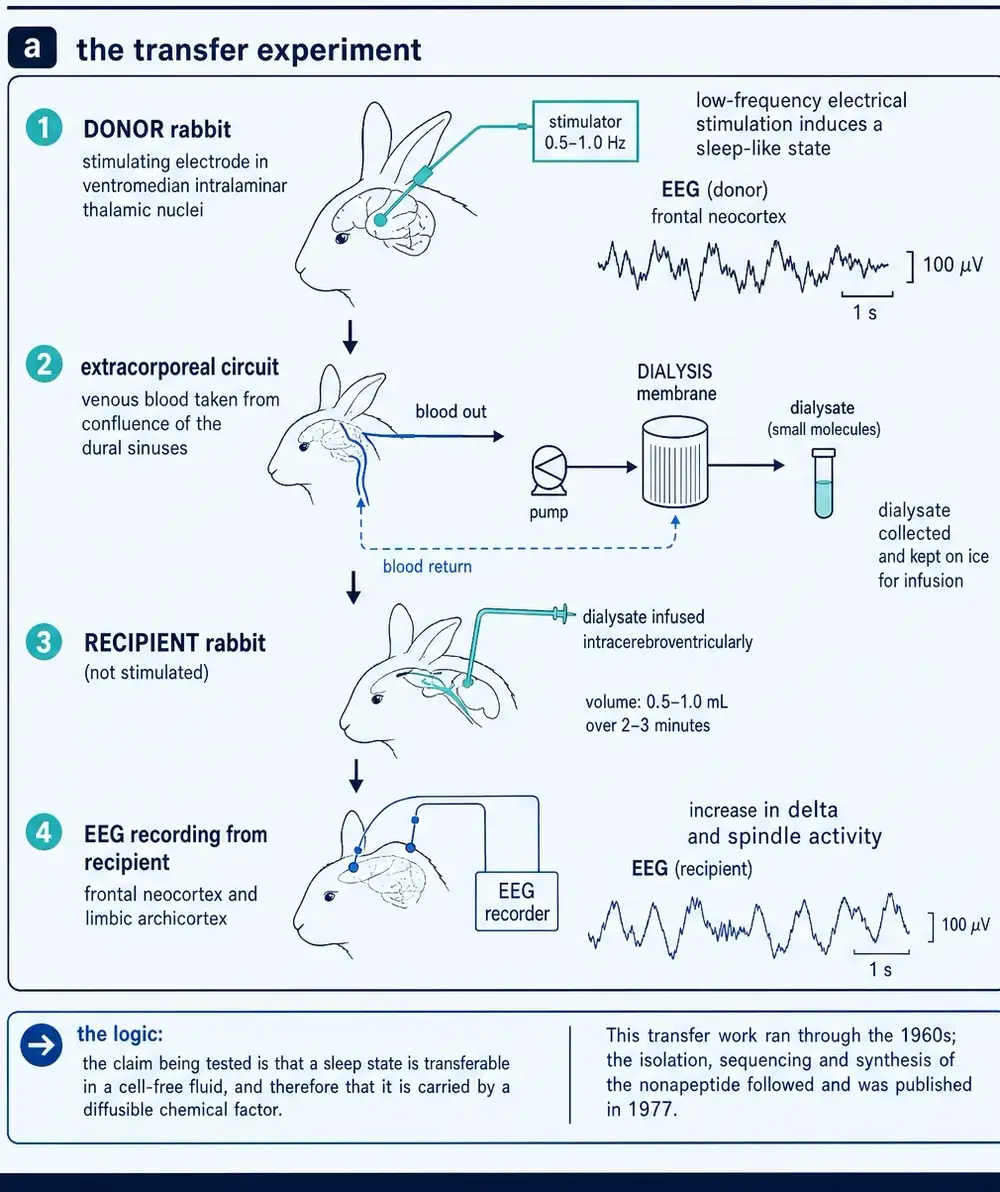
Two features of the design are the reason this work outlived its predecessors, and they deserve to be stated separately because they are the difference between an anecdote and an experiment.
The first is that Monnier ran a sham-stimulation control. Dialysate taken from donor rabbits that had been through the entire surgical and circulatory procedure, but whose thalamus had not actually been stimulated, did not have the same effect. A 2025 retrospective of the field calls this "perhaps the first sleep factor study with an appropriate control" (Opp & Imeri, 2025). Every earlier hypnotoxin experiment is vulnerable to the objection that injecting brain extract into a brain will make an animal sluggish whatever the extract contains; Monnier's is not.
The second is the reciprocal experiment. Stimulating the midbrain reticular formation instead produces arousal rather than sleep; dialysate taken from an alert donor made recipients more aroused, not less (Opp & Imeri, 2025). A substance that has an opposite is very much harder to dismiss as an artefact of handling, temperature or volume. It behaves like a signal rather than like a disturbance.
05Thirteen years to nine amino acids
The chemistry took another decade and a half, and it was not done by Monnier. Guido A. Schoenenberger worked in the Research Division of the Department of Surgery at the Kantonsspital in Basel — a different institution in the same city. The author affiliations on the 1977 papers list the two men under separate headings, and the partnership is the point: Monnier had the physiology, the stereotaxic atlas of the rabbit brain that he had published himself, and the EEG assay; Schoenenberger had the separations.
The work appeared as a numbered series in Pflügers Archiv under the title "Humoral transmission of sleep", running from part I in 1965 to part XI in 1978. By 1972 the group could report the isolation and physicochemical characterisation of an active substance they called factor delta (Schoenenberger et al., 1972). The purification chain in the final papers ran through ultrafiltration, Sephadex gel filtration, preparative thin-layer chromatography, high-voltage paper electrophoresis, a second gel filtration and quantitative thin-layer electrophoresis. The molecular weight came out at 848.98.
In 1977 the sequence was published in the Proceedings of the National Academy of Sciences (Schoenenberger & Monnier, 1977):
Trp–Ala–Gly–Gly–Asp–Ala–Ser–Gly–Glu · WAGGDASGE · nine residues, 848.8 daltons.
The authors named it the delta sleep-inducing peptide, and the abbreviation DSIP entered the literature with it. It would later receive the International Nonproprietary Name emideltide.
06The experiment that made the case
The most persuasive piece of work in the entire DSIP file is the 1978 paper, part XI of the series, and it should be said clearly that it is a good experiment (Schoenenberger et al., 1978).
Having a candidate sequence, the group synthesised it — and then synthesised eight other things: five fragments corresponding to plausible metabolic breakdown products of the nonapeptide (residues 1–8, 2–9, 2–8, 1–4 and 5–9), two analogues in which one or two amino acids had been exchanged, and a related tripeptide. All nine peptides were infused into the ventricular system of rabbits at 6 nmol/kg, in 0.05 ml of a cerebrospinal-fluid-like solution, over three and a half minutes. Sixty-one rabbits were used including controls. The experiment was run double-blind, and the cortical EEG was fast-Fourier transformed and analysed by computer rather than scored by eye.
Only the intact nonapeptide worked. Mean delta activity rose by about 35 per cent in the neocortex and the limbic cortex relative to animals given the vehicle or any of the other eight peptides. The companion 1977 report in the same series put the increase at 43.1 ± 6.25 per cent (Schoenenberger et al., 1977a).
The design carries its own specificity control. Eight closely related peptides — including the fragments the molecule would itself break into — were inactive. That is exactly the pattern a real, structure-specific receptor-mediated effect should produce, and it is very difficult to produce by accident. The chemistry also turned up a detail that would matter later: only the alpha-aspartyl form was active, and the beta-aspartyl isomer was not.
It is important to be fair to this work, because much of what follows is critical. The DSIP programme did not begin badly. It began with a controlled transfer experiment, a reciprocal control, a thirteen-year purification, a blinded structure–activity study with eight negative congeners, and computer-analysed rather than hand-scored electrophysiology. By the standards of 1978 neuroscience that is careful work, and it is why the compound was taken seriously. The problems in this file are not problems of the founding experiments. They are problems of everything that was built on top of them.
07The race DSIP was winning
DSIP did not arrive into an empty field. It arrived first in a crowded one, and the standing of the competitors is the best measure of how large the achievement seemed.
In 1967 John Pappenheimer at Harvard reported that cerebrospinal fluid from sleep-deprived goats promoted sleep when infused into rats and cats (Pappenheimer et al., 1967). By 1971 his group had localised the activity to a fraction below 500 daltons and named it Factor S (Fencl et al., 1971). In Japan, Koji Uchizono and Shojiro Inoué began in 1972 to pursue a sleep-promoting substance from the brains of sleep-deprived rats (Nagasaki et al., 1974).
By 1980, when Alexander Borbély and Irene Tobler in Zurich reviewed the field, there were exactly four candidate sleep factors in the world: DSIP, arginine vasotocin, Factor S, and Uchizono's still-unidentified substance (Opp & Imeri, 2025). Of those four, only DSIP had been purified to homogeneity, sequenced, synthesised, and shown to work as a synthetic compound.
DSIP was, unambiguously, the first endogenous sleep factor anybody had ever caught. That is the achievement, and no part of this document disputes it.
What happened to the competitors is worth knowing, because it is the yardstick. Factor S was chemically identified in 1982, and the answer was strange: it is a muramyl peptide — a fragment of bacterial cell wall, structurally a piece of peptidoglycan (Krueger et al., 1982a). Synthetic muramyl dipeptide reproduced the sleep effect (Krueger et al., 1982b). The archetypal endogenous sleep factor turned out to be, in origin, bacterial — which sounds like a failure and was in fact the opening of an entire field, because it connected sleep to immune signalling and led directly to the modern understanding that infection makes you sleepy through interleukin-1 and tumour necrosis factor. Uchizono's substance resolved into uridine and oxidised glutathione. Prostaglandin D2 and adenosine arrived later and are where the field's centre of gravity sits today.
Each of DSIP's rivals, in other words, was eventually chased down to a defined chemical entity with a known biosynthesis and a mechanism that made sense of something else. DSIP was the one that had been chased down first. Part Five is about the fact that, alone among them, it was never chased down to a gene.
08What became of the two men
Monnier remained at Basel until his retirement in 1974 and was succeeded by Leo Hösli — his co-author on the original 1964 dialysis experiment. His other legacies are technical: he is credited at Basel with contributions to electronystagmography, electroretinography and electropupillography, and his stereotaxic atlas of the conscious rabbit brain, published with Gangloff in 1961, is the instrument that made intraventricular infusion in that species routine.
Schoenenberger's career took a different turn. He continued to publish on DSIP into the early 1990s, but the larger part of his output after 1980 is on something else entirely: burns. With the Basel surgeon Martin Allgöwer he characterised a lipid–protein complex generated by thermal injury to skin — a "burn toxin" — and worked on cerium nitrate treatment for burn wounds. His last traceable publication, a fifty-five-page review in Burns, appeared in 2008.
A founder moving to another field is not evidence against a compound, and this document does not offer it as any. But it is part of why a literature stops being renewed. The two people who understood the original preparation best both stopped working on it, and nobody inherited the problem.
09Nine amino acids and nothing else
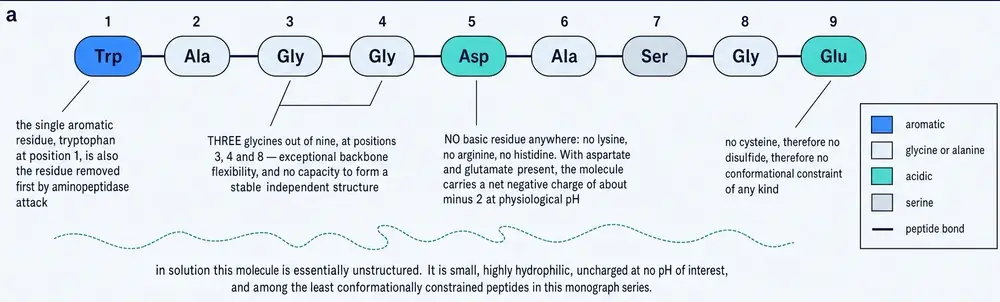
DSIP is about as plain as a peptide gets. Nine residues: tryptophan, alanine, glycine, glycine, aspartate, alanine, serine, glycine, glutamate. Molecular formula C35H48N10O15, 848.8 daltons. There is no disulfide bridge, no ring, no bound metal, no sugar, no lipid tail, no modified residue. Four of the nine positions are glycine or alanine, which are the two smallest and least interesting amino acids there are.
What it does not have is as informative as what it does. It carries no basic residue at all — no lysine, no arginine, no histidine — so at physiological pH the molecule is net negative, dominated by the aspartate at position 5 and the glutamate at position 9. Peptides that dock into receptors usually have a recognisable pharmacophore: a charged cluster, a hydrophobic face, a constrained turn. DSIP has a single aromatic residue at one end and a run of glycines in the middle, which is the sequence equivalent of a piece of string.
It also resembles nothing else. A 2006 review in the Journal of Neurochemistry puts it flatly: the structure "is different from any other known representative of the various peptide families" (Kovalzon & Strekalova, 2006). It is not a fragment of a known hormone, not a member of a recognised family, not homologous to anything the field had already characterised. In 1977 that was thrilling — a genuinely new kind of molecule. In retrospect it is the first hint of the problem that Part Five is about: a peptide with no relatives is a peptide with no obvious gene.
10The isomer problem, and an unexpected second career
The 1978 characterisation reported something easy to skip over: only the alpha-aspartyl peptide was active, and the beta-aspartyl isomer was not (Schoenenberger et al., 1978).
This is not an exotic detail. Aspartate residues followed by glycine or alanine — and DSIP's Asp5 is followed by Ala6 — spontaneously rearrange in aqueous solution. The side-chain carboxyl attacks the backbone, forms a five-membered succinimide ring, and the ring reopens the wrong way about three times out of four, moving the peptide backbone through what was formerly a side chain. The product, isoaspartate, is the same mass and the same amino acid composition. It is invisible to every routine assay. And by the founding study's own account, it does not work.
So the active compound converts, on the shelf and in solution, into an inactive compound of identical mass. Any batch of DSIP is a mixture, and the mixture drifts. This is a plausible partial explanation for a phenomenon that runs through the entire literature and that the originating group repeatedly acknowledged: the effects were inconsistent.
It also gave the molecule an afterlife nobody planned. Because DSIP isomerises readily and is small enough to characterise completely, it became a standard model substrate in the enzymology of protein damage and repair — the study of protein L-isoaspartyl methyltransferase, the enzyme that finds isoaspartate residues and repairs them. A substantial cluster of the modern DSIP literature retrieved for this document is of exactly this kind: papers on isoaspartate formation, on mass-spectrometric detection of isoaspartyl residues, on methyltransferase substrate specificity. They use the molecule as a reagent. They have nothing to do with sleep, and their authors would be surprised to learn the compound is sold as a supplement.
11It does not last
DSIP is degraded by a membrane-associated, puromycin-sensitive aminopeptidase that clips the N-terminal tryptophan off the front of the molecule (Nakamura et al., 1993). The enzymology was demonstrated directly: incubating DSIP with rat brain membrane liberates free tryptophan, and the aminopeptidase inhibitors bestatin and puromycin block both the degradation and the tryptophan release.
The rate is fast. Schoenenberger's own 1984 summary gives the half-life for proteolytic removal of tryptophan by brain slices and homogenates as fifteen minutes (Schoenenberger, 1984). In whole blood, human or rat, incubation of DSIP produces material eluting at the position of free tryptophan, and the rate depends on temperature, time and species (Graf et al., 1987).
That matters more than it might appear, because of what the 1978 experiment established. The five metabolic fragments the group synthesised — including 2–9, which is precisely what you get when you remove Trp1 — were all inactive. So the first chemical event that happens to DSIP in tissue converts it into a peptide the founding study showed does nothing.
The 1987 degradation paper contains a sentence that deserves to be read slowly. Comparing DSIP with two analogues, the authors found the analogues degraded more slowly and formed complexes, and concluded that this "resulted in longer persistence of apparently intact analogs", adding: "Whether this could explain the sometimes stronger and more consistent effects of DSIP-analogs remains to be examined" (Graf et al., 1987).
That is the originating laboratory, in a peer-reviewed paper, recording that the parent compound's effects were weaker and less consistent than those of its own derivatives. It is offered as a pharmacokinetic explanation, and it may well be one. It is also, read plainly, a description of a drug that does not reliably work.
And there is a body of work that takes the observation much further than a remark in a discussion section. Between 1986 and 2001, groups in Moscow and Szeged made analogues designed to resist that first aminopeptidase cut, and tested them head to head against the parent.
The results are consistent and they are strange. Replacing the N-terminal tryptophan with its D-isomer gives [D-Trp1]DSIP, which is more stable against aminopeptidases — and in rabbits, intracerebroventricular doses of 0.7, 7 and 70 µg/kg raised slow-wave sleep by 40 per cent (p < 0.01), with intravenous injection raising it 25 per cent over a narrow 30–70 µg/kg window. The paper reporting it is titled, without irony, "Active analog of the inactive 'sleep peptide'" (Koval'zon et al., 1986). In rats at dark onset — the same protocol in which DSIP itself did nothing — both [D-Trp1]DSIP and [D-Tyr1]DSIP promoted sleep, and the authors concluded that "DSIP is degraded quickly and is therefore not effective" (Obál et al., 1986).
A survey of thirteen analogues in rabbits found the pattern in its sharpest form. DSIP and most of its analogues had no significant effect on sleep. [NMeAla2]DSIP — alanine 2 replaced by N-methylalanine, which stiffens the backbone — produced a pronounced sleep-inducing effect, raising slow-wave sleep by 10–15 per cent. [beta-Ala2]DSIP — the same position replaced by beta-alanine, which lengthens and loosens the backbone — significantly suppressed sleep (Koval'zon, 2001). The phosphorylated form was separately reported five times more potent than the parent, and effective only in a narrow dose window (Kimura & Inoué, 1989).
Two things follow, and they pull in opposite directions. The first supports the compound: something about this sequence is doing real pharmacology, because single-atom changes at one position flip the effect from promoting sleep to suppressing it, and a rigid and a flexible analogue behave like an agonist and an antagonist at the same unidentified target. That is not what noise looks like.
The second is harder for the compound. The molecule that works in these experiments is not the molecule that is sold. The analogues were built specifically to survive the degradation that destroys the parent, and the parent is the preparation on the market. If the reason DSIP fails where its derivatives succeed is that it is cleaved before it can act, then no amount of correct underlying biology rescues a vial of the parent peptide.
12Getting into the brain
A peripherally injected peptide has to reach the brain to act on sleep, and DSIP demonstrably does. Transport across the blood–brain barrier was shown early in the rabbit (Monnier et al., 1977) and studied in detail by Abba Kastin's group at Tulane through the 1980s.
The mechanism, though, is not a dedicated transporter. Radiolabelled N-Tyr-DSIP crosses by a non-competitive route — unsaturable, not displaced by excess unlabelled peptide (Banks et al., 1984). In dogs, the amount of DSIP or its analogues entering cerebrospinal fluid correlated with the plasma concentration, with the plasma half-life, and with the lipophilicity of the particular peptide — but not with plasma protein binding and not with molecular weight (Banks et al., 1986). Those are the correlates of passive diffusion, not of active carriage.
Put the pieces together and there is a hard ceiling on what any peripheral dose can achieve. A molecule with a fifteen-minute degradation half-life, whose first degradation product is inactive, crossing into the brain by unassisted diffusion, will deliver a small and briefly-sustained quantity of intact peptide to the tissue where it is supposed to act. Every systemic result in this document — every intravenous human trial, every subcutaneous rat study — has to be read against that ceiling. It does not make those results wrong. It does mean that a large effect from a peripheral dose would be surprising, and that is worth remembering when we come to the reported effects.
13A dose–response curve of the wrong shape
Almost every drug has a monotonic dose–response relationship over its working range: more produces more, until the system saturates. This is not a cosmetic property. It is the single most powerful tool pharmacology has for distinguishing a real effect from noise, because it makes a sharp prediction that a coincidence will fail. If a middling dose does something and a larger dose does more, that is hard to get by chance.
DSIP does not behave this way. Schoenenberger's own summary describes intracerebroventricular, intravenous and subcutaneous administration as yielding, "in contrast to pharmaka, a parabolic dose-response curve with different effective optima" for each route (Schoenenberger, 1984). Other reports describe the relationship as U-shaped or bell-shaped. The 1984 review by Graf and Kastin states a U-shaped activity curve for dose and for the time of infusion (Graf & Kastin, 1984).
Effects also depend on when in the day they are given. Delta sleep-inducing peptide reduced the nocturnal rise in rat pineal N-acetyltransferase activity, but injections in the morning did not change the enzyme's activity at all (Graf et al., 1985).
There is a practical consequence, and it is worth stating before the argument about evidence. If the dose–response really is parabolic with a different optimum for each route, then there is no such thing as a correct quantity of this compound in the abstract. A number is only meaningful once the route, the species, the time of day and the endpoint being measured are all fixed, and the published optima differ on every one of those axes. That is a statement about the shape of the reported evidence, not a dosing observation: it means the literature does not contain the information a dose would have to be derived from, and no amount of care in reading it will produce that information.
Non-monotonic dose–response relationships are real. Hormesis is a genuine phenomenon, and several endogenous signalling molecules show one. So this is not, by itself, evidence that DSIP does nothing.
But it has a consequence that must be stated plainly, because it shapes how every subsequent result in this document should be weighed. A hypothesis of the form "the effect appears at an optimum dose, which differs by route, and depends on the time of day of administration" is a hypothesis that almost no experiment can refute. A failure at a low dose is below the optimum. A failure at a high dose is above it. A failure at dark onset is the wrong phase. Each of those rescues may be true. Collectively they remove the ability of a negative result to count against the claim — and a claim that cannot be refuted cannot really be confirmed either.
This is the interpretive problem at the centre of the DSIP file, and it is not a rhetorical point. In the next Part there are several careful, competent studies that found nothing. Each of them was met, in the literature of the time, with an explanation of that kind.
14The animal record, and the one result that matters most
The positive animal literature is real and it is not small. In rabbits, the founding species, intraventricular DSIP raised delta activity by roughly a third (Schoenenberger et al., 1978). In rats, intraventricular injection increased sleep duration (Kafi et al., 1979). Intracerebro- ventricular administration increased sleep in rats in other hands as well, with vehicle-injected controls unchanged from their own baseline (Ursin & Larsen, 1983).
A rival Japanese group tested it head to head against four competitors. Using a single nocturnal ten-hour intracerebroventricular infusion in freely moving rats, Inoué and colleagues found DSIP at 2.5 nmol "rapidly effective in increasing both slow-wave sleep and paradoxical sleep", with the caveat that "the effects were not long-lasting". In the same protocol, component B of sleep-promoting substance was "markedly effective" at inducing and maintaining both kinds of sleep (Inoué et al., 1984). A qualified positive from an independent laboratory — which also happens to rank DSIP below a competitor.
But the single most important experiment in the entire DSIP file is none of these, and it deserves its own treatment because it is of a different and better kind.
Iyer, Marks, Kastin and McCann, working at Tulane and Dallas, published in PNAS in 1988. Rats were deprived of sleep for four hours on a slowly rotating wheel. On removal, they showed a significant increase in slow-wave sleep and a significant rise in plasma growth hormone — the normal rebound.
Both increases were abolished by microinjecting a highly specific antiserum to DSIP into the third cerebral ventricle. Control rats receiving an equal volume of normal rabbit serum showed the rebound intact (Iyer et al., 1988).
Every other positive study in this document adds peptide from outside and observes an effect. That design can only ever show that a molecule is sufficient to do something when introduced at an experimenter's chosen dose. The 1988 experiment does the opposite: it removes the animal's own endogenous peptide and watches a natural physiological process fail. That is a loss-of-function result, and loss-of-function is the design that speaks to whether a molecule has a role rather than merely an effect.
It is the closest DSIP ever came to meeting the field's own definition of a sleep factor. It is also, thirty-eight years later, unreplicated.
15The animal record: what did not work
The failures are not from hostile outsiders, and this is the part of the history most often left out. They are same-decade, same-dose, same-route experiments by people who went on to distinguished careers in sleep research.
The earliest and most direct came from Zurich. Irene Tobler and Alexander Borbély gave rats DSIP systemically at 40–160 nmol/kg intraperitoneally, and into the lateral or third ventricle at 7–24 nmol. Neither sleep nor EEG delta power increased significantly. Their conclusion is unambiguous: "neither DSIP nor AVT qualify as a specific sleep-promoting substance" (Tobler & Borbély, 1980).
One detail in that paper is easy to miss and turns out to matter a great deal. Delta-band power was not merely unchanged. After 7 nmol of DSIP into the third ventricle it was reduced.
In 1985 Ferenc Obál and colleagues in Szeged injected DSIP and an analogue at 7 nmol/kg intracerebroventricularly in rats at dark onset and recorded for twenty-four hours. "The duration of sleep did not increase after either DSIP or C-DSIP." Brain temperature followed the vehicle curve exactly. The only significant effect was more waking, six to nine hours later (Obál et al., 1985).
The same year, Susić and Maširević gave cats 7 nmol/kg intracerebroventricularly after seventy-two hours of paradoxical- sleep deprivation. "DSIP failed to affect the duration of slow-wave sleep, PS and total sleep time." What it did do was redistribute light slow-wave sleep into deep slow-wave sleep without changing any total (Susić & Maširević, 1985).
Two further studies found not absence but reversal. In cats given 30 nmol/kg intraperitoneally, DSIP reduced the amount of sleep — specifically light slow-wave sleep and REM sleep — and lengthened REM latency (Sommerfelt, 1985). In rabbits given 30 nmol/kg intravenously there was a tendency towards decreased slow sleep and increased motor activity in the second hour after injection (Griniavichius & Milashius, 1982). And Obál's group later established that a shortened analogue, [D-Trp1]-DSIP(1–6), had "a prompt arousing effect", concluding that DSIP "contains a fragment with an arousing effect" (Obál et al., 1986).
And there is a null of a different and more damaging kind. If DSIP is the substance that accumulates with waking and discharges in sleep, its brain concentration must move when sleep pressure moves. Nagaki and Kato measured free-form immunoreactive DSIP across rat brain regions by enzyme immunoassay after twenty-four hours of sleep deprivation and during subsequent rebound sleep. "Sleep deprivation and subsequent rebound sleep had no significant effect on the brain contents of 'free-form' DSIP" (Nagaki & Kato, 1984).
16When the animal changes, the effect changes shape
DSIP's reported action is species-dependent in an unusual way. In rabbits it enhances delta. In cats, by the originating group's own account, "REM-sleep was predominantly produced" (Schoenenberger, 1984) — that is, in one species the compound named for deep non-REM sleep principally affects the other kind. In rats the results range from clear increases to nothing at all.
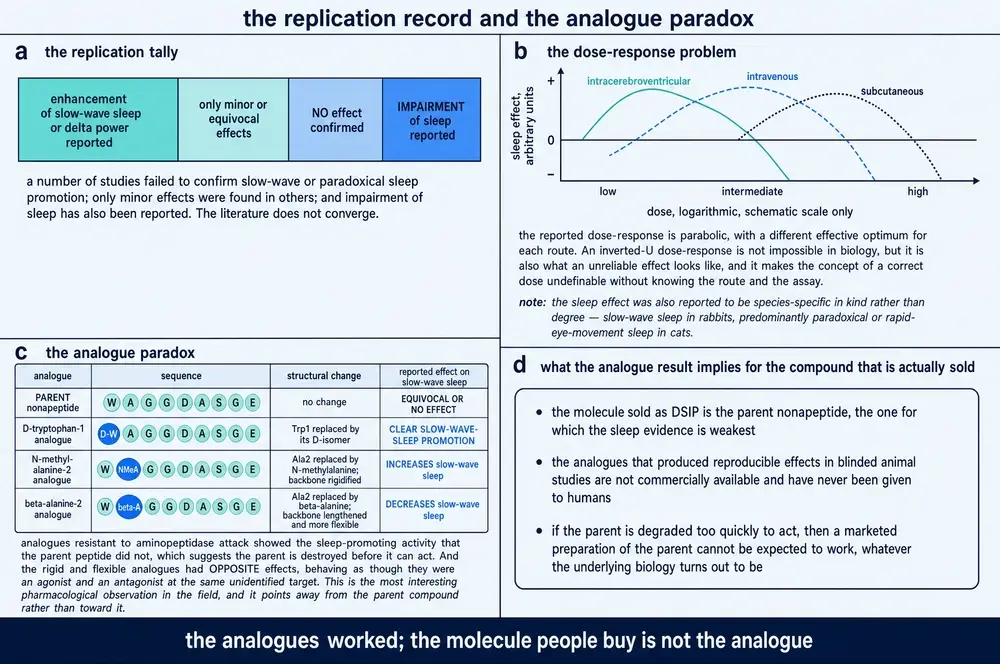
There are two readings, and the honest position is that the available evidence does not separate them. The first is biological: sleep architecture genuinely differs between species, and a modulator acting on a shared upstream system could plausibly express itself differently in each. The second is statistical: a weak, condition-sensitive effect measured in small groups will produce exactly this pattern of inconsistent, direction-varying results, and "species specificity" is the name a field gives that pattern when it believes the underlying effect is real.
17The human record: one investigator's series
Nearly all of the positive human sleep evidence for DSIP comes from one clinician: Dietrich Schneider-Helmert, working with Schoenenberger.
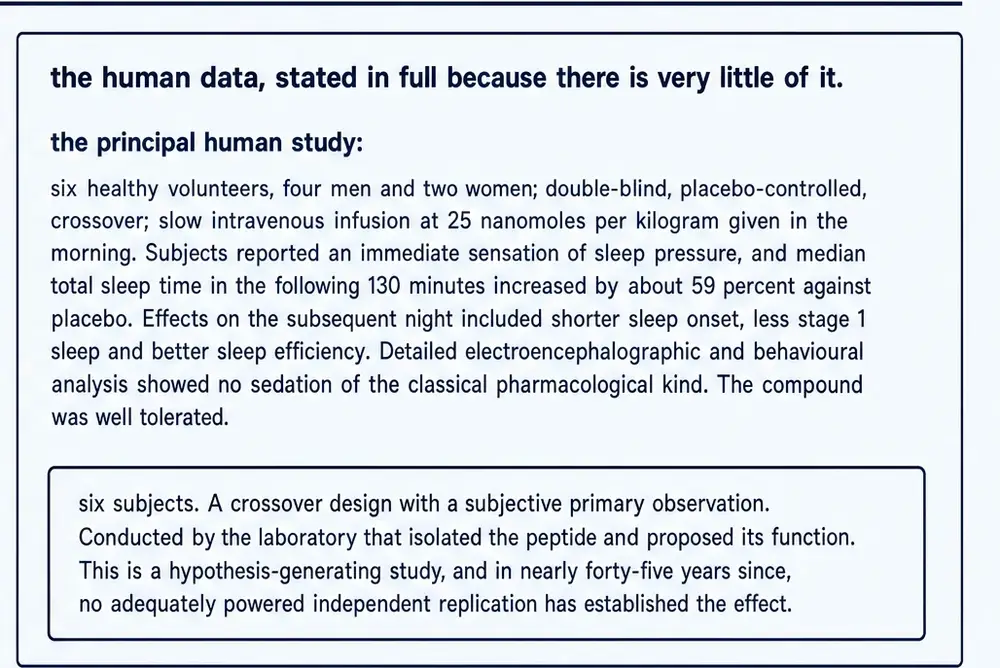
The first study, in 1981, gave 25 nmol/kg by slow intravenous infusion to six healthy volunteers in a double-blind crossover design. Total sleep time rose by 59 per cent (median) in the 130 minutes after treatment, subjects reported a feeling of sleep pressure, and subsequent night sleep showed shorter onset and better efficiency. The authors were careful to note that detailed behavioural and EEG analysis revealed "no sedation in the classic pharmacologic way" (Schneider-Helmert et al., 1981a). The same year, a Lancet report announced that the peptide improved sleep in insomniacs (Schneider-Helmert et al., 1981b), and a companion paper reported six middle-aged chronic insomniacs given the same dose (Schneider-Helmert & Schoenenberger, 1981).
The series continued for six years. A 1983 synthesis of five studies reported a sleep-induction latency of about an hour but a duration of effect "up to 20 h", with complete normalisation of disturbed sleep after four consecutive injections (Schneider-Helmert & Schoenenberger, 1983). A 1986 study gave eighteen chronic psychophysiological insomniacs six doses of 30 nmol/kg over a week (Schneider-Helmert, 1986). A 1987 study gave fourteen middle-aged chronic insomniacs seven consecutive nights of placebo-controlled double-blind treatment and reported improvement in both night sleep and daytime alertness (Schneider-Helmert, 1987).
Note the sizes: six, six, fourteen, eighteen. These are early-phase studies, and they were presented as such. The issue is not that they are small. It is that for a decade they were the whole of the human evidence, and they all came from the same centre, using peptide supplied by the laboratory that discovered it.
18The human record: what happened when others tried
Two groups outside Basel ran double-blind polysomnographic trials. Both published null or near-null results, and together they are the hinge of this document.
In Montevideo, Monti and colleagues gave chronic insomniacs 25 nmol/kg intravenously or placebo across four nights in a double-blind crossover design, with polysomnographic recording. Awakenings, non-REM sleep latency, total waking time and waking after sleep onset all fell under DSIP — but not significantly against baseline or against placebo. Total sleep time and non-REM sleep did rise, and the rise was driven by stage 2. Stage 1, slow-wave sleep — stages 3 and 4, the delta sleep the compound is named for — and REM sleep "were not modified". Where DSIP–placebo differences did reach significance, the authors observed that "the same differences existed already for the baseline values". Their conclusion: "sleep improvement under DSIP treatment is of little clinical significance" (Monti et al., 1987).
Five years later a Dutch group ran a double-blind, matched-pairs, parallel-group study in sixteen chronic insomniac patients across five consecutive laboratory nights, with 25 nmol/kg intravenously or a glucose placebo before each of the last three. Objective sleep quality did favour DSIP: higher sleep efficiency, shorter sleep latency. But the authors reported that "the statistically significant effects were weak and in part could be due to an incidental change in the placebo group", that no other measure including subjective sleep quality changed at all, and concluded that short-term treatment of chronic insomnia with DSIP "is not likely to be of major therapeutic benefit" (Bes et al., 1992).
The pattern here needs naming precisely, because it is easy to overstate. This is not a case of one group fabricating an effect that others could not find. Both independent studies did see the numbers move in the expected direction. What they did not see was an effect large enough, or clean enough against its own controls, to matter. And the one endpoint that failed most clearly in the independent work was slow-wave sleep — the endpoint the molecule is named after.
19The most careful measurement ever made, and it points the other way
The last substantial human study of DSIP was published in 2009 in the European Journal of Anaesthesiology, and it is the most heavily instrumented measurement of the compound's effect on the human brain in the literature.
Pomfrett and colleagues in Manchester recruited twenty-four women undergoing surgery. Twelve received saline; twelve received DSIP at 25, 50 or 100 nmol/kg intravenously — once while awake and again after induction of anaesthesia with propofol and maintenance with isoflurane. Bilateral EEG electrodes, continuous bispectral index and heart-rate variability were recorded throughout. The hypothesis was explicit and favourable: that DSIP, being a natural hypnotic, would deepen anaesthesia (Pomfrett et al., 2009).
It did the opposite. DSIP significantly increased heart rate and decreased heart-rate variability. At 25 nmol/kg during isoflurane anaesthesia it reduced burst suppression and increased the bispectral index — that is, it made the anaesthesia lighter. And, in the authors' own word, "paradoxically", it significantly reduced delta rhythm. It also altered the left–right symmetry of the EEG. Their interpretation was that DSIP had reduced parasympathetic tone and lightened anaesthetic depth.
How much weight should this carry? It is a single study. The participants were anaesthetised, not naturally asleep, and an anaesthetised EEG is not a sleeping EEG. Those limitations are real and the document does not set them aside.
But two things give it standing. The first is that it is the most recent and by a wide margin the best-instrumented human EEG measurement of this compound, and this document's standing rule is to weight recency unless a preponderance of evidence contradicts it. Nothing contradicts it, because nothing comparable has been done since. The second is that it is not alone in direction: Tobler and Borbély reported reduced delta-band power after intraventricular DSIP in rats in 1980. Two measurements, twenty-nine years and two species apart, made by groups with no connection to each other, both found delta power going down.
20The bar the field set for itself
By 1980 the sleep-factor field had grown large enough to need rules, and Borbély and Tobler proposed them. By the time of their comprehensive Physiological Reviews survey nine years later the criteria had been distilled to two, each with several components: first, the sleep a candidate substance promotes must be physiological — real sleep, reversible, with normal architecture, not sedation; second, changes in the endogenous substance must be associated with changes in sleep in the organism (Borbély & Tobler, 1989).
On the first criterion DSIP does moderately well, with one dissent that deserves recording. What sleep it produced looked like ordinary sleep: no classical sedation, no hangover, normal architecture, and human subjects reported sleep pressure rather than druggedness. Whatever else is true, nobody has ever suggested DSIP is a sedative. The dissent is from 1980, when Demin and colleagues examined the biochemistry of the induced state in rats and found it lacked the anabolic protein- and RNA-synthesis signature that accompanies natural sleep, characterising it instead as a "cataleptiform immobility" of a kind normally seen only in lower vertebrates (Demin et al., 1980). That is a direct challenge to the first criterion, made on biochemical rather than electrophysiological grounds, and it was never resolved.
On the second it fails on the only direct test available. Brain content of free DSIP did not change with sleep deprivation or rebound (Nagaki & Kato, 1984). The one result pointing the other way — that blocking endogenous DSIP with antiserum abolished sleep rebound (Iyer et al., 1988) — is powerful, and it is a single unreplicated experiment from 1988.
It is worth remembering what happened to the field around DSIP while this was unresolved. In 1980 Borbély and Tobler could list four sleep factors. By 1989 they listed more than twenty, and Inoué's book of the same year listed about thirty (Opp & Imeri, 2025). "Few of these substances had been characterised well enough to meet all proposed sleep factor criteria." The molecules that survived that expansion — adenosine, prostaglandin D2, the inflammatory cytokines — survived because each acquired a receptor, a synthetic pathway and a mechanism that explained something else as well.
DSIP acquired none of those. That is the subject of Part Five. But first there is the question of what a compound's literature does when its founding claim will not consolidate — because in DSIP's case, it did not stop. It spread.
21What a literature does when its headline claim will not settle
Between 1980 and 1995 the DSIP literature grew quickly. It did not grow deeper — there was no second generation of larger, better-controlled sleep trials — it grew wider. The compound was reported to act on the stress axis, on withdrawal syndromes, on pain, on seizures, on free radicals, on tumours, on cardiac rhythm, on ageing.
This is a recognisable pattern and it is worth naming before the findings are presented, because it changes how they should be read. When a compound's founding claim will not consolidate, its literature rarely stops. It diversifies. Each new domain starts fresh, with small studies and no accumulated burden of failed replication, and each can be reported as a positive finding. The result is a bibliography that looks impressive in aggregate and thin at every individual point.
That framing is not a verdict. Some of what follows is genuinely well supported — one claim in this Part has a better evidence chain than the sleep claim ever did. The purpose of naming the pattern is to make sure the reader weighs each domain on its own evidence rather than on the size of the pile.
22The stress axis: the best-supported claim in the file
If DSIP does one thing reliably, this is it.
In isolated rat anterior pituitary in vitro, DSIP inhibited corticotropin-releasing-factor-stimulated ACTH secretion while leaving basal ACTH and basal cyclic AMP unchanged (Okajima & Hertting, 1986). In rats in vivo, DSIP reduced the corticosterone release elicited by CRF but had no effect on the corticosterone released by ACTH itself (Graf et al., 1985b). Those two results locate the action precisely: DSIP acts upstream, on the pituitary's response to hypothalamic drive, and not on the adrenal gland's response to pituitary drive.
The human test came in 1989. Eleven healthy men aged 25–39 received a single 25 nmol/kg intravenous dose of DSIP or saline in a randomised, double-blind crossover design. Plasma ACTH-like immunoreactivity fell significantly for at least three hours relative to controls, in whom it rose slightly. Plasma cortisol was unaffected and followed its normal diurnal decline (Bjartell et al., 1989b).
And in 1988, twenty-four subjects — twelve with major depressive disorder and twelve matched controls — received 100 µg of synthetic human CRH intravenously. Healthy subjects showed a slight sustained rise in plasma DSIP; depressed patients showed a marked reduction (Lesch et al., 1988).
Weighing this. The direction of effect is consistent across cultured pituitary cells, whole animals and human volunteers, from more than one laboratory, with a coherent mechanistic locus and an appropriate control that distinguishes the pituitary from the adrenal. That is a better evidence chain than anything in Part Three. It is worth pausing on the irony: the claim with the cleanest support is the one nobody markets, and the reason is presumably that "modestly blunts the ACTH response to CRH" does not sell.
Two cautions belong beside it. The human study measured ACTH-like immunoreactivity, and cortisol — the downstream output that would matter physiologically — did not move. And several of the observations depend on radioimmunoassays for DSIP whose specificity is the subject of Part Five.
23Withdrawal: the most dramatic claim, on the weakest design
In 1983 a Geneva group led by Pierre Dick reported that DSIP given intravenously at 25 nmol/kg, as sole treatment, relieved withdrawal symptoms in 67 patients — 28 withdrawing from alcohol, 39 from opiates. Twenty-seven per cent were lost or unevaluable. Of the 49 evaluable patients, 48 improved, with immediate onset and lasting suppression of the somatic signs; anxiety resolved more slowly, over hours (Dick et al., 1983).
A larger report followed in 1984: 107 inpatients, 47 alcohol and 60 opiate. Thirteen and twenty-two per cent respectively were unevaluable. Symptoms disappeared or improved markedly in 97 per cent of opiate and 87 per cent of alcohol patients. Tolerance was good aside from headaches in a few patients (Dick et al., 1984).
The hypothesis behind the work was specific and interesting. Tissot had found that morphine, alcohol, pentobarbital and DSIP all produced slow-wave sleep with spindles when injected into the bulbo-mesencephalo-thalamic recruiting system, and that in every case the effect was reversed by naloxone — suggesting DSIP had agonist activity at opioid receptors.
Neither study had a placebo group, a control group, randomisation, or blinding. Outcome was assessed clinically by the treating physicians and nursing staff, without a validated withdrawal instrument.
Withdrawal syndromes remit spontaneously on a timescale of days, and are among the conditions most responsive to inpatient admission, attention and reassurance. Under an uncontrolled design, a 97 per cent response rate is not evidence of a large treatment effect. It is compatible with a large treatment effect, with a small one, and with none at all, and the design cannot distinguish between them. This is not a criticism of the investigators, who described what they did accurately; it is a statement about what the method can deliver.
The naloxone-reversibility hypothesis was never tested against placebo in people. It is also the concern the United States Food and Drug Administration would return to in 2026, and it is the indication for which the compound is approved in Russia today — both discussed in section 32.
24Pain and seizures
The human pain evidence is a single open pilot. Larbig and colleagues treated patients with chronic pronounced pain episodes and reported therapeutic effects (Larbig et al., 1984). There was no control group. The supporting animal work is three rodent studies, two from one Japanese group, and they disagree with the third about whether the analgesia is naloxone-sensitive — which is the question that would determine whether the proposed opioid mechanism is real.
The anticonvulsant literature is better populated and more consistent. DSIP and its analogues showed antiepileptic activity in metaphit-provoked audiogenic seizures in rats (Stanojlović et al., 2005), and DSIP potentiated valproate in the same model (Hrnčić et al., 2006). In corazol kindling, DSIP at 100 µg/kg intraperitoneally reduced the mortality of animals that developed kindled seizures (Shandra et al., 1988). A review from the same tradition proposes DSIP alongside neuropeptide Y as an endogenous anticonvulsant (Stanojlović et al., 2008).
There has never been a human seizure trial of DSIP. The entire anticonvulsant claim is animal data, concentrated in a small number of laboratories in Serbia, Ukraine and Russia.
25The Russian second life: adaptogen, antioxidant, geroprotector
From the early 1990s the centre of gravity of DSIP research moved decisively to Russia, and principally to the Shemyakin–Ovchinnikov Institute of Bioorganic Chemistry, where the peptide and its analogues were synthesised. The framing changed with the geography. DSIP stopped being a sleep factor and became an adaptogen — a non-specific protector against stress of any kind.
The claims are numerous and internally consistent. Subcutaneous DSIP at 100 µg/kg, given to rats as five-day courses once a month across ages two to twenty-four months, increased expression of the genes for superoxide dismutase 1 and glutathione peroxidase (Kutilin et al., 2014), stabilised mitochondrial electron-transport chain enzymes, stabilised lysosomal membranes, and reduced accumulation of oxidised proteins measured by carbonyl and thiol groups (Bondarenko et al., 2012). In rats subjected to global cerebral ischaemia, the Deltaran preparation was associated with 100 per cent survival against 38 per cent mortality in untreated animals (Koplik et al., 2008). A DSIP analogue reduced death from acute cisplatin toxicity to 17 per cent against 50–67 per cent in controls (Mikhaleva et al., 2014).
The longevity work is the most carefully reported of the group and its result is more interesting than the summaries suggest. Popovich, Voitenkov and Anisimov gave Deltaran to 54 female SHR mice per group, at roughly 100 µg/kg subcutaneously, five consecutive days every month from the age of three months until natural death. The findings (Popovich et al., 2003):
- mean life span — no effect;
- life span of the last 10 per cent of survivors — increased 17.1 per cent;
- maximum life span — increased 24.1 per cent;
- total spontaneous tumour incidence — decreased 2.6-fold;
- chromosome aberrations in bone-marrow cells — decreased 22.6 per cent.
A later study in the same strain and schedule found the last 10 per cent of survivors lived 16 per cent longer (Voitenkov et al., 2009).
Weighing this body of work. Three things should be said, and the order matters. First, it is not junk: the studies are properly powered by the standards of rodent gerontology, the longevity work reports its own null on mean lifespan rather than burying it, and a 2.6-fold reduction in spontaneous tumour incidence is a large and specific finding. Second, it is a literature produced by a small number of linked groups, published very largely in Russian-language journals with limited international readership, and it has essentially no independent replication outside Russia. Third — and this is the part that should temper enthusiasm most — there is no human lifespan, mortality or hard-outcome data of any kind. The two human records in this domain are a sixty-day open-label pilot in eleven elderly diabetic patients (Odin et al., 2004) and an uncontrolled two-month intranasal study of visual evoked potentials in thirty patients with diabetic retinopathy (Kresiun et al., 2014). Neither had a control group.
26The adverse record, which is not empty
DSIP is routinely described as free of side effects. One paper in this corpus states outright that the compound "produced no harmful effects even when overdosed" (Stanojlović et al., 2001). That statement cites prior work rather than reporting a toxicology result, and it is contradicted by findings in the same literature.
Acute parkinsonism. Bilateral microinjection of 10.0 nmol of DSIP into the rat substantia nigra provoked hypokinesia and rigidity lasting four hours; the authors concluded it "caused acute parkinson syndrome in rats". Half that dose into the same structure, or the full dose into the caudate nuclei, did not (Kryzhanovskii et al., 1990). Unilateral intranigral DSIP produced a contralateral rotational syndrome, prevented by naloxone and enhanced by haloperidol (Shandra et al., 1996). A review from that group lists parkinsonian and rotational syndromes among the neuropathological states DSIP can help generate (Shandra et al., 1995).
Immunosuppression. In a lymphokine screen, DSIP significantly decreased interleukin-3, colony-stimulating factor levels and responses, interleukin-2, the number of IL-2 receptors, and cell proliferation — and among the agents tested "DSIP was the most potent" (Yehuda et al., 1987).
Hepatic and oxidative signals at low doses. In rats under foot-shock stress, DSIP up to 40 µg/kg increased serum aminotransferase activity, and decreased catalase activity at every dose tested after acute stress; malondialdehyde fell at 40 µg/kg but rose at other doses against a background of reduced total antioxidant activity (Belykh et al., 2015). This is the same domain in which DSIP is reported as an antioxidant, at overlapping doses.
Cardiovascular direction disputed. In rats, DSIP decreased blood pressure and heart rate (Yehuda et al., 1988). In the 2009 human anaesthesia study it significantly increased heart rate and decreased heart-rate variability (Pomfrett et al., 2009).
Thermoregulation in both directions. In rats at 4 °C a low dose caused hypothermia while larger doses did not; at 22 °C all three doses caused hyperthermia (Yehuda et al., 1980).
None of this establishes that DSIP is dangerous, and it should not be read that way. Intranigral microinjection is a deliberate lesion-style manipulation, not a model of any human exposure. The point is narrower and it is a point about the evidence rather than about the molecule: the claim that DSIP has no adverse effects is not supported by its own literature, and the reason it has persisted is that no study was ever designed to look. As the reading of the corpus established, no human study of DSIP reports systematic safety monitoring, laboratory panels, or a defined adverse-event follow-up period. The only human adverse event recorded anywhere in the corpus is headache in a few patients in the 1984 withdrawal series. An absence of reported harm from studies that did not measure harm is not a safety record.
27What "multifunctional regulatory peptide" means
The phrase recurs throughout the modern literature, and by now the reader can assemble what it stands for. Across the corpus DSIP has been reported to affect sleep, EEG frequency composition, ACTH, corticosterone, cortisol, luteinising hormone, growth hormone, prolactin, pituitary cell differentiation, pineal N-acetyltransferase, monoamine oxidase A, body temperature, locomotor circadian rhythm, amphetamine and morphine responses, seizure threshold, ventricular fibrillation threshold, lipid peroxidation, antioxidant enzyme gene expression, mitochondrial enzyme activity, lysosomal membrane stability, protein and RNA synthesis, polyamine metabolism, heat-shock protein accumulation, lymphokine production, tumour incidence and maximum lifespan.
For a nine-residue peptide with no identified receptor and a fifteen-minute degradation half-life, that breadth is a problem rather than a credential.
Two readings compete, and this document does not think the evidence distinguishes them. The generous reading is that DSIP is a genuine upstream modulator — something acting early in a regulatory cascade, whose perturbation therefore shows up in many downstream measurements. Molecules like that exist. The unforgiving reading is that this is what a literature looks like when many small, underpowered studies each test a different endpoint and each publishes the one that moved.
What would separate them is not another effect. It is a mechanism: a receptor, a binding site, a signalling pathway. A molecule with a known receptor that turned out to touch twenty systems would be a fascinating upstream regulator. A molecule that touches twenty systems and has no known receptor after fifty years is something else, and the question of which is the subject of Part Five.
28What the antibody was seeing
Hundreds of the papers in this document rest on a single technique. To ask whether DSIP rises in stress, falls in depression, appears in milk, tracks the circadian cycle or differs between patients and controls, you raise an antibody against synthetic DSIP, and you measure what it binds. The quantity you get is called DSIP-like immunoreactivity, DSIP-LI.
What follows is the case that DSIP-LI is mostly not DSIP. The remarkable thing about that case is that almost every piece of it was assembled and published by the people who believed in the compound. This is not a critique from outside. It is a fifteen-year record of a field documenting its own central difficulty, in print, and then continuing.
The warning is in the very first radioimmunoassay paper. Kastin and colleagues raised antibodies that showed no cross-reactivity with nineteen naturally occurring peptides, established the assay, and found immunoreactivity in rat brain, highest in the thalamus at 11.9 ± 1.3 pg/mg. Then they wrote that "the widespread presence of DSIP-like material throughout the body as well as the shared amino acid sequences of DSIP with other proteins suggest caution in defining the material being measured by this new assay" (Kastin et al., 1978).
The caution was warranted. Over the following years the same groups established, piece by piece, what the antibody was actually binding:
- In twelve peripheral rat organs, immunoreactive material ranged from 86 pg/mg in muscle to 849 pg/mg in stomach — and gel chromatography showed it was mostly larger than DSIP, apparently bound to protein, releasable into small immunoreactive peptides only by tryptic digestion (Graf & Kastin, 1984b).
- In pig pituitary and adrenal medulla, high-performance liquid chromatography revealed one major immunoreactive peak that did not co-elute with synthetic DSIP; the authors suggested it might be N-terminally truncated fragments (Ekman et al., 1987).
- In human, pig and rat gut, a single peak appeared at approximately the retention time of DSIP 3–9 — not the nonapeptide (Bjartell et al., 1989a).
- In cultured mouse anterior pituitary cells, pulse-chase labelling identified three precursors of 50–60 kDa processed to intermediates and then to a peptide below 3 kDa which incorporated glucosamine — a glycopeptide, "not identical with, but has similarities to, rabbit DSIP" (Bjartell et al., 1990).
- In porcine pituitary and adrenal, "the naturally occurring forms of DSIP are not fully identified"; roughly 30 per cent of the immunoreactivity appeared glucosylated, and immunoblotting identified a 25 kDa immunoreactive component (Bjartell et al., 1991a).
- In rat hypothalamus, a single immunoreactive peak of lower hydrophobicity than synthetic DSIP (Bjartell et al., 1991b).
- And in 1997, structural biology delivered a candidate for at least part of what the antisera had been seeing: a 77-residue protein named delta sleep-inducing peptide immunoreactive peptide, a close homolog of the Drosophila shortsighted gene product, which forms a leucine-zipper dimer (Seidel et al., 1997). That is not a neuropeptide. It is a transcription-factor-like protein.
There is one more finding, and it is the most uncomfortable of them. In 1984 Fischman, Kastin and Graf reported an artefact they named HPLC shadowing: carry-over of peptide from a previous injection of standard onto the same column. With DSIP they measured the carry-over at as much as 10 per cent, and warned that it "can appear to result in the presence of endogenous peptide in the test sample when none is actually there" (Fischman et al., 1984).
Since the standard method for demonstrating that endogenous DSIP-LI really is DSIP was to run it on HPLC and show that it co-elutes with a synthetic standard, this is a paper from within the field explaining precisely how the field's principal confirmatory technique can manufacture the result it is used to confirm.
The counter-evidence, which is real and must be given its weight. Free DSIP does exist. Graf, Kastin and Fischman applied gel chromatography followed by HPLC to rabbit, human, rat and dog plasma and found a distinct peak of immunoreactivity eluting exactly where synthetic DSIP elutes; free DSIP was also found in human cerebrospinal fluid, and in human urine most of the small-molecular- weight material eluted at the position of DSIP-P, the phosphorylated form (Graf et al., 1984). Nakamura and colleagues later showed that immunoreactive material released from rat brain slices co-eluted with native DSIP (Nakamura et al., 1993).
So the question is not whether the nonapeptide exists in tissue. On the available evidence it probably does, in small amounts. The question is whether the hundreds of studies that measured "DSIP" in plasma, cerebrospinal fluid, milk, gut, pituitary, adrenal and tumour tissue were measuring it — and the chromatography, wherever it was actually performed, mostly says no.
29Released, but not the way a neuropeptide is released
In 1993 Nakamura, Nakanishi and Shiomi asked whether DSIP behaves like a neuropeptide. The answer was half yes.
Immunoreactive DSIP was released from rat brain slices and from synaptosomes when they were depolarised with high potassium, and the released material co-eluted with native DSIP on gel filtration. That is good evidence of regulated release from nerve endings. Degradation was by a membrane-associated, puromycin-sensitive aminopeptidase, blocked by bestatin and puromycin (Nakamura et al., 1993).
But the release was independent of extracellular calcium. Vesicular release of neurotransmitters and neuropeptides is calcium-dependent; that is one of the most reliable facts in cellular neuroscience. The authors noted, carefully, that "the secretory pathway of DSIP may be different from that of other neurotransmitters."
This is a result that supports and undermines the same claim, and it should be read as both. Something DSIP-shaped comes out of nerve terminals when they fire. It does not come out through the machinery by which neuropeptides are known to be released.
30Fifty years, no gene
Every peptide messenger the field accepts has three things: a gene, a precursor protein from which it is cleaved, and a receptor through which it acts. Insulin has all three. So does orexin, the peptide that actually does regulate wakefulness and whose discovery in 1998 reshaped sleep medicine. So do the melanocortins, the opioid peptides, and every hypothalamic releasing factor.
DSIP has none of them.
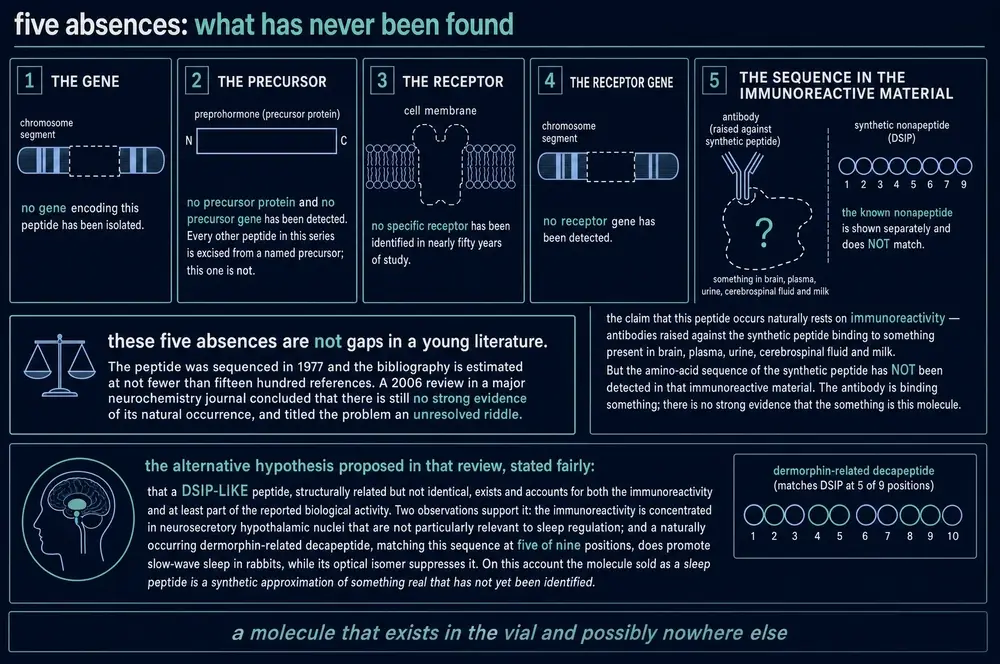
Vladimir Kovalzon and Tatyana Strekalova, writing in the Journal of Neurochemistry, titled their review "Delta sleep-inducing peptide (DSIP): a still unresolved riddle". Their assessment: the link between DSIP and sleep "has never been further characterized, in part because of the lack of isolation of the DSIP gene, protein and possible related receptor. Thus the hypothesis regarding DSIP as a sleep factor is extremely poorly documented and still weak" (Kovalzon & Strekalova, 2006).
They went further, and proposed the explanation this Part has been building towards: that some other, DSIP-like peptide accounts for both the immunoreactivity and the biological activity. Their evidence included the observation that DSIP-like immunoreactivity maps to hypothalamic neurosecretory nuclei that are not particularly relevant to sleep regulation.
Note what that review is and where it appeared. It is not a polemic in an obscure venue; it is a mainstream review in a mainstream neurochemistry journal, by an author who had spent his career on this compound and had asked the same question in Russian twelve years earlier under a title that is itself a summary: "DSIP: the sleep peptide or an unknown hypothalamic hormone?"
Twenty years on, nothing has answered it.
31The best available answer: a fragment of a histone demethylase
In 2011 a group at the Shemyakin–Ovchinnikov Institute did the obvious thing, which nobody had done: they searched the protein databases for the DSIP sequence.
They did not find WAGGDASGE. What they found, at residues 324–332 of human lysine-specific histone demethylase 3B — the product of the JMJD1B gene, one of a ubiquitous and phylogenetically ancient family of chromatin-modifying enzymes — was WKGGNASGE: the same nine positions, differing at two of them (Mikhaleva et al., 2011).
They then synthesised it, named it KND, and tested it against DSIP head to head. The results are the part that makes this more than a database curiosity.
In comparative in-vivo assays, KND's antioxidative, anticonvulsive and behavioural effects were "even more expressed than in DSIP case" (Mikhaleva et al., 2013). KND halved animal mortality from an LD50 dose of cisplatin. And in ischaemia–reperfusion models — where the peptides were given in the first minute of reperfusion — KND reduced myocardial infarct area to 19.1 ± 7.3 per cent against 42.1 ± 9.2 per cent in saline controls, and brain infarct volume to 7.4 ± 3.5 per cent against 12.2 ± 5.6 per cent (Tukhovskaya et al., 2021a).
The same paper carries a hard safety finding that belongs beside those numbers. In pilot experiments where the peptides were given during the occlusion rather than at reperfusion, mortality was 100 per cent. The authors concluded that in ischaemia–reperfusion injury these peptides can be used only during reperfusion (Tukhovskaya et al., 2021a). Timing is not a detail here; it is the difference between protection and death in the animal model.
What this does and does not establish. It does not establish that KND is the endogenous molecule. Nobody has shown that this fragment is actually cleaved out of the demethylase in a living cell, and until someone does, the hypothesis is a sequence alignment with supporting pharmacology. The 2011 authors were appropriately careful, writing that the enzymes "can be considered as possible protein precursors".
But consider what it would mean if it were right. The best current candidate for the endogenous source of "DSIP activity" would be a fragment of an enzyme that edits chromatin — a molecule with nothing to do with sleep, whose day job is removing methyl groups from histones. And in several assays that fragment works better than the peptide that has carried the name for fifty years.
It is worth sitting with the shape of that. The 1977 isolation was a real achievement performed with real rigour. It may also have caught the wrong molecule — something close enough to the real signal to be biologically active, and to fool an antibody, and to sustain fifty years of research, without being the thing itself.
32Where the compound stands in 2026
Publication. The literature has a clear shape. Indexed records whose identity resolves to DSIP number 12 in the 1970s, 179 in the 1980s, 158 in the 1990s, 69 in the 2000s, 25 in the 2010s and 7 so far in the 2020s. What remains is largely three things: work from a small number of Russian groups, papers that use DSIP as a reagent in protein-repair enzymology, and reviews that list it among historical sleep factors. A 1994 bibliometric study of 42 neuroactive peptides identified a class showing "an initial, often intense, research emphasis that inexplicably declined, in some cases precipitously, in the mid 1980s"; DSIP was among the peptides analysed (Myers, 1994).
Registration. DSIP is not approved in the United States or the European Union, and it appears in no pharmacopoeia. But the frequently repeated claim that it is approved nowhere is wrong. In the Russian Federation, Deltaran holds registration certificate ЛП-003849: a lyophilisate for intranasal solution containing 0.3 mg of tryptophanyl-alanyl-glycyl-glycyl-aspartyl-alanyl-seryl-glycyl-glutamic acid — DSIP, named in full rather than by its INN — together with 3.0 mg of glycine. It is classified ATC N07BB, drugs used in alcohol dependence, and its registered indications are treatment and prevention of stress-induced states, and alcohol withdrawal syndrome and primary pathological craving for alcohol. It is available without prescription.
Two things about that registration deserve emphasis. First, the indication is not insomnia. The one jurisdiction that has approved DSIP approved it for the domain covered in section 23 — the one supported by two uncontrolled open-label case series. Second, the product is ten parts glycine to one part peptide by mass, and glycine is itself sold as a sleep aid.
The 2026 refusal. On 23–24 July 2026 the United States Food and Drug Administration's Pharmacy Compounding Advisory Committee considered whether emideltide should be added to the section 503A list of bulk drug substances that compounding pharmacies may use. It considered several peptides at that meeting. It recommended BPC-157, KPV, TB-500, MOTS-c, epitalon and semax. Emideltide was the only one it refused, on a vote of 6 in favour, 7 against, with 1 abstention.
The stated grounds, as reported from the meeting, were that the substance is not adequately characterised and carries potential for peptide-related impurities from incomplete coupling, truncation or side reactions; that there is a lack of safety and efficacy data for the nominated uses of insomnia, narcolepsy and opioid use disorder; and that approved therapies already exist for those conditions. One committee member cited "low-quality evidence around efficacy". Public testimony noted that the most recent supporting study was decades old. The recommendation is advisory and not binding; any change would require formal rulemaking.
Trials. There is no registered interventional clinical trial of DSIP on ClinicalTrials.gov.
The market. Meanwhile the compound is sold. This project's own vendor sweep of the research-chemical market recorded DSIP offered at 2 mg and 5 mg per vial by multiple retailers, against 74 distinct product pages across more than a dozen domains. Of 323 documents in the local library mentioning DSIP, five were peer-reviewed full texts; 177 were dated snapshots of vendor product pages and a further 125 were trade and affiliate copy. That ratio — roughly sixty-three commercial documents for every scientific one — is the sharpest single measurement in this document of where DSIP now lives.
Those two bodies of writing have been moving apart for thirty years. The scientific literature peaked in the 1980s and has shrunk in every decade since, while the commercial literature is, on this project's own sampling, an order of magnitude larger and still being written. Nothing in the second depends on anything in the first: the vendor pages do not cite the failures to replicate, because they do not cite anything. What sustains the compound now is not evidence but a name — one coined in 1977 as a hypothesis about what a molecule might do, and read ever since as a description of what it does.
33What would actually settle it
It would be easy to end by saying the evidence is mixed. It is more useful to say exactly what is missing, because the list is short and none of it is impossible.
- A receptor, or a demonstration that there is none. Fifty years of binding studies produced binding sites on cultured brainstem neurons and no identified receptor protein. A modern deorphanisation screen would resolve in months a question that has been open since 1977.
- Evidence that the WAGGDASGE sequence is liberated from any protein in a living animal. The JMJD1B hypothesis makes a testable prediction. Nobody has tested it.
- One adequately powered, independent, placebo-controlled polysomnographic trial. The largest human sleep study of DSIP ever conducted enrolled eighteen people. No trial has ever been powered to detect the effect it was looking for.
- An assay that can tell DSIP apart from what surrounds it. Mass spectrometry can now distinguish the nonapeptide from DSIP 3–9, from the phosphorylated form, from the glycosylated forms and from the 77-residue immunoreactive protein. Almost the entire endogenous-DSIP literature predates the routine availability of that capability.
- Replication of the 1988 antiserum-blockade experiment. It is the strongest evidence in this file, it is the only loss-of-function result, and it is thirty-eight years old and has never been repeated.
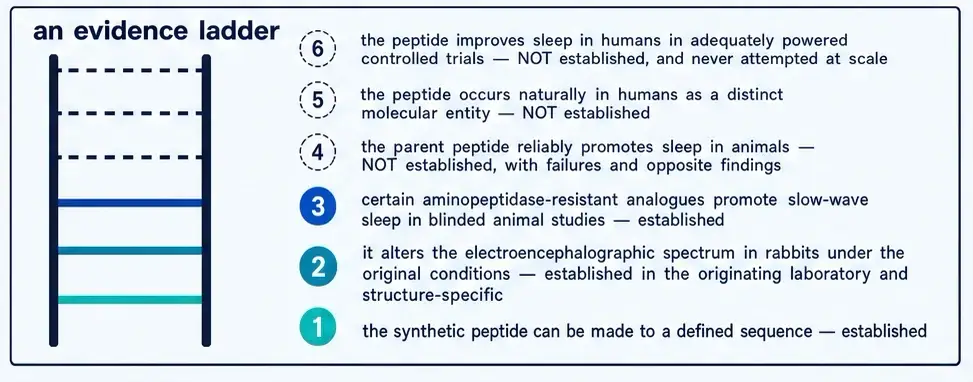
Until then, the honest position is the one this document has tried to hold throughout. DSIP is a real molecule with real and reproducible biological effects, most reliably on the pituitary response to CRF. It is the first substance ever isolated in the hunt for a sleep factor, and that hunt was conducted with genuine rigour. And the specific claim carried in its name — that it induces delta sleep — is the least well supported claim attached to it: unreplicated outside the laboratory of origin, absent from both independent controlled trials, and reversed in direction by the two most explicit measurements of delta power ever made under the compound.
A molecule can be interesting and not be what it is called. DSIP has been both for fifty years.
This document describes published research. It does not recommend human use of any compound and it specifies no dose, route or schedule for any person. Every dose that appears above is a reported experimental parameter, stated with the species, route and duration under which it was reported.
DSIP has no approved therapeutic indication in the United States or the European Union. Its single identified national registration is for stress- related states and alcohol withdrawal, not for sleep. It has never been studied in an adequately powered controlled clinical trial for any indication, and no human study of it in this corpus reports systematic safety monitoring or a defined adverse-event follow-up period. It is sold for research use only.
34References
Generated from verified NCBI records rather than from recall. Author lists, journal names, volumes, pages and identifiers are taken from the PubMed record for each citation, and the build refuses to run if any identifier fails to resolve. This series has twice shipped reference lists drafted from memory in which identifiers pointed at real but unrelated papers. During this build a reader pass proposed four attributions — for the CRF/ACTH in-vitro result, the antioxidant gene-expression study, the valproate interaction and a cardiovascular finding — each of which was assigned to the wrong first author until it was checked against the record.
- Banks WA, Kastin AJ, Coy DH. Evidence that [125I]N-Tyr-delta sleep-inducing peptide crosses the blood-brain barrier by a non-competitive mechanism. Brain Res. 1984;301(2):201-7.
PMID 6547363 · doi:10.1016/0006-8993(84)91088-6 - Banks WA, Kastin AJ, Coy DH, Angulo E. Entry of DSIP peptides into dog CSF: role of physicochemical and pharmacokinetic parameters. Brain Res Bull. 1986;17(2):155-8.
PMID 3768731 · doi:10.1016/0361-9230(86)90111-5 - Belykh AE, Bobyntsev II, Kryukov AA, Dudka VT. [THE INFLUENCE OF DELTA SLEEP-INDUCING PEPTIDE ON FUNCTIONAL STATE OF RATS HEPATOCYTES IN FOOT-SHOCK STRESS]. Ross Fiziol Zh Im I M Sechenova. 2015;101(6):700-7.
PMID 26470489 - Bes F, Hofman W, Schuur J, Van Boxtel C. Effects of delta sleep-inducing peptide on sleep of chronic insomniac patients. A double-blind study. Neuropsychobiology. 1992;26(4):193-7.
PMID 1299794 · doi:10.1159/000118919 - Bjartell A, Ekman R, Bergquist S, Widerlöv E. Reduction of immunoreactive ACTH in plasma following intravenous injection of delta sleep-inducing peptide in man. Psychoneuroendocrinology. 1989;14(5):347-55.
PMID 2554357 · doi:10.1016/0306-4530(89)90004-8 - Bjartell A, Ekman R, Hedenbro J, Sjölund K, Sundler F. Delta sleep-inducing peptide (DSIP)-like immunoreactivity in gut: coexistence with known peptide hormones. Peptides. 1989;10(1):163-70.
PMID 2664725 · doi:10.1016/0196-9781(89)90093-4 - Bjartell A, Ekman R, Loh YP. Biosynthesis and processing of delta sleep-inducing peptide-like precursors in primary cultures of mouse anterior pituitary cells. Eur J Biochem. 1990;190(1):131-7.
PMID 2364941 · doi:10.1111/j.1432-1033.1990.tb15555.x - Bjartell A, Sundler F, Ekman R. Extraction and immunochemical characterization of delta sleep-inducing peptide-like material from the porcine pituitary and adrenal gland. Peptides. 1991;12(3):445-54.
PMID 1923924 · doi:10.1016/0196-9781(91)90082-z - Bjartell A, Sundler F, Ekman R. Immunoreactive delta sleep-inducing peptide in the rat hypothalamus, pituitary and adrenal gland: effects of adrenalectomy. Horm Res. 1991;36(1-2):52-62.
PMID 1814802 · doi:10.1159/000182108 - Bondarenko TI, Sorokina IA, Mayboroda EA, Durkanaeva OA, Kutilin DS, Mikhaleva II. Effect of delta sleep-inducing peptide on oxidative modification of proteins in rat tissues and blood during physiological aging. Bull Exp Biol Med. 2012;153(3):371-4.
PMID 22866315 · doi:10.1007/s10517-012-1719-3 - Borbély AA, Tobler I. Endogenous sleep-promoting substances and sleep regulation. Physiol Rev. 1989;69(2):605-70.
PMID 2564687 · doi:10.1152/physrev.1989.69.2.605 - Demin NN, Karmanova IG, Maksimuk VF, Rubinskaia NL. [Protein and RNA concentration in the supraoptic nucleus of the rat brain during sleep induced by delta-hypnogenic peptide]. Zh Evol Biokhim Fiziol. 1980;16(3):257-60.
PMID 6157271 - Dick P, Grandjean ME, Tissot R. Successful treatment of withdrawal symptoms with delta sleep-inducing peptide, a neuropeptide with potential agonistic activity on opiate receptors. Neuropsychobiology. 1983;10(4):205-8.
PMID 6328354 · doi:10.1159/000118012 - Dick P, Costa C, Fayolle K, Grandjean ME, Khoshbeen A, Tissot R. DSIP in the treatment of withdrawal syndromes from alcohol and opiates. Eur Neurol. 1984;23(5):364-71.
PMID 6548969 · doi:10.1159/000115715 - Ekman R, Bjartell A, Ekblad E, Sundler F. Immunoreactive delta sleep-inducing peptide in pituitary adrenocorticotropin/alpha-melanotropin cells and adrenal medullary cells of the pig. Neuroendocrinology. 1987;45(4):298-304.
PMID 3033539 · doi:10.1159/000124744 - Fencl V, Koski G, Pappenheimer JR. Factors in cerebrospinal fluid from goats that affect sleep and activity in rats. J Physiol. 1971;216(3):565-89.
PMID 4327693 · doi:10.1113/jphysiol.1971.sp009541 · PMC1331923 - Fischman AJ, Kastin AJ, Graf MV. HPLC shadowing: artifacts in peptide characterization monitored by RIA. Peptides. 1984;5(5):1007-10.
PMID 6548808 · doi:10.1016/0196-9781(84)90128-1 - Graf MV, Kastin AJ. Delta-sleep-inducing peptide (DSIP): a review. Neurosci Biobehav Rev. 1984;8(1):83-93.
PMID 6145137 · doi:10.1016/0149-7634(84)90022-8 - Graf MV, Saegesser B, Schoenenberger GA. Degradation and aggregation of delta sleep-inducing peptide (DSIP) and two analogs in plasma and serum. Peptides. 1987;8(4):599-603.
PMID 3628078 · doi:10.1016/0196-9781(87)90031-3 - Graf MV, Kastin AJ, Schoenenberger GA. Delta-sleep-inducing peptide and two of its analogs reduce nocturnal increase of N-acetyltransferase activity in rat pineal gland. J Neurochem. 1985;44(2):629-32.
PMID 3838100 · doi:10.1111/j.1471-4159.1985.tb05458.x - Graf MV, Kastin AJ, Coy DH, Fischman AJ. Delta-sleep-inducing peptide reduces CRF-induced corticosterone release. Neuroendocrinology. 1985;41(4):353-6.
PMID 2995861 · doi:10.1159/000124200 - Graf MV, Kastin AJ. Delta sleep-inducing peptide (DSIP)-like material exists in peripheral organs of rats in large dissociable forms. Proc Soc Exp Biol Med. 1984;177(1):197-204.
PMID 6548030 · doi:10.3181/00379727-177-41932 - Graf MV, Kastin AJ, Fischman AJ. DSIP occurs in free form in mammalian plasma, human CSF and urine. Pharmacol Biochem Behav. 1984;21(5):761-6.
PMID 6549071 · doi:10.1016/s0091-3057(84)80016-7 - Griniavichius KA, Milashius AM. [Effect of delta sleep-inducing peptide (DSIP) on slow sleep in the rabbit]. Zh Vyssh Nerv Deiat Im I P Pavlova. 1982;32(6):1084-9.
PMID 6897693 - Hrncić D, Stanojlović O, Zivanović D, Susić V. Delta-sleep-inducing peptide potentiates anticonvulsive activity of valproate against metaphit-provoked audiogenic seizure in rats. Pharmacology. 2006;77(2):78-84.
PMID 16645330 · doi:10.1159/000093001 - Inoué S, Honda K, Komoda Y, Uchizono K, Ueno R, Hayaishi O. Differential sleep-promoting effects of five sleep substances nocturnally infused in unrestrained rats. Proc Natl Acad Sci U S A. 1984;81(19):6240-4.
PMID 6592612 · doi:10.1073/pnas.81.19.6240 · PMC391896 - Iyer KS, Marks GA, Kastin AJ, McCann SM. Evidence for a role of delta sleep-inducing peptide in slow-wave sleep and sleep-related growth hormone release in the rat. Proc Natl Acad Sci U S A. 1988;85(10):3653-6.
PMID 3368469 · doi:10.1073/pnas.85.10.3653 · PMC280272 - Kafi S, Monnier M, Gallard JM. The delta-sleep inducing peptide (DSIP) increases duration of sleep in rats. Neurosci Lett. 1979;13(2):169-72.
PMID 530466 · doi:10.1016/0304-3940(79)90036-3 - Kastin AJ, Nissen C, Schally AV, Coy DH. Radioimmunoassay of DSIP-like material in rat brain. Brain Res Bull. 1978;3(6):691-5.
PMID 318193 · doi:10.1016/0361-9230(78)90019-9 - Kimura M, Inoué S. The phosphorylated analogue of DSIP enhances slow wave sleep and paradoxical sleep in unrestrained rats. Psychopharmacology (Berl). 1989;97(1):35-9.
PMID 2496423 · doi:10.1007/BF00443409 - Koplik EV, Umryukhin PE, Konorova IL, Terekhina OL, Mikhaleva II, Gannushkina IV, et al.. Delta sleep-inducing peptide and Deltaran: potential approaches to antistress protection. Neurosci Behav Physiol. 2008;38(9):953-7.
PMID 18975104 · doi:10.1007/s11055-008-9076-4 - Koval'zon VM, Kalikhevich VN, Churkina SI. [Active analog of the inactive "sleep peptide"]. Biull Eksp Biol Med. 1986;101(6):707-9.
PMID 3730559 - Koval'zon VM, Obál F, Kalikhevich VN. [Peptidergic modulation of sleep: a comparative study of analogs of the peptide DSIP]. Zh Evol Biokhim Fiziol. 1986;22(5):483-8.
PMID 3788358 - Koval'zon VM. [Hypnogenic properties of DSIP peptide analogs: structural-functional relationship]. Izv Akad Nauk Ser Biol. 2001:467-74.
PMID 11525128 - Kovalzon VM, Strekalova TV. Delta sleep-inducing peptide (DSIP): a still unresolved riddle. J Neurochem. 2006;97(2):303-9.
PMID 16539679 · doi:10.1111/j.1471-4159.2006.03693.x - Kresiun NV, Godlevskiĭ LS. [Using deltalicin for the treatment of patients with diabetic retinopathy]. Eksp Klin Farmakol. 2014;77(12):22-5.
PMID 25739189 - Krueger JM, Pappenheimer JR, Karnovsky ML. The composition of sleep-promoting factor isolated from human urine. J Biol Chem. 1982;257(4):1664-9.
PMID 7056735 - Krueger JM, Pappenheimer JR, Karnovsky ML. Sleep-promoting effects of muramyl peptides. Proc Natl Acad Sci U S A. 1982;79(19):6102-6.
PMID 6964403 · doi:10.1073/pnas.79.19.6102 · PMC347061 - Kryzhanovskiĭ GN, Shandra AA, Godlevskiĭ LS, Mikhaleva II. [Appearance of parkinsonian syndrome after administration of delta sleep-inducing peptide into the rat substantia nigra]. Biull Eksp Biol Med. 1990;109(2):119-21.
PMID 2337637 - Kubota K. Kuniomi Ishimori and the first discovery of sleep-inducing substances in the brain. Neurosci Res. 1989;6(6):497-518.
PMID 2677843 · doi:10.1016/0168-0102(89)90041-2 - Kutilin DS, Bondarenko TI, Kornienko IV, Mikhaleva II. Effect of delta sleep-inducing peptide on the expression of antioxidant enzyme genes in the brain and blood of rats during physiological aging. Bull Exp Biol Med. 2014;157(5):616-9.
PMID 25257425 · doi:10.1007/s10517-014-2628-4 - Larbig W, Gerber WD, Kluck M, Schoenenberger GA. Therapeutic effects of delta-sleep-inducing peptide (DSIP) in patients with chronic, pronounced pain episodes. A clinical pilot study. Eur Neurol. 1984;23(5):372-85.
PMID 6548970 · doi:10.1159/000115716 - Lesch KP, Widerlöv E, Ekman R, Laux G, Schulte HM, Pfüller H, et al.. Delta sleep-inducing peptide response to human corticotropin-releasing hormone (CRH) in major depressive disorder. Comparison with CRH-induced corticotropin and cortisol secretion. Biol Psychiatry. 1988;24(2):162-72.
PMID 2839244 · doi:10.1016/0006-3223(88)90271-5 - Mikhaleva II, Ivanov VT, Onoprienko LV, Prudchenko IA, Chikin LD, Yakubovskaya RI, et al.. [Antioxidative and detoxifying effects of analogues of delta-sleep inducing peptide (DSIP)]. Bioorg Khim. 2014;40(1):3-11.
PMID 25898718 · doi:10.1134/s1068162014010087 - Mikhaleva II, Prudchenko IA, Ivanov VT, Voitenkov VB. JmjC-domain-containing histone demethylases of the JMJD1B type as putative precursors of endogenous DSIP. Peptides. 2011;32(4):826-31.
PMID 21262293 · doi:10.1016/j.peptides.2011.01.006 - Mikhaleva II, Ivanov VT, Voĭtenkov VB, Vechkanov EM, Bondarenko TI. [Olygopeptide KND as a putative endogenous prototype of delta sleep inducing peptide (DSIP). Comparative study of biological properties]. Bioorg Khim. 2013;39(3):277-84.
PMID 24397026 · doi:10.1134/s1068162013030096 - MONNIER M, HOESLI L. DIALYSIS OF SLEEP AND WAKING FACTORS IN BLOOD OF THE RABBIT. Science. 1964;146(3645):796-8.
PMID 14197576 · doi:10.1126/science.146.3645.796 - Monnier M, Dudler L, Gächter R, Schoenenberger GA. Transport of the synthetic peptide DSIP through the blood-brain barrier in rabbit. Experientia. 1977;33(12):1609-10.
PMID 590449 · doi:10.1007/BF01934026 - Monti JM, Debellis J, Alterwain P, Pellejero T, Monti D. Study of delta sleep-inducing peptide efficacy in improving sleep on short-term administration to chronic insomniacs. Int J Clin Pharmacol Res. 1987;7(2):105-10.
PMID 3583493 - Myers RD. Neuroactive peptides: unique phases in research on mammalian brain over three decades. Peptides. 1994;15(2):367-81.
PMID 8008641 · doi:10.1016/0196-9781(94)90025-6 - Nagaki S, Kato N. Delta sleep-inducing peptide-like material in rat brain as determined by enzyme immunoassay: effect of sleep deprivation. Neurosci Lett. 1984;51(2):253-7.
PMID 6549054 · doi:10.1016/0304-3940(84)90560-3 - Nakamura A, Nakanishi H, Shiomi H. Characterization of the release and metabolism of delta sleep-inducing peptide (DSIP) in the rat brain. Neuropeptides. 1993;24(3):131-8.
PMID 8474631 · doi:10.1016/0143-4179(93)90076-m - Noteborn HP, Graf MV, Ernst A, Schoenenberger GA, Weusten JA, Ebels I, et al.. Purification and characterization of DSIP-like material from ovine pineal glands: possible peptide-protein interaction. J Pineal Res. 1988;5(2):161-77.
PMID 3367267 · doi:10.1111/j.1600-079x.1988.tb00779.x - Obál F, Török A, Alföldi P, Sáry G, Hajós M, Penke B. Effects of intracerebroventricular injection of delta sleep-inducing peptide (DSIP) and an analogue on sleep and brain temperature in rats at night. Pharmacol Biochem Behav. 1985;23(6):953-7.
PMID 3841214 · doi:10.1016/0091-3057(85)90099-1 - Obál F, Kovalzon VM, Kalikhevich VN, Török A, Alföldi P, Sáry G, et al.. Structure-activity relationship in the effects of delta-sleep-inducing peptide (DSIP) on rat sleep. Pharmacol Biochem Behav. 1986;24(4):889-94.
PMID 3754970 · doi:10.1016/0091-3057(86)90432-6 - Odin VI, Belikova TV, Pushkova ES, Barr NA. [Diabetes mellitus in elderly: geroprotective and antidiabetic properties of delta-sleep induced peptide]. Adv Gerontol. 2004;15:101-14.
PMID 15754961 - Okajima T, Hertting G. Delta-sleep-inducing peptide (DSIP) inhibited CRF-induced ACTH secretion from rat anterior pituitary gland in vitro. Horm Metab Res. 1986;18(7):497-9.
PMID 3017833 · doi:10.1055/s-2007-1012357 - Opp MR, Imeri L. Sleep and immune health: How dogs, goats and 'factor S' shaped a field. Neurobiol Sleep Circadian Rhythms. 2025;18(Suppl):100118.
PMID 40703576 · doi:10.1016/j.nbscr.2025.100118 · PMC12282848 - Pappenheimer JR, Miller TB, Goodrich CA. Sleep-promoting effects of cerebrospinal fluid from sleep-deprived goats. Proc Natl Acad Sci U S A. 1967;58(2):513-7.
PMID 5233454 · doi:10.1073/pnas.58.2.513 · PMC335665 - Pomfrett CJ, Dolling S, Anders NR, Glover DG, Bryan A, Pollard BJ. Delta sleep-inducing peptide alters bispectral index, the electroencephalogram and heart rate variability when used as an adjunct to isoflurane anaesthesia. Eur J Anaesthesiol. 2009;26(2):128-34.
PMID 19142086 · doi:10.1097/EJA.0b013e32831c8644 - Popovich IG, Voitenkov BO, Anisimov VN, Ivanov VT, Mikhaleva II, Zabezhinski MA, et al.. Effect of delta-sleep inducing peptide-containing preparation Deltaran on biomarkers of aging, life span and spontaneous tumor incidence in female SHR mice. Mech Ageing Dev. 2003;124(6):721-31.
PMID 12782416 · doi:10.1016/s0047-6374(03)00082-4 - Schneider-Helmert D, Gnirss F, Monnier M, Schenker J, Schoenenberger GA. Acute and delayed effects of DSIP (delta sleep-inducing peptide) on human sleep behavior. Int J Clin Pharmacol Ther Toxicol. 1981;19(8):341-5.
PMID 6895513 - Schneider-Helmert D, Graf M, Schoenenberger GA. Synthetic delta-sleep-inducing peptide improves sleep in insomniacs. Lancet. 1981;1(8232):1256-7.
PMID 6112579 · doi:10.1016/s0140-6736(81)92417-x - Schneider-Helmert D, Schoenenberger GA. The influence of synthetic DSIP (delta-sleep-inducing-peptide) on disturbed human sleep. Experientia. 1981;37(9):913-7.
PMID 7028502 · doi:10.1007/BF01971753 - Schneider-Helmert D, Schoenenberger GA. Effects of DSIP in man. Multifunctional psychophysiological properties besides induction of natural sleep. Neuropsychobiology. 1983;9(4):197-206.
PMID 6689058 · doi:10.1159/000117964 - Schneider-Helmert D. Efficacy of DSIP to normalize sleep in middle-aged and elderly chronic insomniacs. Eur Neurol. 1986;25(6):448-53.
PMID 3792404 · doi:10.1159/000116050 - Schneider-Helmert D. Effects of delta-sleep-inducing peptide on 24-hour sleep-wake behaviour in severe chronic insomnia. Eur Neurol. 1987;27(2):120-9.
PMID 3622582 · doi:10.1159/000116143 - Schoenenberger GA, Cueni LB, Hatt AM, Monnier M. Isolation and physical-chemical characterization of a humoral, sleep inducing substance in rabbits (factor 'delta'). Experientia. 1972;28(8):919-21.
PMID 5076324 · doi:10.1007/BF01924946 - Schoenenberger GA, Maier PF, Tobler JH, Monnier M. A naturally occurring delta-EEG enhancing nonapeptide in rabbits. X. Final isolation, characterization and activity test. Pflugers Arch. 1977;369(2):99-109.
PMID 560681 · doi:10.1007/BF00591565 - Schoenenberger GA, Monnier M. Characterization of a delta-electroencephalogram (-sleep)-inducing peptide. Proc Natl Acad Sci U S A. 1977;74(3):1282-6.
PMID 265572 · doi:10.1073/pnas.74.3.1282 · PMC430668 - Schoenenberger GA, Maier PF, Tobler HJ, Wilson K, Monnier M. The delta EEG (sleep)-inducing peptide (DSIP). XI. Amino-acid analysis, sequence, synthesis and activity of the nonapeptide. Pflugers Arch. 1978;376(2):119-29.
PMID 568769 · doi:10.1007/BF00581575 - Schoenenberger GA. Characterization, properties and multivariate functions of delta-sleep-inducing peptide (DSIP). Eur Neurol. 1984;23(5):321-45.
PMID 6548966 · doi:10.1159/000115711 - Seidel G, Adermann K, Schindler T, Ejchart A, Jaenicke R, Forssmann WG, et al.. Solution structure of porcine delta sleep-inducing peptide immunoreactive peptide A homolog of the shortsighted gene product. J Biol Chem. 1997;272(49):30918-27.
PMID 9388238 · doi:10.1074/jbc.272.49.30918 - Shandra AA, Godlevskiĭ LS, Kryzhanovskiĭ GN, Makul'kin RF, Mikhaleva II. [The effect of delta sleep-inducing peptide on the convulsive activity in corasol kindling]. Biull Eksp Biol Med. 1988;106(9):269-71.
PMID 3167173 - Shandra AA, Godlevskiĭ LS, Vast'ianov RS, Zaporozhchenko MB, Ibragim M, Brusentsov AI, et al.. [A rotational syndrome induced by administration of the delta sleep-inducing peptide into the reticular portion of the rat substantia nigra]. Fiziol Zh Im I M Sechenova. 1996;82(10-11):69-72.
PMID 9162398 - Shandra AA, Godlevskiĭ LS, Vast'ianov RS, Brusentsov AI, Moalla I, Nikel' B. [The role of the delta sleep-inducing peptide in the formation of neuropathological syndromes]. Fiziol Zh Im I M Sechenova. 1995;81(9):13-24.
PMID 8581045 - Sommerfelt L. Reduced sleep in cats after intraperitoneal injection of delta-sleep-inducing peptide (DSIP). Neurosci Lett. 1985;58(1):73-7.
PMID 3840239 · doi:10.1016/0304-3940(85)90331-3 - Stanojlovic O, Zivanovic D, Susic V. [The delta-sleep inducing peptide and its effect on the electroencephalogram and power spectrum density in rats with metaphit-induced epilepsy]. Srp Arh Celok Lek. 2001;129(5-6):114-8.
PMID 11797457 - Stanojlović O, Hrncić D, Radosavljević T. [Endogenous anticonvulsants: neuropeptide Y and delta sleep inducing peptide]. Med Pregl. 2008;61(5-6):252-5.
PMID 19102071 · doi:10.2298/mpns0806252s - Stanojlović OP, Zivanović DP, Mirković SD, Mikhaleva II. Antiepileptic activity of delta sleep-inducing peptide and its analogue in metaphit-provoked seizures in rats. Seizure. 2005;14(4):240-7.
PMID 15911358 · doi:10.1016/j.seizure.2005.02.001 - Susić V, Masirević G. Effects of delta sleep inducing peptide on sleep cycle of cats deprived of paradoxical sleep. Arch Int Physiol Biochim. 1985;93(4):271-7.
PMID 2421663 · doi:10.3109/13813458509079606 - Tobler I, Borbély AA. Effect of delta sleep inducing peptide (DSIP) and arginine vasotocin (AVT) on sleep and motor activity in the rat. Waking Sleeping. 1980;4(2):139-53.
PMID 7405185 - Tukhovskaya EA, Shaykhutdinova ER, Ismailova AM, Slashcheva GA, Prudchenko IA, Mikhaleva II, et al.. DSIP-Like KND Peptide Reduces Brain Infarction in C57Bl/6 and Reduces Myocardial Infarction in SD Rats When Administered during Reperfusion. Biomedicines. 2021;9(4).
PMID 33918965 · doi:10.3390/biomedicines9040407 · PMC8069497 - Tukhovskaya EA, Ismailova AM, Shaykhutdinova ER, Slashcheva GA, Prudchenko IA, Mikhaleva II, et al.. Delta Sleep-Inducing Peptide Recovers Motor Function in SD Rats after Focal Stroke. Molecules. 2021;26(17).
PMID 34500605 · doi:10.3390/molecules26175173 · PMC8434407 - Ursin R, Larsen M. Increased sleep following intracerebroventricular injection of the delta sleep-inducing peptide in rats. Neurosci Lett. 1983;40(2):145-9.
PMID 6688864 · doi:10.1016/0304-3940(83)90293-8 - Voĭtenkov VB, Popovich IG, Zabezhinskiĭ MA, Iurova MA, Piskunova TA, Mikhaleva II. [Effect of delta-sleep inducing peptide preparation Deltaran on longevity, physiological functions, and carcinogenesis in mice]. Adv Gerontol. 2009;22(4):646-54.
PMID 20405733 - Yehuda S, Shredny B, Kalechman Y. Effects of DSIP, 5-HTP and serotonin on the lymphokine system: a preliminary study. Int J Neurosci. 1987;33(3-4):185-97.
PMID 3496316 · doi:10.3109/00207458708987403 - Yehuda S, Caspy T, Carasso RL. The circadian cycle effects of DSIP on colonic temperature, blood pressure, and heart rate in control and area postrema-lesioned rats. Int J Neurosci. 1988;42(3-4):259-65.
PMID 3209378 · doi:10.3109/00207458808991600 - Yehuda S, Kastin AJ, Coy DH. Thermoregulatory and locomotor effects of DSIP: paradoxical interaction with d-amphetamine. Pharmacol Biochem Behav. 1980;13(6):895-900.
PMID 6894196 · doi:10.1016/0091-3057(80)90225-7
Sources without a PubMed record
Regulatory instruments, drug registers and meeting records have no PubMed record and are listed separately, so that the generated list above remains wholly machine-verified.
- Ishimori K. True cause of sleep: a hypnogenic substance as evidenced in the brain of sleep-deprived animals. <i>Tokyo Igakkai Zasshi</i>. 1909;23:429–457. Predates PubMed; translated in full as an appendix to Kubota 1989 (PMID 2677843), which is the source used here.
- Legendre R, Piéron H. Des résultats histo-physiologiques de l'injection intra-occipito-atlantoïdienne des liquides insomniques. <i>C. R. Soc. Biol.</i> (Paris). 1910;68:1108–1109. No PubMed record; cited in the reference list of Schoenenberger et al. 1977.
- Nagasaki H, Iriki M, Inoué S, Uchizono K. The presence of a sleep-promoting material in the brain of sleep-deprived rats. <i>Proc. Jap. Acad.</i> 1974;50:241–246. No PubMed record; cited in the reference list of Schoenenberger et al. 1977.
- Monnier M, Gangloff H. Atlas for Stereotaxic Brain Research on the Conscious Rabbit. Amsterdam: Elsevier, 1961. The atlas that made intraventricular infusion in the rabbit routine.
- Russian State Register of Medicines. Deltaran, registration certificate ЛП-003849 — lyophilisate for solution for intranasal administration. Active substance tryptophanyl-alanyl-glycyl-glycyl-aspartyl-alanyl-seryl-glycyl-glutamic acid (delta-sleep peptide) 0.3 mg with glycine 3.0 mg; ATC N07BB. Register entry read directly, 2 August 2026. Registered indications: treatment and prevention of stress-induced states; alcohol withdrawal syndrome and primary pathological craving for alcohol. Available without prescription. Marketing authorisation holder OOO NITs KOMKON, Yekaterinburg; manufacturer FGUP Gos.NII OChB, St Petersburg.
https://www.rlsnet.ru/drugs/deltaran-78384 - United States Food and Drug Administration, Pharmacy Compounding Advisory Committee. Meeting of 23–24 July 2026: bulk drug substances considered for the section 503A Bulks List, including emideltide (free base) and emideltide acetate. The committee voted against recommending emideltide: 6 in favour, 7 against, 1 abstention — the only substance of those considered that it declined to recommend. Vote and stated grounds taken from two independent contemporaneous reports of the meeting; FDA's own briefing document could not be retrieved and is not relied upon.
- World Anti-Doping Agency. The 2026 Prohibited List. In force 1 January 2026. Neither DSIP nor emideltide is named in the List or its index. Substances with no current approval by any governmental regulatory health authority for human therapeutic use fall under section S0, prohibited at all times.
- U.S. National Library of Medicine. ClinicalTrials.gov — searched for DSIP, delta sleep-inducing peptide, emideltide and Deltaran. No registered interventional study located. Searched 2 August 2026.
https://clinicaltrials.gov/
35How this document was assembled
The corpus was built against project 05, the Therapeutic Peptide Research Library. Two numbers below matter more than the rest: how little of this compound's literature is retrievable as full text, and how much of what carries its name is not literature at all.
The identity problem. DSIP is an unusually crowded abbreviation, and the collisions were established by reading records rather than by assuming them. Besides the delta sleep-inducing peptide, the same four letters stand for a domain-specific information preservation framework in machine learning, deuterium stable isotope probing in Raman microbiology, double-surface intensive phototherapy in neonatology, the Dhaka Sanitation Improvement Project, a dye-surfactant ionpair in physical chemistry, a dialyzable schistosome incubation product in immunology, a double-stranded ion-pair method for DNA purification, designated state investment programs in Medicaid policy, and — the most dangerous of them, because it lives in the sedation literature — a daily sedation interruption protocol in intensive care. The matcher is case-sensitive and boundaried; an unambiguous designation confirms alone, and the bare code is admitted only where no known expansion appears in the text and subject-matter vocabulary sits beside the hit.
Where the gate did its work, reported separately. Of the local files, 323 contained a designation and only 9 were refused. That is a low rate and it would be misleading to offer it as evidence the gate earned its keep. It earned it on the fetched literature, where 18 of 283 documents were refused as carrying a different DSIP — the largest single offender used the string forty times and was about phototherapy for neonatal jaundice. A separate and opposite category is the 97 documents that named no designation at all but did name a rival sleep factor: those arrived through a deliberately harvested context arm and were never candidates for this corpus. Pooling the two would credit the identity gate with work the query did. A further 66 named neither, which says the query was wider than it needed to be.
The source-kind problem. Every file with a document extension in the project's stores was opened — 45,975 of them. Of the 314 admitted as being about DSIP, exactly 5 were peer-reviewed scientific full texts. The other 309 were dated snapshots of vendor product pages, trade and affiliate copy collected as writing samples, and this project's own earlier internal write-ups. That is roughly sixty-three commercial documents for every scientific one, the widest such ratio this series has measured. For a compound with a large research-chemical market and a small, ageing scientific literature, the split is itself a finding, and section 32 treats it as one.
The external harvest. A scoped PubMed query returned 796 records, reconciled against the partitioned total with a shortfall of zero, of which 629 survived a relevance screen. The query ran three named arms: the compound with its relatives, the rival sleep factors of the same era, and the humoral-sleep-factor question itself. The second and third are context, are reported separately, and are never admitted as evidence about DSIP; they exist because this compound cannot be explained without the race it was discovered into. Because PubMed indexes only titles, abstracts and MeSH terms, a second route searched PubMed Central's full text and returned 228 matches, of which 214 were invisible to the first. Stage 03 fetched the union: 283 documents. The surface was small enough to retrieve in full, so no document in this corpus is counted without having been read.
Merging the local and fetched sets by PMCID and removing the 5 documents present in both gives the reading corpus this monograph is written from: 38 unique scientific full texts, roughly 491 printed-page equivalents, together with the complete 629-record metadata layer.
| Stage | What it does | Result |
|---|---|---|
| 01b | Targeted scan of the project's document stores | 45,975 files opened |
| 01c | Interrogation of the curated library database | SQL prefilter, gated in Python |
| 01g | Classification of local hits by source kind | 5 of 314 are literature |
| 02 | PubMed E-utilities harvest, three named arms | 796 records, shortfall 0 |
| 02b | PubMed Central full-text search | 228 matches |
| 03 | Open-access full-text retrieval of the union | 283 documents |
| 03c | Identity gate and substantive-use screen | 38 retained |
| 04 | Keyed union, de-duplication, inventory | 38 unique full texts |
| 05 | Reference list from verified NCBI records | 89 citations |
| 06 | Assembly of this document | 1 deliverable |
Artwork
No artwork was commissioned for this monograph. Every figure in it is an authored vector graphic generated from values traceable to the records cited beside it, and no third-party published figure has been reproduced. Where a figure is schematic rather than data-bearing — the transfer apparatus and the dose–response shapes — the caption says so in place. The dose–response figure is captioned schematic for a specific reason: the corpus contains no dose–response dataset with enough points at enough doses to plot a curve of either shape, and drawing one would have implied data that does not exist.
36Evidence handling
Findings are labelled by the kind of study that produced them, in the sentence that reports them, and the species is named every time. Animal and in-vitro results are never phrased so as to imply a human outcome.
Four things named DSIP, kept apart. The nonapeptide itself; DSIP-P, its serine-7 phosphorylated form, which is a different molecule and in several assays a more potent one; DSIP-like immunoreactivity, which is an assay signal and not a molecule at all; and Deltaran, a formulated product that is ten parts glycine to one part peptide by mass. A large share of this compound's published evidence measures the third of those, and section 28 sets out fifteen years of chromatography — published by the compound's own proponents — indicating that what the antibody binds is mostly not the nonapeptide. Every claim in this document names which of the four was actually studied.
The corpus gap, stated plainly. DSIP's substantive literature was published between 1977 and about 1995, before open-access deposition existed. The consequence is that the 38-document full-text reading corpus is not where most of this compound's evidence lives. The founding isolation papers, the entire Schneider-Helmert human series, both independent negative trials, the withdrawal case series and most of the Russian work reach this document through their indexed records and structured abstracts, not through their full texts. That is why the 629-record metadata layer is reported alongside the full-text count rather than beneath it, and why no claim is made anywhere about material an abstract does not contain.
One instrument that could not be read. The United States Food and Drug Administration's briefing document for the July 2026 advisory meeting could not be retrieved; the published link returns a not-found error. This document therefore reports the outcome of that meeting, which two independent sources record identically, and the grounds as those sources report them. It makes no claim about what the briefing document states internally, because the standing rule of this series is to verify a regulatory claim against the instrument and never against a summary of it. The Russian registration in section 32 was verified directly against the drug-register entry, including the certificate number, the spelled-out active substance, the ATC code and the registered indications.
Recency is weighted, but not blindly. A newer finding takes precedence unless a preponderance of evidence contradicts it, and that rule does real work in two places. At section 19 it gives standing to a 2009 anaesthesia study whose result — reduced delta power — contradicts the compound's own name, on the grounds that it is the best-instrumented human EEG measurement ever made of DSIP and that nothing comparable has been done since; its limitations, a single small sample of anaesthetised rather than sleeping patients, are stated in the same passage. At section 31 it gives standing to a hypothesis about the compound's biosynthetic origin published between 2011 and 2021, while recording explicitly that no one has shown the proposed fragment is liberated in vivo.
Conflicts are presented as conflicts. Several are live and none is resolved here: whether DSIP promotes sleep at all in species other than the rabbit; whether the sleep it produces is physiological, which a 1980 biochemical study denies; whether its effect on delta power is positive or negative; whether it raises or lowers heart rate; whether it is an antioxidant or, at overlapping doses, a pro-oxidant; and whether the endogenous immunoreactive material is the nonapeptide at all. Where a widely repeated claim is not supported by the primary record — including the claim that this compound has no adverse effects, and the claim that it is approved nowhere — it is named as unsupported rather than quietly omitted.
Continue exploring