
MIF-1 The hypothalamic tripeptide that taught peptide science to look upward
In 1971, a three-residue scrap of peptide chemistry changed what people thought a hypothalamic factor was for. Isolated from bovine brain as something that might quiet melanocyte-stimulating hormone, Pro-Leu-Gly-NH2 soon looked more interesting for what it did to the brain itself. It acquired a clutter of names — MIF-1, MRIH, melanostatin, PLG — and then, decades later, lost its abbreviation to an unrelated cytokine. This document puts the peptide back under its own lights: discovery, chemistry, animal and cell mechanisms, early human observations, and the modern medicinal-chemistry afterlife of its scaffold. Nothing here is a recommendation for human use.
Every finding below is labelled by the kind of study that produced it. “In male C57BL/6J mice” and “in a 1976 double-blind Parkinson series” are the boundary of the claim, not throat-clearing. MIF-1 has a long animal literature and a short, early human one; the temptation to let those weigh the same is strongest when the story is good.
Search is part of the science here. Macrophage migration inhibitory factor owns the token MIF in modern databases. This monograph admits sources on peptide designations — Pro-Leu-Gly-NH2, melanocyte-inhibiting factor, Tyr-MIF-1 lineage — and refuses cytokine papers that only share the abbreviation. Doses appear only as reported study parameters. Nothing here is a recommendation for any person.
01A three-residue celebrity
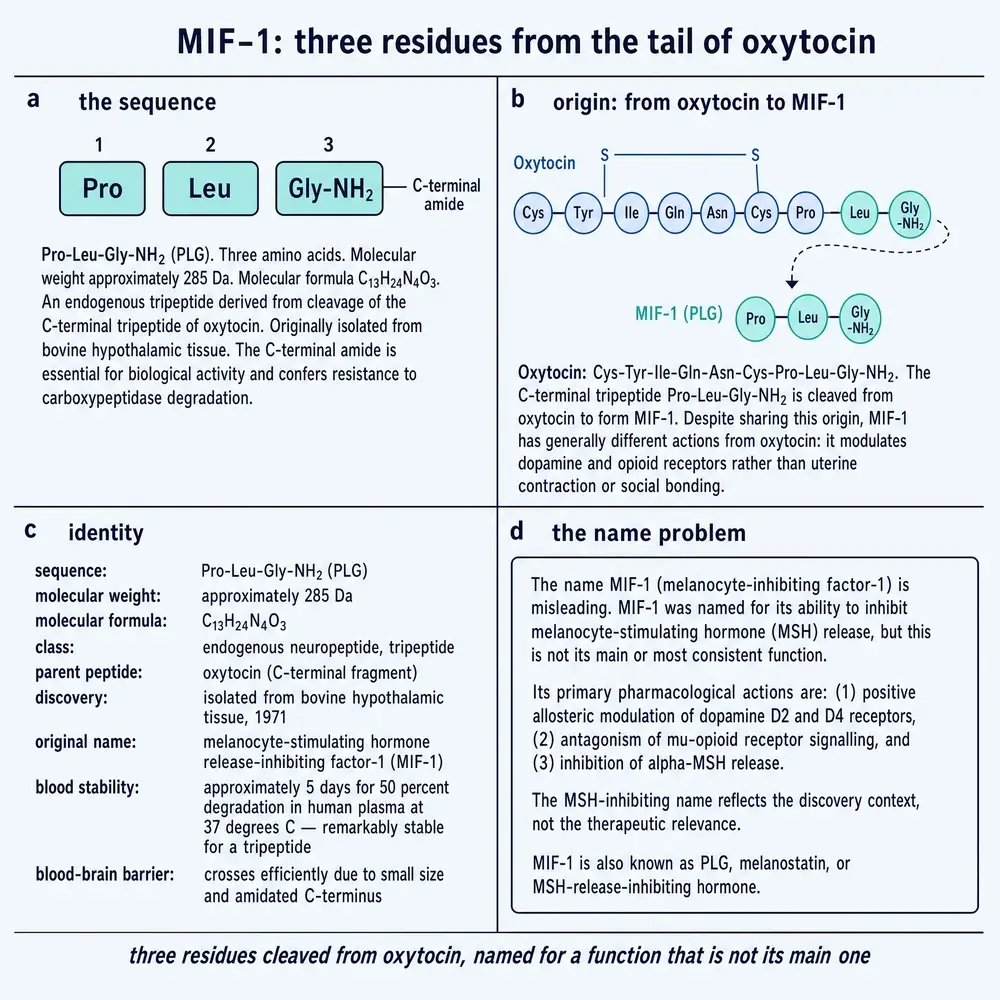
MIF-1 is small enough to write on a napkin and famous enough to be misidentified by a search engine. Chemically it is L-prolyl-L-leucyl-glycinamide: three amino acids, amidated at the end, average mass about 284 daltons (C13H24N4O3), PubChem CID 92910. Historically it is one of the first hypothalamic peptides argued to act on the brain rather than only on the pituitary below it (KastinPan2010; Khan2010).
The naming is a mess with reasons. It was isolated as an MSH-release inhibiting hormone or factor — MRIH / MIF — before anyone was sure that MSH release was its real job. The numeral “1” arrived when it became clear that the story was larger than one assay. Melanostatin stuck in some literatures; PLG stuck in others. None of those names is wrong. What is wrong is confusing this tripeptide with macrophage migration inhibitory factor, a cytokine that later commandeered the abbreviation MIF across immunology. In the Project 05 local library that collision is measurable: peptide-specific hits are essentially empty; macrophage-MIF language is not (Figure 1).
This monograph treats the naming clutter as evidence of a molecule that kept being rediscovered for new jobs. The structure did not change. The question attached to it did.
02Pulled from a cow’s hypothalamus
The first act is chemistry, not neurology. Schally and Kastin had already been purifying bovine hypothalamic material that moved pituitary MSH stores when Nair, Kastin and Schally reported the structure of the principal active peptide as prolyl-leucyl-glycine amide (Nair1971). Synthetic L-Pro-L-Leu-Gly-NH2 matched the natural isolate in activity and in the physical comparisons available at the time. That match is the load-bearing sentence of the discovery: the factor was not an impure mystery fraction. It was a sequence you could make.
Kastin’s 1973 review of MSH-release inhibiting factors places that isolation inside a denser neighbourhood of related peptides and assays, and already points toward behavioural pharmacology beyond the frog-skin and pituitary readouts that named the field (Kastin1973). The chronology is short and steep: purification logic in the mid-1960s, structure in 1971, clinical curiosity by 1972 (Figure 3).
03The oxytocin leftover
Almost immediately, another laboratory offered a biogenesis story that made the structure look less like a one-off invention and more like a cut end of something already known. Celis, Taleisnik and Walter proposed that the factor inhibiting MSH release could be formed from oxytocin, whose C-terminal tripeptide is precisely Pro-Leu-Gly-NH2 (Celis1971). Other groups compared ring fragments and side-chain fragments of the neurohypophysial hormones; the tripeptide remained the structure tied to the MIF-1 name.
Whether every molecule of MIF-1 in a living brain is an oxytocin scrap is a separate and still unsettled physiological question. The historical point is simpler: by 1971, chemists and physiologists already had a plausible way to imagine the peptide as an endogenous fragment rather than as an exotic synthetic. That made the later brain story easier to take seriously.
04Looking up, not only down
If MIF-1 had remained only an MSH-release inhibitor, this monograph would be a footnote to pituitary biology. It did not. Plotnikoff, Kastin, Anderson and Schally reported that the hypothalamic factor potentiated DOPA in animal assays — a result that pointed at central catecholamine systems rather than at melanocytes (Plotnikoff1971). Reviews from inside the Kastin circle later put the claim in plain language: MIF-1 was the first hypothalamic peptide shown to act “up” on the brain, not just “down” on the pituitary (KastinPan2010; Khan2010; Pan2007).
That reorientation is why a 1971 isolation still generates peptidomimetic papers in the 2020s. The original job title faded. The idea that a tiny hypothalamic peptide could rewrite central signalling did not.
05Three letters and an amide
Strip away the mythology and MIF-1 is almost embarrassingly simple: proline, leucine, glycinamide. The amide matters. A free acid at the C-terminus would be a different molecule with a different charge and a different relationship to oxytocin’s processed end. The synthetic material that closed the 1971 structure proof was the amidated tripeptide, and that is the entity carried forward through the behavioural and clinical literature (Nair1971; Figure 5).
There is no elaborate stapling, lipid tail, or non-coded residue in the parent compound. Later chemists would add those things precisely because the native tripeptide is a starting point, not a finished drug product. The parent’s virtue is legibility: when a peptidomimetic paper says it is based on melanostatin or PLG, the reader can see which three residues are being argued with.
06Stability that surprised people
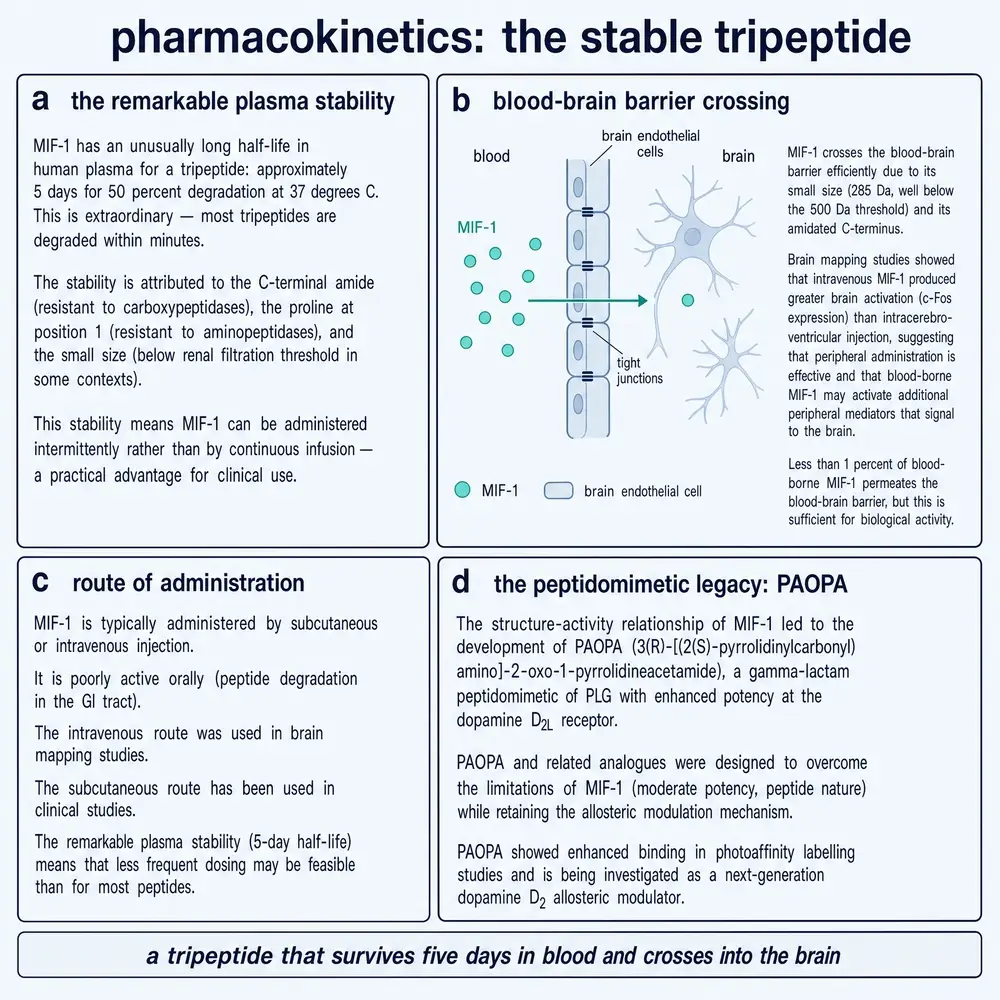
One reason MIF-1 kept escaping the “too unstable to matter” bin is empirical durability in biological fluids as reported by the Kastin group and restated in later mechanism papers. Khan, Yu, Kastin and colleagues noted that half-degradation of MIF-1 in human plasma at body temperature was reported on the order of days rather than minutes, and treated that stability as part of why blood-borne peptide could remain biologically interesting (Khan2010). That observation does not license dosing advice. It does explain why intravenous delivery in mice was not dismissed as futile theatre.
Mass spectrometry later put the peptide into mouse brain tissue as a measured analyte rather than only as an injected drug product (Kheterpal2009). Presence is not proof of a particular physiological job, but it closed one sceptical loop: the sequence is not merely a synthetic curiosity that never appears in mammalian matrix.
07Family resemblance
MIF-1 sits at the root of a small peptide family that Pan and Kastin mapped as an intellectual lineage: Tyr-MIF-1, Tyr-W-MIF-1, and eventually the endomorphins, which share an N-terminal logic even when their receptor stories diverge (Pan2007). Tyr-MIF-1, in particular, carried some of the antiopiate and blood–brain-barrier transport arguments that later writers sometimes blur into MIF-1 itself (Galina1987; Pan2007).
This monograph keeps the family visible and the attributions strict. When the evidence is about Tyr-MIF-1, the prose says so. When modern chemists say “melanostatin neuropeptide” and mean the PLG scaffold, that usage is accepted as synonymy for the parent tripeptide, not as a licence to import every relative’s pharmacology.
08Dopamine, allosterically
The steadiest mechanistic through-line for MIF-1 is dopaminergic. Early animal assays — DOPA potentiation, oxotremorine antagonism, deserpidine antagonism — already pointed that way (Plotnikoff1971; Kastin1973). Decades later, the language sharpened: PLG and constrained peptidomimetics were described as positive allosteric modulators of the dopamine D2 receptor, favouring agonist-preferring states rather than simply flooding the orthosteric site (Raghavan2009; Bhagwanth2013).
The commissioned plate that follows redraws the same two-receptor story as schematic art: dopamine D2 allostery on one side, mu-opioid uncoupling on the other, with the Parkinson investigation rationale stated as history rather than as advice.
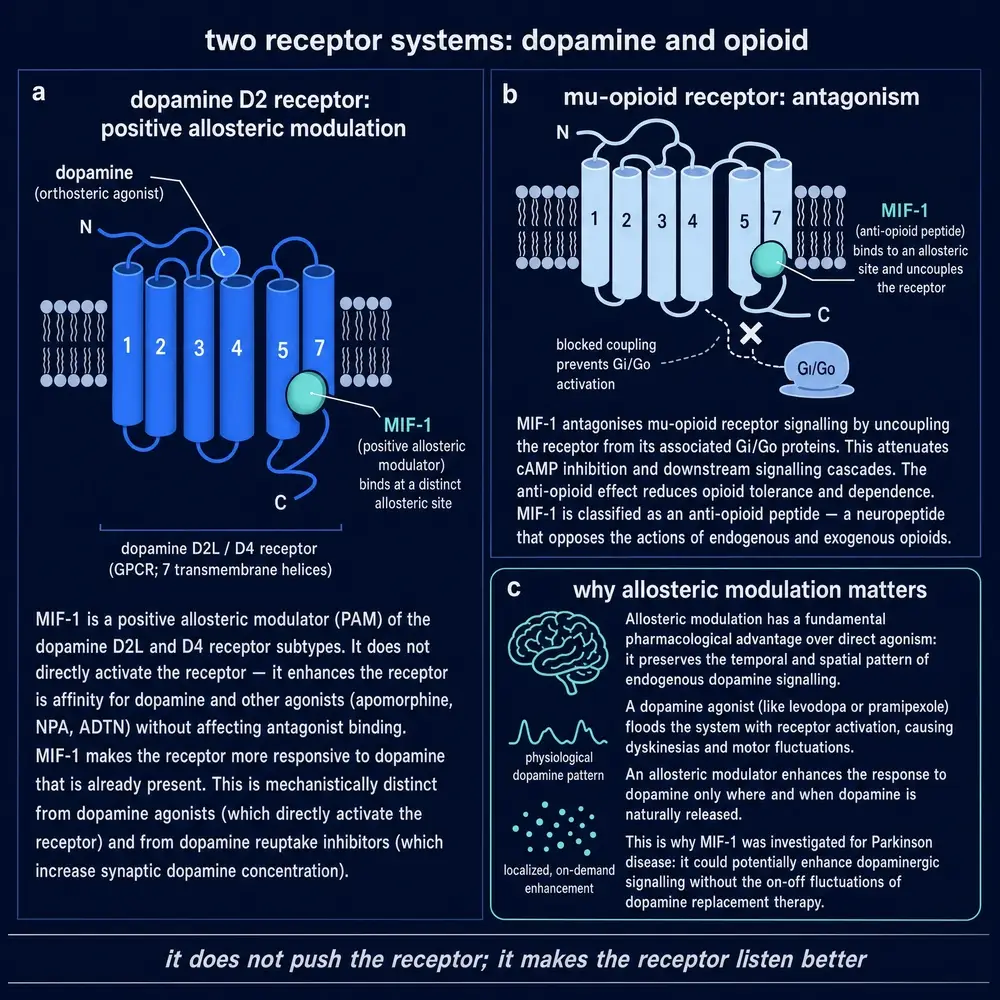
That framing matters for how recent chemistry should be weighed. Papers from the 2020s that remodel melanostatin’s proline residue and report potent D2 modulation are not reinventing a forgotten folk remedy; they are continuing a structure–activity argument that has been explicit for more than a decade (SampaioDias2025). Recency here improves the chemical map. It does not, by itself, manufacture a clinical indication.
09Opioid antagonism without being an opioid
A second through-line is antiopiate activity. MIF-1 and its relatives were reported to antagonise opiate actions in animal assays, and the first such reports were later framed as predicting a broader class of endogenous antiopiate peptides (Pan2007; Khan2010). Tyr-MIF-1 attenuates stress-analgesia responses in animal models that are not identical to classical morphine assays (Galina1987). Reviews of non-opioid peptides that nonetheless touch opioid effects continue to list the family (see corpus CONTEXT reviews admitted under opioid-frame screens).
Two cautions keep this section honest. First, antiopiate is not the same as analgesic, and not the same as antidepressant. Second, several of the cleanest mechanistic statements in the secondary literature belong to Tyr-MIF-1 or to mixed family discussions. The parent tripeptide participates in the story; it does not own every paragraph written about the family.
10Brain maps and cell signals
In 2010, Khan, Yu, Kastin, Pan and colleagues asked a blunt mapping question: if MIF-1 reaches the brain, which regions actually respond? In adult male C57BL/6J mice, intravenous MIF-1 increased c-Fos immunoreactivity in cingulate and infralimbic cortex, nucleus accumbens, hypothalamic paraventricular nucleus, amygdala, and thalamic territories among other sites. Intracerebroventricular delivery lit a narrower set, with the PVN prominent. In differentiated SH-SY5Y human neuroblastoma cells, MIF-1 increased c-Fos after a transient rise in phosphorylated ERK and a biphasic change in phosphorylated STAT3 (Khan2010).
The paper is careful about what it is: a cellular and regional activation study, not a trial. Its comparative finding — that blood-borne peptide activated more broadly than ventricular peptide in several regions — fits the group’s longer argument that peripheral peptide can matter centrally when barrier transport and stability allow (KastinPan2010; Khan2010). It remains one laboratory’s map in one mouse strain, and it should be read that way.
11Behavioural pharmacology
Before c-Fos antibodies and D2 allosteric jargon, there were behavioural screens. Plotnikoff’s DOPA-potentiation result (Plotnikoff1971) and the cluster of motor and affective assays reviewed by Kastin (Kastin1973) are why neurologists and psychiatrists were willing to look at PLG in people at all. Much later, Katzenschlager and colleagues revisited antiparkinsonian activity in MPTP-treated common marmosets and again saw motor effects of L-prolyl-L-leucyl-glycinamide / melanocyte-inhibiting factor in that primate model (Katzenschlager2007).
Animal behaviour is where MIF-1 looks most consistent and least finished. Consistent, because multiple decades keep returning dopaminergic and motor signals. Unfinished, because the field never converged on a single receptor identity with the tidy finality that modern GPCR programmes expect. The peptidomimetic work is, among other things, an attempt to finish that sentence.
12Parkinson’s disease, early and cautious
The human Parkinson story begins almost as soon as the structure does. Kastin and Barbeau published preliminary clinical observations with L-prolyl-L-leucyl-glycine amide in Parkinson’s disease in 1972 (KastinBarbeau1972). Barbeau, Roy and Kastin followed with a double-blind evaluation of oral PLG in 1976 (Barbeau1976). Those papers are part of why the peptide never quite disappeared from neurological memory.
The plate below compresses Parkinson, depression, the c-Fos map and the Tyr-MIF-1 family onto one canvas. Read it as a synopsis of claims already tiered in the prose, not as new primary evidence.
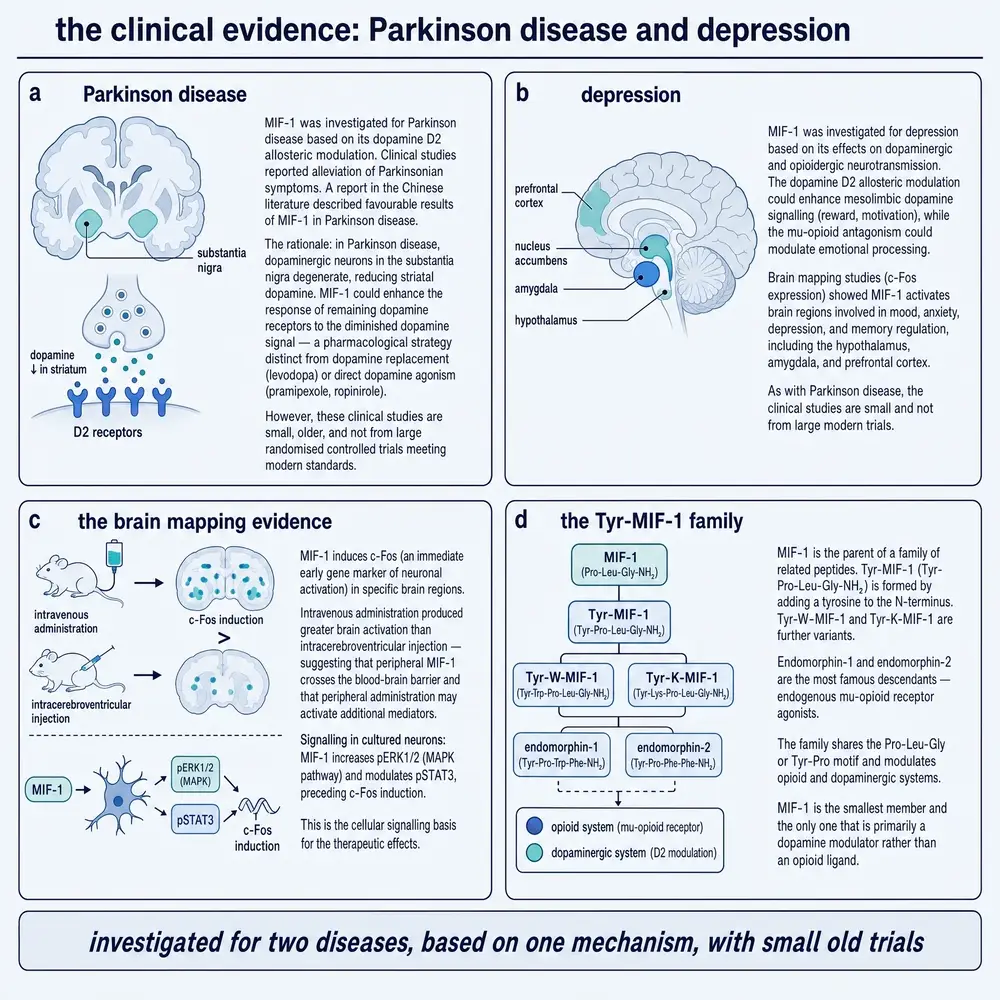
They are also why honesty about evidence tiering matters. The studies are early, small by modern registrational standards, and methodologically of their decade. Later writers in the Kastin circle continued to cite favourable clinical impressions, including references to literature outside the English indexing mainstream (Khan2010). None of that reconstitutes a contemporary Phase 3 programme. In the corpus built for this monograph, MIF-1 in Parkinson’s disease remains an historically important signal with animal corroboration (Katzenschlager2007), not an approved therapy and not a dosing manual.
13Depression trials
The mood literature is even more dependent on the people who lived inside it. Ehrensing, commemorating Kastin, describes collaborative clinical work in which MIF-1 appeared to improve depression with greater apparent efficacy and faster onset than traditional antidepressants of that era, while also exhibiting the inverted-U dose–response relationship that haunts many peptide behavioural curves (Ehrensing2015). Khan and colleagues likewise summarise clinical depression observations as part of the reason to map brain activation (Khan2010).
Read as history of science, those accounts are invaluable: they show what questions the peptide was asked to answer when monoamine drugs defined the default. Read as modern evidence, they are underpowered and incompletely standardised. This document records them as research observations. It does not convert them into guidance for any person, and it does not print a regimen.
14What the human record can and cannot carry
Put the human shelves side by side and the asymmetry is obvious. The animal and chemical shelves are crowded. The human shelf has a handful of early clinical explorations, later narrative reviews from participants, and no late-stage registrational architecture comparable to a contemporary metabolic peptide. Absence of a modern programme is not proof of inactivity; it is proof that the evidence stopped being organised that way.
Where recent data are strong — D2-targeted peptidomimetic chemistry, refined allosteric language, cellular signalling maps — they are strong about mechanism and medicinal chemistry. They have not yet rewritten the human clinical weight of the 1970s series. Recency is favoured in this monograph when it clarifies receptors and scaffolds; it is not allowed to overwrite the thinness of the human outcome record.
15Weighing it
The discovery chemistry is strong: independent isolation logic, a sequence, and synthetic confirmation in 1971 (Nair1971; Celis1971). The brain-facing pharmacology in animals is also strong in the weak sense that matters for an old peptide — many years, many assays, directional agreement on dopaminergic and motor themes (Plotnikoff1971; Kastin1973; Katzenschlager2007). The D2 allosteric / peptidomimetic programme is moderately strong and still moving (Raghavan2009; Bhagwanth2013; SampaioDias2025). The 2010 c-Fos map is a solid single-study mechanism paper (Khan2010). The human Parkinson and depression series are historically real and evidentially modest (KastinBarbeau1972; Barbeau1976; Ehrensing2015).
The status plate that follows is the commissioned counterpart to that ledger: solid rungs where the molecule, mechanism and early clinical record sit; dashed rungs where modern trials and approval do not.
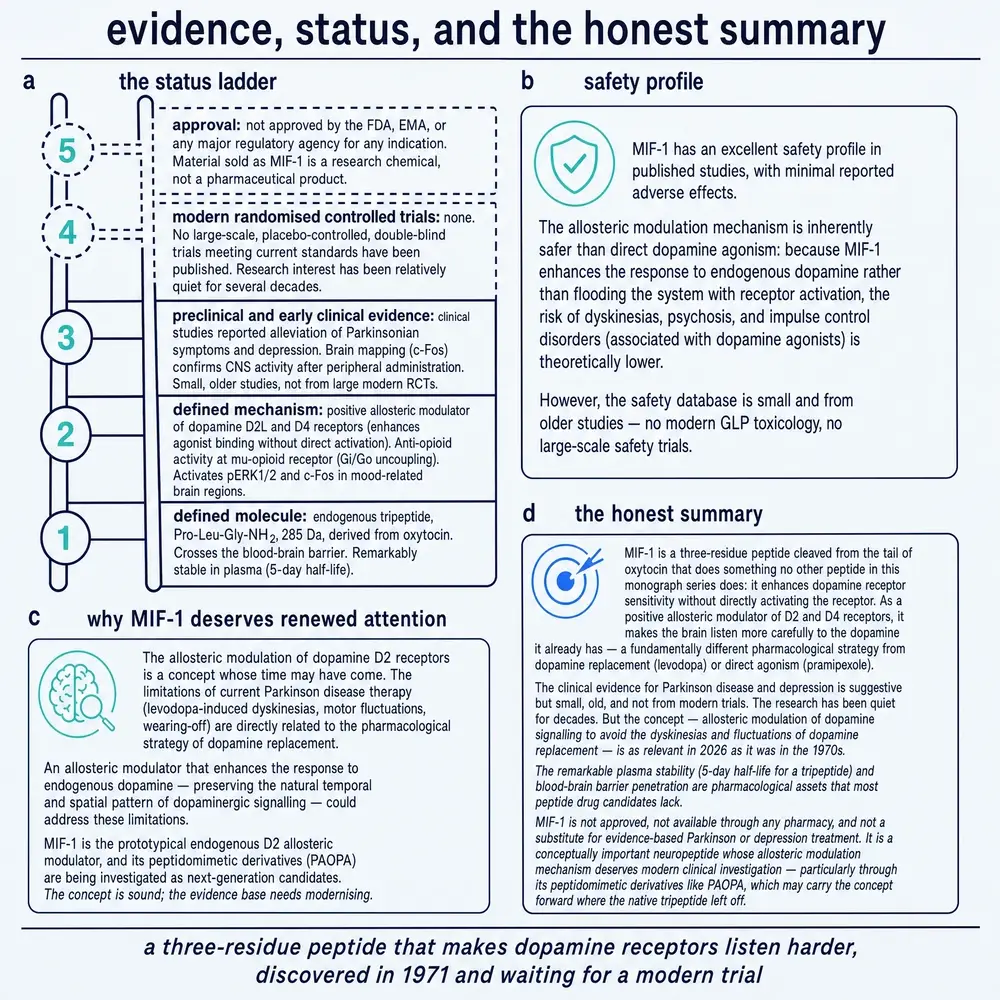
Nothing in that ledger supports presenting MIF-1 as an approved medicine, and nothing in this document does.
16The living scaffold
If the clinical programme quieted, the chemistry did not. Constrained PLG analogues were developed as tools to understand allosteric control at D2 (Raghavan2009; Bhagwanth2013). Concepts papers from Kastin and Pan kept the broader biologically active peptide frame visible (KastinPan2010). In 2025, Sampaio-Dias and colleagues were still reporting proline homologation inside the melanostatin neuropeptide as a route to potent dopamine D2 modulators (SampaioDias2025). That is what recency weighting looks like when it is earned: new compounds, new measurements, same ancestral tripeptide.
17Evidence gaps
Several gaps are structural rather than accidental.
Receptor finality. Allosteric D2 language is the best current mechanistic story, but MIF-1 has also been discussed across opioid-related and other neuromodulatory frames. The field still lacks a single, universally accepted receptor assignment of the sort that closes modern peptide monographs.
Human replication. The early Parkinson and depression observations were never replaced by large, contemporary randomised programmes in the corpus assembled here. Narrative continuity is not replication.
Identity pollution. Macrophage MIF will keep contaminating naive literature searches. Any future evidence synthesis that does not gate on peptide designations will quietly become a cytokine review.
Physiological biogenesis. The oxytocin-tail hypothesis is elegant and old (Celis1971). How much endogenous MIF-1 arises that way in humans remains less settled than the chemical possibility.
18What would change the picture
A modern, adequately powered clinical study in a clearly defined neurological or psychiatric population would immediately reweight Part Four — whether positive, negative, or mixed. A genetically or pharmacologically decisive demonstration of the endogenous receptor pathway in vivo would reweight Part Three. A clean demonstration that endogenous human MIF-1 is or is not primarily an oxytocin processing product would finish a sentence opened in 1971. Until those arrive, the honest picture is the one already on the table: a tiny hypothalamic peptide that enlarged the ambition of peptide science, left a complicated human footnote, and is still teaching chemists how to talk to dopamine receptors.
This monograph is a research synthesis for scientific and historical understanding. It is not medical advice. No human use, dose, route, schedule, stacking pattern, or self-administration practice is recommended anywhere in this document. Where clinical or laboratory doses appear, they are reported study parameters attached to a cited source and a stated population or species.
19References
Generated from verified NCBI records rather than from recall. Author lists, titles, journals, years and identifiers below were fetched from PubMed before the build was permitted to finish.
- Barbeau A, Roy M, Kastin AJ. Double-blind evaluation of oral L-prolyl-Lleucyl-glycine amide in Parkinson's disease. Canadian Medical Association journal. 1976.
PMID 3279 · PMC1956816 - Bhagwanth S, Mishra RK, Johnson RL. Development of peptidomimetic ligands of Pro-Leu-Gly-NH(2) as allosteric modulators of the dopamine D(2) receptor. Beilstein journal of organic chemistry. 2013.
PMID 23400263 · PMC3389495 - Celis ME, Taleisnik S, Walter R. Regulation of formation and proposed structure of the factor inhibiting the release of melanocyte-stimulating hormone. Proceedings of the National Academy of Sciences of the United States of America. 1971.
PMID 5283931 · PMC389210 - Ehrensing RH. An extraordinary relationship involving MIF-1 and other peptides. Peptides. 2015.
PMID 25817911 - Galina ZH, Kastin AJ. Tyr-MIF-1 attenuates antinociceptive responses induced by three models of stress-analgesia. British journal of pharmacology. 1987.
PMID 2884005 · PMC1917203 - Kastin AJ, Barbeau A. Preliminary clinical studies with L-prolyl-L-leucyl-glycine amide in Parkinson's disease. Canadian Medical Association journal. 1972.
PMID 4640811 · PMC1941054 - Kastin AJ, Plotnikoff NP, Viosca S, Anderson MS, Schally AV. MSH-release inhibiting factors: recent studies. The Yale journal of biology and medicine. 1973.
PMID 4591788 · PMC2592035 - Kastin AJ, Pan W. Concepts for biologically active peptides. Current pharmaceutical design. 2010.
PMID 20726835 · PMC2151924 - Katzenschlager R, Jackson MJ, Rose S, Stockwell K, Tayarani-Binazir KA, Zubair M, et al.. Antiparkinsonian activity of L-propyl-L-leucyl-glycinamide or melanocyte-inhibiting factor in MPTP-treated common marmosets. Movement disorders : official journal of the Movement Disorder Society. 2007.
PMID 17373723 - Khan RS, Yu C, Kastin AJ, He Y, Ehrensing RH, Hsuchou H, et al.. Brain Activation by Peptide Pro-Leu-Gly-NH(2) (MIF-1). International journal of peptides. 2010.
PMID 20721355 · PMC6578289 - Kheterpal I, Kastin AJ, Mollah S, Yu C, Hsuchou H, Pan W. Mass spectrometric quantification of MIF-1 in mouse brain by multiple reaction monitoring. Peptides. 2009.
PMID 19540426 · PMC389210 - Nair RM, Kastin AJ, Schally AV. Isolation and structure of hypothalamic MSH release-inhibition hormone. Biochemical and biophysical research communications. 1971.
PMID 4398196 - Pan W, Kastin AJ. From MIF-1 to endomorphin: the Tyr-MIF-1 family of peptides. Peptides. 2007.
PMID 17988762 - Plotnikoff NP, Kastin AJ, Anderson MS, Schally AV. DOPA potentiation by a hypothalamic factor, MSH release-inhibiting hormone (MIF). Life sciences. Pt. 1: Physiology and pharmacology. 1971.
PMID 4947365 - Raghavan B, Skoblenick KJ, Bhagwanth S, Argintaru N, Mishra RK, Johnson RL. Allosteric modulation of the dopamine D2 receptor by Pro-Leu-Gly-NH2 peptidomimetics constrained in either a polyproline II helix or a type II beta-turn conformation. Journal of medicinal chemistry. 2009.
PMID 19271750 · PMC2529021 - Sampaio-Dias IE, Costa-Almeida HF, Correia XC, Silva-Reis SC, Costa VM, Brea J, et al.. Proline Homologation in Melanostatin Neuropeptide: Discovery of Potent Modulators of the Dopamine D. ACS medicinal chemistry letters. 2025.
PMID 40832547 · PMC11403921
Registry and database sources
- National Center for Biotechnology Information. Melanostatin (Pro-Leu-Gly-NH2), PubChem Compound Summary CID 92910. Chemical database record. Accessed 5 August 2026.
https://pubchem.ncbi.nlm.nih.gov/compound/92910
CAS 2002-44-0; formula C13H24N4O3; average mass 284.35 Da; also indexed as MIF-1 / PLG.
20How this document was assembled
Project 05’s local full-text store was swept first. Across 10,204 readable local files, peptide-specific MIF-1 designations admitted 1 document(s). Bare MIF-1 as a token is unsafe because macrophage migration inhibitory factor dominates modern indexing; the PMC hazard count for that cytokine phrase was 20,571.
PubMed harvest used 18 queries and returned a de-duplicated union of 1,646 records. PMC body-text sweep on peptide designations returned a union of 771 open-access documents. Full texts were fetched for the PubMed-OA and PMC-union targets; 566 bodies were readable (19,270 printed pages at 1,800 characters per page). The identity gate admitted 123 documents (3,193 pp), of which 72 were subject-tier.
Series number 54 was assigned as the next integer above the
filed Desktop register (highest filed compound monograph at build time: 53,
Adipotide) and sibling SERIES_NO claims. Re-read the filed-PDF
folder before any export copy.
21Evidence handling
Findings are labelled in-sentence by study kind and species or population. Human observations from the 1970s are not silently upgraded by later animal or in-vitro clarity. Recency is favoured for receptor and peptidomimetic chemistry when it does not contradict the preponderance of earlier directional evidence. Conflicts and absences are printed rather than smoothed. No dose, route or schedule is recommended for any person.
Continue exploring