
OS-01 Pep 14, OneSkin, and a senomorphic peptide from a progeria screen
OS-01 did not begin as a face-cream story. It began as a screen against skin cells from Hutchinson–Gilford progeria, looking for a short peptide that would quiet senescence markers without simply killing the cells that carried them. The hit that advanced — Pep 14, later coded OS-01 — now sits behind a published sequence, a PP2A-centred mechanism paper, a toxicity package, and three small human topical studies. This monograph follows that trail, weighs what the data can carry, and stops short of turning research regimens into advice.
Findings are labelled by the kind of evidence that produced them. A result in cultured fibroblasts is not a result in a person. An open-label cream study is not a vehicle-controlled trial. Where a formula contains several actives, the peptide is not automatically the cause of every measured change.
A note on names. Pep 14, Peptide 14 and OS-01 are the same research molecule in the OneSkin literature. Formulated products (OS-01 FACE, EYE, BODY) are multi-ingredient preparations that include the peptide. Decapeptide-52 appears as an INCI-style name in some commercial materials.
A note on doses. Concentrations and application schedules appear only as facts about published experiments. Nothing here is guidance for use.
01A peptide with three names and one published sequence
In Project 05 the compound is filed as P274 — OS-01 peptide. The papers call it Pep 14 / Peptide 14 first, then OS-01. The 2022 toxicity report states the sequence: ETAKHWLKGI (acetate, >95% purity on Rink amide resin; Zonari et al., 2022).
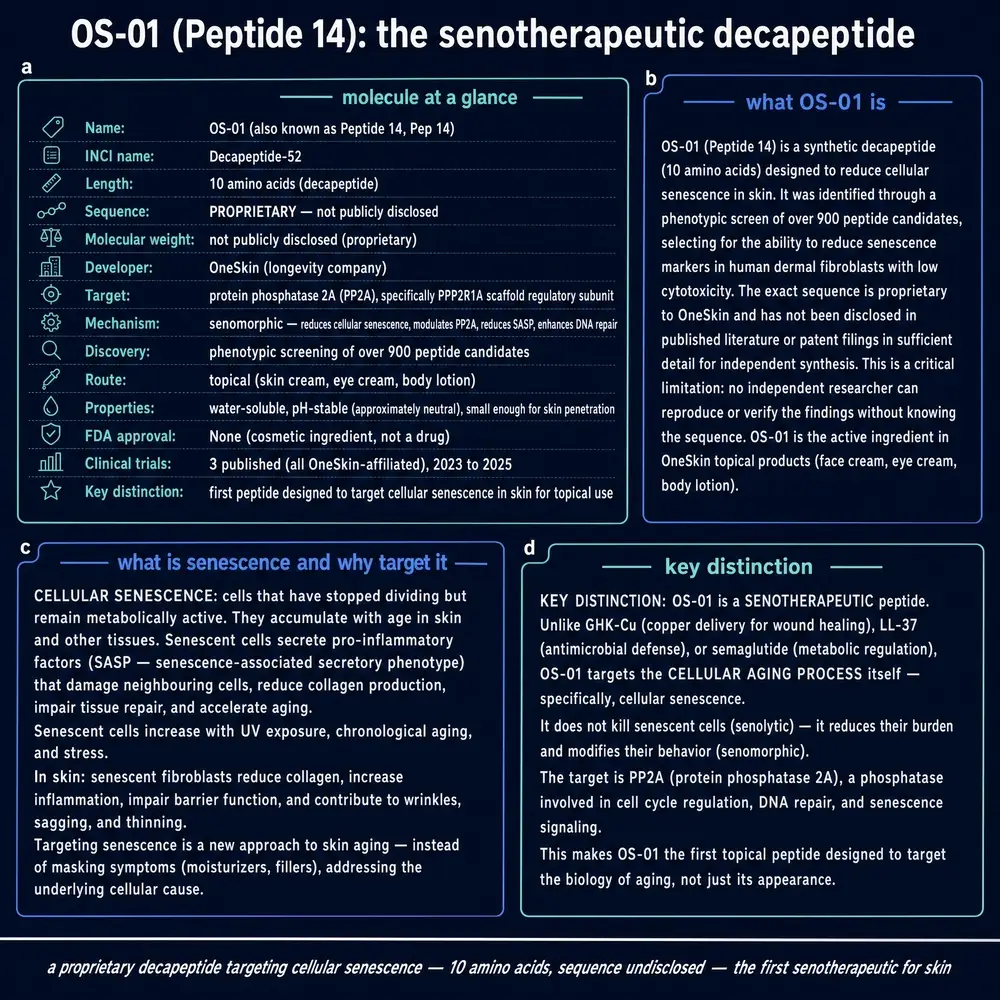
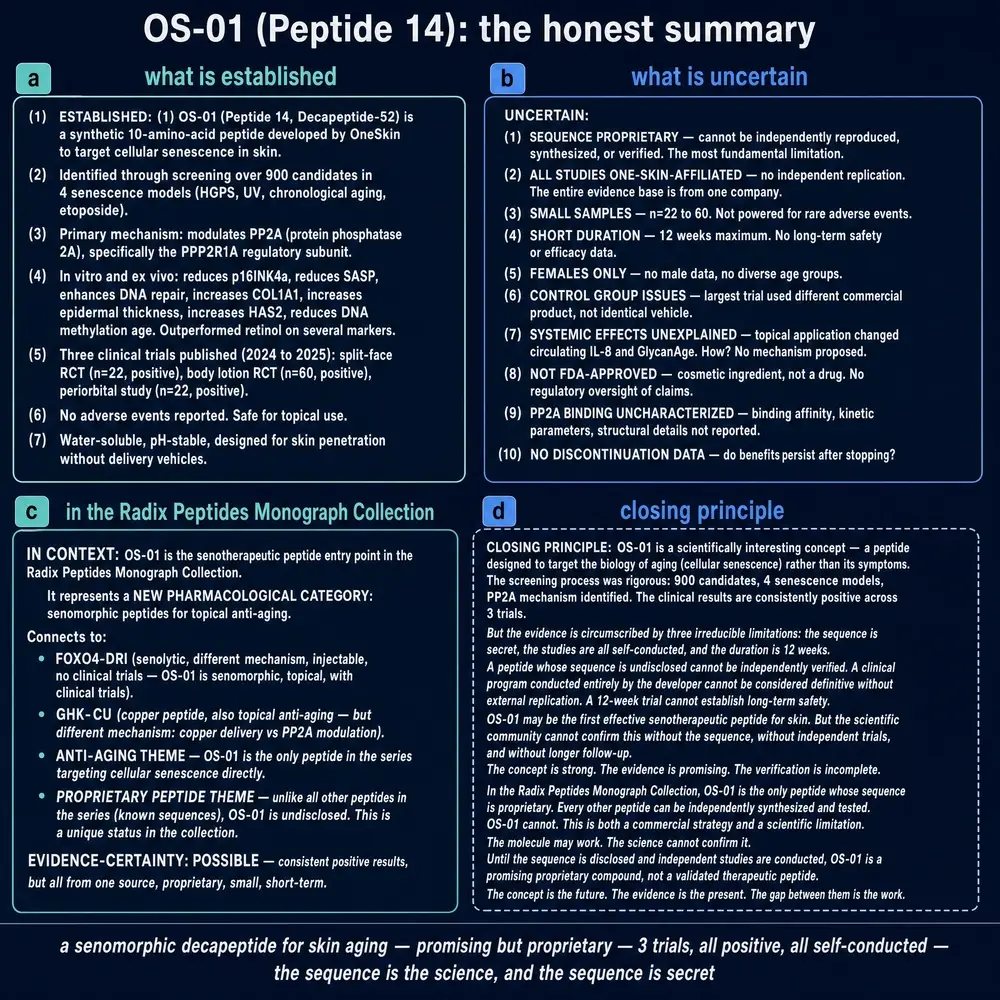
Some commissioned overview art and marketplace copy still describe the sequence as “proprietary / not publicly disclosed.” That claim is contradicted by the peer-reviewed 2022 paper. Public PubChem registration was not established in the local catalog at compilation. OS-01 is not the cyclic GPIbα peptide sometimes abbreviated OS1 in platelet biology. Catalog routing in project 05 uses P274 for the OneSkin Pep 14 identity.
02Discovery: a library, a progeria dish, a preference for quiet
Alessandra Zonari, Juliana L. Carvalho, Mariana Boroni, Carolina R. Oliveira, Lear E. Brace and colleagues — working across OneSkin, Inc. and Brazilian programmes — asked which short peptides could lower senescence markers in primary dermal fibroblasts from an HGPS donor without simply deleting the cells (Zonari et al., 2023). Peptide design and lead optimisation drew on library methods associated with Octavio L. Franco and William F. Porto. The first pass screened 164 non-cytotoxic peptides; hits that cut senescence-associated β-galactosidase-positive cells by more than 25 per cent were expanded by amino-acid scanning into 764 leads. Five top candidates were validated; Pep 14 was selected for the deep characterisation that became the 2023 npj Aging paper.
Why not a senolytic? Clearing senescent cells can help some aged tissues and harm others — acute wound healing among them. A senomorphic strategy aims to change the behaviour of senescent cells, especially their secretory programme, without requiring their death. Topical rapamycin had already offered a human-skin precedent for senescence-marker reduction (Chung et al., 2019). Pep 14 was positioned in that quieter lane.
The business context matters for later clinical papers. Several co-authors are named inventors on OneSkin-owned patents and are co-founders of the company. That does not invalidate the wet-lab work; it does mean independent replication is the missing weight on the scale.
03What senescence is doing in skin
Skin ages by calendar time and by insult. Senescent fibroblasts, through the senescence-associated secretory phenotype (SASP), release inflammatory mediators and matrix-remodelling enzymes that can push neighbouring cells toward the same state (López-Otín et al., 2013; Ritschka et al., 2017). The OneSkin programme treats that feed-forward loop as the actionable target.
04Pep 14 across senescence inducers
In HGPS fibroblasts, Pep 14 lowered SA-β-Gal signal, ATRX foci, H2A.J positivity, abnormal nuclear morphology, and protein levels of p16, p21 and γH2A.x, with parallel reductions in several SASP components measured by ELISA (Zonari et al., 2023). Similar directionality appeared in fibroblasts from chronologically older donors and after UVB or etoposide challenge. Conditioned-medium experiments suggested the peptide could both reduce the senescence-inducing potency of medium from HGPS cells and block paracrine induction when added to the target culture. Reference comparators included the senolytic ABT-263 and the senomorphic rapamycin — useful yardsticks, not proof of clinical equivalence.
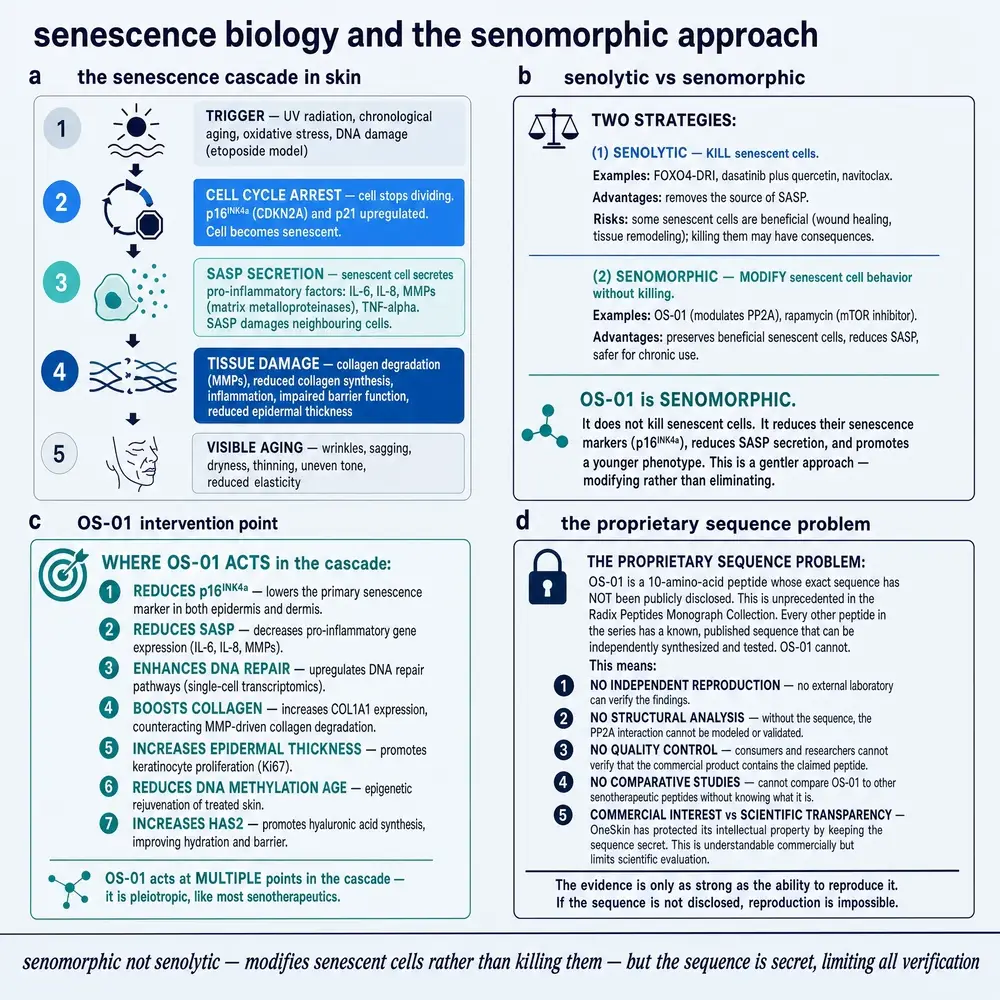
Two details keep this wet-lab package from being over-read. First, working concentrations in the 2023 paper were optimised separately for two-dimensional cultures, three-dimensional equivalents and topical ex vivo work; a micromolar bath is not a cream percentage, and neither is a human-use instruction. Second, the strongest mechanistic claims rest on HGPS cells and reconstructed tissue. Those systems are chosen because they are rich in senescence phenotypes, not because they are average adult skin in situ.
05PP2A as the proposed hub
Bulk RNA-seq and network analysis pointed to PPP2R1A, encoding a scaffold subunit of protein phosphatase 2A (PP2A), as a hub among genes modulated by Pep 14 (Zonari et al., 2023). The authors report increased PPP2R1A / PP2A subunit A protein, reduced Akt phosphorylation at Ser473, and a pattern of DNA-repair support with fewer cells in late, high-SASP states. Single-cell clustering framed a slowing of entry into late senescence rather than a broad apoptotic clear-out. That is the mechanistic heart of the “senomorphic” claim.
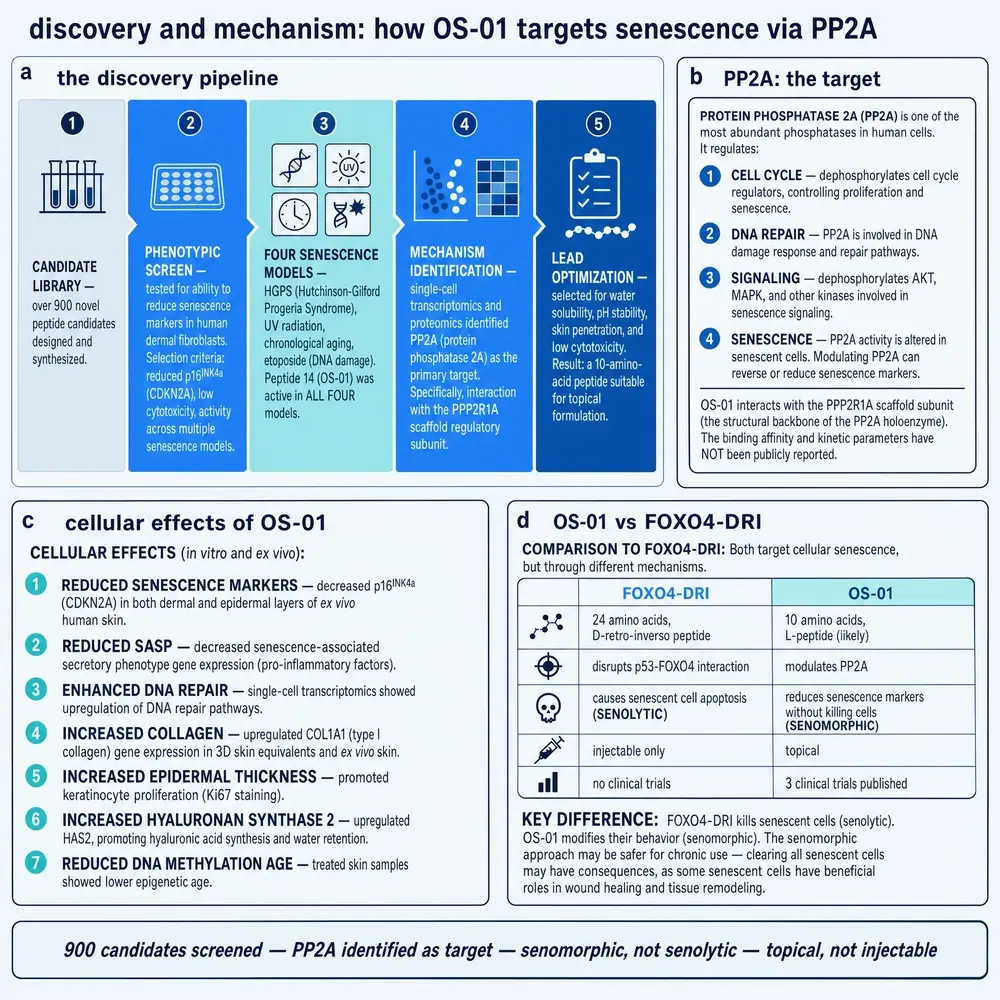
Comparisons with PP2A activators and inhibitors in the same paper situate the effect as “brake-and-repair” rather than selective killing. Nothing in that package, by itself, proves a systemic longevity drug. It does explain why the programme moved toward topical skin endpoints rather than injectable senolysis.
06The 2022 toxicology package
Before the human cream studies, the group published an in-vitro and limited in-vivo safety package for Peptide 14 (Zonari et al., 2022). Primary human dermal fibroblasts and keratinocytes remained viable across the tested concentration range in MTT assays (authors report non-toxicity to 100 µM under their conditions). Three-dimensional reconstructed tissue models were used in OECD-style irritation frameworks and interpreted as non-irritant. Ames and micronucleus assays were reported as negative for mutagenicity. Karyotyping of treated primary fibroblasts was described as apparently normal. Several cancer cell lines (including MeWo and HeLa in the paper’s set) did not show a proliferation signal under the conditions tested.
07Human patch testing
A repeated-insult patch test in 54 adults was reported with grade 0 responses under the conditions described (Zonari et al., 2022). That is reassuring for topical irritation potential in a small volunteer panel; it is not a chronic safety file, and it is not a substitute for larger, independent dermatology programmes. The 2022 paper is also where the sequence ETAKHWLKGI enters the public record for this monograph.
082024: the vehicle-controlled face study
The cleanest design in the clinical set is the twelve-week split-face, double-blind, vehicle-controlled investigation in 22 participants (Zonari et al., 2024). One side of the face received an OS-01-containing formulation; the other received an identical control lacking the peptide. The abstract reports significantly reduced transepidermal water loss versus both baseline and vehicle, with expert grading and imaging favouring wrinkle appearance and texture on the peptide side, while some radiance/texture improvements appeared bilaterally. Full tabular detail was paywalled at compilation; later papers cite this study as confirmation of barrier benefit attributable to the peptide within a matched base. Sponsor inventorship disclosures apply. The design is the right kind of control for a peptide claim; the sample is still a pilot.
092025: periorbital open study (OS-01 EYE)
Twenty-two adults (ages 47–65) applied OS-01 EYE twice daily for twelve weeks in an open study with standardised cleanser, face moisturiser and sunscreen (Zonari et al., 2025, Int J Cosmet Sci). Versus baseline, mean changes included roughly +32% corneometer hydration, +26% cutometer elasticity (R7), +10% firmness (R0), and −17% TEWL, with expert grading improvements in fine lines, puffiness and (by week 12) dark circles. No adverse events were reported in the paper. The formula also contains acetyl hexapeptide-8, botanical extracts and hyaluronic acid. Without a vehicle arm, the study can show that the product moved instruments and grades; it cannot isolate the peptide as the sole cause.
102025: body RCT, barrier, cytokines, GlycanAge
Sixty women aged 60–90 were randomised to a commercial physiologic-lipid emollient previously reported to support barrier function and lower some plasma cytokines (Ye/Dang line of work; Ye et al., 2019) or to an OS-01 body formulation; 52 completers were analysed after twelve weeks of twice-daily body application (Zonari et al., 2025, J Cosmet Dermatol). Both arms improved forearm TEWL; the OS-01 arm also improved upper-arm TEWL and showed larger hydration gains, significant versus control on the upper arm. Self-perception favoured the OS-01 arm on several skin-quality items (70% vs 42% reporting general appearance improvement at twelve weeks).
Plasma cytokines are the ambitious claim. The OS-01 group showed a significant decrease in IL-8 and IL-10, with a broader downward trend across several inflammatory markers; the control group showed significant increases in TNF-α and IFN-γ. GlycanAge (IgG glycan biological-age estimate) was described as roughly stable in the OS-01 arm (mean change about −0.07 years over 12 weeks) versus a mean increase of about +0.72 years in controls — a between-group pattern the authors interpret as slower systemic aging, while noting lifestyle factors were not standardised. Critically, mass spectrometry did not detect OS-01 peptide in plasma after treatment, which the authors read as evidence that effects were local to skin rather than circulating peptide pharmacology. Three OS-01-arm dropouts involved moderate skin reactions possibly related to product or cleanser; control dropouts were for adherence and logistics.
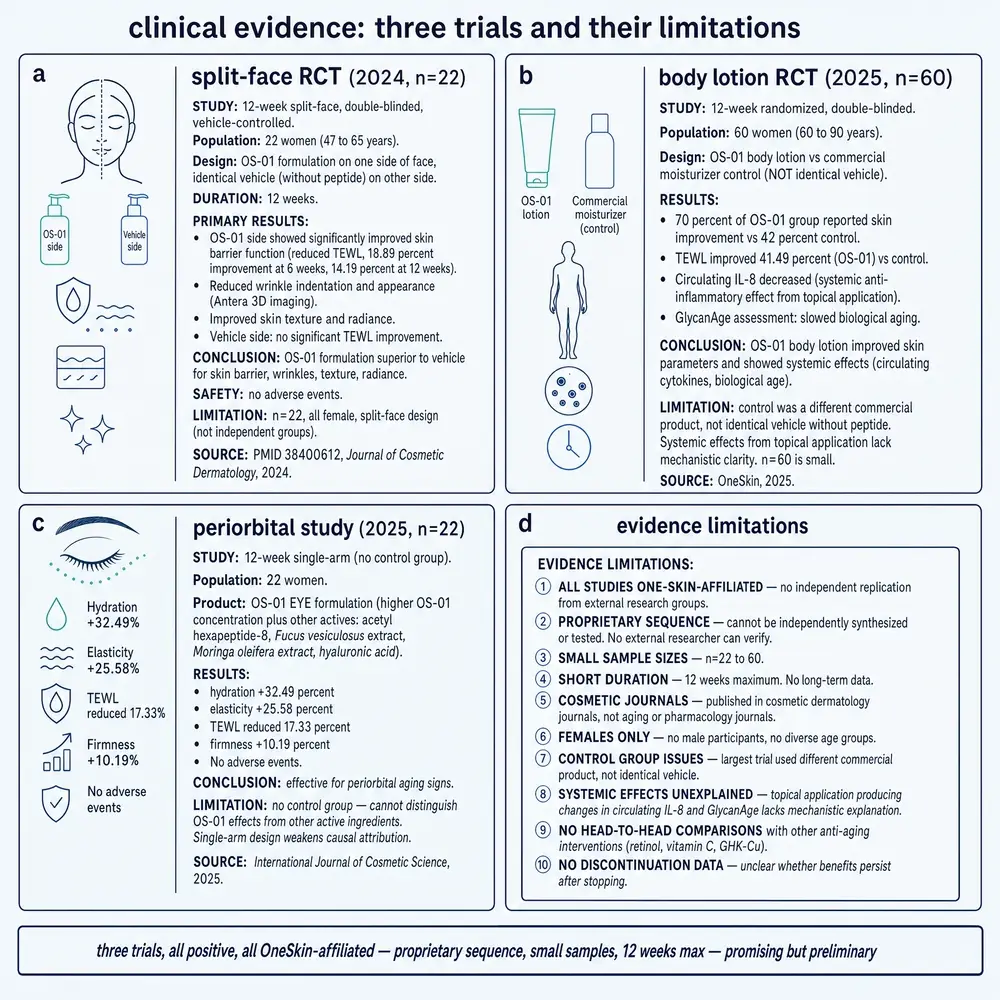
How much weight? The randomised, controlled skin-instrument story is the strongest human evidence in the set, tempered by a multi-ingredient test article and a control that is itself an active emollient. The cytokine and GlycanAge findings are biologically interesting and directionally consistent with a skin–system axis hypothesis, but they sit on a pilot sample, sponsor analysis, and incomplete lifestyle control. Freshness favours these 2025 data; preponderance still says “promising, small, not independently replicated.”
| Study | Design | n | Primary flavour of result |
|---|---|---|---|
| Face 2024 | Split-face, vehicle | 22 | TEWL down vs vehicle (abstract) |
| Eye 2025 | Open-label product | 22 | Hydration / elasticity / TEWL vs baseline |
| Body 2025 | RCT vs emollient | ~52 | Barrier/hydration; IL-8; GlycanAge trend |
Table summarises designs reported in Zonari et al. (2024, 2025). It is not a ranking of efficacy and does not recommend use.
Across the 2022–2025 OneSkin papers, Alessandra Zonari, Mariana Boroni, Carolina R. Oliveira, Lear E. Brace and Juliana L. Carvalho appear as inventors and/or co-founders. Board-certified advisors are disclosed on some clinical papers. Readers should treat efficacy claims as sponsor-linked until independent groups repeat them.
11Established, suggested, not established
Established in this corpus. A defined decapeptide sequence (ETAKHWLKGI) with a published topical-oriented safety package including genotoxicity assays and a human RIPT (Zonari et al., 2022). In human cell and ex vivo skin models, Pep 14 behaves as a senomorphic candidate with a PP2A-linked mechanism and measurable effects on senescence markers and a methylation-age clock (Zonari et al., 2023).
Suggested. Topical formulations containing OS-01 can improve barrier and hydration metrics and some appearance grades in small human studies, including one split-face vehicle-controlled face trial (Zonari et al., 2024) and a randomised body trial against an active emollient (Zonari et al., 2025). A possible link from barrier improvement to shifts in circulating cytokines and GlycanAge is suggested by the 2025 body study but remains preliminary.
Not established. OS-01 as an approved drug; systemic longevity benefit; peptide-only causality for every endpoint in multi-active creams; independent academic replication of the clinical programme; meaningful animal in-vivo efficacy beyond the human patch-test and tissue models already discussed. Vendor capsule products scraped into discovery queues are not evidence of composition or effect.
12Recency against preponderance
The freshest data are the 2025 clinical papers. They deserve attention because they move the conversation from dishes to people and, in one case, to randomised control. They do not overturn the need for larger, independent, peptide-isolating designs. The 2023 mechanistic paper remains the backbone for how the molecule is supposed to work; nothing in the clinical set contradicts that backbone, and nothing in it fully proves it in vivo in humans either — especially while the peptide stays undetectable in plasma.
13What would settle more
Independent vehicle-controlled trials with peptide-only arms; pre-registered cytokine and biological-age endpoints; longer follow-up; male and broader Fitzpatrick representation where missing; and transparent sharing of individual-level instrument data. Until then, OS-01 is best read as a carefully documented cosmetic-research peptide with an unusually explicit senescence mechanism — interesting enough to follow, not settled enough to mythologise.
14Closing
The progeria dish was a strange place to look for a face cream. That strangeness is the point. Zonari, Carvalho, Boroni, Oliveira, Brace and their collaborators treated skin senescence as a molecular phenotype first and a mirror later. The published trail — sequence, PP2A story, toxicology, then small human studies — is coherent. Coherence is not the same as conclusion. This document stops at the edge of the evidence and leaves use decisions where they belong: outside a research monograph.
Section 21References
Every PubMed entry below was resolved against the National Library of Medicine during this build. The build refuses to run if any identifier fails.
- Alencar-Silva T, Barcelos SM, Silva-Carvalho A, Sousa MGDC, Rezende TMB, Pogue R, et al.. Senotherapeutic Peptide 14 Suppresses Th1 and M1 Human T Cell and Monocyte Subsets In Vitro. Cells. 2024;13(10).
PMID 38786036 · doi:10.3390/cells13100813 · pmc-id: PMC11120033; - Chung CL, Lawrence I, Hoffman M, Elgindi D, Nadhan K, Potnis M, et al.. Topical rapamycin reduces markers of senescence and aging in human skin: an exploratory, prospective, randomized trial. Geroscience. 2019;41(6):861-869.
PMID 31761958 · doi:10.1007/s11357-019-00113-y · pmc-id: PMC6925069; - Levine ME, Lu AT, Quach A, Chen BH, Assimes TL, Bandinelli S, et al.. An epigenetic biomarker of aging for lifespan and healthspan. Aging (Albany NY). 2018;10(4):573-591.
PMID 29676998 · doi:10.18632/aging.101414 · pmc-id: PMC5940111; - López-Otín C, Blasco MA, Partridge L, Serrano M, Kroemer G. The hallmarks of aging. Cell. 2013;153(6):1194-217.
PMID 23746838 · doi:10.1016/j.cell.2013.05.039 · pmc-id: PMC3836174;manuscript-id: EMS55354; - Ritschka B, Storer M, Mas A, Heinzmann F, Ortells MC, Morton JP, et al.. The senescence-associated secretory phenotype induces cellular plasticity and tissue regeneration. Genes Dev. 2017;31(2):172-183.
PMID 28143833 · doi:10.1101/gad.290635.116 · pmc-id: PMC5322731; - Ye L, Mauro TM, Dang E, Wang G, Hu LZ, Yu C, et al.. Topical applications of an emollient reduce circulating pro-inflammatory cytokine levels in chronically aged humans: a pilot clinical study. J Eur Acad Dermatol Venereol. 2019;33(11):2197-2201.
PMID 30835878 · doi:10.1111/jdv.15540 · pmc-id: PMC6728229;manuscript-id: NIHMS1015972; - Zonari A, Brace LE, Al-Katib K, Porto WF, Foyt D, Guiang M, et al.. Senotherapeutic peptide treatment reduces biological age and senescence burden in human skin models. NPJ Aging. 2023;9(1):10.
PMID 37217561 · doi:10.1038/s41514-023-00109-1 · pmc-id: PMC10203313; - Zonari A, Brace LE, Alencar-Silva T, Porto WF, Foyt D, Guiang M, et al.. In vitro and in vivo toxicity assessment of the senotherapeutic Peptide 14. Toxicol Rep. 2022;9:1632-1638.
PMID 36518461 · doi:10.1016/j.toxrep.2022.07.018 · pmc-id: PMC9742937; - Zonari A, Brace LE, Li F, Harder NHO, Harker C, Jacob C, et al.. Clinical efficacy of OS-01 peptide formulation in reducing the signs of periorbital skin aging. Int J Cosmet Sci. 2025;47(3):455-465.
PMID 39788697 · doi:10.1111/ics.13042 · pmc-id: PMC12127787; - Zonari A, Brace LE, Buhrer LB, Harder NHO, Harker C, Aronson AB, et al.. OS-01 Peptide Topical Formulation Improves Skin Barrier Function and Reduces Systemic Inflammation Markers: A Pilot 12-Week Clinical Trial. J Cosmet Dermatol. 2025;24(4):e70169.
PMID 40193112 · doi:10.1111/jocd.70169 · pmc-id: PMC11975214; - Zonari A, Brace LE, Harder NHO, Harker C, Oliveira CR, Boroni M, et al.. Double-blind, vehicle-controlled clinical investigation of peptide OS-01 for skin rejuvenation. J Cosmet Dermatol. 2024;23(6):2135-2144.
PMID 38400612 · doi:10.1111/jocd.16242
Sources with no PubMed record.
- OneSkin, Inc.. Corporate and patent disclosures associated with Peptide 14 / OS-01. Inventorship and co-founder relationships stated in the competing-interest sections of Zonari et al. (2022, 2023, 2024, 2025) are treated as primary disclosure of commercial interest, not as independent corroboration..
https://www.oneskin.co/ - South Beach Longevity Library (project 05). Compound P274 OS-01 peptide catalog record and research intake map. Local catalog status at monograph compilation: intake map available; standard dossier sparse (uncited stubs). Used for identity routing only..
local:library/compound_dossier_manifest.csv
Section 22How this document was assembled
The corpus was built against project 05, the Therapeutic Peptide Research Library, and against PubMed Central open-access full text for the OneSkin / Pep 14 programme. Project 05’s own standard dossier for P274 was sparse at compilation and was not treated as evidence. Primary full texts ingested for drafting comprised the 2022 toxicity report, the 2023 npj Aging discovery paper, the 2024 immune-cell paper where available, and the two 2025 clinical papers; the 2024 vehicle-controlled face study was available as abstract and as summarised in later papers. 5 scientific full texts (~81 printed-page equivalents) and 8 figures support the narrative. Sequence identity (ETAKHWLKGI) is taken from Zonari et al. (2022).
Section 23Evidence handling and image provenance
Findings are labelled by study kind in the sentence that reports them. Sponsor inventorship is stated in the clinical sections. Identity is OS-01 / Pep 14 / ETAKHWLKGI (P274); the unrelated cyclic “OS1” ligand is out of scope. Five commissioned Higgsfield plates (P1–P5) print at 140 mm; three authored SVG figures print near full column width with A46-sized type. Where a commissioned plate asserts that the sequence is undisclosed, the caption corrects to the 2022 publication. Nothing here is guidance for use by any person.
Continue exploring