
P021 Five residues cut from a cytokine too toxic to use, by the two people who found out what the Alzheimer tangle is made of
In 1986 a husband and wife working in a state institute on Staten Island proved that the tangles inside an Alzheimer brain are made of tau. It is one of the founding results of the field. Two decades later the same laboratory did something the field mostly did not: instead of trying to clear the damage, it went looking for a way to make the brain build faster than it was losing. P021 is what that search produced — a five-residue fragment of a nerve-growth cytokine, carrying a cage of carbon atoms grafted onto one end to get it past the gut and into the brain. Across fifteen years it has restored memory, neurogenesis and synaptic density in mice and rats, lowered tau, and in one experiment more than doubled survival. Almost all of that work comes from one laboratory. No one has ever given it to a human being. And the most recent time it was tested in a living animal, it did not work.
01Five residues and a cage
P021 is five amino acids long. Four of them — aspartate, glycine, glycine, leucine — are copied straight out of human ciliary neurotrophic factor, a protein of about two hundred residues that the nervous system uses to keep neurons alive. The fifth is not an amino acid that occurs in any protein. It is a laboratory construction: a glycine carrying adamantane, a cage-shaped hydrocarbon of ten carbons that looks, in a structural drawing, like a small diamond lattice, because that is more or less what it is. The whole molecule weighs 578.7 daltons, roughly a third heavier than a molecule of table sugar.14
The written form of the sequence is a trap. It is usually given as Ac-DGGLAG-NH2, six letters, which reads as six residues with an alanine fifth. In the papers the fifth letter is set in italic or superscript to mark the adamantane, and the printers of the world have quietly flattened that distinction ever since. The published molecular formula settles the question without needing anyone's typography: C27H42N6O8 contains six nitrogen atoms, which is five backbone amide bonds plus the amide cap at the tail. A genuine six-residue chain would need seven. The developers call it a pentamer, and the formula agrees with them.14
Everything else about the compound follows from those two facts — four borrowed residues and one manufactured one. The borrowed residues are what it does. The manufactured one is why it can be swallowed.
The name belongs to something else
Research-chemical vendors sell this peptide as P21. That is a problem, because p21 already means something in biology, and it means it loudly. p21, properly p21Waf1/Cip1, is the protein product of the human gene CDKN1A. It is about 164 amino acids long, it is made by cells rather than by chemists, and its job is to shut down the cell cycle — which makes it one of the most heavily studied proteins in cancer biology and, more recently, in the study of cellular senescence. There are also the p21-activated kinases, a family of enzymes abbreviated PAK, which collide on the same string again.
None of that has anything to do with the compound described here. There is no shared sequence, no shared receptor, no shared pathway, and effectively no shared literature: the two bodies of work do not cite each other because they are not about the same subject. The collision is orthographic. It is worth naming plainly at the start because a reader who goes looking for independent evidence about “P21” will find an enormous, rigorous, and entirely irrelevant body of research, and may come away with the impression that this peptide is far better characterised than it is. Throughout this document, P021 means the peptide and nothing else.
021974 to 1986: what the tangle is made of
To understand why a molecule like this exists, it helps to know what its makers had spent the previous thirty years doing.
Alois Alzheimer described two abnormalities in his patient's brain in 1907: plaques between the cells and tangles inside them. For most of the twentieth century nobody knew what either was made of. The plaques gave way first; by the mid-1980s their core protein had been identified as amyloid beta. The tangles held out longer, and they held out partly because they are physically difficult: they are insoluble, they resist the detergents that dissolve most of a cell, and getting enough of them out of post-mortem tissue to run a chemical analysis on was, for a long time, the whole problem.
Khalid Iqbal published a method for doing it in 1974, working at what was then the New York State Institute for Basic Research in Developmental Disabilities on Staten Island — a state institution, not a famous one, whose original mission concerned intellectual disability rather than dementia.25 Bulk-isolating tangles from human brain was a technical achievement rather than a conceptual one, and it took another twelve years to convert it into an answer.
The answer arrived in 1986, in two papers published within weeks of each other by Inge Grundke-Iqbal, Khalid Iqbal and their colleagues. The first, in the Journal of Biological Chemistry, showed that the paired helical filaments that make up a tangle are built from tau — a microtubule- associated protein whose ordinary job is to stabilise the internal scaffolding along which a neuron moves its cargo.16 The second, in the Proceedings of the National Academy of Sciences, showed that the tau in tangles is not ordinary tau: it carries far more phosphate groups than it should, and that abnormal hyperphosphorylation is what appears to make it fall off the microtubules and aggregate.17
Those two results are the foundation of forty years of subsequent work. Every tau-targeting drug programme, every phospho-tau blood test, every tau-tracer PET scan descends from them. Inge Grundke-Iqbal and Khalid Iqbal were married; they worked in the same department for four decades; and they had just defined, in chemical terms, one half of the pathology of the most common form of dementia.
03The turn to regeneration, and a last idea
By the 2000s the dominant approach to Alzheimer's disease was removal. If plaques and tangles are the disease, then dissolving them, clearing them, or preventing their formation should be the cure. Enormous sums went into antibodies against amyloid, into secretase inhibitors, into aggregation blockers. Most of it failed, and much of what did not fail produced effects too small to notice in a patient.
The Staten Island laboratory took a different line, and the reasoning behind it is the most interesting thing about this compound. Their argument, set out across a series of reviews, runs roughly as follows. The adult brain does build new neurons, in a small region of the hippocampus called the dentate gyrus, and it does build new synapses. In early Alzheimer's disease it appears to try: a damaged brain increases this activity, as though attempting to compensate. But the attempt fails, and one plausible reason is that it runs out of the neurotrophic support — the growth signals — needed to keep newborn cells alive and wire them in. If that is right, then supplying the missing signal might let the brain outrun its own degeneration, without touching the plaques or the tangles at all.14,15
It is a bet on repair rather than on removal, and it is testable in a way the amyloid hypothesis often was not: if you give the compound and the animal gets more new neurons, more synapses and better memory, the mechanism is doing what it was supposed to do, whatever happens to the pathology.
Late in her career Inge Grundke-Iqbal pursued exactly this. According to the memorial written by her colleagues after her death, she identified an eleven-residue fragment of ciliary neurotrophic factor that enhanced neurogenesis, then cut it down to a tetrapeptide, and proposed the result as a drug candidate for neurodegeneration.27 Those two molecules — Peptide 6 and Peptide 6c — are the direct ancestors of P021, and section 05 traces the descent residue by residue.
She worked in the laboratory until 14 September 2012, suffered a stroke, and died on 22 September.27 The floor of the institute where she worked now carries her name. P021 itself had been published two years earlier, in 2010, and every study of it in a living animal except the first was carried out after her death.
04Ciliary neurotrophic factor, and why nobody can take it
Ciliary neurotrophic factor was named for what it was first found doing: keeping alive the neurons of the chick ciliary ganglion, the cells that control the muscles of the eye. The name stuck and has been misleading ever since. CNTF turned out to keep a great many kinds of neuron alive, and to push neural stem cells towards becoming neurons rather than glia. It belongs to the interleukin-6 family of cytokines, alongside leukaemia inhibitory factor, oncostatin-M, interleukin-11 and the cardiotrophins — a group that signal not through the receptor tyrosine kinases used by nerve growth factor and its relatives, but through shared cytokine receptors that assemble on the cell surface into multi-part complexes.14,29
The details of that assembly are the reason the whole protein cannot be used as a medicine, so they are worth setting out. CNTF's ordinary signal runs through a complex of three components: a CNTF-specific receptor alpha subunit, which is tethered to the cell membrane and does not itself transmit anything; the leukaemia inhibitory factor beta receptor; and a shared signalling subunit called gp130. When the three come together, Janus kinases attached to their inner faces phosphorylate a tyrosine on the transcription factors known as STATs, of which STAT3 is the relevant one here; the phosphorylated protein then travels to the nucleus and changes what the cell transcribes.14
The trouble is that CNTF has a second, lower-affinity route. It can also signal through a complex built on the interleukin-6 receptor alpha subunit, and that receptor is not confined to the nervous system. It is on liver cells, immune cells, fat and muscle. Engage it and you get the systemic consequences of an interleukin-6-family signal in tissues that were never the target.29
Both problems showed up the moment CNTF was given to people. A double-blind, placebo-controlled trial of subcutaneous recombinant human CNTF in amyotrophic lateral sclerosis, reported in 1996, is the record that settled it.26 Adverse effects were dose-dependent and included anorexia, weight loss, cough and increased salivation; across the CNTF programme as a whole the pattern also included skeletal muscle loss, cramps, muscle pain and hyperalgesia.14 The pharmacokinetics were no better: recombinant CNTF has a plasma half-life of roughly three minutes, and it does not cross the blood–brain barrier.14 A molecule that lasts three minutes, cannot reach the organ it is meant to act on, and makes patients lose weight they cannot spare is not a drug. It is a starting point.
05Eleven residues, then four, then five
The Staten Island approach to that starting point was to find the smallest piece of CNTF that still did the useful thing, and then to modify that piece until it behaved like a drug. This is a well-worn strategy in peptide chemistry and it usually fails; the interesting part here is the record of what each step bought.
The first cut was made by epitope mapping with neutralising antibodies — using antibodies that block CNTF's activity to work out which stretch of the protein the activity lives in. That identified residues 146 to 156, an eleven-residue segment, which was synthesised as Ac-VGDGGLFEKKL-NH2 and named Peptide 6.14 Peptide 6 was a considerable improvement on its parent: a plasma half-life of more than six hours against CNTF's three minutes, and — unlike CNTF — able to cross the blood–brain barrier.14 In mice it increased dentate-gyrus neurogenesis, dendritic and synaptic plasticity, and memory.11
The second cut went further, to a four-residue core, Ac-DGGL-NH2, corresponding to CNTF residues 148 to 151 and named Peptide 6c. It was still neurogenic in mice.12 Four residues is about as short as a peptide can be and retain any specific activity at all, and at that length a molecule has almost no structure: it is a short flexible string rather than a folded shape.
The third step was not a cut but an addition, and it is the step that makes P021 a distinct compound rather than a variant of Peptide 6c. To the C-terminal end of the tetrapeptide the chemists attached an adamantylated glycine — an unnatural residue carrying the adamantane cage — producing the pentamer Ac-DGGLAG-NH2, P021, first reported in 2010.1 Adamantane was chosen to do two things at once. It is bulky and unnatural, which obstructs carboxypeptidases — the enzymes that chew peptides from the C-terminal end — and it is strongly lipophilic, which was expected to help the molecule partition across the blood–brain barrier.14
What the graft bought is measurable, and the developers measured it. P021 has a plasma half-life of more than three hours. It is water-soluble, which for an adamantane-bearing molecule is not a given. It survives artificial gastric juice — more than ninety per cent intact after thirty minutes — and artificial intestinal fluid, more than ninety-five per cent intact after two hours, which is what makes it possible to give it by mouth or in food rather than by injection.14 Almost every animal study described in Part Four exploits that property.
06The gap under the whole design
There is a hole in the middle of that account, and it deserves its own section rather than a parenthesis.
Adamantane was grafted onto the tetrapeptide to get the molecule into the brain. The rationale is chemically reasonable and the group is well known for exactly this purpose. The compound is described as blood–brain-barrier permeable in the developers' own review and in the papers that follow it.14 But an independent appraisal of the programme records that no published study has directly measured how much P021 reaches the brain of a living animal — not by mass spectrometry on brain tissue, not with a radiolabel, not by any of the standard methods.24 The permeability is inferred from the fact that oral or subcutaneous dosing changes things inside the brain: neurogenesis in the dentate gyrus, phosphorylation states of tau, levels of brain-derived neurotrophic factor.
That inference is not unreasonable. It is difficult to change the dentate gyrus of a mouse from outside the skull, and the effects reported in Part Four are hard to explain if nothing arrives. But it is an inference, and it leaves two questions open that a development programme would eventually have to answer: how much of an administered amount actually crosses, and whether the molecule that crosses is intact P021 or a fragment of it. A peptide can be cleaved in plasma and still produce central effects through a metabolite; without a measurement, there is no way to tell those cases apart.
The gap also bears on how the animal results in Part Four should be read. Ciliary neurotrophic factor signalling is not confined to the brain: the receptor complex is present in peripheral tissue, and the parent cytokine's most conspicuous effect in the people who received it was on body weight rather than on the nervous system.26,29 A compound acting partly outside the skull and partly inside it would produce much the same behavioural readouts as one acting only inside it, and nothing in the published record separates those two possibilities. No experiment reported so far was designed to. Until brain exposure is measured directly, the route set out in Part Three is the developers' account of the mechanism rather than a demonstrated one.
07What the peptide is supposed to do
P021 is described as working through two levers, and they pull in the same direction for different reasons. Both were worked out on the parent peptide first and carried forward.
The first lever is subtraction. Neural stem cells in the adult hippocampus face a choice between becoming neurons and becoming glia, and leukaemia inhibitory factor pushes them towards glia and towards self-renewal rather than differentiation. P021 competitively inhibits LIF signalling, and blocking that push shifts the balance towards the formation of neural precursor cells.14 The direct molecular evidence for this lever is thinner than the story around it: the anchoring measurement is that P021 reduced LIF-induced STAT3 phosphorylation by about thirty per cent in cell culture cell culture — one of very few places in the whole record where the compound's action is measured at the level of a molecule rather than inferred from a tissue.1,14 Thirty per cent is a partial block, not a switch, which fits a small peptide competing with a full-length cytokine for the same receptor.
The second lever is addition. P021 increases transcription of brain-derived neurotrophic factor, BDNF — the growth factor most closely associated with the survival, maturation and wiring-in of newly born neurons.14 Where the first lever makes more precursors, the second keeps them alive long enough to become part of a circuit. Increased BDNF is the most consistently reported molecular finding across the animal studies, and it is also, as section 15 will show, the finding that failed most conspicuously in the one model where the compound did not work.
08Down to tau, by a route nobody planned
A compound designed to grow new neurons has no obvious reason to lower tau phosphorylation. That it does is the most interesting mechanistic claim in the file, and the proposed route runs through a single enzyme.
BDNF acts on a receptor called TrkB. TrkB activates phosphoinositide 3-kinase, which activates the kinase AKT. AKT phosphorylates glycogen synthase kinase 3 beta at serine 9 — and that particular phosphorylation is inhibitory. It switches the kinase off. GSK3β is one of the principal enzymes that phosphorylates tau, and it also influences the amyloidogenic processing of amyloid precursor protein. Turn it down and, on this account, you should get less hyperphosphorylated tau and less amyloid generated.2,14
One consequence of this route is worth stating before the data arrive, because it predicts the shape of the results. If the compound reduces the generation of amyloid rather than promoting its clearance, then it should lower the soluble pool, which turns over, and should do little to the insoluble deposits, which do not. That is precisely the pattern the 3xTg-AD experiments report, and section 11 goes through it. A mechanism that predicts its own partial failures is in better shape than one that does not.
09Repair instead of removal
It is worth being explicit about how unusual this bet is, because the unusualness is the point.
The dominant Alzheimer's programmes of the last twenty-five years were subtractive. Anti-amyloid antibodies remove plaque. Secretase inhibitors reduce the production of the peptide that forms plaque. Tau immunotherapies and aggregation inhibitors go after the tangle. All of them accept the premise that the deposits are the disease and that getting rid of them is the treatment. The recent anti-amyloid antibodies do clear plaque, convincingly, and the clinical effect that accompanies the clearance has been small enough to keep the premise under argument.
The P021 thesis is additive and does not require the premise to be true. It holds that what matters clinically is the state of the network — how many neurons, how many synapses, how much capacity to form new ones — and that a brain given enough neurotrophic support might maintain that network in the presence of the pathology rather than by removing it. On this view the plaques and tangles are a burden the network is failing to carry, and the intervention is aimed at the carrying rather than at the burden.14,15
Two things follow. The first is that this framing changes what counts as success. A compound that improved memory and synaptic density in a mouse while leaving plaque untouched would be a failure under the subtractive premise and a success under this one, and the data in Part Four sit exactly in that territory. The second is a caution about how such a claim can drift. There is a family resemblance between “supports the brain's own repair processes” and the language of the supplement market, and the resemblance is superficial: the specific claim here is a competitive inhibition and a transcriptional increase, both of which are falsifiable, and one of them has already been falsified in one model.
What follows is the whole published efficacy record for P021 in a living animal. There are ten of them, spread across five models and sixteen years, and one has an arm in cells as well. They are set out here in the order the compound was given — earliest treatment window first, latest last — rather than by publication date, because the timing of the intervention turns out to be the strongest predictor of how well it worked.
Two facts frame all of them and are not repeated after every paragraph. Every efficacy study named below comes from the Iqbal laboratory or a direct collaboration with it. No independent group has reproduced any of these findings. And none of them involved a human being. Where a study parameter appears — a concentration in feed, a treatment window, a route — it is what investigators gave to animals under an approved protocol and it carries no implication for any person.
10The first mice
The compound's first appearance in a living animal was in normal mice — not a disease model, just healthy adult C57Bl/6 — and the question was simply whether a five-residue peptide could do anything to a brain at all.1 mouse, in vivo It was given by subcutaneous depot at 25 nmol per day for thirty-five days. The animals afterwards performed better on object-recognition and spatial-memory tasks, had more new cells in the dentate gyrus as counted by BrdU labelling, and showed increased levels of the synaptic proteins synaptophysin and synapsin I.
This is a small, clean, unsurprising result and it establishes two things. First, the adamantane-modified pentapeptide retains the neurogenic activity of its parents rather than losing it to the graft. Second, whatever the compound does, it does not require a diseased brain to do it: it increased neurogenesis in animals that had no deficit to correct. That second point cuts both ways, as section 16 discusses. A compound that pushes neurogenesis in a healthy animal is doing something real, and it is also doing something whose long-term consequences in a healthy animal nobody has characterised.
11The Alzheimer mouse, treated late
The workhorse model for the rest of this record is the 3xTg-AD mouse, generated in 2003 by injecting two mutant human transgenes — amyloid precursor protein carrying the Swedish mutation, and tau carrying P301L — into embryos already carrying a knocked-in presenilin-1 mutation. It develops both amyloid plaques and tangle-like tau pathology in an age-dependent way, and it is cognitively impaired long before either appears.30 It is the best available mouse for this question and it is still a mouse with three human mutations in it, which section 16 returns to.
In the first full therapeutic experiment, 3xTg-AD mice were started on P021 at nine to ten months of age — by which point the amyloid pathology is already under way — and kept on it for up to twelve months, delivered in their food at 60 nmol per gram of feed.2 mouse, in vivo Animals were examined at fifteen to sixteen months, after six months of treatment, and at twenty-one to twenty-two months, after twelve.
The tau result was the clearest. Abnormal phosphorylation was significantly reduced at three separate epitopes — the sites recognised by the AT8, PHF-1 and 12E8 antibodies — at both time points, in the subiculum and the CA1 region of the hippocampus. Dentate-gyrus neurogenesis, deficient in the untreated transgenic animals, was restored to wild-type levels. Synaptic markers recovered. Object-recognition memory was restored. BDNF rose and the inhibitory phosphorylation of GSK3β at serine 9 increased, which is the mechanism of figure 7 showing up where it was predicted to.
The amyloid result was mixed in a way that matters. Soluble amyloid-beta, both the 40- and 42-residue forms, fell significantly — but only in the group treated for six months. At twelve months the reduction was gone. Insoluble, aggregated amyloid did not change at either time point. The plaque load in CA1 showed a trend towards reduction that did not reach significance. Among the synaptic proteins, the deficit in the GluA2/3 glutamate-receptor subunits was not corrected. And in the Morris water maze, the probe-trial benefit was a non-significant trend rather than a result.
Read together, the two columns of figure 9 are a coherent result rather than an inconsistent one. What improved is what a neurotrophic mechanism would be expected to improve: the cells, the connections, the behaviour, and the kinase that sits between them and tau. What did not improve is the accumulated insoluble deposit, which nothing in the proposed mechanism acts on. The honest description is a compound that changes the state of the network in a mouse carrying Alzheimer-type pathology, without removing the pathology.
12The Alzheimer mouse, treated early
If the thesis is that the brain fails because its compensation runs out, the obvious experiment is to start before the compensation fails. That experiment was run twice on the same cohort, reported in two papers in 2017, and it produced the strongest single result in the file.
Female 3xTg-AD mice were put on P021 in feed at 60 nmol per gram from three months of age — six to nine months before any overt amyloid or tau pathology, and during the window when the model shows synaptic compensation — and kept on it for about eighteen months. Ninety-eight animals were used in the neurobiological and behavioural arms: forty-one wild-type controls, thirty-five transgenics on vehicle diet, thirty-two transgenics on P021. Average consumption was about 2.7 grams of feed per day, which the authors record as roughly 162 nmol of compound per mouse per day.5 mouse, in vivo
The companion paper reporting dendrites, synapses, neurogenesis and behaviour is one of the two documents read in full for this monograph, and reading it in full changes the impression the abstract gives.5 The headline findings are real: after nine months of treatment, dentate-gyrus neurogenesis measured by doublecortin and Ki-67 staining was not merely restored but pushed above the wild-type level; spatial reference memory in the Morris water maze was rescued, with the treated transgenics escaping faster and swimming shorter distances than their untreated littermates; short-term spatial memory in an object-location task was rescued at eighteen months of age; and PSD-95, NR1, MAP2, synapsin 1 and GluR1 were higher in treated animals at various time points and in various regions.
The texture underneath is patchier than that summary. The paper is full of results reported as a “trend towards” an effect with p-values between 0.05 and 0.09 — MAP2 in CA3 at p = 0.09, PSD-95 in hippocampal western blots at p = 0.07 in both directions, synapsin 1 in the parietal cortex at p = 0.06, NR1 described only as trending. Some markers behaved differently in different brain regions and at different time points; cortical synapsin 1 showed no difference among the three groups at nine months by western blot, and cortical synaptophysin was reduced in the untreated transgenics with no significant recovery under treatment at that point, though both moved at later time points. The result is a broad but uneven rescue assembled from many partial measurements, not a switch being thrown.
The second paper on the same cohort is where the number that everyone quotes comes from.4 mouse, in vivo It reports Fluoro-Jade C staining, a marker of degenerating neurons, reduced in treated animals; tau reduced by roughly half by eighteen months; amyloid plaque formation prevented in the subiculum but not in CA1; and, most striking, a survival difference. At week 71 of the experiment, 87 per cent of the treated animals were alive against 41 per cent of the vehicle controls. Hindlimb paralysis, which these animals develop, occurred in one of thirty-two treated animals against five of thirty-four controls.
A doubling of survival is a large effect and it should be taken seriously. It should also be read for what it is. The animals dying in the vehicle arm are 3xTg-AD mice, which die of causes related to their transgenes; a treatment that extends their lives is telling you something about that mouse line, and the inferential distance from there to a human with sporadic Alzheimer's disease is enormous. The paper reporting it is a single experiment. Nobody outside the originating laboratory has attempted to repeat it in the nine years since.
13Before birth
If starting at three months is better than starting at nine, the logic runs further back. Three experiments took it there, and their results are the most uniformly positive in the record and the least relevant to any adult.
In Ts65Dn mice — a model of Down syndrome, in which Alzheimer-type pathology appears in middle age — P021 was given from the eighth day of gestation, through the mother, until weaning at postnatal day 21.6 mouse, in vivo The treated animals reached developmental milestones on time instead of late, and as adults were not impaired on the memory tasks the model usually fails. BDNF roughly doubled and phosphorylated CREB rose; GSK3β activity fell. Four measured proteins did not change at all: PSD-95, TrkB, CNTF itself, and total CREB. The compound was given to pregnant animals and to pups, and the benefit was read out in adults months later.
Two further experiments applied the same idea to 3xTg-AD mice. Dosing from before birth to weaning prevented tau and amyloid pathology and the behavioural deficits when the animals were examined at twenty-two months of age.8 Dosing from birth to postnatal day 120 rescued cognition and synaptic markers at four months, with increases in phosphorylated CREB and BDNF.9 mouse, in vivo Both papers also report null results on named markers: synapsin, synaptophysin, MAP2 and the microglial marker Iba1 in the 2020 experiment; pro-BDNF, TrkB, CNTF, and the messenger RNA for the GluN2B and GluA1 receptor subunits in the 2021 one.
The recurring null is worth pausing on. Across three separate early-window experiments, CNTF itself and the BDNF receptor TrkB did not change. The proposed mechanism does not require them to — it requires more BDNF ligand acting through the receptor already present — but a reader who assumed the compound broadly “upregulates neurotrophic signalling” would be wrong. It moves one ligand, and the machinery around that ligand stays where it was.
14Old animals, and one eye
The third setting is ordinary ageing rather than engineered disease, and it produces the clearest example in the file of a real effect that is also a modest one.
Aged Fisher rats were given P021 by oral gavage for about eighty-eight days in two related studies.3,13 rat, in vivo Total tau fell in the hippocampus and in the cerebrospinal fluid — a notable result because CSF tau is a biomarker used in human diagnosis, and a compound that moves it in an ageing animal is doing something measurable in a fluid a clinician could sample. Neurogenesis was restored, several synaptic markers recovered, and escape latency in the Morris water maze improved.
Two measurements did not move. Magnetic resonance spectroscopy found no change in brain metabolites. Fluorodeoxyglucose PET found no change in glucose uptake. Both are whole-tissue functional measures, and both were flat while the histology and the behaviour improved. The maze improvement, moreover, did not bring the old animals to the performance of young ones, and the error bars overlapped those of the vehicle group. This is a significant effect and a small one, and the two descriptions are not in conflict.
A separate experiment looked at the retina. In aged rats and in 3xTg-AD mice, P021 prevented the development of retinal changes resembling age-related macular degeneration.7 rat and mouse, in vivo Two limits are stated plainly in the work itself and should travel with the finding: no measure of visual function was taken — no electroretinography, no behavioural vision test — and rodents do not have a macula. The result is about histology in an animal that lacks the anatomical structure the human disease is named for.
15The most recent word is no
In 2024 a group in Bologna, working with Iqbal, tested P021 in a model of CDKL5 deficiency disorder — a developmental epileptic encephalopathy caused by loss of a kinase that the affected brain needs for normal neuronal maturation.10 The rationale was straightforward: CDKL5-null brains show reduced neurogenesis, immature dendritic spines and low BDNF, which is close to a list of the things P021 has been reported to fix.
In cells, it worked. In a human neuroblastoma line engineered to lack CDKL5, P021 restored proliferation, survival and neurite length, and did so in a dose-dependent way.10 human cell line Dose-dependence is a meaningful detail; it is one of the standard signs that an effect is pharmacological rather than incidental. This is also, notably, the only experiment in the entire record performed on human cells.
In animals, it did not. Cdkl5-null mice were treated from postnatal day 21 to postnatal day 90 — an early window, comparable to the ones that produced the strongest results in the Alzheimer models. The compound did not restore memory. It did not restore social behaviour. It did not restore motor function. It did not restore dentate-gyrus neurogenesis. It did not improve survival of CA1 neurons. It did not mature dendritic spines. And it did not raise BDNF — the single most consistent molecular finding in every other in-vivo study of this compound. One outcome improved: muscular rigidity, measured on a catalepsy bar.10 mouse, in vivo
The authors' interpretation is that CNTF-dependent responses may themselves be disrupted in a brain lacking CDKL5, so the lever P021 pulls is not connected to anything in this model. That is a plausible reading and it is also the strongest available argument for not generalising from it: a mechanism that requires an intact downstream system will fail wherever that system is broken, and Alzheimer's disease is not CDKL5 deficiency.
Two things follow anyway, and they are the reason this study is given a section of its own rather than a sentence at the end. First, it is a genuine negative in a living animal, dosed in the window that worked elsewhere, measuring the outcomes that moved elsewhere, and finding nothing. Second, and more uncomfortably for the mechanism, the in-vitro arm worked. If a compound can rescue human cells in a dish and change nothing in the animal made of the equivalent cells, then the in-vitro anchor of the mechanism — the thirty-per-cent STAT3 result of section 07 — carries less weight as evidence about animals than it appeared to.
16What fifteen years of animals can and cannot carry
The record above is substantial by the standards of a research peptide. It spans four species-and-model combinations, treatment windows from before birth to old age, durations up to eighteen months, and outcomes from single proteins to survival. It is internally consistent in the places where a fabricated record would not be: the nulls are in the right places, the amyloid result has the shape the mechanism predicts, and the papers report their own trends and failures rather than hiding them. The eighteen-month experiment read in full for this monograph is, on its own terms, careful work.
Four limits sit on top of all of it.
One laboratory
Every efficacy finding described in Part Four was produced by the Iqbal group at Staten Island or by a direct collaboration with it, including the 2024 negative. In sixteen years no independent laboratory has published an attempt to reproduce any of it. That is not an accusation; it is a description of the state of the evidence, and it is the single most important thing to know about this compound after the absence of human data. Independent replication is what converts a laboratory's findings into a field's, and it has not happened here.
One mouse, mostly
Four of the ten in-vivo experiments used the 3xTg-AD mouse alone and a fifth used it alongside aged rats, so half the record rests on a single engineered mouse line. The authors of the eighteen-month study state the model's limits themselves, and they are worth quoting in substance rather than paraphrase: it is an overexpression model that does not represent the human disease mechanism; the study used only female animals, because the pathology is inconsistent in males; the transgenic line and its wild-type controls are bred separately, so there are no littermate controls; and the sporadic form of Alzheimer's disease, which is 95 to 99 per cent of cases, is not caused by any mutation at all, so a triple-mutant mouse models the rare familial form far better than the common one.5 A compound characterised almost entirely in that animal inherits every one of those limits.
The parents are not the compound
A good deal of writing about P021 draws on results obtained with Peptide 6 or Peptide 6c, and the boundary is worth policing. Peptide 6 has its own literature and its own nulls; one 2010 study of it in 3xTg-AD mice reversed neurogenic and cognitive abnormalities without affecting amyloid or tau pathologies, which the title states outright.28 mouse, in vivo That is a useful result about the family and it is not a result about P021.
One item in that neighbouring literature has to be reported for a different reason. A 2011 paper comparing the neurogenic effects of CNTF-derived peptides with Cerebrolysin in amyloid-precursor-protein transgenic mice — work on the parent peptides, not on P021 — was retracted in June 2026, two months before this document was compiled.31,32 It is cited here for the fact of its retraction and for nothing else. Its results are not used anywhere in this monograph, and no conclusion drawn above depends on it. It is named rather than quietly dropped because a reader following the literature outward from this compound will meet it, and should meet it with the retraction attached.
Safety, as far as rodents can establish it
The safety record is reassuring and it is also entirely rodent. Across studies running up to eighteen months of continuous dosing in 3xTg-AD and wild-type mice, investigators report no weight loss, no tumours, no signs of pain, no change in grooming, posture or limb-clasping, and no change in anxiety-like behaviour.2,4,5,9 No detectable immune reaction was reported in rats.3 Eighteen months is most of a mouse lifespan, which makes this a genuinely long exposure by preclinical standards.
One contrast is instructive. Full-length CNTF causes anorexia and weight loss; P021 does not, and if anything the reported effect on weight runs the other way.14 That is consistent with the design intent — the fragment engages the neural route and not the interleukin-6-receptor route of figure 4 — and it is the most direct evidence available that the truncation achieved what it was for.
None of that is a safety file. There is no toxicology dossier, no genotoxicity work, no reproductive toxicity package, no maximum tolerated dose, and no human exposure at all. The theoretical concern raised in the review literature is the one that applies to any peptide given chronically: the formation of neutralising antibodies against it. None has been observed, in rodents, so far.15 The precedent for taking that seriously is in Part Five, and it belongs to a different molecule.
17Who owns it, and who is developing it
P021 is patented. The relevant instrument is United States Patent 9,327,011, “Neurotrophic peptides for the treatment of tauopathies”, covering the adamantane-modified CNTF peptide family that includes Peptide 6c and P021.21 The assignee is the research foundation attached to the institute where the work was done, which is the ordinary arrangement for an academic invention.
The funding history is more interesting than the patent, because it shows who thought this was worth money and when. The published papers name an Alzheimer's Association Zenith Award, ZEN-12-241433, made to Khalid Iqbal; the New York State Office for People with Developmental Disabilities; and a graduate fellowship from a neuroscience training programme.5 The Alzheimer's Drug Discovery Foundation appears elsewhere in the programme's funding record. And patent prosecution was supported in part by EVER NeuroPharma GmbH of Unterach, Austria — a company whose principal neurological product is Cerebrolysin, a porcine-brain-derived peptide preparation marketed in a number of countries outside the United States for cognitive indications.21,23 That connection is worth recording plainly: a commercial interest in neurotrophic peptide preparations helped fund the intellectual property around this one, and the only published head-to-head comparison of CNTF-derived peptides with Cerebrolysin has since been retracted, as section 16 notes.31,32 The authors of the studies in Part Four declare no competing interests.5
Current development sits with Phanes Biotech, a Pennsylvania company, with which Iqbal is affiliated in his recent publications.23 Academic work continues under National Institutes of Health grant R01AG057602, which funds imaging and behavioural studies of the neurotrophic peptide programme in the 3xTg-AD mouse.22 That grant is a useful marker of where the programme actually is: sixteen years after the compound was first published, its funded work is still being done in mice.
18Two CNTF drugs that did reach people
P021 has never been given to a human being, but the pathway it acts on has, twice, in two very different ways. Neither is P021 and neither is evidence about it. Both are useful for calibrating what a CNTF-pathway drug's path can look like.
The first is Axokine, a modified recombinant variant of human CNTF developed by Regeneron and taken not into neurology but into obesity, on the observation that CNTF causes weight loss. A randomised, dose-ranging trial in obese adults, published in 2003, reported weight loss on the order of a few kilograms.18 human, randomised trial That is the only randomised human trial referenced anywhere in this document, and it concerns a different molecule. The programme did not survive its later phase: a substantial proportion of participants developed neutralising antibodies against the injected protein, and peripheral effects of the kind section 04 describes persisted.15 An engineered variant of a cytokine, given repeatedly, taught the immune system to remove it.
The second is ENCELTO, revakinagene taroretcel, approved by the United States Food and Drug Administration on 5 March 2025 for macular telangiectasia type 2, a degenerative disease of the retina.19,20 regulatory It is not a peptide and not a drug in the usual sense. It is an implant: a small semi-permeable capsule containing living engineered cells that secrete recombinant human CNTF, surgically placed inside the eye, where it releases the cytokine locally and continuously into a tissue the immune system largely leaves alone.
Put side by side, the two say something precise. CNTF signalling can be made into an approved medicine, and the way it was done was to abandon systemic delivery entirely and confine the cytokine to a single privileged organ. P021's proposition is the opposite: keep the systemic route, change the molecule until the systemic route is survivable. That is a coherent alternative and it is unproven, because the step at which Axokine failed — repeated dosing of a human immune system — is the step P021 has never reached.
19What is actually sold, and under what name
P021 is not approved as a medicine in any jurisdiction. It does not appear on the United States Food and Drug Administration's list of bulk drug substances eligible for use in compounding under section 503A. It has no marketing authorisation anywhere. What exists is a research-chemical market: vendors listing the peptide, generally as P21, labelled for laboratory research use only.24 market
The naming is the problem, and it compounds itself. A prospective buyer who searches for “P21” will find, first and overwhelmingly, the literature on p21/CDKN1A: tens of thousands of papers, decades of work, mechanisms established in detail, roles in cancer and cellular senescence mapped. It is a large and genuinely authoritative body of science, and none of it is about this peptide. The impression it creates — that “P21” is a well-characterised molecule with an enormous evidence base — is precisely backwards for the compound actually being sold, whose evidence base is ten animal experiments from one laboratory.
The five plates that follow are that other literature, rendered in the house style so the collision is visible rather than abstract. Every title, pathway, residue count and therapeutic claim on them belongs to CDKN1A. None of them is a claim about Peptide 021. They are filed here, under the naming section, because this is the only place in the document where that molecule is allowed to appear.
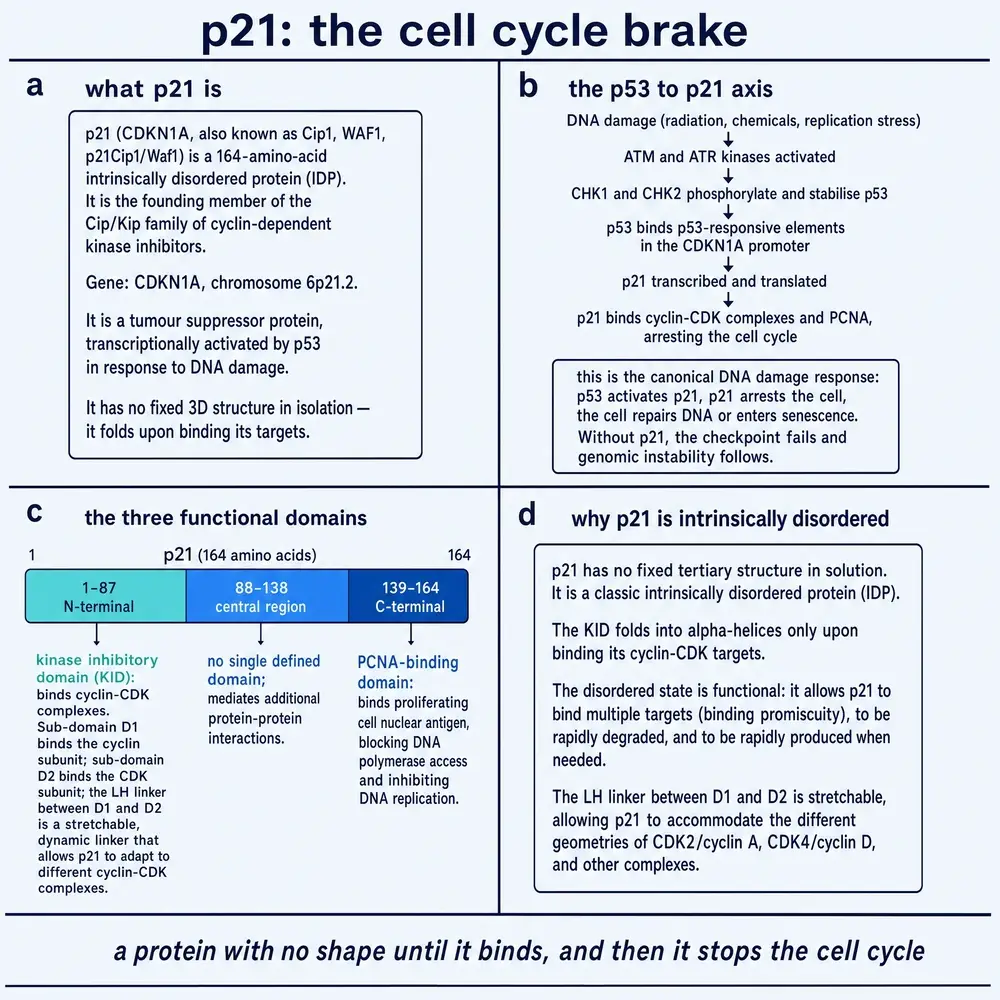
That is the molecule a literature search for “P21” actually returns: a human protein of about eighteen kilodaltons, studied for decades in cancer and senescence, with a gene locus, a domain map and a textbook pathway behind it. The peptide sold under the same string is five residues and less than six hundred daltons. The mass difference alone should settle the naming question; the next plate settles the functional one. It shows how the protein stops the cell cycle — still CDKN1A, still not Peptide 021.
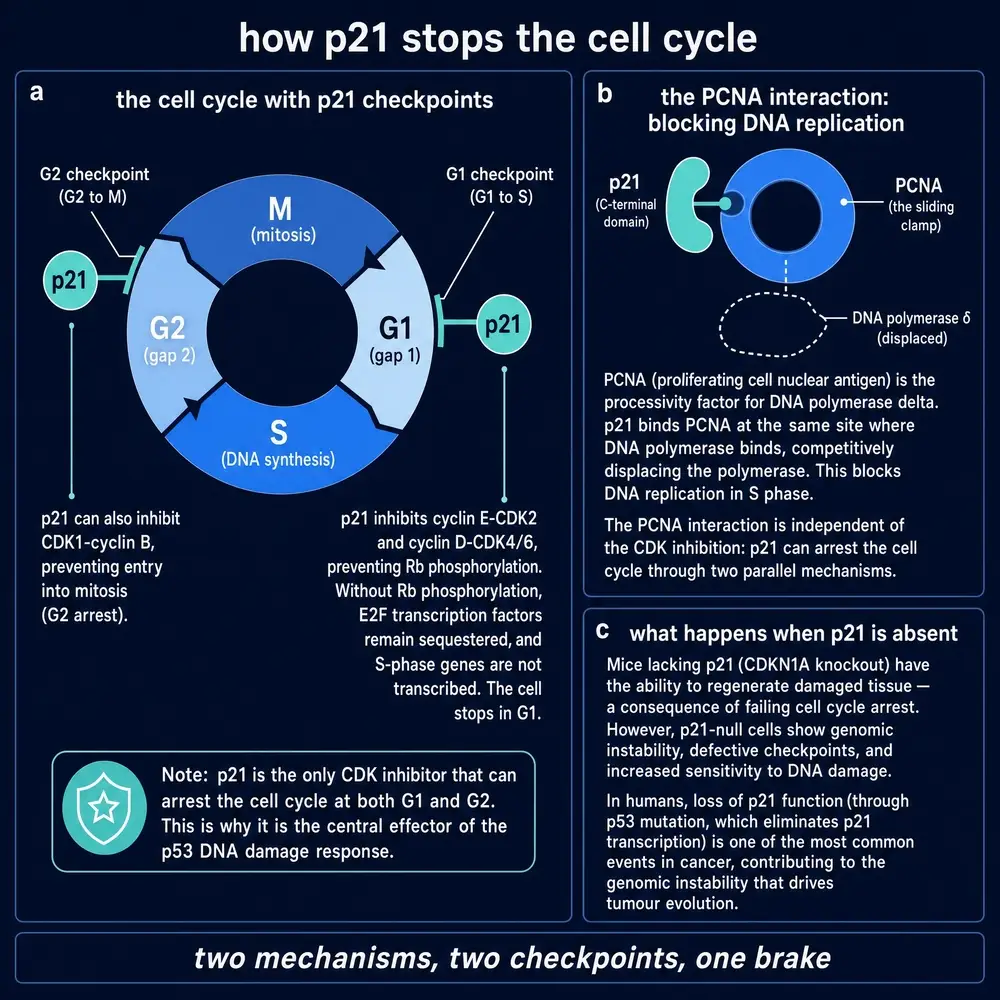
None of that checkpoint biology is a mechanism claim for Peptide 021. G1 and G2 arrest, PCNA displacement and the regeneration phenotype of CDKN1A-null mice belong to a different literature entirely. The third plate is why CDKN1A is clinically awkward even on its own terms: the same protein is a tumour suppressor in the nucleus and an oncogene in the cytoplasm, and the difference is an address, not a sequence.
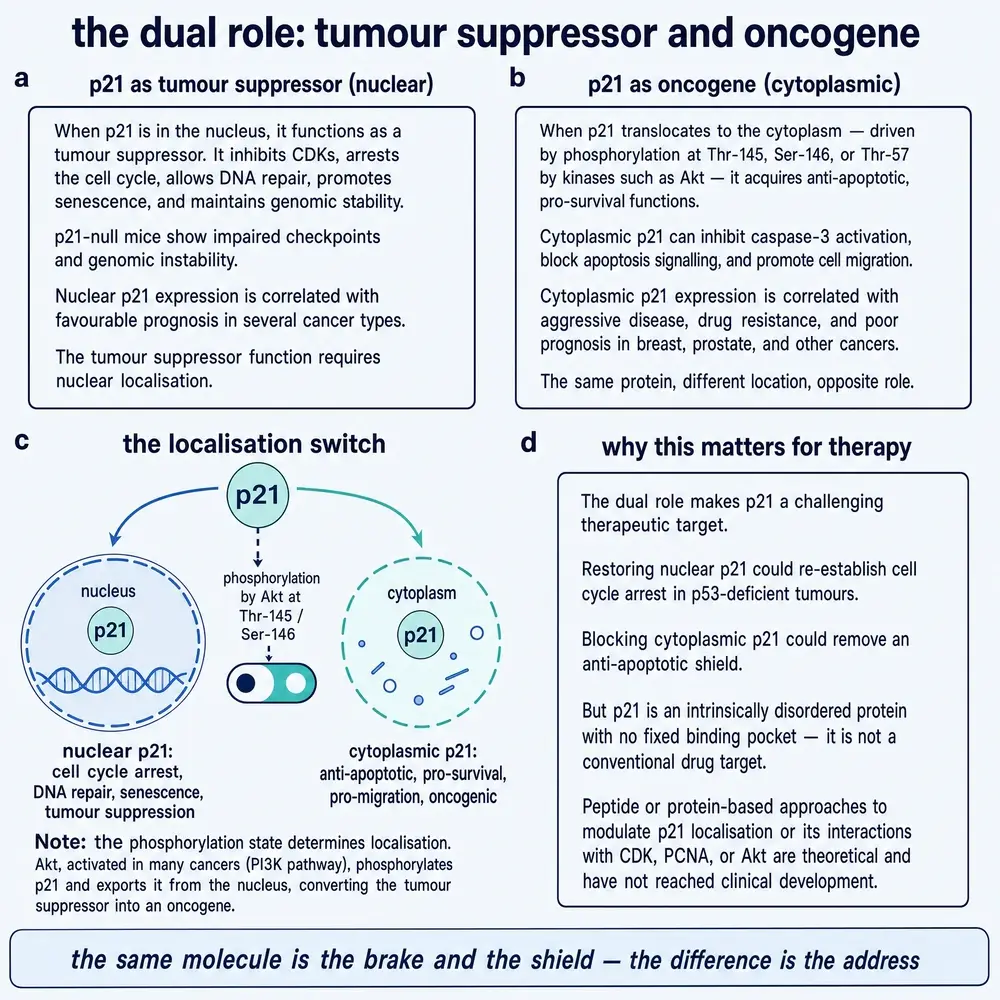
The dual-role framing matters for readers who arrive from a vendor page promising “P21.” Whatever they have bought, it is not a protein that Akt shuttles between nucleus and cytoplasm, and it is not a protein whose nuclear form predicts favourable prognosis while its cytoplasmic form predicts resistance. Those are CDKN1A clinical correlations from the oncology literature. The fourth plate takes that same protein into senescence and regeneration — the geroscience tension that also appears elsewhere in this series under FOXO4-DRI and related compounds, and that has nothing to do with the CNTF mimetic. Keep the address of the claim in view: every panel on these plates is evidence about the cell-cycle brake, and zero of it is evidence about Peptide 021.
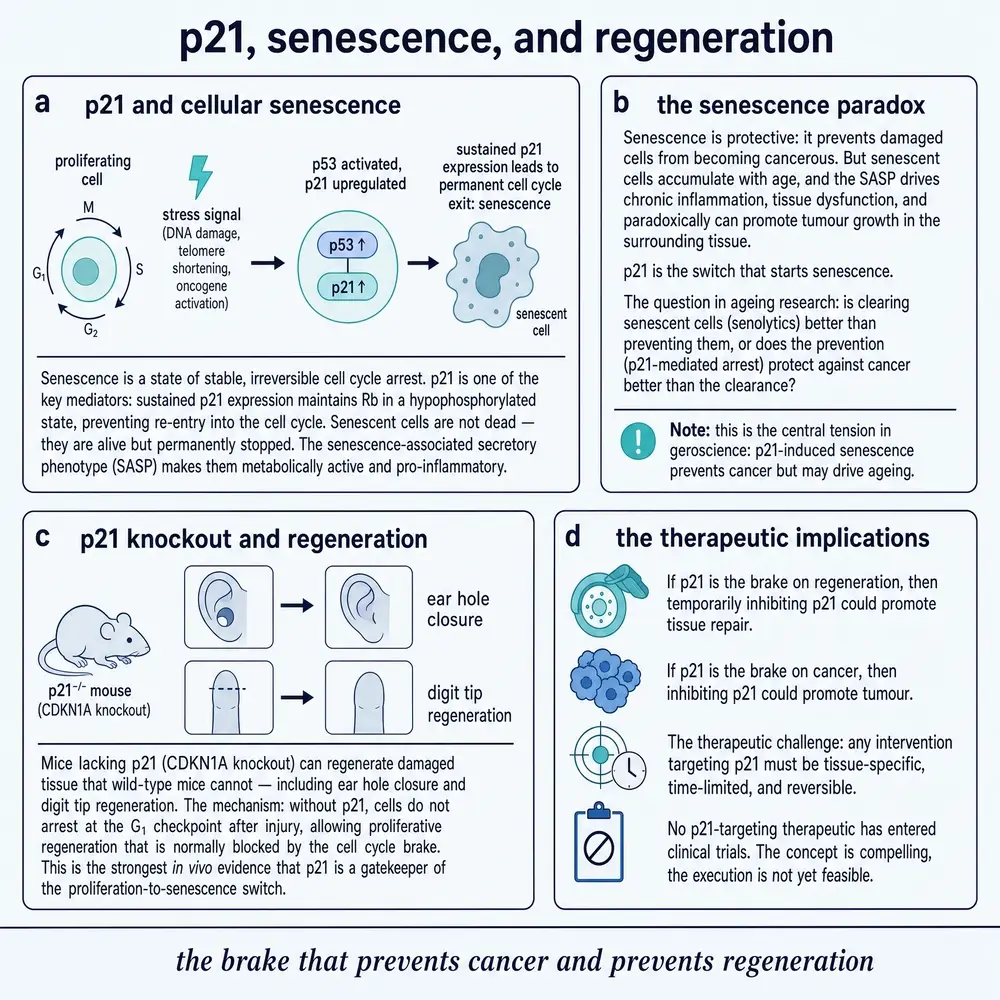
Senescence, SASP and regenerative capacity after CDKN1A knockout are real, heavily studied phenomena. They are also the wrong phenomena for anyone evaluating Peptide 021. A reader who has just been shown ear-hole closure in a CDKN1A-null mouse has learned something true about cell-cycle biology and nothing at all about a CNTF-derived pentapeptide. The same is true of the senescence paradox on the plate above: cancer prevention versus ageing is a central tension in geroscience, and it is the tension that FOXO4-DRI and related entries in this series engage — through p53 and CDKN1A, not through CNTF mimetics. Peptide 021’s animal record is about neurogenesis, tau and synaptic markers in rodents; it does not speak to SASP, digit-tip regeneration or nuclear-versus-cytoplasmic localisation. The last plate states the status of the cell-cycle protein honestly — endogenous biology solid, therapeutic targeting dashed — and states why it appears in a peptide series at all, which is not because it is a peptide drug. It appears because vendors and search engines will not keep the two molecules apart, and a monograph that refuses to show the collision leaves the reader to discover it the hard way. The plate that follows is the last of the five. After it, every claim in this document is again about Peptide 021 and nothing else.
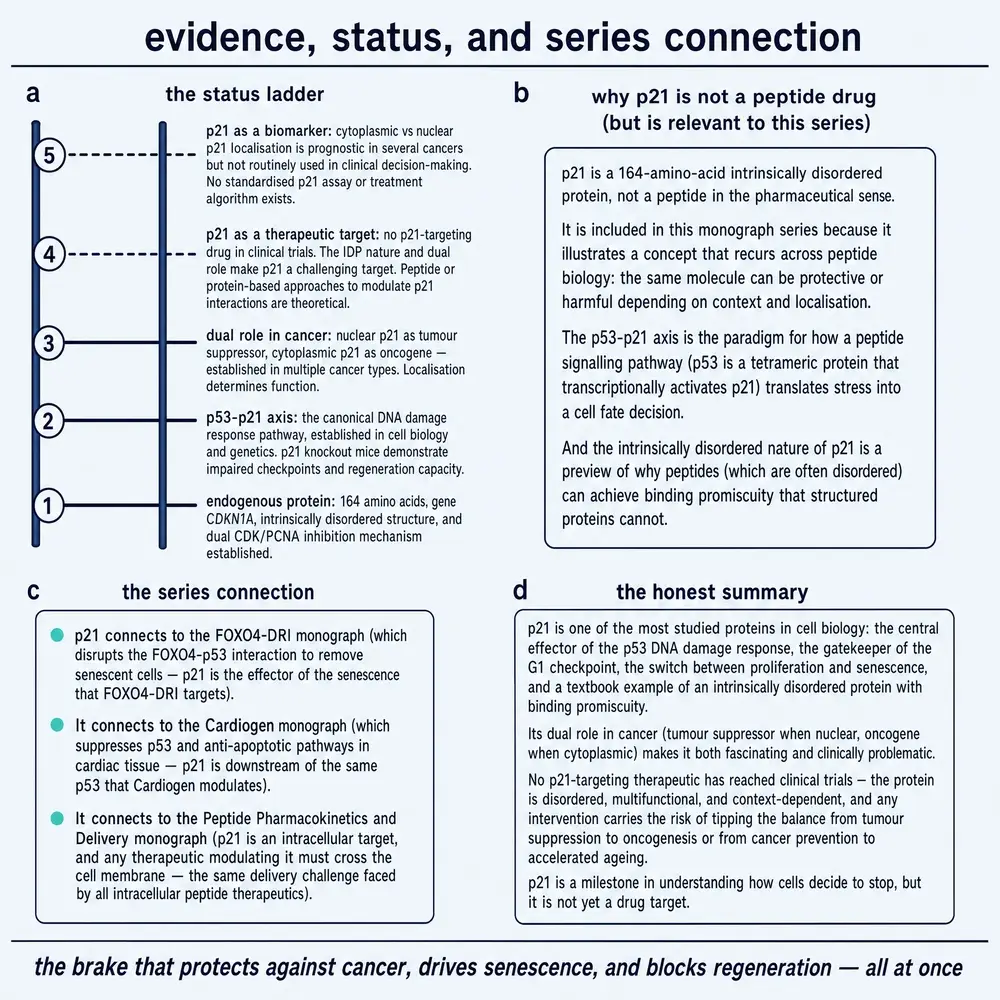
That status ladder is the honest end of the CDKN1A story, and it is also the end of what this monograph will say about it. Two further collisions are worth naming for completeness before the text returns to Peptide 021. P021 is not davunetide, sometimes written NAP, an eight-residue peptide derived from activity-dependent neuroprotective protein that stabilises microtubules and was tested in humans for progressive supranuclear palsy. And it is not CNF-1, a bacterial toxin acting on Rho GTPases that appears in some neurogenesis literature. Neither shares a mechanism, a sequence or a source with this molecule. From here on, every claim is again about the CNTF-derived pentapeptide and nothing else.
20What would settle it
The gap between what is known about P021 and what would need to be known is unusually easy to state, because the missing items are not subtle.
Four things would change the picture, and they are ordered here by how cheaply they could be done.
A brain-penetration measurement. The premise of the molecule's design is that adamantane gets it across the blood–brain barrier, and after sixteen years nobody has measured it.24 This is not a large study. It is a dose, a time course, and mass spectrometry on brain tissue, and it would convert the compound's central design claim from an inference into a number — or reveal that what crosses is a metabolite, which would be more interesting still.
An independent replication. The cheapest useful version is one other laboratory running one of the existing experiments — the aged-rat protocol would do — and reporting what it finds. Sixteen years is a long time for a compound with results this striking to have attracted none. The 2024 CDKL5 work is the closest thing to an outside test, and although Iqbal is an author, the experiments were run by a group in Bologna and returned a negative in the animal.10
A toxicology package. Eighteen months of dosing in mice with nothing observed is encouraging and is not a toxicology file.4,5 Nothing in the published record addresses genotoxicity, reproductive toxicity, or the maximum tolerated dose in any species. The early-window experiments dosed pregnant animals and neonates, which in a formal programme would raise developmental questions that would have to be answered before anything else.6,8
A first-in-human study. Everything above is preliminary to this, and this is what does not exist. There is no registered trial, no pharmacokinetic study in people, no tolerability data, no case report. The question that matters — whether a small peptide given repeatedly to a human being provokes the antibody response that ended Axokine15,18 — cannot be answered in a mouse, and has not been asked.
Where that leaves it
P021 is a well-conceived molecule with a coherent mechanism and a real, internally consistent body of animal work behind it. The design logic is sound and the reasoning that produced it — that a failing brain might be helped to build rather than merely stopped from breaking — is a serious scientific position held by people who had earned the right to hold it. The eighteen-month survival result is the kind of finding that ought to bring a field's attention.
It has not. In sixteen years the compound has generated ten animal experiments from one laboratory, one of which is a clear failure and the most recent, and it has never been given to a person. Its brain penetration — the property its entire chemical design exists to provide — has never been measured. No independent group has confirmed any of its effects. It is sold to the public under a name belonging to an unrelated protein, in a market where that confusion works in the seller's favour.
What the record supports is a statement about mice, rats and one human cell line, made under specified conditions by one group of investigators. What it does not support is any statement about a person. The distance between those two things is not a formality to be cleared later; it is the thing that has not been attempted at all.
21References
Numbered in the order the claim ledger assigns, not alphabetically, because every load-bearing statement in this document was keyed to a number before the prose was written and the inline citations point at those keys. Author lists, journal names, volumes, pages and identifiers come from the live PubMed record for each item; nothing in this apparatus was written from recall.
That precaution earned its keep on this build. The prepared reference list this monograph inherited carried six identifiers that pointed at the wrong paper — not at nothing, which is easy to catch, but at real, plausible, unrelated articles. The identifier given for the first P021 study resolved to a paper on the voltage-sensing helix of a potassium channel; the one given for the aged-rat cerebrospinal-fluid study resolved to a paper on plasma SUMO1. All six were repaired by searching NCBI for the stated title and matching the returned record against it, and the build refuses to run if any identifier is unresolved or if any title fails the match.
- Li B, Wanka L, Blanchard J, Liu F, Chohan MO, Iqbal K, et al.. Neurotrophic peptides incorporating adamantane improve learning and memory, promote neurogenesis and synaptic plasticity in mice. FEBS Lett. 2010;584(15):3359-65.
PMID 20600002 · doi:10.1016/j.febslet.2010.06.025The first P021 study in a living animal: normal C57Bl/6 mice. - Kazim SF, Blanchard J, Dai CL, Tung YC, LaFerla FM, Iqbal IG, et al.. Disease modifying effect of chronic oral treatment with a neurotrophic peptidergic compound in a triple transgenic mouse model of Alzheimer's disease. Neurobiol Dis. 2014;71:110-30.
PMID 25046994 · doi:10.1016/j.nbd.2014.07.0013xTg-AD mice treated from 9-10 months, after pathology is under way. The mixed result: tau down, soluble amyloid down at six months only, insoluble amyloid unchanged. - Khatoon S, Chalbot S, Bolognin S, Puoliväli J, Iqbal K. Elevated Tau Level in Aged Rat Cerebrospinal Fluid Reduced by Treatment with a Neurotrophic Compound. J Alzheimers Dis. 2015;47(3):557-64.
PMID 26401692 · doi:10.3233/JAD-142799Aged Fisher rats; the cerebrospinal-fluid tau result. - Baazaoui N, Iqbal K. Prevention of Amyloid-β and Tau Pathologies, Associated Neurodegeneration, and Cognitive Deficit by Early Treatment with a Neurotrophic Compound. J Alzheimers Dis. 2017;58(1):215-230.
PMID 28387677 · doi:10.3233/JAD-1700753xTg-AD mice treated from 3 months. Source of the survival figure, 87 per cent against 41 per cent at week 71. - Baazaoui N, Iqbal K. Prevention of dendritic and synaptic deficits and cognitive impairment with a neurotrophic compound. Alzheimers Res Ther. 2017;9(1):45. read in full
PMID 28655344 · doi:10.1186/s13195-017-0273-7 · PMC5488423Read in full from the local corpus. The companion paper to reference 4: the same 18-month experiment read out on dendrites, synapses, neurogenesis and behaviour, including the marker-by-marker trends that did not reach significance. - Kazim SF, Blanchard J, Bianchi R, Iqbal K. Early neurotrophic pharmacotherapy rescues developmental delay and Alzheimer's-like memory deficits in the Ts65Dn mouse model of Down syndrome. Sci Rep. 2017;7:45561.
PMID 28368015 · doi:10.1038/srep45561 · PMC5377379Ts65Dn mice, dosed from gestation to weaning. - Liu Y, Wei W, Baazaoui N, Liu F, Iqbal K. Inhibition of AMD-Like Pathology With a Neurotrophic Compound in Aged Rats and 3xTg-AD Mice. Front Aging Neurosci. 2019;11:309.
PMID 31803044 · doi:10.3389/fnagi.2019.00309 · PMC6877482Retinal histology in aged rats and 3xTg-AD mice. No measure of vision, and rodents have no macula. - Wei W, Wang Y, Liu Y, Dai CL, Tung YC, Liu F, et al.. Prenatal to early postnatal neurotrophic treatment prevents Alzheimer-like behavior and pathology in mice. Alzheimers Res Ther. 2020;12(1):102.
PMID 32854771 · doi:10.1186/s13195-020-00666-7 · PMC74509383xTg-AD mice dosed through the mother and to weaning. - Wei W, Liu Y, Dai CL, Baazaoui N, Tung YC, Liu F, et al.. Neurotrophic Treatment Initiated During Early Postnatal Development Prevents the Alzheimer-Like Behavior and Synaptic Dysfunction. J Alzheimers Dis. 2021;82(2):631-646.
PMID 34057082 · doi:10.3233/JAD-201599 · PMC83855253xTg-AD mice dosed from birth to postnatal day 120. - Mottolese N, Loi M, Trazzi S, Tassinari M, Uguagliati B, Candini G, et al.. Effects of a ciliary neurotrophic factor (CNTF) small-molecule peptide mimetic in an in vitro and in vivo model of CDKL5 deficiency disorder. J Neurodev Disord. 2024;16(1):65.
PMID 39592934 · doi:10.1186/s11689-024-09583-4 · PMC11590213The most recent study in a living animal, and a negative one. Human CDKL5-null cells rescued; Cdkl5-null mice not. - Chohan MO, Li B, Blanchard J, Tung YC, Heaney AT, Rabe A, et al.. Enhancement of dentate gyrus neurogenesis, dendritic and synaptic plasticity and memory by a neurotrophic peptide. Neurobiol Aging. 2011;32(8):1420-34.
PMID 19767127 · doi:10.1016/j.neurobiolaging.2009.08.008Peptide 6, the eleven-residue parent. Not P021. - Blanchard J, Chohan MO, Li B, Liu F, Iqbal K, Grundke-Iqbal I. Beneficial effect of a CNTF tetrapeptide on adult hippocampal neurogenesis, neuronal plasticity, and spatial memory in mice. J Alzheimers Dis. 2010;21(4):1185-95.
PMID 20952820 · doi:10.3233/JAD-2010-1000069Peptide 6c, the four-residue core. Not P021. - Bolognin S, Buffelli M, Puoliväli J, Iqbal K. Rescue of cognitive-aging by administration of a neurogenic and/or neurotrophic compound. Neurobiol Aging. 2014;35(9):2134-46.
PMID 24702821 · doi:10.1016/j.neurobiolaging.2014.02.017Aged rats. Source of the magnetic-resonance-spectroscopy and glucose-imaging null results. - Kazim SF, Iqbal K. Neurotrophic factor small-molecule mimetics mediated neuroregeneration and synaptic repair: emerging therapeutic modality for Alzheimer's disease. Mol Neurodegener. 2016;11(1):50. read in full
PMID 27400746 · doi:10.1186/s13024-016-0119-y · PMC4940708Read in full from the local corpus. The developers' own account of the design logic, the lineage and the mechanism; also the source for the physical and stability properties. - Baazaoui N, Iqbal K. Alzheimer's Disease: Challenges and a Therapeutic Opportunity to Treat It with a Neurotrophic Compound. Biomolecules. 2022;12(10).
PMID 36291618 · doi:10.3390/biom12101409 · PMC9599095The most recent review of the programme by its originators. - Grundke-Iqbal I, Iqbal K, Quinlan M, Tung YC, Zaidi MS, Wisniewski HM. Microtubule-associated protein tau. A component of Alzheimer paired helical filaments. J Biol Chem. 1986;261(13):6084-9.
PMID 3084478Tau identified as the subunit of the tangle filament. - Grundke-Iqbal I, Iqbal K, Tung YC, Quinlan M, Wisniewski HM, Binder LI. Abnormal phosphorylation of the microtubule-associated protein tau (tau) in Alzheimer cytoskeletal pathology. Proc Natl Acad Sci U S A. 1986;83(13):4913-7.
PMID 3088567 · doi:10.1073/pnas.83.13.4913 · PMC323854The same laboratory, the same year: the tau in tangles is abnormally hyperphosphorylated. - Ettinger MP, Littlejohn TW, Schwartz SL, Weiss SR, McIlwain HH, Heymsfield SB, et al.. Recombinant variant of ciliary neurotrophic factor for weight loss in obese adults: a randomized, dose-ranging study. JAMA. 2003;289(14):1826-32.
PMID 12684362 · doi:10.1001/jama.289.14.1826Axokine. A CNTF derivative, not P021, and the only randomised human trial anywhere in this document. - Hoy SM. Revakinagene Taroretcel: First Approval. Mol Diagn Ther. 2025;29(4):553-561.
PMID 40540142 · doi:10.1007/s40291-025-00787-5 · PMC12343658ENCELTO. An encapsulated-cell CNTF product approved in March 2025 for macular telangiectasia type 2 - a different modality on the same pathway, and not P021. A correction to this article was published in the same journal later in 2025 (PMID 40797002); the record cited here is the article, not the correction. - U.S. Food and Drug Administration. ENCELTO (revakinagene taroretcel-lwey) intraocular implant, prescribing information. Initial U.S. approval 2025. Neurotech Pharmaceuticals, Cumberland, RI. DailyMed structured product label.
https://dailymed.nlm.nih.gov/dailymed/fda/fdaDrugXsl.cfm?setid=1ae9482a-b478-4e21-9166-b5fd52d3ef9c&type=displayCited only for what the pathway achieved by another route; ENCELTO is recombinant CNTF delivered from an encapsulated cell implant, not P021. - Iqbal K, et al. Neurotrophic peptides for the treatment of tauopathies. United States Patent 9,327,011. Assigned to the Research Foundation for Mental Hygiene / New York State Institute for Basic Research in Developmental Disabilities. Prosecution supported in part by EVER NeuroPharma GmbH, Unterach, Austria, and by Alzheimer's Association Zenith Award ZEN-12-241433.
https://patents.google.com/patent/US9327011B2/enThe adamantane-modified CNTF peptide family, covering P6c and P021. The Zenith award number appears in the funding statement of reference 5, and the EVER NeuroPharma support in that of reference 14. - National Institutes of Health, RePORTER. Grant R01AG057602, neurotrophic peptide programme in a transgenic mouse model of Alzheimer's disease; K. Iqbal, principal investigator.
https://reporter.nih.gov/Public funding record. The work it supports is in mice. - Phanes Biotech, Pennsylvania, United States, and EVER NeuroPharma GmbH, Unterach, Austria - corporate development record for the CNTF-mimetic peptide programme, with the Zenith Award context, as summarised in the project's discovery-history note.Assembled from company and funder material and from author affiliations and funding statements in references 5 and 14.
- Alzheimer's Drug Discovery Foundation, Cognitive Vitality. Independent appraisal of P021 and related neurotrophic peptide mimetics.
https://www.alzdiscovery.org/cognitive-vitality/ratingsThe source of the brain-penetration caveat: no study has measured how much P021 reaches the brain of a living animal. - Iqbal K, Wiśniewski HM, Shelanski ML, Brostoff S, Liwnicz BH, Terry RD. Protein changes in senile dementia. Brain Res. 1974;77(2):337-43.
PMID 4604978 · doi:10.1016/0006-8993(74)90798-7The laboratory's first paper on the tangle, twelve years before it identified what the tangle is made of. - [No authors listed]. A double-blind placebo-controlled clinical trial of subcutaneous recombinant human ciliary neurotrophic factor (rHCNTF) in amyotrophic lateral sclerosis. ALS CNTF Treatment Study Group. Neurology. 1996;46(5):1244-9.
PMID 8628460 · doi:10.1212/wnl.46.5.1244Whole recombinant CNTF given to people. The trial that established why the cytokine itself cannot be used, and the reason a fragment of it was made. - Alonso Adel C, ElAkkad E, Gong C, Liu F, Tanaka T, Kudo T, et al.. Inge Grundke-Iqbal, Ph.D. (1937–2012): the discoverer of the abnormal hyperphosphorylation of tau in Alzheimer’s disease. J Mol Neurosci. 2013;49(2):430-5.
PMID 24883456 · doi:10.1007/s12031-012-9925-zThe memorial written by her colleagues; the source for the sequence of her last work and for the date of her death. - Blanchard J, Wanka L, Tung YC, Cárdenas-Aguayo Mdel C, LaFerla FM, Iqbal K, et al.. Pharmacologic reversal of neurogenic and neuroplastic abnormalities and cognitive impairments without affecting Aβ and tau pathologies in 3xTg-AD mice. Acta Neuropathol. 2010;120(5):605-21.
PMID 20697724 · doi:10.1007/s00401-010-0734-6Peptide 6, not P021, and a null on the pathology it was given to change. The title states the limit. - Pasquin S, Sharma M, Gauchat JF. Ciliary neurotrophic factor (CNTF): New facets of an old molecule for treating neurodegenerative and metabolic syndrome pathologies. Cytokine Growth Factor Rev. 2015;26(5):507-15.
PMID 26187860 · doi:10.1016/j.cytogfr.2015.07.007Independent review of CNTF receptor biology and of why systemic CNTF is poorly tolerated. - Oddo S, Caccamo A, Shepherd JD, Murphy MP, Golde TE, Kayed R, et al.. Triple-transgenic model of Alzheimer's disease with plaques and tangles: intracellular Abeta and synaptic dysfunction. Neuron. 2003;39(3):409-21.
PMID 12895417 · doi:10.1016/s0896-6273(03)00434-3The 3xTg-AD mouse itself, in which most of the P021 record was produced. An overexpression model of a disease that in people is almost never caused by a mutation. - Rockenstein E, Ubhi K, Doppler E, Novak P, Moessler H, Li B, et al.. Regional comparison of the neurogenic effects of CNTF-derived peptides and cerebrolysin in AβPP transgenic mice. J Alzheimers Dis. 2011;27(4):743-52. RETRACTED
PMID 21860085 · doi:10.3233/JAD-2011-110914 · PMC3925781RETRACTED, June 2026 - see reference 32. A study of the parent peptide rather than of P021, and the paper that linked the programme experimentally to EVER NeuroPharma's Cerebrolysin. Cited here for the fact of its retraction, not for its results. - [No authors listed]. Retraction: Regional Comparison of the Neurogenic Effects of CNTF-Derived Peptides and Cerebrolysin in AβPP Transgenic Mice. J Alzheimers Dis. 2026;111(4):1893.
PMID 42015030 · doi:10.1177/13872877261442048The retraction notice for reference 31.
22How this document was assembled
The reading corpus for this compound is small, and saying so is more useful than dressing it up. A sweep of the therapeutic-peptide document stores — 23,797 indexed documents in the acquisition corpus alone, plus the open-access, PubMed Central and Russian-language full-text stores — returned 2 locally retained full-text scientific assets that discuss P021 itself. Five further hits matched on the string P021 or on adamantane and turned out to be papers on multiple myeloma, 20-hydroxyecdysone and intestinal glucose transport; they were rejected. Everything else in the library that mentions this compound mentions it in a table of candidates.
The two assets are the developers' 2016 review of the whole neurotrophic-mimetic programme and the 2017 paper reporting the eighteen-month 3xTg-AD experiment, together about 22,875 words of body text, roughly 46 printed-page equivalents, 17 figures and 238 cited references. Both are open access under CC BY 4.0 and both were read in full. The remaining primary studies were worked from their published records and abstracts through the reference layer, which is stated here because it is a limit on this document: for most of the studies described in Part Four, this monograph reports what the published record says was found, not an independent reading of the methods section.
| Stage | What it does | Result |
|---|---|---|
| 01b | Sweep of the therapeutic-peptide document stores | 23,797 indexed docs |
| — | Identity screen; incidental string matches rejected | 5 rejected |
| — | Full texts retained and read | 2 assets, ~46 pp |
| 05 | Every identifier resolved against the live NCBI record | 27 verified, 6 repaired |
| 05 | Publication-status audit of every cited record | 1 retraction found |
| 06 | Assembly of this document | 20 figures, 32 references |
The publication-status audit is not decoration. Every cited PubMed record was checked for a retraction notice, an erratum or an expression of concern, and one turned up: the 2011 comparison of CNTF-derived peptides with Cerebrolysin, reference 31, was retracted in June 2026, two months before this document was compiled. It is cited here for the fact of its retraction and for nothing else. A reference list that carries a retracted paper silently is a defect, and the only reliable way to avoid one is to ask the database rather than to rely on having noticed.
23Evidence handling
Findings are labelled by the kind of study that produced them, in the sentence that reports them rather than in a footnote. Cell-culture measurements, experiments in mice, experiments in rats and randomised human trials are different kinds of claim, and for this compound the difference is the whole story: there are no human trials of P021, so every efficacy statement in this document is about an animal or a dish, and the species is named every time.
Three rules are particular to this compound and were applied without exception. P021 is not p21. The generic string p21 almost always means CDKN1A, the cyclin-dependent-kinase inhibitor, or one of the p21-activated kinases; none of that literature is about this molecule. Five commissioned plates in section 19 exhibit CDKN1A explicitly as a name-collision disambiguation and are captioned as such; their printed values are not promoted into the P021 evidence record. P021 is not Peptide 6 or Peptide 6c, its eleven-residue and four-residue parents; results obtained with the parents are attributed to the parents. And P021 is not CNTF: Axokine and ENCELTO are CNTF-pathway drugs that reached human beings, and they appear in Part Five as context for what the pathway can and cannot do, never as evidence about this peptide.
Recency is weighted, and on this compound the weighting cuts against it. The newest study in a living animal is the 2024 CDKL5 work, and it is negative. A rule that privileges fresh evidence has to privilege that result too, so it is given the same space and the same seriousness as the positive findings from 2014 to 2021, and it appears beside them rather than after them. Where an effect held at one time point and not another, or in one brain region and not another, or in the tissue and not the behaviour, the boundary is reported with the effect. Where a marker did not move, it is named.
Citations are numeric rather than author-year, which is a deliberate departure from the house citation style for this document. The claim ledger prepared for this compound keys every quantitative statement to a fixed reference number, and preserving that key end to end is worth more here than uniformity with the rest of the series.

Continue exploring