
Selank and the three names sold beside it — N-Acetyl Selank, N-Acetyl Selank Amidate, Adalank
A fragment of an antibody, repaired with three amino acids in a Moscow laboratory, became a prescription anxiolytic in one country and a research chemical everywhere else. Of the four product names in this monograph's title, one has a substantial published pharmacology. The other three have none at all. This document sets out precisely what is known, precisely what is inferred, and precisely where the evidence stops.
Every finding here is labelled, in the sentence that reports it, by the kind of study that produced it — a randomised trial in people, an experiment in rats, a measurement in a dish. These are different kinds of claim and the difference is never left to the reader to infer. Doses appear only as the parameters of a published experiment, always with species, route and duration attached, and never as guidance. Where the evidence conflicts, both sides are given and the conflict is named rather than resolved by preference.
One structural warning before you begin. This monograph carries four compound names in its title, and they are not four compounds with four literatures. They are one compound with a literature and three commercial names without one. Sections 08 through 19 describe Selank and nothing else. Section 07 explains why.
01The fragment that should not have done anything
The discovery began with a measurement that would not behave. At Tufts University School of Medicine in Boston, Victor Najjar's laboratory was studying the kinetics of phagocytosis — the process by which white blood cells engulf and destroy foreign material. A particular fraction of gamma globulin stimulated the process powerfully, but the stimulation was, in Najjar's own later account, short-lived; and if the phagocyte was pre-incubated with the globulin, the globulin was inactivated (Najjar, 1983). Something was being cut off and used up.
The work of the following years was the unglamorous business of chasing that something down until only the active part remained. What remained was astonishingly small: four amino acids in a row — threonine, lysine, proline, arginine. Najjar and Nishioka published it in Nature in 1970 and named it tuftsin, after the university (Najjar & Nishioka, 1970). Within three years the peptide had been isolated, characterised and synthesised from scratch, and the synthetic version reproduced the biological activity (Nishioka et al., 1972; Nishioka et al., 1973).
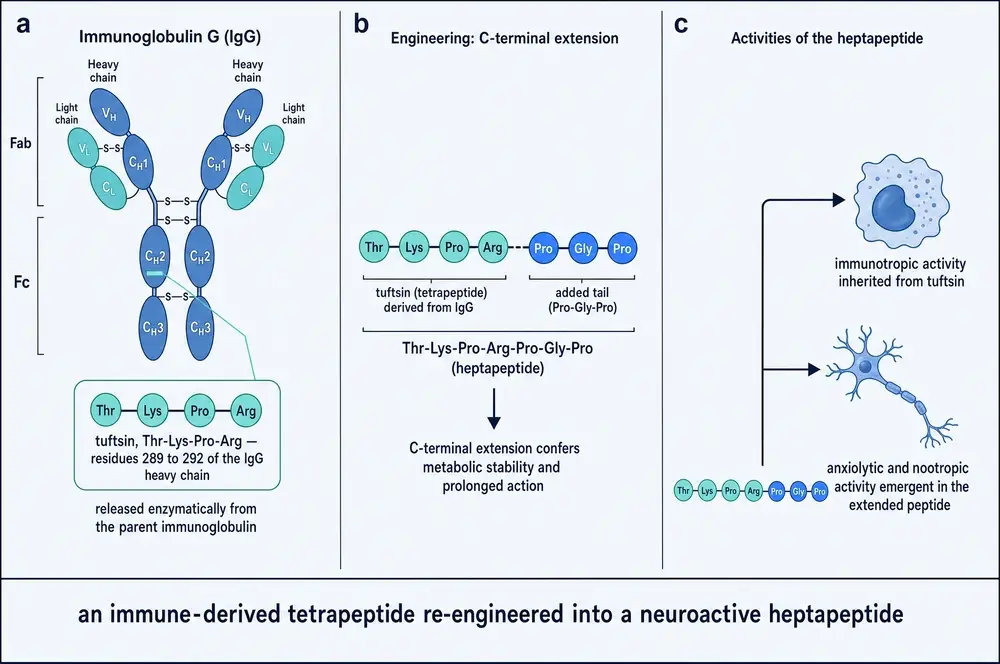
Its position turned out to be inside the antibody's own structure: residues 289–292 of the immunoglobulin G heavy chain. And it is not secreted — it is excised, by a two-enzyme relay. An enzyme from the spleen nicks the heavy chain on one side of the four residues; a second enzyme sitting on the outer membrane of the white blood cell itself cuts the other side, releasing the free tetrapeptide directly at the surface of the cell that is about to use it (Najjar, 1981; Najjar, 1983).
That mechanism is worth pausing on, because it is what makes the discovery conceptually large despite the molecule being so small. Four residues is not a protein. It is barely a peptide. What Najjar had shown was that a large protein can carry, buried inside its own sequence, a short message that becomes active only when the protein is cut — and that the body has dedicated machinery for doing the cutting, in the right place, at the right moment. The antibody was not merely a label. It was also a container for instructions.
The clinical evidence that this was real physiology rather than a laboratory artefact came from people who lacked it. Najjar described a congenital familial deficiency in which a single substitution — glutamic acid in place of lysine at the second position — yields an inactive peptide, and an acquired form appearing after removal or disease of the spleen. Affected patients suffered severe recurrent infections of skin, lymph nodes and lung (Constantopoulos & Najjar, 1972; Najjar, 1981). Three decades later the field marked the anniversary of the discovery with a review treating it as a founding moment for the study of short regulatory peptides, and noting, among much else, that tuftsin had central effects as well as immune ones (Siemion & Kluczyk, 1999).
That last observation is the hinge of this entire story, and it was made in Moscow.
021981: an immune peptide produces behaviour
In 1981, Val'dman, Kozlovskaya, Ashmarin and colleagues did something that in retrospect looks obvious and at the time did not: they gave tuftsin — a molecule defined entirely by what it did to white blood cells — to rats, and watched the animals instead of the cells.
The rats changed. Vertical motor activity increased. Pain perception was altered, with associated aggressiveness and residual excitation. Acquisition of a passive avoidance response was impaired. And the biochemistry followed the behaviour: tyrosine hydroxylase, the rate-limiting enzyme in the synthesis of dopamine and noradrenaline, was directly inhibited in vitro yet showed increased activity in the hypothalamus and, particularly, the striatum in living animals. The authors concluded that there were direct relationships between tuftsin's central effects and changes in the brain catecholamine systems that regulate emotional, motivational and motor behaviour (Val'dman et al., 1981). This is an animal in-vivo study with ex-vivo enzyme measurements.
So the answer to the obvious question — why would anyone look for an anxiolytic in an immune peptide? — is that nobody did. They were not looking for an anxiolytic. They administered an immunopeptide on a structural hunch and got behaviour, and the behaviour is what redirected the programme. Everything after this point follows from an accident of curiosity in a Moscow laboratory in 1981.
03Three amino acids and the problem of survival
Having found that tuftsin acted on the brain, the group ran immediately into the difficulty that had kept peptides out of Western pharmacology for decades. The body is full of enzymes whose entire function is to take peptides apart, and a short unprotected chain introduced into blood is typically dismantled within minutes. A molecule can be exquisitely active and still be useless, because it does not survive long enough to reach anything.
The answer developed in the Russian regulatory-peptide school was elegant and almost embarrassingly simple. Most of the body's general-purpose peptidases cannot cleave a bond where the next residue along is proline — proline's side chain loops back and bonds to its own backbone nitrogen, putting a rigid kink in the chain that the enzymes cannot accommodate. So: leave the active fragment alone, and bolt a proline-rich tail onto the end of it. The tail chosen was Pro-Gly-Pro, one of a family of naturally occurring collagen-derived fragments known as glyprolines.
Ashmarin and colleagues set out the principle as a general method in 2005, arguing that the received wisdom about regulatory peptides being inherently unstable needed amending: Pro-Gly-Pro-containing oligopeptides showed stability comparable to that of conventional pharmaceutical preparations, and could even survive passage through the gastrointestinal tract. They described the deliberate construction of hybrid or “chimeric” peptides pairing an unmodified natural fragment, which supplies the activity, with a stabilising extension, which supplies the durability (Ashmarin et al., 2005).
Selank is exactly that construction. Take tuftsin — Thr-Lys-Pro-Arg — and extend the carboxyl end with three natural L-amino acids, Pro-Gly-Pro. The result is the heptapeptide Thr-Lys-Pro-Arg-Pro-Gly-Pro. The stated purpose of the extension, in the primary literature, is to improve metabolic stability and lengthen the duration of action (Volkova et al., 2016).
It is worth being clear about how modest this is as an act of invention. Nothing novel was designed. An existing human fragment was found, and three ordinary amino acids were appended to stop it being destroyed. Whatever Selank does, it does because tuftsin did something first, and because someone worked out how to keep tuftsin around long enough to find out what.
04TP-7, and the word “anxioselective”
The new heptapeptide entered the literature under a development code. The earliest indexed publication giving its full sequence is from 1995, and it is a head-to-head against its own parent. Seredenin and colleagues compared tuftsin and its analogue TP-7 in 95 adult male Wistar rats whose serotonin systems had been lesioned neonatally, both peptides given at 300 µg/kg. Both weakened the animals' response to stress and normalised brain serotonin — but the anxiolytic and psychostimulant activities of TP-7 were more pronounced than those of tuftsin (Seredenin et al., 1995). That single comparative sentence is the empirical justification for the whole Pro-Gly-Pro decision: the tail had not merely preserved the parent's activity, it had improved on it.
The definitive preclinical characterisation came three years later, and it contains, fully formed, both the claim the compound would be sold on and the caveat that has shadowed it ever since. Seredenin and colleagues tested the heptapeptide in two inbred mouse strains chosen for opposite emotional phenotypes: BALB/c, which are high-anxiety and passive under stress, and C57BL/6, which are not. The compound was effective across a wide dose range, 200 to 3000 µg/kg intraperitoneally — in BALB/c. In C57BL/6 it had no effect. The anxiolytic action was described as comparable to that of low doses of benzodiazepine tranquillisers but, unlike them, without sedative or inhibitory behavioural effects even at high doses. The authors proposed the term anxioselective (Seredenin et al., 1998).
The same year, the compound restored cognitive functions impaired by antenatal hypoxia in rats (Semenova et al., 1998) — the beginning of a long line of work, examined in Section 16, in which the peptide repairs deficits rather than enhancing normal function.
Everything the marketing of this compound would later assert was therefore in print by 1998: benzodiazepine-comparable anxiolysis, no sedation, no dose ceiling, and a nootropic component. So was the finding that would qualify all of it — that in the calm strain, nothing happened at all.
05Moscow, and why a peptide programme existed there at all
Selank was designed and produced at the Institute of Molecular Genetics of the Russian Academy of Sciences, working with the V.V. Zakusov Research Institute of Pharmacology of the Russian Academy of Medical Sciences (Volkova et al., 2016). The chemistry came largely from Myasoedov's and Andreeva's group at the former; the behavioural pharmacology from Seredenin's and Kozlovskaya's at the latter; the molecular genetics from Kolomin, Shadrina, Slominsky and Limborska; the clinical work from Zozulya, Kost and Sokolov at the Mental Health Research Centre. It is a small, stable, interlocking set of names across three decades, and that concentration is itself a fact about the evidence, returned to in Section 18.
The programme's founding premise was not receptor-targeted design. It was that the body already contains short peptides that regulate its own physiology, that their only real defect as drugs is that they last minutes, and that fixing the stability problem yields a medicine which is by construction not a xenobiotic — and therefore, the argument ran, inherently low in toxicity and side effects. That reasoning appears explicitly in the group's own publications, which describe work toward peptides “not ksenobiotics” that “will have no side effects” (Kozlovskaya et al., 2003).
That a molecule resembles something the body makes does not entail that the body handles it safely, and it does not entail an absence of side effects. The premise shaped which questions the programme asked — and, as Section 18 discusses, which it did not. It is flagged here because it recurs, unexamined, throughout this literature and into the marketing that followed.
There is a wider context that is easy to miss from outside. Western pharmaceutical development through these decades was overwhelmingly oriented toward small synthetic molecules, in large part because peptides were considered undruggable: orally unavailable, protease-labile, unable to cross the blood–brain barrier. The Soviet and Russian institutional landscape was different. A cluster of natural-compound chemistry institutes had been founded at the end of the 1960s, and the system had a deep bench in peptide chemistry and in radioisotope-labelled peptide analysis — the technique that later made Selank's degradation products measurable at all. The result is a striking disproportion: of roughly seventy peptide drugs registered internationally, fourteen are Russian, close to a fifth of worldwide development, from a country with a small fraction of global pharmaceutical research spending (Deigin et al., 2022).
The Pro-Gly-Pro trick was, in effect, the Russian answer to precisely the objection that had made Western pharmacology give up on peptides. And the intranasal route — the form in which Selank eventually reached the Russian market, and the route used in much of the animal work in Part Four — was the answer to the second objection. It is described in the primary literature as the optimal way to deliver peptide molecules to the central nervous system (Kasian et al., 2017), and it bypasses both the gut and the first-pass metabolism that would otherwise destroy the compound before it arrived.
One further piece of context belongs here because it is invisible in the papers themselves. The translational phase of this programme — the preclinical characterisation of 1995 to 1998 and the clinical work that followed — ran directly through the collapse of the institutional system that had begun it. Russian science funding fell by roughly an order of magnitude in the 1990s and researchers left in very large numbers. That a two-decade peptide-development programme reached a registered product at all under those conditions is a genuine achievement. It also helps explain the shape of the evidence base described in Part Five: small trials, single-country, run by the institutions that developed the compound, in journals with limited international reach.
06The molecule, precisely
Selank is Thr-Lys-Pro-Arg-Pro-Gly-Pro, seven residues, written TKPRPGP. In the published experimental work it is handled as the diacetate salt — the methods sections of the two Frontiers papers both specify Nα-Thr-Lys-Pro-Arg-Pro-Gly-Pro diacetate (Volkova et al., 2016; Kasian et al., 2017). This matters only in that it is the form the data were generated with, and it is a detail that vendor material generally omits.
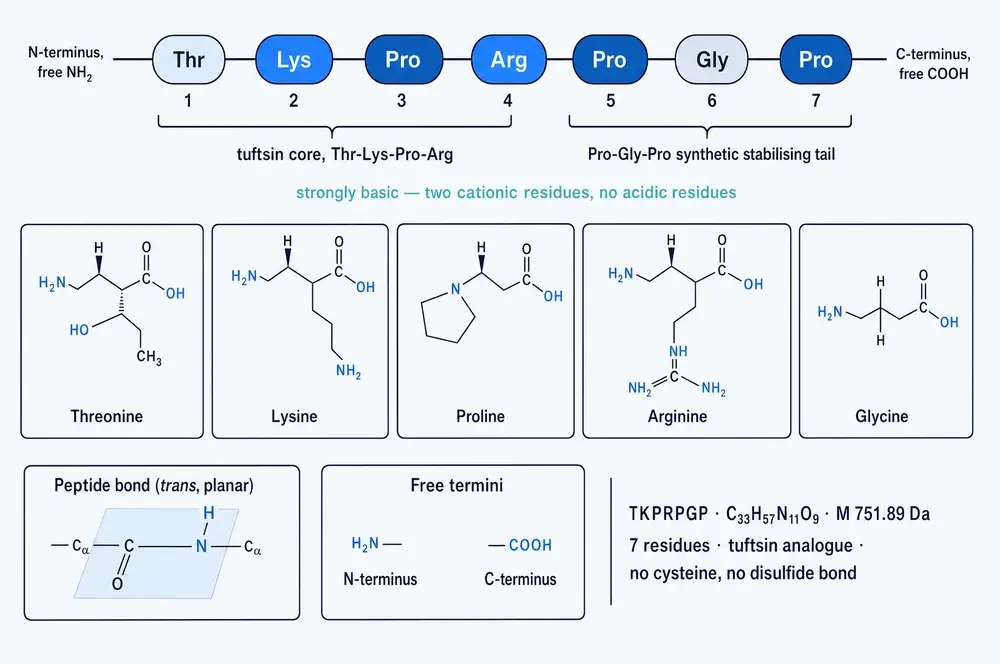
Two features of the sequence do real work later in this document. The first is the three prolines, two of which sit in the appended tail and are the reason the molecule survives long enough to be studied at all. The second is the arginine at position four. Arginine carries a positive charge at physiological pH, and arginine-containing glyproline peptides turn out to have measurable effects on blood coagulation — a property that has nothing to do with anxiety and is discussed in Section 18, where it belongs, rather than buried in a safety appendix.
07Four names, one literature
This is the section the rest of the monograph depends on, so it is stated plainly and without hedging.
The compounds named in this monograph's title are sold as four distinct products. They are not four distinct bodies of evidence. A complete PubMed harvest run on 1 August 2026, together with an exhaustive scan of the local research library — 45,807 files opened — returns the following.
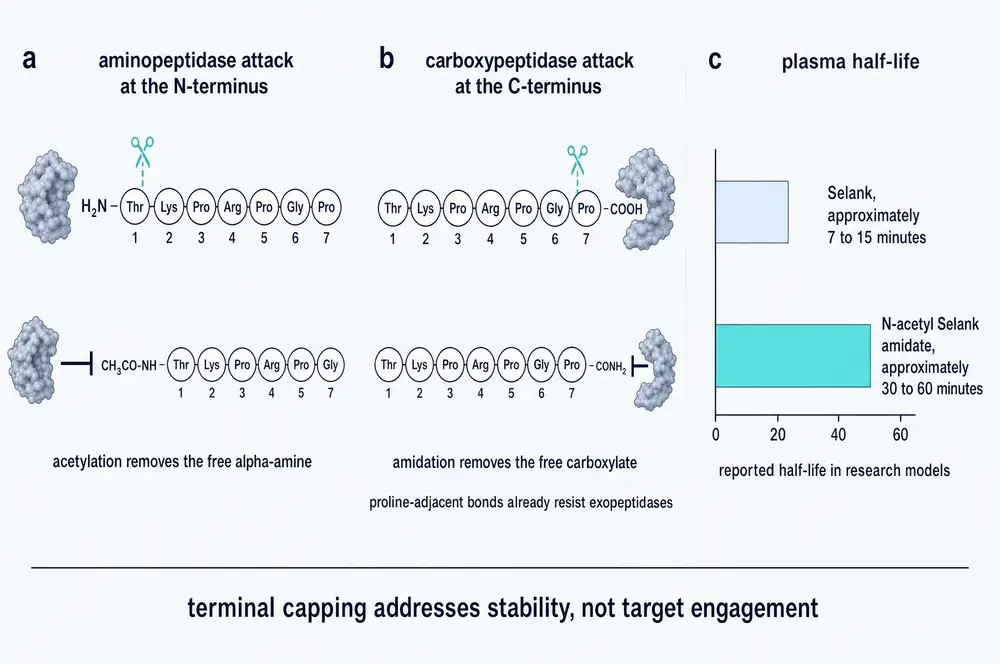
The chemistry the two modified names describe is real and unremarkable. N-terminal acetylation caps the free amino group at the head of the chain with an acetyl group; C-terminal amidation replaces the free carboxyl group at the tail with an amide. Both are standard manoeuvres in peptide chemistry, and both are done for the same broad reason: they remove the charged handles that exopeptidases — the enzymes that chew peptides inward from their ends — use to get a grip. The canonical demonstration is a 1999 study in which a nine-residue tumour antigen with a plasma half-life of twenty-two seconds was markedly stabilised by C-terminal amidation, N-terminal acetylation, or both, while retaining recognition by cytotoxic T cells (Brinckerhoff et al., 1999). Acetylation also blocks an unrelated chemical degradation route, the cyclisation of an N-terminal glutamine to pyroglutamate (de Haan et al., 2004).
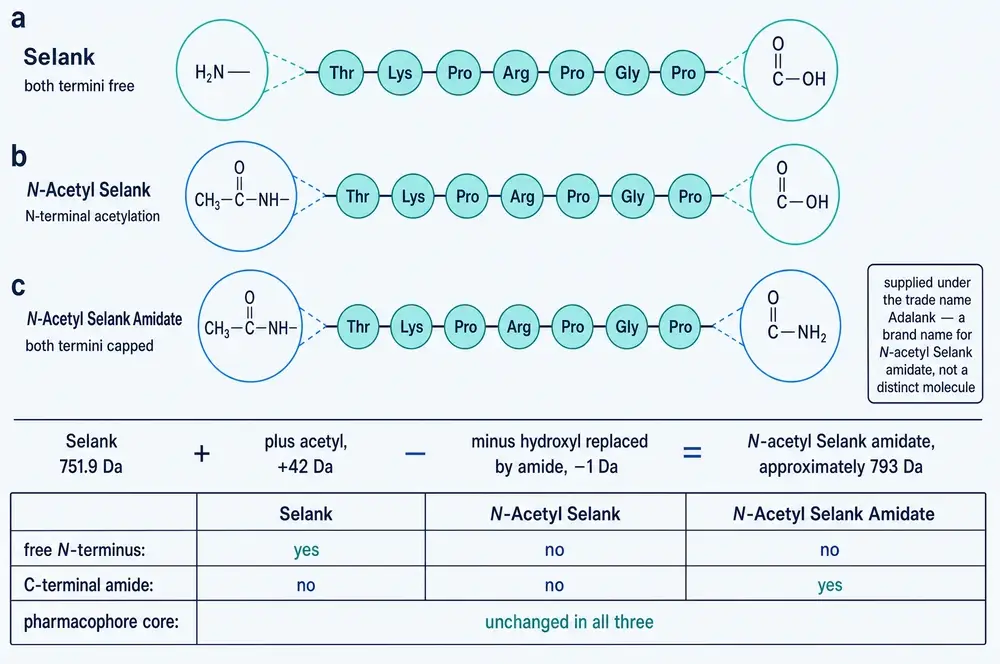
So the reasoning behind “N-acetyl Selank amidate” is sound in outline. Two things stop it being a finding.
The first is that the two modifications do not do the same job, and are not additive. In a systematic study of short arginine- and tryptophan-rich peptides, C-terminal amidation increased biological activity but made little difference to proteolytic degradation in human serum, while N-terminal acetylation significantly increased protease resistance but decreased activity (Nguyen et al., 2010). The marketing proposition for these products — that capping both ends delivers more stability and more potency together — is precisely the combination that study dissociates.
The second is specific to this molecule and, once noticed, is difficult to set aside. Selank's C-terminal residue is already proline, and the whole purpose of the Pro-Gly-Pro tail described in Section 03 was to make that terminus resistant to exactly the enzymes amidation is meant to defeat. Amidating an already-stabilised proline terminus may add a great deal, a little, or nothing. The magnitude has never been measured.
Beyond the chemistry, nothing is known. The general principle that terminal capping slows degradation predicts nothing about potency, about which of the four mechanisms in Part Three would survive the modification, about whether the resulting compound still reaches the brain by the intranasal route, or about whether the degradation fragments that appear to carry part of Selank's activity (Section 08) are still produced. Every one of those is an empirical question, and for these compounds none of them has been asked in print.
Two of the three unpublished names have been chemically characterised exactly once in the primary literature, and the provenance of that characterisation is the point. In building a screening assay for drug-control laboratories, Vanhee and colleagues determined the monoisotopic masses, molecular formulas and chromatographic behaviour of both N-acetyl Selank (Ac-TKPRPGP, C35H59N11O10, 793.4446 Da) and N-acetyl Selank amidate (Ac-TKPRPGP-NH2, C35H60N12O9, 792.4606 Da) (Vanhee et al., 2020).
Neither compound was found in the seized material that prompted the study. Both were custom-synthesised as reference standards, because the authors' survey of what was being sold online established that these molecules were already on the market and would need to be detectable. The only reason anyone in the scientific literature has ever weighed these compounds is so that regulators could identify them in a seizure. That work also fixes the date: these forms were being sold by 2019 at the latest, which is at least seven years of commerce with no pharmacology behind it.
Before this monograph was commissioned, the Radix research library ran its own automated evidence extraction across the same corpus. The internal dossier for Selank (P077, 32 pages) records 123 cited claims and zero thin flags. The internal dossier for N-Acetyl Selank Amidate (P078, 30 pages) records zero cited claims and twenty-four thin flags, and returns the same line for every substantive section — identity, chemical makeup, sequence, origin, mechanism, receptor biology, structure–activity, pharmacokinetics, toxicology: evidence gap, no supporting local passage. Two independent retrieval methods, one local and one against the world's literature index, found the same nothing.
Adalank is a separate case, and a starker one. It has no scientific existence of any kind. It returns nothing from PubMed under any spelling tried, nothing from PubMed Central full text, nothing from PubChem, and nothing from a patent search. It does not have the forensic characterisation that the acetylated and amidated forms have. It appears in no peer-reviewed full text in the local corpus and — unlike those forms, which occur in 177 and 169 local vendor and consumer documents respectively — it does not appear in the local commercial material either.
It is nonetheless sold, by several retailers, as a 10 mg nasal spray. What it is supposed to be depends on who is asked. Some aggregator pages equate it to N-acetyl Selank amidate and give that molecule's sequence and mass. At least one retail description derives it from an entirely different peptide. And one vendor states on the product page itself that Adalank's amino acid sequence and molecular structure are not publicly disclosed, calling it proprietary and directing enquiries about structural data to the supplier. Two retailers list Adalank and N-acetyl Selank amidate side by side as separate products without saying they are related. The commercial world does not agree on whether these are one compound or two, and one part of it declines to say what either is.
The consequence is a rule that governs everything that follows. Sections 08 through 19 describe Selank. Not one finding in them may be transferred to N-Acetyl Selank, to N-Acetyl Selank Amidate, or to Adalank, because a modified peptide is a different molecule until an experiment shows otherwise, and no such experiment has been published.
08What happens to it after administration
The most informative pharmacokinetic work on Selank is also among the oldest. Zolotarev and colleagues prepared the peptide labelled uniformly with tritium at every amino acid residue, using high-temperature solid-phase catalytic isotope exchange, at specific radioactivities of 50–150 Ci/mmol. Labelling every residue rather than one is the whole point of the method: it lets every possible hydrolysis product be detected at once, rather than only those that happen to retain the labelled position. Tracking the peptide in blood plasma, they identified the major degradation products as the pentapeptide TKPRP, the tripeptide TKP, and the dipeptides RP and GP. The same study examined the brain pharmacokinetics of intranasally administered Selank in vivo (Zolotarev et al., 2006).
That highlighted branch is a genuine problem for the field. Kolomin and colleagues found that the dipeptide Gly-Pro, administered on its own, reproduced much of the gene-expression profile that intact Selank produced in mouse spleen — the same direction of change for most of the genes studied — and Gly-Pro has separately been identified as the minimum fragment carrying the compound's antiviral activity (Kolomin et al., 2014; Kolomin et al., 2011a). The authors themselves draw the conclusion: this “might indicate an active contribution of the dipeptide to the final effect of Selank.”
Put less delicately: some of what is attributed to Selank may be the work of its debris. This does not invalidate the observations — the effects were real and measured — but it complicates every mechanistic claim that treats the intact heptapeptide as the acting agent, and it is a reason to be careful about assuming that a chemically capped variant, which would degrade differently, would behave the same way.
The second pharmacokinetic finding is stranger and more consequential. When Vasil'eva and colleagues compared intraperitoneal and intranasal administration of the same compound at the same dose — 300 µg/kg per day for five days, in BALB/c and C57BL/6 mice — the two routes did not merely differ in magnitude. They engaged different receptor systems. Intraperitoneal Selank raised the number of [G-3H]SR 95531 binding sites at GABA receptors in the frontal cortex by 38%, with no change in hippocampal NMDA receptor binding. Intranasal Selank raised [G-3H]MK-801 binding site density by 23%, with no effect on GABA receptors at all. The authors attribute the divergence to route-specific pharmacokinetics and biotransformation (Vasil'eva et al., 2016). These are ex-vivo binding measurements in mice.
The practical importance of this is hard to overstate when reading the rest of the literature. Studies in this corpus use both routes, more or less interchangeably, and frequently treat findings from one as evidence about the other. Vasil'eva's result suggests they may not be commensurable. It is a single study and it deserves replication it has not received — but until it is contradicted, the route on which a finding was obtained is part of the finding.
Selank has been studied for a quarter of a century and there is still no settled account of how it works. That is not a rhetorical concession; it is the actual state of the literature, and the four explanations below are best understood not as rival theories fighting for the same ground but as four descriptions pitched at four different levels, none of which has been connected convincingly to the others.
09The enzyme hypothesis
The first mechanistic proposal, and still the most chemically specific, has nothing to do with receptors. It says that Selank does not act on the brain directly at all; it acts on the enzymes that destroy the brain's own signalling peptides.
Enkephalins are short opioid peptides the body makes itself, and their lifetime is controlled by a set of enzymes collectively called enkephalinases. Zozulya and colleagues reported in 2001 that Selank dose-dependently inhibited the enzymatic hydrolysis of plasma enkephalin with an IC50 of 15 µM, making it more potent in this assay than the established peptidase inhibitors bacitracin and puromycin. Kost and colleagues, working the same year on human serum, put the figure at 20 µM and added a structural detail: pentapeptide fragments of the molecule retained the inhibitory effect, while tri-, tetra- and hexapeptide fragments did not (Zozulya et al., 2001; Kost et al., 2001). These are in-vitro enzyme measurements.
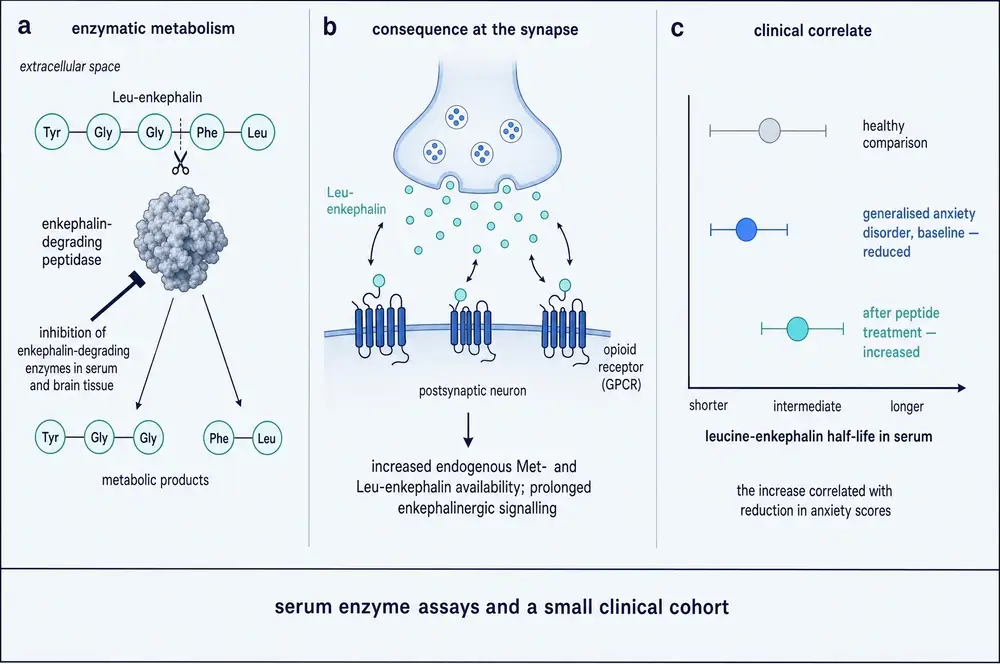
What made the hypothesis attractive was a clinical observation reported alongside it. Patients meeting DSM-IV criteria for generalized anxiety disorder showed a markedly shortened enkephalin half-life and reduced total enkephalinase activity in blood — and, crucially, patients with panic disorder or agoraphobia did not (Zozulya et al., 2001). If generalized anxiety involves a specific deficit in endogenous opioid signalling, then a compound that protects enkephalins from degradation is aimed at the deficit rather than at a downstream receptor. It is an unusually elegant story.
Later work refined the enzymology. Selank turned out to be more specific for carboxypeptidases and dipeptidylcarboxypeptidases than for aminopeptidases (Zolotarev et al., 2004), and a single administration in rats produced changes in carboxypeptidase H activity that persisted for twenty-four hours — far longer than the peptide itself survives (Solov'ev et al., 2012). That persistence is one of the few observations in the corpus that plausibly explains why a molecule with a short life produces effects lasting days.
The hypothesis also produced the corpus's first sighting of what becomes its most stubborn pattern. Sokolov and colleagues found that Selank at 100 µg/kg produced both an anxiolytic effect in the open-field test and an increase in plasma leu-enkephalin half-life — in BALB/c mice. In C57BL/6 mice it did neither (Sokolov et al., 2002). Behaviour and biochemistry moved together, and both moved only in one strain. Section 15 returns to this.
10The opioid hypothesis, and what it is not
If Selank works by preserving enkephalins, blocking opioid receptors should abolish its effects. It does. Meshavkin and colleagues showed that Selank across a wide dose range in mice — 0.01, 0.1, 1.0 and 10.0 mg/kg intraperitoneally — reduced apomorphine-induced behavioural signs of dopamine-system hyperfunction, comparably to the antipsychotic olanzapine at near-therapeutic doses, and that the effect was blocked by naloxone at 10 mg/kg (Meshavkin et al., 2006).
The same paper contains the result that makes this section necessary. In a radioreceptor assay, Selank did not displace 3H-spiperone from D2 dopamine sites at concentrations above 100 µM, and did not displace 3H-DADLE from δ- and µ-opioid sites above 40 µM. It does not bind these receptors. Whatever the naloxone-sensitive effect is, it is not receptor occupancy by the peptide, and the authors attribute it instead to modulation of enkephalin-degrading enzyme activity — which is to say, back to Section 09.
Two further studies complicate rather than confirm. Naloxone pretreatment attenuated Selank sensitivity in BALB/c mice but increased the response in C57BL/6 — opposite directions in the two strains (Kozlovskii et al., 2012). And in DBA/2 mice, Selank at 0.3 mg/kg prevented ethanol-induced hyperlocomotion in much the way naloxone itself did at 1.0 mg/kg (Kolik et al., 2016). The opioid system is clearly involved. What it is doing is less clear than it looks.
11The GABA hypothesis
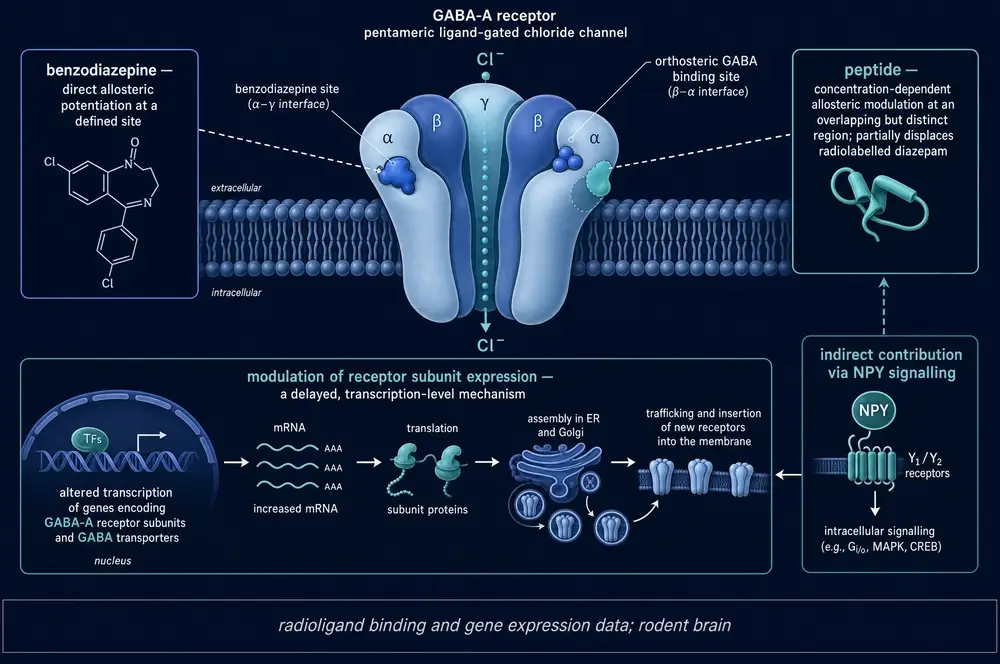
The dominant recent account takes a different route. Since Selank's clinical comparators are benzodiazepines, and benzodiazepines are positive allosteric modulators of the GABAA receptor, perhaps Selank is one too — a molecule that does not activate the receptor itself but changes how the receptor responds to the brain's own inhibitory transmitter.
Vyunova and colleagues tested this directly with radioligand-receptor analysis and reported that Selank affects [3H]GABA binding as a positive allosteric modulator. The more interesting results are the interaction data. When Selank and a benzodiazepine were applied together, the effect on GABA binding was not the sum of their individual effects and differed in character from either alone; and Selank was able to block the modulatory activity of both diazepam and olanzapine. The authors' careful conclusion is that the binding sites are apparently not the same but may partially overlap (Vyunova et al., 2018). This is an in-vitro study on isolated brain-cell plasma membranes.
Electrophysiology is broadly consistent. Applying Selank to rat hippocampal slices increased both the amplitude and the discharge rate of spontaneous inhibitory postsynaptic currents in CA1 pyramidal neurons — more inhibition arriving, which is the direction an anxiolytic ought to move things (Povarov et al., 2017). Earlier patch-clamp work found that the compound at 2 µM raised the frequency of spike-dependent spontaneous inhibitory currents while leaving spike-independent currents unchanged, implying that it acts by exciting inhibitory interneurons rather than at the synapse itself (Skrebitskii et al., 2011).
Povarov and colleagues tested Selank across a concentration range of 1 to 8 µM and reported no significant dose-dependence in its effect on hippocampal inhibitory currents. In some neurons the eventual increase was preceded by a transient decrease. A clean allosteric modulator acting at a defined site should produce a graded, monotonic response over an eightfold concentration range. This one does not, and the discrepancy is not explained anywhere in the corpus.
12The transcriptional layer, and its best-known failure
The fourth account operates at the level of gene expression, and it produced the single most instructive pair of results in the whole literature.
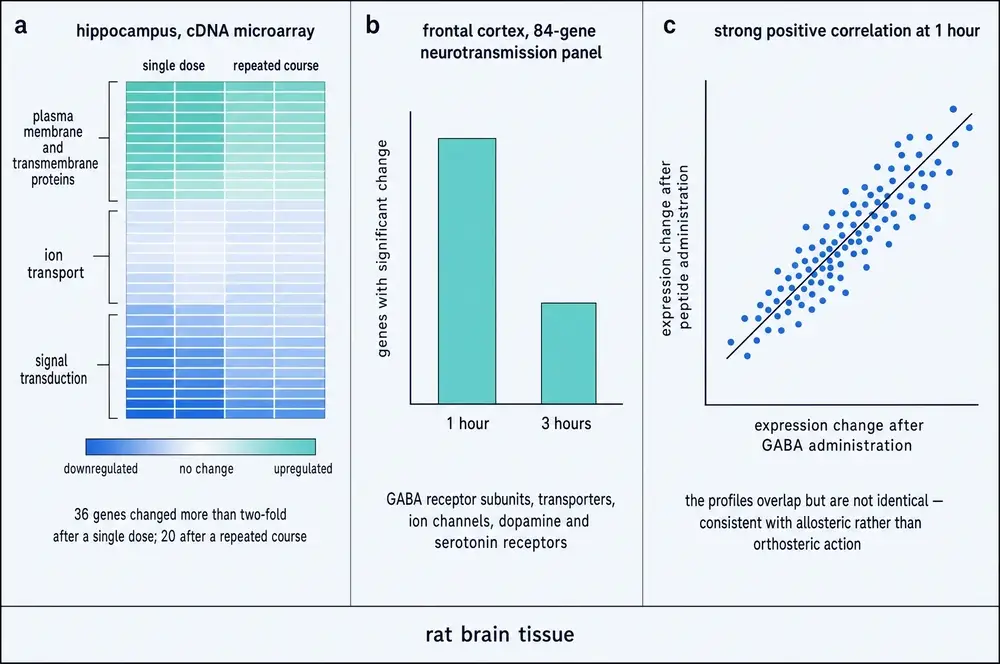
Volkova and colleagues gave rats a single intranasal dose of Selank at 300 µg/kg and measured the expression of 84 genes involved in neurotransmission in the frontal cortex by real-time PCR. Forty-five genes had changed significantly at one hour; twenty-two at three hours. A parallel group received GABA itself at the same dose, and the pattern of change after Selank correlated positively with the pattern after GABA (Volkova et al., 2016). Read on its own, this is strong support for the GABA hypothesis: the peptide produces a transcriptional signature resembling that of the neurotransmitter it is supposed to modulate.
The following year, largely the same group ran the same 84-gene panel in IMR-32 neuroblastoma cells. Selank alone changed nothing. Not one gene's mRNA level moved. What it did do was interfere: applied together with GABA it almost entirely suppressed the changes GABA produced alone, and applied together with olanzapine it broadened the set of genes olanzapine affected (Filatova et al., 2017).
The honest reading is that Selank's transcriptional effect requires something an isolated neuronal cell line does not have. It might require the peripheral compartment, or an intact blood supply, or the degradation products of Section 08, or an immune cell population, or the enzymes of Section 09 acting on endogenous peptides that are simply absent from a dish. The corpus does not distinguish between these possibilities. What it does establish is that in-vitro null results on this compound should not be read as evidence of no activity, and in-vivo transcriptional results should not be read as direct neuronal action.
The transcriptional work extends beyond the brain. A cDNA microarray study of rat hippocampus found 36 genes changed more than twofold after a single intranasal dose at 200 µg/kg and 20 after a course, most of them encoding plasma-membrane-associated proteins (Kolomin et al., 2013). In mouse spleen, an 84-gene inflammation panel showed 34 genes significantly changed after a single 100 µg/kg intraperitoneal dose, with the transcriptional repressor Bcl6 responding to the intact peptide and to every fragment tested (Kolomin et al., 2011b). A follow-up tracked the timing and found the complement gene C3 falling threefold within thirty minutes of injection (Kolomin et al., 2014).
13Neurotrophins, monoamines, and the direction of change
Two further layers are worth stating because they are frequently misdescribed.
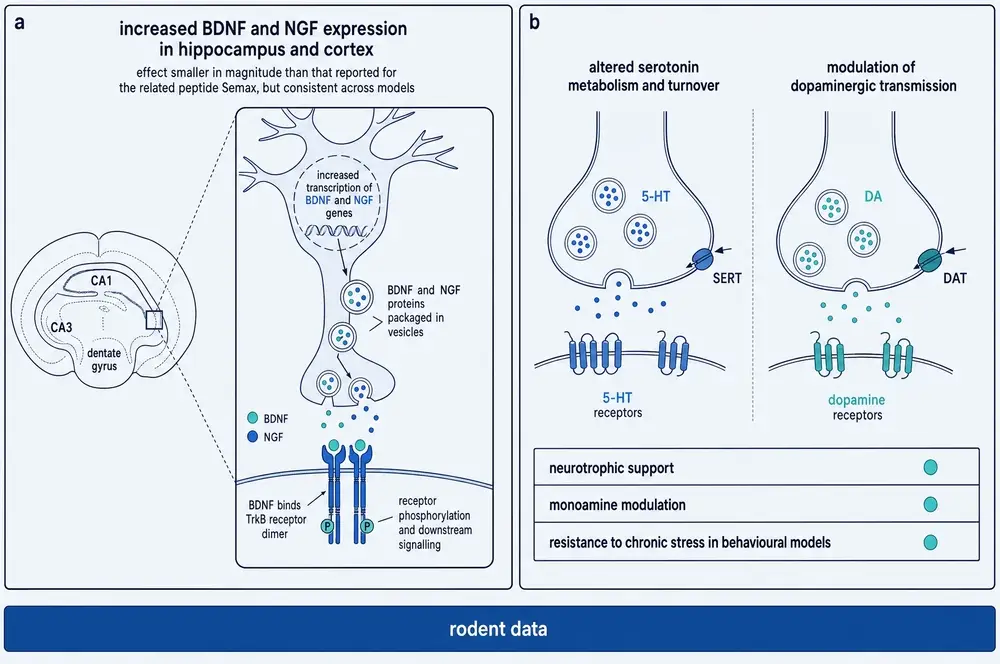
Intranasal Selank regulates BDNF — brain-derived neurotrophic factor, a protein central to synaptic plasticity — in the rat hippocampus in vivo (Inozemtseva et al., 2008). This is often reported as “Selank increases BDNF,” and the most detailed study in the corpus shows why that is too simple. In rats given 10% ethanol as their only fluid for thirty weeks, Selank at 0.3 mg/kg daily for seven days intraperitoneally prevented the ethanol-induced increase in BDNF in the hippocampus and frontal cortex (Kolik et al., 2019). The peptide moved BDNF back toward baseline. The observed action was normalisation, not elevation, and the direction depended entirely on which way the system had already been pushed.
On monoamines, a single 300 µg/kg dose activated serotonin metabolism in rat hypothalamus and caudal brain stem for thirty minutes to two hours, in a study that also reported increased memory-trace stability over thirty days (Semenova et al., 2010). But a strain comparison found the compound raising norepinephrine in the hypothalamus of both mouse strains while moving the dopamine metabolites DOPAC and homovanillic acid in opposite directions in C57Bl/6 and BALB/c, and lowering serotonin and its metabolite in the hippocampus of BALB/c only (Narkevich et al., 2008). A further comparison against the parent tetrapeptide found that Selank enhanced brain-stem serotonin metabolism in serotonin-depleted rats where tuftsin did not (Semenova et al., 2009) — evidence that the Pro-Gly-Pro tail changed the pharmacology and did not merely preserve it.
14Why none of this closes
Look at those four objections together and a pattern emerges. The enzyme account works in plasma at micromolar concentrations, while the animals that respond receive micrograms per kilogram. The opioid account depends on receptors the compound demonstrably does not bind. The GABA account lacks the dose–response relationship that would make it a receptor story. The transcriptional account evaporates the moment the experiment leaves a living animal.
The most parsimonious reading — and it is a reading, not a finding — is that Selank is not a ligand in the ordinary sense. It behaves less like a drug that occupies a site and more like a perturbation of a peptide economy: it changes how long the body's own regulatory peptides survive, and everything downstream follows from that. This would account for the persistence of effects beyond the compound's own lifetime, for the failure in cell culture, for the absence of clean dose–response curves, and for the fact that fragments retain activity. It would also account for the pattern that Section 15 takes up, which is that the compound seems to do very little to an animal that is not already dysregulated.
What would settle it is not mysterious: a binding study identifying the actual molecular target, dose–response curves spanning the doses actually used in vivo, and independent replication outside the originating institutions. The corpus contains none of the three.
15The most reproducible result is a caveat
If one finding in this corpus deserves to be read before all the others, it is this one: Selank does very little to an animal that is not already dysregulated. It is the most consistently replicated observation in twenty-five years of work, it appears in six independent lines of evidence using different models and different endpoints, and it is almost never the headline of the paper that reports it.
The pattern was there from the beginning. Seredenin's 1998 characterisation found the compound effective across a fifteen-fold dose range — 200 to 3000 µg/kg intraperitoneally — in high-anxiety BALB/c mice, and entirely without effect in low-anxiety C57BL/6 (Seredenin et al., 1998). Sokolov and colleagues then showed that the biochemistry tracked the behaviour: at 100 µg/kg, both the anxiolytic effect and the prolongation of plasma leu-enkephalin half-life appeared in BALB/c and in neither measure in C57BL/6 (Sokolov et al., 2002).
It is not merely a matter of magnitude. Narkevich and colleagues found the compound at 0.3 mg/kg raising hypothalamic norepinephrine in both strains while moving the dopamine metabolites DOPAC and homovanillic acid in opposite directions in the two (Narkevich et al., 2008). And naloxone pretreatment attenuated the response in BALB/c while increasing it in C57BL/6 (Kozlovskii et al., 2012). The compound does not simply do less in the calm strain; in places it does the reverse.
The same pattern recurs where the axis is not strain but baseline ability. Selank at 300 µg/kg significantly improved active-avoidance learning in rats with initially poor learning ability from the first dose on the first training day; in normal rats the maximum effect appeared only on the third day, after the initial consolidation phase had already formed (Kozlovskii & Danchev, 2003). And in a genetic model of depression, the compound counteracted depression-like signs in WAG/Rij rats at 1000–2000 µg/kg after repeated injection, reduced immobility in BALB/c mice at 100 and 300 µg/kg after a single injection, and exerted no substantial effect on the behaviour of control Wistar rats (Sarkisova et al., 2008).
One further wrinkle belongs here because it undercuts the tidiest reading of the dose data. Sarkisova's study reported that low doses of 100 and 300 µg/kg reduced immobility in BALB/c mice after a single injection but did not do so after repeated injection, and did not do so at higher doses of 600 and 900 µg/kg (Sarkisova et al., 2008). More is not more, and sustained is not better. Taken with the absent dose–response in the electrophysiology of Section 11, this is a compound whose effects do not scale in the way a conventional receptor drug's do.
16Repair, rather than enhancement
The animal literature is dominated by damage-and-repair designs, and reading them in sequence makes the pattern of Section 15 look less like a quirk of mouse genetics and more like the compound's actual character.
| Model | Species and route | Reported parameters | Outcome as reported |
|---|---|---|---|
| Antenatal hypoxia, gestation days 14–16 | Rat, intraperitoneal | 300 µg/kg | Sensory attention improved 2–3× (p<0.01); learning facilitated 1.5× (p<0.01); serotonergic–noradrenergic balance restored |
| Neonatal 6-hydroxydopamine lesion of catecholamine neurons | Rat, intraperitoneal | 300 µg/kg | Learning, memory and cross-modal attention restored |
| Protein-synthesis blockade with actinomycin D | Rat, intraperitoneal | 0.5 mg/kg | Acquisition, improvement and consolidation of a spatial memory trace protected; re-learning restored |
| 6-hydroxydopamine parkinsonian model | Rat | not stated in abstract | Anxiety reduced; motor activity unaffected; passive defensive behaviour unaffected |
| Chronic foot-shock stress, liver histology | Rat, intraperitoneal, 15 min before each session | 100, 300, 1000 µg/kg | Degenerative change reduced at all doses; maximum stress-limiting effect at 300 µg/kg, not at the highest dose |
| Chronic restraint stress, colon histology | Rat, intraperitoneal, 15 min before exposure | 80, 250, 750 µg/kg | Corticosterone lowered; atrophy, inflammation and mast-cell changes reduced |
| Chronic restraint stress, gut microbiota | Rat, intraperitoneal | 80, 250, 750 µg/kg | Obligate flora restored after stress-induced shift toward opportunistic organisms |
| Unpredictable chronic mild stress, 14 days | Rat, intranasal daily | 300 µg/kg, alone and with oral diazepam 1 mg/kg | Selank alone most effective against course-induced anxiety; the combination most effective under chronic stress |
| Seasonal behaviour in hibernating animals | Arctic ground squirrel, n = 36 | not stated in abstract | Exploratory behaviour increased in spring and autumn only; locomotor activity unchanged |
| Experimental neurosis | Monkey, intranasal | not stated in abstract | Long-lasting reduction of fear and aggression; increased orientational-exploratory activity; memory compensation |
Sources, in table order: Semenova et al., 2008; Semenova et al., 2007; Kozlovskii et al., 2013; Slominsky et al., 2017; Fomenko et al., 2019; Mukhina et al., 2020; Mukhina et al., 2019; Kasian et al., 2017; Semenova et al., 2005; Zh Evol Biokhim Fiziol, 2008. All are animal in-vivo studies. Doses are the parameters of the published experiments and are recorded here for that reason alone.
Two entries in that table deserve emphasis because they are negative results inside positive papers. In the parkinsonian model the compound reduced anxiety and did nothing at all for motor function (Slominsky et al., 2017); in the hibernating ground squirrels it changed exploratory behaviour without touching locomotor activity (Semenova et al., 2005). Whatever this compound is doing, it is not general behavioural stimulation. And the foot-shock study is one of the few in the corpus with three dose levels and a clean answer: the middle dose worked best (Fomenko et al., 2019).
17Withdrawal
The most recent primary pharmacology in this corpus concerns dependence, and it is also where the compound has been benchmarked most directly against an active comparator.
In rats made physically dependent on morphine and then precipitated into withdrawal with naloxone, a single intraperitoneal injection of Selank at 0.3 mg/kg reduced the total withdrawal index by 39.6%, significantly attenuated convulsive reactions, ptosis and posture disorders (p<0.0001), and raised the tactile sensitivity threshold ninefold. Diazepam at 2 mg/kg, tested in the same experiment, reduced the withdrawal index by 49.3% and raised the tactile threshold thirteenfold. The authors' conclusion is appropriately measured: Selank was “slightly inferior to diazepam” (Konstantinopolsky et al., 2022). This is an animal in-vivo study.
The alcohol work runs parallel. In outbred rats drinking 10% ethanol as their only fluid for twenty-four weeks, a single 0.3 mg/kg intraperitoneal injection eliminated the anxiety of 48-hour withdrawal in the elevated plus maze and social interaction tests and prevented mechanical allodynia — while not affecting ethanol consumption (Kolik et al., 2014). In DBA/2 mice the same dose prevented ethanol-induced hyperlocomotion and blocked the expression of behavioural sensitisation without affecting its formation (Kolik et al., 2016). And over a thirty-week ethanol exposure, seven days of 0.3 mg/kg prevented the memory and attention disturbances of withdrawal while returning BDNF toward baseline (Kolik et al., 2019).
The consistent shape across all four studies is that the compound acted on the distress of withdrawal without acting on consumption or on the formation of sensitisation. That is a narrower claim than “treats dependence,” and it is the claim the data support.
18The body below the neck
Selank is routinely described as an anxiolytic, which obscures the fact that its parent molecule was an immune peptide and that a good deal of its measured activity is not neurological at all.
Antiviral. Against influenza A/Aichi 2/68 (H3N2), in cell culture and in animals, the compound showed a pronounced antiviral effect; adding it to cell culture twenty-four hours before inoculation completely suppressed viral reproduction, and the same preventive schedule gave the highest animal survival. It induced interferon-α gene expression without affecting IL-4, IL-10 or TNF-α (Ershov et al., 2009). Structural fragments retained antiviral properties (Andreeva et al., 2010).
Immune gene regulation. In mouse spleen, a single 100 µg/kg intraperitoneal dose changed the expression of 34 of 84 inflammation-related genes, with the transcriptional repressor Bcl6 and its targets responding to the intact peptide and to each fragment tested (Kolomin et al., 2011b). Timing work showed the complement gene C3 falling threefold within thirty minutes (Kolomin et al., 2014). In patients with anxiety-asthenic disorders, the compound at 10−7 M completely suppressed IL-6 gene expression in peripheral blood cells from patients with depression but not from healthy controls, and shifted the Th1/Th2 balance over fourteen days of treatment (Uchakina et al., 2008).
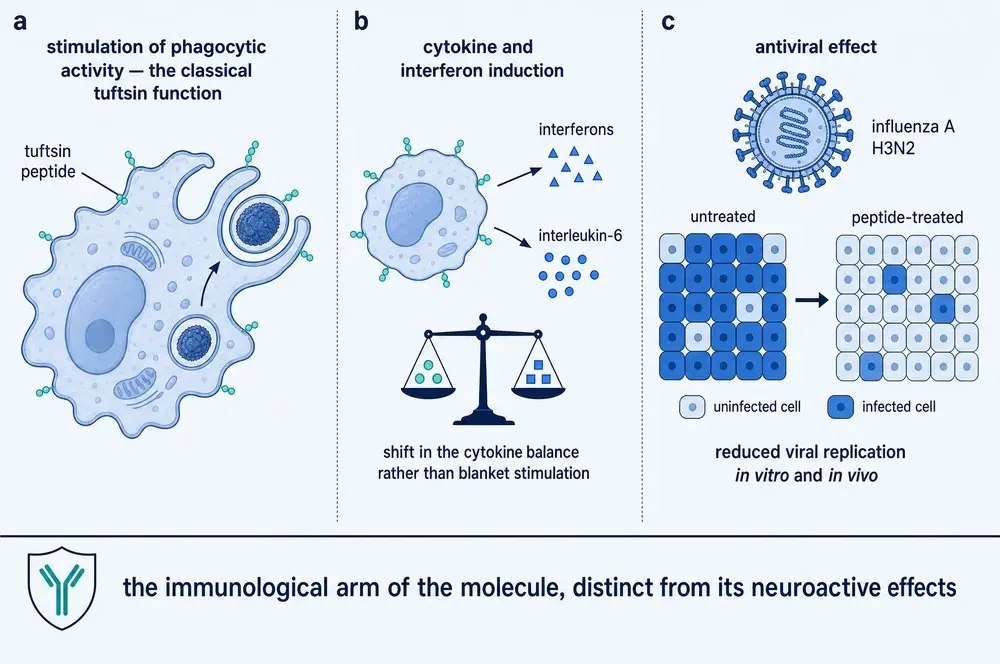
Gastric. Selank and its in-vivo metabolites reduced the area of experimental gastric ulcers across three ulceration models (Pavlov et al., 2007; Pavlov et al., 2004). It did not affect basal gastric blood flow but normalised flow that had been reduced by indomethacin — the repair-not-enhancement pattern again. Its effect on mesenteric lymphatic contractility was frankly biphasic: at 10−12 to 10−14 M it raised both the amplitude and the frequency of contractions, while at 10−6 to 10−10 M it raised amplitude but lowered frequency (Pavlov et al., 2005).
Anticoagulation. Thromboelastography of arginine-containing glyproline oligopeptides found every measured parameter — R, K, MA, S, TMA and J — shifting toward hypocoagulation, and Selank demonstrated the maximal anticoagulant potency of the peptides tested (Rogozinskaya & Lyapina, 2017). This is consistent with earlier comparative work on the glyproline family (Lyapina et al., 2006) and with a study of hemostasis, lipid profile and blood glucose in an experimental metabolic syndrome model (Myasoedov et al., 2014). It is a pharmacological property of the molecule, arising from the arginine residue noted in Section 06, and it is not discussed as a consideration anywhere in the behavioural literature.
Acute hypotension. In anaesthetised cats, intravenous administration produced a 32 ± 4.3% fall in arterial pressure within the first one to three minutes and a 24 ± 2.8% rise in cerebral blood flow over the first five to ten minutes, with heart rate and respiratory rate unaffected (Gan'shina & Kozlovskii, 2005). The route and species are unusual for this corpus and the finding has not been followed up.
19Humans
Four human studies form the entire clinical evidence base. All are Russian. All are small. Three come from the institutions that developed the compound.
| Study | Design | n | Population | Comparator | Reported outcome |
|---|---|---|---|---|---|
| Zozulya et al., 2008 | Randomised controlled trial | 62 | Generalized anxiety disorder and neurasthenia | Medazepam (n = 32) vs Selank (n = 30) | Anxiolytic effects similar between arms; Selank additionally antiasthenic and psychostimulant. Baseline leu-enkephalin half-life was reduced and correlated with illness duration and symptom severity; it rose during Selank treatment, chiefly in the GAD group |
| Medvedev et al., 2014 | Comparative clinical trial; randomisation and blinding not stated | 60 | Phobic-anxiety and somatoform disorders (ICD-10 F40.2-9, F41.1-9, F45.0-1) | Phenazepam | Pronounced anxiolytic and mild nootropic effects; anxiolytic effect persisted one week after the last dose; positive effect on quality of life |
| Medvedev et al., 2015 | Randomised controlled trial | 70 | Anxiety-phobic, hypochondriac and somatoform disorders (F40.2-9, F41.1-9, F45.0-2) | Phenazepam alone (n = 30) vs phenazepam + Selank (n = 40) | Earlier positive effect on HDRS with the combination; reduced phenazepam side effects — attention and memory impairment, asthenia, sedation, lengthened sleep, sexual disturbance, emotional indifference, orthostatism — both during treatment and after tranquilliser withdrawal |
| Panikratova et al., 2020 | Resting-state functional MRI, placebo-controlled | 52 | Healthy volunteers | Placebo | Group and condition differences in functional connectivity between the right amygdala and right fusiform, inferior and middle temporal and parahippocampal gyri, at 5 and 20 minutes after injection |
| Uchakina et al., 2008 | Clinical, immune endpoints | – | Generalized anxiety disorder and neurasthenia | – | Th1/Th2 cytokine balance shifted over 14 days; IL-6 gene expression suppressed in patient cells but not control cells in vitro |
Three observations about this table are worth making explicitly.
First, the 2008 trial's finding is that Selank and a benzodiazepine had similar anxiolytic effects, with the peptide additionally having antiasthenic and psychostimulant properties (Zozulya et al., 2008). At n = 62 split across two arms, a finding of similarity is not a finding of equivalence; the study is not powered to exclude a meaningful difference in either direction. What it does establish, and what the biomarker data support, is that the compound is doing something measurable.
Second, the one-week persistence of effect reported in 2014 (Medvedev et al., 2014) is a genuinely striking claim for a molecule whose plasma survival is measured in minutes. It is consistent with the twenty-four-hour enzyme changes of Section 09, and it is unreplicated. The paper is indexed as a comparative clinical trial rather than a randomised one, and its abstract does not state randomisation, blinding, or the split between arms.
Third, and most interesting, is what happened between 2008 and 2015. The earlier trial positions Selank as a substitute for a benzodiazepine. The later one positions it as an adjunct that lets a benzodiazepine be tolerated better — and the outcome that reached significance was not superior anxiolysis but reduced side-effect burden, sustained after the tranquilliser was withdrawn (Medvedev et al., 2015). That is a narrower and more defensible claim than the one the compound is usually marketed on, and it is the most recent thing the clinical literature has to say.
20Where the evidence is thin, and where it contradicts itself
A monograph that only assembled the positive findings of Part Four would be a misleading document. What follows is the other column of the ledger, drawn from the same corpus.
The literature is produced by a very small number of people. Across three decades, the same author groups recur: Myasoedov and Andreeva on chemistry, Seredenin and Kozlovskaya on behaviour, Kolomin, Shadrina, Slominsky and Limborska on molecular genetics, Zozulya, Kost and Sokolov on the clinical side, Semenova on learning, Kolik on dependence, Bobyntsev and colleagues on stress physiology. These are the institutions that developed the compound. That does not make the work wrong — specialised fields are often small — but it means the corpus contains very little genuinely independent replication, and essentially none from outside Russia.
The founding premise was never tested. Section 05 noted the programme's assumption that a peptide resembling something endogenous would be intrinsically low in toxicity and free of side effects. That assumption appears in the papers as a rationale rather than a hypothesis, and the corpus contains no dedicated toxicology programme, no formal safety pharmacology package, and no systematic adverse-event reporting beyond the tolerability scales used in the Russian trials.
A toxicology paper contains a signal its own conclusion does not address. Kobylyanskii and colleagues tested several peptide preparations on mouse embryonic stem cells and their derivatives and concluded that the compounds do not produce a toxic effect during the embryonic and foetal period. The same paper reports that Selank at 100 µM decreased the proportion of GABA-positive neurons by 61% relative to control (Kobylyanskii et al., 2017). A 61% reduction in the differentiation of the very neuronal population the compound is proposed to act upon is not obviously consistent with a headline of non-toxicity. This is an in-vitro study at a concentration far above anything used in vivo, and both the finding and the conclusion are recorded here because the paper contains both.
Two sources make flatly incompatible claims about clinical development. A 2008 Russian primary paper states in its abstract that the compound represents the working element of a drug that had completed the third phase of clinical testing as a selective anxiolytic (Sarkisova et al., 2008). A 2020 European forensic-chemistry paper states that Selank has not completed any clinical trials (Vanhee et al., 2020). Both statements are in the peer-reviewed record. This pipeline located no trial registration entry that would settle the question. The most likely reconciliation — that Russian domestic registration trials were conducted and reported without entry into an international registry — is an inference, not a finding, and it is presented here as such.
An independent Western assessment is unfavourable. A review in the Journal of Clinical Pharmacology whose subject is abuse potential and withdrawal risk among GABAergic agents groups Selank with phenibut as poorly studied Russian drugs sold to United States consumers as dietary supplements, and describes that state of affairs as inexplicable (Doyno & White, 2021). It is a review rather than new data, and its treatment of Selank is brief. It is nonetheless the closest thing in the corpus to an outside opinion, and it is not favourable.
21Recency, weighed honestly
Weighting recency is a standard analytical instinct and it needs to be applied carefully here, because on this compound recency mostly delivers absence.
The newest primary pharmacology in the corpus is the 2022 morphine-withdrawal study (Konstantinopolsky et al., 2022); the newest human work is the 2020 imaging study (Panikratova et al., 2020). Neither contradicts the older picture. The 2022 study is consistent with the alcohol work of 2014 and 2016; the imaging study is consistent with an amygdala-directed anxiolytic effect. On the substance, recency confirms rather than overturns, and there is no newer null result that displaces an older positive one.
What recency does establish is negative and important. In the four years to 2026 the compound attracted no new mechanistic work, no new clinical trial, and no replication attempt. The only non-Russian attention it received in that window was forensic — a laboratory identifying it in seized preparations (Vanhee et al., 2020) — and cautionary (Doyno & White, 2021). The single 2026 record is a review of therapeutic peptides in orthopaedics that mentions Selank in a list and concedes, of its whole subject area, that clinical trials are currently lacking (Rahman et al., 2026).
So the correct recency-weighted judgement is not that Selank has been superseded. It is that the compound was left where it stood in about 2018: with a coherent animal literature, a plausible but unresolved mechanism, four small domestic human studies, and no momentum.
22What is actually being sold
The four names in this monograph's title are all commercially available, and the gap between the commercial and scientific record is wide enough to require its own section.
Selank appears in the forensic literature. Two suspicious preparations seized in 2017 and 2018 were analysed and found to contain it, prompting the development of a validated liquid chromatography–tandem mass spectrometry method for a panel of ten peptides sold online as cognitive enhancers. The same paper records that these compounds are freely available as lyophilised powder for injection and in nasal sprays (Vanhee et al., 2020).
The three unpublished names are sold too. A survey of vendor listings conducted for this monograph found N-Acetyl Selank, N-Acetyl Selank Amidate and Adalank offered as powders and nasal sprays by more than a dozen retailers, at quantities — 10 mg injectable, 10 mg nasal spray — that match the illegal preparations described in the forensic literature six years earlier. Two vendors sell Adalank and N-Acetyl Selank Amidate as separate products without stating any relationship between them. One states plainly that Adalank's amino acid sequence and molecular structure are not publicly disclosed, describing it as proprietary and directing enquiries to the supplier.
That last point deserves to be sat with. A compound is being sold, for administration by nasal spray, whose vendor states on the product page itself that its structure is not public. Purity figures above 99% are quoted. A purity figure is a statement about how much of the material is the intended substance. It carries no information at all when the intended substance is undisclosed.
The chemistry published by vendors for the two modified forms does not survive arithmetic. Figure 21 sets out what the stated names require, what the vendors publish, and where the two part company. The calculations are this document's own, performed from standard atomic masses and the sequences the vendors themselves state.
The registry identifiers fare worse than the formulas. Four different CAS numbers circulate for N-Acetyl Selank Amidate. Every one of them was checked against PubChem for this monograph, and not one identifies the compound.
| CAS number in circulation | What it actually resolves to | Formula | Mass |
|---|---|---|---|
| 864070-44-0 | Empagliflozin — a marketed SGLT-2 inhibitor for type 2 diabetes | C23H27ClO7 | 450.9 |
| 2920938-90-3 | The acetylated, amidated analogue of a different peptide entirely | C39H54N10O10S | 855.0 |
| 2920938-92-5 | Listed against a small fluorinated molecule; cannot be a heptapeptide | C17H20FN3O2 | 317.4 |
| 2212313-10-6 | No public record located | – | – |
The second row is worth dwelling on, because it can be settled without trusting anyone's database. That formula contains sulfur. Selank is Thr-Lys-Pro-Arg-Pro-Gly-Pro; not one of those seven residues contains a sulfur atom, and neither acetylation nor amidation introduces one. A sulfur-containing formula therefore cannot describe any Selank derivative, whatever the label says. Yet that CAS number, that formula and that sequence appear together on a chemical supplier's catalogue page headed “N-acetyl Selank amidate.” This is not a rounding error in a marketing table; it is the wrong peptide, sold under the right peptide's name, at supplier level.
Half-life is the other place the commercial record collapses. The Russian registration documentation for Selank reports intranasal absolute bioavailability of 92.8%, detection in plasma within thirty seconds, and a progressive decline in plasma concentration over roughly five to five and a half minutes. Against that single sourced figure, vendors publish parent-compound half-lives of two to three minutes, fifteen to twenty minutes and twenty to thirty minutes. For the modified form, one vendor claims a half-life shorter than the parent's, at five to ten minutes; another claims two hundred to three hundred minutes, a tenfold extension. Neither cites anything. Two sellers of the same product make claims that point in opposite directions.
None of this establishes that what is in any particular vial is wrong. It establishes something narrower and still serious: that the published chemistry for these products is not internally coherent, that the same product name carries different formulas, different masses and different registry numbers at different retailers, and that a buyer cannot use the vendor's own documentation to determine which molecule is being offered. The one-Dalton difference between the acetylated free acid and the true amidate is precisely the kind of thing a mass-spectrometric certificate of analysis settles in minutes. The published paperwork points both ways.
One further item belongs in the record. A vendor page for N-Acetyl Selank Amidate, archived before that retailer ceased trading in 2025, asserted that research had shown the modified compound to improve on Selank in potency, half-life, absorbability and blood–brain barrier penetration. No citation was attached to that sentence, and the page's own reference list concerned plain Selank and the glyproline family. The pattern is not confined to one seller: an aggregator page for Adalank cites six studies and labels every one of them, in its own text, as concerning the parent compound — then states that the modification enhances the effects those studies found. That is the whole inferential move of this market, performed in the open. As Section 07 establishes, no research on the modified compounds exists to have shown anything.
Regulatory position
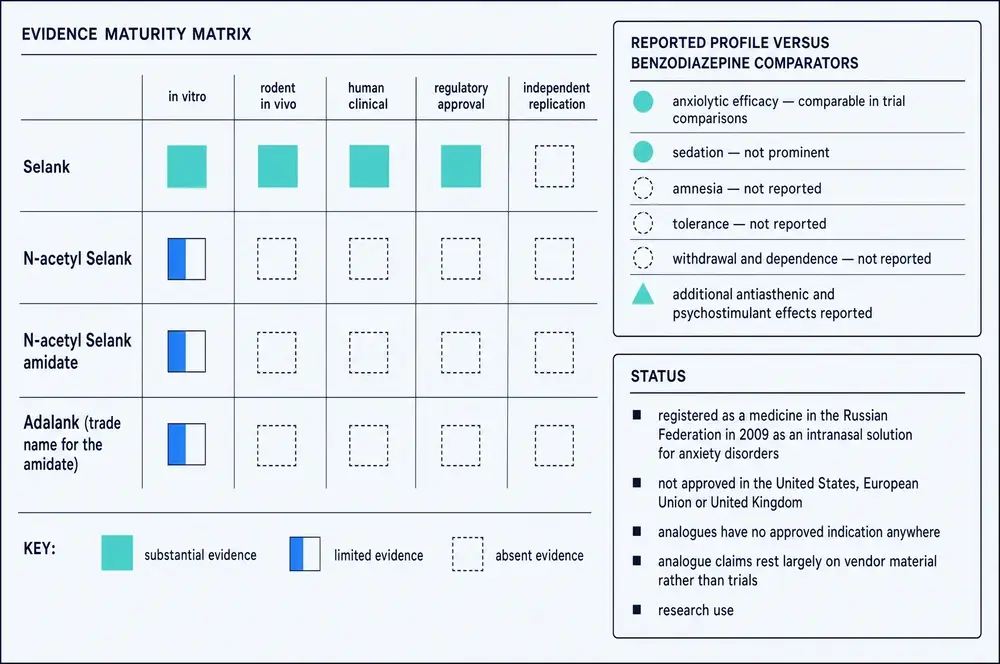
Russia. Selank is a registered medicine. It is marketed as nasal drops at 0.15%, 1.5 mg/mL, under registration number ЛРС-003338/09, classified under ATC code N05BX among other anxiolytics. The registered substance is the diacetate — a counter-ion salt, which is worth distinguishing carefully from N-acetylation, a covalent modification of the backbone. The two are unrelated, and the resemblance of the words is a plausible source of some of the confusion in Section 22. The label carries contraindications in pregnancy, in breastfeeding, and in anyone under eighteen, on the grounds that it has not been studied in those groups.
United States. Selank is not approved in any form. Its position on the FDA's compounding lists is more specific than commercial sources usually state: “Selank acetate (TP-7)” appears not in the active category of bulk substances that may present significant safety risks, but in the list of substances nominated and then withdrawn by the nominators. The agency's recorded concern is that compounded preparations may pose an immunogenicity risk for certain routes of administration, owing to the potential for aggregation and peptide-related impurities, and that it lacks important information about safety in humans. Neither modified form is named by the FDA at all; they were never nominated.
Anti-doping. A full-text search of the World Anti-Doping Agency Prohibited List in force for 2026 returns no occurrence of Selank. This produces a genuine ambiguity rather than a clear permission. Section S0 covers substances with no current approval by any governmental regulatory health authority — and Selank is approved by one, in Russia. Section S2 covers peptide hormones and growth factors, which it is not. A 2025 review of “brain doping” substances places Selank explicitly among agents whose anti-doping status is unclear (Pokrywka et al., 2025). The modified forms invert the situation: being approved nowhere, they fall within S0 far more cleanly than the parent does. Modification makes the regulatory position worse, not better.
23What can and cannot be said
What can be said about Selank, fairly, is this. It is a well-defined molecule with a documented origin, a measured degradation pathway, and a substantial animal literature that consistently shows effects on anxiety-like behaviour, learning after injury, and the distress of drug withdrawal — predominantly in animals that are already dysregulated, at doses clustering around 300 µg/kg, with an effect that does not scale conventionally with dose. Its mechanism is unresolved among four incomplete accounts. It has measurable activity outside the nervous system, including an anticoagulant effect that is the strongest among the peptides it has been compared with. Four small Russian studies in a total of 244 people report anxiolytic effects comparable to benzodiazepine comparators, with the most recent and best-designed of them finding its clearest benefit as a way of making a benzodiazepine more tolerable rather than as a replacement for one. There is no independent replication outside Russia, no formal toxicology programme in the accessible record, and no new work since 2022.
What can be said about N-Acetyl Selank, N-Acetyl Selank Amidate and Adalank is very much shorter. Terminal acetylation and amidation are real and rational peptide-chemistry modifications with a general rationale. Nothing has been published about what these particular modified molecules do. The chemistry vendors publish for them does not survive arithmetic, and in the case of Adalank no structure is disclosed at all. Any statement about their pharmacology — including the assumption, which is the whole premise of selling them, that they behave like Selank but better — is at present an extrapolation from a molecule to three of its untested derivatives.
This document describes published research. It does not recommend the use of Selank, N-Acetyl Selank, N-Acetyl Selank Amidate or Adalank by any person, and it specifies no dose, route, schedule or protocol for any person. Every dose, route and duration reported above is a parameter of a published experiment, reproduced so that the reader can evaluate the evidence, and is attached to the species and model in which it was used. Findings in rats, mice, cats, ground squirrels, monkeys, cell cultures and isolated membranes are findings in those systems. They are not predictions about people, and nothing in Part Four should be read as one.
24References
Generated from verified NCBI records rather than from recall. Author lists, journal names, volumes, pages and identifiers are taken from the PubMed record for each citation, and the build refuses to run if any identifier fails to resolve. This safeguard exists because it has been needed: in two earlier monographs in this series, reference lists drafted from memory contained identifiers that pointed at real but unrelated papers.
- Andreeva LA, Nagaev IY, Mezentseva MV, Shapoval IM, Podchernyaeva RY, Shcherbenko VE, et al.. Antiviral properties of structural fragments of the peptide Selank. Doklady biological sciences : proceedings of the Academy of Sciences of the USSR, Biological sciences sections. 2010;431:79-82.
PMID 20506839 · doi:10.1134/s0012496610020031 - Ashmarin IP, Samonina GE, Lyapina LA, Kamenskii AA, Levitskaya NG, Grivennikov IA, et al.. Natural and hybrid ("chimeric") stable regulatory glyproline peptides. Pathophysiology : the official journal of the International Society for Pathophysiology. 2005;11(4):179-185.
PMID 15837162 · doi:10.1016/j.pathophys.2004.10.001 - Brinckerhoff LH, Kalashnikov VV, Thompson LW, Yamshchikov GV, Pierce RA, Galavotti HS, et al.. Terminal modifications inhibit proteolytic degradation of an immunogenic MART-1(27-35) peptide: implications for peptide vaccines. Int J Cancer. 1999;83(3):326-34.
PMID 10495424 · doi:10.1002/(sici)1097-0215(19991029)83:3<326::aid-ijc7>3.0.co;2-x - Constantopoulos A, Najjar VA, Smith JW. Tuftsin deficiency: a new syndrome with defective phagocytosis. J Pediatr. 1972;80(4):564-72.
PMID 4111394 · doi:10.1016/s0022-3476(72)80051-9 - de Haan EC, Wauben MH, Wagenaar-Hilbers JP, Grosfeld-Stulemeyer MC, Rijkers DT, Moret EE, et al.. Stabilization of peptide guinea pig myelin basic protein 72-85 by N-terminal acetylation-implications for immunological studies. Mol Immunol. 2004;40(13):943-8.
PMID 14725790 · doi:10.1016/j.molimm.2003.10.015 - Deigin VI, Poluektova EA, Beniashvili AG, Kozin SA, Poluektov YM. Development of Peptide Biopharmaceuticals in Russia. Pharmaceutics. 2022;14(4).
PMID 35456550 · doi:10.3390/pharmaceutics14040716 · PMC9030433 - Doyno CR, White CM. Sedative-Hypnotic Agents That Impact Gamma-Aminobutyric Acid Receptors: Focus on Flunitrazepam, Gamma-Hydroxybutyric Acid, Phenibut, and Selank. Journal of clinical pharmacology. 2021;61 Suppl 2:S114-S128.
PMID 34396551 · doi:10.1002/jcph.1922 - Ershov FI, Uchakin PN, Uchakina ON, Mezentseva MV, Alekseeva LA, Miasoedov NF. [Antiviral activity of immunomodulator Selank in experimental influenza infection]. Voprosy virusologii. 2009;54(5):19-24.
PMID 19882898 - Filatova E, Kasian A, Kolomin T, Rybalkina E, Alieva A, Andreeva L, et al.. GABA, Selank, and Olanzapine Affect the Expression of Genes Involved in GABAergic Neurotransmission in IMR-32 Cells. Frontiers in pharmacology. 2017;8:89.
PMID 28293190 · doi:10.3389/fphar.2017.00089 · PMC5328971 - Fomenko EV, Bobyntsev II, Ivanov AV, Belykh AE, Andreeva LA, Myasoedov NF. Effect of Selank on Morphological Parameters of Rat Liver in Chronic Foot-Shock Stress. Bulletin of experimental biology and medicine. 2019;167(2):293-296.
PMID 31243679 · doi:10.1007/s10517-019-04512-1 - Fomenko EV, Bobyntsev II, Kryukov AA, Ivanov AV, Andreeva LA, Myasoedov NF. Effect of Selank on Functional State of Rat Hepatocytes under Conditions of Restraint Stress. Bulletin of experimental biology and medicine. 2017;163(4):415-418.
PMID 28853100 · doi:10.1007/s10517-017-3817-8 - Gan'shina TS, Kozlovskiĭ II. [Effects of the new peptide anxiolytic drug selank on the cardiovascular system functioning and respiration in cats]. Eksperimental'naia i klinicheskaia farmakologiia. 2005;68(4):33-5.
PMID 16193654 - Inozemtseva LS, Karpenko EA, Dolotov OV, Levitskaya NG, Kamensky AA, Andreeva LA, et al.. Intranasal administration of the peptide Selank regulates BDNF expression in the rat hippocampus in vivo. Doklady biological sciences : proceedings of the Academy of Sciences of the USSR, Biological sciences sections. 2008;421:241-3.
PMID 18841804 · doi:10.1134/s0012496608040066 - Kasian A, Kolomin T, Andreeva L, Bondarenko E, Myasoedov N, Slominsky P, et al.. Peptide Selank Enhances the Effect of Diazepam in Reducing Anxiety in Unpredictable Chronic Mild Stress Conditions in Rats. Behavioural neurology. 2017;2017:5091027.
PMID 28280289 · doi:10.1155/2017/5091027 · PMC5322660 - Kobylyanskii AG, Zolotarev YA, Andreeva LA, Grivennikov IA, Myasoedov NF. Studying the Toxic Effects of Some Biologically Active Peptides on the Model of Mouse Embryonic Stem Cells. Bulletin of experimental biology and medicine. 2017;163(6):731-736.
PMID 29063333 · doi:10.1007/s10517-017-3891-y - Kolik LG, Nadorova AV, Seredenin SB. Selank Inhibits Ethanol-Induced Hyperlocomotion and Manifestation of Behavioral Sensitization in DBA/2 Mice. Bulletin of experimental biology and medicine. 2016;162(1):56-59.
PMID 27878720 · doi:10.1007/s10517-016-3544-6 - Kolik LG, Nadorova AV, Antipova TA, Kruglov SV, Kudrin VS, Durnev AD. Selank, Peptide Analogue of Tuftsin, Protects Against Ethanol-Induced Memory Impairment by Regulating of BDNF Content in the Hippocampus and Prefrontal Cortex in Rats. Bulletin of experimental biology and medicine. 2019;167(5):641-644.
PMID 31625062 · doi:10.1007/s10517-019-04588-9 - Kolik LG, Nadorova AV, Kozlovskaya MM. Efficacy of peptide anxiolytic selank during modeling of withdrawal syndrome in rats with stable alcoholic motivation. Bulletin of experimental biology and medicine. 2014;157(1):52-5.
PMID 24913576 · doi:10.1007/s10517-014-2490-4 - Kolomin T, Morozova M, Volkova A, Shadrina M, Andreeva L, Slominsky P, et al.. The temporary dynamics of inflammation-related genes expression under tuftsin analog Selank action. Molecular immunology. 2014;58(1):50-5.
PMID 24291245 · doi:10.1016/j.molimm.2013.11.002 - Kolomin T, Shadrina M, Andreeva L, Slominsky P, Limborska S, Myasoedov N. Expression of inflammation-related genes in mouse spleen under tuftsin analog Selank. Regulatory peptides. 2011;170(1-3):18-23.
PMID 21609736 · doi:10.1016/j.regpep.2011.05.001 - Kolomin TA, Shadrina MI, Slominskiĭ PA, Limborskaia S, Miasoedov NF. [Changes in expression of the genes for chemokines, cytokines, and their receptors in response to selank and its fragments]. Genetika. 2011;47(5):711-4.
PMID 21786679 - Kolomin TA, Agapova TIu, Agniullin IaV, Shram SI, Shadrina MI, Slominskiĭ PA, et al.. [Transcriptome alteration in hippocampus under the treatment of tuftsin analog Selank]. Zhurnal vysshei nervnoi deiatelnosti imeni I P Pavlova. 2013;63(3):365-74.
PMID 24450168 · doi:10.7868/s0044467713030052 - Konstantinopolsky MA, Chernyakova IV, Kolik LG. Selank, a Peptide Analog of Tuftsin, Attenuates Aversive Signs of Morphine Withdrawal in Rats. Bulletin of experimental biology and medicine. 2022;173(6):730-733.
PMID 36322304 · doi:10.1007/s10517-022-05624-x - Kost NV, Sokolov OIu, Gabaeva MV, Grivennikov IA, Andreeva LA, Miasoedov NF, et al.. [Semax and selank inhibit the enkephalin-degrading enzymes from human serum]]. Bioorganicheskaia khimiia. 2001;27(3):180-3.
PMID 11443939 · doi:10.1023/a:1011373002885 - Kozlovskaya MM, Kozlovskii II, Val'dman EA, Seredenin SB. Selank and short peptides of the tuftsin family in the regulation of adaptive behavior in stress. Neuroscience and behavioral physiology. 2003;33(9):853-60.
PMID 14969422 · doi:10.1023/a:1025988519919 - Kozlovskii II, Danchev ND. The optimizing action of the synthetic peptide Selank on a conditioned active avoidance reflex in rats. Neuroscience and behavioral physiology. 2003;33(7):639-43.
PMID 14552529 · doi:10.1023/a:1024444321191 - Kozlovskiĭ II, Andreeva LA, Kozlovskaia MM, Nadorova AV, Kolik LG. [The role of opioid system in peculiarities of anti-anxiety effect of peptide anxiolytic selank]. Eksperimental'naia i klinicheskaia farmakologiia. 2012;75(2):10-3.
PMID 22550852 - Kozlovskiĭ II, Danchev ND. [Optimizing action of synthetic peptide Selank on active avoidance conditioning test in rats]. Zhurnal vysshei nervnoi deiatelnosti imeni I P Pavlova. 2002;52(5):579-84.
PMID 12449836 - Kozlovskiĭ II, Belozertsev FIu, Andreeva LA, Kozlovskaia MM. [Protective effect of selank on the model of mnestic function violation induced by pharmacological blockade of protein synthesis]. Eksperimental'naia i klinicheskaia farmakologiia. 2013;76(12):3-7.
PMID 24605419 - Leonidovna YA, Aleksandrovna SM, Aleksandrovna TA, Aleksandrovna BO, Fedorovich MN, Aleksandrovna AL. The Influence of Selank on the Level of Cytokines Under the Conditions of "Social" Stress. Current reviews in clinical and experimental pharmacology. 2021;16(2):162-167.
PMID 32621722 · doi:10.2174/1574884715666200704152810 - Liapina LA, Pastorova VE, Obergan TIu, Samonina GE, Ashmarin IP, Miasoedov NF. [Comparison of anticoagulant effects of regulatory proline-containing oligopeptides. Specificity of glyprolines, semax, and selank and potential of their practical application]. Izvestiia Akademii nauk. Seriia biologicheskaia. 2006:193-203.
PMID 16634437 - Medvedev VE, Tereshchenko ON, Israelian AIu, Chobanu IK, Kost NV, Sokolov OIu, et al.. [A comparison of the anxiolytic effect and tolerability of selank and phenazepam in the treatment of anxiety disorders]. Zhurnal nevrologii i psikhiatrii imeni S.S. Korsakova. 2014;114(7):17-22.
PMID 25176261 - Medvedev VE, Tereshchenko ON, Kost NV, Ter-Israelyan AY, Gushanskaya EV, Chobanu IK, et al.. [Optimization of the treatment of anxiety disorders with selank]. Zhurnal nevrologii i psikhiatrii imeni S.S. Korsakova. 2015;115(6):33-40.
PMID 26356395 · doi:10.17116/jnevro20151156133-40 - Meshavkin VK, Kost NV, Sokolov OY, Zolotarev YA, Myasoedov NF, Zozulya AA. Naloxone-blocked depriming effect of anxiolytic selank on apomorphine-induced behavioral manifestations of hyperfunction of dopamine system. Bulletin of experimental biology and medicine. 2006;142(5):598-600.
PMID 17415472 · doi:10.1007/s10517-006-0428-1 - Mjasoedov NF, Andreeva LA, Grigorjeva ME, Obergan TY, Shubina TA, Lyapina LA. The influence of Selank on the parameters of the hemostasis system, lipid profile, and blood sugar level in the course of experimental metabolic syndrome. Doklady biological sciences : proceedings of the Academy of Sciences of the USSR, Biological sciences sections. 2014;458:267-70.
PMID 25371249 · doi:10.1134/S0012496614050020 - Mukhina AY, Mishina ES, Bobyntsev II, Medvedeva OA, Svishcheva MV, Kalutskii PV, et al.. Morphological Changes in the Large Intestine of Rats Subjected to Chronic Restraint Stress and Treated with Selank. Bulletin of experimental biology and medicine. 2020;169(2):281-285.
PMID 32651826 · doi:10.1007/s10517-020-04868-9 - Mukhina AY, Medvedeva OA, Svishcheva MV, Shevchenko AV, Efremova NN, Bobyntsev II, et al.. State of Colon Microbiota in Rats during Chronic Restraint Stress and Selank Treatment. Bulletin of experimental biology and medicine. 2019;167(2):226-228.
PMID 31236882 · doi:10.1007/s10517-019-04496-y - Najjar VA, Nishioka K. "Tuftsin": a natural phagocytosis stimulating peptide. Nature. 1970;228(5272):672-3.
PMID 4097539 · doi:10.1038/228672a0 - Najjar VA. Biochemical aspects of tuftsin deficiency syndrome. Medical biology. 1981;59(3):134-8.
PMID 6895538 - Najjar VA. Tuftsin, a natural activator of phagocyte cells: an overview. Annals of the New York Academy of Sciences. 1983;419:1-11.
PMID 6370072 · doi:10.1111/j.1749-6632.1983.tb37086.x - Narkevich VB, Kudrin VS, Klodt PM, Pokrovskiĭ AA, Kozlovskaia MM, Maĭskiĭ AI, et al.. [Effects of heptapeptide selank on the content of monoamines and their metabolites in the brain of BALB/C and C57Bl/6 mice: a comparative study]. Eksperimental'naia i klinicheskaia farmakologiia. 2008;71(5):8-12.
PMID 19093364 - Nguyen LT, Chau JK, Perry NA, de Boer L, Zaat SA, Vogel HJ. Serum stabilities of short tryptophan- and arginine-rich antimicrobial peptide analogs. PLoS One. 2010;5(9).
PMID 20844765 · doi:10.1371/journal.pone.0012684 · PMC2937036 - Nishioka K, Constantopoulos A, Satoh PS, Najjar VA. The characteristics, isolation and synthesis of the phagocytosis stimulating peptide tuftsin. Biochem Biophys Res Commun. 1972;47(1):172-9.
PMID 4112769 · doi:10.1016/s0006-291x(72)80025-1 - Nishioka K, Sato PS, Constantopoulos A, Najjar VA. The chemical synthesis of the phagocytosis-stimulating tetrapeptide tuftsin (Thr-Lys-Pro-Arg) and its biological properties. Biochim Biophys Acta. 1973;310(1):230-7.
PMID 4710594 · doi:10.1016/0005-2795(73)90025-1 - Panikratova YR, Lebedeva IS, Sokolov OY, Rumshiskaya AD, Kupriyanov DA, Kost NV, et al.. Functional Connectomic Approach to Studying Selank and Semax Effects. Doklady biological sciences : proceedings of the Academy of Sciences of the USSR, Biological sciences sections. 2020;490(1):9-11.
PMID 32342318 · doi:10.1134/S001249662001007X - Pavlov TS, Samonina GE, Bakaeva ZV, Zolotarev YA, Guseva AA. Selank and its metabolites maintain homeostasis in the gastric mucosa. Bulletin of experimental biology and medicine. 2007;143(1):51-3.
PMID 18019011 · doi:10.1007/s10517-007-0014-1 - Pavlov TS, Sanzhieva LTs, Samonina GE, Sergeev VI, Lelekova TV. [Effect of new synthetic anxiolytic selank on gastric wall blood flow and mesenteryc lymphatic vessels contractility in anesthetized rats]. Rossiiskii fiziologicheskii zhurnal imeni I.M. Sechenova. 2005;91(2):178-83.
PMID 15835541 - Pavlov TS, Samonina GE, Andreeva LA, Myasoedov NF, Ashmarin IP. A new property of the synthetic anxiolytic Selank and its derivatives. Doklady biological sciences : proceedings of the Academy of Sciences of the USSR, Biological sciences sections. 2004;397:281-3.
PMID 15508574 · doi:10.1023/b:dobs.0000039692.94366.2c - Pokrywka A, Surała O, Grabowska K, Przybyła M, Granda D, Małecki A, et al.. "Brain doping" substances: prohibited or not in sports?. Biol Sport. 2025;42(4):189-201.
PMID 41048238 · doi:10.5114/biolsport.2025.150047 · PMC12492343 - Povarov IS, Kondratenko RV, Derevyagin VI, Myasoedov NF, Skrebitsky VG. Effect of Selank on Spontaneous Synaptic Activity of Rat Hippocampal CA1 Neurons. Bulletin of experimental biology and medicine. 2017;162(5):640-642.
PMID 28361410 · doi:10.1007/s10517-017-3676-3 - Rogozinskaya EY, Lyapina MG. Anticoagulant Effects of Arginine-Containing Peptides of the Glyproline Family (His-Phe-Arg-Trp-Pro-Gly-Pro and Thr-Lys-Pro-Arg-Pro-Gly-Pro) Revealed by Thromboelastography. Bulletin of experimental biology and medicine. 2017;164(2):170-172.
PMID 29181670 · doi:10.1007/s10517-017-3950-4 - Sarkisova KIu, Kozlovskiĭ II, Kozlovskaia MM. [Effects of heptapeptide selank on genetically-based and situation-provoked symptoms of depression in behavior in WAG/Rij and Wistar rats, and in BALB/c mice]. Zhurnal vysshei nervnoi deiatelnosti imeni I P Pavlova. 2008;58(2):226-37.
PMID 18661785 - Semenova TP, Kozlovskaia MM, Medvinskaia NI, Koslovskiĭ II. [Restoration with heptapeptide (synthetic taftsin derivative) of cognitive functions impaired by antenatal hypoxia]. Biull Eksp Biol Med. 1998;125(3):289-92.
PMID 9606546 - Semenova TP, Kozlovskiĭ II, Zakharova NM, Kozlovskaia MM. [Experimental optimization of learning and memory processes by selank]. Eksperimental'naia i klinicheskaia farmakologiia. 2010;73(8):2-5.
PMID 20919548 - Semenova TP, kozlovskiĭ II, Zakharova NM, Kozlovskaia MM. [Comparison of the effects of selank and tuftsin on the metabolism of serotonin in the brain of rats pretreated with PCPA]. Eksperimental'naia i klinicheskaia farmakologiia. 2009;72(4):6-8.
PMID 19803361 - Semenova TP, Kozlovskaya MM, Zuikov AV, Kozlovskii II, Zakharova NM, Andreeva LA. Use of Selank to correct measures of integrative brain activity and biogenic amine levels in adult rats resulting from antenatal hypoxia. Neuroscience and behavioral physiology. 2008;38(2):203-7.
PMID 18197389 · doi:10.1007/s11055-008-0030-2 - Semenova TP, Kozlovskaya MM, Zakharova NM, Kozlovskii II, Zuikov AV. Effect of selank on cognitive processes after damage inflicted to the cerebral catecholamine system during early ontogeny. Bulletin of experimental biology and medicine. 2007;144(5):689-91.
PMID 18683497 · doi:10.1007/s10517-007-0406-2 - Semenova TP, Kozlovskaya MM, Zuikov AV, Kozlovskii II, Andreeva LA. Seasonal effects of Selank on the behavior of hibernating animals. Bulletin of experimental biology and medicine. 2005;140(6):705-7.
PMID 16848230 · doi:10.1007/s10517-006-0060-0 - Seredenin SB, Semenova TP, Kozlovskaia MM, Medvinskaia NI, Nezovibat'ko VN. [The characteristics of the anxiolytic action of taftsin and its analog TP-7 on behavior and serotonin metabolism in the brain of rats with chronic deprivation of serotoninergic system activity]. Eksperimental'naia i klinicheskaia farmakologiia. 1995;58(6):3-6.
PMID 8704608 - Seredenin SB, Kozlovskaia MM, Blednov IuA, Kozlovskiĭ II, Semenova TP, Czabak-Garbacz R, et al.. [The anxiolytic action of an analog of the endogenous peptide tuftsin on inbred mice with different phenotypes of the emotional stress reaction]. Zhurnal vysshei nervnoi deiatelnosti imeni I P Pavlova. 1998;48(1):153-60.
PMID 9583175 - Siemion IZ, Kluczyk A. Tuftsin: on the 30-year anniversary of Victor Najjar's discovery. Peptides. 1999;20(5):645-74.
PMID 10465518 · doi:10.1016/s0196-9781(99)00019-4 - Skrebitskiĭ VG, Kondratenko RV, Povarov IS, Dereviagin VI. [Peptidergic modulation of the hippocampus synaptic activity]. Rossiiskii fiziologicheskii zhurnal imeni I.M. Sechenova. 2011;97(11):1169-78.
PMID 22390072 - Slominsky PA, Shadrina MI, Kolomin TA, Stavrovskaya AV, Filatova EV, Andreeva LA, et al.. Peptides semax and selank affect the behavior of rats with 6-OHDA induced PD-like parkinsonism. Doklady biological sciences : proceedings of the Academy of Sciences of the USSR, Biological sciences sections. 2017;474(1):106-109.
PMID 28702721 · doi:10.1134/S0012496617030048 - Sokolov OY, Meshavkin VK, Kost NV, Zozulya AA. Effects of Selank on behavioral reactions and activities of plasma enkephalin-degrading enzymes in mice with different phenotypes of emotional and stress reactions. Bulletin of experimental biology and medicine. 2002;133(2):133-5.
PMID 12432865 · doi:10.1023/a:1015582302311 - Solov'ev VB, Gengin MT, Sollertinskaia TN, Latynova IV, Zhivaeva LV. [Effect of selank on the main carboxypeptidases in the rat nervous tissue]. Zhurnal evoliutsionnoi biokhimii i fiziologii. 2012;48(3):254-7.
PMID 22827026 - Uchakina ON, Uchakin PN, Miasoedov NF, Andreeva LA, Shcherbenko VE, Mezentseva MV, et al.. [Immunomodulatory effects of selank in patients with anxiety-asthenic disorders]. Zhurnal nevrologii i psikhiatrii imeni S.S. Korsakova. 2008;108(5):71-5.
PMID 18577961 - Val'dman AV, Kozlovskaia MM, Ashmarin IP, Mineeva MF, Anokhin KV. [Central effects of the tetrapeptide tuftsin]. Biull Eksp Biol Med. 1981;92(7):31-3.
PMID 6117337 - Vanhee C, Francotte A, Janvier S, Deconinck E. The occurrence of putative cognitive enhancing research peptides in seized pharmaceutical preparations: An incentive for controlling agencies to prepare for future encounters of the kind. Drug testing and analysis. 2020;12(3):371-381.
PMID 31667971 · doi:10.1002/dta.2717 - Vasil'eva EV, Kondrakhin EA, Salimov RM, Kovalev GI. [COMPARISON OF PHARMACOLOGICAL EFFECTS OF HEPTAPEPTIDE SELANK AFTER INTRANASAL AND INTRAPERITONEAL ADMINISTRATION TO BALB/c AND C57BL/6 MICE.]. Eksperimental'naia i klinicheskaia farmakologiia. 2016;79(9):3-11.
PMID 29787664 - Volkova A, Shadrina M, Kolomin T, Andreeva L, Limborska S, Myasoedov N, et al.. Selank Administration Affects the Expression of Some Genes Involved in GABAergic Neurotransmission. Frontiers in pharmacology. 2016;7:31.
PMID 26924987 · doi:10.3389/fphar.2016.00031 · PMC4757669 - Vyunova TV, Andreeva L, Shevchenko K, Myasoedov N. Peptide-based Anxiolytics: The Molecular Aspects of Heptapeptide Selank Biological Activity. Protein and peptide letters. 2018;25(10):914-923.
PMID 30255741 · doi:10.2174/0929866525666180925144642 - Zolotarev IuA, Dadaian AK, Dolotov OV, Kozik VS, Kost NV, Sokolov OIu, et al.. [Evenly tritium-labeled peptides and their in vivo and in vitro biodegradation]. Bioorganicheskaia khimiia. 2006;32(2):183-91.
PMID 16637290 - Zolotarev IuA, Sokolov OIu, Kost NV, Vas'kovskiĭ BV, Miasoedov NF, Zozulia AA. [Leu-enkephalin homogeneously labeled with tritium in studying the Selank inhibiting effect on the enkephalin-degrading enzymes of human plasma]. Bioorganicheskaia khimiia. 2004;30(3):234-40.
PMID 15344652 · doi:10.1023/b:rubi.0000030126.09208.c3 - Zozulia AA, Neznamov GG, Siuniakov TS, Kost NV, Gabaeva MV, Sokolov OIu, et al.. [Efficacy and possible mechanisms of action of a new peptide anxiolytic selank in the therapy of generalized anxiety disorders and neurasthenia]. Zhurnal nevrologii i psikhiatrii imeni S.S. Korsakova. 2008;108(4):38-48.
PMID 18454096 - Zozulya AA, Kost NV, Yu Sokolov O, Gabaeva MV, Grivennikov IA, Andreeva LN, et al.. The inhibitory effect of Selank on enkephalin-degrading enzymes as a possible mechanism of its anxiolytic activity. Bulletin of experimental biology and medicine. 2001;131(4):315-7.
PMID 11550013 · doi:10.1023/a:1017979514274 - [No authors listed]. [Compensatory and antiamnestic effects of heptapeptide Selank in monkeys]. Zhurnal evoliutsionnoi biokhimii i fiziologii. 2008;44(3):284-90.
PMID 18727417
25How this document was assembled
The corpus was built by a six-stage pipeline against project 05, the Therapeutic Peptide Research Library. Every file with a document extension in the project’s document stores was opened and its extracted text searched for explicit mentions of Selank or Adalank. Matches on tuftsin alone, or on the glyproline family generally, were recorded as context but never counted on their own, because a paper about the parent tetrapeptide is not a paper about this compound. That sweep opened {inv['files_scanned']:,} files and returned {inv['raw_matches']} raw matches, which collapsed to {inv['local_deduped']} after de-duplication.
Classifying those by kind of source is the step that matters, and on this compound it matters more than usual. Only {inv['by_class'].get('peer_reviewed_fulltext', 0)} of the de-duplicated local assets were peer-reviewed scientific full texts. The remainder were vendor catalogue material, consumer web content captured for style training, and internal working documents — none of which is evidence about the compound. That distinction is not a technicality here: 177 local assets mention an acetylated form and 169 mention an amidated form, and every one of those mentions sits in commercial or consumer material rather than in scientific literature. Reporting a corpus size without classifying it would have made three unstudied compounds look well documented.
Because the local snapshot was thin, the pipeline queried PubMed directly, retrieving {inv['pubmed_records']} indexed records and fetching {len(inv['fetched_pmcs'])} open-access full texts from PubMed Central. Of those records, 67 name Selank or Adalank in title or abstract; these, together with the merged local full texts, form the reading corpus this monograph is written from. Much of the Selank literature appears in Russian-language journals that PubMed indexes but PubMed Central does not hold, so abstract-level metadata carries more evidential weight here than it would for a compound with a Western development history. Where a finding rests on an abstract rather than a full text, the text reports what was stated and does not elaborate beyond it.
Two further layers were added by hand. Commercial listings for all four names were surveyed across fourteen retailers to establish what is sold and what chemistry is published for it; that survey is the basis of Section 22. And the molecular formulas and masses in Figure 21 were computed for this document from standard atomic weights and the sequences the vendors themselves state, then checked against the reference standards characterised in the forensic literature. Every registry number quoted was resolved against PubChem.
| Stage | What it does | Result |
|---|---|---|
| 01b | Targeted scan of the project’s document stores | {inv['files_scanned']:,} files opened |
| 02 | PubMed E-utilities harvest, complete publication record | {inv['pubmed_records']} records |
| 03 | PubMed Central open-access full-text retrieval | {len(inv['fetched_pmcs'])} full texts |
| 04 | De-duplication, classification, inventory report | {inv['local_deduped']} unique local assets |
| 05 | Reference list generation from verified records | {len(recs)} citations |
| 06 | Assembly of this document | 1 deliverable |
A note on one recurring trap. A PubMed article record contains reference and comment lists that are themselves full of identifier nodes belonging to other papers. Parsing those without scoping each lookup to the article’s own subtree silently assigns a bibliography entry’s PMID and DOI to the article being read. Every lookup in stage 02 is scoped for this reason.
26Evidence handling
Findings in this document are labelled by the kind of study that produced them. Randomised human trials, open comparative trials, animal experiments, measurements in cell culture and in isolated membranes, and narrative reviews are different kinds of claim, and the difference is stated in the sentence that reports the result rather than left to the reader. Animal and in-vitro findings are never phrased so as to imply a human outcome.
Doses appear throughout Part Four. Every one is a parameter of a published experiment, given with the species, route and duration in which it was used, and reproduced so that the reader can judge the evidence. None is guidance, and this document specifies no dose, route or schedule for any person.
Where evidence conflicts, both sides are given. A 2008 Russian paper stating that phase-three testing was completed and a 2020 European paper stating that no clinical trials have been completed are presented together, with the observation that this pipeline could not locate the registration record that would settle the question. A toxicology paper’s conclusion of non-toxicity is presented alongside the 61% reduction in GABA-positive neuron differentiation reported in its own results. Where an effect was absent in one strain, reversed in another, or lost at higher doses, that is said next to the effect rather than in a later section.
A further rule was applied throughout, and it is specific to this monograph. Findings established for Selank were never transferred to N-Acetyl Selank, N-Acetyl Selank Amidate or Adalank. A modified peptide is a different molecule until an experiment demonstrates otherwise, and for these three no such experiment has been published. The temptation to describe them by extrapolation is precisely the reasoning this document declines to reproduce.
Continue exploring