
Ovagen Glu-Asp-Leu — a three-letter peptide sold under a name that sounds like ovaries, catalogued for the liver, and studied mostly as a kidney protectant
Search “Ovagen” and you will meet three different objects: a veterinary follicle-stimulating hormone used to superovulate goats, a muscle abbreviation that means extensor digitorum longus, and a synthetic tripeptide from a St Petersburg gerontology programme. Only the third belongs here. That peptide—glutamate–aspartate–leucine, coded EDL—is sold as a liver bioregulator and appears in English-indexed experiments mostly as a nephroprotectant. This monograph keeps the collisions in view, then reports what cell cultures and rat models actually measured, and what they did not.
Section 01A name that points the wrong way
Start with the confusion, because the confusion is load-bearing. The molecule this document is about is sold and discussed as Ovagen. The sequence underneath that trade name is Glu-Asp-Leu—three amino acids, systematically H-Glu-Asp-Leu-OH, coded EDL, and in laboratory notebooks of the originating programme sometimes labelled T-35 (Khavinson et al., 2014a). The local Science-DB key is P213. The word “ova” in the brand does not mean the peptide was built for ovaries; adjacent Khavinson products for ovarian tissue sit under other names. The brand is a historical artefact of a catalogue, not an anatomical claim.
Two collisions will keep returning false positives if you do not cut them out. First, a Russian-registered veterinary pharmaceutical also called Ovagen is ovine follicle-stimulating hormone, used with products such as Folltropin for goat superovulation and embryo recovery (Ryan & Hunton, 1989). That paper is indexed on the local P213 compound page. It is the wrong molecule. Second, in muscle physiology EDL means extensor digitorum longus; papers that pair soleus and EDL under fasting or fatigue are about a tendon-linked muscle, not a peptide. Those hits fail the identity gate and do not enter the evidence base.
What remains after the gate is thin under the trade name and denser under the sequence code. PubMed returns essentially no clean scientific hit for “Ovagen” as a peptide; the word is almost invisible in titles. Search instead for EDL peptide with Khavinson affiliations and a small cluster appears: kidney cell cultures in 2014, cisplatin and gentamicin models in 2015–2017, an old-rat kidney paper in 2018, a DNA-binding paper that places EDL beside Bronchogen’s AEDL, and a 2021 systematic review whose Table 5 finally prints the pairing “EDL, Ovagen” with the activities “regulation of renal cells’ function, hepatoprotection, DNA binding” (Khavinson et al., 2021). That table is the cleanest indexed admission that the trade name and the tripeptide belong together.
Catalogue language, meanwhile, sells a liver and gut story. Vendor pages and secondary profiles describe Ovagen as a hepato-gastrointestinal Cytogen, the synthetic counterpart to a liver extract often named Svetinorm. Primary English text does state hepatoprotection—the 2017 nephroprotection paper opens by calling EDL both hepatoprotective and nephroprotective (Zamorskii et al., 2017)—but the experiments that fill pages and tables in those papers are renal. The mismatch is not a scandal; it is a fact about how this literature was written. It belongs in the opening, not the appendix.
There is no registered human clinical trial of the tripeptide. There is no pharmacokinetic study that follows intact EDL from gut to nucleus. There is no independent Western laboratory replication of a liver or kidney endpoint under the Ovagen name. None of that proves the claims false. Absence of replication is not a negative result. It does determine what kind of document this has to be. The subject of an Ovagen monograph includes the thinness of the Ovagen literature and the organ-claim tension inside it.
Every experimental result below is labelled by study type in the sentence that reports it: human or animal cells in culture, rat in vivo, computational model, systematic review. Doses and schedules appear only as parameters of published studies. This document does not recommend human use of Ovagen or any dose pattern for any person.
Section 02What “bioregulator” is claiming
Most compounds in this monograph series are understood one way. A peptide arrives at the outside of a cell, fits a receptor, and the receptor does the rest. Binding constants, displacement curves and receptor knockouts make the model fragile in a useful sense: it can fail in public. The Khavinson short peptides claim something else. Peptides of two to four residues are said to cross plasma and nuclear membranes and to act on DNA and chromatin directly—binding particular sequences, binding histones, altering which genes are available to be read (Fedoreyeva et al., 2011; Khavinson et al., 2016; Khavinson et al., 2021). There is no named receptor for Ovagen. In the class’s own framing, that is the point.
“Bioregulator” is not a pharmacological classification recognised outside this literature. It is a term of art belonging to one programme. It does not map onto a regulatory mechanism class, and in commercial material it often functions as a shelf label rather than as a tested claim. Within the literature the term names a coherent hypothesis: that tissue extracts contain short informational peptides, that those peptides can be synthesised, and that the synthetics reproduce organ-specific effects at nanomolar and lower concentrations (Khavinson, 2002). The hypothesis is extraordinary. Extraordinary hypotheses are allowed. They are not excused from ordinary evidence.
Two generations matter. First came the tissue extracts—cytomedines, later marketed in Cytomax lines—prepared from animal organs. Then came chemically defined short peptides, the Cytogens, derived from those extracts by isolation or by design from amino-acid composition (Khavinson et al., 2021). Thymogen was isolated by HPLC from Thymalin; Epitalon was designed from Epithalamin’s bulk composition rather than sequenced out of it. Those are different epistemic objects. For Ovagen and its claimed liver-extract counterpart, the sourced literature does not settle which path was taken. Section 04 returns to that gap and refuses to close it with a supplier’s phrase.
Falsifiability is the uncomfortable twin of the mechanism claim. Docking scores every ligand. Fluorescence quenching reports a constant for every interacting pair. Marker panels can always be described as a change. In the indexed EDL-specific record, few experiments are framed whose negative outcome would have counted against the hypothesis. That is a description of how the literature has been written, not a verdict on whether the hypothesis is true—but it means a pile of positive abstracts is worth less than a pile count suggests.
Section 03Identity: three residues
Ovagen is a tripeptide. Its sequence is glutamic acid, aspartic acid and leucine—Glu-Asp-Leu—written EDL in one-letter code and, in the 2014 kidney-culture paper, T-35 (Khavinson et al., 2014a). PubChem resolves the sequence as CID 444128 (Glutamyl-aspartyl-leucine) with formula C15H25N3O8 and relative molecular mass 375.37 (PubChem, 2026). The trade name Ovagen need not appear as a synonym on that CID; the chemistry lock is the sequence.
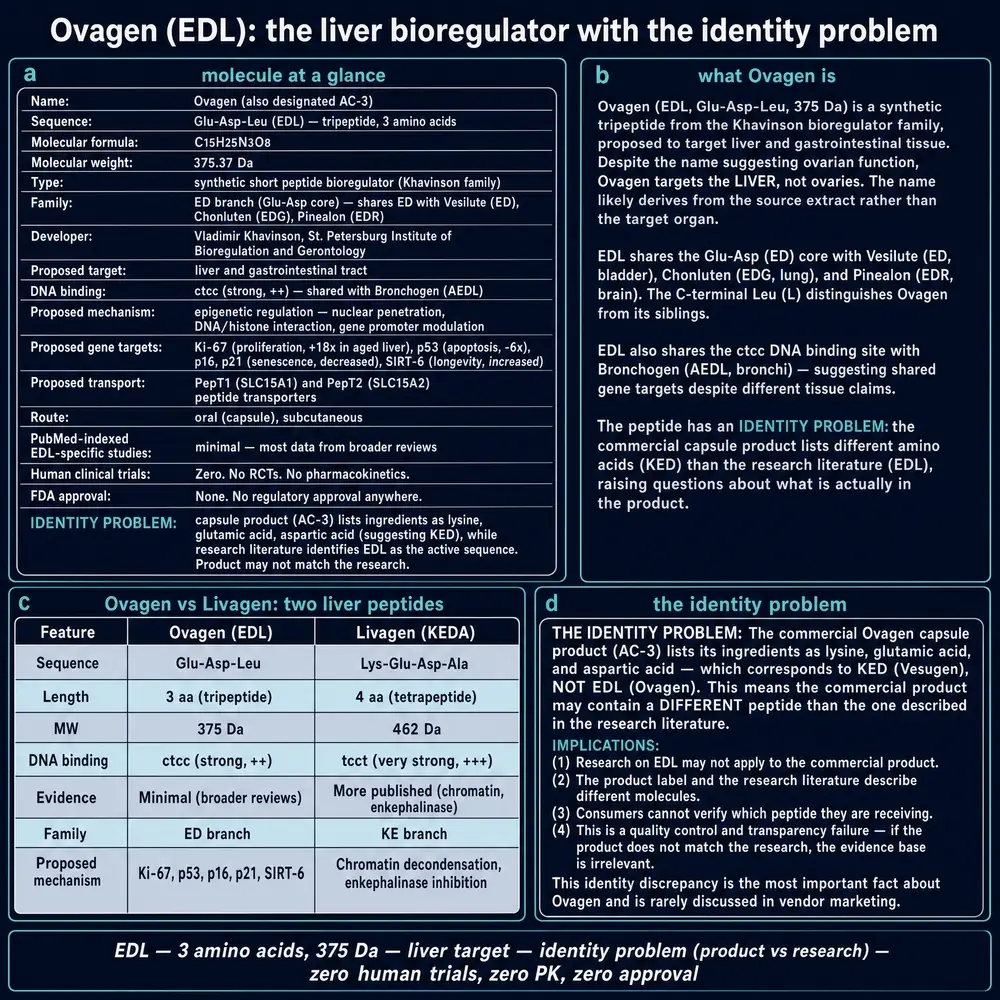
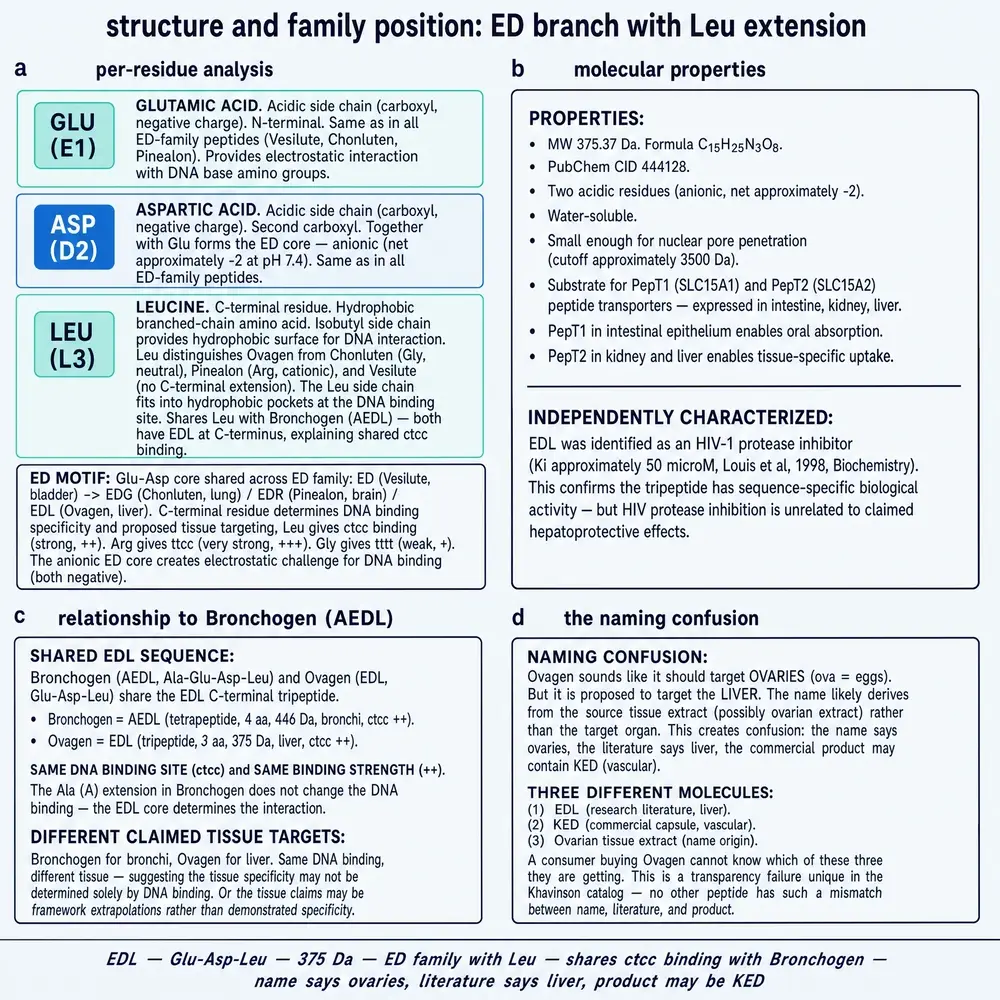
The residue pattern matters for family collisions. Bronchogen is Ala-Glu-Asp-Leu (AEDL): the same three C-terminal residues with an alanine added at the front. In a 2016 DNA-binding study, EDL and AEDL were reported to share a preferred duplex motif, ctcc, with similar complex-formation energies (Khavinson et al., 2016). That is useful chemistry and a hazard for attribution. A sentence about AEDL is not a sentence about Ovagen. Cartalax (AED) appears beside EDL in the renal aging culture work; Livagen (KEDA) is the other liver-associated Cytogen and carries a denser chromatin literature of its own. Sibling findings are labelled as such below and are never silently reassigned.
A further identity hazard sits on the shelf rather than in PubMed. Some commercial capsule products sold under Ovagen / AC-3 branding have been observed to list lysine, glutamic acid and aspartic acid among ingredients—a residue set that reads as KED (Vesugen), not EDL. That lot-level mismatch, where it occurs, means research on Glu-Asp-Leu does not automatically describe the vial in hand. This monograph is about the tripeptide in the indexed literature; it does not certify any vendor’s capsule contents.
Physicochemical expectations for a free tripeptide are ordinary and unflattering. Without special formulation, such molecules are substrates for brush-border and plasma peptidases; the C-terminal leucine is a comfortable carboxypeptidase target. Oral capsule marketing therefore rests on an absorption story—often the proton-coupled oligopeptide transporters PepT1 and PepT2—that has been argued for the class of ultrashort peptides (Khavinson et al., 2023) but has not been measured for intact EDL in a published pharmacokinetic series. The transport literature is cited here as mechanism context, not as proof that capsule contents reach hepatocyte nuclei.
Section 04The parent extract, named and compared
House style for bioregulators requires the natural counterpart to be named and compared, and requires honesty when the comparison is unsettled. Catalogue and secondary profiles pair Ovagen with Svetinorm, a liver-derived polypeptide complex in the Cytomax line: extract first, Cytogen second. That pairing is coherent with the marketing organ. It is not, by itself, proof that EDL was sequenced out of Svetinorm rather than designed from compositional hints the way Epitalon was designed from Epithalamin.
The experimental papers complicate the picture. The 2014–2018 renal series repeatedly places EDL next to a polypeptide complex from kidney (sometimes abbreviated PKC), not next to a liver extract (Khavinson et al., 2014a; Zamorskii et al., 2015; Zamorskii et al., 2018). In those designs the natural comparator is renal. Livagen (KEDA), reviewed elsewhere in this series, is the liver Cytogen with the chromatin and enkephalinase literature; Kuznik, Khavinson and Lin’kova’s 2020 discussion of liver polypeptide complex and KEDA is Livagen’s neighbourhood, not a substitute for EDL-specific liver trials. Ventvil appears in some secondary accounts as another liver-complex name; it is not treated here as a verified synonym without a primary citation that binds it to Ovagen.
Regulatory asymmetry is part of the counterpart story. Tissue extracts in the Russian bioregulator catalogue have decades of domestic clinical use narratives; the synthetic Cytogens that Western research-chemical vendors sell as lyophilised vials are a different regulatory object. Ovagen, as Glu-Asp-Leu, is not approved by the FDA or EMA as a drug. ClinicalTrials.gov returns no study of the tripeptide (ClinicalTrials.gov, 2026). Long-horizon safety and efficacy claims, where they exist at all, sit with extracts and with programme tradition—not with a Western registration dossier for EDL.
Those facts close the molecule-and-counterpart half of the identity problem. What remains is chronology: when EDL entered English indexes, which laboratories ran the assays, and how late the trade name Ovagen was printed beside the code. The next part answers those questions from the checkable record, not from vendor mythology. Independence is not proved by a tidy date list; it is tested by whether a second network ever repeats the work.
Section 05The programme and the people
Ovagen is a product of a research culture that began, in the programme’s own dating, in the early 1970s at what became the St Petersburg Institute of Bioregulation and Gerontology. Vladimir Khavinson’s group built a catalogue of organ extracts and then of short synthetic peptides claimed to carry organ-specific regulatory information (Khavinson, 2002; Khavinson & Anisimov, 2009; Khavinson et al., 2021). The public story sometimes acquires Cold War embroidery—secret military peptides, classified cosmonaut protocols. The documents that can be checked are gerontology papers, institute affiliations, and a long Russian-language clinical tradition around extracts. This monograph stays with the checkable record.
For EDL specifically, the English-indexed trail is recent. In 2014, Khavinson, Lin’kova, Polyakova, Durnova, Nichik and Kvetnoi reported effects of a calf-kidney polypeptide complex and of short peptides T-31 (AED) and T-35 (EDL) on signaling molecules in primary rat kidney cell cultures taken through in-vitro aging (Khavinson et al., 2014a). The same year, a related Russian-language report on tripeptides slowing aging markers in renal culture entered PubMed (Khavinson et al., 2014b). Those papers establish laboratory codes, organ context and the first molecular readouts.
From 2015 to 2018 the experimental centre of gravity shifts to Chernivtsi. I. I. Zamorskii and T. S. Shchudrova at Bukovinian State Medical University, writing with Lin’kova, Nichik and Khavinson, publish a tight series on acute kidney injury and on aging kidney function: cisplatin-induced renal failure (Zamorskii et al., 2015), gentamicin nephropathy and ischemia/reperfusion (Zamorskii et al., 2017), and morphofunctional effects in old rats (Zamorskii et al., 2018). The designs are classical pharmacology: toxin or ischemia, peptide as intervention parameter, urine and plasma chemistry, antioxidant enzymes, histology. They are also a single collaborative network. Recency favours them—2015 to 2018 is the freshest primary EDL animal work in the indexes—but freshness inside a closed authorship circle is not the same thing as independent confirmation.
In 2016 the St Petersburg group placed EDL into a DNA-sequence selectivity paper, reporting that EDL and AEDL prefer a ctcc duplex motif (Khavinson et al., 2016). In 2021 the systematic review in Molecules printed the trade name beside the code in Table 5 (Khavinson et al., 2021). That is late branding relative to the experimental series: the rats were already run before the review taught Western indexes to say “Ovagen.”
Context for a common reader: this is not the story of a blockbuster hormone analogue racing through FDA phases. It is the story of a short peptide inside a national scientific tradition that treats organ extracts and their synthetic fragments as geroprotectors, publishes mostly in translation journals and Russian venues, and meets the Western research-chemical market decades later as a vial label. Understanding Ovagen means understanding that tradition—and refusing to inflate it.
Section 06The organ-claim map
Before the assays, a map. Catalogue copy and many secondary profiles place Ovagen on the liver–gut axis. The 2021 systematic review lists renal regulation, hepatoprotection and DNA binding together for EDL/Ovagen (Khavinson et al., 2021). The 2017 animal paper’s introduction likewise calls EDL hepatoprotective and nephroprotective and mentions stimulation of organotypic kidney and liver cultures (Zamorskii et al., 2017). Those sentences are real. They are also thinner, in the English full texts in hand, than the kidney data that follow them.
Weighing rule for this monograph: when programme text asserts two organs and the measured tables fill one, report both assertions and put the weight where the measurements are. Recency does not erase that distribution. A 2017 rat study is fresher than a 2002 chromatin paper on a sibling peptide; it still does not convert a hepatoprotection clause into a liver histology dataset. Livagen remains the liver Cytogen with the denser published chromatin work; Ovagen’s distinctive published footprint is renal.
Section 07Cell culture: aging markers and MMP-14
In primary kidney epithelial cultures from young Wistar rats, passaged to an aged state (passage 14), Khavinson and colleagues compared saline, peptide T-31 (AED), peptide T-35 (EDL), and a calf-kidney polypeptide complex. Peptides were added at each reseeding at 20 ng/ml; the complex at 100 ng/ml—study parameters, not recommendations (Khavinson et al., 2014a). The abstract’s own division of labour is important and often blurred in secondary writing: the kidney polypeptide complex and T-31 (AED) activated cell-renewal markers, while gelatinase MMP-14 was identified as a target of T-35 (EDL).
That distinction matters. Secondary profiles sometimes attribute large Ki-67 increases and p53 decreases in aged tissue specifically to Ovagen. The 2014 English paper’s headline claim for EDL is extracellular-matrix remodeling via MMP-14, not a monopoly on proliferation markers. A related 2014 report on tripeptides in renal culture (Khavinson et al., 2014b) and later citing passages in the 2017 paper do describe EDL as reducing aging markers p16, p21 and p53 and increasing SIRT-6, alongside molecular modelling of EDL against a d(ATATATATAT)2 minor-groove duplex (Zamorskii et al., 2017, citing the culture work). Those claims are part of the record; they should be read as in-vitro marker shifts inside one research network, not as clinical rejuvenation.
Two interpretive cautions travel with every aging-marker panel. First, increasing a proliferation marker while decreasing p53 is a double-edged pattern: it is the shape of repair rhetoric and also the shape of oncologic unease. No carcinogenicity study of EDL was found in the indexes. Second, culture aging by passage number is a model, not a person. The leap from passage-14 rat kidney epithelium to human chronic kidney disease is a hypothesis, not a result.
Section 08Animal nephroprotection: the densest series
The Zamorskii series is where EDL stops being only a culture reagent and becomes an in-vivo intervention parameter. In cisplatin-induced acute renal failure in rats, a kidney polypeptide complex and the short peptides AED, EDL and AEDG were compared on diuresis, creatinine handling, electrolyte excretion and related functional readouts. The paper reports that EDL produced a potent nephroprotective effect among the peptides tested (Zamorskii et al., 2015). Design detail that matters for weighing: this is toxin-induced AKI in rodents, with laboratory biochemistry endpoints, not a randomised human nephrology trial.
In 2017 the same collaboration tested EDL in two further rat models: gentamicin nephropathy (4% gentamicin sulfate at 80 mg/kg for six days) and bilateral renal pedicle ischemia for 60 minutes with 24-hour reperfusion. EDL was given intraperitoneally at 3 µg/kg—again a published study parameter—either after each gentamicin dose or for three days before ischemia (Zamorskii et al., 2017). Reported effects included mitigation of oliguria and azotemia, reduced proteinuria and sodium excretion, preservation of antioxidant enzyme activities, suppression of lipid peroxidation, and improved cellular energy supply markers. Sample size was seven animals per group in each series. That is enough to generate signals; it is not enough to settle dose–response, sex differences, or translation.
In 2018 the group examined old rats, comparing the kidney polypeptide complex with AED, EDL and AEDG on morphofunctional kidney status. Diuresis increased with PKC, AED and EDL; protein handling and sodium transport shifted in peptide-specific patterns; the authors discuss absence of nephrotoxic signals alongside functional changes (Zamorskii et al., 2018). This paper is valuable because it moves from acute toxin models into aging physiology—still in one species, still in one network.
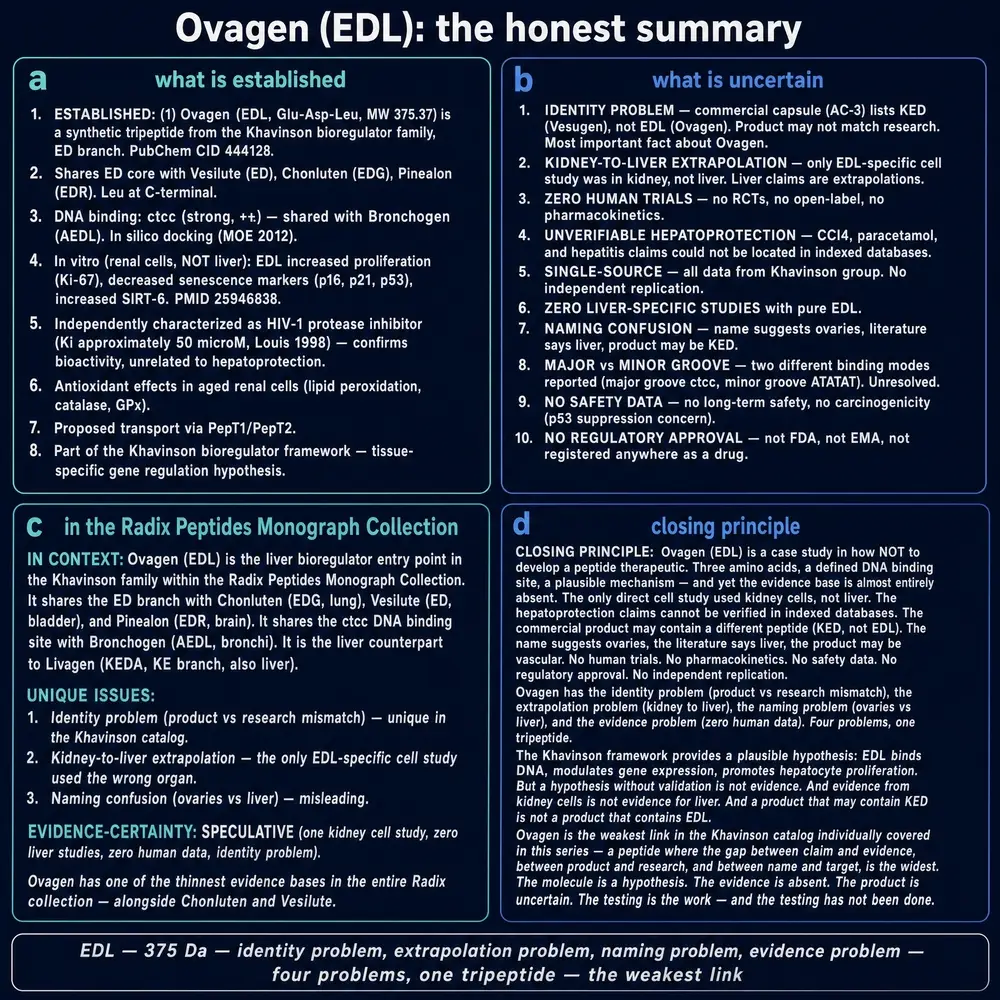
Ukrainian conference and journal material from Shchudrova and Zamorskii compares survival across several AKI etiologies and reports EDL among the stronger peptide performers in those screens. Those reports reinforce the internal consistency of the Chernivtsi programme; they do not widen the authorship circle. No contradictory high-quality animal series from an independent laboratory was found that overturns the nephroprotective direction of effect. The preponderance problem here is not conflict; it is concentration. The commissioned plate that follows redraws that concentration as a kidney-centred map with empty liver and human cells left visibly empty.
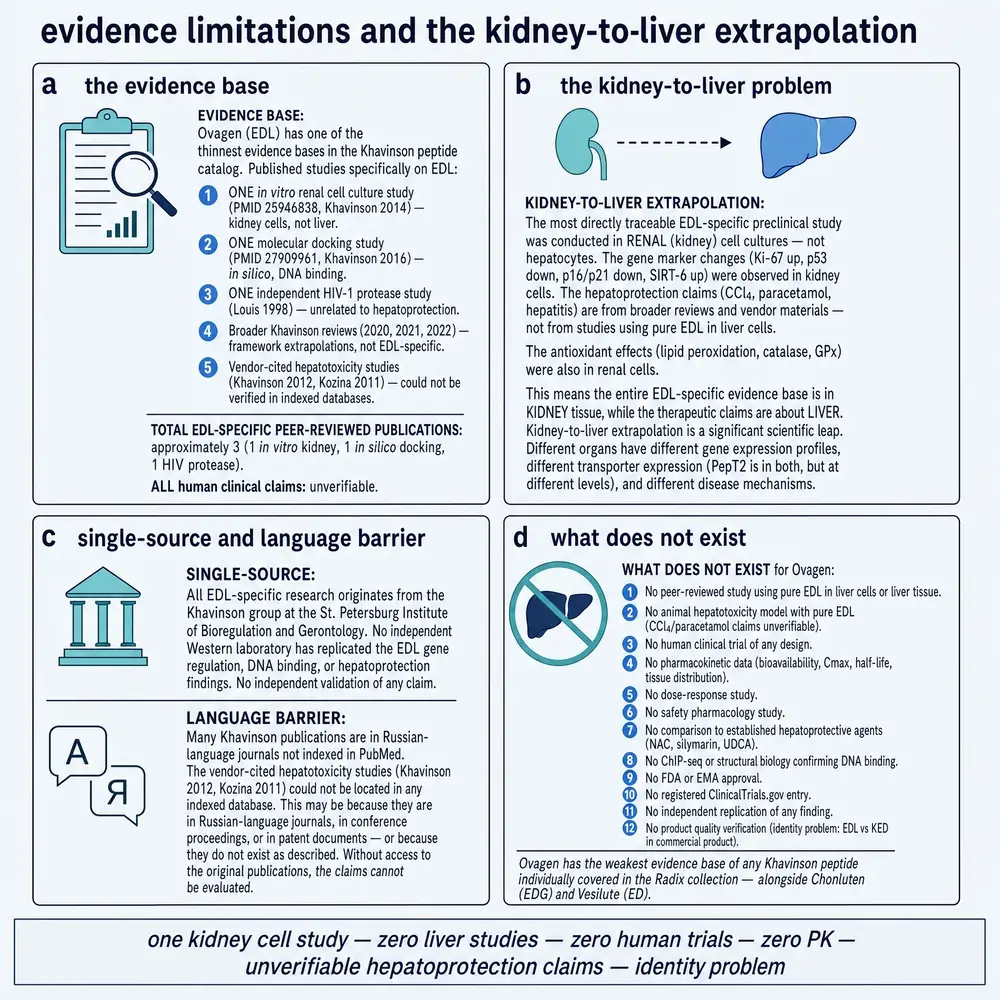
Section 09DNA binding, transport, and the empty human layer
Mechanism claims for EDL sit on three shelves of unequal strength. Shelf one is sequence-selective DNA docking: EDL and AEDL preferring ctcc, with modelling also invoked for AT-rich minor-groove complexes in the aging-culture citations (Khavinson et al., 2016; Zamorskii et al., 2017). Shelf two is class evidence that short fluorescent peptides can enter HeLa nuclei and interact with DNA (Fedoreyeva et al., 2011)—important, and not an Ovagen-specific imaging study. Shelf three is transporter biology: ultrashort peptides as plausible POT/LAT substrates (Khavinson et al., 2023), consistent with the differentiation-and-transport framing in the broader short-peptide reviews (Khavinson et al., 2020). Shelf three explains how a tripeptide could be absorbed; it does not show that marketed microgram oral amounts of EDL survive digestion and reach renal or hepatic chromatin intact.
The human layer is empty. ClinicalTrials.gov lists no Ovagen / EDL peptide study (ClinicalTrials.gov, 2026). No randomised controlled trial, no open-label nephrology series under the tripeptide name, and no peer-reviewed human hepatology endpoint were identified in the Project 05 sweep. Domestic Russian use narratives attach more readily to extracts than to this Cytogen. For a reader deciding how much weight to give the vial on a research-chemical shelf, that emptiness is the governing fact.
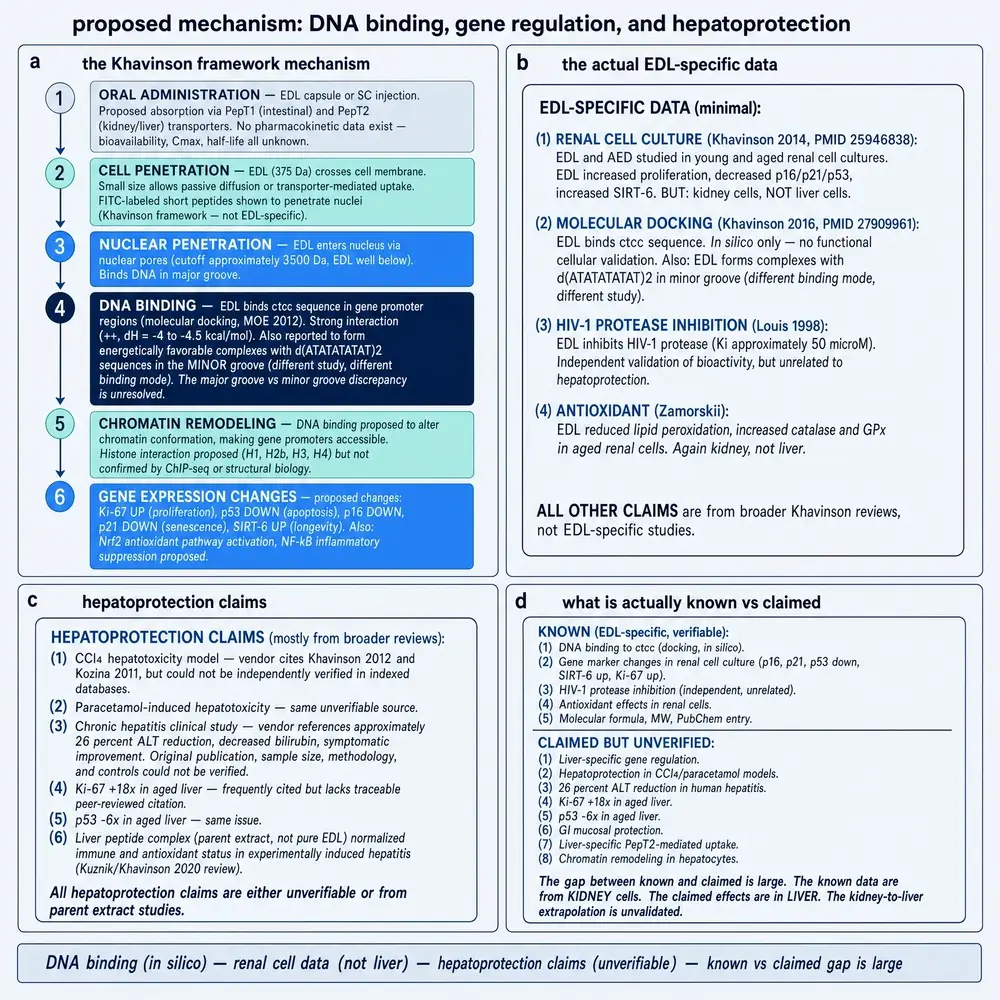
Read the plate against that emptiness. Where the illustration names renal culture markers, ctcc docking, or Zamorskii antioxidant readouts, the English full texts support the card. Where it shows hepatoprotection multiples or a completed human layer, the corpus does not. The drawing is a map of claims, not a substitute for the missing trial.
Section 10What can be believed, and how far
Put the pieces on one table. Identity: Glu-Asp-Leu is a real synthetic tripeptide in a named research programme; the trade name Ovagen is confirmed beside EDL in the 2021 systematic review table; veterinary FSH and muscle EDL are different objects (Khavinson et al., 2021).
Mechanism: a coherent class hypothesis of nuclear and DNA interaction, with EDL-specific docking and culture-marker papers, without a demonstrated in-vivo chain from capsule to chromatin. Efficacy signals: the freshest and densest primary data are rat nephroprotection and kidney-culture marker work from 2014–2018 (Khavinson et al., 2014a; Zamorskii et al., 2015, 2017, 2018). Organ story: hepatoprotection is asserted in primary introductions and in the 2021 table; it is not the measured centre of the English full texts in hand.
Weighing rules applied here follow the commission: prefer fresher data when they are not contradicted by a preponderance of older evidence; separate in-vitro from in-vivo; refuse to invent human outcomes. Nothing in the older class literature contradicts the direction of the Zamorskii renal signals; nothing outside the network confirms them. Recency therefore upgrades the renal series relative to undated marketing claims, and does not upgrade marketing claims relative to the renal series.
Independence is the soft floor under every positive finding. Shared institutes, shared senior authors and shared peptide stocks can produce a literature that is internally consistent and still locally wrong. The honest summary is not “Ovagen works for the kidney” and not “Ovagen is fiction.” It is: inside one research tradition, EDL has reproducible-looking preclinical signals in acute and aging kidney models; the liver catalogue story is thinner in the indexed record than the shelf talk; the human evidence layer has not been built. Commercial identity mismatch risk (capsule lots that may list KED rather than EDL) sits beside those scientific gaps: even a clean preclinical story would not describe a different molecule in the bottle.
Theoretical safety notes belong in judgement, not in scare typography. A pattern that raises proliferation markers and lowers p53 in culture invites oncologic curiosity and has not been tested in carcinogenicity designs. Rapid proteolytic clearance, if it occurs as expected for a free tripeptide, would limit systemic exposure and also undermine oral efficacy stories. Neither speculation substitutes for data.
The status plate that follows is a ledger of those same points: what the corpus locks, what it leaves open, and what it never measured. It adds no dose, route or schedule.
This document describes published research on Ovagen (Glu-Asp-Leu). It does not recommend human use of Ovagen or any other compound, and it specifies no dose, route or schedule for any person. Study amounts appear only as parameters reported by investigators. This is not medical advice.
Section 11Closing
Three letters are easy to sell. They are harder to know. Ovagen’s name points at ovaries and its catalogue points at liver; its indexed experiments point at kidney; its mechanism story points at DNA. Holding those arrows in one hand, without letting any of them erase the others, is the work this monograph set out to do. The next useful paper would not be another review table. It would be an independent laboratory, a pre-registered animal study with full methods, or—if anyone intends a medicine—a human protocol that says in public what endpoint would count as failure.
Section 12Methods note
Project 05 — Therapeutic Peptide Research Library denotes the workspace research corpus, not a single folder. Local stores scanned for filename and text hits on Ovagen / EDL / Glu-Asp-Leu included fulltext/, dossiers/, output/, literature/, knowledge_base/, South Beach Longevity Library/, Radix_Peptides_Global_Project/library/, and vendor PDF replicas. Thirty filename matches resolved to roughly six unique document types after deduplication: an empty Radix dossier (20 pp), an intake evidence map (7 pp), a compound index page, vendor product PDFs (4 pp), seller COAs/images, and catalogue JSON. None of those is peer-reviewed science under the peptide identity.
PubMed was queried for EDL peptide AND Khavinson, Ovagen AND peptide, Glu-Asp-Leu AND Khavinson, and key DOIs on 5 August 2026. Identity gating excluded veterinary ovine FSH Ovagen, muscle EDL, and uncorroborated bare EDL. Subject-primary PDFs were harvested from khavinson.info scans into fulltext_pdf/ and extracted to fulltext_txt/. The local 2021 Molecules systematic review text was screened; Table 5 admits “EDL, Ovagen.”
Chemical constants are programme-consistent (C15H25N3O8, ~375.37); no authoritative PubChem CID was resolved under the trade name in the local P213 cache. Series number assignment follows house style A38 (lowest unused integer in the filed-PDF library) and was re-checked immediately before filing.
Figures are authored SVG using house colour tokens only. No third-party published figure has been reproduced. No human use, dose, route or schedule is recommended in this document; study parameters appear only as published.
Section 13Evidence handling
Study types are labelled in the reporting sentence. Conflicting or asymmetric evidence is presented without forced balance: when the renal series is denser than the hepatic claim set, the asymmetry is stated. Secondary web profiles were used only as discovery leads. Vendor dosing schedules were not imported into the evidence base.
Section 14References
- Fedoreyeva LI, Kireev II, Khavinson VKh, Vanyushin BF. Penetration of short fluorescence-labeled peptides into the nucleus in HeLa cells and in vitro specific interaction of the peptides with deoxyribooligonucleotides and DNA Biochemistry (Mosc) 2011;76(11):1210-9. PMID 22117547 · doi
- Khavinson V, Linkova N, Diatlova A, Trofimova S. Peptide Regulation of Cell Differentiation Stem Cell Rev Rep 2020;16(1):118-125. PMID 31808038 · doi
- Khavinson VK, Lin'kova NS, Tarnovskaya SI. Short Peptides Regulate Gene Expression Bull Exp Biol Med 2016;162(2):288-292. PMID 27909961 · doi
- Khavinson VK, Popovich IG, Linkova NS, Mironova ES, Ilina AR. Peptide Regulation of Gene Expression: A Systematic Review Molecules 2021;26(22). PMID 34834147 · doi · PMC8619776
- Khavinson VK, Linkova NS, Rudskoy AI, Petukhov MG. Feasibility of Transport of 26 Biologically Active Ultrashort Peptides via LAT and PEPT Family Transporters Biomolecules 2023;13(3). PMID 36979488 · doi · PMC10046148
- Khavinson VKh, Lin'kova NS, Polyakova VO, Durnova AO, Nichik TE, Kvetnoi IM. Peptides regulate expression of signaling molecules in kidney cell cultures during in vitro aging Bull Exp Biol Med 2014;157(2):261-4. PMID 24958378 · doi
- Khavinson VKh, Tarnovskaia SI, Lin'kova NS, Poliakova VO, Durnova AO, Nichik TE et al.. [Tripeptides slow down aging process in renal cell culture] Adv Gerontol 2014;27(4):651-6. PMID 25946838
- Khavinson VKh. Peptides and Ageing Neuro Endocrinol Lett 2002;23 Suppl 3:11-144. PMID 12374906
- Khavinson VKh, Anisimov VN. [35-year experience in research of peptide regulation of aging] Adv Gerontol 2009;22(1):11-23. PMID 19827673
- Zamorskii II, Shchudrova TS, Lin'kova NS, Nichik TE, Khavinson VKh. Peptides Restore Functional State of the Kidneys During Cisplatin-Induced Acute Renal Failure Bull Exp Biol Med 2015;159(6):736-9. PMID 26515176 · doi
- Zamorskii II, Shchudrova TS, Lin'kova NS, Nichik TE, Khavinson VK. Nephroprotective Effect of EDL Peptide at Acute Injury of Kidneys of Different Genesis Bull Exp Biol Med 2017;163(3):389-393. PMID 28744634 · doi
- Zamorskii II, Shchudrova TS, Zeleniuk VG, Linkova NS, Nichik TE, Khavinson VK. [The influence of peptides on the morphofunctional state of old rats kidneys.] Adv Gerontol 2018;31(4):498-504. PMID 30607912
- National Center for Biotechnology Information. PubChem Compound Summary CID 444128, Glutamyl-aspartyl-leucine (Glu-Asp-Leu). PubChem, Bethesda MD. Molecular formula C15H25N3O8, relative molecular mass 375.37. Title resolves to Glutamyl-aspartyl-leucine; the trade name Ovagen is not required as a synonym on this CID. Queried 9 August 2026. link
- United States National Library of Medicine. ClinicalTrials.gov search for Ovagen peptide / EDL / Glu-Asp-Leu. Zero studies returned for the Khavinson tripeptide. Queried 5 August 2026. link
- Ryan JP, Hunton JR. Superovulation and embryo recovery in goats treated with ovagen and folltropin. N Z Vet J. 1989;37(1):35-37. doi:10.1080/00480169.1989.35543. Excluded after identity gate: veterinary ovine FSH product sharing the trade name Ovagen, not the EDL tripeptide. Indexed erroneously on the local P213 compound page. link
Continue exploring