
NAD+ The coenzyme that became a commodity
Every cell in your body contains it. So does every cell in a redwood, a hagfish and the bacteria in a hot spring. Nicotinamide adenine dinucleotide is the molecule that carries electrons away from food, and without it the chemistry of being alive stops within seconds. It was found in 1906 in a flask of yeast juice, by two chemists who did not know what they had and did not live to see it fully explained. A century later it became something else: a commodity, sold by the gram, on the promise that raising it slows ageing. This document is about the distance between those two facts — and about a gap that has a precise, documentable shape. Blood NAD+ can now be raised in people reliably, safely and dose-dependently. Almost none of the clinical benefits that motivated raising it have been demonstrated.
Findings are labelled by the kind of study that produced them, in the sentence that reports them. A result in a mouse is called a result in a mouse. Where a study gave a compound to people, the number of people, the duration and the endpoint are stated with the finding, and null results are given the same prominence as positive ones — on this subject they are the majority.
Five different molecules appear here and they are not interchangeable. NAD+ itself, nicotinamide mononucleotide (NMN), nicotinamide riboside (NR), nicotinamide and nicotinic acid are separate compounds with separate evidence. A trial of NR is not evidence about NMN, and neither is evidence about NAD+ given intravenously. Every finding below names the molecule that was actually studied.
Doses appear only as reported experimental parameters, always with the species and the duration attached. Nothing in this document recommends human use of any compound, and it specifies no dose, route or schedule for any person.
01The experiment that needed two things
In 1906 Arthur Harden and William John Young were working at the Lister Institute in London on a problem that had only recently become a problem at all. Eduard Buchner had shown in 1897 that fermentation did not require living yeast cells: grind them up, press out the juice, and the juice alone would turn sugar into alcohol. Fermentation was chemistry, not vitalism. What Harden and Young wanted to know was what the chemistry consisted of.
They did something simple and decisive. They took Buchner's yeast juice and passed it through a gelatine ultrafilter, splitting it into a filtrate that passed through and a residue that did not. Neither fraction fermented sugar on its own. Recombined, they worked again (Harden & Young, 1906). Whatever fermentation required, it required at least two things: something large enough to be held back by the filter, and something small enough to pass.
A second version of the test made the point sharper still. Boiled, filtered yeast juice could not start a fermentation by itself — boiling destroys the large component. But added to fresh active juice it increased the rate at which glucose fermented, and the increase scaled with how much was added. The small component survived boiling. Harden's conclusion, in his own words in the second of the two papers, was that fermentation depends on "a dialysable substance which is not destroyed by heat", present in the juice and therefore presumably present in the living cell. He borrowed Bertrand's term coferment for it, noting that the word was "not entirely satisfactory" pending better knowledge (Harden & Young, 1906).
He was right to hedge. The substance he had just demonstrated the existence of, and could describe only as small, heat-stable and necessary, is the subject of this document. In the German literature it acquired the name that stuck for thirty years: cozymase.
02Thirty years of not knowing what it was
What followed is a useful corrective to the way scientific history is usually told. Cozymase was not identified in a flash. It was concentrated, slowly, by people who had no structural tools worth the name and were working by assay: purify a fraction, test whether it still restores fermentation, repeat.
The chemist who pushed this furthest was Hans von Euler-Chelpin in Stockholm. By the end of the 1920s his group, with Karl Myrbäck doing much of the preparative work, had taken cozymase from a starting material of arbitrary activity 200 to a preparation of 70,000 — a concentration of roughly 350-fold — at a yield of about two centigrams from a kilogram of yeast. What he could say about it was that it "corresponds approximately to a so-called nucleotide, for it contains a sugar residue, a purine residue and phosphoric acid, and everything points to a close relationship with … adenylic acid", with the three components in a ratio near one to one to one (von Euler-Chelpin, 1930).
It is worth being exact about what that does and does not amount to, because the popular account routinely overstates it. Von Euler-Chelpin established that cozymase was a small nucleotide containing adenine, a sugar and phosphate, and that it sat at the centre of the fermentation mechanism rather than at its periphery. He did not identify nicotinamide, which is the half of the molecule that does the actual chemistry; his lecture does not mention it. His group's molecular weight came out around 490. The true figure is 663.4.
In 1929 the Nobel Prize in Chemistry went jointly to Harden and von Euler-Chelpin "for their investigations on the fermentation of sugar and fermentative enzymes". The award came more than two decades after Harden's foundational work, and it was given for a body of chemistry whose central molecule nobody could yet draw.
03The other story: a disease of corn and poverty
While European biochemists were concentrating an unknown factor out of yeast, a physician in the American South was arguing about a disease. The two lines of work had nothing to do with one another for twenty-three years, and then turned out to be the same subject.
Pellagra had been epidemic in the cotton South since the early 1900s. It killed thousands a year and its victims were overwhelmingly poor. The medical consensus held that it was infectious. In February 1914 the Surgeon General assigned Joseph Goldberger, a Public Health Service officer with a background in infectious disease, to find the organism responsible.
He found instead that there was none. His opening argument, published in June of that year, was an epidemiological observation of the kind that is obvious only afterwards: in institutions where pellagra was endemic among the inmates, the nurses and attendants were "uniformly immune", despite sharing the building and handling the patients daily. No contagion and no insect vector could produce that pattern. What the staff did differently was eat differently — they "selected the best" of the food (Goldberger, 1914).
Goldberger then did what the infectious hypothesis could not: he produced the disease deliberately. In 1915, at a farm of the Mississippi State Penitentiary, twelve volunteers were placed on a restricted diet of biscuits, fried mush, grits, corn bread, rice, gravy, sweet potatoes, cabbage, collards, cane syrup and sweetened coffee. Eleven completed the study. The diet supplied 3.32 pounds and 2,952 kilocalories per man per day — it was not a hunger experiment, and that is the entire point. By September, dermatitis had appeared in at least six of the eleven, while not one of the seventy to eighty other men in the camp showed any sign of the disease (Goldberger & Wheeler, 1915).
The volunteers were prisoners, and what they were offered in exchange was a pardon from the Governor of Mississippi. By any modern standard of voluntary consent that is coercive, and the study would not be approved today. It is recorded here because the finding it produced is load-bearing for everything that follows, and because omitting the circumstances would misrepresent how the knowledge was obtained.
Over the following decade Goldberger and the statistician Edgar Sydenstricker worked out what in the diet was missing, by survey rather than by chemistry. In seven South Carolina mill villages they found that pellagra was reduced or absent in households that could manage roughly a pint of milk or thirty grams of fresh meat per adult per day, and that each food protected independently (Goldberger et al., 1920). He named the unknown protective substance the P-P factor, for pellagra-preventive, and spent his last years trying to find something that would let him assay it faster than a human epidemiological study allowed.
He settled on dogs. A canine syndrome resembling pellagra had been produced by Chittenden and Underhill in 1917; Goldberger and Wheeler argued it was the same thing as the veterinary disease called black tongue, and by 1928 had shown they could cause it by diet and cure it with the same foods that protected people (Goldberger & Wheeler, 1928). The dog was now a bioassay. Goldberger died on 17 January 1929, with the P-P factor still unidentified and the assay he had built for finding it working perfectly.
04The two stories become one
They converged from the yeast side. In 1934 Otto Warburg's laboratory in Berlin obtained the coenzyme pure — not concentrated, pure — and hydrolysed it. Out came phosphate, pentose, adenine, and, as Hans Krebs recorded in his memoir of Warburg, "a substance not hitherto known to occur in coenzyme fractions", which was identified as nicotinamide (Krebs, 1972). Warburg's group then showed by spectroscopy that this pyridine ring was the part that took hydrogen on and gave it back — the working end of the molecule (Warburg & Christian, 1936).
The first coenzyme they purified, from red blood cells, carried three phosphates. A second, differing only in having two, was the one that ran fermentation and glycolysis. Because both shared the pyridine ring, Warburg named them diphospho- and triphosphopyridine nucleotide, DPN and TPN. The names survived about thirty years before being replaced by NAD and NADP, and that early sibling relationship is worth holding on to: it is the origin of a confusion that persists in the literature to this day, and Section 08 returns to it.
Now the two stories collide. Nicotinamide was known to chemists. It is the amide of nicotinic acid, a compound sitting on laboratory shelves since 1867, regarded as inert and interesting to nobody. In 1937 Conrad Elvehjem's group at Wisconsin fed nicotinic acid and nicotinamide to dogs with black tongue — Goldberger's assay — and cured them (Elvehjem et al., 1937). Within three months, three independent groups had used nicotinic acid to treat human pellagra.
The vitamin was found because the coenzyme was found. Warburg's laboratory pulled nicotinamide out of a purified fermentation cofactor in 1934–35, which told Elvehjem what to look for; the assay he tested it in was the dog model Goldberger had validated and died in the middle of exploiting. Vitamin B3 is not a substance that happens to prevent a deficiency disease. It is the thing you must eat in order to have NAD+, and pellagra is what NAD+ depletion looks like from the outside.
That reframing is the most useful single idea in this document, and it should be kept in view through everything that follows. It also sets the baseline against which every modern claim has to be read. NAD+ depletion severe enough to matter is a documented human disease with a documented appearance: dermatitis, diarrhoea, dementia and, untreated, death. The question the rest of this monograph examines is not whether NAD+ matters. It is whether the far smaller changes seen in ordinary ageing behave in the same way, and whether pushing them back up does anything.
05The enzymology, and then forty quiet years
The remaining structural and biosynthetic work was done quickly. Arthur Kornberg, then at the National Institutes of Health, worked out the enzymatic synthesis of the dinucleotide, publishing a preliminary note in 1948 and the full account in 1950 (Kornberg, 1950). In 1958 Jack Preiss and Philip Handler published a pair of companion papers establishing the route from nicotinic acid to the dinucleotide, intermediates in the first and enzymes in the second (Preiss & Handler, 1958a, 1958b). That route still carries their names.
And then, for roughly forty years, nothing much. This is the part of the story that gets skipped, and it is the part that makes the rest intelligible. NAD+ did not become obscure after 1958; it became settled. It was in every textbook, in the middle of every metabolic chart, doing a job that was completely understood. It shuttled hydrogen. It was a piece of apparatus, like a spanner, and nobody writes papers about how much spanner a cell contains.
What changed that was not a better measurement of NAD+. It was the discovery that something in the cell was eating it.
06Two nucleotides and a handle
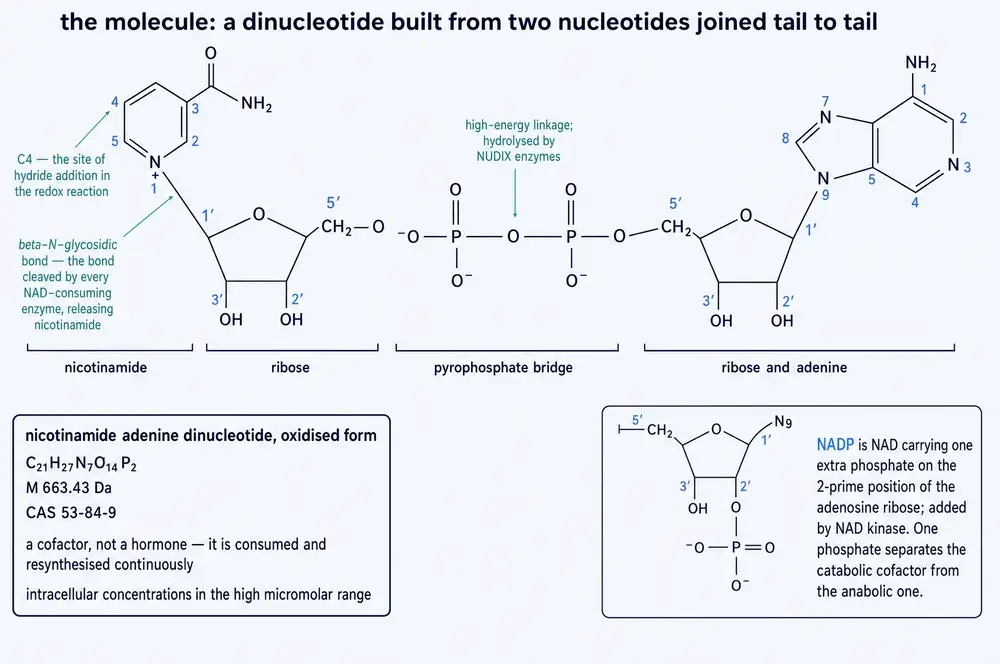
Nicotinamide adenine dinucleotide is two nucleotides joined tail to tail through a bridge of two phosphates. On one end sits adenine, the same base that appears in DNA and in ATP. On the other sits nicotinamide, a six-membered ring with a nitrogen in it and an amide hanging off the side. Each is attached to a ribose sugar, and the two sugars are linked through the phosphate bridge. The formula is C21H27N7O14P2 and the molecular weight is 663.4.
The division of labour is clean and worth fixing in mind, because everything in this document depends on it. The nicotinamide ring does the chemistry. The adenine end is a handle. Enzymes grip the adenine half to hold the molecule in the right orientation; the reaction itself happens at a single carbon of the nicotinamide ring. This is why the vitamin you eat is nicotinamide or nicotinic acid rather than the whole dinucleotide: the body supplies the handle, and what it must obtain from food is the working end.
07Why using it does not use it up
Here is the point at which most popular accounts of NAD+ go wrong, and the confusion is worth clearing before anything else.
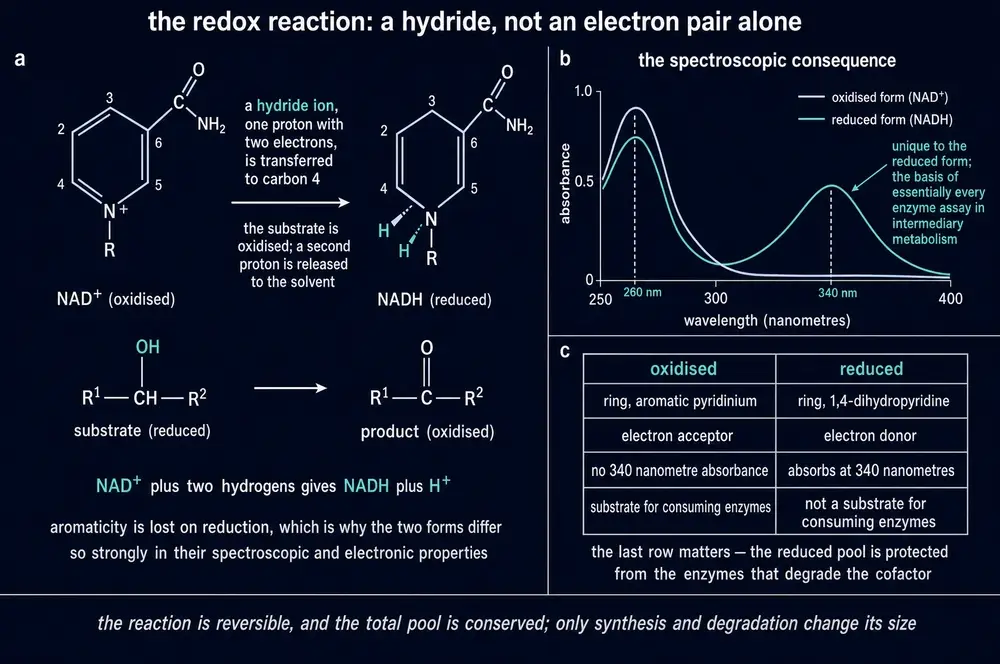
When a cell breaks down food, it strips hydrogen atoms off the fragments. Those hydrogens carry electrons, and electrons are what the cell is actually after. NAD+ is the vehicle. It accepts a hydride — a proton with two electrons — onto carbon 4 of its nicotinamide ring, becoming NADH. It carries that cargo to the mitochondrial membrane, hands it to the respiratory chain, and reverts to NAD+, ready to load again.
The critical word is reverts. NAD+ and NADH are the two states of one molecule, and the molecule is not consumed by the cycle. It is a shuttle bus, not a fuel. A single NAD+ molecule can make that round trip thousands of times a day. This is why, for most of the twentieth century, nobody thought to ask how much NAD+ a cell contained: the quantity that mattered was the ratio of the oxidised to the reduced form, which tells you how hard the cell is working, and the total was assumed to be a fixed piece of equipment.
08The phosphate that splits metabolism in two
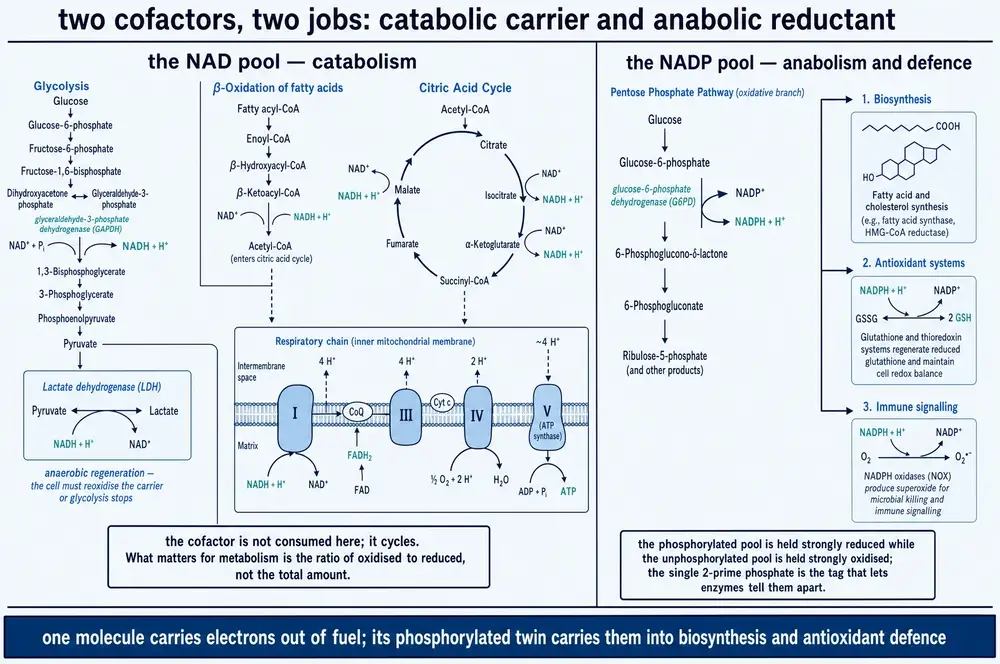
There is a near-twin. Add a single phosphate group to the adenine-side ribose and NAD+ becomes NADP+. The chemistry at the business end is identical — the same ring, the same hydride, the same carbon — but the extra phosphate acts as a molecular label, and enzymes read it.
The result is that a cell runs two separate electron economies that do not mix. NAD+ and NADH are the currency of catabolism: taking things apart, extracting energy, and they are kept mostly in the oxidised state so there is always somewhere for a hydride to go. NADP+ and NADPH are the currency of anabolism: building fatty acids and nucleotides, and regenerating antioxidants, and they are kept mostly reduced so there is always a hydride available to give. One phosphate keeps the demolition and construction budgets in separate accounts.
09The year a constant became a variable
In February 2000, Shin-ichiro Imai, Christopher Armstrong, Matt Kaeberlein and Leonard Guarente published a result about yeast that changed what NAD+ was for. Sir2, a protein already known to silence genes and to extend replicative lifespan in yeast, turned out to be an enzyme — a histone deacetylase — and its reaction required NAD+ (Imai et al., 2000).
Required it, and destroyed it. Sir2 does not use NAD+ the way a dehydrogenase does, borrowing it and giving it back. It cleaves the bond between the nicotinamide and its ribose, consuming one molecule of NAD+ for every acetyl group it removes and releasing free nicotinamide as a by-product. The authors' own framing of the significance was that they had described a molecular framework connecting metabolism, genomic silencing and ageing.
If NAD+ is only a redox shuttle, its total amount is a fixed property of the cell and asking whether it is "low" is close to meaningless. If NAD+ is also a substrate that gets destroyed, then the pool must be continuously rebuilt, which means it has a rate of supply and a rate of demand, which means it has a level, and a level can fall.
Every argument in the rest of this document — scientific, clinical and commercial — descends from that single change of category.
10The consumers
Four families of enzyme are now known to consume NAD+ rather than cycle it. All four do the same chemical thing: they cleave the bond between the nicotinamide ring and its ribose, take the ADP-ribose half for their own purposes, and release free nicotinamide. What separates them is what they do with the fragment, and what they are for.
An obvious question follows, and it is worth saying immediately that this document cannot answer it. Nowhere in the two thousand full texts assembled here is there a statement of the form "consumer X accounts for Y per cent of NAD+ turnover in tissue Z." No measurement of NAD+ turnover rate by isotope flux appears at all. The literature knows which enzymes eat the molecule, and does not know in what proportion — which means that the common claim that one particular consumer is draining the pool with age is, whichever consumer is named, an argument rather than a measurement.
The four are also very unevenly evidenced, and taking them in turn is a way of seeing that. One of them has a complete chain from enzyme mechanism to human disease. One rests on a premise that is asserted far more often than it is measured. One is the leading suspect for the age-related decline and has counter-evidence against it. And one has been studied mostly under conditions — acute DNA damage — that may say little about what it does on an ordinary day.
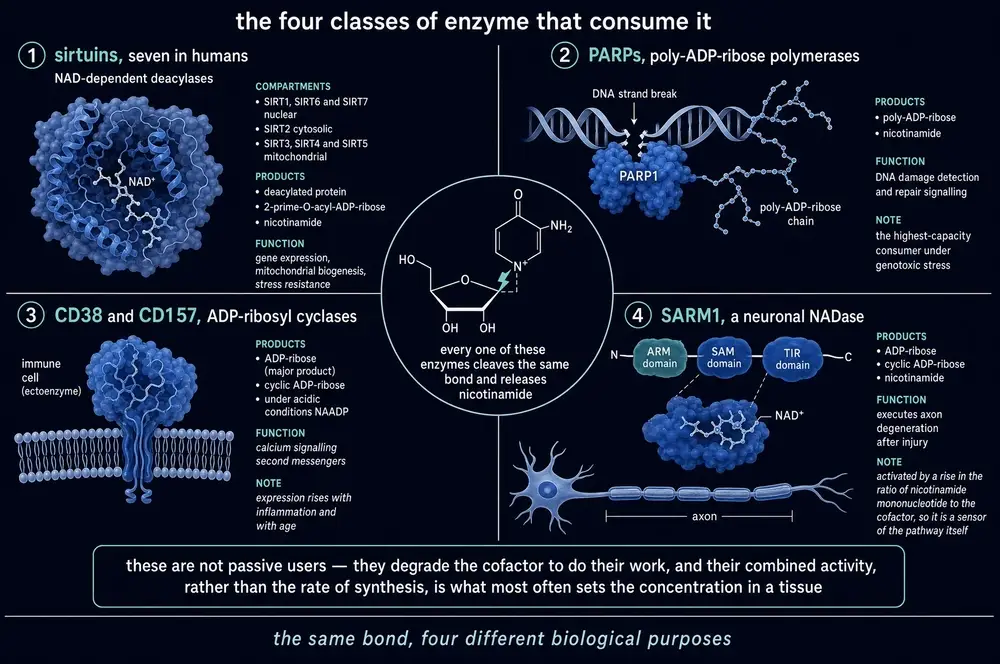
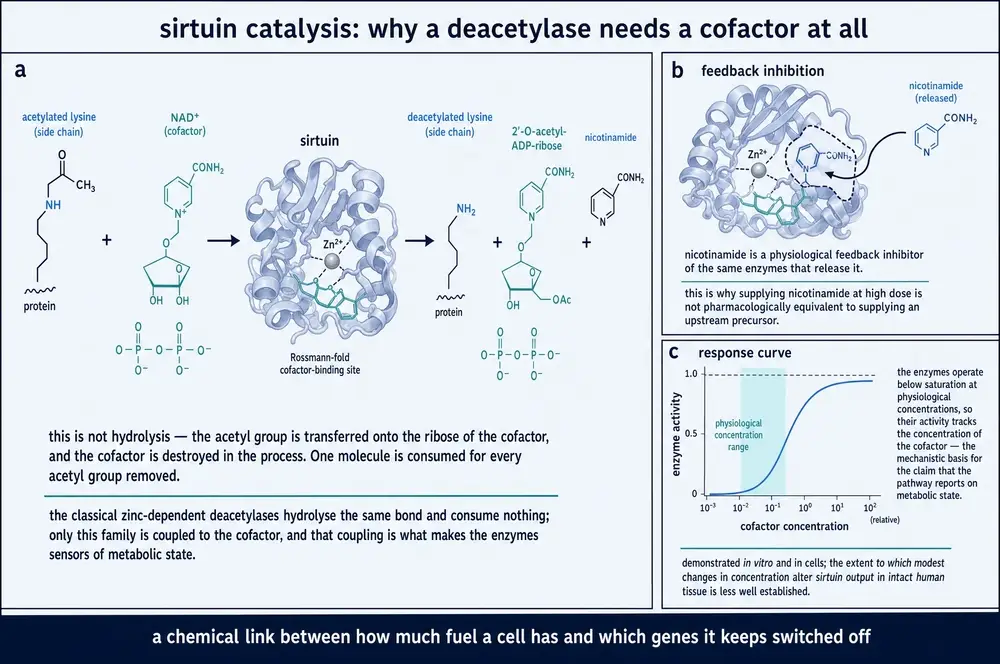
Sirtuins are the seven mammalian relatives of yeast Sir2. They remove acetyl and other acyl groups from proteins, consuming NAD+ as they go, and they are the reason NAD+ entered ageing biology at all. The standard argument for supplementation runs through them: sirtuins are said to have a high Michaelis constant for NAD+, meaning they operate below saturation, meaning raising NAD+ should raise their activity.
That argument is usually made about "sirtuins" as a group, and the numbers do not support treating them as one. Reported Michaelis constants differ across the family by nearly forty-fold, and the free concentration of NAD+ in the nucleus has been estimated at around 100 µM — which puts some isoforms far below saturation and others comfortably above it.
| Sirtuin | Reported Km for NAD+ | What that implies |
|---|---|---|
| SIRT5 | 980 µM | Above the whole cellular pool. Strongly limited by NAD+ — the isoforms with most room to gain. |
| SIRT3 | 880 µM | |
| SIRT1 | 96 µM | Sitting almost exactly at the estimated free nuclear concentration. Genuinely poised, and the marginal case. |
| SIRT4 | 35 µM | Well below ambient. Activity "unlikely to be rate-limited by NAD+", in the source's words. |
| SIRT6 | 26 µM |
"Raising NAD+ activates sirtuins" is not one claim but five, and they do not have the same answer. It is defensible for SIRT3 and SIRT5, marginal for SIRT1, and not supported for SIRT4 and SIRT6, whose activity the same source describes as unlikely to be limited by NAD+ at all.
Two cautions on the numbers themselves. They are values collated in a review from several primary papers rather than measured together in one laboratory, so they carry whatever between-assay variation those papers do. And the ~100 µM free nuclear figure they are compared against is itself an estimate. The conclusion that survives both caveats is the qualitative one: the family does not respond as a block.
PARPs — poly(ADP-ribose) polymerases — consume NAD+ to tag proteins with chains of ADP-ribose in response to DNA damage. PARP1 in particular can consume large amounts quickly, and a widely repeated account of ageing has accumulating DNA damage draining NAD+ through PARP. What has not been established is whether ordinary, undamaged, basal PARP activity is quantitatively important; the evidence for PARP as a sink is largely evidence about acute damage.
CD38 and its relative BST1/CD157 are ectoenzymes that both hydrolyse NAD+ and perform a second, stranger reaction discussed in Section 17. CD38 rises with age in several tissues and is the leading candidate for what drains the pool. Section 17 examines that case and its problems.
SARM1 is different from all of them, and it is where the biology is strongest.
11SARM1, or how a cell kills its own wiring
In 1989 a laboratory mouse strain was found in which cut nerve fibres did not degenerate. Normally, an axon severed from its cell body disintegrates within a day or two; in these animals the severed stump survived for weeks. The strain was called Wallerian degeneration slow, Wldⁿ, and working out why took twelve years.
The answer, when it came, was a chimeric gene: a tandem triplication had fused part of a ubiquitination factor to NMNAT1, an enzyme of NAD+ synthesis. The fusion protein had four times the normal NMNAT enzyme activity — but, and this detail is routinely lost in retelling, the tissue NAD+ content of these mice was not raised. Whatever protected the axons was not simply more NAD+.
Over the following sixteen years the mechanism was assembled. Axon degeneration turned out not to be passive decay at all but an active programme, and the executioner was identified as SARM1. First it was shown to be required: mice lacking it kept their severed axons alive. Then it was shown that its activation triggered rapid destruction of NAD+. Then, finally, it was shown that SARM1 is itself the enzyme — its TIR domain, a protein module previously thought to be a scaffold for immune signalling, cleaves NAD+ directly.
The trigger completes the logic. Axons depend on a short-lived enzyme, NMNAT2, delivered from the cell body. Sever the axon and the supply stops; NMNAT2 decays; its substrate NMN accumulates while its product NAD+ falls; and the rising ratio of NMN to NAD+ activates SARM1 allosterically, which then destroys the remaining NAD+ catastrophically. The axon dies because it has detected that it is disconnected.
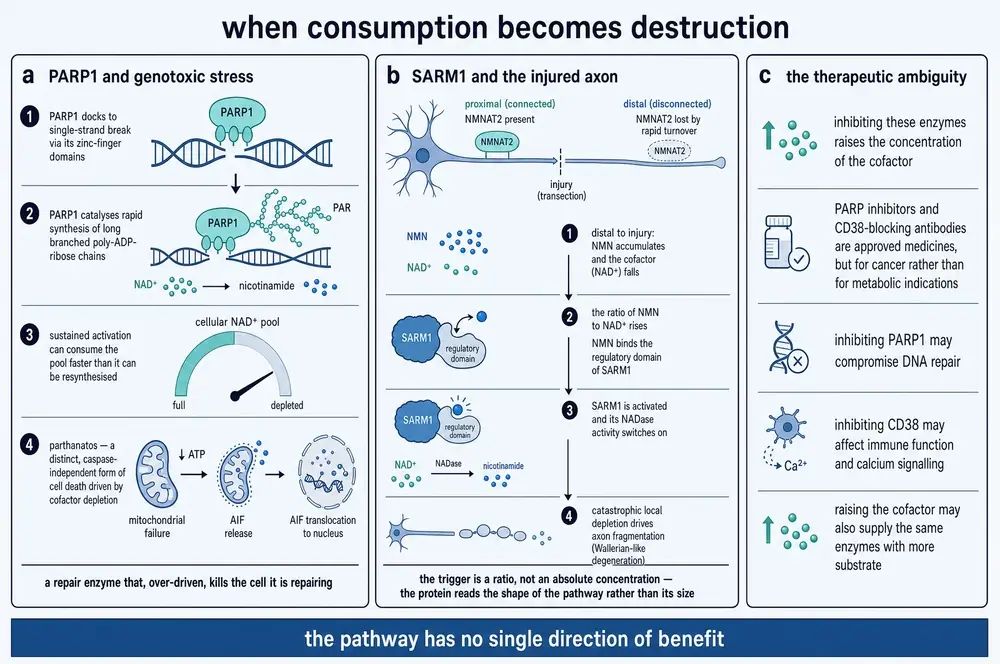
SARM1 is the one place in NAD+ biology with a complete chain from enzyme mechanism to human disease: purified-enzyme kinetics with the allosteric mechanism resolved structurally; a genetic experiment in mice in which deleting Sarm1 fully rescues both the metabolite deficit and the phenotype; and human loss-of-function mutations in NMNAT2 producing a matching disease.
It is also the clearest illustration of a point that recurs throughout this document. The most convincing therapeutic idea to come out of NAD+ biology is to inhibit an enzyme that destroys NAD+ — not to swallow more of its precursor.
12The routes in
A cell has four ways to make NAD+, and they matter individually because the commercial precursors enter at different points.
The de novo route builds the nicotinamide ring from scratch out of the amino acid tryptophan, by way of kynurenine and quinolinic acid. It is usually described as a minor contributor. That description may be too dismissive: in macrophages, isotope tracing has attributed roughly 40 per cent of total NAD+ to de novo synthesis at rest, which is far more than the "salvage dominates" framing implies.
The Preiss–Handler route starts from nicotinic acid and runs through nicotinic acid mononucleotide and nicotinic acid adenine dinucleotide. It is named for the two 1958 papers that mapped it, and Part Four will show it becoming unexpectedly central.
The salvage route recycles nicotinamide — the by-product that sirtuins, PARPs, CD38 and SARM1 all release when they destroy NAD+. NAMPT converts it back to NMN, and NMNAT completes the job. This is the loop that makes NAD+ consumption sustainable, and NAMPT is usually called its rate-limiting step.
Finally, nicotinamide riboside enters through its own kinases, NRK1 and NRK2, bypassing NAMPT entirely. This was the finding that made NR commercially interesting: a precursor that does not have to queue behind the enzyme everything else queues behind.
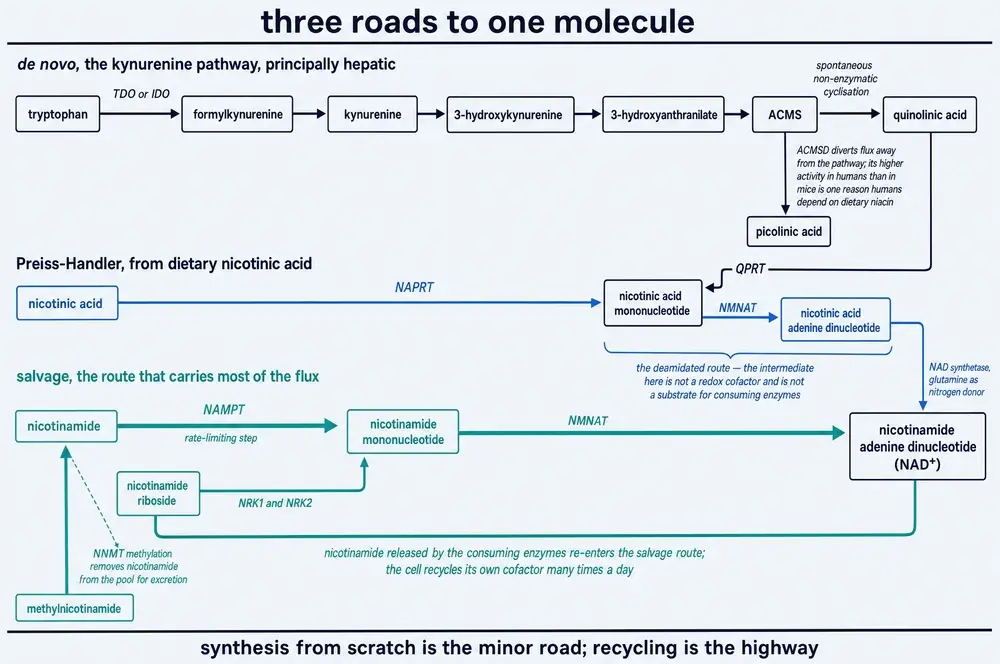
A caution about the word "rate-limiting", which appears constantly in this literature. In mice, deleting NRK1 changes NAD+ in liver, kidney and pancreas not at all in young animals — the route is dispensable at baseline — and only becomes load-bearing under the stress of age. A step can be rate-limiting under one condition and irrelevant under another.
13"NAD+ level" is not one number
One last piece of machinery has to be in place before the evidence can be read properly, and it is the piece most often left out.
NAD+ is not distributed evenly through a cell. It is made in at least three places by three different versions of the same enzyme: NMNAT1 in the nucleus, NMNAT2 in the cytosol and on axonal membranes, NMNAT3 associated with mitochondria. The pools they serve are not freely interchangeable, and a measurement of "cellular NAD+" is a weighted average across compartments that may be doing different things.
How different was shown in an experiment on cultured mouse neurons with reduced NMNAT2. Giving those neurons nicotinamide riboside raised NAD+ in the cell bodies and lowered it in the neurites at the same time. A whole-cell measurement would have reported the average of an increase and a decrease.
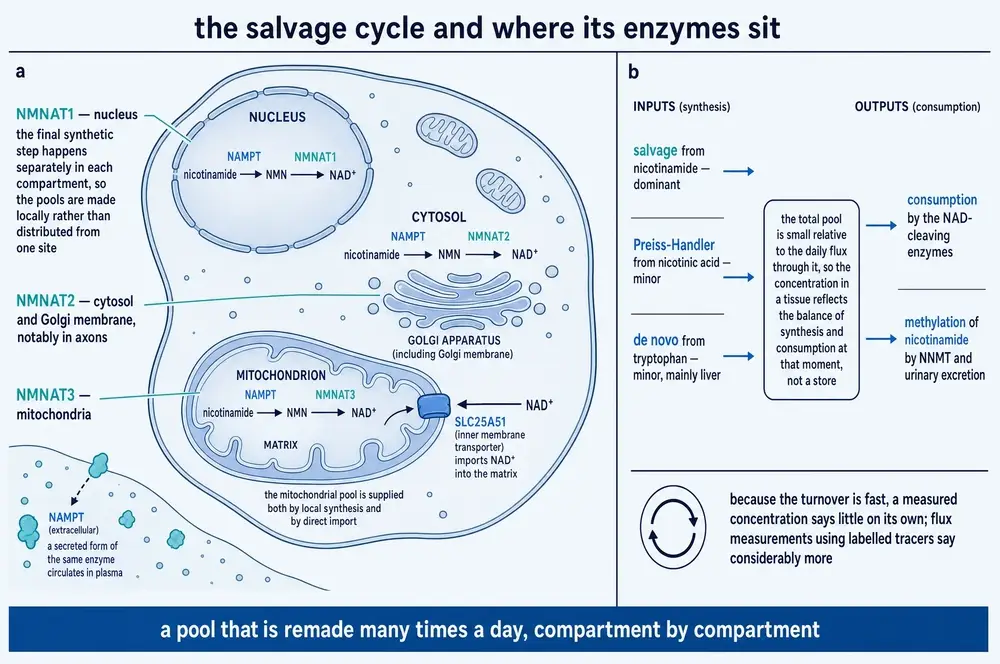
The same experiment supplies a second warning. In neurons from one ganglion the genetic lesion produced a fifty per cent NAD+ deficit; in neurons from another it produced none that could be detected. The difference was traced to the ratio of two enzymes rather than to any NAD+ level. Which cells are vulnerable is set by their machinery, not by their concentration.
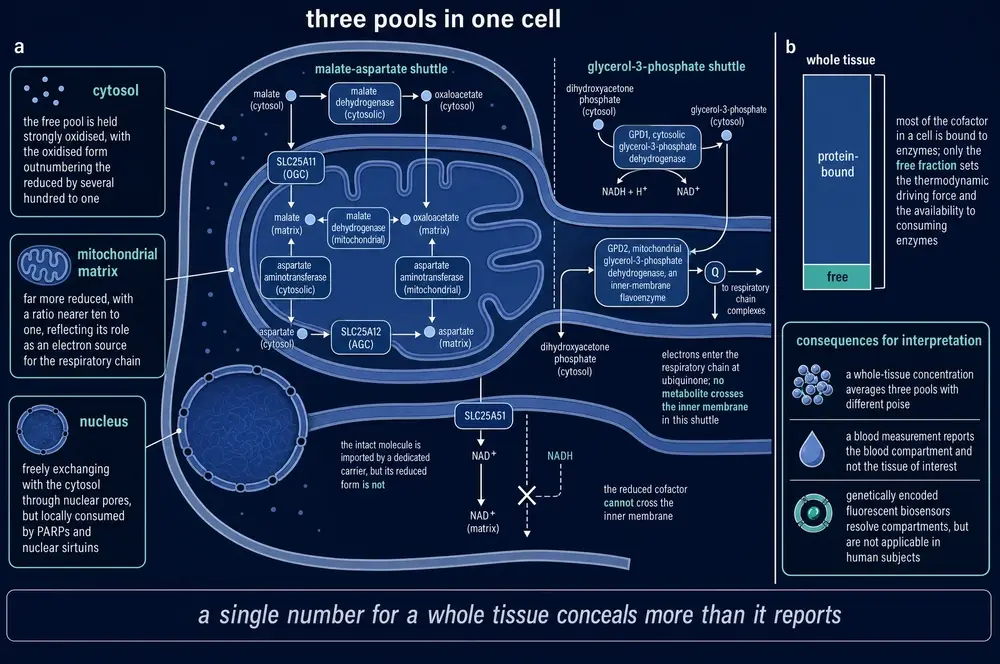
Hold those two findings in mind for the next Part, because the entire clinical literature on NAD+ rests on a single number taken from a single compartment of a single tissue: whole blood.
14The claim, and where it came from
The proposition that underwrites everything commercial about this molecule can be stated in one sentence: NAD+ falls with age, and that fall causes things that go wrong with ageing.
It entered wide circulation through a 2013 paper from David Sinclair's laboratory reporting that declining nuclear NAD+ disrupted communication between the nucleus and the mitochondria in ageing mice, and that raising NAD+ in old animals restored mitochondrial function "to that of a young mouse". The authors described the process as apparently reversible. Around the same time Shin-ichiro Imai formalised a broader framework, the NAD World, in which systemic NAD+ synthesis is the driver that sets the pace of ageing across tissues. By 2025 Imai could write that systemic NAD+ decline "has been accepted to be a key driving force of aging in the field".
That sentence is worth reading carefully, because it is a description of a field's consensus rather than a statement of a measured fact, and the two are not the same thing. This Part asks what the measurements show.
15What the measurements show
The first finding is about the shape of the literature rather than the molecule. The decline is asserted in the introduction of a large majority of the full texts assembled for this document — and it is asserted almost always by citation rather than by measurement. The number of papers here that actually measure NAD+ against age, with a stated method, a stated sample size and stated units, is small. A primary human paper concedes the point in its own opening: NAD+ "has been reported to decline with aging in preclinical models, but human data are sparse."
In rodents the evidence is real and reasonably clean. The best tissue-by-tissue series in this collection compared C57BL/6 mice at three months and twenty-four months and found total NAD+ content lower in aged animals by 18 per cent in pancreas, 40 per cent in kidney and 45 per cent in liver. Those are substantial reductions, measured in the same animals, and they are also a warning: the range across three tissues in one experiment is more than two-fold. Pooling that into "NAD+ falls by about half with age" is not supportable.
In humans, the picture is thinner and stranger. A cross-sectional study measured erythrocyte NAD+ across 206 men in three groups — elite endurance runners aged 20 to 81, elite sprinters aged 21 to 90, and untrained controls aged 20 to 68 — and found NAD+ falling with age in all three, at between 0.29 and 0.50 µmol per litre of red cells per year. Trained groups had higher absolute levels than the untrained, which is the headline the study is usually cited for. It is, as far as this evidence base goes, the only primary human study designed to measure NAD+ against age.
Read the slopes alongside the levels, though, and something awkward appears. The untrained group had both the lowest absolute NAD+ and the shallowest age-related slope. A gentler decline from a lower starting point is not protection, and it is not what a simple "exercise preserves NAD+" reading would predict.
A second human dataset is smaller and blunter still. In a phase I study that measured whole-blood NAD by mass spectrometry, baseline concentrations did not differ between a healthy group of mean age 46 and a Parkinson's group of mean age 64 — a seventeen-year gap with no detectable difference in the number supposedly tracking it.
16Why the number is hard to trust
Before drawing conclusions from any of this it is necessary to say plainly how fragile the measurements are. This is the weakest part of the field and the part least often acknowledged.
The methods are not interchangeable. Absolute NAD+ and NMN values in this evidence base come variously from mass spectrometry with isotope dilution, from ultraviolet-detection chromatography, from commercial luminescent kits, from phosphorus magnetic resonance spectroscopy, and in at least one paper from an indirect proxy in which a targeted enzyme's activity stands in for the concentration itself. These do not give the same answer.
The field's own reference method disagrees with itself. The paper that developed a double-isotope mass-spectrometry assay specifically to measure NMN accurately reports that chromatography and mass spectrometry agree closely after an intraperitoneal dose but give completely different plasma values after oral dosing and at baseline. The authors speculate that the gut microbiome produces something the older method cannot separate from NMN. That is an admitted and unexplained discrepancy sitting directly underneath the central question of what oral precursors do.
Handling the sample changes the sample. Whole blood carries substantial CD38 and CD73 activity, and both act on NMN. Freezing blood and extracting it later is therefore not equivalent to extracting it fresh, and a study that froze would miss a short-lived species entirely.
Imaging is coarse. Brain NAD+ measured by phosphorus spectroscopy at 3 tesla gave roughly a 35 per cent increase after supplementation where a higher-field proton method gave about 16 per cent, a difference the authors attribute to voxel size and placement.
A blinded analytical survey of eighteen commercial NMN products found deviation from label claim ranging from −100 per cent to +11 per cent, with three products containing no quantifiable NMN at all. Powders were accurate; capsules and liposomal formats were not. One 99.2 per cent-pure powder was the declared starting material for two liposomal products that assayed at −86 and −33 per cent.
Any trial or self-experiment using an unassayed commercial product has an unknown exposure, which means an unknown dose on one axis of every dose–response relationship in this field.
17The proposed culprit
If NAD+ falls, something must be responsible: either less is being made or more is being destroyed. The leading candidate for the second is CD38, an ectoenzyme that hydrolyses NAD+ and rises with age in several tissues.
The supporting case is genuine. Deleting CD38 in mice raises tissue NAD+; overexpressing it lowers it; pharmacological inhibitors raise it. And a recent experiment gives the argument unusual force by pairing a failure with a success in the same design. In CD8+ T cells from older human donors, NAD+ was depleted and CD38 elevated. Giving NMN alone failed. Giving NMN together with a CD38 inhibitor succeeded, across metabolic and functional endpoints. The precursor was not the missing ingredient; the drain was.
The counter-evidence is also real. In at least one cultured-cell study, CD38 inhibition did not alter the rate at which NAD+ was consumed. There is an unresolved topological problem, in that CD38's catalytic site faces outward while the NAD+ it is supposed to be draining is inside the cell. And in macrophages a completely different explanation accounts for the same NAD+ fall: not increased destruction at all, but a bottleneck in the de novo pathway, with the enzyme QPRT downregulated so that quinolinic acid accumulates and cannot be converted onward. Two mechanisms, one observation.
There is also a discovery in this area that reframes what precursors even are. CD38 and its relative BST1 do not only hydrolyse NAD+; they perform base exchange, swapping the nicotinamide ring of NMN or NR for a nicotinic acid ring. That converts an amidated precursor into a deamidated one without any deamidase enzyme — which turns out to matter a great deal in the next Part.
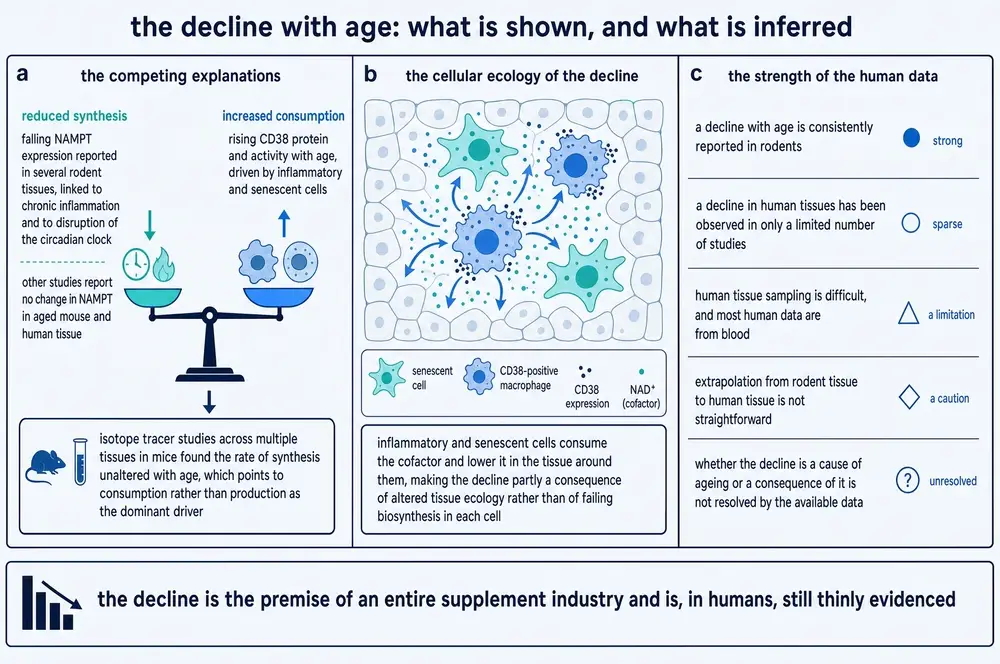
18What survives the scrutiny
Setting the evidence out plainly, four statements can be made with different degrees of confidence, and it is worth separating them.
| Claim | Status in this evidence base |
|---|---|
| NAD+ content falls with age in several rodent tissues | Supported. Measured, with method and sample size, in the same animals. Magnitude is tissue-specific and ranges at least from −18 % to −45 %. |
| A comparable fall occurs in human tissue | Largely untested. There is no human tissue age-series in this evidence base. The human data are blood and red cells, and one primary paper describes human data as sparse in its own opening. |
| Blood NAD+ is a usable proxy for tissue NAD+ | Contradicted. See Section 22. The only human studies measuring both compartments found blood rising while muscle did not. |
| The fall causes the features of ageing | Not established in humans. Causality rests on rodent intervention studies. In human cells, restoring NAD+ is sometimes not sufficient: in one experiment neither nicotinamide riboside nor a transporter overexpression restored proliferation in cells with a premature-ageing lesion. |
Two further findings deserve to be carried forward, because they complicate the entire framing rather than any single number.
The first is that susceptibility is set by enzyme ratios, not by NAD+ levels. In cultured mouse neurons, one identical genetic lesion produced a fifty per cent NAD+ deficit in neurons from one ganglion and no detectable deficit in neurons from another. The difference tracked the ratio of two enzymes, not the concentration of the metabolite.
The second is that a measured deficit need not mean a supply problem at all. In those same neurons, the NAD+ deficit was entirely a consumption phenomenon: deleting the destroying enzyme completely rescued it. The pool had not stopped being filled. It had started being emptied.
The decline is real in rodent tissue, of uncertain magnitude, of largely unmeasured extent in human tissue, and of unproven causal significance in people. That is a considerably weaker foundation than the commercial literature implies, and a considerably stronger one than a dismissal would allow.
It is also, importantly, not the question that matters most. Even granting the decline entirely, a separate question remains: does swallowing a precursor put the NAD+ back where it fell from? That is what Part Four is about, and the answer turns out to be more surprising than the decline itself.
19Four molecules, not one
"NAD+ supplement" is a category, not a compound, and the things inside it are chemically and commercially distinct. Keeping them apart is not pedantry: a trial of one is not evidence about another, and the harms in this family are concentrated almost entirely in the cheapest member.
| Molecule | Enters NAD+ synthesis via | The problem with it |
|---|---|---|
| Nicotinic acid (niacin) | Preiss–Handler | Flushing, via a receptor on skin immune cells. Cheap, old, and the only member with large cardiovascular outcome trials — both negative. |
| Nicotinamide | Salvage | No flushing, but it inhibits sirtuins at higher concentrations — the enzymes the exercise is meant to activate. |
| Nicotinamide riboside (NR) | Its own kinases, NRK1/2, bypassing NAMPT | Fragile. Substantially destroyed before it arrives. |
| Nicotinamide mononucleotide (NMN) | Salvage, one step past NR | Charged and phosphorylated, so cell entry is disputed. Also the physiological activator of SARM1. |
20What happens after you swallow it
This section contains the most surprising finding in the document, and it is not the one the field advertises.
The intuitive model is that you swallow nicotinamide riboside, it is absorbed intact, it reaches your tissues, and NRK1 phosphorylates it into the NAD+ pool. Isotope tracing in mice says that is largely not what happens.
When mice are given nicotinamide riboside or NMN labelled with heavy isotopes by mouth, and their tissues are examined three hours later, the new NAD+ does not carry the label pattern of the intact precursor. In liver, the dominant signatures correspond to NAD+ rebuilt from nicotinamide and from nicotinic acid. In muscle, labelled nicotinamide riboside does arrive — but is not converted there; the NAD+ that appears is again built from nicotinamide. Administered NMN did not directly reach muscle at all.
Three genetic and microbiological experiments in the same work establish where the nicotinic acid comes from, and the answer is not the mouse.
- Knocking out NAPRT, the first enzyme of the Preiss–Handler route, abolished the liver NAD+ rise after oral NMN — including after two weeks of repeated dosing. Hepatic NAD+ from oral precursors is mainly Preiss–Handler, and the direct salvage contribution is marginal even chronically.
- In germ-free mice, the deamidated metabolites completely failed to appear in liver and the liver NAD+ rise was significantly suppressed, while portal-vein nicotinic acid fell and nicotinamide, NR and NMN were unchanged.
- Three days of antibiotics blocked the late phase of the liver response to oral NR while leaving the early intestinal phase intact.
In other words: the gut bacteria strip the precursor down and deamidate it to nicotinic acid, and that bacterially generated nicotinic acid is what the liver actually uses.
Human evidence points the same way, from a different direction. When human faecal communities are incubated with nicotinamide riboside outside the body, it is rapidly cleaved to nicotinamide — peaking at around 2 mM at eight hours — and then deamidated to nicotinic acid, sustained at 200 to 400 µM. The pattern was consistent across every donor tested. And when human whole blood is incubated with the precursors directly, the ranking reverses: nicotinic acid raised the NAD+ signal by about 170 per cent, whereas NMN and nicotinamide riboside did not raise it at all, both being degraded within half an hour and an hour respectively.
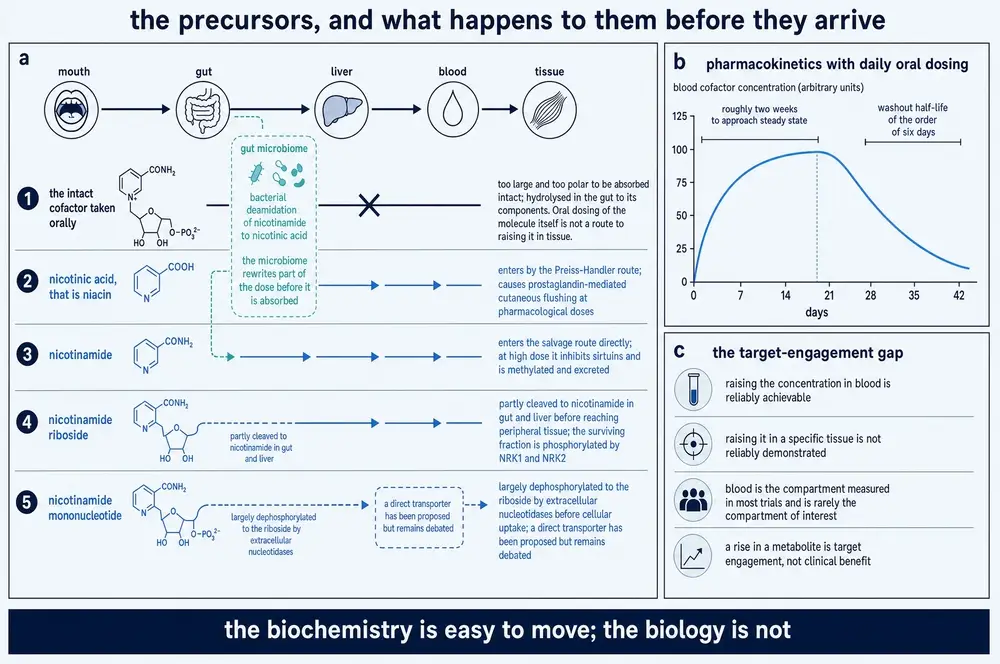
On the evidence assembled here, the two premium-priced precursors raise human blood NAD+ substantially by being converted — largely by gut bacteria — into nicotinic acid, which is niacin: a vitamin identified in 1937 and costing a few pence a gram.
This is a mechanistic account, not a pricing argument, and it carries real caveats. Nicotinic acid taken directly causes flushing at effective doses and the precursors do not, which is a genuine pharmaceutical achievement. But it substantially changes what these molecules are, and it is not how they are described to the people buying them.
One route does deliver intact precursor to muscle, and the experiment that shows it is unusually clean because it changes only one variable. Mice were given the same 200 mg/kg dose of nicotinamide riboside by two routes. Given intravenously, it raised skeletal muscle NAD+ by roughly 140 per cent. Given by mouth, it did not raise muscle NAD+ at all (p = 0.54). Same compound, same dose, same animals' tissue, opposite result — the difference is entirely the first pass through gut and liver. This is reported here as an experimental finding in mice, not as a recommendation; the same authors note that four weeks of intravenous nicotinamide riboside downregulates the muscle kinase it depends on.
21The animal results
The preclinical literature is large, generally positive, and needs to be read with the species and the exposure attached to every claim.
In rodents, NAD+ precursors have improved outcomes in models of fatty liver and alcohol-associated liver injury, doxorubicin cardiotoxicity, sepsis and multi-organ failure, acute kidney injury, fracture healing, skeletal development, ovarian ageing, epidermal inflammation and post-cardiac-arrest brain injury. Formal toxicology is reassuring within its limits: a GLP 90-day study in rats reported a no-observed-adverse-effect level of not less than 800 mg/kg/day for NMN, with a full genotoxicity battery negative, and an acute study put the median lethal dose above 2,000 mg/kg.
Two qualifications belong with that summary rather than after it. First, no carcinogenicity bioassay of either NMN or nicotinamide riboside exists in this evidence base; a genotoxicity battery is not a carcinogenicity study. Second, the doses are large. The rodent efficacy studies typically use hundreds of milligrams per kilogram per day, and the in-vitro concentrations are commonly two to five orders of magnitude above anything physiological. These are reported here strictly as parameters of published experiments; this document does not convert an animal dose into a human one, and no such conversion should be inferred.
The more useful preclinical findings are the awkward ones. In a twelve-week rat study, nicotinamide riboside raised liver NAD+ and its related metabolites — and the authors report that their data on lipid score, steatosis score and triglycerides did not correlate with NAD+ abundance. In the same animals nicotinamide riboside raised global lysine acetylation in liver and lowered a marker of sirtuin activity, which is the opposite of the mechanism the compound is sold on.
22The human pharmacokinetics: this part worked
It is important to give the field its due here, because the achievement is real and the failure that follows is not a failure of chemistry.
Oral nicotinamide riboside and NMN raise NAD+ in human blood reliably, dose-dependently, and with a good short-term safety record. In 140 healthy overweight adults, eight weeks of nicotinamide riboside raised whole-blood NAD+ by 22, 51 and 142 per cent at three ascending doses, with no flushing, no rise in LDL cholesterol and no disturbance of one-carbon metabolism. In a head-to-head trial, nicotinamide riboside and NMN each roughly doubled whole-blood NAD+ over fourteen days — and nicotinamide, tested in the same design, did not. At the highest dose ever formally tested, 3,000 mg/day of nicotinamide riboside for four weeks in people with Parkinson's disease, blood NAD+ rose up to fivefold with no moderate or severe adverse events.
That is a solved problem. The target is engaged.
But the engagement stops at the blood. The single most consequential human experiment in this literature took twelve aged men, gave them a gram of nicotinamide riboside daily for twenty-one days in a randomised placebo-controlled crossover, and took muscle biopsies:
| Skeletal muscle metabolite | NR | Placebo | p |
|---|---|---|---|
| Nicotinamide riboside | 1.40 | 1.25 | 0.23 |
| NAD+ | 210 | 197 | 0.22 |
| Nicotinamide | 92.0 | 86.5 | 0.96 |
| Nicotinic acid adenine dinucleotide | 0.73 | 0.35 | 0.004 |
Values in pmol/mg, 14 hours after the last dose, targeted mass spectrometry, paired comparisons. The compound did not measurably reach the tissue and the tissue's NAD+ did not measurably rise. Only a downstream intermediate moved.
23The human outcomes
Against that background, the clinical results become intelligible rather than merely disappointing.
Four independent groups have given nicotinamide riboside to people with metabolic disease and measured insulin sensitivity with the gold-standard hyperinsulinaemic–euglycaemic clamp. In forty obese, insulin-resistant men given 2,000 mg/day for twelve weeks, the result was null — on insulin sensitivity, endogenous glucose production, glucose disposal, resting energy expenditure, lipolysis and body composition alike. Companion analyses from the same cohort found no effect on muscle mitochondrial respiration, content or morphology, and no effect on beta-cell function or incretins. A separate crossover trial in healthy overweight adults was null on insulin sensitivity and mitochondrial function. In aged men, the muscle NAD+ metabolome rose, and transcriptomics showed energy-metabolism and mitochondrial pathways downregulated, with no change in mitochondrial bioenergetics.
Outside metabolism the pattern holds, with a small number of exceptions worth naming precisely.
| Population | n | Endpoint | Result |
|---|---|---|---|
| Long COVID, 24 weeks | 58 | cognition | Null; also null on fatigue, sleep, anxiety, depression. NAD+ rose 2.6–3.1× |
| Mild cognitive impairment, 10 weeks | 20 | MoCA | Null. NAD+ rose 2.6×. Cerebral blood flow in the default-mode network fell |
| Chronic kidney disease, 6 weeks | 25 | peak oxygen uptake | Null. Submaximal oxygen uptake was worse |
| Elevated blood pressure, 6 weeks | 54 | daytime systolic BP | Null and directionally adverse (+5.2 mmHg with exercise, against −2.7 on placebo) |
| Capsaicin nerve-fibre model | 45 | prevention of nerve-fibre loss | Null — and plasma NAD+ did not rise either |
| Friedreich's ataxia, 12 weeks | 66 | peak VO₂ | NR alone null; combination with exercise no better than exercise alone |
| Non-alcoholic fatty liver, 6 months | 111 | hepatic fat fraction | Null on primary (NR + pterostilbene) |
| COPD, 6 weeks | 40 | sputum interleukin-8 | Positive — −52.6 % (95 % CI −75.7 to −7.6), persisting at 12 weeks |
| Peripheral artery disease, 6 months | 90 | 6-minute walk | Positive but marginal — +17.6 m, reported with a 90 % one-sided interval |
| NMN: prediabetic postmenopausal women, 10 weeks | 25 | muscle insulin sensitivity (clamp) | Positive — and formally contested in the same journal on baseline imbalance |
A widely cited 2018 trial is routinely described as showing that nicotinamide riboside lowers blood pressure and arterial stiffness. It does not report that. Its abstract states that the findings suggest future clinical trials should assess those endpoints — hypothesis-generating language for a safety and tolerability study.
A 2023 Parkinson's safety trial is cited for clinical improvement. Its authors state explicitly that the movement-score improvement was confounded by a shorter interval since the last dose of levodopa.
A 2024 NMN trial is titled for maintained walking speed and improved sleep. It failed its primary endpoint at both four and twelve weeks; the title claim rests on secondary measures.
The meta-analyses converge. A 2024 pooled analysis of twelve NMN trials found a significant effect on blood NAD+ while most clinically relevant outcomes were not different from control, judged not one included trial to be at low risk of bias, and stated that "an exaggeration of the benefits of NMN supplementation may exist in the field." A 2025 analysis in a muscle journal, examining NMN and nicotinamide riboside separately, was null throughout on muscle index, grip strength, gait speed and chair-stand time, and concluded that current evidence does not support supplementation.
24Where the two came apart
The cleanest single demonstration of the gap comes from a trial of the pharmaceutical-grade NMN preparation MIB-626 in 42 people hospitalised with COVID-19 and early acute kidney injury. Blood NAD+ rose from 16.0 to 42.6 µg/mL — an unambiguous, large, dose-confirming increase. Creatinine, cystatin-C, every acute kidney injury marker, C-reactive protein, interleukin-6, tumour necrosis factor alpha and disease severity were all null.
Four explanations for the gap are compatible with the evidence, and the honest position is that they have not been separated.
The wrong compartment. Blood NAD+ is not tissue NAD+, and Section 22 shows the two dissociating directly in the only human study to measure both. Within a single cell the pools are separate enough that nicotinamide riboside raised NAD+ in neuronal cell bodies while lowering it in the neurites at the same time.
The wrong molecule. If oral precursors work largely by becoming nicotinic acid, then the trials are, mechanistically, expensive niacin trials — and the two large cardiovascular outcome trials of niacin were both negative.
The wrong population. The trials that returned something were in people with a specific, measurable pathology: airway inflammation, claudication, prediabetes. Those in healthy or nearly healthy volunteers returned nothing. A correction may only be visible where there is something to correct.
The premise. It remains possible that the age-related decline in NAD+, where it occurs, is a consequence of ageing rather than a cause of it — in which case restoring the number would not be expected to do anything, and the pharmacokinetic success would be exactly as informative as it has proved to be.
25The counter-example
One part of NAD+ biology has produced a convincing therapeutic programme, and it runs in the opposite direction from everything above.
Because SARM1 destroys NAD+ and destroying NAD+ kills axons, inhibiting SARM1 should protect nerves — and in animal models it does. The logic is clean, the enzyme is defined, the trigger is understood, and the human genetics line up. Nothing in the supplement literature has that shape. The most convincing idea to come out of this field is to block an enzyme, not to swallow a precursor.
And the same mechanism raises a question about the precursors themselves that is not comfortable and should not be smoothed over. SARM1 is activated by a rising ratio of NMN to NAD+. NMN is one of the two compounds sold to raise NAD+. In cultured neurons with reduced NMNAT2, nicotinamide riboside lowered axonal NAD+ in a SARM1-dependent way, and a trend toward SARM1 activation appeared even in normal neurites. The authors of that work explicitly call for additional safety studies in conditions of reduced NMNAT function, and name the elderly among the groups of concern.
This is a mechanistic hypothesis grounded in cultured mouse neurons with an engineered genetic lesion. It is not evidence that NAD+ precursors harm human nerves, and no human trial has reported such an effect. It is recorded here because it is the one place where the mechanism most firmly established in this field points toward a possible harm from the intervention most widely sold, and because the researchers who found it asked for it to be followed up.
26Straight into the vein
Intravenous NAD+ is a substantial commercial phenomenon, offered by clinics at 500 to 1,500 mg per session for fatigue, addiction recovery, cognition and ageing. The published human evidence for it is close to non-existent, and saying so precisely matters more than saying so forcefully.
There is one pharmacokinetic pilot: uncontrolled, unrandomised, with author affiliations including a commercial NAD+ infusion clinic. Its central observation undercuts the practice rather than supporting it — plasma NAD+ and all measured metabolites were unchanged for the first two hours of a six-hour infusion, the compound being "rapidly and completely removed from the plasma", with metabolites appearing in urine later.
There is exactly one randomised controlled trial: 180 patients in a single Chinese centre, given 10 mg/day intravenously for seven days alongside guideline therapy. Ejection fraction at one month differed from placebo (45.4 % against 42.4 %, p = 0.024) and every secondary endpoint was non-significant. The abstract does not state that the trial was blinded, the primary endpoint is defined as a change but reported as absolute values, and the dose is roughly two orders of magnitude below what infusion clinics administer. It cannot be cited as evidence for that practice.
Beyond those two, a 2026 systematic review of 113 studies concluded that no eligible outcomes trials of intravenous or intramuscular NAD+ exist. The trial registry holds nothing of scale.
What does exist is a regulatory record. In October 2024 the US Food and Drug Administration warned that compounders were using food-grade NAD+ to make intravenous products, and reported adverse events "including severe chills, shaking, vomiting and fatigue with some requiring medical treatment", consistent with excessive endotoxin. In January 2026 it issued a warning letter to a compounder whose NAD+ vials from a single lot sent three patients to the emergency department; an unopened vial from that lot assayed at 3,360 endotoxin units per millilitre. Ten NAD+ recalls appear in the agency's enforcement database across five years and five firms, one of them Class I. A retrospective review of a commercial infusion practice found that all six patients who received intravenous NAD+ reported moderate-to-severe cramping, diarrhoea, nausea, vomiting, raised heart rate and chest pressure during infusion.
No published case reports of harm from intravenous NAD+ were found in this evidence base. That should not be read as reassurance. There is neither trial evidence of safety nor any surveillance system capable of detecting harm, in a practice that operates almost entirely outside the mechanisms that would generate either.
27From flask to gram
A coenzyme is a strange thing to sell. It is not a drug, it treats no approved indication, and the deficiency disease it prevents was solved in 1937 with a compound that costs almost nothing. What made NAD+ a product was not a new therapeutic claim but a change in what the molecule was thought to be: after 2000 it was no longer a fixed piece of cellular apparatus but a quantity, and quantities can be low, and things that are low can be topped up.
The scale of the resulting market is harder to state honestly than it looks, because almost every figure in circulation comes from commercial market-research firms that do not publish their methods. One number is auditable. Niagen Bioscience — the company formerly called ChromaDex, and the largest listed pure-play seller of an NAD+ precursor — reported revenue of $129.4 million for the financial year 2025, up from $67.4 million in 2021. Those figures come from audited statements filed with the Securities and Exchange Commission.
That is the whole of the reliable evidence about market size, and it is worth being precise about what it does and does not establish. Any estimate placing the NAD+ supplement market in the multi-billion-dollar range is asserting that this listed company holds a very small share of a market composed overwhelmingly of private and cross-border sellers. That may well be true. But it is an assumption inside the estimate rather than an observation, and it should be read as one.
28Who owns a vitamin metabolite
Nicotinamide riboside was identified as a nutrient in cow's milk in 2004, in the same paper that established it as an NAD+ precursor (Bieganowski & Brenner, 2004). Dartmouth College patented compositions containing it, and licensed them to ChromaDex. Nineteen years later the Federal Circuit held the asserted claims invalid, and the reason was the milk.
In ChromaDex v. Elysium Health the court set the elements of claim 1 of US 8,197,807 against natural cow's milk one by one and found that the only difference was that the claimed nicotinamide riboside had been isolated. Under Chakrabarty and Myriad, that is not enough: the claimed compositions "do not exhibit markedly different characteristics from natural milk and are, therefore, invalid for claiming a patent-ineligible product of nature." The Supreme Court denied certiorari in October 2023.
Two details make the case more interesting than a simple loss. The first is that the district court had made a factual error that ran against ChromaDex — it wrongly assumed the trace nicotinamide riboside in milk raises NAD+ — and the Federal Circuit held the error harmless, because the claims require only that the composition raise NAD+ biosynthesis, and milk does that through its tryptophan. The patent failed not because milk works but because the claim was broad enough to cover milk.
The second is what happened at the Patent Trial and Appeal Board four years earlier. Elysium had attacked the sibling patent using prior art from the 1920s — Goldberger's own pellagra papers. Several claims fell to it. One survived, and it survived precisely because it required the nicotinamide riboside to be isolated, which buttermilk is not. That same limitation is what killed it in Delaware three years later.
The prior art that invalidated a twenty-first-century supplement patent was Joseph Goldberger's pellagra research from 1924 and 1928 — the same programme, using the same dog assay, that led to the identification of the vitamin in the first place. The discovery and the invalidation rest on the same body of work.
The litigation ended worse than invalidity. In March 2024 the district court found the case exceptional under 35 U.S.C. § 285, describing ChromaDex's position as "if not frivolous, so feeble as to be exceptional," and entered judgment for $9,151,133 in fees. That award was argued on appeal in July 2026 and had not been decided when this document was compiled; the company's own filings put its exposure with interest at roughly $10.4 million and record that no accrual has been taken.
What survives commercially is not the Dartmouth estate. The Dartmouth and Cornell patents expire through 2026 or are invalid; exclusivity now rests on a different set of claims entirely — the crystalline-form patents held by W. R. Grace, which a Delaware jury found Elysium had willfully infringed in 2023, and a synthesis portfolio from Queen's University Belfast which Niagen bought outright in December 2025. The patents that held up in court were about how to make and crystallise the molecule, not about the molecule. That is the ordinary fate of a natural product, and it took twenty years and four proceedings to establish.
29The NMN problem
Nicotinamide mononucleotide has had a stranger regulatory history, and the version of it that circulates is usually a year or more out of date.
In November 2022 the US Food and Drug Administration wrote to the firms that had filed new-dietary-ingredient notifications for NMN and told them the ingredient was excluded from the definition of a dietary supplement. The statutory mechanism is the drug-preclusion clause: an article authorised for investigation as a new drug, where substantial investigations have been instituted and made public, cannot afterwards be sold as a supplement unless it was marketed as one first. FDA identified the triggering investigation only obliquely, citing three registered trials of MIB-626, and later stated plainly that "NMN and MIB-626 have the same chemical structure … and, thus, are the same article." It has never disclosed the investigational-new-drug date or the sponsor.
Two features of what followed are worth stating carefully. The first is that the drug developer did not stay out of it: Metro International Biotech filed comments actively defending the exclusion, arguing that FDA "correctly applied the drug exclusion clause" and that all prior NMN supplement sales had been unlawful. The second is that the trade association's lawsuit never produced a ruling. It was filed in August 2024, stayed, and voluntarily dismissed in October 2025.
It was dismissed because FDA changed its own mind. On 29 September 2025, responding to a citizen petition, the agency abandoned one element of its 2022 reasoning — the requirement that prior marketing have been lawful:
"we will no longer evaluate whether the dietary supplement or food was lawfully marketed when making a determination under the race-to-market clause … FDA is aware of evidence that NMN was marketed as a dietary supplement in the United States as early as 2017. This preceded the authorization of NMN for investigation as a new drug. Accordingly, we now conclude that NMN is not excluded from the definition of dietary supplement."
In December 2025 FDA formally set aside its 2022 letters. As this document was compiled, NMN is not excluded from the dietary supplement definition in the United States. It remains a new dietary ingredient, which means a premarket notification is still required and — a point routinely misread — that acceptance of such a notification "does not constitute a finding by FDA that the new dietary ingredient … is safe."
And the litigation resumed from the opposite side. In February 2026 Niagen Bioscience sued FDA to have the 2025 reversal vacated. The company that lost its nicotinamide riboside patents is now in court trying to keep nicotinamide mononucleotide off the shelves, arguing for the same regulatory outcome that the NMN drug developer had argued for two years earlier, from the opposite commercial motive.
One further status is frequently misstated. NAD+ itself, given intravenously, is not an approved drug in the United States and is not on the list of bulk substances that may be used in compounding. It sits in a holding category — nominated, under evaluation — in which FDA has said it does not currently intend to take enforcement action against pharmacies that compound with it under stated conditions. That is enforcement discretion under an interim policy, and it is the actual legal footing of the infusion industry. The widely repeated claim that FDA evaluated NAD+ and declined to list it is not supported by the codified record.
30What is actually in the jar
Because these are sold as supplements rather than as drugs, no regulator verifies content before sale. Two independent analytical surveys have asked what is actually in commercial NMN products, and the answer is not reassuring.
In an analytical study of eighteen NMN products purchased online, in pharmacies and direct from sellers, blinded and assayed by validated liquid chromatography–tandem mass spectrometry, measured NMN content ranged from not detectable in three products to 99.2 per cent by weight in one. Deviation from the label claim ran from −100 per cent to +11 per cent. Cost to the consumer ranged from €1.10 to €17.50 per gram of NMN. Only five of the eighteen products carried a manufacturing date. An earlier commercial survey found fourteen of twenty-two brands below one per cent of their claimed content; the two surveys overlapped on a single product and agreed about it.
Behind that distribution sits a manufacturing problem. Chemical phosphorylation of nicotinamide riboside to NMN depends, in the words of one process paper, on "excessive phosphine oxychloride and delicate temperature control", while direct fermentation is "limited by low product titers, making it unsuitable for industrial-scale NMN production". The routes actually reported in the research literature differ in productivity by four orders of magnitude: from 17 micromoles per litre using non-recombinant lactic acid bacteria, through 3.4 grams per litre from engineered Bacillus subtilis, to a space-time yield of 281 grams per litre per day using a nicotinamide riboside kinase with an ATP-regenerating system. Only the last is plausibly industrial. None of the papers states that its own route is in commercial production.
Verification is a related problem. The analytical chemistry needed to measure NMN properly is not trivial — the molecule degrades during sample handling, sits at concentrations far below NAD+, and suffers matrix effects — and the method developed to handle this uses two separately labelled isotopic standards, one to correct for matrix effects and one to trace what happens to the analyte during processing. A certificate of analysis produced by ultraviolet-detection chromatography is not measuring the same thing.
31The mirror image
There is a body of research in which NAD+ is a target, substantial funding is directed at it, and the therapeutic objective is to make it lower. It is oncology, and any honest account of this compound has to put it alongside the supplement literature rather than in a footnote.
Tumours are metabolically demanding and depend heavily on NAD+ for transcription, DNA repair and proliferation. NAMPT — the rate-limiting enzyme of the salvage pathway, the same enzyme that NMN and nicotinamide riboside feed into — is therefore an anticancer drug target, and the drugs are inhibitors. In laboratory and animal models NAMPT inhibitors reduce viability and induce apoptosis across small-cell lung carcinoma, mantle cell lymphoma, epithelial ovarian cancer and acute myeloid leukaemia, and combine with PARP inhibitors and conventional chemotherapy.
The finding a consumer-facing document most needs to carry comes from a mouse study of that class of drug. In mice, the antitumour effect of a NAMPT inhibitor was strongly potentiated by a niacin-free diet, and abolished by adding niacin-family precursors back. In culture, nicotinic acid riboside rescued every tumour cell line tested from a NAMPT inhibitor; nicotinic acid also rescued; and nicotinamide riboside rescued too, though the authors describe it as less potent than the other two.
In a mouse model, raising circulating niacin-family precursors antagonised an experimental anticancer drug that works by starving tumours of NAD+. That is a drug-interaction signal in animals. It is not a demonstration that precursors cause cancer, and it must not be read as one.
The relevant human evidence is absent rather than reassuring. No human trial, cohort, case-control or pharmacovigilance study has tested whether nicotinamide riboside or NMN affects cancer incidence, progression or metastasis. None of the randomised trials in Part Four was powered for, or reported, cancer outcomes, and none included cancer surveillance. There is also no carcinogenicity bioassay of either compound. The absence of a signal here is the absence of a study.
Evidence pointing the other way exists and belongs beside it. A NAD+-synthesising enzyme, NMNAT3, is downregulated in melanoma and behaves as a tumour suppressor when overexpressed in culture. In a mouse mesothelioma model, high-dose NMN produced antitumour activity comparable to PD-1 blockade by reprogramming tumour-associated macrophages. And in a mouse cancer-cachexia model, nicotinamide riboside reduced weight loss and inflammatory markers while making no difference at all to tumour size in either direction — which is, notably, the only study in this collection that gave a precursor to a tumour-bearing animal and reported the tumour mass.
The honest summary is that NAD+ metabolism is genuinely important in cancer, that the pharmaceutical industry is pursuing it in the opposite direction from the supplement industry, and that the human data needed to say whether that matters for a person taking a precursor do not exist.
32What would settle it
After two decades and several hundred million dollars of retail sales, the central question about NAD+ precursors remains open, and it is worth being specific about what would close it.
The first requirement is that the trials already completed should report. The largest and best-designed trial of any NAD+ precursor in any indication is NOPARK: 410 patients with early Parkinson's disease, randomised to nicotinamide riboside or placebo for fifty-two weeks, with a total motor and functional score as its primary endpoint. It completed in June 2025. As this document was compiled it had posted no results and published nothing. A twelve-week dose-finding study of eighty-one patients completed two months earlier and is also unreported, as is a completed study of MIB-626 in 124 highly fit young adults, and a trial of nicotinamide riboside in heart failure that finished in 2019 and has posted registry results but no paper. The evidence base is not merely thin; parts of it have been generated and not released.
The second requirement is measurement. Almost everything in this field rests on blood NAD+ as a surrogate, and Part Three showed how weakly that surrogate is tied to what it is meant to represent. A multi-centre study of inter-laboratory standardisation of NAD+ measurement is due to begin in 2026. It is unglamorous, and it may matter more than several of the efficacy trials running alongside it.
The third is a change in what is being asked. The trials that have reported were mostly small, short and conducted in people who were healthy, or healthy enough. The strongest signals in the whole record — the reduction in sputum interleukin-8 in chronic obstructive pulmonary disease, the improvement in walking distance in peripheral artery disease, the improvement in muscle insulin sensitivity in prediabetic postmenopausal women — came from populations with something specific and measurable wrong with them. Whether that is a real pattern or three isolated results is exactly the kind of question a properly powered trial in a defined population would answer.
Until then, what can be said with confidence is narrow and worth saying plainly. NAD+ is essential and its severe depletion is a documented human disease. Its concentration falls in some tissues of some species with age, by amounts that are measurable but disputed. Two oral precursors reliably raise NAD+ in human blood, safely, at the doses and durations tested. Whether doing so changes anything a person would notice is, on the published evidence, not yet known.
This document describes published research. It does not recommend human use of NAD+, nicotinamide mononucleotide, nicotinamide riboside, nicotinamide or nicotinic acid, and it specifies no dose, route or schedule for any person. Every quantity reported above is a parameter of a published experiment, attached to the species, population and duration in which it was studied. Nothing here is medical advice, and nothing here should be used to guide the treatment of any condition.
33References
Generated from verified NCBI records rather than from recall. Author lists, journal names, volumes, pages and identifiers were re-fetched from PubMed for every entry below, and the returned title of each was read back and confirmed to be the paper intended. This series has twice shipped reference lists drafted from memory in which identifiers pointed at real but unrelated papers, and the build refuses to run if any identifier fails to resolve.
Sources with no PubMed record — the 1906 papers, the Nobel citations, Warburg's Biochemische Zeitschrift work, Goldberger's Public Health Reports papers, the regulatory instruments, the court opinions and the company filings — are listed separately after the indexed references, and are cited to the instrument itself rather than to any summary of it.
- Ahmadi A, Begue G, Valencia AP, Norman JE, Lidgard B, Bennett BJ, et al.. Randomized crossover clinical trial of coenzyme Q10 and nicotinamide riboside in chronic kidney disease. JCI Insight. 2023;8(11).
PMID 37159264 · doi:10.1172/jci.insight.167274 · PMC10393227 - AIM-HIGH Investigators, Boden WE, Probstfield JL, Anderson T, Chaitman BR, Desvignes-Nickens P, et al.. Niacin in patients with low HDL cholesterol levels receiving intensive statin therapy. N Engl J Med. 2011;365(24):2255-67.
PMID 22085343 · doi:10.1056/NEJMoa1107579 - Airhart SE, Shireman LM, Risler LJ, Anderson GD, Nagana Gowda GA, Raftery D, et al.. An open-label, non-randomized study of the pharmacokinetics of the nutritional supplement nicotinamide riboside (NR) and its effects on blood NAD+ levels in healthy volunteers. PLoS One. 2017;12(12):e0186459.
PMID 29211728 · doi:10.1371/journal.pone.0186459 · PMC5718430 - Antoniou C, Loreto A, Gilley J, Merlini E, Orsomando G, Coleman MP. Chronically Low NMNAT2 Expression Causes Sub-lethal SARM1 Activation and Altered Response to Nicotinamide Riboside in Axons. Mol Neurobiol. 2025;62(3):3903-3917.
PMID 39352636 · doi:10.1007/s12035-024-04480-2 · PMC11790816 - Araki T, Sasaki Y, Milbrandt J. Increased nuclear NAD biosynthesis and SIRT1 activation prevent axonal degeneration. Science. 2004;305(5686):1010-3.
PMID 15310905 · doi:10.1126/science.1098014 - Belenky P, Racette FG, Bogan KL, McClure JM, Smith JS, Brenner C. Nicotinamide riboside promotes Sir2 silencing and extends lifespan via Nrk and Urh1/Pnp1/Meu1 pathways to NAD+. Cell. 2007;129(3):473-84.
PMID 17482543 · doi:10.1016/j.cell.2007.03.024 - Berven H, Kverneng S, Sheard E, Søgnen M, Af Geijerstam SA, Haugarvoll K, et al.. NR-SAFE: a randomized, double-blind safety trial of high dose nicotinamide riboside in Parkinson's disease. Nat Commun. 2023;14(1):7793.
PMID 38016950 · doi:10.1038/s41467-023-43514-6 · PMC10684646 - Berven H, Svensen M, Eikeland H, Tvedten N, Sheard EV, Af Geijerstam SA, et al.. The NAD-brain pharmacokinetic study of NAD augmentation in blood and brain using oral precursor supplementation. iScience. 2026;29(3):114764.
PMID 41858901 · doi:10.1016/j.isci.2026.114764 · PMC12996706 - Bieganowski P, Brenner C. Discoveries of nicotinamide riboside as a nutrient and conserved NRK genes establish a Preiss-Handler independent route to NAD+ in fungi and humans. Cell. 2004;117(4):495-502.
PMID 15137942 · doi:10.1016/s0092-8674(04)00416-7 - Brakedal B, Dölle C, Riemer F, Ma Y, Nido GS, Skeie GO, et al.. The NADPARK study: A randomized phase I trial of nicotinamide riboside supplementation in Parkinson's disease. Cell Metab. 2022;34(3):396-407.e6.
PMID 35235774 · doi:10.1016/j.cmet.2022.02.001 - Cabrera M, Eastman B, Ennerfelt H, Alsaadi AI, Alexandrova L, Ay YA, et al.. NAD+ depletion drives age-related monocyte hyperinflammation after stroke and is reversed by nicotinamide riboside. J Neuroinflammation. 2025;23(1):7.
PMID 41299539 · doi:10.1186/s12974-025-03638-6 · PMC12781254 - Cercillieux A, Ratajczak J, Joffraud M, Sanchez-Garcia JL, Jacot G, Zollinger A, et al.. Nicotinamide riboside kinase 1 protects against diet and age-induced pancreatic β-cell failure. Mol Metab. 2022;66:101605.
PMID 36165811 · doi:10.1016/j.molmet.2022.101605 · PMC9557729 - Chen AC, Martin AJ, Choy B, Fernández-Peñas P, Dalziell RA, McKenzie CA, et al.. A Phase 3 Randomized Trial of Nicotinamide for Skin-Cancer Chemoprevention. N Engl J Med. 2015;373(17):1618-26.
PMID 26488693 · doi:10.1056/NEJMoa1506197 - Chiarugi A, Dölle C, Felici R, Ziegler M. The NAD metabolome--a key determinant of cancer cell biology. Nat Rev Cancer. 2012;12(11):741-52.
PMID 23018234 · doi:10.1038/nrc3340 - Christen S, Redeuil K, Goulet L, Giner MP, Breton I, Rota R, et al.. The differential impact of three different NAD+ boosters on circulatory NAD and microbial metabolism in humans. Nat Metab. 2026;8(1):62-73.
PMID 41540253 · doi:10.1038/s42255-025-01421-8 · PMC12855009 - Conforti L, Tarlton A, Mack TG, Mi W, Buckmaster EA, Wagner D, et al.. A Ufd2/D4Cole1e chimeric protein and overexpression of Rbp7 in the slow Wallerian degeneration (WldS) mouse. Proc Natl Acad Sci U S A. 2000;97(21):11377-82.
PMID 11027338 · doi:10.1073/pnas.97.21.11377 · PMC17208 - Conze D, Brenner C, Kruger CL. Safety and Metabolism of Long-term Administration of NIAGEN (Nicotinamide Riboside Chloride) in a Randomized, Double-Blind, Placebo-controlled Clinical Trial of Healthy Overweight Adults. Sci Rep. 2019;9(1):9772.
PMID 31278280 · doi:10.1038/s41598-019-46120-z · PMC6611812 - Damgaard MV, Nielsen TS, Basse AL, Chubanava S, Trost K, Moritz T, et al.. Intravenous nicotinamide riboside elevates mouse skeletal muscle NAD+ without impacting respiratory capacity or insulin sensitivity. iScience. 2022;25(2):103863.
PMID 35198907 · doi:10.1016/j.isci.2022.103863 · PMC8844641 - Dellinger RW, Holmes HE, Hu-Seliger T, Butt RW, Harrison SA, Mozaffarian D, et al.. Nicotinamide riboside and pterostilbene reduces markers of hepatic inflammation in NAFLD: A double-blind, placebo-controlled clinical trial. Hepatology. 2023;78(3):863-877.
PMID 36082508 · doi:10.1002/hep.32778 - Dollerup OL, Christensen B, Svart M, Schmidt MS, Sulek K, Ringgaard S, et al.. A randomized placebo-controlled clinical trial of nicotinamide riboside in obese men: safety, insulin-sensitivity, and lipid-mobilizing effects. Am J Clin Nutr. 2018;108(2):343-353.
PMID 29992272 · doi:10.1093/ajcn/nqy132 - Dollerup OL, Trammell SAJ, Hartmann B, Holst JJ, Christensen B, Møller N, et al.. Effects of Nicotinamide Riboside on Endocrine Pancreatic Function and Incretin Hormones in Nondiabetic Men With Obesity. J Clin Endocrinol Metab. 2019;104(11):5703-5714.
PMID 31390002 · doi:10.1210/jc.2019-01081 - Dollerup OL, Chubanava S, Agerholm M, Søndergård SD, Altıntaş A, Møller AB, et al.. Nicotinamide riboside does not alter mitochondrial respiration, content or morphology in skeletal muscle from obese and insulin-resistant men. J Physiol. 2020;598(4):731-754.
PMID 31710095 · doi:10.1113/JP278752 - Elhassan YS, Kluckova K, Fletcher RS, Schmidt MS, Garten A, Doig CL, et al.. Nicotinamide Riboside Augments the Aged Human Skeletal Muscle NAD+ Metabolome and Induces Transcriptomic and Anti-inflammatory Signatures. Cell Rep. 2019;28(7):1717-1728.e6.
PMID 31412242 · doi:10.1016/j.celrep.2019.07.043 · PMC6702140 - Essuman K, Summers DW, Sasaki Y, Mao X, DiAntonio A, Milbrandt J. The SARM1 Toll/Interleukin-1 Receptor Domain Possesses Intrinsic NAD+ Cleavage Activity that Promotes Pathological Axonal Degeneration. Neuron. 2017;93(6):1334-1343.e5.
PMID 28334607 · doi:10.1016/j.neuron.2017.02.022 · PMC6284238 - Gale EA, Bingley PJ, Emmett CL, Collier T, European Nicotinamide Diabetes Intervention Trial (ENDIT) Group. European Nicotinamide Diabetes Intervention Trial (ENDIT): a randomised controlled trial of intervention before the onset of type 1 diabetes. Lancet. 2004;363(9413):925-31.
PMID 15043959 · doi:10.1016/S0140-6736(04)15786-3 - Gallagher C, Emmanuel OO. NAD⁺ supplementation for anti-aging and wellness: A PRISMA-guided systematic review of preclinical and clinical evidence. Ageing Res Rev. 2026;116:103057.
PMID 41655607 · doi:10.1016/j.arr.2026.103057 - Gerdts J, Brace EJ, Sasaki Y, DiAntonio A, Milbrandt J. SARM1 activation triggers axon degeneration locally via NAD⁺ destruction. Science. 2015;348(6233):453-7.
PMID 25908823 · doi:10.1126/science.1258366 · PMC4513950 - Gomes AP, Price NL, Ling AJ, Moslehi JJ, Montgomery MK, Rajman L, et al.. Declining NAD(+) induces a pseudohypoxic state disrupting nuclear-mitochondrial communication during aging. Cell. 2013;155(7):1624-38.
PMID 24360282 · doi:10.1016/j.cell.2013.11.037 · PMC4076149 - Grant R, Berg J, Mestayer R, Braidy N, Bennett J, Broom S, et al.. A Pilot Study Investigating Changes in the Human Plasma and Urine NAD+ Metabolome During a 6 Hour Intravenous Infusion of NAD. Front Aging Neurosci. 2019;11:257.
PMID 31572171 · doi:10.3389/fnagi.2019.00257 · PMC6751327 - Harkness JM. Prisoners and pellagra. Public Health Rep. 1996;111(5):463-7.
PMID 8837636 · PMC1381793 - Hope HC, de Sostoa J, Ginefra P, Andreatta M, Chiang YH, Ronet C, et al.. Age-associated nicotinamide adenine dinucleotide decline drives CAR-T cell failure. Nat Cancer. 2025;6(9):1524-1536.
PMID 40394194 · doi:10.1038/s43018-025-00982-7 · PMC12463664 - HPS2-THRIVE Collaborative Group. HPS2-THRIVE randomized placebo-controlled trial in 25 673 high-risk patients of ER niacin/laropiprant: trial design, pre-specified muscle and liver outcomes, and reasons for stopping study treatment. Eur Heart J. 2013;34(17):1279-91.
PMID 23444397 · doi:10.1093/eurheartj/eht055 · PMC3640201 - HPS2-THRIVE Collaborative Group, Landray MJ, Haynes R, Hopewell JC, Parish S, Aung T, et al.. Effects of extended-release niacin with laropiprant in high-risk patients. N Engl J Med. 2014;371(3):203-12.
PMID 25014686 · doi:10.1056/NEJMoa1300955 - Imai S, Armstrong CM, Kaeberlein M, Guarente L. Transcriptional silencing and longevity protein Sir2 is an NAD-dependent histone deacetylase. Nature. 2000;403(6771):795-800.
PMID 10693811 · doi:10.1038/35001622 - Imai S. The NAD World: a new systemic regulatory network for metabolism and aging--Sirt1, systemic NAD biosynthesis, and their importance. Cell Biochem Biophys. 2009;53(2):65-74.
PMID 19130305 · doi:10.1007/s12013-008-9041-4 · PMC2734380 - Imai SI. The NAD World 2.0: the importance of the inter-tissue communication mediated by NAMPT/NAD+/SIRT1 in mammalian aging and longevity control. NPJ Syst Biol Appl. 2016;2:16018.
PMID 28725474 · doi:10.1038/npjsba.2016.18 · PMC5516857 - Imai SI. NAD World 3.0: the importance of the NMN transporter and eNAMPT in mammalian aging and longevity control. NPJ Aging. 2025;11(1):4.
PMID 39870672 · doi:10.1038/s41514-025-00192-6 · PMC11772665 - Klein S, Yoshino M. Response to Comment on "Nicotinamide mononucleotide increases muscle insulin sensitivity in prediabetic women". Science. 2021;373(6554).
PMID 34326209 · doi:10.1126/science.abj7375 - KORNBERG A. The participation of inorganic pyrophosphate in the reversible enzymatic synthesis of diphosphopyridine nucleotide. J Biol Chem. 1948;176(3):1475.
PMID 18098602 - Lin KY, Bucha A, McSweeney K, Wade KL, Karaj A, Tamaroff J, et al.. Safety and efficacy of individualised exercise and NAD+ precursor supplementation in patients with Friedreich's ataxia in the USA: a single-centre, 2 × 2 factorial, randomised controlled trial. Lancet Neurol. 2026;25(5):469-481.
PMID 42009009 · doi:10.1016/S1474-4422(26)00082-7 · PMC13162205 - Lin Y, Zeidan RS, Lapierre-Nguyen S, Costello HM, Anton SD, Buford TW, et al.. Nicotinamide riboside combined with exercise to treat hypertension in middle-aged and older adults: a pilot randomized clinical trial. Geroscience. 2025;47(6):6895-6908.
PMID 40770531 · doi:10.1007/s11357-025-01815-2 · PMC12638573 - Lozada-Fernández VV, deLeon O, Kellogg SL, Saravia FL, Hadiono MA, Atkinson SN, et al.. Nicotinamide Riboside-Conditioned Microbiota Deflects High-Fat Diet-Induced Weight Gain in Mice. mSystems. 2022;7(1):e0023021.
PMID 35076278 · doi:10.1128/msystems.00230-21 · PMC8788325 - Lunn ER, Perry VH, Brown MC, Rosen H, Gordon S. Absence of Wallerian Degeneration does not Hinder Regeneration in Peripheral Nerve. Eur J Neurosci. 1989;1(1):27-33.
PMID 12106171 · doi:10.1111/j.1460-9568.1989.tb00771.x - Mack TG, Reiner M, Beirowski B, Mi W, Emanuelli M, Wagner D, et al.. Wallerian degeneration of injured axons and synapses is delayed by a Ube4b/Nmnat chimeric gene. Nat Neurosci. 2001;4(12):1199-206.
PMID 11770485 · doi:10.1038/nn770 - Madawala R, Banks JL, Hancock SE, Quek LE, Turner N, Wu LE. CD38 mediates nicotinamide mononucleotide base exchange to yield nicotinic acid mononucleotide. J Biol Chem. 2025;301(3):108248.
PMID 39894219 · doi:10.1016/j.jbc.2025.108248 · PMC11903787 - Mann R, Stavrou V, Dimeloe S. NAD + metabolism and function in innate and adaptive immune cells. J Inflamm (Lond). 2025;22(1):30.
PMID 40751253 · doi:10.1186/s12950-025-00457-7 · PMC12317530 - Maric T, Bazhin A, Khodakivskyi P, Mikhaylov G, Solodnikova E, Yevtodiyenko A, et al.. A bioluminescent-based probe for in vivo non-invasive monitoring of nicotinamide riboside uptake reveals a link between metastasis and NAD+ metabolism. Biosens Bioelectron. 2023;220:114826.
PMID 36371959 · doi:10.1016/j.bios.2022.114826 - Martens CR, Denman BA, Mazzo MR, Armstrong ML, Reisdorph N, McQueen MB, et al.. Chronic nicotinamide riboside supplementation is well-tolerated and elevates NAD+ in healthy middle-aged and older adults. Nat Commun. 2018;9(1):1286.
PMID 29599478 · doi:10.1038/s41467-018-03421-7 · PMC5876407 - Martens CR, Decker KP, DeConne TM, Sanjana F, Horvat F, Rizzi NA, et al.. A phase-II randomized controlled pilot study of nicotinamide riboside supplementation in older adults with amnestic mild cognitive impairment. Alzheimers Dement. 2026;22(7):e71605.
PMID 42478598 · doi:10.1002/alz.71605 · PMC13386481 - McDermott MM, Martens CR, Domanchuk KJ, Zhang D, Peek CB, Criqui MH, et al.. Nicotinamide riboside for peripheral artery disease: the NICE randomized clinical trial. Nat Commun. 2024;15(1):5046.
PMID 38871717 · doi:10.1038/s41467-024-49092-5 · PMC11176364 - McKenney JM, Proctor JD, Harris S, Chinchili VM. A comparison of the efficacy and toxic effects of sustained- vs immediate-release niacin in hypercholesterolemic patients. JAMA. 1994;271(9):672-7.
PMID 8309029 - Mills KF, Yoshida S, Stein LR, Grozio A, Kubota S, Sasaki Y, et al.. Long-Term Administration of Nicotinamide Mononucleotide Mitigates Age-Associated Physiological Decline in Mice. Cell Metab. 2016;24(6):795-806.
PMID 28068222 · doi:10.1016/j.cmet.2016.09.013 · PMC5668137 - Morifuji M, Higashi S, Ebihara S, Nagata M. Ingestion of β-nicotinamide mononucleotide increased blood NAD levels, maintained walking speed, and improved sleep quality in older adults in a double-blind randomized, placebo-controlled study. Geroscience. 2024;46(5):4671-4688.
PMID 38789831 · doi:10.1007/s11357-024-01204-1 · PMC11336149 - Nomura M, Ohuchi M, Sakamoto Y, Kudo K, Yaku K, Soga T, et al.. Niacin restriction with NAMPT-inhibition is synthetic lethal to neuroendocrine carcinoma. Nat Commun. 2023;14(1):8095.
PMID 38092728 · doi:10.1038/s41467-023-43630-3 · PMC10719245 - Norheim KL, Ben Ezra M, Heckenbach I, Andreasson LM, Eriksen LL, Dyhre-Petersen N, et al.. Effect of nicotinamide riboside on airway inflammation in COPD: a randomized, placebo-controlled trial. Nat Aging. 2024;4(12):1772-1781.
PMID 39548320 · doi:10.1038/s43587-024-00758-1 · PMC11645284 - Orr ME, Kotkowski E, Ramirez P, Bair-Kelps D, Liu Q, Brenner C, et al.. A randomized placebo-controlled trial of nicotinamide riboside in older adults with mild cognitive impairment. Geroscience. 2024;46(1):665-682.
PMID 37994989 · doi:10.1007/s11357-023-00999-9 · PMC10828186 - Osterloh JM, Yang J, Rooney TM, Fox AN, Adalbert R, Powell EH, et al.. dSarm/Sarm1 is required for activation of an injury-induced axon death pathway. Science. 2012;337(6093):481-4.
PMID 22678360 · doi:10.1126/science.1223899 · PMC5225956 - Park JM, Han YM, Lee HJ, Park YJ, Hahm KB. Nicotinamide Riboside Vitamin B3 Mitigated C26 Adenocarcinoma-Induced Cancer Cachexia. Front Pharmacol. 2021;12:665493.
PMID 34262449 · doi:10.3389/fphar.2021.665493 · PMC8273280 - Peluso AA, Lundgaard AT, Babaei P, Mousovich-Neto F, Rocha AL, Damgaard MV, et al.. Oral supplementation of nicotinamide riboside alters intestinal microbial composition in rats and mice, but not humans. NPJ Aging. 2023;9(1):7.
PMID 37012386 · doi:10.1038/s41514-023-00106-4 · PMC10070358 - Pencina KM, Valderrabano R, Wipper B, Orkaby AR, Reid KF, Storer T, et al.. Nicotinamide Adenine Dinucleotide Augmentation in Overweight or Obese Middle-Aged and Older Adults: A Physiologic Study. J Clin Endocrinol Metab. 2023;108(8):1968-1980.
PMID 36740954 · doi:10.1210/clinem/dgad027 · PMC11491622 - Pencina KM, Lavu S, Dos Santos M, Beleva YM, Cheng M, Livingston D, et al.. MIB-626, an Oral Formulation of a Microcrystalline Unique Polymorph of β-Nicotinamide Mononucleotide, Increases Circulating Nicotinamide Adenine Dinucleotide and its Metabolome in Middle-Aged and Older Adults. J Gerontol A Biol Sci Med Sci. 2023;78(1):90-96.
PMID 35182418 · doi:10.1093/gerona/glac049 - Pencina KM, Leaf DE, Valderrabano RJ, Waikar SS, Mehta TS, Shang YV, et al.. Oral MIB-626 (β Nicotinamide Mononucleotide) Safely Raises Blood Nicotinamide Adenine Dinucleotide Levels in Hospitalized Patients With COVID-19 and Acute Kidney Injury: A Randomized Controlled Trial. FASEB Bioadv. 2025;7(8):e70011.
PMID 40746868 · doi:10.1096/fba.2025-00014 · PMC12312518 - Pospieszna B, Kusy K, Slominska EM, Zieliński J, Ciekot-Sołtysiak M. Erythrocyte nicotinamide adenine dinucleotide concentration is enhanced by systematic sports participation. BMC Sports Sci Med Rehabil. 2024;16(1):216.
PMID 39407226 · doi:10.1186/s13102-024-00999-y · PMC11476931 - PREISS J, HANDLER P. Biosynthesis of diphosphopyridine nucleotide. I. Identification of intermediates. J Biol Chem. 1958;233(2):488-92.
PMID 13563526 - PREISS J, HANDLER P. Biosynthesis of diphosphopyridine nucleotide. II. Enzymatic aspects. J Biol Chem. 1958;233(2):493-500.
PMID 13563527 - Prokopidis K, Moriarty F, Bahat G, McLean J, Church DD, Patel HP. The Effect of Nicotinamide Mononucleotide and Riboside on Skeletal Muscle Mass and Function: A Systematic Review and Meta-Analysis. J Cachexia Sarcopenia Muscle. 2025;16(3):e13799.
PMID 40275690 · doi:10.1002/jcsm.13799 · PMC12022230 - Qian XL, Dai YS, Li CX, Pan J, Xu JH, Mu B. Enzymatic synthesis of high-titer nicotinamide mononucleotide with a new nicotinamide riboside kinase and an efficient ATP regeneration system. Bioresour Bioprocess. 2022;9(1):26.
PMID 38647612 · doi:10.1186/s40643-022-00514-6 · PMC10992250 - Remie CME, Roumans KHM, Moonen MPB, Connell NJ, Havekes B, Mevenkamp J, et al.. Nicotinamide riboside supplementation alters body composition and skeletal muscle acetylcarnitine concentrations in healthy obese humans. Am J Clin Nutr. 2020;112(2):413-426.
PMID 32320006 · doi:10.1093/ajcn/nqaa072 · PMC7398770 - Reyna K, Heinzen G, Patel N, Ritter M, Siojo A, Legere H, et al.. Intravenous infusion of nicotinamide adenine dinucleotide (NAD+) versus nicotinamide riboside (NR): a retrospective tolerability pilot study in a real-world setting. Front Aging. 2026;7:1652582.
PMID 41704678 · doi:10.3389/fragi.2026.1652582 · PMC12907335 - Sandalova E, Li H, Guan L, Raj SD, Lim TG, Tian E, et al.. Testing the amount of nicotinamide mononucleotide and urolithin A as compared to the label claim. Geroscience. 2024;46(5):5075-5083.
PMID 38935229 · doi:10.1007/s11357-024-01257-2 · PMC11335992 - Sebrell WH. Joseph Goldberger (July 16, 1874-January 17, 1929). J Nutr. 1955;55(1):3-12.
PMID 13233991 · doi:10.1093/jn/55.1.1 - Seki T, Kim JD, Yahara Y, Uchida H, Yaku K, Karim M, et al.. Epidermal NAD+ deficiency induces IL-36-mediated skin inflammation and acanthosis. JCI Insight. 2026;11(6).
PMID 41665963 · doi:10.1172/jci.insight.189177 · PMC13043086 - Tan Z, Yang Y, Wu Y, Yan J, Zhang B, Hou Y, et al.. Biosynthesis of β-nicotinamide mononucleotide from glucose via a new pathway in Bacillus subtilis. Front Microbiol. 2024;15:1405736.
PMID 38919503 · doi:10.3389/fmicb.2024.1405736 · PMC11197623 - Thomas S, Ben-Davies R, Cetinkaya-Fisgin A, Hu X, Li X, Stewart S, et al.. Evaluation of Nicotinamide Riboside in Prevention of Small Nerve Fiber Axon Degeneration and Promotion of Nerve Regeneration. J Peripher Nerv Syst. 2026;31(1):e70101.
PMID 41502156 · doi:10.1111/jns.70101 - Trammell SA, Schmidt MS, Weidemann BJ, Redpath P, Jaksch F, Dellinger RW, et al.. Nicotinamide riboside is uniquely and orally bioavailable in mice and humans. Nat Commun. 2016;7:12948.
PMID 27721479 · doi:10.1038/ncomms12948 · PMC5062546 - Unno J, Mills KF, Ogura T, Nishimura M, Imai SI. Absolute quantification of nicotinamide mononucleotide in biological samples by double isotope-mediated liquid chromatography-tandem mass spectrometry (dimeLC-MS/MS). NPJ Aging. 2024;10(1):2.
PMID 38167419 · doi:10.1038/s41514-023-00133-1 · PMC10762063 - Wu CY, Reynolds WC, Abril I, McManus AJ, Brenner C, González-Irizarry G, et al.. Effects of nicotinamide riboside on NAD+ levels, cognition, and symptom recovery in long-COVID: a randomized controlled trial. EClinicalMedicine. 2025;89:103633.
PMID 41357333 · doi:10.1016/j.eclinm.2025.103633 · PMC12675013 - Yaku K, Palikhe S, Izumi H, Yoshida T, Hikosaka K, Hayat F, et al.. BST1 regulates nicotinamide riboside metabolism via its glycohydrolase and base-exchange activities. Nat Commun. 2021;12(1):6767.
PMID 34799586 · doi:10.1038/s41467-021-27080-3 · PMC8604996 - Yaku K, Palikhe S, Iqbal T, Hayat F, Watanabe Y, Fujisaka S, et al.. Nicotinamide riboside and nicotinamide mononucleotide facilitate NAD+ synthesis via enterohepatic circulation. Sci Adv. 2025;11(12):eadr1538.
PMID 40117359 · doi:10.1126/sciadv.adr1538 · PMC11927621 - Yoshino J, Mills KF, Yoon MJ, Imai S. Nicotinamide mononucleotide, a key NAD(+) intermediate, treats the pathophysiology of diet- and age-induced diabetes in mice. Cell Metab. 2011;14(4):528-36.
PMID 21982712 · doi:10.1016/j.cmet.2011.08.014 · PMC3204926 - Yoshino M, Yoshino J, Kayser BD, Patti GJ, Franczyk MP, Mills KF, et al.. Nicotinamide mononucleotide increases muscle insulin sensitivity in prediabetic women. Science. 2021;372(6547):1224-1229.
PMID 33888596 · doi:10.1126/science.abe9985 · PMC8550608 - Yu J, Shen Q, Li J. Toxicology study profile of Nicotinamide mononucleotide after acute and 90-day sub chronic dosing in Wistar rats and mutagenicity tests. Curr Res Toxicol. 2024;6:100171.
PMID 38765763 · doi:10.1016/j.crtox.2024.100171 · PMC11101926 - Yu X, Xu J, Cao J, Xu Q, Chen H, Yu D, et al.. Effect of Nicotinamide Adenine Dinucleotide on Heart Failure Caused by Ischemic Cardiomyopathy: A Randomized, Placebo-Controlled Trial. Am J Cardiovasc Drugs. 2026;26(1):97-106.
PMID 40954388 · doi:10.1007/s40256-025-00764-7 · PMC12779688 - Zhang J, Poon ET, Wong SH. Efficacy of oral nicotinamide mononucleotide supplementation on glucose and lipid metabolism for adults: a systematic review with meta-analysis on randomized controlled trials. Crit Rev Food Sci Nutr. 2025;65(22):4382-4400.
PMID 39116016 · doi:10.1080/10408398.2024.2387324 - Zhong O, Wang J, Tan Y, Lei X, Tang Z. Effects of NAD+ precursor supplementation on glucose and lipid metabolism in humans: a meta-analysis. Nutr Metab (Lond). 2022;19(1):20.
PMID 35303905 · doi:10.1186/s12986-022-00653-9 · PMC8932245
Sources without a PubMed record
- Harden A, Young WJ. The alcoholic ferment of yeast-juice. Proc R Soc Lond B. 1906;77(519):405-420. doi:10.1098/rspb.1906.0029
- Harden A, Young WJ. The alcoholic ferment of yeast-juice. Part II - The coferment of yeast-juice. Proc R Soc Lond B. 1906;78(526):369-375. doi:10.1098/rspb.1906.0070
- The Nobel Prize in Chemistry 1929: Arthur Harden and Hans von Euler-Chelpin, 'for their investigations on the fermentation of sugar and fermentative enzymes'. Nobel Foundation.
- von Euler-Chelpin H. Fermentation of sugars and fermentative enzymes. Nobel Lecture, 23 May 1930. Nobel Foundation.
- Warburg O, Christian W. Pyridin, der wasserstoffuebertragende Bestandteil von Gaerungsfermenten (Pyridin-Nucleotide). Biochem Z. 1936;287:291-328.
- Warburg O, Christian W, Griese A. Wasserstoffuebertragendes Co-Ferment, seine Zusammensetzung und Wirkungsweise. Biochem Z. 1935;282:157-205.
- Krebs HA. Otto Heinrich Warburg 1883-1970. Biogr Mems Fell R Soc. 1972;18:628-699. doi:10.1098/rsbm.1972.0023
- Goldberger J. The etiology of pellagra: the significance of certain epidemiological observations with respect thereto. Public Health Rep. 1914;29(26):1683-1686.
- Goldberger J, Wheeler GA. Experimental pellagra in the human subject brought about by a restricted diet. Public Health Rep. 1915;30(46):3336-3339.
- Goldberger J, Wheeler GA, Sydenstricker E. A study of the relation of diet to pellagra incidence in seven textile-mill communities of South Carolina in 1916. Public Health Rep. 1920;35(12):648-713.
- Goldberger J, Wheeler GA. Experimental black tongue of dogs and its relation to pellagra. Public Health Rep. 1928;43(4):172-217.
- Chittenden RH, Underhill FP. The production in dogs of a pathological condition which closely resembles human pellagra. Am J Physiol. 1917;44:13-66.
- Elvehjem CA, Madden RJ, Strong FM, Woolley DW. Relation of nicotinic acid and nicotinic acid amide to canine black tongue. J Am Chem Soc. 1937;59(9):1767-1768. doi:10.1021/ja01288a509
- Elvehjem CA, Madden RJ, Strong FM, Woolley DW. The isolation and identification of the anti-black tongue factor. J Biol Chem. 1938;123(1):137-149. doi:10.1016/S0021-9258(18)74164-1
- Kornberg A. Reversible enzymatic synthesis of diphosphopyridine nucleotide and inorganic pyrophosphate. J Biol Chem. 1950;182(2):779-793. doi:10.1016/S0021-9258(18)56513-3
- US Food and Drug Administration. Letter to Inner Mongolia Kingdomway Pharmaceutical Ltd re New Dietary Ingredient Notification 1259. 4 November 2022. Docket FDA-2022-S-0023-0051.
- US Food and Drug Administration. Response to citizen petition of the Natural Products Association and Alliance for Natural Health USA. Docket FDA-2023-P-0872. 29 September 2025.
- US Food and Drug Administration. Letter to Inner Mongolia Kingdomway Pharmaceutical Ltd re NDIN 1259, setting aside the letters of 11 October and 4 November 2022. 2 December 2025.
- US Food and Drug Administration. Agency response letter, GRAS Notice No. GRN 000635, nicotinamide riboside chloride. 3 August 2016.
- US Food and Drug Administration. FDA reminds compounders to use ingredients suitable for sterile compounding. CDER, 30 October 2024.
- US Food and Drug Administration. Warning Letter WL #718739, GenoGenix LLC. CDER Office of Compounding Quality and Compliance, 20 January 2026.
- US Food and Drug Administration. Bulk Drug Substances Nominated for Use in Compounding Under Section 503A of the FD&C Act. Updated 14 May 2026.
- ChromaDex, Inc. and Trustees of Dartmouth College v. Elysium Health, Inc., 59 F.4th 1280 (Fed. Cir. 2023) (No. 2022-1116), affirming 561 F. Supp. 3d 460 (D. Del. 2021); cert. denied, 144 S. Ct. 330 (2023).
- ChromaDex, Inc. v. Elysium Health, Inc., No. 1:18-cv-01434-CFC-JLH (D. Del.), Memorandum Order awarding fees under 35 U.S.C. 285, 25 March 2024; final judgment 28 October 2024.
- W. R. Grace & Co.-Conn. v. Elysium Health, Inc., No. 1:20-cv-01098 (D. Del.), jury verdict of willful infringement, August 2023.
- Natural Products Association v. Food and Drug Administration, No. 1:24-cv-02479 (D.D.C.), filed 28 August 2024, voluntarily dismissed 31 October 2025.
- Niagen Bioscience, Inc. v. Food and Drug Administration, No. 1:26-cv-00309 (D.D.C.), filed 3 February 2026.
- Commission Implementing Regulation (EU) 2020/16 of 10 January 2020 authorising the placing on the market of nicotinamide riboside chloride as a novel food. OJ L 7, 13.1.2020, pp. 6-10.
- EFSA Panel on Nutrition, Novel Foods and Food Allergens. Safety of nicotinamide riboside chloride as a novel food. EFSA J. 2019;17(8):5775.
- EFSA Panel on Nutrition, Novel Foods and Food Allergens. Safety of beta-nicotinamide mononucleotide as a novel food. EFSA J. 2026;24(5):e10007. doi:10.2903/j.efsa.2026.10007
- Therapeutic Goods Administration (Australia). Therapeutic Goods (Permissible Ingredients) Determination (No. 4) 2025, as in force 10 December 2025.
- World Anti-Doping Agency. World Anti-Doping Code International Standard - Prohibited List 2026. Effective 1 January 2026.
- Niagen Bioscience, Inc. (formerly ChromaDex Corp.). Annual Report on Form 10-K for the year ended 31 December 2025. US Securities and Exchange Commission, filed 4 March 2026. CIK 0001386570.
- National Advertising Division, BBB National Programs. Case #7487, Niagen Bioscience, Inc. Decision announced 16 March 2026; NARB panel affirmed 21 May 2026.
- PubChem Compound Summary CID 5892, nicotinamide adenine dinucleotide. National Center for Biotechnology Information. Record verified 10 July 2026.
34How this document was assembled
The evidence base was built against project 05, the Therapeutic Peptide Research Library, and against NCBI directly. Every file carrying a document extension in the project's document stores was opened and its extracted text searched. That sweep opened 45,975 files and returned 2,111 assets naming a member of the NAD+ family, with none unreadable.
The reading corpus is 3,166 unique scientific full texts, roughly 75,527 printed-page equivalents, assembled from those local stores and from a PubMed Central harvest, keyed by identifier and counted once. It is the largest corpus in this monograph series.
Why the corpus is smaller than the search result
NAD+ presents a retrieval problem no earlier compound in this series has, and it runs in two directions at once.
The name is a substring of a different molecule. "NAD" sits inside "NADP" and "NADPH", which are a distinct coenzyme with a literature of their own, and the standard abbreviation for nicotinamide riboside, "NR", is also nuclear receptor and the commonest cell value in a medical results table, "not reported". The matcher used here is therefore case-sensitive, boundaried on both sides, requires either the plus sign or the spelled-out name, and never admits a bare initialism. Its effect is measurable: in the project's library database a plain text prefilter proposed 2,609 passages and the matcher admitted 1,915, rejecting 26.6 per cent as homographs. A naive substring search would have shipped every one of them.
And the molecule is genuinely everywhere. NAD+ is a universal redox coenzyme, so any paper reporting a dehydrogenase assay names it in its methods. There is no threshold of mention counts that separates a paper about NAD+ from a paper that measured something using it, because both can name it twenty times. The MeSH descriptor alone returns 32,299 records — the whole history of NAD+ as a cofactor. Harvesting that would have produced a corpus figure claiming coverage this document does not have.
The screen was therefore moved in front of the retrieval. A four-arm scoped query returned 11,060 records, of which 6,964 survived an identity screen on title and abstract. From those, 2,010 were selected for full-text retrieval on the only signal available without fetching — whether an indexer had placed the molecule in the article's title, plus every clinical-trial record whatever its title said. Those were retrieved and screened again on their own text, which retained 1,636. The remainder are counted here and were not read.
| Stage | What it does | Result |
|---|---|---|
| 01b | Targeted sweep of twenty-two document stores | 45,975 files opened |
| 01c | Library database, SQL prefilter gated by the shared matcher | 26.6% rejected |
| 02 | PubMed harvest, partitioned by date | 11,060 records |
| 02c | Pre-fetch screen on the indexed record | 2,010 selected |
| 03 | Open-access full-text retrieval | 2,010 retrieved |
| 03c | Substantive-use screen on the retrieved text | 1,636 retained |
| 04 | Keyed union of the local and fetched sets | 3,166 unique |
| 05 | Reference generation from verified NCBI records | 85 citations |
| 06 | Assembly of this document | 1 deliverable |
Three counting traps were guarded against in the pipeline rather than caught in review. A merged corpus figure must be keyed by identifier and never summed: 250 documents were present in both stores, and adding the two page totals would have reported 80,535 pages against a true 75,527. A PubMed article record carries reference and comment lists full of identifiers belonging to other papers, so every lookup is scoped to the article's own subtree. And NCBI's E-utilities silently cap retrieval near ten thousand records in two separate places; the first implementation here reported a plausible-looking result while roughly a thousand records had never been retrieved at all, which is why the harvest is partitioned by date and prints its own shortfall against the unpartitioned total.
35Evidence handling
Findings are labelled by the kind of study that produced them, in the sentence that reports them. Randomised human trials, single-arm human studies, retrospective chart reviews, animal experiments, cultured-cell measurements and narrative reviews are different kinds of claim, and the difference is stated rather than left to the reader to infer. Animal and in-vitro results are never phrased so as to imply a human outcome, and the species is named every time.
Five molecules are kept strictly separate. NAD+ itself, nicotinamide mononucleotide, nicotinamide riboside, nicotinamide and nicotinic acid have different entry points, different pharmacokinetics, different regulatory status and different safety records. Evidence is never pooled across them. That is not a stylistic preference: four of the largest published meta-analyses in this area, reporting on between five and fifteen thousand participants, pool all four molecules together and are dominated by legacy niacin trials. One of them states in its own text that nicotinic acid drove every effect it found and that nicotinamide riboside and nicotinamide had none, while being titled and indexed as a study of NAD+ precursors.
Recency is weighted but not blindly. The 2025 and 2026 literature is treated as current on regulatory status, on trial results and on the pharmacokinetic question, where it genuinely supersedes what came before. It is not treated as current on the age-related decline, where a 2026 review restating a 2013 measurement is not new evidence of it, and where the underlying primary measurements remain sparse.
Where evidence conflicts, both sides are given with the reason one does or does not supersede the other. Three conflicts in this document are live and are presented as live: whether NMN enters cells intact, whether CD38 is the dominant age-associated consumer of NAD+, and whether the microbiome mediates precursor effects in people as it demonstrably does in rodents. Where a widely repeated claim is not supported by the primary record it is named as unsupported rather than quietly omitted — including three frequently cited trials that do not report what they are cited as reporting, and one regulatory claim about the compounding of intravenous NAD+ that the codified record contradicts.
Claims that could not be verified against a primary instrument were withheld. Among them: the patent position of the developer whose investigational drug triggered the 2022 regulatory exclusion, for which no issued composition claim to crystalline NMN could be located; the status of nicotinamide riboside in several jurisdictions outside the United States and the European Union; and a reported death following an NAD+ injection, which appears in news reporting but against which no regulatory, licensing-board or court instrument could be found.
Continue exploring