
Sermorelin The shortest fragment that still works
For fifteen years the hormone that tells the body to grow was the most wanted molecule in endocrinology, and nobody could find it. It was finally caught in 1982 — not in the brain, where it is made, but in a tumour of the pancreas, where a handful of patients were manufacturing it by accident and growing coarse and thick-boned as a result. Within three years chemists had cut the captured hormone down to its first twenty-nine residues and shown that the stub worked as well as the whole. That stub is sermorelin. It answered its scientific question completely and permanently: every growth-hormone-releasing analogue since is built on the scaffold it defined. It answered the commercial question not at all. Approved, then discontinued, it now sells briskly for a purpose no controlled trial has ever tested — and this document is about the distance between those two careers.
Findings are labelled by the kind of study that produced them, in the sentence that reports them. A result in a pig is called a result in a pig — which matters more here than for most compounds, because a large share of this molecule’s literature is animal-production science conducted on livestock, and it can be made to look like clinical evidence by anyone who does not read the methods.
Several closely related molecules appear in these pages and they are not interchangeable. Sermorelin is GHRH(1–29)NH2, the native hormone truncated and amidated, with nothing else done to it. It is not somatorelin, which is the full 44-residue hormone. It is not tesamorelin, which is that hormone with a fatty cap. It is not CJC-1295, which is built on sermorelin’s scaffold but carries four amino-acid substitutions and an albumin hook. And it is not [Nle27]GHRH(1–29)NH2 or [D-Ala2]GHRH(1–29)NH2, two substituted analogues that appear repeatedly in the literature indexed under this compound’s name. Where a study used one of those instead, this document says so, because in at least two prominent cases the distinction changes what the evidence supports.
Doses appear only as reported experimental parameters, always with the species and the duration attached. Nothing here recommends human use of any compound, and it specifies no dose, route or schedule for any person.
Section 01The last one standing
By the end of the 1970s the hypothalamus had been largely disassembled. The idea that a few grams of tissue at the base of the brain governed the whole endocrine system by squirting tiny peptides into a private blood supply had started as a heresy and ended as a Nobel Prize: in 1977 Roger Guillemin and Andrew Schally shared that prize with Rosalyn Yalow for pulling the releasing factors out of the tissue one at a time. Thyrotropin-releasing hormone had fallen. Gonadotropin-releasing hormone had fallen. Somatostatin — the brake rather than the accelerator — had fallen, and would go on to become a drug in its own right.
One conspicuous gap remained. Growth hormone, the most abundant product of the anterior pituitary, plainly answered to something. Cut the stalk between brain and gland and growth stops. Yet the factor responsible resisted every technique that had worked on its neighbours, and it resisted them for fifteen years.
Part of the difficulty was simple arithmetic. These peptides are present in vanishing quantity, and the classical purifications were industrial in scale. In his Nobel lecture Guillemin describes organising the collection of more than five million sheep brains and processing over fifty tons of hypothalamic fragments; the first releasing factor he and Burgus isolated, in 1968, came from three hundred thousand sheep hypothalami and amounted to one milligram (Guillemin, 1978). Schally’s laboratory ran the same gauntlet with pigs.
But growth hormone’s releasing factor failed for a second and more interesting reason: the assay kept finding the opposite of what it was looking for. Guillemin’s group, hunting for a releasing activity in the same crude extracts that had yielded the other factors, kept observing that tiny doses decreased the resting secretion of growth hormone. They followed that inhibition instead, and it became somatostatin — a major discovery, and a hormone that has been a drug for forty years. The search for the accelerator produced the brake.
The field also had a false structure to live down. In 1971 Schally’s laboratory published a decapeptide isolated from porcine hypothalamus on the strength of a bioassay and assigned it growth-hormone-releasing activity (Schally et al., 1971). Within months it was shown to be a fragment of the amino terminus of the β-chain of porcine haemoglobin (Veber et al., 1971), and synthetic material was never shown to release growth hormone at all. When the two men collected their Nobel Prize in December 1977 for taking the hypothalamus apart, the one factor everybody most wanted did not yet exist as a characterised molecule.
Section 02The tumour that gave it up
The break came from the clinic rather than the abattoir, and the man who opened it was not a peptide chemist. Lawrence Frohman, working in Detroit and then Cincinnati, had been studying a rare and confusing kind of patient: people with florid acromegaly whose pituitaries were not themselves diseased. One such patient, reported in 1979, had remained acromegalic for eleven years after her pituitary had been removed and the stalk cut. Something outside the head was driving the disease. It turned out to be a bronchial carcinoid tumour, and removing it dropped her growth hormone to barely detectable (Saeed uz Zafar et al., 1979).
The following year Frohman and colleagues partially purified the responsible activity from carcinoid and pancreatic islet tumours taken from three patients, established that it was a peptide slightly larger than 6,000 daltons, and recorded the observation that redirected the whole field: the greatest activity was in the pancreatic islet tumour (Frohman et al., 1980).
For a peptide chemist that is an extraordinary gift. A tumour that manufactures a rare hormone by the gram is a purification that has already been done, in a tissue obtainable at surgery rather than from an abattoir. Two groups, both at the Salk Institute in La Jolla and both working with clinicians who could supply surgical material, converged on the problem at once.
The most fully documented of those patients was Michael Thorner’s, in Virginia: a twenty-one-year-old woman with Turner’s syndrome and acromegaly whose pituitary surgery revealed not a tumour but diffuse somatotroph hyperplasia — a gland being whipped rather than a gland gone wrong. A scan then found a five-centimetre mass in the tail of her pancreas. When it was removed her growth hormone fell from 70 to 3 ng/mL within two hours (Thorner et al., 1982). Wylie Vale is a co-author on that paper, which is the tissue-supply link between the clinic and the chemistry.
Guillemin’s laboratory published first, in Science on 5 November 1982, reporting a 44-residue amidated peptide isolated from a human pancreatic tumour that had caused acromegaly, printing the full primary structure and showing that a synthetic replicate reproduced the biological activity in vitro and in vivo (Guillemin et al., 1982). Thirteen days later, in Nature, Rivier, Spiess, Thorner and Vale reported the characterisation of a growth-hormone-releasing factor from a human pancreatic islet tumour — a 40-residue peptide, from Thorner’s patient (Rivier et al., 1982). Thorner also appears on the companion biochemical report from Guillemin’s group (Esch et al., 1982), so the two efforts were less hermetically separate than the two-groups framing suggests; Guillemin’s laboratory worked material from more than one patient, including a French case (Böhlen et al., 1983; Sassolas et al., 1983). Frohman’s laboratory continued to characterise the biological behaviour of the ectopic activity through the same period (Szabo et al., 1982).
The peptide was potent in the way hormones are potent rather than the way drugs are. In perifused pituitary cells the tumour-derived factor had a half-maximal effective concentration of 15 picomolar and released growth hormone within thirty seconds; somatostatin blocked it non-competitively (Brazeau et al., 1982). Within a year antibodies raised against the tumour peptide were used to stain neurones in the arcuate nucleus of the brain, projecting to the median eminence and terminating on the portal vessels that carry the signal to the pituitary (Bloch et al., 1983) — the anatomical proof that the pancreatic curiosity really was the missing hypothalamic hormone. The hypothalamic molecule itself was finally isolated in 1984, using antibodies raised against the tumour peptide, and its sequence was identical (Ling et al., 1984b).
The substance was christened human pancreatic growth hormone-releasing factor — hpGRF — because the pancreas is where it was found. It is not a pancreatic hormone. The tumours were making a hypothalamic peptide ectopically, and when hypothalamic extracts were finally characterised the sequences proved identical. The early literature is littered with the abbreviations of that misunderstanding: GRF, hpGRF, hGRF, GHRF, before the field settled on GHRH. A reader searching this literature needs all of them.
Section 03Forty-four, forty, thirty-seven
Sequencing the tumour peptides properly, Esch and colleagues found not one molecule but three, sharing an identical run of residues from the amino terminus and differing only in where they stopped: a 44-residue form, a 40-residue form and a 37-residue form. Chromatography of the natural peptides against synthetic replicates established that the 37- and 40-residue species end in a free carboxyl group while the 44-residue species is amidated (Esch et al., 1983).
That detail matters more than it looks. A C-terminal amide is not a natural consequence of translation; it is added deliberately by an enzyme, and its presence is a signal that the amidated form is the intended product rather than a degradation fragment. The 44-residue amide is the principal form, and it is the molecule whose international non-proprietary name is somatorelin — a name three letters away from the subject of this document and routinely confused with it.
The sequence of the first twenty-nine residues, as printed in the 1982 Science report, is Tyr-Ala-Asp-Ala-Ile-Phe-Thr-Asn-Ser-Tyr-Arg-Lys-Val- Leu-Gly-Gln-Leu-Ser-Ala-Arg-Lys-Leu-Leu-Gln-Asp-Ile-Met-Ser-Arg. Hold on to it; it is the whole of the compound this monograph is about.
Section 04Twenty-nine is enough
Once a sequence exists, the obvious question is how much of it is load- bearing. Peptide chemists answer this by truncation: make the molecule shorter and shorter and watch for the point where the activity falls off a cliff.
Ling and colleagues walked the carboxyl terminus back one residue at a time and measured each fragment on rat pituitary cells. Potency fell gradually to about 23 per cent of the full-length hormone at GHRH(1–34) as a free acid — and then stopped falling. The amidated fragments (1–31), (1–30) and (1–29) all sat at roughly half the potency of the parent and went no lower. Shorter fragments retained full intrinsic activity at steadily worse potency until, at (1–19), the activity disappeared altogether (Ling et al., 1984a).
The plateau is the finding. Residues 30 to 44 are not contributing to receptor activation; what the free acid loses, an amide at position 29 gives back. Twenty-nine is not the shortest fragment that works — that distinction belongs to a much smaller core — it is the shortest fragment that works as well as the hormone does, which is a different and more useful property.
Then the humans disagreed with the rats, in the direction that mattered. Grossman and colleagues in London compared GHRH(1–29)NH2 directly against GHRH(1–40) in normal subjects and in growth-hormone-deficient children and young adults, and found the two equipotent (Grossman et al., 1984a; 1984b). Losa and colleagues put all three natural forms head to head — (1–44), (1–40) and (1–29) — as 50 µg intravenous boluses in five volunteers and found no significant difference in the maximal growth-hormone rise (Losa et al., 1984). Barron, Coy and Millar reached the same conclusion by dose–response in five normal men, with peaks at 15 or 30 minutes, no effect on prolactin, thyrotropin, the gonadotropins, corticotropin, insulin, glucagon, glucose, cortisol or thyroid hormones, and transient flushing at the top dose as the only adverse observation (Barron et al., 1985).
In the isolated rat pituitary cell, GHRH(1–29)NH2 is about half as potent as the full-length hormone (Ling et al., 1984a). In human beings given an intravenous bolus, it is equipotent (Grossman et al., 1984a; Losa et al., 1984; Barron et al., 1985).
Both are primary findings and neither is wrong. A description of this compound as “the shortest fragment retaining full biological activity” is a fair summary of the human data and an overstatement of the chemistry. This document uses the human framing and states the in-vitro figure wherever the claim is made, because the difference between them is not a rounding error — it is the difference between a receptor assay and a gland.
The species gap runs the other way too, and it is a standing warning for anyone reading this literature. Coy’s group at Tulane found that substituting D-alanine at position 2 made the fragment roughly fifty times more potent (Lance et al., 1984; Coy et al., 1985) — in rats. In humans the same substitution was no more potent at all (Grossman et al., 1984a), and a later comparison of another “superactive” analogue reached the same disappointing conclusion, its authors suggesting a genuine difference between the rat and human somatotroph receptor (Aitman et al., 1989). Fifty-fold in a rodent bought nothing in a person. Keep that in mind in Part Four, where several of the compounds sold today rest on rodent superpotency.
A decade later the Salk group mapped the fragment residue by residue. Cervini and colleagues, with Vale and Rivier, ran complete alanine and α-aminoisobutyric-acid scans across all twenty-nine positions and measured each analogue’s potency in vitro. The picture that emerged is not a smooth gradient but a sharp division of labour. Substitution at positions 1, 3, 5, 6, 10, 11, 13, 14 and 23 caused near-complete loss of potency. Substitution at positions 16, 18, 24, 25, 26 and 29 was free. And — the finding with the longest consequences — substitution at positions 8, 9, 15, 22 and 28 produced analogues two to six times more potent than the full-length standard (Cervini et al., 1998).
Read that figure alongside the molecules that came afterwards. CJC-1295 carries substitutions at positions 2, 8, 15 and 27. Three of those four are positions this scan identified as tolerant or advantageous, and the fourth is the methionine — the one residue in sermorelin that can oxidise. The long-acting analogues were not guesses. They are this map, executed.
Section 05A name arriving eight years late
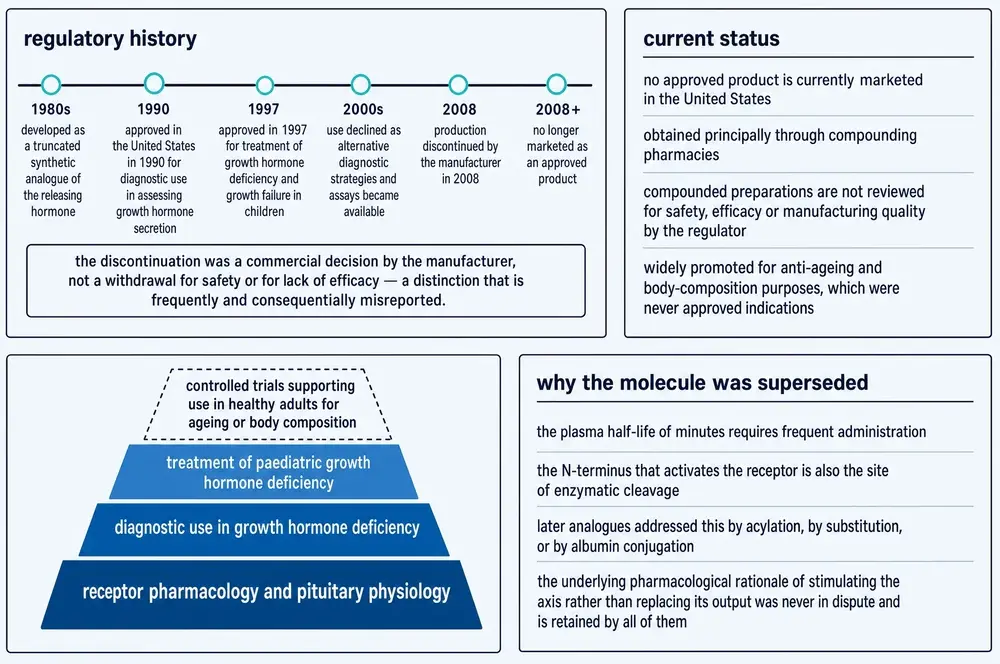
The molecule was in the literature from 1983 and in human studies from 1985. The international non-proprietary name sermorelin was adopted at the end of the decade; the ChEMBL record for sermorelin acetate gives 1989 as the year of its United States adopted name, under the stem -relin, reserved for hormone-release-stimulating peptides.
This eight-year lag is not a curiosity. It is the reason that a literature search for “sermorelin” misses the entire foundational period of the compound’s science. The discovery decade calls this molecule GRF(1–29)NH2, hpGRF(1–29), hGHRH(1–29)NH2 or GHRH-29, and never once calls it sermorelin. Anyone assembling the evidence — including the assembler of this document — has to search on the fragment notation as well as the name, and then face the second problem, which is that the fragment notation is also how two other drugs describe their own backbone.
Section 06Twenty-nine residues and nothing else
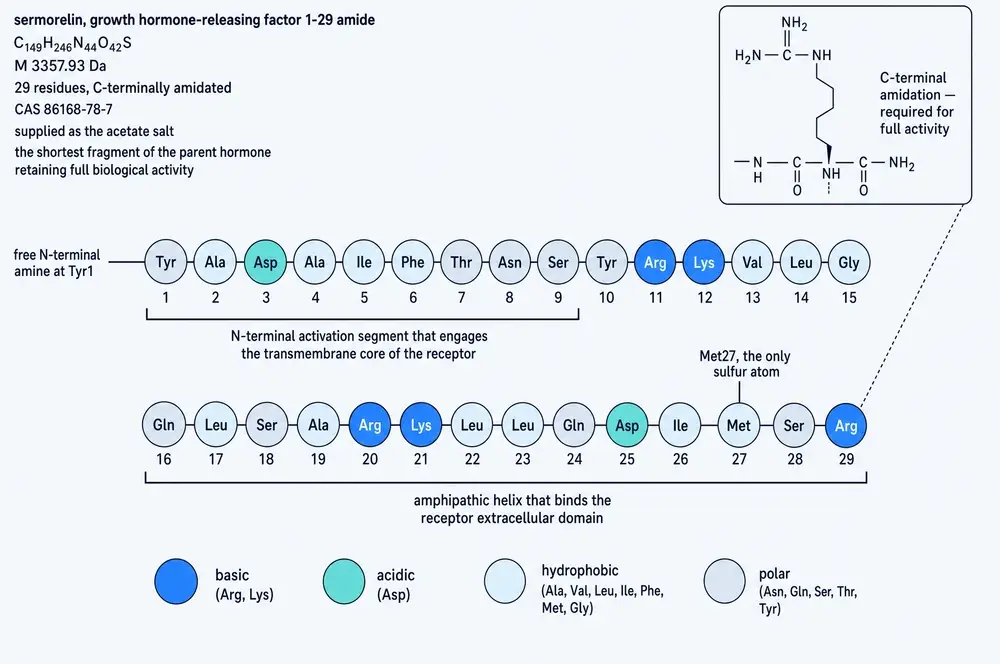
Sermorelin is unusually easy to describe, because almost nothing has been done to it. Take the first twenty-nine residues of human growth-hormone-releasing hormone, cap the carboxyl end with an amide, and stop. There are no non-natural amino acids, no substitutions, no fatty acyl group, no polymer, no conjugate. It is the parent hormone, truncated and closed.
The absence of modification is the whole point of the molecule and also its whole problem. Everything that makes sermorelin a clean scientific instrument — it is the hormone, minus a tail that does nothing — is the same thing that makes it a poor drug. There is nothing in the structure defending it from the enzyme that is about to eat it.
Section 07What happens at the cell
The receptor for this hormone sits on the somatotroph, the growth-hormone- producing cell of the anterior pituitary. It belongs to class B1 of the G-protein-coupled receptors, the family that also handles glucagon, secretin and parathyroid hormone, and it binds its ligand in the two-stage way characteristic of that class: a large extracellular domain first captures the peptide’s C-terminal helix, which supplies most of the binding energy, and the peptide’s amino terminus then inserts into the helical bundle in the membrane and switches the receptor on.
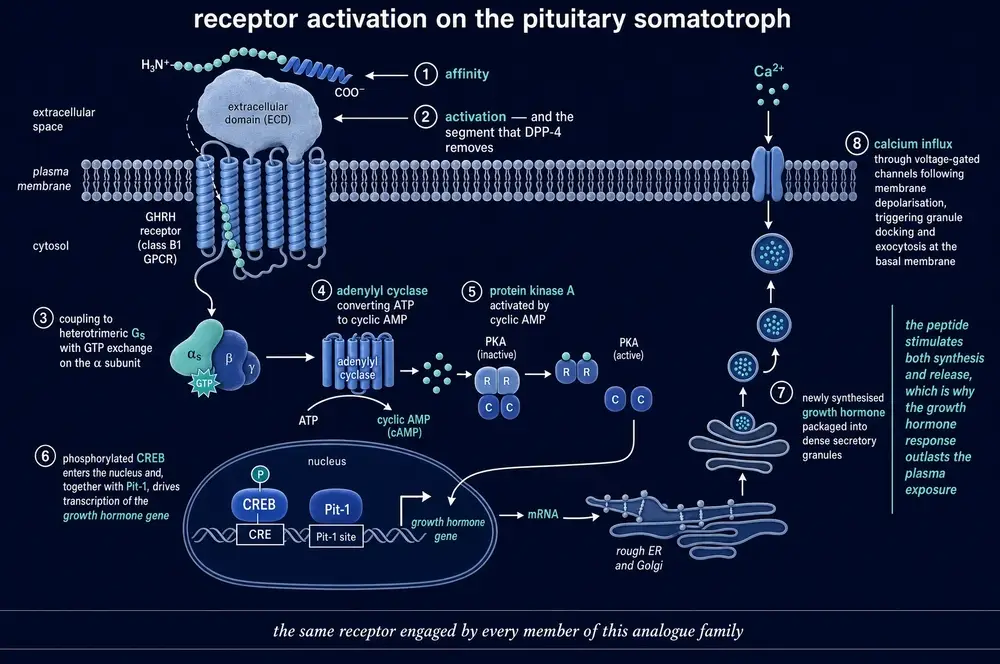
Two features of this arrangement matter for everything that follows. The first is the division of labour between the ends of the peptide: affinity at one end, activation at the other. The second is that the activating end is chemically exposed. A molecule whose business end is its amino terminus is a molecule whose business end is the first thing a plasma aminopeptidase will reach.
Section 08Stimulating a system rather than replacing its output
There are two ways to raise growth hormone in a person. You can inject growth hormone, or you can ask the pituitary for more of its own. These are not variations on a theme; they are different in kind, and the difference is the central pharmacological argument for this entire class of compound.
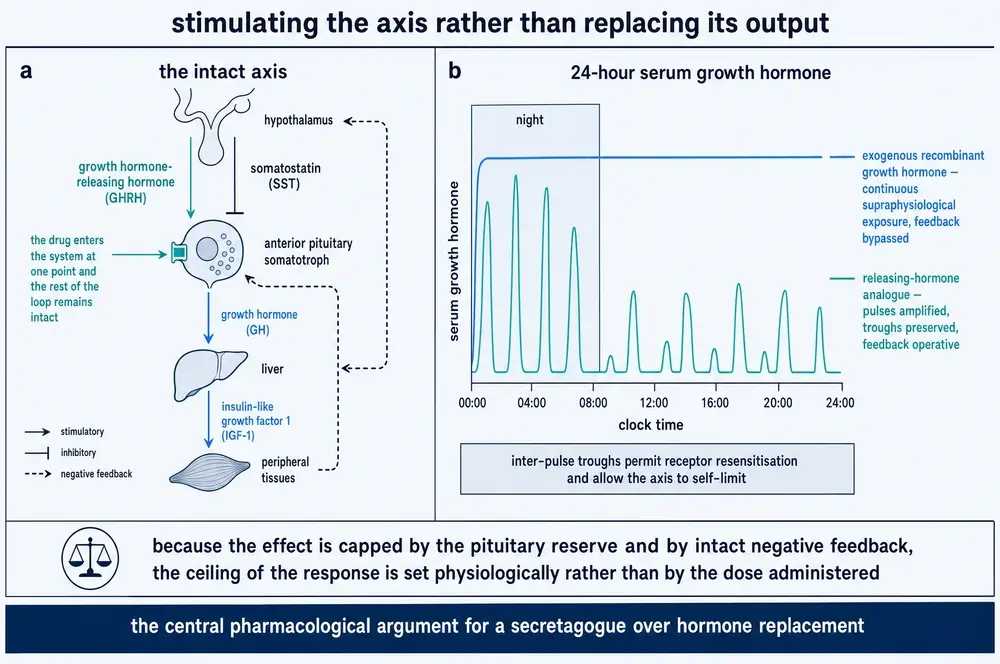
The practical consequence is a ceiling. Because the pituitary can only release what it has, and because IGF-1 feedback continues to operate, the response to a releasing-hormone analogue is limited by the gland rather than by the syringe. That is a genuine safety property, and it is the honest core of the case for secretagogues. It is also, precisely, why sermorelin lost the market it was approved for: a child with severe growth-hormone deficiency needs more hormone than their own pituitary will ever make, and a drug with a physiological ceiling cannot deliver it. The property that makes the compound attractive to a healthy adult is the property that made it inadequate for the sick child. Part Three returns to this.
Section 09Minutes of drug, hours of hormone
Sermorelin is cleared from plasma with striking speed, and the mechanism of its inactivation is more interesting than the rate.
The principal route is dipeptidyl peptidase-4, the same enzyme that gliptin drugs are designed to inhibit in diabetes. It cleaves after the second residue, removing a Tyr-Ala dipeptide and leaving a (3–29) fragment. Because the amino terminus is the activating end, that fragment is not a shortened agonist; it is essentially inert. Frohman and colleagues demonstrated the equivalent conversion for the full-length hormone in human plasma and showed that the resulting (3–44) product retains full immunoreactivity while carrying less than a thousandth of the biological activity (Frohman et al., 1986). Kubiak and colleagues, working with a (1–29) analogue in bovine and porcine plasma, showed the same cleavage and demonstrated its cause directly: adding a competitive dipeptidyl-peptidase inhibitor extended the peptide’s half-life in bovine plasma from 22.1 minutes to 83.3 minutes (Kubiak et al., 1989).
Because the inactivated (3–44) product is fully immunoreactive, radioimmunoassay measures a half-life of about 63 minutes for material that has a biologically active half-life of about 7 minutes (Frohman et al., 1986). Any statement about “circulating GHRH” derived from an antibody-based assay is therefore measuring something roughly nine times more persistent than the active hormone. This matters when reading older literature and it matters for any claim about how long a dose of this compound is present.
How long, then, does sermorelin last? The honest answer is more awkward than a number. One value is solidly measured, one belongs to a different molecule, and the value most often printed cannot be traced to a source at all.
Reference works, review articles and vendor literature state that sermorelin’s half-life is 11 to 12 minutes after intravenous or subcutaneous administration, with clearance of 2.4 to 2.8 L/min. These figures are attributed to the approved labelling. The approved labelling could not be located. There is no Geref label on any Food and Drug Administration domain and none in DailyMed; the Drugs@FDA record for the therapeutic application contains no documents whatever, and the file for the diagnostic application holds only two 1991 chemistry supplements, scanned without a text layer and partly withheld as trade secret. Archival probes for a hosted label returned nothing.
Nor do the secondary sources agree with each other. A 2024 review gives a mean elimination half-life of 8 minutes and cites, for that figure, the tesamorelin label — a different drug. A 2026 review gives 4.3 ± 1.4 minutes, which is Soule’s measurement. No source of any kind could be found for the clearance figure.
This document therefore reports the value that is traceable to a primary measurement — 4.3 ± 1.4 minutes, ten normal men, constant intravenous infusion (Soule et al., 1994) — and records the others as what they are. The label may well say 11–12 minutes; the point is that nobody quoting it appears to have read it, and neither has this document.
Against that brevity, the biological effect is long. Growth hormone peaks roughly fifteen to thirty minutes after an intravenous bolus (Barron et al., 1985) and remains elevated for a period measured in hours — by which time the peptide itself is long gone. This is not paradoxical. It is what a secretagogue does: the drug starts a secretory event, and the event then runs on the gland’s own timetable. Because the cascade in Section 07 drives transcription as well as exocytosis, the pituitary is still making hormone after the trigger has been cleared.
Section 10The family it founded
Sermorelin’s permanent contribution is that it defined a scaffold. Once it was established that twenty-nine residues carry the pharmacology and that certain positions within them tolerate or reward substitution (Section 04), the design problem for everyone who came afterwards was no longer “what is the active molecule?” but “how do we keep it in the body longer?” Three answers were tried, and all three worked.
There is a pleasing symmetry in the authorship. Lawrence Frohman, whose patients pointed the field at the pancreas in 1980, is a co-author on the 2005 trial that established CJC-1295’s multi-day half-life (Teichman et al., 2006). The problem he helped open and the problem sermorelin left unsolved were closed by the same person, twenty-five years apart.
What sermorelin gets from this comparison is not a defeat but a definition. It is the control condition. Every claim that an acyl cap or an albumin hook extends duration is a claim measured against the unmodified fragment, and the unmodified fragment is this molecule. That is a permanent role, and no later analogue takes it away.
Section 11A question only this molecule could answer
A child is not growing. Blood tests show too little growth hormone. The clinical question that follows is not whether the axis is broken but where — because the pituitary might be incapable of making the hormone, or it might be perfectly capable and simply never asked. Those two children need different things, and for most of the twentieth century there was no clean way to tell them apart. The standard provocation tests — insulin hypoglycaemia, arginine, glucagon — all work indirectly, by prodding the hypothalamus and waiting to see what the pituitary does. A flat response tells you the chain is broken somewhere along its length.
A releasing hormone bypasses the hypothalamus entirely and knocks on the pituitary door. If the somatotrophs answer, they are intact and the fault lies upstream. If they do not, the fault is in the gland. This is a genuinely different piece of information, and it is the reason the first approved use of sermorelin in the United States was diagnostic rather than therapeutic.
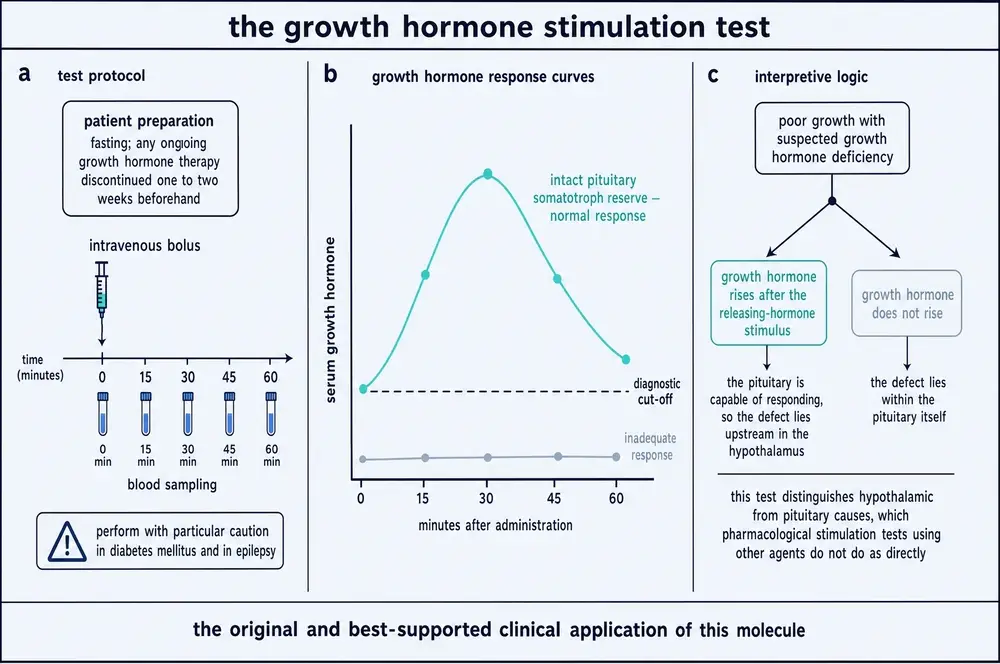
The test earned its keep. Ross and colleagues gave GHRH(1–29)NH2 to eight normal adults and forty-one short children and found that in twenty-three of the twenty-eight children classified as severely growth-hormone-deficient on insulin hypoglycaemia, the peak response to the releasing hormone nonetheless exceeded the best value hypoglycaemia had produced — evidence that in most of these children the defect was hypothalamic rather than pituitary (Ross et al., 1987b). Later work used the same logic more finely: Maghnie and colleagues showed that the pattern and timing of the response to a three-hour escalating infusion tracked structural abnormalities visible on magnetic resonance imaging, with an absent or grossly delayed response marking pituitary-stalk disease (Maghnie et al., 1996).
The same authors are careful about the test’s limits, and so is this document: a releasing-hormone test tells you what the pituitary can do when asked directly. It cannot by itself establish that a child is growth-hormone deficient, because a healthy pituitary responds whether or not the hypothalamus is doing its job in daily life. That is a diagnostic distinction, not a subtlety.
Section 12Eighteen children
The therapeutic question was whether a molecule that asks the pituitary for more hormone could substitute for injecting the hormone itself. The trial that defined the answer was published in the Lancet in January 1987.
Ross and colleagues treated eighteen prepubertal growth-hormone-deficient children with twice-daily subcutaneous injections of GHRH(1–29)NH2. Twelve grew faster. Eight were judged to have shown a worthwhile response, defined as a height-velocity increase of more than two centimetres a year, with increases ranging from 2.7 to 11.2 cm/yr, and those gains were maintained over six to eighteen months of continued treatment. In the fourteen children who had previously received human growth hormone, height velocity on the releasing hormone correlated with height velocity on the hormone itself — the children who responded to one responded to the other (Ross et al., 1987a).
Four of those children decelerated. Their growth slowed on treatment, and the authors report plainly that they do not know why.
A second strand tested the compound in children who were merely short rather than deficient. Hernández and colleagues gave GRF(1–29)NH2 each evening for six months to eleven children with normal growth-hormone secretion, and all eleven increased their growth velocity — while twenty-four-hour growth-hormone profiles, pulse frequency, pulse amplitude and IGF-1 showed no significant change before, during or after treatment (Hernández et al., 1988). The children grew and the measurements the growth was supposed to be explained by did not move. In a six-month uncontrolled study of growing children, that is a difficult result to interpret and the authors do not resolve it.
Section 13Why the antibodies did not sink it
Fourteen of eighteen children raising antibodies against an injected hormone sounds like the end of a drug. It was not, and the reason is a genuine and underappreciated property of the truncation.
Petersen and colleagues raised antibodies against both the full 44-residue hormone and the 29-residue fragment and mapped where they bound. The dominant antigenic surface of the full-length molecule lives in residues 30 to 44: that region bound 85 per cent of the antibodies raised against the whole hormone, and bound them with high affinity. The 1–29 region bound only 15 per cent of them, and did so an order of magnitude more weakly. Antibodies raised against the fragment itself had low affinity for everything, including the native hormone (Petersen et al., 1989).
In other words, sermorelin lacks the part of the hormone that the immune system most objects to. The fifteen residues discarded for being pharmacologically inert turn out to have been carrying most of the immunogenicity. Mowles and colleagues gave African green monkeys twice-daily subcutaneous injections for six months and found that antibodies appeared in one animal of six on the full-length hormone and one of six on a (1–29) analogue, at low titre, and that dialysed serum from those animals did not impair the ability of either peptide to stimulate growth hormone from pituitary cells — the antibodies were non-neutralising (Mowles et al., 1991).
Truncation to twenty-nine residues was done for potency reasons — it cost nothing and simplified synthesis. It happened also to remove the molecule’s principal antigenic region. That is a real advantage of this compound over the full-length hormone, it is supported by direct epitope-mapping evidence, and it is almost never mentioned in the material that markets it, which prefers arguments about youthfulness.
Section 14Twenty-nine days
The commercial story of sermorelin was decided before it was ever approved, by two events one month apart in the autumn of 1985.
Until then, growth hormone for children came from human cadaveric pituitaries, collected at autopsy and pooled. It was scarce, rationed, and distributed through national programmes. A drug that could persuade a child’s own pituitary to make more hormone was therefore not merely an alternative to injected growth hormone — it was an answer to a supply crisis. That was the strategic case for a secretagogue, and in 1984 it was compelling.
On 19 September 1985 the New England Journal of Medicine published, back to back, two reports of Creutzfeldt–Jakob disease in young recipients of cadaveric human growth hormone (Koch et al., 1985; Gibbs et al., 1985). Distribution of pituitary-derived hormone was halted. The eventual United States follow-up cohort ran to 6,284 recipients (Fradkin et al., 1991), and the disease continued to appear in that cohort for decades.
Twenty-nine days later, on 18 October 1985, the Food and Drug Administration approved the first recombinant human growth hormone. The supply problem that made a secretagogue strategically attractive had been solved by fermentation, within a month, and permanently.
19 September 1985 — cadaveric growth hormone linked to
Creutzfeldt–Jakob disease; supply ends.
18 October 1985 — recombinant human growth hormone approved;
supply becomes unlimited.
28 December 1990 — sermorelin (Geref) approved in the United
States, for diagnostic use only.
26 September 1997 — a second approval, for treatment of
idiopathic growth-hormone deficiency in children with growth failure. By this
date recombinant growth hormone had held the market for twelve years.
July and December 2008 — the manufacturer notifies the FDA that
it is discontinuing both products.
18 June 2009 — approval of both applications formally
withdrawn.
Sermorelin arrived five years late to a problem that no longer existed, and its therapeutic indication arrived twelve years late. Against an unlimited supply of the hormone itself, a drug whose whole design principle is that it cannot exceed the pituitary’s own ceiling had nothing to offer the patients who needed the most hormone. The physiological elegance was real and it was irrelevant to the clinical decision.
What the regulatory record does not say is that the products failed. When the Food and Drug Administration later considered the matter formally, it determined that neither Geref product had been withdrawn from sale for reasons of safety or effectiveness — the finding that permits generic applications to reference a discontinued drug. The company stopped selling it. Nobody found anything wrong with it. Those are different facts, and Part Four is largely about what has been built on the gap between them.
Section 15The case for the somatopause, put fairly
Growth-hormone secretion falls with age. This is not disputed and it is not small: nocturnal secretion in healthy elderly men runs roughly a third lower than in young men. Body composition changes in the same direction over the same decades — less lean mass, more fat — and the two facts have been tied together into a hypothesis, the somatopause, which holds that some of what we call ageing is growth-hormone deficiency arriving slowly.
If that is right, the next question is where the deficit sits, and this is where the argument for a releasing hormone becomes genuinely strong rather than merely plausible. Russell-Aulet and colleagues answered it with an elegant experiment. They infused graded doses of a competitive GHRH-receptor antagonist into healthy young and elderly men and measured how much of the spontaneous growth-hormone secretion each dose could suppress. If a pituitary is being driven hard, it takes more antagonist to shut it down; if it is being driven weakly, less. The dose–inhibition curve for spontaneous secretion was shifted to the left in the elderly men. Meanwhile, graded boluses of GHRH itself produced dose-dependent responses that did not differ between the age groups at all (Russell-Aulet et al., 1999).
The conclusion follows cleanly: the aged pituitary answers a releasing signal normally; what has declined is the signal. Soule and colleagues reached a compatible conclusion by a different route, finding that manipulating somatostatin tone did not restore the elderly growth-hormone response while priming with repeated GHRH did, in two of three men tested (Soule et al., 2001).
This is the real mechanistic case, and it deserves to be stated without sarcasm: if the deficit is upstream of the pituitary, then supplying a releasing hormone is the pharmacologically correct intervention, and injecting growth hormone is the crude one. Every subsequent criticism in this Part is a criticism of the evidence, not of the reasoning.
Section 16The trials that exist
There are not many, they are small, they are short, and they were mostly done in the 1990s. Taken together the entire controlled human literature on this compound in ageing amounts to fewer than sixty subjects.
Corpas and colleagues, 1992. Ten healthy non-obese men aged 68 ± 6 and nine young men aged 26 ± 4. The older men took low-dose and then high-dose GHRH(1–29) subcutaneously twice daily for fourteen days each, with a washout between. At the high dose, mean 24-hour growth hormone, area under the secretory peaks, peak amplitude and IGF-1 all rose, and afterwards none of those measures differed significantly between the age groups — the old men’s hormone profile had been returned to the young men’s range. No effect on fasting glucose, urinary C-peptide, blood pressure, or chemistry and haematology (Corpas et al., 1992).
This is the study most often cited as showing that sermorelin reverses the hormonal changes of ageing, and it does show that. What it does not show is anything about the body, because body composition was not measured. The paper’s own closing sentence is a hypothesis, not a finding: the results suggest that prolonged treatment could improve age-related alterations in body composition. Fourteen days is not prolonged treatment.
Vittone and colleagues, 1997. Eleven healthy ambulatory non-obese men aged 64 to 76 with low baseline IGF-1, self-injecting 2 mg of GHRH nightly for six weeks, with dual-energy X-ray absorptiometry, muscle biopsy and phosphorus magnetic-resonance spectroscopy of working forearm muscle. Nocturnal growth-hormone release rose. Two of six strength measures improved, as did one endurance test. And that is the end of the positive findings. There was no change in IGF-1, IGF-binding protein-3 or growth-hormone-binding protein; no change in weight, body-mass index, waist-to-hip ratio, or the muscle and fat compartments measured by absorptiometry; no change in muscle histology, in lipids, or in glucose and insulin responses. The authors’ conclusion is that single nightly doses are less effective than multiple daily doses (Vittone et al., 1997).
Khorram, Laughlin and Yen, 1997 — the largest and longest. Nineteen subjects, ten women and nine men aged 55 to 71, in a single-blind placebo-controlled trial: four weeks of nightly saline followed by sixteen weeks of nightly drug at 10 µg/kg. Twelve-hour nocturnal growth hormone rose in both sexes. IGF-1 and IGF-binding protein-3 rose within two weeks. Skin thickness increased in both sexes. Lean body mass increased in men only. Insulin sensitivity, general well-being and libido improved in men only. Sleep quality was unaffected. There was no change in bone mineral density or in the other body-composition measures. The only adverse effect was transient hyperlipidaemia, which resolved (Khorram et al., 1997a).
Two details of that trial are routinely omitted when it is cited. The first is that the IGF-1 and binding-protein elevations remained elevated for twelve weeks and were returning toward baseline by week sixteen — inside a four-month study, the biochemical effect was already fading. The second is in Section 17.
Section 17Whose molecule was in the syringe
This is the most consequential thing in this document, and it takes one sentence to state.
Khorram, Laughlin and Yen (1997) and Khorram, Yeung, Vu and Yen (1997) both administered [Nle27]GHRH-(1–29)-NH2 — the fragment with methionine 27 replaced by norleucine. That is not sermorelin. It is a substituted analogue, made to remove the one oxidisable residue in the molecule, and it appears in the titles of both papers.
The substitution is small and its pharmacological consequence may well be modest. That is not the point. The point is that the two studies most often produced as evidence that “sermorelin increases lean body mass” and “sermorelin enhances immune function in the elderly” tested a different compound, and the alanine scan in Section 04 shows that position 27 is not inert — substituting it produced an analogue with 15 to 40 per cent of the reference potency, one of the weaker outcomes in the scan (Cervini et al., 1998).
The confusion is not the marketers’ invention. PubMed indexes several of these analogue studies under the supplementary concept Sermorelin, because the controlled vocabulary treats the fragment family as one entity. An indexer will not separate them. A reader has to.
The same caution applies backwards through the literature. The “superactive” analogues of the 1980s were D-Ala2 and acetylated-D-Tyr1 derivatives; the systematic structure–activity work was performed on the [Nle27] parent (Cervini et al., 1998); the 6–7-minute half-life so often quoted for sermorelin belongs to the D-Ala2 analogue (Section 09). Of the ageing trials above, Corpas and Vittone used sermorelin itself; Khorram did not.
Section 18The manufacturer’s own verdict
There is a document that settles the question of whether sermorelin’s pharmacokinetics were adequate, and it comes from the company that sold it.
In 2005, Serono published a phase 1 trial of a polyethylene-glycol-conjugated GHRH in twelve healthy young men and twenty elderly men and women. The paper opens by stating that the clinical use of GHRH “is limited by its short half-life” and that the conjugate was developed to provide increased stability compared with the currently available GHRH(1–29) — that is, compared with its own marketed product. Michael Thorner, who supplied the tumour in 1982, is a co-author (Munafo et al., 2005).
The results are informative in both directions. The conjugate raised growth hormone and IGF-1, and the effect persisted for twelve hours after a single dose in the young and was sustained on repeated dosing in the elderly. No antibodies to GHRH were observed. But injection-site reactions were more frequent than with placebo, and — the finding that matters most for any proposal to give this class of drug to healthy older people for long periods — some impairment of glucose tolerance was observed in the elderly following repeated administration.
Raising growth hormone is not a free action. Growth hormone is counter-regulatory to insulin, and the expected metabolic cost of raising it chronically is exactly this. A three-week phase 1 study found it; no study of sermorelin has run long enough in healthy adults to say whether it does the same.
Section 19Why a discontinued drug is everywhere
The clearest statement of the commercial logic was published in 2006, in a journal article that is worth reading closely because it is remarkably candid.
The piece argues that recombinant growth hormone has become popular in “age management” practice but carries unresolved concerns — that it is mitogenic and may awaken latent cancers, that improper dosing may promote metabolic disorders, that pharmacological delivery bypasses feedback — and proposes sermorelin as the better alternative. It concedes, in its own opening paragraphs, that “few clinical studies have been performed” on long-term growth-hormone therapy and that the concerns “are speculative”. It explains sermorelin’s commercial failure in children by an ingenious inversion: the compound failed as a growth-promoting agent in children for the very reason that it is better for adults, because deficient children need more hormone than their own pituitary can make. That argument is correct, and this document made it in Section 08 — but it is an argument about mechanism, offered in place of evidence about outcomes.
Then it names the actual mechanism of the market:
Unlike recombinant growth hormone, which carries specific legal restrictions on its clinical use in the United States, the off-label prescribing of sermorelin is not prohibited by federal law (Walker, 2006).
That is the entire explanation for why a drug discontinued in 2008 is more widely available in 2026 than it was when it was approved. It is not a scientific advantage. It is a statutory one.
The same article closes by offering sermorelin free of charge, on a competitive basis, to practitioners willing to study it under protocol and publish the results. Twenty years later, that call has not produced a controlled trial of sermorelin for ageing or body composition in the indexed literature. A recent review of growth-hormone secretagogues in men — covering sermorelin, GHRP-2, GHRP-6, ibutamoren and ipamorelin — reaches the same conclusion in the language of a systematic assessment: current data on clinical efficacy largely remain lacking, and the paucity of data limits understanding of these compounds’ role (Sinha et al., 2020).
Section 20What is actually in the vial
Because no approved product is marketed, material reaches users through compounding pharmacies and through research-chemical suppliers. Compounded preparations are not reviewed by the regulator for safety, efficacy or manufacturing quality — that is what compounding is, not an accusation — and the consequence for a peptide with sermorelin’s chemistry is specific rather than generic.
Coppieters and colleagues, developing a detection assay, report that sermorelin and its metabolite degrade rapidly at temperatures above 4 °C and at pH below 7, and that proper handling of samples is essential to avoid losing them before analysis (Coppieters et al., 2022). A molecule that decays in a laboratory sample tube between collection and assay is a molecule whose content in an unrefrigerated vial of uncertain provenance is not knowable. Add the single methionine of Section 06 — the oxidation-sensitive residue that [Nle27] analogues exist to remove — and the stability question is not hypothetical.
It is worth being precise, because this compound’s regulatory position is not the same as that of the peptides it is usually sold alongside, and the difference runs in sermorelin’s favour.
Sermorelin does not appear on the list of drug products withdrawn from the market for reasons of safety or effectiveness, which is the list that would bar it from compounding outright. It is not on the interim category of substances the agency has flagged as possibly presenting significant safety risks. It appears instead in the Category 1 “under evaluation” tier of nominated bulk substances for outsourcing facilities, annotated as a component of an approved drug — which it was.
By contrast, the peptides most often marketed with it — BPC-157, CJC-1295, ipamorelin, epitalon, MOTS-c, melanotan II, selank, semax, thymosin beta-4, thymosin alpha-1, GHK-Cu and others — were nominated and then withdrawn from consideration. Sermorelin is a former approved active ingredient under evaluation; they are not. Anyone reasoning about this class as a single regulatory block is reasoning about a category that does not exist.
This document takes no view on what any individual should do. It observes only that the two most commonly cited reasons for choosing sermorelin over recombinant growth hormone — that it is more physiological, and that it is better characterised because it was once an approved drug — point in opposite directions once the second is examined. The approved product was characterised, at least to the satisfaction of a regulator in 1990 and 1997. What is sold now is not the approved product, and, as Section 09 showed, even the approved product’s published pharmacokinetics are no longer retrievable from the record.
Section 21The other GHRH literature
If you count papers rather than product listings, the largest body of modern research on this hormone has nothing to do with ageing, body composition or growth. It is oncology, and it runs in the opposite direction from everything in Part Four.
The finding that opened it is that the growth-hormone-releasing hormone receptor is not confined to the pituitary. It, and splice variants of it, are expressed by a wide range of tumours, and the hormone itself is produced locally by them — making it an autocrine or paracrine growth factor rather than a distant endocrine signal. This was shown for small-cell lung carcinoma, and subsequently for cancers of the prostate, breast, stomach and mouth among others. Knocking down expression of the hormone inhibits proliferation of human cancer cells; expressing a receptor splice variant in fibroblasts is enough to drive them to proliferate.
The therapeutic programme built on that observation, largely by Andrew Schally’s group — the same Schally of Part One — uses antagonists. Blocking the receptor inhibits tumour growth across a long series of models. This is a serious, sustained and internally consistent literature, and it makes a straightforward prediction: an agonist at this receptor should do the opposite.
Section 22Two studies that disagree, and how to weigh them
Two papers in this corpus bear directly on what sermorelin itself does to tumour cells, and they point opposite ways.
Stepień and colleagues, 2009. They applied GHRH(1–29)NH2 — sermorelin, the actual molecule — to a human bronchial neuroendocrine tumour cell line at concentrations from 10−8 to 10−6 M. It increased proliferation, and increased secretion of vascular endothelial growth factor and chromogranin A. Their conclusion is stated plainly: the hormone functions as a trophic hormone for these tumours (Stepień et al., 2009).
An in-silico screen, 2021. A group working on recurrent glioma computed a transcriptomic “drug resistance score” for 4,865 drugs across 1,018 glioma patients with sequencing data, and reported that recurrent tumours scored as most sensitive to sermorelin. They noted that the receptor is more highly expressed in recurrent than in primary gliomas, and showed that sermorelin reduced viability of two glioblastoma cell lines in a dose- and time-dependent assay. The paper proposes sermorelin as a repurposing candidate for recurrent glioma (Chang et al., 2021).
The reason to set these side by side is not to declare a winner. It is that the anti-ageing case for sermorelin is a case for taking an agonist at a receptor whose best-developed therapeutic literature is a search for antagonists, in people whose cancer risk rises with every year of the age bracket being targeted. That is a real consideration, it is rarely raised in the material that markets the compound, and the honest summary is that nobody has measured it. There is no long-term safety study of sermorelin in healthy adults. Its absence is not evidence of safety and it is not evidence of harm. It is an absence, and it should be named as one.
Section 23Where the new papers come from
One measure of what a compound has become is who is still publishing on it. For sermorelin, an appreciable share of recent primary work is analytical chemistry written by anti-doping laboratories.
Sermorelin is a prohibited substance in sport, and detecting it is technically demanding: the dose is small, the molecule is short-lived, and it degrades in the sample before it can be measured. Coppieters and colleagues developed an antibody-free, ultrafiltration-based assay able to screen and confirm prohibited GHRH analogues — sermorelin, its metabolite, CJC-1295 and tesamorelin — in urine at limits of detection between 5 and 25 pg/mL, and reported along the way the stability findings quoted in Section 20 (Coppieters et al., 2022). Related work has developed immunoaffinity methods for identifying these peptides in plasma.
A field whose growth area is detection rather than therapy has told you where the compound now lives.
Section 24What a fragment is for
Plotted by year, this compound’s literature has a shape that is striking even among discontinued drugs.
The obvious reading is decline, and it is not quite the right one. A literature that stops growing is not always a literature that failed. Sometimes it is a question that got answered.
Sermorelin was asked to establish that the carboxyl-terminal third of growth-hormone-releasing hormone is not required for receptor activation, that twenty-nine residues with an amide are sufficient, and that a synthetic fragment could stimulate the human pituitary as effectively as the natural hormone. It established all three between 1984 and 1985, and none of those findings has been overturned in forty years. The alanine scan that followed turned the finding into a map, and the map was then executed — by tesamorelin, which protected the vulnerable end; by CJC-1295, which substituted at the positions the map marked as free and hung the result on albumin. Those drugs exist because this one defined their starting material.
What sermorelin never became is a good drug, and the reason is contained in its own structure. The residues that activate the receptor sit at the amino terminus, and the amino terminus is the first thing a plasma peptidase reaches. Four minutes of exposure is not a treatment schedule. Every successful molecule in this family is an answer to that one sentence.
The compound’s third career — as a product sold to healthy adults for ageing and body composition — rests on a mechanistic argument that is genuinely sound, a hormonal effect that is genuinely reproducible, and a body of outcome evidence consisting of three small short trials, two of which used a different molecule and one of which measured no body composition at all. That is not a scandal. It is a gap, and it is a gap that has stayed open for thirty years while the compound’s commercial availability grew. It is also, on the evidence assembled here, a thinner base than supported the paediatric indication that was withdrawn.
The useful way to hold all of this at once is to notice that the question sermorelin answered and the question it is now sold to answer are not the same question, and that its permanent achievement belongs to the first. It proved that you do not need the whole hormone. Everything else about this molecule is commentary.
This document describes published research. It does not recommend human use of sermorelin or of any other compound named in it, and it specifies no dose, route or schedule for any person. Every quantity reported above is a parameter of a published study, stated with the species, the number of subjects and the duration attached, and is given for the purpose of describing what was done and what was found.
No approved sermorelin product is marketed. Material obtained outside an approved supply chain has not been reviewed by any regulator for identity, purity, potency or stability, and this compound is known to degrade rapidly above 4 °C and below pH 7.
Section 25References
Generated from verified NCBI records rather than from recall. Author lists, journal names, volumes, pages and identifiers were re-fetched from PubMed for every entry below, and the returned title of each was read back and confirmed to be the paper intended. This series has twice shipped reference lists drafted from memory in which identifiers pointed at real but unrelated papers, and the build refuses to run if any identifier fails to resolve.
One trap specific to this build is worth recording, because it is the shape the failure takes. The small-cell lung carcinoma paper cited in Section 21 is PMC24744. It is not PMID 24744, which is a 1977 paper on a fungal pathogen of mosquito larvae. A PMC identifier and a PubMed identifier that happen to share digits are not the same document, and every PMCID used here was converted through the NCBI identifier service rather than assumed.
- Aitman TJ, Rafferty B, Coy D, Lynch SS, Clayton RN. Bioactivity of growth hormone releasing hormone (1-29) analogues after SC injection in man. Peptides. 1989;10(1):1-4.
PMID 2546126 · doi:10.1016/0196-9781(89)90065-x - Barabutis N, Schally AV. Knocking down gene expression for growth hormone-releasing hormone inhibits proliferation of human cancer cell lines. Br J Cancer. 2008;98(11):1790-6.
PMID 18506184 · doi:10.1038/sj.bjc.6604386 · PMC2410108 - Barron JL, Coy DH, Millar RP. Growth hormone responses to growth hormone-releasing hormone (1-29)-NH2 and a D-Ala2 analog in normal men. Peptides. 1985;6(3):575-7.
PMID 2866496 · doi:10.1016/0196-9781(85)90124-x - Bloch B, Brazeau P, Ling N, Bohlen P, Esch F, Wehrenberg WB, et al.. Immunohistochemical detection of growth hormone-releasing factor in brain. Nature. 1983;301(5901):607-8.
PMID 6402707 · doi:10.1038/301607a0 - Brazeau P, Ling N, Böhlen P, Esch F, Ying SY, Guillemin R. Growth hormone releasing factor, somatocrinin, releases pituitary growth hormone in vitro. Proc Natl Acad Sci U S A. 1982;79(24):7909-13.
PMID 6130528 · doi:10.1073/pnas.79.24.7909 · PMC347459 - Busto R, Schally AV, Varga JL, Garcia-Fernandez MO, Groot K, Armatis P, et al.. The expression of growth hormone-releasing hormone (GHRH) and splice variants of its receptor in human gastroenteropancreatic carcinomas. Proc Natl Acad Sci U S A. 2002;99(18):11866-71.
PMID 12186980 · doi:10.1073/pnas.182433099 · PMC129360 - Böhlen P, Brazeau P, Esch F, Ling N, Wehrenberg WB, Guillemin R. Human growth hormone releasing factor and somatostatin from two pancreatic tumors: isolation and characterization. Regul Pept. 1983;6(4):343-53.
PMID 6138818 · doi:10.1016/0167-0115(83)90263-x - Böhlen P, Esch F, Brazeau P, Ling N, Guillemin R. Isolation and characterization of the porcine hypothalamic growth hormone releasing factor. Biochem Biophys Res Commun. 1983;116(2):726-34.
PMID 6418166 · doi:10.1016/0006-291x(83)90585-5 - Cervini LA, Donaldson CJ, Koerber SC, Vale WW, Rivier JE. Human growth hormone-releasing hormone hGHRH(1-29)-NH2: systematic structure-activity relationship studies. J Med Chem. 1998;41(5):717-27.
PMID 9513600 · doi:10.1021/jm970618s - Chang Y, Huang R, Zhai Y, Huang L, Feng Y, Wang D, et al.. A potentially effective drug for patients with recurrent glioma: sermorelin. Ann Transl Med. 2021;9(5):406.
PMID 33842627 · doi:10.21037/atm-20-6561 · PMC8033379 - Coppieters G, Deventer K, Polet M, Van Eenoo P, Judák P. An antibody-free, ultrafiltration-based assay for the detection of growth hormone-releasing hormones in urine at low pg/mL concentrations using nanoLC-HRMS/MS. J Pharm Biomed Anal. 2022;214:114726.
PMID 35298973 · doi:10.1016/j.jpba.2022.114726 - Corpas E, Harman SM, Piñeyro MA, Roberson R, Blackman MR. Growth hormone (GH)-releasing hormone-(1-29) twice daily reverses the decreased GH and insulin-like growth factor-I levels in old men. J Clin Endocrinol Metab. 1992;75(2):530-5.
PMID 1379256 · doi:10.1210/jcem.75.2.1379256 - Coy DH, Murphy WA, Sueiras-Diaz J, Coy EJ, Lance VA. Structure-activity studies on the N-terminal region of growth hormone releasing factor. J Med Chem. 1985;28(2):181-5.
PMID 3918170 · doi:10.1021/jm00380a006 - Cui T, Schally AV. Growth hormone-releasing hormone (GHRH) and its agonists inhibit hepatic and tumoral secretion of IGF-1. Oncotarget. 2018;9(47):28745-28756.
PMID 29983893 · doi:10.18632/oncotarget.25676 · PMC6033336 - Dioufa N, Farmaki E, Schally AV, Kiaris H, Vlahodimitropoulos D, Papavassiliou AG, et al.. Growth hormone-releasing hormone receptor splice variant 1 is frequently expressed in oral squamous cell carcinomas. Horm Cancer. 2012;3(4):172-80.
PMID 22441816 · doi:10.1007/s12672-012-0108-8 · PMC10358041 - Esch FS, Böhlen P, Ling NC, Brazeau PE, Wehrenberg WB, Thorner MO, et al.. Characterization of a 40 residue peptide from a human pancreatic tumor with growth hormone releasing activity. Biochem Biophys Res Commun. 1982;109(1):152-8.
PMID 7159418 · doi:10.1016/0006-291x(82)91578-9 - Esch FS, Böhlen P, Ling NC, Brazeau PE, Wehrenberg WB, Guillemin R. Primary structures of three human pancreas peptides with growth hormone-releasing activity. J Biol Chem. 1983;258(3):1806-12.
PMID 6130096 - Fradkin JE, Schonberger LB, Mills JL, Gunn WJ, Piper JM, Wysowski DK, et al.. Creutzfeldt-Jakob disease in pituitary growth hormone recipients in the United States. JAMA. 1991;265(7):880-4.
PMID 1992185 - Frohman LA, Szabo M, Berelowitz M, Stachura ME. Partial purification and characterization of a peptide with growth hormone-releasing activity from extrapituitary tumors in patients with acromegaly. J Clin Invest. 1980;65(1):43-54.
PMID 6243140 · doi:10.1172/JCI109658 · PMC371338 - Frohman LA, Downs TR, Williams TC, Heimer EP, Pan YC, Felix AM. Rapid enzymatic degradation of growth hormone-releasing hormone by plasma in vitro and in vivo to a biologically inactive product cleaved at the NH2 terminus. J Clin Invest. 1986;78(4):906-13.
PMID 3093533 · doi:10.1172/JCI112679 · PMC423714 - Gibbs CJ, Joy A, Heffner R, Franko M, Miyazaki M, Asher DM, et al.. Clinical and pathological features and laboratory confirmation of Creutzfeldt-Jakob disease in a recipient of pituitary-derived human growth hormone. N Engl J Med. 1985;313(12):734-8.
PMID 2863752 · doi:10.1056/NEJM198509193131207 - Grossman A, Savage MO, Lytras N, Preece MA, Sueiras-Diaz J, Coy DH, et al.. Responses to analogues of growth hormone-releasing hormone in normal subjects, and in growth-hormone deficient children and young adults. Clin Endocrinol (Oxf). 1984;21(3):321-30.
PMID 6236914 · doi:10.1111/j.1365-2265.1984.tb03477.x - Grossman A, Lytras N, Savage MO, Wass JA, Coy DH, Rees LH, et al.. Growth hormone releasing factor: comparison of two analogues and demonstration of hypothalamic defect in growth hormone release after radiotherapy. Br Med J (Clin Res Ed). 1984;288(6433):1785-7.
PMID 6234047 · doi:10.1136/bmj.288.6433.1785 · PMC1441884 - Guillemin R. Peptides in the brain: the new endocrinology of the neuron. Science. 1978;202(4366):390-402.
PMID 212832 · doi:10.1126/science.212832 - Guillemin R, Brazeau P, Böhlen P, Esch F, Ling N, Wehrenberg WB. Growth hormone-releasing factor from a human pancreatic tumor that caused acromegaly. Science. 1982;218(4572):585-7.
PMID 6812220 · doi:10.1126/science.6812220 - Hernández M, Fragoso J, Barrio R, Argente J, Arilla E. Subcutaneous treatment with growth hormone-releasing hormone for short stature. Horm Res. 1988;30(6):252-7.
PMID 2907992 · doi:10.1159/000181072 - Khorram O, Laughlin GA, Yen SS. Endocrine and metabolic effects of long-term administration of [Nle27]growth hormone-releasing hormone-(1-29)-NH2 in age-advanced men and women. J Clin Endocrinol Metab. 1997;82(5):1472-9.
PMID 9141536 · doi:10.1210/jcem.82.5.3943 - Khorram O, Yeung M, Vu L, Yen SS. Effects of [norleucine27]growth hormone-releasing hormone (GHRH) (1-29)-NH2 administration on the immune system of aging men and women. J Clin Endocrinol Metab. 1997;82(11):3590-6.
PMID 9360512 · doi:10.1210/jcem.82.11.4363 - Kiaris H, Schally AV, Varga JL, Groot K, Armatis P. Growth hormone-releasing hormone: an autocrine growth factor for small cell lung carcinoma. Proc Natl Acad Sci U S A. 1999;96(26):14894-8.
PMID 10611309 · doi:10.1073/pnas.96.26.14894 · PMC24744 - Kiaris H, Schally AV, Busto R, Halmos G, Artavanis-Tsakonas S, Varga JL. Expression of a splice variant of the receptor for GHRH in 3T3 fibroblasts activates cell proliferation responses to GHRH analogs. Proc Natl Acad Sci U S A. 2002;99(1):196-200.
PMID 11773624 · doi:10.1073/pnas.012590999 · PMC117538 - Koch TK, Berg BO, De Armond SJ, Gravina RF. Creutzfeldt-Jakob disease in a young adult with idiopathic hypopituitarism. Possible relation to the administration of cadaveric human growth hormone. N Engl J Med. 1985;313(12):731-3.
PMID 3897861 · doi:10.1056/NEJM198509193131206 - Kubiak TM, Kelly CR, Krabill LF. In vitro metabolic degradation of a bovine growth hormone-releasing factor analog Leu27-bGRF(1-29)NH2 in bovine and porcine plasma. Correlation with plasma dipeptidylpeptidase activity. Drug Metab Dispos. 1989;17(4):393-7.
PMID 2571478 - Lance VA, Murphy WA, Sueiras-Diaz J, Coy DH. Super-active analogs of growth hormone-releasing factor (1-29)-amide. Biochem Biophys Res Commun. 1984;119(1):265-72.
PMID 6231028 · doi:10.1016/0006-291x(84)91647-4 - Ling N, Esch F, Böhlen P, Brazeau P, Wehrenberg WB, Guillemin R. Isolation, primary structure, and synthesis of human hypothalamic somatocrinin: growth hormone-releasing factor. Proc Natl Acad Sci U S A. 1984;81(14):4302-6.
PMID 6431406 · doi:10.1073/pnas.81.14.4302 · PMC345576 - Ling N, Baird A, Wehrenberg WB, Ueno N, Munegumi T, Brazeau P. Synthesis and in vitro bioactivity of C-terminal deleted analogs of human growth hormone-releasing factor. Biochem Biophys Res Commun. 1984;123(2):854-61.
PMID 6435620 · doi:10.1016/0006-291x(84)90309-7 - Losa M, Schopohl J, Müller OA, von Werder K. Stimulation of growth hormone secretion with human growth hormone releasing factors (GRF1-44, GRF1-40, GRF1-29) in normal subjects. Klin Wochenschr. 1984;62(23):1140-3.
PMID 6240568 · doi:10.1007/BF01782473 - Maghnie M, Moretta A, Valtorta A, Larizza D, Sayegh M, Greco AM, et al.. Growth hormone response to growth hormone-releasing hormone varies with the hypothalamic-pituitary abnormalities. Eur J Endocrinol. 1996;135(2):198-204.
PMID 8810733 · doi:10.1530/eje.0.1350198 - Mayo KE, Vale W, Rivier J, Rosenfeld MG, Evans RM. Expression-cloning and sequence of a cDNA encoding human growth hormone-releasing factor. Nature. 1983;306(5938):86-8.
PMID 6415488 · doi:10.1038/306086a0 - Mowles TF, Stricker P, Felix AM, Soike KF, Campbell RM. Effect of human growth hormone-releasing factor and a potent analog on antibody formation in African green monkeys. Horm Metab Res. 1991;23(11):530-4.
PMID 1816063 · doi:10.1055/s-2007-1003747 - Munafo A, Nguyen TX, Papasouliotis O, Lécuelle H, Priestley A, Thorner MO. Polyethylene glycol-conjugated growth hormone-releasing hormone is long acting and stimulates GH in healthy young and elderly subjects. Eur J Endocrinol. 2005;153(2):249-56.
PMID 16061831 · doi:10.1530/eje.1.01965 - Petersen KG, Zeisel HJ, Kerp L. The immune response to GHRH, relationship to conformation. Horm Metab Res. 1989;21(8):427-30.
PMID 2571553 · doi:10.1055/s-2007-1009253 - Rekasi Z, Czompoly T, Schally AV, Boldizsar F, Varga JL, Zarandi M, et al.. Antagonist of growth hormone-releasing hormone induces apoptosis in LNCaP human prostate cancer cells through a Ca2+-dependent pathway. Proc Natl Acad Sci U S A. 2005;102(9):3435-40.
PMID 15728367 · doi:10.1073/pnas.0410006102 · PMC552899 - Rivier J, Spiess J, Thorner M, Vale W. Characterization of a growth hormone-releasing factor from a human pancreatic islet tumour. Nature. 1982;300(5889):276-8.
PMID 6292724 · doi:10.1038/300276a0 - Ross RJ, Rodda C, Tsagarakis S, Davies PS, Grossman A, Rees LH, et al.. Treatment of growth-hormone deficiency with growth-hormone-releasing hormone. Lancet. 1987;1(8523):5-8.
PMID 2879138 · doi:10.1016/s0140-6736(87)90699-4 - Ross RJ, Grossman A, Preece MA, Savage MO, Besser GM. Growth hormone releasing hormone in the assessment and long-term treatment of growth hormone deficiency. Acta Paediatr Scand Suppl. 1987;331:42-7.
PMID 3111168 · doi:10.1111/j.1651-2227.1987.tb17097.x - Russell-Aulet M, Jaffe CA, Demott-Friberg R, Barkan AL. In vivo semiquantification of hypothalamic growth hormone-releasing hormone (GHRH) output in humans: evidence for relative GHRH deficiency in aging. J Clin Endocrinol Metab. 1999;84(10):3490-7.
PMID 10522985 · doi:10.1210/jcem.84.10.6063 - Saeed uz Zafar M, Mellinger RC, Fine G, Szabo M, Frohman LA. Acromegaly associated with a bronchial carcinoid tumor: evidence for ectopic production of growth hormone-releasing activity. J Clin Endocrinol Metab. 1979;48(1):66-71.
PMID 422708 · doi:10.1210/jcem-48-1-66 - Sassolas G, Chayvialle JA, Partensky C, Berger G, Trouillas J, Berger F, et al.. [Acromegaly, clinical expression of the production of growth hormone releasing factor in pancreatic tumors]. Ann Endocrinol (Paris). 1983;44(6):347-54.
PMID 6430207 - Schally AV, Baba Y, Nair RM, Bennett CD. The amino acid sequence of a peptide with growth hormone-releasing activity isolated from porcine hypothalamus. J Biol Chem. 1971;246(21):6647-50.
PMID 4943678 - Sinha DK, Balasubramanian A, Tatem AJ, Rivera-Mirabal J, Yu J, Kovac J, et al.. Beyond the androgen receptor: the role of growth hormone secretagogues in the modern management of body composition in hypogonadal males. Transl Androl Urol. 2020;9(Suppl 2):S149-S159.
PMID 32257855 · doi:10.21037/tau.2019.11.30 · PMC7108996 - Soule S, King JA, Millar RP. Incorporation of D-Ala2 in growth hormone-releasing hormone-(1-29)-NH2 increases the half-life and decreases metabolic clearance in normal men. J Clin Endocrinol Metab. 1994;79(4):1208-11.
PMID 7962295 · doi:10.1210/jcem.79.4.7962295 - Soule SG, Macfarlane P, Levitt NS, Millar RP. Contribution of growth hormone-releasing hormone and somatostatin to decreased growth hormone secretion in elderly men. S Afr Med J. 2001;91(3):254-60.
PMID 11291426 - Spiess J, Rivier J, Vale W. Characterization of rat hypothalamic growth hormone-releasing factor. Nature. 1983;303(5917):532-5.
PMID 6406907 · doi:10.1038/303532a0 - Stepień T, Sacewicz M, Lawnicka H, Krupiński R, Komorowski J, Siejka A, et al.. Stimulatory effect of growth hormone-releasing hormone (GHRH(1-29)NH2) on the proliferation, VEGF and chromogranin A secretion by human neuroendocrine tumor cell line NCI-H727 in vitro. Neuropeptides. 2009;43(5):397-400.
PMID 19747727 · doi:10.1016/j.npep.2009.08.005 - Szabo M, Chu L, Frohman LA. Biological effects of an ectopic growth hormone-releasing peptide in cultured adenohypophyseal cells: comparison with growth hormone-releasing activity of porcine hypothalamus. Endocrinology. 1982;111(4):1235-40.
PMID 6288354 · doi:10.1210/endo-111-4-1235 - Teichman SL, Neale A, Lawrence B, Gagnon C, Castaigne JP, Frohman LA. Prolonged stimulation of growth hormone (GH) and insulin-like growth factor I secretion by CJC-1295, a long-acting analog of GH-releasing hormone, in healthy adults. J Clin Endocrinol Metab. 2006;91(3):799-805.
PMID 16352683 · doi:10.1210/jc.2005-1536 - Thorner MO, Perryman RL, Cronin MJ, Rogol AD, Draznin M, Johanson A, et al.. Somatotroph hyperplasia. Successful treatment of acromegaly by removal of a pancreatic islet tumor secreting a growth hormone-releasing factor. J Clin Invest. 1982;70(5):965-77.
PMID 6290540 · doi:10.1172/jci110708 · PMC370309 - Veber DF, Bennett CD, Milkowski JD, Gal G, Denkewalter RG, Hirschmann R. Synthesis of a proposed growth hormone releasing factor. Biochem Biophys Res Commun. 1971;45(1):235-9.
PMID 4946406 · doi:10.1016/0006-291x(71)90074-x - Vittone J, Blackman MR, Busby-Whitehead J, Tsiao C, Stewart KJ, Tobin J, et al.. Effects of single nightly injections of growth hormone-releasing hormone (GHRH 1-29) in healthy elderly men. Metabolism. 1997;46(1):89-96.
PMID 9005976 · doi:10.1016/s0026-0495(97)90174-8 - Walker RF. Sermorelin: a better approach to management of adult-onset growth hormone insufficiency?. Clin Interv Aging. 2006;1(4):307-8.
PMID 18046908 · doi:10.2147/ciia.2006.1.4.307 · PMC2699646
Sources without a PubMed record
Regulatory instruments are cited to the instrument, never to a summary of it (house style section 10, item 8).
- United States Food and Drug Administration. Determination That GEREF (Sermorelin Acetate) Injection, 0.5 Milligrams Base/Vial and 1.0 Milligrams Base/Vial, and GEREF (Sermorelin Acetate) Injection, 0.05 Milligrams Base/Amp, Were Not Withdrawn From Sale for Reasons of Safety or Effectiveness. <i>Federal Register</i> 2013;78(42):14095–14096. Docket No. FDA-2012-P-1071. 4 March 2013.
- United States Food and Drug Administration. Withdrawal of Approval of 92 New Drug Applications and 49 Abbreviated New Drug Applications. <i>Federal Register</i> 2009;74(95):23407. 19 May 2009. Approval of NDA 19-863 and NDA 20-443 withdrawn effective 18 June 2009.
- United States Food and Drug Administration. Drugs@FDA: NDA 019863, GEREF (sermorelin acetate) injection, EMD Serono, original approval 28 December 1990; NDA 020443, GEREF (sermorelin acetate) injection, EMD Serono, original approval 26 September 1997. Marketing status: discontinued.
- United States Food and Drug Administration. <i>Approved Drug Products with Therapeutic Equivalence Evaluations</i> (the Orange Book), Discontinued Drug Product List, entries for sermorelin acetate under applications N019863 and N020443, each annotated with the Federal Register determination that the product was not discontinued or withdrawn for safety or effectiveness reasons.
- 21 CFR § 216.24 — Drug products withdrawn or removed from the market for reasons of safety or effectiveness. Sermorelin does not appear on this list.
- United States Food and Drug Administration. Bulk Drug Substances Nominated for Use in Compounding Under Section 503B of the Federal Food, Drug, and Cosmetic Act. Sermorelin acetate appears in Category 1, substances under evaluation, annotated as a component of an approved drug product.
- Nobel Assembly at the Karolinska Institutet. The Nobel Prize in Physiology or Medicine 1977: Roger Guillemin and Andrew V. Schally, for their discoveries concerning the peptide hormone production of the brain; and Rosalyn Yalow, for the development of radioimmunoassays of peptide hormones. Press release, October 1977.
- PubChem, National Center for Biotechnology Information. Sermorelin. Molecular formula C<sub>149</sub>H<sub>246</sub>N<sub>44</sub>O<sub>42</sub>S; molecular weight 3357.9. Accessed 2 August 2026.
- ChEMBL, European Molecular Biology Laboratory – European Bioinformatics Institute. SERMORELIN ACETATE, CHEMBL1201490. Maximum phase 4; first approval 1990; USAN 1989, stem <i>-relin</i>; withdrawn flag false. Accessed 2 August 2026.
- World Health Organization. Proposed International Nonproprietary Names, List 56: sermorelinum / sermorelin — growth hormone-releasing factor (human)-(1-29)-peptide amide; CAS 86168-78-7.
Section 26How this document was assembled
The evidence base was built against project 05, the Therapeutic Peptide Research Library, and against NCBI directly. Every file carrying a document extension in the project's document stores was opened and its extracted text searched. That sweep opened 45,975 files and returned 572 assets naming this compound or one of its relatives, with none unreadable.
The reading corpus is 24 unique scientific full texts, roughly 361 printed-page equivalents, assembled from those local stores and from a PubMed Central harvest, keyed by identifier and counted once.
Why 572 local matches produced 11 scientific documents
The local sweep is the clearest illustration in this series of why a raw match count is not a corpus. Of the 572 local assets naming sermorelin, only 11 are peer-reviewed scientific full texts. The remaining 561 are retailer and catalogue pages, archived commercial listings, vendor product PDFs, and this project's own earlier write-ups and writing samples.
That ratio — better than fifty commercial or internal documents for every scientific one — is not an artefact of the sweep. It is a finding about the compound. Sermorelin has a large consumer market and a small and largely historical research literature, and any measure that pools the two will describe the market while appearing to describe the science. Reporting 572 would have been true and useless.
The identity gate, and why it is a sibling problem rather than a homograph problem
“Sermorelin” is a coined international non-proprietary name with no collision anywhere in the life sciences, so the homograph traps that dominated Nos. 05, 15 and 16 in this series do not arise. The difficulty here is the opposite one and it is structural.
The name postdates the molecule by roughly eight years. The compound was in the literature from 1983 and in human studies from 1985; the INN was adopted at the end of that decade. The entire discovery period therefore calls this molecule GRF(1–29)NH2, hpGRF(1–29), hGHRH(1–29)NH2 or GHRH-29 and never once says sermorelin. A matcher keyed on the INN alone would discard the foundational science.
But the fragment notation is also two other drugs' backbone. CJC-1295 is built on GRF(1–29) with four substitutions, and papers about it use the fragment notation constantly. Tesamorelin and somatorelin are the full-length hormone. Subject-matter corroboration cannot separate these, because the subject matter is shared — all are GHRH analogues, all raise growth hormone, all descend from the same 1982 isolation. They separate only by designator, which is house style A22.
The matcher therefore requires an explicit 1–29 residue range wherever it admits on the fragment notation, never confirms on a bare “GRF” or “GHRH”, and gives every relative its own counter so a document admitted on the notation alone can be refused when a sibling outweighs it. In the project's library database the SQL prefilter proposed 33 passages and the matcher admitted 25, rejecting 24.2 per cent.
PubMed indexes several studies of substituted (1–29) analogues — notably [Nle27]GHRH(1–29)NH2 and [D-Ala2]GHRH(1–29)NH2 — under the supplementary concept Sermorelin. The controlled vocabulary treats the fragment family as one entity. Two of this document's most important corrections follow from separating them by hand: the two most-cited ageing trials used the norleucine analogue (Section 17), and the half-life attributed to sermorelin throughout the secondary literature belongs to the D-alanine analogue (Section 09).
The external harvest
The full MeSH descriptor for growth-hormone-releasing hormone returns 5,211 records — the literature of the native hormone and of every analogue ever made from it. That is not this document's subject and it was counted rather than read. A four-arm scoped query returned 644 records, partitioned by publication date and reconciled against the unpartitioned total with a shortfall of zero. Of those, 451 survived an identity screen on title and abstract and 193 were dropped.
Only 46 of the 451 screened records have an open-access full-text deposit, and that is the single most important limitation of this corpus. This is a literature that peaked in 1990 and 1991, a decade before open-access deposit became routine. The foundational papers — the 1982 isolations, the 1984 truncation series, the 1985 human equipotency studies, the 1987 paediatric trial — have no PMCID and are not in the full-text corpus. They were read as indexed records, which for these journals carry structured abstracts reporting the primary numerical results, and every quantity attributed to them in this document was taken from that record rather than from a secondary account of it. Where a value could not be obtained that way it is reported as unverifiable, as in Section 09.
| Stage | What it does | Result |
|---|---|---|
| 01b | Targeted sweep of the project document stores | 45,975 files opened |
| 01b | Classification of local matches by source kind | 11 of 572 scientific |
| 01c | Library database, SQL prefilter gated by the shared matcher | 24.2% rejected |
| 02 | PubMed harvest, partitioned by date, shortfall reconciled | 644 records, shortfall 0 |
| 02b | PubMed Central body-text sweep | 46 targets |
| 03 | Open-access full-text retrieval | 46 retrieved |
| 03c | Substantive-use screen on the retrieved text (A12) | 17 retained |
| 04 | Keyed union of the local and fetched sets | 24 unique |
| 05 | Reference generation from verified NCBI records | 60 citations |
| 06 | Assembly of this document | 1 deliverable |
Counting notes. The merged corpus is keyed by identifier and never summed: 4 documents were present in both stores, and adding the two page totals would have reported 397 pages against a true 361. Of the 46 retrieved full texts, 23 named the compound fewer than 4 times and 6 did not name it at all in the retrieved body; both classes are counted here and were not read. The substantive-use threshold is set at 4, low by the standards of recent builds in this series and deliberately so — the calibration that produced a threshold of twelve for a universal coenzyme would, applied here, discard exactly the diagnostic and tool-use literature that A12 exists to preserve.
Section 27Evidence handling
Findings are labelled by the kind of study that produced them, in the sentence that reports them. Randomised human trials, open-label human studies, animal experiments, cultured-cell measurements, in-silico screens and narrative reviews are different kinds of claim, and the difference is stated rather than left to the reader to infer. Animal and in-vitro results are never phrased so as to imply a human outcome, and the species is named every time.
The livestock literature is kept visibly separate. A substantial part of this compound's published record is animal-production science — growth rate, carcass composition and nitrogen balance in pigs, cattle and sheep — conducted at doses and for purposes that have no clinical counterpart. It is legitimate science and it is not evidence about people. Where it appears it is named as what it is.
Closely related molecules are not pooled. Sermorelin, [Nle27] and [D-Ala2] analogues, CJC-1295, tesamorelin and the native hormone are separate compounds with separate evidence, and the document states which one was administered in every study it reports. Two of the corrections that most change the reading of this literature come from that discipline alone.
Recency is weighted but not blindly. The 2020–2026 literature is treated as current on regulatory status, on detection methods and on the absence of new trials. It is not allowed to outrank older primary work merely by being newer: Section 22 sets a 2021 in-silico repurposing screen against a 2009 experiment that applied the compound to cells and measured the opposite effect, and declines to prefer the newer one, because a transcriptomic signature is not a measurement of a drug's effect.
Where evidence conflicts, both sides are given with the reason one does or does not supersede the other. Three conflicts here are live and are presented as live: whether the fragment is equipotent with the full-length hormone (equipotent in humans, roughly half as potent in the isolated rat pituitary cell); whether agonism at this receptor is a therapeutic strategy or a hazard in the presence of tumour tissue; and what the compound's plasma half-life actually is.
Claims that could not be verified against a primary instrument were withheld or marked. The approved product labelling could not be located on any Food and Drug Administration domain or in DailyMed, so the half-life and clearance figures universally attributed to it are reported as untraceable rather than repeated. No half-life is printed for tesamorelin. The frequently repeated explanation that the product was discontinued because recombinant growth hormone had taken the market is a reasonable inference and is not stated in the regulatory record, which says only that the holder notified the agency the products were no longer marketed; the document says so. Two of the seven commissioned plates supplied for this monograph were withheld under house style A19 and replaced by authored figures — one because it drew CJC-1295 as a thirty-four-residue chain with non-sequential numbering, and one because its central quantitative claim was another molecule's half-life. The verification record for all seven, including every value checked and its outcome, is in the project's MAPPING.md.
Continue exploring