
Epithalon A tetrapeptide, the extract it was inferred from, the family it belongs to, and a mechanism that runs in both directions
Epithalon is the shortest compound in this series and the one with the longest story. Its sequence was not isolated from anything; it was inferred from the amino-acid tally of a cattle-gland extract and then synthesised to see whether the guess worked. It is one of about a dozen peptides built the same way by one laboratory in Leningrad, each assigned to a different organ. Twenty-seven years on, the molecule has a substantial literature, almost all of it from the institute that named it, and a single mechanism — switching telomerase back on — that an outside laboratory has now confirmed. That mechanism is also the reason a regulator has just told an advisory committee the compound may be carcinogenic. Both of those things are downstream of the same measurement.
01Four residues
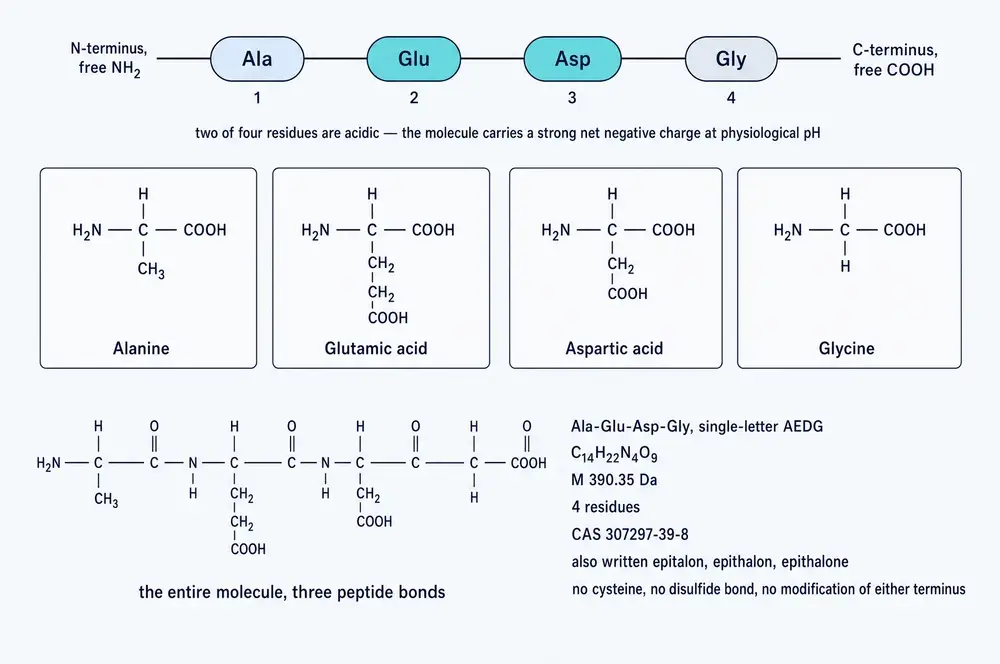
Epithalon is alanine, glutamate, aspartate, glycine — in that order, joined by three ordinary peptide bonds, and nothing else. Written in the one-letter code that biochemists use it is AEDG, which is how a good deal of the literature refers to it. It weighs 390.35 daltons. A molecule of table sugar weighs 342. At physiological pH it carries a net charge of minus two, because both glutamate and aspartate hold a spare acid group that gives up its proton (Khavinson et al., 2020).
Four residues is very short for a molecule expected to do anything interesting. Insulin has fifty-one. The shortest peptide hormones the body makes on purpose run to three. At this length a peptide has almost no structure to speak of: it is a floppy string that samples a great many shapes per nanosecond. What structure it does have comes from two internal salt bridges between the alanine nitrogen and the free acid groups of the other two charged residues, which molecular dynamics simulations report as the main thing holding it in any consistent shape at all.
The compound answers to at least five names. Its originators called it Epitalon; the transliteration Epithalon is more common in English, and Epithalone appears in the older literature. Vendors use all three interchangeably, and several also list it as Epithalamin — which is a different substance, and the source of a great deal of confusion that sections 07 and 21 take apart. The United States Food and Drug Administration, evaluating the compound in May 2026, went out of its way to record that "epitalon is a common name and not United States Adopted Name," and that inconsistent naming of this kind "represent[s] a safety risk for patients as they may be dosed with a different bulk drug substance than the physician ordered" (FDA, 2026). That is an unusually direct thing for a regulator to say about a nomenclature problem, and it is the first sign that this compound's difficulties begin before any pharmacology.
02A stress programme and a meat-packing plant
In 1973, at the S. M. Kirov Military Medical Academy in Leningrad, two military physicians began looking for a way to make soldiers more durable. The problem, as they framed it, was not any particular disease. It was that personnel exposed to ionising radiation, toxic chemicals, injury, oxygen shortage and sustained stress became less able to cope with all of those at once. Khavinson's own retrospective account of the programme, published in 2020, states its object plainly: to raise "the resource of the organism" of service members working under unfavourable conditions (Khavinson, 2020).
The theoretical basis was borrowed from the Hungarian-Canadian endocrinologist Hans Selye, whose general adaptation syndrome divided the body's response to stress into an alarm stage and then a resistance stage. During alarm, Selye had argued, two glands are suppressed: the thymus, which trains the immune system, and the pineal, a pea-sized structure at the centre of the brain that secretes melatonin at night. Resistance normally sets in around the fourth or fifth day. Vladimir Morozov and Vladimir Khavinson reasoned that if you could shorten the gap — if you could push the body into the resistance stage faster — you would have something useful. And the obvious way to do that, in 1973, was to give back what the alarm stage had suppressed: extracts of thymus and pineal gland.
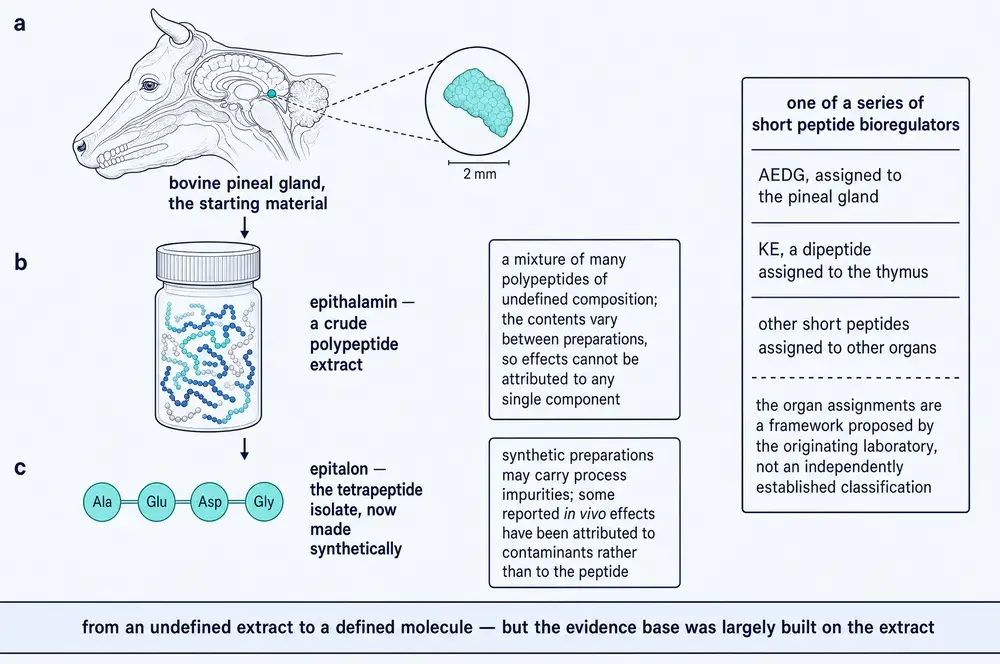
This is where the story acquires its most concrete and least glamorous detail. The work was done jointly with the medical preparations factory of the Leningrad Meat-Packing Combine, an enterprise later reorganised as Samson-Med and still the manufacturer of the resulting products. The reason is straightforward: the raw material was cattle organs, and the meat combine was where cattle organs were. The extraction line Khavinson describes is an industrial one — acetic-acid extraction, centrifugation, precipitation of the low-molecular-weight fraction with acetone, redissolution, removal of ballast, and finally ultrafiltration through hollow fibres whose pores pass nothing above ten kilodaltons. What came off the end was a mixture of small peptides of unknown composition, standardised by molecular weight rather than by chemistry.
In 1988 the programme was formalised: by decision of the USSR State Committee for Science and Technology, a dedicated bioregulator laboratory was established at the Military Medical Academy under Khavinson's direction. The first product, Thymalin, from thymus, was registered in 1982. The pineal preparation, Epithalamin, followed in 1990 (Khavinson, 2020). Neither was a defined molecule. Both were extracts.
03The people
Four men account for most of what follows, and because the independence of this literature is one of its central problems, it is worth knowing who they were and how they were connected.
Vladimir Khatskelevich Khavinson (1946–2024) was born in Cottbus, in what was then East Germany, to a Soviet military family. He went from the Minsk Suvorov Military School to the Kirov Military Medical Academy in Leningrad, graduating as a military physician in 1971, and he stayed. Senior resident in 1977, junior research fellow in 1982, senior research fellow in 1985, and from 1988 head of the Academy's research laboratory for bioregulators — the unit created for this programme. He held the rank of colonel of medical service. In 1992 he founded the St Petersburg Institute of Bioregulation and Gerontology and directed it until his death in January 2024, aged seventy-seven. He was elected a corresponding member of the Russian Academy of Medical Sciences in 2000 and a full academician of the Russian Academy of Sciences in June 2022, two years before he died.
Vladimir Grigorievich Morozov is the co-author of the founding idea and the least visible of the four. He appears on the earliest papers, on the decision to make preparations from thymus and pineal, and on the 2003 paper that carries the family's largest human claim, and then largely disappears from the record.
Vladimir Mikhailovich Dilman (1925–1994) supplied the theory. He ran the endocrinology laboratory at the N. N. Petrov Institute of Oncology in Leningrad, and his idea — that ageing is a drift in hypothalamic regulation rather than accumulated damage — is why anyone was injecting pineal extract into old rats in the first place. Section 04 sets it out.
Vladimir Nikolaevich Anisimov, born 1945, was Dilman's student. He went on to head the Laboratory of Carcinogenesis and Aging at the Petrov Institute from 1987 and its Department of Carcinogenesis and Oncogerontology from 1998, and he is the co-author of nearly all the rodent lifespan and tumour work that Part Three examines. In the 2023 interview that is the best first-person account of this period, he reproduces the inscription Dilman wrote in a book for him in February 1968: to Volodya, my comrade in science (Moskalev, 2023).
The four were working together by 1973. The earliest indexed papers in this lineage — on the effect of epiphyseal extracts on the hypothalamic threshold of old female rats, and on the antitumour activity of pineal against hypothalamic extract in mice with transplanted mammary carcinoma — carry Anisimov, Khavinson, Morozov and Dilman on the same author line (Anisimov et al., 1973a; Anisimov et al., 1973b).
04Dilman's elevation
To understand why anyone thought a pineal extract would slow ageing, it helps to know what the pineal gland meant in Leningrad in the 1970s.
Dilman had proposed in 1954 that ageing is not primarily wear and tear but a regulatory drift. The hypothalamus governs the body's hormonal systems by feedback: it senses circulating hormone concentrations and adjusts its output accordingly. Dilman's claim — he called it the elevation hypothesis, and by 1968 was calling it the neuroendocrine theory of ageing — was that the threshold at which the hypothalamus responds to those signals rises steadily through life. The thermostat drifts. Every downstream system is then run slightly wrong, and the accumulated wrongness is what we recognise as growing old.
This is a testable idea with an obvious therapeutic corollary. If ageing is a rising threshold, then anything that lowers the threshold back toward its youthful setting should push ageing backwards. And that is exactly what the earliest experiments in this lineage measured: the 1972 and 1973 papers are about hypothalamic sensitivity to prednisolone and to oestrogen, in old animals, after pineal extract (Ostroumova & Dil'man, 1972).
The pineal was the natural place to look. Melatonin, its principal secretion, declines monotonically across the lifespan in every mammal examined; the nocturnal peak flattens with age until it is barely a peak at all (Reiter, 1992). Grafting a young pineal gland into an old mouse extended survival (Pierpaoli et al., 1991). By the mid-1990s the pineal had been proposed, in the same review, as a circadian synchroniser whose decay desynchronises everything downstream, as a programmed cellular ageing switch, and as the body's most important antioxidant source (Reiter, 1995). Any of those framings makes a pineal extract worth trying.
Most of that framing has not survived. The circadian pacemaker is now understood to sit in the suprachiasmatic nucleus of the hypothalamus, with the pineal as an output device rather than the clock itself. Melatonin's reputation as an exceptionally potent radical scavenger rested on concentrations far above anything a body produces. And the specific claim that would matter most here — that low melatonin explains the sleep problems of old age — has not held: FDA's 2026 review notes flatly that low melatonin levels "have not been consistently associated with insomnia in elderly adults" (FDA, 2026, citing Youngstedt et al., 1998). What survives is the descriptive observation that started it: melatonin does fall with age. The causal architecture built on top of it has largely been dismantled.
This matters for reading everything that follows. The pineal-clock theory is the reason Epithalon exists. It is not evidence that Epithalon works.
05A family of thirteen
Epithalon is not a single compound with a single story. It is one member of a systematically produced family, and the family is the more interesting object.
The method was always the same. Take an organ from cattle. Extract it by the industrial route described in section 02 to give a mixture of peptides below ten kilodaltons. Register that mixture as a medicine, named for the organ. Then, in a second phase beginning in the late 1980s, go back into the mixture and try to find the individual molecule responsible — and register that too. Thirteen peptide preparations were built this way under Khavinson's direction (Khavinson, 2020).
The extract generation is the one that reached Soviet and Russian pharmacies: Thymalin from thymus, registered 1982; Epithalamin from pineal, 1990; Cortexin from brain cortex, 1999; Prostatilen from prostate; Retinalamin from retina. The molecular generation followed, each named after its parent tissue's function rather than its chemistry.
One line of that table deserves its own sentence. When the group went looking for the active molecule in Retinalamin, the retinal extract, the peptide they arrived at was AEDG — identical to the one they had already derived from the pineal. Khavinson presents this as evidence of a shared regulatory mechanism between pineal and retina, which is a reasonable reading. It can equally be read as evidence that the design method returns the same answer from different starting material, which is a different kind of finding, and the published record does not distinguish them.
The thymus line is the family's success story and the useful comparison. From Thymalin the group isolated individual peptides below one kilodalton by high-performance liquid chromatography, first at bench and then at industrial scale — a kilogram of thymus substance was manufactured at Samson-Med and shipped to the All-Union Cardiological Research Centre for fractionation. The most active fraction turned out to be a dipeptide, Glu-Trp, and V. I. Deigin's group synthesised it as Thymogen, the first Soviet synthetic peptide drug. Its authors received a USSR Council of Ministers Prize.
That is how the procedure is supposed to go: fractionate, identify, confirm the structure, then synthesise. It is not how Epithalon was arrived at.
06From extract to tetrapeptide
By the late 1990s the extract programme had a problem, and Khavinson's laboratory has been candid about it in at least one place. Epithalamin is made from calf pineal glands, and a calf pineal gland is about the size of a grain of rice. FDA's review, reading the group's own 2001 paper, records that the synthetic peptide appeared "due to the limited availability of calf pineal gland needed to produce epithalamin" (FDA, 2026). Supply, not science, is the reason given for going synthetic.
The method used to get from the extract to a molecule is the single most important technical fact in this monograph, and it is routinely misdescribed. Epithalon was not isolated from Epithalamin, sequenced, and then resynthesised, as Thymogen was from Thymalin. It was designed. The group analysed the bulk amino-acid composition of the extract — how much alanine, how much glutamate, and so on, in the mixture as a whole — and from those proportions proposed a four-residue sequence that might account for the activity. Then they made it and tested it. The 2025 review that is the most complete secondary account of the compound states this without euphemism: Epitalon is "a tetrapeptide that was developed on the basis of the amino acids composition of Epithalamin" (Araj et al., 2025).
An amino-acid composition is a shopping list, not a recipe. It tells you what is in the mixture; it tells you nothing about what is bonded to what. Four residues can be arranged twenty-four ways, and that is before considering that the extract contained a great many peptides of many lengths. Choosing AEDG out of that space was an inference, and it should be read as one.
The molecule was claimed as intellectual property before it was claimed as a natural product. Patent priority was filed on 11 May 1999; the Russian patent published on 10 October 2000, and the corresponding United States patent was granted on 27 April 2004. The assignee of the American and European filings is a limited liability company bearing the institute's name.
The claim that the peptide actually exists in a pineal gland came eighteen years after the priority filing. In 2017 the same group reported that mass spectrometry of the pineal polypeptide complex detected AEDG among its tetrapeptides (Khavinson et al., 2017). Their compositional breakdown of that complex is worth seeing, because it shows how crowded the space was that AEDG was picked out of.
07The natural and the synthetic
Because the two substances are sold as though they were one thing, it is worth setting out exactly how they differ and where the difference bites.
Is Epithalon a natural peptide? The honest answer is: probably, on a single unreplicated report, and the question matters less than it sounds. The 2017 mass-spectrometry paper is the only evidence that AEDG occurs in pineal tissue at all. If it is right, the peptide is endogenous — which is the basis for the claim, repeated across the retail market, that this is a substance the body already makes and is simply being topped up with. If it is wrong, or if AEDG is a degradation product of the extraction rather than a molecule the gland produces, then Epithalon is a synthetic compound that happens to be assembled from four common amino acids. Nothing in the published record settles it, and no laboratory outside St Petersburg has looked.
What can be said with more confidence is that endogenous does not mean harmless, and it does not mean active. Adrenaline is endogenous. So is cortisol. The dose, the route and the timing decide what a molecule does, and for this compound none of the three has ever been characterised in a body. A peptide present at picomolar concentrations inside a gland is not doing the same job as ten milligrams injected under the skin.
There is a symmetry here worth stating plainly, because both directions of error are common. The extract's defenders treat every Epithalamin result as though it were an Epithalon result, which it is not. But the molecule's critics sometimes treat the extract evidence as irrelevant, and if AEDG really is a constituent of Epithalamin then the extract trials are weak, indirect, uncontrolled evidence about the molecule — not nothing. The correct position is the uncomfortable middle one: a mixture containing an unknown amount of a compound, given to elderly patients for years, is a poor but non-zero source of information about that compound.
08The academy
Scientific claims are usually stress-tested by people with no stake in them. That process, for this compound, has barely happened, and the reason is structural rather than personal.
A complete harvest of the PubMed record for Epithalon and its extract parent returns 215 indexed papers spanning 1975 to 2026. Of those, 129 carry Khavinson as an author — sixty per cent of the entire literature. Widen the circle to the core collaborating group and it reaches 145, or sixty-seven per cent. Almost half the record appears in three journals: Bulletin of Experimental Biology and Medicine, Advances in Gerontology, and Voprosy Onkologii.
The institutional arrangement is where this becomes structural. Khavinson's institute described itself, in his own author affiliations through the 1990s and 2000s, as belonging to the North-Western Branch of the Russian Academy of Medical Sciences — an academy affiliation, on an institute he had founded himself. In March 1994 the Gerontological Society of the Russian Academy of Sciences was constituted, with Anisimov elected president and Khavinson vice-president; Anisimov held that presidency until December 2022. Anisimov is also editor-in-chief of Advances in Gerontology, the journal carrying thirty-six of the 215 records in this corpus. Khavinson himself became a corresponding member of the Medical Academy in 2000 and an academician of the Russian Academy of Sciences in 2022.
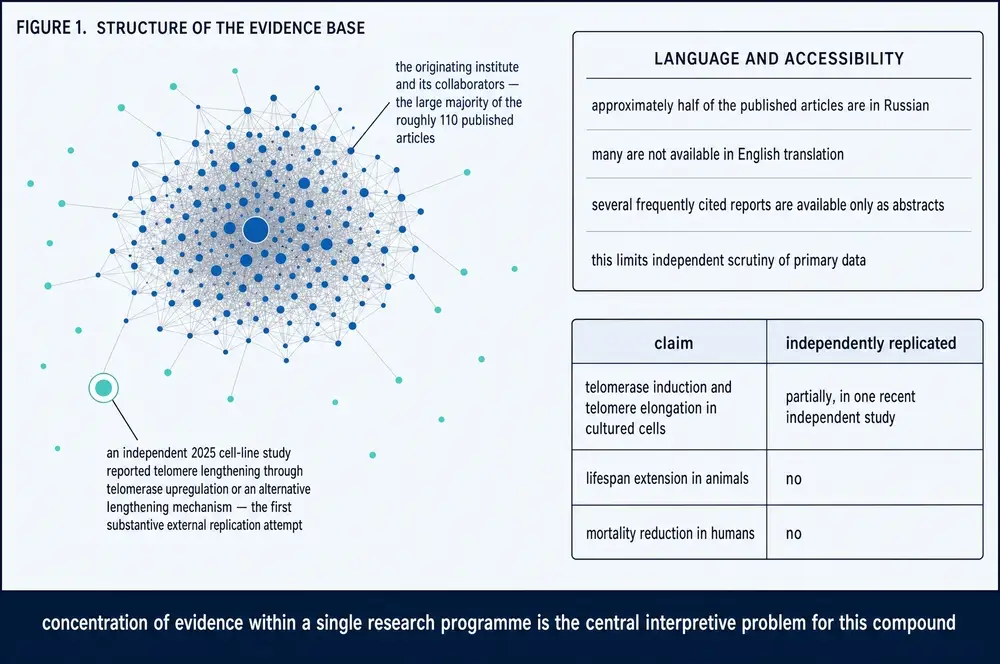
None of that is improper. Learned societies are founded by the people working in a field, and a specialist journal is edited by a specialist. But it means the scientist most often cited as the independent corroborator of Khavinson's work — Anisimov, whose reviews place Epithalon among the most plausible geroprotectors known — is a thirty-year co-author, was scientific director of Khavinson's institute from 1999, and served as his society president while Khavinson served as vice-president. When those reviews endorse the compound they are not independent adjudication. They are the same people, marking their own work.
The Alzheimer's Drug Discovery Foundation, in the only independent expert review of the compound this survey located, put the consequence without hedging: every preclinical and clinical study it examined had been conducted by Khavinson's group, with no independent confirmation of the results. It added that roughly half of the approximately 110 articles it identified are in Russian with no English translation, and were therefore excluded from its own analysis (Alzheimer's Drug Discovery Foundation, undated).
09What a bioregulator is supposed to be
Before any of the evidence, a question that is rarely asked plainly: what kind of drug is this supposed to be? The answer separates Epithalon from almost every other peptide in this monograph series, and it explains why the evidence looks the way it does.
Most therapeutic peptides work the way hormones work. A peptide arrives at the outside of a cell, fits into a receptor sitting in the membrane, and changes that receptor's shape. The receptor then does something on the inside — couples to a G protein, opens a channel, phosphorylates a partner — and a signalling cascade runs from there. This is how tesamorelin reaches the pituitary through the growth-hormone-releasing hormone receptor, how ipamorelin works through the ghrelin receptor, and how the whole GLP-1 class works. It is an extremely well-characterised kind of mechanism, and it has three properties that make it tractable: the receptor can be named, the binding can be measured as an affinity constant, and the dose–response curve is usually monotonic and saturable, because there are only so many receptors.
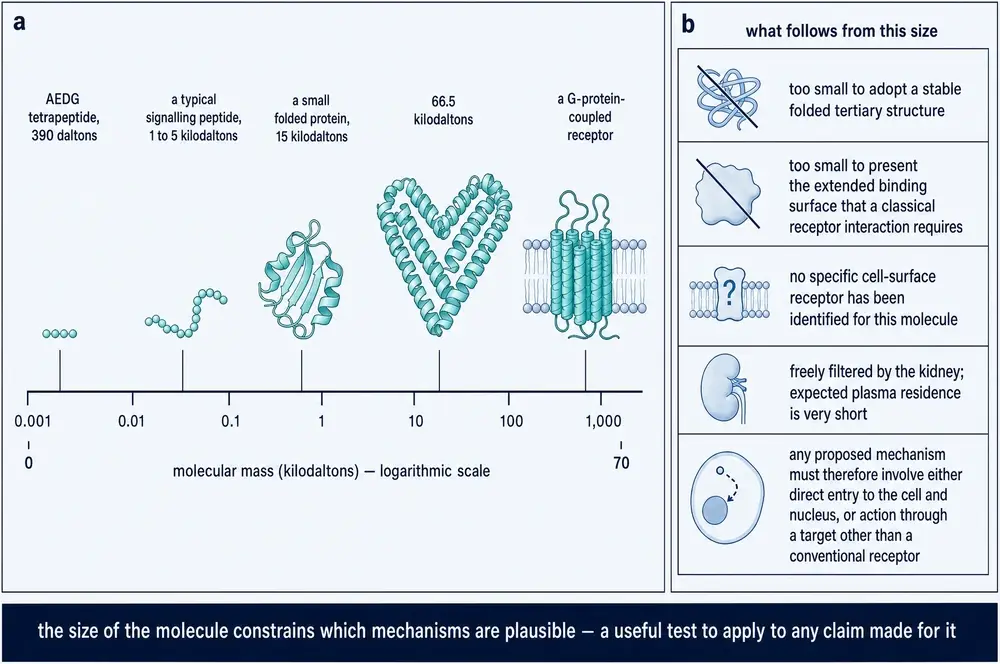
The bioregulator hypothesis proposes something quite different. On Khavinson's account these short peptides have no receptor at all. They cross the cell membrane, cross the nuclear membrane, and act directly on the genome — binding specific short DNA sequences in gene promoters, or binding the histone proteins that DNA is wound around, and by doing so making particular genes more or less readable. The peptide is not a messenger delivered to a letterbox. It is proposed to be something closer to a very small transcription factor.
That is a large claim, and it is worth being clear that it is not absurd. Zinc-finger proteins bind DNA through short recognition motifs, and the group draws that comparison itself. Peptides genuinely do enter cells and nuclei; fluorescently tagged Epithalon has been observed doing exactly that in HeLa cultures. And gene expression genuinely does change after these peptides are applied — the microarray work described in section 12 is real data.
Four consequences follow from choosing the second model, and they run through the rest of this document.
There is nothing to measure a potency against. Receptor pharmacology produces a dissociation constant, an EC50, a curve you can fit. Genome-binding pharmacology, as practised here, produces a docking score from a scoring function. Section 12 sets out what those numbers are and are not.
Selectivity has to be argued rather than shown. A receptor is expressed in some tissues and not others, so tissue specificity follows from where the receptor is. If a peptide instead binds a short DNA motif, that motif occurs in every cell of the body — and the claim that AEDG is specific to the pineal while AEDL is specific to bronchi, peptides differing by a single residue, requires a mechanism nobody has supplied.
Concentrations become uninterpretable. With a receptor you expect activity in a band around the binding constant. Without one there is no principled expectation at all, which is one reason the reported effective concentrations for this compound span nearly four orders of magnitude and the one study that tested a range found the effect disappear at the top of it.
And it makes the hypothesis unusually hard to disprove. A receptor model is falsified by a binding assay. A model in which a peptide subtly retunes gene expression can absorb almost any result, because some genes always change. That is not an accusation against the people who proposed it — it is a structural feature of the hypothesis, and it is why the telomerase claim in the next section carries so much more weight than the rest of the mechanistic literature. It is the one prediction specific enough to fail.
10The telomere claim
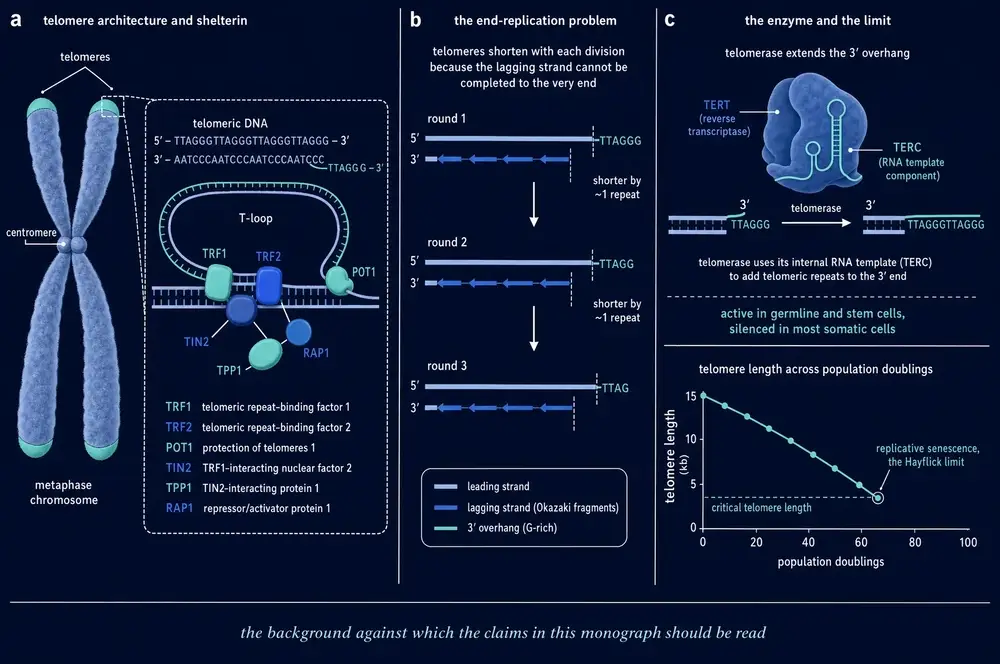
Every chromosome ends in a cap: a repeated six-letter DNA sequence, TTAGGG, wound in a protective protein sheath. These are telomeres, and they exist because the machinery that copies DNA cannot copy the very end of a strand. Every time a cell divides, its telomeres get shorter — in human somatic cells, by up to about seventy base pairs a year. When they get short enough the cell stops dividing altogether and enters the state called replicative senescence. That ceiling on divisions is the Hayflick limit, and it is one of the few genuinely quantitative facts in the biology of ageing (Al-Dulaimi et al., 2025).
There is an enzyme that rebuilds telomeres. Telomerase, made of a catalytic protein subunit called hTERT and an RNA template, is active in embryonic cells, stem cells and germ cells, and switched off in almost every mature somatic cell. It is also reactivated in around ninety per cent of human cancers, which is the detail to keep in mind for the rest of this document.
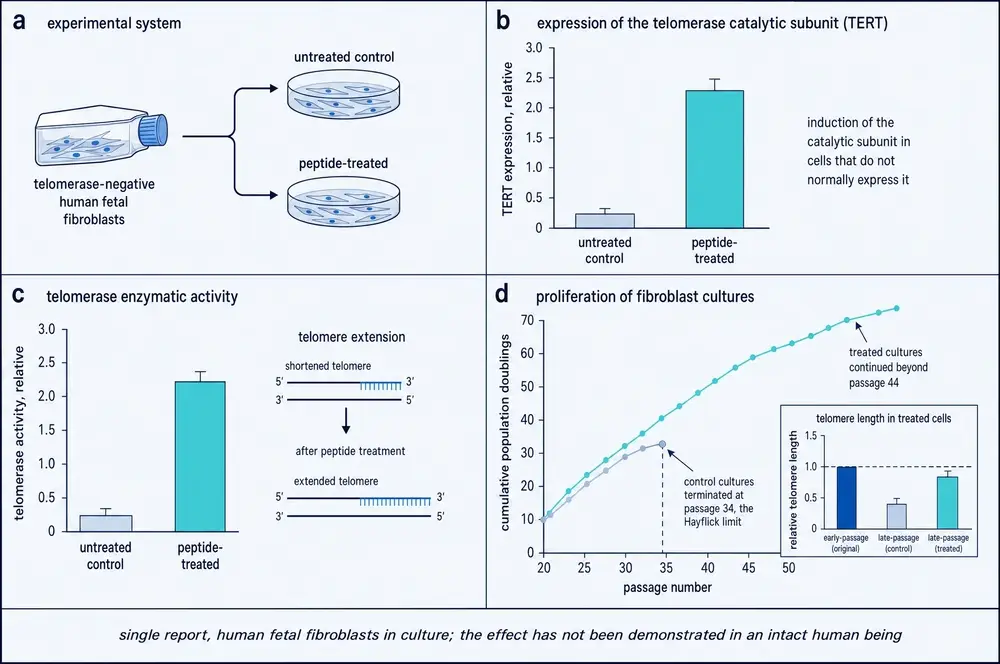
In 2003 Khavinson's laboratory reported that adding Epithalon to a culture of telomerase-negative human fetal fibroblasts induced expression of the catalytic subunit, produced measurable telomerase enzyme activity, and lengthened the telomeres (Khavinson et al., 2003). A follow-up the next year pushed the claim further. Primary lung fibroblasts from a twenty-four-week fetus normally exhausted their proliferative capacity at the thirty-fourth passage; treated cells, the authors reported, made ten further divisions, reached passage forty-four, and were still dividing when the experiment ended (Khavinson et al., 2004). In their own English abstract, the peptide had overcome the Hayflick limit.
This is a large claim and it is the foundation of everything the compound is now sold for. It is worth being precise about what it is and is not. It is a cell-culture result: human cells, in a dish, outside a body, with no immune system, no blood supply and no tissue architecture. Nothing about it establishes that the same thing happens in a person. And for twenty-two years, nobody outside the originating laboratory tested it.
11The 2025 replication, and what came with it
In September 2025 a group at Brunel University London, with no connection to St Petersburg, published the first quantitative outside test of the telomerase claim (Al-Dulaimi et al., 2025). They bought Epitalon from a commercial supplier and applied it to four human cell lines: two normal — a fibroblast line and a mammary epithelial line — and two breast cancer lines. Then they measured four things separately: telomere length by quantitative PCR, hTERT messenger RNA, telomerase enzyme activity by the telomeric repeat amplification protocol, and alternative lengthening of telomeres by a C-circle assay confirmed with immunofluorescence.
The headline is that the twenty-two-year-old claim held. In the normal cells — treated at 1 µg/mL daily for three weeks — telomeres lengthened significantly, hTERT expression rose, and telomerase enzyme activity rose with it: roughly fourfold in the fibroblasts and twenty-six-fold in the epithelial cells relative to untreated controls. This is a genuine independent confirmation and it should be weighted accordingly. It is the most important positive result in this monograph.
What came with it is the complication. In the two cancer lines, treated for four days across a concentration range, telomere length also increased — but telomerase activity did not. The lengthening ran instead through alternative lengthening of telomeres: a tenfold increase in C-circle signal in one line and a threefold increase in the other, confirmed by a rise in the nuclear bodies that mark the pathway. In the normal cells that pathway was untouched.
The authors read this as reassuring, and say so: because ALT was not activated in normal cells, "epitalon can be safely used in healthy individuals to maintain telomeres." That inference is doing a great deal of work. What was demonstrated is that in cells that were already malignant, this compound switched on a telomere-maintenance mechanism those cells had not been using, and made them capable of dividing longer. Nobody in that experiment had a body, an immune system, or an undetected early tumour.
Two further details deserve recording. Dose response was not monotonic: in one cancer line the greatest telomere extension occurred at 0.2 µg/mL, less at 0.5 and 1, and at the lowest concentration tested telomere length actually fell — leading the authors to suggest that low concentrations may be inhibitory. And the paper was corrected in November 2025, when the wrong versions of all three figures were found to have been published; the corrected figures were reissued and the conclusions stand (Al-Dulaimi et al., 2025, correction).
12Binding DNA, binding histones
How could four amino acids possibly switch a gene on? The answer proposed by the originating group is that Epithalon is a very small transcription factor: it enters the nucleus, binds specific DNA sequences, and by doing so makes those regions available for reading.
The supporting observations are real, if thin. Fluorescently tagged Epithalon applied to HeLa cells crosses the cell membrane and reaches the nucleus. In solution it binds particular short sequences — the group reports ATTTC and ATTTTC, and notes that this motif occurs repeatedly in the promoter region of the telomerase gene, which would neatly link the binding to the effect (Khavinson et al., 2005). Most strikingly, adding the peptide to double-stranded DNA in solution dropped the temperature at which the two strands come apart from 69.5 °C to 28 °C, with the thermodynamic quantities of the transition roughly halved (Khavinson, 2020). A molecule that destabilises the double helix at body temperature is at least a plausible candidate for helping transcription begin.
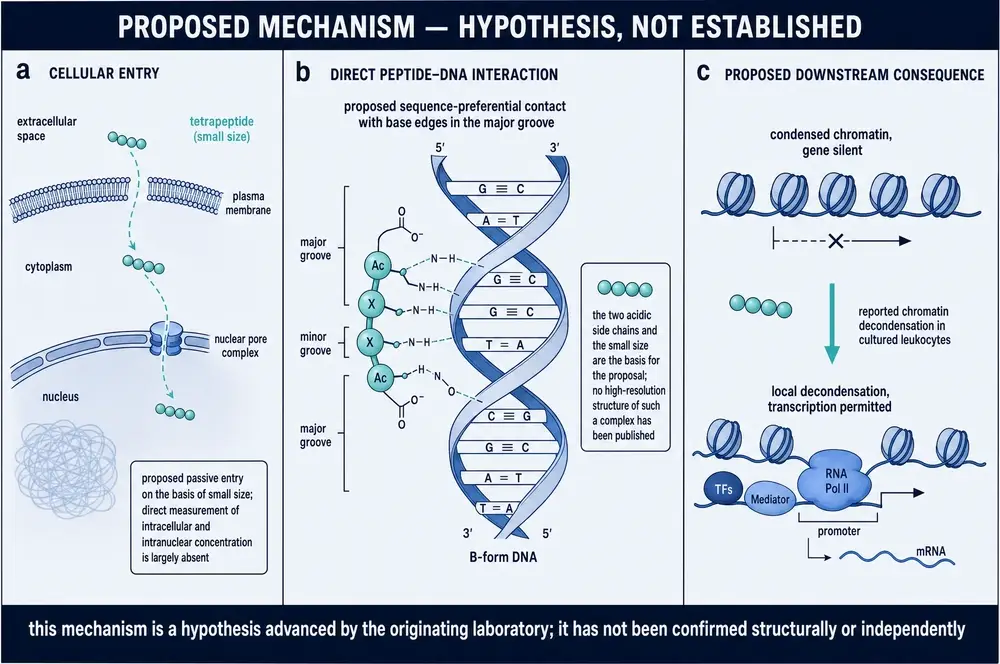
A second mechanism was added in 2020: rather than binding DNA directly, the peptide might bind the histone proteins that DNA is wound around, loosening the packaging. Molecular docking put Epithalon's strongest interactions on the linker histones H1/6 and H1/3, at sites that themselves contact DNA (Khavinson et al., 2020).
There is a problem with that docking study which is easy to miss and which this review flags because no summary of the compound mentions it. The histone structures used were homology models of wheat histones, built because the wheat structures had not been solved — and the experimental binding work the docking is said to corroborate also used wheat histones. Human relevance is assumed rather than shown. The same paper reports the compound's one clean negative: against the core histones H2b, H3 and H4 no binding sites were found at all.
A 2022 review from the same laboratory then did something unusual: it tested the epigenetic hypothesis across several of the group's peptides at once, by computing how many Alzheimer's-associated gene promoters contain each peptide's proposed binding motif. Epithalon came out close to last. The dipeptide EW matched forty-three per cent of the promoters examined and the tripeptide EDR twenty-two per cent; Epithalon matched two per cent, and only two specific gene targets were identified for it. The review's own conclusion names EW and EDR as the compounds with the highest potential, not AEDG (Ilina et al., 2022).
13The melatonin mechanism, and its failure
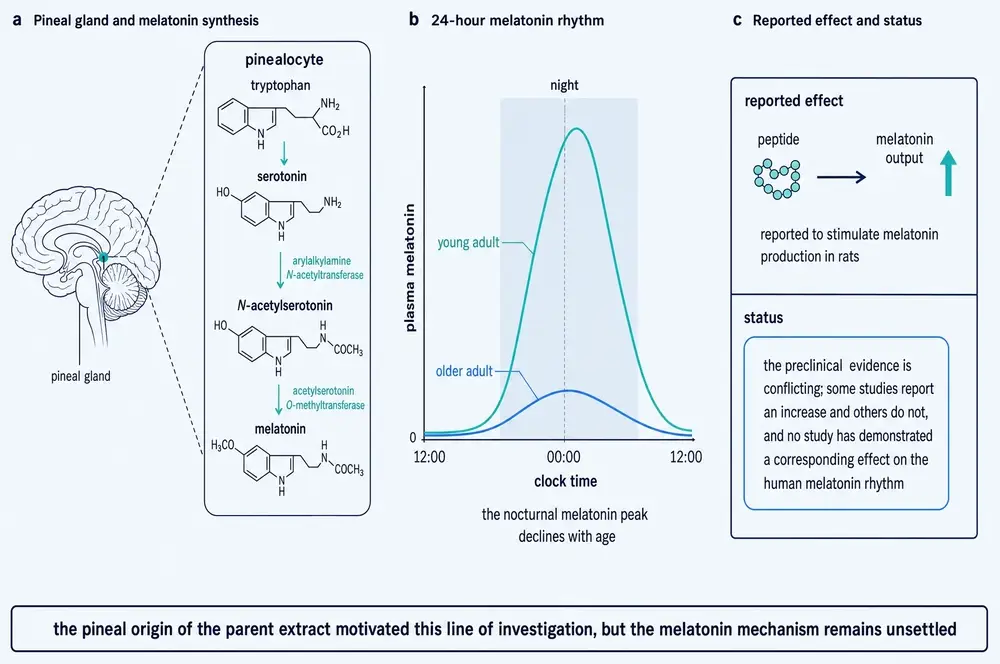
The pineal-clock theory requires Epithalon to restore melatonin production. That is the mechanism by which a pineal peptide is supposed to reset the ageing organism, and it is the mechanism the human studies of Part Four were designed around.
The strongest supporting result is in monkeys. In old rhesus macaques aged twenty to twenty-six years, ten daily intramuscular injections of 2 µg/kg raised evening melatonin more than fourfold and cut evening cortisol by about thirty per cent, restoring a circadian difference the old animals had lost. Young animals showed no melatonin effect (Goncharova et al., 2001). Taken alone it is a clean, biologically coherent finding.
It is not alone. In 2003 a study run at the Pitié-Salpêtrière faculty of medicine in Paris superfused isolated pineal glands from young and old rats with Epithalon at 1, 10 and 100 µM and measured melatonin release directly. There was no effect at any concentration, at either age, and no effect on melatonin release stimulated by a beta-adrenergic agonist. The authors concluded that the tetrapeptide does not appear to play a role, at least in vitro, in the control of melatonin secretion by the rat pineal gland (Djeridane et al., 2003).
The two results are not strictly incompatible. An isolated gland in a perfusion chamber has been cut off from every input the peptide might act through — the hypothalamus, the sympathetic nerve supply, the circulation. It is entirely possible that Epithalon acts upstream of the pineal rather than on it. But that possibility has never been tested, and in the meantime the mechanism that gives the compound its name and its rationale has one positive whole-animal finding and one clean negative direct measurement, from the same authors, two years apart.
14Antioxidant, mitochondrion, senescent cell
Away from telomeres and melatonin there is a scattered set of cell-level findings, mostly recent and mostly from laboratories with no connection to St Petersburg. They are the least contested part of the record.
The clearest is in mouse eggs. Ovulated oocytes deteriorate rapidly if they are not fertilised, accumulating reactive oxygen species, fragmenting, and losing mitochondrial function. A Chinese Academy of Sciences group cultured mouse oocytes for twenty-four hours with Epitalon at 0.1 mM and reported reactive oxygen intensity falling from 32.8 to 4.4 arbitrary units, fragmentation from 13.27 to 5.83 per cent, normal spindle rates rising from 48 to 69 per cent, and partial restoration of mitochondrial DNA copy number and membrane potential (Yue et al., 2022). Every comparison is against untreated aged oocytes, in a dish; no animal received the compound and no egg was fertilised by a sperm.
The interesting part of that paper is a failure. The authors screened six concentrations and found that 1 mM and 2 mM — the two highest — could not rescue reactive oxygen accumulation at all. They call the result unexpected and do not investigate it. An inverted dose response of this kind is common for signalling molecules and is a serious obstacle to reasoning about exposure: it means more is not merely no better, it is nothing.
Other cell-level findings are more modest than their citations suggest. In induced neurons made by reprogramming skin fibroblasts from three women in their sixties, Epithalon at 10 µg/mL daily for ten days increased the number of primary dendritic processes by thirty-four per cent (p = 0.0046) and total dendrite length by thirty-two per cent (p = 0.05). In the same experiment mitochondrial membrane potential, lysosomal activity, lamin B1 and the senescence marker p16 were all unchanged — and p16 moved slightly in the wrong direction (Kraskovskaya et al., 2024).
And in one case the laboratory failed to replicate itself. A 2020 paper had reported that the peptide raised beta-tubulin III messenger RNA by 1.6 to 1.8-fold in human gingival stem cells. A 2025 paper from the same group, applying the peptide to reprogrammed neurons, states plainly that it did not observe any increase in that protein following short-peptide application (Sakhenberg et al., 2025). The two experiments used concentrations a thousandfold apart, which may be the explanation — and which is itself the subject of section 15.
15Getting in
Here is the largest hole in this compound's file, and it is a simple one to state. There is no pharmacokinetic data for Epithalon. Not sparse data; none. No plasma concentration after any dose by any route in any species. No half-life, no area under the curve, no bioavailability fraction, no tissue distribution study using a specific method. FDA searched for it in 2026 and recorded the result in one sentence: no pharmacokinetic data were found for either the free base or the acetate.
What exists instead is modelling. Two papers from the originating group docked the peptide computationally into the amino-acid transporters LAT1 and LAT2 and the peptide transporters PEPT1 and PEPT2, and reported that it binds well — Epithalon scores −32.93 kcal/mol against LAT1, seventh of twenty-six peptides tested. On the authors' own calibration that implies low-micromolar affinity. It is a computed number (Khavinson et al., 2023).
The same papers contain three things that undercut the delivery story, all stated by the authors. First, binding a transporter is not the same as being carried by it: LAT1 moves its cargo through a large conformational change, and the paper concedes that a peptide bigger than an amino acid may jam the mechanism rather than ride it — in which case the compound is an inhibitor rather than a passenger. Epithalon, at four residues, is larger than anything either transporter family normally handles. Second, the papers' own conclusions claim transport only for peptides of two and three residues. Third, the literature they review reports that PEPT1 is not expressed in brain and PEPT2 is absent from the blood–brain barrier, with the choroid plexus transporter oriented to move peptides out of cerebrospinal fluid rather than into it.
The one wet-laboratory measurement bearing on the compound's fate is unfavourable. Incubated in saline, in acid, and in homogenates of stomach, intestine, liver, kidney and spleen, two related peptides resisted breakdown for three to four hours while Epithalon was hydrolysed — less than one other peptide tested, but hydrolysed. The reviewers add that it remains unclear whether only the terminal residue was removed or whether the remaining tripeptide was cleaved as well. The extent is unquantified and the products are unidentified.
The absence of pharmacokinetics has a consequence that runs through the whole of Parts Two and Three: nobody knows how the concentrations used in these experiments relate to each other, or to anything a body would experience. The reported effective concentrations span nearly four orders of magnitude, and the one study that tested a range found the effect vanish at the top of it.
16Lifespan
The claim that made this compound famous is that it makes animals live longer. It rests on about a dozen rodent studies run between 2001 and 2008, almost all from the same laboratory, and the striking thing about them when you read them in sequence is how much less they say than the summaries do.
Start with what the originating group states in its own review. Khavinson's 2020 account reports that giving the tetrapeptide to animals produced a statistically significant increase in mean lifespan of twenty-five to thirty per cent and in maximum lifespan of 42.3 per cent, with the incidence of spontaneous and induced tumours falling by a factor of 1.4 to 7.0 (Khavinson, 2020). A 2026 review in Frontiers in Aging, summarising the same literature for a clinical audience, gives the figure as twelve to twenty-four per cent (Mavrych et al., 2026). Those two numbers describe the same experiments and cannot both be right.
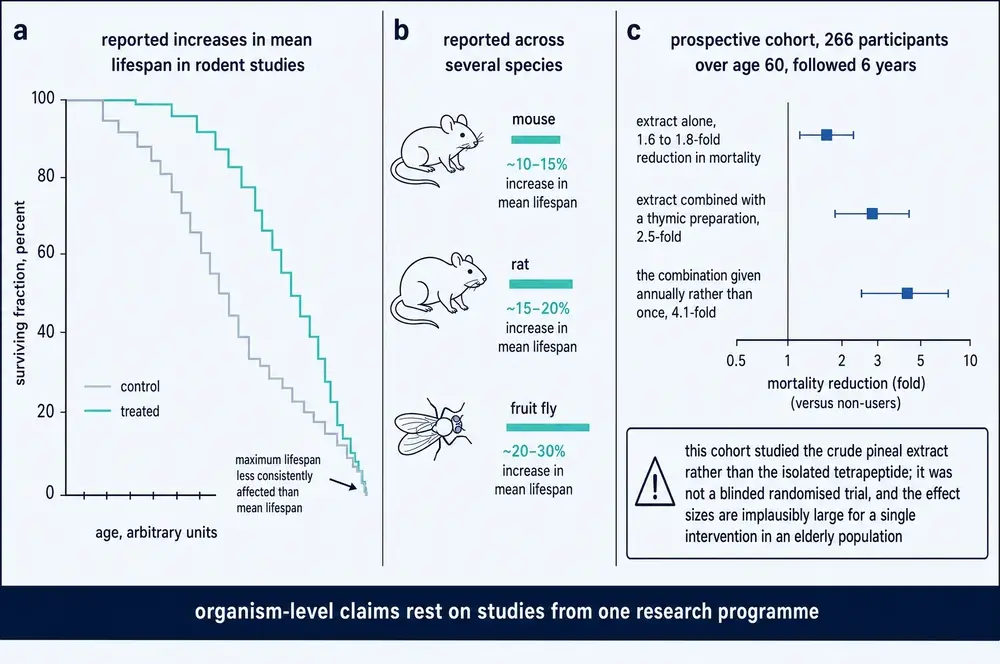
The primary papers are more specific and considerably more mixed.
That distinction is not a technicality, and Anisimov himself supplied the framework for reading it. In a taxonomy he first proposed in 1981, an agent that delays the onset of ageing lengthens the latent period before tumours appear without changing how many animals get them; an agent that slows the rate of ageing reduces the number and lengthens the latency. A mean-lifespan figure reported without the tumour-latency breakdown cannot distinguish the two — and cannot rule out the third possibility in his own scheme, an agent that accelerates ageing (Moskalev, 2023).
The most reliable single result in the set is also the least dramatic. In fruit flies, Epithalon added to the larval medium at 0.00001 per cent by weight extended imago lifespan by up to sixteen per cent in both sexes, with the effect concentrated in mature and old flies. What makes that finding interesting is the comparison the authors draw: to get an equivalent extension with melatonin required a concentration sixteen thousand times higher. Whatever this molecule is doing, it is not doing it as a bulk antioxidant.
17Tumours
Alongside lifespan runs a consistent anticancer claim, and it is better supported than the longevity one. Across mouse strains prone to spontaneous tumours, intermittent subcutaneous Epithalon reduced tumour incidence. The clearest results are in transgenic mice carrying the human HER-2/neu breast cancer gene, which reliably develop mammary adenocarcinoma from about four months of age: treated animals had fewer and smaller tumours, smaller lung metastases, and a 3.7-fold reduction in HER-2/neu messenger RNA in the tumours themselves. That study appeared in the International Journal of Cancer, the highest-profile venue in the whole corpus, and carries Italian co-authors — the nearest thing to independent participation in the animal work.
FDA reviewed three of these studies in 2026 and reproduced their designs. The review is worth reading closely, because it is the only place where an outside body with no stake in the answer has examined this evidence in detail.
FDA made one further observation about this body of work that has not, so far as this review can determine, been noted anywhere else. Examining the genotoxicity data, the agency found that the frequency of chromosome aberrations measured in bone marrow from four saline-treated mice appeared to be serving as historical control data for that strain — because the identical figure was used as the control in a separate study of an entirely different peptide. FDA notes that the authors provide no analysis validating those four animals as representative, and that using unrepresentative historical controls can cause statistical significance to be over- or under-estimated (FDA, 2026). The same review records that the two papers reporting identical data from the same strain disagree about whether the mice were treated from two months of age or from three.
18Monkeys
The primate work is small — a handful of studies from a single facility — but it is the closest the compound comes to a human-relevant animal model, and it is where the neuroendocrine claims were tested most directly.
The melatonin and cortisol result is described in section 13. Two further findings sit alongside it. In old macaques aged twenty to twenty-seven, intramuscular Epithalon lowered the glucose response area from 479.6 to 388.9 mM/min after a glucose challenge, bringing it closer to the young animals' 294.9; a month after treatment stopped the values had drifted back toward baseline. In young animals the same treatment moved glucose handling in the opposite direction. The authors relate the effect to melatonin's known influence on the insulin-secreting cells of the pancreas, which makes it a downstream consequence of the mechanism section 13 leaves unresolved.
The pattern across all the primate work is the same and is worth stating as a general property: this compound does something in old animals and nothing in young ones. Melatonin, cortisol rhythm, glucose tolerance — in each case the young controls were unaffected. That is consistent with the restore-a-lost-function framing the originators use. It is also consistent with regression to the mean in small groups of old animals with more variable physiology, and no study in the corpus was designed to tell those apart.
19The retina
One line of animal work led directly to the only human trial this compound has, and it deserves its own section.
Campbell rats carry an inherited retinal degeneration that destroys the photoreceptor layers within weeks of birth — an animal analogue of retinitis pigmentosa. Injected with Epithalon from birth, treated animals retained retinal layers that were entirely destroyed in controls by day forty-one, and electroretinogram recordings showed retinal function persisting 43.9 per cent longer. Beginning treatment before conception, in the mother, roughly doubled the effect (Khavinson et al., 2002).
That is a substantial finding in a genetic disease with no treatment. It is also the origin of the strangest fact in this compound's regulatory history: Epithalon held an orphan drug designation from the United States Food and Drug Administration for retinitis pigmentosa, granted on 2 September 2010 and withdrawn on 6 January 2016. FDA records both dates in a single sentence of its 2026 review and never returns to the subject. No reason for the withdrawal appears in any source located here.
20What the animal record can bear
To weigh a lifespan claim you need to know what an ordinary lifespan claim looks like, and in 2025 a group including John Ioannidis provided exactly that. They appraised DrugAge, the standard database of lifespan-extension experiments: 667 studies, 720 experiments, 1948 to 2024, across every organism and compound in the field (Parish et al., 2025).
Their findings reset the baseline for everything in Part Three. Across the whole literature, the median lifespan increase reported is 13.3 per cent, and the meta-analytic estimate is 14.3 per cent. In mice specifically it is 6.7 per cent; in rats, 5.9. Randomisation is reported in 19.9 per cent of studies, blinded outcome assessment in 3.0 per cent, and a sample-size calculation in 6.0 per cent — and in rat studies, blinding is reported in none at all. Funnel-plot asymmetry gives an Egger's Z of 11.3, and a formal test finds 546 significant results where 499 would be expected. The authors' conclusion is that the strong suggestion of bias "prompt[s] skepticism about this overall favorable picture and prospects for translation to humans."
There is one signal in that appraisal that runs the other way, and it should be given its due. Of thirty-five compounds tested in both mammals and non-mammals, only twenty-one were significant in non-mammals, and only seven of those also worked in mammals. Epithalamin is one of the seven. That is a real and independently derived point in this family's favour.
Two qualifications travel with it. The mammalian evidence behind that placement is 171 animals in total, against 2,761 for rapamycin. And the compound that translated is Epithalamin, the cattle-gland extract — not Epithalon, the tetrapeptide. They are separate entries in that database, as they are separate substances everywhere else, and the signal does not transfer. That distinction is the subject of the next part.
21Epithalamin is not Epithalon
Almost everything impressive that has been said about this compound in humans was measured on something else.
Epithalamin is a crude extract of cattle pineal gland: a mixture of peptides of unknown composition, standardised by molecular weight, manufactured on an industrial line at a former meat-packing plant and registered as a medicine in Russia in 1990. Epithalon is a single synthetic four-residue molecule, patented in 1999, whose sequence was inferred from that mixture's amino-acid tally. They are related in the way that a wine is related to a molecule of ethanol found in it.
The distinction is not a pedantic one, and the reason to insist on it is that the compound's promoters do not. Both nominations submitted to the United States Food and Drug Administration listed Epithalamin among the common names for Epitalon. FDA's response, in a footnote of its May 2026 evaluation, is the clearest statement of the problem in print:
Applying that rule to the corpus is clarifying and slightly brutal. Of twenty-six articles the nominators submitted as evidence, FDA found that seven — including every long-term human outcome study — concerned Epithalamin rather than Epitalon. The Alzheimer's Drug Discovery Foundation reached the same conclusion independently and stated it in four words: clinical studies on epithalon have not been conducted.
There is one further wrinkle, and it cuts against the tidy version of this argument. Epithalamin also contains, on the originating group's 2017 account, the tetrapeptide itself. If that identification is right, then the extract studies are studies of a mixture that includes the molecule, at an unknown and uncontrolled concentration, alongside a great many other peptides. That is not nothing. It is also not the same as testing the molecule, and it is the reason the Alzheimer's Drug Discovery Foundation notes that the contents of Epithalamin preparations are likely to vary from batch to batch.
22Thymalin and Epithalamin together
The single largest human claim ever made for this family does not concern Epithalon, and it does not concern Epithalamin alone. It concerns the two original extracts given together, and it is worth setting out in full because it is the study that everything else in the family's reputation rests on.
The paper is Khavinson and Morozov, "Peptides of pineal gland and thymus prolong human life," Neuro Endocrinology Letters, 2003. The design returns to the founding logic of section 02: Selye's alarm stage suppresses two glands, thymus and pineal, so the intervention restores both. Thymalin is the thymus extract, registered in 1982; Epithalamin is the pineal extract, registered in 1990. Both are peptide mixtures below ten kilodaltons, manufactured on the Samson-Med line.
Two hundred and sixty-six elderly people were followed at the St Petersburg Institute of Bioregulation and Gerontology and the Institute of Gerontology of the Ukrainian Academy of Medical Sciences in Kiev, for six to eight years. The preparations were given only during the first two to three years of that period; the remaining years were observation. Subjects received Thymalin, Epithalamin, both, or neither.
The reported results are these. Acute respiratory illness fell by a factor of 2.0 to 2.4. The clinical manifestations of ischaemic heart disease, hypertension, deforming osteoarthrosis and osteoporosis were all reduced against control. And mortality over the observation period fell 2.0 to 2.1-fold in the Thymalin group, 1.6 to 1.8-fold in the Epithalamin group, and 2.5-fold in the group given both. A separate cohort dosed with the combination annually for six years is reported at 4.1-fold lower mortality than control (Khavinson & Morozov, 2003).
Four things need saying about that figure, in order, and none of them is that the investigators were dishonest.
The effect size is the problem, not the evidence for it. A 2.5-fold reduction in all-cause mortality would place these extracts among the most powerful medical interventions ever documented, ahead of any single cardiovascular drug. Extraordinary effects invite extraordinary scrutiny, and in this case the scrutiny has not arrived. The Alzheimer's Drug Discovery Foundation notes of the related twelve-year study that it has not been validated by an independent trial, and the 2026 Frontiers in Aging review says the same of the family: extensive clinical use in the former Soviet states, no independent Western validation.
The design details that would let a reader judge it are absent. The published report does not describe randomisation, allocation concealment, blinding, or a prespecified analysis plan, and gives no confidence intervals. Two related papers from the Ukrainian arm are tagged as randomised controlled trials in the PubMed record, but the same gaps apply to their published descriptions.
The combination is the strongest arm, which cuts both ways. A dose — or here an agent — response gradient, with the combination outperforming either extract alone and repeated dosing outperforming a single course, is the kind of internal consistency that makes a result more believable. It is also exactly the pattern that unblinded assessment and healthier-patient selection produce. Nothing in the report distinguishes them.
And none of it is about Epithalon. The tetrapeptide was patented in 1999, in the middle of the first of these cohorts, and appears in no arm of any of them. Its own human record is three studies, the longest of which ran twenty days, and is set out in the next section.
23The human record for the tetrapeptide, in full
FDA searched the published medical literature in 2026 and found three studies in which Epithalon was given to human beings. Three. Here they are.
Retinitis pigmentosa, 2002. At the St Petersburg Institute of Bioregulation and Gerontology, 162 patients aged eighteen to seventy-two with degenerative retinal disease received the peptide by parabulbar injection — into the tissue behind the eye — at 5 µg per eye for ten consecutive days, against a control group given the conventional treatments of the day. The report describes increased bioelectrical activity of the first and second retinal neurons, visual acuity improved by 0.15 to 0.20 on average, expanded peripheral fields in all patients, and reduction or disappearance of absolute scotomas, with no side effects reported (Khavinson et al., 2002). It is not described as randomised or blinded, the control group received a different treatment rather than placebo, and the outcome measures include several that are examiner-dependent.
Circadian gene expression, 2020. Seventy-five healthy women aged forty to fifty, mostly night-shift workers, were stratified by urinary 6-sulfatoxymelatonin — the metabolite by which melatonin production is measured indirectly. Thirty-five with age-appropriate values formed a control group; the forty with values described as being at the level of elderly people were split between placebo spray and a sublingual Epithalon spray, three sprays twice daily for twenty days, corresponding to 0.5 mg of peptide per day. The treated group's 6-sulfatoxymelatonin excretion rose 1.7-fold. Expression of the clock genes Clock and Csnk1e fell and Cry2 doubled (Ivko et al., 2020). The Russian original is dated 2020 and the English translation edition 2021; FDA cites the latter, and both refer to the same study.
Buccal epithelium, 2024. A review reporting the institute's own work on cellular ageing markers in cheek-lining cells, in Russian, which this review could not obtain in full.
That is the entire human dataset for this molecule: one uncontrolled ophthalmology series from 2002, one small randomised study of a urinary metabolite and three genes from 2020, and one Russian-language review. No study has measured a clinical outcome that a patient would notice, other than the 2002 vision report. No study has run longer than twenty days except the retinal one, at ten. FDA's assessment of that controlled trial — the only controlled human study of the tetrapeptide in existence — is worth quoting in full because it is short: the publication did not specify blinding; limitations include short duration and small study size; the study did not evaluate sleep outcomes; and the route used was sublingual while the route proposed for compounding was subcutaneous.
One detail from that trial deserves attention, because it shows how the gap between a measurement and a claim opens up. Alongside the melatonin metabolite, the authors report that subjects receiving the peptide "demonstrated distinct positive dynamics of psycho-emotional and general physical condition in 83 per cent of cases," against twenty-five per cent on placebo. That is a striking number and it is the kind of figure that migrates into marketing. FDA's note on it: no details were provided about how psycho-emotional and general physical condition were assessed.
24The mortality results, and whose they are
The results that built this family's reputation are genuinely striking, and this section takes them seriously before explaining why they cannot be transferred.
Between the St Petersburg institute and the Institute of Gerontology in Kiev, 266 elderly people were followed for six to eight years while receiving courses of Thymalin, Epithalamin, or both, during the first two to three years. Acute respiratory illness fell by a factor of 2.0 to 2.4. Mortality fell 2.0 to 2.1-fold in the Thymalin group, 1.6 to 1.8-fold in the Epithalamin group, and 2.5-fold in those given both. In a subgroup dosed annually for six years, the reported reduction was 4.1-fold (Khavinson & Morozov, 2003).
A separate Ukrainian line of work followed coronary patients with what the authors classed as accelerated cardiovascular ageing. At twelve years, deaths in the Epithalamin group were twenty-eight per cent lower than in controls receiving the same basic therapy, with cardiovascular mortality halved (Korkushko et al., 2006). At fifteen years, with thirty-nine treated patients against forty controls, mortality remained significantly lower (Korkushko et al., 2011).
Four things must be said about these results, in order.
They concern the extract. Every one of them. The tetrapeptide was patented in 1999, midway through the first of these cohorts, and appears in none of them.
They have never been replicated. Not by an independent group, not by the same groups in a second cohort. The Alzheimer's Drug Discovery Foundation's review states of the twelve-year result that it has not been validated by an independent trial, and the 2026 Frontiers in Aging review says the same of the family as a whole: extensive clinical use in former Soviet states, no independent Western validation.
The design is thin for the size of the claim. A mortality difference in seventy-nine coronary patients followed for fifteen years is a small number of deaths, and the reports do not describe allocation concealment, blinding, or prespecified analysis. The 2011 paper is additionally a citation trap: its English title says the geroprotector comes from the pituitary gland, while its abstract says pineal and epithalamin throughout. It is a translation error, and it means that anyone citing the title alone cites the wrong organ.
And nobody who checked was independent. The trials were run by the institute that makes the preparation, published largely in journals within the same community, and reviewed favourably by the co-author of the underlying animal work. That is not an accusation of fraud. It is a description of a system with no external check, and it is the reason these numbers — which would be extraordinary if confirmed — have not moved the field in twenty years.
25What is not known
It is worth setting out plainly, because the list is unusual in its completeness.
Nobody knows what happens to this molecule after it enters a body: not its concentration, not its half-life, not where it goes, not what it is broken down into. Nobody has run an acute toxicity study, a repeat-dose toxicity study, a reproductive toxicity study, or a two-year carcinogenicity study; FDA searched for all four in 2026 and found none. Nobody has assessed whether it provokes an immune response, which for an injected peptide is a standard question — FDA raises it specifically, noting that peptides as short as two residues can aggregate, that aggregation drives immunogenicity, and that subcutaneous injection carries more immunogenic risk than intravenous.
Against that, the compound has a clean adverse-event record. FDA searched its Adverse Event Reporting System through 8 December 2025 and retrieved no reports; a search of the food-complaint system through 5 December found no cases.
That sounds reassuring and it is not, for a reason FDA states in its own footnotes. Reporting is voluntary. Compounders operating under section 503A generally do not report adverse events to FDA at all. And a compound sold online as a research chemical, self-administered by people who may not consider it a medication and may be uncertain whether it is legal, generates no reports by construction. An empty database is what you would expect whether the compound is harmless or not.
26What is sold
A compound with three human studies has a substantial retail market. A price survey of research-use-only peptide sellers conducted for the Radix market tracker on 10 July 2026 found twenty-five distinct Epithalon offers across twenty retailers: vials of 10, 20 and 50 mg, three-milligram capsules, an oral spray, and multi-vial kits.
Prices are best read within a vial size rather than across them, because a 50 mg vial is nearly always cheaper per milligram than a 10 mg one and pooling the two produces a meaningless average. Within the ten-milligram cohort — twelve offers, the market's centre of gravity — the price runs from $2.10 to $7.00 per milligram, with a median of $3.05. Within the fifty milligram cohort the median is $1.63. The spread within a single vial size is more than threefold, for a substance whose identity the buyer cannot check.
FDA looked at the same market from the other end and described it in language that is unusual in a regulatory document. Its 2026 review records that the compound is marketed online by wellness clinics and concierge practices as an anti-aging agent, with some sites calling it the fountain of youth, and lists the claims made for it: slowing and reversing the signs of ageing, increasing lifespan, improving skin, healing muscle, deepening sleep, normalising melatonin, preventing cancer, heart disease and dementia, treating symptoms of diabetes, improving eye health, raising energy and mood. The agency notes that some sites give dosing information, generally five to ten milligrams a day by subcutaneous injection or by mouth, some in cycles. It names six sellers by URL, three of which state that the product is for research use only.
The certificates of analysis that travel with this material are the next link in the chain, and FDA reproduced three of them in its briefing package. They are worth examining, because a certificate is the only quality assurance a buyer in this market is offered.
One detail on the Darmerica certificate is worth recording because it survives into a federal advisory-committee package. The scan FDA reproduced carries a handwritten calculation in the margin — three factors multiplied out to 86.5 per cent — which is the net peptide content once water and acetic acid are subtracted from a material whose stated purity is 99.5. The two numbers measure different things and both are honest. But a buyer weighing out a "10 mg" vial is handling roughly 8.6 mg of peptide, and nothing on the label says so.
27Brussels, 2015
The Belgian Official Medicines Control Laboratory published two papers in 2015 on peptides confiscated by the national medicines agency. The first is about this compound specifically, and its title tells the story: the identification of Epitalon, assumed to be a potential treatment for cancer, old age and retinitis pigmentosa, in two illegal pharmaceutical preparations (Vanhee et al., 2015). It is indexed in the medical literature under the subject heading Illicit Drugs.
The technical content is more interesting than the enforcement context. The analysts flag a specific counterfeiting risk: Glu-Ala-Asp-Gly, the same four amino acids in a different order. It has the same molecular formula and the same mass as Epithalon, so ordinary mass spectrometry cannot tell them apart. The Belgian laboratory's solution was to exploit a chemical quirk: a glutamate at the front of a peptide will cyclise on heating into pyroglutamate and lose a small, measurable amount of mass. Heat the sample; if the mass drops, the glutamate was at the N-terminus and the material is the decoy.
This is the practical meaning of the naming problem FDA raised in section 01. A four-residue peptide has twenty-three sequence isomers, several of which are commercially available, all of which weigh the same. Distinguishing them requires a deliberate experiment that no certificate of analysis examined here performs.
28Silver Spring, 24 July 2026
Eight days before this monograph was compiled, the Pharmacy Compounding Advisory Committee of the United States Food and Drug Administration met at the agency's White Oak campus and took up Epitalon.
The context matters. Section 503A of the Federal Food, Drug and Cosmetic Act allows pharmacies to compound medicines from bulk substances that appear on an approved list. Two nominations had been submitted to add Epitalon to that list — one from Wells Pharmacy Network, one from LDT Health Solutions on behalf of the International Peptide Society. Both were withdrawn. FDA decided to evaluate the compound anyway, on its own initiative.
The indication evaluated was insomnia. Not longevity, not telomere maintenance, not anti-ageing: insomnia, because that is what the International Peptide Society's nomination form specified, and because FDA declined to evaluate the eleven other proposed uses on the grounds that the nominations did not contain enough information to assess them. The compound that the market sells as the fountain of youth came before a federal advisory committee as a candidate sleep aid.
FDA's staff worked through the four statutory criteria and answered no to all four.
The committee was asked two questions: should Epitalon free base be placed on the list, and should Epitalon acetate. Press reports of the meeting state that the committee voted in favour, against FDA's recommendation, as it did for five of the seven peptides considered over the two days; the reported tallies differ between sources and the official minutes had not been published when this document was compiled. The vote is advisory and not binding, and nothing about the compound's legal status changed on the day.
29The inversion
Now the central problem of this compound, which every part of this document has been approaching.
Telomerase is switched off in adult somatic cells for a reason. The shortening telomere is a division counter, and it exists in part as a brake on cancer: a cell that acquires the mutations to grow without limit still runs out of chromosome ends and stops. Roughly ninety per cent of human cancers get around that brake by switching telomerase back on. Long telomeres, generally those more than about 0.7 standard deviations above the mean, are associated with increased risk of malignant tumours.
Epithalon's one reproducible mechanism is switching telomerase back on.
The originating laboratory's answer to this is subtle and worth taking seriously. Through the telomere position effect, a long telomere silences genes near the chromosome end. So — the argument runs — lengthening telomeres by intermittent treatment could suppress nearby cancer-related genes and prevent tumours, which is exactly the pattern the mouse studies of section 17 report. FDA sets out this hypothesis fairly in its review. Then it states the other half:
Read that against the mouse protocols and against the market. The mouse studies dosed five consecutive days a month, which across a two-year life comes to about twenty-two weeks of total exposure. The dosing patterns FDA found on retail and clinic websites are five to ten milligrams daily, some in cycles. Those are not the same exposure, and the mechanism the compound is sold for is one whose sign may depend on which side of that line you are on.
Two very recent papers make the point sharper than any argument could, because neither is about Epithalon at all. Both use it as an off-the-shelf reagent, and they assume opposite mechanisms.
In a 2026 study of paclitaxel resistance in ovarian cancer, Epitalon at 300 nM is introduced as "the telomerase activator epitalon" and used deliberately to create a drug-resistant phenotype: it raised SKOV3 tumour-cell proliferation by forty-five per cent and attenuated the efficacy of chemotherapy, an effect the authors then reversed with a telomerase inhibitor. In a 2026 study of chemoresistance in natural killer/T-cell lymphoma, the same compound is called "an anti-senescence drug" and given to mice, with a second agent, as a senolytic intended to clear therapy-induced senescent tumour cells; in that model the combination reduced tumour growth. Neither paper validates its assumption about what the compound does. Neither cites the other.
30What would settle it
It is worth ending on the fact that all of this is answerable, and that the experiments are neither exotic nor especially expensive by the standards of modern pharmacology.
A pharmacokinetic study in one species, by the routes people actually use, would establish whether the molecule survives contact with a body long enough to reach anything — and would give every concentration in Part Two a denominator. A two-year carcinogenicity study in both sexes at three doses, run to the standard FDA's own guidance describes, would answer the question of section 29 directly. A single properly randomised, blinded, placebo-controlled trial with a clinical endpoint would establish whether the compound does anything a person can feel. None of these has been done in twenty-seven years, and no trial has ever been registered.
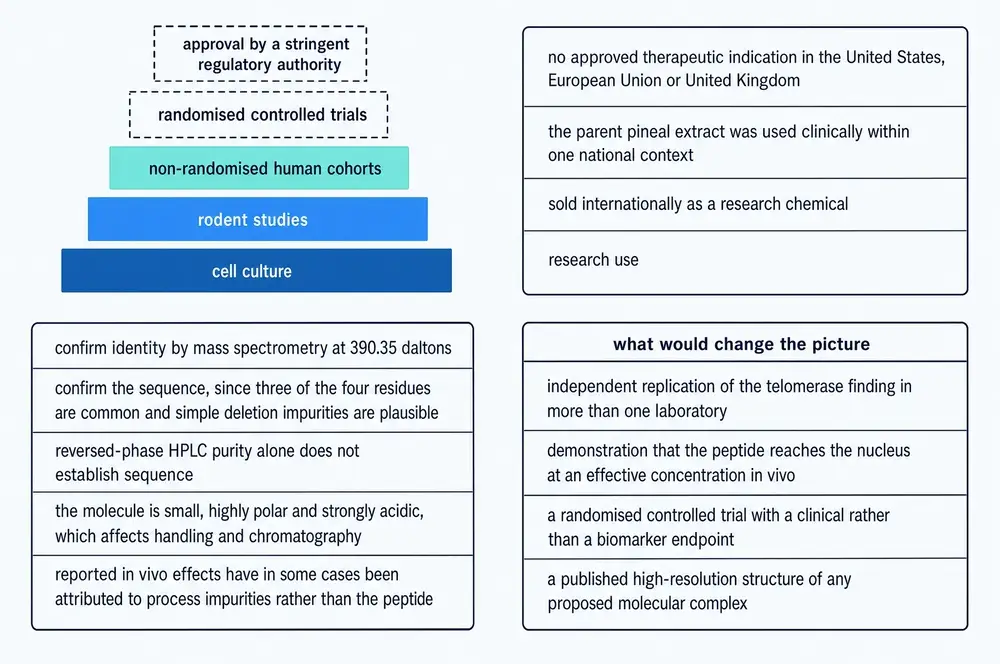
Meanwhile the two things this monograph can say with confidence are these. The 2025 Brunel replication is real: an outside laboratory confirmed that this peptide raises telomerase activity and lengthens telomeres in normal human cells in culture, which is a genuine finding about a genuinely interesting molecule. And the same laboratory found it switching on a telomere-maintenance pathway in cancer cells that those cells had not been using, which is a genuine finding too. Both are true. Deciding what they mean for a person requires evidence that does not exist.
31References
Generated from verified NCBI records rather than from recall. Author lists, journal names, volumes, pages and identifiers are taken from the PubMed record for each citation, and every entry was checked against its title before the build was allowed to run. This series has twice shipped reference lists drafted from memory in which identifiers pointed at real but unrelated papers; the build refuses to run if any identifier is unresolved.
- Al-Dulaimi S, Thomas R, Matta S, Roberts T. Epitalon increases telomere length in human cell lines through telomerase upregulation or ALT activity. Biogerontology. 2025;26(5):178.
PMID 40908429 · doi:10.1007/s10522-025-10315-x · PMC12411320 - Al-Dulaimi S, Thomas R, Matta S, Roberts T. Correction: Epitalon increases telomere length in human cell lines through telomerase upregulation or ALT activity. Biogerontology. 2025;27(1):1.
PMID 41240216 · doi:10.1007/s10522-025-10326-8 · PMC12619744 - Anisimov V. Aging delay: of mice and men. Acta Biomed. 2021;92(1):e2021073.
PMID 33682799 · doi:10.23750/abm.v92i1.11273 · PMC7975961 - Anisimov VN, Khavinson VKh, Morozov VG, Dil'man VM. [Effect of epiphyseal extracts in lowering the threshold sensitivity of the hypothalamo-hypophyseal system of old female rats to the action of estrogens]. Dokl Akad Nauk SSSR. 1973;213(2):483-5.
PMID 4797507 - Anisimov VN, Morozov VG, Khavinson VKh, Dil'man VM. [Comparison of the anti-tumor activity of extracts of the epiphysis and hypothalamus, melatonin and sigetin in mice with transplanted mammary gland cancer]. Vopr Onkol. 1973;19(10):99-101.
PMID 4788592 - Anisimov VN, Khavinson VKh, Zavarzina NIu, Zabezhinskiĭ MA, Zimina OA, Popovich IG, et al.. [Effect of pineal peptide on parameters of the biological age and life span in mice]. Rossiiskii fiziologicheskii zhurnal imeni I.M. Sechenova. 2001;87(1):125-36.
PMID 11227856 - Anisimov VN, Khavinson VKh, Alimova IN, Semchenko AV, Yashin AI. Epithalon decelerates aging and suppresses development of breast adenocarcinomas in transgenic her-2/neu mice. Bulletin of experimental biology and medicine. 2002;134(2):187-90.
PMID 12459848 · doi:10.1023/a:1021104819170 - Anisimov VN, Khavinson VK, Provinciali M, Alimova IN, Baturin DA, Popovich IG, et al.. Inhibitory effect of the peptide epitalon on the development of spontaneous mammary tumors in HER-2/neu transgenic mice. International journal of cancer. 2002;101(1):7-10.
PMID 12209581 · doi:10.1002/ijc.10570 - Anisimov VN, Khavinson VKh, Popovich IG, Zabezhinski MA. Inhibitory effect of peptide Epitalon on colon carcinogenesis induced by 1,2-dimethylhydrazine in rats. Cancer letters. 2002;183(1):1-8.
PMID 12049808 · doi:10.1016/s0304-3835(02)00090-3 - Anisimov VN, Khavinson VKh, Popovich IG, Zabezhinski MA, Alimova IN, Rosenfeld SV, et al.. Effect of Epitalon on biomarkers of aging, life span and spontaneous tumor incidence in female Swiss-derived SHR mice. Biogerontology. 2003;4(4):193-202.
PMID 14501183 · doi:10.1023/a:1025114230714 - Anisimov VN, Khavinson VKh. Peptide bioregulation of aging: results and prospects. Biogerontology. 2010;11(2):139-49.
PMID 19830585 · doi:10.1007/s10522-009-9249-8 - Araj SK, Brzezik J, Mądra-Gackowska K, Szeleszczuk Ł. Overview of Epitalon-Highly Bioactive Pineal Tetrapeptide with Promising Properties. International journal of molecular sciences. 2025;26(6).
PMID 40141333 · doi:10.3390/ijms26062691 · PMC11943447 - Avolio F, Martinotti S, Khavinson VK, Esposito JE, Giambuzzi G, Marino A, et al.. Peptides Regulating Proliferative Activity and Inflammatory Pathways in the Monocyte/Macrophage THP-1 Cell Line. International journal of molecular sciences. 2022;23(7).
PMID 35408963 · doi:10.3390/ijms23073607 · PMC8999041 - Dil'man VM. [Improvement of the indicators of cellular immunity under the effect of polypeptide epiphyseal extract (epithalamine)]. Voprosy onkologii. 1977;23(6):7-9.
PMID 303411 - Djeridane Y, Khavinson VKh, Anisimov VN, Touitou Y. Effect of a synthetic pineal tetrapeptide (Ala-Glu-Asp-GLy) on melatonin secretion by the pineal gland of young and old rats. Journal of endocrinological investigation. 2003;26(3):211-5.
PMID 12809170 · doi:10.1007/BF03345159 - Gatta M, Dovizio M, Milillo C, Ruggieri AG, Sallese M, Antonucci I, et al.. The Antioxidant Tetrapeptide Epitalon Enhances Delayed Wound Healing in an in Vitro Model of Diabetic Retinopathy. Stem cell reviews and reports. 2025;21(6):1822-1834.
PMID 40493162 · doi:10.1007/s12015-025-10911-x · PMC12356729 - Goncharova ND, Khavinson BK, Lapin BA. Regulatory effect of Epithalon on production of melatonin and cortisol in old monkeys. Bulletin of experimental biology and medicine. 2001;131(4):394-6.
PMID 11550036 · doi:10.1023/a:1017928925177 - Goncharova ND, Vengerin AA, Khavinson VKh, Lapin BA. Peptide correction of age-related hormonal dysfunction of the pancreas in monkeys. Bulletin of experimental biology and medicine. 2004;138(1):80-3.
PMID 15514731 · doi:10.1023/b:bebm.0000046946.25425.f5 - Hailu KT, Abriha FN, Duguma YM, Haddad RR, Liyew T, Kasagga A. Unregulated Peptide Use in the Age of Biohacking: Digital Promotion, Gray-Market Access, and Emerging Public Health Risks. Cureus. 2026;18(6):e110657.
PMID 42437212 · doi:10.7759/cureus.110657 · PMC13355462 - Ilina A, Khavinson V, Linkova N, Petukhov M. Neuroepigenetic Mechanisms of Action of Ultrashort Peptides in Alzheimer's Disease. Int J Mol Sci. 2022;23(8).
PMID 35457077 · doi:10.3390/ijms23084259 · PMC9032300 - Ivko OM, Linkova NS, Ilina AR, Sharova AA, Ryzhak GA. [AEDG peptide regulates human circadian rhythms genes expression during pineal gland accelerated aging.]. Advances in gerontology = Uspekhi gerontologii. 2020;33(3):429-435.
PMID 33280326 - Khavinson V, Razumovsky M, Trofimova S, Grigorian R, Razumovskaya A. Pineal-regulating tetrapeptide epitalon improves eye retina condition in retinitis pigmentosa. Neuro endocrinology letters. 2002;23(4):365-8.
PMID 12195242 - Khavinson V, Shataeva L, Chernova A. DNA double-helix binds regulatory peptides similarly to transcription factors. Neuro endocrinology letters. 2005;26(3):237-41.
PMID 15990728 - Khavinson V, Diomede F, Mironova E, Linkova N, Trofimova S, Trubiani O, et al.. AEDG Peptide (Epitalon) Stimulates Gene Expression and Protein Synthesis during Neurogenesis: Possible Epigenetic Mechanism. Molecules (Basel, Switzerland). 2020;25(3).
PMID 32019204 · doi:10.3390/molecules25030609 · PMC7037223 - Khavinson V, Linkova N, Kozhevnikova E, Dyatlova A, Petukhov M. Transport of Biologically Active Ultrashort Peptides Using POT and LAT Carriers. Int J Mol Sci. 2022;23(14).
PMID 35887081 · doi:10.3390/ijms23147733 · PMC9323678 - Khavinson VK, Izmaylov DM, Obukhova LK, Malinin VV. Effect of epitalon on the lifespan increase in Drosophila melanogaster. Mechanisms of ageing and development. 2000;120(1-3):141-9.
PMID 11087911 · doi:10.1016/s0047-6374(00)00217-7 - Khavinson VK, Kopylov AT, Vaskovsky BV, Ryzhak GA, Lin'kova NS. Identification of Peptide AEDG in the Polypeptide Complex of the Pineal Gland. Bulletin of experimental biology and medicine. 2017;164(1):41-43.
PMID 29124531 · doi:10.1007/s10517-017-3922-8 - Khavinson VK, Popovich IG, Linkova NS, Mironova ES, Ilina AR. Peptide Regulation of Gene Expression: A Systematic Review. Molecules. 2021;26(22).
PMID 34834147 · doi:10.3390/molecules26227053 · PMC8619776 - Khavinson VK, Linkova NS, Rudskoy AI, Petukhov MG. Feasibility of Transport of 26 Biologically Active Ultrashort Peptides via LAT and PEPT Family Transporters. Biomolecules. 2023;13(3).
PMID 36979488 · doi:10.3390/biom13030552 · PMC10046148 - Khavinson VKh, Morozov VG. [Application of peptide bioregulators in gerontology: results and perspectives]. Klin Med (Mosk). 2000;78(8):81-4.
PMID 11019535 - Khavinson VKh, Bondarev IE, Butyugov AA. Epithalon peptide induces telomerase activity and telomere elongation in human somatic cells. Bulletin of experimental biology and medicine. 2003;135(6):590-2.
PMID 12937682 · doi:10.1023/a:1025493705728 - Khavinson VKh, Shataeva LK, Chernova AA. Effect of regulatory peptides on gene transcription. Bulletin of experimental biology and medicine. 2003;136(3):288-90.
PMID 14666197 · doi:10.1023/b:bebm.0000008986.02891.de - Khavinson VKh, Morozov VG. Peptides of pineal gland and thymus prolong human life. Neuro endocrinology letters. 2003;24(3-4):233-40.
PMID 14523363 - Khavinson VKh, Bondarev IE, Butyugov AA, Smirnova TD. Peptide promotes overcoming of the division limit in human somatic cell. Bulletin of experimental biology and medicine. 2004;137(5):503-6.
PMID 15455129 · doi:10.1023/b:bebm.0000038164.49947.8c - Khavinson VKh, Lin'kova NS. [Morphofunctional and molecular bases of pineal gland aging]. Fiziologiia cheloveka. 2012;38(1):119-27.
PMID 22567846 - Korkushko OV, Khavinson VKh, Shatilo VB, Magdich LV. Effect of peptide preparation epithalamin on circadian rhythm of epiphyseal melatonin-producing function in elderly people. Bulletin of experimental biology and medicine. 2004;137(4):389-91.
PMID 15452611 · doi:10.1023/b:bebm.0000035139.31138.bf - Korkushko OV, Khavinson VKh, Shatilo VB, Antonyuk-Shcheglova IA. Geroprotective effect of epithalamine (pineal gland peptide preparation) in elderly subjects with accelerated aging. Bulletin of experimental biology and medicine. 2006;142(3):356-9.
PMID 17426848 · doi:10.1007/s10517-006-0365-z - Korkushko OV, Khavinson VKh, Shatilo VB, Antonyk-Sheglova IA. Peptide geroprotector from the pituitary gland inhibits rapid aging of elderly people: results of 15-year follow-up. Bulletin of experimental biology and medicine. 2011;151(3):366-9.
PMID 22451889 · doi:10.1007/s10517-011-1332-x - Kozina LS, Arutjunyan AV, Khavinson VKh. Antioxidant properties of geroprotective peptides of the pineal gland. Archives of gerontology and geriatrics. 2007;44 Suppl 1:213-6.
PMID 17317455 · doi:10.1016/j.archger.2007.01.029 - Kraskovskaya N, Linkova N, Sakhenberg E, Krieger D, Polyakova V, Medvedev D, et al.. Short Peptides Protect Fibroblast-Derived Induced Neurons from Age-Related Changes. International journal of molecular sciences. 2024;25(21).
PMID 39518916 · doi:10.3390/ijms252111363 · PMC11546785 - Ma Y, Chen Z, Shen X, Ding F, Liu N, Yu S, et al.. Dual-Mechanism Aptamer-Drug Complex Overcomes Paclitaxel Resistance in Ovarian Cancer via Structural Constraint and Telomerase Inhibition. Research (Wash D C). 2026;9:1362.
PMID 42453941 · doi:10.34133/research.1362 · PMC13365583 - Mavrych V, Shypilova I, Bolgova O. Therapeutic peptides in gerontology: mechanisms and applications for healthy aging. Frontiers in aging. 2026;7:1790247.
PMID 42021992 · doi:10.3389/fragi.2026.1790247 · PMC13095733 - McNally EJ, Luncsford PJ, Armanios M. Long telomeres and cancer risk: the price of cellular immortality. J Clin Invest. 2019;129(9):3474-3481.
PMID 31380804 · doi:10.1172/JCI120851 · PMC6715353 - Moskalev A. "Development of gerontology would be more effective under governmental support": an interview with Vladimir N. Anisimov. Biogerontology. 2023;24(3):421-442.
PMID 37074493 · doi:10.1007/s10522-023-10025-2 · PMC10113730 - Ostroumova MN, Dil'man VM. [Effect of pineal body extract on the sensitivity threshold of the hypothalamus to the inhibiting effect of prednisolone]. Vopr Onkol. 1972;18(11):53-5.
PMID 4645081 - Parish A, Ioannidis JPA, Zhang K, Barardo D, R Swindell W, de Magalhães JP. Reporting quality, effect sizes, and biases for aging interventions: a methodological appraisal of the DrugAge database. NPJ Aging. 2025;11(1):96.
PMID 41310355 · doi:10.1038/s41514-025-00287-0 · PMC12660400 - Pierpaoli W, Dall'Ara A, Pedrinis E, Regelson W. The pineal control of aging. The effects of melatonin and pineal grafting on the survival of older mice. Ann N Y Acad Sci. 1991;621:291-313.
PMID 1859093 · doi:10.1111/j.1749-6632.1991.tb16987.x - Rahman OF, Lee SJ, Seeds WA. Therapeutic Peptides in Orthopaedics: Applications, Challenges, and Future Directions. Journal of the American Academy of Orthopaedic Surgeons. Global research & reviews. 2026;10(1).
PMID 41490200 · doi:10.5435/JAAOSGlobal-D-25-00236 · PMC12753158 - Reiter RJ. The ageing pineal gland and its physiological consequences. Bioessays. 1992;14(3):169-75.
PMID 1586370 · doi:10.1002/bies.950140307 - Reiter RJ. The pineal gland and melatonin in relation to aging: a summary of the theories and of the data. Exp Gerontol. 1995;30(3-4):199-212.
PMID 7556503 · doi:10.1016/0531-5565(94)00045-5 - Rosenfeld SV, Togo EF, Mikheev VS, Popovich IG, Khavinson VKh, Anisimov VN. Effect of epithalon on the incidence of chromosome aberrations in senescence-accelerated mice. Bulletin of experimental biology and medicine. 2002;133(3):274-6.
PMID 12360351 · doi:10.1023/a:1015899003974 - Sakhenberg E, Linkova N, Kraskovskaya N, Krieger D, Polyakova V, Medvedev D, et al.. The Influence of Short Peptides on Cell Senescence and Neuronal Differentiation. Current issues in molecular biology. 2025;47(9).
PMID 41020860 · doi:10.3390/cimb47090739 · PMC12468822 - Slepushkin VD, Khavinson VKh, Morozov VG. [Effect of epithalamin on the course of traumatic shock in rats]. Patologicheskaia fiziologiia i eksperimental'naia terapiia. 1983:12-5.
PMID 6646823 - Vanhee C, Moens G, Van Hoeck E, Deconinck E, De Beer JO. Identification of the small research tetra peptide Epitalon, assumed to be a potential treatment for cancer, old age and Retinitis Pigmentosa in two illegal pharmaceutical preparations. Drug testing and analysis. 2015;7(3):259-64.
PMID 25535022 · doi:10.1002/dta.1771 - Vanhee C, Janvier S, Desmedt B, Moens G, Deconinck E, De Beer JO, et al.. Analysis of illegal peptide biopharmaceuticals frequently encountered by controlling agencies. Talanta. 2015;142:1-10.
PMID 26003685 · doi:10.1016/j.talanta.2015.04.022 - Vinogradova IA, Bukalev AV, Zabezhinski MA, Semenchenko AV, Khavinson VKh, Anisimov VN. Effect of Ala-Glu-Asp-Gly peptide on life span and development of spontaneous tumors in female rats exposed to different illumination regimes. Bulletin of experimental biology and medicine. 2007;144(6):825-30.
PMID 18856211 · doi:10.1007/s10517-007-0441-z - Vinogradova IA, Bukalev AV, Zabezhinski MA, Semenchenko AV, Khavinson VKh, Anisimov VN. Geroprotective effect of ala-glu-asp-gly peptide in male rats exposed to different illumination regimens. Bulletin of experimental biology and medicine. 2008;145(4):472-7.
PMID 19110597 · doi:10.1007/s10517-008-0121-7 - Youngstedt SD, Kripke DF, Elliott JA. Melatonin excretion is not related to sleep in the elderly. J Pineal Res. 1998;24(3):142-5.
PMID 9551850 · doi:10.1111/j.1600-079x.1998.tb00526.x - Yue X, Liu SL, Guo JN, Meng TG, Zhang XR, Li HX, et al.. Epitalon protects against post-ovulatory aging-related damage of mouse oocytes in vitro. Aging. 2022;14(7):3191-3202.
PMID 35413689 · doi:10.18632/aging.204007 · PMC9037278 - Zhang Y, Qian S, Yang Q, Shi Z, Dong M, Wang Z, et al.. LCP2 mediates SUV39H1-driven cellular senescence-related chemoresistance in natural killer/T-cell lymphoma. Cell death & disease. 2026;17(1).
PMID 42209466 · doi:10.1038/s41419-026-08897-6 · PMC13408427
Sources without a PubMed record
Regulatory instruments, patents, registry queries, an independent expert review and one Russian-language journal article that is not indexed. Each was retrieved and read in full; the FDA briefing document is the single most authoritative source in this monograph and is cited throughout Parts Four and Five.
- United States Food and Drug Administration, Center for Drug Evaluation and Research. FDA Briefing Document: Pharmacy Compounding Advisory Committee Meeting, July 23-24, 2026 — FDA Evaluation of Epitalon-Related Bulk Drug Substances (Epitalon (Free Base) and Epitalon Acetate). Memorandum dated 12 May 2026; 64 pp.
https://www.fda.gov/media/193345/download - United States Food and Drug Administration. Pharmacy Compounding Advisory Committee Meeting, July 23-24, 2026: Questions. Voting questions put to the committee, item 6: Epitalon-related bulk drug substances.
https://www.fda.gov/media/193711/download - Khavinson VKh. Peptide medicines: past, present, future [Lekarstvennye peptidnye preparaty: proshloe, nastoyashchee, budushchee]. Klinicheskaya Meditsina. 2020;98(3):165-177. In Russian; not indexed in PubMed.
https://doi.org/10.30629/0023-2149-2020-98-3-165-177 - Alzheimer's Drug Discovery Foundation. Cognitive Vitality Report: Epithalamin and Epithalon. Independent expert review for researchers; 6 pp., undated.
https://www.alzdiscovery.org/uploads/cognitive_vitality_media/Epithalamin-and-Epithalon-Cognitive-Vitality-For-Researchers.pdf - Khavinson VKh (inventor); OOO Klinika Instituta Bioregulyatsii i Gerontologii (assignee). Tetrapeptide revealing geroprotective effect, pharmacological substance on its basis, and the method of its application. United States patent US 6,727,227 B1. Priority 11 May 1999; granted 27 April 2004.
https://patents.google.com/patent/US6727227B1/en - Khavinson VKh (inventor). Tetrapeptide showing geroprotective activity, pharmacological agent based thereon and method of its use. Russian Federation patent RU 2157233 C1. Priority 11 May 1999; published 10 October 2000.
https://patents.google.com/patent/RU2157233C1/en - United States National Library of Medicine. ClinicalTrials.gov. Registry queried 1 August 2026 for interventions epitalon, epithalon, epithalamin, Ala-Glu-Asp-Gly and AEDG: zero registered studies.
https://clinicaltrials.gov/ - South Beach Longevity. Research-use-only peptide price survey, weekly pricing export, observations of 10 July 2026: 25 Epithalon offers across 20 retailers. Internal dataset, project 02.
32How this document was assembled
The corpus was built by an eight-stage pipeline against project 05, the Therapeutic Peptide Research Library. Every file with a document extension in the project's document stores was opened and its extracted text searched for explicit mentions of the compound. Two identity traps were handled before any reading began. Bare AEDG was rejected on its own, because it is also the name of a data-gathering routing protocol in the underwater-sensor-network literature, which the full-text sweep returns with double-digit mention counts; the token had to sit beside the word peptide. And epithalamin was admitted but counted separately, because it is a different substance and conflating the two is the central error this monograph exists to correct.
That sweep opened 45,807 files and returned 526 raw matches, which collapsed to 381 after de-duplication. Classifying those by kind of source is the step that matters: only 11 were peer-reviewed scientific full texts. The remainder were vendor catalogue material, consumer web content captured for style training, bulk acquisition files and internal working documents. That ratio, roughly thirty-four to one, is itself a finding about how this compound is documented.
Because the local snapshot held so little primary science, the pipeline queried NCBI directly by two routes. A PubMed harvest returned 246 indexed records spanning 1975 to 2026. PubMed indexes titles, abstracts and MeSH terms only, so a second stage searched PubMed Central's full text: 119 matches, of which 104 were invisible to the first route. Every fetched document was then scored by explicit mention count, and those naming the compound only once or twice — typically a single row in a table of geroprotective agents — were excluded: 29 substantive against 91 passing mentions. Merging the local and fetched sets by identifier rather than by adding their totals gives the reading corpus this monograph is written from: 33 unique scientific full texts, roughly 483 printed-page equivalents, together with the complete 246-record metadata layer and the 64-page FDA briefing document of May 2026.
| Stage | What it does | Result |
|---|---|---|
| 01b | Targeted scan of the project's document stores | 45,807 files opened |
| 02 | PubMed E-utilities harvest, complete publication record | 246 records |
| 02b | PubMed Central full-text search | 119 matches |
| 03 | Open-access full-text retrieval of the union | 120 fetched |
| 03b | Substantive-use screen on the body-text sweep | 29 kept, 91 dropped |
| 04 | De-duplication, classification, keyed merge | 33 unique |
| 05 | Reference list generation from verified records | 60 citations |
| 06 | Assembly of this document | 35 figures |
Three traps are worth recording, because each has produced a published error in this series. A PubMed article record contains reference and comment lists that are themselves full of identifier nodes belonging to other papers; parsing them without scoping each lookup to the article's own subtree silently assigns a bibliography entry's identifiers to the article being read. Raw match counts flatter a corpus badly — here they overstated the scientific evidence base by a factor of about thirty-four. And a merged corpus total must be keyed rather than summed, or every document held locally and fetched again is counted twice. All three are guarded against in the pipeline rather than in review.
33Evidence handling
Findings in this document are labelled by the kind of study that produced them. Randomised human trials, uncontrolled human series, animal experiments, cell and tissue measurements, computer simulations, seized-material analyses and regulatory reviews are different kinds of claim, and the difference is stated in the sentence that reports the result rather than left to the reader to infer. Animal and in-vitro findings are never phrased so as to imply a human outcome, and the species is named every time.
One rule is particular to this compound and is applied without exception: Epithalamin and Epithalon are treated as separate substances, following the distinction the United States Food and Drug Administration drew in footnote 6 of its 2026 evaluation. Every result is attributed to the substance that was actually administered. Where a claim about the tetrapeptide rests on evidence from the extract, that is stated in place rather than corrected quietly.
Recency is weighted, but not blindly. A newer finding takes precedence over an older one unless a preponderance of evidence contradicts it. That rule cuts both ways here. The 2025 independent replication of the telomerase claim is the most important recent finding and is given full weight, including the part of it that is unwelcome. The 2026 review layer is treated as current on regulatory status and on patterns of use, while its pharmacological claims are traced back to the primary studies they rest on — which are, in almost every case, from 2000 to 2004. Recency of publication is not recency of evidence.
Where evidence conflicts, both sides are given, and the reason one does or does not supersede the other is stated. Where an effect appears only at some concentrations, that boundary is reported with the effect. Where a widely repeated claim is not supported by the primary record — the secret military programme, the human mortality results attributed to the tetrapeptide, the patent date — it is named as unsupported rather than quietly omitted.
Continue exploring