
Semaglutide The molecule that was made worse at its job, and what followed
Semaglutide binds its own receptor about three times more weakly than the drug it replaced. That was not a compromise. It was the design. Its chemists spent their optimisation not on the receptor but on albumin, the most abundant protein in blood, and bought a molecule that survives a week instead of two minutes. Nearly everything surprising about semaglutide — why it is injected weekly, why it reaches only a few small regions of the brain, why it ended up being tested against heart attacks and kidney failure and liver scarring and knee pain — descends from that single trade.
01The second signal
Swallow a spoonful of glucose and your pancreas releases a great deal of insulin. Deliver exactly the same glucose into a vein, matched so carefully that the concentration in your blood follows an identical curve, and your pancreas releases much less. The sugar is the same. The response is not.
Something in the gut is talking to the pancreas, and it is saying more than the bloodstream alone conveys. Physiologists named the effect and the hypothetical messengers behind it — incretins — long before anyone could put a bottle of one on a bench. For most of the twentieth century the incretin effect was a measured discrepancy in search of a molecule.
02Which fragment is the hormone
The molecule arrived by way of a gene. In 1983 Graeme Bell and colleagues cloned the complementary DNA for hamster preproglucagon and found that the precursor protein contains not only glucagon but two further, previously unsuspected peptides related to it (Bell et al., 1983). The field called them glucagon-like peptide 1 and 2. Their existence was now certain. What they did, and where the cell cut them out of the precursor, was not.
This is where the story acquires its complication. Svetlana Mojsov, a peptide chemist trained in Bruce Merrifield's laboratory at Rockefeller and working as an independently funded investigator at Massachusetts General Hospital, synthesised candidate fragments of the sequence Bell had published, raised antibodies against them, and built the assay needed to tell which one the body actually makes. In 1986 she and her colleagues showed that the pancreas and the intestine process the same precursor differently (Mojsov et al., 1986). The following year came the result that made a drug possible: the truncated fragment GLP-1(7–37) stimulates insulin release from perfused rat pancreas at concentrations as low as fifty picomolar, while the full-length GLP-1(1–37) does essentially nothing at ten thousand times that concentration (Mojsov et al., 1987).
Ten thousand-fold is not a refinement. It is the difference between a hormone and a fragment of protein. Everything downstream — every GLP-1 receptor agonist now sold anywhere in the world — is built on the truncated form. In the same year Daniel Drucker, working in Joel Habener's group and using Mojsov's synthetic peptide, showed that GLP-1 raises cyclic AMP and drives insulin gene expression in a rat islet cell line (Drucker et al., 1987).
And in Copenhagen, entirely independently, Jens Juul Holst's group pulled the active peptide out of pig intestinal mucosa and showed it releasing insulin from perfused pig pancreas (Holst et al., 1987). Holst's group worked with the amidated form, GLP-1(7–36)amide, which turns out to be the dominant circulating species in humans; Mojsov's worked with the free acid. Different peptides, different species, different continents, same conclusion: the hormone is the short one, and it is only the hormone once the first six residues are gone.
03Two minutes
Here is where a beautiful piece of physiology becomes a pharmaceutical problem. The enzyme dipeptidyl peptidase-4 circulates in plasma and sits on the surface of endothelial cells, and it does one thing to GLP-1: it snips off the first two residues, histidine and alanine, converting the hormone into GLP-1(9–36)amide, which does not work. Deacon and colleagues demonstrated this directly, incubating the hormone in human plasma and watching it decay with a half-life of 20.4 minutes at body temperature — a decay that stopped completely when they added a DPP-4 inhibitor or dropped the temperature to four degrees (Deacon et al., 1995). In the living body, with renal clearance running alongside the enzyme, intact hormone disappears faster still.
The consequence was a drug target of unusual quality attached to a drug candidate of unusual hopelessness. GLP-1 lowers blood sugar only when blood sugar is high, which means it is close to incapable of causing hypoglycaemia. It suppresses appetite. It slows the stomach. Every property a diabetes drug could want, in a molecule that is gone before it has finished being injected. You could infuse it continuously, and researchers did, and it worked — but nobody was going to wear a pump for type 2 diabetes.
04The lizard
The solution came from a venom, and from a physician working outside the system that would eventually profit from it.
John Eng was an endocrinologist at the Bronx Veterans Affairs Medical Center with an interest in the peptides that reptile venoms use to wreck a victim's metabolism. In 1992 he and his colleagues isolated a thirty-nine-residue peptide from the venom of Heloderma suspectum, the Gila monster, and named it exendin-4 (Eng et al., 1992). It bore a strong family resemblance to mammalian GLP-1 and, as Göke's group established the following year, it was a high-potency agonist at the very same receptor (Göke et al., 1993).
It also had one small structural quirk that changed the industry. Where GLP-1 carries alanine at position 2, exendin-4 carries glycine. Glycine is the smallest amino acid there is, and DPP-4 — an enzyme fussy about what sits in that pocket — cannot make its cut. The lizard's peptide is not vulnerable to the enzyme that destroys ours. Nature had already solved the problem, in an animal that bites a few times a year and needs its venom to keep working between meals.
The institutional part of the story is the part usually told, and it holds up in outline while resisting precision. Secondary accounts — the National Institute on Aging, the Golden Goose Award materials that honoured Eng in 2013 — report that the Veterans Administration declined to patent the discovery on the grounds that it did not address a condition specific to veterans, and that Eng filed and paid for the patent himself. Reported filing dates conflict between sources, and no patent number was confirmed against the United States Patent and Trademark Office for this document. The claim is recorded here as what it is: a well-corroborated account whose paperwork has not been checked.
Synthetic exendin-4 became exenatide, approved in 2005 as the first GLP-1 receptor agonist. Twice-daily injections, modest weight loss, real nausea. It was not a very good drug. It was an existence proof, and that was worth more.
05Whose name is on it
A monograph about a molecule can usually skip the question of who is credited for it. This one cannot, because the record of who was named is unusually well documented and unusually uneven, and because a reader encountering semaglutide in 2026 will find prize citations that disagree with each other about who discovered the hormone it is built from.
What is documented: in June 1990 Massachusetts General Hospital filed two patents covering GLP-1's insulinotropic use, naming Joel Habener as the sole inventor. Svetlana Mojsov — whose synthesis, assays and 1987 paper had established which fragment was the hormone — was not on them. She pursued the matter for years, and certificates of correction adding her were eventually issued. The account of that process available for this document comes from a 2024 paper by George Barany, a former Rockefeller colleague of Mojsov's, who is an advocate rather than a neutral party; the patent numbers and correction dates in it were not cross-checked against the patent office. Independent reporting in Science and STAT corroborates the outline. The claim is reported here with its source attached.
The prize record needs no such hedging, because prize citations are public. Between 2017 and 2023, four major awards for the discovery of GLP-1 — the Harrington Prize, the Warren Alpert Foundation Prize, the Canada Gairdner International Award and the Wolf Prize in Medicine — named Habener, Drucker and Holst in various combinations, and none of them named Mojsov. Then the pattern reversed. The Tang Prize and the Warren Triennial Prize in 2024 included her; the Pearl Meister Greengard Prize went to her alone; the Lasker~DeBakey Clinical Medical Research Award of September 2024 named Mojsov, Habener and Lotte Bjerre Knudsen; the Princess of Asturias Award a month later named five people including her; and in April 2025 the Breakthrough Prize in Life Sciences named all five principals at once — Drucker, Habener, Holst, Knudsen and Mojsov.
Two details are worth correcting because they circulate in garbled form. The Breakthrough Prize for GLP-1 is 2025, not 2024, and its citation names five people rather than four. And there is no 2021 Warren Alpert prize for Knudsen: the Warren Alpert citation for this work is 2020 and does not include her.
None of this settles the underlying question of relative contribution, which is a matter of judgement among four or five people who all did necessary work. What the record does show is that for seven years the answer given by the prize committees was stable, and then within eighteen months it changed.
06The albumin idea
Exenatide proved a GLP-1 receptor agonist could be a drug. It did not prove it could be a good one. Twice-daily injection is a burden, and a peptide that comes and goes twice a day produces peaks that cause nausea and troughs that do nothing.
At Novo Nordisk a different approach was already running. Instead of finding a peptide the enzyme could not cut, attach something to the peptide that a large, slow, abundant blood protein will hold on to. Albumin makes up about half the protein in plasma, it is too big for the kidney to filter, and it spends its life carrying fatty acids. Hang a fatty acid off a peptide and albumin will carry the peptide too — reversibly, so that a small free fraction is always available to act, while the great bulk of the dose sits in storage, hidden from proteases and from the kidney.
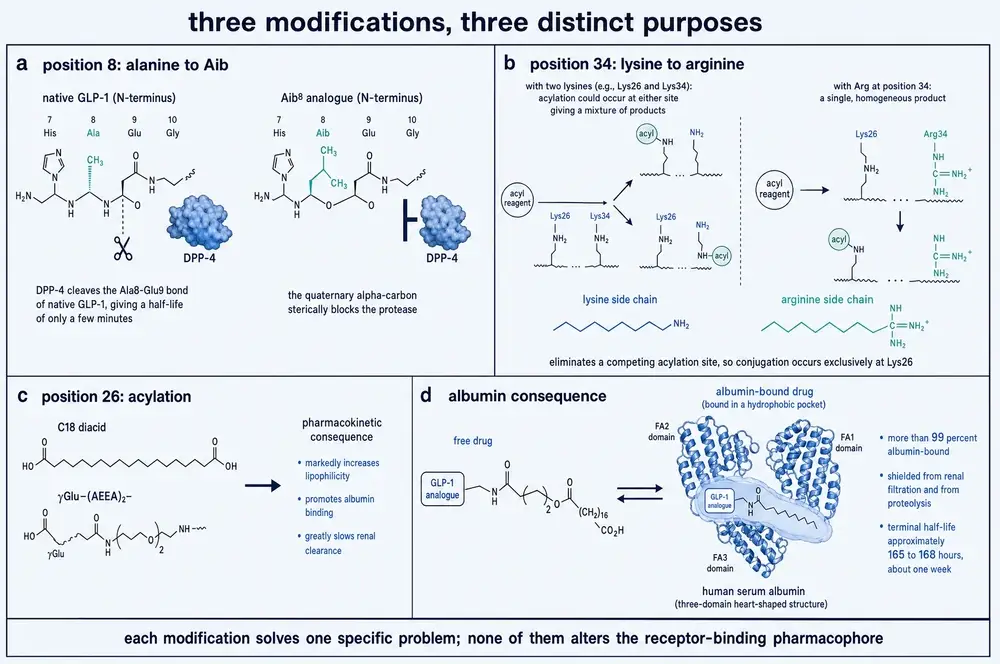
Lotte Bjerre Knudsen's group published the structure–activity work in 2000: acylate GLP-1 analogues with linear fatty acids of increasing length, and duration of action rises while receptor potency falls (Knudsen et al., 2000). The programme's answer was liraglutide — an alanine-to-Aib substitution at position 8 to block DPP-4, an arginine substituted at position 34 so that only one lysine remains available for chemistry, and a sixteen-carbon palmitoyl chain attached to that lysine through a glutamate spacer. Half-life about thirteen hours. Once daily. It reached Europe in 2009 and the United States in 2010.
Knudsen has written her own account of it, and it is worth noting what she says about the timescale: she took responsibility for the invention in 1997 and the drug was approved twelve years later (Knudsen, 2019). This is not a field in which molecules appear quickly.
07Three changes
Semaglutide is described in a single 2015 paper in the Journal of Medicinal Chemistry by Jesper Lau and seventeen colleagues, and that paper is the primary document for everything in this section (Lau et al., 2015).
Two of semaglutide's three modifications are inherited unchanged from liraglutide. Aib8 — alpha-aminoisobutyric acid, a non-natural amino acid with an extra methyl group where a hydrogen should be — replaces alanine at position 8 and physically obstructs DPP-4. The paper demonstrates this rather than asserting it: an otherwise identical analogue built with alanine at position 8 cleared from rats at liraglutide-like rates despite carrying the same albumin-binding side chain, and the cleaved metabolite was identified in circulation. Arg34 replaces the lysine at position 34, leaving lysine 26 as the only site available for acylation, so the chemistry happens in one place instead of two. Receptor mutagenesis in the same paper shows Arg34 has no direct effect on binding at all. Its job is purely synthetic.
The third change is the one that matters. Liraglutide carries a C16 mono-acid on a single glutamate spacer. Semaglutide carries a C18 fatty diacid — an eighteen-carbon chain with a carboxylic acid at both ends — on a longer spacer built from a glutamate and two units of AEEA, a short flexible polyethylene-glycol-like linker. The second carboxylate and the extra length together bind albumin far more tightly, and they hold the peptide out at a distance where it can still reach its receptor when it is released.
08Worse, on purpose
Now the experiment that explains the molecule.
Lau's group measured how well each of forty-five candidate compounds binds the human GLP-1 receptor, and they measured it twice: once in a clean buffer, and once with two per cent human serum albumin present. The clean number is intrinsic affinity — how good the molecule is at its target. The number with albumin is what the receptor actually sees when most of the drug is bound to something else.
| Compound | Receptor binding, no albumin | With 2% albumin | Ratio |
|---|---|---|---|
| Native GLP-1(7–37) | 0.19 nM | 0.10 nM | 0.5 |
| Liraglutide | 0.11 nM | 4.78 nM | 43 |
| Semaglutide | 0.38 nM | 357 nM | 940 |
Read the first column first. Semaglutide's intrinsic affinity for its own receptor is 0.38 nanomolar against liraglutide's 0.11 — roughly three times weaker, and twice as weak as the natural hormone. By the ordinary standard of medicinal chemistry, this is a worse compound.
Then read the third column. Adding albumin costs the natural hormone nothing — it barely binds albumin, so its apparent affinity is unchanged. It costs liraglutide a factor of 43. It costs semaglutide a factor of 940, the largest shift in the entire forty-five-compound series. Direct measurement by analytical ultracentrifugation gave the same answer: semaglutide's albumin-bound fraction is 5.6 times liraglutide's.
What the trade bought, measured in Göttingen minipigs: an intravenous half-life of 46.1 hours against liraglutide's 12.4, a mean residence time after subcutaneous injection of 63.6 hours against 23.0, and subcutaneous bioavailability of 94 per cent against 66 per cent (Lau et al., 2015). In humans the terminal half-life runs to roughly 165 hours — about a week — which is what makes a once-weekly injection possible.
None of this would matter if the modifications had damaged the part of the molecule that talks to the receptor. They did not, and a cryo-electron microscopy structure of semaglutide bound to the receptor together with its G protein shows why (Zhang et al., 2021). The peptide binds in the two-stage motion characteristic of its receptor family: the C-terminal end is caught first by the extracellular domain, then the N-terminus drops into the seven-transmembrane bundle and opens the intracellular site where the G protein couples.
The contacts that do the work are at the N-terminal end. His7 makes a hydrogen bond with the receptor's Gln234; Glu9 hydrogen bonds to Arg190. Not one of the three modifications touches either. Aib8 sits between those two contacts and alters only the shape of a bond the protease was reading; Arg34 and the acyl chain are at the opposite end of the molecule. That is the structural reason a functional potency of about six picomolar survives all three changes.
09Swallowing a peptide
Peptides are not taken by mouth. The stomach exists to destroy them, and anything that survives the acid meets pepsin, and anything that survives pepsin is too large and too water-loving to cross the intestinal wall. This is why insulin is injected a century after its discovery.
Semaglutide is taken by mouth, by a mechanism that is genuinely strange. The tablet contains about three hundred milligrams of an absorption enhancer called SNAC — sodium N-[8-(2-hydroxybenzoyl)amino]caprylate — licensed from a company called Emisphere. Buckley and colleagues worked out what it does, using human clinical studies alongside preclinical work in dogs (Buckley et al., 2018).
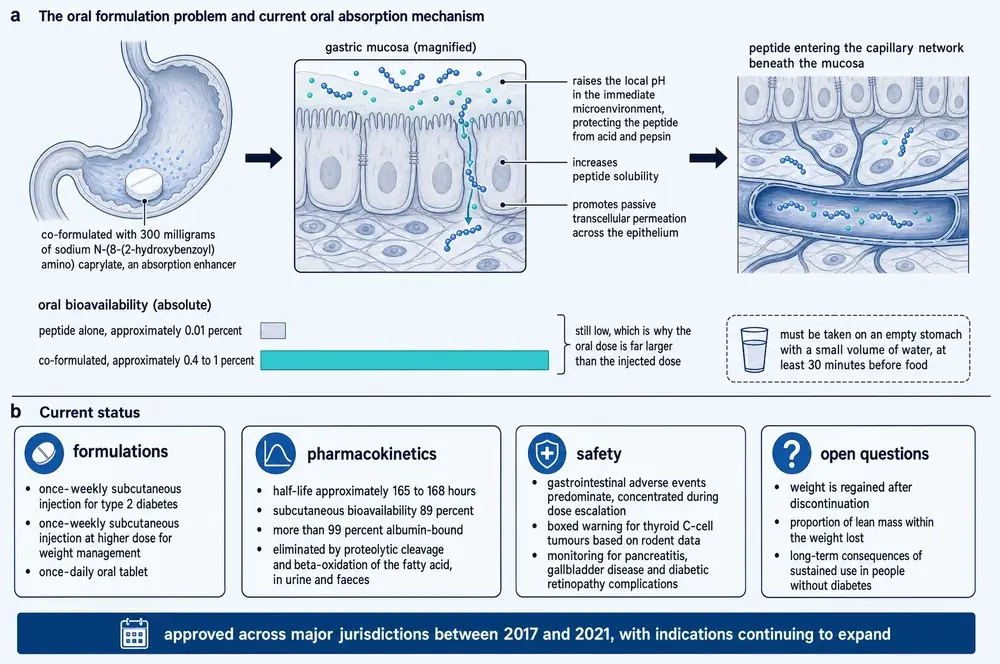
Absorption happens in the stomach, not the intestine. It happens in a small patch of mucosa immediately beside the dissolving tablet, and nowhere else. As the tablet erodes, SNAC creates a locally concentrated buffered microenvironment that raises the pH right at the stomach wall from around one or two up to roughly five — and pepsin, which is an acid protease, essentially stops working above pH five. The peptide crosses the epithelium through the cells rather than between them; the study found no evidence that tight junctions were being prised open.
The efficiency is poor, and honestly so: oral bioavailability is somewhere between 0.4 and 1 per cent. Ninety-nine hundredths of each tablet is wasted. That is affordable only because the peptide is potent and the manufacturing scalable, and it is why the oral tablet's strengths are numerically so much larger than the injection's. Novo Nordisk bought Emisphere outright in November 2020 for 1.8 billion dollars — 1.35 billion for the shares and a further 450 million to retire a royalty obligation on the very technology it was buying.
10Where the drug actually goes
Semaglutide suppresses appetite. Appetite lives in the brain. It is therefore natural to assume the drug floods the brain, and almost every popular account of it says so.
It does not. Gabery and colleagues put a labelled version into mice and rats and looked at where it physically ended up (Gabery et al., 2020). The answer is narrow. Semaglutide reached the brainstem, the septal nucleus and the hypothalamus, and it got in through the circumventricular organs — a handful of small structures, the area postrema chief among them, where the blood–brain barrier is deliberately incomplete so that the brain can sample the blood. The paper states plainly that semaglutide did not broadly cross the blood–brain barrier. A large, albumin-bound molecule cannot.
What it does instead is reach the few doors that are open, and let the wiring do the rest. The same study found activation in ten brain regions, including places the drug never physically touched — the lateral parabrachial nucleus among them — which means those regions are being driven by neurons downstream of the entry points rather than by the drug directly. And weight fell in those animals without a fall in energy expenditure, which places the entire effect on the intake side of the ledger.
A tracer study in the local corpus makes the same point from the opposite direction: of five incretin receptor agonists compared for whole-brain uptake, semaglutide had the lowest. Dulaglutide penetrated considerably better. The drug with the strongest appetite effect is the one that gets into brain tissue least well — which is only a paradox if you assumed the mechanism was diffuse brain exposure. It is not. It is a handful of specific doors.
11A narrow signature
The most informative single experiment on this question was not run on semaglutide alone. Hansen and colleagues profiled six weight-lowering drugs of completely different mechanisms — lorcaserin, rimonabant, bromocriptine, sibutramine, setmelanotide and semaglutide — by mapping neuronal activation across 308 atlas-defined regions of the mouse brain at single-cell resolution, two hours after a single dose (Hansen et al., 2021). This study sits in the project's local corpus.
Semaglutide lit up all four of the brainstem regions the analysis defined: area postrema, nucleus of the solitary tract, dorsal motor nucleus of the vagus, and the parabrachial nucleus. That is exactly the hindbrain satiety circuit.
And then it stopped. Semaglutide was the only one of the six that did not activate the nucleus accumbens — the central node of the brain's reward system. In the amygdala it touched only the medial part of the central nucleus, where the other five drugs activated all subdivisions. The authors note that the other compounds produced extensive, brain-wide responses, which they attribute to better central nervous system access.
12The pancreas, the stomach and the appetite
The peripheral actions are the classical ones and they are not in dispute. Semaglutide amplifies insulin secretion, suppresses glucagon, and slows gastric emptying. What deserves emphasis is a qualifier: the insulin effect is glucose-dependent. The drug amplifies a signal the beta cell is already receiving; it does not generate one. When blood glucose is low there is nothing to amplify. This is the structural reason hypoglycaemia is uncommon on semaglutide alone, and it is why the SUSTAIN 4 trial found severe or confirmed hypoglycaemia in 4 and 6 per cent of semaglutide patients against 11 per cent on insulin glargine.
Which leaves the question everyone actually asks: does it work by making people feel sick?
The answer is no, and it has been measured. Wharton and colleagues pooled the first three STEP obesity trials — 2,117 people on semaglutide against 1,262 on placebo — and ran a mediation analysis on it (Wharton et al., 2022). Gastrointestinal adverse events accounted for less than one percentage point of a weight-loss difference that ran between 7.6 and 14.4 percentage points. The nausea is real, and section 20 gives it its full weight. It is not the mechanism.
13Not just the weight
When SELECT reported a twenty per cent reduction in cardiovascular events, the obvious explanation was that the participants had lost weight, and losing weight is good for the heart. The obvious explanation appears to be wrong, or at least badly incomplete.
A mediation analysis of SELECT tested whether the benefit tracked the weight loss. Adjusting the model for time-varying body weight moved the hazard ratio from 0.80 to 0.81 — that is, essentially not at all. Early change in waist circumference accounted for about a third of the effect. Whatever is protecting these hearts, most of it is not the weight.
Inflammation is the leading candidate. C-reactive protein falls sharply and consistently: across the first three STEP trials, reductions of 44, 39 and 48 per cent against placebo at 68 weeks (Verma et al., 2023); in SELECT, 38 per cent at two years. And in people with type 2 diabetes, only 20 to 62 per cent of that fall was statistically mediated by changes in HbA1c and body weight (Mosenzon et al., 2022) — leaving a substantial residue unaccounted for by either.
Animal work supports a direct anti-inflammatory action on vessels. In ApoE-deficient mice given a carotid injury, semaglutide reduced intimal area by about 66 per cent (Jensen et al., 2022). In diabetic ApoE-deficient mice, early treatment suppressed aortic plaque with only modest glycaemic and lipid improvement — and the anti-inflammatory changes appeared in non-diabetic mice too. That same study found no benefit when treatment began at 18 to 30 weeks instead of early (Dan et al., 2026).
And here the story acquires a genuine puzzle. The Jensen study that found a 66 per cent reduction in vessel remodelling also looked for the GLP-1 receptor in the artery wall — and did not find it, in mouse carotid or in human coronary vessels. Semaglutide had no effect on cultured primary human vascular smooth muscle cells. Baggio and colleagues, examining fifteen human hearts with carefully validated methods, detected receptor transcripts in the heart chambers and the sinoatrial node but not in cardiac fibroblasts, coronary artery endothelial cells or vascular smooth muscle cells (Baggio et al., 2018); a companion review reports negligible expression in ventricular myocytes (Almutairi et al., 2019).
14SUSTAIN, and the first warning
Semaglutide entered humans through a twelve-week dose-finding study of 415 people with type 2 diabetes, which found HbA1c falling by up to 1.7 percentage points and weight by up to 4.8 kilograms, and which selected the 0.5 and 1.0 milligram weekly doses for phase 3 (Nauck et al., 2016). SUSTAIN 1 began enrolling in February 2014.
What followed was eleven trials that tested the drug against, in turn, nothing at all, a DPP-4 inhibitor, an older weekly GLP-1 agonist, basal insulin, an SGLT-2 inhibitor, two rival GLP-1 agonists, and finally itself at a higher dose. It won every comparison on both HbA1c and weight.
Two results deserve pulling out of that pattern. SUSTAIN 7 tested semaglutide against dulaglutide at matched doses and beat it on both endpoints at both dose levels (Pratley et al., 2018). And SUSTAIN 3, against exenatide extended-release, produced the one tolerability comparison semaglutide wins outright: injection-site reactions in 1.2 per cent against 22.0 per cent (Ahmann et al., 2018).
Then there is SUSTAIN 6, which is a different kind of trial and carries a different kind of finding.
The trial that reported a benefit and a warning in the same sentence
SUSTAIN 6 enrolled 3,297 people with type 2 diabetes at high cardiovascular risk and followed them for up to 148 weeks (Marso et al., 2016). Its purpose was to demonstrate that semaglutide did not increase cardiovascular events, which is what regulators required of diabetes drugs after an earlier generation of them had. It found the opposite: major adverse cardiovascular events occurred in 6.6 per cent of the semaglutide group against 8.9 per cent on placebo, a hazard ratio of 0.74 with a confidence interval of 0.58 to 0.95. Non-fatal stroke fell by nearly forty per cent.
And in the same results, retinopathy complications — vitreous haemorrhage, blindness, or eyes requiring injection or laser — occurred in 3.0 per cent on semaglutide against 1.8 per cent on placebo. Hazard ratio 1.76, confidence interval 1.11 to 2.78. This was not buried in a supplement; it is in the abstract, next to the benefit.
The interpretation that has held up is not that semaglutide damages the retina, but that rapidly improving very poor blood sugar transiently worsens retinopathy in eyes that already have it — a phenomenon documented with intensive insulin therapy decades before GLP-1 drugs existed. The strongest support for that reading is inside SUSTAIN 6 itself: of the 79 people who suffered a retinopathy complication, 66 already had retinopathy at baseline.
15STEP, and the gap nobody advertises
The obesity programme is what made semaglutide a household word. STEP 1 randomised 1,961 adults with obesity and without diabetes to semaglutide 2.4 milligrams weekly or placebo for 68 weeks, with lifestyle support in both arms. Mean weight change was −14.9 per cent against −2.4 (Wilding et al., 2021). Half the treated group lost more than fifteen per cent of their body weight; five per cent of the placebo group did.
The rest of the programme mapped the edges of that result. Adding intensive behavioural therapy and a low-calorie run-in took it to −16.0 per cent (Wadden et al., 2021). Extending to two years held it at −15.2 (Garvey et al., 2022). Against liraglutide head to head, −15.8 against −6.4 — and, notably, fewer people quit (Rubino et al., 2022). In adolescents the endpoint was body-mass index rather than weight, and it fell 16.1 per cent while the placebo group's rose slightly (Weghuber et al., 2022).
The same drug, the same dose, a different answer
STEP 2 gave semaglutide 2.4 milligrams to people with obesity and type 2 diabetes for the same 68 weeks. Weight fell 9.6 per cent (Davies et al., 2021). Against STEP 1's 14.9, that is a third of the effect gone.
This is not a fluke of one trial. STEP-HFpEF and its diabetes companion ran the same protocol in the same condition and split the same way: −13.3 per cent without diabetes, −9.8 with it (Kosiborod et al., 2023; Kosiborod et al., 2024). The CagriSema trials reproduced it a third time at a much larger effect size: REDEFINE 1 without diabetes gave −20.4 per cent, REDEFINE 2 with it gave −13.7 (Garvey et al., 2025; Davies et al., 2025).
Why this happens is not settled. Candidate explanations include the glucose-lowering itself removing calories previously lost in the urine, differences in background medication, and longer disease duration. What matters for a reader is the size of it: a person with type 2 diabetes reading a fourteen-per-cent figure is reading a number generated in a population that did not include them.
16SELECT
SELECT is the trial that changed what kind of drug semaglutide is. It enrolled 17,604 adults who were overweight or obese and had established cardiovascular disease, and who explicitly did not have diabetes. Mean follow-up was 39.8 months (Lincoff et al., 2023).
Major adverse cardiovascular events occurred in 569 people on semaglutide, 6.5 per cent, against 701 on placebo, 8.0 per cent. Hazard ratio 0.80, confidence interval 0.72 to 0.90. On 8 March 2024 the FDA added cardiovascular risk reduction to the Wegovy label — the first time a medicine had been approved to reduce cardiovascular risk on the basis of treating obesity.
The same trial recorded permanent discontinuation for adverse events in 16.6 per cent of the semaglutide group against 8.2 per cent on placebo. One in six people stopped. Both numbers are results of the same trial and belong in the same paragraph.
17The kidney
FLOW randomised 3,533 people with type 2 diabetes and chronic kidney disease to semaglutide 1.0 milligram — the diabetes dose, not the obesity dose — or placebo, and was stopped early for efficacy at a prespecified interim analysis (Perkovic et al., 2024). Over a median 3.4 years the primary composite of kidney failure, sustained fifty-per-cent loss of kidney function, and kidney or cardiovascular death occurred 331 times against 410. Hazard ratio 0.76.
All-cause death fell twenty per cent. The rate of kidney-function decline slowed by 1.16 millilitres per minute per year. And serious adverse events were recorded in 49.6 per cent of the semaglutide group against 53.8 per cent on placebo — lower on the drug, in a population sick enough that serious events happen to half of them either way.
Why it works on the kidney is, remarkably, still unknown. A dedicated mechanism trial called REMODEL was designed for exactly that purpose, pairing magnetic-resonance measures of kidney oxygenation and perfusion with paired biopsies, and its own rationale paper states that semaglutide's kidney mechanism "remains unclear" (Cherney et al., 2025). A drug can carry an approved indication for an organ whose response to it nobody has explained.
18The liver, the legs and the knee
The liver. ESSENCE enrolled people with biopsy-confirmed metabolic dysfunction-associated steatohepatitis and fibrosis at stage 2 or 3. In the planned interim analysis of the first 800 participants at 72 weeks, resolution of steatohepatitis without worsening fibrosis occurred in 62.9 per cent against 34.3 on placebo, and fibrosis improved in 36.8 against 22.4 (Sanyal et al., 2025). The FDA granted Wegovy accelerated approval for non-cirrhotic MASH with F2 to F3 fibrosis on 15 August 2025.
The legs. STRIDE randomised 792 people with peripheral arterial disease and type 2 diabetes to semaglutide 1.0 milligram for 52 weeks, measuring how far they could walk. The ratio of maximum walking distance to baseline was 1.21 against 1.08, a treatment ratio of 1.13 (Bonaca et al., 2025). Modest, and in a condition with very little else to offer.
The knee. STEP 9 enrolled 407 people with obesity and moderate radiographic knee osteoarthritis. Weight fell 13.7 per cent against 3.2, and the WOMAC pain score fell 41.7 points against 27.5 (Bliddal et al., 2024). The placebo arm's 27.5-point improvement is worth noticing: most of the pain relief in this trial happened without the drug.
19What it did not do
Everything above is a list of successes, and a list of successes is a misleading way to describe a drug. Here is the other column.
Alzheimer's disease
The preclinical case was strong and it came from good laboratories. In the chronic MPTP mouse model of Parkinson's disease, semaglutide rescued dopaminergic neurons, reduced alpha-synuclein accumulation and outperformed daily liraglutide despite less frequent dosing (Zhang et al., 2019). In APP/PS1 transgenic mice and in brain organoids grown from Alzheimer's patients' own cells, it reduced amyloid plaque, phosphorylated tau and markers of glial activation (Zhang et al., 2024). Epidemiology pointed the same way.
EVOKE and EVOKE+ tested it properly: two phase 3 randomised trials, roughly 3,800 people between them with amyloid-confirmed early Alzheimer's disease, oral semaglutide, cognitive and functional decline measured over 104 weeks. Both missed their primary endpoint. Semaglutide was not superior to placebo.
It is worth registering how comprehensive the preclinical case was, and how completely it failed to predict. A computational analysis in the project's local corpus ranked 39 diabetes drugs for predicted neuroprotection in Alzheimer's disease and placed metformin first and semaglutide in the bottom five — against most of the rodent literature, and against the epidemiology. It was right.
Addiction
The animal evidence here is genuinely interesting. In rats given intermittent access to alcohol, semaglutide reduced intake and prevented relapse-like drinking in both sexes; fluorescently labelled drug was imaged directly in the nucleus accumbens; and in mice it blocked the dopamine release that alcohol normally produces there (Aranäs et al., 2023).
The human evidence is one trial of 48 people who were not seeking treatment. It reduced laboratory alcohol self-administration, peak breath alcohol and craving — and did not significantly change drinks per day or the number of drinking days (Hendershot et al., 2025). Three further completed trials have no published results. The pivotal phase 3 had not begun as of this compilation. "Semaglutide treats addiction" is, at present, a claim resting on forty-eight people and a laboratory endpoint.
The oral cardiovascular trial that fell short of its ambitions
SOUL tested oral semaglutide against placebo in 9,650 people with type 2 diabetes and established cardiovascular or kidney disease. It met its primary endpoint — hazard ratio 0.86, confidence interval 0.77 to 0.96 (McGuire et al., 2025). But its confirmatory secondary outcomes, including major kidney disease events, did not differ significantly. PIONEER 6, the earlier oral cardiovascular trial, demonstrated non-inferiority only: hazard ratio 0.79 with a confidence interval from 0.57 to 1.11, which crosses one (Husain et al., 2019).
20The gastrointestinal tax
In STEP 1, nausea affected 44 per cent of the semaglutide group against 17 per cent on placebo. Diarrhoea 30 against 16. Vomiting 24 against 6. Constipation 24 against 11. These are not rare events; they are the ordinary experience of taking the drug.
What the headline rates conceal is their shape. The pooled analysis of the first three STEP trials found that 98.1 per cent of gastrointestinal events were mild or moderate and 99.5 per cent non-serious, that they clustered during and shortly after dose escalation, and that only 4.3 per cent of participants stopped permanently because of them (Wharton et al., 2022). Most people feel unwell while the dose goes up and then stop feeling unwell.
A comparison that is often made carelessly: STEP 1's 4.5 per cent discontinuation for gastrointestinal events against SELECT's 16.6 per cent for all adverse events. These are not the same measurement. SELECT ran for a mean of 39.8 months against STEP 1's 68 weeks, in an older population with established cardiovascular disease, and counted every adverse event rather than only gastrointestinal ones.
One counterintuitive finding from the project's local corpus deserves a line, because it cuts against a common assumption. Semaglutide's long half-life is often said to make it gentler than short-acting agents. In two independent network meta-analyses it carried the highest constipation risk in its class and significantly higher diarrhoea risk than most comparators, and in one analysis the single highest odds ratio for vomiting of any regimen tested — including higher-efficacy tirzepatide doses. Efficacy and tolerability do not track together across this drug class.
21Signals that held, and signals that dissolved
Four safety questions about semaglutide have produced genuinely contradictory published evidence. Each is instructive about a different way a signal can be wrong, and none should be reported as settled in the direction its loudest study points.
NAION — a signal made and unmade by the choice of comparator
Non-arteritic anterior ischaemic optic neuropathy is a sudden, usually painless, largely irreversible loss of vision in one eye caused by interruption of blood supply to the optic nerve head. In July 2024 a matched retrospective cohort from Massachusetts Eye and Ear reported hazard ratios of 4.28 in patients with type 2 diabetes and 7.64 in patients with overweight or obesity (Hathaway et al., 2024). Those are alarming numbers.
They were followed by studies that disagreed with each other completely. A Danish cohort of 424,152 people found risk roughly doubled. A TriNetX analysis of 174,584 matched pairs found no elevation at 1, 3, 6 or 12 months and then hazard ratios above 2 at years two through four (Hsu et al., 2025). And a Military Health System cohort of 1.2 million people found semaglutide associated with a lower risk — odds ratio 0.36 (Lieberman et al., 2026).
A systematic review in the project's local corpus, covering nine cohorts and more than three million patients, found the resolution (Eisa & Barood, 2026). The studies do not divide by size, or quality, or country. They divide by what they compared semaglutide against. Studies using broad or untreated comparators found elevated risk. Studies using active comparators — other modern drugs prescribed to people with similar disease severity — found none. Pooled across active-comparator studies the hazard ratio is 0.96, confidence interval 0.74 to 1.24. A meta-analysis restricted to randomised trials, the design that eliminates this problem by construction, found OR 1.53 with a confidence interval from 0.53 to 4.44 — not significant (Silverii et al., 2025).
The mechanism of the illusion is confounding by indication: semaglutide is prescribed to people with worse diabetes, more obesity and more cardiovascular disease, and all three are independent risk factors for NAION. Compare those people to the general untreated population and the drug inherits their risk.
Suicidality — a signal from spontaneous reports, absent everywhere else
In 2023 the Icelandic Medicines Agency flagged spontaneous reports of suicidal thinking in people taking semaglutide and liraglutide, and the European Medicines Agency opened a review. In April 2024 that review concluded that the available evidence does not support a causal association and that no product-information change was warranted.
The largest study points the other way entirely. A matched cohort of 240,618 people with overweight or obesity, replicated in 1.59 million with type 2 diabetes, found semaglutide associated with lower incident suicidal ideation and lower recurrent ideation, hazard ratio 0.44 for the latter (Wang et al., 2024). Pharmacovigilance analyses that did find a signal are informative about their own limits: one reported a disproportionality ratio of 2.03 for semaglutide but a higher one for metformin, and stated plainly that no causality could be inferred (Guirguis et al., 2024); a 2026 analysis of the same database found semaglutide not significant on any suicidality endpoint (Seijas-Amigo et al., 2026).
Pancreatitis — nine-fold in a claims database, nothing in the trials
The observational estimate is a hazard ratio of 9.1, from a cohort of 613 semaglutide users compared against people taking bupropion–naltrexone (Sodhi et al., 2023). Its confidence interval runs from 1.3 to 66 — which is to say the study is compatible with almost no effect and with a catastrophic one.
Against that: 31 placebo-controlled trials pooling 40,274 patients, 59 events against 50, odds ratio 0.99. Seven cardiovascular outcomes trials, 56,004 patients, odds ratio 1.05. The randomised evidence has vastly more patients, adjudicated events, and no scope for the differential symptom-investigation that a claims database cannot exclude.
Thyroid C-cell tumours — a real finding in the wrong species
Semaglutide carries a boxed warning for thyroid C-cell tumours, and the finding behind it is real. In two-year carcinogenicity studies, rats and to a lesser extent mice developed C-cell hyperplasia and medullary thyroid carcinoma at clinically relevant exposures.
The foundational study of why this may not transfer is thorough (Bjerre Knudsen et al., 2010). Rodent thyroid C-cells express the GLP-1 receptor; human and cynomolgus monkey C-cells express little of it. In primate tissue, GLP-1 receptor agonists did not activate adenylate cyclase or release calcitonin at all. Twenty months of liraglutide at more than sixty times human exposure produced no C-cell hyperplasia in monkeys. And in people, two years of treatment left calcitonin at the low end of normal.
22Muscle, and what a scanner actually measures
The most persistent worry about rapid pharmacological weight loss is that some of the lost tissue is muscle. The body-composition substudy of STEP 1 supports the concern at first reading: over 68 weeks, total fat mass fell 19.3 per cent and total lean body mass fell 9.7 per cent, with lean tissue making up roughly forty per cent of the weight lost on some analyses — against a figure of twenty to thirty per cent usually quoted for weight loss by diet or surgery.
Two things complicate that reading, and both matter.
First, "lean mass" on a dual-energy X-ray scan is not muscle. The measurement partitions the body into fat, bone mineral, and everything else, and that residual third category is what gets called lean mass. It contains total body water, organs, connective tissue and the fluid inside and around muscle. During rapid weight loss a substantial fraction of what disappears from that compartment is water. A 9.7 per cent fall in DXA lean mass is not a 9.7 per cent fall in contractile muscle, and the two are routinely conflated.
Second, the trajectory is not linear. The SEMALEAN study followed 115 people for twelve months with scans, grip strength and resting energy expenditure. Lean mass fell by about three kilograms by month seven and then stabilised through month twelve, while fat mass kept falling and measured muscle function was preserved or improved (Alissou et al., 2026). It is a single-arm prospective cohort rather than a randomised trial, but it is the most direct evidence available that the lean-mass loss is an early-phase phenomenon.
What does not exist is a trial in older adults. No dedicated randomised trial or large cohort has quantified sarcopenia or functional decline in people over 65 taking semaglutide. The concern is mechanistically reasonable — older people have less reserve — and it has not been tested.
23Stopping
This is the least contested finding in the entire semaglutide evidence base, and the one most often left out of the conversation.
STEP 4 was built to answer it directly. Every participant took semaglutide openly for a twenty-week escalation; the 803 who reached the full dose were then randomised either to continue or to switch to placebo for another 48 weeks, with the lifestyle programme running in both arms throughout. Those who continued lost a further 7.9 per cent. Those switched to placebo regained 6.9 per cent. The difference between the arms was 14.8 percentage points (Rubino et al., 2021).
The STEP 1 extension went further, following 327 people for a full year after both the drug and the lifestyle intervention were withdrawn at week 68. Peak weight loss had been 17.3 per cent. A year later they had regained 11.6 percentage points, leaving them 5.6 per cent below where they started. Roughly two-thirds of the loss returned. The improvements in blood pressure, lipids and glycaemia reverted toward baseline alongside it (Wilding et al., 2022).
24The supply problem
Between 2022 and early 2025 semaglutide was in shortage in the United States, and United States law permits compounding pharmacies to make copies of a drug that is on the shortage list. An industry grew in that gap. When the FDA declared the shortage resolved on 21 February 2025, the legal basis for that industry disappeared, and it sued. The Outsourcing Facilities Association filed against the FDA three days later; a preliminary injunction was denied, and on 13 June 2026 the court ruled for the agency.
Three specific hazards from that period are worth recording, because they are the risks most likely to reach a reader of a research-use monograph.
- Different molecules under the same name. The FDA has stated that some compounders supplied semaglutide sodium and semaglutide acetate — salt forms that are different active ingredients from the base in the approved products, with no data establishing that they share its properties, and no lawful basis identified for compounding with them.
- Dosing errors of five to twenty times. The FDA's July 2024 alert attributed these to users unfamiliar with drawing doses from multi-dose vials — a presentation the approved pen device does not use. Over 600 adverse event reports had been received in connection with compounded semaglutide as of July 2025.
- Falsified product inside the regulated supply chain. WHO Medical Product Alert N°2/2024 identified three falsified Ozempic batches found not on the grey market but within legitimate distribution — in Brazil and the United Kingdom in October 2023 and the United States in December 2023 — including one case in which a genuine batch number had been printed on falsified product.
And the generic that is not one
In April 2026 Apotex received what was widely reported as the first FDA approval for a generic version of Ozempic. The regulatory record, read directly, says something narrower. ANDA 220314 carries a marketing status of "None (Tentative Approval)", and its only original submission is coded TA rather than AP, dated 7 April 2026.
Tentative approval means the application satisfies the agency's scientific and manufacturing requirements and may not be marketed while patent and exclusivity protection on the reference product remains in force. It is a real milestone and it is not a generic anyone can buy, nor evidence that semaglutide's exclusivity has lapsed.
25Standing constraint
26References
Generated from verified NCBI records rather than from recall. Author lists, journal names, volumes, pages and identifiers were re-fetched from PubMed for every entry below and the returned title of each was read back and confirmed to be the paper intended. This series has twice shipped reference lists drafted from memory in which identifiers pointed at real but unrelated papers, and the build refuses to run if any identifier fails to resolve.
- Ahmann AJ, Capehorn M, Charpentier G, Dotta F, Henkel E, Lingvay I, et al.. Efficacy and Safety of Once-Weekly Semaglutide Versus Exenatide ER in Subjects With Type 2 Diabetes (SUSTAIN 3): A 56-Week, Open-Label, Randomized Clinical Trial. Diabetes Care. 2018;41(2):258-266.
PMID 29246950 · doi:10.2337/dc17-0417 - Ahrén B, Masmiquel L, Kumar H, Sargin M, Karsbøl JD, Jacobsen SH, et al.. Efficacy and safety of once-weekly semaglutide versus once-daily sitagliptin as an add-on to metformin, thiazolidinediones, or both, in patients with type 2 diabetes (SUSTAIN 2): a 56-week, double-blind, phase 3a, randomised trial. Lancet Diabetes Endocrinol. 2017;5(5):341-354.
PMID 28385659 · doi:10.1016/S2213-8587(17)30092-X - Al Refaie A, Baldassini L, Mondillo C, Ceccarelli E, Tarquini R, Gennari L, et al.. Glucagon-like Peptide-1 Receptor Agonists and Diabetic Osteopathy: Another Positive Effect of Incretines? A 12 Months Longitudinal Study. Calcif Tissue Int. 2024;115(2):160-168.
PMID 38864922 · doi:10.1007/s00223-024-01240-1 · PMC11246279 - Alissou M, Demangeat T, Folope V, Van Elslande H, Lelandais H, Blanchemaison J, et al.. Impact of Semaglutide on fat mass, lean mass and muscle function in patients with obesity: The SEMALEAN study. Diabetes Obes Metab. 2026;28(1):112-121.
PMID 41068996 · doi:10.1111/dom.70141 · PMC12673431 - Almutairi M, Al Batran R, Ussher JR. Glucagon-like peptide-1 receptor action in the vasculature. Peptides. 2019;111:26-32.
PMID 30227157 · doi:10.1016/j.peptides.2018.09.002 - Aranäs C, Edvardsson CE, Shevchouk OT, Zhang Q, Witley S, Blid Sköldheden S, et al.. Semaglutide reduces alcohol intake and relapse-like drinking in male and female rats. EBioMedicine. 2023;93:104642.
PMID 37295046 · doi:10.1016/j.ebiom.2023.104642 · PMC10363436 - Aroda VR, Bain SC, Cariou B, Piletič M, Rose L, Axelsen M, et al.. Efficacy and safety of once-weekly semaglutide versus once-daily insulin glargine as add-on to metformin (with or without sulfonylureas) in insulin-naive patients with type 2 diabetes (SUSTAIN 4): a randomised, open-label, parallel-group, multicentre, multinational, phase 3a trial. Lancet Diabetes Endocrinol. 2017;5(5):355-366.
PMID 28344112 · doi:10.1016/S2213-8587(17)30085-2 - Aroda VR, Rosenstock J, Terauchi Y, Altuntas Y, Lalic NM, Morales Villegas EC, et al.. PIONEER 1: Randomized Clinical Trial of the Efficacy and Safety of Oral Semaglutide Monotherapy in Comparison With Placebo in Patients With Type 2 Diabetes. Diabetes Care. 2019;42(9):1724-1732.
PMID 31186300 · doi:10.2337/dc19-0749 - Baggio LL, Yusta B, Mulvihill EE, Cao X, Streutker CJ, Butany J, et al.. GLP-1 Receptor Expression Within the Human Heart. Endocrinology. 2018;159(4):1570-1584.
PMID 29444223 · doi:10.1210/en.2018-00004 · PMC5939638 - Bell GI, Santerre RF, Mullenbach GT. Hamster preproglucagon contains the sequence of glucagon and two related peptides. Nature. 1983;302(5910):716-8.
PMID 6835407 · doi:10.1038/302716a0 - Bjerre Knudsen L, Madsen LW, Andersen S, Almholt K, de Boer AS, Drucker DJ, et al.. Glucagon-like Peptide-1 receptor agonists activate rodent thyroid C-cells causing calcitonin release and C-cell proliferation. Endocrinology. 2010;151(4):1473-86.
PMID 20203154 · doi:10.1210/en.2009-1272 - Bliddal H, Bays H, Czernichow S, Uddén Hemmingsson J, Hjelmesæth J, Hoffmann Morville T, et al.. Once-Weekly Semaglutide in Persons with Obesity and Knee Osteoarthritis. N Engl J Med. 2024;391(17):1573-1583.
PMID 39476339 · doi:10.1056/NEJMoa2403664 - Bonaca MP, Catarig AM, Houlind K, Ludvik B, Nordanstig J, Ramesh CK, et al.. Semaglutide and walking capacity in people with symptomatic peripheral artery disease and type 2 diabetes (STRIDE): a phase 3b, double-blind, randomised, placebo-controlled trial. Lancet. 2025;405(10489):1580-1593.
PMID 40169145 · doi:10.1016/S0140-6736(25)00509-4 - Buckley ST, Bækdal TA, Vegge A, Maarbjerg SJ, Pyke C, Ahnfelt-Rønne J, et al.. Transcellular stomach absorption of a derivatized glucagon-like peptide-1 receptor agonist. Sci Transl Med. 2018;10(467).
PMID 30429357 · doi:10.1126/scitranslmed.aar7047 - Cai CX, Nishimura A, Baxter S, Goetz K, Hribar M, Toy B, et al.. Semaglutide and diabetic retinopathy: an OHDSI network study. BMJ Open Diabetes Res Care. 2025;13(6).
PMID 41192935 · doi:10.1136/bmjdrc-2025-005424 · PMC12587949 - Capehorn MS, Catarig AM, Furberg JK, Janez A, Price HC, Tadayon S, et al.. Efficacy and safety of once-weekly semaglutide 1.0mg vs once-daily liraglutide 1.2mg as add-on to 1-3 oral antidiabetic drugs in subjects with type 2 diabetes (SUSTAIN 10). Diabetes Metab. 2020;46(2):100-109.
PMID 31539622 · doi:10.1016/j.diabet.2019.101117 - Cherney DZI, Belmar N, Bjornstad P, Chacko MM, Gunnarsson TP, Hodgin JB, et al.. Rationale, design and baseline characteristics of REMODEL, a mechanism-of-action trial with semaglutide in people with type 2 diabetes and chronic kidney disease. Nephrol Dial Transplant. 2025;40(11):2182-2192.
PMID 40608494 · doi:10.1093/ndt/gfaf114 · PMC12559791 - Dalbøge LS, Christensen M, Madsen MR, Secher T, Endlich N, Drenic' V, et al.. Nephroprotective Effects of Semaglutide as Mono- and Combination Treatment with Lisinopril in a Mouse Model of Hypertension-Accelerated Diabetic Kidney Disease. Biomedicines. 2022;10(7).
PMID 35884965 · doi:10.3390/biomedicines10071661 · PMC9313388 - Dan K, Sanada J, Kimura T, Iwamoto Y, Sugisaki T, Iwamoto H, et al.. Early intervention with tirzepatide or semaglutide influences anti-atherosclerotic effects in ApoE knockout mice. Sci Rep. 2026;16(1).
PMID 41946762 · doi:10.1038/s41598-026-42437-8 · PMC13223216 - Davies M, Færch L, Jeppesen OK, Pakseresht A, Pedersen SD, Perreault L, et al.. Semaglutide 2·4 mg once a week in adults with overweight or obesity, and type 2 diabetes (STEP 2): a randomised, double-blind, double-dummy, placebo-controlled, phase 3 trial. Lancet. 2021;397(10278):971-984.
PMID 33667417 · doi:10.1016/S0140-6736(21)00213-0 - Davies MJ, Bajaj HS, Broholm C, Eliasen A, Garvey WT, le Roux CW, et al.. Cagrilintide-Semaglutide in Adults with Overweight or Obesity and Type 2 Diabetes. N Engl J Med. 2025;393(7):648-659.
PMID 40544432 · doi:10.1056/NEJMoa2502082 - Deacon CF, Johnsen AH, Holst JJ. Degradation of glucagon-like peptide-1 by human plasma in vitro yields an N-terminally truncated peptide that is a major endogenous metabolite in vivo. J Clin Endocrinol Metab. 1995;80(3):952-7.
PMID 7883856 · doi:10.1210/jcem.80.3.7883856 - Drucker DJ, Philippe J, Mojsov S, Chick WL, Habener JF. Glucagon-like peptide I stimulates insulin gene expression and increases cyclic AMP levels in a rat islet cell line. Proc Natl Acad Sci U S A. 1987;84(10):3434-8.
PMID 3033647 · doi:10.1073/pnas.84.10.3434 · PMC304885 - Eisa N, Barood O. Semaglutide and Non-arteritic Anterior Ischemic Optic Neuropathy: A Systematic Review and Narrative Synthesis. AACE Endocrinol Diabetes. 2026;13(2):259-269.
PMID 41938304 · doi:10.1016/j.aed.2026.01.001 · PMC13043474 - Eng J, Kleinman WA, Singh L, Singh G, Raufman JP. Isolation and characterization of exendin-4, an exendin-3 analogue, from Heloderma suspectum venom. Further evidence for an exendin receptor on dispersed acini from guinea pig pancreas. J Biol Chem. 1992;267(11):7402-5.
PMID 1313797 - Frías JP, Auerbach P, Bajaj HS, Fukushima Y, Lingvay I, Macura S, et al.. Efficacy and safety of once-weekly semaglutide 2·0 mg versus 1·0 mg in patients with type 2 diabetes (SUSTAIN FORTE): a double-blind, randomised, phase 3B trial. Lancet Diabetes Endocrinol. 2021;9(9):563-574.
PMID 34293304 · doi:10.1016/S2213-8587(21)00174-1 - Gabery S, Salinas CG, Paulsen SJ, Ahnfelt-Rønne J, Alanentalo T, Baquero AF, et al.. Semaglutide lowers body weight in rodents via distributed neural pathways. JCI Insight. 2020;5(6).
PMID 32213703 · doi:10.1172/jci.insight.133429 · PMC7213778 - Garvey WT, Batterham RL, Bhatta M, Buscemi S, Christensen LN, Frias JP, et al.. Two-year effects of semaglutide in adults with overweight or obesity: the STEP 5 trial. Nat Med. 2022;28(10):2083-2091.
PMID 36216945 · doi:10.1038/s41591-022-02026-4 · PMC9556320 - Garvey WT, Blüher M, Osorto Contreras CK, Davies MJ, Winning Lehmann E, Pietiläinen KH, et al.. Coadministered Cagrilintide and Semaglutide in Adults with Overweight or Obesity. N Engl J Med. 2025;393(7):635-647.
PMID 40544433 · doi:10.1056/NEJMoa2502081 - Gefel D, Hendrick GK, Mojsov S, Habener J, Weir GC. Glucagon-like peptide-I analogs: effects on insulin secretion and adenosine 3',5'-monophosphate formation. Endocrinology. 1990;126(4):2164-8.
PMID 2156683 · doi:10.1210/endo-126-4-2164 - Guirguis A, Chiappini S, Papanti P GD, Vickers-Smith R, Harris D, Corkery JM, et al.. Exploring the association between suicidal thoughts, self-injury, and GLP-1 receptor agonists in weight loss treatments: Insights from pharmacovigilance measures and unmasking analysis. Eur Neuropsychopharmacol. 2024;82:82-91.
PMID 38508100 · doi:10.1016/j.euroneuro.2024.02.003 - Göke R, Fehmann HC, Linn T, Schmidt H, Krause M, Eng J, et al.. Exendin-4 is a high potency agonist and truncated exendin-(9-39)-amide an antagonist at the glucagon-like peptide 1-(7-36)-amide receptor of insulin-secreting beta-cells. J Biol Chem. 1993;268(26):19650-5.
PMID 8396143 - Hansen HH, Perens J, Roostalu U, Skytte JL, Salinas CG, Barkholt P, et al.. Whole-brain activation signatures of weight-lowering drugs. Mol Metab. 2021;47:101171.
PMID 33529728 · doi:10.1016/j.molmet.2021.101171 · PMC7895844 - Hathaway JT, Shah MP, Hathaway DB, Zekavat SM, Krasniqi D, Gittinger JW, et al.. Risk of Nonarteritic Anterior Ischemic Optic Neuropathy in Patients Prescribed Semaglutide. JAMA Ophthalmol. 2024;142(8):732-739.
PMID 38958939 · doi:10.1001/jamaophthalmol.2024.2296 · PMC11223051 - Hendershot CS, Bremmer MP, Paladino MB, Kostantinis G, Gilmore TA, Sullivan NR, et al.. Once-Weekly Semaglutide in Adults With Alcohol Use Disorder: A Randomized Clinical Trial. JAMA Psychiatry. 2025;82(4):395-405.
PMID 39937469 · doi:10.1001/jamapsychiatry.2024.4789 · PMC11822619 - Hinds CE, Peace E, Chen S, Davies I, El Eid L, Tomas A, et al.. Abolishing β-arrestin recruitment is necessary for the full metabolic benefits of G protein-biased glucagon-like peptide-1 receptor agonists. Diabetes Obes Metab. 2024;26(1):65-77.
PMID 37795639 · doi:10.1111/dom.15288 - Holst JJ, Orskov C, Nielsen OV, Schwartz TW. Truncated glucagon-like peptide I, an insulin-releasing hormone from the distal gut. FEBS Lett. 1987;211(2):169-74.
PMID 3542566 · doi:10.1016/0014-5793(87)81430-8 - Hsu AY, Kuo HT, Wang YH, Lin CJ, Shao YC, Chiang CC, et al.. Semaglutide and Nonarteritic Anterior Ischemic Optic Neuropathy Risk Among Patients With Diabetes. JAMA Ophthalmol. 2025;143(5):400-407.
PMID 40146102 · doi:10.1001/jamaophthalmol.2025.0349 · PMC11950975 - Hu L, Li S, Deng X, Zhou Z, Yang L, Li B. GLP-1 receptor agonists alleviate inflammatory responses and endothelial dysfunction in atherosclerosis by activating the Sema3A/NRP1 pathway. Front Cardiovasc Med. 2026;13:1836833.
PMID 42205784 · doi:10.3389/fcvm.2026.1836833 · PMC13201246 - Husain M, Birkenfeld AL, Donsmark M, Dungan K, Eliaschewitz FG, Franco DR, et al.. Oral Semaglutide and Cardiovascular Outcomes in Patients with Type 2 Diabetes. N Engl J Med. 2019;381(9):841-851.
PMID 31185157 · doi:10.1056/NEJMoa1901118 - Jensen DM, Skovsted GF, Bonde MFB, Bentzon JF, Rolin B, Franck G, et al.. Semaglutide treatment attenuates vessel remodelling in ApoE-/- mice following vascular injury and blood flow perturbation. Atheroscler Plus. 2022;49:32-41.
PMID 36644202 · doi:10.1016/j.athplu.2022.05.004 · PMC9833261 - Kadowaki T, Isendahl J, Khalid U, Lee SY, Nishida T, Ogawa W, et al.. Semaglutide once a week in adults with overweight or obesity, with or without type 2 diabetes in an east Asian population (STEP 6): a randomised, double-blind, double-dummy, placebo-controlled, phase 3a trial. Lancet Diabetes Endocrinol. 2022;10(3):193-206.
PMID 35131037 · doi:10.1016/S2213-8587(22)00008-0 - Kadowaki T, Heftdal LD, Ko HJ, Overvad M, Shimomura I, Thamattoor UK, et al.. Oral Semaglutide in an East Asian Population With Overweight or Obesity, With or Without Type 2 Diabetes: The OASIS 2 Randomized Clinical Trial. JAMA Intern Med. 2025;185(10):1206-1217.
PMID 40758358 · doi:10.1001/jamainternmed.2025.3599 · PMC12322823 - Kaur R, Singh A. Efficacy and Safety of GLP-1 Receptor Agonists on Combined Cardiovascular and Renal Outcomes in Patients With Chronic Kidney Disease: A Systematic Review and Meta-Analysis. Diabetes Obes Metab. 2026.
PMID 42337824 · doi:10.1111/dom.71031 - Kindel TL, Wang AY, Wadhwa A, Schulman AR, Sharaiha RZ, Kroh M, et al.. Multisociety Clinical Practice Guidance for the Safe Use of Glucagon-like Peptide-1 Receptor Agonists in the Perioperative Period. Clin Gastroenterol Hepatol. 2025;23(12):2083-2085.
PMID 39480373 · doi:10.1016/j.cgh.2024.10.003 - Knop FK, Aroda VR, do Vale RD, Holst-Hansen T, Laursen PN, Rosenstock J, et al.. Oral semaglutide 50 mg taken once per day in adults with overweight or obesity (OASIS 1): a randomised, double-blind, placebo-controlled, phase 3 trial. Lancet. 2023;402(10403):705-719.
PMID 37385278 · doi:10.1016/S0140-6736(23)01185-6 - Knudsen LB, Nielsen PF, Huusfeldt PO, Johansen NL, Madsen K, Pedersen FZ, et al.. Potent derivatives of glucagon-like peptide-1 with pharmacokinetic properties suitable for once daily administration. J Med Chem. 2000;43(9):1664-9.
PMID 10794683 · doi:10.1021/jm9909645 - Knudsen LB. Inventing Liraglutide, a Glucagon-Like Peptide-1 Analogue, for the Treatment of Diabetes and Obesity. ACS Pharmacol Transl Sci. 2019;2(6):468-484.
PMID 32259078 · doi:10.1021/acsptsci.9b00048 · PMC7088919 - Knudsen LB, Lau J. The Discovery and Development of Liraglutide and Semaglutide. Front Endocrinol (Lausanne). 2019;10:155.
PMID 31031702 · doi:10.3389/fendo.2019.00155 · PMC6474072 - Kolli RT, Aoutla S, Jyothi N, Mohamed Kalifa MRH, Raju A, Cheenikkal Muralidharan K. Rebound or Retention: A Meta-Analysis of Weight Regain After the Discontinuation of Glucagon-Like Peptide-1 (GLP-1) Receptor Agonists and Other Anti-obesity Drugs. Cureus. 2025;17(10):e94926.
PMID 41116804 · doi:10.7759/cureus.94926 · PMC12535773 - Kosiborod MN, Abildstrøm SZ, Borlaug BA, Butler J, Rasmussen S, Davies M, et al.. Semaglutide in Patients with Heart Failure with Preserved Ejection Fraction and Obesity. N Engl J Med. 2023;389(12):1069-1084.
PMID 37622681 · doi:10.1056/NEJMoa2306963 - Kosiborod MN, Petrie MC, Borlaug BA, Butler J, Davies MJ, Hovingh GK, et al.. Semaglutide in Patients with Obesity-Related Heart Failure and Type 2 Diabetes. N Engl J Med. 2024;390(15):1394-1407.
PMID 38587233 · doi:10.1056/NEJMoa2313917 - Lau J, Bloch P, Schäffer L, Pettersson I, Spetzler J, Kofoed J, et al.. Discovery of the Once-Weekly Glucagon-Like Peptide-1 (GLP-1) Analogue Semaglutide. J Med Chem. 2015;58(18):7370-80.
PMID 26308095 · doi:10.1021/acs.jmedchem.5b00726 - Lieberman RA, Korona-Bailey J, Banaag A, Furhman B, Corrado R, Koehlmoos TP. Semaglutide Decreases Risk of Non-Arteritic Anterior Ischemic Optic Neuroapthy in Type 2 Diabetic Patients. Mil Med. 2026;191(5-6):e1020-e1025.
PMID 41217382 · doi:10.1093/milmed/usaf522 - Lincoff AM, Brown-Frandsen K, Colhoun HM, Deanfield J, Emerson SS, Esbjerg S, et al.. Semaglutide and Cardiovascular Outcomes in Obesity without Diabetes. N Engl J Med. 2023;389(24):2221-2232.
PMID 37952131 · doi:10.1056/NEJMoa2307563 - Lingvay I, Catarig AM, Frias JP, Kumar H, Lausvig NL, le Roux CW, et al.. Efficacy and safety of once-weekly semaglutide versus daily canagliflozin as add-on to metformin in patients with type 2 diabetes (SUSTAIN 8): a double-blind, phase 3b, randomised controlled trial. Lancet Diabetes Endocrinol. 2019;7(11):834-844.
PMID 31540867 · doi:10.1016/S2213-8587(19)30311-0 - Malhotra R, Singh L, Eng J, Raufman JP. Exendin-4, a new peptide from Heloderma suspectum venom, potentiates cholecystokinin-induced amylase release from rat pancreatic acini. Regul Pept. 1992;41(2):149-56.
PMID 1279756 · doi:10.1016/0167-0115(92)90044-u - Marso SP, Bain SC, Consoli A, Eliaschewitz FG, Jódar E, Leiter LA, et al.. Semaglutide and Cardiovascular Outcomes in Patients with Type 2 Diabetes. N Engl J Med. 2016;375(19):1834-1844.
PMID 27633186 · doi:10.1056/NEJMoa1607141 - Marx N, Deanfield JE, Mann JFE, Arechavaleta R, Bain SC, Bajaj HS, et al.. Oral Semaglutide and Cardiovascular Outcomes in People With Type 2 Diabetes, According to SGLT2i Use: Prespecified Analyses of the SOUL Randomized Trial. Circulation. 2025;151(23):1639-1650.
PMID 40156843 · doi:10.1161/CIRCULATIONAHA.125.074545 · PMC12144549 - McGuire DK, Marx N, Mulvagh SL, Deanfield JE, Inzucchi SE, Pop-Busui R, et al.. Oral Semaglutide and Cardiovascular Outcomes in High-Risk Type 2 Diabetes. N Engl J Med. 2025;392(20):2001-2012.
PMID 40162642 · doi:10.1056/NEJMoa2501006 - Mojsov S, Heinrich G, Wilson IB, Ravazzola M, Orci L, Habener JF. Preproglucagon gene expression in pancreas and intestine diversifies at the level of post-translational processing. J Biol Chem. 1986;261(25):11880-9.
PMID 3528148 - Mojsov S, Weir GC, Habener JF. Insulinotropin: glucagon-like peptide I (7-37) co-encoded in the glucagon gene is a potent stimulator of insulin release in the perfused rat pancreas. J Clin Invest. 1987;79(2):616-9.
PMID 3543057 · doi:10.1172/JCI112855 · PMC424143 - Mosenzon O, Blicher TM, Rosenlund S, Eriksson JW, Heller S, Hels OH, et al.. Efficacy and safety of oral semaglutide in patients with type 2 diabetes and moderate renal impairment (PIONEER 5): a placebo-controlled, randomised, phase 3a trial. Lancet Diabetes Endocrinol. 2019;7(7):515-527.
PMID 31189517 · doi:10.1016/S2213-8587(19)30192-5 - Mosenzon O, Capehorn MS, De Remigis A, Rasmussen S, Weimers P, Rosenstock J. Impact of semaglutide on high-sensitivity C-reactive protein: exploratory patient-level analyses of SUSTAIN and PIONEER randomized clinical trials. Cardiovasc Diabetol. 2022;21(1):172.
PMID 36056351 · doi:10.1186/s12933-022-01585-7 · PMC9440529 - Mu Y, Bao X, Eliaschewitz FG, Hansen MR, Kim BT, Koroleva A, et al.. Efficacy and safety of once weekly semaglutide 2·4 mg for weight management in a predominantly east Asian population with overweight or obesity (STEP 7): a double-blind, multicentre, randomised controlled trial. Lancet Diabetes Endocrinol. 2024;12(3):184-195.
PMID 38330988 · doi:10.1016/S2213-8587(23)00388-1 - Nauck MA, Petrie JR, Sesti G, Mannucci E, Courrèges JP, Lindegaard ML, et al.. A Phase 2, Randomized, Dose-Finding Study of the Novel Once-Weekly Human GLP-1 Analog, Semaglutide, Compared With Placebo and Open-Label Liraglutide in Patients With Type 2 Diabetes. Diabetes Care. 2016;39(2):231-41.
PMID 26358288 · doi:10.2337/dc15-0165 - Perkovic V, Tuttle KR, Rossing P, Mahaffey KW, Mann JFE, Bakris G, et al.. Effects of Semaglutide on Chronic Kidney Disease in Patients with Type 2 Diabetes. N Engl J Med. 2024;391(2):109-121.
PMID 38785209 · doi:10.1056/NEJMoa2403347 - Pieber TR, Bode B, Mertens A, Cho YM, Christiansen E, Hertz CL, et al.. Efficacy and safety of oral semaglutide with flexible dose adjustment versus sitagliptin in type 2 diabetes (PIONEER 7): a multicentre, open-label, randomised, phase 3a trial. Lancet Diabetes Endocrinol. 2019;7(7):528-539.
PMID 31189520 · doi:10.1016/S2213-8587(19)30194-9 - Pratley R, Amod A, Hoff ST, Kadowaki T, Lingvay I, Nauck M, et al.. Oral semaglutide versus subcutaneous liraglutide and placebo in type 2 diabetes (PIONEER 4): a randomised, double-blind, phase 3a trial. Lancet. 2019;394(10192):39-50.
PMID 31186120 · doi:10.1016/S0140-6736(19)31271-1 - Pratley RE, Aroda VR, Lingvay I, Lüdemann J, Andreassen C, Navarria A, et al.. Semaglutide versus dulaglutide once weekly in patients with type 2 diabetes (SUSTAIN 7): a randomised, open-label, phase 3b trial. Lancet Diabetes Endocrinol. 2018;6(4):275-286.
PMID 29397376 · doi:10.1016/S2213-8587(18)30024-X - Rodbard HW, Lingvay I, Reed J, de la Rosa R, Rose L, Sugimoto D, et al.. Semaglutide Added to Basal Insulin in Type 2 Diabetes (SUSTAIN 5): A Randomized, Controlled Trial. J Clin Endocrinol Metab. 2018;103(6):2291-2301.
PMID 29688502 · doi:10.1210/jc.2018-00070 · PMC5991220 - Rodbard HW, Rosenstock J, Canani LH, Deerochanawong C, Gumprecht J, Lindberg SØ, et al.. Oral Semaglutide Versus Empagliflozin in Patients With Type 2 Diabetes Uncontrolled on Metformin: The PIONEER 2 Trial. Diabetes Care. 2019;42(12):2272-2281.
PMID 31530666 · doi:10.2337/dc19-0883 - Rosenstock J, Allison D, Birkenfeld AL, Blicher TM, Deenadayalan S, Jacobsen JB, et al.. Effect of Additional Oral Semaglutide vs Sitagliptin on Glycated Hemoglobin in Adults With Type 2 Diabetes Uncontrolled With Metformin Alone or With Sulfonylurea: The PIONEER 3 Randomized Clinical Trial. JAMA. 2019;321(15):1466-1480.
PMID 30903796 · doi:10.1001/jama.2019.2942 · PMC6484814 - Rossing P, Bakris G, Perkovic V, Pratley R, Tuttle KR, Mahaffey KW, et al.. Effects of Semaglutide With or Without Concomitant Mineralocorticoid Receptor Antagonist Use in Participants With Type 2 Diabetes and Chronic Kidney Disease: A FLOW Trial Prespecified Secondary Analysis. Diabetes Care. 2025;48(11):1878-1887.
PMID 40730031 · doi:10.2337/dc25-0472 · PMC12583412 - Rubino D, Abrahamsson N, Davies M, Hesse D, Greenway FL, Jensen C, et al.. Effect of Continued Weekly Subcutaneous Semaglutide vs Placebo on Weight Loss Maintenance in Adults With Overweight or Obesity: The STEP 4 Randomized Clinical Trial. JAMA. 2021;325(14):1414-1425.
PMID 33755728 · doi:10.1001/jama.2021.3224 · PMC7988425 - Rubino DM, Greenway FL, Khalid U, O'Neil PM, Rosenstock J, Sørrig R, et al.. Effect of Weekly Subcutaneous Semaglutide vs Daily Liraglutide on Body Weight in Adults With Overweight or Obesity Without Diabetes: The STEP 8 Randomized Clinical Trial. JAMA. 2022;327(2):138-150.
PMID 35015037 · doi:10.1001/jama.2021.23619 · PMC8753508 - Sanyal AJ, Newsome PN, Kliers I, Østergaard LH, Long MT, Kjær MS, et al.. Phase 3 Trial of Semaglutide in Metabolic Dysfunction-Associated Steatohepatitis. N Engl J Med. 2025;392(21):2089-2099.
PMID 40305708 · doi:10.1056/NEJMoa2413258 - Scheltens P, Atri A, Feldman HH, Zetterberg H, Sano M, Johannsen P, et al.. Baseline characteristics from evoke and evoke+: Two phase 3 randomized placebo-controlled trials of semaglutide in participants with early-stage symptomatic Alzheimer's disease. Alzheimers Dement (N Y). 2026;12(1):e70200.
PMID 41522368 · doi:10.1002/trc2.70200 · PMC12789876 - Seijas-Amigo J, Salgado-Barreira Á, Rodriguez-Penas D, Cardeso-Paredes B, Ribeiro-Ferreiro M, Rodriguez-Mañero M, et al.. Comparative pharmacovigilance analysis of suicidality-related adverse events among GLP-1 and non-GLP-1 anti-obesity drugs in the FDA Adverse Event Reporting System. Int J Clin Pharm. 2026;48(3):1026-1035.
PMID 41739406 · doi:10.1007/s11096-026-02099-y · PMC13176177 - Silverii GA, Pala L, Cresci B, Mannucci E. Glucagon-like peptide 1 (GLP1) receptor agonists and risk for ischemic optic neuropathy: A meta-analysis of randomised controlled trials. Diabetes Obes Metab. 2025;27(2):1005-1009.
PMID 39563616 · doi:10.1111/dom.16076 · PMC11701179 - Sodhi M, Rezaeianzadeh R, Kezouh A, Etminan M. Risk of Gastrointestinal Adverse Events Associated With Glucagon-Like Peptide-1 Receptor Agonists for Weight Loss. JAMA. 2023;330(18):1795-1797.
PMID 37796527 · doi:10.1001/jama.2023.19574 · PMC10557026 - Sorli C, Harashima SI, Tsoukas GM, Unger J, Karsbøl JD, Hansen T, et al.. Efficacy and safety of once-weekly semaglutide monotherapy versus placebo in patients with type 2 diabetes (SUSTAIN 1): a double-blind, randomised, placebo-controlled, parallel-group, multinational, multicentre phase 3a trial. Lancet Diabetes Endocrinol. 2017;5(4):251-260.
PMID 28110911 · doi:10.1016/S2213-8587(17)30013-X - Tuttle KR, Bakris GL, Baeres FMM, Bang CN, Bax WA, Belmar N, et al.. Kidney and Survival Benefits of Semaglutide in Diabetes With Chronic Kidney Disease: FLOW Trial Cardiovascular Subgroup Analyses. J Am Coll Cardiol. 2026;87(21):2996-3012.
PMID 42233552 · doi:10.1016/j.jacc.2026.02.5125 - Verma S, Bhatta M, Davies M, Deanfield JE, Garvey WT, Jensen C, et al.. Effects of once-weekly semaglutide 2.4 mg on C-reactive protein in adults with overweight or obesity (STEP 1, 2, and 3): Exploratory analyses of three randomised, double-blind, placebo-controlled, phase 3 trials. EClinicalMedicine. 2023;55:101737.
PMID 36467859 · doi:10.1016/j.eclinm.2022.101737 · PMC9713290 - Vilsbøll T, Agersø H, Krarup T, Holst JJ. Similar elimination rates of glucagon-like peptide-1 in obese type 2 diabetic patients and healthy subjects. J Clin Endocrinol Metab. 2003;88(1):220-4.
PMID 12519856 · doi:10.1210/jc.2002-021053 - Wadden TA, Bailey TS, Billings LK, Davies M, Frias JP, Koroleva A, et al.. Effect of Subcutaneous Semaglutide vs Placebo as an Adjunct to Intensive Behavioral Therapy on Body Weight in Adults With Overweight or Obesity: The STEP 3 Randomized Clinical Trial. JAMA. 2021;325(14):1403-1413.
PMID 33625476 · doi:10.1001/jama.2021.1831 · PMC7905697 - Wang W, Volkow ND, Berger NA, Davis PB, Kaelber DC, Xu R. Association of semaglutide with risk of suicidal ideation in a real-world cohort. Nat Med. 2024;30(1):168-176.
PMID 38182782 · doi:10.1038/s41591-023-02672-2 · PMC11034947 - Wasilewska B, Petruczynik A. Semaglutide - properties, action and chromatographic analysis. J Diabetes Metab Disord. 2025;24(2):197.
PMID 40937273 · doi:10.1007/s40200-025-01711-8 · PMC12420565 - Weghuber D, Barrett T, Barrientos-Pérez M, Gies I, Hesse D, Jeppesen OK, et al.. Once-Weekly Semaglutide in Adolescents with Obesity. N Engl J Med. 2022;387(24):2245-2257.
PMID 36322838 · doi:10.1056/NEJMoa2208601 · PMC9997064 - Weir GC, Mojsov S, Hendrick GK, Habener JF. Glucagonlike peptide I (7-37) actions on endocrine pancreas. Diabetes. 1989;38(3):338-42.
PMID 2645190 · doi:10.2337/diab.38.3.338 - Wharton S, Calanna S, Davies M, Dicker D, Goldman B, Lingvay I, et al.. Gastrointestinal tolerability of once-weekly semaglutide 2.4 mg in adults with overweight or obesity, and the relationship between gastrointestinal adverse events and weight loss. Diabetes Obes Metab. 2022;24(1):94-105.
PMID 34514682 · doi:10.1111/dom.14551 · PMC9293236 - Wilding JPH, Batterham RL, Calanna S, Davies M, Van Gaal LF, Lingvay I, et al.. Once-Weekly Semaglutide in Adults with Overweight or Obesity. N Engl J Med. 2021;384(11):989-1002.
PMID 33567185 · doi:10.1056/NEJMoa2032183 - Wilding JPH, Batterham RL, Davies M, Van Gaal LF, Kandler K, Konakli K, et al.. Weight regain and cardiometabolic effects after withdrawal of semaglutide: The STEP 1 trial extension. Diabetes Obes Metab. 2022;24(8):1553-1564.
PMID 35441470 · doi:10.1111/dom.14725 · PMC9542252 - Yabe D, Nakamura J, Kaneto H, Deenadayalan S, Navarria A, Gislum M, et al.. Safety and efficacy of oral semaglutide versus dulaglutide in Japanese patients with type 2 diabetes (PIONEER 10): an open-label, randomised, active-controlled, phase 3a trial. Lancet Diabetes Endocrinol. 2020;8(5):392-406.
PMID 32333876 · doi:10.1016/S2213-8587(20)30074-7 - Yamada Y, Katagiri H, Hamamoto Y, Deenadayalan S, Navarria A, Nishijima K, et al.. Dose-response, efficacy, and safety of oral semaglutide monotherapy in Japanese patients with type 2 diabetes (PIONEER 9): a 52-week, phase 2/3a, randomised, controlled trial. Lancet Diabetes Endocrinol. 2020;8(5):377-391.
PMID 32333875 · doi:10.1016/S2213-8587(20)30075-9 - Zhang L, Zhang L, Li L, Hölscher C. Semaglutide is Neuroprotective and Reduces α-Synuclein Levels in the Chronic MPTP Mouse Model of Parkinson's Disease. J Parkinsons Dis. 2019;9(1):157-171.
PMID 30741689 · doi:10.3233/JPD-181503 - Zhang X, Belousoff MJ, Liang YL, Danev R, Sexton PM, Wootten D. Structure and dynamics of semaglutide- and taspoglutide-bound GLP-1R-Gs complexes. Cell Rep. 2021;36(2):109374.
PMID 34260945 · doi:10.1016/j.celrep.2021.109374 - Zhang Y, Tang C, He Y, Zhang Y, Li Q, Zhang T, et al.. Semaglutide ameliorates Alzheimer's disease and restores oxytocin in APP/PS1 mice and human brain organoid models. Biomed Pharmacother. 2024;180:117540.
PMID 39405916 · doi:10.1016/j.biopha.2024.117540 - Zhao LH, He Q, Yuan Q, Zhao GG, Wang GH, Pan HL, et al.. N-terminally modified GLP1R agonists drive G protein bias via extracellular loop 3 displacement. Cell Rep. 2026;45(7):117718.
PMID 42467532 · doi:10.1016/j.celrep.2026.117718 - Zinman B, Bhosekar V, Busch R, Holst I, Ludvik B, Thielke D, et al.. Semaglutide once weekly as add-on to SGLT-2 inhibitor therapy in type 2 diabetes (SUSTAIN 9): a randomised, placebo-controlled trial. Lancet Diabetes Endocrinol. 2019;7(5):356-367.
PMID 30833170 · doi:10.1016/S2213-8587(19)30066-X - Zinman B, Aroda VR, Buse JB, Cariou B, Harris SB, Hoff ST, et al.. Efficacy, Safety, and Tolerability of Oral Semaglutide Versus Placebo Added to Insulin With or Without Metformin in Patients With Type 2 Diabetes: The PIONEER 8 Trial. Diabetes Care. 2019;42(12):2262-2271.
PMID 31530667 · doi:10.2337/dc19-0898 · PMC7364672
27How this document was assembled
The corpus was built against project 05, the Therapeutic Peptide Research Library. Every file carrying a document extension in the project's document stores was opened and its extracted text searched for explicit mentions of semaglutide, its development code NN9535, or the trade names Ozempic, Wegovy, Rybelsus and CagriSema. That sweep opened 45,960 files and returned 1,212 assets naming the compound, totalling 12,661,474 words or roughly 26,523 printed-page equivalents. No file was unreadable.
Two separations govern those counts. The first is between projects: project 05 and project 06 share a directory tree and have been conflated twice in this codebase, so their contributions are reported separately and never pooled — 689 assets from project 05's own full-text stores, 203 from project 06's general biomedical corpus, and 320 from dossiers, archives and training sets.
The second separation is the one this compound demands. Semaglutide is the reference comparator for the entire incretin field, which means a very large number of documents name it once, in a table of drug-class options, without being about it in any useful sense. The substantive-use screen was therefore set at six mentions — the highest threshold used anywhere in this monograph series, against three for most compounds and four for tirzepatide. Of 1,212 assets naming semaglutide, 692 clear that bar.
| Stage | What it does | Result |
|---|---|---|
| 01b | Targeted sweep of twenty document stores | 45,960 files opened |
| 01c–01d | Interrogation of the canonical library database | 2,482 chunks, 562 documents |
| 01e–01f | Ranking and extraction of the reading corpus | 95 + 248 documents read |
| 02 | PubMed E-utilities harvest, complete publication record | 5,452 records |
| 04 | Inventory, provenance separation, substantive-use screen | 692 substantive |
| 05 | Reference generation from verified NCBI records | 101 citations |
| 06 | Assembly of this document | 1 deliverable |
The library database holds 2,482 chunks of text mentioning semaglutide across 562 distinct source documents, alongside 614 study records and 36 registered trials. Those documents were banded by how heavily they engage with the compound and the top two bands extracted to plain text and read: 95 documents in band A, 248 in band B, with 219 single- or double-mention documents indexed but not read in full.
What the local corpus could not supply is worth stating plainly. The deepest document in the library carries twenty semaglutide-bearing chunks and none carries more than twenty-five. The open-access corpus holds the response literature — reviews, comparative-effectiveness studies, real-world cohorts, pharmacovigilance analyses and economic models — and not the pivotal trial reports themselves, which sit behind subscription paywalls at the New England Journal of Medicine, the Lancet and JAMA. Every trial result in Part Four was therefore taken from the PubMed metadata layer and verified against ClinicalTrials.gov and the FDA's own database directly, never against a summary of either. That verification changed the document: it established that the FOCUS retinopathy trial has not reported and does not complete until November 2027, and that the widely reported first generic semaglutide holds tentative approval only and cannot be marketed.
28Evidence handling
Findings are labelled by the kind of study that produced them, in the sentence that reports them. Randomised human trials, observational cohorts, pharmacovigilance disproportionality analyses, animal experiments and cell measurements are different kinds of claim, and the difference is stated rather than left to the reader to infer. Animal and in-vitro results are never phrased so as to imply a human outcome, and the species is named every time.
Recency is weighted but not blindly. Where a 2026 finding contradicts a 2016 one, the newer is preferred unless a preponderance of evidence stands against it — and on this compound that rule cuts in both directions. The 2025 and 2026 literature is treated as current on regulatory status and on real-world outcomes. It is not treated as current on mechanism, where the primary work still dates to 2015 and 2020, and a 2026 review restating a 2015 measurement is not new evidence of it.
Four safety questions in this document have genuinely contradictory published evidence, and each is presented as a conflict with the reason one side does or does not supersede the other. On NAION the resolution is comparator choice, and it is nearly perfect: broad comparators produce elevated hazard ratios, active comparators produce none. On suicidality the harm signals come from spontaneous reporting systems that cannot establish causality by design, and the null and protective findings come from a regulatory review and the largest matched cohort. On pancreatitis a single small claims study with a confidence interval spanning 1.3 to 66 is set against 40,274 randomised patients showing an odds ratio of 0.99. On thyroid C-cell tumours the rodent finding is real, the species difference is documented, and the original authors' own hedge — that the long-term human consequences remain unknown — is preserved rather than resolved in either direction.
Claims that could not be verified were either omitted or carried with their status attached. Among them: the patent numbers and correction dates in the GLP-1 credit dispute, which rest on a single non-neutral source; John Eng's exendin-4 patent filing date, on which secondary sources conflict; the SELECT mediation analysis, which exists as a conference abstract; the EVOKE negative result, which is announced but unpublished; and the compounding-error mortality figures, which are secondary-sourced. Where a number is widely repeated but traces to no primary measurement — the one-to-two-minute half-life of native GLP-1 is the clearest case — that is said in place rather than quietly reproduced.
Continue exploring