
AOD‑9604 A fragment of a hormone, cut to keep the fat loss and drop the rest
Growth hormone does two things at once: it strips fat from the body and it makes that body resistant to insulin. For thirty years a laboratory in Melbourne pursued a single idea — that those two effects live in different parts of the molecule, and that the useful one could be cut out and given on its own. AOD‑9604 is what that pursuit produced: sixteen amino acids carrying, its makers argued, growth hormone’s effect on fat and none of its effect on glucose. The idea was narrowly correct. It did not survive a trial of five hundred people.
Every finding is labelled by the kind of study that produced it, in the sentence that reports it, and the species is always named. A result in a Zucker rat is written as a result in a Zucker rat. Nothing in this document is phrased so that an animal or laboratory finding can be mistaken for a human one, and no dose, route or schedule is recommended for any person anywhere in it. Where a study reports the parameters it used, those are given as reported facts about that study.
Four different things are called by names that look alike, and keeping them apart is the main work of this document. AOD‑9604 is a sixteen-residue synthetic peptide. AOD9401 is a different molecule from the same laboratory. “hGH 176–191” and “hGH 177–191” are two numbering conventions for a fifteen-residue piece of growth hormone that is contained in the first but is not the same as it. And human growth hormone itself is a 191-residue protein with a large clinical literature that belongs to it and not to any fragment. Where a result is reported here, the molecule actually studied is named.
01What growth hormone does to fat, and what it does to glucose
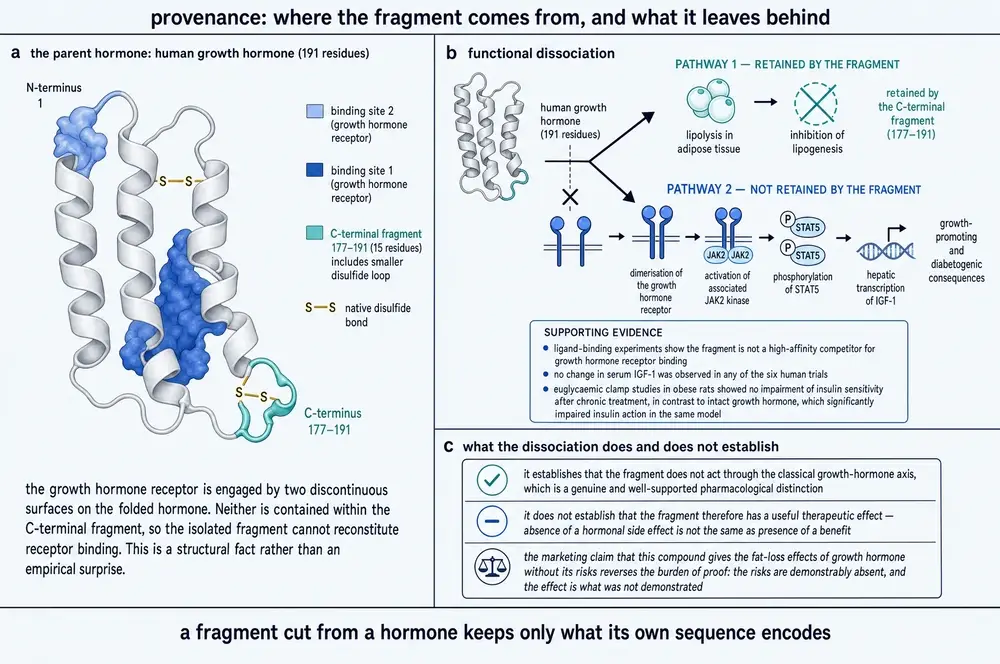
Human growth hormone is a protein of 191 amino acids, secreted in pulses by the anterior pituitary, and it has been understood since the middle of the twentieth century to do two things that pull in opposite directions. It reduces the body’s fat stores. It also raises blood glucose and antagonises insulin — so reliably that the effect has its own adjective in the older literature, where growth hormone is called diabetogenic.
For anyone thinking about obesity this is an obvious temptation and an obvious trap. A hormone that removes fat is exactly what an anti-obesity drug would want to be. A hormone that induces insulin resistance is exactly what an anti-obesity drug must not be, because the population that would receive it is the population already at risk of type 2 diabetes. Give enough growth hormone to shift body composition and you buy the metabolic penalty along with it.
The temptation was real enough that growth hormone was studied for obesity for decades, and the trap was real enough that it never became a treatment for it. What is interesting is not the impasse but the way one group proposed to get out of it, which was to stop treating the hormone as a single thing.
02Melbourne, 1969: growth hormone as a bag of parts
The proposition came from a group at Monash University in Melbourne working around Joseph Bornstein, with Frank M. Ng, John Armstrong and the clinician Peter Taft. Their idea was that growth hormone is not a single-acting hormone at all but a pro-hormone — a precursor that is cut, in the body, into shorter peptides that each carry one of its activities. If that were true, the diabetogenic action and the fat-reducing action would not have to travel together. They would be separate molecules that merely happen to arrive in the same envelope.
The group went looking for those pieces, and reported them in a run of papers in the British Medical Journal at the end of the 1960s. In 1969 they described a pituitary polypeptide that potentiated the action of insulin in healthy fasting volunteers (Bornstein et al., 1969), and a second peptide, obtained by hydrolysing growth hormone, that produced hypoglycaemia in five patients with diabetes (Armstrong et al., 1969). By 1971 they had found a peptide with the opposite property — an insulin antagonist of pituitary origin, present at higher concentrations in the plasma of people with diabetes than in controls, and absent altogether from the plasma of hypophysectomised patients (Zimmet et al., 1971).
That last observation is the load-bearing one. A substance that disappears when the pituitary is removed is a substance the pituitary makes. The group gave their peptides names that have since fallen entirely out of use — cataglykin and somantin, and the paired abbreviations AcG for the acceleratory peptide and In‑G for the inhibitory one (Taft et al., 1972). None of those names survives in the modern literature. The idea underneath them does.
It is worth being clear about what kind of evidence this was. These were small human studies from a period with very different standards of design and reporting, in some cases five patients, and they are cited here as the origin of a hypothesis rather than as demonstrations of a clinical effect. Their function in this story is that they made a specific, testable claim: that the pieces of growth hormone do different things, and that the pieces can be identified.
03An enzyme that cuts the hormone in the right place
A pro-hormone hypothesis needs a mechanism for the cutting, and in 1973 the group supplied one. Driver, Armstrong, Bornstein and Ng isolated a peptidase from sheep pituitary tissue that specifically released, from growth hormone, a peptide with insulin-antagonistic activity in vitro — the peptide they had named somantin (Driver et al., 1973).
This is the argument at its strongest. There is a hormone; there is an enzyme in the same gland that cuts it; the cut product has one of the hormone’s activities on its own. Whether or not the physiology turned out to work that way, the finding licensed the next twenty-five years of work, because it meant that synthesising fragments was not an arbitrary exercise. It was an attempt to make, in a flask, something the body was already making.
It is worth registering how unusual that ambition was in 1973. The idea that one gene product is processed into several active peptides was not yet textbook: proopiomelanocortin, the canonical example of a precursor cut into functionally distinct hormones, was not characterised until the end of that decade. The Melbourne group was proposing for growth hormone something that would later be shown, repeatedly, for other pituitary products. Their instinct about how peptide hormones work was ahead of the evidence available to test it.
What did not survive was the specific claim. Almost none of the terminology from those papers is in current use, no circulating peptide corresponding to somantin or cataglykin is recognised in the modern endocrine literature, and the physiological pro-hormone processing they proposed for growth hormone has not been established. The programme’s durable output was not the biology. It was a set of synthetic peptides and a method for narrowing down which part of a protein does what — and one of those peptides is the subject of this document.
04Two ends, two activities
Through the 1970s and 1980s the Melbourne group worked on both ends of the molecule at once, and the contrast between the two campaigns is the clearest statement of what they believed.
From the amino-terminal end came a series of short peptides that potentiated insulin. Ng and Bornstein synthesised hGH 1–15 and showed it enhanced insulin sensitivity in streptozotocin-diabetic rats without changing circulating insulin (Ng & Bornstein, 1979). Successive truncations narrowed the active region until, in 1980, they reported that the minimum active sequence was a hexapeptide, hGH 8–13, and proposed that it worked by increasing the binding of insulin to its receptor (Ng et al., 1980). The work continued into the 1990s with conformational analogues designed to stabilise a fragile aspartimide ring (Lim et al., 1992).
From the carboxy-terminal end came peptides that did the opposite. It is this end that produced AOD‑9604, and it is worth stating plainly what the C-terminal fragments were originally found to do, because the compound’s later reputation points the other way. They raised blood glucose. They antagonised insulin. The papers that describe them use the word diabetogenic in their titles.
What the two campaigns had in common was a method, and the method is why this story is legible thirty years later. Synthesise a candidate sequence; assay it; shorten it by one residue at a time; find the point at which activity disappears; call what remains the domain. It is a slow, cheap and honest way to map a protein, and applied to the C-terminus it produced a very specific answer — along with an ambiguity in the numbering that has followed the compound ever since.
05The truncation series
The work that produced AOD‑9604 begins with a single experiment published in 1978. Ng and Bornstein synthesised six peptides corresponding to the last stretch of human growth hormone — residues 172–191, 176–191, 177–191, 178–191, 179–191 and 180–191 — and gave each of them to normal rats (Ng & Bornstein, 1978). The year before, Wade and colleagues had established that the longest of these, hGH 172–191, could be made by solid-phase synthesis and was biologically active (Wade et al., 1977).
Four of the six peptides did something. In the rats, hGH 172–191, 176–191, 177–191 and 178–191 each produced a short-lived rise in blood glucose and a longer-lasting rise in plasma insulin. Two of them — 179–191 and 180–191 — did nothing measurable in the same assays. A single dose of 5 nmol per kilogram of body weight, of those peptides containing the 178–191 sequence, significantly reduced the animals’ insulin sensitivity in intravenous insulin tolerance tests.
The paper drew the obvious conclusion, and it is a conclusion about structure rather than about metabolism: an active peptide needs not only the minimum informational sequence but that sequence in the right physical configuration. Losing residues 177 and 178 did not shorten the activity gradually. It abolished it.
06What they were actually looking for
This is the point at which the compound’s modern reputation and its documentary record come apart, and it is worth stating without softening.
The activity the Melbourne group was mapping at the C-terminus was hyperglycaemia and insulin antagonism. The 1978 paper is titled “Hyperglycemic action of synthetic C-terminal fragments of human growth hormone.” The follow-up by Wade, Ng and Bornstein the next year is titled “Diabetogenic action of human growth hormone” (Wade et al., 1979). These fifteen residues entered the literature as the part of growth hormone that causes the metabolic problem, not the part that solves it.
The 1979 paper added two structural findings that matter later. First, of hGH‑(177–191), (178–191) and (179–191), the shortest was inactive, and extending it at the amino terminus was required to restore in vivo activity — the same boundary the 1978 series had found, confirmed by building rather than by cutting. Second, and more surprisingly, the reduced and S-carbamidomethylated form of hGH‑(177–191) — a form in which the two cysteines can no longer join — was also active. The authors concluded that the disulphide bond is possibly not a prerequisite for biological activity.
That second finding is a loose end that was never tied. Every commercial description of AOD‑9604 depicts the cyclic, disulphide-bonded molecule. The founding literature says the ring may not be load-bearing for the activity it was measuring. Nobody appears to have gone back and asked whether the same is true of the fat-related activities that the compound was later built around.
07Fifteen residues, and where the tyrosine comes from
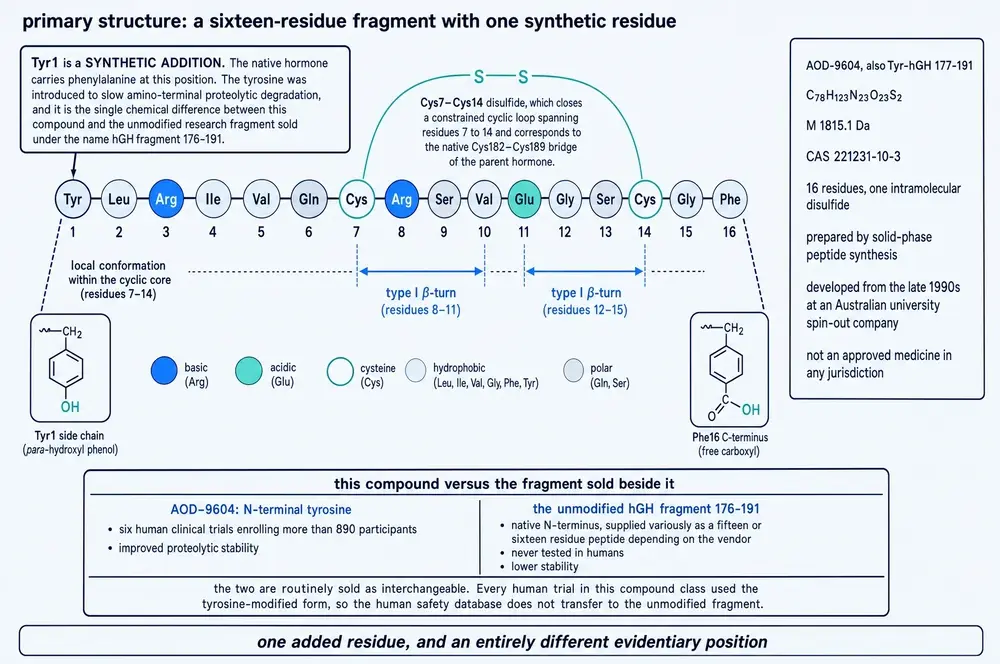
Read against the reference sequence for human growth hormone (UniProt P01241), residues 177–191 of the mature 191-residue hormone are LRIVQCRSVEGSCGF: fifteen amino acids, with cysteines at hormone positions 182 and 189 that form a small loop closing the tail of the protein.
AOD‑9604 is this fifteen-residue sequence with a tyrosine added at the amino terminus — hence the sixteen residues, YLRIVQCRSVEGSCGF, and hence the description of it in the analytical literature as a hexadecapeptide (Cox et al., 2015). The extra tyrosine is not part of growth hormone at that position. It is a synthetic addition, and a tyrosine is the conventional choice when a peptide needs a handle that can be radio-iodinated for binding and tracing work.
Here the numbering ambiguity resolves into something exact, and it is the most useful single fact in this document. Residue 176 of mature growth hormone is a phenylalanine. So the native fragment hGH 176–191 is FLRIVQCRSVEGSCGF — also sixteen residues, and identical to AOD‑9604 at every position except the first, where the native fragment has phenylalanine and AOD‑9604 has tyrosine.
Tyrosine is phenylalanine with a hydroxyl group on the ring. Computed from the sequences, AOD‑9604 is C78H123N23O23S2 and hGH 176–191 is C78H123N23O22S2. The two molecules differ by one oxygen atom — 15.99 daltons out of roughly 1,815, or under one part in a hundred by mass.
The research-chemical market sells “HGH Fragment 176–191” and “AOD‑9604” as separate products, and a great deal of writing treats the two names as synonyms. Neither habit is quite right. They are two different molecules, and they are different by a single oxygen atom on a single side chain.
The World Anti-Doping Agency, which has to be precise about this, lists them as two separate examples in the same clause. Nothing in the corpus assembled for this monograph reports a head-to-head comparison of the two peptides in any assay, in any species, so how much that one hydroxyl group changes is simply not known.
08Narrowing the core, and a second messenger
In 1982 Wade and colleagues took the mapping one step further, assaying a set of C-terminally shortened fragments for insulin-antagonistic activity in rats (Wade et al., 1982). Four constructs — hGH 177–180, and carbamidomethylated forms truncated at 185, 187 and 189 — were inactive even at up to a hundred times the dose that worked for the full-length fragment. The conclusion was that the insulin-antagonistic core of growth hormone lies within residues 178 to 190 inclusive.
A note on that paper’s record: its published abstract names the same peptide twice when listing the two constructs that were active, which is plainly a typographical fault rather than a result. This document therefore reports the paper’s stated conclusion and its list of inactive constructs, and does not attempt to reconstruct which second peptide was meant.
The following year the group reported the first mechanism attaching this region to fat rather than to glucose. Bornstein, Ng and colleagues showed that growth hormone and its part-sequence hGH 172–191 both inhibit acetyl-CoA carboxylase — the committed step of fatty-acid synthesis — and that they do it indirectly, by interacting with adipocyte and hepatocyte plasma membranes to release a relatively non-polar mediator which inhibits the enzyme by increasing its phosphorylation (Bornstein et al., 1983).
Two things about that result deserve emphasis. It is an effect on lipogenesis — the making of fat — not on lipolysis, the breaking of it. And the proposed mechanism is a released second messenger rather than a receptor, which is a way of saying that the target was unknown. Both features persist. Forty years later the compound built from this region still has no identified receptor.
09Antilipogenic, and specifically not lipolytic
Between the mapping work of the early 1980s and the drug programme of the late 1990s, the Melbourne laboratory changed the question it was asking of the C-terminal fragment. It stopped asking what the fragment does to glucose and started asking what it does to fat. The answer it obtained is not the answer that the compound is now sold on, and the discrepancy is worth following carefully.
The groundwork came from the parent hormone. In genetically growth-hormone-deficient “little” mice, Ng, Adamafio and Graystone found that human growth hormone sharply suppressed the synthesis of fat: incorporation of labelled glucose into fatty acid in isolated epididymal fat pads fell from 107.0 ± 27.6 to 38.1 ± 19.6 µmol per gram of tissue per hour after a single injection, and from 174.1 ± 28.5 to 56.3 ± 20.3 after two days of continuous infusion, with acetyl-CoA carboxylase activity more than halved (Ng et al., 1990). This was consistent with what Adamafio and Ng had reported in the same model six years earlier (Adamafio & Ng, 1984).
But the same 1990 paper reported something else, and stated it as a conclusion rather than as a caveat: no lipolytic effect of human growth hormone was found, measured as the rate of glycerol release from the fat pads, either after treatment in vivo or in vitro. The authors wrote that growth hormone’s physiological role in lipid metabolism is concerned mainly with anabolic rather than catabolic processes — that is, with stopping fat being made, not with breaking down the fat already there.
Three years later the fragment was tested the same way, with the same result. Wu and Ng showed that synthetic hGH 177–191 had antilipogenic activity identical to that of the intact hormone in rats, and reported that no significant lipolytic effect of hGH 177–191 was found, again as determined by glycerol release from epididymal fat pads (Wu & Ng, 1993).
By 2000 this same region of growth hormone is being described in the literature, by the same laboratory, as “the lipolytic domain”, and AOD‑9604 is presented as a lipolytic agent. The 1993 paper that characterised the fragment measured lipolysis directly, by the standard method of the day, and did not find it.
Both results are reported here because both were published. The later studies used different models — genetically obese Zucker rats and ob/ob mice rather than normal rats — different endpoints, and in some cases chronic rather than acute dosing, and a compound can plausibly be antilipogenic in one setting and lipolytic in another. What is not available in this corpus is a study that sets the two findings against each other directly. The change in description was not accompanied by a paper reconciling it.
10The fragment was more potent than the hormone
A companion paper from the same year looked at glucose handling in fat cells. Wijaya and Ng isolated adipocytes from genetically obese Zucker rats and measured uptake of labelled deoxyglucose. Synthetic hGH 177–191 reduced both basal and insulin-stimulated uptake — and, at equimolar concentrations, was found to be more potent than the intact human growth hormone molecule (Wijaya & Ng, 1993).
That is a striking claim and it points in a direction the later drug programme did not follow. A fragment more potent than its parent at reducing glucose uptake in fat cells is, on the face of it, a fragment that has concentrated the parent’s insulin-antagonistic property rather than shed it. The authors read it the other way, proposing that reduced glucose transport contributes to the antilipogenic effect — less glucose entering the cell means less substrate for making fat. Both readings are available from the same result, and the corpus assembled here contains no experiment that distinguishes them.
The potency observation deserves more attention than it has had. A fifteen-residue peptide that outperforms the intact 191-residue hormone, mole for mole, is either reaching a target that the whole hormone engages inefficiently or reaching a different target altogether. Growth hormone has to bind and dimerise its receptor to act, and a small fragment that does more with less is, on the face of it, not doing that — which is precisely what was demonstrated directly seven years later and is described in Section 15. Read forwards, this 1993 result is the earliest hint of the mechanistic question that the compound has still not answered.
11The first weight result
In 1994 Natera, Jiang and Ng gave synthetic hGH 177–191 to genetically obese C57BL/6J (ob/ob) mice over a long treatment period. The peptide reduced cumulative body-weight gain and decreased adipose tissue mass, and lipogenesis in adipose tissue was significantly inhibited (Natera et al., 1994).
This is the first result in the sequence that looks like a weight-loss drug, in a mouse, and the paper says so, suggesting the peptide has potential for the treatment of human obesity — and, in the same breath, for the improvement of meat quality in farm animals. It is a useful reminder of the register these papers were written in. The compound had not yet acquired a name, a company or a market.
Both 1993 papers print the fragment’s sequence in full, and both print it as Leu-Arg-Ile-Val-Gln-Cys-Arg-Val-Ser-Glu-Gly-Ser-Cys-Gly-Phe. The reference sequence for human growth hormone gives those two positions in the other order — serine at hormone residue 184, valine at 185, so …Cys-Arg-Ser-Val-Glu…. The two versions have identical amino-acid composition and identical mass; only the order differs.
The reference sequence is corroborated independently, and from an unrelated direction: the anti-doping laboratory that characterised AOD‑9604’s breakdown products identified its most stable serum metabolite as CRSVEGSCG — serine before valine (Cox et al., 2015). This document therefore uses the reference order throughout and records the discrepancy here rather than silently correcting the founding papers.
12Two molecules, one prefix
In 2000 the Melbourne work stopped being academic. A company — Metabolic Pharmaceuticals Pty Ltd, based in Melbourne and ultimately owned by the listed vehicle Calzada Limited — took the C-terminal fragment forward as a drug candidate, and the papers begin to carry development codes instead of residue numbers.
There are two codes, and telling them apart is the single most consequential thing a reader of this literature has to do.
| Designation | What it actually is | Residues | Sequence |
|---|---|---|---|
| AOD9401 | The unmodified natural fragment | 15 | LRIVQCRSVEGSCGF |
| AOD‑9604 | The same fragment plus an N-terminal tyrosine | 16 | YLRIVQCRSVEGSCGF |
| hGH 176–191 | The natural fragment one residue longer | 16 | FLRIVQCRSVEGSCGF |
| hGH (somatropin) | The intact parent hormone | 191 | FPTIPLSRLF…EGSCGF |
AOD9401 is a different molecule from AOD‑9604, and a substantial part of what is popularly cited as AOD‑9604’s animal evidence was in fact obtained with AOD9401. Two papers published in 2000 make this explicit. Ng and colleagues described AOD9401 as the lipolytic domain of growth hormone “which resides in the carboxyl terminus of the molecule and contains the amino acid residues 177–191”, reporting that it stimulated hormone-sensitive lipase and inhibited acetyl-CoA carboxylase in isolated rat adipose tissue, that chronic treatment of obese Zucker rats for twenty days reduced body-weight gain, and that the average diameter of the treated animals’ fat cells fell from 110 to 80 micrometres (Ng et al., 2000a). In the same year Heffernan and colleagues gave oral AOD‑9401 to ob/ob mice for thirty days: body-weight gain was significantly lower than in saline controls from day 16 onward, with no difference in food consumption, and adipose tissue taken from the animals showed reduced lipogenic and increased lipolytic activity (Heffernan et al., 2000).
That second paper also tested isolated adipose tissue from obese humans in vitro and found the same direction of effect. It is frequently cited as human evidence for AOD‑9604. It is neither: it is laboratory work on excised tissue, and it is the other molecule.
AOD9401 is hGH 177–191. In 1993 Wu and Ng reported that synthetic hGH 177–191 produced no significant lipolytic effect, measured by glycerol release. In 2000 the same laboratory reported that AOD9401 stimulated hormone-sensitive lipase and increased lipolytic activity in adipose tissue.
These are statements about the same molecule pointing in opposite directions, seven years apart, and the assays are not identical — glycerol release from a fat pad and hormone-sensitive lipase activity in isolated tissue are different measurements, and the animals differ too. The corpus assembled for this monograph contains no paper that addresses the discrepancy. It is recorded here as unresolved.
13Anti-Obesity Drug 9604
The code is not a chemical abbreviation. AOD stands for “anti-obesity drug” — a fact that recent reviews still spell out when they introduce the compound (Mendias & Awan, 2026). The name states the intended indication rather than the structure, which is unusual, and it makes the compound’s subsequent history slightly poignant: the molecule is still called an anti-obesity drug in every catalogue that sells it, and it is the obesity indication that it definitively failed.
Why add the tyrosine at all? A tyrosine residue is the standard handle for radio-iodination, which is how peptide binding and distribution studies were done at the time, and the extra residue also changes the peptide’s susceptibility to the aminopeptidases that trim it from the N-terminus. The corpus assembled here contains no paper stating the designers’ reasoning directly, so this is an inference from ordinary practice rather than a documented rationale, and it is offered as such.
The company around the molecule is worth a sentence, because it shapes what evidence exists. Metabolic Pharmaceuticals was a small Australian biotechnology firm with one asset, listed through a parent company on the Australian Securities Exchange, and it took AOD‑9604 from laboratory to a five-hundred-patient trial on its own. That is an unusual thing for a single-asset company to achieve. It also means the programme reported to a stock exchange rather than to a journal, that the trial results were announced as market-sensitive information rather than published, and that when the compound failed there was no larger organisation with a reason to write the failure up. Almost every peculiarity of this compound’s evidence base follows from that structure.
14What AOD‑9604 itself did, in animals
Three papers report experiments on AOD‑9604 as distinct from its sibling, and together they are the entire preclinical efficacy case.
Obese Zucker rats, oral, nineteen days. Ng and colleagues gave AOD9604 by mouth at 500 micrograms per kilogram of body weight daily. Body-weight gain over the period was 15.8 ± 0.6 g in treated animals against 35.6 ± 0.8 g in controls — a reduction of more than half. Adipose tissue from the treated rats showed increased lipolytic activity. Critically, and in contrast to chronic treatment with intact growth hormone, euglycaemic clamp studies showed no adverse effect on the animals’ insulin sensitivity (Ng et al., 2000b).
Obese and lean mice, infused, fourteen days. Heffernan and colleagues treated ob/ob and lean C57BL/6J mice by mini-osmotic pump. Both growth hormone and AOD9604 significantly reduced body-weight gain in the obese animals, associated with increased fat oxidation measured in vivo and raised plasma glycerol. Unlike growth hormone, AOD9604 did not induce hyperglycaemia and did not reduce insulin secretion (Heffernan et al., 2001a).
Knockout mice, injected, fourteen days. The third paper asked how the effect was produced (Heffernan et al., 2001b). It is discussed in the next section, because its answer was largely negative.
15The receptor that was not there
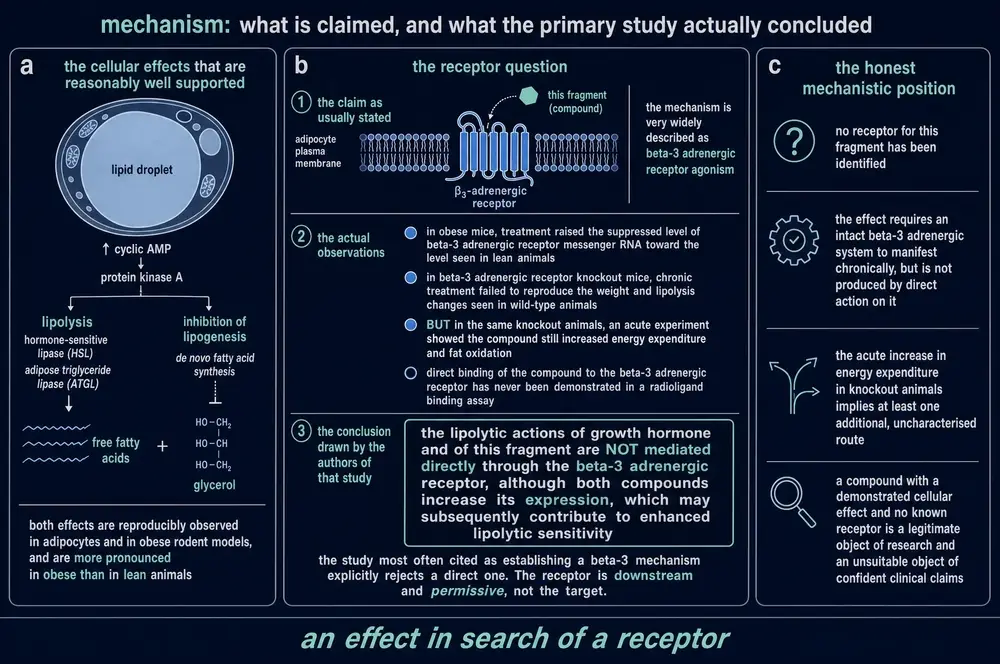
The most important finding in the AOD‑9604 literature is a negative one, and it is the finding that made the compound interesting as a drug candidate. In the 2001 International Journal of Obesity paper, Heffernan and colleagues transfected cells with the human growth hormone receptor and tested whether AOD9604 would bind it. It did not compete for the receptor with labelled growth hormone, and it did not induce cell proliferation through it, although growth hormone itself did both (Heffernan et al., 2001a).
This is exactly what a designer of this compound would want. Growth hormone’s unwanted effects — the insulin antagonism, and the theoretical worry about driving cell growth through IGF-1 — run through the growth hormone receptor. A fragment that changes fat metabolism without touching that receptor has, in principle, escaped them. It is the mechanistic basis for every subsequent claim that AOD‑9604 gives you growth hormone’s fat effect without its risks, and unlike many such claims it rests on a real experiment.
But the result leaves an obvious question, and the answer is that nobody knows. If not the growth hormone receptor, then what?
The 2001 Endocrinology paper tested the most plausible candidate. The β3-adrenoceptor is the principal lipolytic receptor on the fat cell, and both growth hormone and AOD9604 were found to raise its messenger RNA in obese mice, restoring the suppressed levels of obese animals to those seen in lean ones. In β3-adrenoceptor knockout mice, long-term treatment with either compound failed to produce the weight change and the increase in lipolysis seen in wild-type animals — which looks like an answer. Yet in an acute experiment AOD9604 still increased energy expenditure and fat oxidation in those same knockout mice. The authors concluded that the lipolytic actions of both compounds are not mediated directly through the β3-adrenoceptor, even though both raise its expression (Heffernan et al., 2001b).
A drug whose mechanism is unknown is not thereby a bad drug; aspirin was useful for seventy years before anyone identified cyclooxygenase. But the absence matters for a different reason here. When a compound produces a clear effect in rodents and no effect in a large human trial, a known mechanism is what allows you to work out why. AOD‑9604 arrived at that moment without one.
16Six trials, eight hundred and ninety-three people
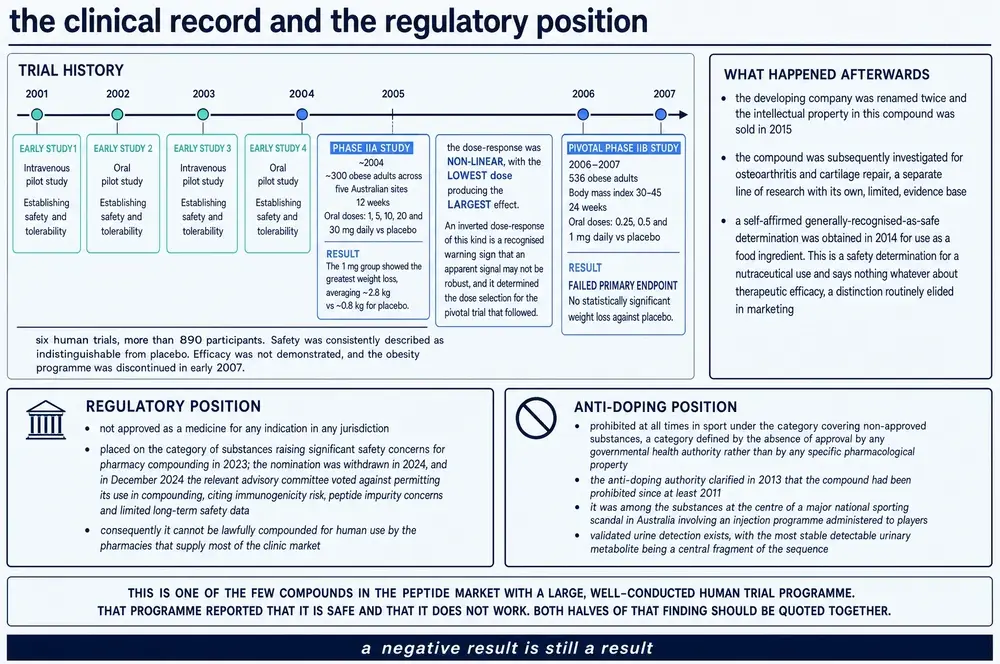
Between roughly 2001 and 2007 Metabolic Pharmaceuticals ran a clinical programme of six randomised, double-blind, placebo-controlled studies in healthy obese adults, designated METAOD001 to METAOD006. The pooled safety data were published in 2013, six years after the programme ended, in the Journal of Endocrinology and Metabolism (Stier, Vos & Kenley, 2013). That paper is the only comprehensive account of the human evidence, and it is worth stating up front that its three authors comprise a consultant to the sponsor, the sponsor’s former medical director, and a person holding a declared 6.9 per cent interest in the sponsor’s parent company.
| Study | Subjects | Population | Route | Dose range | Duration |
|---|---|---|---|---|---|
| METAOD001 | 15 | obese adults | intravenous | 25–400 µg/kg | single dose |
| METAOD002 | 23 | BMI ≥ 35 | intravenous | 25–100 µg/kg | single dose |
| METAOD003 | 17 | BMI ≥ 35 | oral | 9–54 mg | single dose |
| METAOD004 | 36 | BMI ≥ 30 | oral | 9–54 mg | 7 days |
| METAOD005 | 300 | BMI ≥ 35 | oral | 1–30 mg | 12 weeks |
| METAOD006 | 502 | BMI 30–45 | oral | 0.25–1 mg | 24 weeks |
Read the dose column downward. The programme escalated to 54 mg by mouth, ran its 12-week study at 1 to 30 mg, and then ran its largest and longest study — the one that decided the compound’s fate — at 0.25 to 1 mg. The pivotal trial used doses up to fifty-four times lower than the programme had already given to people.
That is not obviously irrational, and the reason is discussed in Section 18. But it is the single most consequential design decision in the compound’s history, and it rests on a dose–response relationship that was not monotonic.
17What the safety data showed
On safety the pooled result is consistent and, taken on its own terms, reassuring. Across all six studies there were no drug-related withdrawals and no drug-related serious adverse events. Laboratory parameters, vital signs and electrocardiograms showed no clinically significant changes. Adverse events were mostly mild to moderate, headache being the commonest — reported by 69.6 per cent of subjects in METAOD002 — with gastrointestinal events such as diarrhoea and flatulence increasing at the highest doses. Five serious adverse events occurred in the long-term studies, all of them malignancies (skin cancers, a breast cancer, a melanoma), and all were judged by the investigators to be unrelated to treatment.
Two specific results carry most of the weight of the compound’s reputation.
IGF-1 did not move. No significant change in serum IGF-1 was found in any treatment group against placebo in any of the six studies. In METAOD006 the overall mean changes were 1.76 nmol/L at twelve weeks and 1.24 nmol/L at twenty-four weeks, neither statistically significant. This matters because IGF-1 is the mediator through which growth hormone drives tissue growth, and a growth-hormone-derived peptide that leaves it untouched has, on this measure, done what it was designed to do.
Glucose handling did not deteriorate. Oral glucose tolerance testing showed no significant differences between treatment and placebo, and the paper reports no evidence of glucose intolerance or insulin resistance. Given that the whole enterprise began with a fragment characterised as diabetogenic, this is the finding that closes the circle opened in Part Two — at the doses tested, in these populations, over these durations.
These findings are real and they are the best human data the compound has. They establish that AOD‑9604 was well tolerated over up to six months at the doses studied, and that it did not reproduce growth hormone’s metabolic penalties. That is a genuine result and it should not be minimised.
It is not, however, evidence that the compound works, and the same paper makes no claim that it does. Tolerability and efficacy are separate questions, and on this compound they were answered in opposite directions.
18The result that is missing from the record
Five of the six METAOD studies list, as an objective, the assessment of “efficacy (reduction in body weight), safety and tolerability”. The 2013 paper reports the safety and the tolerability in detail. It does not report the weight outcomes at all. The comparative weight-loss data between AOD‑9604 and placebo appear nowhere in it.
What is known about the efficacy comes from outside the primary literature, and the chain is short and worth setting out explicitly, because the strength of a conclusion depends on it.
Secondary reviews report that in a 12-week randomised trial, subjects receiving 1 mg per day lost an average of 2.6 kg against 0.8 kg on placebo, and that subjects receiving 10 mg per day showed a smaller reduction than those on 1 mg — that is, the dose–response was inverted. Tracing those figures through the corpus assembled here, every citation resolves to a single 2010 review chain and ultimately to a 2007 review article; no primary report of that trial is available in this corpus or, as far as this search can determine, anywhere in the indexed literature. The numbers are reported here with that caveat attached, and they should not be treated as though they had been through peer review as trial data.
The inverted dose–response is, however, the key to the design decision noted in Section 16. If the lowest dose looked best, then running the pivotal trial at 0.25 to 1 mg is a rational reading of the evidence available. It is also a fragile one, because a non-monotonic dose–response in a 300-person study is exactly the shape that noise produces when there is no real effect to find.
The pivotal trial did not separate from placebo. METAOD006, in approximately 500 obese adults over twenty-four weeks, failed to demonstrate a significant benefit on its primary weight-loss endpoint. In February 2007 the sponsor announced that the Phase 2b results did not support commercial viability for the obesity indication, and development for obesity stopped. The trial was never published. Every account of its outcome in the scientific literature traces to that market announcement or to reviews of it, a point that the most recent review of this compound class makes explicitly (Dominikowski et al., 2026).
It is worth being precise about what that costs. An unpublished null is not the same as a null that has been through peer review: nobody outside the sponsor has seen the analysis plan, the handling of dropouts, the per-protocol against intention-to-treat comparison, or the secondary endpoints. In principle a trial reported only as “did not support commercial viability” could conceal a signal in a subgroup, or an execution problem that a better-run trial would not repeat. In practice the asymmetry runs the other way, because a sponsor with a positive result has every reason to publish it and none to bury it.
The practical consequence for a reader today is that the strongest evidence about whether this compound reduces body weight in people is a sentence in a 2007 market announcement, and the weaker evidence that it does — the 2.6 kg figure — is a number with no primary source at the end of its citation chain. Those are the two things that are known. Everything sold on the strength of this compound’s obesity indication rests on them.
Sources disagree about how many people were in the trial that ended the programme. Several reviews state 536 subjects. The 2013 safety paper tabulates METAOD006 at 502. The most recent review gives 534 enrolled, 502 randomised, which reconciles the two if the larger figures count people who entered but were not randomised.
This document uses 502 randomised where a number is needed, and reports the disagreement rather than choosing silently. No source available here is the trial’s own report, because there is not one.
19The toxicology and pharmacokinetic package
The non-clinical package was published, like the safety data, in the Journal of Endocrinology and Metabolism, by an author from a Berlin consultancy and the sponsor’s chief executive (Moré & Kenley, 2014). Its findings are broadly unremarkable, which for a toxicology package is the point.
The compound was not mutagenic in bacterial reverse-mutation assays and not convincingly clastogenic: a single statistically significant increase in chromosome aberrations at 100 µg/mL without metabolic activation was judged not biologically significant, and a slight increase in micronuclei at 0.1 and 10 mg/kg lacked any dose relationship. In a six-month oral study in rats the no-observed-adverse-effect level was at or above 100 mg/kg/day; in a nine-month oral study in cynomolgus monkeys it was 50 mg/kg/day. No anti-AOD9604 antibodies were detected in either species.
The pharmacokinetics are the more interesting part, and they contain a discrepancy that this document does not resolve.
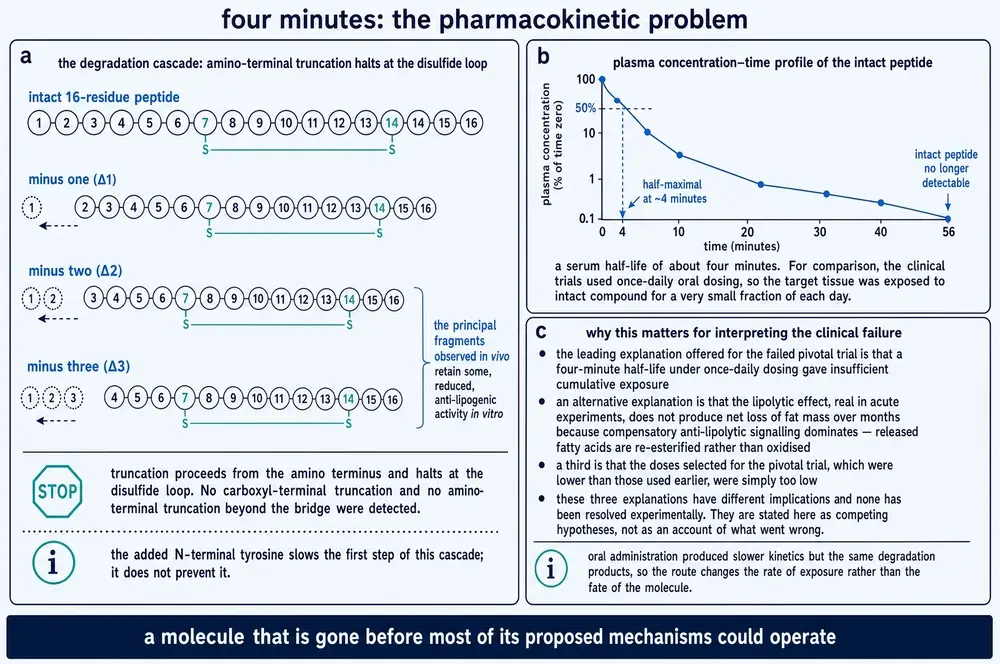
The peptide is very short-lived. Plasma half-life after intravenous administration in pigs is reported at approximately three minutes, with about four minutes measured in rat plasma in vitro. It is cleared by sequential removal of amino acids from the N-terminus, and the resulting two- and three-residue-shorter fragments retain reduced antilipogenic activity in vitro. Whole-body radiography in rats localised it to the pancreas, pineal body, thyroid, liver and kidney cortex, and showed it excluded from the central nervous system.
A three-minute half-life is worth pausing on, because it sits awkwardly with almost everything the compound is sold for. A peptide cleared from plasma in minutes, given by mouth once a day, has to be doing whatever it does through something other than sustained exposure — a durable downstream change, an active metabolite, or a local effect at the site of absorption. The evidence base assembled here does not establish which, and no human pharmacokinetic parameter for this compound — no half-life, no bioavailability, no clearance — appears in it at all.
20From failed drug to food ingredient
A compound that has failed its pivotal trial still has assets: a clean toxicology package, a clean human safety record, and a patent estate. In 2009 Metabolic Pharmaceuticals licensed AOD9604 to Phosphagenics Limited for development as a cosmeceutical aimed at cellulite and subcutaneous fat using a transdermal delivery platform. And at some point the compound acquired the credential that now appears in almost every commercial description of it: GRAS status.
This claim requires care, because it is the most frequently repeated fact about AOD‑9604 and it is almost always stated wrongly.
“GRAS” — generally recognised as safe — is a United States food-law category, and there are two routes to it. A company may convene a panel of qualified experts, have them conclude that a substance is safe under its intended conditions of use, and rely on that conclusion. This is self-affirmed GRAS. It involves no application, no review and no regulator. Alternatively the company may notify the Food and Drug Administration, which reviews the dossier and, if satisfied, issues a letter stating it has no questions. That is a public act with a public record: a GRN number in FDA’s GRAS Notice Inventory.
Commercial and secondary descriptions of AOD‑9604 routinely assert the second, and commonly cite the number GRN 000548.
Searching FDA’s GRAS Notice Inventory directly returns the following:
The distinction between the two routes is not a technicality invented for this document. Self-affirmation exists because the United States food-additive statute exempts substances generally recognised as safe by qualified experts, and that recognition was never required to be registered anywhere. The notification programme came later, is voluntary, and is what produces the public paper trail. A company may therefore lawfully conclude that its own ingredient is safe, put it into food, and never tell the agency; a great many ingredients are in United States commerce on exactly that basis, and nothing about it is improper. What is improper is describing it as though a regulator had looked.
The two claims also differ in what a reader can do with them. A no-questions letter is a document with a number, a date and a substance name, which anyone can retrieve and read. A self-affirmed conclusion is a private report by a panel the sponsor selected, and for AOD‑9604 no such report appears in the public record at all: the panel’s membership, the dossier it considered, the conditions of use it assessed and the intake levels it assumed are unavailable. That claim can therefore be neither verified nor refuted here. What can be checked is the register that the words “FDA GRAS” point at.
The distinction is not pedantry. A self-affirmed GRAS conclusion is a statement by people the sponsor selected and paid; an FDA no-questions letter is a statement by the regulator. Both may be reasonable, but only one is evidence about what a regulator thinks, and the compound’s marketing has for a decade borrowed the authority of the second while resting, as far as the public record shows, on the first.
There is, however, a regulatory record on this compound, and it is a far more substantial one than the food-ingredient claim. It concerns compounding — the practice by which a pharmacy prepares a medicine for an individual patient, which is how most of the peptide clinic market is supplied in the United States.
AOD‑9604, in both its acetate and free-base forms, was nominated for inclusion on the list of bulk drug substances that may lawfully be used in compounding under section 503A, for weight loss, osteoporosis and osteoarthritis. FDA evaluated it and recommended against, and on 4 December 2024 the Pharmacy Compounding Advisory Committee voted against inclusion. The stated grounds were inadequate physicochemical characterisation, the potential for immunogenicity arising from aggregation and peptide-related impurities in an injectable preparation, an absence of clinical effectiveness data for any of the nominated uses, and no published human exposure data for the proposed subcutaneous and topical routes. There is consequently no lawful compounding pathway for this compound.
Two things about that decision are worth separating. The immunogenicity concern is a concern about manufacture — about aggregates and impurities in material of uncertain quality — rather than a finding that the peptide provoked an immune response in the trials. The animal studies described in Section 19 detected no anti-AOD9604 antibodies in either species, and no immunogenicity measurement in humans appears in the evidence base at all. The absence-of-effectiveness ground, by contrast, is the same finding this document has been describing throughout, arriving at a regulator seventeen years after the trial that produced it.
21A second life, a proposed receptor, and a second failure
The compound’s most surprising chapter is the most recent, and it is almost entirely absent from the material that circulates about it.
An Australian company, Lateral Pharma, took AOD‑9604 up again under a new development code, LAT8881, and pointed it at targets that have nothing to do with fat. In doing so its collaborators produced the first credible proposal for the compound’s molecular target in twenty-five years.
Working in models of influenza infection, Harpur and colleagues reported that LAT8881 improved the survival of cultured lung epithelial cells challenged with paclitaxel or hydrogen peroxide, and that this protection was abolished when either LANCL1 or LANCL2 was silenced by interfering RNA — implicating the lanthionine synthetase C-like proteins as the peptide’s receptors. In mice given influenza intranasally, LAT8881 at 20 mg/kg daily improved survival, reduced lung viral burden more than twofold at three days, and lowered airway interleukin-6, MCP-1 and TNF (Harpur et al., 2023, a study funded by Lateral Pharma and involving authors with consultancy and patent interests in it). A follow-up identified a six-residue metabolite, sequence RSVEGS, that retained the activity and depended on a four-residue core (West et al., 2024).
That last detail is worth dwelling on: the active core is a fragment of a fragment of a hormone, and the whole line of work traces back to Bornstein’s 1969 proposition that growth hormone is a bag of separable parts. Whether it is the same activity that was chased through the 1990s is entirely unestablished — the LANCL evidence comes from lung-injury models and has not been tested against any metabolic endpoint.
Lateral Pharma also took LAT8881 into a human trial, and the outcome is recorded in the trial registry. NCT03865953 was a randomised, placebo-controlled, double-blind, crossover Phase IIa study of oral LAT8881 in neuropathic pain, enrolling 53 subjects with either post-herpetic neuralgia or painful diabetic peripheral neuropathy, run in Australia and the United Kingdom between April 2019 and May 2020. Each subject received LAT8881 and placebo for four weeks apiece, separated by a washout. On the primary endpoint — change in mean pain intensity on an eleven-point scale — the reported result was −0.87 with LAT8881 against −0.74 with placebo, p = 0.67. Neither the 30 per cent nor the 50 per cent responder rate favoured the drug.
A published systematic review of investigational drugs for post-herpetic neuralgia tabulates this trial as a study in post-herpetic neuralgia with responder counts out of fifty per group, which implies two parallel arms of fifty. The registry record states 53 subjects in total, a crossover design in which every subject received both treatments, and two eligible conditions rather than one.
The efficacy conclusion is the same either way — the drug did not separate from placebo. But the study is materially smaller and structurally different from the way it has been reported, which is why this document takes registry facts from the registry.
So the compound has now failed to meet its primary endpoint in two randomised, placebo-controlled human trials, thirteen years apart, in two unrelated indications, under two different names and two different sponsors.
22The joint, and the single study behind it
The other indication attached to AOD‑9604 in current practice is osteoarthritis, and it rests on one experiment.
Kwon and Park induced knee osteoarthritis in 32 mature New Zealand white rabbits with intra-articular collagenase, then gave weekly ultrasound-guided injections in four groups: saline, hyaluronic acid 6 mg, AOD9604 0.25 mg, or AOD9604 0.25 mg together with hyaluronic acid (Kwon & Park, 2015). Gross morphological and histopathological scores were significantly worse in the saline group than in all three treated groups, and significantly better in the combination group than in either single-agent group. The combination group was also lame for a significantly shorter period.
That is a clean result and it is the entire basis of the indication. It is one study, in one species, in a chemically induced model, from a single centre, with no human data of any kind. Every subsequent statement in the review literature about AOD‑9604 and cartilage — and there are several, including in orthopaedic journals — resolves to this paper. No chondrocyte experiment, no aggrecan or collagen-II measurement, and no human joint outcome for this compound appears anywhere in the evidence base assembled for this monograph.
It is worth naming what would be needed to turn this into a claim about people, because the gap is instructive. A collagenase-induced model works by digesting the joint’s matrix chemically; human osteoarthritis is a slow, load-bearing, inflammatory disease of a joint that has usually been degenerating for years. A treatment that improves the appearance of cartilage in the first says very little on its own about the second. Establishing the indication would require, at minimum, a mechanism — some account of what the peptide does to a chondrocyte — a dose–response relationship, replication in an independent laboratory, and then a controlled human trial with a validated pain or function endpoint. None of those four steps has been taken.
What exists instead is a single positive animal result which is now cited in the review literature, including in orthopaedic journals, in a way that makes the evidence base sound plural. Four separate statements about AOD‑9604 and cartilage in recent reviews all resolve to this one paper.
23Prohibited, detectable, and widely sold
AOD‑9604 is prohibited in sport at all times, in and out of competition. The 2026 World Anti-Doping Code Prohibited List places it under section S2.2.3, growth hormone and its analogues and fragments, in a clause reading “growth hormone fragments, e.g. AOD-9604 and hGH 176-191”. As noted in Part Two, the list names the two peptides separately, which is the correct treatment.
Detecting it required dedicated work, because the compound is invisible to the standard test. Orlovius and colleagues showed that AOD‑9604 does not influence the WADA growth-hormone isoform immunoassay (Orlovius et al., 2013) — an athlete using it would pass the test designed to catch growth hormone. Cox and colleagues then validated a urine method with a limit of detection of 50 pg/mL, identified six serum metabolites, and found that one of them — the nine-residue CRSVEGSCG — is considerably more stable than either the other metabolites or the parent peptide, offering a longer detection window (Cox et al., 2015). Later work extended detection to dried blood spots, and reported that in liquid serum and plasma AOD9604 is extensively degraded within a week at 4 and 22 °C while remaining detectable in dried matrices (Mazzarino et al., 2026).
The compound circulates. Belgian authorities seized pharmaceutical preparations that proved on analysis to contain AOD9604 (Vanhee et al., 2014), and recent reviews place it squarely inside the grey market in performance and physique peptides, sold as a “research compound” with dosing protocols circulated on forums and retail sites rather than derived from any trial (Dominikowski et al., 2026; Mendias & Awan, 2026). It has no approved therapeutic indication in any jurisdiction.
The scale of that commercial literature is measurable, and it is the reason this monograph was slow to write. Of 485 documents in this project’s own stores that name AOD‑9604 — some 5,500 printed pages — three are peer-reviewed scientific full texts. The remainder are vendor product pages, archived retail snapshots and affiliate copy. For this compound the ratio of marketing to science in the accessible record is better than a hundred and fifty to one, and that imbalance is itself among the more informative facts about it.
This monograph describes published research. It does not recommend human use of AOD‑9604 or of any related peptide, and it specifies no dose, route or schedule for any person. Where doses, routes and durations appear above, they are reported parameters of the studies cited, given so that the reader can judge what those studies did and did not establish.
AOD‑9604 has no approved therapeutic indication in any jurisdiction. It failed the primary endpoint of a randomised placebo-controlled trial in obesity in 2007 and the primary endpoint of a randomised placebo-controlled trial in neuropathic pain in 2020. It is prohibited in sport at all times. It is sold for research use only.
24References
Generated from verified NCBI records rather than from recall. Author lists, journal names, volumes, pages and identifiers are taken from the PubMed record for each citation, and the build refuses to run if any identifier fails to resolve. This series has twice shipped reference lists drafted from memory in which identifiers pointed at real but unrelated papers.
- Adamafio NA, Ng FM. Effects of growth hormone on lipogenesis and glucose oxidation in genetically GH-deficient mice. Mol Cell Endocrinol. 1984;37(2):241-4.
PMID 6149161 · doi:10.1016/0303-7207(84)90057-1 - Armstrong JM, Bornstein J, Ng FM, Taft HP. Pituitary polypeptide with hypoglycaemic action in diabetes mellitus. Br Med J. 1969;2(5650):157-8.
PMID 5778938 · doi:10.1136/bmj.2.5650.157 · PMC1982955 - Armstrong JM, Bornstein J, Bromley JO, Macaulay SL, Ng FM. Parallel insulin-like actions of human growth hormone and its part sequence hGH 7-13. Acta Endocrinol (Copenh). 1983;102(4):492-8.
PMID 6405571 · doi:10.1530/acta.0.1020492 - Bornstein J, Armstrong JM, Ng FM, Taft HP. Potentiation of insulin action in normal subjects by a pituitary polypeptide. Br Med J. 1969;3(5668):451-2.
PMID 5811655 · doi:10.1136/bmj.3.5668.451 · PMC1984216 - Bornstein J, Ng FM, Heng D, Wong KP. Metabolic actions of pituitary growth hormone. I. Inhibition of acetyl CoA carboxylase by human growth hormone and a carboxyl terminal part sequence acting through a second messenger. Acta Endocrinol (Copenh). 1983;103(4):479-86.
PMID 6137122 - Cox HD, Smeal SJ, Hughes CM, Cox JE, Eichner D. Detection and in vitro metabolism of AOD9604. Drug Test Anal. 2015;7(1):31-8.
PMID 25208511 · doi:10.1002/dta.1715 - Dominikowski A, Rękoś Z, Olejarz M, Szczepanek-Parulska E, Domin R, RuchaŁa M. The emerging landscape of performance-enhancing peptides modulating GH-IGF1 axis: bridging the gap between clinical evidence and patient self-administration. Front Endocrinol (Lausanne). 2026;17:1822475.
PMID 42395176 · doi:10.3389/fendo.2026.1822475 · PMC13322892 - Driver CJ, Armstrong JM, Bornstein J, Ng FM. Isolation and characterization of a pituitary peptidase specifically releasing, from growth hormone, a peptide (somantin) with antagonistic activity to insulin in vitro. J Endocrinol. 1973;59(2):261-74.
PMID 4759592 · doi:10.1677/joe.0.0590261 - Halford JC. Obesity drugs in clinical development. Curr Opin Investig Drugs. 2006;7(4):312-8.
PMID 16625817 - Heffernan M, Summers RJ, Thorburn A, Ogru E, Gianello R, Jiang WJ, et al.. The effects of human GH and its lipolytic fragment (AOD9604) on lipid metabolism following chronic treatment in obese mice and beta(3)-AR knock-out mice. Endocrinology. 2001;142(12):5182-9.
PMID 11713213 · doi:10.1210/endo.142.12.8522 - Heffernan MA, Jiang WJ, Thorburn AW, Ng FM. Effects of oral administration of a synthetic fragment of human growth hormone on lipid metabolism. Am J Physiol Endocrinol Metab. 2000;279(3):E501-7.
PMID 10950816 · doi:10.1152/ajpendo.2000.279.3.E501 - Heffernan MA, Thorburn AW, Fam B, Summers R, Conway-Campbell B, Waters MJ, et al.. Increase of fat oxidation and weight loss in obese mice caused by chronic treatment with human growth hormone or a modified C-terminal fragment. Int J Obes Relat Metab Disord. 2001;25(10):1442-9.
PMID 11673763 · doi:10.1038/sj.ijo.0801740 - Jensen MD. Potential role of new therapies in modifying cardiovascular risk in overweight patients with metabolic risk factors. Obesity (Silver Spring). 2006;14 Suppl 3:143S-149S.
PMID 16931496 · doi:10.1038/oby.2006.294 - Khan A, Raza S, Khan Y, Aksoy T, Khan M, Weinberger Y, et al.. Current updates in the medical management of obesity. Recent Pat Endocr Metab Immune Drug Discov. 2012;6(2):117-28.
PMID 22435392 · doi:10.2174/187221412800604644 - Kwon DR, Park GY. Effect of Intra-articular Injection of AOD9604 with or without Hyaluronic Acid in Rabbit Osteoarthritis Model. Ann Clin Lab Sci. 2015;45(4):426-32.
PMID 26275694 - Lim N, Ng FM, Wu ZM, Ede N, Hearn MT. Hypoglycemic action of a novel constrained analog of human growth hormone-(6-13). Endocrinology. 1992;131(2):835-40.
PMID 1639027 · doi:10.1210/endo.131.2.1639027 - Mazzarino M, Colpaert T, Deventer K, Van Eenoo P. Rapid and harmonized analytical workflow for the determination of peptidic and non-peptidic doping agents in dried and liquid blood matrices. Analyst. 2026;151(15):4398-4413.
PMID 42328738 · doi:10.1039/d6an00455e - Mendias CL, Awan TM. Safety and Efficacy of Approved and Unapproved Peptide Therapies for Musculoskeletal Injuries and Athletic Performance. Sports Med. 2026.
PMID 41966639 · doi:10.1007/s40279-026-02437-0 - Natera SH, Jiang WJ, Ng FM. Reduction of cumulative body weight gain and adipose tissue mass in obese mice: response to chronic treatment with synthetic hGH 177-191 peptide. Biochem Mol Biol Int. 1994;33(5):1011-21.
PMID 7987248 - Ng FM, Bornstein J, Welker C, Zimmet PZ, Taft P. Insulin potentiating action of synthetic peptides relating to the amino terminal sequence of human growth hormone. Diabetes. 1974;23(12):943-9.
PMID 4435308 · doi:10.2337/diab.23.12.943 - Ng FM, Larner J. Actions of insulin-potentiating peptides on glycogen synthesis. Diabetes. 1976;25(5):413-9.
PMID 817952 · doi:10.2337/diab.25.5.413 - Ng FM, Bornstein J. Insulin-potentiating action of a synthetic amino-terminal fragment of human growth hormone (hGH 1--15) in streptozotocin-diabetic rats. Diabetes. 1979;28(12):1126-30.
PMID 510810 · doi:10.2337/diab.28.12.1126 - Ng FM, Bornstein J, Pullin CE, Bromley JO, Macaulay SL. The minimal amino acid sequence of the insulin-potentiating fragments of human growth hormone: its mechanism of action. Diabetes. 1980;29(10):782-7.
PMID 6777219 · doi:10.2337/diacare.20.10.782 - Ng FM, Bornstein J. Comparison of hypoglycaemic responses to human growth hormone and the synthetic 4-15 fragment between 16-18 day-old and 45-50 day-old rats. Diabetologia. 1982;23(6):534-8.
PMID 6818082 · doi:10.1007/BF00254306 - Ng FM, Harcourt JA. Stimulation of 2-deoxyglucose uptake in rat adipocytes by a human growth hormone fragment (hGH 4-15). Diabetologia. 1986;29(12):882-7.
PMID 3569692 · doi:10.1007/BF00870144 - Ng FM, Bornstein J. Hyperglycemic action of synthetic C-terminal fragments of human growth hormone. Am J Physiol. 1978;234(5):E521-6.
PMID 645904 · doi:10.1152/ajpendo.1978.234.5.E521 - Ng FM, Adamafio NA, Graystone JE. Effects of exogenous growth hormone on lipid metabolism in the isolated epididymal fat pad of the growth hormone-deficient little mouse. J Mol Endocrinol. 1990;4(1):43-9.
PMID 1969738 · doi:10.1677/jme.0.0040043 - Ng FM, Jiang WJ, Gianello R, Pitt S, Roupas P. Molecular and cellular actions of a structural domain of human growth hormone (AOD9401) on lipid metabolism in Zucker fatty rats. J Mol Endocrinol. 2000;25(3):287-98.
PMID 11116208 · doi:10.1677/jme.0.0250287 - Ng FM, Sun J, Sharma L, Libinaka R, Jiang WJ, Gianello R. Metabolic studies of a synthetic lipolytic domain (AOD9604) of human growth hormone. Horm Res. 2000;53(6):274-8.
PMID 11146367 · doi:10.1159/000053183 - Orlovius AK, Thomas A, Schänzer W, Thevis M. AOD-9604 does not influence the WADA hGH isoform immunoassay. Drug Test Anal. 2013;5(11-12):850-2.
PMID 24124033 · doi:10.1002/dta.1557 - Pullin CO, Harcourt JA, Ng FM, Bornstein J. Insulin-potentiating action of human growth hormone. Synthesis and activity of N-terminal fragments. Int J Pept Protein Res. 1981;18(3):318-23.
PMID 7042618 · doi:10.1111/j.1399-3011.1981.tb02987.x - Rahman OF, Lee SJ, Seeds WA. Therapeutic Peptides in Orthopaedics: Applications, Challenges, and Future Directions. J Am Acad Orthop Surg Glob Res Rev. 2026;10(1).
PMID 41490200 · doi:10.5435/JAAOSGlobal-D-25-00236 · PMC12753158 - Schänzer W, Thevis M. Human sports drug testing by mass spectrometry. Mass Spectrom Rev. 2017;36(1):16-46.
PMID 26213263 · doi:10.1002/mas.21479 - Taft P, Zimmet P, Ng FM, Bornstein J. Role of growth hormone-derived peptides, cataglykin and somantin in human glucose homeostasis. Isr J Med Sci. 1972;8(6):865.
PMID 5051825 - Thomas A, Görgens C, Guddat S, Thieme D, Dellanna F, Schänzer W, et al.. Simplifying and expanding the screening for peptides <2 kDa by direct urine injection, liquid chromatography, and ion mobility mass spectrometry. J Sep Sci. 2016;39(2):333-41.
PMID 26578461 · doi:10.1002/jssc.201501060 - Vanhee C, Moens G, Deconinck E, De Beer JO. Identification and characterization of peptide drugs in unknown pharmaceutical preparations seized by the Belgian authorities: case report on AOD9604. Drug Test Anal. 2014;6(9):964-8.
PMID 24976118 · doi:10.1002/dta.1687 - Wade JD, Pullin CO, Ng FM, Bornstein J. The synthesis and hyperglycaemic activity of the amino acid sequence 172-191 of human growth hormone. Biochem Biophys Res Commun. 1977;78(2):827-32.
PMID 907713 · doi:10.1016/0006-291x(77)90254-6 - Wade JD, Ng FM, Bornstein J. Diabetogenic action of human growth hormone. Synthesis and activity of C-terminal fragments. Int J Pept Protein Res. 1979;13(2):195-200.
PMID 429095 · doi:10.1111/j.1399-3011.1979.tb01868.x - Wade JD, Ng FM, Bornstein J, Pullin CO, Pearce JS. Effect of C-terminal chain shortening on the insulin-antagonistic activity of human growth hormone 177--191. Acta Endocrinol (Copenh). 1982;101(1):10-4.
PMID 6751009 · doi:10.1530/acta.0.1010010 - Wijaya E, Ng FM. Effect of an antilipogenic fragment of human growth hormone on glucose transport in rat adipocytes. Biochem Mol Biol Int. 1993;31(3):543-52.
PMID 8118430 - Wilding J. AOD-9604 Metabolic. Curr Opin Investig Drugs. 2004;5(4):436-40.
PMID 15134286 - Wu Z, Ng FM. Antilipogenic action of synthetic C-terminal sequence 177-191 of human growth hormone. Biochem Mol Biol Int. 1993;30(1):187-96.
PMID 8358331 - Zieba R. [Obesity: a review of currently used antiobesity drugs and new compounds in clinical development]. Postepy Hig Med Dosw (Online). 2007;61:612-26.
PMID 17971763 - Zimmet P, Ng FM, Bornstein J, Armstrong JM, Taft HP. Insulin antagonist of pituitary origin in plasma of normal and diabetic subjects. Br Med J. 1971;1(5742):203-4.
PMID 5541231 · doi:10.1136/bmj.1.5742.203 · PMC1794829
Sources without a PubMed record
For this compound that heading carries unusual weight. The two papers that hold the entire human safety dataset and the entire non-clinical toxicology and pharmacokinetic package have no PubMed record at all, and neither does the reference sequence, the anti-doping instrument or the regulatory search. They are listed separately so that the generated list above remains wholly machine-verified.
- Stier H, Vos E, Kenley D. Safety and tolerability of the hexadecapeptide AOD9604 in humans. Journal of Endocrinology and Metabolism. 2013;3(1-2):7-15. doi:10.4021/jem157w. Reports the pooled safety data from the six METAOD trials (n ≈ 893). The authors declare consultancy to, employment by, and equity in the sponsor. No PubMed record.
https://doi.org/10.4021/jem157w - More MI, Kenley D. Safety and metabolism of AOD9604, a novel nutraceutical ingredient for improved metabolic health. Journal of Endocrinology and Metabolism. 2014;4(3):64-77. doi:10.14740/jem213w. Carries the genotoxicity, chronic rodent and primate toxicology and the pharmacokinetic package. The author declares chief-executive office and equity in the sponsor. No PubMed record.
https://doi.org/10.14740/jem213w - UniProt Consortium. P01241 (SOMA_HUMAN) — Somatotropin, Homo sapiens. Mature chain 27-217 of the precursor; residues 177-191 of the mature hormone are LRIVQCRSVEGSCGF. Reference sequence used to verify the AOD-9604 sequence and the residue numbering. Retrieved 2 August 2026.
https://rest.uniprot.org/uniprotkb/P01241.fasta - World Anti-Doping Agency. The 2026 Prohibited List, International Standard. Section S2.2.3, growth hormone, its analogues and fragments: “growth hormone fragments, e.g. AOD-9604 and hGH 176-191”. Valid 1 January 2026. Prohibited at all times, in and out of competition. Consulted 2 August 2026.
https://www.wada-ama.org/en/prohibited-list - U.S. Food and Drug Administration. GRAS Notice Inventory — searched for “AOD9604” and for “growth hormone”. No records found in either search. GRN 000548, the number commonly quoted for this compound, is high-purity rebaudioside D notified by GLG Life Tech Corporation. Searched 2 August 2026.
https://www.hfpappexternal.fda.gov/scripts/fdcc/index.cfm?set=GRASNotices - U.S. National Library of Medicine. ClinicalTrials.gov — searched for AOD9604, AOD-9604 and sponsor Metabolic Pharmaceuticals. No registered interventional study of AOD-9604 located. Searched 2 August 2026. The METAOD programme predates the registration requirements that would have captured it.
https://clinicaltrials.gov/
25How this document was assembled
The corpus was built against project 05, the Therapeutic Peptide Research Library, by a pipeline of numbered stages. Three of its results are worth reporting in full, because each says something about the compound that the finished prose cannot.
The identity gate did no work, and that is the finding. Every file with a document extension in the project's stores was opened — 45,975 of them — and its extracted text searched. 485 contained a matching designation and 485 were admitted: a refusal rate of zero. Preceding monographs in this series report refusal rates of 26 to 66 per cent, because their compounds' names collide with unrelated things. This one does not: a four-digit development code preceded by three letters is effectively unique, and the bare prefix “AOD” — which is also alcohol-and-other-drugs, an acousto-optic deflector and aortic dissection — is never matched on its own. A gate that never fires has not been shown to work, so the matcher was tested against nine constructed cases including those three homographs and the sibling analogue; it refused all of them and admitted the six true designations.
The source-kind problem is the worst this series has recorded. Of the 485 admitted local documents — roughly 5,500 printed pages — only 3 are peer-reviewed scientific full texts. The other 479 are vendor product pages captured repeatedly over several years, archived retail snapshots, affiliate and trade copy, and this project's own earlier internal write-ups. The ratio of commercial to scientific text in the accessible local record is better than 150 to 1. Quoting the larger number as a corpus would describe a market while appearing to describe a literature.
The external harvest, and what could not be fetched. A four-arm PubMed query returned 1828 records, of which 434 survived a relevance screen. The parent hormone's full MeSH surface — 58,463 records for "growth hormone"[MeSH Terms] — was counted and deliberately not read. Because PubMed indexes only titles, abstracts and MeSH terms, a second route searched PubMed Central's full text and returned 28 matches, of which 24 were invisible to the first route. Stage 03 fetched the union: 80 documents.
Of the 434 records retained, only 22 name AOD‑9604 by its code anywhere in their title or abstract — that is the compound's entire indexed literature — and only two of those twenty-two have an open-access full text. Every pivotal preclinical paper, the human safety report, the toxicology package and the single osteoarthritis study were read through their published abstracts, their structured records, or, for the two journal papers with no PubMed entry, directly from the publisher.
A corpus figure must never imply that a paper was read in full when it could not be retrieved. Where a number in this document comes from an abstract or from a secondary restatement rather than from a full text, the sentence reporting it says so.
The far-side screen. Of the 80 fetched documents, 55 never named the compound in their retrieved body at all — overwhelmingly growth-hormone clinical and protein literature reached because the query had to ask about the parent hormone. 10 mentioned it below the substantive-use threshold. That leaves 15 articles that actually discuss it. Merging the local and fetched sets by PMCID and removing the 1 document present in both gives the reading corpus this monograph is written from: 17 unique scientific full texts, roughly 251 printed-page equivalents, together with the complete 434-record metadata layer.
| Stage | What it does | Result |
|---|---|---|
| 01b | Targeted scan of the project's document stores | 45,975 files opened |
| 01c | Interrogation of the curated library database | SQL prefilter, gated in Python |
| 01g | Classification of local hits by source kind | 3 of 485 are literature |
| 02 | PubMed E-utilities harvest, four scoped arms | 1828 records, 434 kept |
| 02b | PubMed Central full-text search | 28 matches |
| 03 | Open-access full-text retrieval of the union | 80 documents |
| 03c | Identity gate and substantive-use screen | 15 retained |
| 04 | Keyed union, de-duplication, inventory | 17 unique full texts |
| 05 | Reference list from verified NCBI records | 44 citations |
| 06 | Assembly of this document | 1 deliverable |
A gate defect found by reading the corpus
The identity matcher as first written had no pattern for LAT8881, the name under which this molecule has been developed since about 2019 and the only name used in every primary study of it published after 2020. One paper carrying 151 occurrences of that name scored three matches and was classified as a passing mention; the compound's only registered clinical trial reached the discard pile the same way. The matcher also failed to recognise the square-bracket residue notation hGH[176-191], losing two peptide-synthesis papers that use this compound's sequence as a benchmark. Both were corrected and the screen re-run, which recovered two further full texts into the reading corpus.
The general lesson is the one this series keeps relearning in new forms: a compound that has been licensed to a second company has a second name, and an identity gate keyed only to the first will silently discard the newest and most relevant evidence while every count in the build log looks reasonable.
Artwork
No commissioned artwork was supplied for this compound. Every figure in this document is an authored SVG generated from values in the evidence dossier, and each caption states what its figure is not: where a trace is schematic because the source reports only endpoints, where equal bars encode a reported null rather than a measured equality, and where a diagram is a linear index rather than a structure. Two figures print quantities computed here rather than quoted — the molecular formulas and masses in Part Two, and the dose-normalised bioavailability in Part Five. The formula method was validated by reproducing the published formula and both masses of bradykinin exactly before it was applied to this compound.
26Evidence handling
Findings are labelled by the kind of study that produced them, in the sentence that reports them, and the species is named every time. Animal and in-vitro results are never phrased so as to imply a human outcome. On this compound the discipline matters in an unusual direction: there is substantial human evidence, comprising six randomised placebo-controlled trials in some 893 people, and it is almost entirely safety evidence. The efficacy question was answered separately, and negatively, in two trials whose results are not in the peer-reviewed literature at all.
Four molecules, kept apart. AOD‑9604 is Tyr-hGH(177–191). AOD9401 is hGH(177–191) without the tyrosine — a different molecule studied in the same laboratory, in the same models, in the same years, and a substantial part of what is popularly cited as AOD‑9604's animal evidence was obtained with it. hGH 176–191 is a third peptide, identical to AOD‑9604 at fifteen of sixteen positions and differing by a single oxygen atom. Growth hormone itself is the 191-residue parent with a large clinical literature that belongs to it and not to any fragment. Every finding in this document names the molecule actually studied. The compound's own metabolites — the cyclic ten-residue LAT9991F and the linear six-residue LAT9997 — are likewise kept separate, as is LAT7771, which is derived from prolactin and serves as the negative control in the same experiments.
Recency is weighted, but not blindly. A newer finding takes precedence over an older one unless a preponderance of evidence contradicts it. Applied here that rule mostly cuts against the compound: the newest primary work on the molecule — the influenza studies of 2023 and 2024, and the registered neuropathic-pain trial that reported in 2020 — addresses indications unrelated to fat, and the newest review of the class assigns it an evidence tier reflecting short human trials with limited interpretable signals. The oldest work, by contrast, is where the mechanism was mapped, and none of it has been superseded because almost none of it has been repeated.
Conflicts are presented as conflicts. Seven are live in this literature and none is resolved here: whether the fragment is lipolytic, antilipogenic or both, given that the assay which failed to find lipolysis and the papers asserting it come from the same laboratory; whether the region is best characterised as diabetogenic or as metabolically neutral, having been published as each; whether “HGH Fragment 176-191” and AOD‑9604 are the same product; what the compound's oral bioavailability is, given that one paper reports 40 per cent and implies 170 per cent; how many people were in the trial that ended the obesity programme; what “GRAS status” means for a substance with no entry in the register that phrase refers to; and what receptor, if any, mediates the effect on fat. Where a widely repeated claim is not supported by the primary record, it is named as unsupported rather than quietly omitted.
Continue exploring