
The Future of Peptide Therapeutics New targets, new designs, and new delivery systems
Peptides are no longer only natural hormones made longer-lived. They are becoming a designable middle language between chemistry and biology — but every expansion of what they can target, how they are invented, and how they are delivered is bottlenecked by evidence, manufacturing, immunogenicity, access, and the body’s refusal to treat foreign messages as permanent. This monograph maps those technology tracks, weighs demonstration against hope, and refuses to treat company roadmaps as independent evidence.
Section 01The unfinished argument
Insulin taught medicine that a short chain of amino acids could save a life. A century later, the same molecular class still operates under that founding bargain: borrow a message the body already understands, then persuade the body not to erase it too quickly. What has changed is not the bargain but the ambition. Peptide therapeutics are no longer only longer-lived copies of endogenous hormones. They are becoming engineered objects that occupy multiple receptors at once, that carry payloads to tissues, that try to enter cells, that are invented with algorithms as often as with classical medicinal chemistry, and that travel by routes other than a needle.511
The unfinished argument of the field is therefore not whether peptides work. They do, in defined indications, with a body of randomised and observational evidence that is now cardiorenal as well as glycaemic for several incretin-pathway agents.403 The unfinished argument is how far the class can travel beyond the hormone-mimetic beachhead without pretending that proteases, barriers, immune memory, manufacturing cost and regulatory trust will politely step aside. Progress is not a single road. It is a set of partially independent technology tracks — molecular design, discovery tooling, delivery, manufacturing, clinical and social systems — each with its own maturity, failure modes, and reasons it may stall.
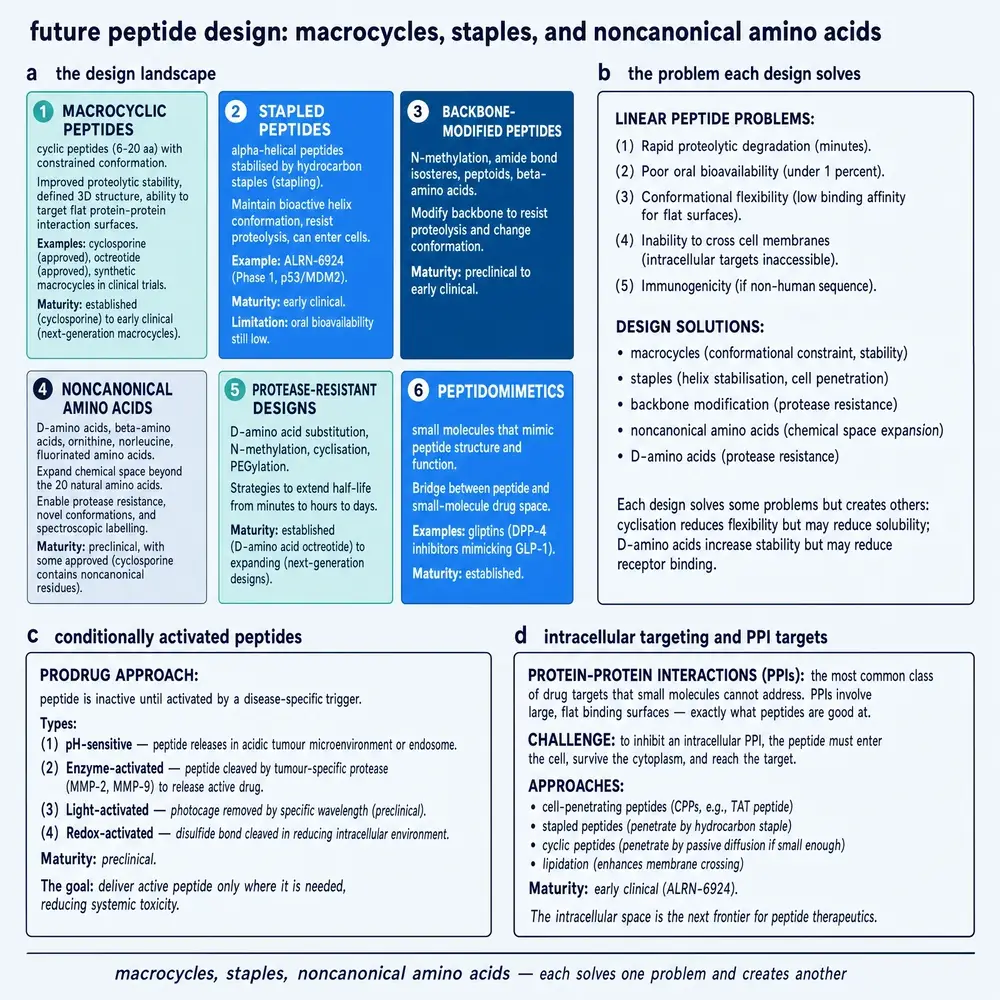
Maturity before romance. Every major technology is classified on a six-level scale from established-and-expanding to speculative. The body still edits the message. Proteases, barriers, endosomes and immune memory remain first-class constraints. Adoption is a social technology. Platforms fail for regulatory, cost, reproducibility and trust reasons as often as for molecular ones.
The contemporary clinical beachhead is instructive precisely because it is not mysterious. Long-acting glucagon-like peptide-1 (GLP-1) receptor agonists and dual agonists such as tirzepatide and glucagon/GLP-1 dual agonists such as BI 456906 (survodutide lineage) show how sequence edits, acylation and receptor balance convert fragile gut hormones into medicines with measurable cardiorenal and weight outcomes in named trial programmes.634014 Amylin-pathway analogues and combination logic extend the same lesson: the next decade of metabolic peptides will be about which signals to combine and how to deliver them, not merely about making half-lives longer.5618 That beachhead is real. It is also a poor template for pretending that every future peptide problem has already been solved by albumin binding. A second, narrower beachhead is forming around oral extracellular macrocycles: icotrokinra (JNJ-2113), an oral IL-23 receptor antagonist, entered the first-approval literature in 2026,29 while enlicitide (MK-0616), an oral macrocyclic PCSK9 inhibitor originating in mRNA-display chemistry, has completed Phase 2b work and entered late-stage programmes.5179 Those molecules expand what “oral peptide” can mean for selected extracellular targets; they do not erase the negative-selection logic that still correctly kills most short, short-lived oral peptide fantasies.
Section 02Discovery history of the parts
The tools that make a “future of peptides” conceivable did not arrive together. They accumulated as separate discoveries that only later began to talk to one another. The story is worth telling as one contextual narrative, because every forecast in later Parts inherits a piece of it.
In 1902, Bayliss and Starling showed that a chemical released from the gut could make the pancreas secrete — secretin, the first hormone in the modern sense. The body was not only a network of nerves; it was a pharmacy of short messages. Two decades later, Banting, Best, Collip and Macleod brought insulin out of pancreas and into dying children. The molecule that followed was not yet a designed peptide. It was an extract whose potency was defined by animal assay long before its primary structure was known. That historical fact still echoes: activity and identity are different questions, and medicine learned to measure one before it could fully name the other.
Solid-phase peptide synthesis (SPPS), invented by Merrifield, changed the industrial and intellectual status of the class. A chain that once required heroic solution chemistry could be built residue by residue on a resin, purified, and redesigned. The method did not abolish manufacturing difficulty — deletion sequences, aggregation and green-chemistry burdens remain — but it made deliberate sequence engineering ordinary. Recombinant expression later gave insulin and related proteins a factory route that did not depend on animal glands. Between those two manufacturing revolutions sits the modern peptide: sometimes chemically assembled, sometimes biosynthesised, often hybridised with fatty acids, polyethylene glycol or linkers that nature never attached.
Receptor cloning and the radioligand era turned “a hormone does something” into “a ligand occupies a defined protein.” GLP-1 and glucose-dependent insulinotropic polypeptide (GIP) physiology, and the later recognition that oxyntomodulin and related proglucagon peptides engage multiple receptors, supplied the conceptual map for today’s multi-agonists.6351 Tight-junction and BBB biology named the walls that delivery science still tries to negotiate. Display technologies — phage, yeast, mRNA and related libraries — made enormous sequence spaces searchable without requiring every analogue to be invented by hand. Computational structure prediction, most visibly AlphaFold-class tools, then gave experimentalists a provisional map of folds and interfaces that could be tested, not worshipped.3958
Venom and natural-product history runs beside the hormone story. Exenatide entered medicine from Gila-monster saliva; ziconotide from cone-snail venom. PeptideMiner and related discovery pipelines now treat those evolutionary experiments as searchable chemical space rather than as folklore, recovering natriuretic and insulin-like sequences across distant taxa and testing selected analogues at human receptors.39 The lesson for forecasting is not that nature has already invented the next blockbuster. It is that sequence space is larger than the endogenous human hormone catalogue, and that tools now exist to mine it with family-aware models rather than with BLASTp alone.
None of these discoveries guarantees a future technology. SPPS made stapled and macrocyclic peptides thinkable; it did not make intracellular PPI inhibition routine. Receptor cloning made dual agonists designable; it did not make polypharmacology safe by default. AlphaFold made docking richer; it did not abolish the need for wet assays. History supplies instruments. Maturity classifies what those instruments have actually accomplished.
Section 03The maturity framework
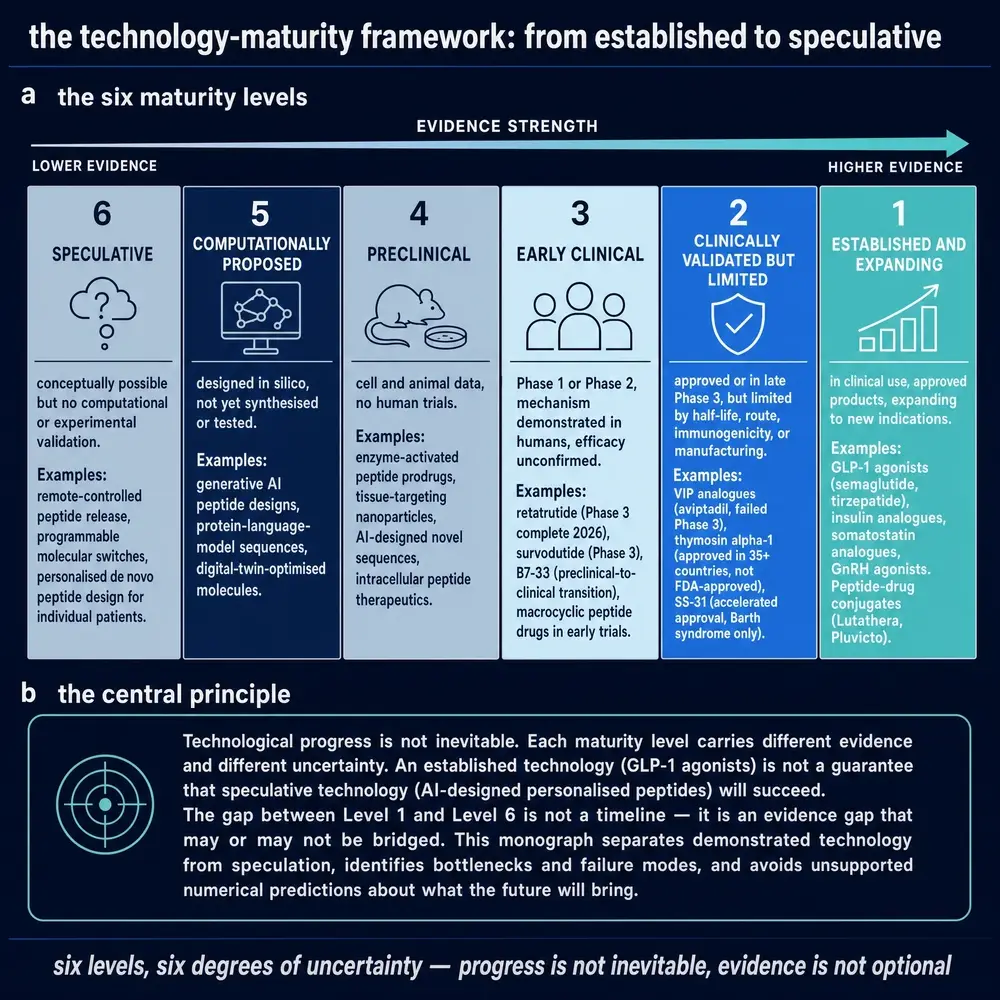
This monograph uses a six-level maturity scale for every major technology track. The labels are deliberately coarse. They exist to prevent a slide deck from laundering a mouse study into a platform revolution.
| Level | Label | What it means in this document |
|---|---|---|
| M1 | Established & expanding | Multiple approved products or deep clinical use; incremental innovation continues |
| M2 | Clinically demonstrated | Human efficacy/safety evidence for the technology class in at least one setting |
| M3 | Translationally advanced | Strong animal or early human signals; major CMC/regulatory questions remain |
| M4 | Emerging / contested | Mechanistic promise with mixed or species-limited evidence; active debate |
| M5 | Early experimental | Compelling in-vitro or sparse in-vivo data; not yet a platform |
| M6 | Speculative | Conceptually coherent but largely unproven; roadmap ≠ evidence |
Evidence is weighed with three standing rules. First, study type travels with every claim: human trial, named animal species, in-vitro assay, or model. Second, recency is preferred when a 2024–2026 finding is not contradicted by a preponderance of earlier evidence — freshness without amnesia. Third, company pipeline statements, press releases and unverified patent claims are never treated as independent demonstration; they may appear in the patent/pipeline map as secondary reporting, labelled as such. Figure 2 states the six levels and the governing principle: the gap between levels is an evidence gap, not a timeline.
Section 04Where the evidence is strong and where it is thin
The published literature that engages next-generation peptide design is richer in some tracks than others. It is dense on metabolic multi-agonists, oral and mucosal delivery, nanoparticle and blood–brain-barrier discussion, immunogenicity and access themes, and incretin-platform engineering.16241 It is thinner on licensed patent landscapes, commercial pipeline databases and fully autonomous closed-loop laboratories as primary subjects. Those absences are not filled by invention. Where this document discusses patents or pipelines, it does so through secondary reporting in the scientific literature and clearly labelled company statements — not as if a proprietary patent or pipeline feed had been independently audited here.
The bibliography is a load-bearing set of sources for the claims that follow, each entry taken from the source record’s own metadata rather than from memory. Where a claim rests on a thinner shelf, the prose says so, and the Apparatus registers keep the thinner shelves visible rather than burying them in confident narrative.
Section 05Speculation versus demonstration
Forecasting without inevitability is a hard constraint of this commission. Every major forward-looking claim in later Parts carries, explicitly or by cross-reference, a factual basis, assumptions, uncertainty, alternative outcomes, bottlenecks and failure modes. Speculative sentences are marked in the prose as such, and they are summarised in Appendix form in the Apparatus and in notes/SPECULATION_VS_EVIDENCE_REGISTER.md.
Demonstrated means human or strongly concordant multi-species evidence for the claim as stated. Translational means credible animal or early-human evidence with named limits. Emerging means active research with contested generality. Speculative means coherent extrapolation that must not be read as a prediction of approval, adoption rate or year-certain success. No adoption-rate percentages or year-certain approvals are asserted without a named source.
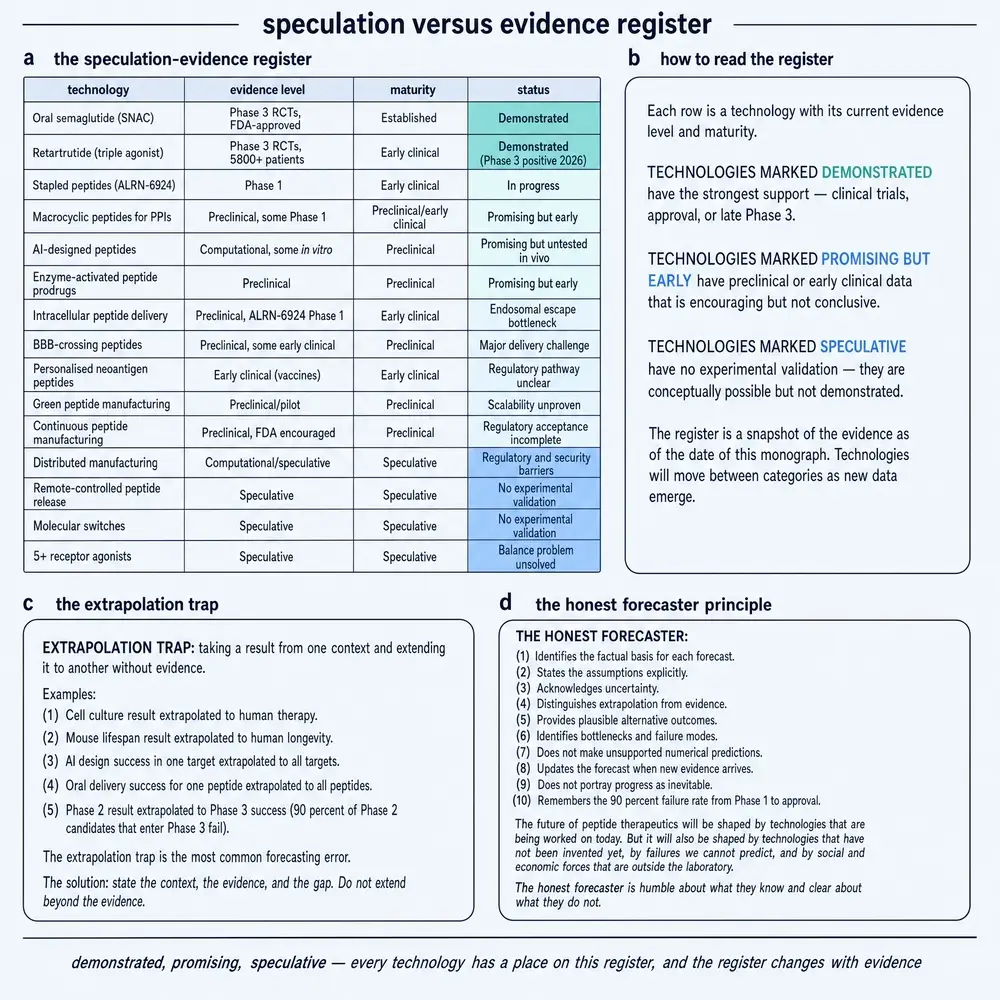
Figure 3 is the snapshot register for that discipline. The refusal of inevitability is not pessimism. Dual agonists, oral semaglutide as a boundary case, nanoplatform targeting of GLP-1 receptors, inflammation-triggered oral conjugates, peptoid nanotubes, and profile-HMM discovery tools are all real objects in the literature of the last several years.8153962 What this document refuses is the slide from “published” to “platform” to “inevitable.” Parts Two through Five classify technologies. Part Five’s closing sections (merged from the outline’s Part Six) ask how those classifications could fail, and what observable signs would upgrade or downgrade them.
Section 06Macrocycles, staples and constraints
A linear peptide is a message written in a language proteases read fluently. Constraint — head-to-tail cyclisation, disulfides, hydrocarbon staples, lactam bridges — is an attempt to change the grammar: lock a bioactive conformation, raise proteolytic half-life, and, in the most ambitious cases, cross a membrane to reach an intracellular protein–protein interface that a small molecule cannot cover and an antibody cannot enter.
Figure 1 states the ambition and the tax. The important distinction for 2025–2026 is where the constrained peptide acts. Extracellular oral macrocycles against named receptors have entered first-approval and late-stage human evidence: icotrokinra as an oral IL-23 receptor antagonist in the first-approval literature,29 and enlicitide (MK-0616) as an oral macrocyclic PCSK9 inhibitor with Phase 2b LDL-C reduction and ongoing Phase III registry programmes.5509 Those successes validate constrained peptides as oral medicines for selected extracellular targets; they do not validate a general intracellular PPI platform. Intracellular stapled programmes such as sulanemadlin (ALRN-6924), a cell-permeating MDM2/MDMX antagonist with Phase 1 oncology experience, remain early translational chemistry rather than an established modality.21477 Permeability remains the central trade-off for cytosolic ambitions: the same hydrophobic and conformational features that favour membrane crossing often favour aggregation, efflux, or loss of solubility, and dish assays that declare “cell-penetrant” do not automatically predict cytosolic free concentrations in a tissue.2045
Maturity: oral extracellular macrocycles against named targets M1–M2 for beachhead cases (icotrokinra-class approval literature; enlicitide-class late development), without generalising that maturity to all oral peptides; injectable extracellular cyclic peptides (e.g. somatostatin analogues) likewise M1–M2; intracellular stapled/macrocyclic PPI platforms typically M4–M5, with ALRN-6924-class programmes as early human probes rather than platform validation. Speculation to avoid: that constraint alone solves endosomal escape, or that one oral macrocycle approval abolishes oral-peptide negative selection.
Section 07Backbone edits and peptidomimetics
If constraint reshapes the chain from the outside, backbone edits rewrite it from within. N-methylation, D-residues, β-amino acids, peptoid substitutions and other noncanonical building blocks are the workhorses of protease resistance and conformational bias. Dipeptide-drug design literature long ago showed that even tiny scaffolds can be remodelled into CNS-relevant and metabolic candidates when the peptide bond is no longer sacred.20 Peptoid nanotubes carrying nicotinamide illustrate a different use of the same idea: the backbone is no longer pretending to be a hormone at all; it is a carrier architecture with peptide-like synthesis and distinct folding behaviour.15
Rational redesign of short GLP-1-related sequences continues in parallel. An 18-residue construct explored as a potential GLP-1 receptor agonist shows how docking, molecular dynamics and medicinal intuition still operate at the scale of a single helix, not only at the scale of foundation models.52 Liraglutide oligomerisation studies remind chemists that backbone and side-chain choices also rewrite solution behaviour: the same fatty-acid logic that extends half-life can open oligomer pathways that analytics must see.32
BI 456906’s discovery chemistry is a clinical-facing case study in backbone and sequence editing for dual agonism: unnatural residues at protease-sensitive positions, C-terminal amidation, and a C18 diacid on a glycine–serine linker to buy albumin binding while balancing glucagon and GLP-1 receptor potencies.63 That molecule is not a peptidomimetic in the classic β-peptide sense, but it is a demonstration that “hormone plus edits” remains the highest-yield design path in human medicine.
Maturity (backbone edits / peptidomimetics): M1–M2 where the edits are the familiar DPP-4-resistant and lipidated hormone analogues; M3–M4 for broader peptoid and β-peptide therapeutic platforms; M5 for many intracellular peptidomimetic ambitions. Failure mode: every unnatural residue is also a potential neo-epitope and a CMC complication.
Section 08Conditionally activated and environment-responsive peptides
A peptide that is always on is a peptide the whole body must tolerate. Conditional activation — pH triggers, protease unlocks, reactive oxygen species (ROS) gates, light switches — tries to make activity a local event. Inflammation-triggered self-immolative peptide conjugates are a concrete 2026 example: a hydrophilic PEG segment, a ROS-responsive hydrophobic self-immolative module and a hydrolysable scaffold assemble into micelle-like nanoparticles that survive gastrointestinal insult and release anti-inflammatory peptides preferentially at inflamed sites in mouse colitis and acute lung injury models.8
Figure 1 distinguishes three layers that are often conflated. Protection keeps the cargo intact until a compartment is reached. Targeting concentrates the construct where a marker is enriched. Activation converts a latent molecule into an active ligand. A technology can succeed at one layer and fail at another. Light-regulated orexin analogues show that photocontrol can achieve nanomolar receptor pharmacology in vivo in research settings; that is powerful chemical biology, not yet a general therapeutic manufacturing path.44 Glycoalkylation of the tripeptide KPV illustrates how even tiny anti-inflammatory scaffolds can be chemically remodeled for delivery-relevant properties.53
Maturity: M3–M4 for inflammation- or enzyme-gated conjugates with strong rodent packages; M5–M6 for general “smart peptide” platforms claimed to solve systemic toxicity across indications. Human evidence remains sparse relative to the elegance of the chemistry. Speculation flag: assuming mouse colitis targeting ratios will survive human inflammatory heterogeneity.
Section 09Multivalent and multi-receptor agonists
If Part One named the beachhead, this section names its molecular logic. Unimolecular dual and triple agonists treat metabolic disease as a network problem: reduce energy intake through GLP-1 (and often GIP) pathways while, in glucagon-inclusive designs, raising energy expenditure and rewriting hepatic programmes. Preclinical pharmacology of BI 456906 showed greater body-weight reduction in diet-induced obese mice than maximally effective semaglutide doses, with biomarkers of glucagon-receptor engagement (amino-acid lowering, FGF-21, hepatic Nnmt) accompanying GLP-1-typical effects on food intake and glucose tolerance.63 Mazdutide, another GLP-1R/GCGR dual agonist, extends the same dual-logic discussion into diabetes-associated cognitive dysfunction models.14
Amylin receptor agonism and dual amylin/calcitonin logic supply a second axis. Reviews of amylin biology and the development of long-acting analogues such as petrelintide show why the field keeps returning to satiety pathways that are not GLP-1.5618 Hormone-based anti-obesity reviews place these agents in a crowded emerging landscape that also includes peptide–small-molecule competition.5111 Independent 2024–2026 reviews of dual and triple incretin co-agonists, and of triple-agonism strategies for obesity, document an active clinical pipeline (including retatrutide-class GIP/GLP-1/glucagon logic and combination constructs such as CagriSema-class amylin plus GLP-1 programmes) without converting any single Phase programme into inevitability.2219
Polypharmacology has limits. Balancing receptor ratios is not a slogan; it is a failure mode. Excess glucagon tone can threaten glycaemia; excess GLP-1 tone can dominate tolerability; species differences in receptor pharmacology can invalidate rodent screening for small-molecule GLP-1 agonists unless the model is humanised.5443 Multi-agonism is therefore best classified as M1–M2 for GIP/GLP-1 dual agonists with large human programmes, M2–M3 for several GCGR/GLP-1 duals, amylin combinations and named triple-agonist clinical packages, and still M4 for casually proposed pentagon pharmacology without biomarker discipline.
Section 10Conjugates as payload platforms
Antibodies taught oncology that a ligand can be a courier. Peptides are attempting the same lesson with a smaller, cheaper, sometimes more penetrant courier. Peptide–drug conjugates (PDCs), peptide–radionuclide pairs and peptide–nucleic-acid constructs share a modular architecture: targeting ligand, linker, payload. Engineered GLP-1R-targeting nanoplatforms push the idea further by treating the agonist not only as a drug but as a homing motif on multimodal carriers.62
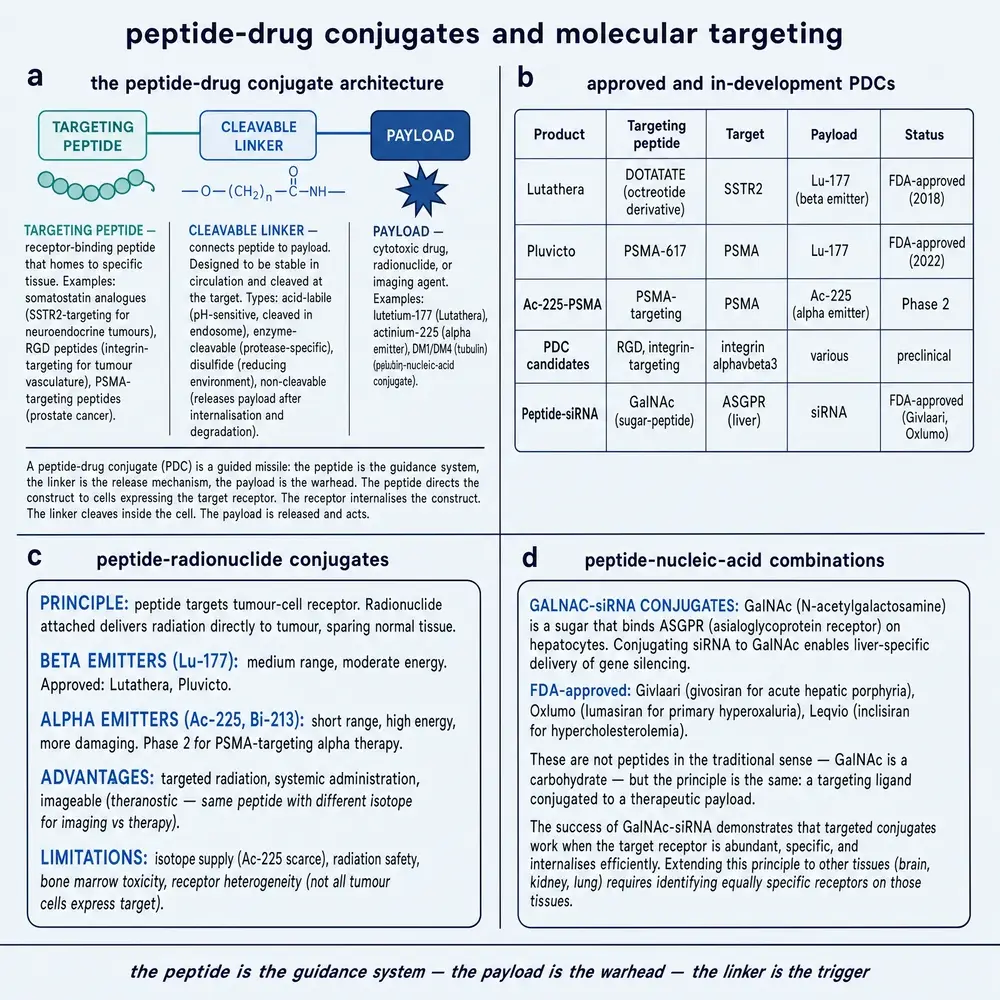
Maturity: peptide radionuclides in approved niches M1–M2; GLP-1R-targeted nanoplatforms M3–M4; general cytotoxic or multimodal PDC platforms beyond a few beachheads M4–M5 (pipeline breadth ≠ platform maturity). Failure modes: payload toxicity, linker metabolites, immunogenicity of repeated carrier exposure, and manufacturing of multicomponent products.
Section 11Intracellular delivery and endosomal escape
Cell-penetrating peptides (CPPs) are the field’s most repeated promise and most repeated disappointment. They can enter cells; the harder question is whether enough intact cargo reaches the cytosol or nucleus to matter, at a therapeutic index the rest of the body will accept. Fusion designs that graft CPP motifs onto mitochondrial or cytoprotective peptides show that rational chimeras can improve delivery phenotypes in preclinical models.45 Hydrophobic membrane-translocating peptides such as MTD 1067 have moved functional protein cargoes across skin barriers in experimental settings.49 Fluorous oligoarginine supra-enhancers likewise tune intracellular and transdermal peptide delivery in experimental systems.46
What human evidence actually shows is narrower than the review rhetoric. Approved peptide drugs remain overwhelmingly extracellular-receptor agonists and enzyme modulators. Intracellular peptide therapeutics that must escape endosomes at scale are still better described as emerging than as established. Nanoplatform and peptoid-carrier papers often demonstrate cargo effects without fully resolving free cytosolic concentration.6215 This document therefore keeps endosomal escape at M4–M5 as a general solution and higher only for specific local or topical contexts with direct evidence.
Section 12Design maturity matrix (molecular)
| Technology | Problem | Mechanism | Evidence spine | Maturity | Limits / failure modes |
|---|---|---|---|---|---|
| Lipidated long-acting hormone analogues | Minutes-scale native half-life | Albumin binding + protease edits | Multiple approved agents; rich PK/PD | M1 | Albumin-turnover ceiling; GI tolerability; supply |
| Unimolecular dual/triple agonists | Single-pathway weight/glucose ceilings | Balanced multi-receptor agonism | Large human programmes + deep preclinical duals | M1–M2 | Ratio errors; species pharmacology; lean-mass loss |
| Amylin-pathway analogues | Complement GLP-1 satiety | Amylin/calcitonin receptor agonism | Clinical and late-preclinical analogues | M2–M3 | Nausea; formulation; combination complexity |
| Oral extracellular macrocycles (named targets) | Needle avoidance for selected extracellular proteins | Constrained oral ligands (e.g. IL-23R, PCSK9) | First-approval / late-phase human packages | M1–M2 (beachhead only) | Over-generalising to classical oral peptides |
| Macrocycle / staple intracellular PPI | Flat intracellular interfaces | Conformational constraint ± permeability engineering | Early clinical probes (e.g. ALRN-6924); chem biol > platform | M4–M5 | Escape, selectivity, CMC, immunogenicity |
| Backbone peptidomimetics / peptoids | Proteolysis; novel scaffolds | Noncanonical backbones | Approved edits common; platforms mixed | M2–M4 | Neo-epitopes; synthesis cost; unknown metabolites |
| Conditional / environment-responsive | Systemic on-target toxicity | Local trigger → active peptide | Strong rodent packages; limited human | M3–M5 | Trigger heterogeneity; incomplete activation |
| PDC / peptide-targeted nanoplatforms | Tissue selectivity of payloads | Ligand + linker + cargo | Niche radioligands; expanding nano literature | M2–M4 | Linker tox; multicomponent CMC; ADA to carriers |
| CPP / endosomal escape | Cytosolic access | Membrane transduction / lysis / fusion tricks | Preclinical > general human platform | M4–M5 | Toxicity, inefficiency, assay overclaim |
Safety and CMC columns are compressed here; the full matrix in notes/MATURITY_CLASSIFICATION_MATRIX.md expands regulatory path and immunogenicity notes. The governing observation for Part Two is simple: the highest-maturity molecular innovations of the decade are still edits and combinations of extracellular hormone logic, while the most romantic targets — broad intracellular PPI control — remain earlier on the scale.
Section 13Protein-language models and generative sequence design
If Part Two asked what molecules might look like, Part Three asks how they might be invented. Protein-language models (PLMs) and generative sequence models treat amino-acid strings the way large language models treat tokens: learn statistical structure from vast corpora, then propose new strings that look “protein-like.” For peptide discovery the promise is obvious — explore sequence space faster than human intuition — and the hazard is equally obvious: a fluent sequence is not a developable drug.
Published peptide work engages AI and machine-learning language more often as surrounding methodology than as peptide-foundation-model clinical proof. A 2026 Chemical Communications perspective on peptide-based drug design using generative AI surveys PLMs, diffusion and inverse-folding stacks as accelerating layers that still require wet validation before maturity upgrades — useful map, not clinical replacement.16 Where generative and model-guided discovery appear with hard peptide outcomes in the local corpus, they often sit beside classical bioinformatics. PeptideMiner is a useful boundary object: it is not a transformer PLM, but it is a family-aware computational discovery system that outperformed BLASTp on short, divergent neuropeptides, recovered novel natriuretic and insulin-like sequences from venom transcriptomes, and supported synthesis and human-receptor binding of selected conoinsulins.39 That is demonstration of computational discovery accelerating analogue finding, not demonstration that an end-to-end generative model can replace medicinal chemistry.
Rational docking-plus-dynamics design of short GLP-1-related peptides shows the complementary pole: human-guided computation on a single scaffold.52 Related computational campaigns on amyloid aggregation inhibitors and on insulin-degrading enzyme conformational dynamics show the same pattern outside incretin space: simulation proposes, wet chemistry and binding still decide.5738 Reviews of engineered nanoplatforms increasingly mention AI-assisted design as an accelerating layer rather than as an autonomous inventor.62 Maturity: PLMs as assistive design tools M3–M4; PLMs as autonomous therapeutic inventors M5–M6. Speculation flag: equating benchmark perplexity or in-silico affinity with clinical developability.
Section 14Structure prediction and generative structural design
AlphaFold-class structure prediction changed the default starting point of protein science. For peptides the gift is uneven. Short, flexible ligands still frustrate methods trained on globular proteins; disulfide-rich and macrocyclic scaffolds can be better behaved; complexes and induced fit remain the hard edge. PeptideMiner’s use of AlphaFold2 to compare predicted conoinsulin folds with human insulin crystal structure is typical of responsible use: structure prediction as a hypothesis generator beside binding data, not as an oracle that closes the file.39
Integrated computational analyses of host-defence peptides (LL-37, HNP-1, magainin-2) show how docking, dynamics and structural comparison can clarify mechanistic divergence without claiming a new drug.58 Fusion CPP designs likewise lean on structural reasoning to justify chimeras before wet validation.45 Generative structural tools (diffusion models, inverse folding) are discussed across the wider literature as enablers; within this local corpus — and in the wider generative-AI peptide literature16 — they should be treated as M3 for structure-informed hypothesis generation and M5–M6 for unsupervised de novo peptide drugs entering humans without classical assays.
That maturity split matters for forecasting. Structure prediction can make a chemist faster without making a clinical candidate more developable. The next section therefore returns to the older DMTA question: which experiments are worth running, and which computational suggestions still die on contact with synthesis, assay noise and species pharmacology.
Section 15Docking, MD, active learning and DMTA cycles
The design–make–test–analyse (DMTA) cycle is older than deep learning. What is new is the hope that active learning can choose the next analogue worth making, that molecular dynamics can stress-test poses, and that closed loops can shrink the number of futile syntheses. Morphology-driven zinc oxide carriers and other delivery papers in the corpus illustrate physics-informed modelling beside empirical barrier modulation — computation as partner to materials science.26 Dual-agonist discovery programmes still read as classical iterative medicinal chemistry with heavy in-vitro panels and in-vivo biomarker strategies, even when computation assists.63
Active-learning language appears in the wider supporting literature more often than fully documented autonomous peptide DMTA loops. This monograph therefore classifies docking/MD-assisted design as M2–M3 (routine assistive use) and fully closed-loop active learning for peptides as M4–M5 pending more transparent, reproducible case studies with negative results published alongside successes. Figure 5 is the Part Three overview: closed-loop ambition, generative tools, and the failure modes that keep computation from replacing synthesis, assay and clinical judgement.
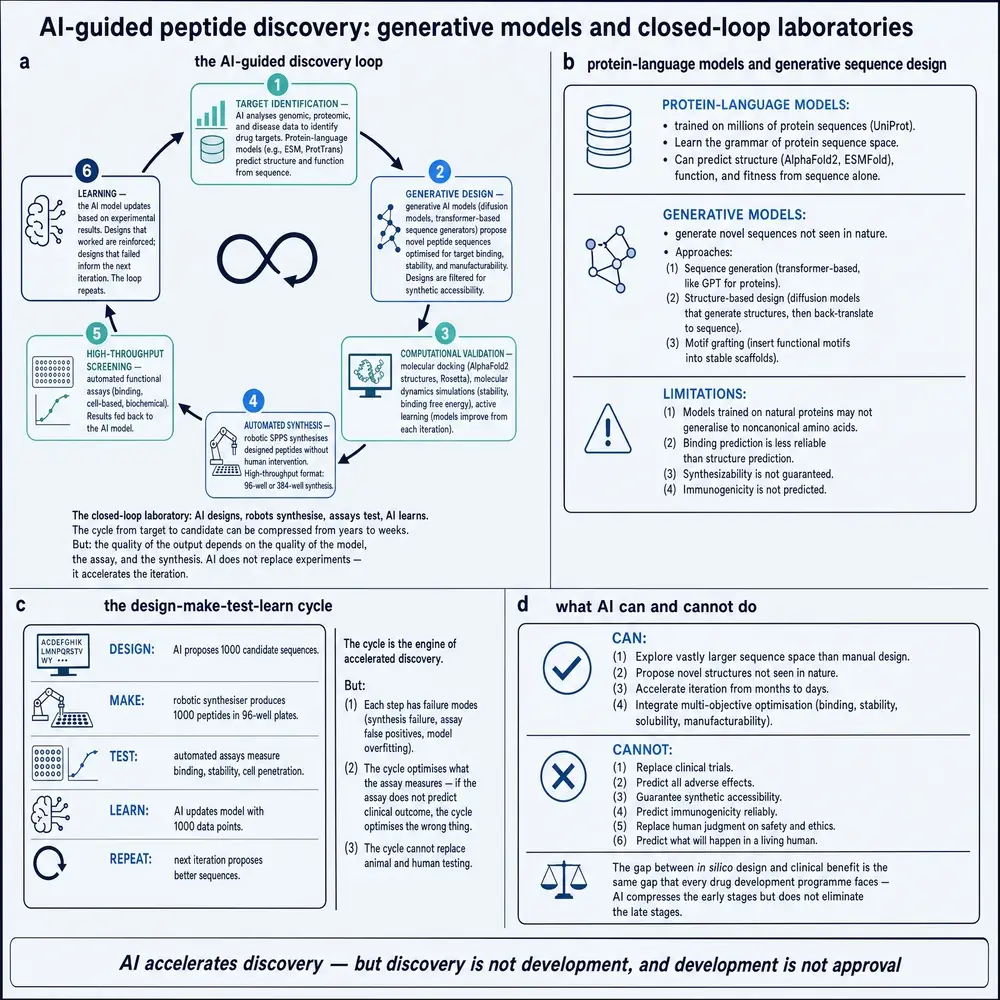
Those maturity labels are provisional. A published active-learning loop that cannot show held-out assay reproduction, or that never reports the analogues it rejected, has not yet earned an upgrade from assistive design to autonomous discovery.
Section 16Autonomous laboratories and robotic synthesis
Robotic synthesis and high-throughput assay platforms are real industrial objects. Fully autonomous “self-driving” peptide laboratories that invent, make and validate clinical candidates without human strategic judgement are not. The distinction matters for forecasting. Microwave-assisted SPPS, automated purification and parallel bioassays already compress cycle time for dual-agonist and analogue campaigns.63 Self-assembling peptide systems and carrier platforms add formulation robotics to the story.24
Three layers are often sold as one: (1) automated execution of human-designed protocols; (2) algorithmic selection among pre-specified design options; (3) open-ended hypothesis generation with unattended ethical and regulatory accountability. Layer 1 is M1–M2 in many companies. Layer 2 is M3–M4. Layer 3 is largely M6 as a clinical-discovery claim, however impressive a demo may look on a conference stage.
Reproducibility and automation bias are first-class risks. A robot that faithfully executes a flawed assay multiplies error. A model trained on published successes inherits publication bias. Governance notes in later sections apply here: transparency of training sets, retention of human veto, and refusal to treat throughput as truth.
Section 17Digital twins, personalization and federated data
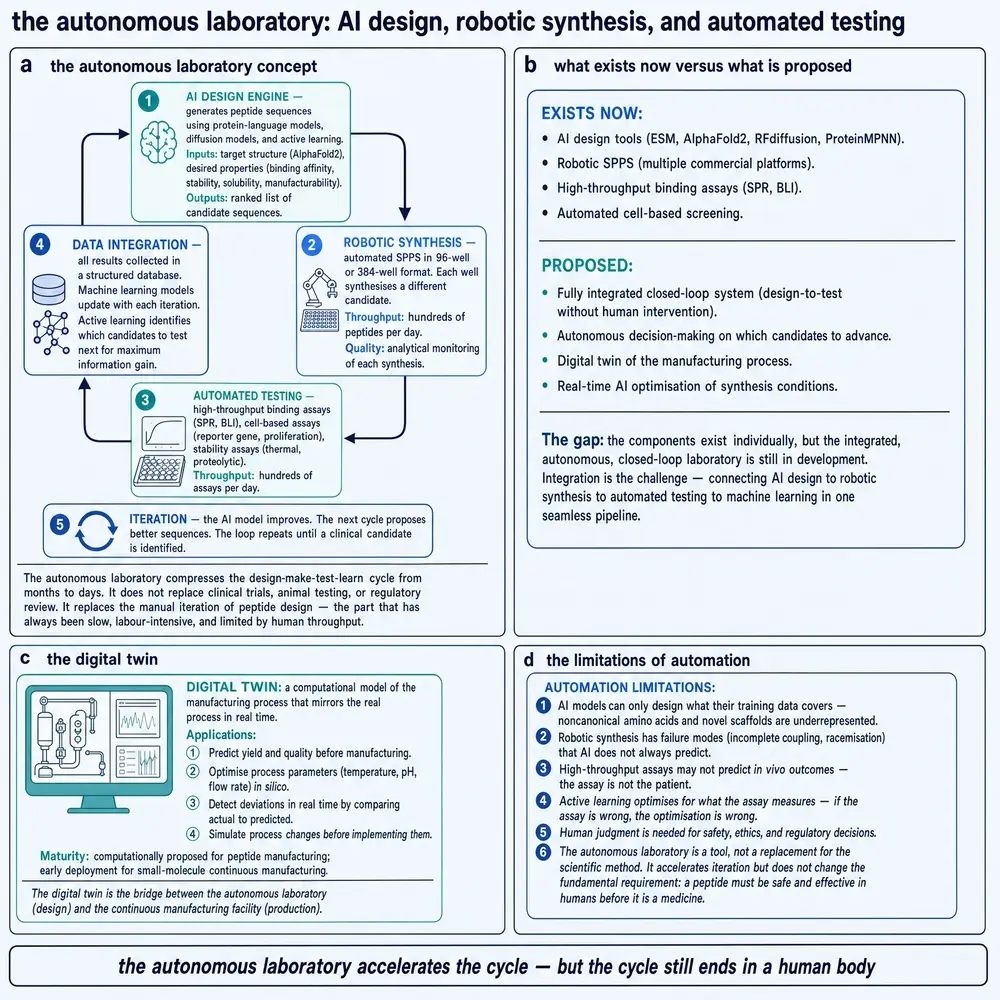
Digital twins — mechanistic or hybrid models that mirror a patient, organ or process — attract peptide-adjacent interest in precision dosing, trial simulation and manufacturing control. An international Delphi consensus on acute kidney injury explicitly discusses foundations for AI-driven digital-twin development; that is adjacent infrastructure, not a peptide-specific validated twin.28 Biomarker-integration and biosensor reviews similarly describe AI-enabled monitoring architectures that could, in principle, close loops around metabolic peptide therapy.33 Figure 6 separates the proposed autonomous closed loop from what exists now, including the digital-twin bridge that still returns every cycle to a human body and a regulatory decision.
Human genetics already supplies a different kind of personalisation signal. Large-scale analysis of function-disrupting myostatin (MSTN) variants shows increased muscle mass and reduced adiposity in carriers, informing the therapeutic logic of myostatin blockade as a potential counterweight to GLP-1-associated lean-mass loss — a precision-biology insight, not a recommendation for any person’s use.23 Humanised GLP-1 receptor mice address a different personalisation problem: making preclinical models match human receptor pharmacology for oral small-molecule agonists.54
Federated learning and privacy-preserving multi-institutional training are discussed more than they are demonstrated for peptide discovery in this corpus. Maturity: genetics-informed target confidence M2–M3; operational patient-level peptide digital twins M5–M6; federated peptide-design networks M5–M6. Failure modes: surveillance creep, biased cohorts, automation bias in clinical decision support, and mistaking a simulation for a trial.
Section 18Oral, nasal, pulmonary — mucosal routes after SNAC-class lessons
Oral peptide delivery is the field’s oldest romance and its most carefully documented graveyard. A century of enteric coats, enzyme inhibitors, permeation enhancers, nanoparticles and ingestible devices has produced mostly failure, punctuated by boundary successes that are easy to over-generalise. The controlling analysis in the local corpus is blunt: success depends on molecular pharmacology more than on formulation theatre. Exposure infeasibility, variability incompatible with regulatory expectations, and dose escalation into gastrointestinal toxicity or impossible cost explain the historical record better than a missing nanoparticle.4148
Oral semaglutide with SNAC is the boundary case, not the platform validation. A roughly week-long half-life, high potency, wide therapeutic window and exposure-driven pharmacodynamics allow low and variable absorption to integrate into useful effect. Most peptides lack that constellation. Oral octreotide under restricted labelling is another boundary, not a blank cheque.41 The fourth Controlled Release Society workshop on oral peptide administration (2026) revisits those lessons from Rybelsus- and Mycapssa-class products and warns against treating patient preference for oral tablets as automatic when weekly injectable options already exist — adherence sociology is part of the technology assessment, not an afterthought.6 A distinct 2025–2026 strand is oral macrocyclic ligands engineered for extracellular targets (IL-23R, PCSK9): these are constrained-molecule successes, not evidence that classical short linear peptides have suddenly become orally tractable platform drugs.2917 Comparative discussion of injectable peptide GLP-1 agonists versus emerging oral small-molecule agonists underscores a competitive pressure: if the goal is merely an oral tablet, chemistry may leave the peptide class entirely.4354
Inflammation-triggered self-immolative conjugates reopen oral delivery as a local strategy for gut and even distant inflamed tissue in mice, which is a different claim from systemic oral bioavailability for a metabolic hormone.8 Paracellular permeation-enhancer studies continue to map what enhancers can and cannot do for model peptides.12 Nasal application of peptides targeting melanocortin and ghrelin pathways shows another mucosal option for appetite circuits, still preclinical in the cited work.64 Intranasal comparisons of regional brain uptake for incretin receptor agonists, and intranasal mitochondrial peptide delivery in injury models, further map what mucosal routes can and cannot promise for CNS-facing cargoes.231
Advances in GLP-1 receptor agonist delivery systems review oral, injectable depot, device and combination strategies as a portfolio rather than as a single winner.1 Maturity: SNAC-class oral for rare PK phenotypes M2; classical oral systemic delivery for typical short peptides M4–M5 (often correctly abandoned early); nasal/pulmonary peptide delivery M3–M4 depending on molecule.
Section 19Transdermal, microneedles, implants and programmable depots
If the gut is hostile, the skin and the subcutaneous depot are negotiable. Hydrophobic membrane-translocating peptides have delivered functional protein cargoes across skin in experimental models, a reminder that “transdermal peptide” is sometimes a CPP story rather than a classical patch story.49 Ionic-liquid microemulsions have been explored as thermodynamically stable topical vehicles that might carry peptide cargoes.37 Microneedles and programmable depots appear throughout delivery reviews as ways to flatten adherence barriers without claiming oral convenience.1 Dissolving microneedle patches carrying engineered collagen-domain peptides, ionic-liquid transdermal insulin studies, and in-situ forming liquid-crystal depots illustrate the breadth of device and vehicle research beyond metabolic blockbusters.602755
Long-acting injectables remain the workhorse that romantic routes must beat. Acylation and depot microspheres already deliver weekly or longer exposure for metabolic and endocrine peptides; the future question is whether devices and depots become smarter — feedback-responsive, combination-capable, lower-variance — or merely prettier. Maturity: conventional SC depots M1; microneedle hormone patches M3–M4; fully programmable closed-loop peptide implants M5–M6.
Section 20BBB transport, nanoparticles and extracellular vesicles
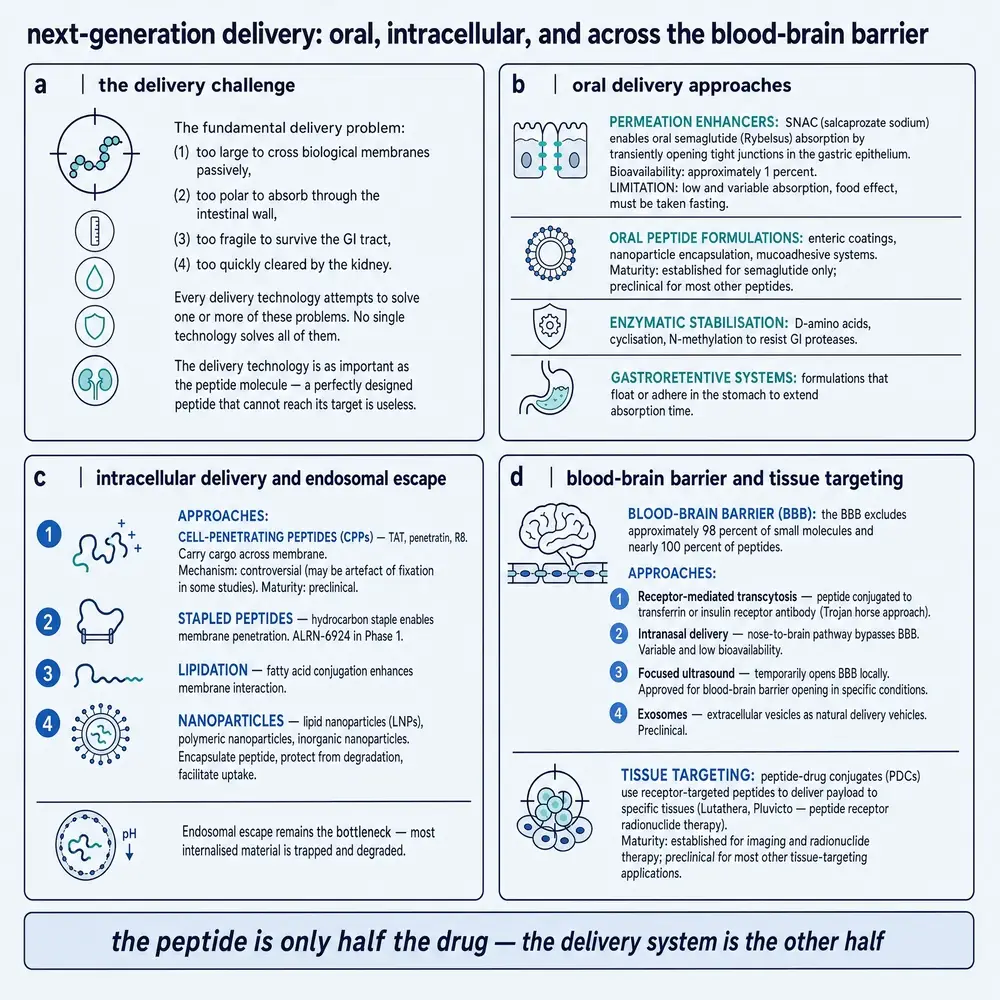
The blood–brain barrier is not a marketing challenge; it is a biological refusal. Peptides that act on central appetite circuits often do so via circumventricular organs, vagal routes or limited transport — not by free diffusion into parenchyma. Dual agonists and incretin reviews discuss cognitive and neuroinflammatory endpoints with appropriate caution about how much central exposure is required.1425 Positron-emission tomography occupancy studies at peripheral and central incretin receptors sharpen that exposure question beyond tissue homogenate guesswork.30 Neuropeptide interventions in ischemic brain injury, and broader reviews of central neuropeptides as modulators of astrocyte function, remain a horizon of targeted delivery challenges as much as of ligand discovery.6159
Nanoparticles, lipid carriers and extracellular vesicles populate the literature as BBB and tissue-targeting proposals. GLP-1R-targeting nanoplatforms explicitly pursue multimodal therapeutic and diagnostic aims.62 Peptoid nanotubes for brain-injury energy support and morphology-tuned zinc oxide carriers for barrier modulation add material diversity.1526 Rodent success remains easy; human generality remains hard. This monograph inherits GPM 07’s scepticism: impressive nanoparticle oral or CNS results in rodents are not automatically human promises.
Maturity: central effects of peripheral metabolic peptides via defined routes M2 for some endpoints; engineered BBB-crossing peptide platforms as a general solution M4–M5; EV therapeutics M4–M5. Figure 7 summarises the uneven ladder across oral, intracellular and barrier routes after those claims have been stated in prose.
Section 21Intracellular and locally activated delivery
Part Two treated intracellular access as a molecular-design problem; here it is a delivery-system problem. Local activation (inflamed gut, tumour microenvironment, endosome) and physical routes (microneedle, depot, device) can reduce the need for heroic systemic permeability. Self-immolative oral conjugates, CPP fusions and nanoplatform targeting are the recurring exhibits.84562 Novel CPPs explored in dermatology research illustrate how “delivery peptide” research often begins far from metabolic blockbusters.35
The practical forecasting question is which intracellular claims remain delivery problems and which remain ligand problems. Endosomal escape, cytosolic stability and on-target organelle exposure are not solved by naming a carrier. Local activation can reduce systemic exposure requirements, but only when the trigger chemistry is reliable in human tissue heterogeneity — a bar most inflammation-gated concepts have not yet cleared outside tightly controlled models.
Section 22Delivery maturity matrix
| Delivery track | Best-supported use case in corpus | Maturity | Principal failure mode |
|---|---|---|---|
| SC injection / lipidation depot | Long-acting metabolic & endocrine peptides | M1 | Adherence, manufacturing scale, GI on-target effects |
| SNAC / enhancer oral (boundary) | Long half-life, high-potency exposure-driven peptides | M2 | Over-extrapolation to unsuitable molecules |
| Oral extracellular macrocycles | Selected extracellular targets (e.g. IL-23R, PCSK9) | M1–M2 (beachhead) | Treating as general oral-peptide platform |
| Classical oral systemic peptide | Most short peptides | M4–M5 (often negative-select) | Bioavailability × half-life infeasibility |
| Inflammation-gated oral local delivery | GI / inflamed-tissue peptides in mice | M3–M4 | Human trigger heterogeneity |
| Nasal / pulmonary | Selected hormones & neuropeptides | M3–M4 | Variability, irritation, device dependence |
| Transdermal / microneedle | Experimental protein/peptide cargoes | M3–M4 | Dose loading, skin tox, scale |
| BBB nanoparticles / EVs | Preclinical CNS targeting | M4–M5 | Species gap; safety of chronic nanocarriers |
| Targeted nanoplatforms (e.g. GLP-1R) | Multimodal research systems | M3–M4 | CMC complexity; translational dose metrics |
| Ingestible injection devices | Combination-product concept | M3–M4 | Device reliability & regulatory path |
The triage lesson deserves restatement. For many candidates, the rational “future” delivery system is not oral nanoparticle magic; it is an honest route choice — long-acting injectable, nasal, pulmonary, device, or local activation — made early, before formulation budgets invent a bioavailability that pharmacology cannot support.41
Section 23Continuous, greener and enzyme-mediated manufacturing
A future peptide that cannot be made reproducibly at acceptable solvent load, cost and impurity control is not a medicine; it is a poster. Solid-phase synthesis remains central, including microwave-assisted routes used in dual-agonist discovery chemistry.63 Greener solvents, reduced chromatography burden, enzyme-mediated ligation and flow chemistry are the recurring industrial aspirations. The local corpus engages manufacturing less densely than delivery or multi-agonism; maturity judgements here therefore stay conservative and point to series neighbours (GPM 09) for deeper quality mechanics.
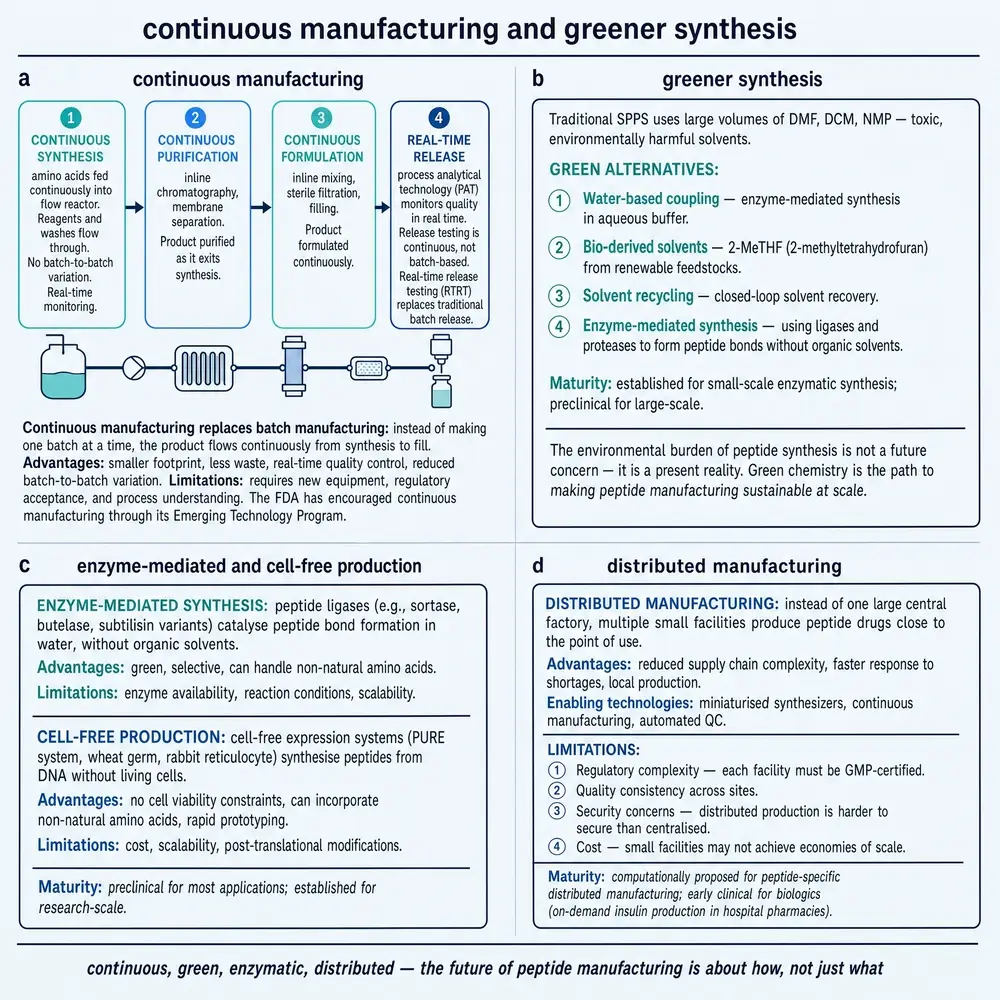
Figure 8 contrasts batch SPPS with continuous-flow and hybrid recombinant/chemical routes. Continuous manufacturing is M3–M4 as a general peptide default and higher only where specific processes are already validated. Enzyme-mediated fragment condensation is attractive for reducing protecting-group theatre; it is not yet the silent background of every commercial peptide. Self-assembling peptide systems add a formulation-manufacturing borderland where sequence encodes material behaviour.24 Distributed manufacture and real-time release remain ambitions whose regulatory and analytical burdens often exceed the solvent savings they advertise.
Section 24PAT, real-time release, distributed manufacturing and AI process optimisation
Process analytical technology (PAT) and real-time release testing promise to replace some end-product waiting with in-process seeing. For peptides, the relevant CQAs — identity, purity including deletion sequences, aggregation, potency, sterility, endotoxin — are unforgiving of method substitution without validation. AI process optimisation can reduce cycle times; it can also fit noise. Distributed or point-of-care manufacturing is largely M5–M6 for sterile peptide injectables, whatever the appeal in pandemic rhetoric.
Oligomerisation and higher-order structure analytics, as in liraglutide mass spectrometry studies, show why release methods must evolve with engineering.32 Quality is a system property, not a certificate decoration — a theme this series develops elsewhere and only summarises here. The continuous-manufacturing plate belongs with that analytical honesty: flow and PAT are not greener by slogan; they are greener only when the CQAs are still met.
Section 25Precision medicine, biomarkers and adaptive/platform trials
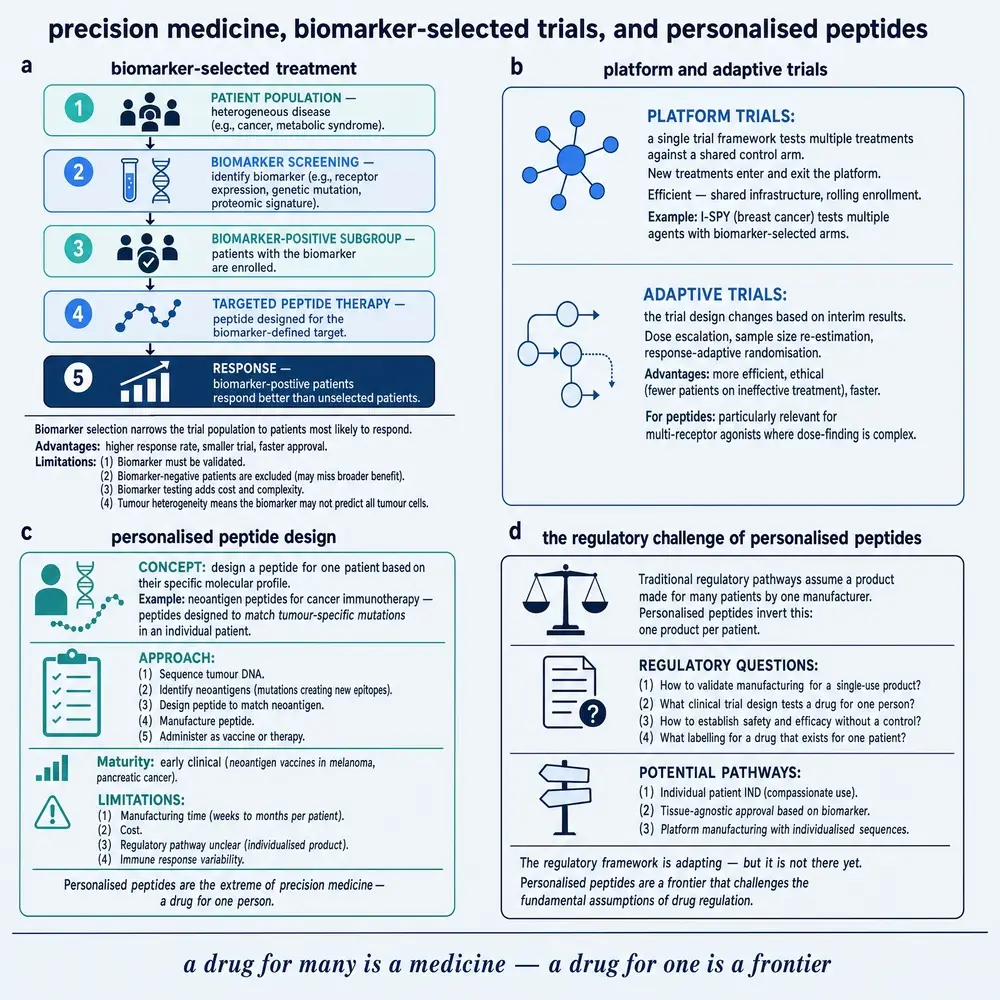
Incretin medicines already live inside a biomarker-rich clinical culture: HbA1c, weight, eGFR slopes, UACR, MACE composites, imaging. Cardiorenal outcome programmes have rewritten what “diabetes drug” means.403 MASLD/MASH programmes test whether metabolic peptides rewrite liver disease trajectories.1163 Exploratory work on GLP-1 agonists in movement disorders and on GLP-1/GLP-2 biology as intestinal reparative strategies shows how the same receptor class is being stretched across organ systems — each stretch requiring its own evidence, not a class halo.1334 Adaptive and platform trial designs are natural fits for multi-agonist and combination eras, but they do not abolish the need for confirmatory evidence. Multidimensional intervention reviews outside the incretin core likewise caution against single-modality certainty.36
Genetics-informed target validation (e.g. MSTN) and humanised receptor models are precision tools for development, not consumer customisation of sequences.2354 Biosensor and digital monitoring layers may eventually support adaptive care pathways; they remain infrastructural rather than peptide-specific proven platforms in this corpus.33 Maturity: outcome-driven metabolic peptide development M1; truly individualised peptide sequence therapy M6.
Figure 9 keeps biomarker selection, adaptive-trial logic and neoantigen-style personalisation in one frame so the maturity gap between outcome-driven metabolic programmes and truly individualised sequence therapy stays visible.
Section 26Immunogenicity of highly engineered molecules; surveillance
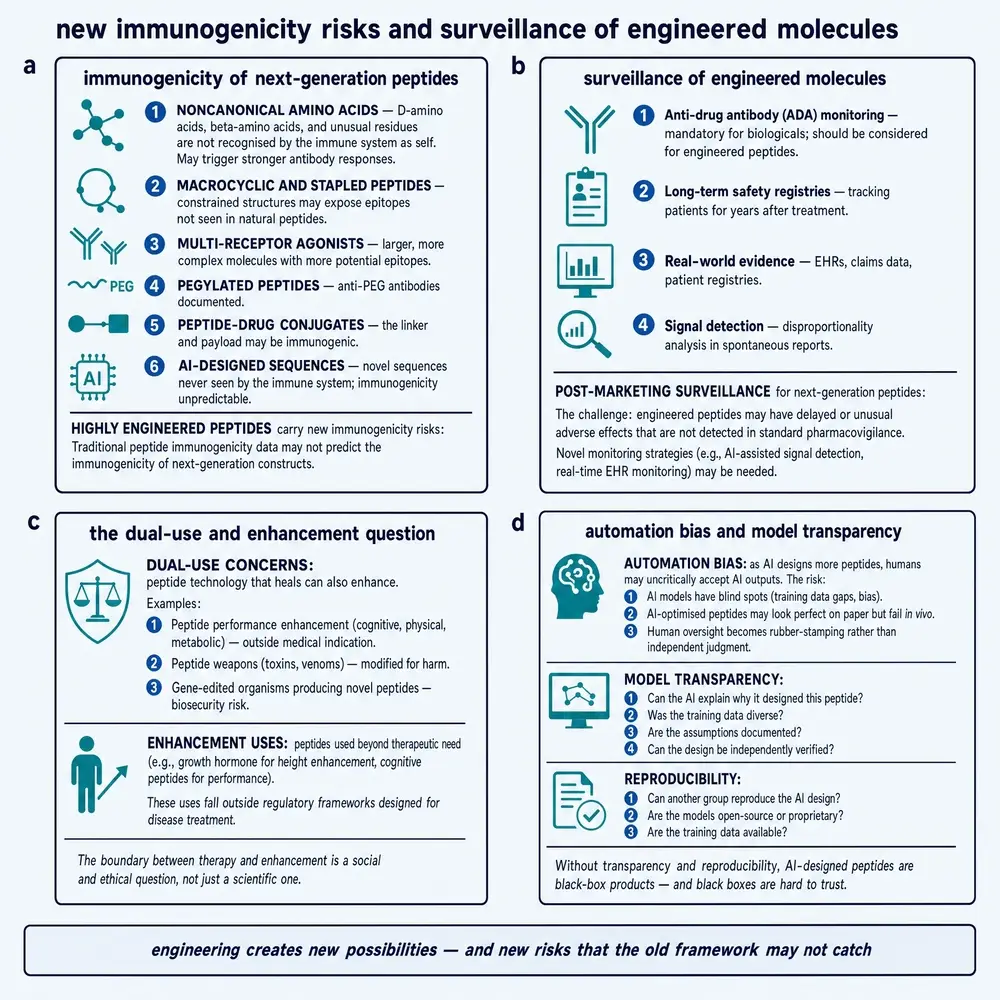
Every unnatural residue, linker, staple, PEG branch and nano-carrier surface is a possible immune lesson. Approved lipidated agonists show that engineering can be immunologically acceptable for many people; they do not show that arbitrarily exotic scaffolds will be. Aggregation and oligomer pathways can create neo-epitopes even when the primary sequence looks familiar.32 Pharmacovigilance and immunogenicity surveillance are therefore not bureaucratic afterthoughts; they are part of the technology’s maturity. Multi-agonists and conjugates deserve especially long attention windows because novelty clusters.
Falsified and unregulated products are a separate immune and safety disaster: identity unknown, aggregates uncontrolled, no reliable surveillance. Access crises that push people toward grey markets are social failure modes with molecular consequences.
Figure 10 groups those risk classes with the surveillance and governance edges that engineered novelty keeps creating. Immunogenicity is not only a clinic problem; it is also an access problem when grey-market products bypass every surveillance channel the approved molecule is supposed to have. The next section therefore treats affordability and dual-use governance as continuation of the same maturity problem, not as an afterthought.
Section 27Access, IP, affordability, enhancement uses, dual-use and data governance
A peptide platform that works only for the wealthy is a partial technology. Supply constraints, device ecosystems, cold chain and intellectual-property thickets shape adoption as much as receptor potency. Oral small-molecule GLP-1 agonists are partly an access and adherence story, not only a chemistry story.43 Enhancement uses of metabolic and myostatin-pathway biology, dual-use concerns around delivery and discovery tools, and governance of training data for generative models are real policy objects even when this monograph cannot resolve them.
Model transparency and reproducibility belong here as well as in Part Three. A generative pipeline that cannot explain why it proposed a toxic sequence is a governance failure waiting for a headline. Federated data dreams collide with privacy law and with the prosaic fact that many institutions still cannot share negative assay results.
Figure 11 keeps cost, exclusivity and access in the same frame as the inventorship questions that generative design is already raising.
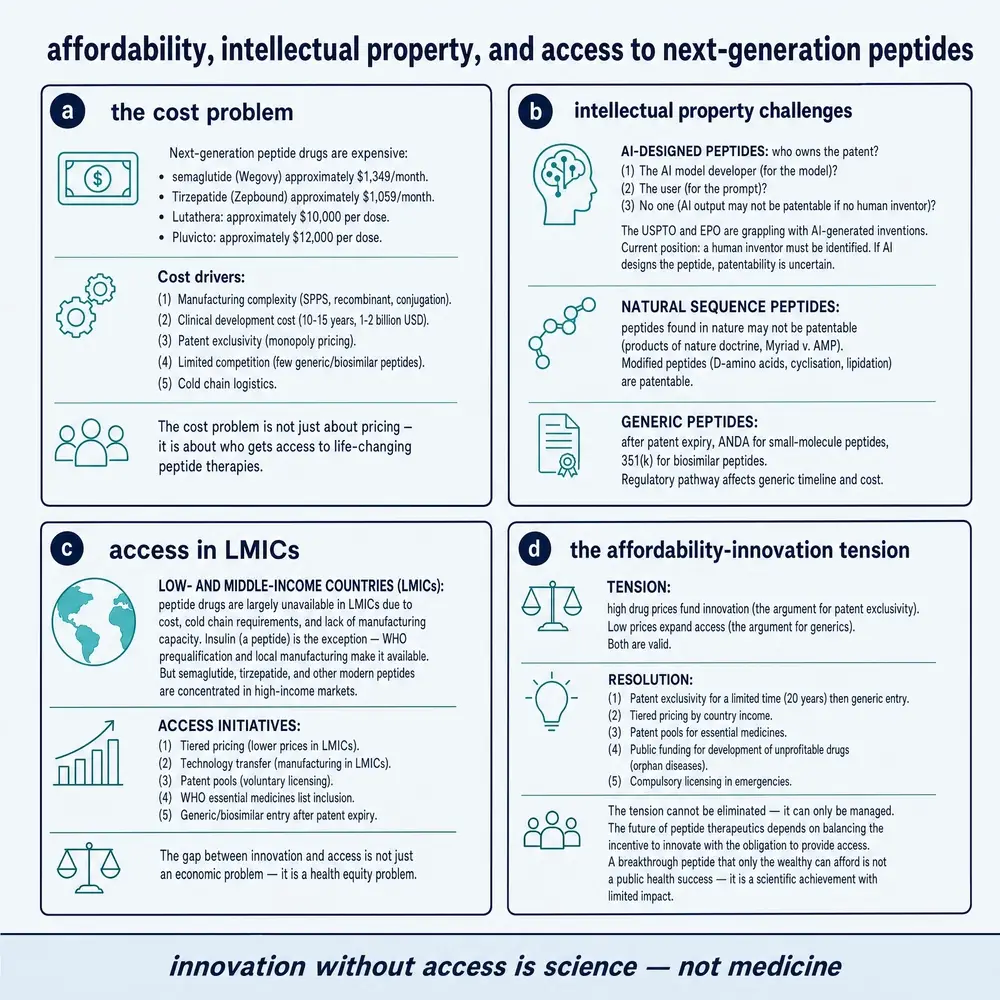
Figure 11 keeps those cost and exclusivity questions visible before the monograph turns to modality convergence. An access failure that pushes patients toward falsified injectables is not a side issue for the next decade; it is one of the ways a technically successful platform can still fail socially.
Section 28Convergence with antibodies, RNA, gene therapy and nanotechnology
Competition is not only scientific. Oral small-molecule agonists, amylin analogues, dual agonists, melanocortin/GLP-1 multiple agonists and regenerative or antibody approaches to muscle and metabolism jointly determine whether a given peptide programme is still worth the CMC burden in 2030.51564 Convergence can raise capability; it can also dissolve the peptide value proposition.
Antibodies still own many extracellular protein–protein contacts where half-life and effector functions dominate; RNA and gene therapies rewrite the source rather than the ligand; nanotechnology promises targeting that chemistry alone cannot buy. Peptides remain strongest where a short, manufacturable ligand must hit a receptor or enzyme with tunable polypharmacology — and weakest where chronic intracellular exposure or cheap daily oral dosing is the real product requirement. Multi-receptor agonists sit inside that contest: they expand what a single injectable can do, while also inviting comparison with antibody and combination regimens that may achieve similar receptor coverage by other means.
CMC and regulatory complexity rise with every added receptor, linker or co-formulated partner. A convergence story that ignores analytical control, immunogenicity surveillance and indication-specific outcome evidence is not a platform strategy; it is a slide deck. Figure 12 places the agonist ladder beside those competing modalities so the contribution — and the non-contribution — of peptides stays explicit.
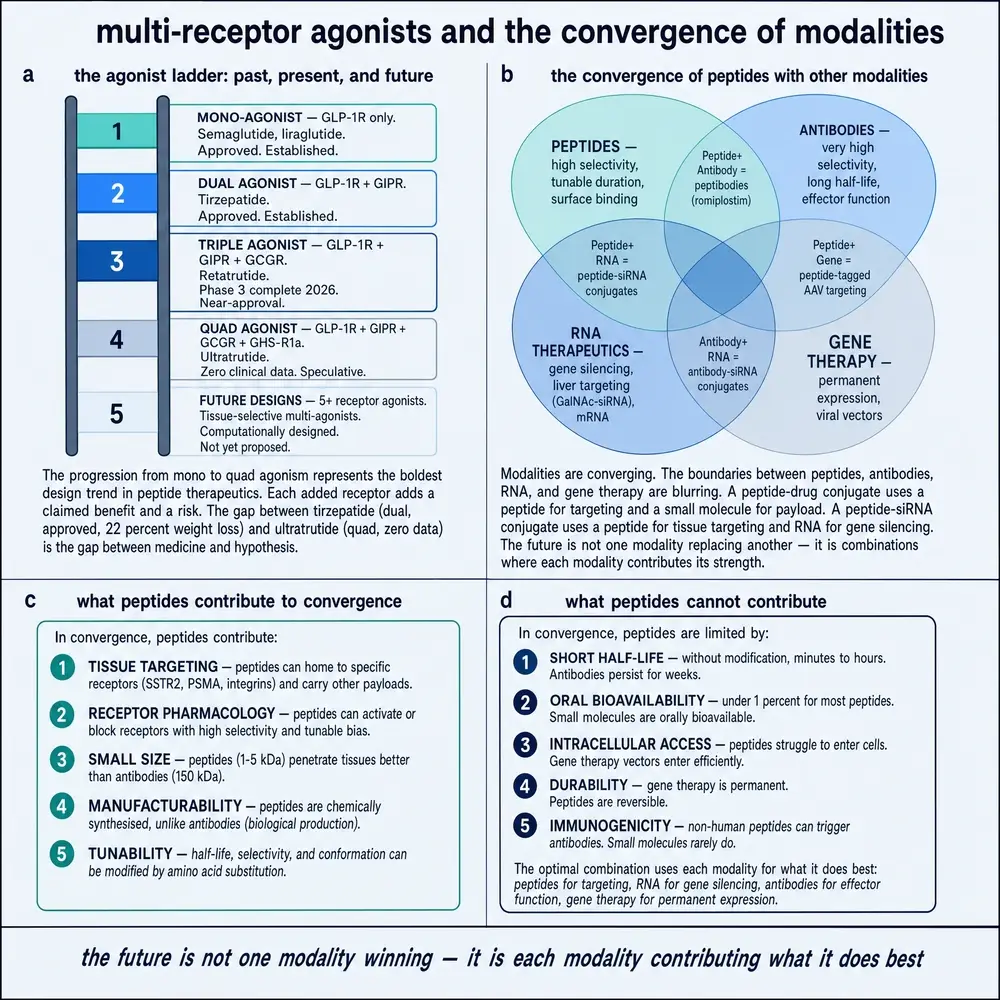
Read that way, convergence is not a victory lap for peptides. It is a reminder that modality competition will decide which peptide programmes still justify their CMC burden once antibodies, RNA, gene therapy and oral small molecules have taken the use-cases they can take more cheaply or more durably.
Section 29Alternative scenarios for the next decade
Forecasts fail when they pretend to be single lines. The next decade is better read as a fan of alternative futures, each already partially evidenced, none entitled to exclusivity.
Scenario A — Hormone-platform consolidation. Multi-agonist, triple-agonist and amylin combinations deepen the metabolic beachhead; delivery innovation is mostly device and depot refinement; oral peptides remain rare exceptions plus a handful of extracellular macrocycle beachheads; intracellular PPI peptides stay niche. This is the highest-continuity scenario given current M1–M2 evidence.405619
Scenario B — Oral and small-molecule displacement. Non-peptide oral agonists capture much of the adherence-sensitive metabolic market; peptides retreat to injectables, radioligands, local gut activation and hard targets. Boundary oral peptides and selected oral macrocycles persist but do not generalise to classical short linear scaffolds.43416
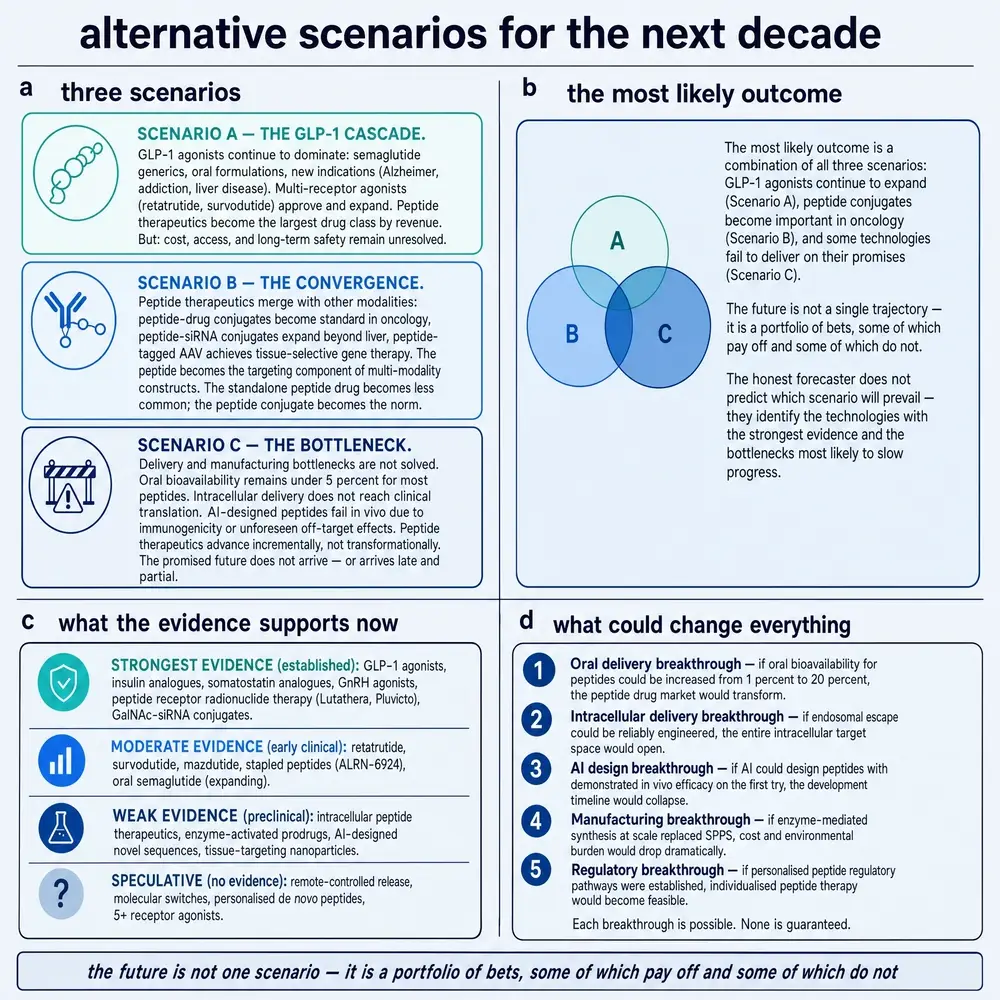
Scenario C — Targeted conjugate and nanoplatform expansion. PDCs, radioligands and receptor-targeted nanoplatforms become a second commercial pillar beside metabolic hormones, especially in oncology and inflammatory local disease. CMC and immunogenicity, not ideas, are the rate limiters; early-stage pipeline counts remain a weak maturity signal.62842
Scenario D — Discovery-tool acceleration with translation lag. PLMs, generative AI peptide design, autonomous labs and structure generators flood the literature with analogues; clinical and manufacturing bottlenecks barely move; the gap between invented and developable widens. Computational success metrics diverge from patient impact.3916
Mixed futures are likelier than pure ones. Figure 13 is the fan, not a single predicted line; the point is to keep any single corporate roadmap from sounding like destiny.
Section 30Bottlenecks and major failure modes (cross-cutting)
Across Parts Two through Five, the same bottlenecks recur:
- Biology edits the message — proteolysis, clearance, endosomal trapping, BBB refusal.
- Pharmacology before formulation — unsuitable half-life/potency/window cannot be rescued by nanoparticles alone.41
- Polypharmacology imbalance — wrong receptor ratios, species mismatches.6354
- CMC and analytics — deletions, aggregates, linkers, multicomponent release.32
- Immunogenicity and surveillance gaps — especially for exotic scaffolds and grey-market products.
- Access and trust — cost, supply, device lock-in, data opacity.
- Automation bias — high-throughput error, unreproducible AI pipelines.
- Modality competition — small molecules, antibodies, RNA may win the use-case.
Section 31What would change the picture
Maturity labels should move when observables move. Examples of upgrades:
- Multiple independent cytosolic PPI stapled/macrocyclic programmes with acceptable therapeutic index beyond ALRN-6924-class early probes → raise intracellular constraint platforms from M4–M5 toward M3.477
- Oral peptide successes outside the long-half-life/high-potency phenotype and outside carefully engineered extracellular macrocycle beachheads, without heroic dose/cost → revise negative-selection strength.416
- Transparent, multi-site closed-loop discoveries that reproduce with held-out assays → raise autonomous DMTA from M4–M5 toward M3.
- Chronic human safety of receptor-targeted nanoplatforms with clear CMC control → raise nano-homing from M3–M4 toward M2.62
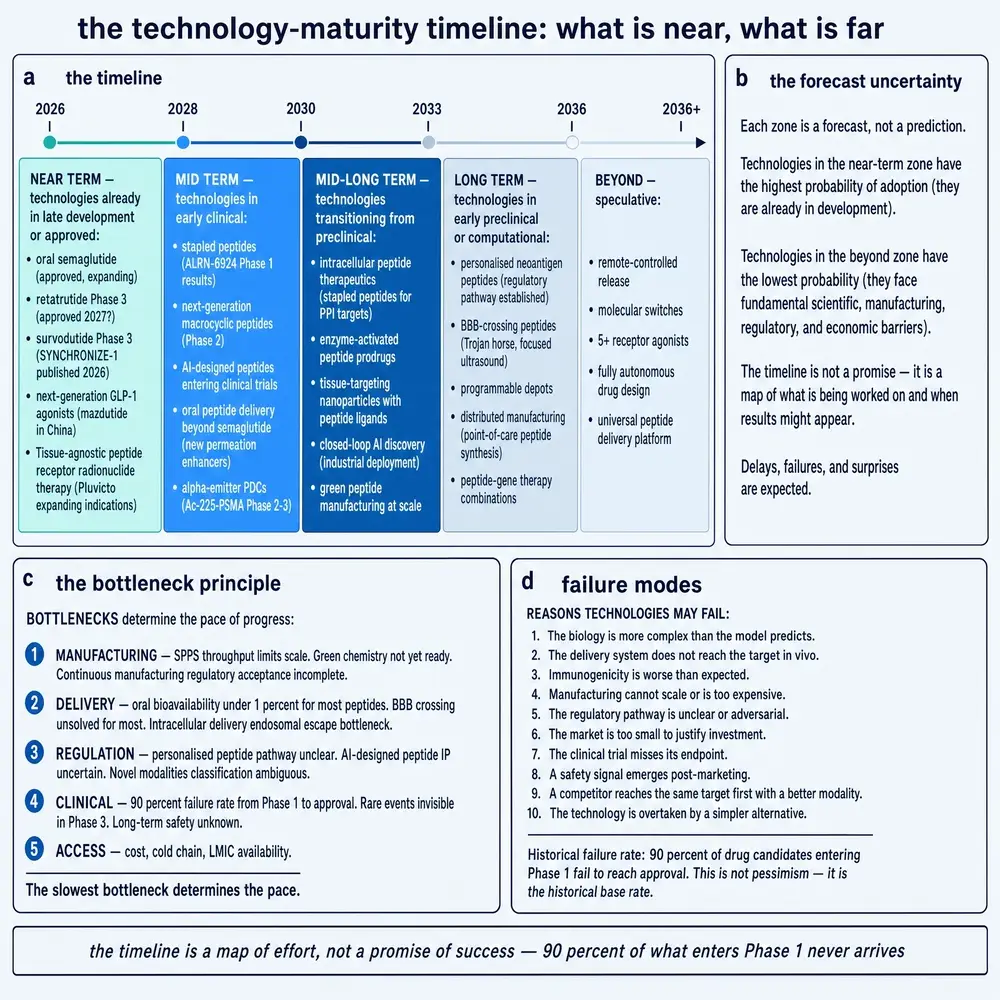
Figure 14 places those upgrade conditions on an illustrative horizon so maturity labels stay tied to observables rather than to year-certain forecasts.
Examples of downgrades:
- Repeated clinical failures of GCGR-inclusive ratios on safety grounds.
- Pharmacovigilance clusters tied to particular engineering motifs.
- Demonstration that generative models systematically propose non-developable sequences while starving negative-result sharing.
- Access failures that shift populations toward falsified injectables faster than legitimate supply expands.
Section 32Closing: a middle language, still provisional
Peptides remain a middle language between chemistry and biology: larger and more informational than most tablets, smaller and often more manufacturable than antibodies, still subject to erasure by the body’s editing machines. The next decade will almost certainly deepen the hormone-platform story already underway — multi-agonists, amylin combinations, cardiorenal evidence, contested oral and device delivery.401 Whether it also delivers general intracellular targeting, routine autonomous invention, or ubiquitous oral peptides is not a matter of rhetoric. It is a matter of evidence accruing against the bottlenecks named above.
This monograph’s job was not to pick winners. It was to keep maturity labels honest, to separate speculation from demonstration, and to remember that adoption is a social technology as much as a molecular one. The language is getting richer. It is still provisional. Figure 15 holds the established, promising and speculative layers in one frame.
This monograph describes published research on peptide technology horizons — targets, designs, discovery tools, delivery systems, manufacturing and social adoption. It weighs demonstrated and translational evidence, labels speculative claims, and prefers recent literature through 5 August 2026 except where a preponderance of older evidence contradicts it. It does not recommend the human use of any compound and specifies no dose, route or schedule for any person. Company roadmaps and unverified pipeline claims are not treated as independent evidence.
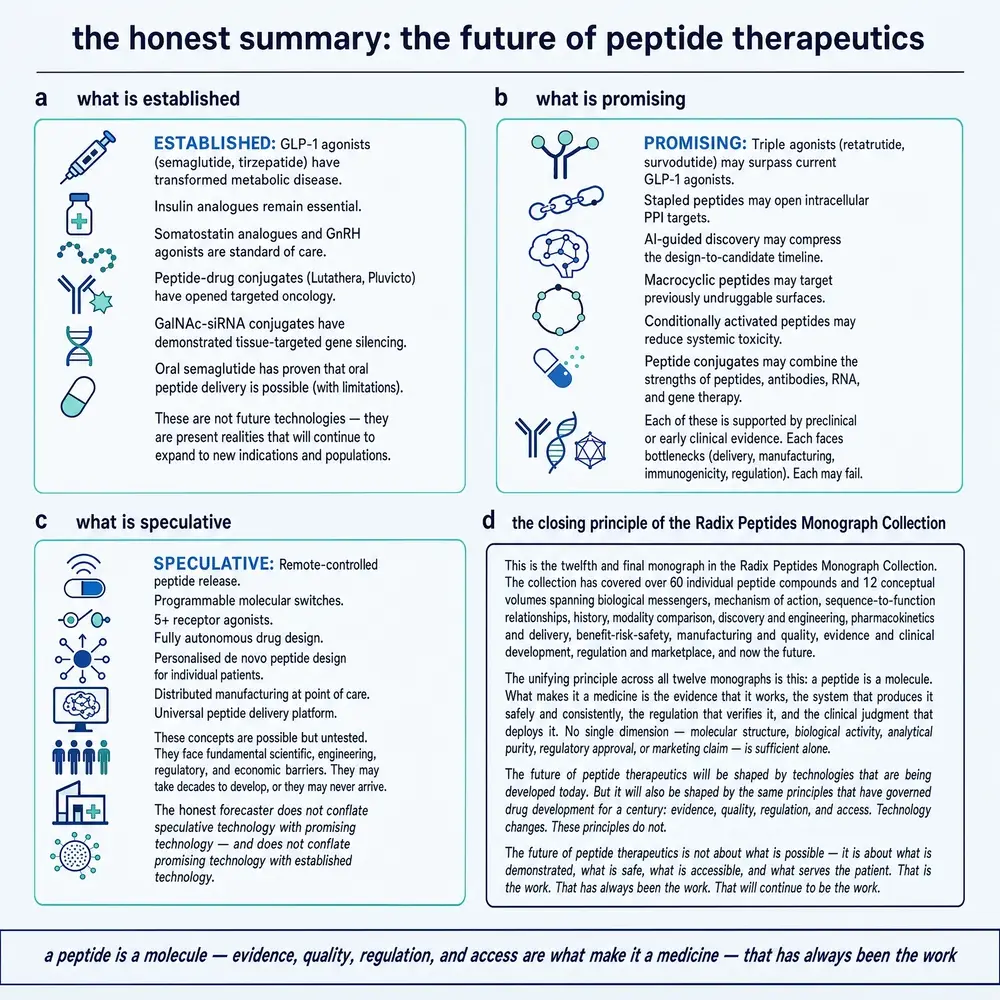
A peptide is a molecule until evidence, quality systems, regulation and access make it a medicine. That is the series principle this closing plate restates.
Section 33Glossary
Active learning. Iterative model-guided selection of the next experiments worth running in a design–make–test cycle.
BBB (blood–brain barrier). The selective endothelial barrier restricting passive entry of many peptides into brain parenchyma.
Conditional activation. Latent peptide or conjugate that becomes active after a local trigger (pH, enzyme, ROS, light, etc.).
CPP (cell-penetrating peptide). Sequence motif used to promote cellular entry of cargo; cytosolic bioavailability remains the hard problem.
DMTA. Design–make–test–analyse discovery cycle.
Dual / multi-agonist. Unimolecular ligand engaging two or more receptors with intentional balance.
Macrocycle / staple. Chemical constraint locking peptide conformation and often altering protease and permeability behaviour.
Maturity level (M1–M6). This monograph’s six-point scale from established and expanding to speculative (Section 03).
PDC. Peptide–drug conjugate: targeting peptide + linker + payload.
Peptidomimetic. Backbone- or side-chain-edited analogue that retains a peptide-like recognition mode.
PLM (protein-language model). Statistical sequence model trained on protein corpora for representation or generation.
SNAC. Salcaprozate sodium; permeation-enhancer component in a boundary oral peptide product phenotype.
SPPS. Solid-phase peptide synthesis.
Therapeutic index. Separation between efficacious exposure and dose-limiting toxicity; for multi-agonists, often receptor-ratio dependent.
Translational gap. Distance between a rodent or in-vitro success and a human developable product, including CMC, immunogenicity and species pharmacology.
Fuller glossary filed at notes/GLOSSARY.md.
Section 34Maturity matrix summary
The table compresses the Part-by-Part maturity calls into a single scan. Labels remain provisional; they move when observables move, not when roadmaps insist.
| Track | Typical maturity | Notes |
|---|---|---|
| Lipidated long-acting agonists | M1 | Expanding indications |
| GIP/GLP-1 dual agonists | M1–M2 | Large human evidence |
| GCGR/GLP-1 duals; amylin analogues | M2–M3 | Ratio and tolerability sensitive |
| SNAC-class oral (boundary) | M2 | Do not generalise casually |
| Classical oral systemic peptides | M4–M5 | Negative selection often correct |
| Targeted nanoplatforms / PDCs | M2–M4 | Niche vs platform gap |
| Conditional conjugates | M3–M5 | Strong rodent, sparse human |
| Intracellular staples / CPP escape | M4–M5 | Chemical biology > platform |
| Assistive AI / structure prediction | M3–M4 | Enabler, not oracle |
| Autonomous clinical invention | M5–M6 | Demo ≠ developability |
| Continuous peptide manufacturing | M3–M4 | Process-specific |
| Patient-level peptide digital twins | M5–M6 | Infrastructure earlier than therapy |
Expanded matrix: notes/MATURITY_CLASSIFICATION_MATRIX.md.
Section 35Speculation register summary
Claims treated as speculative unless upgraded by evidence include: general oral systemic delivery for short peptides; routine cytosolic PPI platforms; fully autonomous clinical candidate invention; ubiquitous BBB nanoparticle therapeutics; distributed sterile peptide manufacturing; patient-specific generative peptide dosing. Factual bases, assumptions and defeaters are listed in notes/SPECULATION_VS_EVIDENCE_REGISTER.md and notes/ASSUMPTIONS_REGISTER.md.
Section 36References
The list below is numbered and sorted by first-author surname. Every entry was resolved from the source record’s own metadata — author, title, journal, year, volume, issue, pages and identifiers — and never from recall. In-text citations are the superscript numbers throughout the document.
- Abbasi M, Sun K, Huggins KW, Heath B, DeLoit H, McGinness L, et al.. Advances in GLP-1 receptor agonists delivery systems for obesity and diabetes. Acta Pharmaceutica Sinica. B. 2026;16(5):2682.
PMID 42180536 · doi:10.1016/j.apsb.2026.01.035 · PMC13198345 - Abdulhameed N, Babin A, Hansen K, Weaver R, Banks WA, Talbot K, et al.. Comparing regional brain uptake of incretin receptor agonists after intranasal delivery in CD-1 mice and the APP/PS1 mouse model of Alzheimer’s disease. Alzheimer's Research & Therapy. 2024;16:173.
PMID 39085976 · doi:10.1186/s13195-024-01537-1 · PMC11293113 - Aljabri AA. Semaglutide in Metabolic Medicine: A Review on Clinical Applications and Emerging Therapeutics. Saudi Medical Journal. 2026;47(4):615.
doi:10.15537/1658-3175.1060 · PMC13227446 - Ashlaw EF, Elfers CT, Chichura KS, Miranda IC, McGivney A, Chepurny OG, et al.. A melanocortin 4- and glucagon-like peptide 1 receptor multiple agonist for the treatment of diabetes and obesity. Metabolism: clinical and experimental. 2025;174:156414.
PMID 41093057 · doi:10.1016/j.metabol.2025.156414 · PMC13286047 - Ballantyne CM, Banka P, Mendez G, Garcia R, Rosenstock J, Rodgers A, et al.. Phase 2b Randomized Trial of the Oral PCSK9 Inhibitor MK-0616. Journal of the American College of Cardiology. 2023;81(16):1553-1564.
PMID 36889610 · doi:10.1016/j.jacc.2023.02.018 - Brayden DJ, Buckley ST, Lewis AL. The fourth controlled release society workshop on oral peptide administration. Frontiers in drug delivery. 2026;6:1860678.
PMID 42306584 · doi:10.3389/fddev.2026.1860678 · PMC13266291 - Chandramohan A, Josien H, Yuen TY, Duggal R, Spiegelberg D, Yan L, et al.. Design-rules for stapled peptides with in vivo activity and their application to Mdm2/X antagonists. Nature communications. 2024;15(1):489.
PMID 38216578 · doi:10.1038/s41467-023-43346-4 · PMC10786919 - Cheng J, Wu P, Li C, Han Y, Sun M, Dou Y, et al.. Inflammation-triggered self-immolative conjugates enable oral peptide delivery by overcoming gastrointestinal barriers. Science Advances. 2026;12(3):eaea2989.
PMID 41533788 · doi:10.1126/sciadv.aea2989 · PMC12802832 - ClinicalTrials.gov. A Study of Enlicitide Decanoate (MK-0616 Oral PCSK9 Inhibitor) in Adults With Hypercholesterolemia (CORALreef Lipids). ClinicalTrials.gov. 2023.
NCT05952856 - Collado Camps E, van Lith SAM, Kip A, Frielink C, Joosten L, Brock R, et al.. Conjugation to a cell-penetrating peptide drives the tumour accumulation of the GLP1R antagonist exendin(9-39). European Journal of Nuclear Medicine and Molecular Imaging. 2022;50(4):996-1004.
PMID 36446951 · doi:10.1007/s00259-022-06041-y · PMC9931918 - Concepción-Zavaleta MJ, Fuentes-Mendoza JM, Gonzáles-Yovera JG, Ruvalcaba-Barbosa GY, Cura-Rodríguez LD, González-Rodríguez JS, et al.. Efficacy and safety of anti-obesity drugs in metabolic dysfunction-associated steatotic liver disease: An updated review. World Journal of Gastroenterology. 2025;31(37):111435.
PMID 41025003 · doi:10.3748/wjg.v31.i37.111435 · PMC12476660 - Dahlgren D, Olander T, Sjöblom M, Hedeland M, Lennernäs H. Effect of paracellular permeation enhancers on intestinal permeability of two peptide drugs, enalaprilat and hexarelin, in rats. Acta Pharmaceutica Sinica. B. 2021;11(6):1667.
PMID 34221875 · doi:10.1016/j.apsb.2020.12.019 · PMC8245904 - Dahshan A, Khalil MIM, El-Jaafary SI, Al Yamani A. Glucagon-like peptide-1 receptor agonists in movement disorders: From Parkinson's disease to the broader spectrum — Mechanisms, evidence, and future directions. Clinical Parkinsonism & Related Disorders. 2026;15:100461.
PMID 42328044 · doi:10.1016/j.prdoa.2026.100461 · PMC13279746 - Dong W, Bai J, Yuan Q, Zhang Y, Zhang Y, Zhang Z, et al.. Mazdutide, a dual agonist targeting GLP-1R and GCGR, mitigates diabetes-associated cognitive dysfunction: mechanistic insights from multi-omics analysis. eBioMedicine. 2025;117:105791.
PMID 40479843 · doi:10.1016/j.ebiom.2025.105791 · PMC12205698 - Du H, Trinh TKH, Brandon OC, Zheng R, Wang H, Corry K, et al.. Nicotinamide-Loaded Peptoid Nanotubes for Energy Regeneration in Acute Brain Injury. ACS Nano. 2026;20(16):12250.
PMID 41973499 · doi:10.1021/acsnano.5c19897 · PMC13131050 - Ekambaram S, Dokholyan NV. Peptide-based drug design using generative AI. Chemical communications (Cambridge, England). 2026;62(3):672-691.
PMID 41376388 · doi:10.1039/d5cc04998a · PMC13060724 - Ferri N, Marodin G. Emerging oral therapeutic strategies for inhibiting PCSK9. Atherosclerosis plus. 2025;59:25-31.
PMID 39802651 · doi:10.1016/j.athplu.2024.11.003 · PMC11722601 - Fischer Munch H, Just R, Mosolff Mathiesen J, Eriksson P, Skodborg Villadsen J, Vestergaard B, et al.. Development of Petrelintide: a Potent, Stable, Long-Acting Human Amylin Analogue. Journal of Medicinal Chemistry. 2025;68(22):23925-23940.
PMID 41217931 · doi:10.1021/acs.jmedchem.5c01185 · PMC12670398 - Goldney J, Hamza M, Surti F, Davies MJ, Papamargaritis D. Triple Agonism Based Therapies for Obesity. Current cardiovascular risk reports. 2025;19(1):18.
PMID 40741227 · doi:10.1007/s12170-025-00770-z · PMC12304053 - Gudasheva TA, Ostrovskaya RU, Seredenin SB. Novel Technologies for Dipeptide Drugs Design and their Implantation. Current Pharmaceutical Design. 2018;24(26):3020-3027.
PMID 30295186 · doi:10.2174/1381612824666181008105641 · PMC6302556 - Guerlavais V, Sawyer TK, Carvajal L, Chang YS, Graves B, Ren JG, et al.. Discovery of Sulanemadlin (ALRN-6924), the First Cell-Permeating, Stabilized α-Helical Peptide in Clinical Development. Journal of medicinal chemistry. 2023;66(14):9401-9417.
PMID 37439511 · doi:10.1021/acs.jmedchem.3c00623 - Gutgesell RM, Nogueiras R, Tschöp MH, Müller TD. Dual and Triple Incretin-Based Co-agonists: Novel Therapeutics for Obesity and Diabetes. Diabetes therapy : research, treatment and education of diabetes and related disorders. 2024;15(5):1069-1084.
PMID 38573467 · doi:10.1007/s13300-024-01566-x · PMC11043266 - Herman JL, Dornbos P, Landheer K, Geraghty BJ, Egerman MA, Phan D, et al.. Humans with function-disrupting variants in the myostatin gene (MSTN) have increased skeletal muscle mass and strength, and less adiposity. Nature Communications. 2026;17:3891.
PMID 41826329 · doi:10.1038/s41467-026-70422-2 · PMC13125550 - Hu X, Guo L, Ding Y, Nie S, Fang J, Li J, et al.. Self-assembling peptide inspired by insulin and type 1 insulin-like growth factor for the treatment of androgenetic alopecia. Bioactive Materials. 2025;53:819.
PMID 40822304 · doi:10.1016/j.bioactmat.2025.08.004 · PMC12354804 - Hölscher C. Incretin Hormones GLP-1 and GIP Normalize Energy Utilization and Reduce Inflammation in the Brain in Alzheimer’s Disease and Parkinson’s Disease: From Repurposed GLP-1 Receptor Agonists to Novel Dual GLP-1/GIP Receptor Agonists as Potential Disease-Modifying Therapies. CNS Drugs. 2025;39(12):1201.
PMID 40938528 · doi:10.1007/s40263-025-01226-z · PMC12602575 - Jeong J, Han C, Kang J, Kim D, Park C. Morphology-driven zinc oxide biointeractive carriers with biological barrier modulating effects for pulmonary delivery of liraglutide. Journal of Nanobiotechnology. 2026;24:446.
PMID 41622258 · doi:10.1186/s12951-026-04085-y · PMC13200438 - Jorge LR, Harada LK, Silva EC, Campos WF, Moreli FC, Shimamoto G, et al.. Non-invasive Transdermal Delivery of Human Insulin Using Ionic Liquids: In vitro Studies. Frontiers in Pharmacology. 2020;11:243.
PMID 32390824 · doi:10.3389/fphar.2020.00243 · PMC7191306 - Kashani M, Ninan J, Wei L, Cheungpasitporn W, Lal A, Gajic O, et al.. International Delphi consensus on acute kidney injury: Foundations for AI-driven digital twin development in critical care nephrology. PLOS One. 2026;21(3):e0344991.
PMID 41880297 · doi:10.1371/journal.pone.0344991 · PMC13016343 - Keam SJ. Icotrokinra: First Approval. Drugs. 2026;86(8):1401-1407.
PMID 42243571 · doi:10.1007/s40265-026-02340-y - Khalil A, Velikyan I, Xiong M, Bossart M, Wagner M, Eriksson O. Positron emission tomography to assess drug occupancy at peripheral and central incretin receptors. eBioMedicine. 2025;122:106033.
PMID 41274021 · doi:10.1016/j.ebiom.2025.106033 · PMC12682123 - Kim KH. Intranasal delivery of mitochondrial protein humanin rescues cell death and promotes mitochondrial function in Parkinson's disease. Theranostics. 2023;13(10):3330.
PMID 37351170 · doi:10.7150/thno.84165 · PMC10283052 - Kuo S, Xi Z, Cong X, Yan X, Russell DH. Dissecting Hidden Liraglutide Oligomerization Pathways via Direct Mass Technology, Electron-Capture Dissociation, and Molecular Dynamics. Analytical Chemistry. 2025;97(25):13465.
PMID 40521838 · doi:10.1021/acs.analchem.5c01851 · PMC12224166 - Kushner JA, Pandey M, Kohli SSS. Biomarker integration and biosensor technologies enabling AI-driven insights into biological aging. Frontiers in Aging. 2025;6:1703698.
PMID 41281356 · doi:10.3389/fragi.2025.1703698 · PMC12635586 - Lee JJ, Bajgain P, Lightner AL. GLP-1 and GLP-2 as intestinal reparative therapies in inflammatory bowel disease: mechanisms, translation, and clinical opportunity. Frontiers in Gastroenterology. 2026;5:1790420.
PMID 42231903 · doi:10.3389/fgstr.2026.1790420 · PMC13222807 - Lee YI, Kim W, Roh H, Min A, Jung J, Choi H, et al.. A novel cell-penetrating peptide supports hair follicle growth through anti-inflammatory and growth factor–associated mechanisms in preclinical models. BMC Biotechnology. 2026;26:63.
PMID 41975396 · doi:10.1186/s12896-026-01130-4 · PMC13159305 - Li X, Chen Z, Zhang Y, Fan C, Chen L, Xu X, et al.. Research progress on multidimensional intervention strategies for hyperuricemia: Western medicine, Traditional Chinese Medicine, and emerging therapies. Frontiers in Endocrinology. 2025;16:1722245.
PMID 41488145 · doi:10.3389/fendo.2025.1722245 · PMC12757217 - Liu T, Liu Y, Zhao X, Zhang L, Wang W, Bai D, et al.. Thermodynamically stable ionic liquid microemulsions pioneer pathways for topical delivery and peptide application. Bioactive Materials. 2023;32:502.
PMID 38026438 · doi:10.1016/j.bioactmat.2023.10.002 · PMC10643103 - Mancl JM, Liang WG, Bayhi NL, Wei H, Budell WC, Mendez JH, et al.. Characterization and modulation of human insulin degrading enzyme conformational dynamics to control enzyme activity. eLife. 2026;14:RP105761.
PMID 42253225 · doi:10.7554/eLife.105761 · PMC13246006 - Mendel HC, Hopping G, Undheim EAB, Zuegg J, Lewis RJ, Forbes BE, et al.. PeptideMiner—neuropeptide discovery across the animal kingdom. GigaScience. 2025;14:giaf078.
PMID 40796375 · doi:10.1093/gigascience/giaf078 · PMC12343078 - Miramontes-González JP, Rodrigo-Alaíz Á, Gabella-Martín M, González-Calle D, Carretero-Gómez J, Corral-Gudino L. Rewriting Diabetes Therapy: How Incretin Modulation is Transforming Cardiovascular and Renal Outcomes. Diabetes Therapy. 2026;17(3):317-330.
PMID 41489681 · doi:10.1007/s13300-025-01829-1 · PMC13000015 - Niazi SK. Oral delivery of peptides and proteins: pharmacokinetic boundaries, negative selection, and route triage. Frontiers in Drug Delivery. 2026;6:1776167.
PMID 41939723 · doi:10.3389/fddev.2026.1776167 · PMC13047097 - Nsereko Y, Armstrong A, Coburn F, Al Musaimi O. Innovative Peptide Therapeutics in the Pipeline: Transforming Cancer Detection and Treatment. International journal of molecular sciences. 2025;26(14):6815.
PMID 40725089 · doi:10.3390/ijms26146815 · PMC12295999 - Patel D, Muacevic A, Adler JR. Small-Molecule Oral Versus Injectable Glucagon-Like Peptide-1 (GLP-1) Receptor Agonists: Comparative Efficacy, Safety, and Future Clinical Perspectives. Cureus. 2026;18(4):e107202.
PMID 42153087 · doi:10.7759/cureus.107202 · PMC13180026 - Prischich D, Sortino R, Gomila-Juaneda A, Matera C, Guardiola S, Nepomuceno D, et al.. In vivo photocontrol of orexin receptors with a nanomolar light-regulated analogue of orexin-B. Cellular and Molecular Life Sciences: CMLS. 2024;81(1):288.
PMID 38970689 · doi:10.1007/s00018-024-05308-x · PMC11335211 - Qian K, Yang P, Li Y, Meng R, Cheng Y, Zhou L, et al.. Rational fusion design inspired by cell-penetrating peptide: SS31/S-14 G Humanin hybrid peptide with amplified multimodal efficacy and bio-permeability for the treatment of Alzheimer's disease. Asian Journal of Pharmaceutical Sciences. 2024;19(4):100938.
PMID 39253611 · doi:10.1016/j.ajps.2024.100938 · PMC11382307 - Rong G, Fan Q, Chen K, Cheng Y, Hu J. Fluorous oligoarginines as supra-enhancers for intracellular and transdermal peptide delivery. Bioactive Materials. 2025;59:305.
PMID 41551769 · doi:10.1016/j.bioactmat.2025.12.027 · PMC12804165 - Saleh MN, Patel MR, Bauer TM, Goel S, Falchook GS, Shapiro GI, et al.. Phase 1 Trial of ALRN-6924, a Dual Inhibitor of MDMX and MDM2, in Patients with Solid Tumors and Lymphomas Bearing Wild-type TP53. Clinical cancer research : an official journal of the American Association for Cancer Research. 2021;27(19):5236-5247.
PMID 34301750 · doi:10.1158/1078-0432.ccr-21-0715 · PMC9401461 - Shaji J, Patole V. Protein and Peptide Drug Delivery: Oral Approaches. Indian Journal of Pharmaceutical Sciences. 2008;70(3):269.
PMID 20046732 · doi:10.4103/0250-474X.42967 · PMC2792531 - Shin HJ, Bak SU, La HN, Kang JS, Lee HH, Eom HJ, et al.. Efficient transdermal delivery of functional protein cargoes by a hydrophobic peptide MTD 1067. Scientific Reports. 2022;12:10853.
PMID 35760980 · doi:10.1038/s41598-022-14463-9 · PMC9237094 - Siddiqui Z, Frishman W. New Oral PCSK9 Inhibitor: "MK-0616". Cardiology in review. 2025;33(6):573-577.
PMID 38285643 · doi:10.1097/crd.0000000000000655 - Sidrak WR, Kalra S, Kalhan A. Approved and Emerging Hormone-Based Anti-Obesity Medications: A Review Article. Indian Journal of Endocrinology and Metabolism. 2024;28(5):445.
PMID 39676791 · doi:10.4103/ijem.ijem_442_23 · PMC11642516 - Singh A, Shadangi S, Rana S. A rationally designed 18-amino acid peptide with potential as GLP-1 receptor agonist. Frontiers in Pharmacology. 2026;17:1789257.
PMID 42244872 · doi:10.3389/fphar.2026.1789257 · PMC13229714 - Songok AC, Panta P, Doerrler WT, Macnaughtan MA, Taylor CM, Silman I. Structural modification of the tripeptide KPV by reductive “glycoalkylation” of the lysine residue. PLoS ONE. 2018;13(6):e0199686.
PMID 29953505 · doi:10.1371/journal.pone.0199686 · PMC6023233 - Sonne N, Roque M, Zachariassen LF, Porsgaard T, Pors SE, Cavalera M, et al.. Generation and characterisation of a humanised GLP-1 receptor mouse model for translational drug development. eBioMedicine. 2026;124:106121.
PMID 41547115 · doi:10.1016/j.ebiom.2026.106121 · PMC12855590 - Vitek M, Zvonar Pobirk A, Roškar R, Matjaž MG. Exploiting the potential of in situ forming liquid crystals: development and in vitro performance of long-acting depots for peptide drug thymosin alpha 1 subcutaneous administration. Drug Delivery. 2025;32(1):2460708.
PMID 40066714 · doi:10.1080/10717544.2025.2460708 · PMC11899226 - Volčanšek Š, Koceva A, Jensterle M, Janež A, Muzurović E. Amylin: From Mode of Action to Future Clinical Potential in Diabetes and Obesity. Diabetes Therapy. 2025;16(6):1207.
PMID 40332747 · doi:10.1007/s13300-025-01733-8 · PMC12085449 - Wu S, Liu C, Li Y, Zhang X, Han Q, Zhao H, et al.. Inhibitory mechanisms of amentoflavone on amyloid-β peptide aggregation revealed by replica exchange molecular dynamics. Scientific Reports. 2025;15:24352.
PMID 40628933 · doi:10.1038/s41598-025-10623-9 · PMC12238462 - Yakobi SH, Nwodo UU. Structural and mechanistic divergence in LL-37, HNP-1, and Magainin-2: An integrated computational and biophysical analysis. Current Research in Structural Biology. 2025;10:100176.
PMID 41376844 · doi:10.1016/j.crstbi.2025.100176 · PMC12686798 - Yang M, Jia M, Cai M, Feng X, Huang L, Yang J. Central neuropeptides as key modulators of astrocyte function in neurodegenerative and neuropsychiatric disorders. Psychopharmacology. 2025;242(11):2353.
PMID 40536717 · doi:10.1007/s00213-025-06840-9 · PMC12578712 - Ye T, Wu C, Fan Y, Xia H, Li Z, Deng J, et al.. Engineered collagen XVII-loaded dissolving microneedle patch for promoting hair regrowth in androgenic alopecia. Regenerative Biomaterials. 2025;12:rbaf104.
PMID 41377685 · doi:10.1093/rb/rbaf104 · PMC12688376 - Yu J, Shen M, He T. The neuropeptide in ischemic brain injury: insights, challenges, and horizon of targeted interventions. Journal of Translational Medicine. 2026;24:366.
PMID 41664200 · doi:10.1186/s12967-026-07801-2 · PMC12983573 - Zeng J, Tang X, Qin D, Yu L, Zhou X, Feng C, et al.. Engineered GLP-1R-targeting nanoplatforms: multimodal therapeutics in human diseases. Journal of Nanobiotechnology. 2025;23:682.
PMID 41088364 · doi:10.1186/s12951-025-03677-4 · PMC12522959 - Zimmermann T, Thomas L, Baader-Pagler T, Haebel P, Simon E, Reindl W, et al.. BI 456906: Discovery and preclinical pharmacology of a novel GCGR/GLP-1R dual agonist with robust anti-obesity efficacy. Molecular Metabolism. 2022;66:101633.
PMID 36356832 · doi:10.1016/j.molmet.2022.101633 · PMC9679702 - Özbay B, Jülke E, List M, Nowicki M, Els-Heindl S, Immig K, et al.. Modulating food intake by nasal application of peptides targeting melanocortin 4 receptor and ghrelin receptor systems. Brain Communications. 2026;8(1):fcaf450.
PMID 41574088 · doi:10.1093/braincomms/fcaf450 · PMC12820429
Section 37Evidence handling
Study type is labelled at the point of use. Recency through 4 August 2026 is preferred but not blindly: a newer high-quality study is weighted above an older narrative when methods are sound, yet a preponderance of contradictory evidence still wins. Null and negative delivery results are first-class citizens. Company roadmaps are not independent evidence. No numerical adoption forecast was invented. No human use, dose, route or schedule is recommended anywhere in this document.
Continue exploring