
Peptide Purity vs Sterility
Chemical purity, microbiological sterility, and freedom from bacterial endotoxin are three separate guarantees, established by three different tests. A number on one axis is silent on the other two — which is why a 99% pure powder can still be non-sterile and pyrogenic.
Abstract
Buyers of research peptides routinely read a single number — a purity percentage on a certificate of analysis — as a verdict on quality. It is not. Chemical purity, microbiological sterility, and bacterial endotoxin are three independent properties of a vial, each established by a different test: purity as an area percent by HPLC with identity confirmed by mass spectrometry; sterility, the absence of viable microorganisms, by the compendial method of USP General Chapter <71>; and endotoxin, a fever-inducing fragment of Gram-negative bacterial cell wall, by the Bacterial Endotoxins Test of USP <85>. Because the axes are independent, a 99% pure powder can be non-sterile and pyrogenic, and — because endotoxin is heat-stable and survives sterilization — even a sterilized preparation can still carry toxin. The piece then draws the distinction that matters for material sold 'not for human use': a sterile injectable is manufactured, filled, and released under a specific pharmaceutical regime — terminal sterilization or aseptic processing, environmental monitoring, container-closure integrity, depyrogenation, validated batch release — that a research-use-only powder never enters. A purity figure characterizes a chemical; it does not make a vial safe or lawful to inject. Educational; no dosing or medical advice.
Key findings
- Chemical purity, microbiological sterility, and bacterial endotoxin are three independent properties, each measured by its own method — purity by HPLC area percent with identity by mass spectrometry, sterility by USP <71>, endotoxin by USP <85> — so a result on one axis carries no information about the other two (McCarthy et al., 2023; USP <71>; USP <85>).
- A 99% pure peptide powder can still be non-sterile and pyrogenic: the chromatographic method that measured purity never tested for living microbes or for bacterial toxin (McCarthy et al., 2023; Schneier et al., 2020).
- Endotoxin — lipopolysaccharide shed from the outer wall of Gram-negative bacteria — is heat-stable and survives ordinary sterilization, so killing the organisms does not remove the toxin; depyrogenation is a separate, more demanding process than sterilization (Miyamoto et al., 2009; Schneier et al., 2020; USP <1228>).
- Sterility is a process guarantee, not something a purity number can imply: a sterile injectable is made by terminal sterilization or aseptic processing under environmental monitoring, container-closure integrity, and validated batch release — not certified after the fact by a small end-product sterility test (FDA aseptic-processing guidance; 21 CFR 211.113; USP <1207>).
- Research-use-only peptide powder is chemically characterized, not pharmaceutically released: a certificate of analysis purity figure does not make a vial sterile, non-pyrogenic, safe, or lawful to inject, and 'research use only' is a labeling status, not a grade of quality (Operation Supplement Safety; 21 CFR 211.113).
- The formal 'Research Use Only' rule buyers sometimes cite (21 CFR 809.10; FDA's 2013 RUO/IUO guidance) governs in-vitro diagnostic products, not research-chemical peptides, and is not a quality or safety standard for a peptide vial (21 CFR 809.10; FDA RUO/IUO guidance, 2013).
- Methodology
- Every analytical and regulatory claim was verified against a primary or authoritative source: United States Pharmacopeia general chapters (<71>, <85>, <1207>, <1228>), FDA aseptic-processing and research-use-only guidance, the U.S. Code of Federal Regulations, and peer-reviewed analytical and microbiological literature retrieved from PubMed with DOIs preserved. The independence of the three axes is a reasoned entailment of individually verified sources, labelled as such. No product data, dose, route, or schedule appears, and no preparation or administration method is described. Evidence cutoff August 2026.
"Pure" and "sterile" sound like two words for the same reassurance. They are not. Chemical purity, microbiological sterility, and freedom from bacterial endotoxin are three different guarantees about a vial, each established by a different test, and each can hold while the others fail. A peptide powder can be 99% pure by the instrument that measures purity and, in the same moment, be teeming with bacteria and carrying a fever-inducing toxin — because the method that read the purity never looked for either. Purity says nothing about sterility, and sterility says nothing about endotoxin.
That is the whole of this explainer, and it is the close companion to South Beach Longevity's walk-through of what a peptide certificate of analysis actually tells you. Where that piece reads the document line by line, this one separates the three promises the document's lines are silent about, and explains why a research-use-only chemical — however clean its purity number — is not a medicine. For the chemistry underneath, see what a peptide is.
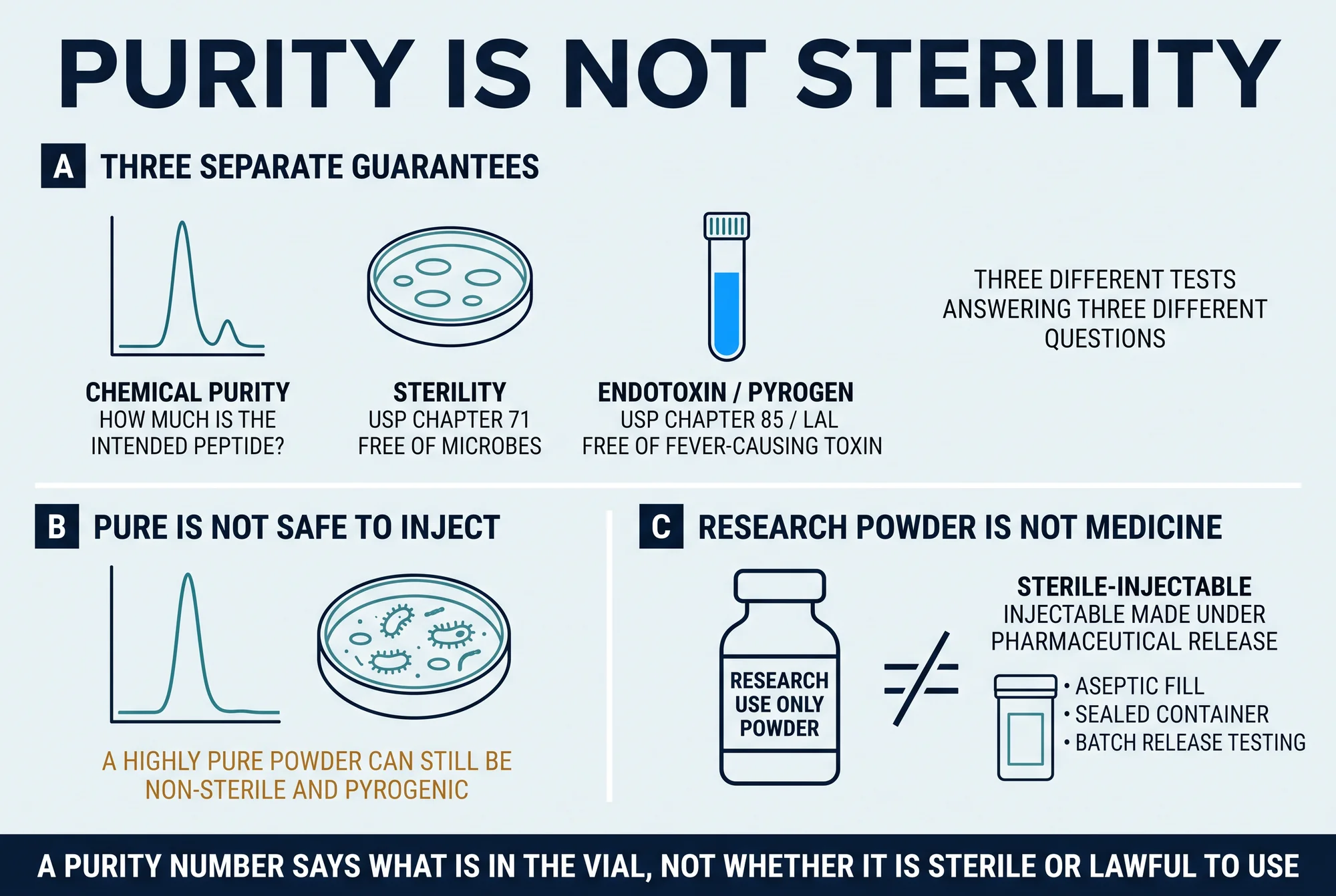
Three questions, three tests
A useful way to hold this is that a vial can be interrogated along three separate axes, and each has its own instrument. Confusing them is the single most common error a buyer makes when reading a research-peptide certificate.
Chemical purity: what fraction is the intended peptide?
Purity is a statement about composition. The standard method is reversed-phase high-performance liquid chromatography — HPLC — which separates the components of a sample by how strongly they cling to a column and reports each as a percentage of the total ultraviolet-absorbing material the detector saw; identity, the separate question of whether the main peak is the molecule it should be, is established by mass spectrometry (McCarthy et al., 2023). Together these answer a chemical question and only a chemical question: is this the right molecule, and what fraction of the detected material is it?
What matters here is the boundary of the method. HPLC and mass spectrometry are analytical-chemistry techniques, performed on a dissolved sample in a laboratory instrument that detects molecules by their chemistry. Nothing in either method tests whether the powder contains living bacteria or fungal spores, and nothing in either detects a bacterial toxin unless it is specifically sought. A purity result, however high, is a measurement on the chemical axis alone (McCarthy et al., 2023).
Sterility: is anything alive in the container?
Sterility is a statement about biology — the absence of viable microorganisms. It is tested by a compendial method, the United States Pharmacopeia's General Chapter <71>, Sterility Tests, which incubates the product (or the material caught on a filter through which the product has passed) in growth media and watches for microbial growth (USP <71>). It is a microbiological test, wholly unrelated to any chemical measurement, and it is run on the finished, filled container rather than on a chemical characterization of the bulk material.
Sterility also carries a hard limit that matters later: the test examines only a sample of a batch, and a negative result on a few units cannot by itself prove the whole batch — still less your individual vial — is sterile. FDA's guidance on aseptic processing states the point directly, noting that sterility tests are "limited in their ability to detect contamination because of the small sample size typically used," and locating real sterility assurance in the manufacturing process rather than in end-product testing (FDA aseptic-processing guidance). Sterility, in other words, is something built into a product during manufacture and confirmed by controls — not a property that a purity number, or even a single passing sterility line, can stand in for.
Endotoxin and pyrogenicity: is there bacterial toxin, even with nothing alive?
The third axis is the one most often missed, because it can fail even when the second passes. Endotoxin is lipopolysaccharide — a large molecule from the outer membrane of Gram-negative bacteria that is released when the cell dies and is a principal cause of the pyrogenic, or fever-producing, reaction to contaminated injectable products (Schneier et al., 2020). It is a chemical fragment of a dead organism, not a living thing, so a preparation can contain no viable microbes at all and still carry enough endotoxin to cause fever, chills, and inflammation on injection.
Endotoxin is measured by its own assay, the Bacterial Endotoxins Test of USP General Chapter <85>, historically using Limulus amebocyte lysate from horseshoe-crab blood and increasingly an animal-free recombinant reagent, reporting a level in endotoxin units against a defined limit (Tindall et al., 2021; USP <85>). And it is strikingly durable. Endotoxin is heat-stable: it resists the conditions that kill microbes, so that removing it — "depyrogenation" — is a separate and more demanding process than sterilization, classically requiring dry heat on the order of 250 °C, far above ordinary sterilizing temperatures (Miyamoto et al., 2009; USP <1228>). Killing the bacteria does not destroy the toxin they have already shed. That single fact is why sterility and endotoxin are different guarantees.
Why the three axes don't talk to each other
Put the three together and the central point follows on its own. A method on one axis carries no information about another, because each was designed to answer a different question on a different kind of sample (McCarthy et al., 2023; USP <71>; USP <85>).
The consequence, stated bluntly: a 99% pure powder can still be non-sterile and pyrogenic. The HPLC that measured the purity tested for neither microbes nor toxin, and a bulk powder is typically not filled or tested as a sterile product at all. Purity is high, sterility is untested, endotoxin is untested — three separate verdicts, only one of them rendered (McCarthy et al., 2023; Schneier et al., 2020). The reverse holds too: a preparation can be sterile and still be the wrong molecule, underfilled, or — because endotoxin survives the process that confers sterility — pyrogenic despite passing a sterility test (Miyamoto et al., 2009). "Pure," "sterile," and "pyrogen-free" are three different clean bills of health, and each is silent about the other two.
This is a reasoned entailment rather than a single citation: each half — that purity is a chemical measurement, that sterility and endotoxin are separate microbiological and toxicological ones — is individually verified, and the independence follows from setting them side by side. It is also analytically uncontroversial. It is simply not how a purity figure is usually read.
From chemical characterization to pharmaceutical release
The deeper reason the axes matter is that a sterile injectable medicine is not a pure powder that someone later declared clean. It is a product manufactured, filled, and released under a specific and demanding regime — and that regime, not a certificate's purity line, is what makes an injectable sterile and non-pyrogenic.
Under pharmaceutical good-manufacturing-practice rules, a drug "purporting to be sterile" must be made under written procedures designed to prevent microbiological contamination, including validation of all sterilization and aseptic processes (21 CFR 211.113). In practice a product reaches sterility one of two ways. The preferred route, where the product can tolerate it, is terminal sterilization: the drug is sealed in its final container and then subjected to a lethal process such as heat or radiation, so the sealed unit itself is sterilized. Where that is not feasible, the product is made by aseptic processing — the drug, container, and closure are sterilized separately and then assembled in a rigorously controlled environment, with no sterilizing step after assembly, so sterility depends entirely on keeping contamination out (FDA aseptic-processing guidance). Aseptic processing is treated as the harder, fallback route precisely because nothing downstream can rescue it.
Around either route sits a system of controls that has no analogue on a bulk-chemical certificate: continuous environmental monitoring of the air, surfaces, and personnel in the fill area; verified container-closure integrity, so the sealed package maintains its sterile barrier across shelf life (USP <1207>); endotoxin control and, where needed, depyrogenation of components (USP <1228>); and formal batch release against a finished-product specification. Sterility and freedom from pyrogens are outcomes of this whole apparatus. They cannot be reconstructed backward from a purity assay run on a dissolved sample of the powder.
This is the difference between chemical characterization and pharmaceutical release. Characterizing a peptide — establishing its identity, its purity, its net content — is real and valuable analytical work, and it is what a good certificate of analysis reports (McCarthy et al., 2023; Elsayed et al., 2025). But characterization describes what a molecule is. Release certifies that a finished, filled unit was made and controlled to be safe to administer. A research-use-only powder receives the first and, by definition, not the second.
Why this matters for "research use only" material
Most peptides sold outside a pharmacy are offered "for research use only" or "not for human consumption," accompanied by a certificate of analysis showing a purity percentage. The structural point of this explainer is that the purity number and the safety of injection sit on different axes, and the certificate speaks only to the first.
A research-use-only vial is, in the ordinary case, a bulk chemical: characterized for identity and purity, but not manufactured as a sterile injectable, not filled under environmental monitoring, not endotoxin-controlled to an injectable limit, and not released against a finished-product specification. Its purity line can be entirely genuine and still say nothing about whether the contents are sterile, pyrogen-free, or lawful to put in a body. The U.S. Department of Defense's Operation Supplement Safety states the general case for one widely sold peptide: such products are unapproved drugs, commonly labeled "research use only," and that label "is not a statement of safety, purity, or quality" (Operation Supplement Safety). A clean certificate does not change a product's regulatory status, and it does not perform the manufacturing controls the product never underwent.
One clarification heads off a common error, and it is the same one the certificate-of-analysis companion flags. Buyers sometimes point to the formal federal "Research Use Only" clause as though it were a quality tier. That clause — 21 CFR 809.10, elaborated in FDA's 2013 guidance on the distribution of in-vitro diagnostic products labeled for research or investigational use — governs in-vitro diagnostic products, the laboratory kits used to test specimens, and it exists to stop unproven diagnostics being used clinically (21 CFR 809.10; FDA RUO/IUO guidance, 2013). It is not a manufacturing or safety standard for a research-chemical peptide, and it says nothing about sterility, endotoxin, or purity. The peptide market's "research use only" wording runs its legal course through intended-use doctrine under the Food, Drug, and Cosmetic Act — the subject of the companion on how the research-peptide market works — not through the diagnostics rule.
None of this is an accusation against any particular seller. It is a description of what the market's standard guarantee — a certificate of analysis with a purity figure — structurally is and is not. Purity is a genuine and checkable property; it is simply not sterility, not freedom from endotoxin, and not pharmaceutical release. And because these are independent axes, price is no guide either: a higher number on the invoice moves a product along none of the three, a point developed in why peptide prices vary and price per milligram.
Common misunderstandings
"99% pure means clean." Clean along one axis. A purity percentage is a chromatographic composition figure; it is blind to living microbes and to endotoxin, neither of which the method tested for (McCarthy et al., 2023; Schneier et al., 2020).
"Sterile-filtered, so it's endotoxin-free." Sterilization and depyrogenation are different targets. Filtration or heat can remove or kill organisms while leaving behind the heat-stable endotoxin they have already shed; freedom from pyrogens is a separate control with its own test (Miyamoto et al., 2009; USP <85>; USP <1228>).
"It passed a sterility test, so it's safe to inject." A sterility test is a small-sample check, not a guarantee about your vial, and it speaks to living organisms only — not to endotoxin, not to identity or content, and not to the manufacturing controls that make an injectable safe (FDA aseptic-processing guidance; USP <71>).
"Research-use-only is a grade." It is a labeling status, not a quality standard — and it is not the diagnostics "Research Use Only" rule either (Operation Supplement Safety; 21 CFR 809.10).
What remains uncertain, and the bottom line
Little here is scientifically contested; the axes and their tests are settled pharmacopeial and analytical practice. What is routinely uncertain is the specific vial. A certificate tells you about a batch's chemistry; it does not tell you whether your unit is sterile, whether it carries endotoxin, or whether it was ever made under the controls that would make either question answerable. Where a certificate reports no sterility or endotoxin line at all — the default for a bulk powder — those axes are simply untested, and an untested axis is silent, not passing.
The bottom line is a single sentence: purity, sterility, and endotoxin are three separate guarantees, and a research-use-only peptide is characterized on the first while remaining, by construction, outside the manufacturing and release system that would establish the other two. The chemistry can be excellent and the material still not be a medicine. For the document that carries the purity figure, read what a peptide certificate of analysis tells you; for the molecule itself, what a peptide is; and the Therapeutic peptides and Peptide markets hubs collect the deeper analytical and market research behind this piece.
This explainer separates three independent quality axes of a research peptide — chemical purity, microbiological sterility, and bacterial endotoxin — and distinguishes chemical characterization from pharmaceutical release, drawing only on verified primary and authoritative sources: peer-reviewed analytical and microbiological literature retrieved from PubMed with DOIs preserved, the United States Pharmacopeia general chapters for sterility, the bacterial endotoxins test, package integrity, and depyrogenation, FDA aseptic-processing and research-use-only guidance, and the U.S. Code of Federal Regulations, to an evidence cutoff of August 2026. The independence of the three axes is a reasoned entailment of individually verified sources rather than a single citation; the endotoxin heat-resistance figure is a published analytical value, not a market measurement. It is educational and is not medical, legal, or purchasing advice, contains no dosing, route, schedule, or preparation method, and is not an accusation against any seller. A clean purity percentage does not make a research-use-only chemical sterile, pyrogen-free, safe, or lawful to inject; "research use only" is a labeling status, not a grade of quality. For the neighbouring questions, see what a peptide certificate of analysis tells you and how the research-peptide market works.
References
- 1.21 CFR 211.84(d)(2). Current Good Manufacturing Practice for Finished Pharmaceuticals — Testing and approval or rejection of components. U.S. Code of Federal Regulations. Link
- 2.21 CFR 211.113. Control of microbiological contamination. Current Good Manufacturing Practice for Finished Pharmaceuticals. U.S. Code of Federal Regulations. Link
- 3.21 CFR 809.10(c). Labeling for in vitro diagnostic products — Research Use Only. U.S. Code of Federal Regulations. Link
- 4.Elsayed YY, Kuhl T, Imhof D. Regulatory Guidelines for the Analysis of Therapeutic Peptides and Proteins. J Pept Sci. 2025;31(3):e70001. doi:10.1002/psc.70001
- 5.FDA. Guidance for Industry: Sterile Drug Products Produced by Aseptic Processing — Current Good Manufacturing Practice. U.S. Food and Drug Administration. Link
- 6.FDA. Distribution of In Vitro Diagnostic Products Labeled for Research Use Only or Investigational Use Only — Guidance for Industry and Food and Drug Administration Staff. U.S. Food and Drug Administration; November 2013. Link
- 7.McCarthy D, Han Y, Carrick K, Schmidt D, Workman W, Matejtschuk P, Duru C, Atouf F. Reference Standards to Support Quality of Synthetic Peptide Therapeutics. Pharm Res. 2023;40(6):1317-1328. doi:10.1007/s11095-023-03493-1
- 8.Miyamoto T, Okano S, Kasai N. Inactivation of Escherichia coli endotoxin by soft hydrothermal processing. Appl Environ Microbiol. 2009;75(15):5058-5063. doi:10.1128/AEM.00122-09
- 9.Operation Supplement Safety (Uniformed Services University / U.S. Department of Defense). BPC-157: a prohibited peptide and an unapproved drug found in health and wellness products. Link
- 10.Schneier M, Razdan S, Miller AM, Briceno ME, Barua S. Current technologies to endotoxin detection and removal for biopharmaceutical purification. Biotechnol Bioeng. 2020;117(8):2588-2609. doi:10.1002/bit.27362
- 11.Tindall B, Demircioglu D, Uhlig T. Recombinant bacterial endotoxin testing: a proven solution. Biotechniques. 2021;70(5):290-300. doi:10.2144/btn-2020-0165
- 12.USP General Chapter <71> Sterility Tests. United States Pharmacopeia. Link
- 13.USP General Chapter <85> Bacterial Endotoxins Test. United States Pharmacopeia (harmonized US/EU/JP). Link
- 14.USP General Chapter <1207> Package Integrity Evaluation—Sterile Products (container-closure integrity). United States Pharmacopeia. Link
- 15.USP General Chapter <1228> Depyrogenation and <1228.1> Dry Heat Depyrogenation. United States Pharmacopeia. Link
Disclosures
Educational content explaining three independent quality axes — chemical purity, microbiological sterility, and bacterial endotoxin — and the difference between chemical characterization and pharmaceutical release. Not medical, legal, or purchasing advice, and not an endorsement of or accusation against any product or seller. Contains no dosing, route, or schedule, and no instructions for preparing, sterilizing, or administering any material. A purity percentage does not establish sterility, freedom from endotoxin, safety, or legality; 'research use only' is a labeling status, not a grade of quality, and is distinct from the in-vitro-diagnostics 'Research Use Only' rule (21 CFR 809.10). The independence of the three axes is a reasoned entailment of individually verified sources; USP chapter numbers, CFR citations, and the endotoxin heat-resistance figure are from primary or authoritative records, to an evidence cutoff of August 2026.