
Khavinson Cytomaxes Natural organ peptide complexes, six registered medicines, and the retail names PubMed barely indexes
Search PubMed for Cytomax and the useful science does not come back under that spelling. The word is a retail brand for about twenty natural organ peptide complexes from the St Petersburg programme built by Vladimir Khavinson and colleagues. The indexed work that matters is filed under extract medicines such as Thymalin and Epithalamin, under author Khavinson, and under short synthetic sequences such as AEDG and KED. This class monograph is about the natural-complex layer: how it was named, how it is sold, how it pairs with Cytogens, what Bill Lawrence later carried into American longevity media, and which evidence belongs to which object. Khavinson died on 6 January 2024. The catalogue did not.
Three objects share a marketing language. A Cytomax is a natural organ-derived peptide complex sold under a retail name (Ventfort, Endoluten, Vladonix, and seventeen siblings). A classical extract medicine (Thymalin, Epithalamin, Cortexin, Retinalamin, Prostatilen) is an earlier, often state-registered preparation from the same programme. A Cytogen is a synthetic di-, tri- or tetrapeptide later claimed as a short piece of an extract. Every finding below names which of the three was studied.
“Bioregulator” is the programme’s own category. It is not a pharmacological classification recognised outside this literature. That contest is stated early, not held for a late caveat.
Concentrations and doses appear only as reported experimental or observational parameters. Nothing here is a recommendation for human use.
01The brand is not the literature
Most monographs in this series begin with a molecule and ask what is known about it. A Cytomax monograph has to begin with naming, because the ordinary tools for finding the science do not meet the name on the bottle.
The house catalogue register lists twenty Cytomax complexes (library/khavinson_bioregulators.csv, P277–P296). Each row assigns a retail name to an organ and, where known, to a paired Cytogen or extract medicine. Ventfort is mapped to vessels and Vesugen (KED); Vladonix to thymus and the Thymalin / Thymogen / Vilon line; Endoluten to pineal and Epithalamin / Epitalon; Sigumir to cartilage and Cartalax (AED). Those pairings are claims to re-verify (§8a.2). They are not, by themselves, proof that the retail capsule and the short peptide are the same epistemic object.
The inventory for this build found the string cytomax nearly absent from local JATS stores, while author and extract sweeps returned hundreds of candidate documents. ClinicalTrials.gov returned no interventional registrations under the Cytomax retail names queried for this compilation. That combination is the same fork Cartalax and Vesilute already forced on this series: either nobody studied the products, or the work was filed under other names. For this family the second answer is usually the right one. The long human follow-ups attach to Epithalamin and related extracts. The short-peptide experiments attach to sequences. The retail complexes inherit both stories in advertising and neither in a clean index.
The rest of this series is mostly receptor pharmacology: secretagogues, incretins, melanocortin ligands with named targets and, increasingly, large trials. The Cytomax line claims a different kind of object. There is no Kd for a capsule named Vladonix. There is a programme hypothesis about tissue-derived peptide complexes and nuclear gene regulation. Whether that hypothesis has been paid for, under which name, is the substance of the pages that follow. The opening plate is a programme overview, not a PubMed abstract: use it to hold the layers apart while the citations decide which layer each study belongs to.
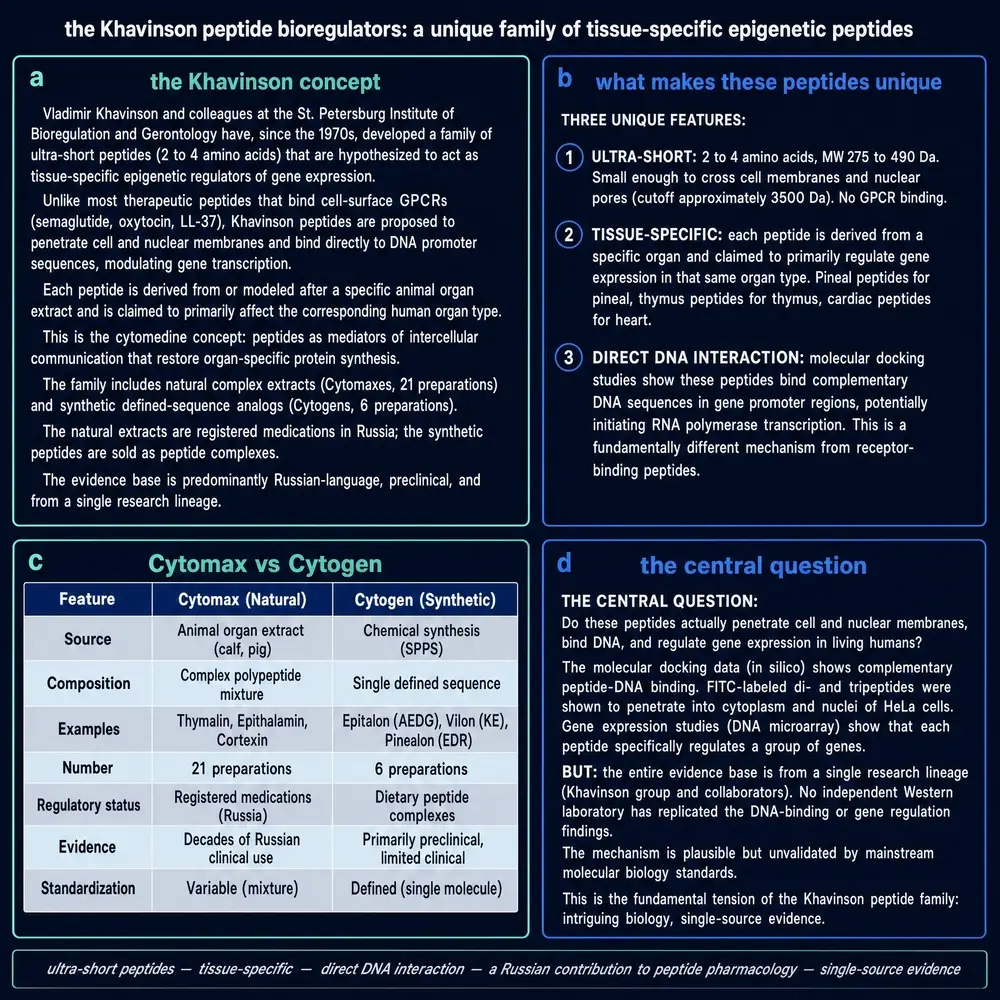
02What is a bioregulator?
The programme calls these substances peptide bioregulators. The term was developed inside the St Petersburg Institute of Bioregulation and Gerontology and its military-medical predecessor, not by an international pharmacology committee. In the group’s own framing, a bioregulator is not a hormone, not a cytokine and not a classical receptor ligand. It is a short peptide or peptide complex said to enter cells, reach the nucleus, and alter gene expression and protein synthesis in a tissue-preferential way (Khavinson, 2013; Khavinson et al., 2021).
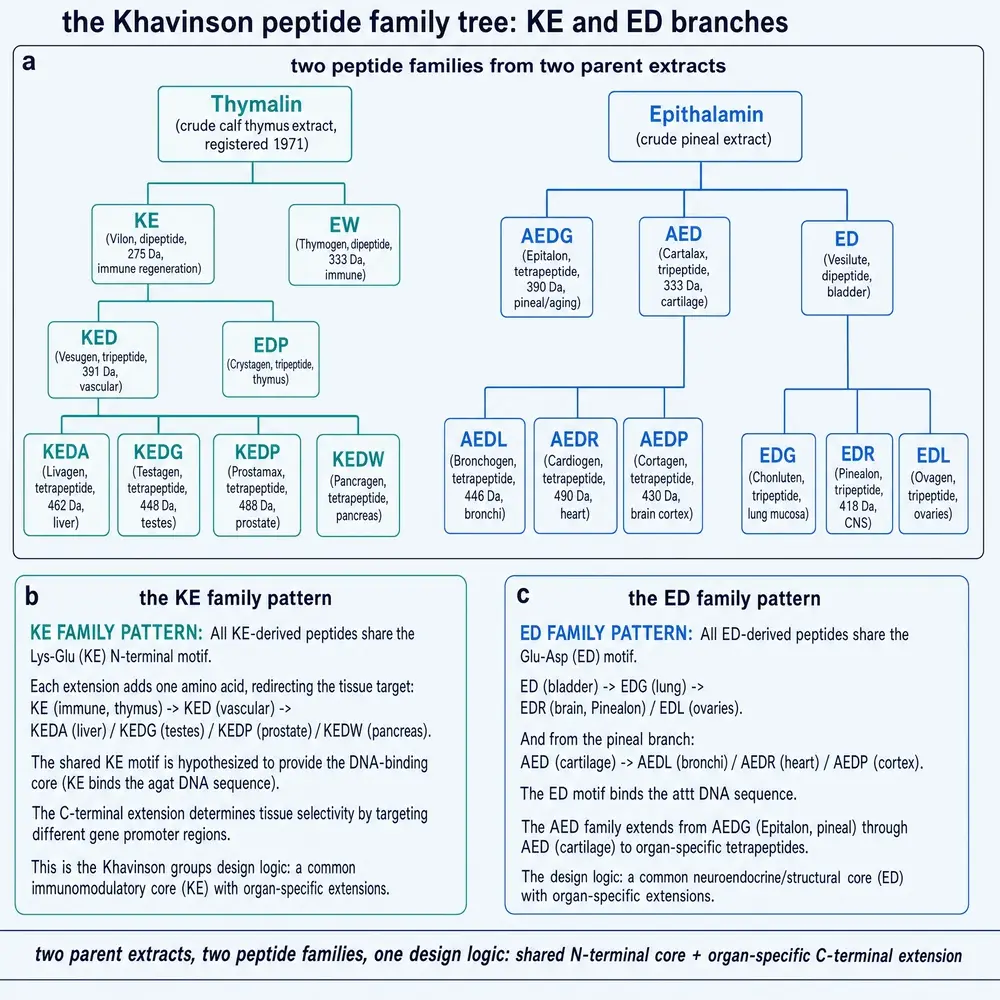
Two generations are built into the definition. The first is the tissue extract: a complex of low-molecular-weight peptides prepared from a young animal organ. The second is the synthetic short peptide later isolated from, or designed after, that complex. The extracts came first; the short peptides followed. A Western buyer who meets only a capsule name is usually meeting the first generation under a retail brand, or the second under a Cytogen name, without being told which object is in the bottle (HOUSE_STYLE §8a.1).
The concentration rhetoric of the class is nanomolar and below. If true, that would place these peptides among unusually potent signalling molecules. It also raises ordinary pharmacological questions (uptake, half-life, target engagement, dose–response) that the class literature answers unevenly. Outside this literature, “bioregulator” is not a standard drug class. Treating it as settled pharmacology is the first error a monograph can make. The naming history in the next section is how that error usually begins: one word stands in for three objects.
03Three generations of naming
Early open papers speak of cytomedines for the organ peptide complexes. A 1987 military-medical journal article is among the dated appearances of that vocabulary (PMID 3310391). Later commercial channels use Cytamine and Cytomax for natural complexes aimed at dietary-supplement and anti-ageing markets. Cytogen names the synthetic short peptides.
The shift matters because PubMed barely knows the word Cytomax. A reader who searches only the retail names will conclude, wrongly, that nothing has been studied. The science that exists is filed under Thymalin, Epithalamin, Cortexin, under author Khavinson, and under three-letter codes such as AEDG and KED. Absence of the brand is not absence of a programme.
04The twenty Cytomaxes
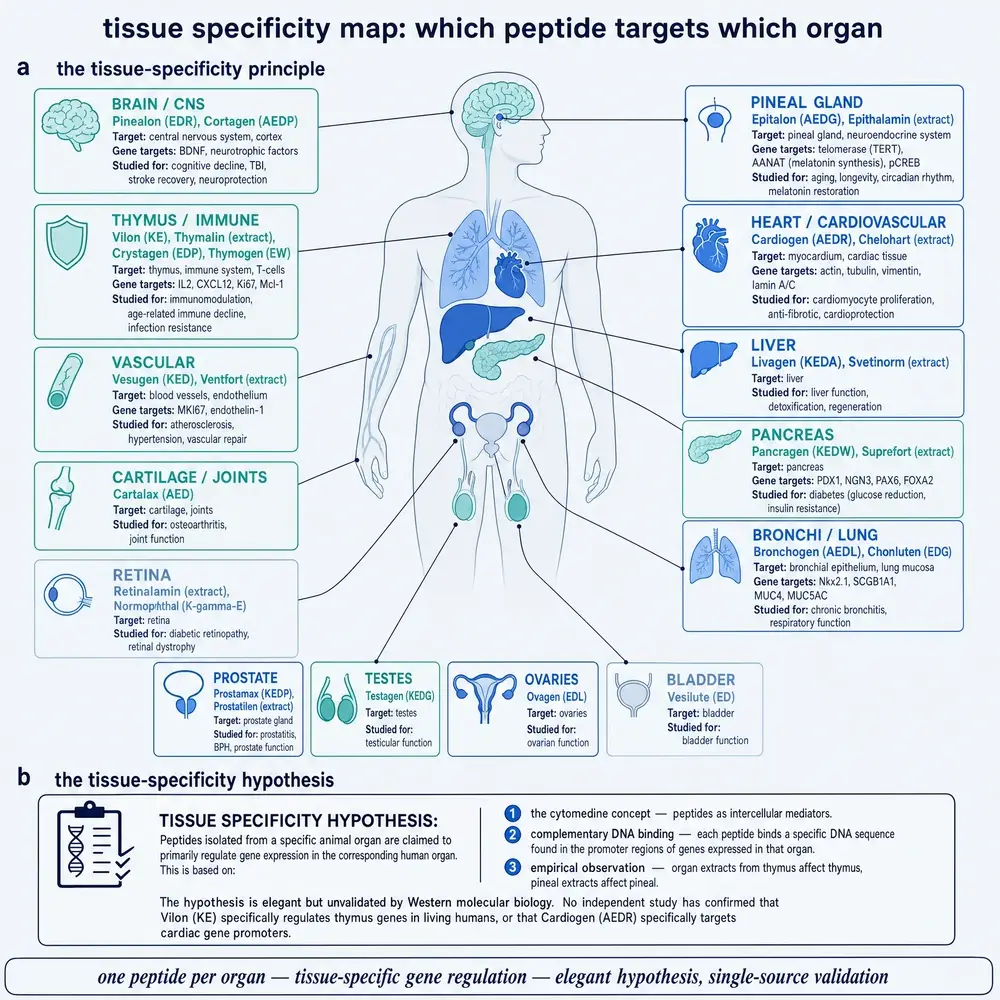
The house register lists twenty Cytomax complexes. The table is a claim to re-verify, not a finished structural proof.
| Cytomax | Organ (claim) | Paired Cytogen / extract (claim) |
|---|---|---|
| Ventfort | vessels / aorta | Vesugen (KED) |
| Vladonix | thymus | Thymalin / Thymogen / Vilon |
| Endoluten | pineal | Epithalamin / Epitalon |
| Cerluten | brain | Cortexin / Pinealon / Cortagen |
| Sigumir | cartilage & bone | Cartalax (AED) |
| Svetinorm | liver | Livagen |
| Suprefort | pancreas | Pancragen |
| Chelohart | heart | Cardiogen |
| Taxorest | bronchi | Bronchogen / Chonluten |
| Visoluten | eyes / retina | Normoftal / Vilon line |
| Chitomur | urinary bladder | Vesilute (ED) / Vezustim |
| Libidon | prostate | Prostamax |
| Testoluten | testis | Testagen |
| Stamacort | stomach | — |
| Zhenoluten | ovaries | — |
| Gotratix | muscle | — |
| Bonothyrk | parathyroid | — |
| Glandokort | adrenal | — |
| Pielotax | kidney | — |
| Bonomarlot | bone marrow | — |
Figure 3 is the claim table for this family document. Tissue and species of origin are often stated only as “young animals” in commercial copy. Peer-reviewed methods papers that lock species, organ lot and peptide mass window are uneven across the line. Rows without a clear paired Cytogen in the register are marked with an em dash.
05Cottbus to the Military Medical Academy
Vladimir Khatskelevich Khavinson was born on 27 November 1946 in Cottbus, Germany, into the family of a Soviet military officer. The family later lived in Minsk. He attended Minsk secondary school No. 6, then entered the Minsk Suvorov Military School in 1959 and finished in 1965 with a gold medal. In the same years he was a boxing champion of Minsk (1964) and a track-and-field champion of Byelorussia (1965). In 1965 he entered the S. M. Kirov Medical Military Academy in Leningrad, graduating in 1971 with a diploma in treatment and prevention (khavinson.info curriculum vitae; biographical summaries consistent with Wikipedia’s secondary account).
The peptide programme did not begin in a university gerontology department. It began in that military-medical pipeline: Suvorov school, then the Kirov Academy. Later Institute and commercial accounts still sit on that origin.
06The Bioregulators Laboratory
From 1977 Khavinson returned to the Kirov Academy as a clinician-researcher: senior resident doctor, then junior and senior research officer. In 1978 he received the Candidate of Medical Sciences degree; in 1987 the Doctor of Medical Sciences degree; in 1990 the rank of Professor. In 1988 he became Chief of the Research Laboratory of Bioregulators at the Academy. In 1989 he established the State Biomedical Scientific and Production Complex “Cytomed” and served as its General Director until 1992 (khavinson.info CV).
The laboratory’s stated purpose, in later programme language, was peptide protection of vital functions under stress and ageing — work that began in the early 1970s and that the group’s own review titles date to 1973–74 (Khavinson and Anisimov, 2009). The first products were not capsules for anti-ageing boutiques. They were peptide complexes developed in a military- medical context and, according to programme accounts, used for restoration of immune, endocrine, brain and retinal functions in personnel exposed to radiation accidents, toxic substances, combat trauma, and related stressors (Wikipedia field-of-work summary, drawn from Institute materials; treat as programme narrative pending primary military archives).
In a Phil Micans interview, Khavinson himself framed the early brief as military: battlefield lasers, submarine and silo radiation exposure, and premature ageing in personnel — work that was secret at the time (Antiaging Nutrition interview). Vendor lore also adds Olympic athletes and cosmonauts. What can be dated without those archives is the Academy laboratory, the Cytomed production complex, and the later registered medicines. Programme narrative and primary military records are not the same source class.
07Six registered medicines — the hard core
Before Cytomax was a brand, there were medicines. The CV and programme reviews name six pharmaceuticals authorised by the Russian Ministry of Health for clinical application (spellings vary by transliteration):
| Medicine | Source tissue | Stated role in programme literature |
|---|---|---|
| Thymalin | thymus | Cellular immunity regulator |
| Epithalamin | pineal | Endocrine / melatonin-axis regulator |
| Cortexin | cerebral cortex | Brain function regulator |
| Prostatilen / Samprost / Vitaprost | prostate | Prostate / urogenital regulator |
| Retinalamin | retina | Retinal function; laser-lesion studies cited |
| Thymogen | synthetic Glu-Trp (from Thymalin) | Immunity; the isolation story |
Wikipedia’s secondary summary, drawing on Institute materials, states that over 1973–2013 the group extracted more than twenty organ peptide complexes and synthesised about fifteen short peptides, with six medicinal preparations permitted for medical use in the USSR/Russia/CIS and used first by the military medical service. The same account credits Khavinson with introducing gerontology and geriatrics as a formal specialty in the Russian attestation system and with large numbers of patents and publications (figures vary by source: on the order of 700+ papers and 190+ patents in Institute digests). Those counts are programme tallies; they are not an independent bibliometric audit.
08The Institute (1992–2024)
In 1992 Khavinson founded the St Petersburg Institute of Bioregulation and Gerontology and remained its director. In 2001 the Institute was integrated into the North-Western Department of the Russian Academy of Medical Sciences. He later held concurrent posts as Main gerontologist of the St Petersburg Health Committee, head of peptide-regulation work at the Pavlov Institute of Physiology, and head of the Chair of Gerontology and Geriatrics at the North-Western State Medical University. He served as vice-president of the Gerontological Society of the Russian Academy of Sciences and, from 2011, as president of the European region of the International Association of Gerontology and Geriatrics (khavinson.info CV).
The Institute became the institutional home from which the extract medicines, the short-peptide programme, and the commercial Cytomax / Cytogen catalogues all radiated. Collaborators named repeatedly include V. G. Morozov on the founding peptide work and V. N. Anisimov on ageing biology (Anisimov and Khavinson, 2010).
09The discovery process — how a Cytomax is made, in principle
The process, as the programme tells it across decades, has three stages.
Stage A — Extract. Young animal organs are fractionated to yield low-molecular-weight peptide complexes. These complexes are tested for tissue-preferential effects in organotypic cultures and animals, then — for a minority — advanced toward registered medicines.
Stage B — Identify or design. Short sequences are either isolated by chromatography from the complex (Thymogen from Thymalin is the clearer case) or designed from bulk amino-acid composition (Epitalon from Epithalamin is the clearer designed case, later detected in pineal material by SRM; PMID 29124531). Many Cytomax–Cytogen pairs never publish which path was taken.
Stage C — Synthesise and brand. The short peptide is made from amino acids as a Cytogen. The natural complex is sold under a Cytomax (or earlier Cytamine / cytomedine) retail name. Marketing language often collapses Stage A and Stage C into “the active fragment,” which is exactly the error HOUSE_STYLE §8a.2 forbids.
10Death and succession of a catalogue
Khavinson died on 6 January 2024 in Saint Petersburg, aged 77. The Institute, the registered medicines, the Cytomax retail line, and the American affiliate studies he authorised continue without him. That fact does not resolve the evidence gaps in this monograph; it clarifies why the founding voice is now historical as well as scientific.
11How they are named
The same programme acquired several names as it moved from military clinic to open literature to export retail.
Cytomedine — early scientific term for organ peptide complexes (mid-1980s open literature; PMID 3310391).
Cytamine — intermediate commercial/scientific branding for natural complexes in some Institute and licensee materials.
Cytomax (Cytomaxes) — export retail brand for natural organ peptide complexes, typically sold as oral capsules or “lingual” forms. About twenty organ-assigned names (Ventfort, Vladonix, Endoluten, …). Local PubMed presence under these spellings is thin.
Cytogen — synthetic short peptide (usually 2–4 residues) with a defined sequence and a trade name (Epitalon, Vilon, Vesugen, Cartalax, …).
Classical extract medicine — Thymalin, Epithalamin, Cortexin, Retinalamin, Prostatilen/Samprost — registered drugs, not synonyms for the retail Cytomax of the same organ.
Cyrillic forms travel beside Latin ones (Везилют, Хавинсон, Тималин). Western catalogues mix layers; a search that treats every synonym as one drug will mis-attribute evidence.
12How they are sold
Four sales channels appear in the commercial record. Evidence and regulation do not transfer automatically from one to another.
1. Russian registered medicines. Thymalin, Epithalamin, Cortexin, Retinalamin, Prostatilen-line, Thymogen — prescription/clinical drugs in Russian (and historically Soviet/CIS) practice. Human clinical gravity, when it exists, concentrates here.
2. Cytomax food-supplement retail. Natural complexes sold as capsules or lingual forms under organ trade names. Positioned internationally as dietary supplements / anti-ageing products (Antiaging Systems, Profound Health, Navi Organics, e-peptide and similar licensees and resellers). Not FDA-approved drugs. Bill Lawrence’s American studies, by his own account, used these natural Cytomaxes as “food-based” peptides.
3. Cytogen / synthetic short-peptide retail. Defined sequences sold as research chemicals or supplements depending on jurisdiction and vendor (Epitalon, Vilon, Vesugen, Cartalax, …). Often the layer Western peptide shops mean by “Khavinson peptides.”
4. Grey / RUO injection markets. Some short peptides appear in research-use-only injectable catalogues unrelated to the Institute’s capsule brands. Those channels are outside this monograph’s product map but confuse identity searches.
13Compound-by-compound overview
The house catalogue lists twenty Cytomaxes. Below: organ assignment, claimed pair, and a one-line evidence note. Every pairing row is a claim to re-verify (§8a.2).
| Cytomax | Organ | Claimed pair / extract | Evidence note |
|---|---|---|---|
| Vladonix | thymus | Thymalin / Thymogen / Vilon | Strong extract-medicine lineage |
| Endoluten | pineal | Epithalamin / Epitalon (AEDG) | Flagship; human data mostly Epithalamin |
| Cerluten | brain | Cortexin / Pinealon / Cortagen | Extract medicine + peptide papers |
| Ventfort | vessels | Vesugen (KED) | Peptide literature > retail name |
| Chelohart | heart | Cardiogen (AEDR) | Programme peptide papers |
| Svetinorm | liver | Livagen (KEDA) | Moderate programme depth |
| Suprefort | pancreas | Pancragen (KEDW) | Programme peptide papers |
| Sigumir | cartilage/bone | Cartalax (AED) | Named pair in recent papers; Cartalax string empty in PubMed |
| Taxorest | bronchi | Bronchogen / Chonluten | Respiratory peptide line |
| Visoluten | eyes/retina | Retinalamin / Normoftal–Vilon | Retinalamin is the medicine |
| Chitomur | bladder | Vesilute (ED) / Vezustim | Human urodynamic data under Chitomur |
| Libidon | prostate | Prostatilen / Prostamax | Extract medicine lineage |
| Testoluten | testis | Testagen (KEDG) | Thin under retail name |
| Zhenoluten | ovaries | — | Catalogue > PubMed |
| Stamacort | stomach | — | Catalogue > PubMed |
| Pielotax | kidney | — | Catalogue; some AED neighbour work |
| Gotratix | muscle | — | Catalogue > PubMed |
| Bonomarlot | bone marrow | — | Catalogue > PubMed |
| Glandokort | adrenal | — | Catalogue > PubMed |
| Bonothyrk | parathyroid | — | Catalogue > PubMed |
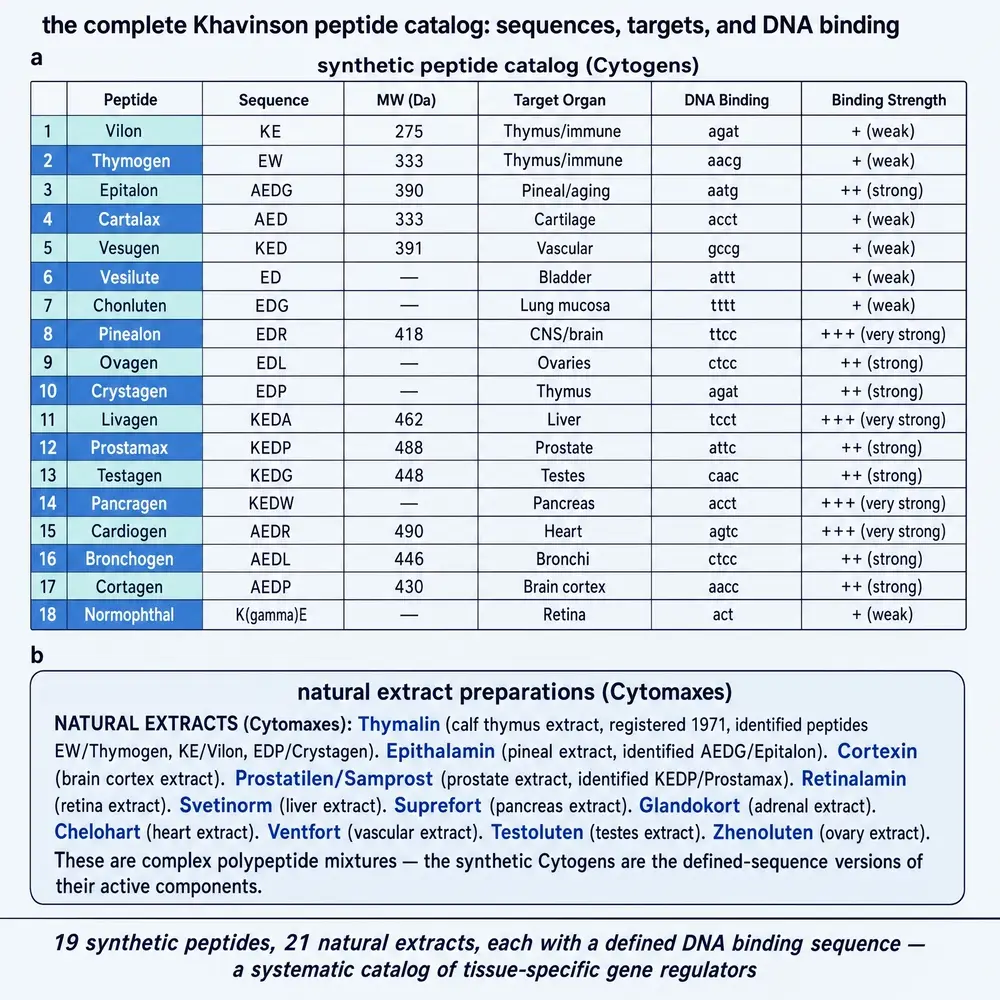
Commercial lists sometimes add Thyreogen (thyroid) or other names beyond this twenty; treat extras as catalogue variants until verified against primary Institute registers. The plate above is a programme map, not an extra row of evidence: it shows how the school draws organ assignment, not how PubMed indexes the retail spellings.
14Case studies that carry the weight
Endoluten / Epithalamin / Epitalon. Flagship pineal line. Long-horizon human language attaches to Epithalamin; Epitalon has the largest short-peptide file; Endoluten is the Cytomax retail name. Do not collapse them. The pineal cluster on the next plate is useful as a memory aid for that three-layer split; it is not a substitute for reading which object each cited study actually dosed.
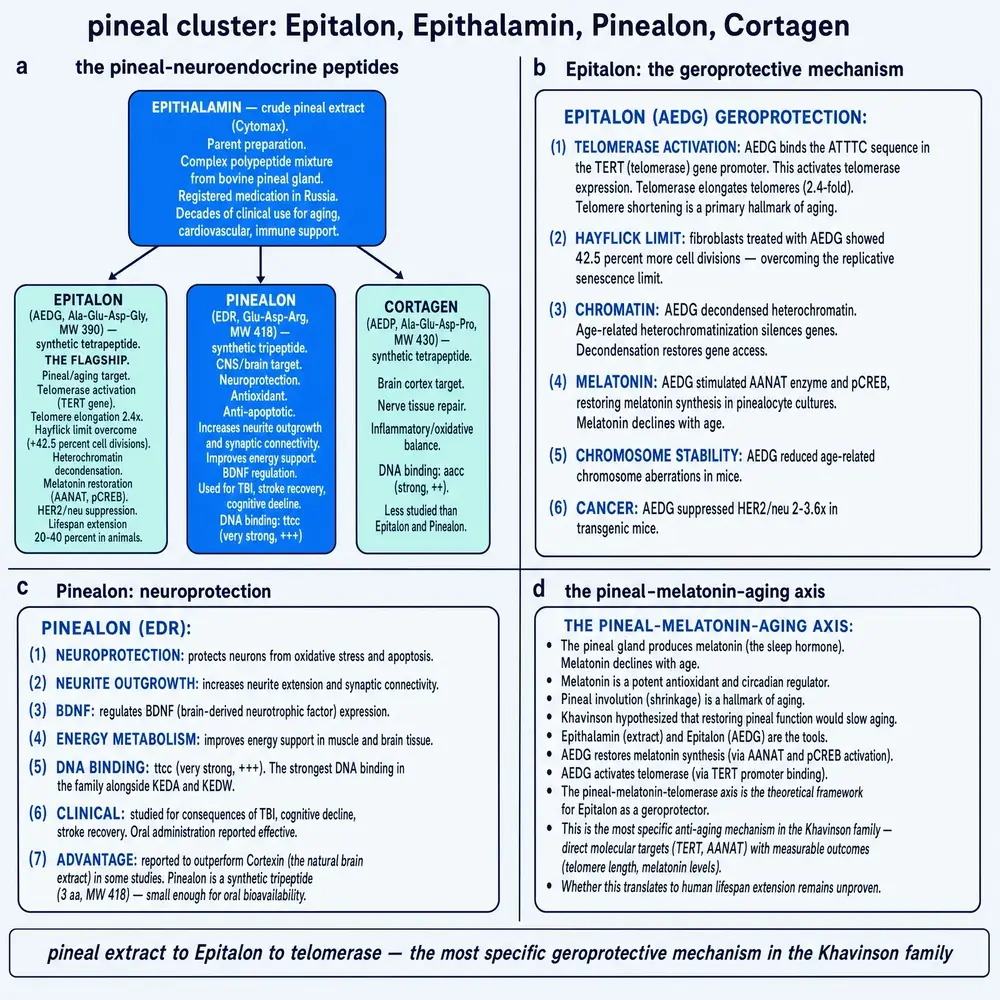
Vladonix / Thymalin / Thymogen–Vilon. Thymalin is among the most clinically established extracts. Thymogen is the clearer isolation story. Vilon is a separate short peptide. Vladonix is the retail thymus complex. When a Western catalogue says “thymus bioregulator,” ask which of those four objects is meant before borrowing a Thymalin trial as if it were a Vladonix capsule study.
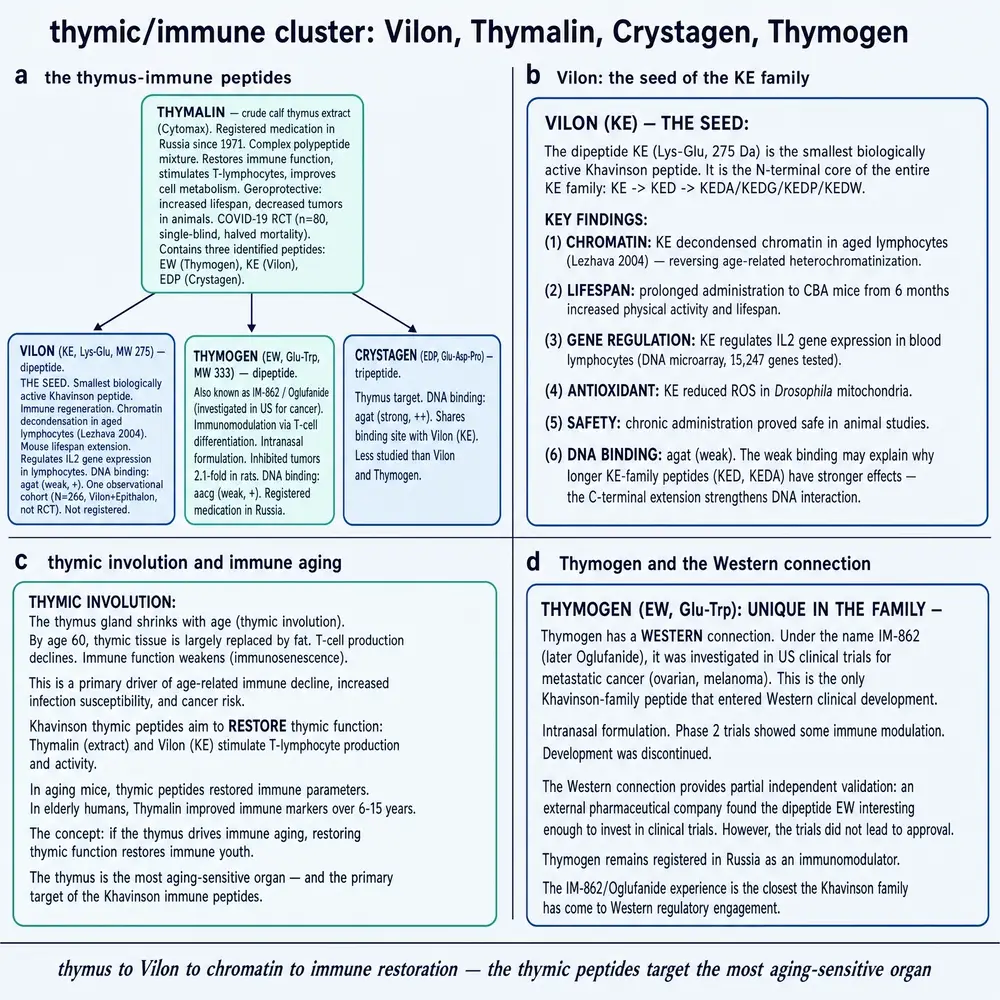
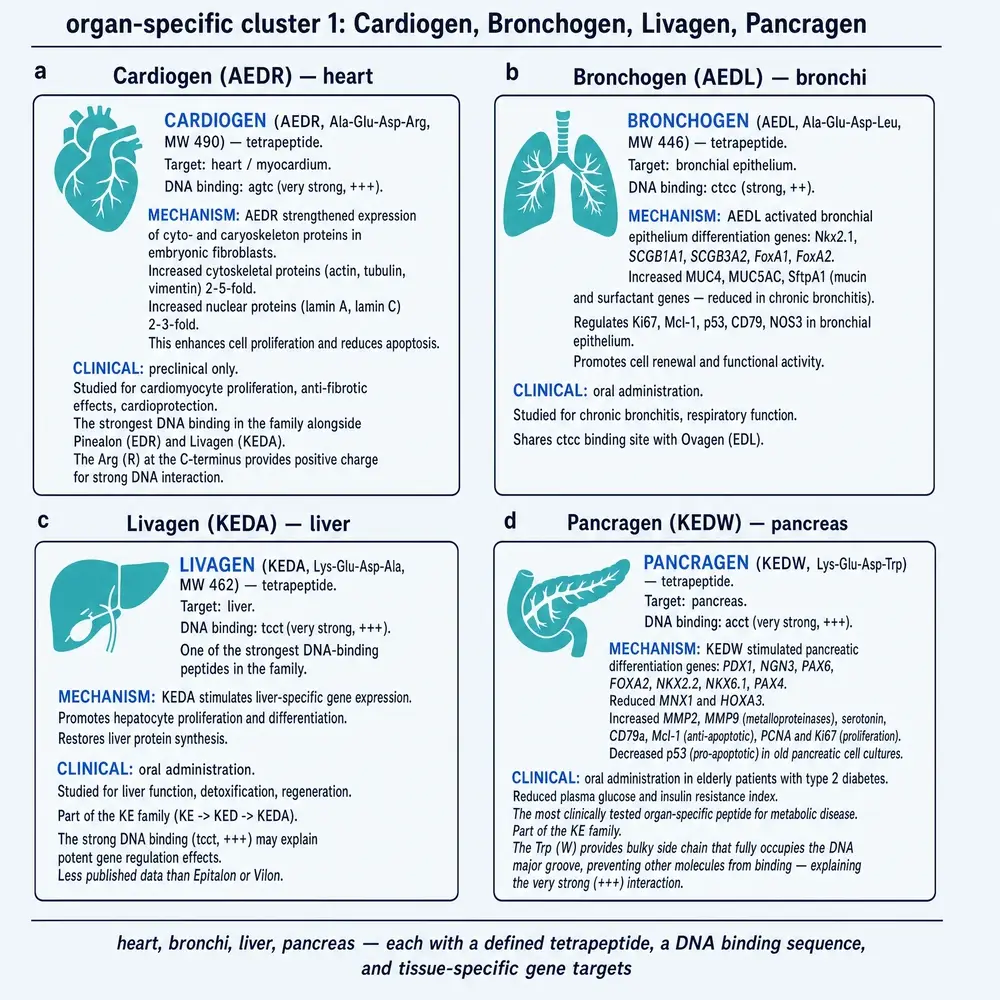
Cerluten / Cortexin / Pinealon–Cortagen. Cortexin is the registered neurotropic extract. Pinealon and Cortagen are synthetic neighbours. Cerluten is the Cytomax brain assignment. The same separation applies to heart, bronchi, liver and pancreas clusters: programme gene-target plates are hypothesis maps until a paper names the exact reagent. A reader who borrows a Cortexin outcome for Cerluten, or a Cardiogen outcome for Chelohart, has changed the object under study without saying so.
Those organ clusters are also where the catalogue looks densest and the index looks thinnest. Chelohart, Taxorest, Svetinorm and Suprefort have clear organ assignments in retail materials; under those spellings PubMed is sparse. The weight, where it exists, sits under Cardiogen, Bronchogen/Chonluten, Livagen and Pancragen — or under the extract medicines that historically preceded them. Keeping the names separate is tedious. Collapsing them is how false certainty enters a citation chain.
Chitomur / Vesilute. Randomised urodynamic data under Chitomur (PMID 28976156). Vesilute named in docking and programme review. Different objects. Chitomur is one of the few retail Cytomax names that can carry a primary human endpoint under its own spelling; that does not license the rest of the catalogue. It does show that a Cytomax trade name can, in principle, host a clinical measurement without being rewritten as an extract medicine first.
Sigumir / Cartalax. Recent papers name the pair; PubMed barely knows the word Cartalax. Science lives under AED / T-31. The contrast with Chitomur is instructive: one retail name has a urodynamic trial string; the other has a fashionable short-peptide neighbour and almost no index presence under the pair’s Western brand. Further organ short-peptide plates later in the monograph are therefore read as programme summaries with an evidence-gradient note, not as twenty independent clinical proofs. Mechanism claims for the class come next; they inherit the same naming discipline.
15The claim: enter the cell, reach DNA
Ordinary peptide drugs in this series bind receptors on the cell surface. The bioregulator claim is almost the opposite: short peptides are said to cross membranes, enter nuclei, contact DNA or chromatin, and change which genes are available for transcription (Khavinson et al., 2016; Khavinson et al., 2021). Tissue preference is attributed not to a named receptor map but to sequence-specific DNA contacts and to the peptide’s origin tissue.
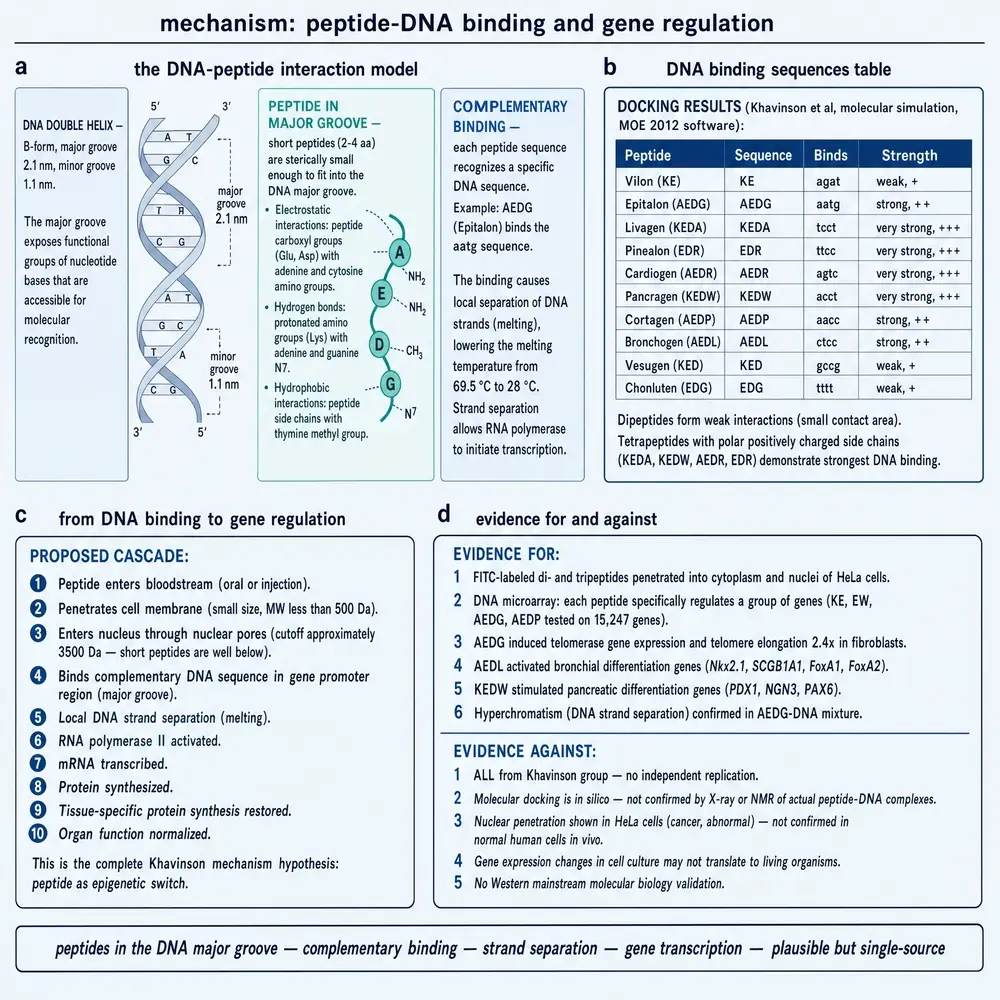
For Cytomaxes — which are complexes, not single sequences — the mechanism story is inherited from the short-peptide layer. The complex is treated as a library of such peptides. That inheritance is a hypothesis. It is not a demonstration that every capsule on the Cytomax shelf has been shown to deliver nuclear peptides to the assigned human organ.
16What the evidence actually shows
Uptake. FITC-labelled short peptides from the school have been reported in cytoplasm, nucleus and nucleoli of HeLa cells in vitro (Fedoreyeva et al., 2011). That is a real experimental result about labelled di- and tripeptides in a cell line. It is not pharmacokinetics of an oral Cytomax capsule in a human. The cascade plate that follows is the school’s own summary of that claim chain; read it as a map of assertions, then match each arrow to a method.
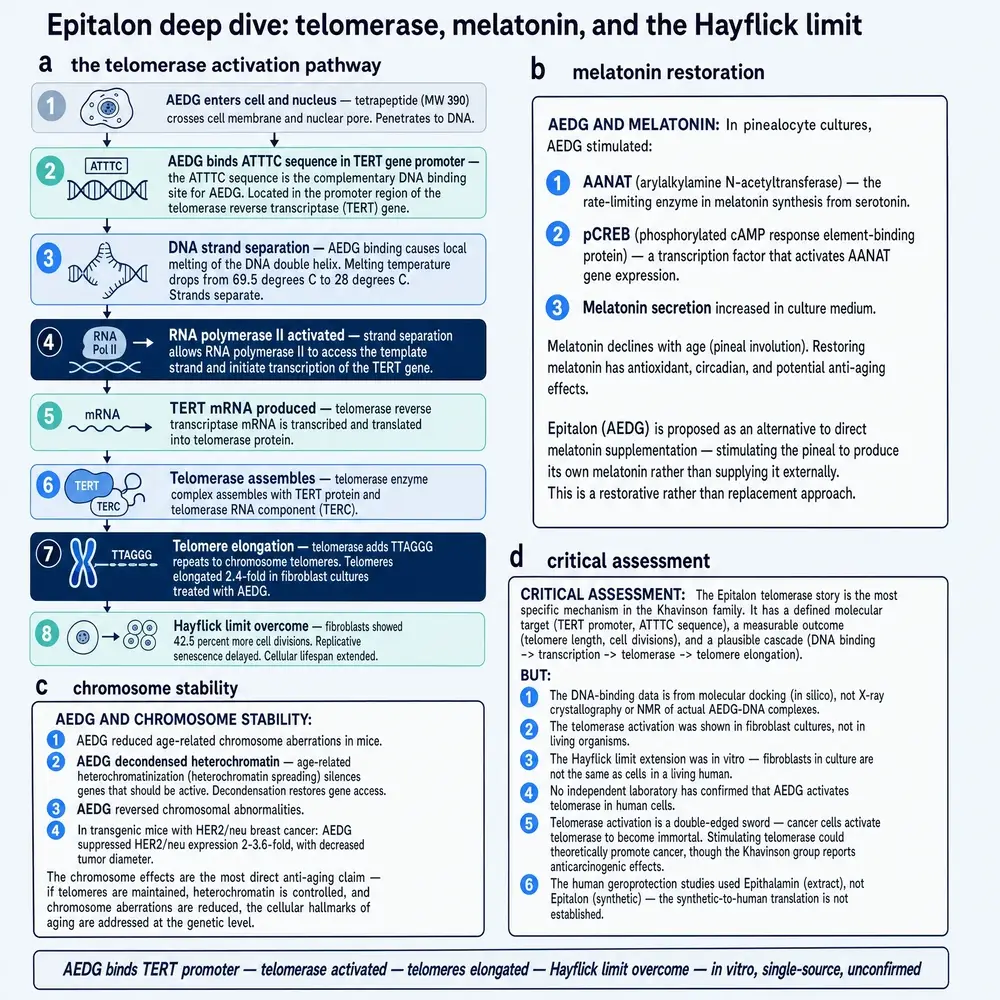
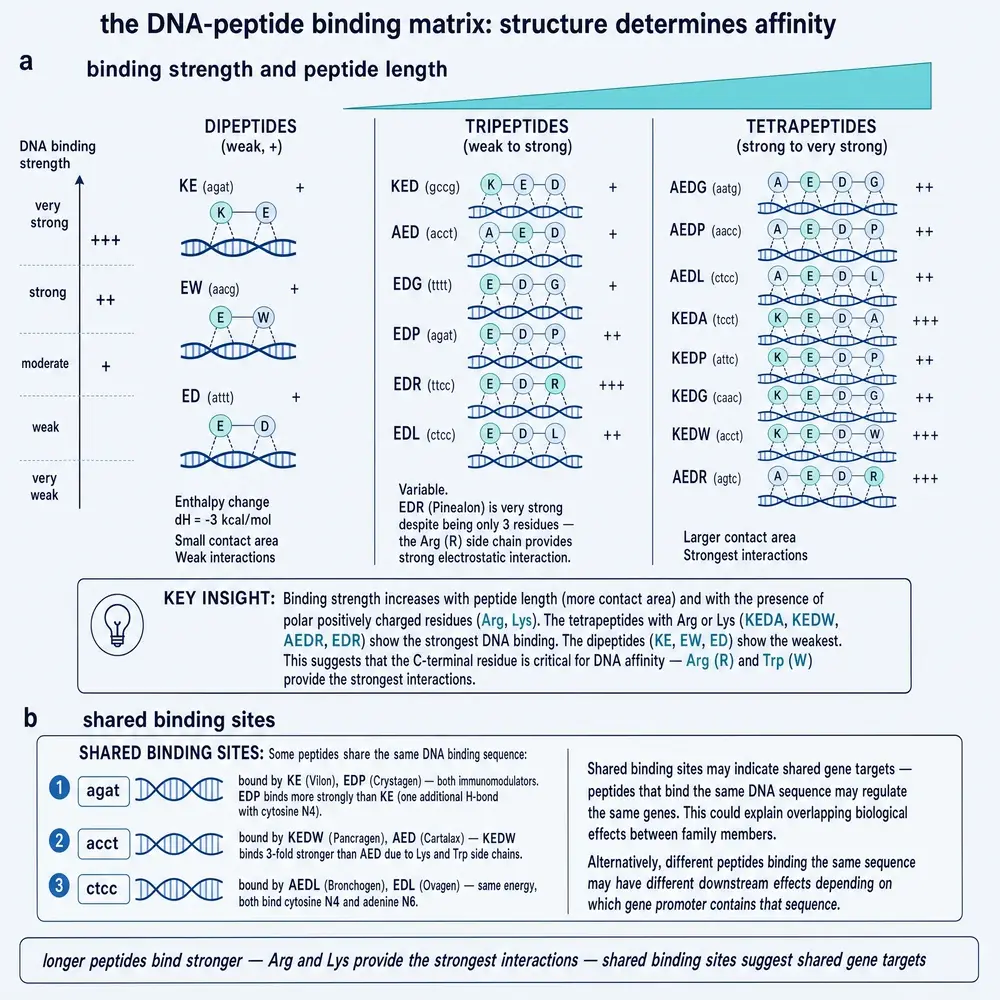
DNA contact. Molecular docking and biophysical papers report short peptides binding preferred DNA sites or altering DNA melting behaviour (Khavinson et al., 2016; PMID 25946838; PMID 19526107). Docking enthalpies for dipeptides are often weak; the 2016 paper itself bins many interactions as “+” rather than strong. Computational contact is not target engagement in tissue. A docking matrix that paints many sequences as binders is still a matrix of computed poses unless a biophysical measurement is cited for the same sequence.
Organotypic cultures. A recurring experimental format exposes explants of the “matching” organ to the extract or peptide and reports growth-zone or marker changes (e.g. PMID 26390619). These designs can show biological activity in a dish. They cannot, alone, establish organ-selective biodistribution after systemic administration. They also cannot tell a buyer whether an oral Cytomax capsule delivered the same fraction the explant saw.
Transport hypotheses. More recent work discusses ultrashort peptide transport by proton-coupled oligopeptide transporters and LAT-family carriers (PMID 35887081). That is the class’s most testable mechanistic frontier, because transporter dependence can be inhibited, knocked out or saturated. It remains thinner than the receptor pharmacology available for GLP-1 or GHRP compounds, and it has not been shown, compound by compound, for the twenty retail Cytomax complexes as sold. Ordinary peptide pharmacology, by contrast, usually begins with a receptor the reader can name.
17Comparison with ordinary peptide pharmacology
A reader arriving from a sermorelin or semaglutide monograph imports a mental model that does not apply. There is typically no Kd for a Cytomax complex, no receptor knockout phenotype, no displacement assay, no PET ligand. Falsifiability is lower because a negative gene-expression result can be attributed to wrong tissue, wrong time point, wrong peptide fraction, or wrong chromatin state. That flexibility is scientifically costly. It must be named.
None of this proves the claim false. It proves the claim is harder to pin down than receptor pharmacology, and that the published record has not yet paid the full empirical cost of its ambition.
18Independence and falsifiability
The 2021 Molecules systematic review of peptide regulation of gene expression is recent, open, and useful as a map of what the school has published (Khavinson et al., 2021). It is also authored from inside the programme. Recency is real; independence is not. Independent laboratories have engaged individual short peptides (notably Epitalon) with mixed results; they have rarely taken up the Cytomax retail complexes as such. ClinicalTrials.gov queries for the Cytomax trade names, run for this compilation, returned no interventional registrations under those retail strings.
A preponderance of same-school positives does not become a consensus by ageing into the next decade. Fresher programme papers are weighed, but they do not outvote the structural absence of independent replication for the product line as marketed.
19Who Bill Lawrence is
In English-language longevity media, Cytomax names often arrive through Bill Lawrence rather than through PubMed. Affiliate biographies give him a J.D. (UCLA Law), an M.S. in psychology, and a Ph.D. in nutritional science. From about 2015 he has described himself as affiliated with the Saint Petersburg Institute of Bioregulation and Gerontology on observational programmes that use natural organ peptide complexes of the Cytomax type (Aging Matters / Phil Micans interview, 2022; Ageless and Timeless; Hack My Age).
In his own account he first read Khavinson’s longevity work in 2013, later met him, and agreed on American observational programmes using the natural food-based complexes sold as Cytomaxes. He is not a Russian peptide chemist and not the originator of the extract programme. For this monograph he matters as the clearest named English-language intermediary for the natural- complex layer.
20What he says he did with Cytomaxes
In the October 2022 Aging Matters interview with Phil Micans, and in Hack My Age and conference talks, Lawrence describes two overlapping programmes that use the natural Cytomax shelf (he speaks of about twenty-one food-based complexes, matching the Institute’s expanded retail set):
- TAP (Telomerase Activation Protocol) — begun 2017. Participants take rotating Cytomax-class capsules while telomere length is tracked as a proxy “telomere age.” In the 2022 interview he reports, for more than sixty participants at three years, an average telomere-age reversal on the order of about twenty-two years, and later more than one hundred participants on active or maintenance schedules. Those numbers are his programme reports in affiliate media, not PubMed RCT endpoints under Cytomax trade names.
- EMS (Epigenetic Methylation Study) — begun early 2020. Same product class, with Horvath-style epigenetic clocks and mortality-risk “gap” framing. He reports preliminary two-year average epigenetic-age reductions on the order of about five years among early participants. Again: affiliate-reported observational framing, not an indexed Cytomax RCT.
He also describes a typical cycling pattern in interviews (several complexes per month, pulsed days-on / days-off, rotating through the full set over a year). That is programme practice claimed by an affiliate. It is not a dosing recommendation.
Public materials for TAP and EMS are interviews, conference talks and commercial pages, not independent Cytomax-named randomised trials in PubMed. The products are described as natural organ peptide complexes of the Khavinson / Cytomax type. That matters for catalogue history. It does not transplant registered-extract trial evidence onto every retail SKU.
21Why the affiliation matters historically
Khavinson’s programme was built inside Soviet and then Russian military medicine and gerontology. Export of the idea into American longevity culture required intermediaries. Lawrence is the clearest named intermediary in English sources for the natural-complex (Cytomax) layer. His interviews repeatedly distinguish natural food-based peptides from synthetic short peptides — that is, Cytomax-class material from Cytogen-class material — even when commercial sites blur the distinction.
After Khavinson’s death in January 2024 the catalogue continued without its founder. Buyers who meet Cytomaxes through podcasts are meeting a transmission story. Part Six returns to what Russian and international sources show for extracts, short peptides and the retail names.
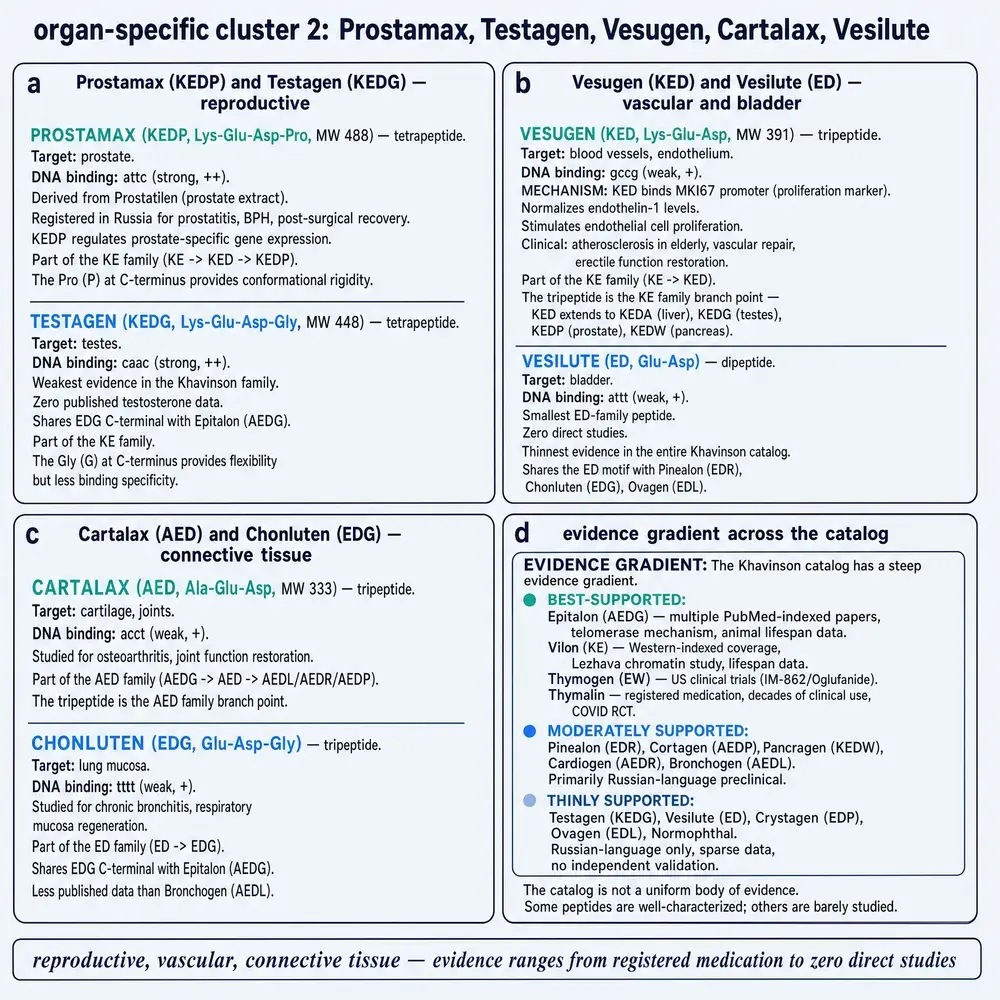
The plate’s evidence-gradient note is the right tone for this Part as well: affiliate observational programmes sit on the thin end of that gradient until methods appear under the retail spellings they advertise.
22Limits on those claims
Therapeutic-peptide monographs in this series do not invent human dosing or use recommendations, and do not place observational affiliate claims in the same evidence tier as registered Russian medicines or indexed extract trials:
- TAP and EMS are programmes Lawrence and partners report, not completed PubMed RCTs under Cytomax trade names.
- Biomarker movement discussed in interviews stays interview-level until a peer-reviewed methods paper under those names is cited.
- No dose, schedule or self-administration guidance is offered here.
23In vitro and organotypic
The densest experimental layer for the class is in vitro: cell lines, primary cultures, organotypic explants. Short peptides alter markers of differentiation, senescence-associated phenotypes, and selected gene panels in programme papers synthesised in the 2020–2021 reviews (Khavinson et al., 2020; Khavinson et al., 2021). Organ extracts tested on “their own” organotypic cultures show activity patterns the authors read as tissue preference (PMID 26390619).
What this layer can support: biological activity of specific peptides and complexes in controlled culture. What it cannot support alone: human organ targeting after oral or injectable retail use, or equivalence between a Cytomax SKU and a named Cytogen. When a review moves from “peptide X changed marker Y in culture” to “therefore Cytomax Z supports that organ,” the second sentence has changed both the object and the evidence tier. Keep the culture result; refuse the silent upgrade.
24In vivo animal studies
Animal work in the programme includes lifespan and tumour-incidence endpoints in rodents, tissue morphology, melatonin-related measures, and disease models matched to organ lines (Anisimov and Khavinson, 2010; Khavinson, 2020). These studies are the backbone of the geroprotection narrative. They are also overwhelmingly same-school. Species, dose and duration vary; this document does not convert them into human regimens. Where a plate or review lists many organs beside many survival or morphology endpoints, ask first which reagent was injected or fed in each cited row.
Where newer animal or ex vivo papers appear (cartilage, kidney, neuronal differentiation for individual short peptides), they are weighed as fresh data on those peptides. They are not automatically pooled upward to validate every Cytomax name on the shelf. The same rule applies in reverse: an empty animal file for a retail Cytomax name does not erase animal data that exist under the paired extract or short peptide — it only keeps the attribution honest. Geroprotection language in programme plates should be read the same way: as a compiled school summary, not as a registry of independently repeated Capsule-X survival trials. Read a rodent survival curve under an extract or a named short peptide as an update to that object’s file. It does not, by itself, update every Cytomax SKU assigned to the same organ in a retail table.
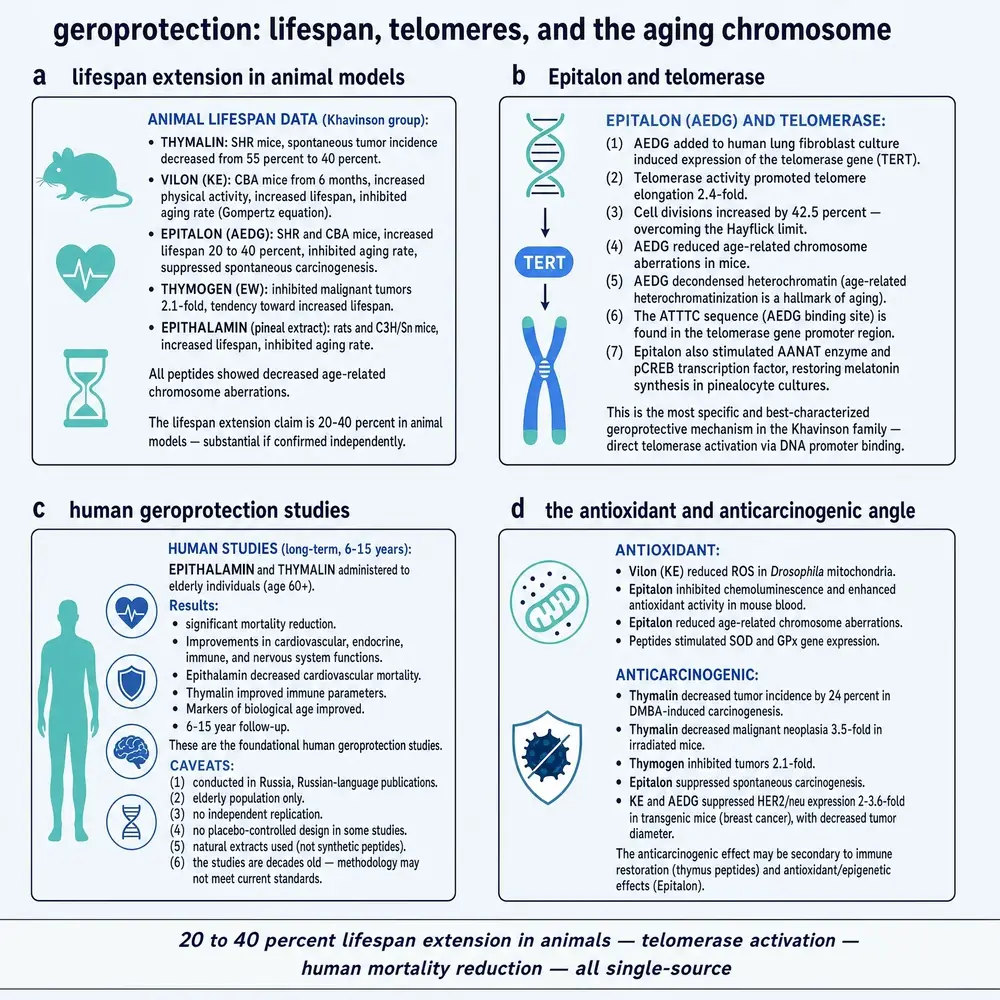
The plate’s lifespan panel is useful once that attribution rule is already in hand. Without it, the panel becomes a poster for the catalogue. Human evidence, next, is thinner still under retail spellings.
25Human information — mostly the extracts
Human data that survive a careful reading are concentrated in the classical extract medicines and a few named complexes such as Chitomur and Sigumir. Epithalamin studies in elderly subjects and long-term follow-up work are the clearest examples of multi-year human observation in the pineal line (PMIDs 17426848, 22451889). Thymalin has a clinical history as an immunotropic medicine in Russian practice. Cortexin is used as a neurotropic extract medicine. Chitomur has at least one randomised urodynamic report (PMID 28976156). Sigumir appears in dental and joint-disease contexts (PMID 22708467).
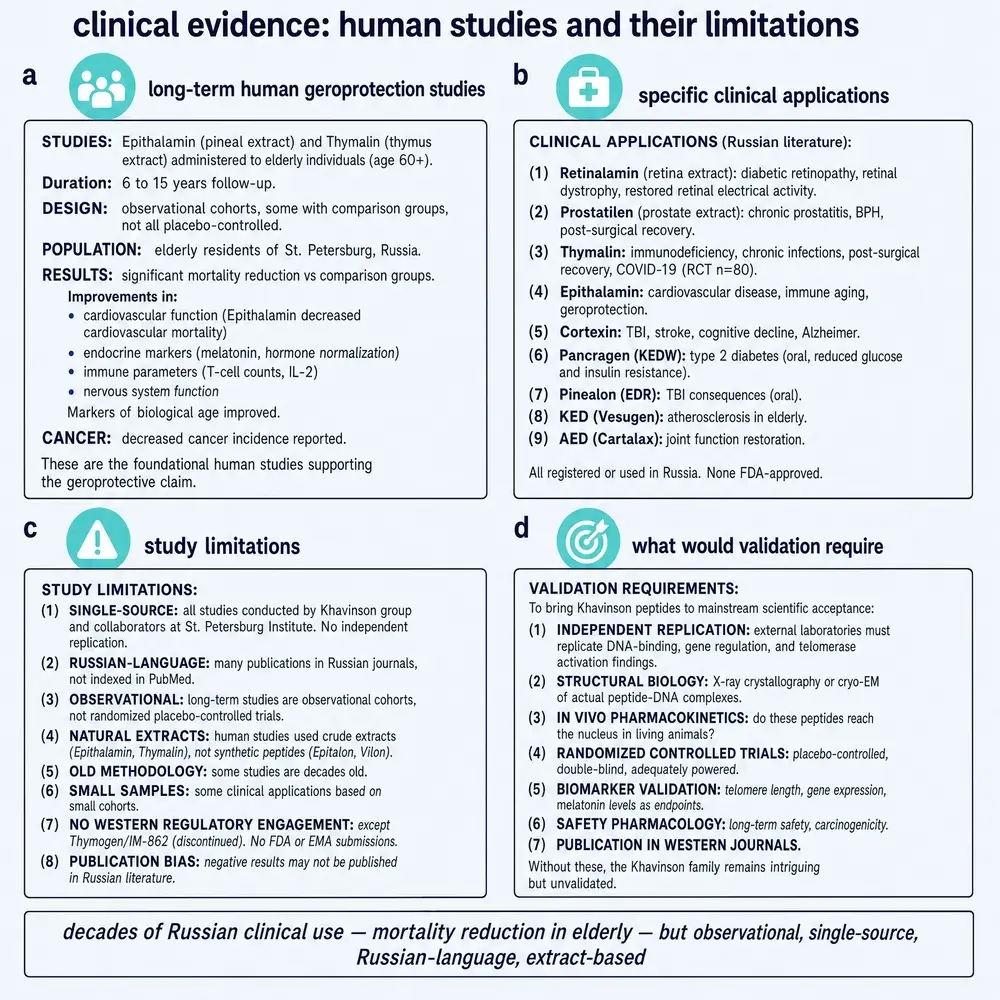
What does not appear, in the registry and index sweeps run for this build, is a portfolio of ClinicalTrials.gov interventional studies under the Cytomax retail names Ventfort, Vladonix, Endoluten, Cerluten and their siblings. The commercial catalogue is wide. The registered trial surface under those spellings is not.
Where papers report doses, schedules or routes, those numbers are experimental or observational parameters belonging to the study named in the citation. They are not recommendations for human use of any Cytomax, Cytogen or extract medicine.
26Recency versus preponderance
The freshest synthesising documents — the 2020 programme review and the 2021 Molecules systematic review — restated and extended the gene-expression model with modern molecular language. They deserve weight as maps of the school’s current claims. They do not, by themselves, repair the structural gaps: sparse independent replication, missing PK for Cytomax products, and human data that cling to extract names.
A practical reading rule follows. When a 2023–2025 paper reports a concrete assay on a named short peptide — chondrogenic markers for AED, transporter dependence for an ultrashort sequence, a corrected figure in an independent Epitalon study — that result updates the peptide’s file. When a fresh brochure or review restates that a Cytomax capsule “is” that peptide, the brochure has not updated anything. The date on the PDF is not the date of the evidence.
Where a newer primary experiment on a named short peptide conflicts with an older optimistic review sentence, the primary experiment wins. Where a newer review repeats an older unverified retail equivalence (“Cytomax X is peptide Y”), recency does not help. Preponderance here means many independent methods and groups, not many chapters from one institute.
27What is absent
Naming absences is part of weighing data. The gaps below are structural, not editorial oversights that a longer catalogue brochure can fill:
- No robust ClinicalTrials.gov interventional portfolio under Cytomax retail names (queried for this build).
- No standard pharmacokinetic packages for the retail complexes comparable to approved peptide drugs.
- No named receptor pharmacology for the class as marketed.
- Little independent, non-programme replication for most Cytomax SKUs.
- Frequent failure of PubMed to connect retail names to the extract and peptide literatures that actually exist.
These are findings. They are not invitations to invent bridging claims. A single-source methods panel does not become multi-source by reprinting it in colour. The absences also explain why English-language buyers often meet the class through affiliate interviews and retail copy rather than through a trial registry page under the capsule name they purchased.
Where a brochure answers an absence with a synonym — substituting Epithalamin for Endoluten, or AEDG for a pineal complex — the synonym must be checked against the methods section of the cited paper. If the paper dosed an extract or a synthetic, the absence under the retail spelling remains an absence for that spelling. The missing-methods plate that follows is therefore not decorative pessimism; it is the shape of the indexed record this build could defend.
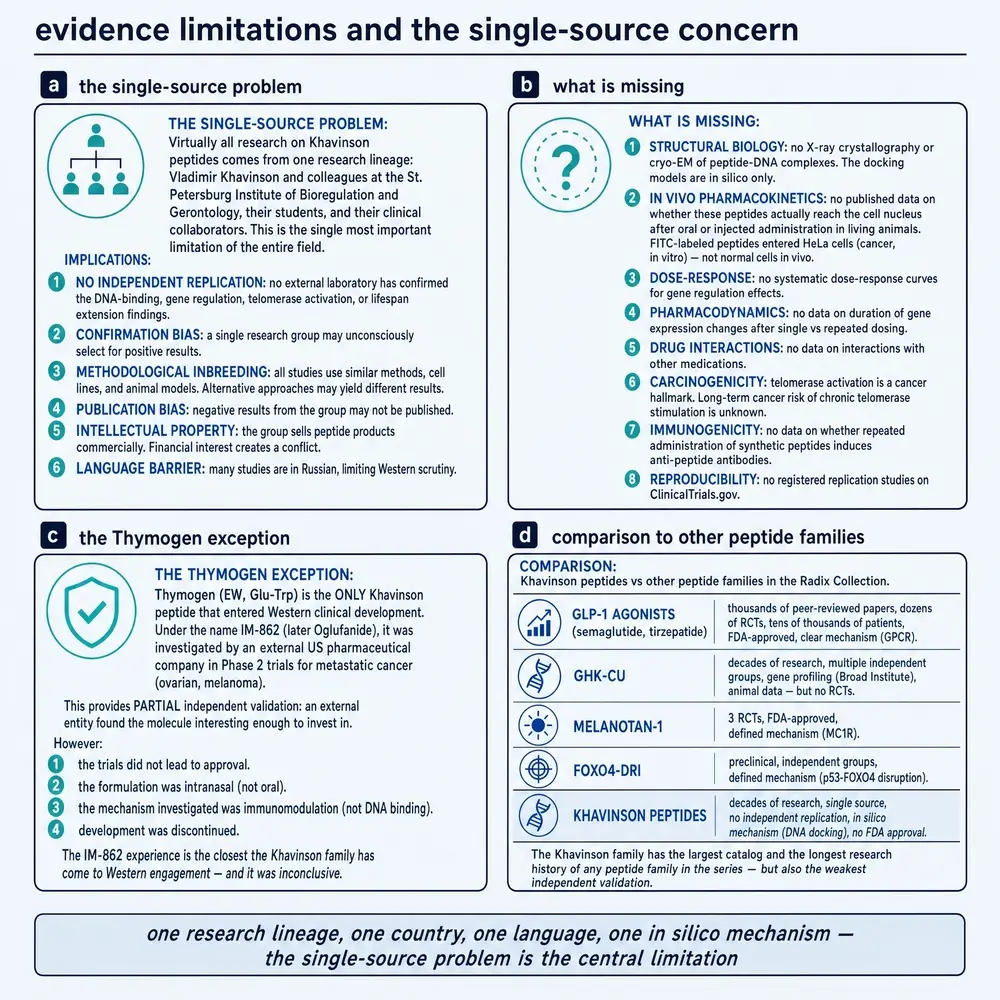
Treat that panel as a checklist against any future claim that “the Cytomaxes are clinically proven” without naming which object, which endpoint, and which independent method.
28Closing
Over about fifty years the St Petersburg programme produced organ extracts that became registered medicines, short peptides with a nuclear-gene-regulation hypothesis, and a commercial Cytomax catalogue that exported organ assignments into anti-ageing retail. After Khavinson’s death in 2024, that catalogue and Lawrence’s TAP/EMS interviews remain how many English-speaking buyers first meet the natural-complex layer. The closing plate states established programme facts beside open uncertainties; it is a summary of the argument above, not a substitute for the citation trail.
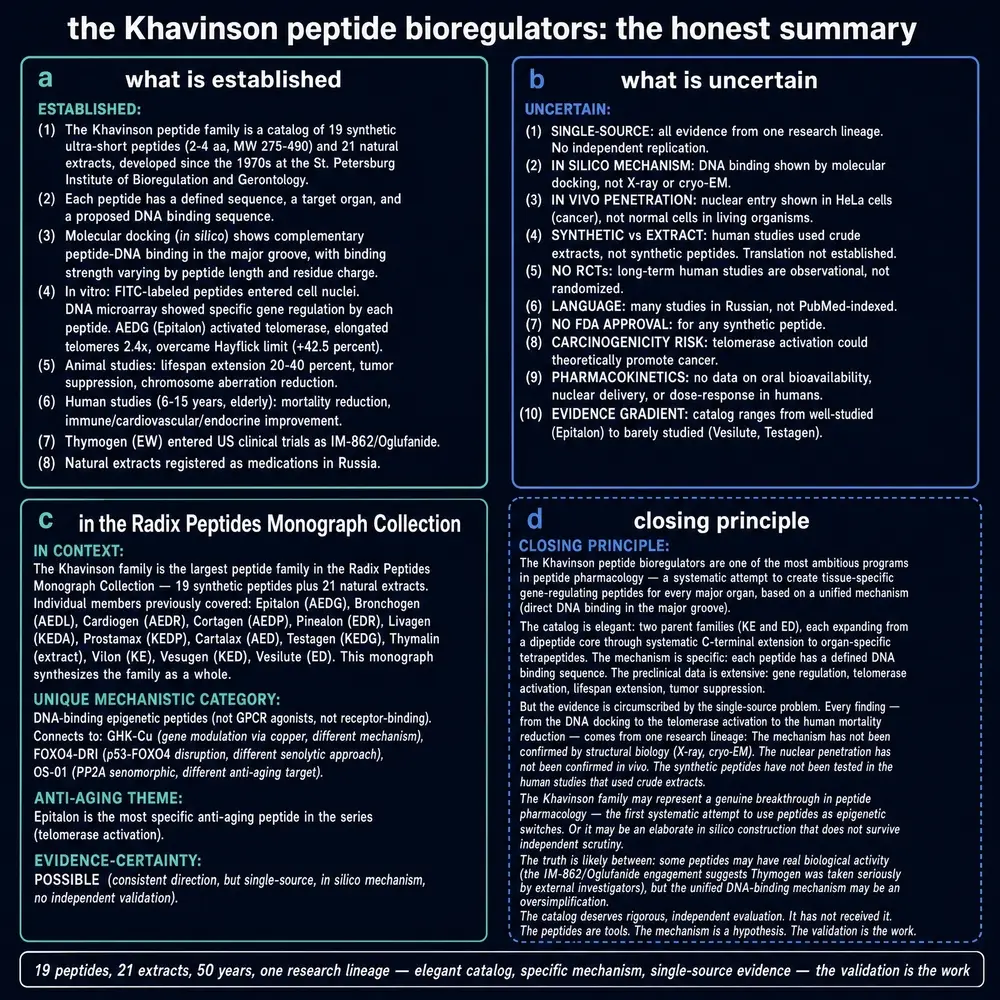
The extract medicines have clinical histories. Several short peptides already have dedicated monographs in this series. Affiliate interviews explain Western demand; they do not convert retail capsules into registered drugs. On present evidence the twenty Cytomax names are not twenty independently validated, receptor-defined drugs with interchangeable human proof under those spellings.
An extract result is an extract result. A three-letter peptide result is a peptide result. A catalogue name is a catalogue name. An affiliate interview is an affiliate interview. The usable question is which of those objects a cited study actually measured.
29References
Generated from verified NCBI records rather than from recall. Author lists, journal names, volumes, pages and identifiers are taken from the PubMed record for each citation. The build refuses to run if any identifier fails to resolve.
- Anisimov VN, Khavinson VKh. Peptide bioregulation of aging: results and prospects. Biogerontology. 2010;11(2):139-49.
PMID 19830585 · doi:10.1007/s10522-009-9249-8 - Fedoreyeva LI, Kireev II, Khavinson VKh, Vanyushin BF. Penetration of short fluorescence-labeled peptides into the nucleus in HeLa cells and in vitro specific interaction of the peptides with deoxyribooligonucleotides and DNA. Biochemistry (Mosc). 2011;76(11):1210-9.
PMID 22117547 · doi:10.1134/S0006297911110022 - Fedoreyeva LI, Smirnova TA, Kolomijtseva GY, Khavinson VKh, Vanyushin BF. Interaction of short peptides with FITC-labeled wheat histones and their complexes with deoxyribooligonucleotides. Biochemistry (Mosc). 2013;78(2):166-75.
PMID 23581987 · doi:10.1134/S0006297913020053 - Gomberg VG, Ryzhak AP, Lyutov RV. [Correction of age related bladder function decrease with peptide geroprotector in women]. Adv Gerontol. 2013;26(2):309-314.
PMID 28976156 - Iakovlev GM, Morozov VG, Khavinson VKh. [Modern concepts of cytomedins and the problems of bioregulating therapy]. Voen Med Zh. 1987:37-40.
PMID 3310391 - Iordanishvili AK, Samsonov VV, Soldatova LN, Polens AA, Ryzhak GA. [Application of bioregulating therapy in complex treatment of temporomandibular joint diseases in people of elderly and senile age]. Adv Gerontol. 2012;25(1):181-6.
PMID 22708467 - Khavinson V, Linkova N, Diatlova A, Trofimova S. Peptide Regulation of Cell Differentiation. Stem Cell Rev Rep. 2020;16(1):118-125.
PMID 31808038 · doi:10.1007/s12015-019-09938-8 - Khavinson V, Linkova N, Kozhevnikova E, Dyatlova A, Petukhov M. Transport of Biologically Active Ultrashort Peptides Using POT and LAT Carriers. Int J Mol Sci. 2022;23(14).
PMID 35887081 · doi:10.1007/s11095-020-02826-8 · PMC7203094 - Khavinson VK, Lin'kova NS, Tarnovskaya SI. Short Peptides Regulate Gene Expression. Bull Exp Biol Med. 2016;162(2):288-292.
PMID 27909961 · doi:10.1007/s10517-016-3596-7 - Khavinson VK, Popovich IG, Linkova NS, Mironova ES, Ilina AR. Peptide Regulation of Gene Expression: A Systematic Review. Molecules. 2021;26(22).
PMID 34834147 · doi:10.1134/S0026893319020092 · PMC8287948 - Khavinson VK, Kopylov AT, Vaskovsky BV, Ryzhak GA, Lin'kova NS. Identification of Peptide AEDG in the Polypeptide Complex of the Pineal Gland. Bull Exp Biol Med. 2017;164(1):41-43.
PMID 29124531 · doi:10.1007/s10517-017-3922-8 - Khavinson VKh. Peptides and Ageing. Neuro Endocrinol Lett. 2002;23 Suppl 3:11-144.
PMID 12374906 - Khavinson VKh, Anisimov VN. [35-year experience in research of peptide regulation of aging]. Adv Gerontol. 2009;22(1):11-23.
PMID 19827673 - Khavinson VKh, Ryzhak GA, Mikhaĭlova ON. [Saint Petersburg Institute of Bioregulation and Gerontology: achievements and prospects (towards the 20th anniversary)]. Adv Gerontol. 2013;26(1):11-9.
PMID 24003725 - Khavinson VKh, Solov'ev AIu, Zhilinskiĭ DV, Shataeva LK, Vaniushin BF. [Epigenetic aspects of peptide regulation of aging]. Adv Gerontol. 2012;25(1):11-22.
PMID 22708439 - Khavinson VKh, Tarnovskaia SI, Lin'kova NS, Poliakova VO, Durnova AO, Nichik TE, et al.. [Tripeptides slow down aging process in renal cell culture]. Adv Gerontol. 2014;27(4):651-6.
PMID 25946838 - Khavinson VKh, Solovyov AY, Shataeva LK. Melting of DNA double strand after binding to geroprotective tetrapeptide. Bull Exp Biol Med. 2008;146(5):624-6.
PMID 19526107 · doi:10.1007/s10517-009-0342-4 - Korkushko OV, Khavinson VKh, Shatilo VB, Antonyuk-Shcheglova IA. Geroprotective effect of epithalamine (pineal gland peptide preparation) in elderly subjects with accelerated aging. Bull Exp Biol Med. 2006;142(3):356-9.
PMID 17426848 · doi:10.1007/s10517-006-0365-z - Korkushko OV, Khavinson VKh, Shatilo VB, Antonyk-Sheglova IA. Peptide geroprotector from the pituitary gland inhibits rapid aging of elderly people: results of 15-year follow-up. Bull Exp Biol Med. 2011;151(3):366-9.
PMID 22451889 · doi:10.1007/s10517-011-1332-x - Linkova N, Khavinson V, Diatlova A, Myakisheva S, Ryzhak G. Peptide Regulation of Chondrogenic Stem Cell Differentiation. Int J Mol Sci. 2023;24(9).
PMID 37176122 · doi:10.31857/S004213242002012X · PMC3784733 - Myakisheva SN, Linkova NS, Kozhevnikova EO, Ryzhak GA. [Chondrocytes secretory phenotype associated with aging: role in the pathogenesis of osteoarthritis and prospects for peptide bioregulation.]. Adv Gerontol. 2023;36(3):313-323.
PMID 37782637 - Ryzhak AP, Chalisova NI, Lin'kova NS, Khalimov RI, Ryzhak GA, Zhekalov AN. [POLYPEPTIDES INFLUENCE ON TISSUE CELL CULTURES REGENERATION OF VARIOUS AGE RATS]. Adv Gerontol. 2015;28(1):97-103.
PMID 26390619
Sources without a PubMed record
Programme reviews, commercial catalogue material, commissioned-plate captions and registry searches are listed separately so that the machine-verified PubMed list stays clean.
- Khavinson VKh. Peptide medicines: past, present, future. Klinicheskaya meditsina. 2020;98(3):165-177. Russian programme review. Local full text: fulltext/russian_open/2020-khavinson-peptide-medicines-past-present-future.pdf (13 pp).
https://doi.org/10.30629/0023-2149-2020-98-3-165-177 - Khavinson VKh. Perspectives of application of peptide bioregulators for resource vital function increase. 2013 conference/article text. Local full text: fulltext/russian_open/2013-khavinson-peptide-bioregulators-vital-function.pdf (3 pp).
file:///fulltext/russian_open/2013-khavinson-peptide-bioregulators-vital-function.pdf - Garmonia / commercial channel. Peptide bioregulators / Cytomax catalogue leaflet. 2015 marketing leaflet mapping Cytomax organ complexes. Local: fulltext/khavinson/2015-garmonia-peptide-bioregulators-leaflet.pdf (9 pp). Cited as commercial catalogue evidence, not peer-reviewed pharmacology.
file:///fulltext/khavinson/2015-garmonia-peptide-bioregulators-leaflet.pdf - South Beach Longevity catalogue register. khavinson_bioregulators.csv — Cytomax and Cytogen pairings. Internal catalogue register of 20 Cytomax complexes (P277–P296) and paired Cytogen short peptides. Treated as a claim table to re-verify, per HOUSE_STYLE §8a.2.
file:///library/khavinson_bioregulators.csv - ClinicalTrials.gov. Registry search for Cytomax trade names and class terms. Queried 5 August 2026 for Ventfort, Vladonix, Endoluten, Cerluten, Sigumir, Chitomur, Cytomax, and related bioregulator strings. No interventional registrations found under Cytomax retail names.
https://clinicaltrials.gov/ - Khavinson VKh. Curriculum vitae — St. Petersburg Institute of Bioregulation and Gerontology. Official CV page: birth Cottbus 1946; Suvorov; Kirov Academy 1971; Bioregulators Laboratory; Cytomed; Institute director from 1992. Primary biographical authority for Part Two.
https://khavinson.info/curriculum-vitae - St. Petersburg Institute of Bioregulation and Gerontology. Institute digest (English) — Cytomaxes as parapharmaceuticals. Programme brochure describing Cytomaxes as biologically active food supplements derived from organ peptide complexes. Local/web: khavinson.info/downloads/ibg.pdf. Catalogue / programme narrative.
https://khavinson.info/downloads/ibg.pdf - Lawrence B; Micans P (interviewer). Reversing biological aging with peptide bioregulators. Aging Matters Magazine, 13 Oct 2022. Affiliate interview: 2013 exposure to Khavinson work; Institute affiliation; TAP (2017) and EMS (2020) using Cytomax-class natural complexes. Cited as Western transmission / observational programme narrative, not PubMed RCT.
https://aging-matters.com/reversing-biological-aging-with-peptide-bioregulators/ - Lawrence B. Dr. Bill Lawrence — biographical note (Ageless and Timeless). Affiliate biography: JD UCLA Law; MS Psychology; PhD Nutritional Science; affiliated with St. Petersburg Institute since 2015; administers TAP and DNA/methylation programmes using Khavinson peptide bioregulators.
https://agelessandtimeless.com/dr-bill-lawrence/ - Khavinson VKh; Micans P (interviewer). The role of peptide bioregulators — interview with Vladimir Khavinson. Antiaging Nutrition / Phil Micans interview. Programme account of 1980s military brief (radiation, lasers, premature ageing in personnel) and oral peptide bioregulator framing. Secondary interview source for discovery narrative.
https://antiaging-nutrition.com/articles/the-role-of-peptide-bioregulators-interview-with- - Wikipedia contributors. Vladimir Khavinson. Secondary encyclopaedia summary (birth/death dates; offices; six pharmaceuticals / food-supplement tallies). Cross-checked against khavinson.info CV; not primary science.
https://en.wikipedia.org/wiki/Vladimir_Khavinson
30How this document was assembled
The corpus was built against project 05 — the Therapeutic Peptide Research Library (resolved as the shared fulltext/, literature/, Russian open store, library registers and prior monograph corpora in this workspace; there is no folder literally named 05_THERAPEUTIC_PEPTIDES).
Identity gates admit Cytomax trade names, classical extract medicine names with programme corroboration, and substantive Khavinson-programme language; they refuse bare cytokine hits and sports-nutrition products that reuse the word Cytomax. After removing deliverable HTML replicas, the cleaned scientific-path set is 124 full-text assets (~9,325 printed-page equivalents). The four dedicated local programme PDFs total 45 pages and form the reading spine.
Fifteen commissioned plates were admitted from the Higgsfield pack labelled 18 KHAVINSON CYTOMAXES, encoded as WebP data URIs, and placed as Figures 1–15. References were resolved against NCBI. ClinicalTrials.gov was queried for Cytomax retail names. No human use, dose, route or schedule is recommended anywhere in this document.
31Evidence handling
Findings are labelled by study kind in the sentence that reports them. Extract medicines and synthetic cytogens are never treated as interchangeable with Cytomax retail complexes. Recency is weighted when it is not contradicted by a preponderance of evidence. Where the literature is dominated by one research school, that fact is stated as an epistemic finding, not a side note.
Continue exploring