
Cerebrolysin A pig-brain extract from 1954, four thousand patients of randomised evidence, and the problem of a drug nobody can fully list
What the Austrian medicines register says is in the ampoule is “215.2 mg of a proteolytic peptide fraction from pig brain protein”, and that is the whole of the chemical specification. There is no sequence, because there is no single molecule; there is no formula, because nobody has finished writing down what is in it. Cerebrolysin has nonetheless been given to patients continuously since about 1951, is licensed in more than forty countries, and has been through a volume of randomised controlled trials unusual for a preparation whose active constituents remain unnamed. What follows asks what can and cannot be concluded about a drug defined by how it is made rather than by what it is.
Findings are labelled by the kind of study that produced them, in the sentence that reports them. A result in a dish of rat tumour cells is called that. A result in a retrospective chart review of eleven patients is called that. Where a number appears, the species, the dose and the duration travel with it, and an effect measured while a drug is being infused is distinguished from an effect still present after it stops.
Several preparations appear in these pages and they are not interchangeable. Cerebrolysin is the subject: the porcine brain-derived peptide preparation made in Unterach, Austria. Cortexin, Cerebrolysate, Cerebrocurin and Actovegin are different products, studied in the same diseases by the same methods, and results belonging to them are never attributed here to Cerebrolysin. Cerebroprotein hydrolysate is a special case — it is the descriptor under which several manufacturers sell their own porcine brain hydrolysates, and where that literature is used below it is named as such.
No dose, route or schedule is recommended for any person. Doses appear only as the parameters of studies that have been published, always with the population and the duration attached. Where a paper reports a regimen, that regimen is quoted as evidence about the study, not as guidance for use.
01A drug that cannot be listed
The standard way to begin a description of a drug is to say what it is. A molecule has a formula, a mass, a structure that can be drawn, and an entry in a public database against which every claim about it can be checked. Cerebrolysin has none of them, and the reason is not that the manufacturer is being secretive. It is that the drug is a fraction, not a compound — the low-molecular-weight part of what remains when pig brain protein is broken down with enzymes and the large molecules are filtered out.
The registered text is unusually candid about this. The Austrian summary of product characteristics, the instrument under which the drug is authorised in its country of origin, states that one millilitre contains 215.2 mg of “a proteolytic peptide fraction from pig brain protein” in aqueous solution. That sentence is the entire compositional specification. It names a mass, a process and a source animal. It does not name a single constituent.
That is a different kind of identity from the one chemistry usually supplies. A defined peptide can be weighed against a reference standard, and a disputed batch can be settled by asking whether the sequence and the purity match the label. Here the label does not enumerate what would be matched. The public chemical databases that ordinarily anchor a drug monograph have nothing to index: there is no InChI, no CAS number for an active moiety, and no sequence string that would let a reader confirm that two papers studied the same substance. What can be confirmed is that a given ampoule was made by a named process from a named tissue and passed a company potency assay.
That fact reshapes every later question. There is nothing to count against a reference structure, and no sequence to match to a database. When two batches are compared, what is compared is a chromatogram: a pattern of peaks, not a list of ingredients. When a copy is made in another country, whether it is the same drug can be answered only by testing what it does, because there is no specification detailed enough to test what it is. The inventor was already writing about that problem in 1954; it has never been solved, only reframed. What follows sets out what is known, what is claimed, what has been measured in people, and where the honest limits of each are.
02Salzburg, 1954
Nearly every account of this drug's origin says that it was discovered in 1949 by Gerhart Harrer at the University of Innsbruck. Two of those three facts do not survive contact with the record, and the third cannot be checked.
The primary instrument exists and is perfectly ordinary to obtain. Harrer published a preliminary communication titled, in translation, “On the biological effectiveness of brain hydrolysates” in the Deutsche Medizinische Wochenschrift in June 1954 (Harrer, 1954). It is the first publication anywhere to use the name Cerebrolysin. Its affiliation line reads: neurological department of the Landeskrankenanstalten Salzburg — a department Harrer himself headed, having moved there from Innsbruck on 1 October 1950. The Innsbruck association in the literature belongs to two other people: Hetzel and Niedermeyer, who ran an electroencephalographic study of the hydrolysate from the Innsbruck university clinic the following year and who cite Harrer's paper as the source of the preparation (Hetzel & Niedermeyer, 1955).
The date is more interesting. Harrer's paper reports experience gathered “in now almost three years, in 256 patients”. Counting back from June 1954 puts the start of the clinical series around the middle of 1951, not 1949. Nothing on brain hydrolysates appears in Harrer's own complete bibliography before the 1954 paper, and nothing appears in any of his indexed records, which run continuously from 1947 and cover brain injury, autonomic disorders and basal metabolism. The earliest hard date attaching to the substance itself is an unpublished expert report by the biochemist Hermann Tuppy on the amino-acid content of Cerebrolysin, dated 2 June 1953, whose existence is attested in the reference list of the Innsbruck paper.
The 1949 date, and the widely repeated claim of a first Austrian approval on 1 August 1954, trace to a single non-commercial source: a memorial website maintained on Harrer's behalf, which cites nothing for either. The Austrian medicines register today records the authorisation as granted on 25 March 1996 — which is consistent with the wholesale re-registration that Austrian law forced in the 1980s and therefore does not disprove an earlier original, but it does mean that no register anywhere records 1954. Both dates are reported here as traditional and unsourced, because that is what they are.
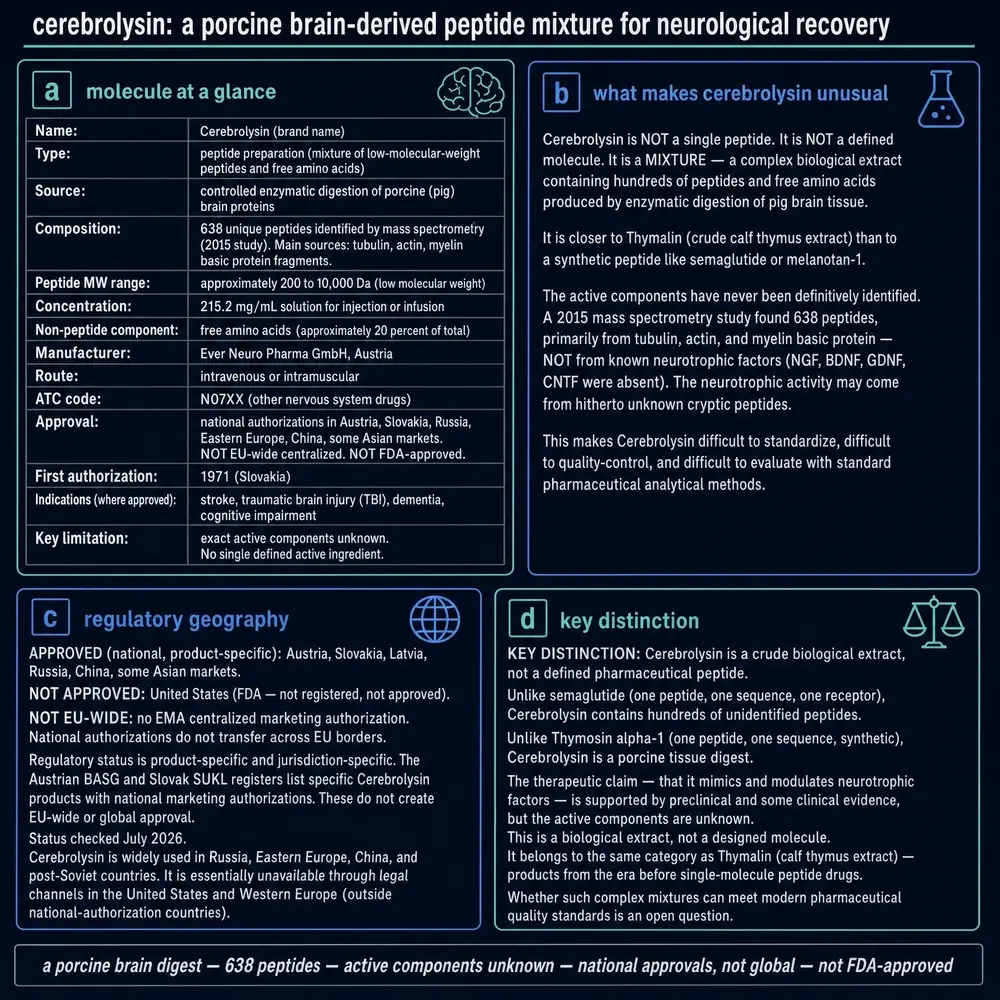
Cerebrolysin belongs to a way of thinking that was mainstream in mid-century central European medicine and has almost entirely vanished from the West: organotherapy, the principle that a failing organ can be treated with an extract of the same organ from an animal. Thyroid extract, which works, is the ancestor of the idea; a great many preparations that did not work are its other descendants.
What makes Cerebrolysin unusual is that it outlived the theory that produced it. Most organotherapeutic products disappeared as the active principles of the tissues they came from were identified and synthesised. Brain never yielded a single active principle, so the extract was never superseded — and the same argument that would once have been a criticism, that nobody can say what is in it, has been reformulated as its central selling point.
03What is actually in it
The manufacturing description that appears in the peer-reviewed literature is consistent and brief: an aqueous, protein-free solution produced by a standardised enzymatic breakdown of lipid-free pig brain proteins (Hutter-Paier et al., 1996). Which protease is used is not stated in the registered text and could not be located in any peer-reviewed source; the widely repeated claim that it is a porcine pancreatic enzyme appears only in commercial material and is not asserted here.
Two numbers are quoted for the composition, and the popular one is the minority position. The figure that appears in most secondary accounts is that Cerebrolysin is about 25 per cent low-molecular-weight peptides and about 75 per cent free amino acids, on a total-nitrogen basis. That figure comes from a single paper (Hartbauer et al., 2001). Four other peer-reviewed sources spanning a quarter of a century give 15 per cent peptides and 85 per cent free amino acids — Akai et al. (1992), writing about the same material under its development code FPF 1070; Hutter-Paier et al. (1996); Schwab et al. (1997); and Allam et al. (2018). Both camps invoke nitrogen content, so the divergence is not obviously an artefact of expressing the same measurement two ways, and neither figure appears in the Austrian registered text at all. The range and both attributions are printed rather than a single chosen figure.
The peptide fraction is conventionally described as everything below 10 kilodaltons. That convention is supported by several independent peer-reviewed papers and is likewise absent from the registered specification, which makes it a convention of the literature rather than a term of the licence.
Two further things are known about the peptide fraction, and they pull in opposite directions. On the reassuring side, batch consistency has been measured: twenty-five separate batches produced a linear dose-response in a cell-based assay with a correlation of 0.99, and a specificity panel run against fifty batches gave a coefficient of variation under nine per cent. Batches of this product behave alike.
On the other side is what that measurement is, and the same paper states it plainly: there is no national or international reference standard for Cerebrolysin. The manufacturer therefore defines an in-house reference batch and reports every potency figure as a percentage relative to it. So the consistency that has been demonstrated is functional rather than chemical — batches agree with one another in one assay against a company-held sample. That is a real and non-trivial quality claim. It is not the same claim as knowing that two batches contain the same peptides, and no published measurement supports the stronger version.
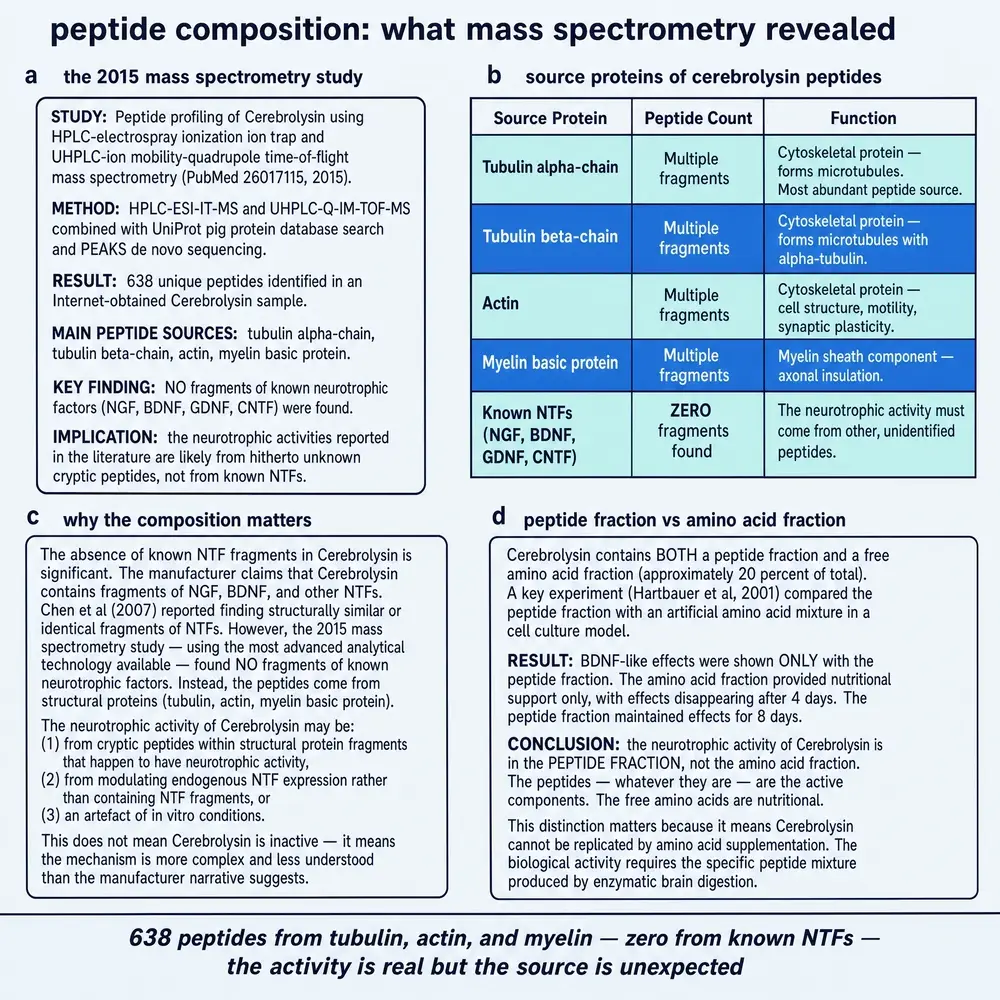
The question a reader will want answered next — which peptides, and how many — does not have a satisfying answer, and the shape of the non-answer is itself informative. What is published is not a list of constituents but a fingerprint: a reversed-phase chromatogram whose peak pattern is reproducible between batches of the genuine product and visibly different between the genuine product and preparations made elsewhere to the same description. A fingerprint establishes that two samples are alike. It does not say what either of them contains.
04The theory that reversed itself
The most striking fact in this drug's history is that its inventor and its current manufacturer disagree about what the active ingredient is, and the disagreement is total.
Harrer's 1954 paper is explicit. The preparation, he writes, contains all the amino acids involved in building the central nervous system, and he proposes that its particular therapeutic effectiveness rests not so much on the action of the individual amino acids as on their mutual quantitative proportion — what he calls the Aminosäuremuster, the amino-acid pattern. The earliest analytical document on the substance, Tuppy's 1953 report, is an assay of its amino-acid content. For its first decades, this was an amino-acid drug whose claimed mechanism was the ratio between its amino acids.
The modern product is defended on the opposite basis. The active fraction is now said to be the peptides, and the amino-acid component is used as the experimental control. In the antiapoptotic work of Hartbauer et al. (2001) an artificial amino-acid mixture is the negative comparator. In the 2024 study comparing Cerebrolysin with eleven competitor preparations, the baseline against which neurotrophic activity is measured is, in the authors' own words, “the amino acid component of Cerebrolysin” — and that baseline produces no relevant signal.
The same trade name, made in the same Austrian town, is therefore now sold on the claim that the part its inventor identified as the active principle is the part that does nothing. Neither position has ever been retracted, because the two were never directly contested; the field simply moved, and the label stayed. A reader is entitled to notice that a preparation whose active principle has been redefined once, without a change of product, is a preparation whose active principle is not established.
05Originator, copies, and a second name
Because Cerebrolysin is specified by process rather than by content, the question of whether a copy is the same drug cannot be settled on paper. It has been tested experimentally, once, and the result matters both for what it shows and for who paid for it.
A 2024 study compared twelve preparations marketed for neurological disorders — Cerebrolysin, a deproteinised calf-blood extract, and ten brain-derived products from manufacturers in China, South Korea and Russia — on two measures: their ability to induce neurofilament-L expression in a rat cell line, and their reversed-phase chromatographic fingerprints. Of the twelve, only Cerebrolysin produced neurofilament-L expression appreciably above the amino-acid control, and every preparation tested had a chromatographic profile clearly different from Cerebrolysin's. Products from different manufacturers sharing the same declared active ingredient were also unlike each other, which the authors read as evidence of unstandardised manufacturing. They report that they could find no clinical studies conducted with any of the copies at all.
Three cautions belong beside that result, and the third is the one that matters most. One batch of each competitor product was tested. The endpoint is a single cell-based assay, not a clinical comparison. And the study was conducted by the originator's own company: the manufacturer supplied both the reference product and the amino-acid control, and the conclusion is that only the manufacturer's product works. That does not make the finding wrong — the chromatographic differences are objective and the design is reasonable — but it is not independent evidence, and no independent replication was located.
The declared active ingredient of most of those copies is cerebroprotein hydrolysate, and that phrase is why both designations must be held apart. It is a second name for the same kind of material, used by a literature that is largely disjoint from Cerebrolysin's own: of twenty-five indexed records naming cerebroprotein hydrolysate, only six also name Cerebrolysin. A search keyed on the trade name alone silently discards three quarters of that work. Both designations are therefore admitted here, counted in separate columns, and attributed to the preparation actually studied whenever the second literature is used — because on the only direct evidence available, they are not the same product.
06Neurotrophic-factor-like, without the neurotrophic factors
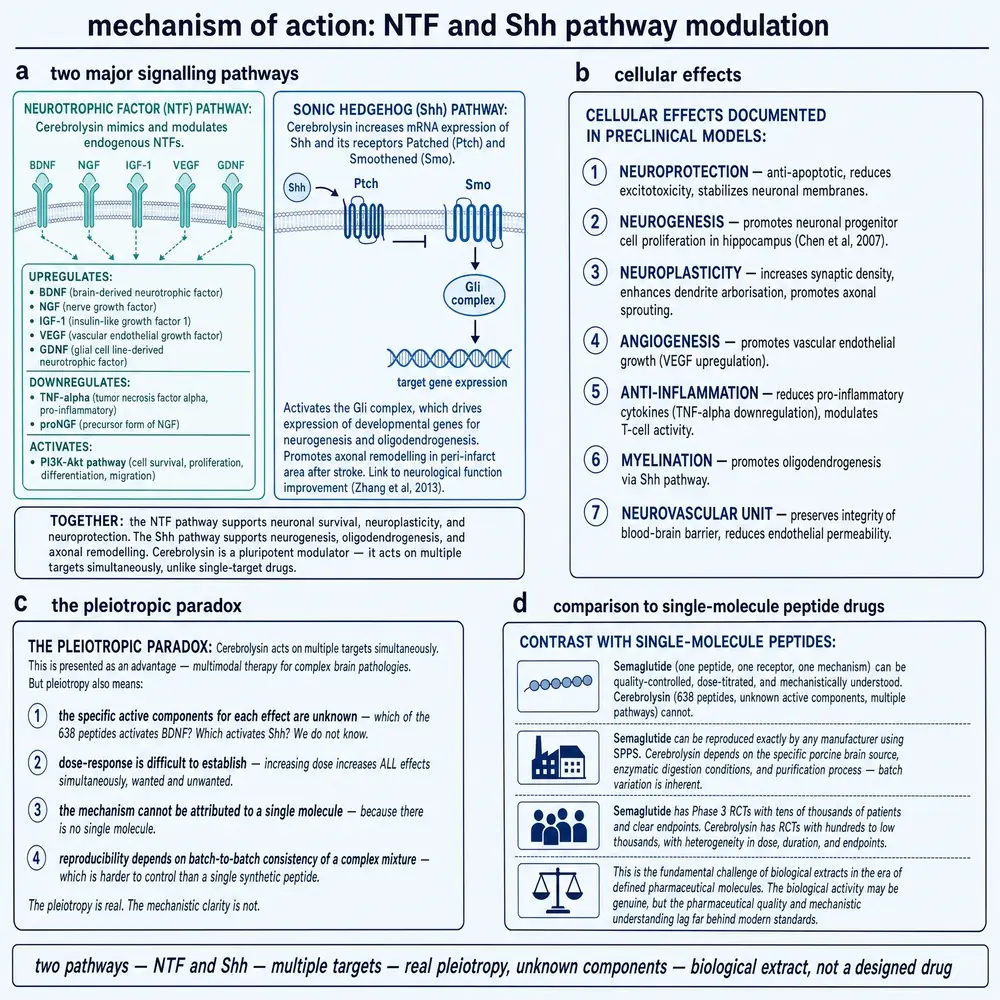
The sentence most often written about this drug is that it mimics the action of endogenous neurotrophic factors. It appears, in one form or another, in a substantial fraction of every paper published about it. It is worth taking seriously, because it is doing two very different jobs at once.
Neurotrophic factors are proteins — nerve growth factor, brain-derived neurotrophic factor, glial cell line-derived neurotrophic factor, ciliary neurotrophic factor — that keep neurons alive and connected. They were among the most promising drug candidates of the late twentieth century and they failed, for a reason that is not in dispute: given systemically they do not reach the brain, and given directly they cause unacceptable effects. A preparation that could produce their effects without being them would be genuinely valuable. That is the claim.
The trouble begins when the claim hardens from mimics into contains. Both forms are in the literature. Several papers state, as compositional fact, that Cerebrolysin contains nerve growth factor, brain-derived neurotrophic factor, ciliary neurotrophic factor or glial cell line-derived neurotrophic factor. One states that brain-derived neurotrophic factor is its main active ingredient. Others state the opposite as flatly: that it contains peptides with such activities but not the intact proteins, and one review reports that no fragments of those factors are found in it at all (Martínez-Iglesias et al., 2022). Two papers cite the same source for opposite conclusions.
There is a physical argument that settles the strong version, and it is striking how rarely the literature states it. Mature brain-derived neurotrophic factor is about 13.6 kilodaltons as a single chain and about 27 as the dimer it actually works as; nerve growth factor, glial cell line-derived neurotrophic factor and ciliary neurotrophic factor are all in the same range or larger. The preparation is specified as the fraction below 10 kilodaltons. A filtrate defined by that cutoff cannot contain intact neurotrophins. Several papers state the cutoff and the containment claim in the same document, without noticing.
What survives is the weaker and more interesting claim: that some of the peptides in the mixture engage the same machinery. The evidence for that is real but thin, and it is worth separating the strands.
The strongest single experiment in the whole mechanistic literature is a blockade study. In cultured neural progenitor cells from the subventricular zone, Cerebrolysin increased the proportion of dividing cells from about 27 per cent to about 44 per cent, and raised phosphorylated Akt — and when the phosphoinositide 3-kinase inhibitor LY294002 was added, both effects disappeared and the proliferation returned to about 30 per cent (Zhang et al., 2010). That is a properly constructed causal experiment: a mechanism proposed, a specific blockade applied, and the effect abolished. Among the mechanistic studies located for this preparation, it is the only one of its kind.
Most of the other named mechanisms are supported far more weakly than their frequency of citation suggests. Calpain inhibition is cited in roughly ten papers; the only data reproduced anywhere is a figure captioned as supplied by the manufacturer (Onose et al., 2009). Activation of the sonic hedgehog pathway is cited in at least six; no primary dataset for it was located. Preservation of the dendritic marker MAP2 is the best-replicated finding, appears in several independent rodent studies, and is not attributable to the manufacturer. And one marker that appears in the promotional literature, GAP-43, belongs in the papers where it appears to dexamethasone and to resveratrol, not to this compound.
The literature contains a clean example of how a hedge becomes a fact. Step one is careful: peptides with ciliary neurotrophic factor-like activity, but not the intact proteins. Step two drops the qualifier: fragments of neurotrophic factors. Step three generalises: composed of neurotrophic factors including BDNF. Step four, in a paper published in 2024, states that the medication's main active ingredient is BDNF.
No new measurement occurs at any step. Each paper cites the one before it. The final claim is false on the preparation's own specification, and it is now in the indexed literature where the next reader will find it.
07What the preclinical work actually shows
The animal literature is large, generally positive, and separated from human dosing by a wider margin than is usually acknowledged.
The most informative rodent study is a stroke model in which rats received Cerebrolysin intraperitoneally for twenty-one days beginning a day after an embolic occlusion. Function improved on three separate behavioural measures at the two higher doses, and the effect persisted to twenty-eight days; cells undergoing programmed death at the edge of the injury fell by roughly half; and new neurons appeared in the subventricular zone. The result that matters most, though, is the one the authors report as a null: infarct volume was not significantly reduced (Zhang et al., 2010). The entire argument of the paper is built on that null — the drug is proposed to work by promoting recovery rather than by saving tissue. Several later reviews nonetheless state that it reduces infarct volume, always by citation and never by measurement.
A second study, in a mouse model of Alzheimer's-type pathology, is unusually honest about persistence. Animals were treated for three months and then followed. Behaviour and synaptic markers were improved immediately after treatment and still improved three months later; by six months both had returned to baseline. Amyloid deposits were reduced by 55 to 65 per cent immediately after treatment, by 35 per cent at three months, and not at all at six (Rockenstein et al., 2011). The authors note the dissociation themselves: the behavioural benefit outlasted the amyloid effect, so amyloid clearance cannot be the mechanism.
The dose gap is the part of this literature that is least often stated plainly. A human course of 30 millilitres a day works out, at the registered concentration and for a seventy-kilogram adult, to roughly 92 milligrams per kilogram. The rodent studies run from about 430 to 1,930 milligrams per kilogram — between six and twenty-one times the human exposure on a straight weight basis, before any correction for the faster metabolism of small animals, which would widen the gap further. No rodent study located here tested a dose at or below the human equivalent.
The head-to-head comparison against Cortexin, a Russian cortex-derived preparation, is worth reporting for the same reason. Both beat placebo on neurological deficit and on two behavioural tests, and both reduced the volume of necrotic tissue — Cortexin by 45 per cent and Cerebrolysin by 38. But Cortexin achieved that at 1 to 3 milligrams per kilogram and Cerebrolysin at 538 to 1,614 (Kurkin et al., 2021). The authors draw the obvious conclusion, which is that the peptide content matters and that Cerebrolysin's is dilute. The study is Russian and Cortexin is a Russian product, which is a reason to read the ranking cautiously; it is not a reason to discount a five-hundred-fold difference in the dose required.
08The pharmacokinetic void
There is no human pharmacokinetic data for Cerebrolysin. Not sparse data, not old data — none. No maximum concentration, no time to peak, no area under the curve, no half-life, no clearance, no volume of distribution, no measurement in plasma or cerebrospinal fluid, no bioavailability figure, no identified metabolite, no dose-proportionality study.
This is not an oversight, and it is not a criticism of anyone in particular. It follows directly from the composition problem in Section 03. Pharmacokinetics measures the concentration of a defined substance over time. Cerebrolysin has no defined substance in it to measure. With an unenumerated peptide mixture and no identified active principle, there is nothing to assay, and so nothing has been assayed. The literature says so where it addresses the point at all: one review notes that larger trials would be needed to determine the pharmacokinetics; another observes that the appropriate dose and duration ought to be chosen on pharmacokinetic grounds and cannot be.
Two consequences follow, and both matter for reading the clinical chapters that come next.
The dose was chosen empirically. Human trials have used 10, 20, 30 and 50 millilitres a day, a five-fold range, with no pharmacokinetic basis for preferring any of them. The dose-ranging trial in Alzheimer's disease illustrates what that produces: across three doses, cognition improved in the lowest arm, daily-activity scores in the middle arm, and neuropsychiatric symptoms in the highest. That is not a dose-response relationship. It is the pattern that appears when several endpoints are tested across several arms.
And the central delivery claim is largely untested. That the preparation crosses the blood-brain barrier is asserted in a dozen papers and measured in one: a mouse tracer study in which brain radioactivity thirty minutes after injection was about 5 per cent of whole-blood radioactivity for Cerebrolysin, against 3 per cent for albumin — the negative control — and 6 to 8 per cent for Cortexin. One paper that asserts barrier penetration concedes a few paragraphs later that it is not known how much reaches the brain. A related confusion is worth naming: several papers describe the drug stabilising the blood-brain barrier after injury, which is a different claim from crossing it, and the two are frequently run together.
An absent pharmacokinetic profile is not evidence that a drug does not work. Aspirin was in use for seventy years before its mechanism was understood, and plenty of effective medicines were adopted before anyone could measure them.
What it does mean is narrower and still important: no dose in any trial of this compound can be justified as the right one, no failure can be attributed to under-dosing, no success can be attributed to reaching a target concentration, and no batch can be shown to have delivered the same exposure as another. Every clinical result reported below was obtained under those conditions.
09Ten retracted papers
Publication status is taken from the indexed record itself — publication type and the corrections list — not from secondary summaries. Of the 637 admitted indexed records, ten carry a retracted publication type, and one further paper carries an editorial expression of concern.
They are three separate matters, and treating them as one story would misstate the record.
The first cluster is the one that matters for this compound
Four retracted papers and the paper under an expression of concern come from a single laboratory at the University of California, San Diego, with Eliezer Masliah as senior author and, on four of them, Edward Rockenstein — whom the notices record as deceased — as first author. They are the transgenic-mouse studies: a Rett syndrome model published in 2008, a comparison of ciliary neurotrophic factor-derived peptides with Cerebrolysin in an amyloid model in 2011, a tauopathy model in 2014, and a Pick's disease model in 2015. The expression of concern, issued in 2026, attaches to a 2009 paper on tau pathology in amyloid-transgenic mice.
The stated grounds in every case are image integrity. The notices specify overlapping figure panels representing animals under different experimental conditions, an edited background, and in one instance blots the authors confirmed had been spliced to remove a marker lane, which they said was considered acceptable at the time. One notice records that the editors were alerted by a post-publication discussion forum; the expression of concern records that concerns were raised by a third-party whistle-blower. The senior author disagreed with two of the retractions, did not state a position on a third, and agreed to the expression of concern; on the fourth, the authors did not reply to the publisher.
Two facts about these papers belong in the same paragraph as their withdrawal, because both are printed on the papers themselves. The manufacturer's own staff are co-authors — employees of EBEWE Pharmaceuticals and later of EVER Neuro Pharma appear across the set. The work was funded in part by the manufacturer, which one paper's funding statement records directly. And that paper's competing-interests statement discloses that its two senior authors were advisers to a company described there as a wholly owned United States subsidiary of EVER Neuro Pharma.
The second cluster rests on a national misconduct finding
Three further retracted papers come from a group at Uppsala University working on nanoparticle-delivered formulations, with Hari Shanker Sharma as corresponding author. Two of the three notices give an unusually specific reason: an investigation by Sweden's National Board for the Assessment of Research Misconduct determined that one or more elements of data, in the form of tissue images or reported statistical results, was fabricated or falsified, and they cite the board's decision of 29 November 2024 by case number.
That decision is worth describing, because Cerebrolysin is not incidental to it. The board's own background section states that Cerebrolysin is central to the research it examined, its protective effect having been investigated in laboratory animals in a large part of the reported publications. Fifty-six publications were reported and forty-eight examined; of 140 suspicions tested, 125 were judged to constitute falsification, the largest category being photographs of one tissue sample presented as different samples. Six researchers were found responsible, two judged to have acted intentionally and four grossly negligent; all denied it. An administrative court has since upheld the finding, and appeals were pending as of March 2026, so the judgment is not final.
The published decision is anonymised and names no individual, and none is named here. What can be said from primary instruments is narrower and sufficient: two Cerebrolysin papers were retracted by their publisher on the strength of that finding, and the corresponding author of both is named in the retraction notices themselves.
One notice from this cluster records something else worth reporting: a listed co-author stated that he did not participate in the research and that his name and affiliation were added to the author list without his consent.
The third cluster is not about Cerebrolysin at all
The remaining three retracted papers come from two Egyptian groups and concern stem-cell and drug-combination work in rodent models. Their notices cite plagiarism and overlap of data, figures and tables with an unrelated earlier publication. Cerebrolysin appears in them only as a reference comparator, and they say nothing about it. They are counted here because they are in the admitted set, and separated because folding them into this compound's integrity record would overstate it.
What this does and does not touch
No clinical trial of Cerebrolysin is retracted or under an expression of concern. Every withdrawn paper is an animal or laboratory study. Of the ninety-one indexed clinical-trial publications on this compound, not one is flagged, and the formal intersection of that set with the withdrawn set is empty. No Cochrane review cites any affected paper: the reference lists of the stroke and vascular-dementia reviews were retrieved and checked directly, and the hit count is zero in every one that could be retrieved. Nothing in the clinical sections that follow rests on withdrawn work.
Across thirty-nine indexed systematic reviews and meta-analyses the check returns one hit, and it is worth naming precisely rather than rounding to none. A 2011 review of drug treatments for Alzheimer's disease — a whole-field review, not a Cerebrolysin one — cites the 2009 paper that carries the expression of concern, as one of 260 references. That is the whole of the exposure in the systematic-review literature.
Two documents are more exposed, and neither is a trial. A 2021 narrative review arguing the case for this compound in Alzheimer's disease cites four affected papers; it is the most prominent recent synthesis of that case, and its mechanism section rests on them. And a 2022 biomarker analysis in patients — cited below for its finding that the markers did not track the clinical outcome — cites four affected papers in its rationale. Its own data are unaffected; what is exposed is the framing it inherited.
Nor is the preclinical case wholly removed. The senior author of the first cluster published twenty-one Cerebrolysin papers between 1999 and 2016, and sixteen remain unflagged, including the founding amyloid-transgenic series. There is also a genuinely independent preclinical literature — most substantially from a group at Henry Ford Hospital on neurogenesis and functional recovery, whose author lists carry none of the affected names, and which is the source of the blockade experiment reported in Section 07 as the strongest single result in the mechanistic literature.
What has been removed is specific, and it is the most quotable part: the demonstrations that this preparation acts on tau pathology. Here the damage is worse than a count of retractions suggests. A search for an independent animal study reporting reduced tau phosphorylation or tau pathology with this preparation — one with no author from the affected laboratories — did not find one. Every such paper located is either retracted, under an expression of concern, or from the same two groups. The tau claim now rests on withdrawn work with no arms-length replication that could be located. That is an absence in a search rather than a proof of absence, and it is reported as such.
The amyloid and neurogenesis limbs stand better. The founding amyloid-transgenic papers are unflagged, and neurogenesis has genuinely independent support from a New York group publishing in 2003 and 2007 — with the caveat, which belongs in the same sentence, that the same laboratory later co-authored one of the retracted papers. Synaptic protection is the best-replicated limb, with at least four arms-length groups in three countries. And one further caution: two studies reporting reduced amyloid and phosphorylated tau in transgenic mice test cerebroprotein hydrolysate, the second-name preparation of Section 05, and must not be read as evidence about this one.
The defensible statement is narrow, and it is not fraud in the clinic. It is that the preclinical rationale has been materially damaged while the clinical evidence base is untouched by retraction — and that the trials reported below were designed against a rationale that is now partly withdrawn.
A retracted paper is never cited here in support of a factual claim about the compound. It is described only as a claim that was made and withdrawn, and the same passage says what remains if it is set aside.
An expression of concern is a different instrument from a retraction and is not collapsed into one. It records an unresolved question, not a withdrawal.
Two further points of precision, because both are easy to get wrong. The United States National Institutes of Health made a finding of research misconduct against the senior author of the first cluster in September 2024, concerning re-use and relabelling of figure panels in two publications it did not name. That finding covers his work at NIH from 2016 onward; the retracted Cerebrolysin papers are all from the earlier university period and fall outside it. As of August 2026, no federal research-integrity finding covering them has been published. The retractions rest on journal investigations and, for the second cluster, on the Swedish decision.
And the manufacturer's position is on the record. Asked about the challenged work by Science in 2024, its head of research and development for neurology said that none of it played a crucial role in the clinical development of Cerebrolysin, that the company took the allegations seriously, and that it would refrain from using data from the named publications until the matter was clarified (Piller, 2024). The same report states that eight studies from the affected laboratory, funded in part by the company, had supported its development case. Readers should note that the person quoted is himself a co-author on one of the retracted papers.
10The trials, and what their primary endpoints did
Cerebrolysin has been through an unusually large number of randomised trials in acute ischaemic stroke. That volume is why it deserves careful treatment rather than dismissal, and why the single most useful discipline a reader can bring to this literature is to ask, of every trial, one question: what was the pre-specified primary endpoint, and did it move?
Asking it changes the picture substantially.
CASTA is the largest randomised trial of the drug ever run: 1,070 patients across fifty-one centres, mostly in China, treated within twelve hours of stroke onset with 30 millilitres a day for ten days. Its pre-specified primary endpoint was a composite of the National Institutes of Health Stroke Scale, the modified Rankin scale and the Barthel Index at ninety days. It was not met. There was no significant difference between drug and placebo (Kim & Kim, 2016). What is cited instead, almost universally, is a post hoc subgroup: among the 246 patients with a baseline stroke-scale score above 12, the treated group improved by about three points more at ninety days, at p = 0.04. That subgroup is the origin of the entire “works in severe stroke” literature, and it is the stated rationale for the trial programme that followed.
CERE-LYSE-1 tested the drug on top of clot-dissolving therapy in 119 patients across five countries. Its primary endpoint was the modified Rankin scale at ninety days. It was not met. The positive finding reported from it is a secondary responder analysis on the stroke scale at four separate time points, with no stated correction for testing four times.
ECOMPASS, in Korea, randomised seventy patients and pre-specified improvement in the Fugl-Meyer motor assessment. It was not met — no interaction between time and treatment on any Fugl-Meyer measure. The published conclusion, that the drug benefits motor recovery in patients with severe impairment, rests on a pre-planned subgroup of thirty-seven people.
CARS-1 did meet its endpoint, and by a wide margin: an Action Research Arm Test effect of 0.71 on the Mann-Whitney measure, in 208 patients treated for twenty-one days alongside standardised rehabilitation (Guekht et al., 2017). It is the strongest positive randomised result in the literature. It also has a problem that its own successor exposed. The CARS-1 placebo group did unusually badly — a final placebo arm score of 27 against 53 in the otherwise identical CARS-2, with 49 per cent of CARS-1 patients starting at zero against 20 per cent in CARS-2, and an extracted rate of good outcome in the placebo arm of 33.7 per cent. When a treatment effect is produced as much by an unexpectedly poor control group as by an unexpectedly good treated one, the effect is fragile.
CARS-2 ran the same protocol in 240 patients and produced a much weaker result: a disability effect of 0.52 against CARS-1's 0.70, where 0.50 is no effect at all.
The two were then pooled, and the pooled analysis is where the strongest published claim comes from: an effect of 0.62, p < 0.0001. Buried in the same paper is the sensitivity analysis. Under a random-effects model — the model that accounts for the possibility that the two trials are estimating genuinely different things — the result is p = 0.1791, and not significant. The heterogeneity statistic between the two trials on the primary endpoint was 0.90, meaning they disagreed almost entirely. The authors dismiss the random-effects result as inappropriate with only two studies, which is a defensible statistical position; it is nonetheless the single most important fragility in the CARS evidence, and it is almost never quoted downstream.
11Why the meta-analyses disagree
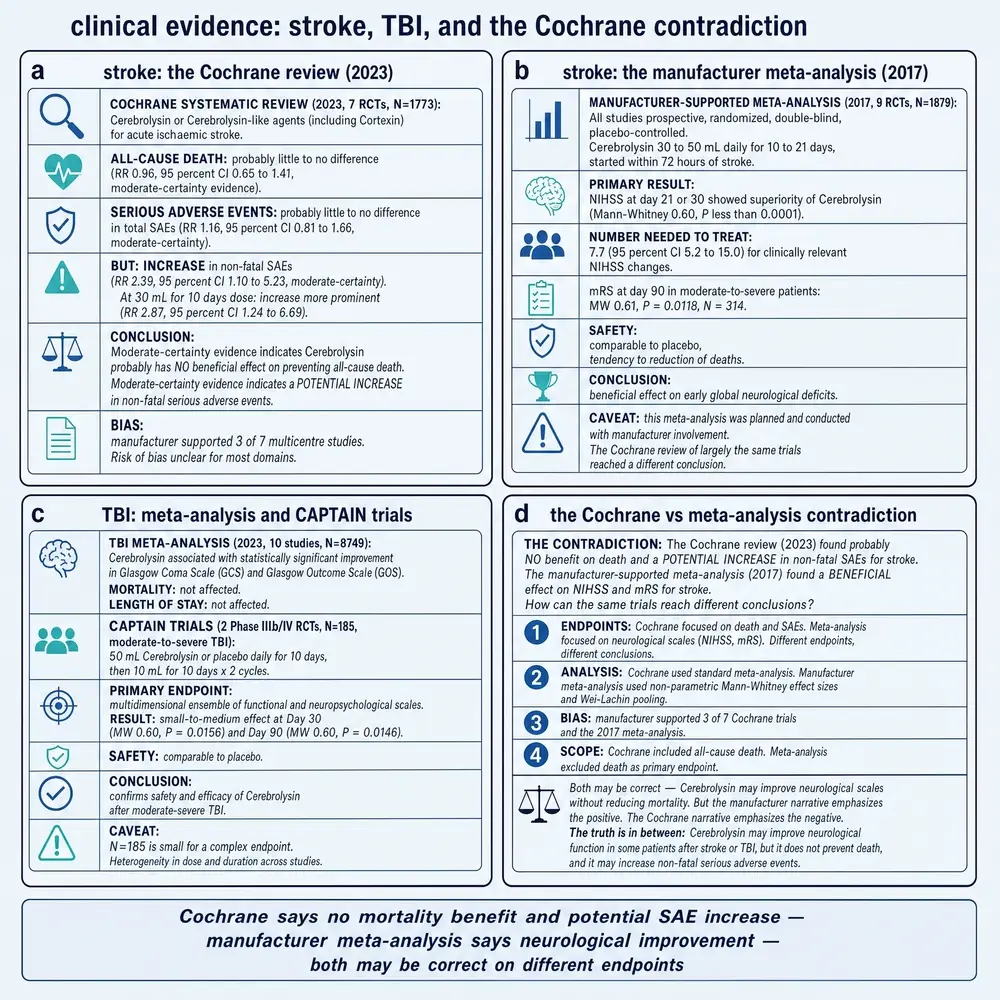
Three major meta-analyses of essentially the same trials reached opposite conclusions within a year of each other. That looks like a scandal and is actually informative, because the disagreement is entirely explained by three design choices and the authors on both sides say so.
The positive analysis pooled nine trials and 1,879 patients and found an early stroke-scale effect of 0.60, with a number needed to treat of 7.7 (Bornstein et al., 2018). The two negative analyses pooled six and seven trials over similar numbers and found nothing: disability relative risk 1.33, stroke-scale relative risk 1.03, Barthel relative risk 0.95, every confidence interval spanning no effect. One concluded that routine administration cannot be supported by the available randomised evidence (Wang et al., 2017); the other that routine use could not be backed by the available evidence (Zhang et al., 2017).
The three differences are these. The positive analysis measured change from baseline on full ordinal scales; the negative ones measured absolute values, dichotomised into good and poor outcome. The positive analysis emphasised days 21 to 30; the negative ones day 90. And Cochrane's inclusion window of forty-eight hours from stroke onset excludes the CARS trials entirely, because they enrolled at 24 to 72 hours.
The author of the positive analysis attacks dichotomisation as arbitrary and underpowered, which is a real methodological point. The author of one negative analysis concedes the corresponding one: every included trial showed accelerated recovery early, and “these inspiring results vanished at the final visit on Day 90 in several trials”. Both are right, and together they are the finding — an early, reproducible acceleration on a neurological impairment scale, and no demonstrated difference in how disabled patients are three months later.
One further caution belongs with the positive analysis, and it is not about its statistics. It states that the manufacturer helped identify sources for it. Its analytic method was pre-specified inside a manufacturer-sponsored trial and then applied to the whole literature. It has no published protocol and no registration. Its risk-of-bias assessment was performed by the same statistical contractor that appears as an author on the trials being pooled. None of that makes its arithmetic wrong; all of it bears on how much independent weight a reader should give it.
A 2025 meta-analysis reports that Cerebrolysin reduces haemorrhagic transformation, relative risk 0.55 with a confidence interval of 0.32 to 0.92, no heterogeneity, and “high certainty”. It is the most cited recent claim in the drug's favour.
Adding up the events in that paper's own table gives three haemorrhages in 650 treated patients and eight in 739 controls. Eleven events. That yields a relative risk of about 0.43 with a confidence interval running from roughly 0.11 to 1.60 — not significant, and nowhere near high certainty. The published figure cannot be reproduced from the data printed beside it.
The same paper counts the CARS-1 patients twice, once as a trial and once inside the pooled CARS analysis it also lists as a trial; enters one trial's improvement counts as if they were outcome rates; gives one placebo arm as 30, 29 and 39 patients in three different tables; and describes an open-label trial as placebo-controlled and double-blind.
12The thrombectomy era
Stroke care changed fundamentally after 2015. Mechanical removal of the clot became standard for large-vessel occlusion, and the question for any neuroprotective agent became whether it adds anything on top. Recency should be weighted heavily here, because a drug tested against 2005 standard care is being tested against a different disease course from the same drug tested against 2025 standard care.
The recent evidence divides sharply by design, and the division is the finding.
The randomised evidence agrees with the older randomised evidence. CEREHETIS, published in 2023, gave the drug alongside clot-dissolving therapy in 341 patients (Khasanova et al., 2023). It had two co-primary endpoints. Symptomatic bleeding into the infarct fell — 3.2 against 9.3 per cent, odds ratio 0.248 — and that is a real result. Any bleeding, the other co-primary endpoint, did not reach significance in the main analysis (p = 0.078). And disability at ninety days was unchanged: p = 0.240, with good outcome in 75.4 against 69.8 per cent, p = 0.265. The trial was open-label, because, as its authors explain with some candour, the drug is yellow and could not be disguised. Its symptomatic-bleeding result rests on twenty-four events in total.
That is the same shape as CERE-LYSE-1 a decade earlier: safe, an early neurological signal, no functional benefit at ninety days.
The positive recent evidence is entirely non-randomised. Three cohorts have reported striking results for the drug added to thrombectomy. In Warsaw, fifty treated patients were compared with fifty propensity-matched historical controls (Staszewski et al., 2025, 2026): good outcome 68 against 44 per cent at ninety days, and 74 against 46 at twelve months. In Cairo, seventy-five treated patients against seventy-five historical controls (ElBassiouny et al., 2025): good outcome 64 against 34.7 per cent, symptomatic bleeding 2.7 against 41.3 per cent, mortality 5.3 against 32.
Those are very large effects, and there is a specific reason to distrust them. The control arms are anomalous. A symptomatic haemorrhage rate of 41 per cent and a ninety-day mortality of 32 per cent after successful thrombectomy in Cairo, and a 24 per cent haemorrhage rate in Warsaw, sit far outside what contemporary thrombectomy practice produces. Both control groups were treated in earlier calendar years than the treated groups. When the comparison group is drawn from an earlier era, improvement in everything else — technique, imaging selection, timing, aftercare — is attributed to the drug. Secular trend is a live and unexcluded explanation for the whole of this signal.
The Warsaw study is candid about its own limits, and its internal detail argues against a large effect. Twelve-month mortality was identical, 18 per cent in both arms. Every measure of recovery trajectory was null. And the ordinal analysis loses significance (p = 0.053) when adjusted for stroke severity measured before the thrombectomy rather than after it. Its authors describe the work as hypothesis-generating rather than evidence of efficacy, which is the correct description.
The largest recent study, an observational registry of 1,769 patients across sixteen countries, reports an odds ratio for good outcome of about two (Vosko et al., 2025). It is prospective and it is not randomised: physicians chose who received the drug, the arms differed substantially in how many received clot-dissolving therapy, and that imbalance was not in the matching set. Its effect size is two to three times anything the randomised literature has produced, which in a non-randomised design is a reason for suspicion rather than encouragement.
No randomised trial of Cerebrolysin with thrombectomy has reported. Several are said to be running.
13Safety, and the one durable signal
On the two measures that matter most, the answer is reassuringly dull. Mortality shows no effect in either direction — six independent meta-analytic estimates, every one non-significant, ranging from a relative risk of 0.82 to 0.96. Overall adverse events show no difference: roughly 44 to 46 per cent of patients in both arms across every large synthesis. For a drug given intravenously for ten to twenty-one days to people in the acute phase of a stroke, that is a good safety record and it should be said plainly.
There is one exception, and it has proved durable. Three successive Cochrane reviews have reported an increase in non-fatal serious adverse events: relative risk 2.15 in 2020 (Ziganshina et al., 2020) and 2.39 in 2023 (Ziganshina et al., 2023), both at moderate certainty, and 2.86 and 2.87 in the subgroup treated with the commonest regimen of 30 millilitres a day for ten days. The 2023 confidence interval runs from 1.10 to 5.23 — significant, but wide, and resting on three trials.
Two things should be said about it, and they pull in opposite directions.
The first is that every independent attempt to reproduce it points the same way. The two negative meta-analyses found relative risks of 1.20 and 1.18; a twelve-trial safety analysis found 1.18 (Strilciuc et al., 2021). None reached significance, but none pointed the other way either. A signal that is consistent in direction across five analyses and significant in the most methodologically conservative of them is not easily dismissed.
The second is that the strongest criticism of it is substantive. The twelve-trial safety analysis argues that Cochrane's split between fatal and non-fatal serious events was constructed inconsistently — that one trial was included for non-fatal events but excluded from the fatal analysis despite reporting deaths in both arms, without a stated general rule. That is a real methodological objection. It should also be read knowing that the twelve trials in that analysis were assembled with the manufacturer's assistance, while Cochrane's three met a strict forty-eight-hour window.
The honest position is that a modest excess of non-fatal serious events cannot be ruled out, that it has never been reproduced at significance outside Cochrane, and that it is systematically absent from the syntheses closest to the manufacturer.
Cochrane's 2023 review looked for the outcome that matters most to a patient — being dead or dependent at the end of follow-up — and found that not one eligible trial reported it. The same is true of quality of life, of early death, and of time to return to work.
After more than a dozen randomised trials and nearly three thousand randomised patients, the question “does this drug leave fewer people disabled?” has not been answered because it has not been asked in a form the review could pool.
14Traumatic brain injury
The traumatic brain injury programme is smaller than the stroke programme and turns on a single methodological question that a reader has to understand before the results mean anything.
The two CAPTAIN trials are the flagship (reviewed in Jarosz et al., 2023). CAPTAIN II randomised 142 patients with moderate-to-severe injury at a single centre in Romania to the drug or saline, in an initial ten-day course followed by two further cycles. Its result is reported as an effect of 0.59 with a confidence interval of 0.52 to 0.66, p = 0.0119, which the authors themselves describe as small-to-medium.
What that number measures is the important part. CAPTAIN II has no conventional single primary endpoint. Its pre-specified primary outcome is a multidimensional ensemble of thirteen separate outcome scales, assessed by a multivariate directional test. There is no reported Glasgow Outcome Scale result, no disability-rating result, and no mortality result that met a pre-specified single-outcome test, because none was pre-specified. The hypothesis the test evaluates is that the treated group is stochastically superior across the ensemble — a materially weaker claim than that the drug improved any particular outcome by any particular amount.
This is not by itself illegitimate. Composite multivariate endpoints have a real statistical rationale in conditions where no single scale captures recovery, and traumatic brain injury is such a condition. But it means that the sentence “CAPTAIN II was positive” and the sentence “Cerebrolysin improved outcome after brain injury” are not the same sentence, and only the first is supported.
The registry adds a detail the publications do not emphasise. The CAPTAIN trial registered on ClinicalTrials.gov is recorded as terminated, and the reason field reads “poor patient recruitment”. Three further registered Cerebrolysin studies are stopped: two terminated for stated strategic, pandemic and recruitment reasons, and one withdrawn with no reason recorded at all. None was stopped for a safety or integrity reason. Of forty-two registered studies, the manufacturer is lead sponsor on eight, which are also the largest.
Two further findings complicate the picture, and both come from within the programme itself. A re-analysis of CAPTAIN II's own dataset, using 125 of the 142 patients, reversed one of its headline component results: the depression score that the original reported as significantly improved was not significant on re-analysis, while an anxiety score not emphasised originally was strongly significant. The difference is attributed to how missing data were imputed. And the programme's third trial, CAPTAIN-rTMS, was negative on its pre-specified primary composite (Verisezan Rosu et al., 2023) — p = 0.06 at day 101 and p = 0.54 at day 180 — with the individual scales agreeing with the composite.
The wider traumatic-brain-injury literature is thinner than its volume suggests. The two meta-analyses pooled ten and five studies (Jarosz et al., 2023; Ghaffarpasand et al., 2019); in the first, only three of ten were blinded, and in the second, four of five were cohort studies and one was a randomised trial. The first found a Glasgow Outcome Scale difference of 0.42 but no significant effect on the Glasgow Coma Scale (p = 0.1) and none on length of stay — and then concluded in favour of an effect on both coma scale and outcome scale, which its own pooled estimate does not support. The second reported a low level of evidence in its own words.
Several individual studies point the other way and are worth stating, because they are cited less often. A trial of twenty-one patients found a difference that was not statistically significant and is routinely cited as positive. A Polish pilot of fifty-six patients found no effect on outcome scale, length of stay or mortality, and its authors wrote that they could make no recommendations (Jarosz et al., 2024). A matched cohort of eighty severe-injury patients receiving the drug on top of citicoline found no difference on its primary six-month outcome (p = 0.417) or on mortality (p = 0.809), with intensive-care and hospital stays numerically longer in the combination arm (Schlager et al., 2025).
In subarachnoid haemorrhage, the largest study is a retrospective series of 462 patients (Park et al., 2018), and its result has an instructive shape: mortality fell — 9.0 against 17.4 per cent — while disability did not move at all. Median disability score was 2 in both arms; the proportion with a good outcome was 52.2 against 55.2 per cent, slightly favouring the control group. In the poor-grade patients, where the mortality difference was largest, the treated group had numerically fewer good outcomes. Angiographic vasospasm was more frequent on the drug, 52.2 against 28.8 per cent.
In mild injury and concussion, the entire human evidence base is one pilot trial of thirty-two people. It found a difference on one cognitive instrument at twelve weeks (p = 0.046) and none on another (p = 0.111). The standard deviations were as large as the means, and the placebo group improved by more than a third of the treated group's improvement on its own — which is what one expects in a condition where 80 to 85 per cent of people recover fully without treatment. Neither meta-analysis was able to pool it. It does not support a claim of efficacy.
15Dementia, and the difference between detectable and meaningful
The dementia literature is where the distinction that runs through this whole document is sharpest, and where the reviewers themselves state it most clearly.
The Cochrane review of Cerebrolysin in vascular dementia pooled six randomised trials and 597 patients (Cui et al., 2019). It found a cognition effect of 0.36 and a global-function relative risk of 2.69, both nominally positive, and no difference in adverse events. It rated the certainty of every one of those findings as very low, and wrote:
“If there are benefits of Cerebrolysin, the effects may be too small to be clinically meaningful.” And, in the version written for patients: “Even if the benefit reported in the studies is real, the effect was modest and may not be important to people living with dementia.”
The review also records that where funding details were available, all of those studies were supported by the pharmaceutical industry; that follow-up ranged from fifteen days to three years; and that no eligible new trial has appeared since 2013. The evidence base is not accumulating.
There is a technical reason the effect cannot be translated into anything a patient would recognise. The pooled figure combines two different instruments — a thirty-point screening test and a seventy-point cognitive battery — into a standardised unit. That unit cannot be converted back into points on either scale, and so it cannot be compared against any published threshold for a clinically important difference. “Statistically detectable” and “clinically meaningful” come apart precisely here, and the review says so.
The most informative single result in the dementia literature concerns persistence, and it comes from a trial comparing the drug against donepezil and against the combination in 200 patients (Alvarez et al., 2016). The trial found no difference between arms on cognition. Dosing stopped at week 16; by week 28, twelve weeks later, the drug arm had lost the within-group improvement it had at week 16, and its combined responder rate had fallen from 42.8 to 31.3 per cent. Serum brain-derived neurotrophic factor, which had risen significantly at week 16, had returned to baseline — in the paper's own phrase, the increase “vanished 12 weeks after stopping”.
The same pattern appears in the largest quantitative synthesis of this class of drug: cognition at under four weeks gives a standardised effect of −0.16, significant; the same measure at three to seven months gives −0.07 and is not significant (Alsulaimani et al., 2021). Publication bias was, in the authors' phrase, strongly suspected for both. Every efficacy outcome was rated very low certainty, and the authors concluded that the effects “would be regarded by many as smaller than the minimal important clinical difference”.
The biomarker studies deserve particular care, because they are the part of this literature most often presented as mechanistic confirmation. All three come from the same trial and none has a placebo arm. They are also not independent of the parties with an interest in the result: their author lists include employees of the manufacturer, and the senior author of the retracted preclinical work discussed in Section 09. The investigators nonetheless report the crucial negative themselves: brain-derived neurotrophic factor levels and their changes “showed no significant correlations with measures of clinical efficacy” — not with cognition, not with neuropsychiatric symptoms, not with global function. In the companion study of amyloid and tau markers, of eighteen correlations tested between biomarker and clinical measures, one weak one survived adjustment for disease severity (Alvarez et al., 2022). A biomarker moved; the patients did not.
The most recent appraisals are also the least favourable, which matters under a recency-weighted reading. A 2025 systematic review of vascular cognitive impairment covering 173 trials and 22,347 participants (Masserini et al., 2025) includes Cerebrolysin on two trials and 173 participants, rates the evidence low, notes that functional endpoints lacked sufficient data to pool at all, and dismisses the class in a sentence: these agents “were associated with small statistical effects and negligible clinically meaningful effects, we will not discuss them further”. A Bayesian network meta-analysis of 194 randomised trials across twenty-one drugs (Dang et al., 2024) does not rank Cerebrolysin in its cognition table or its daily-activities table at all; it appears only in the safety column.
16What the guidelines say, and a distinction that is easy to get wrong
Two European guideline documents address this drug, they reach opposite conclusions, and conflating them is a material error that appears in the secondary literature.
On cognition after stroke, the joint guideline of the European Stroke Organisation and the European Academy of Neurology declines to recommend it (Quinn et al., 2021). The guideline posed the question directly — whether Cerebrolysin or Actovegin improves cognitive decline after stroke — and reported that it found no trials with an exclusive focus on post-stroke cognitive impairment at all. Its discussion states that the group “could find no evidence for the use of actovegin and cerebrolysin following stroke and noted concerns around safety and cost”. It records moderate-quality evidence that the drug has no effect on mortality in acute stroke and is associated with possibly increased adverse-event rates. Its plain-language summary tells patients the same thing.
On motor rehabilitation after ischaemic stroke, a different guideline — from the European Academy of Neurology with the European Federation of Neurorehabilitation Societies — does recommend it, for early motor neurorehabilitation.
Both statements are accurate. They concern different outcomes, were produced by different working groups, and answer different questions. A reader who encounters only the second could reasonably conclude that European neurology endorses the drug; a reader who encounters only the first could reasonably conclude the opposite. Neither conclusion is right; both statements are reported below.
Outside those two documents the picture is uniform. No major international dementia guideline recommends Cerebrolysin. A 2025 review of mild cognitive impairment (Mangalagiu et al., 2025) concludes that it and Actovegin “cannot currently be regarded as standard therapy” and are “better viewed as experimental or adjunctive”, noting that almost all the supporting data come from Eastern European or Russian cohorts. And the European guideline makes the structural observation that matters most: unlike the cholinesterase inhibitors and memantine, the nootropics do not have international approval for use in dementia.
17The regulatory geography
Cerebrolysin occupies an unusual position: widely licensed, and licensed almost nowhere that runs a large independent drug regulator.
It is authorised in its country of origin under an Austrian marketing authorisation held by EVER Neuro Pharma of Unterach. The registered indications, in the regulator's own text, are senile dementia of the Alzheimer type, vascular dementia, deficits following stroke, and craniocerebral trauma. Published reviews put the number of countries where it is approved at 44 or “over 45”, concentrated in central and eastern Europe, Russia, China, South Korea and parts of south and south-east Asia. It is not approved in the United States, and the European guideline quoted in Section 16 makes the wider point plainly: unlike the cholinesterase inhibitors and memantine, the nootropics as a class “do not have international approval for use in dementia”.
It is worth being careful about what that asymmetry does and does not imply, because it is easy to read too much into it in either direction.
It does not mean the drug has been rejected by the large Western regulators. There is no record of an application being refused. A drug that has never been submitted and a drug that has been assessed and turned down are different things, and Cerebrolysin is in the first category, not the second. Nor is geographic concentration by itself evidence of poor quality: several effective medicines are licensed in some jurisdictions and not others for commercial rather than scientific reasons.
What it does mean is that the drug has never been through the specific kind of scrutiny that a large regulator applies — an independent statistical re-analysis of the raw trial data, a formal manufacturing specification negotiated with an agency, and a public assessment report setting out why an application succeeded or failed. Every judgement about this compound in the public domain is a judgement about the published literature. For most drugs that is a partial view; here it is the whole of it.
The composition problem in Part One makes that gap larger than it would otherwise be. A regulator approving a biological product of undefined composition would normally demand a reference standard, a specified potency assay and defined limits on batch variation. There is no international reference standard for Cerebrolysin. That is not an inference; it is stated by the manufacturer's own scientists, who describe defining an in-house reference batch and reporting potency relative to it. Every claim of batch consistency in the literature is therefore a claim about agreement with a company-held sample.
18Weighing it
The evidence set out above points in different directions. This section says what it adds up to, and where a reasonable reader could disagree.
What is reasonably well supported. An acceleration of early neurological improvement after ischaemic stroke — measurable at two to four weeks on an impairment scale, with a number needed to treat around seven or eight in the analyses that find it. This is the drug's strongest claim. It is reproducible across several trials, it survives in a large pooled analysis, and it is not obviously an artefact. It should be weighed knowing that the analyses reporting it use change-from-baseline on full ordinal scales, and that the largest of them was assembled with the manufacturer's help and has no registered protocol.
What is not supported. Three things, each with substantial evidence behind the negative.
Mortality: six independent meta-analytic estimates, every one non-significant, and no randomised evidence of benefit. Every large mortality reduction in this literature comes from a non-randomised study with historical controls.
Sustained functional benefit at ninety days: the endpoint that matters to a patient. CASTA missed it in 1,070 patients. CERE-LYSE-1 missed it. CEREHETIS found disability unchanged at p = 0.240. ESCAS found absolute disability and Barthel scores non-significant. Two meta-analyses found nothing, and a network meta-analysis of forty-two trials could not rank the drug on ninety-day disability at all. The pattern the negative reviewers describe — early gains that vanish by the final visit — is stated by the positive reviewers as well.
Clinically meaningful cognitive benefit in dementia: Cochrane rated every outcome very low certainty and wrote that any benefit “may be too small to be clinically meaningful”. The short-term cognitive effect in the largest synthesis does not survive to three-to-seven months. And in the one trial that stopped dosing and kept watching, the gain was gone twelve weeks later, along with the biomarker that was supposed to explain it.
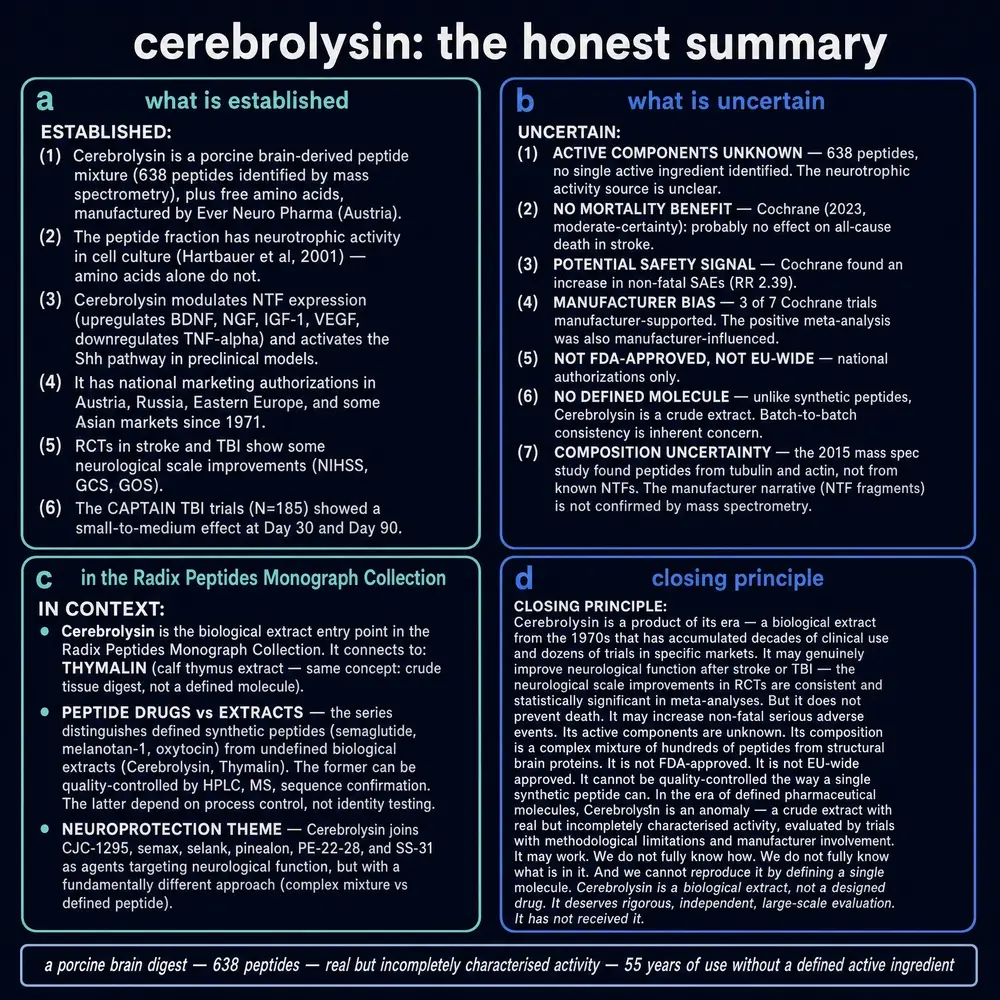
What remains genuinely open. Haemorrhagic transformation after clot-dissolving therapy. One open-label randomised trial found a real reduction in symptomatic bleeding on twenty-four events, while its other co-primary endpoint missed and its functional outcome did not move. The meta-analytic confirmation of that finding does not survive arithmetic. The three thrombectomy cohorts reporting dramatic reductions all used historical control arms with bleeding rates far outside contemporary practice. This is a hypothesis worth a proper trial, and it does not yet have one.
What should not be smoothed over. A possible excess of non-fatal serious adverse events, reported at moderate certainty in three successive Cochrane reviews, pointing the same way in every independent replication, and absent from every synthesis close to the manufacturer.
The evidence base is real. Nearly three thousand randomised patients in stroke alone, several double-blind placebo-controlled trials, and a consistent safety record on mortality and overall adverse events. This is not a compound with no evidence; it is a compound whose evidence is genuinely contested.
The positive evidence is unusually concentrated. The trials, the pooled analyses of those trials, and the observational registry supporting them share principal investigators and a statistical contractor. That does not make any result false. It does mean the literature contains less independent confirmation than its volume suggests.
The negative evidence is unusually independent. The two negative meta-analyses, both Cochrane reviews, the European cognition guideline and the two most recent systematic appraisals have no identified manufacturer link, and they agree with one another.
And the newest evidence is the least favourable. Weighting the literature toward more recent and better-designed work, the 2023 Cochrane update, the 2024 network meta-analysis, the 2025 vascular-cognitive-impairment review and the 2025 mild-cognitive-impairment review all land in the same place: small statistical effects, negligible clinically meaningful ones, and no basis for recommendation.
19What would settle it
It is worth stating what the missing study looks like, because the shape of it explains why seventy-five years have not produced one.
The trial that would settle the stroke question is not complicated to describe: adequately powered, double-blind, placebo-controlled, conducted across centres with no financial relationship to the manufacturer, in patients receiving contemporary reperfusion care, with a pre-specified single primary endpoint of death or dependence at ninety days — the outcome Cochrane looked for and found in not one eligible trial. Nothing about that is technically novel. It is the standard design of modern stroke medicine, and it is what nerinetide received, twice, before failing.
Two things make it harder here than for an ordinary molecule.
The first is the composition problem, and it is not a formality. A trial tests a substance. If the substance is a fraction defined by a process rather than by content, then a trial tests the batches used in that trial, and the inference to future batches rests on a potency assay against a company-held reference sample. A negative result could always be attributed to the material; a positive one cannot be transferred with confidence to a different preparation, which is precisely what the 2024 comparison of the originator against eleven copies demonstrated.
The second is that the incentive is weak. The drug is already licensed in more than forty countries and has been sold for decades. A definitive trial can only remove markets, not add them; a null result would be far more consequential commercially than a positive one would be valuable. That is not an accusation. It is the ordinary economics of an old, established, off-patent-in-practice product, and it explains why the most decisive evidence about many such drugs is never generated.
Meanwhile a smaller and more tractable study would answer a real question: a proper randomised trial of the drug as an adjunct to thrombectomy, with a concurrent rather than historical control arm and bleeding as a pre-specified endpoint. The three cohorts that generated that hypothesis cannot test it, because each compared patients treated now against patients treated years earlier.
And one thing could be done at any time, cheaply, by anyone with access to the material: publish a complete peptidomic characterisation. Seventy-five years after Harrer's first paper, the identified constituents of the active fraction amount to fragments of three structural proteins, reported at second hand. Modern mass spectrometry could enumerate that fraction in a matter of weeks. A public sequence-level inventory would not by itself settle efficacy, but it would end the present situation in which originator and copy can be compared only by a bioassay the manufacturer defines. Until someone publishes that inventory, every argument about what this preparation is, and every dispute about whether a copy is the same drug, will continue to be conducted without the one piece of information that would resolve it.
Until that inventory exists, and until a trial of the kind set out above has been run, the literature will continue to support two readings at once: early neurological change that is real enough to keep appearing, and a durable functional benefit that the best-designed syntheses have not confirmed.
This monograph describes published research. It does not recommend human use of Cerebrolysin or of any related preparation, and it specifies no dose, route or schedule for any person. Every dose that appears in these pages is reported as the parameter of a study that has been published, with the population, the route and the duration attached to it.
Cerebrolysin is a prescription medicine in the jurisdictions where it is licensed, and it is not approved in the United States. Nothing here is medical advice, and nothing here should be read as a reason to seek, obtain or administer it.
20References
Generated from verified NCBI records rather than from recall. Author lists, journal abbreviations, volumes, pages and identifiers are as the National Library of Medicine holds them; the build refuses to run if any cited identifier fails to resolve. Sources without a PubMed record — regulatory instruments, registers, company filings — are listed separately below and are never given a fabricated identifier.
Sorted by first author surname. 61 works with a PubMed record; 4 without one.
- Afridi A, Sajjad F, Arshad A, Shahid I, Fatima NE, Alam U, et al.. Efficacy and Safety of Cerebrolysin as an Adjunct to Mechanical Thrombectomy in Acute Ischemic Stroke: A Systematic Review and Meta-Analysis of Observational Studies. Brain Behav. 2026;16(3):e71252.
PMID 41880098 · doi:10.1002/brb3.71252 · PMC13045362 - Aguilar-Hernández L, Flores-Gómez GD, Nacher J, Morales-Medina JC, Flores G. Cerebrolysin Ameliorates Age-Induced Dendritic Spine Degeneration and Memory Decline in C57BL6 Mice. Neurochem Res. 2025;51(1):23.
PMID 41460391 · doi:10.1007/s11064-025-04627-0 · PMC12748144 - Akai F, Hiruma S, Sato T, Iwamoto N, Fujimoto M, Ioku M, et al.. Neurotrophic factor-like effect of FPF1070 on septal cholinergic neurons after transections of fimbria-fornix in the rat brain. Histol Histopathol. 1992;7(2):213-21.
PMID 1515704 - Allam AFA, Abotakia TAA, Koptan W. Role of Cerebrolysin in cervical spondylotic myelopathy patients: a prospective randomized study. Spine J. 2018;18(7):1136-1142.
PMID 29155000 · doi:10.1016/j.spinee.2017.11.002 - Alsulaimani RA, Quinn TJ. The efficacy and safety of animal-derived nootropics in cognitive disorders: Systematic review and meta-analysis. Cereb Circ Cogn Behav. 2021;2:100012.
PMID 36324709 · doi:10.1016/j.cccb.2021.100012 · PMC9616232 - Alvarez XA, Alvarez I, Iglesias O, Crespo I, Figueroa J, Aleixandre M, et al.. Synergistic Increase of Serum BDNF in Alzheimer Patients Treated with Cerebrolysin and Donepezil: Association with Cognitive Improvement in ApoE4 Cases. Int J Neuropsychopharmacol. 2016;19(6).
PMID 27207906 · doi:10.1093/ijnp/pyw024 · PMC4926802 - Alvarez XA, Alvarez I, Martinez A, Romero I, Benito C, Suarez I, et al.. Serum VEGF Predicts Clinical Improvement Induced by Cerebrolysin Plus Donepezil in Patients With Advanced Alzheimer's Disease. Int J Neuropsychopharmacol. 2020;23(9):581-586.
PMID 32640027 · doi:10.1093/ijnp/pyaa046 · PMC7710915 - Alvarez XA, Winston CN, Barlow JW, Sarsoza FM, Alvarez I, Aleixandre M, et al.. Modulation of Amyloid-β and Tau in Alzheimer's Disease Plasma Neuronal-Derived Extracellular Vesicles by Cerebrolysin® and Donepezil. J Alzheimers Dis. 2022;90(2):705-717.
PMID 36155516 · doi:10.3233/JAD-220575 · PMC9697063 - Berk C, Sabbagh MN. Successes and failures for drugs in late-stage development for Alzheimer's disease. Drugs Aging. 2013;30(10):783-92.
PMID 23943247 · doi:10.1007/s40266-013-0108-6 · PMC4000701 - Bornstein NM, Guekht A, Vester J, Heiss WD, Gusev E, Hömberg V, et al.. Safety and efficacy of Cerebrolysin in early post-stroke recovery: a meta-analysis of nine randomized clinical trials. Neurol Sci. 2018;39(4):629-640.
PMID 29248999 · doi:10.1007/s10072-017-3214-0 · PMC5884916 - Chang WH, Park CH, Kim DY, Shin YI, Ko MH, Lee A, et al.. Cerebrolysin combined with rehabilitation promotes motor recovery in patients with severe motor impairment after stroke. BMC Neurol. 2016;16:31.
PMID 26934986 · doi:10.1186/s12883-016-0553-z · PMC4776414 - Cui S, Chen N, Yang M, Guo J, Zhou M, Zhu C, et al.. Cerebrolysin for vascular dementia. Cochrane Database Syst Rev. 2019;2019(11).
PMID 31710397 · doi:10.1002/14651858.CD008900.pub3 · PMC6844361 - Dang C, Wang Q, Zhuang Y, Li Q, Feng L, Xiong Y, et al.. Pharmacological treatments for vascular dementia: a systematic review and Bayesian network meta-analysis. Front Pharmacol. 2024;15:1451032.
PMID 39239652 · doi:10.3389/fphar.2024.1451032 · PMC11374729 - ElBassiouny A, Shehata MSA, Zaki AS, Bedros RY, El-Sudany AH, Nasser AA. Cerebrolysin as an adjuvant therapy after mechanical thrombectomy in large vessel occlusion cardioembolic stroke: a propensity score matching analysis. Front Neurol. 2025;16:1510284.
PMID 40027163 · doi:10.3389/fneur.2025.1510284 · PMC11868704 - Elhessy HM, Habotta OA, Eldesoqui M, Elsaed WM, Soliman MFM, Sewilam HM, et al.. Comparative neuroprotective effects of Cerebrolysin, dexamethasone, and ascorbic acid on sciatic nerve injury model: Behavioral and histopathological study. Front Neuroanat. 2023;17:1090738.
PMID 36816518 · doi:10.3389/fnana.2023.1090738 · PMC9928760 - Gevaert B, D'Hondt M, Bracke N, Yao H, Wynendaele E, Vissers JP, et al.. Peptide profiling of Internet-obtained Cerebrolysin using high performance liquid chromatography - electrospray ionization ion trap and ultra high performance liquid chromatography - ion mobility - quadrupole time of flight mass spectrometry. Drug Test Anal. 2015;7(9):835-42.
PMID 26017115 · doi:10.1002/dta.1817 - Ghaffarpasand F, Torabi S, Rasti A, Niakan MH, Aghabaklou S, Pakzad F, et al.. Effects of cerebrolysin on functional outcome of patients with traumatic brain injury: a systematic review and meta-analysis. Neuropsychiatr Dis Treat. 2019;15:127-135.
PMID 30643411 · doi:10.2147/NDT.S186865 · PMC6311329 - Gharagozli K, Harandi AA, Houshmand S, Akbari N, Muresanu DF, Vester J, et al.. Efficacy and safety of Cerebrolysin treatment in early recovery after acute ischemic stroke: a randomized, placebo-controlled, double-blinded, multicenter clinical trial. J Med Life. 2017;10(3):153-160.
PMID 29075343 · PMC5652261 - Guekht A, Vester J, Heiss WD, Gusev E, Hoemberg V, Rahlfs VW, et al.. Safety and efficacy of Cerebrolysin in motor function recovery after stroke: a meta-analysis of the CARS trials. Neurol Sci. 2017;38(10):1761-1769.
PMID 28707130 · doi:10.1007/s10072-017-3037-z · PMC5605586 - HARRER G. [The biological effects of cerebral hydrolysates; preliminary report]. Dtsch Med Wochenschr. 1954;79(24):983-5.
PMID 13182884 · doi:10.1055/s-0028-1115595 - Harrer G, Melnizky U, Wagner F. [Mode of action and therapeutic activity of a brain hydrolysate]. Arzneimittelforschung. 1972;22(5):900-4.
PMID 4558848 - Hartbauer M, Hutter-Paier B, Skofitsch G, Windisch M. Antiapoptotic effects of the peptidergic drug cerebrolysin on primary cultures of embryonic chick cortical neurons. J Neural Transm (Vienna). 2001;108(4):459-73.
PMID 11475013 · doi:10.1007/s007020170067 - HETZEL H, NIEDERMEYER E. [Arousing effects of brain hydrolysate in hypoglycemic coma and their electroencephalographic appearance]. Arch Psychiatr Nervenkr Z Gesamte Neurol Psychiatr. 1955;193(4):369-82.
PMID 13249577 · doi:10.1007/BF00343137 - Homberg V, Jianu DC, Stan A, Strilciuc Ș, Chelaru VF, Karliński M, et al.. Speech Therapy Combined With Cerebrolysin in Enhancing Nonfluent Aphasia Recovery After Acute Ischemic Stroke: ESCAS Randomized Pilot Study. Stroke. 2025;56(4):937-947.
PMID 39957612 · doi:10.1161/STROKEAHA.124.049834 · PMC11932442 - Hutter-Paier B, Eggenreich U, Windisch M. Dose-dependent behavioural effects of two protein-free peptide derivatives on the passive avoidance reaction of rats. Arzneimittelforschung. 1996;46(3):242-6.
PMID 8901142 - Jarosz K, Kojder K, Andrzejewska A, Solek-Pastuszka J, Jurczak A. Cerebrolysin in Patients with TBI: Systematic Review and Meta-Analysis. Brain Sci. 2023;13(3).
PMID 36979317 · doi:10.3390/brainsci13030507 · PMC10046100 - Jarosz K, Kojder K, Skonieczna-Żydecka K, Andrzejewska A, Sołek-Pastuszka J, Jurczak A. The Effects of Neuromonitoring and Cerebrolysin Administration on Outcomes in Patients with Traumatic Brain Injury-An Interventional Pilot Study. J Clin Med. 2024;13(2).
PMID 38256487 · doi:10.3390/jcm13020353 · PMC10816546 - Jianu DC, Muresanu DF, Bajenaru O, Popescu BO, Deme SM, Moessler H, et al.. Cerebrolysin adjuvant treatment in Broca's aphasics following first acute ischemic stroke of the left middle cerebral artery. J Med Life. 2010;3(3):297-307.
PMID 20945821 · PMC3019000 - Kandasamy G, Arumugam V, Orayj K, Alshahrani AM, Alanazi TS, Hmlan A, et al.. Evaluating the Effect of Cerebrolysin as an Adjuvant to Standard Therapy in Patients with Acute Ischemic Stroke: A Prospective Observational Study. Medicina (Kaunas). 2025;61(9).
PMID 41010922 · doi:10.3390/medicina61091531 · PMC12472081 - Kang DH, Choi BY, Lee SH, Kho AR, Jeong JH, Hong DK, et al.. Effects of Cerebrolysin on Hippocampal Neuronal Death After Pilocarpine-Induced Seizure. Front Neurosci. 2020;14:568813.
PMID 33177978 · doi:10.3389/fnins.2020.568813 · PMC7596733 - Khasanova DR, Kalinin MN. Cerebrolysin as an Early Add-on to Reperfusion Therapy: Risk of Hemorrhagic Transformation after Ischemic Stroke (CEREHETIS), a prospective, randomized, multicenter pilot study. BMC Neurol. 2023;23(1):121.
PMID 36973684 · doi:10.1186/s12883-023-03159-w · PMC10041692 - Kim JS, Kim BJ. Why Are CASTA and CARS Results Different? Analysis of CASTA Data from Korea and Hong Kong. J Stroke. 2016;18(2):233-5.
PMID 27165265 · doi:10.5853/jos.2016.00101 · PMC4901952 - Kurkin DV, Bakulin DA, Morkovin EI, Kalatanova AV, Makarenko IE, Dorotenko AR, et al.. Neuroprotective action of Cortexin, Cerebrolysin and Actovegin in acute or chronic brain ischemia in rats. PLoS One. 2021;16(7):e0254493.
PMID 34260655 · doi:10.1371/journal.pone.0254493 · PMC8279368 - Mangalagiu AG, Petrescu BM, Riga S, Vasiliu O. Pharmacological Management of Mild Cognitive Impairment: From Symptomatic Treatment to Disease Modification-A Narrative Review. NeuroSci. 2025;7(1).
PMID 41562827 · doi:10.3390/neurosci7010002 · PMC12821547 - Martínez-Iglesias O, Naidoo V, Carrera I, Corzo L, Cacabelos R. Nosustrophine: An Epinutraceutical Bioproduct with Effects on DNA Methylation, Histone Acetylation and Sirtuin Expression in Alzheimer's Disease. Pharmaceutics. 2022;14(11).
PMID 36432638 · doi:10.3390/pharmaceutics14112447 · PMC9698419 - Masserini F, Gendarini C, Baso G, Salvadori E, Pantoni L. Therapeutic strategies in vascular cognitive impairment: A systematic review and meta-analysis. Alzheimers Dement. 2025;21(11):e70840.
PMID 41198594 · doi:10.1002/alz.70840 · PMC12591988 - Onose G, Mureşanu DF, Ciurea AV, Daia Chendreanu C, Mihaescu AS, Mardare DC, et al.. Neuroprotective and consequent neurorehabilitative clinical outcomes, in patients treated with the pleiotropic drug cerebrolysin. J Med Life. 2009;2(4):350-60.
PMID 20108748 · PMC3019019 - P A, Rengarajan S, Venkatachalam S, Pattabi S, Jones S, K P, et al.. Neuroprotection by Cerebrolysin and Citicoline Through the Upregulation of Brain-Derived Neurotrophic Factor (BDNF) Expression in the Affected Neural Cells: A Preliminary Clue Obtained Through an In Vitro Study. Cureus. 2024;16(2):e54665.
PMID 38524067 · doi:10.7759/cureus.54665 · PMC10960614 - Park YK, Yi HJ, Choi KS, Lee YJ, Kim DW, Kwon SM. Cerebrolysin for the Treatment of Aneurysmal Subarachnoid Hemorrhage in Adults: A Retrospective Chart Review. Adv Ther. 2018;35(12):2224-2235.
PMID 30414051 · doi:10.1007/s12325-018-0832-8 · PMC6822868 - Patel PN, Mangal D, Patel K. Safety and Efficacy of Cerebrolysin for Neurorecovery After Acute Ischemic Stroke: A Systematic Review and Meta-Analysis of 14 Randomized Controlled Trials. Cureus. 2025;17(8):e91054.
PMID 41018475 · doi:10.7759/cureus.91054 · PMC12465088 - Piller C. Challenged papers underpin several drugs. Science. 2024;385(6716):1410.
PMID 39325892 · doi:10.1126/science.adt3536 - Quinn TJ, Richard E, Teuschl Y, Gattringer T, Hafdi M, O'Brien JT, et al.. European Stroke Organisation and European Academy of Neurology joint guidelines on post-stroke cognitive impairment. Eur Stroke J. 2021;6(3):I-XXXVIII.
PMID 34746430 · doi:10.1177/23969873211042192 · PMC8564156 - Rockenstein E, Ubhi K, Pham E, Michael S, Doppler E, Novak P, et al.. Beneficial effects of a neurotrophic peptidergic mixture persist for a prolonged period following treatment interruption in a transgenic model of Alzheimer's disease. J Neurosci Res. 2011;89(11):1812-21.
PMID 21793038 · doi:10.1002/jnr.22712 · PMC3171597 - Schlager P, Grgac I, Herzer G, Trimmel H. Combined citicoline and Cerebrolysin for neuroprotection in traumatic brain injury: a retrospective cohort analysis. Front Neurol. 2025;16:1684981.
PMID 41409218 · doi:10.3389/fneur.2025.1684981 · PMC12705382 - Schwab M, Schaller R, Bauer R, Zwiener U. Morphofunctional effects of moderate forebrain ischemia combined with short-term hypoxia in rats--protective effects of Cerebrolysin. Exp Toxicol Pathol. 1997;49(1-2):29-37.
PMID 9085071 · doi:10.1016/S0940-2993(97)80053-X - Seidl LF, Aigner L. Comparing the biological activity and composition of Cerebrolysin with other peptide preparations. J Med Life. 2024;17(1):24-27.
PMID 38737662 · doi:10.25122/jml-2024-0129 · PMC11080511 - Seidl LF, Winter S, Aigner L, Schartner J. A Neurofilament-L reporter cell line for the quantification of early neuronal differentiation: A Bioassay for neurotrophic activities. Heliyon. 2024;10(2):e24753.
PMID 38304771 · doi:10.1016/j.heliyon.2024.e24753 · PMC10831791 - Soto C, Salinas P, Muñoz D, Olivares S, González J, Sáez V, et al.. A retrospective study of Cerebrolysin in patients with moderate to severe traumatic brain injury: Cognitive and functional outcomes. J Med Life. 2023;16(7):1017-1021.
PMID 37900065 · doi:10.25122/jml-2023-0125 · PMC10600656 - Stan A, Birle C, Blesneag A, Iancu M. Cerebrolysin and early neurorehabilitation in patients with acute ischemic stroke: a prospective, randomized, placebo-controlled clinical study. J Med Life. 2017;10(4):216-222.
PMID 29362596 · PMC5771251 - Staszewski J, Dębiec A, Strilciuc S, Gniadek-Olejniczak K, Piusinska-Macoch R, Balo D, et al.. Efficacy of Cerebrolysin Treatment as an Add-On Therapy to Mechanical Thrombectomy in Patients with Acute Ischemic Stroke Due to Large Vessel Occlusion in Anterior Circulation: Results of a 3-Month Follow-up of a Prospective, Open Label, Single-Center Study. Transl Stroke Res. 2025;16(6):1931-1946.
PMID 40325343 · doi:10.1007/s12975-025-01355-z · PMC12598679 - Staszewski J, Dębiec A, Gniadek-Olejniczak K, Stępień A, Piusinska-Macoch R, Strilciuc S, et al.. Cerebrolysin after Endovascular Thrombectomy in Stroke: 12‑Month Functional Outcomes in a Propensity‑Matched Cohort. Transl Stroke Res. 2026;17(2).
PMID 41739286 · doi:10.1007/s12975-026-01414-z · PMC12935719 - Strilciuc S, Vécsei L, Boering D, Pražnikar A, Kaut O, Riederer P, et al.. Safety of Cerebrolysin for Neurorecovery after Acute Ischemic Stroke: A Systematic Review and Meta-Analysis of Twelve Randomized-Controlled Trials. Pharmaceuticals (Basel). 2021;14(12).
PMID 34959697 · doi:10.3390/ph14121297 · PMC8708612 - Verisezan Rosu O, Jemna N, Hapca E, Benedek I, Vadan I, Muresanu I, et al.. Cerebrolysin and repetitive transcranial magnetic stimulation (rTMS) in patients with traumatic brain injury: a three-arm randomized trial. Front Neurosci. 2023;17:1186751.
PMID 37360156 · doi:10.3389/fnins.2023.1186751 · PMC10285097 - Vosko MR, Sanak D, Do Y, Vatanagul JS, Roushdy T, Bornstein NM, et al.. C-REGS2-A multinational, high-quality comparative effectiveness study of Cerebrolysin in moderate acute ischemic stroke. Int J Stroke. 2025;20(9):1060-1070.
PMID 40851188 · doi:10.1177/17474930251375439 · PMC12589672 - Wang Y, Li M, Jiang Y, Ji Q. Comparative efficacy of neuroprotective agents for improving neurological function and prognosis in acute ischemic stroke: a network meta-analysis. Front Neurosci. 2024;18:1530987.
PMID 39834702 · doi:10.3389/fnins.2024.1530987 · PMC11743486 - Wang Z, Shi L, Xu S, Zhang J. Cerebrolysin for functional recovery in patients with acute ischemic stroke: a meta-analysis of randomized controlled trials. Drug Des Devel Ther. 2017;11:1273-1282.
PMID 28458521 · doi:10.2147/DDDT.S124273 · PMC5402893 - Zhang C, Chopp M, Cui Y, Wang L, Zhang R, Zhang L, et al.. Cerebrolysin enhances neurogenesis in the ischemic brain and improves functional outcome after stroke. J Neurosci Res. 2010;88(15):3275-81.
PMID 20857512 · doi:10.1002/jnr.22495 · PMC3073377 - Zhang D, Dong Y, Li Y, Chen J, Wang J, Hou L. Efficacy and Safety of Cerebrolysin for Acute Ischemic Stroke: A Meta-Analysis of Randomized Controlled Trials. Biomed Res Int. 2017;2017:4191670.
PMID 28656143 · doi:10.1155/2017/4191670 · PMC5474547 - Zhang L, Bai YY, Hong ZS, Xie J, Tian Y. Isolation, Identification, Activity Evaluation, and Mechanism of Action of Neuroprotective Peptides from Walnuts: A Review. Nutrients. 2023;15(18).
PMID 37764868 · doi:10.3390/nu15184085 · PMC10534798 - Ziganshina LE, Abakumova T, Nurkhametova D, Ivanchenko K. Cerebrolysin for acute ischaemic stroke. Cochrane Database Syst Rev. 2023;10(10):CD007026.
PMID 37818733 · doi:10.1002/14651858.CD007026.pub7 · PMC10565895 - Ziganshina LE, Abakumova T, Hoyle CH. Cerebrolysin for acute ischaemic stroke. Cochrane Database Syst Rev. 2020;7(7):CD007026.
PMID 32662068 · doi:10.1002/14651858.CD007026.pub6 · PMC7387239
Sources without a PubMed record
- Bundesamt für Sicherheit im Gesundheitswesen (BASG). Cerebrolysin 215.2 mg/mL Konzentrat zur Herstellung einer Injektions-/Infusionslösung — Fachinformation (Summary of Product Characteristics). Austrian medicines register, marketing authorisation 1-21380; authorisation granted 25 March 1996, last renewed 25 March 2001; version of March 2021. Marketing authorisation holder EVER Neuro Pharma GmbH, Unterach. The instrument for the composition, the concentration and the registered indications.
https://medikamente.basg.gv.at/documents/1-21380__DOTC_FACH_INFO.pdf - Novartis AG. Form 6-K, financial year 2009 — agreement to acquire the specialty generic injectables business of EBEWE Pharma. United States Securities and Exchange Commission. The instrument establishing that the neurology business holding this product was excluded from the sale.
https://www.sec.gov/Archives/edgar/data/0001114448/000110465909034691/a09-1424 - Sandoz International GmbH. Sandoz completes acquisition of EBEWE Pharma, improving global patient access to affordable injectable cancer medicines. Press release, 24 September 2009. Corroborates the 1945 Unterach date and the scope of the transaction.
https://www.globenewswire.com/news-release/2009/09/24/1878628/0/en/Sandoz-comp - EVER Pharma. Who we are — corporate history. Company disclosure. Cited for the 1934 founding and the 1945 relocation only; the company's own history page does not expand the EBEWE acronym and does not mention a 1954 approval.
https://www.everpharma.com/who-we-are/
21Evidence handling
Findings are labelled by study type in the sentence that reports them. A result in a rat pheochromocytoma cell line is called that. A retrospective chart review of eleven patients is called that. No animal or in-vitro result is phrased so that it could be read as a human outcome, and no dose appears without its species, route and duration.
The pre-specified primary endpoint is treated as the trial's result. This is the single discipline that most changes the reading of this literature. Three of the seven named randomised trials in stroke missed their primary endpoint, and two of those three are routinely cited as positive through a subgroup. A subgroup finding is reported here as a subgroup finding, with the subgroup's size, and never as the trial's result.
A change score and an absolute value are reported as different things, because in this literature they systematically disagree — and so are an effect measured during infusion and an effect still present after dosing stops.
Conflicts are presented as conflicts. Four are live in this literature and none is resolved here: whether the active fraction is the peptides or the amino acids, on which the compound's inventor and its current manufacturer take opposite positions; whether the preparation contains neurotrophic factors, on which two papers cite the same source for opposite conclusions; whether the early neurological benefit translates into less disability at ninety days, on which three meta-analyses of the same trials disagree for reasons their authors state; and whether there is a real excess of non-fatal serious adverse events, on which Cochrane and every manufacturer-adjacent synthesis disagree.
Arithmetic defects in the source literature are reported rather than propagated. Several published papers central to this subject contain internal contradictions: a meta-analysis whose haemorrhage result cannot be reproduced from its own event table and which counts one trial's patients twice; a cohort reporting five per cent mortality and fifty-nine per cent survival in the same section; a meta-analysis whose conclusion asserts a benefit its own pooled estimate does not support; a systematic review printing two different effect sizes for one analysis. Where a paper's numbers cannot be reconciled, that fact is stated and the numbers are not used.
Withdrawn work is never cited in support of a factual claim about the compound. Retracted papers are described only as claims that were made and withdrawn, and the passage that describes one also says what remains if it is set aside. An expression of concern is treated as a different instrument from a retraction and not collapsed into one.
Funding and authorship are reported where they bear on weight. A result is not wrong because a manufacturer paid for it, and it is not treated as such here. But where the trials, the pooled analyses of those trials and the observational registry that supports them share principal investigators and a statistical contractor, that is a fact about how much independent confirmation the evidence base contains, and it is stated.
Recency is weighted, but not automatically. Where newer and better-designed work disagrees with older work it is given precedence — which in this literature mostly means that the least favourable appraisals are also the most recent. Where the newest work is larger but weaker in design, as with the non-randomised thrombectomy cohorts, size is not allowed to substitute for randomisation.
And absences are reported with the same prominence as findings. There is no human pharmacokinetic data, no identified receptor, no international reference standard, no enumeration of the peptides, and no trial reporting death-or-dependence that Cochrane could pool. For a compound of this age and this trial volume, each of those is a finding in its own right.

Continue exploring