
PE 22-28 Seven amino acids, arrived at by subtraction
Most drugs are built. This one was found by taking things away. It began with a mouse that had been engineered to lack a single potassium channel and turned out, unexpectedly, to be resistant to depression; it passed through a forty-four-residue scrap of protein that a cell cuts off a receptor and discards; and it ended, seven years and three rounds of shortening later, at a chain of seven amino acids — glycine, valine, serine, tryptophan, glycine, leucine, arginine — that blocks that channel at about a tenth of a nanomolar, roughly three hundred times more tightly than the peptide it was cut from. In mice it shortens immobility in the standard behavioural screen within thirty minutes of a single injection, and it doubles the number of new cells in the hippocampus in four days, which is a fifth of the time an ordinary antidepressant needs. It has never been given to a human being. Every efficacy result in this document comes from one laboratory in the south of France, and no independent group has reproduced any of them.
Findings are labelled by the kind of study that produced them, in the sentence that reports them. A measurement made in a dish of transfected human cells is called that; a result in a mouse is called a result in a mouse. On this compound the distinction does more work than usual, because the entire efficacy record is preclinical and much of it belongs, strictly speaking, to two chemically modified derivatives rather than to PE 22-28 itself. Where that is true, this document says so at the point of the claim rather than in a footnote.
A note on doses. Amounts and routes appear here only as parameters of experiments that were performed, always with the species and the duration attached, because those are facts about the research. They are not recommendations. Nothing in this document is offered for use by any person.
A note on the name. PE 22-28 is a coordinate, not a word. It denotes residues 22 to 28 of a particular propeptide, and the string collides in the literature and in trial registries with abbreviations for pre-eclampsia and for phosphatidylethanolamine. Records retrieved for this build were screened against those homographs before use.
01What the compound is
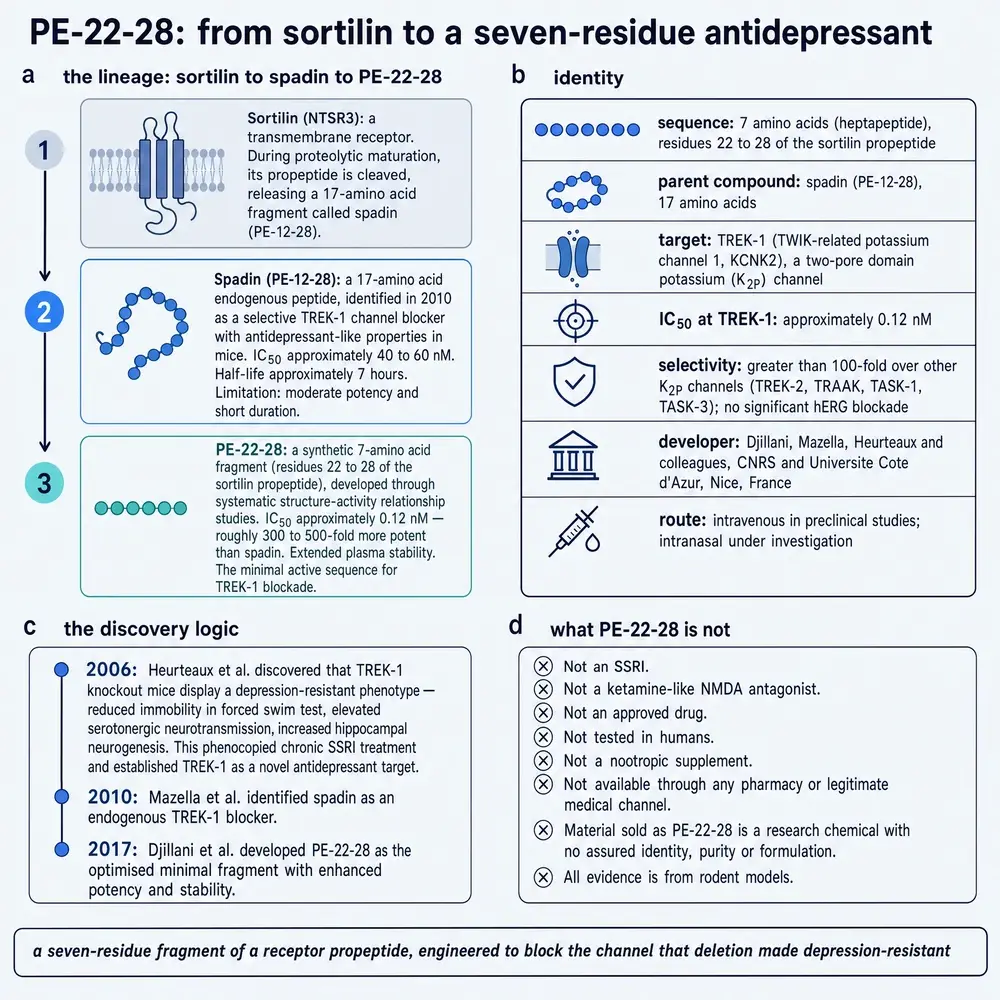
PE 22-28 is a peptide of seven amino acids with the sequence GVSWGLR, a molecular formula of C35H55N11O9 and a mass of about 774 daltons. By the standards of the molecules in this series it is very small — smaller than many conventional drugs, and about a fortieth the size of the peptide hormones that dominate current metabolic medicine. It is not a natural product in the ordinary sense, but neither is it invented: it is a contiguous stretch of a human protein sequence, isolated from its context and synthesised on its own.
| Field | Value |
|---|---|
| Sequence | GVSWGLR (Gly-Val-Ser-Trp-Gly-Leu-Arg), 7 residues |
| Formula | C35H55N11O9 |
| Mass | ~773.9 g/mol |
| PubChem | CID 91826106 |
| Parent peptide | Spadin, PE 12-28, YAPLPRWSGPIGVSWGLR, 17 residues |
| Origin | Residues 22–28 of the 44-residue sortilin/NTSR3 propeptide (Gln1–Arg44), released by furin in the late Golgi |
| Target | TREK-1, also K2P2.1; gene KCNK2 |
| Class | Designed synthetic peptide fragment; selective peptidic potassium-channel blocker |
| Catalogue | P094; parent peptide P095 |
| Human studies | None registered for this compound or its parent |
The designation is a coordinate rather than a trade name, and the coordinate is worth unpacking because it encodes the compound's whole history. PE stands for propeptide; 22 and 28 are positions along that propeptide's forty-four-residue sequence. Read the name and one has read the derivation: this is the twenty-second to twenty-eighth amino acid of something the cell makes and throws away. The parent peptide's name, spadin, is the only word in the lineage that is not a coordinate.
It has one known molecular action. It blocks TREK-1, a potassium channel found in the membranes of neurons and encoded by the gene KCNK2, and in the cell line used to measure it, it does so at a concentration of about a tenth of a nanomolar — a concentration at which a litre of solution contains something on the order of sixty billion molecules, which sounds like a great many until one remembers that a litre of water contains thirty-three thousand billion billion. Against a panel of the channel's nearest relatives, and against the cardiac channel whose blockade is the classical liability of psychiatric drugs, it did nothing measurable (Djillani et al., 2017).
What that block appears to produce, in mice, is a rapid change in mood- related behaviour and a rapid change in the structure of the hippocampus. The behavioural effect is present thirty minutes after a single injection. The structural effect — roughly twice the normal number of newly born cells — is present after four days. Both are described in detail in Part Four, and both come with a caveat that this document repeats because it matters: they are results from one research group, in one species, and nobody outside that group has published a replication.
A seven-residue fragment of the propeptide that human cells cut off the receptor sortilin and throw away. It blocks one potassium channel with high potency and, on the evidence available, with unusual selectivity. In mice it behaves like a fast-acting antidepressant. It has no human data of any kind, no independent replication, no published pharmacokinetics of its own, and no measured duration of action — the durations usually quoted for it belong to two of its derivatives.
02The problem it was built for
The drugs that treat depression work. That is the first thing to say, because everything after it is a complaint. Selective serotonin reuptake inhibitors have been prescribed for four decades, they are safer in overdose than what came before, and for a large number of people they help. The complaint is about two things: how long they take, and how many people they fail.
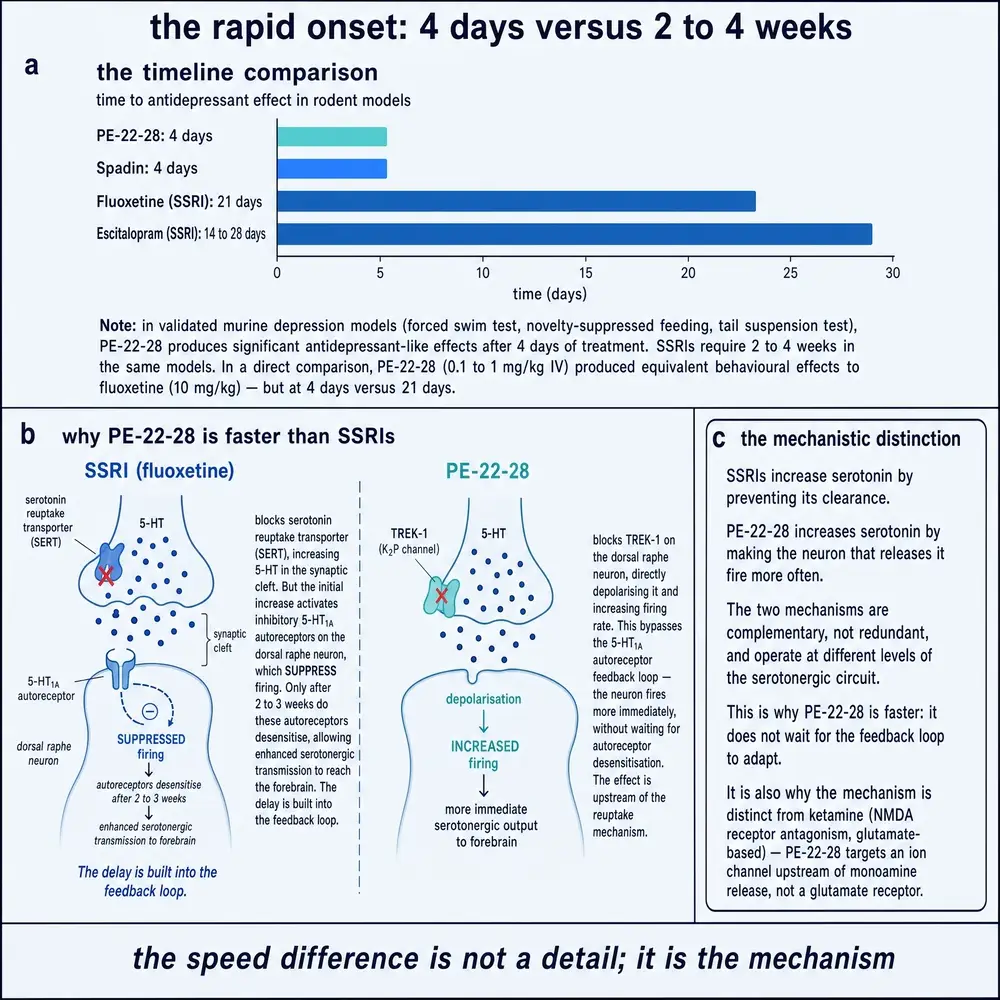
The delay is the more peculiar of the two. An SSRI raises extracellular serotonin within hours of the first dose — that is what the molecule does, and it does it immediately. The clinical improvement, when it comes, comes after two to three weeks, and sometimes after six. Nothing in the stated mechanism explains the gap. Something else has to be happening in between, and identifying what it is has occupied the field since the 1990s. The prevailing answer implicates the slow, adaptive part of the response: receptor densities shift, gene expression changes, and — the finding that reorganised the field — new neurons are born in the hippocampus. Santarelli and colleagues showed in 2003 that if hippocampal neurogenesis is blocked by X-irradiation, the behavioural effects of both fluoxetine and imipramine disappear in mice, which made neurogenesis look less like a side-effect of treatment than a requirement for it (Santarelli et al., 2003).
For a person in the acute phase of a severe depressive episode, a three-week delay is not a scheduling inconvenience. It is three weeks of the illness at its most dangerous, during which the treatment provides no benefit and may provide side effects. It is also three weeks of not knowing whether this particular drug is one of the ones that will work, because roughly a third of patients do not respond adequately to the first agent they are given, and a substantial minority do not respond adequately to several.
The scale of that second problem was established by the study that also supplies this compound's only human genetic evidence. STAR*D enrolled several thousand outpatients with major depression in the United States and treated them in sequence: everyone began on citalopram, and those who did not remit moved to a second strategy, then a third, then a fourth. It was designed to document what happens in ordinary practice rather than in a selected trial population, and what it documented was that a substantial fraction of patients pass through several treatments without adequate benefit. Treatment resistance, after STAR*D, stopped being an edge case and became a category with its own research literature (Perlis et al., 2008).
The demonstration that the delay is not a law of nature came from ketamine, whose antidepressant effect in treatment-resistant patients appears within hours. Ketamine established that the target of a fast antidepressant need not be the serotonin transporter, and that the timescale of the response is a property of the mechanism rather than of the disease. It also brought its own problems — dissociation, abuse liability, an effect that fades in days — which is why the search for other fast mechanisms continued rather than stopping.
The work described in this monograph is one branch of that search. It did not begin with a search for a fast drug, though. It began with a mouse.
03A brake in the membrane
Neurons fire because charge moves across their membranes, and whether a given neuron fires depends on how far its resting voltage sits from the threshold at which the firing machinery engages. Potassium channels are the principal instrument for setting that distance. Open a potassium channel and positive charge drifts out of the cell; the interior becomes more negative; the threshold recedes. Close it and the opposite happens.
Most potassium channels are gated — they open in response to voltage or to a ligand, do their work and shut. A smaller family, the two-pore-domain or K2P channels, behaves differently. These are background or leak channels: substantially open at rest, contributing a continuous outward current that holds the membrane potential down. They are the tonic component, the setting rather than the signal. The K2P family has fifteen members in mammals, and they are modulated by an unusual assortment of things — membrane stretch, temperature, intracellular pH, polyunsaturated fatty acids, and volatile anaesthetics, which is how several of them were found (Honoré, 2007).
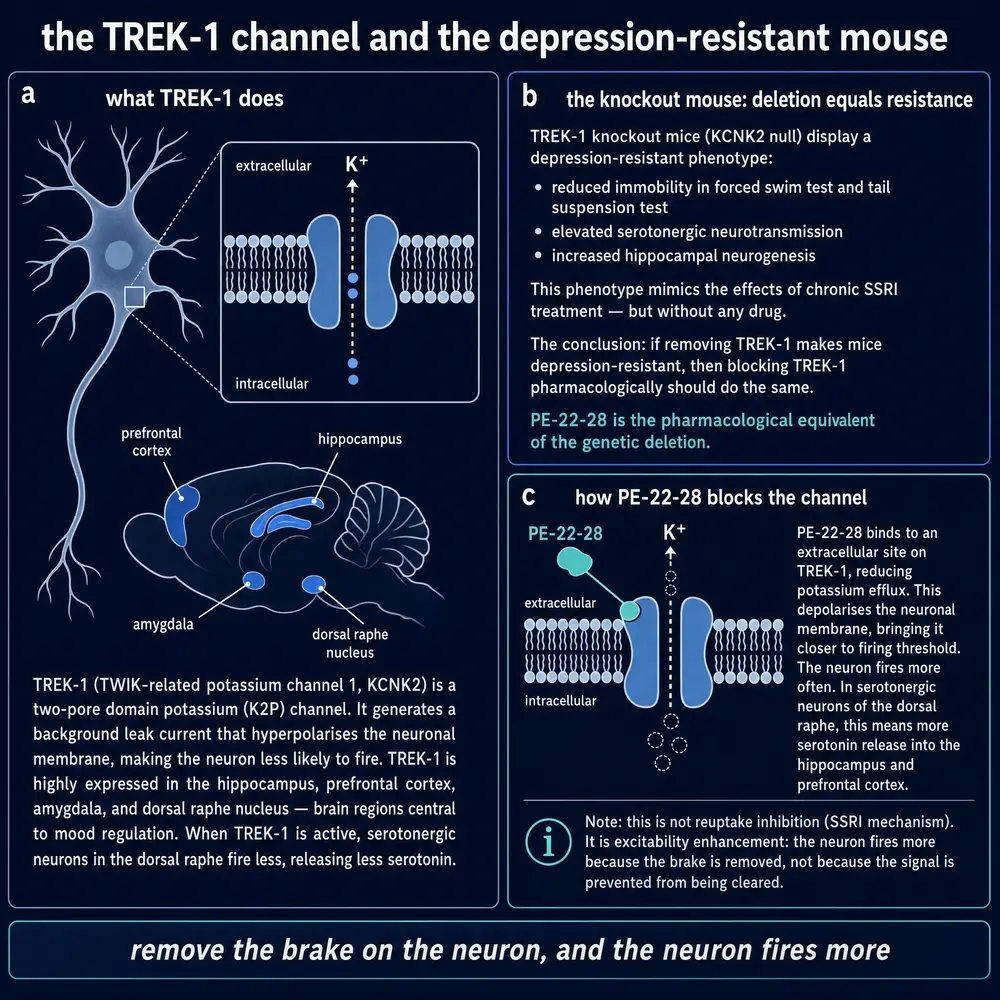
TREK-1 is one of them. Its behaviour makes it a plausible switch: it is opened by arachidonic acid, by mechanical stretch, by acid and by heat, and it is closed by protein kinase A and protein kinase C. It is expressed through the central nervous system, and in particular in the regions that recur in the biology of mood — the prefrontal cortex, the hippocampus, the striatum and the dorsal raphe nucleus, which is the origin of most of the serotonin in the forebrain (Honoré, 2007; Djillani et al., 2019).
Put those two facts together and the hypothesis writes itself. If TREK-1 is open in serotonin neurons, it is holding them below their firing threshold. Blocking it should let them fire. And if the fundamental problem in depression is too little serotonergic tone — which is what the reuptake inhibitors assume — then a TREK-1 blocker would achieve the same end by a different and possibly faster route.
The hypothesis was not, however, arrived at by that reasoning. It was arrived at by deleting the gene.
The mouse that would not despair
In 2006 Catherine Heurteaux and colleagues at the Institut de Pharmacologie Moléculaire et Cellulaire, the CNRS laboratory at Valbonne on the hills above Antibes, reported what happened to mice in which KCNK2 had been deleted (Heurteaux et al., 2006). The animals were normal to look at. In the standard behavioural screens for depression-like states, they were not: they behaved as though they were already being treated. In the forced swim test and the tail suspension test they struggled longer; in the learned helplessness paradigm they were harder to make helpless; their serotonin neurons fired faster; and the sucrose preference and corticosterone measures moved in the same direction. The authors called it a depression-resistant phenotype, and the paper title said so.
This is a strong form of evidence and it is worth being precise about what it does and does not establish. A knockout mouse shows what happens when a protein is absent for the animal's entire life, which is not the same as what happens when it is blocked for an afternoon; developmental compensation is a standing hazard of the method. What the 2006 result did establish is that removing TREK-1 moves behaviour in the direction that antidepressants move it, in several independent paradigms, and that the movement is accompanied by the physiological change — faster serotonergic firing — that the mechanism predicts. It converted TREK-1 from an interesting channel into a drug target.
class="hf dark" so the mat stays navy in both editions.The same laboratory had, in the same year, published TREK-1's role in polymodal pain perception, where the knockout mouse is more sensitive to painful heat and to mechanical pressure (Alloui et al., 2006). That paper matters here for a reason that only becomes visible later: it is the first sign that this channel is not a mood-specific device, and that anything that blocks it everywhere will be doing more than one thing at once.
A validated target is a hypothesis about where to intervene. It is not a drug, and the history of neuropharmacology is substantially a history of well-validated targets that produced no useful medicine. The remainder of this document concerns the attempt to make a molecule that acts on this particular target, and the point at which that attempt currently stands is a long way short of a medicine.
04The offcut
Proteins destined for the cell surface are not made in their final form. They are made long and then trimmed, and the trimmings are usually treated, by cell biologists and by the cell, as waste. The story of this compound turns on one of those trimmings.
Sortilin is a large receptor of the VPS10 family, involved in sorting proteins between the Golgi apparatus, the cell surface and the lysosome. In 1998 Jean Mazella and colleagues at the same Valbonne laboratory identified it as something else as well: the long-sought hundred-kilodalton neurotensin receptor, a binding site for the neuropeptide neurotensin that was not, as everyone had assumed a receptor must be, coupled to a G protein (Mazella et al., 1998). The protein acquired a second name, NTSR3, and a second literature.
Sortilin is synthesised with a forty-four-residue propeptide at its N-terminus. In the late Golgi the enzyme furin cuts that propeptide off, and only then can the receptor bind its ligands: the propeptide occupies the binding site, and its removal is the activating step (Munck Petersen et al., 1999). This is a common enough arrangement in protein maturation. What is less common is what happens next. The freed propeptide does not simply disappear. It is released, it retains a high affinity for the mature receptor it was cut from — a dissociation constant of about five nanomolar — and it can be detected in human serum, where it circulates as a peptide in its own right (Mazella et al., 2010; Mazella et al., 2018).
So the cell manufactures, on a large scale, a short peptide with high affinity for a receptor implicated in neuronal function, and then discards it. The Valbonne group's question was whether the discard was doing anything. It is the kind of question that is easy to ask and expensive to answer, and the answer, when it came, was that the propeptide interacts with the TREK-1 channel — not directly at first sight but through sortilin, which turns out to govern how much TREK-1 reaches the cell surface at all (Mazella et al., 2018).
05Spadin, 2010
The forty-four-residue propeptide is too large and too fragile to be a drug. The group's approach was to find the smallest part of it that retained the binding, and their method was straightforward truncation. Binding activity survived cutting the peptide back to residue 28. It was lost when the peptide was cut back to residue 16. The active region therefore lay somewhere between, and the group's own account of what they did next is unusually explicit about the reasoning: they conserved the sequence from residue 17 to residue 28 and added residues 12 to 16 — the run APLRP — in order, as they put it, to maintain conformational stress (Mazella et al., 2010). The product ran from alanine 12 to arginine 28, seventeen residues, sequence YAPLPRWSGPIGVSWGLR. They named it spadin.
The 2010 paper in PLoS Biology is the foundation of everything that follows, and it is worth setting out what it actually showed, because the compound this monograph is about is a fragment of its subject. Spadin binds sortilin: it displaced radiolabelled neurotensin from the receptor on a human microglial cell line with an affinity of eight nanomolar, in vitro. It blocks TREK-1: at a hundred nanomolar it suppressed sixty-three per cent of the arachidonic-acid-stimulated current, with a half-maximal inhibitory concentration of about seventy nanomolar at zero millivolts, measured by patch clamp. It is taken into cells: about eighty per cent of the cell-associated radiolabelled peptide was intracellular within thirty minutes, in transfected COS-7 cells.
And it did something in animals. In mice it was active in five separate behavioural paradigms — forced swim, tail suspension, conditioned suppression of motility, learned helplessness and novelty-suppressed feeding — by three different routes of administration. In anaesthetised mice it raised the firing rate of serotonin neurons in the dorsal raphe from 1.26 to 3.1 hertz, an increase of a hundred and forty-six per cent, which the authors noted was almost identical to the rate seen in the TREK-1 knockout animal. A four-day course doubled the number of newly born cells in the hippocampal subgranular zone and raised phosphorylated CREB, the transcription factor through which activity reaches the genome.
In the novelty-suppressed feeding test — the paradigm that most reliably requires chronic rather than acute antidepressant treatment — a four-day course of spadin reduced the latency to feed in mice. A four-day course of fluoxetine at 3 mg/kg, run alongside it, did not (Mazella et al., 2010). Both figures are study parameters in mice and neither is a recommendation. The claim the laboratory built on that result — four days rather than three weeks — has been repeated in every subsequent paper from the group, and it rests on this experiment and its neurogenesis companion.
One negative result from that paper deserves more attention than it usually receives. Spadin had no effect in the elevated plus maze, the light–dark transition test or the staircase test, in all of which diazepam was active as a positive control. Spadin is not anxiolytic. For a compound proposed for depression that is a genuinely informative absence: it suggests the effect is not a general sedative or disinhibitory action masquerading as an antidepressant one, and it distinguishes the profile from that of the benzodiazepines.
The people and the place
The Institut de Pharmacologie Moléculaire et Cellulaire sits in the Sophia Antipolis technology park at Valbonne, in the hills behind Antibes. Its potassium-channel work is associated above all with Michel Lazdunski, whose laboratory characterised a large part of the two-pore-domain family in the 1990s. The spadin programme was carried by Jean Mazella, who had identified sortilin as NTSR3 twelve years earlier; Marc Borsotto; and Catherine Heurteaux, whose knockout mice had made the target credible in the first place. The 2010 paper carries all four names. The chain is unusually direct: the same institute that found the receptor found the channel phenotype, and then designed a peptide bridging them.
06Two problems and a screening machine
Spadin was a proof of concept with two practical defects, and the five years between 2010 and 2015 were substantially spent on them.
The first was measurement. Assessing channel blockers by manual patch clamp is slow, and comparing analogues requires many measurements. In 2011 the group described a stable human cell line — HEK-293 cells expressing human TREK-1 — built specifically as a screening tool, and validated it against the known pharmacology (Moha ou Maati et al., 2011). Nearly every in-vitro potency figure in this monograph was measured in that line or its equivalent, which is a point in favour of internal consistency and, at the same time, a limitation: the numbers are all from one assay system, and the one place where a different system was used — a different cell line, for fluoxetine — the value moved by a factor of three.
The second defect was durability. Spadin is a short unmodified peptide in a bloodstream full of peptidases, and its antidepressant activity in the forced swim test disappeared beyond about seven hours after a single intraperitoneal injection in mice (Veyssière et al., 2015). The conventional remedy is chemical modification, and the group tried the standard one: retro-inverso analogues, in which the sequence is reversed and the amino acids replaced by their mirror images, producing a molecule that presents a similar face to a receptor while being nearly invisible to enzymes that recognise natural stereochemistry. Two of the analogues worked. The duration of the behavioural effect extended from about seven hours to about sixteen.
And the group abandoned the approach. Their stated reasons, given in the 2017 paper and in the later review, were that the retro-inverso analogues showed toxicity in vitro at higher concentrations and that their synthesis cost was high enough to make them uncompetitive against spadin itself (Djillani et al., 2017; Djillani et al., 2019). A seventeen-residue peptide made from unnatural amino acids is an expensive object. This is the hinge of the story and it is an economic one: the next move was made because the obvious chemical solution was too costly, not because anyone expected the alternative to work better.
07Reading the wreckage
The alternative was to go shorter. If the problem is that enzymes cut the peptide up, one response is to armour it; another is to find out where the cuts fall and ask whether any of the pieces is still active. The second approach has an attractive property: a shorter peptide is cheaper, and if it happens to be one of the fragments the body already makes, it will be present anyway.
So Djillani and colleagues incubated spadin in mouse serum and watched it disappear. Ten nanomoles of peptide in two hundred microlitres of serum at thirty-seven degrees; within thirty minutes almost all of the parent compound had gone, and two new peaks had appeared in the chromatogram. Mass spectrometry identified them. The first, maximal at fifteen minutes and then itself degraded, was PE 14-25. The second, maximal at thirty minutes and still present at sixty, was PE 12-27. Tested on the channel, PE 12-27 inhibited TREK-1 and PE 14-25 did not (Djillani et al., 2017).
That result narrowed the field but did not answer the question. The degradation products told the group which parts of the molecule survived serum, not which parts did the work. So they synthesised a panel of fragments — the two serum products, and four further peptides cut from the C-terminal end — and put every one of them through both tests: the patch clamp, and the mouse.
The winner was the shortest fragment on the list. PE 22-28, the last seven residues of spadin, blocked 55.5 per cent of the arachidonic-acid-activated TREK-1 current at a hundred nanomolar — more than spadin itself, which managed 44.4 per cent — and cut immobility in the forced swim test from 161.7 seconds to 91.8 seconds. Both results were significant at the strictest threshold the paper reports.
Two rows of that table are more interesting than the winner, and they are the reason the figure above plots both measures rather than one. PE 22-27 — PE 22-28 minus its terminal arginine — did nothing in either test. Remove the last residue and the activity goes. But PE 22-25, which is shorter still and also lacks the arginine, produced a clear behavioural effect while failing to reach significance on the channel. A peptide that moves the animal without measurably moving the target is either evidence of a second mechanism, or evidence that the in-vitro assay is an imperfect proxy for what happens in a mouse, or noise in a small sample. The paper reports it and does not resolve it, and neither does this document.
What the panel does establish is that the activity is not distributed smoothly along the sequence. It is concentrated at the C-terminal end, it depends on the terminal arginine, and it survives the removal of ten of spadin's seventeen residues. The molecule that came out of that experiment was 40 per cent of the mass of its parent, cheaper to make by the same proportion, and — when the full concentration–response curves were run — several hundred times more potent.
A knockout mouse suggested a channel. A receptor's discarded propeptide supplied a starting sequence. Truncation and a deliberate addition produced a seventeen-residue peptide. The peptide's own destruction in serum suggested where to cut it. A panel of six fragments, tested on a channel and in an animal, produced a seven-residue peptide more potent than anything before it. Each step is a subtraction, and the last one was forced by the price of the alternative.
08At the membrane
The mechanism of PE 22-28 is described in this corpus at two levels of resolution, and it is important not to confuse them. At the level of the current, the evidence is direct and quantitative: the peptide is applied, the current falls, and the fall is concentration-dependent. At the level of the molecule, there is no structure, no mutagenesis mapping a binding site and no kinetic model of the block. What follows is therefore an account of what the peptide does, with an honest note about how little is known of how.
The measurements are made on TREK-1 that has first been opened. The channel carries little current at rest in a transfected cell, so the standard protocol activates it with arachidonic acid at ten micromolar and then adds the peptide. Spadin, and PE 22-28 after it, suppress that arachidonic-acid-evoked current. A later study by an independent group sharpened the description: spadin antagonises the arachidonic acid activation of TREK-1 selectively, acting against that particular mode of opening rather than blocking the pore indiscriminately (Ma et al., 2020). That paper is also, for what it is worth, the only work in this corpus from outside the originating laboratory that examines the pharmacology of a spadin-family peptide directly.
The second action belongs to sortilin. The propeptide family binds the receptor it came from — spadin with an affinity of eight nanomolar on a human microglial line — and roughly four fifths of the cell-bound peptide is internalised within thirty minutes in transfected cells (Mazella et al., 2010). Sortilin, in turn, governs how much TREK-1 is present in the membrane at all: the receptor participates in trafficking the channel to the cell surface, which means that a peptide binding sortilin has a route to the channel that does not pass through the pore (Mazella et al., 2018). Whether the acute electrophysiological block and the sortilin interaction are the same event described twice, or two separate events that happen to point the same way, is not settled by anything in this corpus.
No structure of spadin or PE 22-28 bound to TREK-1 has been published. The residues of the channel that the peptide contacts are unidentified. The block has not been characterised as competitive or allosteric, as state-dependent or state-independent, or as open-channel or closed-channel. The dependence of activity on the terminal arginine is the only structure–activity information in the record, and it comes from a single comparison in a table of six peptides. Any diagram of this interaction, including the one above, is a placement of a shape rather than a model.
09From a channel to a mood
The dorsal raphe nucleus is a small structure in the brainstem containing most of the serotonin-producing neurons that project to the forebrain. If those neurons are the volume control for serotonergic tone, and if TREK-1 sits in their membranes holding them down, then blocking TREK-1 in the raphe should turn the volume up. That is the prediction, and it has been tested.
In anaesthetised mice, the mean firing rate of dorsal raphe serotonin neurons rose from 1.26 hertz under vehicle to 3.1 hertz after spadin, an increase of a hundred and forty-six per cent, and the same experiment repeated in rats gave a very similar result (Mazella et al., 2010). The comparison that gives the number its force is the genetic one: the rate reached with the drug is close to the rate the TREK-1 knockout mouse shows without it. A pharmacological intervention reproduced the phenotype of deleting the gene.
This is the strongest single piece of mechanistic evidence in the whole programme, because it closes the loop between the molecular action and the circuit. It is also, and this needs saying plainly, a spadin result. The equivalent recording has not been published for PE 22-28. The inference that the shorter peptide does the same thing rests on the shorter peptide blocking the same channel more potently and producing the same behavioural changes; it is a reasonable inference and it is an inference.
Two features of the experiment are worth holding on to when the number is read. The first is that the comparison has a ceiling built into it. A drug that blocks a channel can, at most, do what deleting the channel does; the knockout animal is the upper bound of the mechanism, not a control group, and a treated rate that arrives close to it says the block was close to complete at the concentration used rather than that the effect was unusually large. The second is that the result was obtained twice, in two species, by the same route: the mouse recording was repeated in rats after intraperitoneal administration and gave a very similar profile (Mazella et al., 2010). Cross-species reproduction inside one laboratory is not independent replication, but it is more than a single measurement, and it is the only finding in this compound's lineage that has been reproduced in a second species at all.
There is a complication in the serotonin system that the raphe result has to survive. Serotonin neurons carry inhibitory autoreceptors of the 5-HT1A subtype on their own cell bodies: raise serotonin in the raphe and the neurons detect it and slow down. This negative feedback is the standard explanation for why SSRIs take weeks — the initial rise in serotonin is substantially cancelled at the source, and clinical benefit waits for those autoreceptors to desensitise. A mechanism that raises firing by removing a potassium conductance rather than by raising synaptic serotonin concentrations engages that loop differently, and the group's argument for speed rests partly on this difference (Borsotto et al., 2015; Djillani et al., 2019). The argument is plausible and the corpus read for this document does not contain a direct measurement of autoreceptor desensitisation under spadin or PE 22-28.
What the parent did, and what it did not do
Two results from the 2010 paper sharpen what the phrase antidepressant-like is doing in this file. Both belong to spadin.
The first is a comparison rather than a demonstration. Novelty-suppressed feeding puts a hungry mouse in a brightly lit arena with food at the centre and measures how long it takes to start eating; the conflict between hunger and the aversion to open space is the point of the test, and it is one of the few rodent paradigms that conventional antidepressants pass only after weeks of treatment. Four days of intravenous spadin shortened the latency to feed. A four-day course of fluoxetine at three milligrams per kilogram, run in the same study, did not (Mazella et al., 2010). That is the sharpest statement of the speed claim anywhere in the corpus, because it is not a comparison of a peptide against saline but of a peptide against the standard drug on the standard drug's slowest test, at a duration chosen to be too short for the standard drug to work.
The second is a negative result the group reported rather than left in a drawer. Spadin had no effect on the elevated plus maze, on light–dark transitions or on the staircase test, in each of which diazepam was active as a positive control (Mazella et al., 2010). The peptide is not an anxiolytic. That matters twice over: it argues that the behavioural changes in the swim and suspension tests are not a general sedative or disinhibiting action being read as antidepressant activity, and it sets a boundary on the mechanism, since a channel this widely expressed might have been expected to move anxiety measures too. Neither test has been run with PE 22-28.
10Structure, not just chemistry
If the whole effect were the firing rate, it would be hard to explain why four days of treatment should matter. Firing changes in minutes. What takes days is building things, and the second half of the mechanism is about building.
Phosphorylated CREB is the standard readout for a cell having converted electrical activity into a change in gene expression. It rose in the hippocampus of mice after four days of spadin (Mazella et al., 2010). Downstream of CREB sits brain-derived neurotrophic factor, the growth factor most closely associated with antidepressant action; the group reports the pathway running through PI3 kinase and Akt, and through the MAP kinase cascade, rather than through mTOR (Djillani et al., 2019; Roulot et al., 2018). That distinction is not incidental. Ketamine's rapid effect is attributed to an mTOR-dependent burst of synaptic protein synthesis, and a fast mechanism that does not use mTOR is a different animal — a claim about the route rather than a measurement of it, since no experiment in this corpus tests mTOR dependence for either peptide.
The structural consequences have been measured twice, in two different ways. New cells: a four-day course of spadin doubled the number of bromodeoxyuridine-labelled cells in the subgranular zone of the mouse hippocampus, and the increase was still present at fifteen days (Mazella et al., 2010). New synapses: spadin increased markers of synaptogenesis in cultured neurons and in mice, in a study devoted specifically to that question (Devader et al., 2015). For PE 22-28 itself, the corresponding in-vitro observation is that cortical neurons treated with a tenth of a micromolar of the shortened analogues showed roughly twice as much PSD-95 — a scaffolding protein of the postsynaptic density — at thirty-six hours as at five hours (Djillani et al., 2017).
Neurogenesis carries particular weight in this literature because of the Santarelli result described in section 02: block the birth of new hippocampal neurons and conventional antidepressants stop working in mice (Santarelli et al., 2003). A compound that produces the neurogenesis in four days rather than fifteen is therefore proposing to reach the same endpoint by the same road, faster. What has not been done for either peptide is the experiment that would test the claim directly — irradiate the hippocampus, remove the new cells, and see whether the behavioural effect survives. Until that is done, the neurogenesis is a correlate of the behavioural change rather than a demonstrated cause of it.
A peptide blocks a leak potassium channel in the membranes of serotonin neurons. Those neurons depolarise and fire faster. Serotonergic tone rises in the forebrain without the reuptake transporter being touched. Activity reaches the genome through CREB; growth factors follow; new cells appear in the hippocampus and synaptic markers rise, on a four-day rather than a three-week clock. Every link in that chain has been observed. No experiment in this corpus observes the chain as a single continuous process, and the firing-rate link has been measured only for the parent compound.
11Potency and selectivity, in vitro
The headline number for this compound is a half-maximal inhibitory concentration of about a tenth of a nanomolar against TREK-1 current, measured by patch clamp in the human TREK-1/HEK line. Against spadin's forty nanomolar in the same assay, that is a gain the paper describes as more than three hundred fold (Djillani et al., 2017).
Before the number is used it has to be qualified, because the source states it three times and does not state it the same way twice. The results text lists the four values in the order 40, 0.12, 0.10 and 1.2 nanomolar for spadin, PE 22-28, G/A-PE 22-28 and the biotinylated derivative, which assigns 0.12 to PE 22-28. The legend to the figure those values come from lists them as 0.1, 0.12, 1.2 and 40 for PE 22-28, G/A-PE 22-28, the biotinylated derivative and spadin, which assigns 0.10 to PE 22-28. The discussion agrees with the legend. The same group's 2019 review follows the results text (Djillani et al., 2019). Two of the four statements give 0.10 to PE 22-28 and two give 0.12, and the two candidate values belong to a compound and its close derivative, so nothing of consequence turns on the answer except the ranking of two very similar molecules. This document reports about 0.1 nanomolar and names the disagreement.
The second comparison on that ladder needs the same treatment. Fluoxetine is quoted at about six micromolar in the 2017 paper and at nineteen micromolar in the 2019 review, which cites earlier work in a different cell line. Both are in the micromolar range and either supports the qualitative claim that the peptide is some five orders of magnitude more potent at this channel than the reference SSRI. Neither supports a precise ratio, and the comparison is in any case between a compound whose target is TREK-1 and a compound whose target is the serotonin transporter, on which fluoxetine is nanomolar. Blocking TREK-1 is a side activity of fluoxetine, not its mechanism.
Two measures that do not rank the same way
The concentration–response curves are the paper's headline, but the table beside them is the more interesting document. Every peptide in the subtraction series was put through two tests at once: applied at a hundred nanomolar to arachidonic-acid-activated TREK-1, with the percentage of current blocked recorded, and given to mice and scored in the forced swim test. Read down the two columns and they do not agree.
On the channel, PE 22-28 was the strongest of the set at 55.5 per cent block across thirteen cells, ahead of spadin at 44.4 per cent and of PE 12-27, the fragment that appears in serum, at 28.4 per cent. Three rows failed to reach significance. PE 14-25 blocked nothing and in fact trended the other way at −14.7 per cent; PE 22-27 returned 25.7 per cent with a spread of twenty; PE 22-25 returned 36.0 per cent and missed the conventional threshold at 0.06 (Djillani et al., 2017).
The behavioural column does not follow that order. PE 22-25, which did not reach significance on the current, shortened immobility to 100.2 seconds at p = 0.0001 — the same value, to the decimal, that the table records for PE 12-27. PE 14-25, which blocked no current at all, shortened immobility to 112.2 seconds. Of the fragments that failed on the channel, only PE 22-27 also failed in the animal.
The paper does not resolve the discrepancy and this document will not resolve it either, but the readings available are worth setting out, because which one is right determines how much the potency ladder is worth. The channel assay may simply be underpowered for the weaker fragments: the non-significant rows carry the largest standard errors in the table, and a 36 per cent block at p = 0.06 is not the same claim as no block. The swim test may be responding to something other than TREK-1 blockade, in which case the ladder measures two different things and only the top of it is about the channel. Or the fragments may be processed in the animal into species the patch pipette never saw — which is not speculation but the observed behaviour of this peptide family, since the serum experiment described in section 07 exists precisely because spadin turns into other things within half an hour. A short peptide that is inactive in a dish and active in a mouse is, in this series, exactly what a prodrug looks like.
Potency without selectivity is not worth much, and the selectivity data for this compound are the cleanest part of its record. PE 22-28 was the representative peptide tested against the channel's nearest relatives in transfected cells: TREK-2, TRAAK, TRESK and TASK-1. It had no effect on any of them. Spadin-family analogues at ten micromolar — a hundred thousand times the concentration that half-blocks TREK-1 — did not modify hERG current, measured at the end of the pulse and on the tail (Djillani et al., 2017).
The hERG result deserves its place in that panel. Block of the hERG potassium channel lengthens cardiac repolarisation and is the mechanism behind the arrhythmia risk that has removed several psychotropic drugs from the market; screening against it is a routine early gate in development. A clean result at ten micromolar is a good result. It is also six channels tested out of a proteome, in cells rather than in hearts, and it is the whole of what is known.
12Behaviour, in vivo, mouse
The forced swim test places a mouse in a cylinder of water from which it cannot escape and measures how long it spends immobile over six minutes. Every clinically used antidepressant shortens that immobility, which is why the test is used; the test does not model depression, and a compound that passes it has demonstrated pharmacological similarity to known antidepressants rather than clinical promise. All of the behavioural data on PE 22-28 come from male mice.
Thirty minutes after a single intraperitoneal injection at three micrograms per kilogram, mice given PE 22-28 were immobile for 91.8 seconds against 161.7 seconds for saline (Djillani et al., 2017). The comparison that made the result notable is not the size of the reduction but the mass required to produce it: in the same figure of the same paper, spadin achieved a comparable reduction at a hundred micrograms per kilogram, a thirty-three-fold difference in administered dose. Both figures are study parameters in mice, with the species and the single-injection timing attached, and neither is a recommendation.
Three further behavioural findings fill out the picture, all in mice. A four-day sub-chronic course at three micrograms per kilogram reduced escape latency in the learned helplessness paradigm, which is the model in the set that most resembles a persistent depressive state rather than an acute challenge. The peptide was active in the forced swim test after oral gavage at one milligram per kilogram — a route that a seven-residue unprotected peptide has no obvious right to survive, and one of the more surprising observations in the record. And the two chemically modified derivatives were active in the same tests, at similar doses, with the substituted analogue reaching 110.2 seconds and the biotinylated one 140.7 seconds against the same saline control.
Oral activity for a small unmodified peptide is a claim that ordinarily demands supporting pharmacokinetics: an absorption measurement, a plasma concentration, a demonstration that the intact molecule reaches the circulation and the brain. None of that has been published for this compound. The observation is a behavioural effect after gavage at a dose roughly three hundred times the intraperitoneal one, which is consistent with poor but non-zero absorption, with an active fragment, or with an indirect route. The corpus does not distinguish between them.
13Neurogenesis, in vivo, mouse
Bromodeoxyuridine is a thymidine analogue that is incorporated into DNA during replication, so cells that divide while it is present can be identified afterwards by staining. Counting them across the hippocampus gives a measure of how many new cells were born in the labelling window and survived to the point of sacrifice.
After four days of intraperitoneal treatment at three to four micrograms per kilogram per day, mice given PE 22-28 had 1,736 labelled cells per hippocampus against 899 for saline, with five animals per group and a significance threshold below one in ten thousand. The substituted derivative reached 2,110 and the biotinylated one 1,809 (Djillani et al., 2017). The multiple for PE 22-28 is a little under twice control, which reproduces in four days with the seven-residue peptide what the 2010 paper reported in four days with spadin.
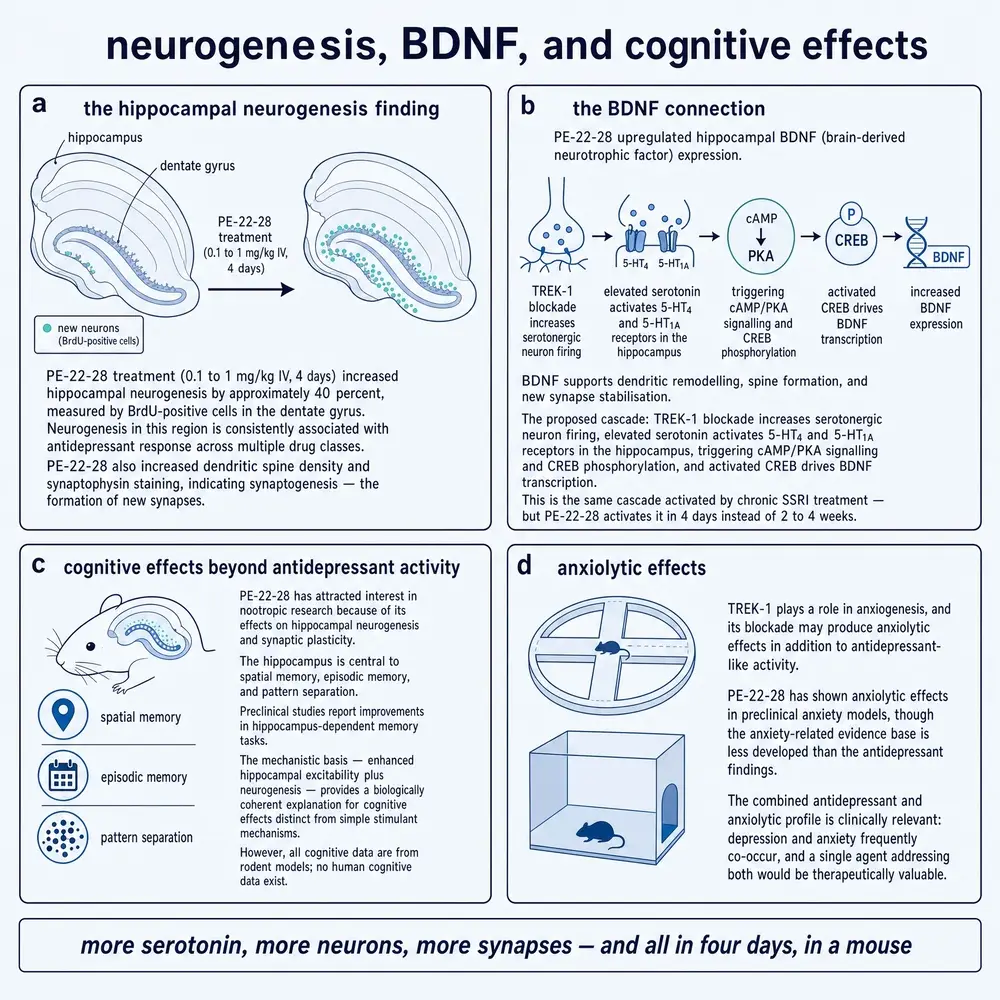
What the count establishes is bounded. It shows that cells divided and were still present four days later. It does not show what those cells became: maturation into functioning granule neurons takes weeks, and the experiment that would demonstrate it — double-labelling for a mature neuronal marker at a later time point — is reported for spadin at fifteen days but not for PE 22-28. Nor does the count establish that the new cells caused the behavioural change; the behavioural change is present at thirty minutes, long before any new cell could contribute to it, which suggests that the acute effect and the structural effect are separate consequences of the same block rather than one causing the other.
14Durability, and a correction
The most frequently repeated claim about PE 22-28 is that its effect lasts fourteen to twenty-three hours against spadin's six. The claim is traceable, it is not a fabrication, and it is not about PE 22-28.
The duration experiment in the 2017 paper measured the half-effect time in the forced swim test — the point at which the reduction in immobility seen one hour after injection had decayed to half its initial size — for two compounds at two doses each. Those compounds were G/A-PE 22-28 and biotinylated-G/A-PE 22-28, the substituted and tagged derivatives. The values were fourteen hours and twenty-one hours for the substituted analogue at 3.2 and 32 micrograms per kilogram, and seventeen and twenty-three hours for the biotinylated analogue at 4.0 and 40 micrograms per kilogram, against six hours previously measured for spadin (Djillani et al., 2017; Veyssière et al., 2015). PE 22-28 was not in the experiment.
The unmodified peptide's own duration of action has therefore never been measured, and the derivatives differ from it precisely in the features most likely to affect duration — a substituted residue and a bulky biotin tag, both of which are standard devices for slowing enzymatic degradation. Attributing their durability to the parent is exactly the inference the modifications were made to avoid needing.
A second gap sits beside the first. There is no published pharmacokinetic study of PE 22-28: no plasma half-life, no measurement of brain penetration, no distribution or clearance data. The mismatch that would be interesting — a peptide whose behavioural effect outlasts its presence in the blood by a wide margin, which is what the derivative data imply and what the neurogenesis data would predict — cannot be examined, because only one half of it has been measured.
Duration of action of 14 to 23 hours belongs to two chemically modified derivatives of PE 22-28, at two doses each, in mice. The duration of action of PE 22-28 itself is unknown. Any secondary source that attributes those hours to the compound has compressed the primary result, and the compression matters, because durability is the property the shortening programme was undertaken to obtain.
15Safety, and the shape of the ignorance
There is no toxicology on PE 22-28. No repeat-dose study, no safety pharmacology package, no genotoxicity, no reproductive study; nothing beyond the observation that treated mice completed the behavioural experiments. What exists is a safety argument by inheritance, and it is worth setting out because it is the argument that will be made.
The inherited evidence is a 2012 study of spadin that looked specifically for the side effects the target predicts. TREK-1 is involved in pain perception, in the response to cerebral ischaemia, in cardiac function and in seizure threshold, and a blocker of it might reasonably be expected to interfere with all four. The study found no deleterious effect on those functions in mice and reported that spadin was not pro-convulsant (Moha Ou Maati et al., 2012). That is a genuinely reassuring result, and it is a result about a different molecule with a different potency, a different mass and a different duration.
Three specific unknowns follow from the pharmacology rather than from the absence of studies, and they are the ones a reader should hold on to.
The channel is not confined to the brain. Section 16 sets out the range of tissues in which TREK-1 has been shown to do work, and it includes the pancreatic beta cell, where blocking the channel with spadin potentiates calcium influx and insulin secretion in mice (Hivelin et al., 2016). A systemically administered blocker acts wherever the channel is, and an effect on insulin secretion is a pharmacological consequence of the mechanism rather than an off-target surprise.
The selectivity panel is six channels wide. Clean results on TREK-2, TRAAK, TRESK, TASK-1 and hERG are real evidence and they are not a selectivity profile. Nothing is known about this peptide's behaviour at receptors, transporters, enzymes or other channel families, and the sortilin interaction described in section 08 is itself a second target.
Nothing is known about immunogenicity. A synthetic fragment of a human sequence is a low-risk case in principle, and in principle is where the evidence stops.
The table below is the compound's evidence ledger in one view. It is deliberately arranged so that the empty cells are as visible as the full ones.
| Domain | Evidence for PE 22-28 | Study type |
|---|---|---|
| Channel potency | IC50 about 0.1 nM at TREK-1; 55.5% block at 100 nM | In vitro, human cell line |
| Selectivity | No effect on TREK-2, TRAAK, TRESK, TASK-1; no hERG effect at 10 µM | In vitro, human cell line |
| Binding site | None identified; no structure, no mutagenesis | — |
| Acute behaviour | Immobility 91.8 s vs 161.7 s saline, 30 min after one injection | In vivo, mouse |
| Sub-chronic behaviour | Reduced escape latency after a 4-day course | In vivo, mouse |
| Oral activity | Active in the forced swim test after gavage | In vivo, mouse |
| Neurogenesis | 1,736 vs 899 labelled cells per hippocampus at 4 days | In vivo, mouse |
| Synaptic markers | PSD-95 higher at 36 h than at 5 h under treatment | In vitro, mouse neurons |
| Firing rate | Not measured for this compound; parent peptide only | — |
| Duration of action | Not measured; the quoted 14–23 h belongs to two derivatives | — |
| Pharmacokinetics | None published: no half-life, no brain penetration, no clearance | — |
| Toxicology | None. The reassuring side-effect study examined the parent peptide | — |
| Independent replication | None of any result | — |
| Human data | None. Target-level genetics and a propeptide biomarker only | — |
Every direct pharmacological result on PE 22-28 in this corpus, and every efficacy result on spadin, originates with the IPMC/CNRS group at Valbonne or with collaborations led by it. No independent group has published a replication of the 0.1 nanomolar potency, the forced swim result or the neurogenesis result. One study from outside the group examines a related question — the selectivity of spadin's antagonism of arachidonic-acid activation — and supports the mechanism (Ma et al., 2020), but it does not test the compound this document is about. Internal consistency across a decade of work from one laboratory is worth something. It is not the same thing as independent replication, and the difference is the largest single item in this compound's evidence ledger.
16The target has a life outside mood
A monograph organised around a compound tends to make its target look like a mood channel that happens to appear elsewhere. The literature of the last decade suggests the reverse: TREK-1 is a general-purpose regulator of excitability and of calcium entry that happens, among other things, to be involved in mood. The recent work is worth reading for that reason, and it is worth reading with the labels attached, because none of it is a finding about PE 22-28.
The oldest of these findings is the pain phenotype: TREK-1 knockout mice are more sensitive to painful heat and to mechanical pressure, which makes the channel a brake on nociceptive signalling as well as on serotonergic firing (Alloui et al., 2006). Two later results extend the theme into injury. In a rat model of traumatic brain injury, controlled decompression limited compressive damage through TREK-1-mediated inhibition of necroptosis and neuroinflammation (Chen et al., 2021). In a rat model of major depressive disorder, blocking TREK-1 suppressed the activation of A1-like reactive astrocytes through NF-κB signalling — a mood result, but a glial one, arriving at the same channel from the immune side rather than the neuronal side (Cong et al., 2023).
Outside the nervous system the picture widens further. Blocking TREK-1 with spadin potentiates calcium influx and insulin secretion in mouse pancreatic beta cells (Hivelin et al., 2016). TREK-1 regulates adipocyte differentiation and lipid accumulation (Kim et al., 2025). It contributes to arachidonic-acid-induced calcium signalling in human fibroblast-like synovial cells, the cells that line joints and drive the inflammatory arthritides (Khaltar et al., 2025). Arachidonic acid hyperpolarises human mesenchymal stromal cells through the channel (Tarasov et al., 2019). In zebrafish, two paralogues of the gene exist where mammals have one, which complicates the use of that model organism for anything involving this channel (Nasr et al., 2018). And in a mouse model of decompression sickness, spadin enhanced fluoxetine's protective effect, an odd corner of the literature that nevertheless demonstrates the peptide doing something outside the behavioural paradigms (Vallée et al., 2016).
Two conclusions follow, and they point in opposite directions. The first is that the target is real and durable: nine years of work by groups with no connection to Valbonne have found TREK-1 doing consequential work in tissue after tissue, and none of it contradicts the mood findings. Weighted for recency, as this series weights evidence, the 2019–2025 literature strengthens the case for the target rather than undermining it. The second is that a systemically administered blocker of a channel this widely distributed is not a targeted intervention. The pancreatic result is the sharpest example: the effect on insulin secretion was produced by the same compound, acting on the same channel, by the same mechanism that produces the mood effect. It is not a side effect in the usual sense. It is the drug working, somewhere else.
That tension has a standard resolution in drug development and it has not been attempted here. A compound intended to act on a channel in the brain and nowhere else is normally engineered either to cross the blood–brain barrier and be excluded from the periphery, or to be delivered in a way that achieves the same separation. Nothing in this corpus addresses that question for PE 22-28. Its distribution has not been measured, its access to the brain has not been demonstrated, and the peripheral consequences of blocking TREK-1 at an effective central concentration have not been looked for. The beta-cell result is not evidence of harm; it is evidence that the question exists and has not been asked.
17The human evidence, all of it indirect
No human being has knowingly received PE 22-28 or spadin in a study. This document states that as a verified absence rather than as an assumption: a search of the ClinicalTrials.gov registry run for this build on 3 August 2026 returned no studies for the sequence GVSWGLR, none for spadin and none for KCNK2. The string PE 22-28 returned twenty-seven records, every one of them obstetric or haematological, in which PE denotes pre-eclampsia. The compound's own name collides with another abbreviation in the registry, which is a good illustration of why this document treats the designation as a coordinate rather than a word.
What human evidence exists is about the target and about the parent propeptide, and there are two pieces of it.
Genetics
The STAR*D study was a large, pragmatic, sequenced trial of antidepressant treatment in the United States, designed to establish what happens when the first drug does not work. A pharmacogenetic analysis of genes implicated in rodent models of antidepressant response found four single-nucleotide polymorphisms in KCNK2 — the gene encoding TREK-1 — associated with treatment resistance (Perlis et al., 2008). This is a human genetic association, and it is the single most useful piece of human evidence in the compound's whole file, because it connects the target to a clinical phenotype in people rather than in mice. It is also a candidate-gene association from 2008, an era whose findings have a poor replication record in psychiatric genetics, and it says nothing about whether blocking the channel helps anybody.
A biomarker, after electroconvulsive therapy
The second piece concerns the propeptide from which spadin was designed. Roulot and colleagues measured serum levels of the sortilin-derived propeptide in treatment-resistant depressed patients receiving electroconvulsive therapy (Roulot et al., 2018). Levels rose significantly between baseline and one month after the course. That result is routinely summarised as evidence that an effective antidepressant treatment raises the endogenous relative of spadin, and the summary is stronger than the study.
Three details from the same paper qualify it. The patients' propeptide levels did not differ from healthy controls at baseline, so the measure is not a marker of the depressed state. There was no change immediately after the course of treatment, only at one month. And the design is an uncontrolled within-subject comparison over a month, during which a great deal else changes in a recovering patient. The finding is compatible with the mechanism and it is not evidence for it.
Set the two halves of the file side by side. On the preclinical side: a sub-nanomolar potency, a clean six-channel selectivity panel, five behavioural paradigms, a doubling of hippocampal cell birth, a firing-rate change that reproduces a knockout phenotype, and oral activity. On the human side: four polymorphisms in the target gene associated with treatment resistance in 2008, and a serum protein that rises over a month in twenty-odd patients after electroconvulsive therapy. There is no bridge between them — no phase 1, no tolerability data, no human pharmacokinetics, no measurement of whether the peptide survives human serum or crosses a human blood–brain barrier. This is not an unusual position for a preclinical compound. It is worth stating plainly because the preclinical half reads, on its own, like a much later-stage story than it is.
18Where this leaves the compound
PE 22-28 occupies a specific and somewhat awkward position. Judged as chemistry it is elegant: a seven-residue human sequence, cheap to synthesise, sub-nanomolar at its target, clean against the obvious liabilities, and active in an animal by mouth. Judged as a drug candidate it is at the earliest stage the word candidate can bear, and it has been there since 2017. The primary paper is nine years old at the time of writing and the corpus read for this document contains no follow-up on the compound itself — no independent replication, no pharmacokinetics, no toxicology, no development programme.
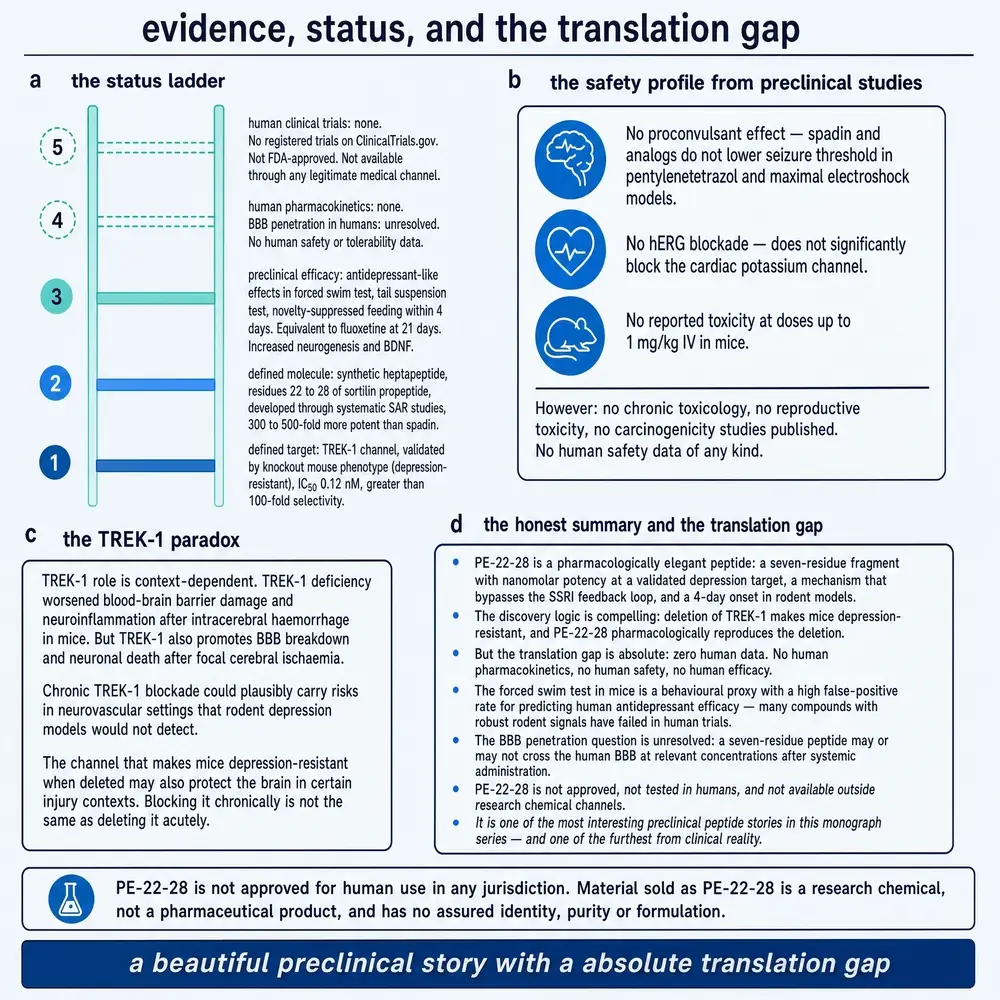
The comparison that clarifies its position is with ketamine. Ketamine established that fast antidepressant action is possible, and it did so in people, which is why it changed the field. Every fast-acting candidate since is measured against a compound with human efficacy data, and PE 22-28 has none. What the peptide offers in principle is a route to speed without dissociation, without abuse liability, and through a mechanism that raises serotonergic tone rather than acting on glutamate; the group's own argument places it as an alternative to both the SSRIs and the mTOR-dependent rapid agents (Borsotto et al., 2015; Djillani et al., 2019). It is an argument about a mechanism, and mechanisms have a poor record of predicting clinical outcomes in psychiatry.
The wider search continues along other unconventional lines — a 2025 open-label proof-of-concept study of thymosin alpha-1 in patients with common variable immune deficiency and depression is one recent example of how far the field is now willing to look for antidepressant mechanisms outside the monoamine system (Aynekulu Mersha et al., 2025). PE 22-28 belongs to that broader movement, and its particular contribution is the demonstration that a target validated by a knockout mouse can be reached by a fragment of a protein the body already discards.
What would move the evidence
Four experiments would change the weight of this file more than any amount of further work in the originating laboratory.
An independent replication. One group outside Valbonne measuring the TREK-1 potency and running the forced swim test would convert a consistent single-laboratory record into a finding. Nothing else in this list matters as much.
Pharmacokinetics of the unmodified peptide. Plasma half-life, brain penetration, and the duration of action that has been attributed to PE 22-28 but measured only for its derivatives.
A causal test of the neurogenesis. Ablate hippocampal neurogenesis and ask whether the behavioural effect survives, as was done for the conventional antidepressants in 2003.
A structure, or a binding site. The peptide's mode of interaction with TREK-1 is entirely unknown, which makes rational improvement impossible and leaves the terminal-arginine dependence as the only piece of structure–activity information in the record.
Until some of that exists, the honest summary is the one the record supports. A knockout mouse identified a channel. A discarded propeptide supplied a sequence. Three rounds of subtraction produced seven amino acids that block the channel at a tenth of a nanomolar and behave, in mice, like a fast antidepressant. Nobody has checked the result, nobody has given the compound to a person, and the compound's most-quoted property belongs to something else.
This monograph describes published research. It does not recommend human use of PE 22-28, of spadin or of any related compound, and it specifies no dose, route or schedule for any person. Every amount and route reported in it is a parameter of an animal or in-vitro experiment, given with its species and its duration attached so that the underlying result can be read. No clinical study of this compound or of its parent peptide exists, and nothing in this document is medical advice.
19References
Numbered and sorted by first-author surname. Every entry in the numbered list was generated from the record NCBI returned for its identifier during this build; none was written from memory, and the build refuses to run if any identifier fails to resolve. Material with no PubMed record — a chemical database entry, a protein knowledgebase entry, a trial-registry search and one commercial listing — is listed separately so that the numbered list remains wholly machine-verified.
- Alloui A, Zimmermann K, Mamet J, Duprat F, Noël J, Chemin J, et al.. TREK-1, a K+ channel involved in polymodal pain perception. EMBO J. 2006;25(11):2368-76. PMID 16675954 · doi:10.1038/sj.emboj.7601116 · PMC6729548
- Aynekulu Mersha DG, Fromme SE, van Boven F, Arteaga-Henríquez G, Wijkhuijs A, van der Ent M, et al.. Indications for an antidepressive effect of thymosin alpha-1 in a small open-label proof of concept study in common variable immune deficiency patients with depression. Brain Behav Immun Health. 2025;43:100934. PMID 39867848 · doi:10.1016/j.bbi.2020.10.013 · PMC7986984
- Borsotto M, Veyssiere J, Moha Ou Maati H, Devader C, Mazella J, Heurteaux C. Targeting two-pore domain K(+) channels TREK-1 and TASK-3 for the treatment of depression: a new therapeutic concept. Br J Pharmacol. 2015;172(3):771-84. PMID 25263033 · doi:10.1111/bph.12953 · PMC4023150
- Chen T, Qian X, Zhu J, Yang LK, Wang YH. Controlled Decompression Attenuates Compressive Injury following Traumatic Brain Injury via TREK-1-Mediated Inhibition of Necroptosis and Neuroinflammation. Oxid Med Cell Longev. 2021;2021:4280951. PMID 34790287 · doi:10.1155/2016/3142175 · PMC5220496
- Cong T, Sun Y, Zhou Y, Wu H, Li L, Chu Z, et al.. Blocking Two-Pore Domain Potassium Channel TREK-1 Inhibits the Activation of A1-Like Reactive Astrocyte Through the NF-κB Signaling Pathway in a Rat Model of Major Depressive Disorder. Neurochem Res. 2023;48(6):1737-1754. PMID 36670238 · doi:10.3389/fimmu.2022.847360 · PMC8978957
- Devader C, Khayachi A, Veyssière J, Moha Ou Maati H, Roulot M, Moreno S, et al.. In vitro and in vivo regulation of synaptogenesis by the novel antidepressant spadin. Br J Pharmacol. 2015;172(10):2604-17. PMID 25598009 · doi:10.1111/bph.13083 · PMC3375317
- Djillani A, Pietri M, Moreno S, Heurteaux C, Mazella J, Borsotto M. Shortened Spadin Analogs Display Better TREK-1 Inhibition, In Vivo Stability and Antidepressant Activity. Front Pharmacol. 2017;8:643. PMID 28955242 · doi:10.1016/j.ejphar.2007.12.005 · PMC5483313
- Djillani A, Mazella J, Heurteaux C, Borsotto M. Role of TREK-1 in Health and Disease, Focus on the Central Nervous System. Front Pharmacol. 2019;10:379. PMID 31031627 · doi:10.1523/JNEUROSCI.5784-08.2009 · PMC6665656
- Heurteaux C, Lucas G, Guy N, El Yacoubi M, Thümmler S, Peng XD, et al.. Deletion of the background potassium channel TREK-1 results in a depression-resistant phenotype. Nat Neurosci. 2006;9(9):1134-41. PMID 16906152 · doi:10.1038/nn1749
- Hivelin C, Béraud-Dufour S, Devader C, Abderrahmani A, Moreno S, Moha Ou Maati H, et al.. Potentiation of Calcium Influx and Insulin Secretion in Pancreatic Beta Cell by the Specific TREK-1 Blocker Spadin. J Diabetes Res. 2016;2016:3142175. PMID 28105440 · doi:10.1016/j.neuron.2012.04.026 · PMC3383668
- Honoré E. The neuronal background K2P channels: focus on TREK1. Nat Rev Neurosci. 2007;8(4):251-61. PMID 17375039 · doi:10.1038/nrn2117
- Khaltar B, Toyoda F, Kumagai K, Yayama T, Tsedenbal B, Umeda K, et al.. Two-pore domain potassium channel TREK-1 contributes to arachidonic acid-induced Ca2+ signaling in human fibroblast-like synovial cells. Biochem Biophys Rep. 2025;43:102098. PMID 40612004 · doi:10.1016/j.jaut.2023.103136 · PMC4863321
- Kim A, Jung S, Kim Y, Jung J, Lee S, Lee H, et al.. Novel function of TREK-1 in regulating adipocyte differentiation and lipid accumulation. Cell Death Dis. 2025;16(1):164. PMID 40057491 · doi:10.1515/hmbci-2014-0022 · PMC5942360
- Ma R, Lewis A. Spadin Selectively Antagonizes Arachidonic Acid Activation of TREK-1 Channels. Front Pharmacol. 2020;11:434. PMID 32317978 · doi:10.1042/CS20150533 · PMC6762917
- Mazella J, Zsürger N, Navarro V, Chabry J, Kaghad M, Caput D, et al.. The 100-kDa neurotensin receptor is gp95/sortilin, a non-G-protein-coupled receptor. J Biol Chem. 1998;273(41):26273-6. PMID 9756851 · doi:10.1074/jbc.273.41.26273
- Mazella J, Pétrault O, Lucas G, Deval E, Béraud-Dufour S, Gandin C, et al.. Spadin, a sortilin-derived peptide, targeting rodent TREK-1 channels: a new concept in the antidepressant drug design. PLoS Biol. 2010;8(4):e1000355. PMID 20405001 · doi:10.1371/journal.pbio.1000355 · PMC1170177
- Mazella J, Borsotto M, Heurteaux C. The Involvement of Sortilin/NTSR3 in Depression as the Progenitor of Spadin and Its Role in the Membrane Expression of TREK-1. Front Pharmacol. 2018;9:1541. PMID 30670975 · doi:10.18632/oncotarget.3782 · PMC4621903
- Moha ou Maati H, Peyronnet R, Devader C, Veyssiere J, Labbal F, Gandin C, et al.. A human TREK-1/HEK cell line: a highly efficient screening tool for drug development in neurological diseases. PLoS One. 2011;6(10):e25602. PMID 22022421 · doi:10.1016/j.neuropharm.2011.07.019 · PMC1170762
- Moha Ou Maati H, Veyssiere J, Labbal F, Coppola T, Gandin C, Widmann C, et al.. Spadin as a new antidepressant: absence of TREK-1-related side effects. Neuropharmacology. 2012;62(1):278-88. PMID 21807005 · doi:10.1016/j.neuropharm.2011.07.019
- Munck Petersen C, Nielsen MS, Jacobsen C, Tauris J, Jacobsen L, Gliemann J, et al.. Propeptide cleavage conditions sortilin/neurotensin receptor-3 for ligand binding. EMBO J. 1999;18(3):595-604. PMID 9927419 · doi:10.1093/emboj/18.3.595 · PMC1171152
- Nasr N, Faucherre A, Borsotto M, Heurteaux C, Mazella J, Jopling C, et al.. Identification and characterization of two zebrafish Twik related potassium channels, Kcnk2a and Kcnk2b. Sci Rep. 2018;8(1):15311. PMID 30333618 · doi:10.1038/nport.2013.041nport.2013.041 · PMC1299299
- Perlis RH, Moorjani P, Fagerness J, Purcell S, Trivedi MH, Fava M, et al.. Pharmacogenetic analysis of genes implicated in rodent models of antidepressant response: association of TREK1 and treatment resistance in the STAR(*)D study. Neuropsychopharmacology. 2008;33(12):2810-9. PMID 18288090 · doi:10.1038/npp.2008.6 · PMC6762917
- Roulot M, Minelli A, Bortolomasi M, Maffioletti E, Gennarelli M, Borsotto M, et al.. Increased serum levels of sortilin-derived propeptide after electroconvulsive therapy in treatment-resistant depressed patients. Neuropsychiatr Dis Treat. 2018;14:2307-2312. PMID 30233189 · doi:10.2147/NDT.S170165 · PMC4409910
- Santarelli L, Saxe M, Gross C, Surget A, Battaglia F, Dulawa S, et al.. Requirement of hippocampal neurogenesis for the behavioral effects of antidepressants. Science. 2003;301(5634):805-9. PMID 12907793 · doi:10.1126/science.1083328
- Tarasov MV, Kotova PD, Bystrova MF, Kabanova NV, Sysoeva VY, Kolesnikov SS. Arachidonic acid hyperpolarizes mesenchymal stromal cells from the human adipose tissue by stimulating TREK1 K+ channels. Channels (Austin). 2019;13(1):36-47. PMID 30661462 · doi:10.1080/19336950.2019.1565251 · PMC4839434
- Vallée N, Lambrechts K, De Maistre S, Royal P, Mazella J, Borsotto M, et al.. Fluoxetine Protection in Decompression Sickness in Mice is Enhanced by Blocking TREK-1 Potassium Channel with the "spadin" Antidepressant. Front Physiol. 2016;7:42. PMID 26909044 · doi:10.1097/00000637-199204000-00008 · PMC2072572
- Veyssiere J, Moha Ou Maati H, Mazella J, Gaudriault G, Moreno S, Heurteaux C, et al.. Retroinverso analogs of spadin display increased antidepressant effects. Psychopharmacology (Berl). 2015;232(3):561-74. PMID 25080852 · doi:10.1002/psc.1306 · PMC2365731
Sources without a PubMed record
- National Center for Biotechnology Information. PubChem compound summary for CID 91826106, PE 22-28 (Gly-Val-Ser-Trp-Gly-Leu-Arg). PubChem, National Library of Medicine. Accessed 3 August 2026. https://pubchem.ncbi.nlm.nih.gov/compound/91826106
- UniProt Consortium. Q99523 · SORT1_HUMAN, sortilin: propeptide Gln1–Arg44 and the furin cleavage site. UniProt knowledgebase. Accessed 3 August 2026. https://www.uniprot.org/uniprotkb/Q99523/entry
- ClinicalTrials.gov. Registry search for PE 22-28, GVSWGLR, spadin and KCNK2, run 3 August 2026: no registered study of the compound or of its parent peptide. U.S. National Library of Medicine, API v2. The 27 records returned for the string “PE 22-28” are obstetric and haematological studies in which PE denotes pre-eclampsia. https://clinicaltrials.gov/search?term=spadin
- Peptide Sciences. PE-22-28 product dossier, catalogue item P094, with parent item P095 (spadin). Commercial research-chemical listing, archived locally. A secondary source, used only to cross-check identity fields against the primary literature; no claim in this document rests on it. https://www.peptidesciences.com/
20How this document was assembled
The corpus is small, which is a fact about the compound rather than about the search. Seventeen scientific full texts were read in their entirety, of which two carry almost all of the direct evidence: the 2017 paper that describes PE 22-28 and the 2010 paper that describes its parent. The remainder divide into the spadin lineage — the screening cell line, the retro-inverso analogues, the side-effect study, the synaptogenesis study — and the target literature, which is where the recent work is. A commercial product dossier for catalogue item P094 was read as a secondary source and used only to cross-check identity fields against the primary literature; no claim in this document rests on it.
| Stage | What it does | Output |
|---|---|---|
| 02 | PubMed harvest for the compound, its parent, its target and the surrounding literature | 27 indexed records |
| 03 | Full-text retrieval and plain-text extraction from JATS | 17 scientific full texts |
| 05a | Identifier resolution: PMCIDs converted through the NCBI ID converter, remaining works resolved by constrained title-and-journal search narrowed to a single hit | 27 verified PMIDs, 0 unresolved |
| 05 | Reference list generated from the records NCBI returned | 27 numbered references + 4 without a PubMed record |
| 05c / 06a | Figures injected at their markers and numbered in document order | 12 authored figures |
| 06 | Assembly of the body fragment and both theme wrappers | 3 HTML deliverables |
| 07 / 07c | Rendering to A4 through headless Chrome; running headers and folios stamped | 2 PDF editions |
| 11–13 | Page density, margin, artwork-integrity and contrast audits, both editions | QC reports |
| 14 | Release manifest: every work product verified present, current and identical at every location | RELEASE_MANIFEST.md |
Two identity problems needed handling before any of that. The first is the homograph: the string PE denotes pre-eclampsia in the obstetric literature and phosphatidylethanolamine in the lipid literature, and a naive search for “PE 22-28” returns mostly those. Records were admitted only on an unambiguous identifier — the sequence GVSWGLR, or the range notation in a context that names sortilin, spadin or TREK-1. The second is the family: PE 22-28 has close siblings that appear in the same tables (PE 12-27, PE 14-25, PE 22-27, PE 22-25) and two chemically modified derivatives whose results are routinely quoted as its own. Derivative results are labelled as derivative results wherever they appear in this document, and section 14 exists because one of them is habitually misattributed.
All twelve figures were authored for this document as theme-token SVG and verified on both editions. No third-party published figure has been reproduced, and every value plotted traces to a line in the verified-facts ledger built from the full texts.
21Evidence handling
Findings are labelled by study type in the sentence that reports them. Three labels do most of the work here. In vitro means a measurement in transfected cells, almost always the human TREK-1/HEK line, and covers every potency and selectivity figure in the document. In vivo, mouse covers the entire behavioural and neurogenesis record; where a result comes from rats it is named as such. Human appears twice, for a genetic association and for a serum biomarker, and it never covers an efficacy claim, because there is no human efficacy claim to cover.
Where a source contradicts itself, this document reports the contradiction rather than resolving it silently. Three such cases appear. The primary paper assigns the values 0.10 and 0.12 nanomolar to PE 22-28 and its substituted derivative two different ways in three places, and the group's own later review follows one of the readings; section 11 reports about 0.1 nanomolar and names the disagreement. The same paper's Figure 1 legend calls a serum degradation product PE 14-28 while its text and sequence panel call it PE 14-25 twice; section 07 uses PE 14-25 and records the inconsistency. And fluoxetine's potency at TREK-1 is quoted at about six micromolar in one paper from the group and nineteen micromolar in another, measured in a different cell line; both are reported.
Recency is weighted, with a limit. The 2019–2025 literature on TREK-1 is newer than the antidepressant work and is given corresponding weight, but it reinforces the target rather than overturning the older findings: none of it contradicts the 2010 and 2017 results, and none of it corroborates them either, because it concerns the channel in other tissues rather than these peptides. An older positive result is not superseded by a newer paper that does not test it.
Two gaps are treated as findings rather than as omissions. The first is the absence of any human study, verified against the trial registry rather than inferred from the literature. The second is the absence of independent replication: every direct efficacy result on this compound and its parent comes from one laboratory, and that fact is stated wherever those results are used rather than confined to a limitations paragraph.

Continue exploring