
Lean Mass During GLP-1 Weight Loss
Every large weight loss — from dieting, surgery, or drugs — sheds some fat-free mass along with fat. What the DEXA data from the GLP-1 trials actually show, why 'lean mass' is not the same as muscle, and what protein and resistance training can and cannot do about it.
Abstract
Weight loss of any kind — caloric restriction, bariatric surgery, or incretin drugs — removes fat-free mass along with fat. Across dual-energy X-ray absorptiometry (DEXA) substudies, roughly a quarter to a third of the weight lost is fat-free mass, and the GLP-1 and GLP-1/GIP therapies fall inside that range rather than outside it: in the SURMOUNT-1 tirzepatide substudy about 26% of the weight lost was lean mass, almost identical to the 25% seen on placebo, while the semaglutide STEP 1 substudy reported a higher share near 40%. The central caveats are that 'lean mass' on a scan includes organs, bone, connective tissue, and body water — not only contractile muscle — and that magnetic-resonance work suggests the skeletal-muscle change is largely the adaptive response expected for a smaller body, with improved muscle quality and function in most people but real sarcopenia risk in older and frailer patients. Resistance training and adequate protein preserve fat-free mass in exercise-plus-diet trials, and combination and muscle-targeted agents are in development; but that evidence comes from diet studies rather than dedicated trials layered on the drugs, and training cannot switch off the appetite suppression that lowers protein intake. Throughout, mechanism and association are kept separate from demonstrated clinical harm, and study type, population, and duration are labelled on every figure.
Key findings
- Losing weight costs some fat-free mass no matter how you do it: across DEXA studies roughly a quarter to a third of weight lost is fat-free mass, and a 2026 meta-analysis of trials reaching at least 10% weight loss put the fat-free share at about 33% for incretin drugs and 34% for bariatric surgery, versus about 15% for diet and lifestyle interventions overall (Busk-Cirera et al., 2026; Heymsfield et al., 2025).
- The GLP-1 numbers are in that range, not above it: in the SURMOUNT-1 tirzepatide DEXA substudy about 26% of the weight lost was lean mass — nearly identical to the 25% on placebo — while the semaglutide STEP 1 substudy reported a higher share near 40%, the kind of trial-to-trial heterogeneity the field has flagged (Look et al., 2025; Neeland et al., 2024).
- 'Lean mass' is not muscle: a DEXA lean-mass reading includes organs, bone, connective tissue, and body water — including glycogen-bound water lost early — so a drop in the number overstates any loss of contractile muscle (Neeland et al., 2024; Look et al., 2025).
- The muscle change looks largely adaptive: in the SURPASS-3 MRI substudy thigh-muscle volume fell about 0.64 litres, statistically no different from what the weight loss alone predicts, while muscle fat infiltration improved — a marker of better muscle quality — though most trials were not designed to measure strength or physical function directly (Sattar et al., 2025; Neeland et al., 2024).
- Resistance training plus adequate protein preserves fat-free mass during a caloric deficit — a network meta-analysis found exercise prevented about 46% of the fat-free-mass loss, and combined or resistance training preserved the most — but this evidence comes from diet-based trials, not from training layered on the drugs, and it cannot undo the appetite suppression that lowers protein intake (Deller et al., 2026; Villareal et al., 2017; Locatelli et al., 2024).
- The genuine concern is concentrated, not general: older age and advanced disease raise sarcopenia risk and bear on who is a good candidate, and muscle-sparing combination agents are in development — but for most people the evidence points to an expected adaptation with improved insulin sensitivity, not demonstrated clinical harm (Neeland et al., 2024).
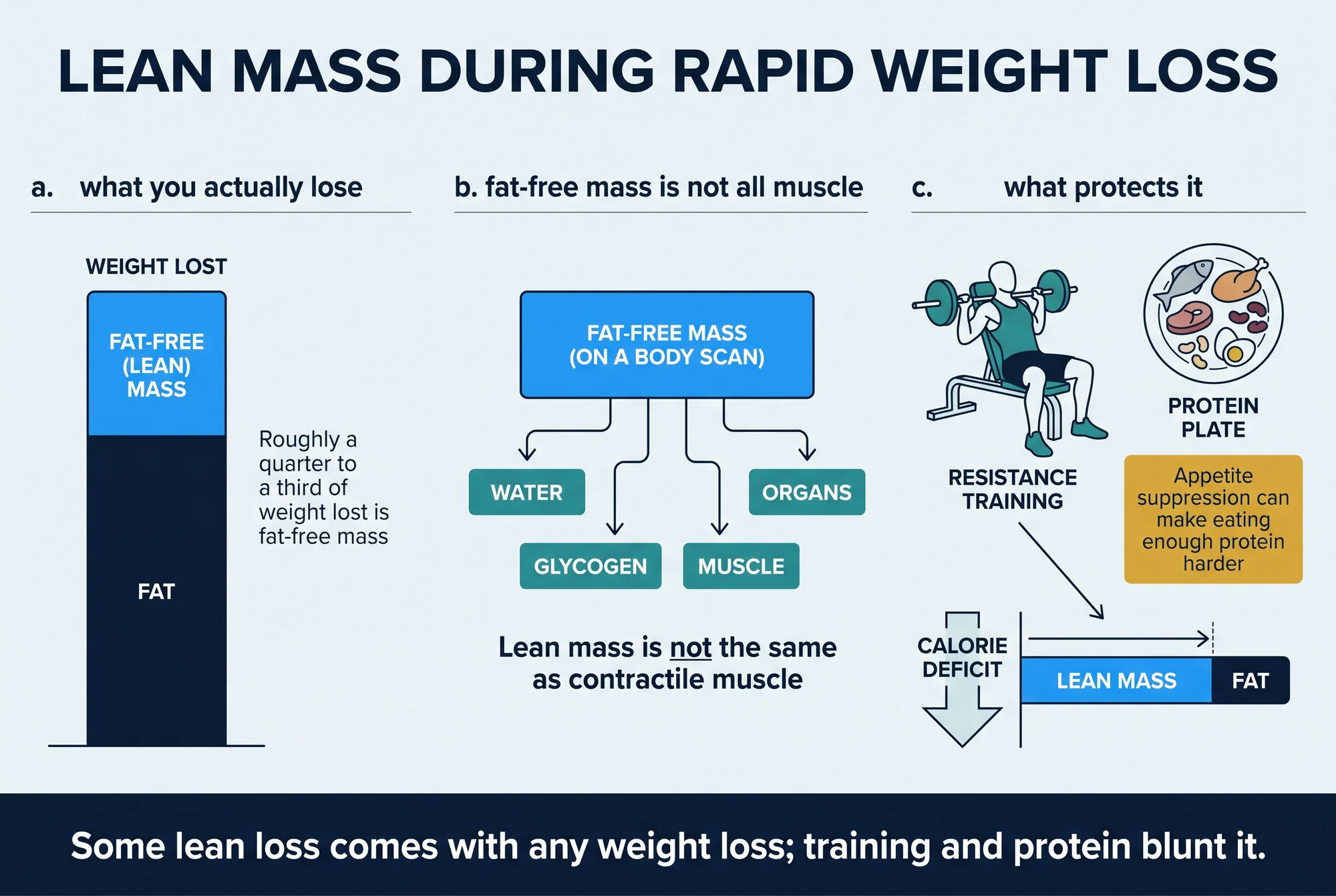
One of the most repeated worries about the GLP-1 weight-loss drugs is that they "make you lose muscle." The honest version is more specific, and more reassuring, than the slogan. Yes, rapid weight loss on semaglutide or tirzepatide reduces lean mass as well as fat. But that is true of every large weight loss — dieting, bariatric surgery, and drugs alike — because the body does not burn pure fat. And the quantity a body scan calls "lean mass" is not the same thing as working muscle: it includes organs, bone, connective tissue, and a surprising amount of water.
Put the two facts together and the question sharpens: not "do these drugs cost you muscle?" but how much of the weight lost is fat-free tissue, whether that share is unusual, how much of it is actually muscle, and whether it changes how a person functions. The dual-energy X-ray absorptiometry (DEXA) substudies of the major trials now answer most of that with numbers.
Why the question matters
Muscle is not just for movement. It is the body's largest site for clearing sugar from the blood after a meal, an endocrine tissue, and a protein reserve — the reasons set out in the companion explainer on muscle as a metabolic organ — and losing it with age, as sarcopenia, tracks with worse metabolic health, disability, and higher mortality. A therapy that removes large amounts of body mass quickly therefore deserves scrutiny: if much of what leaves is functional muscle, that matters.
What is new is the scale and speed. The incretin drugs — semaglutide (a GLP-1 receptor agonist) and tirzepatide (a dual GLP-1/GIP agonist), with the investigational triple agonist retatrutide behind them — now produce weight loss of roughly 15% to 24% of body weight, approaching what surgery achieves (Locatelli et al., 2024). Weight loss that large and that fast is exactly the setting in which body composition is worth measuring rather than assuming — and it has been measured.
Every weight loss costs some fat-free mass
Start with the fact that predates the drugs. When the body loses weight it does not draw down a pure fat compartment; it loses fat-free mass too. Across dietary-restriction studies the rule of thumb is that about three-quarters of the weight lost is fat and about one-quarter is lean tissue. A 2025 DEXA analysis of voluntary weight loss put numbers on it: in 140 adults who lost about 11% of their weight on a hypocaloric diet, the lean-soft-tissue share was 25% in women and 33% in men — and, tellingly, the composition tracked closely with what could be predicted in advance from the weight lost and each person's starting body composition (Heymsfield et al., 2025). Losing fat-free mass is not a drug side effect; it is what weight loss is.
The proportion shifts with how the weight comes off. A 2026 systematic review and meta-analysis of randomized trials that achieved at least 10% weight loss laid the modalities side by side (Busk-Cirera et al., 2026): expressed as the share of weight lost that was fat-free mass, the figures were about 15% for diet and lifestyle interventions overall, about 33% for incretin drugs, and about 34% for bariatric surgery, with pooled absolute reductions of roughly 1.8 kg, 4.8 kg (versus placebo), and 9.1 kg respectively. That diet-and-lifestyle figure is a category average that spans a wide internal range — diet-only nearer 22%, and about 8% once exercise is added (see below). The larger and faster the weight loss, the more fat-free mass goes with it — so the incretin drugs land near surgery and well above supervised lifestyle change. That is the honest framing: not that the drugs are uniquely harmful to lean tissue, but that they sit at the higher-weight-loss end of a spectrum that always includes some fat-free-mass loss.
What the GLP-1 trials actually show
The cleanest look inside a GLP-1/GIP weight loss comes from the DEXA substudy of SURMOUNT-1, the pivotal tirzepatide obesity trial (Jastreboff et al., 2022): 160 participants were scanned at baseline and at 72 weeks (Look et al., 2025).
The tirzepatide group lost 21.3% of its body weight; fat mass fell 33.9% and lean mass 10.9%, an absolute lean-mass reduction of about 5.6 kg (Look et al., 2025). But the number that matters here is the share: of the total weight lost, about 74% was fat and 26% was lean — and on placebo, with far less weight lost, the split was almost identical, 75% fat and 25% lean, holding across age, sex, and amount lost. The reading is pointed: tirzepatide removed three times as much fat as lean, in the same ratio as lifestyle change alone. It drove more weight loss, not a worse kind.
Semaglutide's own DEXA substudy, in the STEP 1 obesity trial (14.9% mean weight loss; Wilding et al., 2021), is where the picture gets more textured: its body-composition subgroup reported a larger fat-free share — on the order of 40% of the weight lost as lean mass (about 10.4 kg of fat and 6.9 kg of lean, as summarized by the SURMOUNT-1 investigators; Look et al., 2025). A 26% lean share in one trial and roughly 40% in another is a real spread, and exactly the heterogeneity the field has flagged: a 2024 review noted reported lean-mass reductions ranging from 40–60% of weight lost in some studies down to about 15% or less in others, driven by population, the specific drug, coexisting disease, and how body composition was measured (Neeland et al., 2024). The defensible summary is a range, not a single figure: between a quarter and roughly two-fifths of GLP-1-era weight loss shows up as fat-free mass, with a pooled cross-trial estimate for incretin drugs near a third (Busk-Cirera et al., 2026). In absolute terms that is roughly a 10%, or about 6 kg, lean-mass reduction — comparable, one review noted, to a decade or more of normal aging compressed into a year (Locatelli et al., 2024).
"Lean mass" is not muscle
Every figure above carries a caveat that changes its meaning, and it is the single most important thing to understand here. Fat-free mass, or "lean mass," on a body scan is not muscle. It is everything in the body that is not fat: skeletal muscle, yes, but also the heart and other organs, bone, connective tissue, and body water (Neeland et al., 2024). The DEXA "lean soft tissue" reading used in these substudies is fat-free mass minus bone — still a mixture of muscle, organs, and fluid, not a muscle measurement (Look et al., 2025).
Two consequences follow. First, some of the early drop in "lean mass" is not tissue at all but water: muscle stores carbohydrate as glycogen, each gram held with several grams of water, so as glycogen falls early in weight loss the associated water leaves with it — registering as lost lean mass without any loss of muscle protein. Second, because the compartment is a mixture, a given percentage drop in "lean mass" overstates the loss of the contractile muscle that generates strength. This is why the near-identical fat-to-lean split appears whether weight is lost on tirzepatide or placebo: the compartment responds to weight loss itself, not to a muscle-specific action of the drug (Look et al., 2025). A headline that a GLP-1 drug "costs 40% of your weight loss in muscle" has made exactly this error — swapping a mixed fat-free compartment for muscle, and reading an association with weight loss as an effect of the drug.
Expected adaptation, or genuine concern?
If "lean mass" overstates muscle loss, the natural next question is what happens to muscle specifically — and imaging that looks directly at muscle, rather than the DEXA mixture, is more informative. In the SURPASS-3 MRI substudy, 246 people with type 2 diabetes — 190 of them on tirzepatide, the rest on an insulin comparator — were scanned before and after a year (Sattar et al., 2025). Thigh-muscle volume fell by about 0.64 litres — but against what UK Biobank data predict for the amount of weight lost, the difference was just 0.04 litres and not statistically significant: essentially what the weight loss alone would predict, not an excess on top of it. Meanwhile muscle fat infiltration — fat wedged inside and between muscle fibres, a marker of poor quality — improved more than predicted. Muscle got somewhat smaller, in proportion to the smaller body, but by this measure its quality improved. This is a post-hoc, exploratory analysis against an active comparator, so it is supportive rather than definitive, but it points the same way as the broader review: with MRI-based studies added, the skeletal-muscle changes appear adaptive — commensurate with what aging, disease status, and the degree of weight loss would predict, and accompanied by improved insulin sensitivity, together lowering the probability of a loss in strength or function (Neeland et al., 2024).
Function is the outcome that ultimately matters, and it is where the evidence is thinnest, because most trials were built to measure pounds, not performance. The signals so far are reassuring but limited. In SURMOUNT-1, patient-reported physical function improved on tirzepatide despite the lean-mass loss — but that is a subjective questionnaire, and the authors called for direct tests such as a physical-performance battery or sit-to-stand test (Look et al., 2025). The real-world SEMALEAN study of 106 people on semaglutide measured grip strength directly: over a year, weight fell about 13% and fat mass about 18%, lean mass dipped then stabilized, handgrip strength rose about 4.5 kg, and the prevalence of sarcopenic obesity fell from 49% to 33% (Alissou et al., 2026) — encouraging, but a single-arm study with no control, so improvement cannot be cleanly separated from natural course or lifestyle change. The fair conclusion: the trials have not shown a decline in strength or function, and several show improvement, but were largely not designed to detect one — the functional question is answered provisionally, not closed.
Where the concern is real, it is concentrated rather than general. Older patients and those with more advanced disease start with less muscle reserve and higher baseline sarcopenia risk, so a further reduction in fat-free mass is more consequential for them — a reason for individualized candidate selection and monitoring at the margins, not a reason to read the average result as harm (Neeland et al., 2024).
What resistance training and protein can preserve
If losing some fat-free mass is intrinsic to weight loss, the practical question is how much can be held onto — and here the evidence is genuinely strong, with one boundary. Exercise-plus-diet trials show that training during a caloric deficit preserves fat-free mass. A 2026 network meta-analysis of 34 randomized trials found that adding exercise to caloric restriction preserved about 0.87 kg more fat-free mass than dieting alone — enough to prevent roughly 46% of the fat-free-mass loss — with combined and resistance training preserving the most and endurance the least (Deller et al., 2026). The same modality review that put incretin drugs at a 33% fat-free share found that within diet programs, adding exercise cut the fat-free share from about 22% to about 8% (Busk-Cirera et al., 2026). Exercise does not merely blunt the loss; it can roughly halve it.
The landmark trial is in exactly the group with the most to lose. In a New England Journal of Medicine study of 160 obese older adults who lost about 9% of their weight over six months, those assigned to resistance or combined aerobic-plus-resistance training lost less lean mass than the aerobic-only group (a 2–3% decline versus 5%), better preserved hip bone density, and gained roughly 18–19% in strength (Villareal et al., 2017). Push the deficit harder and the effect holds: in young men on a 40%-calorie deficit doing resistance and interval training, a higher-protein diet (2.4 g per kilogram per day) produced a gain of about 1.2 kg of lean mass alongside greater fat loss, versus essentially none on half that protein (Longland et al., 2016). The mechanism is understood — energy restriction lowers the rate at which muscle builds new protein, and resistance exercise offsets much of that drop (Hector et al., 2018). Adequate protein and resistance training together are the best-supported way to steer weight loss toward fat.
What they cannot do
That evidence is real, but two boundaries keep it honest, both specific to the GLP-1 setting.
The first is that almost all of it comes from diet-based weight loss, not from training layered on the drugs. Dedicated randomized trials of resistance training during GLP-1 or GLP-1/GIP therapy are largely still to come; the tirzepatide substudies above involved general lifestyle advice with no strength-training protocol (Look et al., 2025). The closest direct evidence is that combining a GLP-1 drug (liraglutide) with exercise improved weight-loss maintenance more than either alone, which is why reviewers propose resistance training as an adjunct to incretin therapy — extrapolated from diet trials and mechanism, not yet a proven muscle-sparing result inside a large drug trial (Locatelli et al., 2024). Reading "resistance training preserves lean mass" as an established fact about GLP-1 users specifically runs ahead of the evidence; it is a strong inference, labelled as such.
The second boundary is more fundamental. Resistance training and a protein target cannot switch off what the drug does. GLP-1 receptor agonists work in large part by suppressing appetite, which lowers total food intake — and with it, very often, protein intake (Drucker, 2018). The diet trials that preserved fat-free mass did so by deliberately supplying high protein, in the range of 1.2 to 2.4 g per kilogram in the resistance-training studies. Hitting an intake like that while a drug is actively reducing hunger is the practical difficulty, and no amount of training removes it: the appetite suppression that produces the weight loss is the same force working against eating enough protein to protect muscle. And because part of the early "lean mass" loss is glycogen-bound water rather than muscle protein, training cannot "save" that fraction at all — it was never muscle to begin with.
What remains uncertain
Several honest caveats belong beside the reassurance.
- The size of the loss varies, partly because of how it is measured. The fat-free share of weight lost ranges from about a quarter to roughly two-fifths across GLP-1-era studies (Look et al., 2025; Neeland et al., 2024), and DEXA "lean mass," MRI muscle volume, and true contractile muscle are three different things. Any single percentage should name its method and its trial.
- Function was rarely the primary question. Most trials measured weight and body composition, not strength, gait speed, or a sit-to-stand test; the functional signals so far are reassuring but come from questionnaires, exploratory analyses, and uncontrolled real-world studies (Look et al., 2025; Alissou et al., 2026).
- The muscle-sparing playbook has not been proven on the drugs. Resistance training and protein preserve fat-free mass in diet-and-exercise trials (Deller et al., 2026; Villareal et al., 2017), but randomized trials of that approach during GLP-1/GIP therapy are still emerging, and combination agents designed to preserve muscle while cutting fat are in development (Neeland et al., 2024).
- Association and mechanism are not demonstrated clinical harm. That less muscle tracks with worse outcomes in the general population, and that rapid weight loss reduces fat-free mass, are both true — but neither shows that GLP-1 therapy causes clinically meaningful muscle harm in a typical patient. The imaging evidence points toward an adaptive change with improved muscle quality, the genuine risk concentrated in older and frailer people (Sattar et al., 2025; Neeland et al., 2024).
This review summarizes published human evidence through 2026 on lean and fat-free mass during GLP-1 and GLP-1/GIP weight loss — the DEXA-substudy composition figures, the distinction between scanned lean mass and contractile muscle, MRI-based muscle findings, and the exercise-and-protein evidence. Evidence cutoff: 2026-08. Every statistic is drawn from the primary or peer-reviewed record and reported with its study type, population, and duration; observational, single-arm, and post-hoc analyses are labelled as such, and mechanism and association are kept separate from demonstrated clinical harm. It is educational and is not medical, nutritional, or exercise advice, a diagnosis, or a treatment plan. For related reading, see Muscle Is a Metabolic Organ, What Is GLP-1 and How Does It Work?, Semaglutide, and What Is Tirzepatide?, or browse the GLP-1s and Nutrition & body composition hubs.
References
- 1.Alissou M, Demangeat T, Folope V, et al. Impact of semaglutide on fat mass, lean mass and muscle function in patients with obesity: the SEMALEAN study. Diabetes Obes Metab. 2026;28(1):112-121. doi:10.1111/dom.70141
- 2.Busk-Cirera L, Carlsen IØ, Madsen LB, et al. Effects of incretin-based therapies, diet and exercise interventions, and bariatric surgery on fat-free mass in adults with overweight or obesity: a systematic review and meta-analysis. Diabetes Obes Metab. 2026;28(9):7737-7751. doi:10.1111/dom.71006
- 3.Deller M, Weiershaus J, Held S, Brinkmann C. Effects of calorie restriction with and without strength, endurance or mixed training on fat-free and skeletal muscle mass in overweight or obese individuals: a systematic review with pairwise meta-analysis and network meta-analysis of randomized controlled studies. Diabetes Obes Metab. 2026;28(8):6810-6823. doi:10.1111/dom.70873
- 4.Drucker DJ. Mechanisms of action and therapeutic application of glucagon-like peptide-1. Cell Metab. 2018;27(4):740-756. doi:10.1016/j.cmet.2018.03.001
- 5.Hector AJ, McGlory C, Damas F, Mazara N, Baker SK, Phillips SM. Pronounced energy restriction with elevated protein intake results in no change in proteolysis and reductions in skeletal muscle protein synthesis that are mitigated by resistance exercise. FASEB J. 2018;32(1):265-275. doi:10.1096/fj.201700158RR
- 6.Heymsfield SB, Ramirez S, Yang S, et al. Critical analysis of dual-energy x-ray absorptiometry-measured body composition changes with voluntary weight loss. Obesity (Silver Spring). 2025;33(4):685-694. doi:10.1002/oby.24255
- 7.Jastreboff AM, Aronne LJ, Ahmad NN, et al. Tirzepatide once weekly for the treatment of obesity (SURMOUNT-1). N Engl J Med. 2022;387(3):205-216. doi:10.1056/NEJMoa2206038
- 8.Locatelli JC, Costa JG, Haynes A, et al. Incretin-based weight loss pharmacotherapy: can resistance exercise optimize changes in body composition? Diabetes Care. 2024;47(10):1718-1730. doi:10.2337/dci23-0100
- 9.Longland TM, Oikawa SY, Mitchell CJ, Devries MC, Phillips SM. Higher compared with lower dietary protein during an energy deficit combined with intense exercise promotes greater lean mass gain and fat mass loss: a randomized trial. Am J Clin Nutr. 2016;103(3):738-746. doi:10.3945/ajcn.115.119339
- 10.Look M, Dunn JP, Kushner RF, et al. Body composition changes during weight reduction with tirzepatide in the SURMOUNT-1 study of adults with obesity or overweight. Diabetes Obes Metab. 2025;27(5):2720-2729. doi:10.1111/dom.16275
- 11.Neeland IJ, Linge J, Birkenfeld AL. Changes in lean body mass with glucagon-like peptide-1-based therapies and mitigation strategies. Diabetes Obes Metab. 2024;26(Suppl 4):16-27. doi:10.1111/dom.15728
- 12.Sattar N, Neeland IJ, Dahlqvist Leinhard O, et al. Tirzepatide and muscle composition changes in people with type 2 diabetes (SURPASS-3 MRI): a post-hoc analysis of a randomised, open-label, parallel-group, phase 3 trial. Lancet Diabetes Endocrinol. 2025;13(6):482-493. doi:10.1016/S2213-8587(25)00027-0
- 13.Villareal DT, Aguirre L, Gurney AB, et al. Aerobic or resistance exercise, or both, in dieting obese older adults. N Engl J Med. 2017;376(20):1943-1955. doi:10.1056/NEJMoa1616338
- 14.Wilding JPH, Batterham RL, Calanna S, et al. Once-weekly semaglutide in adults with overweight or obesity (STEP 1). N Engl J Med. 2021;384(11):989-1002. doi:10.1056/NEJMoa2032183
Disclosures
Educational review of published evidence. Not medical advice, a diagnosis, or a treatment or nutrition recommendation. Trial doses, protein intakes, training protocols, durations, and populations are reported as study parameters, not instructions. Semaglutide and tirzepatide are FDA-approved prescription drugs; retatrutide is investigational; observational and single-arm findings are labelled as such and are not causal proof; mechanism and association are distinguished throughout from demonstrated clinical harm.