
Larazotide The cholera toxin fragment that tried to close the gut
Cholera opens the gut. That is not a metaphor. Among the weapons of Vibrio cholerae is a protein that pries apart the seals between intestinal cells so that water and salt pour into the lumen. In the 1990s Alessio Fasano’s laboratory named that protein zonula occludens toxin, found a human relative that does a milder version of the same job, and then synthesised an eight‑amino‑acid peptide that appeared to do the opposite: hold the seals shut. The peptide became larazotide acetate. For two decades it was the most advanced drug candidate aimed at the intestinal tight junction in coeliac disease. A phase 2 trial met its primary symptom endpoint at the lowest dose tested. A phase 3 programme was stopped for futility in 2022. This document is an account of that arc — discovery, mechanism, animal repair, human trials, and the parts of the story that still do not settle — written so a careful non‑specialist can follow the evidence without being asked to take a dose of anything.
Every finding is labelled by the kind of study that produced it, in the sentence that reports it. A result in a dish of human keratinocytes is called a result in keratinocytes. A result on porcine intestine mounted in an Ussing chamber is called that. A randomised trial in people with coeliac disease is called a randomised trial, with its size and endpoint named.
A note on doses. Milligram amounts and dosing schedules appear only as facts about published research or registry protocols. Nothing here is guidance for any person’s use.
A note on the stop. The phase 3 programme did not succeed. It is not quarantined at the end. It appears in chronological place, at the same length as the earlier positive signals, because that pattern is the most informative thing in the clinical record.
01What the gut wall actually is
The lining of the small intestine is one cell thick. That thinness is the point: nutrients must cross. It is also the risk. On one side sits a dense mixture of food fragments, microbes and their products. On the other sits the body’s immune system, which is not meant to see most of those things. The cells form a continuous sheet. Between them sit tight junctions — assemblies of claudins, occludin, junctional adhesion molecules and the scaffold proteins ZO‑1, ZO‑2 and ZO‑3 — that decide what may slip through the gap (Slifer et al., 2021).
Two routes matter. The transcellular route goes through a cell. The paracellular route goes between cells, under the control of those junctions. When people say “leaky gut,” they are usually pointing at the second route, often with more slogans than measurements. The measurement that laboratories actually use is electrical resistance across the sheet (TEER), or the passage of labelled sugars and probes. The slogan and the measurement are not the same thing (Fasano, 2021).
02Cholera’s second trick
Classical cholera toxin forces the enterocyte to secrete chloride; water follows. That was already textbook when Fasano and colleagues reported that V. cholerae culture supernatants still altered rabbit ileal permeability after cholera toxin was accounted for. In 1991 they described a second enterotoxin that rearranged tight‑junction strands and raised transepithelial conductance. They named it zonula occludens toxin, Zot (Fasano et al., 1991). Later work placed Zot’s action on actin polymerisation through a protein‑kinase‑C‑dependent path (reviewed in Slifer et al., 2021).
A pathogen that opens junctions is, for a mucosal biologist, also a clue. If bacteria have evolved a key, the host may keep a lock — and perhaps a gentler version of the same key for ordinary physiology.
03Fasano, zonulin, and the octapeptide
That line of thought produced zonulin. In 2000 Wang, Fasano and colleagues purified a human intestinal protein that behaved like Zot on tissue resistance. Fetal and adult forms differed at the amino‑terminal residues, but a shared motif remained. From the fetal sequence, positions 8–15, they synthesised an octapeptide. On rhesus monkey intestine mounted in Ussing chambers, Zot and zonulin each lowered TEER; the synthetic peptide prevented those drops (Wang et al., 2000). The same year, Fasano’s group reported zonulin expression in coeliac disease in The Lancet (Fasano et al., 2000).
The laboratory context matters. Fasano was working in the University of Maryland mucosal‑biology milieu, where cholera, intestinal permeability and paediatric gastroenterology sat in the same corridor of questions. Coeliac disease — gluten‑triggered, junction‑disrupted, common, and treated only by lifelong dietary exclusion — was the natural first clinical target for a peptide that seemed to antagonise the opening signal.
In 2009 Tripathi and colleagues identified human zonulin as prehaptoglobin‑2, reframing a permeability modulator as a known pro‑protein with a second job (Tripathi et al., 2009). The peptide from the 2000 synthesis moved into development as AT‑1001, later larazotide acetate, sometimes coded INN‑202. The company trail ran Alba Therapeutics to Innovate Biopharmaceuticals to 9 Meters Biopharma after a merger (Slifer et al., 2021).
In 2021 Sollid and Gray argued in Gut that AT‑1001 / larazotide should not be described as related to zonulin or prehaptoglobin‑2 in the way much of the secondary literature assumes (Sollid & Gray, 2021). This monograph does not resolve that dispute by preference. It reports the discovery narrative as the founding papers tell it, and it reports the critique beside it. Readers who need the molecular genealogy should read both.
04Identity card
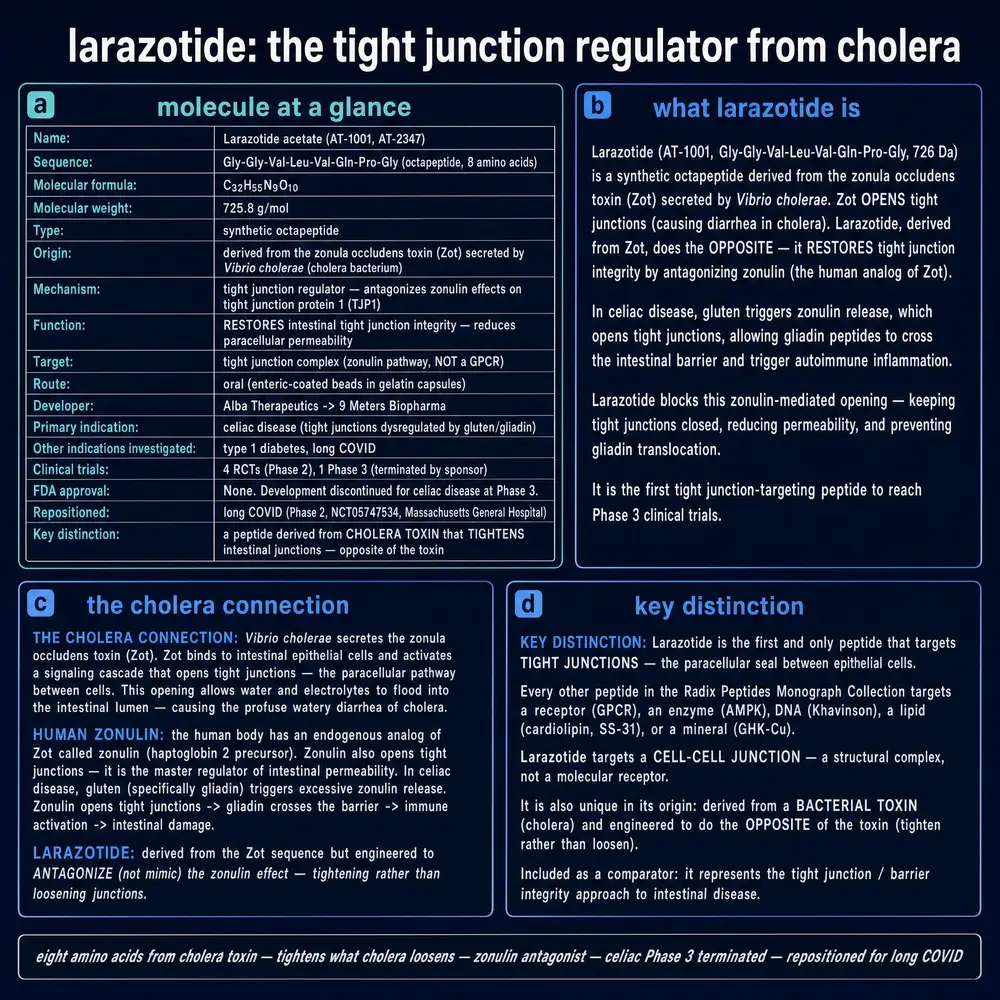
Larazotide is Gly‑Gly‑Val‑Leu‑Val‑Gln‑Pro‑Gly (GGVLVQPG): eight natural amino acids, usually studied as the acetate salt (PubChem CID 44146842; CAS 881851‑50‑9). It is designed as a locally acting, poorly absorbed oral peptide — a nonsystemic, intestine‑targeted agent in the language of its developers (Slifer et al., 2021). It is not AT‑1002, a hexamer from the same programme that increases permeability. It is not the iminosugar sometimes coded AT1001 in an unrelated literature; PubChem states the collision explicitly.
Proposed mechanisms, in plain language: zonulin (or a zonulin‑like signal) helps open the junction after certain luminal triggers, including gliadin; larazotide is thought to interfere with that opening and to favour reassembly of junction proteins and actin. Downstream readings include EGFR/PAR2 signalling and myosin‑light‑chain phosphorylation. The reviews are careful to say that the exact binding story is still incomplete (Slifer et al., 2021; Gopalakrishnan et al., 2012).
The commissioned overview plate that follows is a teaching card for that identity story — sequence and codes, the Zot‑opens / larazotide‑closes contrast, the cholera‑to‑zonulin lineage, and why a structural junction target is unlike most peptides in this series.
05Cell and tissue pharmacology
In epithelial monolayers, larazotide has been reported to promote tight‑junction assembly: occludin and claudins shift toward the membrane, actin associates with junctions, and ZO‑1 redistribution after permeability‑increasing stimuli is reduced (Gopalakrishnan et al., 2012; Slifer et al., 2021). Those are cell‑culture and tissue findings. They explain why the molecule was interesting; they do not, by themselves, prove a clinical effect. The same papers are careful about what a TEER rise is and is not: an electrical proxy for junction tightness in a dish, not a symptom score and not a registrational endpoint.
Anoxia/reoxygenation models in Caco‑2‑derived monolayers link larazotide to lower phosphorylated myosin light chain and better‑organised junction proteins during recovery — again in vitro (reviewed Slifer et al., 2021; extended in Kim et al., 2025). In 2025, Glinka and colleagues reported that larazotide mitigated acute histamine‑stimulated barrier disruption in normal human keratinocyte monolayers, framing the peptide as a PAR2 antagonist in skin epithelium (Glinka et al., 2025). That is a human‑cell result outside the gut. It is not a dermatology trial.
06Pigs, mice, and a non‑monotonic dose curve
The cleanest large‑animal pharmacology in the local corpus is ischemic injury of porcine jejunum. Slifer, Blikslager and colleagues subjected juvenile Yorkshire pigs to forty‑five minutes of segmental ischemia, then mounted the mucosa in Ussing chambers. Apical larazotide at 1 µM raised transepithelial resistance at later recovery timepoints and reduced mucosal‑to‑serosal FITC‑LPS flux compared with untreated ischemic tissue. Single doses of 0.1 µM and 10 µM did not produce that recovery (Slifer et al., 2021). The curve was not “more is better.”
Histology explained why the electrical signal mattered. Villous height and re‑epithelialisation after recovery did not differ between larazotide‑treated and untreated injured tissue. The peptide was not rebuilding the villus; it was acting at the junction step. Membrane claudin‑4 densitometry was higher with 1 µM larazotide than without (0.80 ± 0.05 versus 0.43 ± 0.06; P < 0.01) (Slifer et al., 2021).
Mass spectrometry of the bath showed fragmentation. Aminopeptidase M clipped the peptide; fragment F2 (VLVQPG) inhibited the parent’s recovery effect when applied in excess. A D‑amino‑acid analogue (A6) recovered barrier function at a tenfold lower concentration and with an earlier TEER rise, but it too formed inhibitory fragments (Slifer et al., 2021). That chemistry is a caution about reading any single bath concentration as a simple potency number.
Separately, Enomoto and colleagues studied a delayed‑release oral formulation in living pigs with intestinal ultrafiltration probes. Larazotide appeared throughout the small intestine over four hours, with peak duodenal and proximal jejunal fluid concentrations around one hour after dosing (Enomoto et al., 2021). That is in‑vivo regional exposure, not efficacy.
In mice, Tajik and colleagues tied zonulin‑pathway barrier changes to the onset of collagen‑induced arthritis and reported that larazotide prevented the increase in macromolecular flux and raised tight‑junction transcripts when given before arthritis onset (Tajik et al., 2020). Other rodent injury models — acute pancreatitis, acute liver failure — have since reported barrier‑related signals with larazotide (Karahan et al., 2024; Caliskan et al., 2021). They widen the hypothesis space. They do not replace the coeliac clinical programme.
07A computational side quest
During the early COVID‑19 literature surge, Di Micco and colleagues docked larazotide against SARS‑CoV‑2 main protease and explored derivatives (Di Micco et al., 2020; Di Micco et al., 2021). Those papers are labelled here as in‑silico work. They are not antiviral clinical evidence, and they are not weighed as such below.
08The clinical question
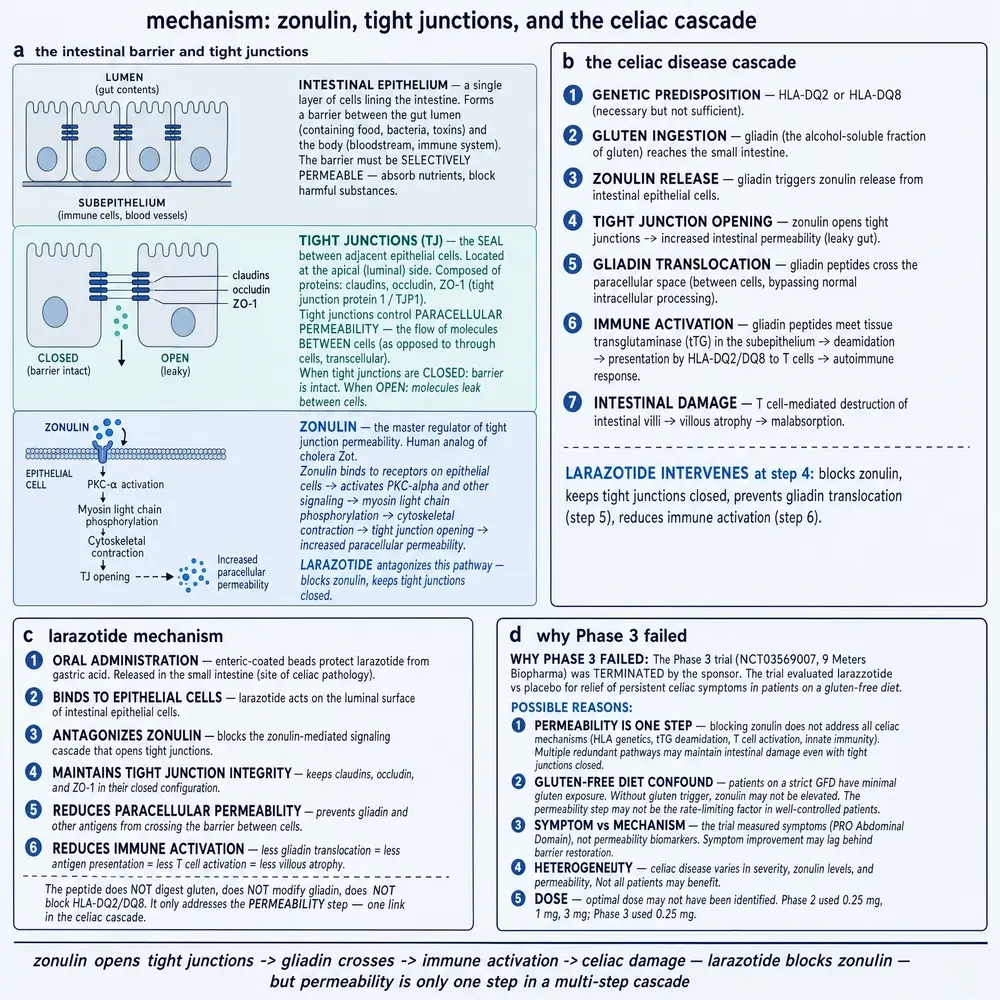
Coeliac disease is a gluten‑driven autoimmune enteropathy affecting roughly one person in a hundred in Western populations. The only established standard of care is a lifelong gluten‑free diet. Many patients who keep that diet still report symptoms. Some of those symptoms come from inadvertent gluten; some from other causes. A drug that could reduce paracellular leakage of gliadin fragments — without claiming to replace the diet — was the clinical pitch for larazotide (Leffler et al., 2015; Slifer et al., 2021). The plate above is the teaching map for that pitch: barrier anatomy, the coeliac cascade with larazotide at the permeability step, and why closing one door did not finish the programme.
Endpoints quarrelled with each other from the start. Symptom scales (GSRS, CeD‑GSRS, patient‑reported outcome days) ask how people feel. The lactulose‑to‑mannitol (LAMA) ratio asks how the small bowel handles two sugars. Antibody titres ask what the immune system has seen. A drug can move one without moving another. That disagreement is not a detail; it is the shape of the programme.
09Early human studies and phase 2
Paterson and colleagues published an early clinical exploration of AT‑1001 in coeliac subjects under gluten challenge conditions (Paterson et al., 2007). Leffler and colleagues later reported a randomised gluten‑challenge study of larazotide acetate (Leffler et al., 2012). Kelly and colleagues reported a randomised, placebo‑controlled gluten‑challenge trial in which larazotide limited the gluten‑induced worsening of gastrointestinal symptom severity relative to placebo, while permeability readouts remained difficult (Kelly et al., 2013). Those trial arms used specified milligram amounts and gluten exposures as protocol parameters; they are described here as study facts, not as instructions.
The pivotal phase 2b signal for persistent symptoms despite a gluten‑free diet is Leffler et al., 2015, in Gastroenterology (NCT01396213). Adults with coeliac disease who had been on a gluten‑free diet for at least twelve months and still had symptoms were randomised to placebo or larazotide acetate at 0.5, 1, or 2 mg three times daily for twelve weeks after a placebo run‑in. The primary endpoint was the difference in average on‑treatment CeD‑GSRS score. In the modified intention‑to‑treat population (n = 340), the 0.5 mg arm met the primary endpoint versus placebo (ANCOVA P = .022; mixed model for repeated measures P = .005). The 1 mg and 2 mg arms did not separate from placebo on that endpoint (Leffler et al., 2015).
Exploratory symptom metrics at 0.5 mg included a 26 percent decrease in CeD patient‑reported‑outcome symptomatic days (P = .017) and a 31 percent increase in improved‑symptom days (P = .034). Safety assessments in that trial were comparable with placebo (Leffler et al., 2015). The authors called the study a successful trial of a tight‑junction‑targeted agent in symptomatic coeliac disease on diet — and they also called the overall results mixed. Both statements belong in the same paragraph.
Hoilat and colleagues’ 2022 systematic review and meta‑analysis pooled four randomised trials (626 participants; 465 larazotide, 161 placebo). Under gluten challenge, larazotide correlated with better symptom scores than placebo; the LAMA permeability endpoint did not differ significantly; among patients already on a gluten‑free diet the symptom advantage was less clear. The authors concluded that larazotide was unlikely to be a definitive cure and might, at best, complement diet rather than replace it (Hoilat et al., 2022). That is a synthesis of trials, not a dosing recommendation.
10Phase 3 and the stop
The phase 3 study registered as NCT03569007 was a randomised, double‑blind, placebo‑controlled trial of larazotide acetate for relief of persistent symptoms in adults with coeliac disease on a gluten‑free diet. The primary outcome on the registry is the proportion of subjects who were binary responders at twelve weeks. Actual enrollment was 307. The record lists the study as terminated by the sponsor, with a completion date of 21 July 2022 (ClinicalTrials.gov NCT03569007).
In late June 2022, 9 Meters Biopharma publicly stated that an interim analysis indicated the trial would not meet its primary efficacy endpoint and that the programme would not continue. That disclosure is a corporate and registry fact about development status. It is not a peer‑reviewed efficacy table. It still belongs here at full volume, because a monograph that lingers on phase 2 and whispers the stop is not weighing evidence; it is editing a prospectus.
Why can phase 2 and phase 3 disagree? Several non‑exclusive explanations sit in the literature and in trial‑design commentary: different primary endpoints (continuous symptom score versus binary responder); residual gluten exposure that is hard to standardise; the existence of transcellular as well as paracellular gliadin routes, so that sealing one path cannot block all antigen traffic; and the non‑monotonic dose behaviour already visible in animals and in the 2015 dose arms (Slifer et al., 2021; Hoilat et al., 2022). None of those explanations resurrects a failed primary endpoint. They explain how a real earlier signal can fail to become an approval.
11Weighing the human coeliac record
What is solid: randomised evidence that, under defined trial conditions, larazotide acetate at the 0.5 mg three‑times‑daily arm reduced gastrointestinal symptom scores versus placebo in patients with persistent symptoms on a gluten‑free diet (Leffler et al., 2015). What is also solid: higher dose arms in that same study did not; permeability biomarkers have been noisy across the programme; and the phase 3 programme was stopped for futility with the drug still unapproved (NCT03569007; Hoilat et al., 2022).
Recency matters. The 2022 termination updates the development story and outweighs optimistic secondary summaries written while phase 3 was still “ongoing.” It does not erase the phase 2 measurements. The preponderance for regulatory success in coeliac disease is negative. The preponderance for some randomised symptom activity under specific conditions is mixed‑to‑positive at one arm. Those are different claims. This document keeps them separate.
12Autoimmunity and barrier hypotheses
Fasano’s broader reviews argue that zonulin‑mediated permeability sits upstream of several chronic inflammatory conditions, not only coeliac disease (Fasano, 2021). The Tajik arthritis model is one experimental bridge: barrier change before joint disease, and a zonulin‑pathway intervention that altered that sequence in mice (Tajik et al., 2020). Troisi and colleagues surveyed proposed uses of AT‑1001 across acute and chronic inflammatory settings (Troisi et al., 2021). These are hypothesis‑generating maps. They are not a second clinical franchise.
13MIS‑C and the 2025 human signal
Multisystem inflammatory syndrome in children (MIS‑C) after SARS‑CoV‑2 infection became an unexpected chapter. Yonker and colleagues reported in 2021 that MIS‑C was associated with zonulin‑dependent loss of gut mucosal barrier and trafficking of SARS‑CoV‑2 antigens (Yonker et al., 2021). A 2022 case series described larazotide as an adjuvant under institutional protocols (Yonker et al., 2022). In 2025, a Science Translational Medicine paper reported viral spike antigen clearance and augmented recovery in children with post‑COVID MIS‑C treated with larazotide in a controlled study context (Yonker et al., 2025).
That 2025 paper is recent and load‑bearing for the non‑coeliac human story. It does not reopen the terminated coeliac phase 3 programme. It does show that the barrier hypothesis still generates serious clinical investigation after the coeliac stop. Study‑type labels matter here more than enthusiasm: case series, controlled paediatric study, and failed adult coeliac phase 3 are three different kinds of evidence. Collapsing them into one “human evidence” pile is how a side path becomes a false re‑opening of the coeliac stop.
The side‑path map is a reminder of what the coeliac stop did and did not end. It ended a registrational programme under NCT03569007. It did not end barrier biology as a research question, and it did not convert every later paper into a coeliac approval argument.
14Skin and other epithelia
The 2025 keratinocyte work extends the PAR2‑antagonist framing to epidermal monolayers under histamine challenge (Glinka et al., 2025). It is fresh, narrow, and in vitro. It belongs in the mechanism section of the mental model, not in a list of approved uses — there are no approved uses. If the receptor story holds outside the gut, that is interesting pharmacology. It is still not a dermatology indication.
15What the molecule cannot do
Even a perfect paracellular seal would leave transcellular gliadin uptake and established adaptive immunity untouched. Coeliac disease is not only a junction problem. Enzyme therapies, gluten‑specific immune approaches and other barrier strategies sit in the same competitive landscape; this monograph does not rank them for patients. It only notes that larazotide’s design addresses one path among several (Hoilat et al., 2022). Closing one door is still closing one door.
16What is solid
Larazotide is a defined octapeptide with a clear discovery lineage from Zot and the 2000 zonulin papers, whatever one concludes about later naming disputes (Fasano et al., 1991; Wang et al., 2000; Sollid & Gray, 2021). In epithelial systems and in ischemic porcine jejunum it can favour tight‑junction recovery under specified conditions, with a non‑monotonic concentration dependence and real fragment chemistry (Slifer et al., 2021). In people with coeliac disease and persistent symptoms on diet, one randomised phase 2b arm improved a prespecified symptom score versus placebo (Leffler et al., 2015).
17What is contested or thin
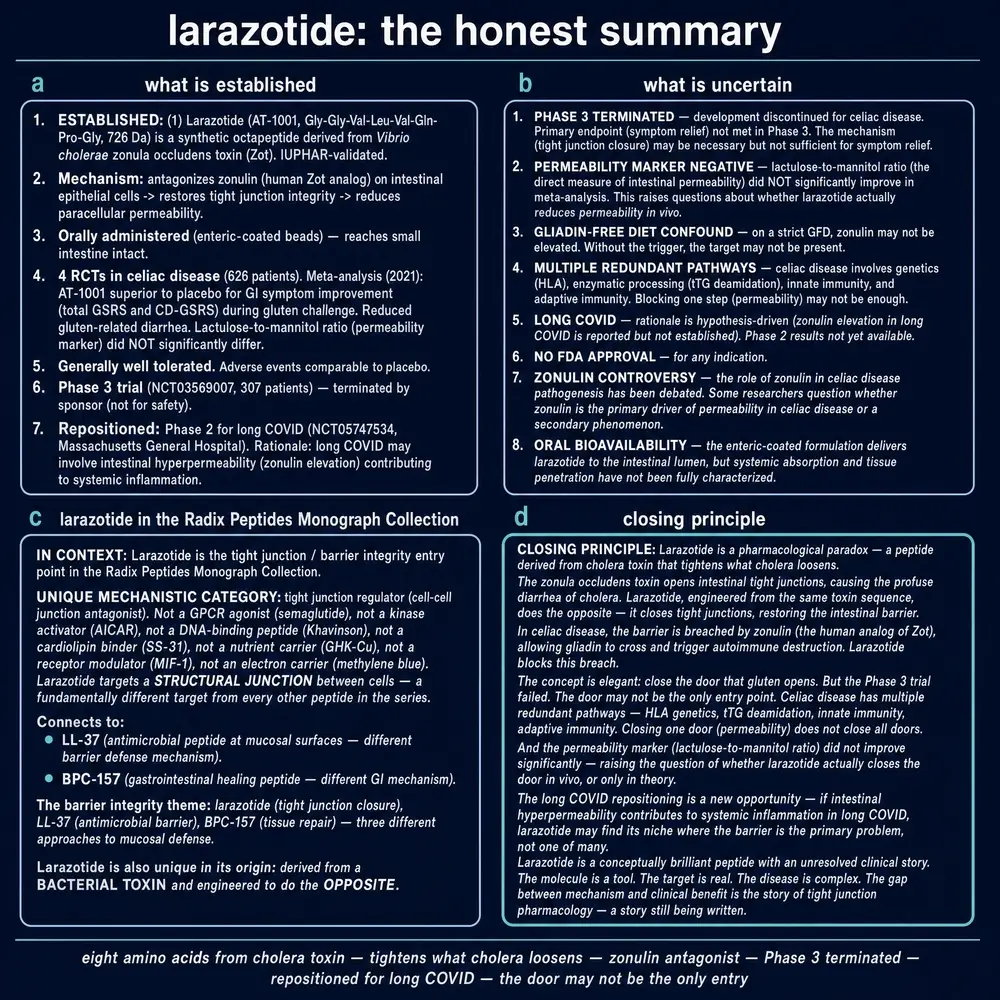
Exact receptor pharmacology; the fidelity of “zonulin antagonist” as a molecular description; LAMA as a drug‑response biomarker; whether any oral schedule can survive brush‑border fragmentation in humans the way formulators hope; and — decisively for development — whether symptom benefits seen in phase 2 translate into a phase 3 win. On that last question the terminated NCT03569007 record is the current answer. Long‑COVID repositioning proposals inherit the same thinness until permeability is shown to be the primary problem in that setting, not one of many.
The commissioned closing plate that follows gathers what is established against what remains uncertain. A plate that lists uncertainties is useful only if the reader treats those lines as open questions, not as settled verdicts.
18Why the story still matters
Tight junctions are adjustable, and adjustable biology invites drugs. Larazotide was an early, serious attempt to treat that adjustability with a short peptide born from a bacterial toxin’s mirror image. The attempt taught the field about endpoints, about gluten challenge versus diet‑refractory symptoms, about dose curves that bend the wrong way, and about the gap between a beautiful mechanism and a registrable effect. Those lessons remain useful even when the coeliac programme does not.
This document describes published research. It does not recommend human use of larazotide or larazotide acetate. It specifies no dose, route or schedule for any person. It is not medical advice. The framing is research use exclusively.
19References
Every PubMed entry below was resolved against the National Library of Medicine during this build and read back against its author, journal, year and title. None was written from recall. The build refuses to run if any identifier fails to resolve.
- Armandi A, Pellicano R, Caviglia GP. Tight junction regulation in celiac disease: role of larazotide acetate. Minerva Gastroenterol (Torino). 2022;68(1):4-6.
PMID 33793152 · doi:10.23736/S2724-5985.21.02838-5 - Caliskan AR, Gul M, Yılmaz I, Otlu B, Uremis N, Uremis MM, et al.. Effects of larazotide acetate, a tight junction regulator, on the liver and intestinal damage in acute liver failure in rats. Hum Exp Toxicol. 2021;40(12_suppl):S693-S701.
PMID 34791921 · doi:10.1177/09603271211058882 - Di Micco S, Musella S, Scala MC, Sala M, Campiglia P, Bifulco G, et al.. In silico Analysis Revealed Potential Anti-SARS-CoV-2 Main Protease Activity by the Zonulin Inhibitor Larazotide Acetate. Front Chem. 2020;8:628609.
PMID 33520943 · doi:10.1016/S0140-6736(20)30566-3 · PMC7270627 - Di Micco S, Musella S, Sala M, Scala MC, Andrei G, Snoeck R, et al.. Peptide Derivatives of the Zonulin Inhibitor Larazotide (AT1001) as Potential Anti SARS-CoV-2: Molecular Modelling, Synthesis and Bioactivity Evaluation. Int J Mol Sci. 2021;22(17).
PMID 34502335 · doi:10.1063/1.445869 · PMC2143354 - Enomoto H, Yeatts J, Carbajal L, Krishnan BR, Madan JP, Laumas S, et al.. In vivo assessment of a delayed release formulation of larazotide acetate indicated for celiac disease using a porcine model. PLoS One. 2021;16(4):e0249179.
PMID 33844694 · doi:10.1136/gut.48.4.571 · PMC1728243 - Fasano A, Baudry B, Pumplin DW, Wasserman SS, Tall BD, Ketley JM, et al.. Vibrio cholerae produces a second enterotoxin, which affects intestinal tight junctions. Proc Natl Acad Sci U S A. 1991;88(12):5242-6.
PMID 2052603 · doi:10.1073/pnas.88.12.5242 · PMC51848 - Fasano A, Not T, Wang W, Uzzau S, Berti I, Tommasini A, et al.. Zonulin, a newly discovered modulator of intestinal permeability, and its expression in coeliac disease. Lancet. 2000;355(9214):1518-9.
PMID 10801176 · doi:10.1016/S0140-6736(00)02169-3 - Fasano A. All disease begins in the (leaky) gut: role of zonulin-mediated gut permeability in the pathogenesis of some chronic inflammatory diseases. F1000Res. 2020;9.
PMID 32051759 · doi:10.1155/2019/5945721 · PMC6710742 - Glinka DM, MacGregor GG. The PAR2 Antagonist Larazotide Can Mitigate Acute Histamine-Stimulated Epithelial Barrier Disruption in Keratinocytes: A Potential Adjunct Treatment for Atopic Dermatitis. JID Innov. 2025;5(4):100369.
PMID 40330848 · doi:10.1016/j.xjidi.2025.100369 · PMC8999015 - Gopalakrishnan S, Tripathi A, Tamiz AP, Alkan SS, Pandey NB. Larazotide acetate promotes tight junction assembly in epithelial cells. Peptides. 2012;35(1):95-101.
PMID 22401910 · doi:10.1016/j.peptides.2012.02.016 - Hoilat GJ, Altowairqi AK, Ayas MF, Alhaddab NT, Alnujaidi RA, Alharbi HA, et al.. Larazotide acetate for treatment of celiac disease: A systematic review and meta-analysis of randomized controlled trials. Clin Res Hepatol Gastroenterol. 2022;46(1):101782.
PMID 34339872 · doi:10.1016/j.clinre.2021.101782 - Karahan D, Harputluoglu MMM, Gul M, Gunduz A, Ozyalin F, İnceoğlu F, et al.. Ameliorative Effects of Larazotide Acetate on Intestinal Permeability and Bacterial Translocation in Acute Pancreatitis Model in Rats. Dig Dis Sci. 2024;69(4):1242-1252.
PMID 38441784 · doi:10.1159/000447252 · 5988153 - Kelly CP, Green PH, Murray JA, Dimarino A, Colatrella A, Leffler DA, et al.. Larazotide acetate in patients with coeliac disease undergoing a gluten challenge: a randomised placebo-controlled study. Aliment Pharmacol Ther. 2013;37(2):252-62.
PMID 23163616 · doi:10.1111/apt.12147 - Kim J, Madan JP, Laumas S, Krishnan BR, Jin Y. Larazotide Acetate Protects the Intestinal Mucosal Barrier from Anoxia/Reoxygenation Injury via Various Cellular Mechanisms. Biomedicines. 2025;13(10).
PMID 41153766 · doi:10.1097/MPG.0b013e3182a7dc74 · PMC2597688 - Leffler DA, Kelly CP, Abdallah HZ, Colatrella AM, Harris LA, Leon F, et al.. A randomized, double-blind study of larazotide acetate to prevent the activation of celiac disease during gluten challenge. Am J Gastroenterol. 2012;107(10):1554-62.
PMID 22825365 · doi:10.1038/ajg.2012.211 · PMC2274985 - Leffler DA, Kelly CP, Green PH, Fedorak RN, DiMarino A, Perrow W, et al.. Larazotide acetate for persistent symptoms of celiac disease despite a gluten-free diet: a randomized controlled trial. Gastroenterology. 2015;148(7):1311-9.e6.
PMID 25683116 · doi:10.1053/j.gastro.2015.02.008 · PMC1856434 - Paterson BM, Lammers KM, Arrieta MC, Fasano A, Meddings JB. The safety, tolerance, pharmacokinetic and pharmacodynamic effects of single doses of AT-1001 in coeliac disease subjects: a proof of concept study. Aliment Pharmacol Ther. 2007;26(5):757-66.
PMID 17697209 · doi:10.1111/j.1365-2036.2007.03413.x - Slifer ZM, Krishnan BR, Madan J, Blikslager AT. Larazotide acetate: a pharmacological peptide approach to tight junction regulation. Am J Physiol Gastrointest Liver Physiol. 2021;320(6):G983-G989.
PMID 33881350 · doi:10.1111/apt.12147 · PMC3463856 - Slifer ZM, Hernandez L, Pridgen TA, Carlson AR, Messenger KM, Madan J, et al.. Larazotide acetate induces recovery of ischemia-injured porcine jejunum via repair of tight junctions. PLoS One. 2021;16(4):e0250165.
PMID 33886649 · doi:10.1007/s13361-013-0808-5 · PMC4057941 - Sollid LM, Koning F. Lack of relationship of AT1001 to zonulin and prehaptoglobin-2: clinical implications. Gut. 2021;70(11):2211-2212.
PMID 33443022 · doi:10.1136/gutjnl-2020-323829 - Tajik N, Frech M, Schulz O, Schälter F, Lucas S, Azizov V, et al.. Targeting zonulin and intestinal epithelial barrier function to prevent onset of arthritis. Nat Commun. 2020;11(1):1995.
PMID 32332732 · doi:10.1371/journal.pone.0061217 · PMC3632530 - Tripathi A, Lammers KM, Goldblum S, Shea-Donohue T, Netzel-Arnett S, Buzza MS, et al.. Identification of human zonulin, a physiological modulator of tight junctions, as prehaptoglobin-2. Proc Natl Acad Sci U S A. 2009;106(39):16799-804.
PMID 19805376 · doi:10.1073/pnas.0906773106 · PMC1383309 - Troisi J, Venutolo G, Terracciano C, Carri MD, Di Micco S, Landolfi A, et al.. The Therapeutic use of the Zonulin Inhibitor AT-1001 (Larazotide) for a Variety of Acute and Chronic Inflammatory Diseases. Curr Med Chem. 2021;28(28):5788-5807.
PMID 33397225 · doi:10.2174/0929867328666210104110053 - Wang W, Uzzau S, Goldblum SE, Fasano A. Human zonulin, a potential modulator of intestinal tight junctions. J Cell Sci. 2000;113 Pt 24:4435-40.
PMID 11082037 · doi:10.1242/jcs.113.24.4435 - Yonker LM, Gilboa T, Ogata AF, Senussi Y, Lazarovits R, Boribong BP, et al.. Multisystem inflammatory syndrome in children is driven by zonulin-dependent loss of gut mucosal barrier. J Clin Invest. 2021;131(14).
PMID 34032635 · doi:10.1186/s12874-020-01110-y · PMC7483494 - Yonker LM, Swank Z, Gilboa T, Senussi Y, Kenyon V, Papadakis L, et al.. Zonulin Antagonist, Larazotide (AT1001), As an Adjuvant Treatment for Multisystem Inflammatory Syndrome in Children: A Case Series. Crit Care Explor. 2022;10(2):e0641.
PMID 35211683 · doi:10.1097/CCE.0000000000000641 · PMC7997897 - Yonker LM, Kane AS, Swank Z, Papadakis L, Kenyon V, Han S, et al.. Viral spike antigen clearance and augmented recovery in children with post-COVID multisystem inflammatory syndrome treated with larazotide. Sci Transl Med. 2025;17(809):eadu4284.
PMID 40737433 · doi:10.1126/scitranslmed.adu4284
Sources with no PubMed record. Registry and chemical database material is listed separately so that the numbered list above stays wholly machine-verified.
- ClinicalTrials.gov, US National Library of Medicine. Registry record NCT03569007 — Phase 3 larazotide acetate for persistent symptoms of celiac disease on a gluten-free diet (CeDLara / related programme). Status TERMINATED by Sponsor; actual enrollment 307; primary outcome proportion of binary responders at 12 weeks; study period 2019-05-29 to 2022-07-21. Retrieved 4 August 2026. Sponsor interim futility disclosures around 28 June 2022 are cited in the text as corporate communications, not as peer-reviewed efficacy data..
https://clinicaltrials.gov/study/NCT03569007 - PubChem, National Library of Medicine. Larazotide acetate, compound summary, CID 44146842. Sequence-linked identity, CAS and synonym set including AT-1001; record warns against confusion with iminosugar AT1001 nomenclature..
https://pubchem.ncbi.nlm.nih.gov/compound/44146842
20How this document was assembled
The corpus was built against project 05, the Therapeutic Peptide Research Library, and against PubMed / PubMed Central. Local full-text discovery admitted peer-reviewed assets that name larazotide, AT‑1001 or INN‑202 in the article body, with page counts at 500 words per printed‑page equivalent. Identity collisions with iminosugar AT1001 nomenclature were refused. Clinical phase 1–3 facts that were absent from the local OA JATS store were harvested from PubMed, ClinicalTrials.gov and open PDFs and entered in the evidence dossier before drafting.
| Stage | Output | Count |
|---|---|---|
| Local scientific full texts (unique) | Inventory | 16 |
| Printed-page equivalents | Inventory | ~328 |
| PubMed records screened | Metadata | 65 |
| PMC body-text surface | Sweep | 16 |
| Peer-reviewed local class | Classification | 16 |
| Authored figures | SVG | 14 |
| References resolved | NCBI | 27 |
| Local refusals (identity / collision) | Matcher | 0 |
Refusal causes (A20): bare AT‑1001 without corroboration 0; iminosugar / retraction disqualifications 0; zonulin/Zot field-only 0.
21Evidence handling
Study types are labelled in the sentence that reports them. Animal and in‑vitro findings are never silently promoted to human conclusions. Where phase 2 and phase 3 disagree, both are stated at comparable length. Recency is favoured when it does not contradict a preponderance of evidence; the 2022 phase 3 termination updates development status without erasing earlier randomised measurements. The Sollid & Gray 2021 critique of zonulin naming is carried beside the discovery narrative rather than resolved by preference. Larazotide remains four statements, not one: defined peptide, mixed randomised symptom signals, registrational stop in coeliac disease, and an open barrier‑biology programme afterward. No human use, dose, route or schedule is recommended. The footer below restates the series constraint in its canonical wording.

Continue exploring