
Why We Age
Two families of explanation — the damage that accumulates in a body, and the evolutionary reason natural selection lets it — and how modern biology fits them together. Aging is a by-product, not a program built to kill you.
Abstract
Aging can be explained on two levels that are often confused. The proximate level asks how a body falls apart, and answers with stochastic damage: accumulating somatic mutations, free-radical and mitochondrial injury, and the failure of the systems that keep proteins correctly folded — the machinery catalogued as the hallmarks of aging. The ultimate level asks why natural selection permits any of this, and answers with evolutionary theory: the force of selection declines with age, because in the wild most individuals are already dead from external causes before late-acting genes matter. From that single premise follow mutation accumulation (Medawar), antagonistic pleiotropy (Williams), and the disposable-soma theory (Kirkwood) — aging as a by-product of selection weakening after reproduction, not a program designed to end life. This review sets the two families side by side, shows how the damage theories describe the 'how' while evolution supplies the 'why', flags the hyperfunction hypothesis as a modern reframing, and reviews the evidence that aging rates are malleable — single-gene mutants, caloric restriction, and negligible-senescence species — each labelled by organism, none a demonstrated human anti-aging intervention.
Key findings
- Aging has a proximate answer (how a body degrades — accumulating damage) and an ultimate answer (why selection allows it); confusing the two is the main source of muddle about 'why we age'.
- The stochastic-damage family explains the machinery of aging — somatic mutation (Szilard, 1959), the free-radical and mitochondrial theories (Harman, 1956, 1972), and loss of proteostasis — but the free-radical version failed a decisive test: 18 antioxidant-gene manipulations in mice barely moved lifespan (Pérez et al., 2009).
- The evolutionary family explains why: the force of natural selection declines with age (Medawar, 1952; Hamilton, 1966), so late-acting harm accumulates (mutation accumulation), genes good early and bad late are favoured (antagonistic pleiotropy; Williams, 1957), and a body is built to last only as long as it must (disposable soma; Kirkwood, 1977).
- Aging is not a purpose-built program to kill you. It is a by-product of selection's weakening grip after reproduction — a conclusion supported directly by breeding flies only from old parents, which evolves longer life (Rose, 1984).
- Aging rate is demonstrably tunable: single genes double lifespan in worms (Kenyon et al., 1993) and extend it in mice (Brown-Borg et al., 1996), caloric restriction lengthens life across species (McCay et al., 1935; Mattison et al., 2017), and naked mole-rats barely age at all (Ruby et al., 2018) — all in animals, none a proven human intervention.
- The hyperfunction (quasi-programmed) view — that aging is developmental growth programmes running on rather than damage piling up — is an influential modern hypothesis (Blagosklonny, 2006; Gems & Partridge, 2013), not a settled fact.
Ask a biologist how we age and the answer is a catalogue of breakdown: DNA that mutates, proteins that misfold, mitochondria that leak, cells that stop dividing. Ask why we age and the question is deeper — not what wears out, but why living things are built to wear out at all. A car rusts because no one designed it to last forever; the harder question about a body is who decided how long it should last. The answer is natural selection, and its verdict is not that we should die on schedule but that, past a certain point, it stops caring whether we live.
Those two questions map onto two families of theory that have spent a century being mistaken for rivals. The first is about damage — aging as the accumulation of unrepaired wear, the province of somatic mutation, free radicals, and failing quality control. The second is about evolution — why selection permits that damage to accumulate at all, and why it never built a body that repairs itself indefinitely. They are not competitors. One describes the machinery; the other explains why the machinery is allowed to fail. Getting the relationship between them right is what it means to understand why we age.
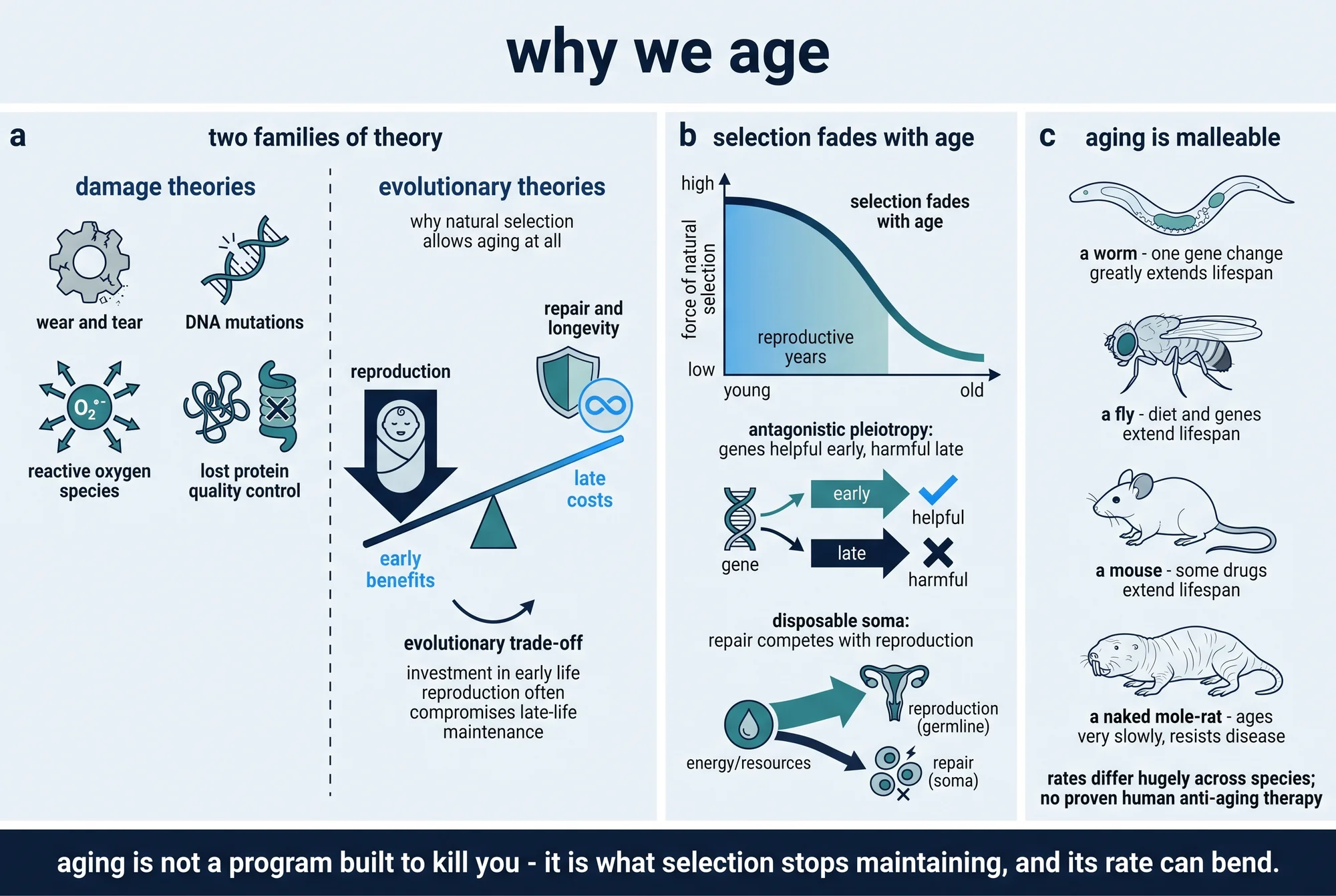
The 'how' is not the 'why'
Most of what people know about the biology of aging is really an answer to how. Our companion explainer on the hallmarks of aging walks through the standard catalogue — genomic instability, telomere attrition, epigenetic drift, loss of proteostasis, cellular senescence, and the rest. That catalogue describes the proximate machinery: the molecular failures through which a body deteriorates. It is indispensable, and it is not a why. Knowing that proteins misfold with age tells you the mechanism of decline the way knowing an engine seized from lack of oil tells you the mechanism of a breakdown — not why the car had no one to change the oil.
This is the old distinction between a proximate explanation (the immediate mechanical cause) and an ultimate one (the evolutionary reason that cause exists and was never selected away). Aging needs both. The commonest error in popular writing is to treat a proximate finding ("free radicals damage cells") as if it were the ultimate cause, skipping the question of why evolution left cells vulnerable in the first place.
Family one: aging as accumulated damage
The intuitive version is wear-and-tear — living costs energy, metabolism produces by-products, and over time those by-products and the insults of daily life pile up faster than the body clears them — incomplete rather than wrong, with more rigorous descendants that each name a specific kind of damage.
The somatic mutation theory holds that the genome of ordinary body cells accumulates errors over a lifetime, degrading the instructions those cells run on. Leó Szilárd proposed a version in 1959, framing aging as the accumulation of random "hits" to the genetic material of somatic cells (Szilard, 1959). The idea has aged well: modern sequencing confirms that somatic mutations do accumulate with age, and a 2022 study below makes the accumulation strikingly quantitative.
The free-radical theory, proposed by Denham Harman in 1956, is the most famous of the damage theories and the cautionary tale of the group. Harman argued that reactive by-products of oxygen metabolism — free radicals — inflict cumulative molecular damage that constitutes aging (Harman, 1956); sixteen years later he localized the main source to the cell's power plants, the mitochondrial free-radical theory, in which mitochondria both generate most reactive oxygen and suffer its damage (Harman, 1972). The theory dominated for decades and drove the antioxidant-supplement industry — then met the evidence. One laboratory genetically altered mice to over- or under-produce a wide range of antioxidant enzymes, 18 manipulations in all, and found that only one, deletion of the Sod1 gene, measurably affected lifespan. The authors asked in their title whether the oxidative-stress theory of aging was dead, and their data called it into serious question as an account of how long a mouse lives (Pérez et al., 2009); many careful tests of the oxidative-damage theory, reviewers note, "have come up negative" (Gems & Partridge, 2013). Oxidative damage is real; that it is a primary cause of aging is not established, and the mitochondrial connection is covered on its own terms in our explainer on mitochondrial dysfunction.
The third damage theory is subtler: loss of proteostasis, the gradual failure of the systems that fold proteins correctly, refold the ones that go wrong, and dispose of the rest. When that quality-control network — including autophagy, the cell's recycling program — falters, misfolded and aggregated proteins accumulate, a process central to age-related neurodegeneration and named as one of the hallmarks of aging (López-Otín et al., 2013). Here the damage is to the machinery of maintenance itself.
What unites the damage family is a shared silence: each explains a route by which a body deteriorates, none explains why the body's repair systems — which exist, and are far better in some organisms than others — were not simply built good enough to hold the damage off indefinitely. That is the question the second family answers.
Family two: why natural selection permits aging
Aging is, on its face, an evolutionary paradox. Selection favours whatever raises reproductive success, and dying lowers it; a body that repaired itself perfectly ought to leave more descendants than one that falls apart. So why has selection not eliminated aging everywhere? The resolution, worked out in the mid-twentieth century, turns on a single idea: the force of natural selection declines with age.
The reason is mortality that has nothing to do with aging. In the wild, animals die of predators, cold, starvation, and accident at a roughly constant rate, so even a non-aging animal becomes rare with age by bad luck alone. Selection acts through reproduction, so a gene that acts early, when most of the cohort is still alive to carry it, feels the full force of selection; a gene that acts only in late life, when almost everyone is already dead from external causes, is nearly invisible to it. Peter Medawar set this out in 1952 in a lecture aptly titled An Unsolved Problem of Biology (Medawar, 1952), and William Hamilton made it rigorous in 1966, showing mathematically that the sensitivity of fitness to a change in survival or fertility falls with age and, after reproduction ceases, formally reaches zero (Hamilton, 1966). Late life is, in a precise sense, a blind spot of selection.
From that premise follow three complementary theories.
Mutation accumulation, Medawar's own proposal, is the passive consequence. Mutations whose harmful effects appear only late in life are barely selected against, because their carriers have already reproduced by the time the harm lands; generation after generation, such late-acting deleterious mutations drift into the genome and are never purged. Aging, on this account, is partly the phenotype of a lifetime's worth of late-acting genetic junk that selection had no reason to clean up (Medawar, 1952).
Antagonistic pleiotropy, proposed by George Williams in 1957, is the active and more provocative version ("pleiotropy" means one gene with more than one effect). Williams argued that a gene conferring a benefit early in life — faster growth, earlier or more vigorous reproduction — will be favoured even if it causes harm later, because the early benefit falls where selection is strong and the late cost where it is weak (Williams, 1957). Aging, on this view, is not junk but the deferred price of genes that paid off when it counted. A clean illustration comes from the worm Caenorhabditis elegans: mutations in the age-1 gene that substantially lengthen life also reduce fertility — exactly the trade-off between reproduction and longevity that pleiotropy predicts (Friedman & Johnson, 1988).
The disposable soma theory, introduced by Thomas Kirkwood in 1977, supplies the economic logic beneath both (Kirkwood, 1977). An organism has a finite energy budget and must divide it between reproduction and the maintenance and repair of its body — the "soma." Because that body is, in the wild, likely to be killed by something external before long, it makes no evolutionary sense to maintain it to a standard it will never need; the optimal strategy is to spend just enough on repair to run through the reproductive years, and no more. Aging is the predictable result of that under-investment: a body built, by the economics of selection, to last only about as long as it usually gets the chance to. The theory makes a comparative prediction, too — animals with low external mortality should evolve better maintenance and slower aging — borne out below by the naked mole-rat.
Two things about this second family are routinely garbled. First, it is testable, and has been tested: Michael Rose bred fruit flies using only eggs laid by older females, generation after generation, forcing selection to keep "caring" about late life — and the populations evolved postponed senescence and longer lifespans, exactly as the theory predicts (Rose, 1984). Second, and most important for reading any claim about aging: this is not a program to kill you. Adaptive "programmed aging" — dying on a genetic timer for the good of the species — requires forms of group selection that the mainstream rejects, and nothing in Medawar, Williams, Hamilton, or Kirkwood needs it. Aging is a by-product: what happens to a body when the force that shaped it looks away.
How the two families fit together
Set the families side by side and the relationship is division of labour, not conflict. Evolution explains why a body is allowed to fall apart — selection under-invested in its maintenance once the reproductive job was done — and the damage theories describe how it falls apart, through the mutations, oxidative injuries, and proteostatic failures of that under-maintained decline. The hallmarks of aging are the proximate machinery; evolutionary theory is the ultimate reason it is permitted to fail. That framing is what makes geroscience conceivable: because aging is the shared upstream driver of most chronic disease, and can be slowed in the laboratory by genetic, dietary, and pharmacological means, targeting it might postpone many diseases at once (Kennedy et al., 2014).
A modern reframing tries to fuse the two families, and it is worth flagging clearly as a hypothesis rather than a conclusion. The hyperfunction, or quasi-programmed, theory — associated with Mikhail Blagosklonny — proposes that much of what we call aging is not damage accumulating but the developmental and growth programmes of youth running on when they should have switched off, becoming excessive and pathological in later life (Blagosklonny, 2006). The culprit, on this view, is not too little repair but too much lingering growth signalling — often through the nutrient-sensing mTOR pathway — so that aging is "quasi-programmed": the run-on of a real program, not a program for death itself, and antagonistic pleiotropy restated at the molecular level. Reviewers list it among the "revolutionary concepts" reopening basic assumptions about aging, precisely because the oxidative-damage theory underperformed (Gems & Partridge, 2013); it remains a contested hypothesis, treated as such here and in our discussion of lifespan versus healthspan.
Even the damage theories, read through the evolutionary lens, point back to selection. A 2022 study sequenced intestinal-cell genomes from 16 mammal species and found that the yearly rate of somatic mutation varies enormously — almost perfectly inversely with lifespan. Despite a roughly 30-fold range in lifespan, the total mutation burden reached at the end of life varied only about 3-fold — fast-mutating mice and slow-mutating humans arriving at a similar lifetime total (Cagan et al., 2022). Damage accumulation is real, but its rate is a dial that evolution sets — up in species left short-lived, down in those allowed to persist. The damage is proximate; the setting of the dial is ultimate; the two families are one story told at two levels.
Aging is not fixed: the evidence that its rate is tunable
If aging were pure inevitable wear, its rate would be fixed. It is not — and the demonstration that it can be changed is among the strongest reasons to take the evolutionary account seriously, because an evolved setting is, in principle, adjustable. Three bodies of evidence show the dial moving, each labelled by organism, and none a demonstrated anti-aging intervention in humans.
Single genes can reset lifespan. In 1993 Cynthia Kenyon's laboratory showed that a mutation in a single gene, daf-2, more than doubles the lifespan of the worm C. elegans — active, fertile animals living twice as long as normal, the largest extension then reported, dependent on a second gene, daf-16 (Kenyon et al., 1993). It generalizes upward: in mice, the Ames dwarf mutation — a single defect in pituitary development that lowers growth hormone and related signalling — produces animals that live substantially longer than normal littermates (Brown-Borg et al., 1996), a single gene reaching lifespan in a mammal.
Diet can slow aging across species. The oldest intervention is caloric restriction. In 1935 Clive McCay and colleagues found that feeding rats a nutritionally complete but calorie-reduced diet lengthened their lifespan (McCay et al., 1935), and the finding has been reproduced, with caveats, up the tree of life. In long-lived rhesus monkeys the picture is instructively messy: two landmark studies disagreed, and a joint 2017 analysis reconciled them by concluding that the health benefits of restriction are real but depend heavily on when it begins, what the diet contains, and how the study is run (Mattison et al., 2017). Whether the same holds for humans on any lifespan measure is untested and, over feasible timescales, largely untestable — the human trials to date measure metabolic markers, not survival, as our longevity-science overview details.
Some species barely age at all. The naked mole-rat, a mouse-sized subterranean rodent, lives past 28 years — nine times as long as a similar-sized mouse — with little of the usual decline, keeping stable body composition and, in breeding females, undiminished fertility into its third decade (Buffenstein, 2008). More striking still, an analysis of over 3,000 lifespan records found that its risk of dying does not rise with age, even 25-fold past sexual maturity — a defiance of the near-universal mammalian pattern that qualifies it, in the authors' words, as a non-aging mammal (Ruby et al., 2018). This "negligible senescence," seen also in some long-lived fish and reptiles, is what the disposable-soma theory predicts for a species evolved under low external mortality: safe in its burrows, the naked mole-rat could afford to maintain itself, and did.
Together they say what the evolutionary theories imply: aging rate is a parameter written by selection, different in every species, not a constant of biology — genuine cause for optimism. It is not, on current evidence, licence for any human claim; every result above is a worm, a mouse, a monkey, or a mole-rat, and the distance from those to a person measures how much remains unknown.
What remains uncertain
Several real limits belong beside the confidence.
- Which family dominates is unsettled. Damage and hyperfunction are not mutually exclusive, and how much of human aging is accumulated damage versus run-on developmental programme is open and actively debated; hyperfunction in particular is a hypothesis, not an established mechanism (Blagosklonny, 2006; Gems & Partridge, 2013).
- The free-radical theory's fall is a warning. The most popular damage theory of the twentieth century largely failed controlled genetic testing (Pérez et al., 2009): a real, intuitive mechanism can still be the wrong explanation for lifespan.
- Programmed-aging claims persist at the margins. A minority still argues for adaptive, selected-for aging programmes; the mainstream position, taken here, is that aging is a non-adaptive by-product of the declining force of selection, not a death timer.
- Human relevance is inferred, not shown. The single-gene, dietary, and comparative results establish that aging can be slowed in animals. None demonstrates a safe, effective intervention in people, and marketed "anti-aging" products routinely outrun this evidence — a gap the research community has formally flagged (Olshansky et al., 2002).
The satisfying part is that "why we age" has an answer at all: selection invests in a body only as long as it is likely to keep reproducing and looks away thereafter, leaving ordinary damage to accumulate in the blind spot it leaves behind. Aging is neither a curse nor a plan, and the growing evidence that its rate can be moved is what turns the old paradox into a research programme.
Related topics
This explainer is the evolutionary companion to the hallmarks of aging, which details the proximate "how," and to what longevity science is, which asks whether any of this can yet be acted on in humans. It connects to lifespan versus healthspan on why the goal is healthy years, to mTOR and autophagy on the nutrient-sensing and maintenance pathways central to the hyperfunction and disposable-soma accounts, and to cellular senescence and mitochondrial dysfunction as two of the damage processes named above. All sit under the Longevity and Aging biology hubs.
This explainer sets out the two families of theory for why aging happens — stochastic damage and evolutionary explanation — and how modern biology reconciles them into a proximate "how" and an ultimate "why," drawing on the foundational evolutionary papers (1952–1977), the classic and modern damage theories, and model-organism and comparative-biology evidence that aging rates are malleable. Every citation was verified against the primary record via PubMed; theory is labelled as such and separated from established finding, and each empirical result is reported with the organism and design that produced it, with an evidence cutoff of August 2026. It is educational analysis, not medical advice, and no animal or comparative result here is a demonstrated human anti-aging intervention.
References
- 1.Blagosklonny MV. Aging and immortality: quasi-programmed senescence and its pharmacologic inhibition. Cell Cycle. 2006;5(18):2087-2102. doi:10.4161/cc.5.18.3288
- 2.Brown-Borg HM, Borg KE, Meliska CJ, Bartke A. Dwarf mice and the ageing process. Nature. 1996;384(6604):33. doi:10.1038/384033a0
- 3.Buffenstein R. Negligible senescence in the longest living rodent, the naked mole-rat: insights from a successfully aging species. J Comp Physiol B. 2008;178(4):439-445. doi:10.1007/s00360-007-0237-5
- 4.Cagan A, Baez-Ortega A, Brzozowska N, et al. Somatic mutation rates scale with lifespan across mammals. Nature. 2022;604(7906):517-524. doi:10.1038/s41586-022-04618-z
- 5.Friedman DB, Johnson TE. Three mutants that extend both mean and maximum life span of the nematode, Caenorhabditis elegans, define the age-1 gene. J Gerontol. 1988;43(4):B102-B109. doi:10.1093/geronj/43.4.b102
- 6.Gems D, Partridge L. Genetics of longevity in model organisms: debates and paradigm shifts. Annu Rev Physiol. 2013;75:621-644. doi:10.1146/annurev-physiol-030212-183712
- 7.Hamilton WD. The moulding of senescence by natural selection. J Theor Biol. 1966;12(1):12-45. doi:10.1016/0022-5193(66)90184-6
- 8.Harman D. Aging: a theory based on free radical and radiation chemistry. J Gerontol. 1956;11(3):298-300. doi:10.1093/geronj/11.3.298
- 9.Harman D. The biologic clock: the mitochondria? J Am Geriatr Soc. 1972;20(4):145-147. doi:10.1111/j.1532-5415.1972.tb00787.x
- 10.Kennedy BK, Berger SL, Brunet A, et al. Geroscience: linking aging to chronic disease. Cell. 2014;159(4):709-713. doi:10.1016/j.cell.2014.10.039
- 11.Kenyon C, Chang J, Gensch E, Rudner A, Tabtiang R. A C. elegans mutant that lives twice as long as wild type. Nature. 1993;366(6454):461-464. doi:10.1038/366461a0
- 12.Kirkwood TBL. Evolution of ageing. Nature. 1977;270(5635):301-304. doi:10.1038/270301a0
- 13.López-Otín C, Blasco MA, Partridge L, Serrano M, Kroemer G. The hallmarks of aging. Cell. 2013;153(6):1194-1217. doi:10.1016/j.cell.2013.05.039
- 14.Mattison JA, Colman RJ, Beasley TM, et al. Caloric restriction improves health and survival of rhesus monkeys. Nat Commun. 2017;8:14063. doi:10.1038/ncomms14063
- 15.McCay CM, Crowell MF, Maynard LA. The effect of retarded growth upon the length of life span and upon the ultimate body size. J Nutr. 1935;10(1):63-79.
- 16.Medawar PB. An Unsolved Problem of Biology. London: H.K. Lewis; 1952.
- 17.Olshansky SJ, Hayflick L, Carnes BA. Position statement on human aging. J Gerontol A Biol Sci Med Sci. 2002;57(8):B292-B297. doi:10.1093/gerona/57.8.b292
- 18.Pérez VI, Bokov A, Van Remmen H, et al. Is the oxidative stress theory of aging dead? Biochim Biophys Acta. 2009;1790(10):1005-1014. doi:10.1016/j.bbagen.2009.06.003
- 19.Rose MR. Laboratory evolution of postponed senescence in Drosophila melanogaster. Evolution. 1984;38(5):1004-1010. doi:10.1111/j.1558-5646.1984.tb00370.x
- 20.Ruby JG, Smith M, Buffenstein R. Naked mole-rat mortality rates defy Gompertzian laws by not increasing with age. eLife. 2018;7:e31157. doi:10.7554/eLife.31157
- 21.Szilard L. On the nature of the aging process. Proc Natl Acad Sci U S A. 1959;45(1):30-45. doi:10.1073/pnas.45.1.30
- 22.Williams GC. Pleiotropy, natural selection, and the evolution of senescence. Evolution. 1957;11(4):398-411. doi:10.1111/j.1558-5646.1957.tb02911.x
Disclosures
Educational review of published evidence. Not medical advice, diagnosis, or a treatment recommendation. Theory is labelled as theory or hypothesis and distinguished from established finding; every empirical result is reported with the organism and study design that produced it, and model-organism and comparative-biology findings are never presented as demonstrated human outcomes.